



Abstract
For decades, analysts believed that the expansion of the service sector would lead to a ‘middle-class’ society. By the late 20th century, class analysts and labour process scholars called into question this argument. They showed that distinctions such as that between ‘white-collar’ and ‘blue-collar’ work failed to capture the dynamics of control and exploitation within production. Nevertheless, in Chile and other parts of Latin America, research still contends that the expansion of employment in private-sector service activities accelerated the consolidation of a ‘new middle class’. This article challenges this idea. Drawing upon insights from neo-Marxist class analysis and labour process theory, the article compares the perceptions of control over the labour process of workers from different industries, employment sectors and class locations. Quantitative and qualitative evidence suggest that the most important conclusions of recent research are misleading.
Introduction
The literature on social class has offered different interpretations on the expansion of the service industry. Some analysts have stated that the phenomenon is the basis for the consolidation of a ‘post-industrial’ era with a stronger middle class employed in the service sector (Bell, 1973; Marshall et al., 1988). Without denying the expansion of service activities, others rejected the idea that service-sector employees enjoyed, as the direct consequence of their insertion in ‘non-manual’ activities, a privileged status in the relations of productions (Crompton and Jones, 1984; Wright, 1985). Similarly, since the 1990s, analysts of the labour process have contended that job precariousness, flexibilization and work intensification resulting from globalization and neoliberalism are phenomena that challenge the very foundations of the optimistic view envisioned years ago by the ‘post-industrial’ hypothesis (Hassard et al., 2009; Smith et al., 1991; Thompson and Warhurst, 1998).
In spite of this, the classic argument which associates service sector employment with a ‘middle-class’ class location continues to be widely used in recent research on Chile and, to a lesser extent, Latin America in general (Franco and León, 2010; León and Martínez, 2007). In Chile, this perspective holds that since the late 1980s, the expansion of employment in private service activities has meant the ‘mesocratization’ of the class structure – i.e. the progressive growth of middle-class positions (Ruiz and Boccardo, 2015). Although recent investigations have called into question this idea (Gayo et al., 2016; Pérez Ahumada, 2018), the dialogue between them and labour process theory has barely existed. Consequently, in ignoring the study of how capitalists and managers seek to control the labour process to ensure the exploitation of the labour force and the accumulation process (Smith, 2015; Thompson and Smith, 2010), these investigations have not examined whether the ‘manual’ and ‘non-manual’ labour processes in Chile actually differ from each other.
This article aims to contribute to these debates by drawing upon the central elements of neo-Marxist class analysis (Wright, 1997) and labour process theory (Smith, 2015; Thompson and Smith, 2010). Through quantitative and qualitative evidence, the article shows that the most important conclusions derived from the thesis of the ‘growing middle class’ in Chile are misleading. In line with the neo-Marxist and labour process approaches, our findings indicate, among other things, that the perceptions of control over the labour process of service and manufacturing workers are essentially the same. The findings also suggest that these perceptions are strongly structured by class, as those located in a privileged position in the relations of exploitation perceive significantly higher levels of job control than non-managerial workers. Based on this, we argue that current research in Chile and Latin America should pay more attention to recent debates on class and the labour process in order to stop using the distinction between service and manufacturing employment as a proxy for the boundaries between the ‘middle’ and the ‘working’ classes. We also contend that this can contribute, both in Latin America and elsewhere, to the development of research agendas able to link macro-level analyses of the class structure with a systematic study of the dynamics between capitalists, managers and workers that take place inside the workplace.
The Growth of the Service Industry and Its Effects on Class Structure
Throughout the second half of the 20th century, sociologists analysed the growth of the service industry and its effects on the class structure of capitalist societies from two different perspectives. Some analysts stated that the phenomenon would be the basis for the consolidation of a ‘post-industrial’ society (Bell, 1973). In this, the more skilled, autonomous white-collar employees of the service sector would end up replacing the traditional ‘working-class’ (blue-collar) wage-earners of manufacturing industries. Starting from these premises, these analysts conceived the grow of the service sector as the structural basis for both the de-proletarianization of the class structure and the consolidation of a ‘new’, white-collar middle class. This new middle class was depicted not only as an economically privileged segment of the salaried population, but also as a class whose ideological orientations would be more ‘conservative’ or ‘pro-capitalist’ than those of the blue-collar working class (Bell, 1973; Goldthorpe, 1982; Marshall et al., 1988; Poulantzas, 1975).
Contrary to this interpretation, several researchers rejected the idea that service-sector employees enjoyed, as the direct consequence of their insertion in ‘non-manual’ activities, a privileged status in the relations of productions (Crompton and Jones, 1984; Wright, 1985). From a neo-Marxist perspective, Wright (1985) contended that wage-earners’ class position should not be understood as the result of occupational or sectoral differences emerging from functional divisions of labour, such as those associated with workers’ insertion in manufacturing or service activities. According to Wright, in contemporary capitalism class divisions derive from people’s position in the relations of production and exploitation – which is defined by individuals’ ownership of productive assets such as the means of production, skills and authority. Unlike occupational or functional-related distinctions, the divisions derived from people’s location in the relations of production do generate antagonistic interests between those who possess and those who do not possess these productive assets. Consequently, service and manufacturing workers should be conceived as part of the contemporary working class. As long as they work in poorly-skilled jobs and perform non-managerial roles within production, both white-collar and blue-collar workers are, for Wright, equally exploited by the managers and by the owners of the means of production.
By the 1990s, the heterogeneity of service activities led scholars to argue that an important proportion of service workers would never enjoy the privileges envisioned by the ‘post-industrial’ hypothesis (Smith et al., 1991; Thompson and Warhurst, 1998). In the 2000s, others argued that even middle-level white-collar managers are increasingly exposed to precariousness and work intensification (Hassard et al., 2009). However, despite this new evidence, the classic argument which associates service sector employment with a ‘middle-class’ class location continues to be widely used in recent research on Chile and, to a lesser extent, Latin America in general (Franco and León, 2010; León and Martínez, 2007).
Service Economy, Class Structure and the ‘New Middle-class’ in Chile
As noted above, the scholars espousing the post-industrial thesis were concerned with the effects of the ‘tertiarization’ of economy on the class structure of advanced capitalist nations (Bell, 1973; Marshall et al., 1988). Despite the dissimilarities existing between these nations and developing countries, in Chile and parts of Latin America several researchers have invoked this thesis to describe the recent transformations of the class structure. Maintaining the classic distinction between ‘working-class’ blue-collar labour and ‘middle-class’ white-collar labour, they assert that the economic recovery and the expansion of the service industry observed in Latin America in the 1990s resulted, in the 2000s, in the growth of the middle class (Franco and León, 2010; Hopenhayn, 2010; a similar argument can be found in Ferreira et al., 2012). While recognizing that non-manual employment is heterogeneous and has a ‘precarious’ segment with modest incomes, Franco and his collaborators (2011: 21–22) contend that the consequences of the expansion of white-collar employment are noticeable: along with expanding consumption capacities, it has consolidated a ‘middle-class’ identity that has become prevalent in the region and that is defined more by the symbolic content of consumption than by the labour-based discourses of the manual working class.
In Chile, León and Martínez (2007) claim that the expansion of the service sector led to a process of mesocratization of the class structure – i.e. a process of sustained growth of middle-class occupations. This idea has been recently reaffirmed by Ruiz and Boccardo (2015: 64–65), who argue that Chilean society has experienced a steady rise of salaried middle-classes with ‘middle and high skill levels’ employed in the private service sector and in the most dynamic activities of the economy. According to them, the development of this ‘new’ middle class is explained by the way in which the growth of private-sector service activities increased the need to hire new segments of skilled and expert labour force which, thanks to the expansion of higher education in the country, is made up of people with working-class backgrounds. These authors also contend that the mesocratization of the country has been reinforced by a growth of the ‘managerial middle sectors’ which have strengthened ‘under the wing of the thriving financial and exporting primary sector’ (Ruiz and Boccardo, 2015: 112–113).
According to Ruiz and Boccardo, these new managerial middle classes of the private sector differ from the ‘old’ middle class employed in public administration in that they are exposed to higher incentives to ‘make a career’ as individuals, that is, to ‘move up’ in the occupational ladder based on incentives associated with short-term individual productivity (Ruiz and Boccardo, 2015: 112–113). In line with León and Martínez (2007: 311–312), they also state that the more ‘dynamic’, ‘flexible’ and ‘de-bureaucratized’ labour process of some private-sector service industries – particularly finance, insurance and banking services – is one of the structural bases of the consolidation of middle-class identities among Chilean white-collar employees. Based on this, they explain the weakness of the ‘traditional’ (blue-collar) labour movement in Chile by noting how service sector employment facilitates the formation of ‘middle-class’ identities (Franco and León, 2010: 72–74; Ruiz and Boccardo, 2015: 135). Starting from similar premises, other scholars have suggested that the consolidation of middle-class identities among workers meant the replacement of old ‘class struggles’ with new ‘status struggles’, as well as an increase in political conformism (Castillo et al., 2013: 171; Espinoza et al., 2013: 180).
Both in Chile and in other Latin American countries, several analysts have developed similar hypotheses to explain how the growth of white-collar occupations has been an important structural basis for the increments in the levels of intergenerational social class mobility observed since the early 2000s. In these investigations, upward mobility has usually been understood as the transition from a blue-collar working-class origin to a white-collar ‘middle-class’ destination (Jorrat, 2005; Solís, 2005; Wormald and Torche, 2004). While casting doubts on the extent to which this type of mobility implies significant improvements in the standard of life (Espinoza, 2006; Wormald and Torche, 2004), all of these scholars agree in defining the type of employment (manual or non-manual, manufacture or service employment) as a class barrier that individuals have to ‘pass through’ to ‘move up’ in the class structure.
In sum, these analysts replicate the classic sociological argument according to which white-collar work implies a belonging to a middle class that differs, both in its position in the productive process and in its identities and interests, from the manufacturing working class.
As already stated, scholars have criticized this classical argument from different angles (Crompton, 1993; Crompton and Jones, 1984; Wright, 1985). In Chile, recent research has also called into question the idea of a growing middle class. Some investigations have rejected the idea that the growth of non-manual activities led necessarily to an expansion of middle-class employment (Gayo et al., 2016; Pérez Ahumada, 2018). Others have demonstrated that working in white-collar industries does not necessarily generate a ‘middle-class’ consciousness that differs from the ‘working-class’ consciousness of blue-collar workers (Pérez Ahumada, 2017). However, none of these investigations has empirically analysed how workers from different industries, employment sectors and class locations perceive the dynamics of control and domination taking place at the workplace itself. Thus, these investigations have left aside the study of how labour relations and the disputes for the control of the labour power associated with them are, as argued in labour process theory (Smith, 2015; Thompson and Smith, 2010), a central aspect of more general class relations. This article aims to do so by drawing upon central aspects of labour process theory (Smith, 2015). We argue that labour process theory’s focus on workplace dynamics is a good supplement to the macro-level studies commonly emphasized in Marxist class analysis (Carter, 1995).
Service-sector Employment and ‘Post-industrial’ Labour Relations Through the Lens of Labour Process Theory
Following Marx’s analysis, labour process theorists emphasize how the capitalist accumulation of profits implies, above all, the transformation of labour power into profitable work and, as a result thereof, into surplus value (Smith, 2015; Thompson and Smith, 2010). In claiming this, labour process theory also contends that given the structural opposition of interests between capitalists and workers, the generation of profits requires the exercise of some form of control over the labour force by capitalists and managers (Braverman, 1998 [1974]; Hyman, 1987). This control can be exercised through different strategies – from centralized collective bargaining systems to schemes of ‘hegemonic despotism’ inside the companies (Burawoy, 1985; Hyman, 1989 [1972]; for a review see Sturdy et al., 2010). However, no control strategy can solve the structural opposition of interests between labour and capital and, therefore, the ‘imperative’ of control of capitalist production (Braverman, 1998 [1974]; Thompson, 1990).
In emphasizing relations of control and domination within production, research on labour processes claims that the thesis according to which the de-industrialization of the economy would involve the growth of ‘middle-class’ (more autonomous and better-skilled) occupations is, at best, excessively optimistic (Braverman, 1998 [1974]; Crompton and Jones, 1984; Harley, 1999; Smith et al., 1991; Taylor et al., 2002; Thompson and Warhurst, 1998). Since Braverman’s (1998 [1974]) Labour and Monopoly Capital, labour process research has shown that a significant proportion of office and other service workers (including those employed in dynamic sectors such as financial and banking) are exposed to important processes of ‘proletarianization’ – i.e. processes that imply the separation between the ‘conceptualization’ of the labour process and its execution under routinized and highly controlled work regimes (Crompton and Jones, 1984; see also the articles in Smith et al., 1991). Based on different types of evidence, this research questions the alleged consolidation of more decentralized, horizontally coordinated and less hierarchic decision-making structures usually noted by scholars espousing the post-Fordist management theories. This research has done so by showing that individuals’ work control is strongly structured by class hierarchies, as well as strategies of routinization and standardization within production (Bain and Taylor, 2000; Baldry et al., 1998; Boreham, 1992; Harley, 1999; Taylor et al., 2002). In their study of managers in the US, the UK and Japan, Hassard, McCann and Morris (2009) demonstrate that large corporations’ responses to increasing competitiveness have led to organizational changes that have usually implied the intensification and precarization of the work of employees that, as middle-level managers, were frequently depicted as ‘privileged’.
These findings have recently been strengthened in investigations suggesting that the internet, digital information, social networks and wearable computing devices have become efficient instruments of supervision and organization of the labour force, both locally and worldwide (McDonald et al., 2016; Wilson, 2013; see also the compilation edited by Briken et al., 2017). These studies indicate that the utilization of this type of technologies has meant a threat to work security for even ‘privileged’ segments of the non-manual workforce (Boes et al., 2017; Movitz and Allvin, 2017). Reflecting on the effects of this ‘new digital industrialization’, Boes and his collaborators (2017: 169) conclude that today ‘mental work’ is subject to mechanisms of ‘digital Taylorization’ that have ended up undermining the quality of jobs that traditionally were the basis of ‘middle-class’ employment.
In sum, labour process research presents evidence that, like neo-Marxist class analysis, calls into question the most optimistic theses that identify the growth of employment in the service industry as the basis for the rise of a ‘new middle class’. Research on the labour process can also be helpful for nuancing the argument that claims that the expansion of the Chilean middle class was driven by the rise of private-sector employment (Ruiz and Boccardo, 2015). In contrast to this argument, labour process scholars show that public sector employees are less exposed to managerial control than their counterparts in the private sector (Crompton and Jones, 1984; Ramsay et al., 1991). According to these scholars, both the stronger collective power of civil servants and the public sector’s ‘non-capitalist’ logics of work – i.e. forms of work not directly oriented towards the generation of surplus value – explain why the management strategies developed in the private sector have not been extensively introduced into the public sector.
This article takes these findings as its starting point. It aims to study the way in which salaried workers from different social classes, industries and employment sectors perceive the labour process in which they are situated. By doing so, it seeks to link the literature on labour process with the most recent debates on social class in Chile. Although such links are key for understanding the relationship between labour processes and traditional class-related issues (e.g. class formation and conflict), the dialogue between both literatures has been scarce (Carter, 1995). This lack of dialogue is in part the result of the rejection by certain labour process scholars of research agendas focused on apparently ‘static’ (non-relational) concepts such as ‘class structure’ (Smith and Willmott, 1991). In Latin America, the dialogue between class analysis and labour process theory is even more scarce. Probably due to the European orientation of most labour process investigations, this framework has been rarely used to supplement the analyses of Latin American class structures.
This article tries to overcome these gaps by analysing the Chilean case. To do so, it uses a relational concept of class structure that conceives it as a set of class locations which, as suggested by Wright (2015: 14–21), refer not to an atomized attribute of the person but rather to the social positions occupied by individuals within class relations. Following the Marxist argument, this article understands this particular type of social relation as one that structures individuals’ positions in the relations of exploitation, their levels of material well-being, their rights and powers, as well as their material interests.
Drawing upon quantitative and qualitative evidence, the article shows that many of the conclusions deriving from the thesis of the ‘growing middle class’ are questionable. With the exception of the work in some particular service activities (e.g. professional activities which require high qualifications or activities associated with semi-independent forms of employment), the perceptions of control over the labour process of workers employed in the service industry are not significantly higher than those held by their counterparts employed in manufacturing industries. Similar to previous research (Crompton and Jones, 1984; Ramsay et al., 1991), our findings also demonstrate that those who work in the private sector perceive lower levels of job control than public sector employees. This, again, contradicts the most optimistic views on a ‘new middle class’ in Chile. Finally, in line with neo-Marxist class analysis, our findings indicate that class location is a significant predictor of the levels of control perceived by the respondents. Those occupying privileged positions in the relations of exploitation (managers, supervisors and experts) perceive greater control over their labour process than those located in unskilled and non-managerial working-class positions.
After presenting the data, methods and hypotheses that led this study, the rest of the article shows in detail the findings and the conclusions we drew from them.
Data and Methods
Quantitative Data Analysis
The quantitative data was obtained from the National Survey on Employment, Work and Health Conditions (ENETS), conducted between 2009 and 2010 (national representation, 15 years or more). Considering the objectives of this work, we used a subsample of 5500 cases that included only the urban salaried population (the subsample excluded the cases employed in agriculture).
Dependent Variable and Main Independent Variables
The dependent variable of this study is ‘Perception of control over the labour process’. This variable was measured through four Likert-type responses to the following questions:
Can you influence the amount of work assigned to you?
Can you choose or change the order in which you perform your tasks?
Can you choose or change the way in which you perform your work?
Can you decide when to take a break?
The responses to these questions ranged from 0 (never) to 4 (always). They were summed up to create an additive scale of perceptions of control over the labour process. To facilitate the interpretation of the scale, it was transformed to range from 0 to 100 (the higher the value, the higher the perception of control). The scale had a mean of mean of 47.9 and a standard deviation of 30.6. Statistical analyses showed that it is unidimensional (Factor Analysis, Principal Component factor method – VARIMAX rotation, Eigenvalue = 2.455) and internally consistent (Cronbach’s Alpha = 0.79). Theoretically, this scale is also satisfactory as the questions used to construct it match some variables used in previous research on perceptions of control over the labour process (Boreham, 1992: 16–17; Harley, 1999: 49–50; Marshall et al., 1988: 115–126), as well as on investigations on the impact of work autonomy on employees’ subjective well-being (Wheatley, 2017). Recently, this scale has also been used in investigations on class and gender inequality and their effects on the perceptions of the quality of employment in Chile (Aguilar et al., 2016: 136–137).
There are three main independent variables of this research:
Industry, measured through a nominal variable of 12 categories derived from the International Standard Industrial Classification of All Economic Activities (ISIC, Rev. 4). Due to sample size limitations, it was not possible to use a more disaggregated number of categories.
Employment sector, measured as a dummy variable where 0 = public and 1 = private.
Social class, measured through the neo-Marxist scheme proposed by Wright (1997: 80–87). Wright’s model identifies a series of categories derived from the unequal control over productive assets such as skills (which differentiates experts from skilled and unskilled workers), and authority (which in turn allows distinguishing supervisors and managers from non-managerial workers). These categories are meant to represent individuals’ positions in the relations of exploitation, i.e. their location in relations of extraction and appropriation of surplus labour. Due to sample size limitations, wage-earners’ class location was measured through six categories: 1) Expert managers; 2) Non-expert managers; 3) Expert supervisors; 4) Non-expert supervisors; 5) Non-managerial experts; and 6) Working class.
Details on the operationalization and the descriptive statistics for these three independent variables can be found in Table 1.
Main independent variables.

Hypotheses
The arguments reviewed above allow delineating three hypotheses regarding the impact of the industry, employment sector and class location on the perceptions of work control:
H1 (labour process hypothesis 1): Control mechanisms are extensively used in both service and manufacturing industries. Therefore, working in service activities does not significantly increase the perceptions of control over the labour process, compared to working in the manufacturing sector.
H2 (labour process hypothesis 2): The labour process in the public sector is defined by, among other things, the existence of work logics not directly intended to the generation of surplus value. As a result, public-sector workers’ perceptions of work control are higher than those of their private-sector counterparts.
H3 (neo-Marxist class analysis hypothesis): wage-earners located in ‘privileged’ locations in the relations of exploitation (experts, supervisors and managers) have higher perceptions of work control than those employed in unskilled, non-managerial working-class positions. Given the irrelevance of the ‘white-collar’/‘blue-collar’ distinction, the effect of social class remains significant even after controlling for industry and employment sector.
These hypotheses were tested through a series of Ordinary Least Squares (OLS) regression models. Following recent literature (Soto, 2014; Stecher et al., 2010; Wheatley, 2017), the models also included a series of control variables organized into two groups:
Sociodemographic controls: gender (reference: male), age (in years), educational level (measured in four categories; reference: primary education or less), monthly income (measured through an interval variable ranging from 1 to 11) and seniority in the current job (measured through a six-category ordinal variable).
Labour condition controls: firm size (ordinal variable with four categories), type of employment (measured through categories such as permanent and stable, unstable and temporary, etc.), type of salary (fixed, flexible, etc.) and exposure to work harassment (measure through a 0 to 8 additive scale).
As controls, these variables were not systematically analysed. Details on the operationalization of these variables as well as on the justification for their inclusion are available by request.
Methods
As already stated, the hypotheses were tested through a series OLS regression models. Due to the existence of collinearity between the employment sector variable and the category defined as ‘Administrative and support service activities, public administration and defence’ of the industry variable (which is based in part on the public/private employment distinction), both variables were analysed in separate models. Statistical analyses indicated that none of these models suffered multicollinearity issues (none of the variables showed a VIF over 3.5).
Qualitative Data Analysis
In addition to the quantitative data, this article drew upon 134 in-depth interviews with workers employed in the mining, manufacturing, construction, wholesale and retail and transport and storage trades, as well as the finance and banking industries, both in the public and private sectors. The interviews were conducted between July 2013 and September 2015, and took place in the main metropolitan areas of Chile (Antofagasta, Santiago, Valparaíso and Concepción). Most of the interviewees were unskilled or semi-skilled non-managerial workers, and a minority (fewer than 20%) occupied a supervisory role. Case selection was not probabilistic (snowball sampling), so we tried to get a sample as heterogeneous as possible in terms of age, gender composition, etc. The interviews were not meant to represent the entire Chilean labour force, but rather to supplement the information obtained through the quantitative data analysis. The interviews lasted between 45 minutes and 1.5 hours and covered a wide range of issues – from questions that captured workers’ perceptions of the labour processes in which they were situated to general questions about class in Chile. Details on the interviewees can be found in the supplemental material file (available by request).
Findings
Quantitative Results
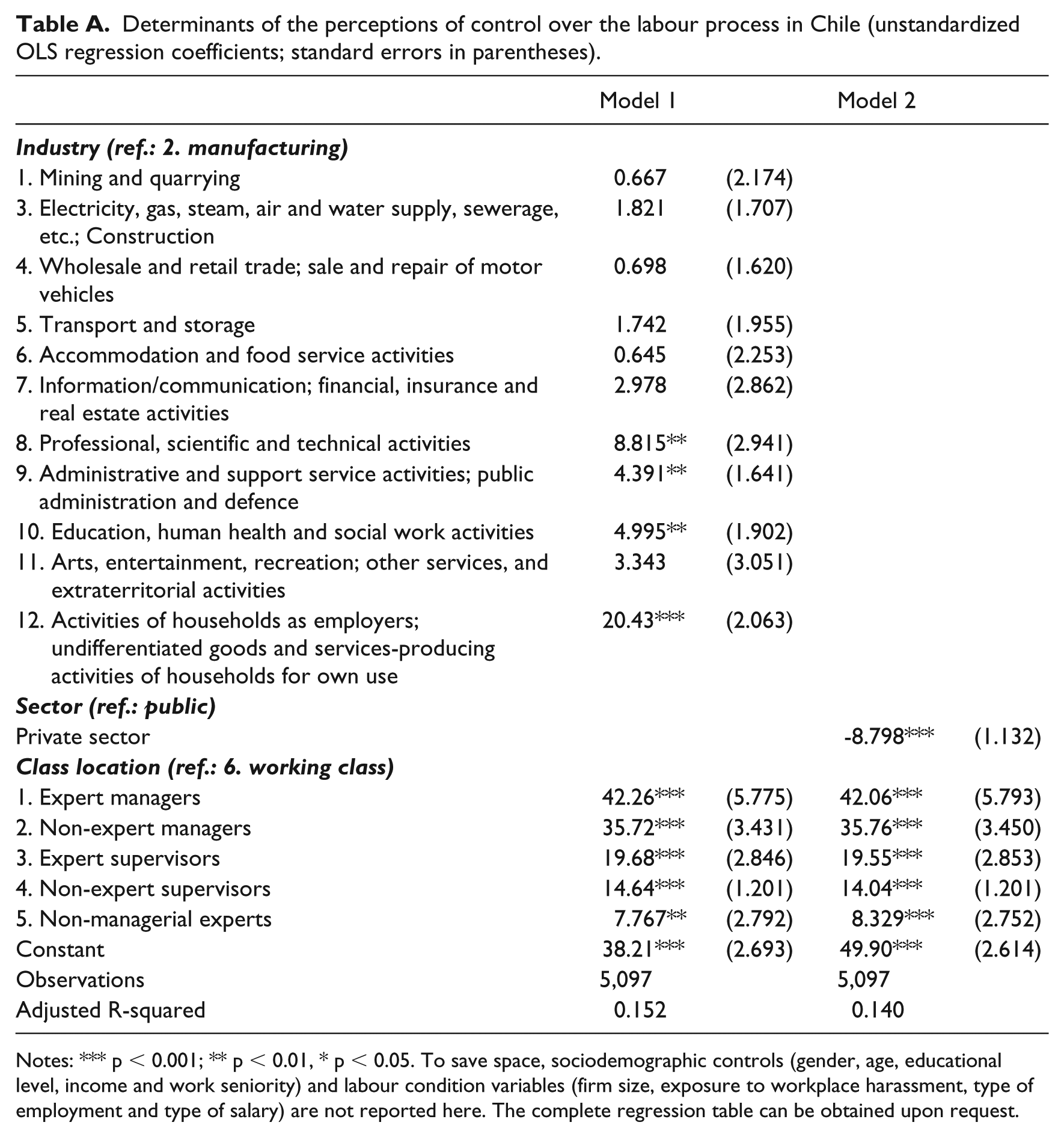
The quantitative results are based on two OLS regression models (see Table A, Appendix). The first model shows the coefficients for industry and class location, while the second one depicts the coefficients for employment sector and class location. Both models also included all the demographic and labour condition variables mentioned above. Based on these models, we calculated the predicted values in the scale of perception of control over the labour process for industry, sector and class, with their 95 percent confidence intervals. To do so, all other variables were held constant at their means or modal values. The predicted values are presented in Figures 1 to 3.
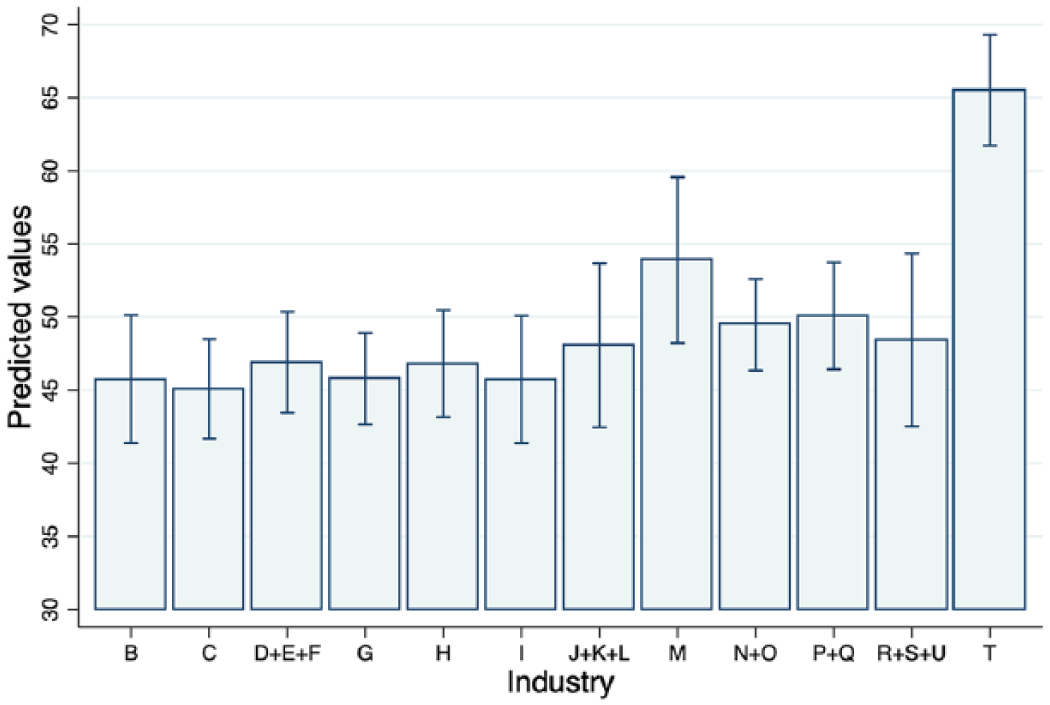
Predicted values in the scale of perception of control over the labour process by industry.

Predicted values in the scale of perception of control over the labour process by sector of employment.
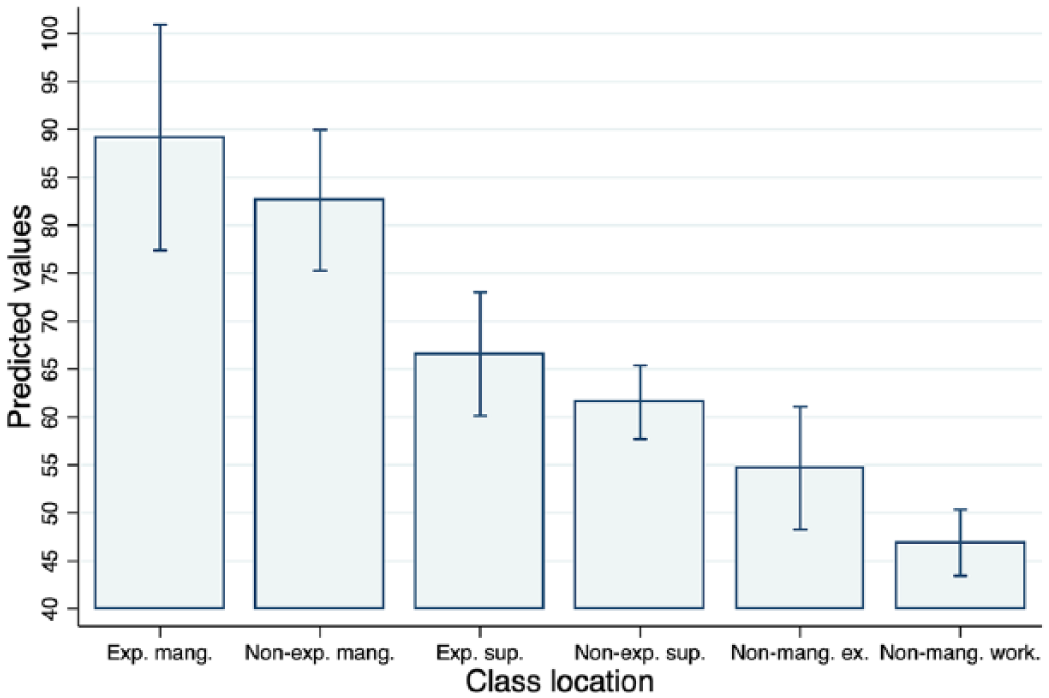
Predicted values in the scale of perception of control over the labour process by class location.
Figure 1 depicts the predicted values by industry. In line with H1, Figure 1 shows that working in the service activities grouped between the categories G and J+K+L (wholesale and retail trade, transport/storage, accommodation/food services, information/communication, insurance, financial and real estate activities) does not lead to statistically significant increases in the perceptions of control over the labour process, compared to working in the manufacturing sector. It is worth emphasizing what happens with the activities clustered in group J+K+L (information/communication, real estate, insurance and financial activities). Literature on the growth of the service sector in Chile and Latin America suggests that such activities represent one of the most developed segments of the service sector (Ruiz and Boccardo, 2015; Weller, 2004). Part of this literature affirms that the expansion of employment in those sectors is indeed one of the structural bases behind the growth of a ‘new salaried middle class’ in Chile. Nevertheless, the results presented here show that the levels of work control perceived by the workers employed in these activities are not significantly higher than those perceived by their counterparts from the manufacturing industry.
Figure 1 also indicates that the level of control perceived by those employed in groups M (professional, scientific and technical activities) and P+Q (education, human health, social work) is higher than that perceived by, say, manufacturing workers. Although their confidence intervals overlap, the coefficients for these categories are statistically significant (see Table A, Model 1, Appendix). This suggests that working in these industries is positively associated with higher perceptions of control over the labour process. Rather than the effect of the performance of ‘non-manual’ labour per se, this might be the result of the professional certificates or diplomas required to perform these activities, which are positively associated with higher levels of autonomy in the labour process (Marshall et al., 1988; Thompson and Warhurst, 1998: 12).
According to the predicted values, the industry category that produces the highest increases in the perceptions of control is T (activities of households as employers), which denotes a set of activities through which households produce goods and services for their own use. Since this sample considered only workers reporting a salaried work condition, it is possible that those who were classified in this industry correspond to wage-earners employed in family-scale production units, whose insertion in formal labour markets is unclear and whose levels of autonomy are high. This could explain why the predicted scores for this category (around 65 points) was the highest among all of the industry categories.
Figure 2 displays the predicted values in the scale of control over the labour process by employment sector. As hypothesized in H2, this figure suggests that those employed in the private sector perceive less work control than those who are employed in the public sector. This contradicts the expectations from recent analyses of the Chilean case which see the expansion of private employment as a driving force for the growth of ‘middle-class’ occupations in the country (León and Martínez, 2007; Ruiz and Boccardo, 2015).
Finally, Figure 3 shows the predicted scores by class location. As contended by the neo-Marxist hypothesis (H3), class location is a significant determinant of the variations in the level of control perceived by the respondents. More specifically, the wage earners located in privileged positions in the relations of exploitation (managers, supervisors and experts) perceive more work control than the members of the reference category (non-managerial, unskilled workers). Figure 3 also indicates that the impact of class category is the most important among the three main independent variables. The predicted scores for expert managers are 89.1, while the scores for non-managerial workers are 46.9 – that is, 42.2 points lower. In between these two extremes, the variation in the predicted values closely resembles the differences in the respondents’ authority levels. This could denote the centrality of authority in capitalist production. As contended by Wright (1997: 20), capitalists do not simply own the means of production and hire workers; they also dominate them within production. Thus, as ‘executors’ of capitalist class powers, managers and supervisors can be seen as agents who, while wage-earners, engage in practices of domination within production. Understood in this way, the significant class differences observed in the perceptions of work control can be seen as a subjective expression of the different roles that individuals play in these relations of domination.
Qualitative Results
The interviews conducted in the course of this research largely coincided with the results from the regression models. In showing workers’ perceptions on a wide variety of topics, the interviews provided us with valuable information to ‘make sense’ of the quantitative results.
Industry: The interviews suggested that at least three factors might explain the similarities between the perceptions of control of manufacturing and some service workers. The first factor refers to the changes in management strategies observed in industries such as retail trade, which in the last two decades have brought about particular combinations of ‘Taylorist’ and ‘post-Fordist’ work dynamics (Stecher et al., 2010). From the workers’ perspectives, these transformations have meant the introduction of a series of ‘experiments’ – e.g. multi-functional contracts, initiatives to improve customer services, training innovations to form ‘integral sellers’ – that have resulted in the deterioration of their working conditions. Reflecting on the changes in the retail industry since the late 1990s, a male worker contended: They make your work more precarious, because they are never associated with higher remunerations. Quite the contrary, they always imply stronger pressures to meet goals. And that’s the only way we have to get decent salaries, because most workers here have a commission-based pay.
Like this worker, several interviewees referred to managers’ attempts to promote the formation of ‘integral’ (proactive, flexible and empowered) salespersons as a ‘failure’ as they are always coupled with the extensive use of multi-functional contracts. From workers’ view, multi-functional contracts are the main tool that permits managers to compel them to perform different types of work (from ‘physical work’ when they are requested to restock shelves or clean up facilities to ‘emotional work’ when they are required to work as salespersons), and thus ‘fragment’ their labour activities.
The second factor that explains the similarities in the perceptions of manufacturing and service workers was frequently mentioned by non-managerial workers from financial activities. It refers to the extensive use of performance-based strategies to improve productivity. According to the respondents, the work of all bank workers – account executives, tellers, customer service staff members, etc. – depends on their ability to fulfil the goals established by the management (e.g. selling a minimum number of products such as credit cards, insurance services, etc.). In an interview, a female account executive summarized well what it means to work under strategies like these: ‘Things are hard here. If you don’t fulfil the goal in three consecutive months, you’re out. That’s simple … So, you can tell why this work is really stressful’.
Related to this, a third factor refers to what can be defined as the ‘degradation’ of labour in the finance and banking industry. Similar to recent evidence found elsewhere (Boes et al., 2017; Movitz and Allvin, 2017), in the interviews several workers denied that being a bank employee was a ‘privilege’, such as it used to be decades ago. ‘Today there is no even banking career’, claimed a bank worker in his mid-fifties while complaining about the high levels of job insecurity in the industry. In the interviews, older employees also pointed to technological change to explain the ‘degradation’ of their labour. They did so by noting, for example, that unlike 30 or 40 years ago, now the executive accountants need ‘no skills’ to perform their job. A male worker stated: Decades ago it was difficult to manage a customer’s account. Now, the computer does 90% of the job, and … the executive is basically in charge of offering products, credit cards, checking accounts, etc. (…) Today, our job is rather repetitive, and that’s why many workers want to quit.
Sector of employment: The interviews with private- and public-sector workers suggest that the latter perceive themselves to have more work control, due to the public sector’s resilience to changing ‘old’ management policies which allow for higher levels of labour autonomy. Like their private-sector counterparts, civil servants have certainly experienced initiatives to ‘modernize’ management – from initiatives to promote the merit-based selection of senior public managers and increase the supervision of civil servants to measures aiming to improve the coordination between state offices (Olavarria-Gambi, 2017) – yet public-service employees have more power to influence the implementation of some of these changes. In line with past evidence on public-sector workers (Crompton and Jones, 1984; Ramsay et al., 1991), the interviews showed that Chilean civil servants have resisted some managerial initiatives not only by drawing upon their collective power (like elsewhere, in Chile civil servant associations are comparatively stronger than private-sector unions), but also by emphasizing the ‘particular aspects’ of their work – i.e. emphasizing how they aim to provide services rather than to accumulate profit. Reflecting on recent attempts to introduce new management technologies, a male public-sector worker pointed out: They [the management] incorporate administration software programmes that do not work, then they introduce others, and others, but the goal that they promise is never fulfilled … [because] when there is a ambition to incorporate software programmes, the authority must decide the objective: ‘What are we going to do, do we want more control over the employees or facilitation?’. Both things are contradictory because control over the workers means giving an account of everything, requesting permission for everything, and that deteriorates the work, especially regarding deadlines.
Another expression of this is observed in employees’ rejection of the outsourcing of public services. Throughout the interviews, civil servants pointed to the ‘particular’ characteristics of their jobs to explain why they strongly oppose outsourcing. For instance, a male employee of the Labour Directorate Office affirmed that civil servants reject outsourcing simply because the Labour Directorate Office ‘is the only mechanism that exists in Chile to oversee labour legislation’, so it is ‘the only counterbalance’ Chilean workers have to confront employers’ power.
Social class: Finally, the interviews showed that despite all the differences existing between the labour processes of service and blue-collar workers, they all share –as non-managerial workers – similar experiences of domination within the production. In several interviews, workers asserted that any managerial strategy to increase productivity is in conflict with their interests. While producing higher profits for the company, workers usually defined these strategies as the cause of higher exposure to unhealthy labour environments (construction or manufacturing workers), as the source of stronger psychological pressures (bank workers) or as the basis for the implementation of new contractual modalities (multi-functional contracts) that would allow supervisors to manage labour ‘at will’ (retail workers). In sum, the interviews indicate that, whether ‘white collar’ or ‘blue collar’, non-managerial workers see any attempt to increase productivity as a means to augment profits and, at the same time, as a factor facilitating more ‘precarious’ labour conditions and more ‘abuses’ by managers and bosses.
Discussion and Conclusion
Drawing upon evidence from Chile, this article contradicts the hypothesis according to which the expansion of private service-sector employment leads to the growth of the middle class. In contrast, our evidence largely supports the hypotheses derived from labour process theory and neo-Marxist class analysis. In line with labour process theory, it shows that working in service industries does not significantly increase the degree of control over the labour process perceived by workers. This conclusion holds even for the most dynamic service activities such as finances and baking, and is in agreement with recent research in Chile suggesting that important segments of the working population in these industries are compelled to perform simple, routine jobs (Soto, 2014). Similar to investigations on the public-sector labour process, the evidence also demonstrates that private-sector workers’ perceptions of work control are lower (not higher) than those of their public-sector counterparts. Finally, in line with neo-Marxist class analysis, the evidence suggests not only that the perceptions of work control follow a clear class-based pattern, but also that class location is probably the most important mechanism shaping such perceptions.
As noted in the quantitative data analysis, the evidence gave rise to some unexpected findings. According to these, there is a significant relationship between working in some service industries (e.g. education and healthcare activities) and perceiving stronger levels of control over the labour process. While important, these results should not be overstated, as the positive and significant effect of working in these industries may be explained more by the skills requirements associated with these activities than by the simple fact of working in a ‘non-manual’ industry.
Regardless of these specific results, the evidence is unambiguous in demonstrating the centrality of class. When it is conceived in Marxist terms, class is a concept that refers to individuals’ location in the relations of exploitation. Consequently, it is a variable that, as shown in this article, significantly shapes people’s perceptions of work control. This has an important implication because, understood in this way, class location is likely to be a factor that mediates the impact of the industry and employment sector on such perceptions of work control. Further research should study whether this is so or not. To put it in statistical terms, further research should test whether there is an interaction effect between class, industry and employment sector. If such an interaction effect exists, scholars need to study how and in what ways the impact of industry and employment sector – for example, the impact of working in a ‘non-manual’ industry – differs by people’s class location.
Overall, our evidence and findings have broader implications that are worth considering. They suggest that the transformation of the class structure in Chile, Latin America or anywhere else in the global south should be conceived not as the simple effect of the expansion of industries or economic sectors (e.g. the private service sector), but rather as the result of structural changes that alter the dynamics of class inequality, exploitation and work control within production. To put it differently, our findings suggest that a ‘real’ growth of the middle class is more likely to be observed in political economies in which ‘middle-class jobs’ – expert, skilled, supervisory or managerial – occupy a central economic role and when, in addition to this, there are opportunities for working-class children to ‘move up’ to these positions through, for example, a strong public education system. Nothing like this has happened in Chile. Entrepreneurial rhetoric aside, since the imposition of neoliberal policies in the late 1970s, Chilean capitalists have been more interested in extracting rents from natural resources or oligopolistic markets than in innovation or industrial development. Consequently, the country’s development model continues to rely on the export of commodities, on a poorly skilled workforce (and a costly and highly privatized educational system), as well as on pro-business labour laws that impede the emergence of a strong labour movement able to push for the decommodification of social rights. All of these processes, along with the factors detailed throughout this article, might help explain why in Chile the expansion of private service employment has not implied the consolidation of more autonomous or skilled workers who could be associated with a ‘new middle class’.
This has important implications for class analysis as well. Drawing upon some of the interviews conducted in the course of this project, one of the authors (Pérez Ahumada, 2017) analysed the type of class consciousness upheld by different categories of non-managerial workers in Chile. Through an analysis of the private sector’s bank, supermarket, construction and metal workers, he concluded that no significant differences existed between the type of class identity and class interests of manufacturing and service workers. According to Pérez Ahumada (2017: 303–305), political economic factors such as economic concentration and Chile’s liberal welfare regime and class-related mechanisms (e.g. similar experiences of exploitation) explain why the manual/non-manual divide is largely irrelevant for shaping workers’ consciousness. Based on the evidence presented here, these similarities in class consciousness can also be explained by the way in which non-managerial workers are exposed, regardless of the industrial activity where they work, to similar dynamics of managerial control expressed in supervision from above, work deterioration, increasing pressures to meet productivity goals, etc.
To finish, we believe that this article contributes to existing research in two ways. First, it suggests that current research in Chile and Latin America should pay more attention to international debates on class and the labour process. We think that this might encourage scholars to stop using the distinction between service and manufacturing employment as a proxy to describe the boundaries between the ‘middle’ and the ‘working’ classes. As we aimed to show throughout this article, such a distinction is not helpful to identify significant variations in the way in which working-class and middle-class employees perceive their labour processes. Second, this article suggests the need to link, both in Latin America and elsewhere, class analysis with the core arguments of labour process theory (Carter, 1995). The dialogue between these two bodies of literature would allow us to understand the dynamics of control and exploitation occurring at the workplace and, at the same time, the ways in which these dynamics shape the contours of class structure as a whole. This is what we attempted to do in this article. However, considering the article’s limited scope – i.e. its focus on a single Latin American country – we believe that it should be seen as merely the starting point of a bigger research agenda.
Footnotes
Appendix
Determinants of the perceptions of control over the labour process in Chile (unstandardized OLS regression coefficients; standard errors in parentheses).
| Model 1 | Model 2 | |||
|---|---|---|---|---|
|
|
||||
| 1. Mining and quarrying | 0.667 | (2.174) | ||
| 3. Electricity, gas, steam, air and water supply, sewerage, etc.; Construction | 1.821 | (1.707) | ||
| 4. Wholesale and retail trade; sale and repair of motor vehicles | 0.698 | (1.620) | ||
| 5. Transport and storage | 1.742 | (1.955) | ||
| 6. Accommodation and food service activities | 0.645 | (2.253) | ||
| 7. Information/communication; financial, insurance and real estate activities | 2.978 | (2.862) | ||
| 8. Professional, scientific and technical activities | 8.815** | (2.941) | ||
| 9. Administrative and support service activities; public administration and defence | 4.391** | (1.641) | ||
| 10. Education, human health and social work activities | 4.995** | (1.902) | ||
| 11. Arts, entertainment, recreation; other services, and extraterritorial activities | 3.343 | (3.051) | ||
| 12. Activities of households as employers; undifferentiated goods and services-producing activities of households for own use | 20.43*** | (2.063) | ||
|
|
||||
| Private sector | −8.798*** | (1.132) | ||
|
|
||||
| 1. Expert managers | 42.26*** | (5.775) | 42.06*** | (5.793) |
| 2. Non-expert managers | 35.72*** | (3.431) | 35.76*** | (3.450) |
| 3. Expert supervisors | 19.68*** | (2.846) | 19.55*** | (2.853) |
| 4. Non-expert supervisors | 14.64*** | (1.201) | 14.04*** | (1.201) |
| 5. Non-managerial experts | 7.767** | (2.792) | 8.329*** | (2.752) |
| Constant | 38.21*** | (2.693) | 49.90*** | (2.614) |
| Observations | 5,097 | 5,097 | ||
| Adjusted R-squared | 0.152 | 0.140 | ||
Notes: *** p < 0.001; ** p < 0.01, * p < 0.05. To save space, sociodemographic controls (gender, age, educational level, income and work seniority) and labour condition variables (firm size, exposure to workplace harassment, type of employment and type of salary) are not reported here. The complete regression table can be obtained upon request.
Acknowledgements
The authors would like to thank Miguel Urrutia and the anonymous reviewers for their helpful and constructive comments at different stages of this article. They would also like to thank the participants of the 36th International Labour Process Conference (ILPC) (Buenos Aires, Argentina, 2018) and the participants of the XXXV International Congress of the Latin American Studies Association (LASA) (Lima, Perú, 2017), where preliminary versions of this article were presented.
Declaration of conflicting interests
The author(s) declared no potential conflicts of interest with respect to the research, authorship, and/or publication of this article.
Funding
This research was partially funded by the Centre for Social Conflict and Cohesion Studies (COES; CONICYT/FONDAP/15130009) and by the FONDECYT Project #1131018 (‘Los repertorios de acción sindical frente las transformaciones del mundo del trabajo en Chile, 1990–2014. Estudio en las 15 regiones del país’, PI: Miguel Urrutia).
