



Abstract
In Japan, the increasing number of homeless people on the streets has been perceived as a social problem since the 1990s, and government policy regarding homeless people has been developed in an attempt to deal with it. This study examines the conditions of homeless people and describes how homeless policy started and developed in Tokyo, using the concept that homeless policy is a mixture of welfare measures and punitive measures. Examining the development process in three periods, it is pointed out that in the case of Tokyo, development of homeless measures has been influenced by the number of homeless people, reactions of homeless movement organizations, and public opinion. From the angle where punitive measures dominate, through to the point where welfare measures are superior, the aspect where punitive measures are dominant again supported by welfare measures.
Introduction
In June 2017, the “Act on Special Measures concerning Assistance in Self-Support of Homeless” (Homeless Self-Support Act) was approved for a 10-year extension in the Japanese National Diet. Although the measures were enacted in 2002 with a 10-year term limit, they will now continue until 2027. At the same time, the trends regarding homeless people have been changing. The most significant change is that the number of “visible” homeless street people has been decreasing since the national government began counting homeless street people in 2001. Such changes are the result of the development of a homeless policy by the government. But the process of development of this policy was not simple, and it has not uniformly improved the situation for homeless people in Japan. This paper examines the actual conditions of homeless people and homeless policy and considers how homeless policy has been developed focusing on Tokyo, one of the cities that has the comparatively largest number of homeless people in Japan.
Tokyo Metropolitan Government (TMG) is composed of 23 Tokyo Special Ward (TSW) districts and other districts (cities, towns, and villages) 1 . However, homeless street people have been concentrated within Special Wards 2 , and, accordingly, government policy for homeless people implemented mainly at TSWs. Considering such distribution(s), in this paper, “Tokyo” refers to Special Ward district unless otherwise specified. Although public homeless policy has been planned and implemented by a plurality of local governments such as the TMG, and the associated 23 Special Wards, from this point on, unless a special distinction is made, I will simply use the term “local government” to refer to all cases. But when referring to administrative documents, I will follow each document’s respective terminology.
In this paper, I will first outline the characteristics of homeless people in Japan and previous research on the topic. Second, I will describe the conditions facing homeless people in Tokyo and the development process of countermeasures for the homelessness, before finally considering the politics surrounding homeless policy practices.
Homeless People in Japan
Definition of “Homeless” in Japan
In Japanese, the definition of “homeless” (Hômuresu) is narrow. In fact, it is almost entirely limited to homeless street people. TMG, which has had the most homeless people in Japan after Osaka City, has defined the homeless as “street dwellers” (Rojôseikatsusha), meaning “people who live everyday life in public spaces, such as roads, parks, riversides, stations, etc.,” from the 1990s onward (e.g., Rojôseikatsushamondainikansurutokukentokai, 1996). In the report “Homeless in Tokyo” issued in 2001, TMG says “homeless” is synonymous with “street dweller” (Tokyotofukusikyoku, 2001).
The Homeless Self-Support Act that was enacted in 2002 also adopts this definition. In the second article of this Act, “homeless” is defined as a “person who lives in city parks, riversides, roads, station buildings and other facilities without reason and use for them in daily life.” Because of this narrow definition of homeless people in Japan, official statistics of homeless people always underestimates the magnitude of homelessness. Homeless statistics based on this definition do not include the number of people living in welfare facilities without a home. For example, in 2013, TMG reports about 1800 people on the streets as “homeless,” but more than 4500 people were living in facilities (details of the facilities will be shown at Table 4). Moreover, those who their lost homes and sleep in various commercial facilities are not counted as “homeless.” For example, in 2007, it was estimated that 2000 homeless people were sleeping in an internet cafe in TSWs, but they were not included in the number of “homeless” people (according to headcounts on streets by TMG, about 4000) (Ministry of Health, Labor and Welfare, 2007).
The following characteristics can be noted regarding homeless people in Japan: (1) the vast majority are male; (2) middle-aged and elderly people occupy the majority (Ministry of Health, Labor and Welfare, 2003); and (3) most had previously worked as blue-collar workers, and many worked as non-regular employees, such as a day laborer, for years (Ministry of Health, Labor and Welfare, 2003). More detailed data will be shown in the next section, but these characteristics indicate that non-regular and precarious workers that are middle-aged and older have been driven into unemployment and become homeless in Japan.
Outline of Previous Homeless Studies in Japan
Many of the studies about the homeless in Japan had been focused on slum districts called yoseba until the 1980s. In Japan, since the high economic growth period (i.e., the 1950–1960s), manufacturing and construction industries have employed migrant workers from domestic rural areas as day laborers and other temporary laborers instead of foreign laborers. These laborers lived in flophouses in yoseba or dormitories for construction workers called hanba. Because such housing was tied to employment, these laborers were frequently forced to sleep on the streets when they lost their jobs. As will be shown by homeless statistics, these day/temporary laborers are the main part of homeless people in Japan, especially in Tokyo. In the late 1960s, Eguchi et al. (1979) investigated the day laborers in the San’ya district, one of the largest yoseba in Tokyo, and noted the instability of their living and working conditions. Additionally, Aoki (1989) pointed out the continuity between day laborers in yoseba and the homeless sleeping on the street and discussed discrimination against both groups in Japan.
On the other hand, riots often occurred in yoseba, and some sociologists have focused their attention on such riots, pointing out the potential cooperativeness existing among the yoseba day laborers (Nishizawa, 1995; Yoshida, 1994). In the 1990s, as the number of homeless street persons rapidly increased in large cities, such as Tokyo and Osaka, their visibility rose as cardboard houses and tents made of blue sheets became increasingly noticeable. Also, around this time, ethnographic research on the everyday lives of homeless people began to emerge. For example, Yamaguchi analyzed the living conditions of homeless people, and the process of identity management in Tokyo using Snow and Anderson’s concept of “survival strategy” found from the research of Tucson’s homelessness study in the United States (Snow and Anderson, 1993; Yamaguchi, 1998a,b; 2001). Kitagawa also reports that homeless people create groups to alleviate their living difficulties in Tokyo (Kitagawa, 2001a). Yamakita’s participant observation study of homeless social movements in Nagoya and Osaka described the interaction between homeless people and their supporters (Yamakita, 2014). Additionally, in looking at the research on homeless women, Maruyama points out that homeless women have been hidden in shelters, making them much less visible (Maruyama, 2013). In contrast, based on mass homeless surveys in Tokyo and Osaka conducted by local governments, length of street life and the form of the sleeping arrangement on the streets (by hut, tent, etc.) have been found to be correlated (Osakashiritsudaigakutoshikankyômondaikenkyûkai, 2001; Toshiseikatsukenkyûkai, 2000).
In relation to this point, Tsumaki (2003) noted that homeless people are generating structures for street living, such as tents and miscellaneous jobs (such as collecting empty cans and other wasted commodities) on the street; moreover, they tend to refuse governmental support provided via homeless facilities because of their strong internalization of self-help norms. Hasegawa (2005) discussed the structural causes of the increased number of homeless people in Tokyo since the 1990s as follows: (1) conversion of industrial structures from manufacturing industry to service industry in Japan; (2) urban redevelopment; and (3) policy deregulation and privatization. Kitagawa (2001b) also argued that, because of the change in the structure of the labor market itself, which has been using day laborers more frequently, the expansion of the enclosure of skilled and young workers and the change in the method of recruiting a marginal labor force has had a significant effect, that is, from direct recruitment at yoseba to indirect recruitment through media, such as newspapers and magazines. Hence, unemployed and unskilled workers among middle-aged and elderly people are more likely to become unemployed.
Furthermore, the conflict between the homeless social movement organizations and the governments from the 1990s and 2000s in Tokyo has been described and analyzed by Kitagawa (2002) and Hasegawa (2006). Hayashi (2014) similarly discusses how day laborer and homeless movements advocating for their rights managed to influence policies in Kotobuki-cho, a major yoseba in Yokohama City.
For Self-help Support Center (SSC), one of the pillars of the homeless policy, support provided for getting jobs, and explanations regarding support available before admission to these centers, are not sufficient (Goto, 2005, 2013; Marr, 2012). Kitagawa also pointed out that the SSC functions as a system to select the homeless persons who can support themselves from those who do not, and to abandon the latter to the street again (Kitagawa, 2006). Furthermore, research on support for homeless people not limited to SSC has also been conducted. Yamada (2009) examined the substantial role that public assistance, such as Livelihood Protection (LP) and employment support (SSC etc.) programs, have played in homeless measures. Yamada pointed out that the “self-help assistance approach” is a kind of political slogan, and other public aid, such as LP, is overwhelmingly utilized in exiting from the cycle of homelessness.
Additionally, based on survey data of people who escaped homelessness, Goto classified the “escape” from homelessness into three stages and pointed out that ex-homeless people who have acquired jobs or who use social welfare services, even though they live in permanent homes, have not reached the advanced stages, such as (re)construction of intimate human relations or recovery of self-esteem (Goto, 2013).
On the other hand, when considering the supply, location, and expansion process of the shelters in Los Angeles City between 1996 and 2000, DeVerteuil used the concept of poverty management as a superordinate concept of homeless control measures and pointed out that measures controlling homeless people should be regarded as a variation of poverty management policy (DeVerteuil, 2006). DeVerteuil, in a paper co-authored with May and Mahs, also criticized the fact that the homeless studies within the United States in the 2000s overemphasized the shift to punitive-style policies of urban social policy and called attention to its multifaceted and ambivalent (not just punitive) aspects (DeVerteuil et al., 2009).
In this article, by employing the proposal by DeVerteuil et al., and taking the perspective of looking at homeless control measures in Tokyo from the 1990s to the 2010s as a kind of poverty control policy consisting of multiple (sometimes contradictory) measures, I describe and examine changes with reference to its complex array of factors. Additionally, I focus on how local governments control the number of homeless people on the street. Therefore, I use “punitive” only to mean forcing homeless people to leave the street. On the other hand, “welfare” means supplying facilities and houses for homeless people to use voluntarily 3 .
When looking at the development process of homeless control measures in Tokyo, we can focus on some policy-changing events, from which we can discern the attitudes of local governments toward homelessness at a particular time period. Social movements by homeless people (and their supporters) often develop their activities as reactions to various homelessness prevention strategies taken up by the government. However, it does not necessarily mean that all the homeless control measures up to that point will be replaced with new ones due to certain events.
I describe the actual conditions and characteristics of homelessness in Tokyo, as well as the characteristics and the development process of homeless measures in Section “Homelessness in Tokyo”. In Section “Characteristics of Homeless Measures in Tokyo”, after considering what kind of politics has played out informing the development process of homeless measures, I consider the meaning of politics surrounding homelessness in Japanese society.
Homelessness in Tokyo
Demographics and Characteristics of Homeless People in Tokyo
The approximate number of homeless street people in Tokyo had been rapidly increasing since the latter half of the 1990s but began to rapidly decline in 2004. According to headcounts on the streets by TMG (conducted every January), in Tokyo Special Wards (TSWs), there were about 3300 people in 1995, rising to almost 5400 by 2004 before falling to just over 700 by 2017. In addition, in 2003 about 20 percent of all Japanese homeless were in Tokyo, but in 2017, it was just over 10 percent. These drastic decreases of homeless street people in Tokyo have two dimensions: (1) the expansion of picking up homeless people from the street to various kinds of shelters and (2) the dispersion of homeless people by the reinforcement of the management of public spaces.
The basic attributes of the homeless street people (Table 1) are as follows. Around 90 percent are male, and in terms of age, they are centered on their fifties and sixties. In recent years, the proportion of those in their forties and fifties have been decreasing, while the proportion of those in their seventies and older have been increasing. One reason for the age composition of the population is that young precarious workers and unemployed persons who can’t afford to rent a room often avoid homelessness by living with their parents (they aren’t counted as “homeless” in Japan). In addition, the reasons for the extremely low percentage of women are as follows: (1) women are more likely to receive family support than men and (2) welfare facilities for women (for example, single mothers) are suppressing homelessness 4 .
Basic attributes of street homeless people (Tokyo Special Wards).
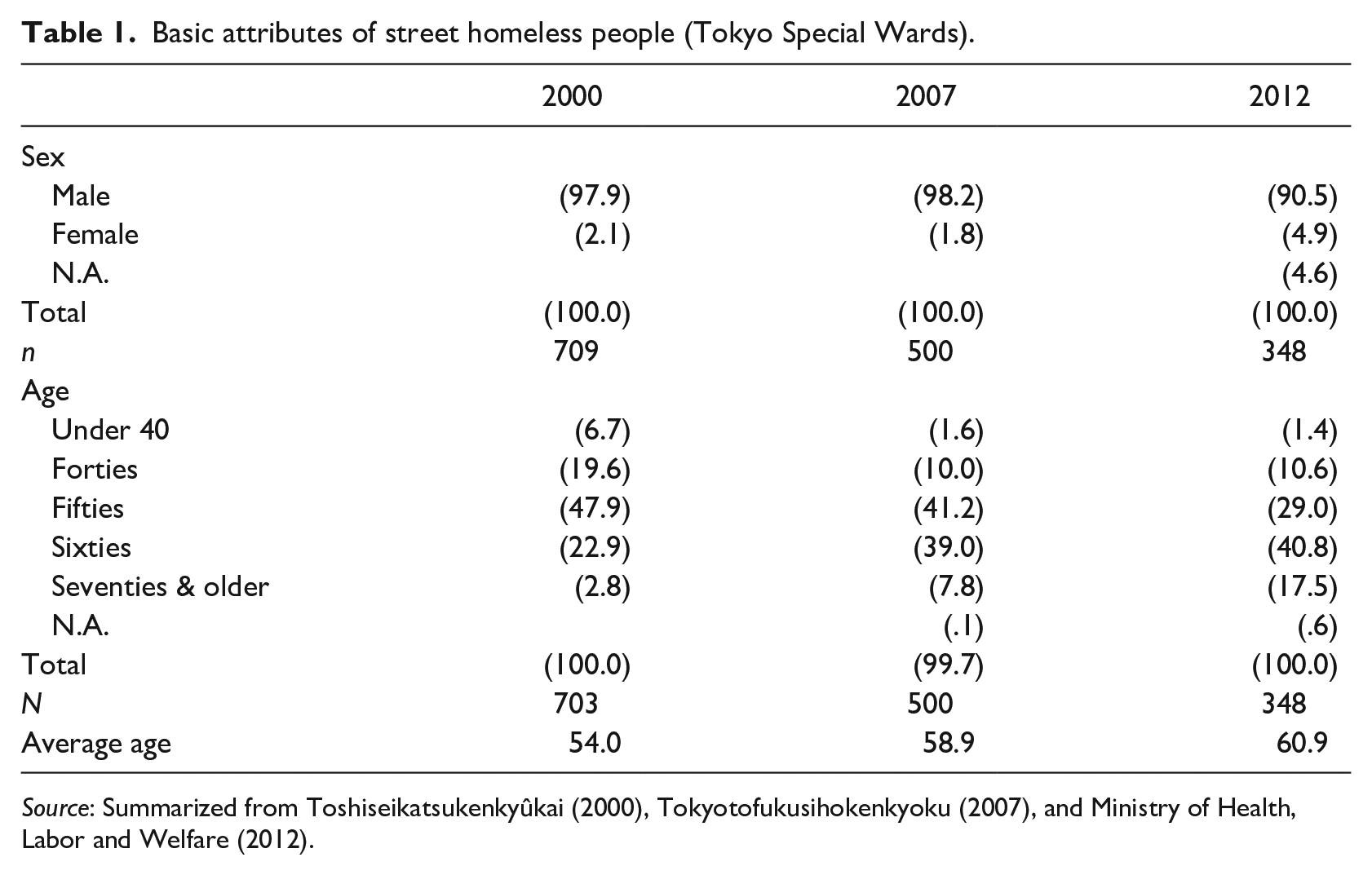
Source: Summarized from Toshiseikatsukenkyûkai (2000), Tokyotofukusihokenkyoku (2007), and Ministry of Health, Labor and Welfare (2012).
The main jobs they had just before becoming homeless are as shown in Table 2. The table shows that about half of the people had worked in the construction industry, and about 60 percent were engaged in manual labor including manufacturing and construction. This table shows two points: (1) about 60 percent of homeless people are usually blue-collar workers and (2) manufacturing has doubled from 2002 to 2012. These trends mean that post-industrialization and the stagnation of the construction industry in Tokyo pushed out people from the labor market (especially from yoseba) to the street.
Main job just before becoming homeless (TSWs).
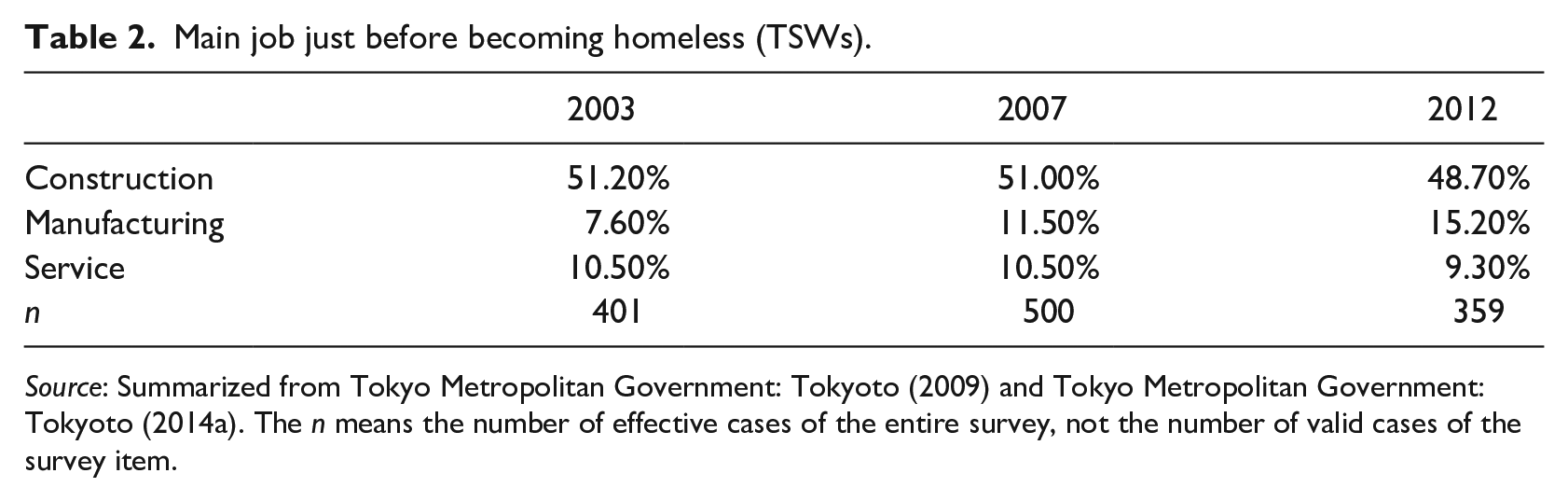
Source: Summarized from Tokyo Metropolitan Government: Tokyoto (2009) and Tokyo Metropolitan Government: Tokyoto (2014a). The n means the number of effective cases of the entire survey, not the number of valid cases of the survey item.
Table 3 shows some of the living conditions for homeless street people. About half of the people have a semi-permanent hut made with sheets of blue plastic, waste materials, etc. But they are decreasing and people who sleep on the street under harsher conditions (e.g., just laying the rug) are increasing. These changes are the result of the enforcement of spatial management by local government. For example, many small parks in the downtown area have been closed at night to prevent homeless people from sleeping in them. Vacant spaces under the stairs of pedestrian bridges also have been closed using fences to keep homeless people out. At large terminal stations, security guards frequently patrol and ask homeless people not to sit or lie down during business hours. These changes are especially remarkable in redevelopment areas and tourist spots, such as Shibuya, Shinjuku, and Sumida-Riverside. Therefore, it has been getting harder for homeless people to build huts/tents. This means the conditions of homeless street people are getting harsher and less protected.
Sleeping arrangements on the streets (TSWs).

Source: summarized from Tokyotofukushihokenkyoku (2007), Ministry of Health, Labor and Welfare (2012).
As mentioned above, the characteristics of homeless people in Tokyo are as follows: (1) after the rapid increase in the 1990s, the downward trend continues through the 2000s and 2010s; (2) most are single middle-aged and elderly males, and the overall population has been aging; (3) in relation to occupational career, most worked mainly in the construction industry and other manufacturing industries; (4) about half of them have a semi-permanent sleeping place, such as tents and simple huts, but they are gradually decreasing. These characteristics and their changes are closely related to the homeless measures created by the administration (TSWs), and the development of social initiatives by private organizations working to alleviate the problem of homelessness.
Characteristics of Homeless Measures in Tokyo
As characteristics of homeless measures in Tokyo, two points can be cited: (1) a consistent attitude that regards living on the street as a problem and (2) an emphasis on shelter and housing placement. Since local governments (TMG and TSWs) began to recognize the existence of homeless people as a social problem in the 1990s, they have consistently defined the “homeless problem” as being consolidated into two main points: the problem of the difficulties of the street life and the problem of homeless people occupying “public space.”
For example, according to a report published for the first time on the homeless problem by TMG and TSWs, “problems on street life” are such that “street life often lacks a minimum standard of living” and “the most fundamental of measures vis-à-vis the homeless is to support homeless people to get out of the street life by their own will.” In addition, “efforts should not be directed to support the continuation of street life as a result, but to support [the] Self-help of [the] homeless.” Therefore, support based on street life should be limited to urgent/transient cases” (Rojôseikatsushamondainikansurutokukentokai, 1996).
In addition, TMG launched a comprehensive plan to reduce homelessness commonly referred to as the “white paper on homelessness in Tokyo,” following the recognition of the above-mentioned first report. It states: “the homeless problem is a problem we can’t neglect and it can be summarized as follows: (1) homeless people are placed in extremely harsh living conditions and are easily excluded from the social system; and, (2) [the homeless are] occupying public space and conflicts are occurring between homeless people and the local community.” Furthermore, “the basis of measures to combat homelessness is to restore Self-help life and to become a member of the community” (Tokyotofukusikyoku, 2001).
Based on these policies, the following measures have been taken. The first is eviction (and lockout) from public spaces. These evictions are carried out for specific sidewalks and parks, and some are carried out routinely and periodically, while others are carried out at specific spaces (parks etc.) at specific times 5 . The second is accommodation in facilities (e.g., Kôsei-shisetsu; rehabilitation facilities for the poor, Shukuhakujo; simple accommodation etc.) with the application of Livelihood Protection (LP), which is a general public assistance system. The third is to accommodate the facilities (which can be divided into premises for continuing support such as emergency facilities called Winter Temporary Accommodation Facilities and Self-help Support Centers) established outside the framework of Livelihood Protection. The fourth is a project (Chiiki Seikatsu Ikô Shien Jigyô; Transitional Housing Project: THP) that allows homeless street people to move into permanent housing borrowed by the government for a certain period with a low rent. This project was implemented for a limited period from 2004 to 2007. Table 4 shows the summary of these facilities and project.
Summary of facilities and project for homeless people.
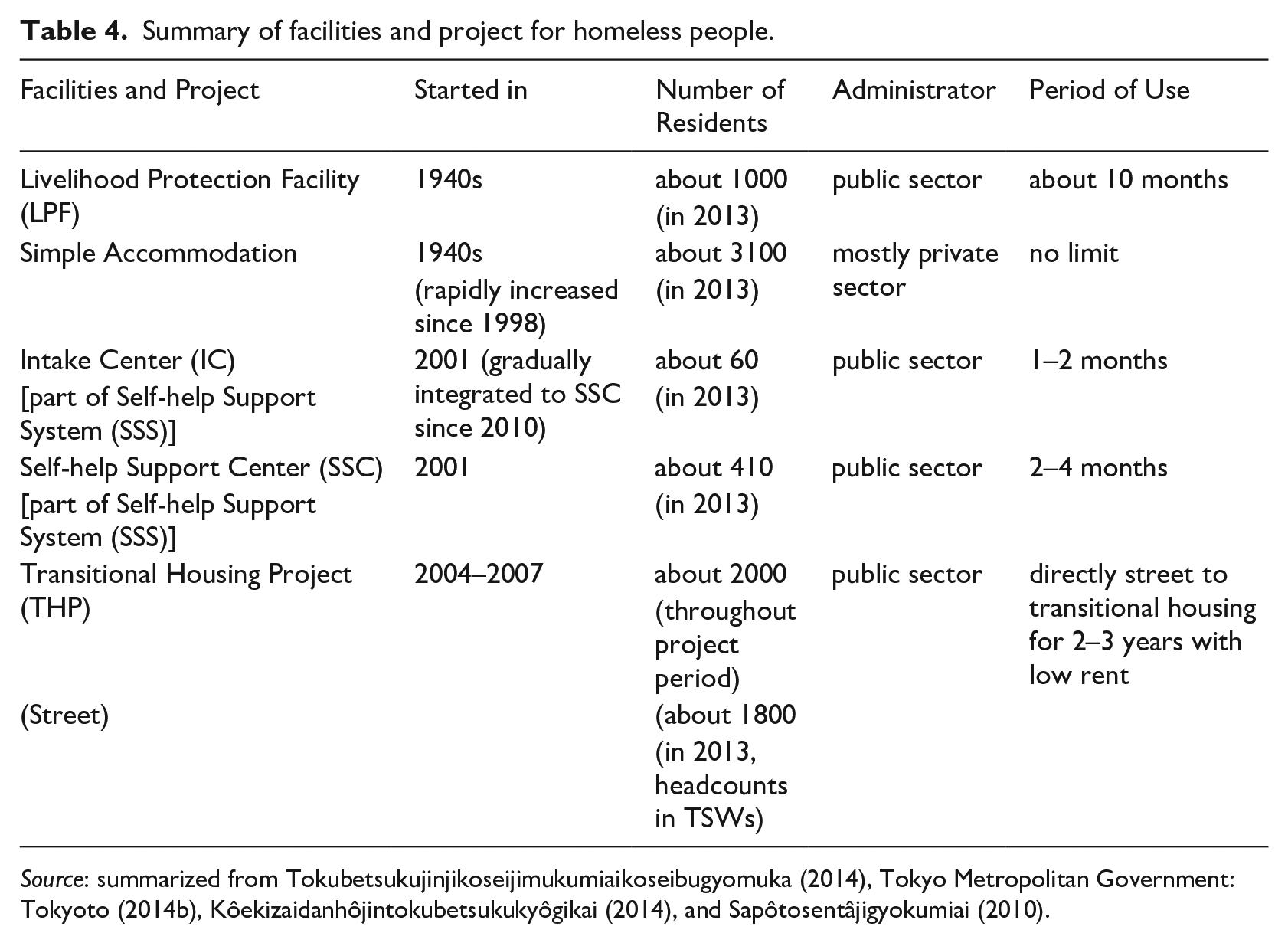
Source: summarized from Tokubetsukujinjikoseijimukumiaikoseibugyomuka (2014), Tokyo Metropolitan Government: Tokyoto (2014b), Kôekizaidanhôjintokubetsukukyôgikai (2014), and Sapôtosentâjigyokumiai (2010).
However, not all of the measures listed up to this point have been implemented on the same scale from the onset of the homeless problem to the present, and the combination of measures and the balance between them have changed over time. In the next section, these changes will be summarized.
Development Process of Homeless Measures in Tokyo
(1) Until the first half of the 1990s: Pre-history for “homeless measures”
In Tokyo, measures named as “hômuresutaisaku/rojôseikatsushataisaku,” (“measures for homeless”) started in the first half of the 1990s, after the homeless problem had been socially constructed because of the increased visibility of homeless people on the streets. However, it is not that there was no measure for those who lost their housing before the 1990s. In Tokyo, there was the San’ya district, the largest yoseba in Tokyo. People who lost their homes but were able to still work either voluntarily moved to San’ya for day labor or were forced there by welfare agencies in Tokyo to find work (Imagawa, 1987). During this period, men who lost their housing and were living in poverty were excluded from the welfare system, so they got jobs through day labor markets, and lived in flophouses (kan’ishukuhakujo) or workmen’s shacks (called hanba) as provisional housing. For those who could not take a job even in day labor markets, the government carried out emergency measures, such as temporary accommodations in public facilities, based on measures targeting specific areas called “San’ya measure” (Kitagawa, 2005: 223–242).
In addition, before the 1990s, there were other welfare measures for homeless people and those who lost their housing besides San’ya measures. As a social welfare measure for homeless people and those who lost their housing, the accommodation in public facilities, such as Livelihood Protection Facilities (LPF, e.g., kôseishisetsu), was also carried out. After World War II, its location has been maintained and dispersed across 23 wards (although there is some uneven distribution).
The facilities have been managed by “Tokyo Special Ward Association” (TSWA), which is a part of the administrative association established by TSWs in 1967. Since then, LPFs have occupied a certain weight as homeless shelters 6 . Figure 1 shows the number of kôseishisetsu, the most prevalent LPFs, and the number of the residents in Tokyo. According to Figure 1, they increased from the late 1960s to the 1970s, and have increased sharply since the latter half of the 1990s. This reflects the fact that the protection facilities were expanded due to the number of homeless people in the 1990s having increased markedly, and therefore becoming more noticeable, and in turn creating social problems (Kitagawa, 2013). The reason for the increase in facilities and residents from 1995 to 2003 is that local governments (TMG and TSWs) began to recognize the existence of homeless people as a social problem in the mid-1990s and started to increase the number of facilities to accommodate (especially aged or injured) homeless people on the streets (but failed to catch up with homeless population growth). In addition, Livelihood Protection Facilities are generally operated in a paternalistic style as residents are expected to learn social skills for living alone (such as management skills of living expenses) and move to permanent housing within about 10 months. Therefore, some homeless people refuse to be admitted to these facilities.
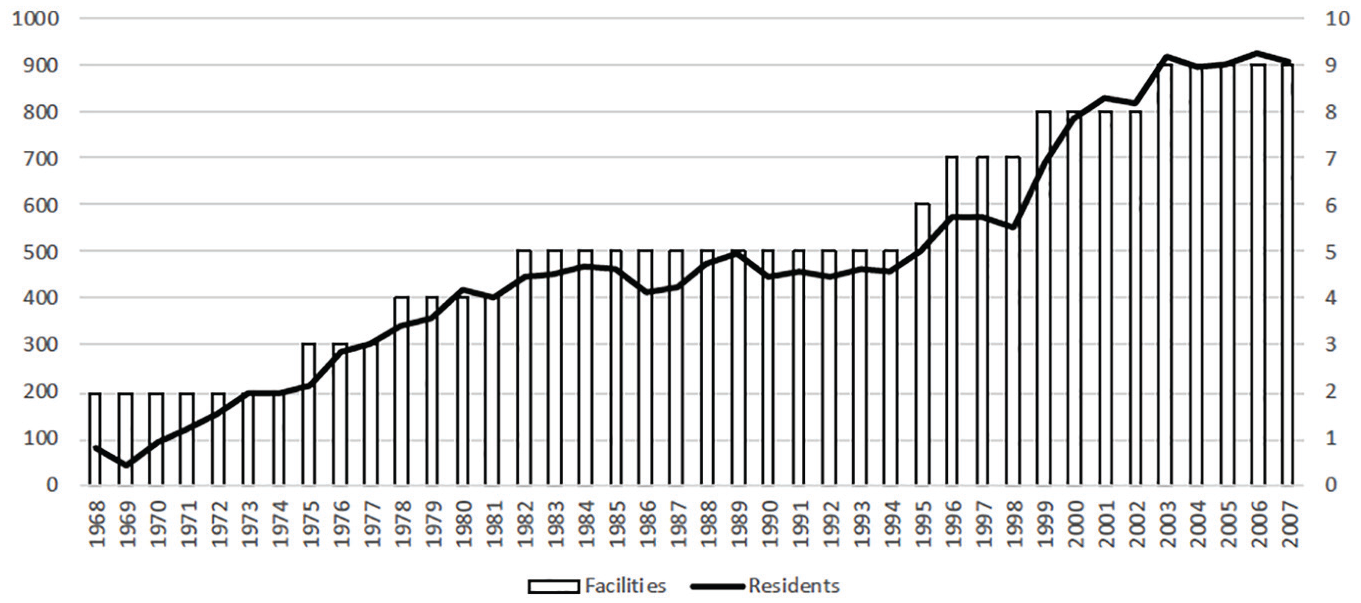
Number of kôseishisetsu [major Livelihood Protection Facilities] facilities (right axis) and residents (left axis) (every October 1).
(2) The latter half of the 1990s to the middle of the 2000s: the start and development of “homeless measures”
In the early 1990s, due to the collapse of the so-called bubble economy, investment in construction was drastically reduced. For example, the amount of investment in construction in Tokyo shows a sharp decline from 11,059,653 yen in 1991 to 6,969,641 yen in 1995, and then to 6,108,324 yen in 19997. Due to this recession of the construction industry, and other conditions, such as the aging of day laborers who worked in yoseba like San’ya, combined with the expansion of new recruitment media, such as recruitment advertisements in newspapers and part-time job information magazines, the function of yoseba as a day labor market therefore shrunk. For example, Figure 2 shows the total number of job offers to the San’ya Labor Center (Johoku Labor-Welfare Center), one of the public employment security offices for day laborers, and the number of consultations provided by the Welfare Center at the time for unemployed day laborers. It can be seen that the number of consultation cases has been rapidly increasing, while simultaneously, the number of job offers drastically decreased from 1990 to 1991.
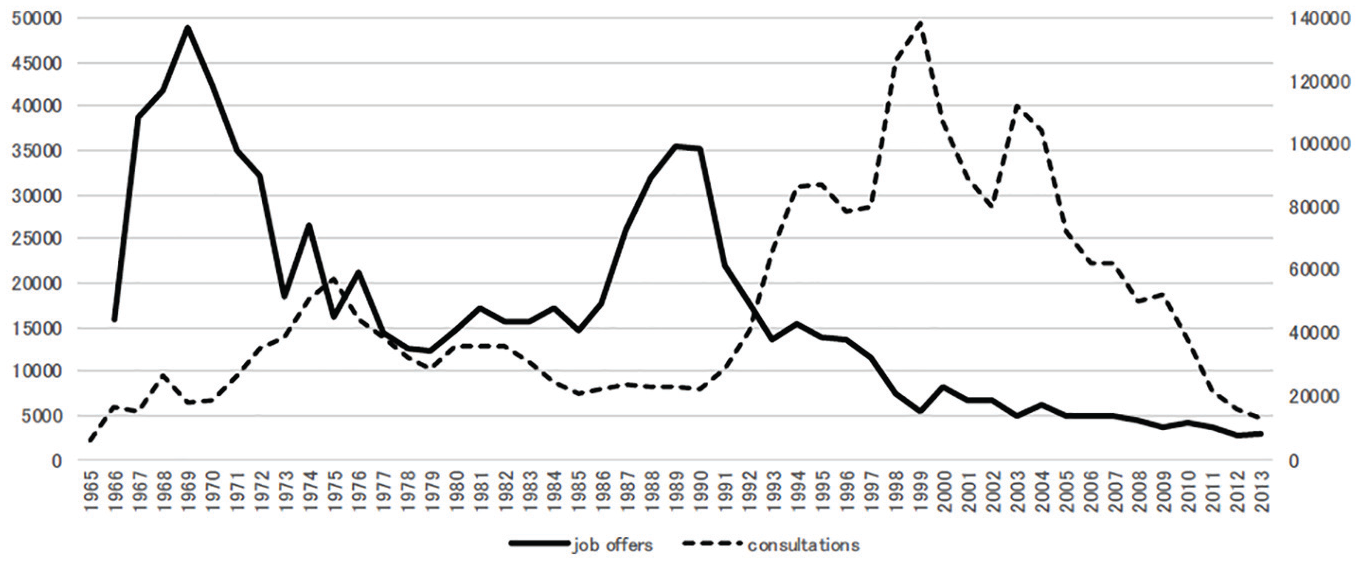
Number of job offers (monthly average) (left axis) and consultations (right axis) at San’ya Labor Center (1965–2013).
Under these circumstances, as a result of long-term unemployment, homeless people who can’t afford to stay in flophouses overflowed from the San’ya district to parks, riversides, downtown areas, and so on. Especially at the west exit of Shinjuku Station—which is one of the biggest traffic terminals in Tokyo—and along the shopping street from the station to the TMG Building, simple huts made of wasted cardboard rapidly increased since 1993. Those huts caught the attention of many citizens. On 17 February 1994, TMG forcibly locked out these people and accommodated them in a temporary shelter. From then on, between the residents, administrative officials, homeless people, and their supporters 8 , conflicts had arisen regarding the homeless problem and a number of conflictual situations and negotiations had repeated (Hasegawa, 2006; Kasai, 1999; Kitagawa, 2002; Rojôseikatsushamondainikansurutokukentokai, 1996; Shinjukurenrakukai, 1997). As a result of those negotiations, TMG established a policy system called the “Self-help Support System” (SSS), which consisted of an “Intake Center” (IC) and “Self-help Support Center” (SSC) as a “homeless countermeasure” jointly operated by the TMG and TSWs (Tokyotofukusikyoku, 2001) 9 . In addition, at this time, TMG and the homeless movement organization had agreed that TMG would not force homeless people to admit into facilities. Subsequently, the facilities based on this SSS gradually increased. Table 5 shows the status of the facilities. In the SSS, a plan to set up five ICs and SSCs in Tokyo was laid out, which was implemented in the 2000s. This table shows that the establishment of the facilities has been progressing 10 .
Facilities of Self-help Support System.
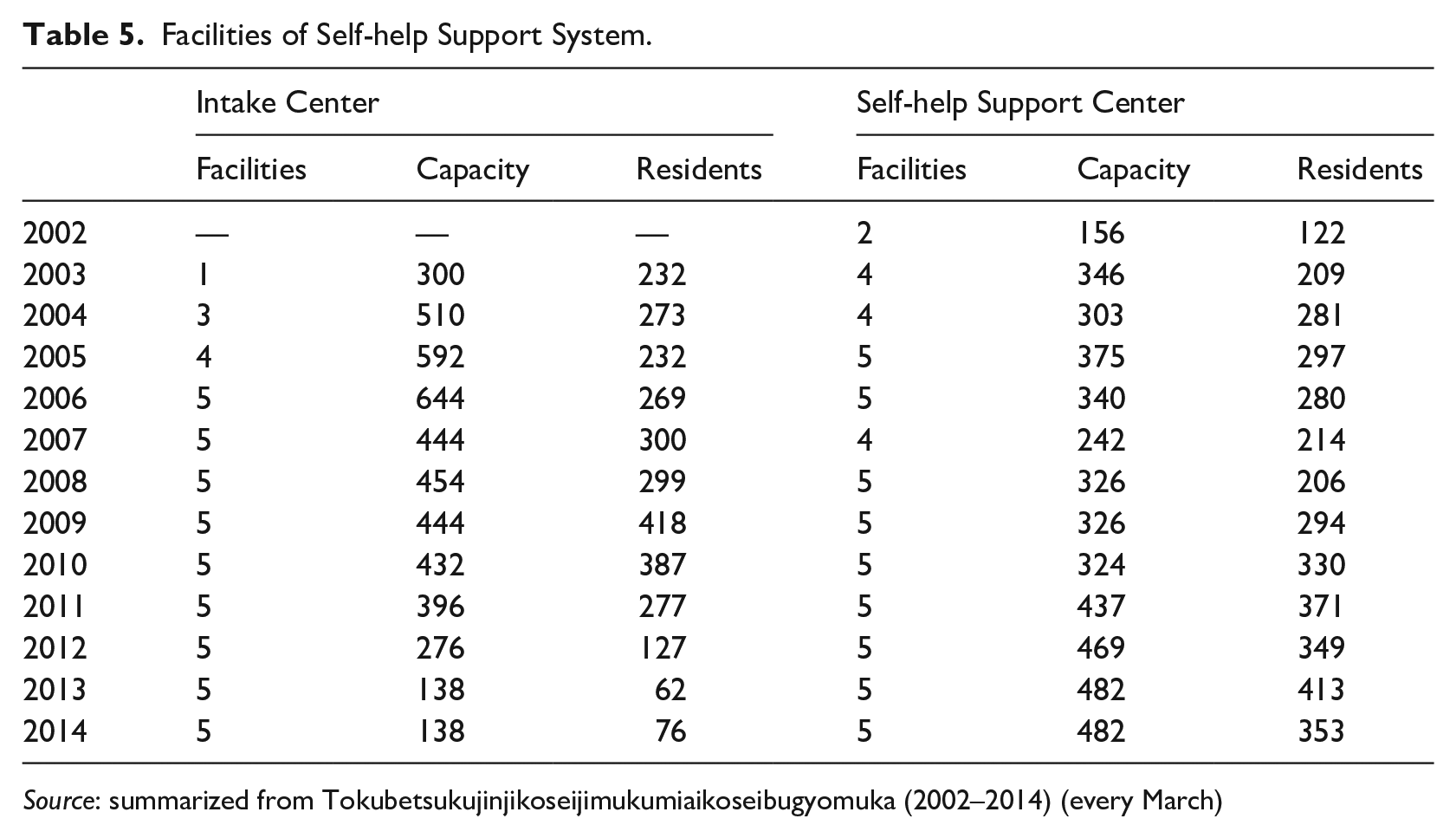
Source: summarized from Tokubetsukujinjikoseijimukumiaikoseibugyomuka (2002–2014) (every March)
Also, in parallel with the establishment of facilities based on such SSS, from 2004 to 2007, in order to reduce the “non-decreasing blue tent” (TMG, 2004) at the parks where the homeless people concentrate, Transitional Housing Project (THP) was created to allow homeless people to rent apartments at low costs (almost directly without going through the facilities) for 2–3 years 11 . In the process of implementation of this project, the project staff “persuaded” the homeless people who live in the park or riverside to apply to the project. The number of tents and huts declined drastically as a result of the expulsion from the district, and strict prohibitions against the building of new tent/hut dwellings were established (Hoshino, 2005; Watanabe, 2005; Yamada, 2005). One of the major reasons for the drastic decrease of the number of consultations at the San’ya Labor Center since 2004 shown in Figure 2, despite of stagnation of low job offers, is the implementation of this project at Sumida-Riverside near the San’ya district (514 homeless people applied to the project between 2004 to 2007 from Sumida-Riverside).
On the other hand, during the 2000s, simple accommodation (shukuhakujo), which was mainly used by LP recipients, also increased rapidly 12 . Table 6 shows the number of the facilities and the capacity of facilities in Tokyo. In the 12 years from 1998 to 2010, it was found that the number of facilities had increased about six times, the capacity had also increased about 2.5 times, and most of the increase was accounted for by private sector accommodations, such as non-profit organizations. These facilities were used as temporary residences by ex-homeless people who applied for LP, etc. These rapid increases of private accommodations are a kind of privatization of the welfare system 13 .
Number of Simple Accommodations and capacity by establisher.
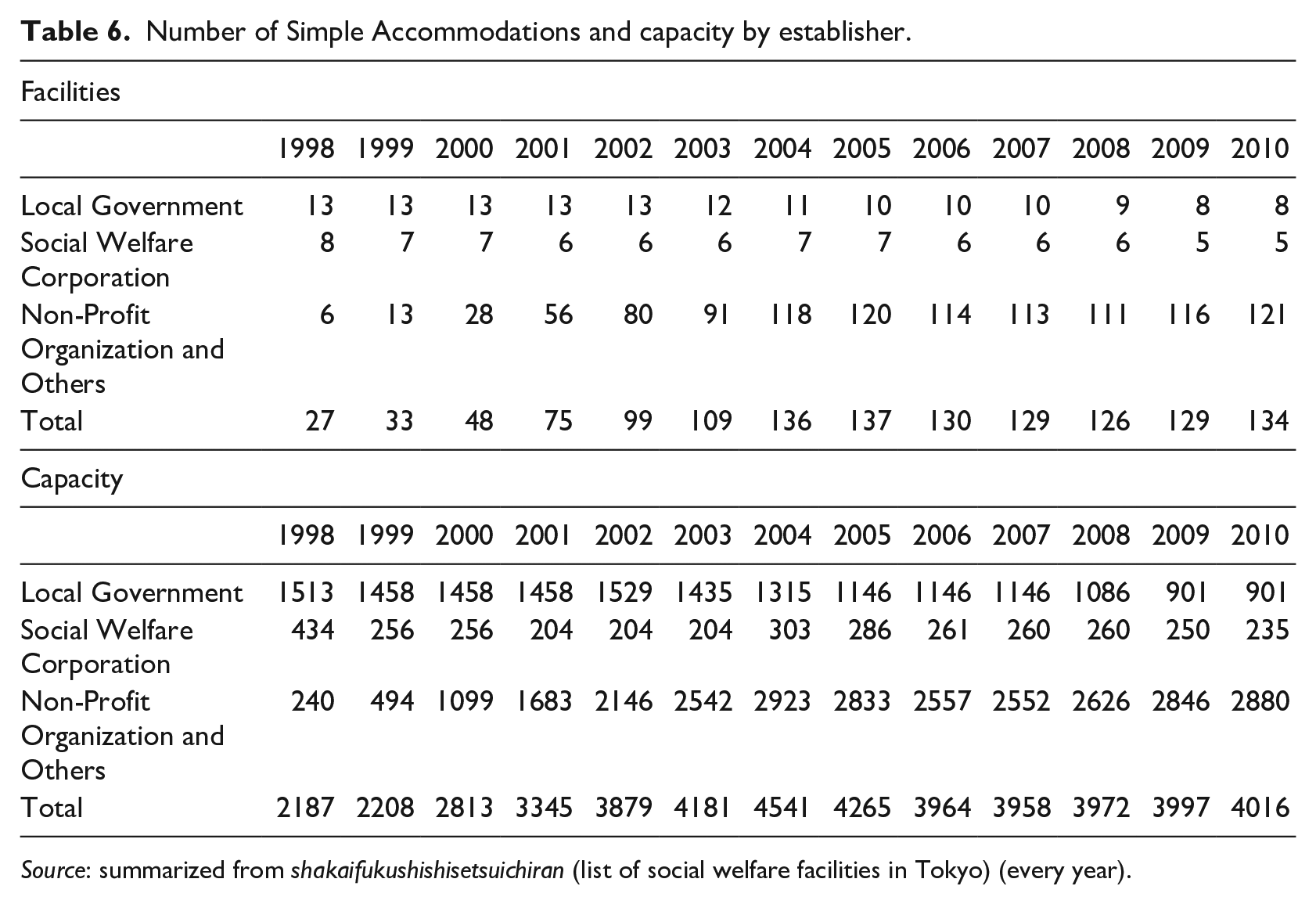
Source: summarized from shakaifukushishisetsuichiran (list of social welfare facilities in Tokyo) (every year).
(3) Late 2000s: Restructuring of “homeless measures.”
In the latter half of the 2000s, the SSS had been criticized for contributing to the decline in the number of participants and efficiency in self-help support due to the presence of two types of facilities: IC and SSC. As a result, the “New Self-help Support Center,” which integrated both facilities, was developed, and “Self-Help Supporting Housing,” which is a sub-lease housing system 14 , acting as an intermediate stage leading to permanent housing, was added as a “New Self-help Support System” (Tokyotofukusikyoku, 2007). From 2010 onwards, conversion to the “New Self-help Support System” has commenced, and it continues to the present. On the other hand, with the nominal reconstruction of the park as part of the gentrification process, homeless people living in the parks have been forced to move into temporary housing, and forced evictions have been increasing (Mukai, 2013; Murota, 2015; Ogawa, 2016; Sonobe, 2014).
Thus far, I have outlined the process of developing homeless control measures in Tokyo. They are shown in Figure 3. The width of the line showing each countermeasure indicates a relative change in the scale of it (such as the number of facilities), although differences in scale between measures are not reflected.

Timeline of Homeless Control Measures in Tokyo.
The Politics of Homelessness in Tokyo
Relations Between Punitive Measures and Welfare Measures
In this section, I consider the homeless measures developed in Tokyo, as described in the previous section, as a complex mixture of punitive measures against homeless people and welfare measures, and consider the change and meaning of their composition. Here I would first like to organize the details of punitive measures and welfare measures. As mentioned in Section “Homelessness in Tokyo”, the local government has been defining the homelessness as two problems: (1) occupation of public space by homeless people and (2) harshness of street life; and, therefore, the basic purpose of homeless measures is aimed at extricating the homeless from street life. To eliminate the occupation of various places by the homeless, it is necessary to shut them out of public space by some means. Therefore, homeless measures have been carried out in combination with punitive measures (such as evacuation recommendations and compulsory exclusion, etc.) and welfare measures to remove the homeless from the harsh environment of street life (such as accommodation in various facilities and houses are applied for welfare protection or other) 15 .
But, in case of Tokyo, the balance between punitive measures and welfare measures have not been consistent, rather it has varied; depending on what kind of measures are concretely combined, either punitive or welfare aspects emerge as the prominent features of the policy.
Thus, it can be concluded that, in Tokyo, the development of homeless measures entailed a process in which policy shifted from punitive measure being superior to welfare measures, and back again to punitive measures (but not simply returning to the initial phase of punitive dominance).As mentioned earlier, there were people who lost their housing due to unemployment and poverty even before the 1990s. However, most of these people were induced (or created by the functioning of day labor markets) to move to a socially isolated space called the San’ya district until the early 1990s, and most of whom were sent to the day labor market. Those who could not afford day labor due to aging, injury, etc. have been made invisible by being accommodated in LPFs and so on. In this period, it can be said that the increase and visibility of the homeless on the streets has been suppressed by linking day labor markets and (limited) welfare administration. It was in the 1990s that such collaborations collapsed. During this period, the entire construction industry contracted sharply due to the collapse of the so-called bubble economy, while the day labor market also deteriorated, leaving many day laborers unemployed and poor. On the other hand, throughout this time, those who were physically able to work tended to be excluded from the LP (Kitagawa, 2005), even if they were in need of assistance (but not suffering from diseases and injuries). Therefore, many unemployed people were forced to stay on the street for an extended period of time, not only in the San’ya district, but also in the central areas of Tokyo. As a result, homeless people became more noticeable in downtown areas, such as Shinjuku. During this period, under the circumstances where the period of street life was prolonged, the spread of homeless styles of setting up a permanent hut with corrugated cardboard and blue plastic sheets also increased the visibility of the homeless.
Under these circumstances, to resolve the state of occupation of the street by homeless people, the TMG forcibly excluded homeless people from the underpass in Shinjuku, where the homeless cardboard huts were concentrated. Shinjuku was also the new city center of Tokyo and was also the location of the new government building in Tokyo. They were then accommodated in temporary facilities twice in 1994 and 1996. However, with interim and poor support being provided, these interventions were criticized by the homeless and their supporters as the punitive aspects were obvious. In the case of forced exclusions in 1996, the homeless representatives and the TMG collided, and the mass media also reported a great deal of criticism from other homeless people not involved in the movement.
Based on these experiences, the government presented the SSS, in which continuing support was provided in the latter half of the 1990s. In addition, TMG told the homeless movement organizations that they do not force homeless people to admit into facilities. In this period, while the forced restraining of the homeless from parks and streets was suppressed, the establishment of SSCs were proceeding. However, although the number of facilities such as SSCs increased, the number of people living in tents and temporary huts in parks had hardly changed. There are some reasons for this. In the first place, users of SSCs can’t refuse to live in a shared room and SSCs provide insufficient support to find a job. Therefore, those who wish to live in a single room or who don’t expect to find a job because of their age or career will not use SSCs. In addition, those who used SSS but couldn’t find a job returned to the street again.
As mentioned in Section “Homelessness in Tokyo”, many simple accommodations were established since the late 1990s and many homeless people received Livelihood Protection by being “picked up” from the street and granted accommodation therein. However, such an increase in accommodation (i.e., an increase in the number of residents at the same time) is not the result of the government advancing the expansion as part of the homeless measures, but as a result of private business owners finding opportunities to expand their operations.
For the local government, regarding the objective of the measures “to let homeless people get out of street life,” it was unacceptable that the high number of tent dwellers (most conspicuous among homeless people) were “occupying” parks. But it was also obvious that if the homeless were forced to be accommodated in the shelters, a massive protest would be enacted by the homeless movement organizations again 16 . Therefore, the Transitional Housing Project (THP) was developed. In the project, the target area was limited to parks where many homeless people dwell. The point where this project differs from previous homeless countermeasures is that at the SSC, opportunities to move to permanent houses are only provided to those who can find employment and income, whereas in the other project, the opportunity to move into an apartment had been provided almost unconditionally regardless of income or not.
In a sense, it can be said that a universalistic style THP was drafted to complement the selection oriented SSS 17 . As mentioned in the previous section, the impact of this project, “directly from the street to the apartment,” was big and many homeless wished to use it. Some homeless support groups (including homeless movement organizations) criticized the lack of employment support and other welfare support mechanisms associated with the project, as well as the strengthening of evictions. But there were few organizations that clearly expressed their opposition against the project.
On the contrary, some homeless support groups were entrusted with performing important elements of this project (such as outreach and counseling support after moving to apartments etc.) from the administration and became part-managers of the project. This project was regarded as different from Livelihood Protection (LP), but for people who were not able to earn sufficient income even after moving into an apartment, those living in poverty were left to apply for LP, and 57.3 percent of the project users received support for welfare services at the end of the project (Sapôtosentâjigyokumia, 2010).
On the other hand, around 2007, some homeless support groups had started to support applying for LP and moving into apartments directly from the streets (Tokano, 2008). The application process for LP was carried out in the support facilities (named as Toshikoshi-hakenmura; temporary encampments) of the unemployed irregular workers arising from the global financial crisis of autumn 2008. As a result, the number of homeless people in Tokyo continued to decline, rather than increase.
As I have mentioned several times, governments have defined the homeless problem as a problem of “occupation of public space” and “difficulties of street life.” Therefore, the solution has been implemented by combining punitive measures and welfare measures with the fundamental aim of getting the homeless out of the street life. However, the balance of the combination has changed in the following way. Until the first half of the 1990s, welfare measures, such as facility accommodations, were limited only to elderly or injured persons, or only short-term emergency assistance was provided. On the other hand, punishment measures such as evictions were dominant.
But, apparent punitive countermeasures, such as compulsory evictions of homeless people from underpasses in Shinjuku, created resistance by homeless movement organizations and caused a relatively broad social criticism to emerge. Consequentially, punitive measures had to be restrained. Instead, SSS that professes continuous support has been newly formulated and implemented as a welfare countermeasure. Furthermore, as a countermeasure to reduce homeless people, especially for those who have tents but have not been explicitly excluded, THP was additionally implemented. On the other hand, the homeless movement organizations also requested the expansion of these measures, and at the same time, it invited homeless people to call for its use and to apply for LP. Even during this period, punitive countermeasures, such as demands to retreat, in the form of piggybacking on the implementation of welfare measures against the homeless who live in the park were carried out. Protest actions against this were also carried out, but they were relatively small and sporadic and were done in such a way as to be obscured by the expansion of welfare measures, so that they would not attract much attention as a social problem. In this period, to avoid criticism from homeless movement organizations and the general public, it was necessary to reduce the numbers of visible homeless people as much as possible, that is, to conceal them by removing them from public space, using welfare measures instead of punitive ones as the dominant approach.
In the 2010s, after the number of homeless people drastically decreased due to THP and the increase in applications for LP, the SSS began focusing on the integration of facilities and successive care after moving to an apartment. Yet, as the number of homeless people has decreased, it has become easier to evict homeless persons from parks and other public spaces. Based on the “success” of THP, individual persuasion is persistently done so as to use measures for the few homeless people who remain in the park, again resulting in the forced exclusion of the homeless. In the 1990s, the resistance movement attracted social attention and garnered public sympathy relatively easily because more than 100 homeless people had been forcibly evicted and the support measures were poor. By contrast, in the 2010s, is becoming more difficult for the resistance movement to present a rational, acceptable reason to resist the evictions because the number of targets of evictions are getting smaller, the welfare measures presented instead of withdrawing are getting more careful, the application of Livelihood Protection, semi-permanent housing support and so on. As the expansion of welfare measures has progressed to a certain extent and due to the fact that the number of homeless people has decreased, the punitive measures have become easier to enforce.
It should be noted that Tokyo is a target area for selective and intensive investment (e.g., “urban renewal” or “national strategic special zone”) to overcome the economic stagnation since the 1990s (for example, Igarashi and Ogawa, 2003; Machimura, 2015; Kitazaki, 2015), and as an economic policy, the tourism industry is one of the important promotion targets (for example, Nose, 2010). I believe that the resumption of dominating punitive measures for homeless people are also solidified by the progress of gentrification that is transpiring as a backdrop, but in this paper, I will only note the relationship.
Politics over Homelessness in Japan
Up to the previous section, I have described and examined how homeless countermeasures have been developed in Tokyo. Japanese society has advocated a welfare state after World War II, in which unemployed single men are categorized according to their working abilities, barring those who can work from welfare assistance, but the irregular casual workforces were absorbed into the labor market and supported the Japanese labor market from the bottom.
However, in the reorganization of the bottom part of the labor market in the 1990s, a subgroup of people who were banished from the labor market but were excluded from the welfare system have been created. That the overwhelming majority of Tokyo’s homeless are middle-aged and elderly men, as noted in Section “Homelessness in Tokyo”, is an indication that these people were forced into becoming homeless. However, the TMG has not allowed such homeless people to remain on the street because TMG have been defining the homeless problem as not only a harshness of street life, but also as the occupation of public space itself. These perspectives are almost always followed by the recognition of the homeless problem on the part of the Japanese government as stated in Article 1 of the Homeless Self-Support Act, which was enacted in 2002. Therefore, homeless people are positioned as being unacceptable, and homeless countermeasures have been formulated and implemented.
In the case of Tokyo, the initial countermeasure is the punitive measure that excludes homeless people from public spaces first and foremost, while the welfare measures act as a passive acceptance. However, in the face of too overt punitive countermeasures being criticized, a SSS focusing on re-training homeless persons as a labor force for the labor market in a manner that gives priority to Livelihood Protection was started, and punitive measures retreated into the background. In addition, in the case of Tokyo, since homeless numbers could not be drastically reduced even after the SSS started, the implementation of a large-scale housing project, which is not easily criticized by homeless movement organizations, has also succeeded in reducing the numbers of homeless people.
Even after that, while welfare measures, such as SSS, are being reorganized with the objective of increasing efficiency, the increased “sophistication” of welfare measures is strengthening the “legitimacy” of punitive measures, such as spatial exclusion (e.g., “the government is trying to provide welfare assistance that is profoundly good, and since the welfare support is getting better, the choice to continue to live on the street is simply a personal preference not worth respecting, so it is inevitable to exclude them from the street”), which signals the re-emergence of a dominant punitive approach.
In other cities in Japan, welfare measures among the homeless measures are beginning to diversify, and as the empirical data accumulates with the passage of time, we see that homeless people are getting out of the street and living a stable life. Studies focusing upon social work and welfare measures tasked with improving the effectiveness and efficiency of supporting re-acquisition are also increasing in Japan. However, refining each welfare countermeasure always has the potential to strengthen the “justification” of truncating those who do not meet those measures. In other words, research that is not objective regarding the fact that welfare measures and punitive countermeasures are complementary to each other will thus be carried out with the unconsciously biased role of justifying the elimination of the homeless from the street.
Conclusion
If welfare measures are developed so that every homeless person can voluntarily and reliably get out of a homeless situation, the number of homeless people will be zero. While this may be theoretically possible, it is a fantasy. In reality, as long as specific measures are formulated and implemented within the limits of budgets, personnel and other temporal limitations, such a situation will never occur. Given the reality of the situation, homeless measures should be read from the viewpoint of how the government is going to control and manage the number of homeless and their manner of existence, and what kind of politics exist there. In the case of Tokyo, homeless measures have been influenced by the trends of the homeless rights movement and public opinion. This has led to an oscillation between punitive and welfare measures being the dominant mechanism for tackling homelessness.
In this paper, by focusing on Tokyo as a case, I illustrated that the homeless countermeasures by the administration do not show single-line developments, such as progress of exclusive measures and vice versa. However, detailed planning processes of individual measures and their detailed conclusions have not been fully developed. Furthermore, I could not evaluate whether the process of homeless countermeasures [punitive advantage → welfare advantage → discipline superiority] in Tokyo is common in other cities in Japan or other countries, nor what kind of geographical/historical condition causes differences if processes are different. In addition, in this paper, I focused on policy development of the administration, and I was unable to analyze each group's evaluation, role, and assertion about various homeless movement organizations and various homeless countermeasures at each point of development. I would like to analyze them in a future paper.
