



Abstract
This article reinforces the criticisms I cast on civil resistance literature in my study “Debunking the Myths Behind Nonviolent Civil Resistance” through addressing issues on how scholars code violence, unarmed violence, and nonviolence. It justifies studying unarmed violence as a sole category and explicates the pathways through which unarmed violence can lead oppositional campaigns toward success. In responding to Onken, Shemia-Goeke, and Martin, the article demonstrates that the dichotomization of nonviolence and violence is not premised on analytical equivalency and should be avoided if the study of resistance strategies is to progress onward and step away from the literature's intrinsic ideological bias. There is nothing idealistic about seeking to improve how we operationalize concepts to study resistance strategies, but if scholars in the civil resistance literature fail to move away from universalistic assumptions about nonviolence and social change, they will continue to misinterpret historical processes and produce policy suggestions that are neo-colonial in nature.
Introduction
Over the last decade, numerous books and dozens of peer-reviewed articles have been published in top-ranked journals across international relations and political science on themes related to “nonviolence”—a term that is synchronously used in reference to civil resistance, civil disobedience, and passive resistance (Chenoweth and Lewis, 2013; Stephan and Chenoweth, 2008, 2011; Schock, 2005; Sharp, 1973; Zunes et al., 1999). This boom in research on nonviolence can be attributed to Chenoweth and Stephan’s inquiries and data which at the time, constituted the first direct quantitative assessments of a protest strategy that has been talked about since Sharp’s (1973) encyclopedic contributions to the topic in the 1970s. In their article “Learning from Criticisms of Civil Resistance,” Onken, Shemia-Goeke, and Martin (2021) engage with my (Anisin, 2020a) study, “Debunking the Myths Behind Nonviolent Civil Resistance,” and put forward an insightful set of questions that surround the study’s concepts, analyses, and the important matter of ideological bias. Prior to the publication of my study, there were political criticisms of nonviolence (Gelderloos, 2007), and a few scholars identified inconsistencies with how data in this literature were coded (Anisin, 2018; Pressman, 2017), and how certain cases were omitted from samples (Lehoucq, 2016). At the time, Kadivar and Ketchley (2018) put forward the most comprehensive critique through an analysis of unarmed violence where they discovered that riots were significantly correlated with democratization in a global sample of cases.
In my study, I demonstrated that the cardinal variables used in this literature were improperly conceptualized and coded, that the sample of cases analyzed in quantitative tests were imperfect, and that the literature is underpinned by ideological bias. Chenoweth and Stephan erroneously operationalized violent and nonviolent resistance strategies. “Violent” cases were drawn from the Correlates of War data set, which explicitly features armed combatants in contexts where at least 1000 battlefield deaths per year had to have occurred, while “nonviolent” cases featured unarmed violence including rock throwing, Molotov cocktails, building burning, rioting, among other actions. I improved on these measures through the following coding procedures and added new cases into analysis and discovered the following (Table 1):
Campaign Success Rates, 1800–2006.
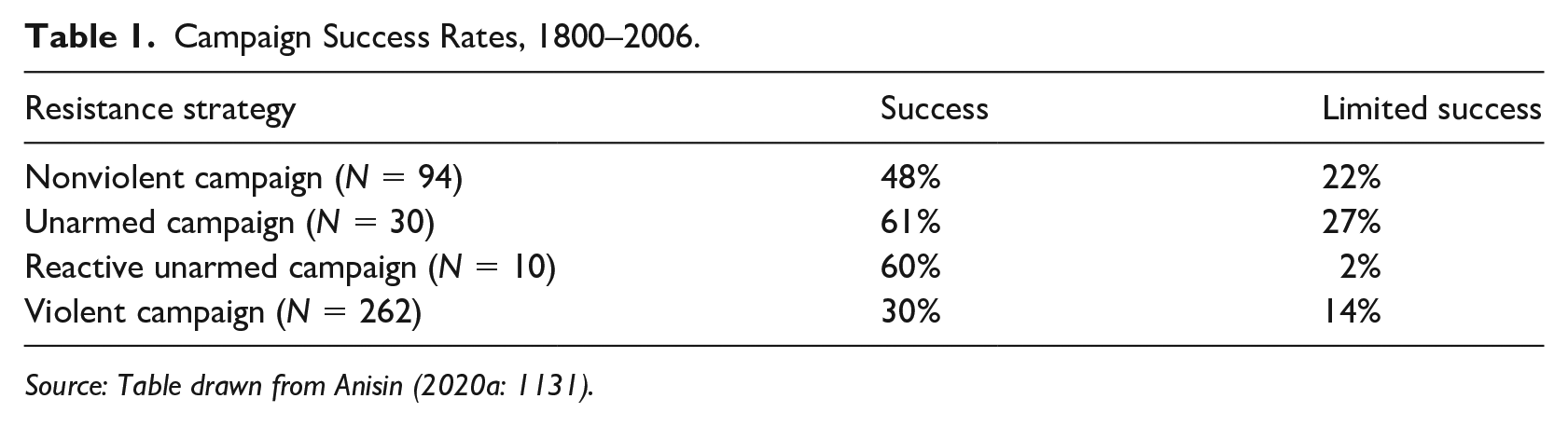
Source: Table drawn from Anisin (2020a: 1131).
After publication, my study received a significant amount of attention on social media and in online academic settings (e.g. ResearchGate) likely because it was (and still remains) the most comprehensive evaluation of the nonviolent civil resistance literature produced thus far. I am very happy that the study received the attention it did, that Onken, Shemia-Goeke, and Martin (2021) have put forward a thoughtful and engaging response to my article, and that the article has led to greater scholarly attention cast on the problems inherent to the civil resistance literature. Scholars are already beginning to acknowledge that this literature is problematic in its core. In a very impactful recent book (How to Blow Up a Pipeline, London: Verso), Malm (2021a: 61) describes this literature and its assumptions about oppositional campaigns as follows: Unarmed collective violence was present in the lion’s share of the transitions, but ignored by Chenoweth and Stephan, who had to exorcise it to generate their result, their ‘twice as likely’ conclusion hiding the mad multitudes from Chile to Indonesia, Pakistan to Madagascar, even Serbia. Other scholars have contributed to the debunking of their data set. Chenoweth and Stephan are not the IPCC of resistance.
In this article, I will reinforce my critiques of this literature and reply to Onken, Shemia-Goeke, and Martin (2021) through addressing their points on (1) methodological issues, (2) ideological issues, (3) technology and violence. My intention is not to downplay or disregard the efficiency of nonviolent civil resistance, but to elucidate why it is likely not the most empirically effective resistance strategy that activists can adopt in search of social change. The different pathways and mechanisms that have been identified and associated with civil resistance and revolution are factually real, but they are not the only pathways and mechanisms that have brought about social change nor do they possess the greatest transformative potential. This response demonstrates that my coding techniques were among the most conceptually sound produced thus far in the study of cross-national resistance strategies; that there are significant pathways that have historically led movements who adopted unarmed violence toward success; that contrary to the authors’ claims that I idealize scientific practice, the coding techniques I proposed are straightforward and simple improvements scholars can adopt to observe resistance strategies. Through engaging with the authors’ assumptions on nonviolence, this article brings an unfortunate fact to light—the civil resistance literature is overridden with bias and universalistic neo-colonial assumptions that distort scholarly interpretations of historical processes.
Response to Methodological Issues
My criticisms of widely used data and coding practices in nonviolent civil resistance research stem from personal experiences with the Nonviolent and Violent Campaigns and Outcomes (NAVCO) 1.0 and 2.0 data sets. Having engaged in qualitative and comparative inquiry on nonviolence during doctoral and postdoctoral studies, I was well aware of these data and after substantial inquiry on many cases, variables, and research topics such as repression backfire (Anisin, 2016), state repression (Anisin, 2019), and security force defection (Anisin, 2020b; 2020c), I started to notice problems. Before delving into these problems, we must keep in mind that these data are widely utilized, cited, and studied across interdisciplinary scholarly outlets. For example, the journal article and accompanying code book of the NAVCO Data Project 2.0 are cited 262 times on Google Scholar (Chenoweth and Lewis, 2013); most of the citations are in top-ranked (according to the Web of Science) journals in international relations, political science, and sociology. These data also constitute scientific knowledge because their usage has led to research findings that are disseminated throughout scholarly and public venues. Most of these journals privilege the publication of quantitative analyses, which demarcates this strand of nonviolence scholarship away from descriptive inquiry and places it into the realm of scientific, causal inference-based research.
I demonstrated that civil resistance data are problematic in two ways. First, they are built on erroneous coding practices that classify nonviolence and violence in a dichotomous manner. Second, they feature an incomplete sample of movements, many cherry-picked cases of successful nonviolent resistance outcomes, and the exclusion of failed nonviolent opposition campaigns. In the following paragraphs, I will reinforce my critiques and concurrently respond to Onken, Shemia-Goeke, and Martin’s (2021) interpretations of these critiques. My rebuttals to these authors are not meant to be divisive, but rather, I am grateful that we are having this much needed discussion.
Beginning with the authors’ low-density criticisms, they note that I did not supplement quantitative data with qualitative case studies. This was simply not possible due to word limits. Where relevant, I did mention case-specific examples, but ultimately, my aim was to put forward a more precise coding scheme of resistance strategies and to assess those strategies across a better historical sample of cases. By including new classifications for all campaigns that were in Chenoweth and Stephan’s data (323 in total), plus adding omitted campaigns (21 in total) and cases from the 19th century (38 in total), I strongly believe that my article went above and beyond the average empirical study in social science in terms of its conceptual and empirical contents. Next, Onken, Shemia-Goeke, and Martin (2021) point out that my 19th-century sample of cases omits the Hungarian anti-Austrian campaign of the 1850/60s. I acknowledge my lack of awareness on this case. When compiling data on different campaigns in 1800–1899, I identified 38 in total and simply missed this one, and it is likely that there are other cases that were left out. Nevertheless, my accidental omission of this case is in no way comparable to Chenoweth and Stephan’s omission and cherry-picking of cases (as observable in the NAVCO 1 & 2 data sets), where 21 cases were omitted (see Anisin, 2020a: 1127, for more examples of how certain cases favorable to their argument were included and others excluded).
In my study, I put forward two additional coding classifications of protest strategies. In other words, I disaggregated the binary nonviolence/violence distinction by considering strategies of unarmed violence and reactive unarmed violence alongside violence and nonviolence. Importantly, I only classified movements as nonviolent if there was no unarmed violence or reactive unarmed violence throughout the duration of a given campaign. The authors contend that I did not make these categories clear enough because I did not specify if they are the primary modes of struggle a given campaign adopted. As noted in my study’s appendix, many of the cases that I categorized as featuring unarmed nonviolence were drawn from Kadivar and Ketchley’s (2018) study. It is also worth noting that I initially sought to assess only unarmed violence, but a helpful reviewer for Critical Sociology also recommended the inclusion of reactive unarmed violence. Ultimately, only 10 cases out of 394 featured reactive unarmed violence.
My response to Onken, Shemia-Goeke, and Martin’s (2021) high-density criticism that these categorizations are not clear because of a lack of information on whether they are primary or secondary strategies is that it does not matter if unarmed or reactive violence is the primary mode of struggle endured throughout a campaign. The authors note that I classify the 1991–93 Madagascar campaign as one that adopted unarmed violence, when according to certain news reports, only 2% of the 147 different events included rock throwing (Onken, Shemia-Goeke, and Martin 2021). This pertains to my exact criticism of the literature, that it classifies campaigns which featured variant degrees of unarmed violence as being nonviolent. The conceptual issue at hand here is that there are campaigns that did not feature any unarmed violence and those which did, which entails we should not analytically equate the two into the same exact category of observation. Take a recent example into consideration: the 2020 (and ongoing) Belarusian civil resistance movement. From my observation of this movement, there were no riots, car burning, rock throwing, or other forms of unarmed violence throughout its duration. According to my coding scheme, this movement would be labeled as being fully nonviolent. However, the authors believe that “nearly every campaign contains a mixture of methods”—I did not find this to be the case throughout my overview of many campaigns. Hence, I reject the assertion that my classifications of resistance strategies can be made subject to the same sort of problems that I attribute to Chenoweth and Stephan’s data.
If there is unarmed violence that occurs during the span of a given campaign, we cannot just slip it under the rug and claim that the campaign is nonviolent because it will distort empirical findings and eventually will produce misleading public perceptions about resistance strategies. The authors suggest we gauge the intensity of nonviolence by comparing it to the extent to which unarmed or reactive unarmed forms of violence were either present or absent during the course of a given campaign. I do not disagree with this recommendation, but it can also run risk of equating different strategical actions to each other, which is problematic because different resistance strategies are not analytically equitable phenomena. If we treat them as equitable, this could lead to civil resistance researchers simply saying that some campaigns only featured “__%” of unarmed violence, and hence they are nonviolent, and while making such statements or justifications, researchers would not be able to account for the qualitative importance that different resistance strategies and their events had during a campaign. Acts of unarmed violence such as rock throwing, the destroying of buildings, car burning, among others, can be fundamentally transformative, much more so than simple marches, sit-ins, or occupations. As subsequent examples of this article will demonstrate, when protesters take over police stations or burn government buildings, such actions are much more powerful in their impact compared to peacefully standing outside of such locations.
If a campaign featured unarmed violence, it should be classified as such. Vice versa, if a campaign did not feature unarmed violence, then it should be classified as nonviolent. In previous research (Anisin, 2018), I made such coding decisions in the study of event-based data on state repression that resulted in protesters being massacred. Furthermore, even if unarmed violence is rare in relation to the larger repertoire of contention that a campaign undertakes, it can have great symbolic and strategic importance. Unarmed violence can function as a focal point and can foster solidarity, signaling to potential protest participants that activists are willing to take legal risks and are willing to put their own fates on the line for the greater cause of the movement. For example, if protesters throw rocks at police and then successfully converge on a government building and set it alight, this can foster perceptions that the tide has shifted in favor of the campaign and away from the incumbent regime. Here we arrive at an area of conceptual importance. If only several or a handful of such incidents arise throughout the duration of a campaign, and if scholars don’t consider their qualitative importance when coding data, then the conclusions they arrive at from their analyses will be analytically imprecise. Most civil resistance scholars tend to only regard that nonviolence can bring about transformative mechanisms that lead to campaign success. They continuously blind themselves from the heterogeneity of empirical processes that motivate social change.
Unarmed violence and violence have empirically spurred pathways that brought about campaign success. They have led to security force defection, bureaucratic defection, and have forced incumbent regimes into negotiations and concessions. Along these lines, even though my study features a section titled “Why Mechanisms of Nonviolent Change Are Obsolete” in which I demonstrate that the key mechanism of security force defection has arisen in cases featuring armed resistance (see Anisin, 2020b for further information), Onken, Shemia-Goeke, and Martin (2021) still contend that, “Anisin neglects to establish any explanatory correlation between unarmed violence and success rates based on violence-specific mechanisms. The question thus remains whether and how unarmed violence could be responsible for the success of the campaigns — and not just occurring despite it.”
The following examples should shed light on why unarmed violence is effective in bringing about major social change. At the same time, I must again defend my lack of explication in the original study about mechanisms because, similar to the authors’ criticism that my study lacks in-depth analysis of case studies, one can only do so much in a single journal article that already features new coding classifications and an assessment of nearly 400 campaigns spanning 1800–2006.
Beginning with a recent case in which unarmed violence was highly prevalent in spurring the largest protests in the history of the US; Malm (2021b) puts forward an insightful viewpoint that goes against the age-old civil resistance claim that unarmed violence alienates participants and would-be participants from engaging in collective action. The 2020 BLM protests in the US featured the largest wave of dissent in recorded American history (i.e. 15–26 million people protested at the peak of the movement’s activity)—a movement that Malm (2021b) describes as having been catalyzed by insurrections that started in Minneapolis and Portland where activists battled with police, threw rocks, Molotov cocktails, set off fireworks, used lasers, and set buildings and police vehicles on fire. Activists took over entire police precincts in Minneapolis and Seattle, where their actions resulted in damage of 1–2 billion dollars in insurance costs, estimated to be the most expensive damage of this sort in history (Malm, 2021b). Although the bulk of demonstrations were fully nonviolent, Malm argues that rather than scaring people off, these actions “rallied them to the cause like never before, because it demonstrated that the killer cops could be overwhelmed.”
A similar example can be found in Kadivar and Ketchley’s (2018) study of the 2011 Egyptian revolution in which different episodes of unarmed violence drew attention away from and protected peaceful protesters. Unarmed violence diverted state repression away from the front-line of mobilization and simultaneously disrupted the coercive capacity of the state—it is estimated that three quarters of the country’s police stations, security force offices, police check points, vehicles, courts, and governmental offices were either burned down or attacked. These actions, at the end of the day, significantly undermined the Mubarak government’s capacity to deal with dissent. Another case can be observed in the 2013–14 Ukrainian Euromaidan revolution where riots, the burning of cars, government buildings, and other unarmed violent actions unfolded in the weeks leading up to regime transition. However, regardless of the variant degrees of unarmed violence in these cases, according to how Chenoweth and Stephan coded their data, they would qualify as being primarily “nonviolent.” I stand by my critique of these erroneous forms of operationalization, and ultimately, if unarmed violence is observable throughout the course of a campaign or in event-based data on campaign interactions, the campaign must be labeled and coded as such. Indeed, it is much easier to make such coding decisions when dealing with event-based data (which are more precise), but even if one is using an annual measure such as that found in the NAVCO (1, 2) data sets, the occurrence of unarmed violence in a campaign must be coded, otherwise problems will arise because this empirical event will not be taken into consideration in analyses.
This of course does not mean that all cases featuring unarmed violence will lead to similar outcomes, but it is worth noting that Onken, Shemia-Goeke, and Martin (2021) assume that unarmed violence is not effective in bringing about campaign success. They bring up several studies that show a dampening effect of unarmed violence on campaign outcomes (Abbs and Gleditsch, 2021; Huet-Vaughn, 2013; Steinert-Threlkeld et al., 2021), while concurrently they disregard studies that find the opposite. They reference the following studies: the Huet-Vaughn work is based on data from one country, France, while Abbs and Gleditsch assess campaigns that arose in Africa and Central America from 1990–2013, do not investigate “success,” but rather, analyze the onset (emergence) of nonviolent campaigns as well as their termination (end). Their inquiry does not consider crucial phenomena such as repression backfire (did it happen during campaigns or not), security force defection, nor do they consider the ethnic relations between the campaign and the incumbent regime it was challenging—three phenomena that represent important antecedent conditions related to campaign success. It is thus not possible for them to make any causal claims pertaining to the effect that different sorts of riots have in relation to the prospects of success of a given campaign. Lastly, Steinert-Threlkeld et al. (2021) investigate five countries and only look at the effect that state or protester violence has on mobilization levels and not the success of the entire movement.
As such, I recommend Onken, Shemia-Goeke, and Martin (2021) to acknowledge that there is, at worst, mixed evidence for a negative effect of unarmed protest violence on campaign success, and at best, to acknowledge that unarmed violence is more effective than strict nonviolence in bringing about campaign success. We must reflect on Kadivar and Ketchley’s (2018) study, which found that riots and unarmed violence were positively associated with democratization in a global sample of 103 cases from 1990 to 2004. The authors’ dependent variable is political liberalization (defined as a substantive change in a country’s Polity IV score), meaning they directly assess how campaigns impacted societal transformations (rather than short-term fluctuations in protest levels or their termination). The effect of riots on liberalization was found to be much more salient than occupations/sit-ins. Combined with my (2020) study of 394 campaigns over 1800–2006, Kadivar and Ketchley’s feature a global sample of cases and directly assess relevant outcomes. What’s more, a recent book by Miller (2021) assesses 139 different democratic transitions and discovers that democratization tends to follow violent domestic shocks which include phenomena such as assassinations, coups, and civil wars. Scholars should not downplay the importance of unarmed violence and if they continue to measure and code unarmed violence as being a part of nonviolence, empirical results will be misconstrued.
Lastly, Onken, Shemia-Goeke, and Martin (2021) point out that Pinckney (2016) argues there is insufficient justification to treat unarmed violence as an anti-regime campaign category. However, the same type of claim can be made with reference to all types of campaigns including violent and nonviolent. By privileging strategies over substance when labeling oppositional challenges to political status quos, we attribute more agency to strategy over demands. This is precisely why a long stemming literature on democratization has posed that mass mobilization is exogenous to political liberalization. For some, the strategical actions that an opposition movement carries out may not be considered to be more important than say, their identities, goals, macro-level factors such as their society’s economic standing, or the incentives and constraints facing autocratic rulers during civil upheaval. With that being said, I believe strategies are important, but they have to be adequately operationalized when observing cases and coding data. In part, I agree with Onken, Shemia-Goeke, and Martin’s (2021) assertion that “the existence of a category is not neutral because it suggests a particular way of understanding the world and potentially obscures other possible ways,” but we must also think about how social scientists tend to gather and code data for quantitative inquiry. It is well known that quantitative research is at risk of conceptual overstretching. George and Bennett (2005: 19) describe this as an adversity because often, scholars lump together dissimilar cases for the purpose of putting together a large sample, which can then be statistically assessed. This is precisely what scholars in the nonviolent civil resistance literature have done in basing their chief empirical findings on data that feature the comparison of violent campaigns (armed insurgencies) to the erroneously classified “nonviolent” campaign.
Part of the reason behind why these problems in the civil resistance literature had yet to be thoroughly problematized until my 2020 study has to do with ideological bias, a topic I will now revisit.
Response to Scientific Bias and Idealism
In my study, I attempted to account for how such an influential and widely cited literature could be premised on data that are not conceptually sound. On one hand, I explained that over the last 40 years, social scientists have increasingly relied on causal inference based frameworks and have disregarded description as the years have gone by (Anisin, 2020a: 1133). On the other hand, I identified ideological bias that spans across civil resistance research. Specifically, I noted that Nonviolence is advocated as the sole strategy and choice of resistance that can potentially take a population out of dictatorship and tyranny. There is ideological bias behind the universal advocation of nonviolent civil resistance as it is assumed that the exclusive way out of such conditions (and presumably forward to social progress) is through free-market institutional transition and the adoption of a capitalistic economic system. (Anisin, 2020a: 1134)
I must reaffirm the logic underlying the two scientific examples I put forward to support these statements. First, I cited a study on caffeine and hypertension to point out that in the natural sciences, one would not get away with associating or testing an independent variable that was not conceptually precise (e.g. when weighing the impact of caffeine on blood pressure, researchers knew that caffeine was only caffeine, and not caffeine mixed with fructose), while in the civil resistance literature, researchers have tested, reported on, and generalized about nonviolence when in actuality, variables on nonviolence represent observations of phenomena that are not nonviolent! Second, I brought up another example about how the sugar industry, in the 1960s, sponsored Harvard scientists to write a meta-analysis and literature review that downplayed the dangers of sugar consumption for heart disease. It has since been revealed the study was inaccurate, but for decades, it influenced medical professionals by setting narratives and shaping academic knowledge of the topic. To my surprise, Onken, Shemia-Goeke, and Martin (2021) contend that I myself am biased and that I hold an idealistic view of science. They claim that “Anisin’s portrait of the scientific research enterprise is an idealised one, built on the assumption that scientists are, or can be, neutral, objective searchers for the truth.” In my article, the word “truth” is not brought up once. My intention with the two aforementioned examples was to demonstrate that there are standards in scientific inquiry and such standards were side-stepped (and eventually accepted) in the civil resistance literature due to ideological bias.
Having received training in Ideology and Discourse Analysis (the Essex School), I am aware of and even sympathetic to the belief that scientists cannot ultimately step outside or refrain from their own biases when carrying out research. I also acknowledge that studying social reality is much more difficult than natural because the former is more contingent and subjective. Nevertheless, even with our own biases, there are accurate ways to carry out inquiry and less accurate ways. There is nothing illusory or mythical about science, but there are good standards of scientific practice and in the literature under attention, they have not been implemented thus far. Moreover, Onken, Shemia-Goeke, and Martin (2021) state that I relied solely on my own judgment when assigning campaign classifications “without fully disclosing the coding criteria.” This is not the case as the section “Nonviolence, Unarmed Violence, and Reactive Unarmed Violence” explains what these different strategical actions encompass, and importantly, the study’s appendix features a case-by-case description of both unarmed and reactive unarmed forms of violence that arose in campaigns as well as numerous sources drawn from Kadivar and Ketchley (2018).
The authors then claim that Chenoweth and Stephan consulted “subject and area experts” to examine their data on campaigns and aid in their classification of primary resistance type. The authors contend that “by drawing on judgements by experts outside their project, they reduced the likelihood that their biases would influence their dataset.” In NAVCO 2.0 codebook, Chenoweth and Lewis (2013) explain that they drew from “among approximately a dozen experts in nonviolent conflict.” The problem here is that the civil resistance literature is an echo chamber. If it was a transparent, non-ideologically biased literature, then there would have been greater problematization cast on the first quantitative assessments scholars produced. Instead, these inquiries led to Chenoweth and Stephan’s (2011) Why Civil Resistance Works winning the political science disciplinary (APSA) best book award.
I stand by my summary of this literature, specifically that “entire theories, institutions, and NGOs have been built on the premise that nonviolence is the grand causal strategy that will lead to emancipation” (Anisin, 2020: 1135). Most scholars in this literature have not seriously considered that combinations of nonviolence and unarmed violence may perhaps be the most effective keys to winning political conflicts because of ideological bias. If trends of this sort were identified, it could potentially throw entire careers worth of research findings into the bin. Along these lines, it is no surprise that the findings of my study pose problems for the status quo of civil resistance literature, a status quo that is biased toward elite interests. Onken et al. (2021) do admit that the civil resistance literature can be biased, “this may be true in some instances,” but point out that nonviolent campaigns have challenged pro-Western powers and even go as far as to claim that among the nonviolence research community, “there is considerable support for challenging US imperialism.”
I do not hold the authors at fault for these suppositions, which are likely posited due to their lack of understanding of the nature of ideology. Ideology is much more wide reaching than common scholarly and political discourses tend to presume—that is, it is not a simple left or right wing phenomenon, but rather, ideology constitutes the fundamental ontology of politics (Laclau, 1990, 2005). Ideologies enable people to understand, interpret, and experience the world, and they are also marked by a profound absence in structural stability. Ideologies are relational to what Laclau notably referred to as a constitutive outside—an external lack comprised of negated elements. The authors’ statements on nonviolence and its usage in combating elite interests unveal the instrinsic ideological bias of this literature. They note that “similarly, nonviolent action has been widely used to combat elite interest, for instance against racial segregation in the US, the achievement of universal suffrage, and independence from colonial rule.” The authors’ interpretations of these historical processes exemplify my claim that this literature is ideologically biased. They place nonviolence alongside other symbols and factors that belong to a positive range of elements including democracy, human rights, and moral superiority. This is precisely how ideology functions in our world; ideology also has an overarching tendency to supersede common cognition which is why Žižek (1989) refers to it as comprising a “sublime object.”
For example, the authors note that nonviolence is most effective because “in general, mass support will more likely be generated for those that seem to have the moral high ground, and less likely for those who engage in human rights abuses.” In this ideologically biased literature, violence, including unarmed violence, is incompatible with understandings of social progress because discursively, they function and take on the position of nonviolence’s negated form. The “moral high ground” can thus not be achieved without nonviolence. There are important implications here since these elements are solidified in their ideological framework, they shape scholarly understandings history. If one were to look at the topics that the authors refer to above (racial segregation in the US, universal suffrage, independence from colonial rule), he/she could denote a more neutral reading of historical events.
First, racial segregation in the US did not end solely because of nonviolent civil resistance. As Malm (2021a) explains, civil rights activists stockpiled weapons and provided armed escorts for movement leaders (e.g. the SNCC and CORE). Haines (1984) finds that violent actions resulted in greater material support for resistance groups. Martin Luther King Jr. notably kept loaded guns in house for self-defense, and an important historical turning point arose during the Birmingham offensive in 1963 where King Jr. was arrested after dozens of urban riots ensued in which activists smashed property and charged at police officers. Malm (2021a) demonstrates that it was particularly at this moment that, for the first time, federal forces were sent in, which resulted in the Kennedy administration having to make major concessions due to a twofold impeding risk of public order breaking down and shifts in support going to more militant opposition groups. Thus, the civil rights movement was victorious because it had a “radical flank that made it appear as a lesser evil in the eyes of state power,” and similarly, in the first 8 months of 1968, there were upwards of 300 riots across the country (Malm, 2021a: 49). The passing of the Civil Rights Act of 1968 afterwards was not a mere coincidence.
Second, it is farfetched to believe that the achievement of universal suffrage can be explained by the sole usage of nonviolence. Historical and sociological inquiries have revealed that democratization was brought about by many violent shocks, interactions and wars (Tilly, 2003a, b; Miller, 2021). The USSR was the first large industrial country to have women participate in their full capacity in the workplace, and historians acknowledge that communist parties in western states had substantial influences on the formation of norms about the role of women in politics and economics. In the US and many other western democracies, indeed, picketing, marches, and activism in general were influential in spurring social change for women’s groups, but this could not have happened without a change in norms. Women’s rights activists (such as Emily Pierson, who set up the Connecticut Branch of the National Woman's Party in 1922) were traveling to the USSR as early as the 1920s, and in the 1930s, the Communist Party of the United States of America (CPUSA) had more of an influence on women than “the small feminist movement of that decade” (Cott, 1994: 621–622). When a large women’s liberation movement did form in the US in the 1960s, forms of unarmed violence enabled the movement to force the state into reforms and concessions (Freeman, 1975).
Third, the ways in which populations gained independence from colonial rule were heterogeneous; violent, unarmed violent, and nonviolent forms of resistance brought down colonial regimes. The authors’ assumptions that nonviolence was the sole (or even the most salient) factor that led to independence movements achieving success helps us to see the civil resistance literature’s ideological bias—a bias that shapes and misconstrues scholars’ understanding of history. For example, scholars in the civil resistance literature frequently bring up Gandhi and the Indian Independence movement against British colonialism as an exemplary case of civil resistance, yet the actual historical events that took place during this long-stemming process were much more complicated and cannot simply be explained by a unitary causal role of nonviolent resistance. There were militant groups that fought in armed struggle against the British, such as those that were led by those such as Chandrasekhar Azad. Similarly, Bhagat Singh, a revolutionary, gained widespread mass support for bombings and assassinations as part of a struggle to accomplish the overthrow of both foreign and Indian capitalism (Gelderloos, 2007). As Gelderloos (2007) demonstrates, the “pacifist history of India’s struggle cannot make any sense of the fact that Subhas Chandra Bose, the militant candidate, was twice elected president of the Indian National Congress, in 1938 and 1939” (Gelderloos, 2007: 8).
When I proposed that we fairly evaluate and operationalize resistance strategies (violence, unarmed violence, reactive unarmed violence, nonviolence), in response, the authors argue that I myself am biased and view science through some form of idealistic vantage point. I will leave it up to readers to decide for themselves whether coding resistance strategies in such a way is idealistic. In my view, these are simple observational improvements that can and should be made in the literature. The risk that we run if we do not go down this route is best summarized by Malm (2021a: 56–58), who describes Chenoweth and Stephan’s explanations of numerous “nonviolent” revolutions ranging from Lebanon to Nepal as follows: “the problem is that this sounds, once again, more like a morning prayer than an account of what happened.”
Lastly, my identification of ideological bias is vital for future discussions because if scholars continue to associate nonviolence with a positive range of factors with relation to a negated set of factors, the literature will not be able to be improved upon because alternative viewpoints will be expurgated. As I have mentioned, most likely, scholars make faulty assumptions about social reality and historical change unknowingly—this is precisely how the sublime nature of ideology functions. For example, let us consider some of the authors’ closing statements in which they note that, “there can be advantages of using violence in campaigns but also significant disadvantages, including legitimating increased repression, making violent escalation more likely and modelling a world built upon violence and human rights abuses,” and that, “in particular, the human cost of the campaign — death, suffering and lasting impacts — needs to be considered.”
Scholars must be critical if they are to put forward statements such as “modelling a world built upon violence and human rights abuses”—does this mean that societies which go through a civil war or experience a substantially violent revolution will be socially engineered or prone to experience human rights abuses? Did the US, France, or Britain forge a peaceful route toward liberal democracy in their respective histories? Did Palestinians who in recent times launched hundreds of short range missiles toward Israeli cities do so because they want to build a world based on human rights abuses, or do they perceive that nonviolent resistance including marches, sit-ins, and occupations may not be effective considering the severe territorial demarcations they face? On the other hand, what if a populace does not want to live according to notions of “freedom” that are defined by westerners as human rights—for example, private property; liberalism; consumerism; individualism? The authors’ assumptions in the above statements reek of coloniality and are ideologically driven. Discursively, nonviolence coincides with other constructed elements and in the minds of many scholars in this literature, these positive elements cannot be disconnected because nonviolence is premised on myths that are universal in their scope—myths that entail nonviolence will enable societies (in any context) to be restructured a certain way, achieve justice, and be morally superior to alternatives. Ideas voiced by the authors resemble what Dostoevsky notably referred to as the common revolutionaries’ destructive ambition of setting up an “earthly paradise.” Problematically, every time activists and revolutionaries have pursued such ideas, absolutism and immense historical ravage followed.
Is not the advocating of nonviolence in the civil resistance literature premised on tightly concealed coloniality? The epistemic characteristics of assumptions held by the authors exemplify ideas that are prevalent throughout this literature, and importantly, such ideas originate from institutions that that are in no way neutral organizations (see Anisin, 2020a: 1134 for specific examples of such institutions). In the future, scholars should give attention to coloniality in the civil resistance literature because similar to international relations scholarship, it is dominant in this academic field. Coloniality not only survived past colonialism, but it also represents long-standing patterns of power that arose as a result of colonialism, and then grew to “define culture, labour, intersubjectivity relations, and knowledge production well beyond the strict limits of colonial administrations” (Maldonado-Torres, 2007: 243). Ndlovu-Gatsheni (2015: 488) describes coloniality as a phenomenon that constitutes “an invisible power structure, an epochal condition, and epistemological design, which lies at the centre of the present Euro-North American-centric modern world.”
We must acknowledge that human history has been exceedingly violent, and nonviolence should not be apotheosized. Civil resistance scholars, unfortunately, have mastered their explanatory narratives through nit-picking causally irrelevant instances of civil resistance (such as Norwegian civil resistance against the Nazis in WWII) to claim that such events are somehow relevant to major outcomes in history. Human history has been and will continue to be driven by war and destruction. Ontologically, what is history if not the verbal and written account of human conflict? The first history book (Thucydides) was a book about an epic war. Collective violence led to the first democracies, and nationalistic upsurges and battles forged the first nation states. Political liberalization is significantly correlated with riots when compared to nonviolent occupations. Much earlier, throughout the ancestral past of humanity, all was not at peaceful. There is evidence that suggests around 15% of early humans died in battles with rival tribes (Junger, 2011: 246). Theists from Judeo-Christian traditions even acknowledge that ever since the Fall, Cain killed Abel and afterwards, violence has been at the very least an antecedent condition of social life, and in its most pronounced form, violence has been the driver of history and will continue to be in the future. At the eschatological end point of the Apocalypse, it is said that an army of 200 million will attempt to take hold of Jerusalem during a juncture when Christ will return (Book of Revelation).
Conclusion
A final topic that the authors bring up has to do with technological change and states’ improved ability to deal with, sanction, and penalize revolutionary violence. I will touch on this topic briefly, considering it is an implication of my study and not directly relevant to the analysis. I thank the authors for bringing this to light, and it is a subject that should be researched in times ahead. As nearly the entirety of oppositional struggles during the 1800s were comprised of violent resistance and unarmed forms of violence, the authors note that governments during this century “had no great advantage” and hence, they contend that the prominence of violence in the 1800s conflates our understanding of the effectiveness that violent struggle may have today. They note that “for most of the 1800s, weapons might be said to have been relatively democratic in the sense that they were available to both governments and challengers.” By the 1900s, many governments consolidated substantial weaponry advantages, and today they have greater physical and institutional capacity to control violence. For these reasons, the authors believe that nonviolent campaigns will have a greater likelihood of success compared to alternative strategies in contemporary political struggles.
One could make a plausible claim that the opposite will actually occur. In an age where states have enormous security capacity, can put populations under wide-reaching robotic surveillance, and can shut down means of communication to an extent that has hitherto not been experienced in history, there will be more nonviolent movements, but they probably will be more prone to failure. Although I have not gathered data or stringently assessed all oppositional campaigns that have arisen over the last two decades (a time period which marks the onset of fully digitalized communication), it does appear that there have been more nonviolent movements than ever before, but at the same time, their rate of success also appears to be less than 48%, which means they are less successful than I identified in my study. With that being said, regardless of the century, taking up armed struggle against an incumbent governor has always meant that significant conflict and risk to life would be on the horizon for revolutionaries. In today’s world, it is indeed the case that some states have more arms and technologically sophisticated weapons than ever before, but we should not disregard that some populations are also heavily armed. In the US, it is estimated that there are close to 400 million guns in civilian hands, which equates to more than one gun per civilian (Karp, 2018). Hypothetically, if two movements (one armed and one nonviolent) sought to bring down the federal government, it would be difficult to believe that the odds wouldn’t be in favor of the movement with potential access to hundreds of millions of guns. It is also important to admit that insurgents armed with nothing but AK-47s (no airpower, infrared night vision goggles, bullet-proof vests, helmets, or sophisticated communication technology) have defeated empires. Junger’s (2011) experiences in Afghanistan demonstrate how this happened to both the USSR and USA in their attempts to instill socio-political order in the country.
In times ahead, it can be potentially fruitful for scholars to address research questions that have to do with concessions and their relation to different resistance strategies. Thus far, too much attention has been given to the false “twice as likely” finding of Chenoweth and Stephan—that is, nonviolent campaigns are twice likely to succeed as violent. From this mistaken vantage point, scholars have made further assumptions about processes that they necessarily link to their incorrect perceptions about the effectiveness of nonviolence. Scholars frequently claim that they “replicated” earlier findings in this literature, but fail to consider that the initial findings are underpinned by erroneous measurements of empirical reality. If improved classifications of resistance strategies get utilized, researchers can gain greater understanding about the mechanisms behind success with relation to the utility of strategies used. Simply assuming that nonviolent resistance will be more effective in the twenty first century due to states’ increased weaponry and capacity for violence oversimplifies dynamics of political change.
To conclude, I would like to reiterate that in my original study and in this response article, I am in no way advocating for or attempting to incite violence, but rather, my aim has been to assess the empirical salience of different strategies of resistance and their association with campaign outcomes. I thank for their reply, and hope that readers will find this exchange engaging.
