




Abstract
The article deals with the social aspects of economic inequality in society. Special attention is paid to non-monetary indicators of social stratification of Russian society. It substantiates the conclusion that economic inequality in Russian society has reached a critical line fraught with serious social threats.
The problem of socio-economic inequality has now moved to one of the central places in a number of social sciences. This problem is dealt with in economic science, sociology, political science, psychology and so on, and even medicine (Deaton, 2016). Of particular importance in the study of economic inequality is, of course, economics. Justification of the limits of inequality of incomes and economic benefits is one of the most difficult and socially conflict issues of the modern agenda for all countries striving to be called civilized. And these questions are designed to explore not only economic theory, but also sociology. The social context of inequality is important here.
Economic freedom and poorly regulated market rampage in Russia have led to an immeasurable polarization of the incomes of the population and, as a consequence, to a sharp social polarization of society (Voeykov and Anisimova, 2015). The post-Soviet period is characterized by an increase in the concentration of income in the hands of the rich. It is evidenced by the dynamics of the Gini coefficient (income concentration index), which characterizes the degree of deviation of the line of actual distribution of total income from the line of their uniform distribution. In Russia, for the period 1992–2020, the Gini coefficient increased from about 0.289 to 0.403.
In the study of economic inequality, two approaches are usually used to solve this problem: economic and sociological. The first, let us call it economic, is that the effect of inequality on economic growth is determined. And it is shown that there are periods when an increase in inequality enhances economic growth, and there are periods when too much inequality begins to slow down economic growth. This approach was developed by Simon Kuznets (1901–1985) and his followers. But as S. Kuznets himself and subsequent researchers admitted, it is very difficult to empirically prove the influence of inequality on economic growth. At the same time, excessive inequality reflects the inability of society to equally use the economic potentials of all able-bodied groups of the population and provide an acceptable standard of living for groups of the population in need of social support. Normal inequality is directly related to economic processes, while excessive inequality depends on society’s tolerance for poverty and institutional conditions.
However, the disadvantage of the economic approach is the definition of the level of poverty and, accordingly, excess inequality as a purely statistical category. However, the category of inequality is to a large extent a value category closely related to the concept of justice and other social phenomena. The prevailing notions of justice in society predetermine the level of inequality in the distribution of income, which is recognized by society as the norm. Therefore, the forms and level of inequality are assessed in society by the criterion of justice. Deviation from this norm has a negative impact on economic development. This way of finding the optimal measure of inequality can be called social. According to him, a comfortable society should be characterized by minimal economic inequality. Such are, for example, the countries of Northern Europe, which are called a welfare state or countries with a social market economy. The Gini coefficient equal to 0.30 and less is typical for countries with a social market economy, while for countries such as China, Russia and India, it exceeds 0.40 and even 0.50.
Comparison of the dynamics of the main economic indicators (gross domestic product (GDP), growth in industrial production, etc.) with the dynamics of the degree of social stratification of Russian society shows that there is no clear relationship between them and the same direction of trends. The trend of unjustified growth in inequality is observed both during periods of economic recession (1991–1998 and 2008–2009) and against the background of economic growth. It can be concluded that in 2011–2013, Russia has entered a period of increasing excessive inequality, when the decline in economic growth is accompanied by an increase in the degree of inequality.
Considering the concept of ‘inequality’, it should be borne in mind that there is an objective inequality due to gender and age characteristics, which, of course, change, but in principle, they are unavoidable, objective. Therefore, physically people cannot be equal and it is impossible to eliminate this inequality. People work in different ways and achieve different economic results. And, it would be unfair to equalize everyone economically. In this sense, the following words of R.S. Grinberg (2010), to whom one can only join: Today we know that social justice is not equality in poverty, but a reasonable measure of the differentiation of prosperity. Yes, a talented manager, engineer, scientist should live better than a slacker. But we understand: the lumpenization of millions of people, the beggarly salaries of teachers and other representatives of the ‘ordinary’ intelligentsia, with the growth of a layer of dollar billionaires, is not a way to stimulate active creative work, but to an economically ineffective and socially unfair type of society. (p. 8)
Another thing is the socio-economic inequality of members of society, associated with the historically emerging economic relations and institutions. Socio-economic reflects the structure of the dominant economic interests in society, at the same time, being the most important factor and result of social development. The defining basis of socio-economic inequality is property relations, which determine the nature and forms of distribution in society, and, consequently, the social status of people, differences in the level and quality of life, and the structure and degree of satisfaction of their needs.
The most important factor in the formation of excessive economic inequality in Russian society is the violation of the proportions in wages between types of employment, according to the level of qualifications at enterprises of different forms of ownership. Unreasonably, high differentiation of wages does not correspond to the degree of productivity and professional and qualification characteristics of labour activity (complexity, quality, conditions and labour intensity). The ratios between the minimum and average wages, minimum and average pension, as well as scholarships and benefits have been violated.
The upward trend in inequality in Russian society is primarily due to deformations in property relations and imperfect distribution mechanisms. Unequality or inequality in the distribution of national income or national wealth is one of the most important economic characteristics closely related to economic growth and affecting it. The optimal level of inequality stimulates economic growth. Excessive inequality begins to slow down social progress, and under certain conditions can reach a critical value, creating a threat to the stability of society.
Unjustified inequality of income levels of the population in Russia is one of the most important factors restraining economic growth, which is closely related to the value of consumer demand of the population. When carrying out economic reforms in Russia, the positive foreign experience of using the savings of the population, which is one of the main sources of financing for long-term investments, is not taken into account. In Russia, only a small part of the population has large unused savings. However, large savings of the richest part of the population do not always flow into investments. As noted in the literature, ‘the savings of the rich are transformed into real estate for resale and/or rent for the purpose of obtaining rent, or invested in foreign assets. Both are unproductive and counterproductive for the national economy’ (Kussainov, 2016: 12). The main part of the population often not only has no savings, but also has to deny itself in many ways. Thus, excessive inequality constrains domestic market expansion and production growth opportunities.
In modern Russia, there is no integral social policy of the state, which is proclaimed social. Scattered laws and regulations are adopted, in which endless clarifications, changes and additions are made – predominantly of a liberal nature, focused on reducing the social functions of the state. Often, the adopted laws do not meet the requirements of a modern welfare state, increasing the property gaps between certain segments of the population, supporting certain small groups of wealthy citizens, keeping most of the population in poverty and misery. In developed countries with market economies, state regulation has been carried out for a long time, aimed at equalizing the material situation of various income groups of the population, and such a system is recognized as the most important part of the income redistribution mechanism.
Economic growth with the growing socio-economic inequality cannot lead to qualitative changes without fundamentally solving the problem of poverty and improving the welfare of the whole society. The majority of the Russian population receive incomes that are too low compared to the subsistence level, which is why their human and labour potential is used ineffectively. Low labour productivity in Russia in comparison with developed countries, high mortality and low birth rates, corruption and underdevelopment of civil society institutions are problems directly related to the excessive socio-economic inequality in our country and largely due to them.
As the Russian reality testifies, over the past 30 years, the country has accumulated many extremely acute problems, the presence of which significantly hinders the country’s economic development. Among them, first of all, it is necessary to highlight:
Massive impoverishment of the bulk of the population as a result of low levels of real wages and per capita incomes as a prerequisite for the degradation of needs and consumption, a decrease in labour motivation and the transformation of labour from a factor of success in life into a factor of survival;
The decline in fertility, occurring against the background of an increase in mortality, which is not typical for the transition to a civilized type of population reproduction, which is characterized by low mortality and low fertility;
A sharp deterioration in the health of the nation; individual health potential in newly born, growing generations and among people of working age as a result of the crisis in the health care system; a decrease in the level of medical care for the impoverished part of the population with the transition to insurance medicine; the commercialization of medical services; and a sharp increase in prices for medicines and sanatorium services.
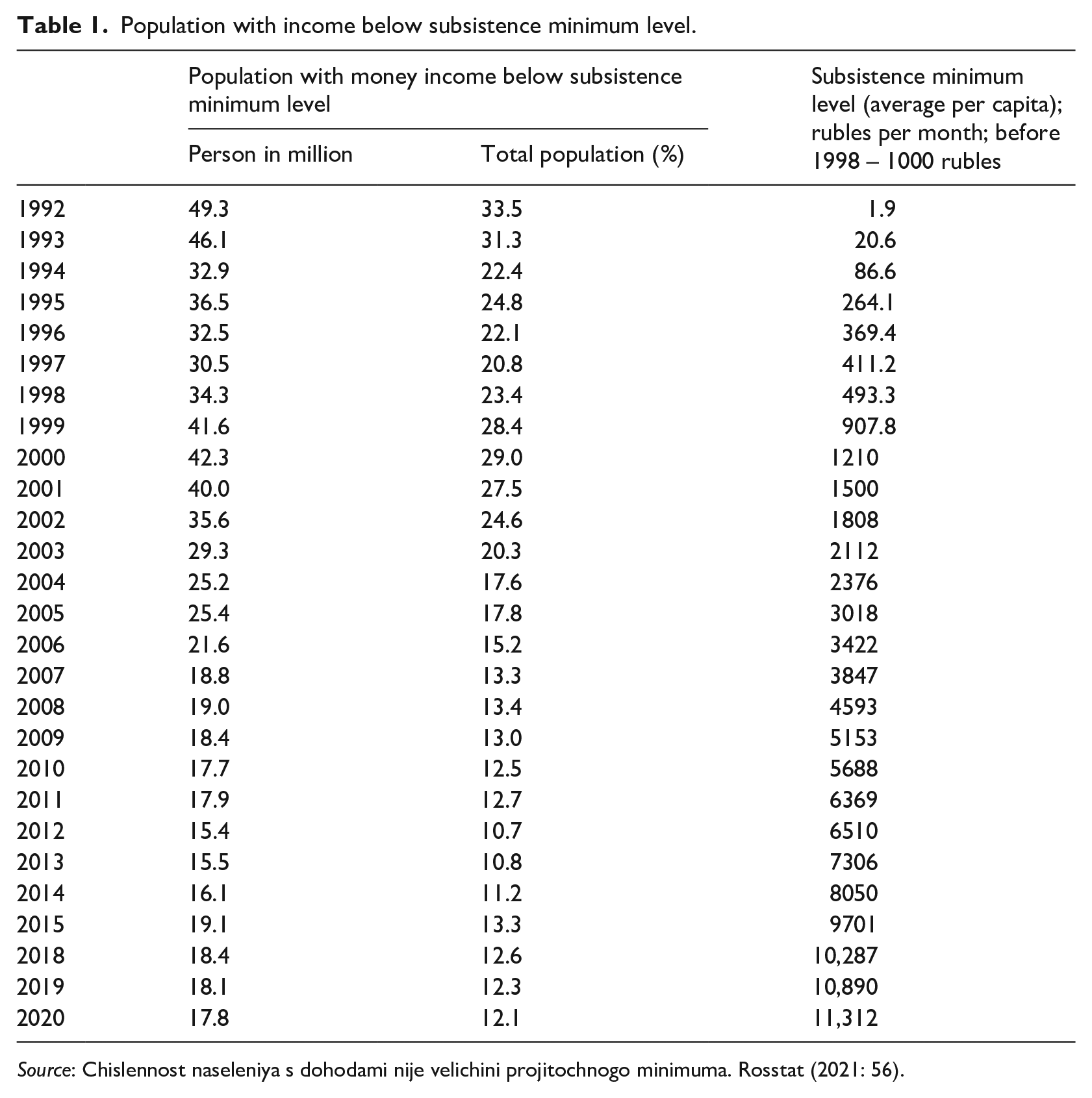
The tendency for the formation of excessive inequality is observed against the background of increasing poverty. As shown by the data of official statistics (see Table 1) for 2012–2020, the number of people with incomes below the subsistence level has increased. If in 2012 there were 15.4 million people in Russia with incomes below the subsistence level, then in 2020 their number was 17.8 million.
Population with income below subsistence minimum level.
Source: Chislennost naseleniya s dohodami nije velichini projitochnogo minimuma. Rosstat (2021: 56).
The rise in income inequality in the post-Soviet period is taking place against the backdrop of a catastrophic overall deterioration in the economic situation of workers. Among the poor, the proportion of groups where poverty is the most dangerous in terms of its social and economic consequences, and above all, in families with children and among workers, is increasing (see Table 2).
Low-income households by main category (percent of total low-income households).

Source: Rosstat (2020b: 164).
In the total number of households, families with children under 18 make up 82.4%. Their number for the period 2015–2018 increased by almost 5%. Those, the risk of poverty increases significantly with the birth of a child, which directly contradicts declarations on measures to stimulate the birth rate. The concentration of children in poor households leads to a decline in the quality of the country’s human potential in the future.
The risk-forming factor of poverty is living in rural settlements and small towns (up to 50,000 permanent residents). Such cities in Russia concentrate far from a small part of the population, accounting for about 70% of cities.
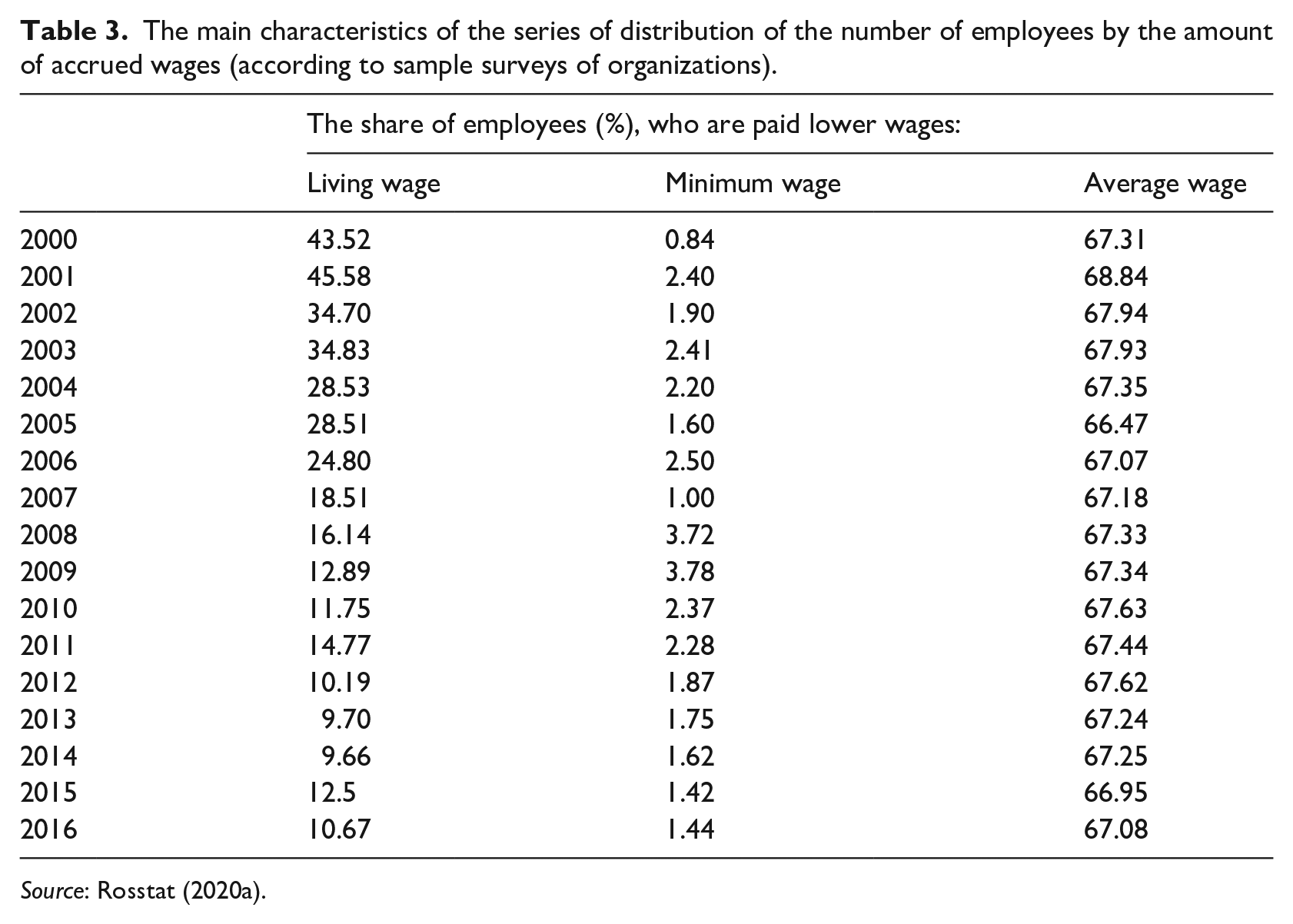
The working class has no normal salary worthy of this title. There are calculations according to which the number of low-income workers should be not more than 7% of the employed. Only then does the salary begin to fulfil its guarantee function of labour force reproduction (Toksanbaeva, 2006: 68). At the beginning of the reforms, this requirement was met by the entire economy of our country (in 1991, 3.8% of workers and employees received wages below the subsistence level). As the data in Table 3 show, wages in Russia do not provide the possibility of reproducing the labour potential of a huge number of workers. For the majority of workers (almost 70%), wages do not reach the average Russian value.
The main characteristics of the series of distribution of the number of employees by the amount of accrued wages (according to sample surveys of organizations).
Source: Rosstat (2020a).
These ‘new poor’ or ‘working poor’ are the evidence of the nonviability of society. The poverty of workers in Russia is a phenomenon that in a concentrated form exposes the perniciousness of the liberal course of both economic and social policies. It should be borne in mind that the earnings that do not guarantee the restoration of the labour force, meaningfully represent not so much the earned income as social benefits for the participation in labour activity. It should be noted that the concept of ‘living wage’ is generally quite conditional. And in Russia, this official living wage is fixed at a very low level.
In order for wages to fulfil a reproductive function, the simplest work must be paid not below the subsistence level. The compliance of this rule is important not only for a low-skilled labour. A skilled labour is the labour of greater complexity and productivity, therefore, as believed back in the 1920s. S.G. Strumilin (1982), the ability to work of a skilled worker, in contrast to a low-skilled worker, is associated with the satisfaction of basic needs in more developed and, accordingly, more expensive forms. This means that inadequate wages for a simple labour as the basis for the qualification differentiation of earnings leads to the undermining of the reproduction of labour in the entire totality of employed labour resources. It violates the incentives to work, prompting the employed to reduce labour activity, which is a specific form of simplification of labour, restoring the correspondence between its complexity and actual pay.
The situation in which the remuneration of a significant part of employees does not reach the subsistence level is a consequence of employers’ realization of the advantages of their economic position. This provision is antisocial in nature and leads to the ‘eating up’ of the labour potential of employees. In modern Russia, law and the institution of social partnership do not limit a significant deviation of wages from the subsistence minimum. At the same time, it is systematic in nature and strongly hits the vital interests of employees. These conditions were typical for the market countries until the 20th century and provoked a bitter struggle between workers and trade union movements for workers’ rights.
Inequality in material status is the basis of the inequality in living standards, including the inequality in the energy value of food by the population groups. In the scientific literature, indicators of the standard of living and its dynamics are sometimes given as the purchasing power of the nominal wages of specific categories of the population. So, it is calculated how many of these or those products can be purchased for an average monthly salary. At the same time, some researchers quite reasonably note that this ‘method is very limited in nature’ (Tkachenko, 2016: 115). For the rise in prices for different products is not synchronous. It seems to us that a more reliable indicator of the standard of living and differentiation of the population can serve as an indicator of caloric intake.
In 2008, the head of the Federal Service for Supervision of Consumer Rights Protection and Human Welfare, Chief State Sanitary Doctor of the Russian Federation, G.G. Onishchenko, the norms of rational nutrition were approved, taking into account the physiological needs for energy and nutrients of various groups of the population of the Russian Federation. According to this document, ‘the norms of physiological needs for energy and nutrients are the average value of the required intake of food and biologically active substances, which ensures the optimal implementation of physiological and biochemical processes fixed in the human genotype’, 1 and also ‘norms’ are values that reflect optimal needs of certain groups of the population in food substances and energy. 2 These norms are used in the formation of the minimum set of food products (consumer basket) for the working-age population, pensioners and children.
Approved values for basal metabolic rate of the adult population, that is, the minimum amount of energy required for the implementation of vital processes (costs for the functioning of organs and body systems in a state of a thermal comfort, complete physical and mental rest) are reflected in Table 4.
Average basal metabolic rate of the adult population of Russia (kcal/day).

According to the given data, in order for the human body to be able to ensure its own functioning (basal metabolism), an adult man needs about 1700 kcal/day, and a woman – about 1500 kcal/day. This is the amount of calories the body needs at rest.
Considering that the daily energy requirement depends on the degree of a physical activity of a person, the entire adult population is divided, depending on the amount of energy consumption, divided into five groups for men and four groups for women, depending on the type of a labour activity. 3
According to the approved norms, the number of necessary calories for men is
The energy value of food products on the average per person is 2487 kcal/day 4 for the working-age population, which corresponds to the norms of the physiological need for nutrients and energy for workers of very light and light physical activity. Studies show that the energy value of food products of 30% of the population is below this minimum allowable norm. Those in fact, the poor are not 13.3% (according to Rosstat data), but 30% of the population (see Figure 1).
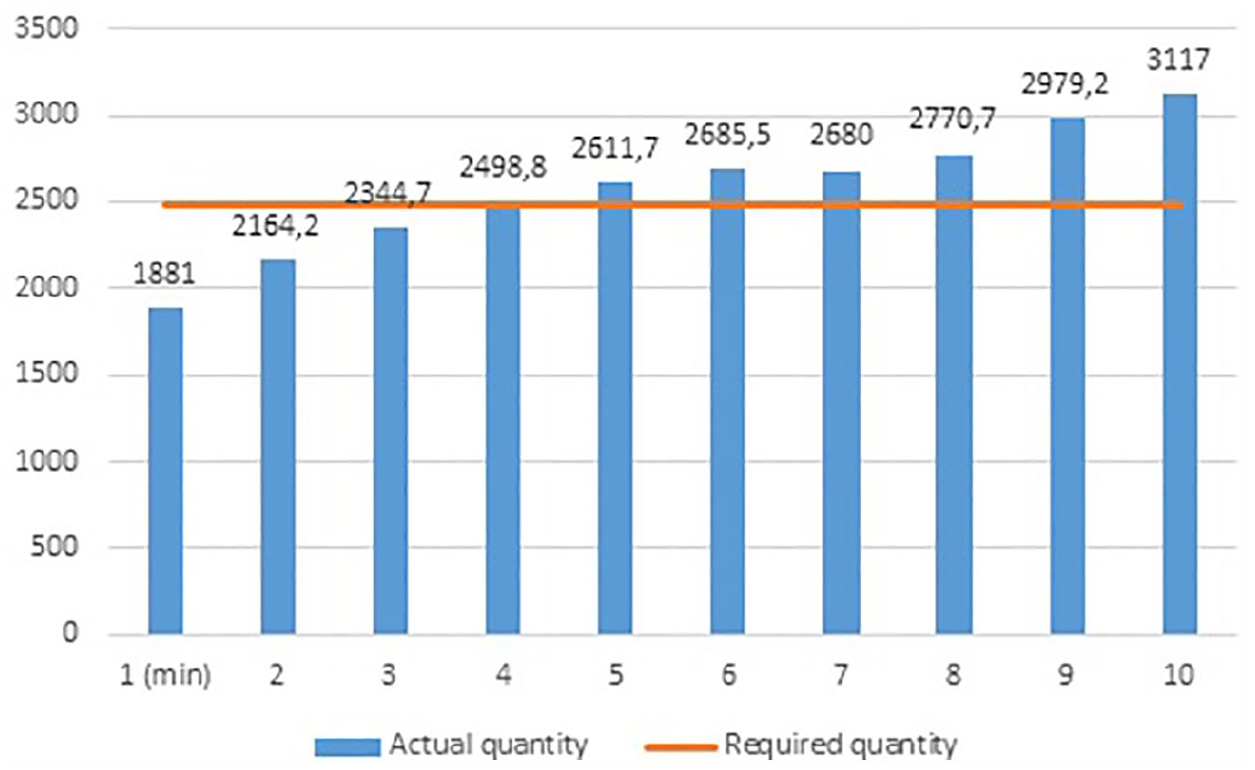
Ratio of the required and actually received amount of calories by 10% (decile) population groups depending on the level of average per capita disposable resources (on average per day per consumer, kcal) in 2015.
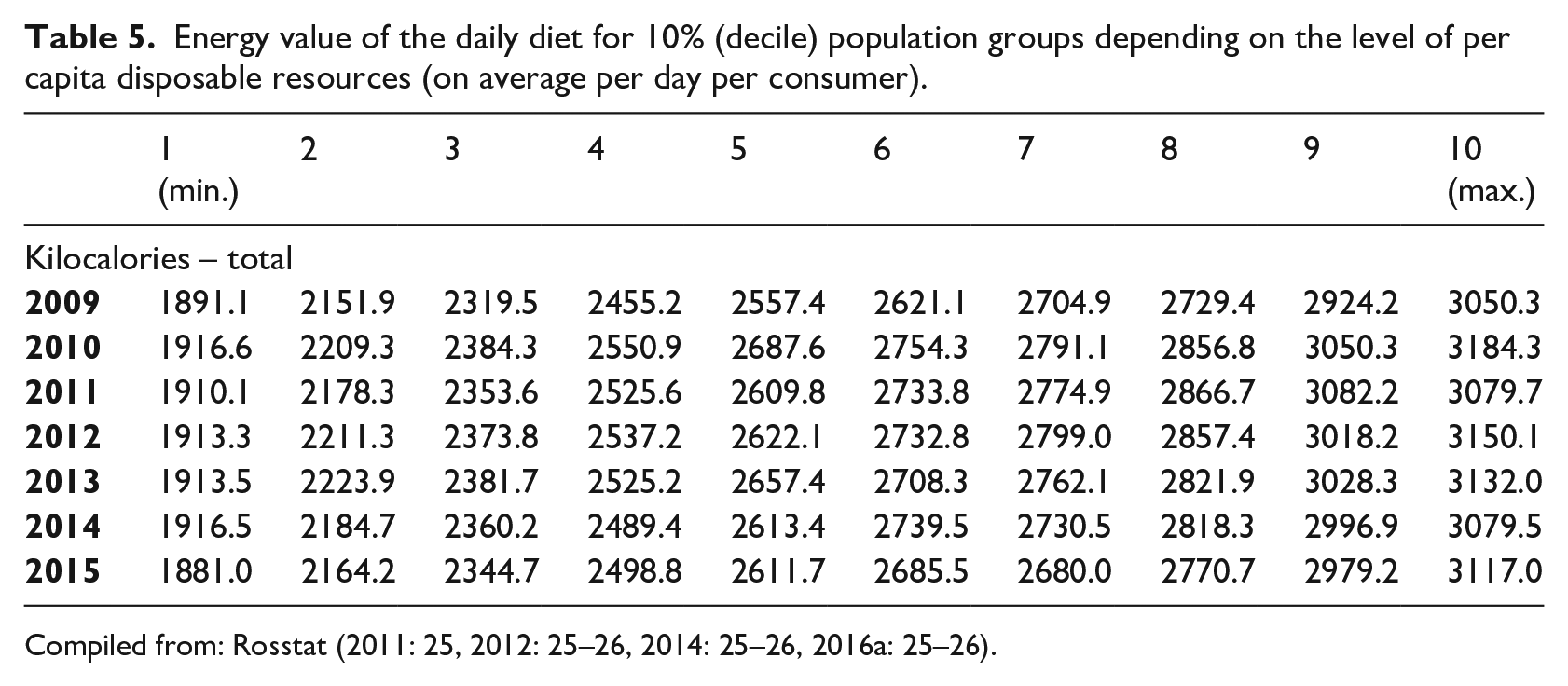
As the data of Russian statistics show (see Table 5), the gap in the level of energy value of food between the extreme (the richest and the poorest) groups of the population is steadily more than 1.5 times. For the first poorest group of the population, the calories received are barely enough for the body to maintain its own functioning (basic metabolism) under resting conditions (1700 kcal).
Energy value of the daily diet for 10% (decile) population groups depending on the level of per capita disposable resources (on average per day per consumer).
Compiled from: Rosstat (2011: 25, 2012: 25–26, 2014: 25–26, 2016a: 25–26).
Poverty, in terms of the mechanism of its formation, is a direct consequence of inequality. As long as there is excessive inequality of income levels, going beyond the framework of equity and economic efficiency, until the state distribution policy changes, poverty cannot be overcome.
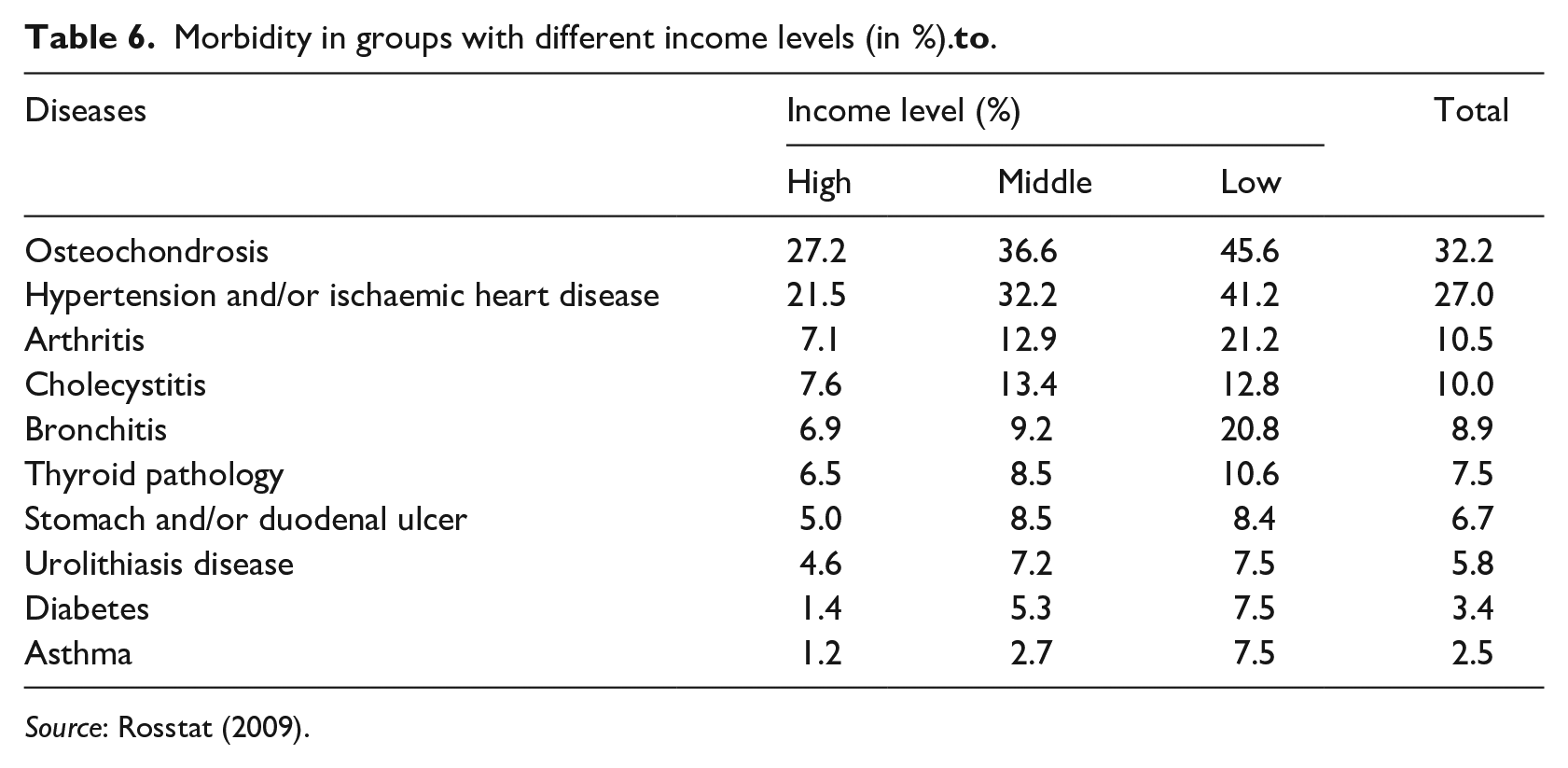
Inequality in material status entails inequality in living standards and health status, discrimination in education and medical care. It is known that the state of health largely depends on the possibility of high-quality nutrition, that is, first of all, on the level of income. This dependence is also confirmed by the results of a survey conducted with the participation of the Ministry of Health and Social Development of Russia, Rossport, the Institute for Social Research in 24 constituent entities of the Russian Federation (Table 6). People with high incomes do not experience any problems with high-quality medical care, with the purchase of any medicine or with spending on recreation.
Morbidity in groups with different income levels (in %).
Source: Rosstat (2009).
As evidenced by the data in the group of respondents with a low income level, almost every second respondent indicated the presence of diseases of the musculoskeletal system and the circulatory system, and on average, 8–-9 respondents out of every 10 respondents suffer from two diseases. The survey data provide strong grounds for concluding that social disorder is the main source of stress. For example, in the group of respondents with low incomes, one and a half to two times more often than in the high-income group, there is a state of acute psychological anxiety about an unclear future of existence, a feeling of loneliness, anxiety caused by the possibility of losing a job. Such a nervous state, which persists for many years, determines the widespread anomie of society. It is expressed in the inconsistency of consciousness and behaviour of many people, including in relation to their health as a value and the main factor that determines the fullness of life. Excessive socio-economic stratification of the population, causing stress and depression, leads to poor health, increasing the mortality rate among low-income groups of the population.
The most significant negative trend is the decline in the population, which since 1992 has grown into a protracted depopulation. If in the intercensal periods 1970–1979 and 1979–1989 there was a tendency for general population growth (by 5.7% and 7.0%, respectively), then in the period 1989–2002, the total population decline amounted to –1855.2 thousand people (–1.3%), 5 and for 2002–2010, the population of Russia decreased by more than 2 million people (–1.6%). 6 The trend of excess of mortality over birth rate was reversed only in 2013. However, since 2018, the trend of population decline has resumed.
The process of depopulation is associated with multidirectional dynamics of changes in the level of fertility and mortality (‘Russian cross’) (see Table 7). In the period 1992–2020, Russia was characterized by a uniquely low birth rate, which did not ensure simple reproduction of the population, against the background of extremely high mortality rates, significantly outstripping birth rates (in a number of regions more than twice).
Crude vital rates.

Source: Rosstat (2006a: 75, 2009b: 84, 2015b: 83; 2016b: 83, 2021: 43).
Of course, the decline in the birth rate is a global demographic trend, but during the period of economic reforms, it happened at an extremely fast pace. This suggests that the destabilization of the socio-economic situation, the decline in the level and quality of life of the population, and uncertainty about the future were significant factors in the decline in the birth rate.
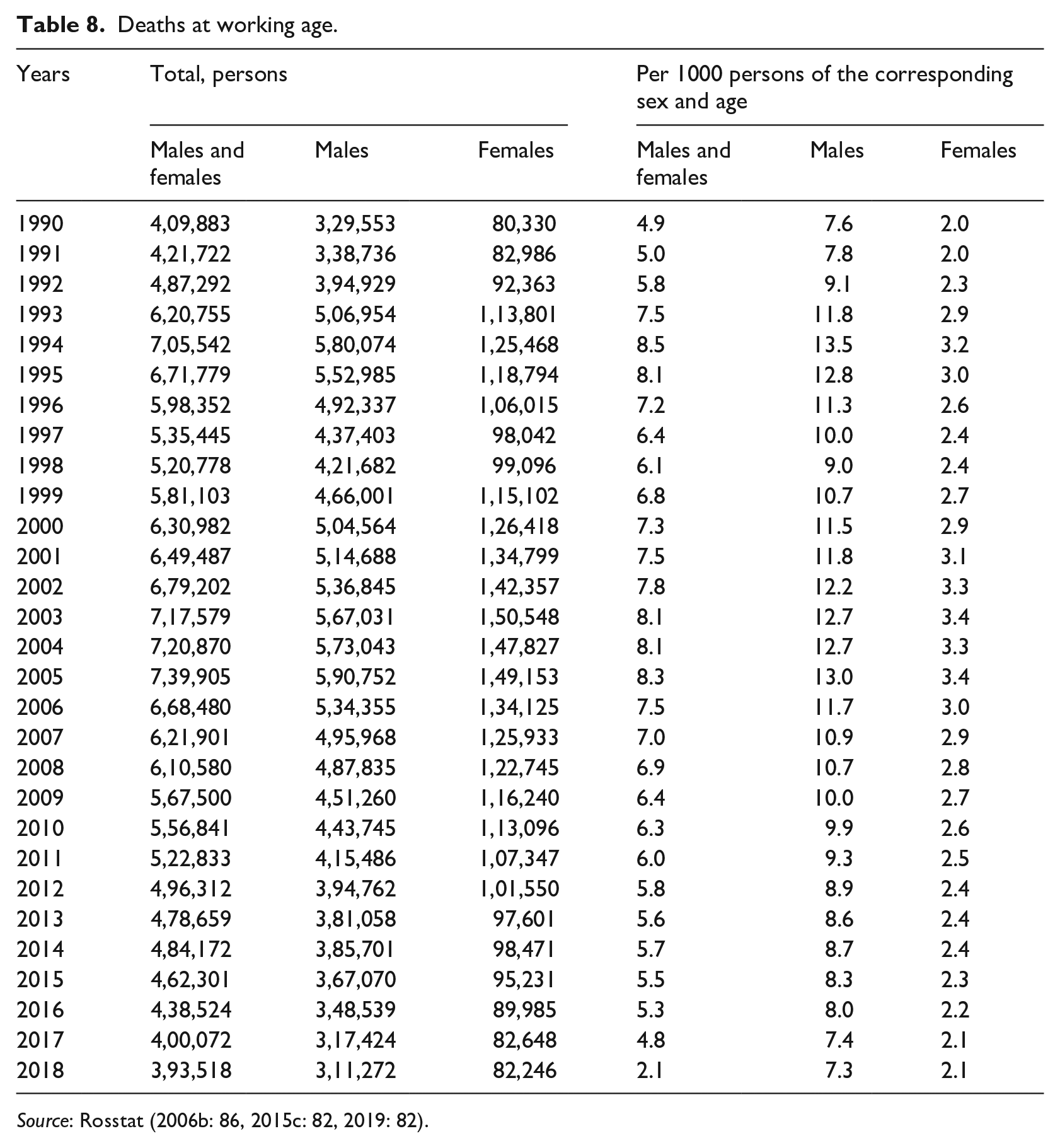
The most acute problem of the demographic development of Russia is the exorbitantly high mortality rate of the working-age population, primarily the mortality rate of men (Table 8). This negative trend is clear evidence of demographic degradation.
Deaths at working age.
Source: Rosstat (2006b: 86, 2015c: 82, 2019: 82).
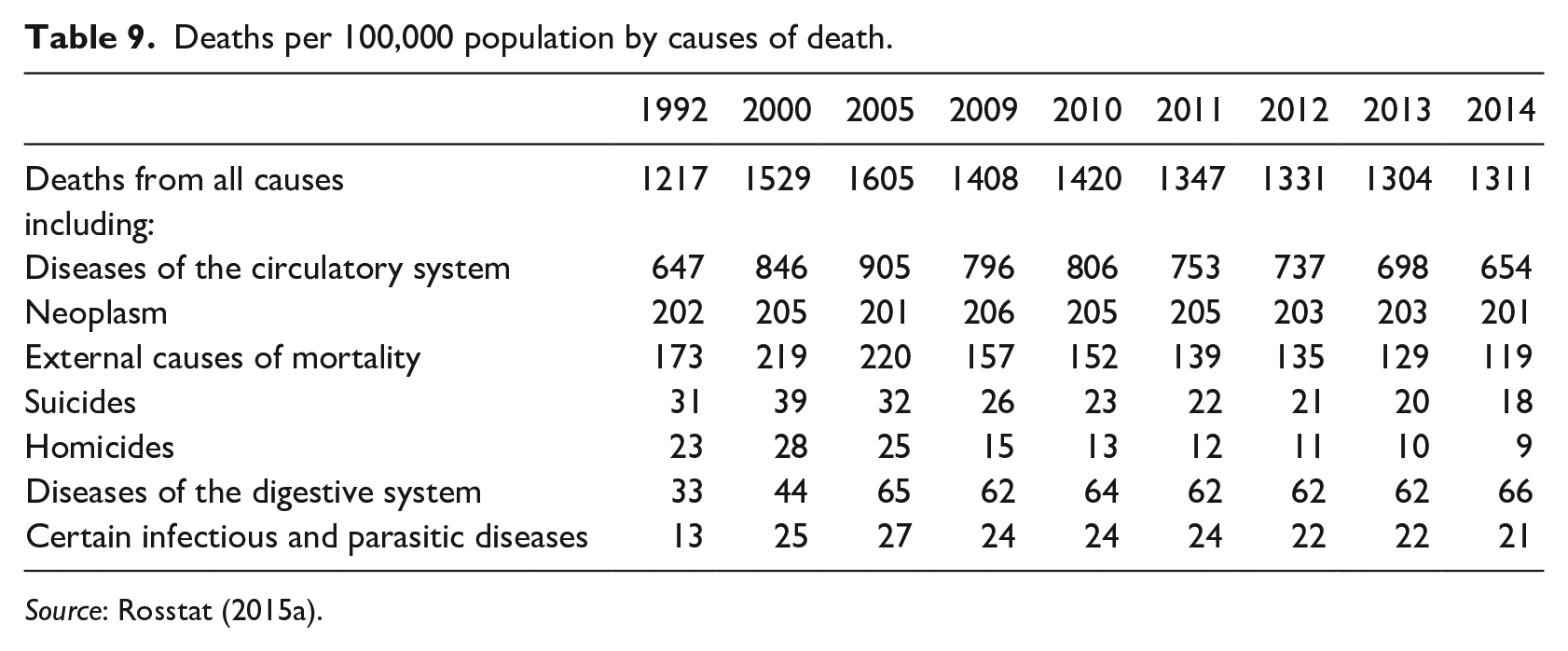
Of particular concern is the increase in mortality from unnatural causes (accidents, homicides and suicides), cardiovascular diseases, premature heart attacks and strokes. In Russia, since 1990, the death rate from suicide has exceeded the death rate from homicide (Table 9). The reason for the early departure from life often lies in the absence of visible development prospects. The aimlessness and helplessness of existence leads to a very low value of life and the absence of a subconscious desire to continue it. Particularly highlighted is such a factor of male over-mortality as ‘psychological suicide’, when the way of life inevitably leads to loss of health and premature death.
Deaths per 100,000 population by causes of death.
Source: Rosstat (2015a).
Studies by the Institute of Socio-Economic Problems of Population of the Russian Academy of Sciences have shown that in Russia, excessive inequality constrains economic development and contributes to a decrease in the birth rate and an increase in mortality. Under normal inequality, Russia (under the norm, if the incomes of the rich are 7–9 higher than those of the poor and not 15–20, as now), in 2007, would have had a GDP almost 30%–35% more than the current one, and the population could be about 160 million by 2050 (Neshitoj, 2008).
Research on the effects of inequality on economic growth has shown that indicators of ‘social health’ are worse in countries with greater income inequality. In these countries, public and individual spending on education is significantly lower, its level is lower, the percentage of people receiving benefits or food stamps and who do not have health insurance is higher, and the percentage of unemployed and prisoners is higher (Yates, 2003: 58–89). Most of the population receives too low incomes in comparison with the subsistence minimum, because of this, their human and labour potential is used ineffectively. In the long term, a decline in the quality of social capital leads to the degradation of the entire economy, since the share of a poorly educated population that is unable to produce or even consume high-tech goods increases, which makes the innovative path of economic development problematic.
Economic inequality is reproduced in legal inequality, which, in turn, affects economic and social relations. Growing inequality strengthens the power positions of the few and creates barriers for the majority; contradicts democracy and contributes to the development of authoritarian tendencies. As international studies show, there is a link between inequality and corruption, and similar links are observed between inequality and crime. Corruption is much higher in an unequal society than with more evenly distributed resources (Glaeser et al., 2003; You and Khagram, 2005).
Unequal distribution of income and wealth creates an opportunity for high-income people to intervene in political processes and democratic governance. In particular, a significant concentration of wealth and income provides rich people with the resources sufficient to pay bribes to high-ranking officials and politicians. Inequality increases the likelihood of wealthy households influencing the distribution of public money and lobbying for their interests.
And in conclusion, we present two conclusions of modern researchers, pointing at the root cause of economic inequality and degradation of society. The first conclusion belongs to the well-known American researchers D. Acemoglu and D. Robinson (2016), who talk about the poverty of Egypt: ‘In fact, Egypt is poor precisely because it was ruled by a narrow layer of the elite, who organized the economy in such a way as to get rich at the expense of all the rest of the population’ (p. 14). And exactly, the same conclusion is made by the modern Russian researcher K.I. Mikulsky (2016): If we try to highlight the core of the life of Russian society, then it consists in a deep (almost antagonistic) conflict of interests of the elite and society. It develops latently, without external acute manifestations, but ‘immobilizes’ society, hinders progress, decomposes it. (p. 6)
Thus, we can conclude that the path to the prosperity of a society consists in overcoming excessive economic inequality, which must first of all come to the ruling class of any society.
