




Abstract
The article presents the research on the social and class structure of modern society from the positions of the Post-Soviet School of Critical Marxism. It is shown that late capitalism is characterised by the active formation of inter-class and intra-class layers. The article reveals the contradictions of the ‘creative class’. The ‘creative class’ is divided into (1) the people who are employed in the creatosphere and give rise to the phenomena of culture and the creative qualities of human beings and (2) those who ‘creatively’ produce useless goods. Then it is further divided into people employed in the (1) public and (2) commercial sectors. The author introduces the term ‘the socialiat’ to characterise the public-sector workers who comprise a protoclass within the creative class, shows the core and periphery of it, and provide the analysis of the precariat as the alter ego of the socialiat.
Keywords
For students of society and actors in the political struggles of the late-19th and early-20th centuries, Marx’s Capital became the theoretical and methodological foundation that allowed them to search for ways to carry out complex practical tasks in the field of social creativity, that is, the creation of history. For all the disagreements between the social democratic and communist wings of the heirs of Marx, the conclusions of the author of Capital and of his followers during that period made it possible to enact socially oriented reforms and to begin the revolutionary socialist transformations in Russia, China, Cuba and elsewhere. The late-20th century, however, brought more than a few disappointments; the departure of the World Socialist System from the historical arena and the triumph of the neoliberal model of late capitalism compelled a fresh look at the contradictions and limitations of capitalism. The collective work of writing ‘Capital-XXI’, which in essence had never ceased, went ahead. Today, we are able to draw upon the works of Ernest Mandel (1987), István Mészáros (1995), David Harvey (2015), David Kotz (2015) and many others. Work on a new ‘Capital’ is also being conducted within the framework of the Post-Soviet School of Critical Marxism; the results include, in particular, the crucially important monograph by Professor Viktor Ryazanov (2016), a series of articles developing the ideas of that book (Ryazanov, 2017), and also the two-volume work by Andrey Kolganov and the present author Global Capital, five editions of which have now been published in Russia. Some fragments of the latter have been published in English (Buzgalin and Kolganov, 2010, 2016, 2013).
While basing himself on these studies (and on more than a 1000 others, included in the bibliography of Global Capital), the author in this article singles out just one aspect; the conditionality of the social structure of late capitalism on the relationships of appropriation and alienation (and accordingly, of exploitation) of late capitalism. The basis for this study will be a brief mention of the key differences in the relations of capital and hired labour as they appear in the second-half of the 19th century and in the early-21st century. The latter task is in itself an extremely complex question of scholarship, but as indicated earlier, the results of the research conducted by the author on this matter have already been published, and he will thus confine himself to brief remarks that are nevertheless of fundamental importance for the following analysis of the features of the social structure of modern-day capitalism.
We shall begin, naturally, with methodology.
Research Methodology
For more than a decade, the author has been conducting research at the point of intersection of social philosophy, sociology and political economy. This quest is conditioned to a considerable degree by the centrality of these disciplines to the Marxist current of social thought in general and to the Post-Soviet School of Critical Marxism in particular.
The latter school, it should be stressed, is characterised by the use above all of the dialectical method, now almost ignored even in many works of Marxist scholarship. In the present case, this method provides an extremely useful basis for resolving the issues on which the author wishes to concentrate. These issues are first, the problem of the objective bases; second, the transformations that have occurred in the structure of society in the early-21st century; and third, the problem of social and class contradictions.
The above problems, to say the least, are not new, but it is rare to find them addressed from the positions of the methodology and theory of modern-day Marxism. Nevertheless, this approach makes it possible to find solutions that if not particularly unexpected, are extremely ‘functional’, including in terms of their practical application.
Problem number 1 assumes that not only do we positively determine the presence of various socially diverse strata, and not only set out the distinct characteristics of particular groups on the basis of postmodernist guidelines (deconstruction and deterrialisation as imperatives for investigation, while rejecting all ‘grand narratives’; Deleuze, 1995; Foucault, 2004), but that we also pose the questions of the technological and
In itself, the posing of problem number 2 assumes that we consider the presence of quantitative and qualitative, evolutionary and revolutionary changes in the social structure of society and in its bases to be the rule and not the exception. Hence the obvious consequence; the theses of Marx and Lenin on the ever-increasing polarisation of society and on the formation of the classes of the bourgeoisie and proletariat must now, more than 100 years later, be subjected to critical development, even though these theses were fully adequate to the periods of the primary accumulation of capital and of classical industrial capitalism. If this is not done, the theses will not be Marxism but dogmatism. Accordingly, the transformations undergone by the social structure, as defining elements in the formation of its present-day quality, will lie at the basis of our subsequent conclusions.
Problem number 3 assumes the investigation not only of antagonistic class contradictions, but also of contradictions as a source of the progress (or regression – this is now 21st-century Marxism) of the social structure (it should not be forgotten that contradiction involves not only the struggle of opposites, but also their unity; the class of hired workers cannot exist if there is no class of the owners of capital, and vice versa). The following thesis must be stressed: the change of form of class contradictions, their self-negation at the same time as they become more profound and complex both within the capitalist system and beneath the influence of more extensive shifts, is a process that confirms the correctness of Marxist methodology and does not refute it. Meanwhile, and as was just noted, to maintain the old thesis that capitalism involves exclusively the contradiction between the proletariat and the bourgeoisie is in modern circumstances to contradict both the methodology and theory of Marxism.
Before we continue with these reflections, it should be recalled that the twilight of capitalism is at the same time the twilight of the entire economic and social formation that Marx and Engels termed the ‘realm of necessity’. At this stage, we are witnessing the undermining and negation of the entire system of social alienation, and not only of capitalist relations in the strict sense; naturally, this places a particular stamp on the transformation of the social structure of society at this current stage of its development (for a more detailed treatment of this point, see Buzgalin, 1998).
And a final remark on methodology; whether this is obvious or not, the methodology of positivism that is employed in most modern sociological research presumes the isolating in the first instance of social groups that are distinguished by specific traits, empirically observable and readily reflected in quantitative terms: gender, age, income levels, education, place of residence, profession and so forth, with these parameters supplemented by the results of the respondents’ own self-assessment of their lives. There is no disputing that these characteristics – which appear to be thoroughly concrete, while in fact being profoundly abstract (individual, superficial) 2 – are important. But this is only as a starting-point for investigation. 3
To complete our methodological introduction, here are some preliminary definitions of key concepts in this text. Proceeding from what has been said, a class may be considered to be a social group that takes shape within the framework of a certain socio-economic formation and that possesses a unified systemic quality that combines the following main characteristics:
Its position in the system of social production (above all, its labour content and place in the social division of labour);
Its socio-economic position (its quality as a particular subject of certain productive relations, in the first place, of relations of appropriation and alienation, of the distribution and redistribution of income, and of reproduction);
The possession of specific social interests; and
Their politico-ideological presentation.
A class takes on its finished form when all its main characteristics are clearly expressed and mutually sufficient, when its labour content, place in the system of productive relations and politico-ideological forms correspond to one another. This is what the classes of hired workers and capitalists were like within the framework of classical industrial capitalism.
In specific historical circumstances and within a particular social expanse (let us say, a country), classes are always to a greater or lesser extent blurred and diffuse. This diffusion is especially typical during the genesis or decline of a particular social system. Under these conditions social groups arise and take shape as subsystems of the system or class, or arise at the points of intersection of these systems. Subsequently in this text, such groups will be termed social layers or strata. They are characterised by the following:
One or several, but not all, of the peculiarities of a class. For example, they may be hired workers engaged primarily in creative labour, or bourgeois who control key property rights of global corporate capital (oligarchs);
Inter-class diffusion, that is, the forming of groups that are transitional from one class to another within the society. A typical example is the stratum of managers, hired workers who engage in managerial tasks in capitalist enterprises and who exercise a part of the functions of capital while even appropriating a portion of the profits;
The transformation of a class that is characteristic of one historical social system into a class that is characteristic of another; for example, the transformation of Russian serfs into hired workers, or of hired workers into members of a free working association.
It should be noted that there is nothing especially new in these definitions. They are not simply postulated, however, but are derived on the basis of a consistent realisation of Marxist methodology. This is important, since one of the main tasks of this text is to show that an integrated and systematic use of the methodology and theory of Marxism permits an adequate depiction of the social structure of society, and in particular, of the social structure of late capitalism.
To the analysis of this social structure, a characterisation of the main technological and socio-economic determinants of the socio-class structure of late capitalism will now be added.
Capital-XXI: The Technological and Socio-Economic Determinants of the Social and Class Structure of Late Capitalism
In the theoretical expanse of modern-day Marxism, a well-known conclusion is that transformational states in societies are characterised by the processes of class diffusion and the active formation of inter-class and intra-class social strata. A reverse link – the presence of active inter-class diffusion and the formation of intra-class layers as witnesses of the transformation of one social system into another – receives far less emphasis. In any case, the transformation of what Marxism calls the forces of production and relations of production leads to a gradual blurring (one might say ‘de-focusing’) of the social and class structure of a society that is departing into the past (the structure of classical capitalism). Simultaneously, the products of the decay of the ‘old’ social strata give rise to prototypes of the elements of a new social structure, born out of the contradictions of the previous state of the capitalist system and from the results of its combination of progress and regression.
What Is It that Determines These Transformations?
The technological changes that have characterised the past few decades have drawn the attention of large numbers of researchers. During the 20th century, scholars wrote primarily about post-industrial and/or information society, or the knowledge society (Bell, 1973; Machlup, 1962; Sakaiya, 1991); the most recent period has been characterised by them as the age of a new industrial revolution, with the accent on digital, nano-, biotechnologies and so forth (see also: Bodrunov, 2016, 2018). The present author suggests keeping faith with Marxist theory in this instance and speaking of changes in the forces of production.
The point of departure for these changes was the process of scientific and technical revolution that began in the 1950s and 1960s. In the economies of the ‘centre’, this process led to the formation of significant sectors of social production that required the widespread use of human creative potential. The result of this ‘order’ that was placed by the productive forces was the formation of a massive layer of people, 30% of the workforce or more, with higher education or specialised technical training. That is, we saw the rise of a social layer of workers potentially capable of creative activity.
The late-20th century and the early years of the present century witnessed the beginning of significant corrections to this process. For a time, the linear progress of technology in material production was slowed and became concentrated primarily in the field of information and communications technology, which until recently had a little impact on the dynamic of labour productivity or on the appearance of the main branches of material production (we drive approximately the same cars, and fly at the same speed in much the same aircraft as 50 years ago . . . ). It is only recently that people have been confronted with the prospect of serious changes in material production linked to the progress of NBiKS technologies, and that the basis has emerged for the development of ‘clever’ automated production, leaving mainly creative functions to be carried out by human beings. But in any case, capitalism has already been standing for half a century on the threshold of the creative revolution (for more detail, see Buzgalin, 2018: 18–23, 28–31). In the countries of the ‘centre’ extremely deep changes are under way, changes that affect the very foundations of capitalism. Reproductive industrial labour is being replaced by creative activity.
Contrary to widespread reports in the current literature of a reduction of the creative economy (according to some scholars, of creative business) to the sphere of art and allied areas, the present author regards creative activity as defining the content of labour in such fields as education (in the unity of nurturing, instruction and enlightenment); healthcare and sport; management in all its forms; science and art; creative activity in the area of material production; social work and many more. This approach was traditional for the Soviet Marxism of the 1960s and 1970s (Changli, 1973), and remains so for the Post-Soviet School of Critical Marxism (Bulavka-Buzgalina, 2021; Yakovleva, 2018). In recent years, it has manifested itself in a number of works on the topic of the ‘creative class’ (Florida, 2002, 2014).
No less profound changes are occurring in the system of productive relations.
However, transformations have taken place in the relations between labour and capital. Personified private capital, concentrated in the hands of a specific individual (Krupp, Ford, Morozov), has now come to be typical mainly of small and middle production. Large-scale capital has taken on a corporate form, which has led to the boundaries of the bourgeois class becoming blurred, and to the emergence of a number of social layers.
At the top of this hierarchy is the oligarchy. This is the part of the bourgeoisie that concentrates in its hands the main rights over property (using the categories of the new institutionalism; Coase, 1960), not so much in the form of shareholding as of control over finances and information, and the ability to make key decisions. It is important to note that as a result of financialisation (Fine, 2013; Krippner, 2005; Mavroudeas, 2019; Sifakis-Kapetanakis, 2019), the oligarchy is becoming more and more tightly connected to financial capital. This process was already under way in the 20th century, when Marxists (including Soviet scholars) revealed the main features of financial oligarchy (Inozemtsev, 1971). Beginning in the last century, the development of active state regulation led to a progressive intertwining of the financial oligarchs with the top levels of the state bureaucracy (the content and forms of this intertwining were described not only by Marxists in the West but also by their Soviet counterparts as early as the 1960s; Inozemtsev, 1971). The result was the formation of the specific social layer that dominates the economic and political life of modern-day capitalism – the oligarchic-bureaucratic nomenklatura (in this case, the term ‘nomenklatura’ is used by analogy with the party-state nomenklatura of the Union of Soviet Socialist Republics (USSR), a relatively closed social stratum that resurrected various features of a feudal aristocracy).
Lower down in the social hierarchy of late capitalism are to be found the members of the middle and petty bourgeoisie, whose position is closest to that of the bourgeoisie in past centuries, since in most cases, they fulfil the ‘classic’ functions of the owners of capital, exploiting hired workers. Bordering on the class of hired workers are the managers, who perform the work of controlling and administering various property rights, and who receive a part of the income from the profits of capital. Leaving aside for the moment the members of the ‘free professions’ – this text will return to them subsequently, when it defines the characteristics of the so-called ‘creative class’ and the precariat – let us examine the main changes in the class of hired workers.
Here too, an active blurring of the distinctions within and between classes is under way. The basis of this process consists of changes in the content of labour and of the productive relations. One of the main changes is linked to the development of creative labour and to the formation of a stratum of creative hired workers. The latter are characterised by a qualitatively new form of relations of exploitation that involves the appropriation, by the owners of capital who employ creative labour, not just of surplus value but also of intellectual rent. The relations that arise here are characterised by a special mode of exploitation – one that includes rent – and by the subordination to capital not simply of labour, but also of the human individual. This is the case since capital in this instance does not employ the labour power, sold for a time to the capitalist, of a personally independent hired worker, but the worker’s creative potential, that is, his or her most important personal qualities. These changes have been described in more detail by the author in an earlier text (Buzgalin and Kolganov, 2013); this article will therefore confine itself to drawing the conclusion that this specific characteristic of creative workers provides one of the bases for distinguishing the so-called ‘creative class’ – about which, as indicated earlier, more will subsequently be said.
Alongside such special strata as creative workers, managers and so forth, the global capitalist system also preserves the traditional ranks of industrial hired workers, and also social layers that are the objects of semi-feudal forms of coercion, something especially common in the case of migrant workers.
However, since the second half of the 20th century, the processes of the socialisation of capitalism have been undergoing active development. Between a quarter and a third of the population in developed countries have come to work in areas where the goods created are not private but public. These workers participate directly in the process of social appropriation of these goods, and receive income from public sources (the state budget, non-governmental organizations (NGOs) and so forth) rather than from the sale of their labour power to a private owner of the means of production. In these areas, of course, significant market-capitalist components are present, but this is not the whole story; within the framework of the market-capitalist system transitional relations, including post-capitalist elements, have begun taking shape.
Until relatively recently, these post-capitalist elements included such areas as free education and health care. Over more than three decades, however, the neoliberal stage of late capitalism has unleashed processes of deregulation and desocialisation that have brought about a significant transformation of the once strongly expanding public sector. 4 Even in the current period, however, the system of productive relations of late capitalism has been characterised by the widespread development of transitional relations that supplement and to a degree reform the ‘classical’ variety of industrial capitalism (i.e. the one described in Marx’s Capital). Among these relations are the contradictory combinations of the market with social regulation; of private with public appropriation in socially important fields (health care, education and others); of growing social inequality with the still-surviving partial redistribution of surplus value to the advantage of society; and so forth.
These transitional relations have partially altered the productive relations of capitalism together with the forces of production, that are gradually diverging from traditional industrial technologies. They are also conditioning the main transformations in the social structure, transformations that are especially noticeable in the countries of the ‘centre’ and in various countries of the semi-periphery (in Russia, in particular).
The above changes have been noted and described by sociologists, who for several decades have been analysing such phenomena as the ‘creative class’ and the ‘precariat’. The task of this article is to present a Marxist interpretation of these well-known phenomena, and to set forward some of the less obvious results of analysing them through the use of contemporary Marxist methodology and theory.
Let us begin with one of the most noticeable consequences of the changes in the productive forces – the birth of the so-called ‘creative class’.
The ‘creative class’: The Real Causes of Its Emergence and Social Heterogeneity
It is not by chance that the author has written here of the ‘creative class’ as a so-called class, and has put its name in inverted commas. Before the reasons are explained, it is necessary to recall briefly what it is (or more precisely, who it is) that we are discussing.
As is widely known, the term ‘creative class’ has became popular since the appearance of a book by Richard Florida (2002, 2014) in which that author assembles a considerable volume of statistical information on the various professional groups employed in fields where the application of creative abilities is required. Florida goes on to distinguish a super-creative core consisting of people in whose work creative functions play a determinant role, and shows that in the United States at present, this social layer accounts for as much as a third of the workforce. 5 This essentially Marxist approach (Florida allocates workers to different social strata on the basis of the content of their labour, the main parameter from the point of view of locating people within a particular system of productive forces) would deserve to be welcomed were it not for a number of ‘nuances’.
The most important of these ‘nuances’ lies in the fact that this ‘class’ unites, in a sort of non-organic whole, people whose spheres of activity are quite different in terms of their place and role in social production, and who occupy substantially different positions within the system of productive relations. As a result, Florida’s ‘creative class’ unites top-level managers with ordinary teachers, show-business stars with doctors, and public relations experts with scientists.
The situation is rendered still more confused by today’s media. It is no accident that mass information outlets in recent years have foisted on us an image of the creative class as a layer of entrepreneurs and of people, from lawyers to show-business personalities, who are close to them in social status. In these media offerings, the rest of the intelligentsia and especially the people who in our country in recent times have come to be called ‘budget sector workers’ (though not in serious sociological research!) have been excluded from the ‘creative’ stratum and declared members of the ‘passive majority’. Accordingly, the former have become bearers of the ideas of liberalism and development, and the latter, defenders of paternalism and conservatism.
This unscientific discourse might be disregarded, if it did not provide a reflection (in a distorting mirror, but a reflection nonetheless) of a genuine problem. Not only are there profound differences between these two distinct social groups who share a single, yet significant common basis – the fact that their labour is creative in its content. 6 There is also a profound contradiction between the socio-economic status and position of the two groups, and between their respective political and ideological orientations.
Special attention needs to be paid to understanding this contradiction. For this understanding to be reached, it is necessary to remind the reader of the view of social reproduction in the 21st century that the authors of the above-mentioned publications put forward. In these publications, it is shown that the combining of two bases for classification – the productive forces and the relations of production – makes it possible to distinguish three main areas in the modern socio-economic system (see Figure 1).

Structure of the social reproduction of the market economy under the conditions of the genesis of mass creative activity.
The first of these areas is that of material production, producing goods and services that directly serve the reproduction of the means of production and of the material lives of human beings. This sphere includes production of the means of production (including infrastructure), of items of consumption and of useful services. The second area is the creatosphere, in which cultural phenomena and personal qualities of human beings (education, science, art and so forth) are created through labour that is creative in its content. These two areas make up the real or useful sector.
The third area is that of the production of goods that are useless from the point of view of creating conditions for the progress of technology and of human qualities, or for solving social, environmental and humanitarian problems – that is, goods that do not conduce to progress or that counteract it. This area – and here we have one of the most important contradictions of late capitalism – supports the production of commodities for which there is a demand and which, moreover, are as a rule more profitable than business in the real sector. 7 This third area makes up the false or useless sector, creating goods that are perversely transmuted and whose real content is ‘turned seamy side out’. The main components of this sector are the larger (speculative) part of the financial sector; activities in the fields of marketing, public relations and business consulting; the bureaucratic element of management; and the production of commodity-simulacra (commodity-symbols) whose main value is imparted to them by a ‘cool’ brand. 8
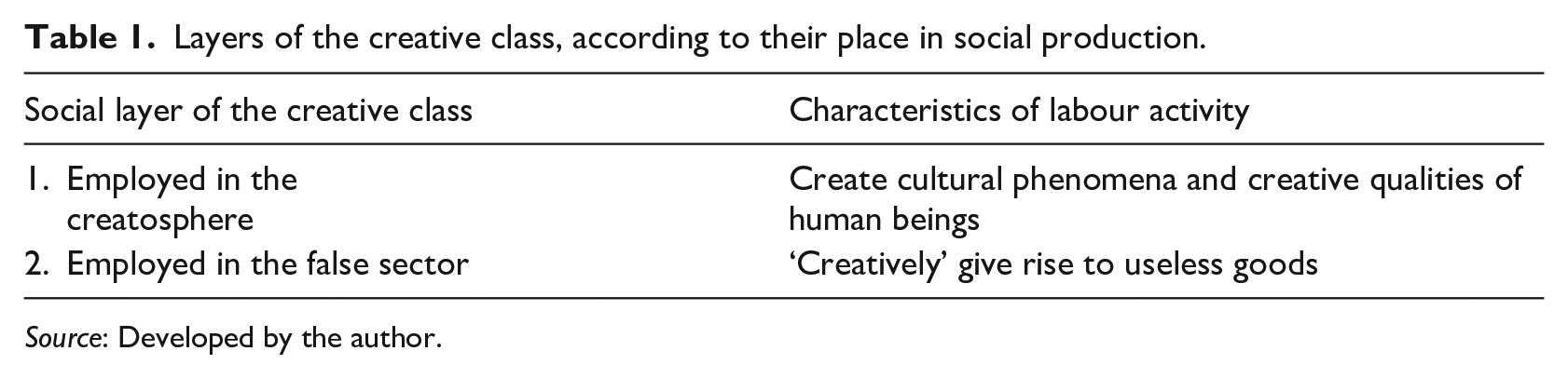
The distinction drawn between these areas (and especially the final one) rests on a hypothesis developed by the author and elaborated in earlier publications (see, for example, Kolganov and Buzgalin, 2014: 89–91). This article will now use this hypothesis as the basis for further reflections. If the hypothesis is correct, then the stratum of people employed in creative activity needs to be divided into several qualitatively different social layers (see Tables 1 and 2).
Layers of the creative class, according to their place in social production.
Source: Developed by the author.
Layers of the creative class, according to their place in the system of productive relations.

Source: Developed by the author.
According to the criterion of the role of individuals in social production, the above stratum is divided into people (1) who are employed in the creatosphere and who create cultural phenomena and creative human qualities, and (2) people who are employed in the false sector and who ‘creatively’ produce useless goods (the details of their activity are depicted vividly in the book by Frédéric Beigbeder 99 Francs; Beigbeder, 2005).
Using the criterion of people’s role within the system of productive relations, the ‘creative class’ may be divided into (a) people employed in the public sector of the creatosphere, those who will subsequently be termed the core of the socialiat (this concept will be explained later) and (b) people employed in the commercial sector of the creatosphere. 9 The latter include hired workers, entrepreneurs or business owners and people acting as a function of capital, and also members of the precariat. Naturally, the creative personnel employed in this expanse differ qualitatively in terms of their socio-economic positions, incomes and so forth. Moreover, the ‘lower’ categories of workers (according to their incomes and places in the hierarchy) in the commercial sector of the creatosphere occupy a position close to the core of the socialiat, while the ‘upper’ categories are closer to the worker-creators of the false sector.
It is sufficiently clear that employed in sector (1) are representatives of groups (a) and (b), and in sector (2), primarily members of group (b).
This complex structuring of the personnel engaged in creative activity is not a whim of the author, inventing various criteria, but corresponds to the realities of late capitalism, under whose conditions a blurring, diffusion and ‘de-focusing’ of social groups takes place, at the same time, as the social structure grows more convoluted. As was noted in the first article of the cycle, this is a law of societies that are located in the space-time of social transformations.
Meanwhile, this situation also reflects the real contradictions within the social stratum known traditionally as the ‘intelligentsia’, and which people now prefer to designate as consisting of ‘intellectuals’. This stratum, which possesses a certain real unity – a relatively high level of education – is nevertheless now profoundly dissociated (not to say, split) according to a whole series of parameters. This is not only on the basis of income; above all, it reflects these people’s degree of practical orientation towards public or private goods; their need for work that is mainly creative in content, or else their desire to maximise their monetary earnings; their need for solidarity, or their competitiveness in interpersonal relations; and so forth. In each of these cases, the people in the first category seek work in the schools, hospitals, libraries and research centres of the public sector, while the latter opt for corporate offices, law firms or show business.
Before us, therefore, we find the question of a new aspect of the transformations of the social structure under late capitalism, now no longer connected so much with changes in the forces of production as with changes in productive relations. These latter changes, we should recall, have in recent decades been profoundly contradictory. On one hand, the process of socialisation of capitalism remains, and periodically acquires new impulses of development. In developed countries, this socialisation ‘pulsates’, changing its content in important ways; not only is a significant public sector alive, but productive relations that are transitional to post-capitalism have become established within it, and continue to function. 10 On the other hand, the trend to desocialisation that is dominant in our era has created an extensive category of people who have been excluded from the public sector (or at least not included in it), and who at the same time are unsuited (for reasons to be explored later) to employment in ‘classical’ private capitalist production.
The people who have escaped this exclusion retain (though not without problems and contradictions) their long-standing qualities as public-sector workers. For the present, this layer (protoclass) generally lacks a name; subsequently, this article will term it the socialiat, with the author reconciling himself to the clumsiness of this designation.
Meanwhile, the people of the second category have come to constitute an ever-growing protoclass (the author would say: a class-simulacrum), the precariat (see Frase, 2013; Munck, 2013; Standing, 2011; Toshchenko, 2015, 2017).
Late Capitalism: The Precariat and Socialiat as Products of the Contradictions of the Incipient Creative Revolution
The key to understanding the nature of both social phenomena – the precariat, and the protoclass of public-sector workers – lies in their genesis, or more precisely, the causes of their genesis. These causes are connected on a methodological level with the exhaustion of the potential of the positive stimuli to progress in the human qualities and productive forces that created the ‘classic’ classes of classical capitalism, the proletariat and bourgeoisie. For the development of the creative individual and of high technology, neither the kindly old bourgeois entrepreneur, overseeing labour and personally the most talented individual in the firm, nor the hired worker, uncomplainingly submitting not only to the entrepreneur but also to the machines the entrepreneur has purchased, is any longer fit for purpose. What is needed is a new stratum of creative workers who are not alienated from their labour and its results, and who are free of subjection to the dictates of capital. These are the requirements both of the forces of robotised production, and of the new human qualities of the overwhelming majority of citizens of the countries of the ‘core’ (as well as of an important minority in the countries of the semi-periphery and of a minority in the countries of the periphery). The people concerned have higher education and consider it an attribute of human existence to enjoy individual freedom not only after work, but also while work is under way. An imperative of the future that is now being born is the free labour of the creative worker, that is, the labour of a person who freely chooses the field of his or her activity and self-realisation, and who is free (subject neither to material factors of production, nor to external direction by capital or bureaucracy) in his or her work process.
These causes also summoned into life the social phenomena being investigated here. The first of these, the precariat, is the result of a negative apparent resolution of the contradiction between the need for an increasingly broad development of labour that is free in both its content and form, and the narrow framework of hired labour and private entrepreneurship.
The precariat represents a conditional (apparent) resolution of the above contradiction, since the extremely diverse members of this layer are becoming not so much subjects of free labour, as subjects free of any objective social preconditions and guarantees of work whatsoever. They are free even of the guarantees provided by the ‘hired slavery’ that in the 20th century was still substantially ameliorated by social partnership, tripartism and similar results of the class struggle of hired workers. This struggle yielded hired workers (though by no means everywhere, and not always) substantial gains: certain guarantees of employment, job security, reasonable pay, weekends and holidays, social benefits and so forth. An analysis of the protoclass of the precariat will not be undertaken here, since the reader can be referred to the characterisations provided in the works of a number of foreign authors, whose conclusions have been summarised both creatively and critically in the above-noted works by Zh.T. Toshchenko.
A second product of the imperative of the liberation of labour mentioned earlier is the protoclass (why ‘proto’ will be explained a little later) of public-sector workers who create social goods (appropriated free of charge by society), and who receive their incomes from public sources (the state budget and so forth). Strange as it might seem, this protoclass so far as this author is aware does not yet have any particular name, and here it is proposed to call it the ‘socialiat’.
If we look first at which empirically observed groups make up this protoclass, it turns out that before us are the well-known ‘budget sector workers’, who in present-day Russia make up one of the poorest and most oppressed social layers. In the countries of the periphery, these workers as a rule are very few, but in the ‘core’ states, and especially where the social democratic model prevails (Scandinavia, Austria and others), the ‘budget sector workers’ are typical members of the ‘middle class’. The qualification must immediately be made, however, that in the conditions of neoliberal revanche their position too is gradually deteriorating.
In this case, though, the level of prosperity of the socialiat is by no means all that should interest us. If we look more deeply, at their class-determining characteristics, it turns out that the members of this protoclass are extremely heterogeneous. In addition, the boundaries of the socialiat are blurred and diffused, as a result of the transitional position of the public sector in the market-capitalist system. The socialiat is also contradictory; it functions within the sphere of public property, where the results of activity are provided free of charge to society, but at the same time, a part of the public-sector works for the market and even in institutions that are funded purely from the budget, and that produce social goods, processes of commercialisation are now going ahead. In most cases, therefore, public-sector workers combine the traits of the socialiat and of other groups within bourgeois society (hired workers, the petty bourgeoisie and sometimes members of the precariat as well). For these reasons, the socialiat will be described as a protoclass with diffuse boundaries.
In terms of their labour content, the members of the socialiat are employed in education, health care and social work, in science, art and environmental services. The main distinguishing feature of their labour, that defines its content, is the presence of a creative component.
If, however, we view the members of this protoclass within the system of productive relations, it turns out that in present-day circumstances the socio-economic trait uniting them, employment in the public sector, tends to shape this layer as a unified class – though as noted earlier, in profoundly contradictory fashion, since under the conditions of late capitalism this social sector is itself thoroughly contradictory. A certain number of the enterprises of the public sector create free social goods, and the subjects of creative activity employed in these enterprises are closest in terms of their position within the economic system to workers in the future post-capitalist (we can say outright, socialist) society. The author defines these people as the ‘core’ of the socialiat.
The ‘periphery’ of the socialiat is made up, on one hand, of those public-sector workers who also create social goods, but who are engaged primarily in reproductive labour, either manual or industrial (most of the workers in housing and communal services, for example), and on the other hand, of that section of creative workers who are employed by commercial public enterprises (see diagram).
Under capitalism, nevertheless, the hired workers who are engaged in reproductive labour in state-owned commercial enterprises will be closest in terms of their social position to the hired workers of capitalist firms, though employed in this case by state-capitalist enterprises.
There are several other features of the core of the socialiat. This protoclass is characterised by a relative uniformity in terms of all its main parameters – the content of its labour (the significance of the creative component), its incomes (as a rule, these are less differentiated than in the private sector), and also its socio-cultural and ideological leanings. In particular, this core is characterised by a somewhat greater solidarity than other social layers, and by a lesser degree of competitiveness. It is marked by a greater need for work and by a lesser degree of commodity and money fetishism; its members are somewhat more oriented to social democratic and socialist values, and so forth.
Now let us add to this pot of ‘social honey’ a spoonful of ‘capitalist tar’. The socialiat is described here as a protoclass because its above-listed features as a new social layer do not, in the first instance, allow it to be classified as anything but an embryo of the future classless society of the working people. This, however, is not the main thing.
The main consideration is the fact that, in the second place, the socialiat is no more than an embryo, taking shape within the context of a capitalist system that is hostile to it. Hence, in the third instance, the socialiat (and especially its core) is developing as a sort of transitional social phenomenon, combining antagonistic principles within itself. On one hand, it is a stratum of associated public-sector creative workers. On the other hand, it is a layer of people who just like any other social group, are subject to the general conditions of late capitalism: to commodity fetishism, the global hegemony of capital, and so forth. Moreover, under the conditions of capitalism, the public sector along with its boss – the state – never represents the public interest so much as the interests of capital, and its own interests as a particular socio-political force. All this has the effect of transforming even the core of the socialiat into a protoclass, that in the first instance serves the interests of capital. As a rule, the representatives of this protoclass are subject to the hegemony of corporate capital to the degree that (1) this hegemony is universal and (2) states and social organisations are themselves agents of this hegemony.
Nevertheless, the socialiat is the force that, together with the class of hired workers and above all its industrial core, is becoming a potential subject of social creativity aimed at ending capitalist and other forms of social alienation. Under present-day conditions, a new configuration is thus being formed of the social division into social creators and conformists.
Social Creators and Conformists
The social division suggested below is at the same time both obvious and unfamiliar. It proceeds from the existence of a certain common basis shared by all the social relations of the ‘realm of necessity’ that hold sway over the world’s population – patriarchal traditions, the market, capital, the state and so forth. In social philosophy since the time of Hegel, this common basis has been defined as alienation. The concept of alienation was developed in the works of Marx, and in the 1960s and 1970s was explored in detail by Western and Soviet Marxists (Batishchev, 2010; Ilyenkov, 1984, 2012; Mészáros, 1970; Ollman, 1971); since then, it has become one of the defining categories of the Post-Soviet School of Critical Marxism (Bulavka-Buzgalina, 2018). In the literature of modern Western Marxism, however, it is employed only very rarely (Musto, 2010).
The category of ‘alienation’ reflects the actual common basis of the mechanisms that render the labour and products of labour of working people alien to them and outside their control (e.g. through the subordination of labour to capital, and the appropriation of the products of the labour of hired workers by the owners of capital). Also reflected in the category of alienation are relations between people (as, for example, when people become a function of the market, and their behaviour is subordinated to the dictates of the ‘invisible hand’ and to the goals of maximising material goods and money). Even people’s attitudes to themselves become alienated, as when they come to regard themselves as a particular type of capital, instead of as unique individuals. In the world of the ‘realm of necessity’, these relations are universal, and they have characterised pre-bourgeois societies (subordination to class hierarchies, slavery, serfdom), capitalism, and even ‘real socialism’ with its authoritarian politico-ideological domination.
Under the conditions of late capitalism, the system of relations of alienation is somewhat weakened wherever workers succeed in winning participation in management, the redistribution of a part of profits to the advantage of society (e.g. through a progressive income tax) and limitations on the ‘invisible hand of the market’. But simultaneously, the relations of alienation are reinforced whenever, for example, the ‘invisible hand’ of the market is supplemented by the partly visible hand of corporate manipulation, and consumerism by the hegemony of commodity-symbols (Baudrillard), satisfying simulative needs in simulative fashion.
The dominance of the relations of alienation leads to a situation in which virtually every member of society becomes a function of the relations of alienation, whether as a passive conformist or active ‘generator’ of alienated relations (the most straightforward example of the former might be a person who accepts the standards imposed by advertising and the media, while the latter are exemplified by the marketers, political manipulators and news-makers, and by the people who direct their activities). The former reproduces and strengthens the relations of alienation in passive fashion, while the latter do so actively.
As the socio-economic and politico-cultural contradictions of society grow more acute, however, forces simultaneously emerge that have an objective interest in ending the relations of alienation through reforms and revolutions. These forces are the subjects of social creativity. In the social structure of various societies, this role is played to differing degrees by a range of social strata. Social creativity generates its maximum energy where two poles are formed. One of these is maximum oppression (not only economic and political, but cultural as well), while the other is a potential for social creativity, a capacity for altering history through jointly carrying out reforms and revolutions.
I repeat: to a certain degree every member of society is both a conformist and a social creator (either potentially, or in fact). Even in epochs of socialist revolution, the class of hired workers has included people who support capital, while among the people who have joined the struggle against capital have been members of the bourgeoisie. But the general rule has been different; the proletariat and its allies have waged a fight against the bourgeoisie and its minions.
In line with classical Marxism, it can thus be stated that within capitalism a class is taking shape that has an objective interest in ending the rule of capital. But this is insufficient; we need also to recall the thesis, developed in the works of 20th-century Marxists, according to which the class of hired workers is at the same time characterised both by subordination to capital and its ideology, and by a narrowly economist, petty-bourgeois interest in increasing its money incomes and minimising its labour while preserving the capitalist system.
Under the conditions of late capitalism, the situation is becoming still more complex. Intra-class and inter-class diffusion, together with globalisation, are creating a more blurred and complex disposition of forces. On one hand, there are conformist trends acting to preserve (or to generate) alienation, while on the other hand, there are forces that act as subjects of social creativity, and that struggle both in practice and theory against all varieties of social alienation, not just against the exploitation of hired workers by capital.
The specific nature of the present stage lies, at least, in the fact that the social structure first of all has a ‘mixed’ character, and second, in the fact that the objective tasks include not just doing away with the power of capital, but also putting an end to all other forms of social alienation. The tasks include transcending the ‘realm of necessity’ and all its attributes – the contradiction between reproductive and creative labour, the contradiction between humanity and nature, the alienation of workers from managerial tasks and so forth. Hence, the need, demonstrated by practice, for a struggle not just against economic exploitation, but also to solve environmental problems, to achieve grass-roots democracy, and for many other goals.
Meanwhile, under the conditions of late capitalism the basis for the whole system of relations of alienation remains the global hegemony of capital, and the main social force with an objective interest in overcoming this hegemony remains the cohort of the class of hired workers that suffers most from the power of capital, and that, at the same time, is capable of engaging collectively in constructive, solidary actions to overcome it.
These latter imperatives – the need for a positive sublation of the power of capital, while preserving and developing the productive forces and culture, and while ensuring the qualitative (self)-management of this development – mean that the socialiat has an objective interest in this struggle, and that its inclusion in the fight is of great importance. Just as a precondition for involving hired workers in social creativity is removing them from beneath the power of the forces of alienation (the market, capital, liberal ideology and so forth), including the socialiat in the struggle to end the hegemony of capital presupposes liberating them from dependency on the (bourgeois) state that pays their wages and commands their labour, as well as from the very same market, bourgeois ideology and culture, and so forth.
The result is that under late capitalism, a dual division of society is becoming established. One axis of this division, the ‘vertical’, may be depicted using the familiar pyramid (constructed on the basis of movement from low to high), that charts primarily the position of social layers in the system of productive forces and productive relations (content of labour, relationship to property, size of income and means of obtaining it). The other axis, the ‘horizontal’ (constructed on the basis of separation to the left or right) distinguishes those who actively or passively reproduce alienation (the ‘conformists’) from those who struggle to end it (the ‘social creators’). Since various social strata, occupying different positions in the ‘vertical’ structure, have different degrees of objective interest in ending alienation, and differ in their ability to contribute to this goal, the ‘horizontal division’ does not form a straight line but an arrowhead, the arrowhead of social creativity. This dual division is illustrated in Figure 2.
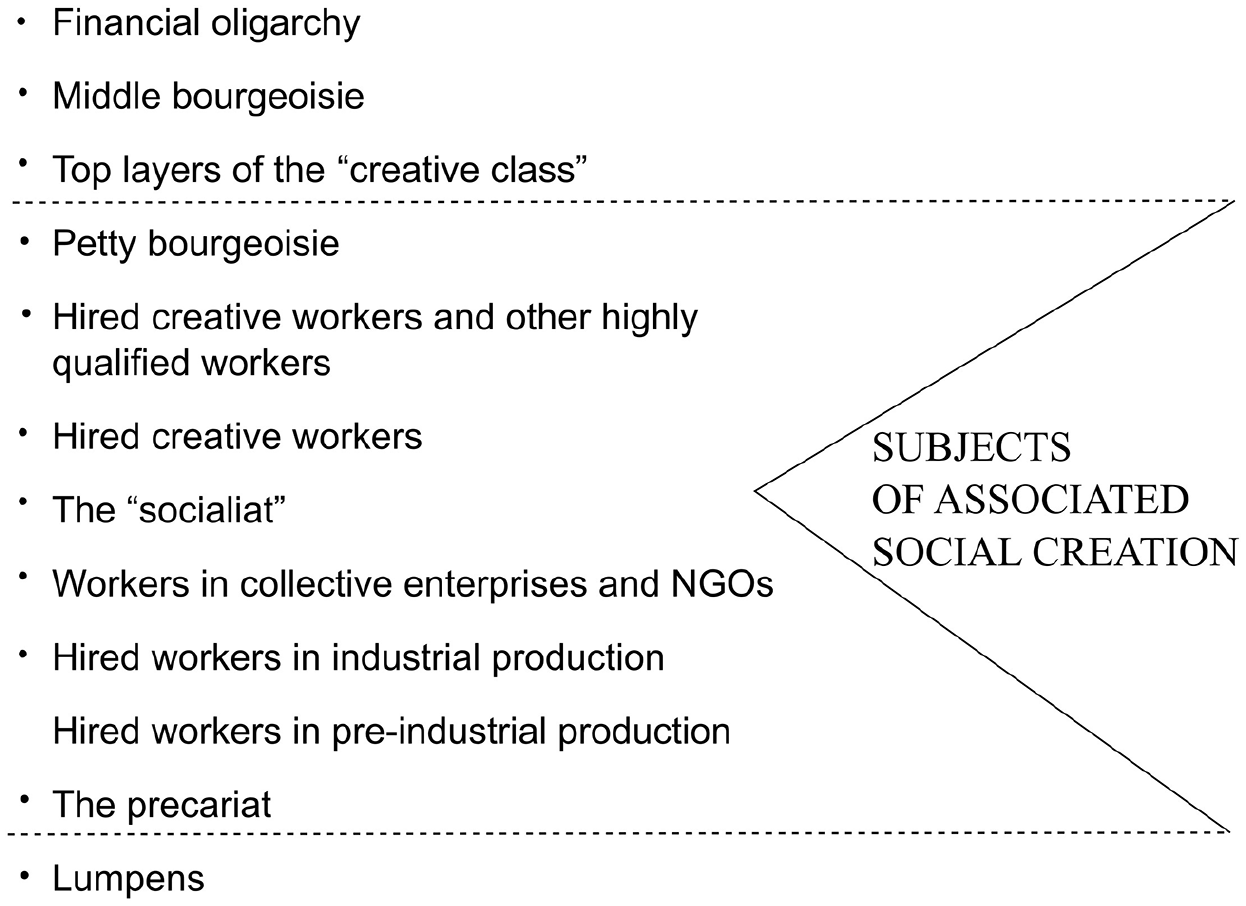
Social structure and subjects of associated social creativity.
Without question, in different countries that occupy distinct places in the system of relations of global capitalism, and that have experienced the different historico-cultural trends of development indicated earlier, the bases of social structurisation display their own considerable individual features. This cannot fail to be true of 21st-century Russia as well.
Transformations of the Social Structure: The Case of Russia
In their main features, the transformations of the social and class structure that are occurring under late capitalism are characteristic of post-Soviet Russia as well. Nevertheless, they have a significant peculiarity that others besides Russians may find it important to study; in a number of cases, the contradictions of the Russian socium indicate the possible future directions of development of world social processes with particular exactness, more clearly even than in the most developed countries. The reasons for this paradoxical situation will be explored subsequently; for the present, the main specific features of the present-day Russian society will be addressed.
These features are conditioned, first of all, by the specific nature of their historical genesis. One of the paradoxes of contemporary Russia is the fact that this relatively developed country (in its technological, social and cultural respects), with one of the world’s six largest economies, is based on a particularly ‘young’ system of productive relations. The fact is that the emergence and development of the market-capitalist socio-economic system in Russia began, for effective purposes, barely 30 years ago. Earlier, the country had experienced a brief (lasting a little more than half a century) proto-history of the development of capitalism, played out in the depths of a feudal system.
As a result, the inertia of a pre-bourgeois system of relations, dominant for more than 500 years (!), survives in our country in the 21st century. Over the centuries, the main determinants of social stratification in Russia have been the archaic relations of patriarchal-communal bonds, combined in contradictory fashion with class inequality and a system of extra-economic subjection, based on personal dependency (serfdom in the Russian empire was abolished only in 1861, but its traces remained for decades thereafter). These archaic relations also, in the main, determined the content of social groups, their structures, values and behavioural motivations, which were merely supplemented by the capitalist relations that had ripened in the depths of the old system. It was only in the last few decades before the socialist revolution of 1917 that capitalist relations became a significant determinant of social stratification and class formation.
An even greater influence on the social structure of modern-day Russia and on the peculiarities of its social strata has been the system of relations of ‘real socialism’, that existed for only 70 years but that transformed society profoundly. For the first time in the world, it created a system that in contradictory fashion combined features of the nascent ‘realm of freedom’ 11 with the dying capitalism and patriarchalism, all united by the relations of paternalist bureaucratic power (Buzgalin, 2018). As a result, the Russian Soviet Federative Social Republic (RSFSR) as part of the USSR saw the establishing of a system that was highly specific, but that created durable social stereotypes. The system included (1) the accelerated formation of a mass layer of public-sector creative workers; (2) the absence of deep social differentiation in the field of the appropriation of social riches; (3) traditions of social equality in the distribution of incomes, and of egalitarian access to wealth; and (4) the presence of a stable, active set of collectivist values and motivational goals. The result was a pattern of social stratification that was conditioned mainly by people’s position within the system of social production, and not by property relations or the distribution of income. The only people who were outside the bounds of this pattern were the members of a narrow stratum of the bureaucratic party-state nomenklatura. Right down to the present, these traits of the Soviet system exert a significant influence on social stratification in the Russian Federation.
Second, the peculiarities of present-day Russian society are determined by the nature of the social stratification that has become established in our country in the most recent decades, and that in many respects has been shaped by the specific nature of the system of productive forces and relations in post-Soviet Russia. Our country has seen the establishing of a system of relations of semiperipheral oligarchic-bureaucratic capitalism (Buzgalin and Kolganov, 2019; Menshikov, 2008; Tsagolov, 2010). In the Russian Federation in the early-21st century, the forces of production are characterised by a profound contradiction that, on one hand, has seen material production oriented principally towards crude primary products and the vigorous development of the intermediary sector, while on the other hand, the development of science, culture and advanced technologies (primarily in the defence sector) has been preserved, together with the traditionally high level of creative potential of working people.
The system of productive relations is also characterised by a whole set of transformative contradictions, combining features of late capitalism, late feudalism and the Soviet system.
In particular, these contradictions affect the essential characteristics of the class of hired workers, and especially, of hired industrial workers. In the Russian Federation, the latter have traditionally been numerous (according to calculations by the author, their overall number amounts to around 20 million people, or about 30% of the total number of hired workers). They exist, however, in a state of dual dependency, economic and extra-economic, on the owners of the means of production. First, the Russian Federation is characterised by a model of the relations between labour and capital that resembles the forms typical of industrial capitalism in the 19th and early-20th centuries, since workers in our country lack adequate mechanisms for the defence of their class interests. In particular, they do not have strong trade unions or adequate political representation; that is, they are not organised as a class-for-itself. For the most part, they continue to exhibit a paternalist-oriented model of behaviour, formed both by the hegemony of the Russian Empire over the centuries, and by the Soviet model. Meanwhile, it should be borne in mind that in the Russian Federation at present, a significant part of the industrial working class (as much as 30%) is employed in the state sector.
For the present text, the greatest interest lies in the specific features of the so-called ‘creative class’, as the social layer that is taking shape in the world as a result of the emergence of fresh shoots of new productive forces and social relations that extend outside the framework of capitalism and of the ‘realm of necessity’ as a whole. The peculiarities of the ‘creative class’ in the Russian Federation are especially remarkable, since it emerged as a leading social force under the conditions of a qualitatively different – that is, Soviet – system of social relations. By the mid-20th century, this social grouping had become one of the USSR’s most numerous (its overall numbers have been estimated at 25% of the workforce 12 ) and advanced (in socio-cultural and politico-economic respects), forming a layer, the ‘Soviet intelligentsia’, that was extremely distinctive and that requires special study.
In post-Soviet Russia, the specific nature of the ‘creative class’ is linked to the fact that this ‘class’ is made up principally of members of the socialiat, while the forms of social organising that are most typical of creative workers in the ‘core’ countries (free-lancing, private creative corporations), and the corresponding fields of activity (show business, finance, brokerage, etc.), are relatively weakly developed in the Russian Federation (by the author’s estimate, the proportion of creative workers employed in the public sector is about 50% of the total number of workers engaged in creative labour). The reason for this difference is the retention in Russia, due in large measure to the inertia of the Soviet system, of a relatively large public sector, covering health care, education, culture, defence and other areas. Here, creative workers have traditionally found employment, forming the special subtype of the ‘creative class’ that the author earlier termed the socialiat. These are the people who in Russia are described as ‘budget sector workers’.
Unlike the situation in the countries of the ‘core’, the budget sector workers in Russia mainly occupy positions in the middle or even lower part of the social hierarchy of present-day Russian society, based on the size of their incomes. Unfortunately, demonstrating this conclusion statistically does not appear possible, since in recent years, Russian statistics have substantially distorted the incomes of budget sector workers (on the whole, these distortions reflect the obligation of state structures to carry out the instructions of the Russian president to raise the salaries of the workers concerned). Meanwhile, the workers in this area, despite the nature of their work giving them the material base for taking an active position as subjects of social relations, have traditionally been profoundly subordinated to the state bureaucracy, and generally display a paternalist mode of behaviour. This results both from the historical heritage detailed earlier, and from the specific socio-economic relations of Russian capitalism, within which the key socio-economic power is concentrated in the hands of a new oligarchic-bureaucratic nomenklatura.
The socialiat in Russia, however, also has important progressive qualities. Crucial among them is a lesser degree of subordination of creative workers to private market interests than in countries with long traditions of the hegemony of the market-capitalist system. Also apparent is a greater inclination to collectivism, along with an orientation to the creating not of private intellectual products, but of social goods and other post-capitalist values. This peculiarity of the Russian socialiat is due in no small degree to the historical inheritance from the USSR, and also to a specifically Russian cultural context and content. Together, these factors make the Russian socialiat a potential (‘in itself’) social leader of the movement towards a new social system, destined to create green shoots of the ‘realm of freedom’.
With that thesis, the author would like to conclude this text.
