




Abstract
This article argues that U.S. education reforms for “failing” schools are strikingly similar to a domestic Structural Adjustment Program; and that comparing the two clarifies: how K–12 schools are neoliberalized and how neoliberalism’s key feature is the making of a larger yet less democratic state. The study contrasts with the scholarship claiming that reforms epitomized by the “No Child Left Behind Act” are neoliberal because they stem from interests in privatization for capital accumulation. The analysis focuses on a “failing” school navigating federal reforms in New York State, drawing on education policy, school documents, ethnography, and interviews. It shows how the neoliberal state took power from local school authorities, and largely did not shrink the state via privatization. This work illustrates how neoliberal reforms for “failing” schools are at least as much about power as they are about profits and demonstrates the large-scale continuity in neoliberal restructuring strategies and outcomes.
Keywords
Introduction
Twenty-first century education reforms since the “No Child Left Behind” Act (NCLB) have transformed the Elementary and Secondary Education Act of 1965 (ESEA) into a policing apparatus. The ESEA is the main federal funding mechanism for K–12 schools and goes to states’ high-poverty schools (Title I). Since NCLB, if states want this money, they must identify and intervene in “failing schools”—schools with the lowest average state exam scores. And in 2012, the federal government intensified this mandate, demanding that states take “drastic action” to improve their “failing” schools (Ravitch, 2016: 259). As a result, New York State (NYS) identified schools like the one I studied, Silverleaf High School (SHS), “failing” because its students scored very low on the state exams. 1 Once branded as “failing,” NYS began restructuring SHS to boost its students’ state test scores. The standard tools to reach this goal included extra test preparation, new security equipment, and initiatives like “cracking down” on student misbehavior. SHS had to endure state intervention until it improved, or else it could be closed and replaced with a charter school. Yet, despite over a decade of nonstop interventions, SHS has not made meaningful progress. Still, only about half of its students graduate, which is determined by their ability to pass state exams.
In this article, I argue that the nature of U.S. K–12 school reform parallels unsuccessful state reform programs called Structural Adjustment Programs (SAPs) and that comparing the two clarifies, (a) how schools are becoming neoliberalized and (b) how the key feature of neoliberalism involves a larger yet less democratic state. My argument contrasts with the dominant view that the neoliberal state is shrunken and likewise that the neoliberalization of K–12 schools is primarily a shift to privatization for corporate profit. That misinterpretation minimizes how the restructuring process allows elite state bodies take additional power. My analysis shows how neoliberalism is at least just as much about power as it is about profits.
Like with U.S. school reforms for struggling schools, actual SAPs for nation-states are improvement programs prescribing market-oriented reforms. More specifically, SAPs are state development programs for low-income countries to improve their economies; but the central feature of SAPs is conditionality (Babb and Carruthers, 2008; Kentikelenis et al., 2016; Stiglitz, 2003). Because vital funding is attached to SAPs, international governance organizations led by the world’s richest countries can force states composed of formerly colonialized populations to implement their preferred policies including privatization, austerity, and liberalization (Stiglitz, 2003: 72). Similarly, U.S. education reforms also use conditionality to impose market-oriented reforms, and they target low-income schools mainly serving youth from formerly colonized populations, a majority of whom are from low-income families (Hursh, 2007; Owens and Sunderman, 2006).
The comparison between U.S. domestic K–12 education reforms and SAPs shows how neoliberal reform is about seizing control away from local populations and placing it in the hands of elites. SAPs prioritize imposing market-oriented reforms, but also require a lot of governance to do so. This largely reorganizes the state upward rather than shrinking it because the international governance organizations deploying SAPs, the International Monetary Fund, and World Bank, are entirely public governance institutions.
My case study shows how twenty-first century U.S. education reforms for “failing” K–12 schools are largely not shrinking the state. Like SAPs, they too require enduring compliance monitoring from a more centralized powerful governance entity, the federal government in the case of U.S. K–12 schools. Both school and nation-state restructuring coercively supersedes the local governance in communities composed of formerly colonized groups; and doing so by offering essential financial support with massive restrictions attached and also promising greater independence with improvement measured by externally defined metrics. Both sets of reforms are also justified based on the claim that poor local governance explains the challenges.
In the sections that follow, I examine the nature of U.S. K–12 school reforms and how they are neoliberal, focusing on the role of the state. I then present my theoretical model of education reforms for failing schools as parallel to “domestic SAPs,” and subsequently describe a case study of New York State (NYS) to demonstrate the model. The case study shows how NYS implemented federal mandates to improve its K–12 schools over the last decade. I focus on a particular “failing” school district in upstate New York and the interventions and outcomes in this district’s “failing” high school. My analysis draws on state and federal education policy, school performance and policy implementation documents, school ethnography, and interviews with students and school professionals. My argument of the striking likeness of K–12 U.S. education reform to a domestic SAP clarifies how K–12 schools are becoming neoliberalized, and likewise how neoliberalism’s key feature involves a larger yet less democratic state.
The Neoliberalism of Education Reform
Critical education scholars tend to argue that twenty-first century U.S. education reforms epitomized by NCLB stem from elites’ interests in privatizing K–12 education through market-based policies to accumulate capital, underscoring that this is what characterizes these reforms as “neoliberal” (e.g., Fabricant and Fine, 2013; Lipman, 2011). These types of scholars stress that neoliberalism is about shrinking the state by replacing government with the private sector (Hursh, 2020). The scholarship emphasizes how the policies epitomized by NCLB to raise education standards transfer funds and students to corporations through test preparation and evaluation services as well as charter schools, which are privately managed but taxpayer funded, and often result in degrading rather than improving education (Fabricant and Fine, 2013). These scholars draw on geographer David Harvey’s neo-Marxist conception of neoliberalism, which explains the logic and practice for taking away public goods (e.g., water, education) and privatizing them for profit (Harvey, 2005). They document how this state-driven shift creates the opportunity for privatization of formerly public resources: urban public schools are neglected, branded by new state-driven evaluations as “failing” and then replaced with charter schools (Lipman, 2011). Lipman (2011) even briefly remarks that “structural adjustment” has come to the United States, but this is still to stress that neoliberal education reform pushes public education privatization.
Yet, the key features of recent neoliberal education reforms for struggling K–12 schools mainly do not reflect state-led privatization. Very few (about three percent) of “low-performing” traditional public schools are actually closed and this has been consistent throughout the post-NCLB era (Center for Research and Education Outcomes, CREDO, at Stanford University, 2017). Instead, it is the credible threat of dissolution that is the core of the neoliberal state; in this case transpired by increasing federal disciplinary governance over states’ K–12 schools. Since revisions to NCLB in 2012, the federal government compels states to identify and intervene in “failing” schools—those whose students had the lowest state exams. The state tells these schools that they can remain as traditional public schools if they meet certain external criteria developed by the state and private partners.
The overly economistic evaluation by the critical education scholarship may be due to its focus on central cities. It is likely that the very real intensity of public school closures and entry of charters in some large urban centers may be inadvertently overshadowing the more central power shift, an upward redistribution of state power. School closures have been intensely applied in places like New York City and Chicago; and case study analysis of central cities typically stresses the contestation over public resources in those settings, including charter school networks “circling” to take over (e.g., Ewing, 2018; see also, Picower and Mayorga, 2015). Charter schools mainly increase in urban districts (Ravitch, 2016: 130; see also Center for Research and Education Outcomes, CREDO, at Stanford University, 2017). Likewise, these types of scholars stress how the plight of urban schools is related to their locations in “fought-over” gentrifying epicenters (Lipman, 2011).
In contrast, broadening the analysis from large city centers to address low-income suburban schools more clearly reveals how neoliberalism in practice looks more like a domestic SAP than just a “money grab.” Low-income suburban schools are targeted with the same reforms as their large city counterparts and these distressed schools are increasingly located in high-poverty suburbs, also serving mainly Black and Latinx students (Anyon, 2014; Frankenberg and Orfield, 2012; Orfield, 2002). However, instead of being fought-over spaces, high-poverty suburbs are the unseen places many low-income people go to as cities gentrify (Kneebone and Berube, 2013; Medina, 2014; Michaels, 2020; Noguera and Syeed, 2020). Importantly, the constant federal education directives for “failing” schools are present in both types of cases (urban and small towns), and this reflects upward redistribution of power.
Yet, other critical scholars do argue that neoliberalism is mainly about reorganizing the state to one that is less democratic through upward centralization and not characteristically about shrinking the state (e.g. Brown, 2019; Fine and Saad-Filho, 2017; Wacquant, 2009). Apple (2007) has applied this argument to education: that neoliberalism is about largely state centralization, rather than privatization. Though less specific than the present study clarifies, this scholarship offers theoretical concordance in the sphere of how U.S. domestic K–12 education reform is neoliberal. Apple argues that NCLB has been a mechanism of “massive recentralization and what is best seen as a process of de-democratization” (2007: 111–112). Giroux (2004) also stresses that neoliberalism is “more than an economic theory”; it is about shifting “cultural politics,” which includes rationalizing the exclusion of some children from their education (via punitive discipline) to boost a school’s overall test scores as a key part of NCLB-style education reform policies (2004: 105).
Neoliberalism in Practice: (Unevenly) Coercive
Outside of education studies, critical scholars of neoliberalism have increasingly drawn attention to the striking contrast between neoliberal ideology and practice. This scholarship stresses that in an intentional divergence from political elites’ rhetoric around small government, “actually existing neoliberalism” uses “dramatic intensification of coercive, disciplinary forms of state intervention” (Brenner and Theodor, 2002: 5). These types of scholars maintain that neoliberalism in practice is not about the state shrinking itself (Fine and Saad-Filho, 2017; Larner, 2000). As Fine and Saad-Filho argue, “neoliberalism is not defined by the withdrawal of the state from social and economic reproduction” (2017: 690; see also, Wacquant, 2009). Likewise, this scholarship argues that the key feature of neoliberalism is political maneuvering to remake the state to be less democratic through upward centralization, and not economistic capitalist instrumentality (Brown, 2019: 64). Thus, their take is that neoliberalism as practiced does increase the role for the private sector, but also deploys a big state to manage the inclusion of corporations (2019: 82).
The abovementioned scholarship is in pointed contrast to the earlier described critical education scholarship’s analysis of how recent reforms to “failing” K–12 schools are neoliberal. The latter suggests (focusing on schools) that the key feature and incentive marking the shift to the neoliberal state is privatization for corporate financial gain. This education scholarship follows Harvey (2005). Harvey does acknowledge that the neoliberal state can paradoxically be interventionist but remains focused on the “neoliberal turn” as chiefly characterized by austerity and privatization of public goods for profit, reducing the welfare state (e.g. 2005: 45–46, 69).
To date, the neoliberal state as characteristically, coercive, undemocratic, and very much undiminished is most clearly demonstrated in the United States domestically by analysts of the growing penal state (Gilmore, 2007). This work reveals the unevenness of neoliberal governance along lines of racialized social inequality (2007). Focusing on contact with the criminal justice system, these types of scholars show that “small government” only applies to those at the top, those at the bottom receive even more government intervention into their lives (Wacquant, 2010: 214).
International analysis illustrates how coercive state intervention is a key feature of neoliberal governance and is not just relegated to the penal sphere. The International Monetary Fund (IMF) and World Bank’s expressly neoliberal state reform programs (formerly) called SAPs typify a large disciplinary state on the international scale. 2 As Brenner and Theodor (2002) maintain, the “hegemonic role of supranational institutions” like “the IMF” and “the World Bank” are used to impose neoliberal governance (2002: 13–14). As the next section will show, their strategies are also remarkably similar to U.S. education policy for struggling schools.
Education Reforms for Failing Schools as Domestic SAPs
The primary shared features of SAPs and “failing” school education reforms are conditionality for accessing essential funding for previously colonized groups and the promise of greater local autonomy if they improve by the external standards. The rules do not apply to all as a pathway for improvement, as “failing” schools nearly always serve students of color from low-income families. The reform mandates also shift government control toward one that is more “top-down” and standardized, leaving little power to local school administrators. Yet, these local managers are then told they failed even when they restructure their schools according to the boilerplate reform program—the programs are standardized “one-size-fits-all” remedies. Thus, the overlap between SAPs and “Structurally Adjusted Schools” also includes assigning the blame for failure to the local entity needing the money, whether it be nations or schools. This comparison illustrates how education reforms for “failing” schools are like domestic SAPs. The similarities I highlight show how a core element of neoliberalism is reorganization toward a big coercive state that is also unevenly widened along racialized inequalities.
Table 1 compares the “Structurally Adjusted School” to SAPs. As shown on the left side of the chart, SAPs offer funding to financially strapped countries if they implement World Bank and IMF development programs, which are led by rich countries. Since the 1980s, the IMF and World Bank designed and funded SAPs as the central poverty reduction and economic development strategy for financially struggling nation-states (Bello, 2001).
Comparing the Structural Adjustment Models for Nation-States and Schools.
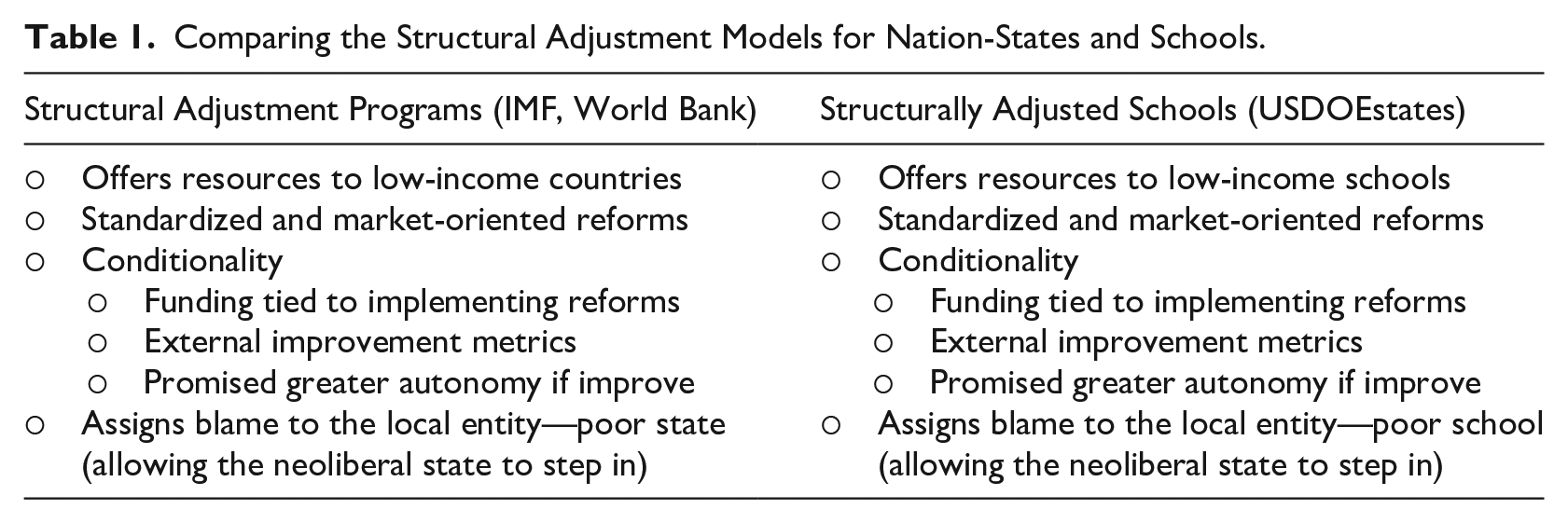
Conditionality is a key feature of what makes these programs big coercive state projects. Conditionality is central to SAPs because to get the program funding, low-income countries’ leaders must restructure their economies according to the terms of the SAP, which typically excludes using the funds to support public infrastructure even if locally deemed crucial (Stiglitz, 2003). Instead, they must use the SAP funds to restructure their economy for fuller participation in global capitalism (Weis, 2004: 466). For instance, to get IMF funding, Korea had to lower trade barriers and open its markets to foreign investment (Babb and Carruthers, 2008: 21). Conditionality is also central to SAPs because countries receiving the funds must agree to heavy compliance monitoring through structural benchmarks; the logic being that IMF or World Bank oversight and intervention along the way will inculcate “good governance.” For example, the conditions of Turkey’s 2003 IMF loan included only two performance criteria but 17 structural benchmarks to get there. The loan terms compelled Turkey to agree to regular IMF supervision and greater monitoring through “waivers” when it did not meet the performance targets (Babb and Carruthers, 2008: 19–20). In short, SAP reforms are market-oriented, but it is elite global governance entities ordering and persistently overseeing the changes.
On the right side of the chart are what I call “Structurally Adjusted Schools.” This characterizes the U.S. Department of Education policies for states’ access to federal resources for their K–12 schools predominantly serving low-income populations. Access to these funds has been conditional to agreeing to standardized federal improvement programs since the 2003 reauthorization of the Elementary and Secondary Education Act of 1965 (known as the “No Child Left Behind Act” 2003–2015). States risk losing federal funds for their Title I schools (schools with high rates of students living in poverty) if they do not comply with federal orders to improve educational outcomes, measured mainly by students’ performance on standardized tests. Thus, states agree to programs like NCLB because compliance is a condition of receiving Federal Title I funding.
The schools identified as “failing” have a greater number of students from very low-income families and more minority students compared to other Title I schools (United States Department of Education, 2010). Because poverty is racialized and most U.S. schools are racially segregated, low-income schools typically serve majority Black and Latinx student populations (Kozol, 2005; Owens and Candipan, 2019). As Noguera (2013) summarizes, “Failure rates are most pronounced in the areas where poverty is concentrated. . .[because] family income and to a lesser degree parental education continue to be the strongest predictors of academic performance” (2013: 181).
In 2012, the U.S. Department of Education “ramped up” its school improvement order with more revisions, requiring states to dramatically improve their struggling schools using standardized federal programs. State compliance with NCLB comes at a particular cost. The sanctions for “failing” schools are punitive and increase the longer the school has low performance. The sanctioned school must use a rising percentage of its federal funding allotment toward the improvement programming assigned for each year they are “failing.” The ultimate punishment is school closure; a credible threat, which has been intensely applied in places like New York City and Chicago (Ravitch, 2016).
Conditionality in “Structurally Adjusted Schools” means tying indispensable school funding to implementing and prioritizing federal-led “boiler-plate” market-oriented reform programs. These types of schools must focus on increasing students’ state exam scores and are pressed to do so by implementing market-oriented solutions like contracts with private companies to add practice tests to prepare students for state exams and train teachers. The logic is that this is fair because the standards are same and the market is more efficient.
Program Re-branding
NCLB and SAPs have been both replaced with new policies, but each leaves the basic conditions intact. Separately, the new policies claim to give more flexibility to local governance and came about as responses to public resentment. The IMF and World Bank formally replaced SAPs with “Poverty Reduction Strategy Papers” (PRSP) in 1999, claiming the new program gives more space for local governments to decide the state reform conditions. Yet, analysis of IMF policies over the last three decades shows that PRSPs do not actually change the conditions the IMF applies to states (Kentikelenis et al., 2016). 3 Similarly, the U.S. federal government replaced NCLB with the “Every Student Succeeds Act” (ESSA) in 2015 and put it into effect for all schools in 2018. The U.S. Department of Education promoted the ESSA as giving states more control over restructuring their failing schools, stressing that “states will no longer be told exactly how to evaluate schools or how to hold failing schools accountable” (United States Department of Education, 2017). Yet, the ESSA largely continues the same strategies of “test and punish” for struggling schools (Noguera, 2016).
‘Top-Down’ State Reorganization
The U.S. federal government’s approach to low-income struggling schools is to offer them funding conditional on applying its standardized reform prescriptions. The logic is that with added resources, pressure, and a standardized improvement plan, the “failing” school will improve. The federal government evaluates the school’s progress using metrics based on students’ state test scores and behavior reports, even though education experts are unconvinced that these indicators are useful measures of school quality (e.g. Au, 2009; Ravitch, 2016). These external standards devalue local metrics of school success because only the state benchmarks count toward improvement. “Failing” schools are forced to restructure to produce state-mandated metrics of achievement. If they do not meet these goals, the state will further discipline them. In this approach, any local metrics of achievement are de-valued. Instead, only the state standards matter for school evaluations.
In actual SAPs, the World Bank or IMF unilaterally decide on the indicators for improvement and the route to achieve those standards. The guidelines tend to be standardized and require directing all resources into improving outcomes the lending agencies value. The IMF and World Bank also monitor the progress and deny support along the way until certain tasks are fulfilled. For instance, to get IMF funding, Jamaica had to cut public spending, reduce wages and adopt new standardized exchange rate convertibility for trading purposes (Weis, 2004: 466). When Jamaica failed to meet the IMF’s expectations (it had rising deficits and unemployment), the IMF intensified its prescription, adding more funds along with new conditions (2004: 466). Thus, while the reform mandates were market-oriented, a central feature of the SAP was an elite global governance entity (the IMF) leading and even growing its claim to regulating Jamaica.
Racialized Reforms Programs—Who Gets the Treatment?
Colonialism also links the United States’ domestic education reform programs for “failing” schools and global SAPs. Generally, previously colonized countries get SAPs and U.S. education reform targets Black and Latinx students. The IMF and World Bank are entirely public global governance institutions and most countries have agreed to monitoring from them. Every country in the world gets an annual IMF assessment “grade” along with directives (Stiglitz, 2003). The world’s richest countries lead the IMF and World Bank, and rich countries can ignore them. For instance, when the IMF told the United States to raise interest rates to combat inflation, the United States disregarded this counsel and the economy grew as a result (2003: 49). In contrast, low-income countries must adhere to the IMF’s instructions because they depend on IMF financing.
Similarly, while technically all public U.S. schools are susceptible to state intervention, in practice only schools needing funding are forced to engage in general restructuring. As Owens and Sunderman (2006) summarize, “Only Title I schools are identified as needing improvement and subject to the law’s sanctions” (2006: 4). This is also about conditionality because schools are promised greater flexibility if they improve, and the improvement metrics are external. Thus, what school districts need to improve and the metrics to mark improvement are not decided locally. These are fundamentally the same principals and features of SAPs.
Case Study and Research Methodology
To examine the state’s role in neoliberal restructuring and the character of U.S. education reform for “failing” schools, I draw on a case study. I conducted a critical policy analysis of NCLB-style policies and their application to K–12 schools in New York State (NYS). NYS is a good case study because it was one of the first states to implement federal demands to identify and intervene in its struggling K–12 schools, including using new tests aligned with the “Common Core Learning Standards” in 2012. NYS’s early entry into shifting federal policy mandates allows for analysis of the results over a lengthy timeframe.
My case study research examines the state-led interventions in a specific “failing” school district in upstate New York that I call “Silverleaf School District” (SSD). In that analysis, I contrast SSD with the rebellion of affluent school districts across NYS serving majority white student populations to entirely “opt-out” of the NCLB-mandated standardized state tests.
To examine the case of NYS and SSD, I reviewed federal and state education policy and school program implementation documents for one of SSD’s failing schools where I also conducted a three-year ethnography. I refer to this SSD school as “Silverleaf High School” (SHS). My analysis of SHS draws on field notes from participant observation at SHS, interviews with SHS’s teachers and students, and NYS Department of Education performance data.
Conditionality: A Big Coercive State
In 2012, NYS applied for a federal “waiver” because it was not meeting NCLB benchmarks. Without the waiver, NYS would not get federal money for its schools serving many low-income students (Title I). The waiver required states to test students annually using exams tailored to new federal guidelines called the “Common Core Learning Standards” (CCLS). The waiver also required NYS to identify schools based on student achievement outcomes and their overall achievement state ranking (Reward, Focus, or Priority); NYS also had to identify at least five percent of all its schools in the lowest category (Priority). 4
To comply with the waiver, NYS overhauled its state exams to align them with the federal CCLS and required higher passing scores to graduate high school in 2013 (New York State Education Department, 2013a). Prior to 2012, NYS students could graduate high school with a “local diploma,” which had low-level exit tests and did not require passing the state exams called “Regents” (Debray, 2005). Since 2012, NYS students have been unable to graduate high school without passing five different state exams. And in 2013, the state exams became additionally challenging (CCLS aligned), making graduation more difficult. NYS then began using these new more challenging tests and higher passing scores to classify high schools. Under the new system, NYS schools where students’ average state test scores were below the state’s targets, had to undergo a state-directed school improvement process (New York State Education Department, 2012).
Conditionality: Who Gets the Treatment
Also like actual SAPs, the NCLB directives the federal government imparts are universal, but in practice the state only restructures low-income schools with many Black and Latinx students. Strikingly, in restructuring schools in NYS, 93% are students of color and 82% of these students are low-income (New York State, 2015). On the other hand, affluent schools are largely unaffected. Test scores measure affluence and affluent schools do not depend on state or federal funds (Reardon et al., 2019). 5 Affluent schools’ high local tax base frees them from needing to comply with state and federal demands to acquire funding. And, when they feel some pressure from the state, they can successfully push back. Across NYS, 20% of eligible students opted out of the state tests in 2015 and the students who refused the state exams tended to be affluent and white (New York State Education Department, 2015c).
Top-down Standardized Improvement Plans
State elites devise standardized improvement plans that “failing” schools and districts with one or more failing schools must implement. NYS uses a federal template called the “Diagnostic Tool for School and District Effectiveness,” to review its “failing” schools, and then selects a District Comprehensive Improvement Plan (DCIP). The DCIP is an approved federal waiver program for Focus or Priority Schools, (aka “failing” schools). For example, one DCIP option is the “Turnaround Model,” which gives the school a three-year federal grant with the funding attached to specific reforms. Most of the DCIP indicators are students’ test result metrics, but they also include student behavior metrics, measured largely by reducing the incidents of student misbehavior, as a tool to improve academic achievement (New York State Education Department, 2013b: 8). 6
NYS’s reform programs’ use of student behavior metrics was also shaped by a section of NCLB, called the “Unsafe School Choice Option.” This section required states receiving ESEA funds to prove that their schools were safe by providing increased and standardized numbers gauging their safety level (violent incidents) based on federal benchmarks. To comply, states had to make new school safety laws (United States Department of Education, 2004). Consequently, NYS passed the “SAVE Act” (Schools Against Violence in Education), which created a uniform violent incident reporting system for NYS schools using Penal Law’s definitions of crimes (New York State Education Department, 2004). The SAVE Act also increased schools’ ability to remove “disruptive” students and not count these sanctions as suspensions (Ferrara, 2004). 7 As a result, many low-level school violations were treated more punitively.
The Case of Silverleaf School District (SSD)
Silverleaf School District’s (SSD) sole high school (“SHS”) is one of its schools on probation for academic performance nearly every year since 2005. NYS had labelled it “failing” because its students scored “too low” on the state’s exams. The state’s plan was that schools like SHS undergo one of their standardized improvement programs. The neoliberal state’s promise (justification) had been that this top-down temporary new management with a plan would get SHS on the right track and with compliance, SHS leadership would regain control of its school. Yet, restructuring did not help SHS. Still, just half of its students graduate which is now determined by their ability to pass state exams. The short-term extra resources, the execution of state-led standardized and market-oriented reform plans tied to those funds did not help, neither did the state’s pressure to improve. So, SHS continues to have more state-led interventions. As one local SHS community member and GED educator put it in a fall 2019 conversation, “The state is running that school now.”
SHS’s history illustrates why “structural adjustment” does not work. SHS had not always been low performing by state standards. Even into the early 2000s NYS’s past evaluations of SHS indicated that it was still in “good standing” with the state’s expectations for school quality. But, from the mid-2000s onward, it became a “failing” school: students’ graduation rates dropped and it failed the new state student performance standards. In part, SHS became a “failing” school due to the altered state standards themselves. As said, the new exams were harder for students to pass. From the state’s view, it was just “raising the bar.” Yet, most educators saw the new exams as problematic: they narrowed curriculum, reduced local control, offered insufficient implementation resources, and fixated on rebuking schools for noncompliance; they also claimed the tests were badly designed (Ravitch, 2016).
But SHS also became a “failing” school due to the combination of school funding and assignment policies, as well as a regional demographic transition. In short, SHS became “failing” when most of its students were from high-poverty households. This demographic shift was also racialized; almost all SHS students are Black or Latinx. Because affluence and segregation continue to sharply influence academic achievement (Reardon et al., 2019); this population shift was accompanied by a drop in attainment outcomes, exemplifying the enduring “opportunity gap” for children’s educational outcomes (Welner and Carter, 2013: 3). Like national trends, Black and Latinx students at SHS have lower rates of academic achievement than white students, especially for standardized tests.
Historically an integrated white and Black community, gentrification in New York City pushed more working-class Black and Latinx families into suburbs like this one. From the 1990s to the present, new Black and Latinx families came to SHS; and as this happened, more white families also left SHS. Even in 2000, one in four of SHS students were still white; by 2015, that number dropped to just one in ten. The proportion of low-income SHS students also increased during this same period. By 2012, four out of five SHS students were low-income. The rising poverty rates among SHS students meant that the school district increasingly had limited funding because of the low tax base; like most districts in NYS, local school funding comes primarily from property taxes (New York State Education Department, 2016: 5). 8 As a result, Silverleaf School District depends on state aid for two-thirds of its total budget.
Conditional Funding
In the post-NCLB era, Silverleaf School District’s state funding (as serving mainly low-income students) has had huge restrictions on how the money can be spent because SHS is a “failing” school. Also because of its high-poverty and “failing” status, SHS has applied for and received short-term federal “School Improvement Grants” to “improve” by state program benchmarks. The sanctions for improvement are also fierce because of NYS’s participation NCLB’s “waiver” option in 2012. SHS’s teachers and administrators could be fired, or the school could be shut down if its students’ state test scores did not improve. Under these conditions, it is unsurprising that four out of five teachers were either worried or very worried about their job security due to the students’ low performance on state or local tests. 9
Importantly, the same reform policies impacted schools differently: low-income schools struggled to meet state benchmarks, so they had to agree to state-led restructuring. Yet, in the school districts adjacent to SSD where the student population is mainly white and middle-class, none of the schools were being restructured, or even under pressure to comply with the state’s mandate that all students take the state exams. In these affluent districts nearby SSD, 40–50% of students of the students opted-out of NYS tests. In contrast, as a “failing” school district, SSD needed a high percentage of its enrolled students to take the state exams for its evaluation and hardly any of the students in the SSD refused the state exams. 10
The Pressure at SHS
The state “reforms” directed SHS professionals and students to work under intense pressure to produce specific outcomes determined of value externally, which also resulted in a newly punitive work/school experience. Their views reveal this new situation. As one teacher named Mr. Robertson explained, “The pressure that we have from the state obviously goes to our superintendent, down to her staff, down to the administrators in the building, and then down to teachers, and then down from teachers to the students.” He continued, “The state expects teachers to sprinkle our special dust on these kids. . . [and] if we haven’t sprinkled that dust on them, then we are bad teachers. And that is stressful; especially if the state is saying, this is something that can be used to get rid of teachers, or what they call ‘bad teachers.’” This view was shared by the vast majority of SHS teachers.
Likewise, the students reported that because teachers had to greatly increase the time students spent practicing for the new high-stakes tests, it left little time for anything else. Most of the students were like Marisol, who stated, “[The teachers’] only focus is getting you ready for the Regents [state exams]. And they constantly bring it up, they like [for example]. . . ‘hurry up so we can finish this, so we can practice for the Regents.’” The new curriculum to improve the students’ state exam scores, and satisfy the state’s orders, was mainly more tests. And the students stated that the state’s prescribed test drills were not for their scholastic benefit. Instead, students tended to frame it as Carly did, “There’s a lot of new testing the students have to do for the state” [emphasis added].
SHS students’ accounts also revealed how the state’s pressure put intense stress on students and school professionals to produce state-valued achievement metrics through arduous test drills and harsh penalties for under-performance. As a student named Martín stated, “The school’s doing their best to just focus on getting the test scores passing so that state doesn’t take their jobs and hire new people.” He explained that if the students’ test scores did not go up, “the state will get to us. . . [The state] will actually have to shut the school down [and] that’s what the school is trying to avoid.” Martín’s observation was accurate, dissolution was a credible threat if SHS students’ state test scores did not improve. Like all of the SHS students I met, Martín adversely perceived the pressure the school professionals experienced to improve the students’ test scores. To him, the elite state was a burden to fend off and not helpful for students. And the teachers I met agreed with their students. As a teacher named Ms. Holden stated, “The people that make the rules over there in Albany, [need to] actually stop and think. . . I do believe education is the key to success, but it is becoming more and more difficult [because of them].” Not one of the SHS students or teachers that I met thought the state improvement programs were good ideas; instead, they claimed these reform programs undermined students’ learning. Thus, the threat of school privatization is a process for removing local control, and not just a general neoliberal government hand-off to private profiteering.
Interventions at SHS: Market Orientation, via Top-Down Program Conditionality
SHS’s reform programs reveal the elite state’s newly influential role in supervising its introduction to corporate products. SHS purchased corporate contracts through the state’s prescribed improvement plans called “District Comprehensive Improvement Plans” (DCIPs). SHS had nonstop DCIPs. As a “failing” school, SHS had to contract with certain state-approved corporations to provide new test preparation materials, which would qualify as required extra non-state tests. The state required templates and review process memos for its implementation and the school district had to fill out the form using a drop-down menu. The 2014–2015 DCIP, “goal number one” was “Academic Achievement.” One state “approved” product SHS purchased was the “MAP” (Measure of Academic Progress), an online test intended to prepare students for the actual state exams and evaluate the teachers (New York State Education Department, 2015b, 2018). 11
Like the other new test training products resulting from the state’s improvement programs, implementing the MAP test created problems. For one, it was a high-stakes test for the teachers. The teacher ratings created from students’ MAP test scores have resulted in teachers’ dismissals in several states including New York (New York State Education Department, 2018). These test results also have a larger impact if the school has a Title I “School Improvement Grant” like SHS did, where its improvement plan includes a new process for removing teachers. This restructuring condition compelled the SHS teachers’ union to agree to a modified union contract, allowing them to be more easily be fired based on students’ MAP exam scores. The contract changes enabled these scores to have greater weight on the teachers’ evaluations than before and any teacher with a low rating twice had be removed from the classroom.
Understandably, the new threat of removal and other sanctioning exasperated impacted SHS teachers. As a visibly rattled teacher named Ms. Temple described to me one afternoon, she was on “probation” because of her students’ “inadequate” scores on the MAP test. It frustrated her because it meant participating in extensive timewasting extra meetings and reports for her state-led “Teacher Improvement Plan,” which took away time that she needed for lesson-planning as a newer teacher. She also explained that, since this new precarious position, she found herself “snapping at kids because [she] was so stressed.” Ms. Temple then decided to leave SHS for a different nearby school that was not “failing.” As is common for struggling schools, turnover among SHS teachers and administrators was high.
New “Safety and Security” Products
New testing products, pressure, and time spent on test drills were not the only key changes in daily life at SHS via its state improvement plan; “Safety and Security” was “goal number two” in its abovementioned 2013–14 “District Comprehensive Improvement Plan” (DCIP). 12 This is striking because SHS did not have a violence problem according to its own records. 13 This DCIP element required SHS to raise student attendance and lower their suspension rates by enhancing “school culture and climate.” Following federal and state guidance and using the federal grant money attached to its reform plan, SHS purchased new student monitoring technology and metal detectors. It also installed new surveillance technology, added non-teaching security staff, and police patrol in 2013. As one school professional named Joni described some of the security intensification, “There’s double doors where there used to be single doors last year; they search everyone’s backpacks. . . There’s a larger number of security officers.” She summarized, “Everything in this school is organized around security.” During my time at SHS, I noticed that the bathrooms, lunchrooms, classroom and hallway passage, and school dress code were all strictly managed with the support of police, security staff, and new technologies, including student-tracking computer software and comprehensive security cameras.
The main outcome of expanded securitization was that students were patrolled even when they managed to avoid being punished. As a student named Claudia explained, security had gotten “tighter” and “stricter” than it was formerly. Previously, school adults would urge you to get to class if you were walking in the hallways when class was in-session. She contrasted that former scenario with the new “crack down” approach to managing students’ behavior. She stated, “Now it’s like, if you don’t have a pass [when you are in the hallway], you going to the principal’s office, detention for sure, or in-school suspension, that strict.” She described the new discipline system as initially “crazy” because so many kids were suspended. Yet, she accepted the change, stating finally, “We got the hang of that, which is good.” The decision-making process to implement school safety practices at SHS is complex. Yet, school policy documents show that the primary aim was to lower student misconduct. And, like the efforts to increase academic achievement at SHS, the new security and discipline practices were also part of the school’s state-led “failing” school reform program.
The school shift toward “cracking down” on student behavior to safeguard against any possible major student misbehavior incidents was at least partially due to its compliance with state directives. And as earlier said, this move was also partly due to a NCLB section, which coerced states to standardize and prioritize a narrow version of school climate and be audited for compliance. This change paved the way for new corporate profits, but it also reflects an increase in elite state power over schools like SHS, especially incentivizing metrics and mediums to both audit schools and resulting in greater carcerality in “failing” schools. Thus, from security to testing products, SHS’s new use of private businesses did not shrink the state’s role, instead they were simply included in the shift toward a larger coercive elite state presence.
Deepening the Conditionality: The Receivership Program
The state intensified its efforts to reform SHS in 2015, providing it with new short-term funding attached to a more aggressive improvement plan through the “New York Education Transformation Law.” This new law created a receivership program allocating extra funding for intensified school reform programs and broadening state power to restructure “failing” schools, aiming for them to improve according to NCLB accountability standards (New York State Senate, 2015: 5). In its first year, the receivership program impacted 144 schools including SHS. These schools were under state pressure even before the new law. But the receivership made school closure an imminent threat if students’ test scores did not improve, putting new fear and pressure on all the schools’ stakeholders. As one receivership superintendent put it, in an interview with the NYS School Boards Association, “The state is expecting these schools to make things dramatically different in a short period of time when all the state is threatening them with is a bigger stick” (Woodruff, 2015). The law placed schools in the lowest five percent of the state that had been so since the 2012–13 school year in “receivership,” a ranking that was largely based on the students’ low state test scores (New York State Education Department, 2015d, 2015e). It also allowed NYS to assign an external manager to run the school for three years and this person could supersede any local school policies, dismiss all school employees, or request a new modified collective bargaining agreement (New York State Teacher’s Union, 2015).
Being under receivership forced SHS to accept the terms of an even stricter improvement program: forgo local control and allow extensive restructuring. As their (then) superintendent, Ms. Dobbs, asserted in a public statement, the receivership would “intensify” their existing reform program. It required SHS to make “demonstrable improvement” in student attendance, state test scores and various discipline indicators (New York State Education Department, 2015a). NYS specifies which indicators are available for selection and then chooses most of the metrics for the individual school (New York State Education Department, 2015f). 14 Thus, the improvement mandates shifted government control toward one that was more “top-down” and standardized, leaving little power to local school administrators. This outcome is predictable: NCLB-style reforms were created based on the assumption that schools’ problems are managerial, which justifies ignoring local leaders and bringing in consultants (Downey et al., 2008).
Yet, SHS’s student outcomes did not improve as a result of the receivership. And while SHS’s local leaders had little power, they were blamed for the failure, not the improvement programs. In response to the incredible pressure they were under—and largely seeming to be trying to buy time and stave off state inspectors—the school’s leadership broke the rules to increase students’ test scores and graduations. This outcome is the case in many struggling schools (Ravitch, 2016). In 2016 the graduation rate went up at SHS enough to get NYS to remove it from the receivership program. Yet, by 2018 SHS’s graduation rate was back to its former lower levels. This drop occurred after a 2017 state inquiry into SHS’s graduation data found widespread “improper and questionable” graduations, leading to the removal of nearly all top school administrators. Strikingly, even when the graduation rate “improved,” it was still so slight that SHS stayed in non-compliant status as a “focus school” in the bottom five percent of NYS, keeping it under increased state scrutiny to improve its students’ test scores. Thus, attaching badly needed resources, because of historical and contemporary structural inequalities, to participation in punitive restructuring programs decided externally did not help raise the students’ test scores.
The SHS school administration’s collective view in a state document also reveals the stark contrast between the reform program they were given, and their chief concerns as well as the approach they would like the state to take to support them. In the last quarter of receivership, the SHS school administration completed a mandatory state survey evaluating its experience with the program. In this document, their central demands were that the state provide “flexibility with grant allocation to support the diverse needs of each school,” that the state “work directly with schools,” and provide opportunities to witness “high-performing districts/schools demonstrating effective practices” to model. Their requests are clearly the opposite of the standardized federal approach taken, which like SAPs involved a “one-size-fits-all” ahistorical plan that excludes how “good” schools have succeeded.
The school leaders summarized SHS’s unmet needs. These unmet needs contrasted with the temporary, restrictive and insufficient state funding offered for “failing schools.” They cited their utmost unmet need as adequate, sustained, flexible funding. They framed this desired funding as an issue of unaddressed “equity,” describing how this funding could help their top needs of addressing “staff turnover” and “supports for high-needs populations.” SHS was supposed to get free from state oversight by participating in the receivership program. Yet, like international SAPs, it did not work, and so SHS persists under the supervision of endless state-led reform programs.
As the case of SHS showed, no one thought the state’s programs were good ideas, local administrators and teachers had little choice in deciding how to implement them, and the school was no better off than before the reforms. The only thing that changed was the school leadership (and many of the teachers). Many of the personnel who could “voted with their feet,” and many of those who stayed were later removed for trying to cheat in a situation where they were set up to fail. Like with SAPs, the process of reforming “failing” schools allows the (elite) neoliberal state to define the problem’s key areas, how to address them, and then place all of the responsibility on the local school officials to meet those external metrics. The neoliberal state takes responsibility, but this is defined by labelling the problem, making audit-style demands for how to improve and offering temporary resources to do so.
Conclusion
I have argued that NCLB-style programs for struggling U.S. K–12 public schools are strikingly similar to a domestic SAP, that comparing the two clarifies how schools are becoming neoliberalized, and likewise that this shows how neoliberalism’s key feature involves a larger yet less democratic state. The main way that education reforms are like SAPs is by offering conditional support to financially strapped schools with many working-class Black and Latinx students. The only way to get essential funding is to aggressively pursue the ordered boilerplate and market-centric strategies. This strategy assumes that the obstacles to success (academic or fiscal) are managerial problems, and not resource based. Yet, when the school does not “improve,” a new round of directives mandate more restructuring with the same basic priorities and strategies. The rules are impersonal but rely on collective acceptance that some children deserve one type of education and other children deserve another. That agreement is key to allowing the “indiscriminate” policy structures to continue to normalize inequality because everyone technically gets the same treatment.
The analogy of SAPs and recent U.S. education reforms does have limitations. Restructuring a country is different than reorganizing a school, especially regarding the larger scale and complexity of the reform programs for nation-states. Remaking international trade policies and removing food subsidies is different from bringing corporate personnel, standardized tests and security products into schools. As well, the state funding schools receive is not a loan. SAPs require that nation-states repay the funding they receive even when the SAP fails to improve their economies. Still, the analogy remains meaningful. While schools do not have repay the money there are other acute outcomes, a “Structurally Adjusted” school can be terminated and the replacement can be a for-profit charter school with no local influence at the helm. And crucially, these policies to raise education standards often produce more disadvantage for already disenfranchised student populations by making their education even worse than it was before (Darling-Hammond, 2007; Fabricant and Fine, 2013; Michaels, 2020). Likewise, basic measures of well-being (e.g. poverty, education and health rates) tend to be the same or worse after the SAP (Bello, 2001; see also, Greer, 2014).
There is no “settled definition of neoliberalism” (Brown, 2019: 17). Yet, my argument contrasts with the view of neoliberalism as primarily “shrinking” the state, resulting from privatization to offer opportunities for capitalists’ financial gains. Much of the critical education scholarship has stressed how capitalist profit incentives drive the overtly “neoliberal” K–12 education reform policies; suggesting that NCLB-style policies embody a shift to privatization of formerly public assets, including authority over K–12 public schools (e.g. Fabricant and Fine, 2013; Hursh, 2020; Lipman, 2011). This scholarship draws on Harvey (2005), suggesting that the neoliberal state takes a smaller role for the private sector to lead (Harvey, 2005: 79). In contrast, scholars like Fine and Saad-Filho (2017: 690) explain, neoliberalism does not typically reflect state retreat. Yet, this type of insight still overly stresses the financial incentives, in effect, masking the role of political motivations. As Apple (2007) pointed out in general terms, NCLB has de-democratized K-12 education through “massive recentralization” of power (2007: 111–112). Through my analysis of the neoliberalization of K–12 education reform for distressed schools, focusing on NYS and one of its targeted schools, I suggest that the neoliberal state’s role as practiced was a least as much about removing local power as it was about generating profits.
My analysis illustrated how the neoliberal state is driven by a political rationality for public sector elites to take power away from local school authorities primarily serving previously colonized groups. This “aid” for previously colonized groups is based in a politics that is not simply a money grab but a controlling and harmful redeployment of governance that is less democratic. NCLB and its sequel (ESSA) put political teeth into allowing the federal government to claim it was dealing with the racialized social injustice of the poor quality of education many children of color received. Both critics and supporters labelled this approach “neoliberal,” because it induced a larger role for markets in public education. Yet, in practice the state did not shrink, instead it has changed into an (unevenly applied) disciplinary apparatus. This audit culture of NCLB-style policies is about transitioning leadership from local officials to public sector political elites, claiming have superior knowledge to solve educational inequities.
The comparison between two very different types of explicitly neoliberal cases, Structural Adjustment Programs and twenty-first century federal education reforms for “failing” K–12 schools, reveals the colonialist nature of these power grabs. In both cases, the target is communities composed of previously colonized groups. It illustrates both how state elites think that the reason schools are struggling is “poor leadership” and so they should lead, and then, in the name of improvement, prescribe a punishing type of education for the children in “failing” schools that they would never agree to for their own children. It also demonstrates large-scale continuity in neoliberal restructuring strategies and outcomes. There have always been school inequities that hurt Latinx and Black students, but the “Structurally Adjusted” School uses additional means and examining the likeness of the program’s structure to a domestic SAP helps to explain why these types of school improvement strategies do not work. To correct the harms these reforms policies engender, especially as it applies to addressing existing social inequalities in education, future scholarship on neoliberalism can pay more attention to issues of democracy in the public sector, rather than the almost exclusive focus on private profit incentives.
Footnotes
Acknowledgements
I am grateful to the students, teachers and staff at “Silverleaf High School” for sharing their time and knowledge with me. I also thank Carolina Bank Muñoz, Ruth Milkman, David Brotherton, Philip Kasinitz, Daniel Buffington, Peter Ikeler, Daniel Douglas, Brenda Gambol, as well as the editors and reviewers at Critical Sociology for their helpful comments on earlier drafts.
Funding
The author received no financial support for the research, authorship, and/or publication of this article.
