



Abstract
This article aims to explain the political-economic character of the increasing suicides in Turkey since 2018 that stem from indebtedness, poverty, and unemployment. It frames the acts as economy-relevant suicides to emphasize the embeddedness of these suicides within the neoliberal transformation and its consequences at the global and national levels. In this regard, the study traces the trajectory of neoliberalism in Turkey from 1980 to the COVID-19 pandemic, and critically evaluates the political and economic decisions of the Justice and Development Party (AKP) government to reveal the causal links with the increasing number of suicides. The study argues that two aspects of neoliberalization have paved the way for the post-2018 suicides: the declining political and economic power of the working class and the outcomes of financialization such as long-term unemployment and indebtedness. Thus, it argues that economy-relevant suicides are pathologic but depict political character, regardless of their effectiveness as a political strategy, given the consequences of the neoliberal transformation and political choices in due course.
For suicide, formerly the enviable privilege of the upper classes, has become fashionable among the English workers, and numbers of the poor kill themselves to avoid the misery from which they see no other means of escape. Capital therefore takes no account of the health and the length of life of the worker, unless society forces it to do so. Its answer to the outcry about the physical and mental degradation, the premature death, the torture of over-work, is this: Should that pain trouble us, since it increases our pleasure (profit)?
Introduction
In this study, we aim to question the context and meaning of rising suicide rates in contemporary Turkey, especially since 2018. To this end, the study includes two inquiries: (1) exploring the relationship between neoliberalism in Turkey and suicides by emphasizing the effects of the former, such as the declining political power of the working class, changes in labor relations with implications on indebtedness, extreme poverty, and long-term unemployment; (2) analyzing suicides in Turkey as part and parcel of global trends. We believe that discussing where, when, and how suicide is performed would expose the neoliberal rationality that produces death.
Working-class suicide has spread globally. Waves of suicide are often framed as psychological, individual, pathologic, and emotional by local, national, and supranational organizations and governments (see similar critique; Alt, 2019: 43–44; Badami, 2014: 97; Chan, 2013: 86; Stamenkovic, 2014: 265; Taylor, 2015: 191; Waters, 2015: 506). Pathologizing self-administrated deaths and depoliticizing the underlying causes are common reflexes that can also be traced in the Justice and Development Party’s (AKP) 1 response to suicides following the 2018 crisis in Turkey. According to a report by the opposition party, the number of worker suicides increased by 300% in 2018 compared to 2013 data, and the official data indicate an increase about 38% in suicides for economic reasons between 2017 and 2019. 2 Moreover, these increasing numbers are accompanied by the spreading publicity of the tragic suicide cases in the opposing media. That is why, the AKP’s strategy is not to reject the phenomenon, but to depoliticize these suicide cases based on neglecting the socio-political background of the acts, which is the deterioration of economic conditions due to political preferences and the experience of poverty, unemployment, and debt misery. Thus, the reasons for suicide are presented as individual, pathological, and purely psychological. 3 Our interrogation of contemporary suicide cases is fundamentally a critique of this depoliticization. The term ‘economy-relevant suicides’ is used to point to the socio-political background of these suicides, as the suicidal subject is not an innate category (Taylor, 2015) and it is socially constructed.
This study draws upon the growing concerns about recent economy-relevant suicides with different causal links. While some scholars in this literature focus on the impact of the Eurozone crisis and austerity in Southern Europe (Agathangelou, 2019; Davis, 2015; Gounari, 2016; Madinos et al., 2014; Stamenkovic, 2014; Waver and Munro, 2013), some address the housing crisis in the United States (Jones and Pridemore, 2016). Although some inquire about the role of the changing labor regime (Chan, 2013; Lin et al., 2016; Waters, 2015), others focus on the environmental, social, and economic crises in rural relations (Alt, 2019; Badami, 2014; Kaushal, 2015; Münster, 2012; Shah, 2012; Taylor, 2012).
Related to them, this study dwells on the rising wave of suicides within the context of neoliberal transformation, which affects labor relations with strong implication on deepening poverty. In capitalism, working classes constantly face major challenges in their lives with potentially lethal consequences, such as the dependence of their reproduction on the market due to the separation of the labor from the means of production, and the exhaustive labor processes. However, neoliberalism, in response to the problems of profitability and accumulation under capitalism, has exacerbated these challenges with a new wave of dispossession, generalized precarity, persistent unemployment, and over-indebtedness. Although the wealth effect caused by the financial mechanisms of neoliberalism, such as the expansion of credit, can obscure the link between neoliberal transformation and working-class suicides, the sustainability of personal debt leading to over-indebtedness in the context of changing labor relations stimulates the economic distresses paving the way to suicides. This study argues that the main reason for the spread of suicides in Turkey can be better understood and explained by referring to the neoliberal transformation that has worsened the workers’ living conditions by depriving them of the political means to resist and publicly express their demands. This paper will thus show how the neoliberal transformation, on the one hand, deprives the working class of its political means and, on the other hand, burdens indebted individuals and paves the way for voluntary death when debt is no longer sustainable.
The article consists of three parts. In the first part, we describe the methodology of the study. Then, we address the neoliberalization process of Turkey to answer the question of how this neoliberalization has prepared the death production in contemporary Turkey. Finally, we examine the economy-relevant suicides by dividing them into categories. To do so, we first divide these acts into protest suicides, dignity suicides, and debt-, poverty-, and unemployment-fueled suicides. We then focus on suicides during the COVID-19 pandemic to reveal how the pandemic worsened the situation for the working class while the state was indifferent to these deaths. This categorization is based on an analytical division and helps to understand how the suicides in Turkey speak to us for exposing the lethal face of neoliberalism.
Methodology: How Suicide Talks
For our understanding, economy-relevant suicides can be defined as an outcome of contemporary capitalist relations resulting from changes in the labor regime, financialization, economic crises and austerity policies, and the political isolation of the workers as a whole. The dimensions of the economy-relevant suicides are, as expected, social and psychological. In other words, the path that drives the individual to voluntary death consists of the destruction of both social relations and the psyche of the individual. These dimensions are manifested in the destruction of social and family relations, deprivation, poverty, loneliness, depression, hopelessness, insecurity, and a sense of shame and loss of dignity because one sees oneself as a failure. However, separating the psychology of the suicidal subject from the economic and political background is still a preferred option in the literature and policymaking. By using the term economy-relevant suicides, which emphasizes the underlying economic and political aspects, we distance ourselves from this preference.
We admit that the psychology of the suicidal subject has a significant impact on self-administered death. Nevertheless, it would be equally wrong to deny the importance of the sociological background of suicide cases; indeed, the psyche of the suicidal subject is not independent of socio-economic factors (Azeri, 2019: 890; Taylor, 2015; Waters, 2015: 506). Ignoring the effects of capitalism, or psychologizing suicide, creates a discourse that accuses the victim of being ‘weak’ (Alt, 2019: 43; Badami, 2014: 97; Taylor, 2015: 191). Psychologizing links suicide to the idea of ‘pathology’. Even though these people live in similar circumstances of poverty and despair, the suicidal subject becomes a ‘victim’ of pathology because they are not resilient. Such attempts by policymakers and corporate leaders can be observed, for example, in the cases of French Télécom (Waters, 2015: 206), Foxconn in China (Chan, 2013: 86, 92), or farmer suicides in India (Alt, 2019: 43–45; Badami, 2014). For our account, economy-relevant suicides are the result of violence in neoliberal transformation, including deprivation, poverty, indebtedness, and political and psychological despair. Therefore, both the body and the psyche of the suicidal subject are the objects of this violence.
Moreover, Durkheim’s (2005) distinction of suicides does not help us to categorize the economy-relevant suicides, as they are not an expression of excessive individualization or altruism of the individual. Durkheim’s anomic suicides, which occur during major social transformations, are closer to economy-relevant suicides because these suicides represent an anomaly of capitalism. However, based on the given examples above, the economy-relevant suicides compose a global phenomenon, so these suicides are not anomic expressions in contemporary societies, but they arise at the core of social relations.
Steve Taylor (1982), in distinguishing the types of suicides, emphasizes the conversation or ‘dialogue with others’ through the other-directed suicides. This type of suicide act turns its face outward to address the public and call the witnesses (Taylor S, 1982: 172–178). Economy-relevant suicides, then, are more than ending a life in silence (Waters, 2015: 503). They articulate a language for the subject whose voice and body are excluded from the social order. It is a communicative act that conveys a message of despair and protest (Andriolo, 2006: 102; Badami, 2014: 93; Münster, 2012: 198). Listening to this message provides an opportunity to uncover the economic and political background of voluntary death.
The communication with society can take various forms, such as the location of the act—whether it is public or private—the manner in which the subject ends his/her life, or the notes left behind. Thus, the conversation may not directly refer to a collective cause or accusation (Stamenkovic, 2014: 263). The political character of the communication emerges from these forms or the ‘aesthetics of suicide’ not in the sense of a ‘judgment of beauty’ but as a ‘discourse of body’ (Allen, 2009: 171), which is nothing other than the form of communication. To understand this highly politicized discursive field, we need to expose the connection between the discourses of these suicides and the violent mechanisms that surround the subject and drive him/her to suicide.
In addition to defining the term, the methodology requires an explanation of the data related to the economy-relevant suicides. We reached 4 a total of 283 suicides and suicide attempts by workers in Turkey between January 2018 and August 2021 through scanning the websites of four opposing national newspapers (Birgün, Evrensel, Cumhuriyet, and Sözcü), three local newspapers from the province of Kocaeli, 5 one opposing national TV channel (KRTTV), and one Twitter account on working-class news in Turkey (@yasarustaportal). During our search, we used the keywords ‘intihar’ (suicide), ‘işçi intiharı’ (worker suicide), and ‘işçi intihar teşebbüsü’ (worker suicide attempt). Many suicides are reported without stating the explained or suspected reasons. For this reason, we include cases of suicides in our discussion only when there is a direct reference to indebtedness, poverty, unemployment, wage problems, or economic hardship.
Finally, we started our study in 2018, because after the economic crisis economy-relevant suicides achieved high level of publicity. This can be seen in the frequency of tragic suicides and the increasing focus on the worker suicides by opposition parties and civil society organizations. During this period, four different reports were published by the largest opposition party, the CHP, 6 and a report from Musician-Union (Müzik-Sen) 7 and a non-governmental organization (NGO) (İSİG–Health and Safety Labor Watch/Turkey). 8
A Historical Account of the Neoliberalization in Turkey
The increasing number of suicides in Turkey in the post-2018 period cannot be explained without referring to the development of neoliberalism. In this section, a brief historical overview of the neoliberalization process is provided to lay a foundation for the upcoming discussion on the current phenomenon of economy-relevant suicides. Historically, the process includes three phases: (1) the introduction of neoliberalization from 1980 to 2001, which was accompanied by the suppression of the political and economic power of the working class and the creation of a new form of financialization based on arbitrage opportunities through the financing of the public deficit; (2) the neoliberal consolidation from 2002 to 2018, coinciding with the AKP rule, labor reform, the decline of working class struggle, and increasing personal debt; and (3) the crisis in the post-2018 period, in which political and economic instabilities are manifesting themselves as financialization is no longer sustainable in Turkey. Two developments within this historical process highlight the reason for the economy-relevant suicides. On the one hand, the political and economic power of the working class is dwindling due to the weakening of trade unions and the restriction of class struggle (strikes, rallies, etc.), as well as the transformation of labor relations (precariousness). On the other hand, stagnating wages and increasing unemployment are compensated by the indebtedness, which exacerbates economic hardship and explodes the number of economy-relevant suicides. Thus, the economy-relevant suicides are based on poverty and deprivation, as well as on the disorganization of labor and the silence of workers to express their living conditions.
The threshold of neoliberal transformation in Turkey, which is the Structural Adjustment Program (SAP) of 1980, was the response to the economic and political crises of the late 1970s. The SAP aimed to stabilize the crisis by spreading anti-class and non-antagonistic policies through de-unionization and depoliticization of the labor’s conditions. Another goal of SAP was export-oriented growth, which included promoting exports through wage pressure, integrating into the global economy to attract foreign capital, and spreading the market-driven economy (Bozkurt-Güngen, 2018: 223; Çelik, 2015: 620; Yalman, 2009: 306). As the program met political resistance and failed to solve the economic and political crises, the military coup followed on 12 September 1980 to pacify the socio-political opposition through legal, economic, and violent measures.
After the coup, unions were shut down, and strikes were forbidden. Extra-economic coercion upon the working class was followed by the legal transformation 9 limiting collective rights and ‘legal’ political activities such as unionization and strikes. Developing authoritarian statism that narrowed down the space of the politics (Akçay, 2019; Bedirhanoğlu, 2019) further oppressed the political capacity as ‘non-legal’ practices such as slowdown, occupation, rallies, and boycotts (Çelik, 2012: 114). Although mobilization against the neoliberal transformation can be found in various instances in the late-1980s and early-1990s, neoliberalization continued at an unsteady pace.
In the case of integration into the world economy, foreign exchange markets, trade regulations, and capital accounts were liberalized in the 1980s, and a speculative arbitrage opportunity was created through public deficit financing (Akyüz and Boratav, 2003). In the form of foreign loans, the speculative capital inflow created an unstable macroeconomic environment that manifested itself in cycling waves of crises, and stagnating real wages, which were utilized to solve profitability problems and export promotion, which worsened the conditions of the working class.
The last of the cyclical crises, the twin crises of 2000 and 2001, represents a threshold in Turkey’s neoliberalization. These crises paved the way for the rule of the AKP in 2002. As for the economy-relevant suicides, the most important changes in the neoliberal framework are replacement of public debt with household debt, the legalization of labor market flexibility, and the AKP’s authoritarian policies that suppressed workers’ political agency (Akçay, 2019: 55–56; Bahçe et al., 2016: 276; Çelik, 2012: 108).
The silencing of the political voice of the working class can be seen in the declining unionization by almost 75% between 1986 and 2011 (Çelik, 2015: 629). Similarly, workers’ legal and non-legal political practices have been weak, exceptional, and ephemeral, even in the most influential strikes 10 due to problems in organizing and mobilizing, and the AKP’s negative attitude toward the labor movement, which includes strike postponements and police deployments (Bağımsız Sosyal Bilimciler (BSB), 2015; Çelik, 2012; Yalman and Topal, 2019). The deteriorating working conditions are legalized by the neoliberal reform of the labor market, characterized by the 2003 Labor Law, which introduced flexible employment such as subcontracting, part-time work, and fixed-term contracts (Bozkurt-Güngen, 2018: 230; Çelik, 2015: 624). According to Senem Oğuz (2020: 118), between 2004 and 2013, the share of the stagnant surplus population, which involves ‘extremely irregular employment’ (Marx, 1992: 796) such as precarious, flexible, part-time, temporary and intermittent employment, in active workforce increased from 68% to 74%. These working conditions decreased job security, and thus drove the workers to despair by isolating them.
In addition to the dwindling power of the working class, there are economic hardships related to the financialization and deindustrialization of the Turkish economy, which most notably reflected in unemployment. While economic growth between 2002 and 2008 was 6.68% (BSB, 2011: 43), it was a jobless growth tied to capital inflows, consumption, and financial mechanisms (Bahçe et al., 2016: 276; Orhangazi and Yeldan, 2021: 468). Figure 1 11 shows that unemployment has become a natural condition for labor in Turkey. The dispossessed masses that emerged from the neoliberal transformation of agriculture are on the margins or outside of the labor market, and economic growth is not a solution for them. During the growth years of the 2000s, unemployment rose from 10.9% in 2000 to 18.3% in 2010 (BSB, 2011: 44–47; Table 1).
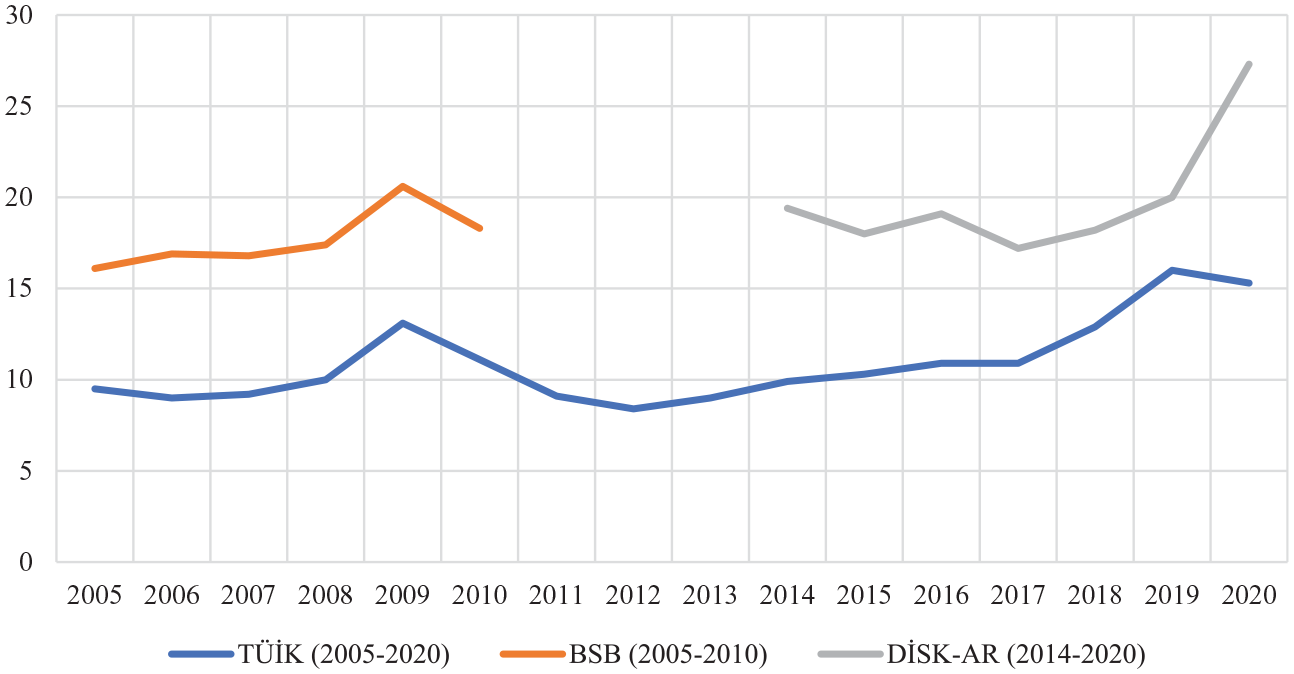
Unemployment rate in Turkey (2005–2020).
The AKP’s usage of debt mechanism at the same period through extending the financialization to the working classes has succeeded in fabricating consent of the working class, as workers rely on debt to meet their needs (Karaçimen, 2015: 159–160; Orhangazi and Yeldan, 2021: 485). During the 2000s, the rising household credits took place with the decreasing private savings therefore ‘consumption grew faster than income, and households, especially from low income groups, resorted to borrowing for further consumption’ (Bahçe et al., 2016: 284). The average physical (only involves food, shelter, clothing, and transportation) minimum expenditure per capita to average income per capita in 2011 shows that many social groups, especially low-income earners, require compensation mechanisms to live a dignified life 12 (Bahçe and Köse, 2018: 54; BSB, 2015: 186).
Figure 2 shows that household credit as a share of gross domestic product (GDP) increased from 2% in 2001 to 19.5% in 2013. However, the expansion of credit opportunities is not a solution to income volatility and poverty, but rather exacerbates these problems. For example, between 2003 and 2012, the ratio of household debt to household disposable income increased sevenfold to 48.8%, and the share of household liabilities in household assets increased from 8.5% to 49.4% (Karaçimen, 2015: 22). Moreover, the increase in debt is not evenly distributed across socio-economic groups. Since low-income earners are much more affected by poorer working conditions, unemployment, and income fluctuations, they are more dependent on credits. For example, the share of indebted poor (whose income is between 0 and 2000 Turkish Liras) in the total number of indebted people increased by 20% in 2005 and peaked at 70% in 2009 (Akçay, 2017: 60–61).
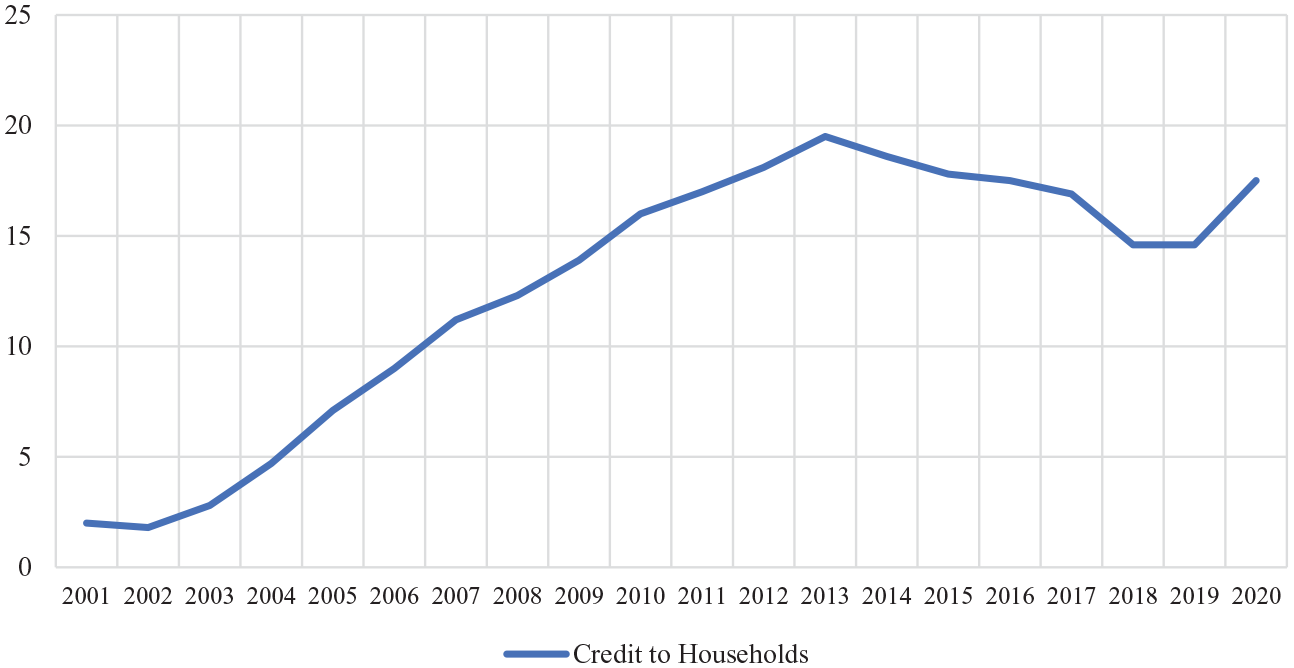
Household credits’ ratio to GDP (2001–2020).
In 2013, when the global liquidity became scarce, the social and economic consequences of unsustainable neoliberalism and debt became apparent in the form of bankruptcies, inflation, and unemployment (Bedirhanoğlu, 2021: 77; Orhangazi and Yeldan, 2021: 487). The AKP postponed the crisis by seeking new channels for capital inflow, expanding state-sponsored lending, and suppressing social and political opposition by widening practices of authoritarian statism, as evidenced by police violence and the 2 years state of emergency following the failed coup attempt in 2016. Nevertheless, the crisis erupted in 2018. Currency depreciation during the crisis 13 led to a wave of bankruptcies among small and large companies, as the proportion of debtors in foreign currencies was high. Moreover, defaults were followed by rising unemployment and inflation reached 25% during the year (Orhangazi, 2020: 215). According to DİSK-AR (see Figure 1), broadly defined unemployment increased from 19.4% in 2014 to 27.3% in 2020. At the same time, the crisis period sustained the growing number of people who cannot pay their loans, by almost 26% increase in the total number between 2017 and 2019. 14
Economic conditions favoring suicides were exacerbated by the COVID-19 pandemic. In addition to declining economic and industrial activities, sectors such as tourism, transportation and entertainment, and small businesses became more vulnerable to the economic turmoil because of the lockdowns. Due to the adverse impact of the 2018 crisis on the fiscal capacity, cash support remained quite low, and the government pushed for a new wave of deepening household credit to solve debt and income problems. Thus, while many individuals in the aforementioned sectors continued their spending during the lockdowns without income, they were deprived of cash assistance or bailouts. As Ali Rıza Güngen (2021) states, ‘[t]he insufficient cash assistance was topped up with supportive loans. From 1 April 2020, until the reopening of the economy in mid-June, almost 7 million individuals applied for basic needs credit (with limits up to 10,000 TRY)’ (p. 5). The solution to economic hardship during the pandemic further incited the vicious cycle of debt and income problems, leading to more suicides.
Thus, the neoliberal transformation from 1980 had two consequences that led to economy-relevant suicides of the working class. The first is the political weakening of the working class, manifested in the decline of class struggle, solidarity, and unionization. During this period, some major class struggles were unable to create concrete political demands against neoliberalism or sustained solidarity. The second consequence of the neoliberal transformation is the deepening of financialization through credit. The financial instruments introduced were presented as wealth and welfare mechanisms, in other words as compensation for the AKP’s neoliberal policies. However, under conditions of rising unemployment, stagnating real wages, and dwindling job security, financial mechanisms such as loans and credit cards are unsustainable and unmanageable for the low-income earners. Therefore, they further increase the burden on the working class. These two developments, the weakening of the labor movement and debt, thus illustrate the link between the neoliberal transformation and the economy-relevant suicides in Turkey after the 2018 crisis.
Suicides After the 2018 Crisis
The growing problem of suicides in Turkey became more visible after Sıtkı Aydın’s attempted self-immolation on 13 January 2018. The event marked the beginning of the increasing tragic cases of suicide due to the 2018 crisis, as evidenced by the fact that the number of suicides due to economic hardship increased by more than 38% from 2017 to 2019. 15 This section discusses these suicides following the 2018 crisis within three categories: protest, dignity, and debt-, poverty-, and unemployment-relevant suicides. Although these categories overlap in suicide occurrence, they are separated according to the predominant emphasis within a specific case for analytical clarification.
As mentioned earlier, the chronologically first case, Sıtkı Aydın’s attempted self-immolation in front of the Parliament, is essential as it reveals the operating mechanisms and instruments of neoliberalism. 16 Before the suicide attempt, he was no longer able to work because he had injured himself while working at a construction site due to a lack of safety precautions. During his hospitalization, he was persuaded and deceived by the general director, who promised him a ‘blood price’ in exchange for not pressing charges. To describe his situation after treatment, Aydın said, ‘They threw me away like a dead dog’. He sued the company, but the case was never closed for 5 years. Moreover, he could not earn the money he needed because of his incapacity after the accident. So, he applied for a loan from the bank. Due to his working conditions, he could not repay the loan. Therefore, the interest on his debt had increased. As a result, Aydın fell into a vicious cycle of debt that fueled poverty, despair, anxiety, and exhaustion. As a last chance, he turned to the Parliament, hoping to find someone there who would listen to his story and help him. However, he was prevented from doing so by the police, and he decided to burn himself to death. The story that led Aydın to self-immolation is not an individual story, but an example of the death-producing machine of the ‘blood-sucking vampire’ (Marx, 1992: 342). It is not a mere suicide attempt due to psychological reasons and economic conditions, but rather an organized murder in slow motion by the consequences of neoliberal transformation. Aydın’s act is in a way a call for ‘public concern’ (Andriolo, 2006: 107) when there is no other way out but to ‘sacrificing himself’ (Taylor, 1982: 191). Thus, it is a protest suicide that conveys a message in a situation of permanent despair and poverty under the violence of capitalist institutions (Münster, 2012: 198). However, Aydın’s sacrifice of his body through self-immolation is not based on higher religious or political ideals, as is the case with the hunger strikes and self-immolation by fire of political militants. Rather, it is an attempt to give voice to the working class that has been condemned to silence. Aydın’s suicide is thus also a message to the neoliberal transformation in this silence. Here, the body became the form of the message as the cry of the people abandoned to death demanding a dignified life.
Two weeks after Aydın’s suicide attempt, another unemployed man, named Muhterem Birgül, tried to burn himself to death in front of the municipality hall. 17 Birgül, as a former convict, had applied several times to the municipality for employment, but he received no response. As a member of the criminalized poor masses under the neoliberal regime (Wacquant, 2001), he witnessed the discriminatory anti-labor discourses, lack of solidarity, and exclusion from the stable and formal work channels. The violence he faced and the resulting despair and hopelessness drove Birgül to the decision to self-immolate. In addition to these two cases, a farmer in Malatya brought his crops to the bank where he had taken out a loan and could not repay his debt. 18 After the pressure and harassment from the bank for repaying the debt, Metin Çelik, the farmer, could no longer withstand it and tried to burn himself with his crop while shouting: ‘You [the manager] did not accept whatever I offer. You kept saying, “Bring the money”’. Similarly, another farmer in another city went to the same bank to apply for loan structuring because he could no longer pay the loan. However, his application was rejected, whereupon he began to burn himself. 19 In a similar period, an unemployed man tried to burn himself in front of the parliament building but was convinced by a member of the opposition party. 20 In addition, a father in front of the governor’s office in Hatay and another in front of the parliament building attempted to self-immolate by shouting, ‘My children are hungry’. 21
A similar story to that of Muhammed Bouazizi 22 in Tunisia occurred in Erzincan but was forgotten in complete silence. Yavuz P was a street vendor and earned his family’s income by selling corn. The city police confiscated his small wheelbarrow of produce, after which he decided to burn himself to death. 23 In Turkey, however, the event never made the media headlines and was eventually forgotten, with no public anger or protest. In this respect, Yavuz P’s self-immolation did not resonate in society. During the wave of suicides in the working class, one stood out, not because of the story, but to show how capitalism destroys people’s hopes for the future. Furkan was an 18-year-old boy and committed suicide after writing ‘I do not want to spend my years on a house, a car, or anything else’. Furkan’s suicide was an individual revolt against capitalism’s vicious cycle between work and consumption. 24
We count 24 public suicides or suicide attempts from January 2018 to August 2021. All reports of these events are about long-term unemployment, debt, and despair and misery due to poverty and isolation. These acts are important to show that there is no hope for the future to escape the current conditions of persistent poverty, lack of political power, and structural violence. They can be seen as a cry for help and revelation of loneliness. This cry refers to the people and processes responsible for the situation. Although there is no direct reference to the capitalist logic of those responsible, and no note is left, it can be said that the choice of public space for voluntary death shows the desperation. For, as Biehl (2001: 134–our emphasis) describes in his discussion of the abandonados, ‘[t]his is a socially authorized death, mundane and unaccounted for, and we partook of it in our foreign and native gazing, in our blend of learned indifference, sense of intolerability, and failed witnessing’. The failure of exchange with society in protest suicide is indicative of neoliberalism’s success in dividing society according to the ‘value of the life’ and transforming suicide into a socially authorized death. Thus, neither society nor the state cares about the meaning of these lives. These lives get their meaning precisely in these zero lines of ‘no value’ and ‘no care’. This section of society is considered worthy of living in constant poverty, debt, depression, misery, and hopelessness. However, dying by suicide does not necessarily lead to a significant change or threat to the neoliberal logic (Alt, 2019; Davis, 2015: 1022), and this is also true for Turkey. Protest suicide does not refer to direct liberation. As long as the message conveyed is not exchanged with society and the terror and burden of capitalism remain silent, the reproduction of the devaluation of people’s lives continues.
The second suicide category, dignity suicides, does not differ significantly from protest suicides in terms of the socio-economic conditions into which it was born. The key difference is that dignity suicides are collective suicides. Thus, they are not individual choices, but voluntary deaths of family members. We use the term dignity to describe them because the fear of collective impoverishment is prevalent in these suicides, which eventually leads to collective self-administered death. In other words, under these conditions, there is no belief in redemption for the individual or family members. Although these suicides are not dominant compared to other types of suicide, it is worth noting that there is no sign of hope for these people left to die. For example, in December 2019, four siblings (aged between 48 and 60) committed suicide by cyanide poisoning in Istanbul. 25 Two of them had been working in temporary jobs and had recently been laid off, and another brother was ill. Two days before their suicide, the company had cut off their electricity because they had not paid their bills. In the meantime, they went into debt with the grocer to buy bread for their daily living, and when they could no longer afford the debt, they decided to kill themselves. In this story, debt is not about wealth or consumption, but about survival. The family’s decision to die was to preserve dignity and honor in the face of the shame and guilt of being in debt and poor. Three days later, another family with two children was found dead by cyanide poisoning after failing to pay rent. 26 One week after, another family in Istanbul with one kid was found dead with cyanide poisoning due to their debt. 27 In another case, a family with a one-and-a-half-year-old daughter decided to commit suicide because of financial problems. 28 As a result of this wave of family suicides in silence (without note), the government refused to appoint a parliamentary commission to investigate these events, but banned the sale of cyanide to the population. Instead of acknowledging the socio-political background and messages of the suicide, people blamed the relaxed regulations on access to cyanide and individualized, criminalized, and pathologized the events. However, it can be said that the lives of these people driven to despair were surrounded by capitalist organizations such as privatized services, banks, flexible working conditions, and the state itself. In other words, in the case of the dignity suicides, the political background appears as the terrorizing effect of the abandonment by neoliberalism.
Esha Shah (2012) notes that fear of impoverishment plays an important role in farmer suicide in India because ‘[b]ecoming a pauper would mean loss of social dignity’ (p. 1172). Since dignity is earned and maintained with respect for others in society, the impoverished know they will no longer have a place in society. The neoliberal transformation not only changes the economic and political structure, but also affects social values (Erdoğan, 2016). It changes the perception of impoverishment and the poor in the eyes of others. Neoliberalism transfers the responsibility for failures (impoverishment, bankruptcy, and unemployment) to individuals. The bitter fate of the poor results from individual and irrational choices (Lazzarato, 2017: 37 ff.). Thus, impoverishment is detached from its social and political background, and the poor are blamed for their tragic fate. In this sense, poverty reinforces the feelings of shame and guilt that result from failure. In dignity suicides, death presents itself as the end of the loss of honor.
Elizabeth Davis’ (2015) separation of ‘good death’ and ‘bad death’ is very helpful in understanding dignity suicides to preserve family honor and dignity. The key point of separation is to prioritize ending life over finding food in the trash and living with shame and guilt. According to Davis, (2015), ‘the indignity at stake was associated not with death but with the lives they had been leading: their impoverishment and desperation, and especially their inability to repay debts’ (p. 1021). The indignity dehumanizes the victim of poverty as a form of dishonor, indigence, dependence, and scavenging. It is nothing other than the process of animalization (Biehl, 2001: 133). The good death becomes the limit that prevents the subject from becoming an abandoned animal in society. In the fear of animalization, death becomes the only way to preserve dignity. In other words, the logic behind the idea of the ‘good death’ is that suicide is the last chance to preserve dignity, as economic hardship not only threatens the maintenance of daily life, but also destroys the dignity of the self.
The other suicide category is debt-, poverty-, and unemployment-relevant suicides, which more directly emphasize these consequences of neoliberal transformation. Because of unemployment, Tolunay C committed suicide with the note ‘It is up to here’. 29 Around the same time, Ramazan K and Egemen Ş committed suicide because they could no longer pay their debts. 30 Two people in different cities listed their debts to banks and committed suicide after exposing the violence of financial capitalism. 31 In Aksaray, a young adult set himself on fire with oil due to poverty and deprivation; he exchanged his phone to buy the oil he burned himself with. 32 In Çorum, two people ended their lives on the same day. One of the wives left behind told the police, ‘We have no bread to eat at home’. 33 These suicides and their proximity in time should not be considered a coincidence. Debt, unemployment, deprivation, and depression are common to all these suicide cases at the moment of crisis. Erman Ö also killed himself with a note of ‘No one is responsible for my death’ when an attachment order was served. 34 During the same days, in Kocaeli, seven young workers committed suicide within a week. 35 The burden of unpayable debts locks those affected in a cage with no hope of escape. This is what happened to Levent A, whose debts reached a level of TRY400,000. He decided to kill himself as a way out and hanged himself at his workplace. 36 There are many more examples of how debt can drive a person to death. For example, a 41-year-old textile worker killed himself because of his debts to his relatives, 37 or a 65-year-old man took his own life because of his TRY20,000 debt after attending his grandson’s wedding. 38 These suicide stories show that suicide presents itself as a solution to financial problems rooted in indebtedness, and that unemployment and debt are everyday experiences that can no longer be endured. Turkey’s jobless growth through financialization has increased systematic debt immeasurably. As Pınar Bedirhanoğlu (2021) states, ‘[i]ndebtedness of the working classes has helped them preserve and even improve their consumption abilities while neoliberalization process as a whole have taken away their political intervention capability by systematically weakening their organized power vis-à-vis the capital’ (p. 76). To put it simply, the spread of household debt, combined with changing labor relations, fluctuating incomes, and the weakness of the working class eventually led to a vicious cycle of economic problems and psychological deprivation. In particular, the weakening of the working class not only affected the ability to intervene in economic and political events, but also destroyed solidarity among its members. The isolation of working-class members eventually led them to abandon their struggle in the face of these economic and psychological hardships. These conditions were exacerbated by the COVID-19 pandemic, which brought new economic and political difficulties.
The Suicides During the COVID-19 Pandemic
When the COVID-19 pandemic emerged after the 2018 crisis, the AKP was not prepared to handle the burden of the pandemic financially, especially in terms of providing financial support. As the economic lockdown is not sustainable under the economic conditions in Turkey, production was not stopped and no significant efforts were made for the health of workers in factories as part of the pandemic measures. Moreover, in the first months of the pandemic, the AKP issued a decree that allowed companies to put their workers on unpaid leave or to pay short-time allowances (which are only 60% of the daily wage) by giving a daily fee of about 40 Turkish Liras, which was an impossible amount of money to live on. This decree was issued for the benefit of companies, so they employed their workers without pay or with reduced wages. At the same time, gig and day-to-day workers, as well as small business owners affected by the lockdown, are ‘supported’ by the increasing supply of credit, which further increases their economic burden. Moreover, the lockdown measures have further hindered social and political solidarity by insisting on isolation at home.
Thus, the AKP’s policy decisions have increased the causes of economy-relevant suicides during the pandemic. For example, a 49-year-old bus driver ended his life during the COVID-19 quarantine by leaving the note, ‘Living conditions are too hard. I cannot stand it. Forgive me; I love you’. 39 The pandemic mostly affected precarious workers who depend mainly on daily, monthly, or seasonal income to survive. One seasonal worker, Fedai Kuşçu, did not receive his wages because he was quarantined. 40 Therefore, Kuşçu could not repay his loans. After giving his wife the last money in his pocket, TRY12—about USD1 back then—and saying ‘goodbye’, he jumped from the balcony and ended his life. In another case, 29-year-old Emre Salsan, a tourist guide with one child who had been unemployed for a year, committed suicide because he could no longer bear the financial difficulties associated with unemployment. 41
As mentioned earlier, lockdown also affected small business owners, as there was no financial support. A coffee shop owner in İzmir, Nuri Çengeloğlu, was unable to pay his debts due to the fluctuation of income during the lockdown and the repossession orders sent to his house. With no hope of repayment and increasing uncertainty due to the pandemic and the economic situation, Çengeloğlu put an end to his life. Similarly, another coffee shop owner in İzmir, 50-year-old Erdal Şenözpak, shot himself in the heart in his coffee shop. Şenözpak suffered from depression due to unpaid rent and debts. 42 Another small business owner who ended his life under the burden of debt and daily financial problems is Murat Gümüş, who owned a fast-food shop. On social media, he wrote, ‘Day after day, I return to the house without earning a penny. Will you visit my grave when I die?’ and first sold his car to pay his debts. After selling his car, he hanged himself in front of his house. 43 Without significant financial support, these people cannot withstand the economic instabilities resulting from the pandemic. These suicides, then, are not the result of individual deprivation, but rather the consequence of neoliberal policy choices associated with increasing inequality and precarity. As Harootunian (2004) points out, capitalism constantly produces inequality and unequal developments, and this has not changed in the face of pandemic measures (p. 122). In Turkey, corporate profits are also rising to their highest levels ever, while suicides are down to the proportion of those who have no support due to capitalism’s unequal development.
Amid the lockdown, the entertainment sector was hit hard as the AKP ordered bars, pubs, and so on to be closed for reasons of social isolation even after the lockdown ended, and also banned social events such as weddings and concerts. Workers in these sectors did not receive significant financial support from the government, even though they were unemployed. Therefore, musicians have been affected worse than any other group of the working class and deserve special attention. According to statistics from the Musician-Union, nearly 100 musicians committed suicide since the beginning of the pandemic. 44 These suicides should not be considered individual story; rather, they show how people are abandoned to death. For example, a musician from Istanbul named Duran Ay ended his life after 9 months of unemployment. 45 Similarly, Erdem Topuz, another musician with two children, was unemployed for 11 months and took his own life due to his financial instability. 46 Drummer Mehmet Mert El, who was unemployed for a year, also took his own life. The long-term unemployment of musicians put them in considerable financial difficulties. Some can endure it by selling their possessions, such as cars or houses, but those who have nothing to sell are forced to live with the burden of debt. Another example is pianist İlyas Tetik, who could not find a solution to his financial problems even after selling his car and eventually took his own life to end these problems. 47
During the pandemic, suicides lost publicity and importance to the state and society as fear and increased attention to the daily death toll due to the COVID-19. Moreover, the AKP promoted the credit opportunities without significant financial support. The death of the working classes has grown due to debt and deprivation. In this context, it should be noted that the death of people for economic reasons is not a moral issue but the political decision of the AKP. As Nicos Poulantzas (2014) argues that the state is a condensation of the class struggle, the working class is the weaker side in this struggle in the post-1980 period. If the AKP’s increasing authoritarianism is accompanied by the weakening of the working class under neoliberalism in terms of oppression of any working class, it is clear why no political struggle has developed in society against the class character of the pandemic measures.
In conclusion, to analyze capitalism today, we should consider it not only as a sum of economic relations, but also as a social relation. In other words, to understand capitalism, the interaction between economic and non-economic social relations is crucial (Streeck, 2012: 4). The suicides in Turkey take their place in this intersection. On the one hand, economic relations such as indebtedness or unemployment drive these people to suicide; on the other hand, the social interactions of these economic relations such as self-worth, dignity, isolation, and depression put the subject in a ‘hopeless’ situation where life becomes worthless. Thus, the economy-relevant suicides in the post-2018 period in Turkey result from the AKP government’s long-term neoliberalization process and the economic crises that terrorize the lives of workers in the capitalist mode of production.
Conclusion
Fatmir Haskaj (2019) mentions that ‘simple abandonment of populations into the deliberate killing of populations for profit, in other words, the transformation of surplus populations and the unemployed and unemployable into death-subjects’ does not only let them die, but actively kills them during the process of their creation (p. 1156). Therefore, various forms of killing and death, such as suicide, are an integral part of neoliberalism. The lethal nature of global neoliberalism cannot be separated from ‘global financial growth and accumulation of goods’ (Stamenkovic, 2014: 302). Similarly, due to the long process of neoliberalization, Turkey has joined the global suicidal economy as much as it is part of the global financial economy, as the post-2018 suicides show.
This study has clearly asserted that the suicides of the working class should not be seen as a temporal and individual problem, as the policymakers and politicians claimed, but as a result of long-term neoliberal policies and consequences of structural decisions regarding wages, unionization, employment levels, and types of employment. Before the 2018 crisis, the AKP had already paved the way to death 48 with its acceleration of neoliberalization in the forms of work accidents 49 and suicides. Following the changes in global capital flows in 2013, neoliberalism was proven unsustainable by the AKP aggravating the burden to the working class (bankruptcies, poverty, and deprivation), and deteriorating the macroeconomic situation (inflation, currency depreciation, unemployment, etc.), which led to suicides of members of the working class. Moreover, this period was accompanied by the decrease of the political power of the unions vis-à-vis the AKP, as well as by increasing authoritarian practices of the AKP, manifested in police violence and legal changes, which silenced collective opposition and mobilization against these transformations. The declining political power of the working class during this period led to isolation, loneliness, and the destruction of the political means to express their anger and despair. People’s despair became even more unbearable after the 2018 crisis, and the economy-relevant suicides gained increasing publicity.
This study fills the gap in the literature on how the long road of neoliberalization has driven the working class to death in the case of Turkey. As mentioned earlier, these self-inflicted deaths not only point to the deteriorating conditions of the working class over time, but also emphasize how indifferent society has become to these deaths. The material conditions of neoliberal policies have paved the way to the cases of voluntary deaths, especially after the 2018 crisis. These conditions include not only the deterioration of income, unemployment, and over-indebtedness, but also the absence of any public sympathy and social and political solidarity. Without solidarity and conveying messages to others, despair and abandonment fuel suicidal acts. In that regard, the isolation of the working class should be considered as important as financial policies during the neoliberal period to understand these suicides. Therefore, exemplary categories such as protest, dignity, and debt-, poverty-, and unemployment-relevant suicides show that Turkey is not exempt from the discursive, practical, and political effects of neoliberalism that lead to the global suicide epidemic.
Footnotes
Acknowledgements
The authors are grateful to Ömür Birler, Özge Yakut, and two anonymous reviewers for their constructive criticism, comments, and suggestions.
Funding
The author(s) received no financial support for the research, authorship, and/or publication of this article.
