



Abstract
Introduction
Driving in late-life is important to independence and well-being, and driving cessation is associated with an increased likelihood of depression (Ragland, Satariano, & MacLeod, 2005) and worse health status (Edwards, Lunsman, Perkins, Rebok, & Roth, 2009). The number of older drivers increased by 23% in a recent 10-year period (1999-2009), and the trend is expected to accelerate as the population ages (Centers for Disease Control and Prevention, 2011). Currently there are more than 34 million older licensed drivers (National Highway Traffic Safety Administration [NHTSA], 2012). These older drivers face multiple threats to driving fitness due to normal age-related physical and cognitive changes, the increased risk of chronic diseases, and the medications used to treat them (Carr, Flood, Steger-May, Schechtman, & Binder, 2006; Mann, McCarthy, Wu, & Tomita, 2005). These threats to driving fitness are associated with negative crash outcomes. Specifically, in 2009 approximately 187,000 were injured and more than 5,000 fatally injured in car crashes (NHTSA, 2012).
As an adaptation to changing abilities, some drivers modify the amount, frequency, or distance driven, whereas others cease driving altogether. While senior transportation research has identified a number of risk factors for driving cessation (e.g., age, gender, race, vision impairment, cognitive impairment; Choi, Mezuk, Lohman, Edwards, & Rebok, 2012; Dugan & Lee, 2013; Edwards, Bart, O’Connor, & Cissell, 2010; Owsley & McGwin, 2010), the role of psychological factors (e.g., personality) in continued driving is not yet known.
Personality is defined by the American Psychological Association (APA) as “individual differences in characteristic patterns of thinking, feeling, and behaving” (APA, 2014). One of the most well-established and widely used conceptual models of personality is the Big Five Factor Model (McCrae & Costa, 2008). The Big Five Model focuses on five personality traits: neuroticism, openness to new experience, extraversion, agreeableness, and conscientiousness. Neuroticism is the tendency to experience unpleasant emotions easily and is sometimes referred to as emotional instability; extraversion is associated with significant engagement, assertiveness, and sociability; agreeableness is the tendency to be compassionate, cooperative, trusting, and helpful; conscientiousness is the tendency to show self-discipline, act dutifully, and plan; openness to experience is associated with intellectual curiosity, creativity, and a preference for novelty and variety (McCrae & Costa, 2008). Research to explore what, if any, role personality may play in driving cessation is needed.
Personality and Driving
Traits such as extraversion, neuroticism, impulsivity, and low self-control have been linked to driver safety problems in young and middle-aged adults (Dahlen, Martin, Ragan, & Kuhlman, 2005; Lajunen, 2001; Lawton, Parker, Manstead, & Stradling, 1997; Renner & Anderle, 2000). Clarke and Robertson (2008) found that both neuroticism and extraversion were associated with accident involvement and argued that extraverts are especially susceptible to accidents when they are performing monotonous tasks that require sustained attention. Low conscientiousness has also been found to be associated with risky driving behavior in college students (Schwebel, Severson, Ball, & Rizzo, 2006). Agreeableness and conscientiousness have been found to be predictive of reduced road rage and driving aggression, while extraversion and neuroticism were associated with increased road rage (Britt & Garrity, 2006; Dahlen, Edwards, Tubre, Zyphur, & Warren, 2012). Other research found that agreeableness was associated with a lower number of driving tickets and both at-fault and not-at-fault accidents (Cellar, Nelson, & Yorke, 2000). Risky (Dahlen & White, 2006) and aggressive (Benfield, Szlemko, & Bell, 2007) driving has been associated with being low in openness. Conversely, Arthur and Graziano (1996) found that openness was associated with at-fault accidents.
Research on personality and driving in late-life is limited, and the few studies that consider personality tend to use driving performance as an outcome rather than driving cessation. For example, Owsley, McGwin, and McNeal (2003) collected data from older licensed drivers in a single state (Alabama) and measured personality with Eysenck’s Impulsivity Inventory (Eysenck & Eysenck, 1978), driving errors and violations, and the number of driving trips made in a week. They found more driving errors for drivers with higher impulsivity and empathy, and lower venturesomeness. Similarly, Schwebel et al. (2007) studied driving performance on a sample of drivers aged 75 and older in Alabama (n = 101). The measures used were the Adult Temperament Questionnaire (Derryberry & Rothbart, 1984), the Sensation-Seeking Scale–Form V (Zuckerman, 1994), and a virtual driving task. They reported that sensation-seeking was associated with greater driving violations and tickets, and undercontrolled temperament was associated with overall risky driving. Biernacki and Tarnowski (2011) studied 160 Polish drivers and found neuroticism had a moderating effect on driving performance, such that neuroticism increased the influence of age on declines in cognitive driving performance tasks. Finally, McPeek, Nichols, Classen, and Breiner (2011) studied a convenience sample of 50 older drivers, using an on-road assessment of driving behaviors and performance, self-rated driving ability, and the Myers-Briggs Type Indicator (MBTI) Step III instrument. The results of this exploratory study showed that extraverted and confident drivers rated their driving more favorably than others.
Notably, only a few studies have examined how the Big Five Model of personality relates to driving status in late-life. A New Zealand study used the Big Five measure and conducted on-road driving tests of 60 older drivers and found no association (Hoggarth, Innes, Dalrymple-Alford, Severinsen, and Jones, 2010). Likewise, Strahan, Mercier, Mercier, and O’Boyle (1997) did not find a relationship between personality and driving ability. However, Adrian, Postal, Moessinger, Rascle, and Charles (2011) conducted an on-road driving assessment of 42 drivers above age 60 in France and found that higher extraversion was associated with poorer driving performance.
The studies that have considered personality and older drivers vary in both how they conceptualize and measure personality and the driving outcome of interest. Moreover, the research is limited in generalizability (e.g., small convenience samples from a single location). Research using a large, nationally representative sample with well-established measures of personality and driving status is needed to describe what association, if any, exists between personality and driving status in older adults.
We expect that extraversion, openness, and neuroticism will be related to an increased likelihood of driving in late-life as it has been associated with risky driving in early and mid-life (Arthur & Graziano, 1996; Dahlen et al., 2005; Lawton et al., 1997; Renner & Anderle, 2000). In addition, we hypothesize that conscientiousness and agreeableness will be associated with a decreased likelihood of driving in late-life based on findings in younger drivers (Britt & Garrity, 2006; Dahlen et al., 2012; Schwebel et al., 2006). Given the importance of gender to driving cessation (Dugan & Lee, 2013), we will also include separate models for older men and women.
Method
Data
Data are from the 2008 wave of the Health and Retirement Study (HRS). The HRS is a nationally representative longitudinal panel study, surveying thousands of Americans above age 50 every 2 years since 1992. The HRS collects detailed demographic information, as well as information about labor force participation, health and physical functioning, and social interaction. Data were also drawn from the Leave Behind Questionnaire (LBQ; a self-administered questionnaire left with a subsample of respondents who completed the in-person Core interview) and from the RAND HRS files (including computed variables like cognition, income, marital status, fine and gross motor limitations, and self-rated health). The RAND file contains processed and cleaned variables, with imputed values when necessary. Other variables come from the Tracker File, including age, gender, race, and years of education. The Tracker File contains data from all waves, and includes one record for every person ever eligible for any wave. This record includes demographics, information about inter-respondent relationships, and cross-sectional weights.
For comprehensive information about the HRS, please see http://hrsonline.isr.umich.edu.
Sampling
The initial file used includes all respondents from the 2008 HRS Core, RAND, and Tracker Files (n = 31,169). The analytic sample was reduced through a number of steps. First, deceased respondents at the time of the 2008 survey were excluded, leaving a sample of 19,478. Then, because the key variables were located in the LBQ, only respondents who completed the LBQ in 2008 were included (n = 6,575). Next, because driving status was only asked of respondents age 65 and older, those below 65 were excluded, leaving a sample of 4,388. Proxy respondents were excluded leaving a sample size of 4,360. Those without a car or who never drove were excluded (resulting in n = 4,166), as were respondents with missing data. The 138 respondents lost due to missingness were spread across all study variables, and the loss was not primarily due to any one variable. Thus, the final sample was 4,028.
Measures
Driving status includes four levels: do not drive (0), can drive but have not driven in the past month (1), can drive but limit their driving to nearby locations (2), and can drive and do not limit their driving (3). Although the groups of this variable may be viewed along a continuum of driving to non-driving status, note that the non-recent drivers, limited drivers, and unlimited drivers are all considered drivers.
Five personality scales measured neuroticism, extraversion, agreeableness, conscientiousness, and openness. These five scales were computed according to HRS codebook instructions. Each question included in the scales asks respondents to indicate how well each word describes them (1 = a lot, 2 = some, 3 = a little, 4 = not at all). The items were reverse-coded, so a higher score indicated a higher affiliation with the personality construct. Scores for items within each scale were averaged, and the final score was missing if half or more of the items had missing values within the scale. Neuroticism included moody, worrying, nervous, and calm (reversed). Extraversion included outgoing, friendly, lively, active, and talkative. Agreeableness included helpful, warm, caring, softhearted, and sympathetic. Conscientiousness included organized, responsible, hardworking, careless (reversed), and thorough. Openness to experience included creative, imaginative, intelligent, curious, broadminded, sophisticated, and adventurous. Scores on the five scales ranged from 1 to 4, with higher scores indicating higher affiliation with the personality construct.
Age in years is a continuous variable. Gender is a dummy variable (female = 0, male = 1). Marital status is coded as a dummy variable (not married = 0, married = 1). Race is a series of exclusive dummy variables, including White non-Hispanic, Black non-Hispanic, Hispanic, and Other. Income comes from the RAND HRS file, and was positively skewed. The natural logarithm of income was taken to make the distribution more normal. Education is a continuous variable of years of education completed (ranging from 0 to 17). Rural/urban location is made up of three dummy variables: urban, suburban, and rural.
Self-rated health is from the RAND HRS file, and was coded into a dummy variable, such that having good or better self-rated health was coded as 1 and poor or fair self-rated health was coded as 0. Fine and gross motor limitations were computed into several dummy variables. For fine motor limitations, there were three variables: no fine limitations (0 = has fine motor limitations, 1 = does not), one fine limitation (1 = has one fine motor limitation, 0 = other), and two or more fine limitations (1 = has two or more fine motor limitations, 0 = other). For gross motor limitations, there were four variables: no gross limitations (0 = has gross motor limitations, 1 = does not), one gross limitation (1 = has one gross motor limitation, 0 = other), two gross limitations (1 = has two gross motor limitations, 0 = other), and three or more gross limitations (1 = has three or more gross motor limitations, 0 = other). Cognition is a longitudinal imputed score from the RAND HRS, which includes measures of cognitive functioning such as word recall (immediate and delayed), the serial 7’s test, naming tasks, counting backward, and vocabulary. The total cognition score sums scores on the mental status and recall indices, and ranges from 2 to 35, with higher scores indicating higher functioning. Self-rated vision is found in the HRS Core, and asks respondents to rate their eyesight while using glasses or corrective lenses. Self-rated vision was coded as a dichotomous dummy variable: excellent, very good, or good vision versus fair vision, poor vision, or legally blind.
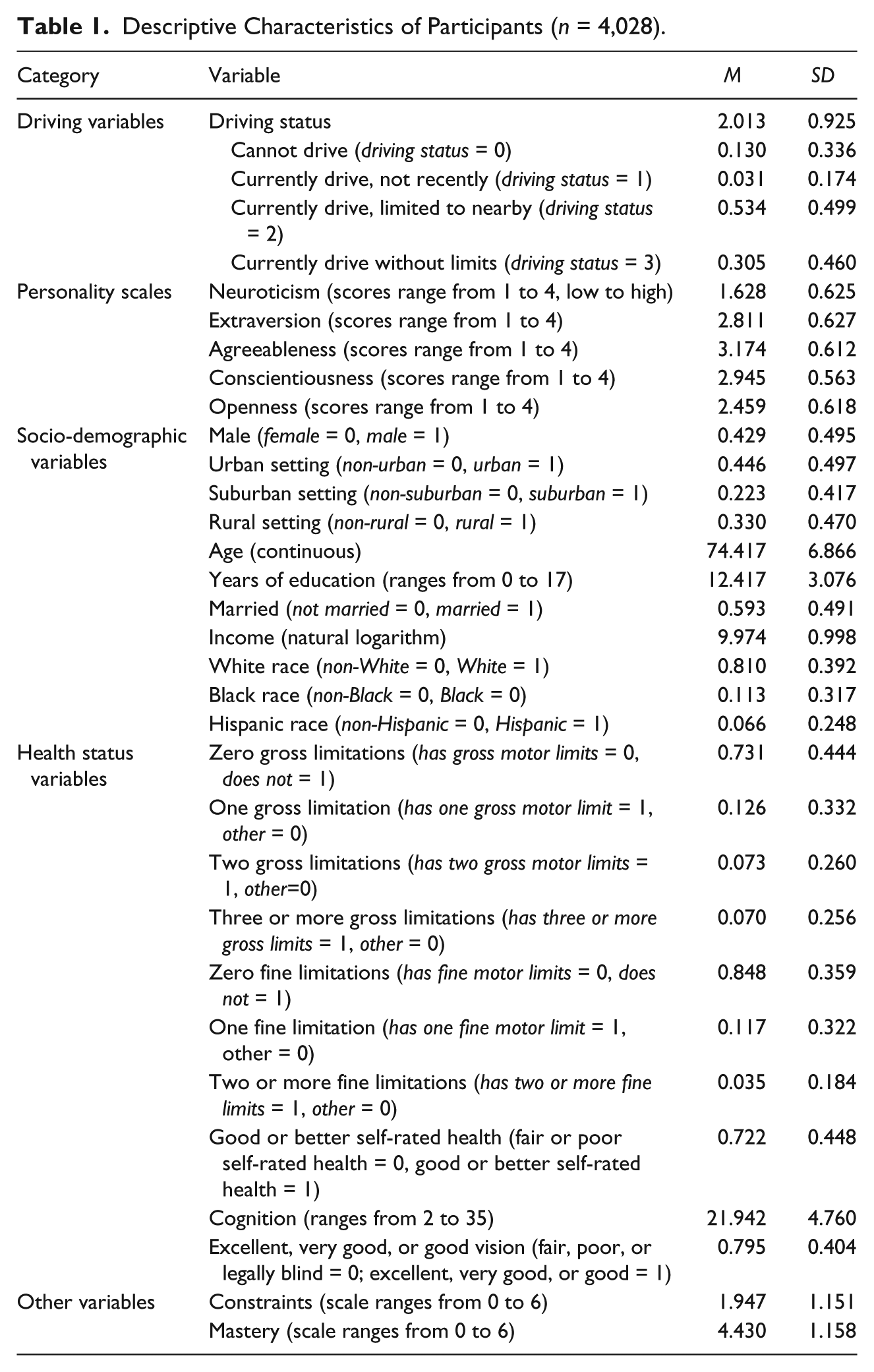
Perceived control comes from the LBQ and is made up of two indices: constraints and mastery. Respondents were asked the extent to which they agree or disagree (from 0 to 6) with statements such as, “Other people determine most of what I can and cannot do” and “What happens in my life is beyond my control,” measuring constraints, and “I can do just about anything I really set my mind to” and “When I really want to do something, I usually find a way to succeed at it,” measuring mastery. Scores on these items were averaged for each of the two scales, with high scores on the constraint scale indicating low perceived control, and high scores on the mastery scale indicating high perceived control. For means and standard deviations of all variables, see Table 1.
Descriptive Characteristics of Participants (n = 4,028).
Analytic Strategy
In addition to descriptive and bivariate analyses, multinomial logistic regression was used to estimate the effect of the Big Five personality factors (neuroticism, openness, extraversion, agreeableness, and conscientiousness) on late-life driving status. The four-level driving status variable served as the dependent variable, with people who no longer drove serving as the reference group for each regression. A first set of five models included just the personality scale being tested. Second, a model included all five personality scales together. Third, a model included all five personality scales and all demographic and control variables. Fourth, because previous research has found significant gender differences in driving behavior, we stratified analyses by gender. STATA 12 was used for all analyses.
Results
Driving, but Not in the Past Month
Bivariate analyses indicate that people high in extraversion (β = 0.4318, p < .01), conscientiousness (β = 0.3796, p < .05), and openness (β = 0.5512, p < .001) were more likely to drive, but not in the past month. Results for neuroticism and agreeableness were not significantly different from those of non-drivers.
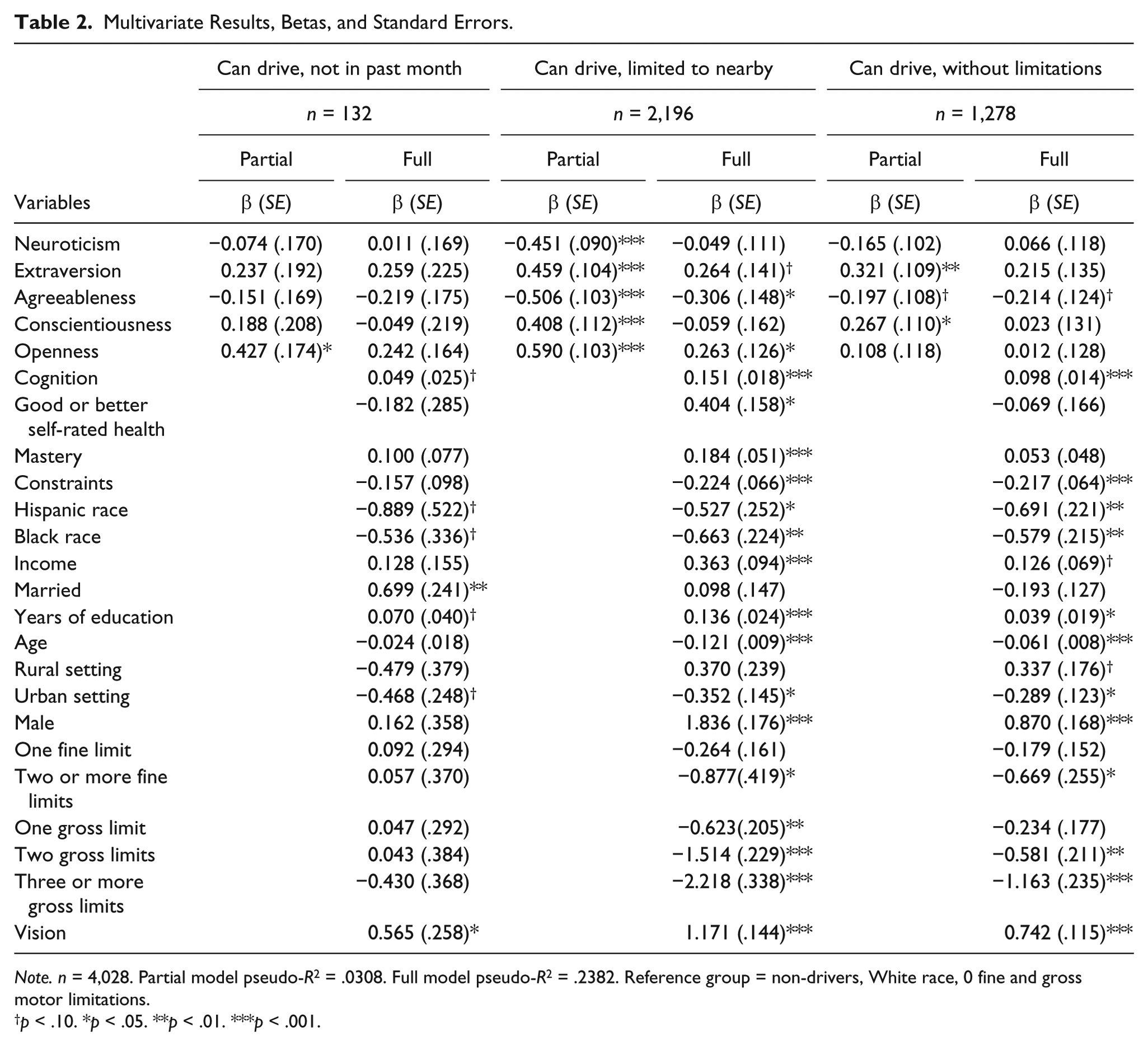
As seen in Table 2, including all five personality factors together in the model further demonstrated the finding that those who drive, but not in the past month, are quite similar to non-drivers. Those high in openness were more likely to drive, but not in the past month (β = 0.4274, p < .05). Neuroticism, extraversion, agreeableness, and conscientiousness were not statistically significant in this model.
Multivariate Results, Betas, and Standard Errors.
Note. n = 4,028. Partial model pseudo-R2 = .0308. Full model pseudo-R2 = .2382. Reference group = non-drivers, White race, 0 fine and gross motor limitations.
p < .10. *p < .05. **p < .01. ***p < .001.
The addition of control variables in the full model completely mediated the significance of the personality factors in predicting driving, but not within the past month. None of the five factors were significantly associated with driving, but not in the past month. Of the control variables, marital status (β = 0.6994, p < .01) and having excellent, very good, or good vision (β = 0.5652, p < .05) were significantly predictive of driving, but not in the past month. Again, those who identify as current drivers who had not driven in the past month were not significantly different from non-drivers.
Driving With Limitations
Bivariate analyses indicated that neuroticism was associated with a decreased likelihood of driving only to nearby locations (β = −0.6187, p < .001), whereas extraversion (β = 0.6586, p < .001), conscientiousness (β = 0.6781, p < .001), and openness (β = 0.8134, p < .001) were associated with an increased likelihood of driving only to nearby locations. Agreeableness was not significantly associated with driving only to nearby locations.
Results were similar when all five personality variables were included in the model. Neuroticism (β = −0.4511, p < .001) and agreeableness (β = −0.5058, p < .001) were associated with a decreased likelihood of driving only to nearby locations. Extraversion (β = 0.4588, p < .001), conscientiousness (β = 0.4077, p < .001), and openness (β = 0.5903, p < .001) were associated with an increased likelihood of driving only to nearby locations.
The inclusion of control variables in the model partially mediated these findings. Agreeableness was associated with a decreased likelihood of driving only to nearby locations (β = −0.3064, p < .05), and openness was associated with an increased likelihood of driving only to nearby locations (β = 0.2631, p < .05). Cognition (β = 0.1509, p < .001), good or better self-rated health (β = 0.4040, p < .05), perceived mastery (β = 0.1843, p < .001), income (β = 0.3628, p < .001), years of education (β = 0.1364, p < .001), male gender (β = 1.8357, p < .001), and having excellent, very good, or good vision (β = 1.1712, p < .001) were associated with an increased likelihood of driving only to nearby locations. Perceived constraints (β = −0.2242, p < .001), Hispanic race (β = −0.5269, p < .05), Black race (β = −0.6630, p < .01), older age (β = −0.1211, p < .001), living in an urban setting (β = −0.3523, p < .05), and the presence of fine (β = −0.8770, p < .05 if two or more) and gross (β = −0.6229, p < .01 if one; β = −1.5138, p < .001 if two; β = −2.2183, p < .001 if three or more) motor limitations were associated with a decreased likelihood of driving only to nearby locations. Marital status and living in a rural setting were not significant in this model.
Driving Without Limitations
Individual models for each of the five personality variables indicate that neuroticism was associated with a decreased likelihood of driving without limitations (β = −0.2450, p < .05), whereas extraversion (β = 0.3780, p < .001), conscientiousness (β = 0.3720, p < .001), and openness (β = 0.2933, p < .01) were associated with an increased likelihood of driving without limitations.
Patterns of results are similar with the inclusion of all five personality variables in the same model, but the significance is attenuated. Extraversion (β = 0.3215, p < .01) and conscientiousness (β = 0.2665, p < .05) were associated with an increased likelihood of driving without limitations. Neuroticism, agreeableness, and extraversion were not significant in this model.
The inclusion of demographic and health control variables attenuated the significance of personality. In the full model, none of the personality variables were significantly associated with driving without limitations. However, a Wald test indicated that the five personality factors were still, as a whole, predictive of late-life driving status, F(15, 38) = 1.93, p < .05. Of the control variables, cognition (β = 0.0979, p < .001), years of education (β = 0.0395, p < .05), male gender (β = 0.8696, p < .001), and having excellent, very good, or good vision (β = 0.7424, p < .001) were associated with higher likelihood of driving without limitations. Perceived constraints (β = −0.2172, p < .001), Hispanic race (β = −0.6909, p < .01), Black race (β = −0.5789, p < .01), older age (β = −0.0614, p < .001), living in an urban setting (β = −0.2890, p < .05), and the presence of fine (β = −0.6688, p < .05 if two or more) and gross (β = −0.5808, p < .01 if two; β = −1.1634, p < .001 if three or more) motor limitations were associated with a lesser likelihood of driving without limitations.
Gender Differences
Results indicate gender differences in both driving status and personality. Men were more likely to be current drivers (β = 0.1346, p < .001), while women reported higher levels of neuroticism (β = −0.1118, p < .001), extraversion (β = −0.0696, p < .001), agreeableness (β = −0.2614, p < .001), and conscientiousness (β = −0.0938, p < .001) than men. Openness did not differ by gender. Although men and women differed significantly in terms of driving and personality, the relationship between personality and driving was largely similar for both men and women. When analyses were stratified by gender, the trends across variables were consistent, although the levels of significance differed.
In bivariate models, women high in extraversion (β = 0.5815, p < .01) and openness (β = 0.6454, p < .001) and men high in conscientiousness (β = 1.2696, p < .01) were more likely to drive, but not in the past month. Women high in extraversion (β = 0.7666, p < .001), agreeableness (β = 0.3494, p < .01), and conscientiousness (β = 0.7161, p < .001) were more likely to drive only to nearby locations, whereas women high in neuroticism (β = −0.6181, p < .001) and openness (β = −0.8969, p < .001) were less likely to report only driving to nearby locations. Similarly, men high in extraversion (β = 0.6717, p < .001), conscientiousness (β = 0.9260, p < .001), and openness (β = 0.8048, p < .001) were more likely to drive only to nearby locations, whereas men high in neuroticism (β = −0.4156, p < .01) were less likely to report only driving to nearby locations. Finally, women high in extraversion (β = 0.3885, p < .001) and conscientiousness (β = 0.4178, p < .001) were more likely to drive without limitations, whereas women high in neuroticism (β = −0.2764, p < .05) and openness (β = −0.3492, p < .01) were less likely to drive without limitations. Men high in extraversion (β = 0.3596, p < .05) were also more likely to drive without limitations.
With all five personality scales included in the model, results indicate that women high in openness (β = 0.5433, p < .05) were more likely to drive, but not in the past month. Men high in conscientiousness were more likely to drive, but not in the past month (β = 1.3655, p < .001). Women high in extraversion (β = 0.4981, p < .001), conscientiousness (β = 0.3627, p < .001), and openness (β = 0.5889, p < .001) were more likely to drive only to nearby locations. Women high in neuroticism (β = −0.4096, p < .001) and agreeableness (β = −0.2574, p < .05) were less likely to drive only to nearby locations. Similarly, men high in conscientiousness (β = 0.6828, p < .01) and openness (β = 0.4842, p < .05) were more likely to drive only to nearby locations. Women high in extraversion (β = 0.2790, p < .05) and conscientiousness (β = 0.2931, p < .05) were more likely to drive without limitations, while no personality variables were significantly predictive of driving without limitations for men (although trends were similar to women).
For results of the full model, stratified by gender, see Table 3. As in the full model with both genders, the significance of personality was attenuated by the inclusion of control variables. Trends were largely similar by gender. The only variable that men and women differed on was education, such that men with more years of education were less likely to identify as current drivers, whereas women with more education were more likely to be current drivers.
Multivariate Results Stratified by Gender, Full Model, Betas, and Standard Errors.

Note. n = 4,028. Male model pseudo-R2 = .2344. Female model pseudo-R2 = .2360. Reference group = non-drivers, White race, 0 fine and gross motor limitations.
p < .10. *p < .05. **p < .01. ***p < .001.
Discussion
This study showed that personality is associated with driving status in older adults. Even after controlling for known risk factors, the association was statistically significant. Specifically, we found that older adults high in neuroticism and agreeableness were less likely to be current drivers and those high in extraversion, conscientiousness, and openness were more likely to be current drivers. In addition, those who self-restricted their driving to only nearby locations were the most different from those who no longer drove on the personality and control variables. It appears there is something unique about such drivers who restrict their driving to nearby locations. Thus, research on driving status may want to broaden the definition beyond a dichotomous variable (yes/no). We found a continuum of behavior that represents the varied driving statuses of older adults.
Aspects of these five personality factors may explain these findings. Perhaps those high in neuroticism are anxious about their physiological changes that may affect driving ability, and thus reduce, limit, or cease driving, whereas those high in agreeableness may hear from a doctor or a family member that they are unsafe, and may accept this judgment of others and cease for that reason. Older adults high in extraversion are likely to value social engagement and may continue to drive to participate in valued activities. People high in openness may similarly be adventurous and possibly less concerned about potential driving risks.
It is possible that the unexpected finding that conscientiousness was associated with a higher likelihood of driving is the result of the self-report nature of the personality measures. Conscientiousness was made up of items such as organized, responsible, hardworking, careless (reversed), and thorough, and although the distribution of this scale was normal, it is possible that many respondents may have answered these in a socially desirable way. Alternatively, those who are conscientious might continue to drive, but might be doing so more safely and in ways not captured by these self-report categories. For example, conscientious drivers might only be driving during the day or might be using adaptive equipment, which could explain the somewhat counterintuitive finding that conscientious respondents drive in late-life.
This research also found interesting gender results. Although trends of results were consistent, there were some gender differences. Men were more likely to drive in late-life, whereas women reported higher levels of neuroticism, extraversion, agreeableness, and conscientiousness. Bivariate analyses indicate that extraversion and conscientiousness were associated with a higher likelihood of driving for both men and women, whereas neuroticism was associated with a lesser likelihood of driving for women. When all five personality scales were included, it was found that women high in extraversion, conscientiousness, and openness were more likely to be current drivers, whereas men high in just conscientiousness and openness were more likely to be current drivers. Women high in neuroticism and agreeableness were less likely to be current drivers. In the full model, better vision and cognition and higher income were associated with continued driving for both men and women. Education differed by gender, such that women with more years of education were more likely to drive, whereas men with more years of education were less likely to drive. For both genders, being high in constraints, of Black or Hispanic race, and having fine or gross motor limitations was associated with a lesser likelihood of driving.
A major contribution of this research was the inclusion of several levels of driving status, including those who do not drive, those who do but have not within the past month, those who drive and limit their driving to nearby locations, and those who drive and do not limit their driving to just nearby locations. In the full model, those who drive but had not driven within the past month were not significantly different from non-drivers in terms of personality or any of the control variables except marital status (drivers were more likely to be married). A possible explanation for this is that although these people self-identify as drivers, they are likely well on their way to becoming actual “non-drivers.” Identifying as a current driver, even though they may be moving away from regular driving may be a way of maintaining feelings of self-efficacy and independence. An interesting finding was that those who drove and self-restricted their driving to only nearby locations were the most different from those who no longer drove on the personality and control variables. It appears that there is something unique about those who drive but limit their driving to nearby locations. Like the non-recent drivers, those who drove without limitations were largely similar to non-drivers in the full model. Personality factors were not significant, so it seems that personality may not predict non-driving status versus full driving without limitations.
These multiple levels of driving status are also valuable in that they reflect actual driving behavior. Adler and Rottunda (2006) conducted focus groups with older adults who recently ceased driving, and found that respondents fell into two groups: “proactives” and “reluctant accepters.” Proactive non-drivers are those who independently made the decision to cease driving, planned appropriately, and informed family and friends of their plans, whereas reluctant accepters are those who understood their driving limitations and reluctantly decided to cease. Respondents also described the existence of a third group: “resisters,” who are unrealistic about their changing abilities and only cease driving when they are forced (Adler & Rottunda, 2006). It is possible that those who describe themselves as drivers who have not driven in the past month are proactives, making the move to non-driving, while those who limit their driving to nearby locations are reluctant accepters. Drivers who do not limit their driving to nearby locations may be resisters or those who are not experiencing any driving-related difficulty.
Understanding the association between driving cessation and personality is important because of the increasing rates of older drivers (Centers for Disease Control and Prevention, 2011) and the risks for adverse outcomes following driving cessation (Dugan & Lee, 2013; Edwards et al., 2009; Ragland et al., 2005). Research on personality and late-life driving is limited, and existing research is characterized by small sample sizes and convenience samples, focuses on driving performance and not cessation, and rarely uses psychometrically validated personality measures like the Big Five. This study is among the first to examine the relationship between personality and driving in late-life and, to our knowledge, is the first to use the Big Five personality factors, a measure of driving status, and a large, nationally representative U.S. sample.
The current findings add to the transportation research on personality and driving in youth and middle-aged adults. Such research has found that those who are high in neuroticism and high in extraversion are riskier drivers and have poorer overall driving performance (Dahlen et al., 2005; Lawton et al., 1997; Renner & Anderle, 2000), and that high impulsivity and sensation-seeking are associated with risky driving in general and speeding more specifically (Jonah, Thiessen, & Au-Yeung, 2001). Furthermore, in younger drivers, those high in conscientiousness are generally safer drivers (Schwebel et al., 2006). Our results provide further support for the value of considering psychological predictors of driving behavior across the life-course.
This research had limitations. The first is that the group of those who drive but had not driven recently included only 132 respondents. Thus, it might not be possible to draw definitive conclusions about this group. Second, this is a cross-sectional study, so statements about change over time or statements about causation are not possible. Third, all measures are self-report. Future research should longitudinally examine personality and driving outcomes, and intervention studies could be tailored by personality.
Footnotes
Declaration of Conflicting Interests
The authors declared no potential conflicts of interest with respect to the research, authorship, and/or publication of this article.
Funding
The authors received no financial support for the research, authorship, and/or publication of this article.