




Abstract
Keywords
Introduction
Individual and population aging are usually linked to chronological age. The United Nations (UN) conventionally set the threshold for “being old” at the age of 60 or 65 (UN, 2001), but recent studies have shown that the idea of a static measure of age is changing (Christensen, Doblhammer, Rau, & Vaupel, 2009; Lutz, Sanderson, & Scherbov, 2008; Sanderson & Scherbov, 2008, 2013). The concept of aging is not independent of time and place and it should account for improvements in health and life expectancy that have influenced how people age.
In this work, we focus on subjective age, often referred to also as felt age, a measure of how old people feel they are. Subjective age reflects personal evaluation of age, accounting for factors such as recognition of chronological age, role involvement, health, and physical limitations as well as awareness of societal age norms. As suggested by Demakakos, Gjonca, and Nazroo (2007), subjective age measures one’s evaluation of the own present status against one’s representations of age and aging, which forms one’s personal aging model: “You may be 70 but feel 50 because you do not fit your expectations about 70” (Ward, 2010, p. 168). Such self-assessment captures aspects of personal well-being that remain uncaptured by traditional health measures (Uotinen, Rantanen, & Suutama, 2005) and it encompasses more social and psychological meaning than chronological age per se (Kaufman & Elder, 2003).
Research suggests that middle age is a turning point, after which people tend to start perceiving themselves as younger than their chronological age (Keith, 1997). Determining which factors influence age perception may help identify factors associated with the quality of life and mental health of the adult population.
Previous research showed that individuals’ evaluations of how old they feel are grounded in the demographic realities around them and in the experience of age-symbolic events, such as retirement and widowhood (Kleinspehn-Ammerlahn, Kotter-Grühn, & Smith, 2008; Settersten & Hagestad, 2015). These so-called “age-roles” serve as markers of transitions into social roles people are expected to enact at later stages in life. Among them, grandparenthood is one of the most salient for older individuals and it is therefore expected to greatly affect one’s own subjective age (Kaufman & Elder, 2003). Yet, only little research has focused on this aspect.
In this article, using data from the Health and Retirement Study (HRS) in the United States, we study the relationship between subjective age and grandparenthood. To the best of our knowledge, the only works that have analyzed such relationship so far are those by Barak and Gould (1985) and Kaufman and Elder (2003). Barak and Gould (1985) did not specifically focus on grandparenting, but included some grandparenthood-related variables (i.e., age of the youngest and oldest grandchildren, number of grandchildren) among a large set of correlates of subjective age. Kaufman and Elder (2003), instead, analyzed the influence of the age at grandparenthood on subjective age. Neither of the two studies considered the role of providing grandchild care. We add to the isolated evidence on the topic by (a) using a large representative data set, (b) considering having grandchildren and providing grandchild care, and (c) by testing how such relationships vary between men and women and by age ranges. This research topic is of high interest as it highlights the importance of considering measures of aging alternative to chronological age and points to the important role grandparenthood plays in explaining why some people tend to feel more or less young than others.
Background and Hypotheses
Subjective Age
Although chronological age is a reasonable proxy for developmental status early in life, it is a measure that cannot be changed. Therefore, aging needs to be understood also in terms of individual perceptions to have a better understanding of individuals’ aging-related expectations, goals, actions, and identity processes (e.g., Diehl, Wahl, Brothers, & Miche, 2015). To do so, we need to use also alternative measures of aging (Sanderson & Scherbov, 2008).
The idea is not new (see, for example, Markides & Boldt, 1983; Markides & Ray, 1988), but recently there has been a growing interest in both conceptualizations (e.g., Diehl & Wahl, 2010; Montepare, 2009) and empirical research (e.g., Levy, Slade, Kunkel, & Kasl, 2002) on “age identity.” This multidimensional and superordinate construct subsumes several related concepts such as the concepts of felt or subjective age, how old a person feels to be; perceived old age, at which age a person thinks old age starts; self-perceived life expectancy, how long does a person thinks to live; and self-perception of aging, which measures satisfaction with one’s own aging (e.g., Kaufman & Elder, 2003). Previous studies found support for differential associations of age identity and the various constructs under this umbrella with physical and cognitive functioning outcomes, well-being, and life satisfaction in later life (e.g., Keyes & Westerhof, 2012; Stephan, Caudroit, & Chalabaev, 2011; Stephan, Sutin, Caudroit, & Terracciano, 2015). Yet, all these concepts are characterized by the unidimensional self-evaluation of how a person feels about his or her aging.
It has been shown that older people not only would like to be younger than their chronological age, but they also tend to feel younger than their chronological age (e.g., Montepare, 2009; Rubin & Berntsen, 2006; Westerhof & Barrett, 2005). Feeling younger is an expression of positive self-perceptions of aging (Kleinspehn-Ammerlahn et al., 2008), which therefore may indirectly lead to better health and quality of life (e.g., Penninx et al., 2000). This may have important consequences on the involvement in society, family-related activities, and participation in the labor market in later life. Thus, finding what supports a sense of feeling younger among older adults is of crucial importance.
Grandparenting and Subjective Age
With increasing longevity and the enlarged time span of overlap of grandparents’ lives with those of their grandchildren (Timonen & Arber, 2012), several strands of research have extended their focus to consider the effects of grandparenting on grandparents within the successful aging framework (Rowe & Kahn, 1997). But grandparenthood is also a powerful reminder of a person’s aging (Karp, 1988; Ryff, Lee, Essex, & Schmutte, 1994), and as such it is likely to affect subjective age. The social psychology of aging emphasizes that the association between life events and subjective age is strongly influenced by the timing of life transitions (Neugarten, 1997). Kaufman and Elder (2003), who specifically analyzed felt age, showed that those who become grandparents at younger ages feel older than those who enter this role “on time.” Because of data limitation (i.e., no information on the date of birth of the grandchildren), we can only indirectly capture this aspect by considering the age of the grandparents.
We expect having grandchildren to be associated with either increased or reduced subjective age depending on chronological age. On the one hand, having grandchildren may play the role of a premature marker of old age when the person is at an early stage of older adulthood and young grandparents may therefore tend to feel older (i.e., positive association with subjective age). On the other hand, older grandparents are more likely to have a closer relationship with grandchildren (Neugarten, 1997), feel less the pressure to provide care to their grandchildren (see Winefield & Air, 2010, for a review) and, as a consequence, they may tend to feel younger (i.e., negative association with subjective age; Hypothesis 1).
Yet, such association may be a compound effect of several aspects related to grandparenthood. In particular, among the grandparents, we distinguish those who actively look after their grandchildren from those who do not. Linked to grandparenthood are intergenerational relationships and informal roles of caregiving which may also affect age identity. Drawing on the buffering hypothesis (Cohen & Wills, 1985), we may assume that in the same way as social integration predicts well-being, mortality, and health outcomes (see Berkman & Glass, 2000, for a review), older subjective age could be buffered by the involvement in family life. Several studies on the effects of grandchild care on grandparents’ well-being found positive effects of this role, such as better health and health-related behaviors (Di Gessa, Glaser, & Tinker, 2015; Hughes, Waite, LaPierre, & Luo, 2007), beneficial effects for some dimensions of cognitive functioning (Arpino & Bordone, 2014), and enhanced sense of purpose in life (Coall & Hertwig, 2011; Silverstein & Giarrusso, 2013). However, also mixed evidence exists on the effect of grandparental childcare, for example on having a more active lifestyle (Arpino & Bordone, 2015; Waldrop & Weber, 2001). To the best of our knowledge, no previous study has analyzed specifically the association between the provision of grandchild care and subjective age, however indirect evidence suggests that a person’s involvement in family activities is related to a youthful felt age (Kaufman & Elder, 2003). Therefore, we expect that looking after grandchildren is also relevant for older people’s subjective age, with age-specific and opposite associations of grandchild care and subjective age by chronological age. While grandchild care is expected to correlate with an older subjective age for younger grandparents because, working as an age reminder, it makes a person identifying too early with the role of grandparent, it is expected to be negatively associated with subjective age later in life (Hypothesis 2).
As far as gender is concerned, although we may expect men and women to react differently to the role of being grandparent because of the different tasks and responsibilities associated with it (Winefield & Air, 2010), a priori we do not have clear expectations on gendered effects (see also Kaufman & Elder, 2003 for a discussion about this aspect). Nonetheless, we will carry out the analyses separately for men and women to test possible gendered associations between grandparents’ role and subjective age.
Data and Method
Data and Sample Selection
The data for this study come from the ninth wave of the HRS, conducted in 2008 (for more information about the HRS sample interviewed in 2008, see http://hrsonline.isr.umich.edu/modules/meta/2008/core/desc/h08dd.pdf). HRS is a longitudinal panel study (sponsored by the National Institute of Aging [Grant No. NIA U01AG009740] and conducted by the University of Michigan) that surveys every 2 years a representative sample of residents in the United States aged 50 or above. The first wave took place in 1992. Despite the relatively long panel of HRS, we use the ninth wave as this is the first wave where the question on subjective age was asked (see also Stephan et al., 2015).
Among the respondents who were eligible to take part in the Participant Lifestyle Leave-Behind Questionnaire (a self-administered questionnaire left with about half of the 2008 respondents on the completion of the in-person Core Interview to collect additional information, for example, on subjective age, without adding to the interview length), we selected those with at least one child, aged 50 to 85 years old and who are not nursing home residents. We excluded respondents that in the occupational status question declared to be permanently sick or disabled because this influences too strongly subjective age and the likelihood to provide childcare. We also excluded the top 1% in the distribution of the number of grandchildren (i.e., respondents with more than 30 grandchildren) and the outliers in the distribution of subjective age. Of the 4,441 respondents with these characteristics, we excluded observations with missing values in any of the variables described below (i.e., 43 on grandparental childcare, six on education, three without information on number of children, two on self-reported health, two on co-residence with grandchildren, and 289 with missing information on subjective age, amounting to 7.8% of the selected sample). Our working sample includes 1,701 men and 2,395 women.
Dependent Variable
Subjective age has been measured in many ways, sometimes with single items and some others with a multi-item scale. Whereas in some studies subjective age is reported in years, in others individuals rate their subjective age relative to their chronological age, but results on the determinants of subjective age have been consistent (see Bergland, Nicolaisen, & Thorsen, 2014, for a review). Similar to that of Kaufman and Elder (2003), in this study the dependent variable derives from the question on subjective age: “What age do you feel?” A continuous measure of subjective age allows for greater variance and attaches no social desirability in the form of labels (Kaufman & Elder, 2002). In additional analyses, we have also tried to use the difference between chronological age and reported felt age as dependent variable. The results were descriptively the same but showed larger confidence intervals.
Explanatory Variables
To test the effect of having grandchildren (Hypothesis 1), we used the dummy variable being grandchildless versus having at least one grandchild.
HRS asks respondents whether they or their partner have looked after their grandchildren for at least 100 hr (in the 2 years before the interview). If the answer is “yes,” it is then asked the number of hours of childcare provided by the respondent and, separately, those provided by the partner. Note that, even if the respondent first answered yes to the question whether or not he or she or the partner has looked after a grandchild for at least 100 hr in the last 2 years, the number of hours of grandchild care provided by the respondent at the second question can also be less than 100 (i.e., ≥0). We are interested in whether the respondent has looked after grandchildren since the last interview. Therefore, we used the information from these two questions to construct another categorical variable (used to isolate the association between looking after grandchildren and subjective age, Hypothesis 2) which distinguishes whether the respondent has no grandchildren, the respondent has grandchildren but does not look after them (i.e., has answered “no” to the first question or has reported 0 hr of grandchild care; reference), the respondent provides some grandchild care (i.e., the answer to the first question was “yes” and it has been reported a positive number of hours for himself or herself in the second one).
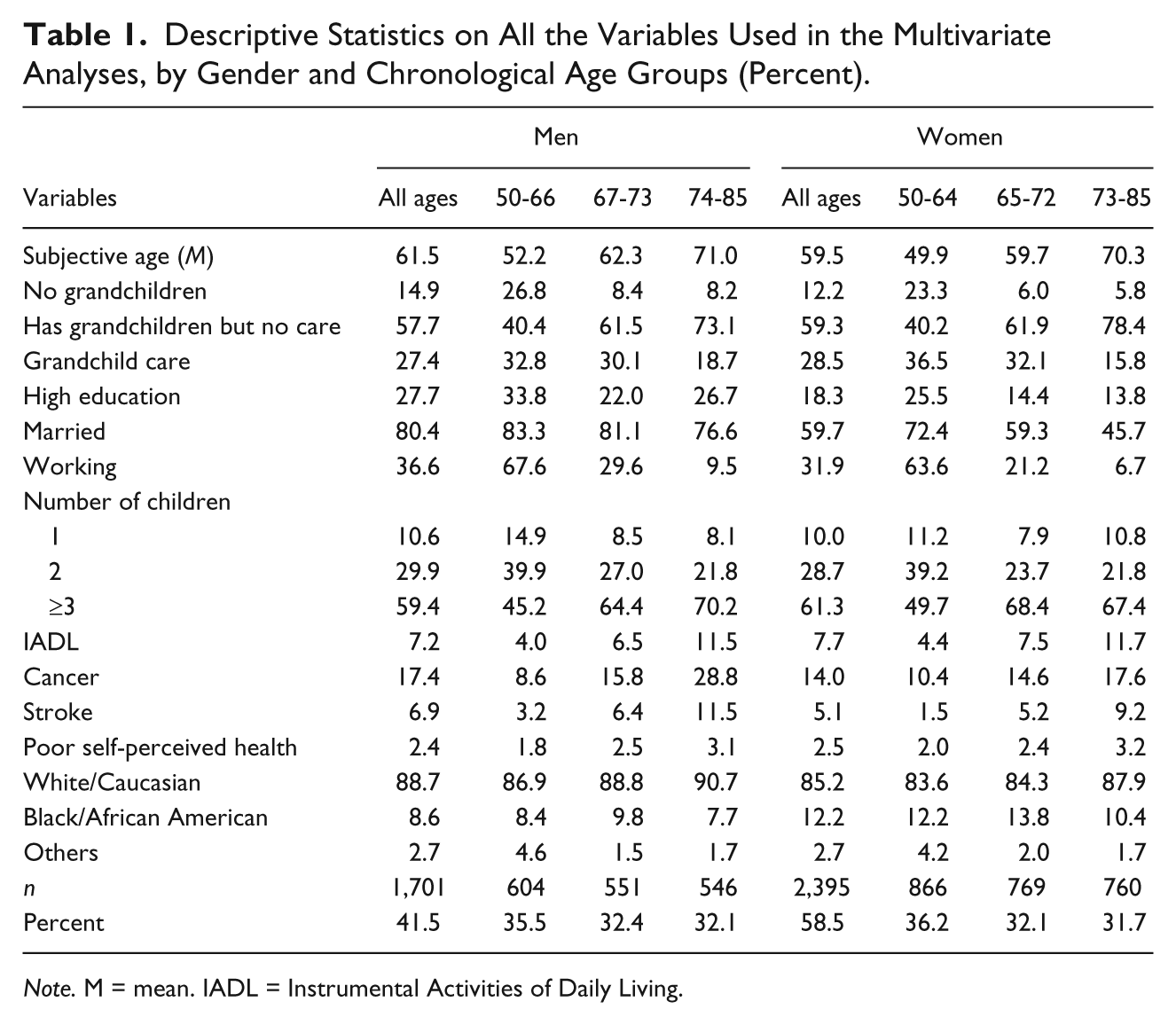
Table 1 shows that the large majority of our working sample has grandchildren. Among men, about 15% are grandchildless and the corresponding figure for women is 12%. For both men and women, the percentage of grandchildless decreases with age. About 28% of grandparents have looked after grandchildren, with higher percentages at younger ages.
Descriptive Statistics on All the Variables Used in the Multivariate Analyses, by Gender and Chronological Age Groups (Percent).
Note. M = mean. IADL = Instrumental Activities of Daily Living.
Control Variables
The following control variables were included in the regression models, based on past evidence regarding the determinants of subjective age and the provision of grandchild care, that is, potential confounding variables. Summary statistics of the control variables included in the analyses are shown in Table 1.
Chronological age
As discussed by Choi, DiNitto, and Kim (2014), subjective age among older adults tend to differ by age group. We attempted at dividing the male and female samples in three equal size parts (tertiles), but chronological age being a discrete variable, the three resulting groups have only approximately the same size. Specifically, we considered the following groups. For men: first age tertile = 50-66, reference; second age tertile = 67-73; third age tertile = 74-85. For women: first age tertile = 50-64, reference; second age tertile = 65-72; third age tertile = 73-85. Although some previous studies found that chronological age only modestly predicts subjective age (e.g., Logan, Ward, & Spitze, 1992), Bergland et al. (2014) found that older age was one of the most important predictors significantly associated with a more youthful subjective age. We notice that chronological age, as well as gender, are not only thought of as control variables in our study, but we also test whether they moderate the effects of the explanatory variables related to grandparenthood. We used age brackets for two reasons. First, although the overall sample size is relatively large (amounting to 4,096 observations), the sample sizes used for the estimations get smaller once the analyses are run separately by gender and aim at estimating age felt in different sub-groups of older people (i.e., those who are grandchildless, those who have grandchildren but do not provide grandchild care and those who do). Second, our hypotheses involved an interaction with age. Therefore, the sample sizes for individual years of age would have been too small. Moreover, interpreting the interaction between categorical variables as we did is more straightforward and easier to report.
High education (= 1 if the respondent has at least 4 years of college degree; = 0 otherwise)
Previous research has shown mixed results about the association between education and subjective age. Whereas Bergland et al. (2014) found that those with lower education feel more youthful than those with higher education, other studies showed that respondents who felt older had significantly fewer years of education (Barrett, 2003; Rubin & Berntsen, 2006). Kaufman and Elder (2003) reported no significant effect of education on subjective age.
Race (White/Caucasian [ref.]; Black/African American; Others)
Previous studies found no statistically significant difference between Blacks and Whites’ subjective age (e.g., Henderson, Goldsmith, & Flynn, 1995). Yet, the role of grandparent and its normative content may vary by race (Goodman & Silverstein, 2002; Hughes et al., 2007). Note that HRS detailed data on ethnicity are restricted and therefore we could not distinguish the Asian-American sub-sample from the others.
Health
Knoll, Rieckmann, Scholz, and Schwarzer (2004) showed that functional limitations may be more important to the construction of subjective age than their underlying health-related causes. We therefore consider a measure of Instrumental Activities of Daily Living (IADL) which indicates whether the respondent reports having at least one difficulty with the following activities: preparing a hot meal, grocery shopping, making phone calls, taking medications if needed, managing money. Due to the multidimensionality of the concept of health, we control for self-perceived health (= 0 if the respondent reports health as excellent, very good, or good; = 1 if fair or poor) and for two objective measures of health (two dummy variables indicating, respectively, whether the respondent has ever been diagnosed with cancer and stroke).
Marital status (= 1 if married; = 0 otherwise)
Being single is considered to be a predictor of younger subjective age, especially for the younger adults (Bergland et al., 2014), but not all studies found a significant relationship between marital status and subjective age (e.g., Henderson et al., 1995).
Occupational status (= 1 if working; = 0 otherwise)
The literature on retirement and subjective age shows mixed findings. On the one hand, the loss of a critical and economic role characterizes the image of old age and may increase subjective age (see Kaufman & Elder, 2003, for a review). On the other hand, Logan et al. (1992) found no significant effect of retirement on age identity once age was controlled. Yet, older adults who are still working are more likely to have responsibilities conflicting with grandchild care (Hughes et al., 2007) and we therefore include this control in the analyses.
Number of children (1 [ref.]; 2; 3+)
Previous studies have found that the more children one has, the older one feels (Barak & Gould, 1985; Kaufman & Elder, 2003).
Method
To assess whether the previously listed grandparenthood-related explanatory variables are associated with subjective age, we estimate a series of linear regression models where they are included one at the time. As we hypothesize that the effects of the explanatory variables differ by chronological age, we estimate the regression models including interactions between the explanatory variables and the chronological age groups dummy variables. To ease the interpretation of results, we graphically show the marginal effects on subjective age for the various explanatory variables by chronological age group and gender. Each marker in the graphs can be interpreted as the average difference in terms of subjective age between two compared groups (e.g., grandchildless and grandparents in Figure 1) within a specific age bracket (1st, 2nd, and 3rd age tertiles). Positive (negative) values can be interpreted as an older (younger) subjective age for the considered group in comparison with the reference group within a specific age bracket. We use different markers for indicating different levels of significance: gray dot (p value < 5%), gray square (p value < 10%), hollow dot (p value ≥ 10%).

Estimated effects with 90% confidence intervals on felt age of not having versus having grandchildren, by gender and age group.
Our goal of testing whether the effects of the explanatory variables vary by gender and age groups implies a practical issue in terms of small sample sizes. This has an impact on the confidence intervals that usually were large. For this reason, confidence intervals in all graphs show significance at 10%. However, as now recognized by many scholars (see, for example, Nuzzo, 2014), statistical significance and p values are neither as reliable nor as objective as usually assumed and we should pay more attention to the actual size of an effect. The patterns and sizes of the marginal effects we display in the graphs help in assessing the practical significance of the estimated effects. The complete estimates are reported in Table S.1 in the Supplementary data.
Results
Figure 1 shows a negative effect of being grandchildless on subjective age for the youngest age groups. In particular, for both men and women in the first age tertile being grandchildless is strongly and significantly associated with feeling younger (about 2 years for men and 1.5 years for women). For women in the middle age group, the effect is very similar to their younger counterparts. On the contrary, for women in the oldest age group considered (i.e., 73-85 years old) the association is reversed: grandchildless women in this age group feel, on average, about 2.1 years older than grandmothers in the same age group.
The association between not having versus having grandchildren and subjective age can however be considered as a compound effect of several aspects related to grandparenthood. Indeed, among the grandparents, we distinguish between those who actively look after their grandchildren and those who do not (Figure 2).
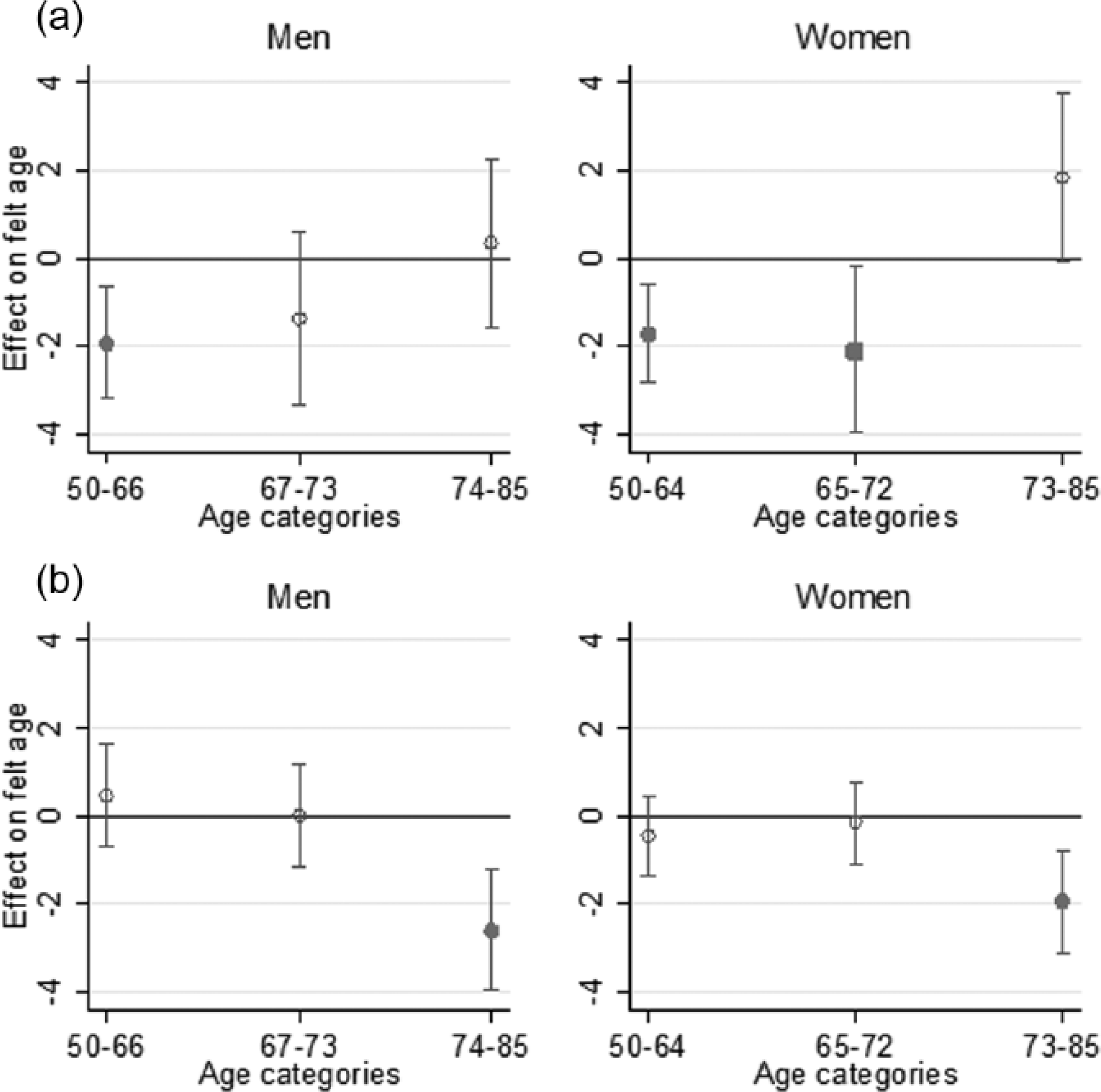
Estimated effects with 90% confidence intervals on felt age of (a) not having grandchildren and (b) providing grandchild care versus having grandchildren, but not providing grandchild care, by gender and age group.
In Figure 2a, we compare those not having grandchildren with their counterparts with grandchildren but not providing grandchild care. We notice very similar results to those shown in Figure 1, confirming the “pure” effect of being grandchildless. In Figure 2b, we compare, among those who have grandchildren, grandparents who look after their grandchildren and those who do not. Looking after grandchildren is significantly associated with lower subjective age in later life (i.e., 74-85 years old men and 73-85 years old women). Taking care of grandchildren is associated with younger felt age both for grandfathers and grandmothers, who report a youthful subjective age of 2.6 and 1.9 years, respectively. As a robustness check, we tested the effect of looking after grandchildren by excluding grandparents who reside with at least one grandchild. Results (see Figure S.1 and Table S.2 in Supplementary data) are very similar to those presented in Figure 2.
Discussion and Conclusion
In light of the increasing interest in measures of aging alternative to chronological age, this article investigated felt age for people aged 50 to 85 using data from the HRS carried out in 2008 in the United States. Drawing on the idea that the roles that individuals occupy affect how they age and how they perceive their aging, in this article we focused on grandparenthood, one of the most important roles for older adults, to study the association between subjective age on the one hand and having grandchildren and provision of grandchild care, on the other. This study expands prior research by examining age group differences in factors associated with subjective age among older adults and by considering men and women separately.
The results of this study show that grandparenthood has a heterogeneous association with subjective age, moderated by chronological age. Indeed, confirming our Hypothesis 1, we found that the association between being grandparent and subjective age is moderated by chronological age. Both men and women in the younger age group tend to feel older if they have grandchildren. Yet, the significant effect found for the older age group of women highlights a reversed association, with grandmothers feeling younger than grandchildless women.
Although we do not know when grandparents in our sample had their first grandchild, the strong association between having grandchildren and subjective age, independent from care provided to grandchildren, hints to interpret our results following Kaufman and Elder’s reasoning (2003). On the one hand, the positive association between having grandchildren and subjective age among relatively young grandparents suggests that people who find themselves to be grandparents when they may not yet be ready for it or at an age when expecting to have more time for themselves also tend to feel older. On the contrary, the presence of grandchildren at older ages may be considered to be more common and therefore to be associated with younger subjective age, as we find for women.
The association between having grandchildren and a youthful felt age in later life only for women may lay in the traditional gender norms that stress the responsibilities of women as kin keepers. For women, having grandchildren in later life may be perceived as prescriptive (Reitzes & Mutran, 2004) and therefore somehow increase their positive feelings and in turn affect their subjective age. Moreover, given the higher life expectancy of women and their caregiver role within the family, whereas men in later life mainly rely on their wives, women are more likely to exchange support with their children (Silverstein & Giarrusso, 2013). The presence of grandchildren is known to increase the frequency of contact with children (e.g., Bordone, 2009) and we may therefore speculate that being grandchildless after age 70 could increase the risk of isolation. Loneliness may, in turn, increase women’s subjective age (Kleinspehn-Ammerlahn et al., 2008). These mechanisms require further investigation in future studies.
We also partially confirm the age-specific association between grandchild care and subjective age (Hypothesis 2): both older grandfathers and grandmothers who look after their grandchildren report a youthful subjective age. As argued by Kaufman and Elder (2003), the grandparent role as caregiver may be special, in that it keeps older people actively involved with younger grandchildren and it gives them “something to live for.”
We acknowledge that it would have been interesting to look also at the transition into grandparenthood to interpret age-specific results of the association between having grandchildren and subjective age. However, being subjective age asked for the first time in the 2008 wave, the size of the sample facing the transition from being grandchildless to having one grandchild within the observation period in HRS is too small to allow specific analyses by gender and age group.
The main finding of this study can be summarized as a clear association between providing grandchild care and feeling younger among both grandfathers and grandmothers above 70. For women, this is cumulated with an additional youthful feeling due to having grandchildren per se. In conclusion, people construct their subjective age based on the particular circumstances of their lives. The present study emphasizes the importance of considering the subjectivity of aging which, as we show, relates to both the roles that individuals hold in later life and their timing.
The magnitude of our estimated effects, when significant, is about 2 years (being 2.6 the strongest for 74-85 years old men taking care of grandchildren). The substantive relevance of these results lies on the finding from previous studies that subjective age rivals or even outperforms chronological age as a predictor of psychological and health-related outcomes. Research on the topic has shown (positive) effects of a youthful subjective age on well-being (Stephan et al., 2011; Westerhof & Barrett, 2005), health-related outcomes (Boehmer, 2007; Demakakos et al., 2007; Stephan et al., 2011), as well as lower mortality risk (Kotter-Grühn, Kleinspehn-Ammerlahn, Gerstorf, & Smith, 2009). However, different studies have used different ways to measure both subjective age and health outcomes. Therefore, it is neither easy to uniquely quantify such effects nor to assess whether the magnitude we find is substantially important. Yet, evidence seems to hint at self-rated health being strongly associated with all aspects of age identity and to indicate that healthier people feel about 2 to 3 years younger. Future studies should better assess the practical importance of the estimated effects.
This study paves the way for future research aiming at better understanding of the sources of subjective age in later life. Yet, the causality of the factors included in the analyses need to be explored in future studies, when longer panel data will be available to clarify the mechanisms behind the associations we find. We also acknowledge that narrowing down the personal experience of aging to how old a person feels addresses only a subset of the phenomena related to age identity. The natural next step of this study will be to expand the current analyses by considering a wider range of measures.
Footnotes
Authors’ Note
V.B. and B.A. planned the study, performed the statistical analyses, and wrote the article.
Declaration of Conflicting Interests
The authors declared no potential conflicts of interest with respect to the research, authorship, and/or publication of this article.
Funding
The authors disclosed receipt of the following financial support for the research, authorship, and/or publication of this article: The work of V.B. was supported by the European Research Council (Grant No. ERC2012-AdG 323947-Re-Ageing). B.A. ackwnoledges funding from the Ministry of Economy and Competitiveness (Grant No. CSO2015-62707-ERC). The Health and Retirement Study is sponsored by National Institute on Aging (Grant No. NIA U01AG009740) and is conducted by the University of Michigan.