



Abstract
Introduction
The aging of the population and the increased urbanization are global trends that rapidly transformed the health profile of Latin American cities. Both changes directly affect public health policies and present two emerging challenges: reducing the burden of chronic conditions and disabilities and designing cities and neighborhoods to support an inclusive and accessible urban environment that encourages healthy aging (Brazilian Institute of Geography and Statistics [IBGE], 2009b; Organização Mundial da Saúde [OMS], 2005; Veras, 2009; World Health Organization [WHO], 2007).
Previous studies have suggested that physical activity promotes health later in life. Engaging in at least 150 min of moderate-intensity physical activity per week can significantly reduce the risk of developing chronic diseases, disabilities, and premature mortality, and can extend years of active and independent living (Ashe, Miller, Eng, & Noreau, 2008; Autenrieth et al., 2013; Bauman et al., 2012; Chodzko-Zajko et al., 2009; Hirsch et al., 2010; Nelson et al., 2007; Ueshima et al., 2010). Despite these clear health benefits of physical activity, older adults do not meet physical activity recommendations (Hallal et al., 2012; Ministério da Saúde, Secretaria de Vigilância em Saúde, & Secretaria de Gestão Estratégica e Participativa, 2012; Siqueira et al., 2008; Sun, Norman, & While, 2013; Zaitune et al., 2010).
There is evidence that walking is the most common form of physical activity in older adults, as it is safe, accessible, and easy to incorporate into one’s daily routine (Hughes, McDowell, & Brody, 2008; Van Cauwenberg et al., 2012). It also has many of the same health benefits as other forms of moderate-intensity physical activity (Hamer & Chida, 2008; Kerr, Rosenberg, & Frank, 2012; King, 2001). Thus, walking represents a promising way to promote physical activity among older adults. However, to design effective interventions to encourage walking among this target population, increased knowledge on the correlates of this activity is required (Moran et al., 2014; Van Cauwenberg et al., 2012).
Because physical activity determination is complex, domain-specific, and affected by diverse aspects (Sallis et al., 2006; Sallis, Owen, & Fisher, 2008; Stokols, 1996), the influence of the built environment on physical activity has gained increased attention over the past decade. A growing body of literature has shown that the built environment is associated with several health behaviors among older adults. More specifically, aging-friendly environments can remove barriers and empower older people to age with improved physical and mental health (Heath et al., 2006; WHO, 2007; Yen, Michael, & Perdue, 2009).
Studies have demonstrated that characteristics of the built and social environment, whether perceived or objectively measured (e.g., density, sidewalks, access to destinations, recreational facilities, safety from crime, traffic safety, social support), are associated with increased walking and other recreational and transportation-related physical activities among older adults (Cunningham & Michael, 2004; Giles-Corti et al., 2005; Saelens & Handy, 2008; Van Cauwenberg et al., 2012; Yen et al., 2009).
Studies investigating associations of the perceived environment and walking among older adults are scarce, and most of the evidence comes from high-income nations (Arango, Páez, Reis, Brownson, & Parra, 2013; Cunningham & Michael, 2004; Yen et al., 2009). Thus, the aim of the present study was to explore the associations between perceived environment characteristics and walking for transportation and for leisure among older adults living in Florianopolis, Brazil.
Method
Sampling and Study Design
This study used data from the EpiFloripa Elderly, a population-based cross-sectional study performed in the urban area of Florianopolis, southern Brazil, from September 2009 to June 2010.
Florianopolis is the capital of the state of Santa Catarina, and has an urban population of 408,163 inhabitants, with approximately 44,460 of them aged 60 years or above (IBGE, 2009a). The city ranks high in terms of social indicators compared with other Brazilian capitals, and the life expectancy was 77.4 years in 2010 (Programa das Nações Unidas para o Desenvolvimento [PNUD], 2013). Yet, marked social inequalities are observed; half of the city’s population lives with a family income less than US$200 per month.
The sampling was conducted in two stages to generate a sample that is representative of the entire city. The first stage was based on data from the IBGE, in which Florianopolis is divided into 420 urban census tracts (delimited areas comprising approximately 300 households each). Eighty census tracts were randomly sampled (eight in each income decile). The households were randomly selected in each tract in the second stage of the sampling strategy, and every older adult living in each selected household was eligible for the study.
All the sampled participants were contacted at least four times before being considered non-respondents. Institutionalized subjects were not included in this study.
Home visits included administration of a face-to-face questionnaire. All interviewers were intensively trained prior to fieldwork. Questionnaire pre-testing was performed with 30 older adults not included in the final sample. A pilot study included 99 older adults. A short questionnaire (16 questions) was administered to a random sample of 10%, through a telephone interview, to ensure consistence and quality of the data.
Walking Outcomes
Measures of walking for transportation and for leisure were assessed using the long version of the International Physical Activity Questionnaire (IPAQ; Craig et al., 2003), that has already validated for the Brazilian older adult population (Benedetti, Antunes, Rodriguez-Añez, Mazo, & Petroski, 2007; Benedetti, Mazo, & Barros, 2004). Walking for transportation and for leisure were categorized as no walking (0 min/week), 10 to 149 min/week, and 150+ min/week for each outcome (Chodzko-Zajko et al., 2009; Nelson et al., 2007; U.S. Department of Health and Human Services, 2008).
Perceived Neighborhood Environment
The perceived environment characteristics were assessed using a modified and culturally adapted version (Florindo et al., 2012) of the Neighborhood Environment Walkability Scale (NEWS; Saelens, Sallis, Black, & Chen, 2003), which was previously validated in Brazil (Florindo et al., 2012; Malavasi, Duarte, Both, & Reis, 2007), and the scale of social support for physical activity (Reis, Reis, & Hallal, 2011). This modified version comprises categorical response options and has been used in other studies in Brazil (Amorim, Azevedo, & Hallal, 2010; Arango et al., 2013; Gomes et al., 2011; Salvador, Florindo, Reis, & Costa, 2009; Salvador, Reis, & Florindo, 2009, 2010).
The adapted NEWS survey consists of 22 items that assessed the following perceived environment characteristics: infrastructure and safety for walking and cycling, aesthetics, traffic and crime safety, recreational facilities, and social support. These questions refer to a neighborhood environment where the person could walk within 15 min from their residence.
Control Variables
Individual variables included were gender, age (60 to 69, 70 to 79, and 80 or greater); education (0-4 years, 5-8, 9-11, and ≥12), self-rated health (excellent/good, fair, and poor/very poor), and body mass index (BMI)—categorized as underweight (< 22,0 kg/m2), eutrophic (22,0 to 27,0 kg/m2), and overweight/obesity (> 27,0 kg/m2) (Lipschitz, 1994).
Data Analysis
Descriptive statistics were conducted for all variables. In the unadjusted analysis, chi-square tests for heterogeneity were conducted. Multinomial logistic regressions, using logit model (Hosmer & Lemeshow, 2004), were run for both outcomes (walking for leisure and for transportation) with calculation of odds ratio (OR) and respective 95% confidence intervals. These analyses were conducted using the category of subjects who reported no walking (0 min/week) as the reference category.
In unadjusted models, each environment variable was included separately, and in adjusted models, all confounding variables were included (gender, age, self-rated health, BMI, and education). A p value ≤.05 by Wald’s test was considered statistically significant. Data analyses were carried out in Stata 12.0, using the svy group of commands to account for the complex survey design, and considering the sampling weights.
This study was approved by the Federal University of Santa Catarina Ethics Committee (Protocol 352/2008). Written informed consent was obtained from all participants before survey application. The National Council for Scientific and Technological Development (CNPq) funded this research.
Results
The final sample of the EpiFloripa Elderly study included 1,705 older adults, producing a response rate of 86.7%. For the present study, thirty interviews were excluded due to have been answered by caregivers; also 38 interviews were excluded of older adults who were unable to walk, thus, the analytical sample was composed by 1,637 individuals.
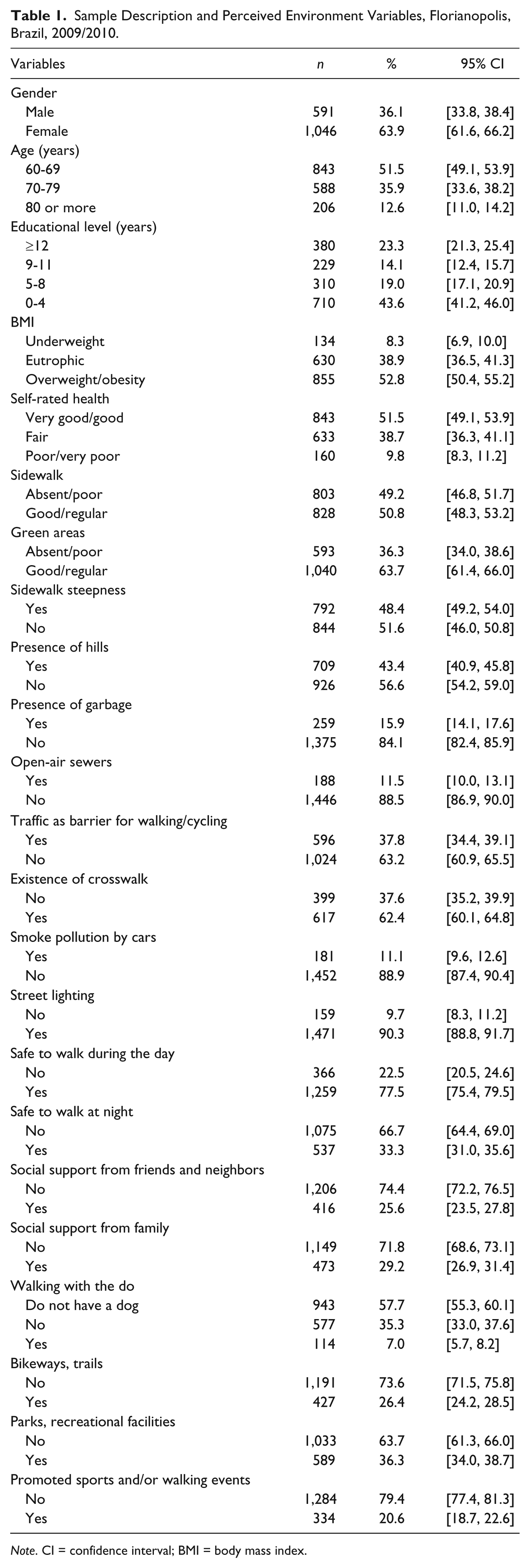
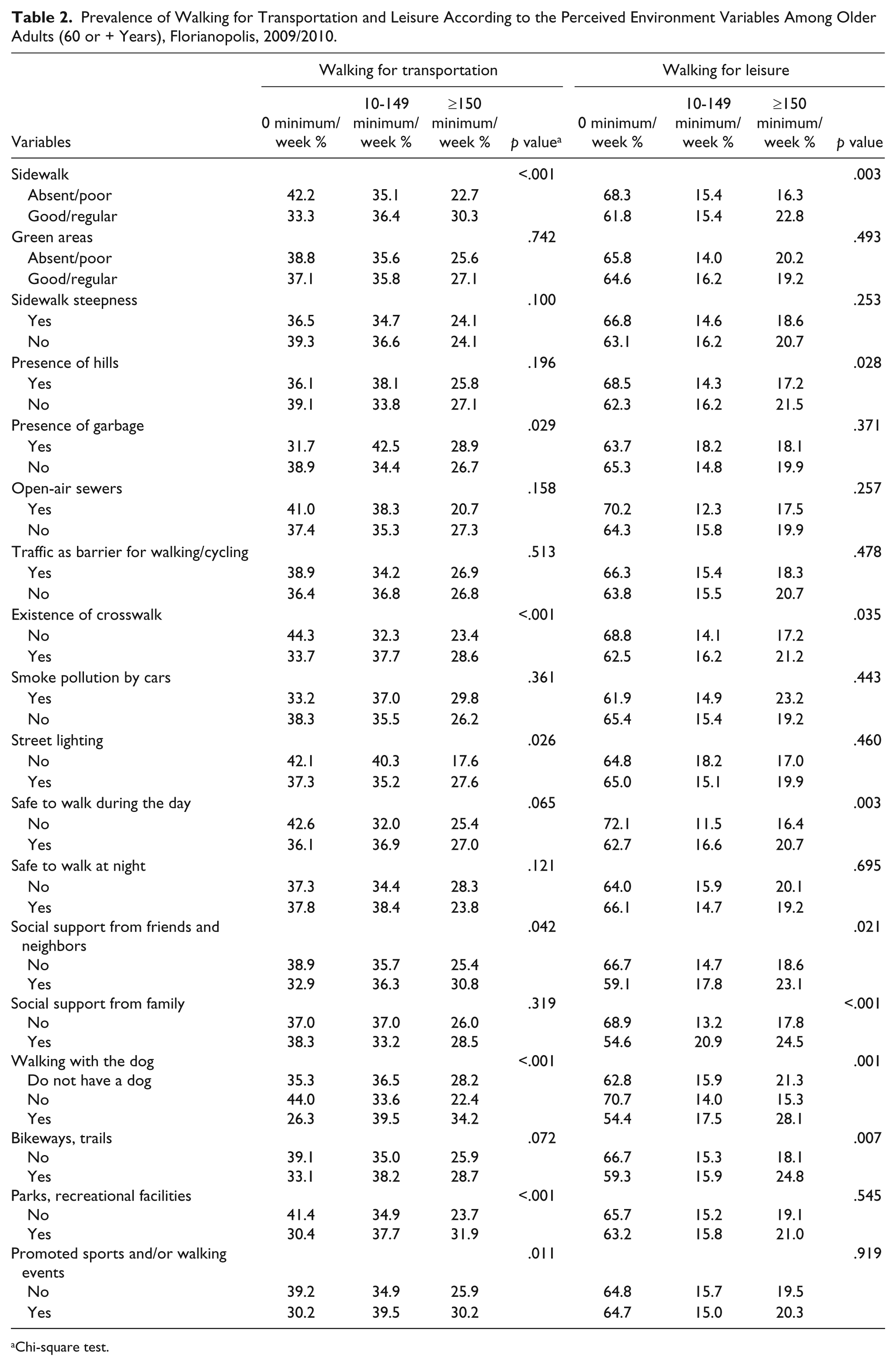
The mean age was 70.3 years (± 7.7 years), 63.9% of the participants were women, and 43.6% had attended school for up to 4 years. More than half of the participants were classified as overweight/obese and reported themselves to be of good/very good health status (Table 1). A description of the prevalences of outcomes by neighborhood environment characteristics is presented in Table 2.
Sample Description and Perceived Environment Variables, Florianopolis, Brazil, 2009/2010.
Note. CI = confidence interval; BMI = body mass index.
Prevalence of Walking for Transportation and Leisure According to the Perceived Environment Variables Among Older Adults (60 or + Years), Florianopolis, 2009/2010.
Chi-square test.
The proportion of individuals who did not walk (0 min/week) for transportation was 37.9% (95% CI = [35.5, 40.2]), 35.6% (95% CI = [33.3, 37.9]) walked for 10 to 149 min/week, and 26.5% (95% CI = [24.4, 28.6]) of the older adults achieved 150+ min/week of walking for transportation. Participants who reported walking for transportation engaged in an average of 114.5 min/week (SD =182.6 min/week), and the median was 60 min/week.
Regarding walking for leisure, 65.1% (95% CI = [62.7, 67.4]) of the older adults did not walk (0 min/week) during leisure time, 15.3% (95% CI = [13.6, 17.1]) did walk for 10 to 149 min/week, and 19.6% (95% CI = [17.7, 21.5]) had reported walking for leisure for 150+ min/week for. The mean number of minutes engaged in this activity was 77.7 min/week (standard deviation=143.4 min), and the median was 0 min/week.
Concerning to additional information related to moderate and vigorous-intensity physical activity in the sample, was found that only a fraction of older adults was classified as in 10 to 149 min/week (11.8%, 95% CI = [10.4, 13.5]) and 150+ min/week (8.0%, 95% CI = [6.9, 9.4]) of moderate-intensity physical activity (M = 33.3 min/week, SD = 95.5 min). Furthermore, 4.3% (95% CI = [3.3, 5.2]) and 2.5% (95% CI = [1.8, 3.3]) of the participants were engaged in 10 to 149 min/week and 150+ min/week of vigorous-intensity physical activity, respectively. The mean number of minutes engaged in this activity was 10 min/week (SD = 51.6 min; data not shown).
Environmental Correlates of Walking for Transportation
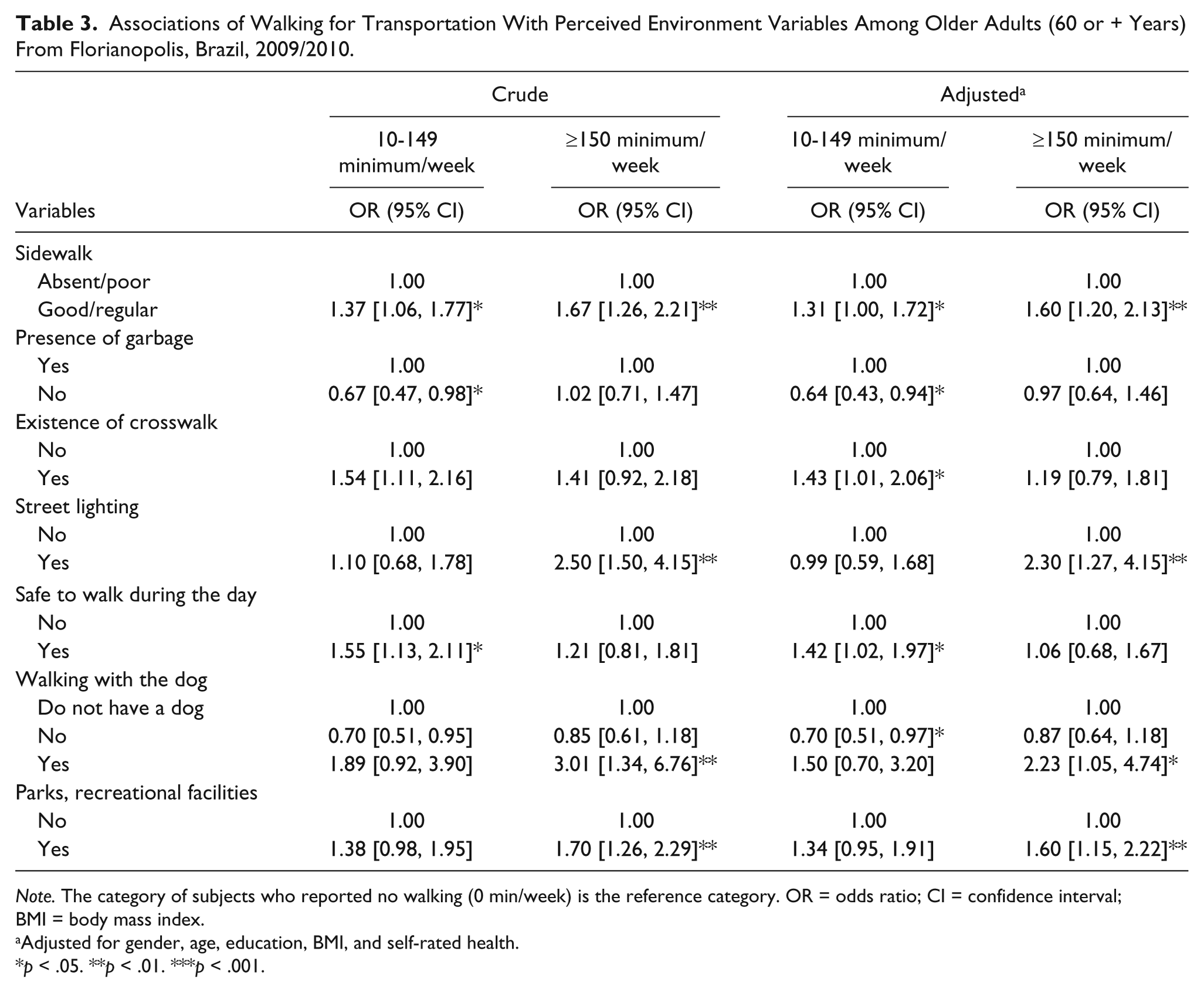
Results of unadjusted and adjusted multinomial logistic regression are displayed in Table 3. In adjusted analyses, compared with older adults who did not walk for transportation, the odds of achieving 10 to 149 min/week and 150+ min/week of walking for transportation were 31% (95% CI = [1.00, 1.72]) and 60% higher (95% CI = [1.20, 2.13]), respectively, for older adults who reported sidewalks in good conditions. Also, individuals who reported presence of crosswalk in the streets and safety during the day had greater odds of walking for 10 to 149 min/week in this domain (OR = 1.43, 95% CI = [1.01, 2.06]; OR = 1.42; 95% CI = [1.02, 1.97], respectively). The presence of street lighting (OR = 2.30, 95% CI = [1.27, 4.15]) and parks and other recreational facilities (OR = 1.60, 95% CI = [1.15, 2.22]) was positively associated with walking for 150+ min/week. Also, older adults who have a dog and take him for walk were more likely (OR = 2.23, 95% CI = [1.05, 4.74]) to walk 150+ min/week as a mode of transportation.
Associations of Walking for Transportation With Perceived Environment Variables Among Older Adults (60 or + Years) From Florianopolis, Brazil, 2009/2010.
Note. The category of subjects who reported no walking (0 min/week) is the reference category. OR = odds ratio; CI = confidence interval; BMI = body mass index.
Adjusted for gender, age, education, BMI, and self-rated health.
p < .05. **p < .01. ***p < .001.
The absence of garbage in the neighborhood streets (OR = 0.64, 95% CI = [0.43, 0.94]) and having a dog, but do not walk with the dog (OR = 0.70, 95% CI = [0.51, 0.97]), were inversely associated with walking for 10 to 149 min/week for transportation purposes.
Environmental Correlates of Walking for Leisure
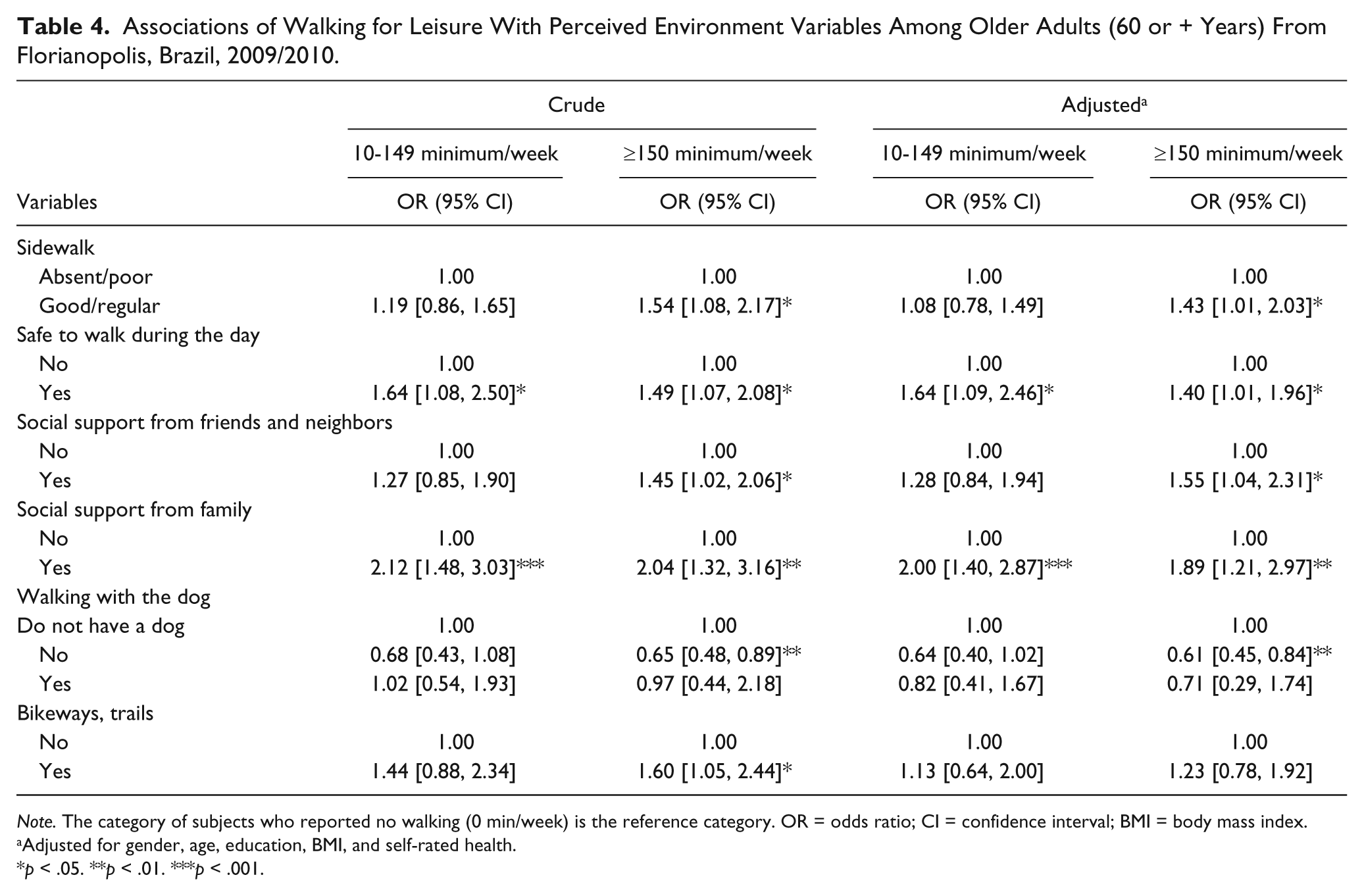
Table 4 presents unadjusted and adjusted analyses related to walking for leisure. Among the environmental variables evaluated, five were significantly associated with walking for leisure. Perception of safety during the day (OR = 1.64, 95% CI = [1.09, 2.46]; OR = 1.40, 95% CI = [1.01, 1.96]) and social support from family (OR = 2.00, 95% CI = [1.40, 2.87]; OR = 1.89, 95% CI = [1.21, 2.97]) were significantly associated with walking for 10-149 min/week and 150+ min/week for leisure. The presence of sidewalks in good conditions (OR = 1.43, 95% CI = [1.01, 2.03]) and social support from friends and neighbors (OR = 1.55, 95% CI = [1.04, 2.31]) were positively associated with walking for 150+ min/week during leisure time. Older adults who reported having a dog, but did not take it for walk (OR = 0.61; 95% CI = [0.45, 0.84]), were less likely to walk for 150+ min/week.
Associations of Walking for Leisure With Perceived Environment Variables Among Older Adults (60 or + Years) From Florianopolis, Brazil, 2009/2010.
Note. The category of subjects who reported no walking (0 min/week) is the reference category. OR = odds ratio; CI = confidence interval; BMI = body mass index.
Adjusted for gender, age, education, BMI, and self-rated health.
p < .05. **p < .01. ***p < .001.
Discussion
Environmental correlates associated with walking have not been extensively studied in older adults, especially in middle-income countries (Arango et al., 2013; Van Cauwenberg et al., 2011). This study showed that perceived neighborhood environment characteristics were associated with walking, and those associations varied by domain (transportation vs. leisure). These findings support the need for behavior-specific interventions, and may help policy makers and health professionals to better address issues related to health promotion among older adults (Giles-Corti et al., 2005; Owen, Humpel, Leslie, Bauman, & Sallis, 2004; Sallis et al., 2008).
Favorable perceptions about the neighborhood environment, including features as sidewalks in good conditions, well-lit streets at night, and crosswalks along the streets in the neighborhood, were positively associated with walking. These results are supported by previous studies showing that neighborhood features such as sidewalks and streets lighting are important concerns among older adults, and can be strongly correlated with rates of walking among this population (Gallagher et al., 2010; Salvador, Reis, et al., 2009; Wang & Lee, 2010).
Street lighting can be related to the perception of safety and prevention of violence as well as may be related to good infrastructure conditions in the neighborhood (Wang & Lee, 2010). Similar to the findings from the current study, the positive association between the perception of traffic safety and walking for transportation was found by others researchers (Gomez et al., 2010; Tsunoda et al., 2012).
In the present study, social support from family and friends was consistently associated with walking for leisure. The positive role of social support in influencing leisure time physical activity among older adults was also observed in other studies (Carlson et al., 2012; Salvador, Florindo, et al., 2009). Being encouraged to exercise by relatives, friends, or neighbors may be an important contributor to an active lifestyle, making physical activity more enjoyable (Ståhl et al., 2001).
Regarding the association between feeling safe during the day with walking for transportation and for leisure, this finding is consistent with results from a cross-sectional (Van Cauwenberg et al., 2012) and a longitudinal study, which showed perceived general safety to be related to a lower decline in older adults’ recreational walking in 12 months of follow-up (Anderson et al., 2005).
Surprisingly, presence of parks and other recreational facilities in the neighborhood was significantly correlated with walking for transportation, but not with walking for leisure. One explanation, as discussed by previous studies (Inoue et al., 2011; Shigematsu et al., 2009), is that older adults might combine walking for transportation and walking for leisure in one trip. Therefore, recreational facilities, including parks, nearby the resident’s home, might support active lifestyles. Moreover, planning and designing communities in ways that support the ability to walk to destinations and provide access to recreational facilities can play a strong role in influencing physical activity among older adults (Kerr et al., 2012).
Contrary to expectations, the absence of visible garbage along the streets of the neighborhood was inversely related to walking behavior. As discussed in previous studies, individuals who walk frequently in their neighborhood are may be more likely to perceive and report problems than inactive people, because they are more exposed to the neighborhood’s environment (Inoue et al., 2011).
In the present study, older adults who had a dog and took it for walking were more likely to walk for transportation. However, older adults who have a dog, but did not walk with it, were less likely to walk for transportation and for leisure, a result that was consistent with other studies (Cutt, Giles-Corti, & Knuiman, 2008; Thorpe et al., 2006). Studies suggest that dog walking is associated with increased levels of physical activity and might promote social interactions, which are relevant for a healthy aging (Toohey, McCormack, Doyle-Baker, Adams, & Rock, 2013).
Study Limitations and Strengths
The current study has several limitations. First, it is difficult to establish causal inferences between perceived environment variables and walking due to the cross-sectional study design. Second, the use of self-reported measures can overestimate the prevalence of physical activity, as discussed previously (Hallal et al., 2012), and the walking component from IPAQ was not validated in older adult population. Also, the environmental measures were based on self-report. Even though self-report can assess a wide range of environmental characteristics, the possibility of a discrepancy between perception and reality must be considered. Self-reported information in regard to features of the environment is likely to differ from those captured with objective methods (Brownson, Hoehner, Day, Forsyth, & Sallis, 2009). Thus, the use of objective measures, such as geographic information system for environmental evaluation, is important for future research.
Among the strengths, it should be emphasized that this study was conducted with a representative sample of older adults living in Florianopolis, ensuring the extrapolation of results to the older population of the city as a whole. We highlight the high response rate achieved. Also, we separately analyzed walking for transport and walking for leisure, which certainly adds to the value of this study, because certain environments may affect specific physical activities (Giles-Corti et al., 2005; Saelens & Handy, 2008; Sallis et al., 2006). Although the mean income of Florianopolis is higher than several other cities in Brazil, marked income inequalities are observed in the city and in our sample. Moreover, even that Florianopolis has good social indicators, comparing with others capitals in Brazil, the urban planning in Florianopolis has not played a substantial role in urbanization, and there is a lack of good infrastructure to promote active lifestyles, as sidewalks, parks, and safety. In addition, Florianopolis is the capital with worst urban mobility in Brazil (PNUD, 2013).
Conclusion
Perceived environment characteristics are related to walking behaviors in older adults living in Florianopolis, Brazil. A positive perception concerning neighborhood characteristics such as the presence of sidewalks, safety from crime and traffic, well-lit streets at night, presence of parks, and other recreational facilities and social support were independently associated with increased levels of walking in a large sample of older adults. More importantly, many of these features are modifiable, and therefore, investments in the environment can lead to increased physical activity level of the population.
Footnotes
Acknowledgements
The authors would like to thank the Brazilian Institute of Geography and Statistics (IBGE) and the Florianopolis Health Authority staff for their useful help with the practical aspects of the study.
Authors’ Note
Maruí W. Corseuil Giehl made a substantial contribution to the concept and design, acquisition of data or analysis, and interpretation of data; drafted the article or revised it critically for important intellectual content; and approved the version to be published. Pedro C Hallal drafted the article or revised it critically for important intellectual content and approved the version to be published. Ross C. Brownson drafted the article or revised it critically for important intellectual content and approved the version to be published. Eleonora d’Orsi made a substantial contribution to the concept and design, acquisition of data, or analysis and interpretation of data; drafted the article or revised it critically for important intellectual content; and approved the version to be published.
Declaration of Conflicting Interests
The authors declared no potential conflicts of interest with respect to the research, authorship, and/or publication of this article.
Funding
The authors disclosed receipt of the following financial support for the research, authorship, and/or publication of this article: The EpiFloripa Elderly study was supported by Conselho Nacional de Desenvolvimento Científico e Tecnológico (CNPq; no. 569834/2008-2). The first author received a scholarship from Coordenação de Aperfeiçoamento de Pessoal de Nível Superior (CAPES). The second author is funded by the Wellcome Trust through a New Investigator Award.