



Abstract
Introduction
Maintaining cognitive functioning in later life is one of the essential aspects of successful aging (Rowe & Kahn, 1997), and it is associated with better psychological well-being (Llewellyn, Lang, Langa, & Huppert, 2008) and retention of autonomy among older adults. Accordingly, there has been a significant effort to identify predictors of retaining cognition. Based on cognitive reserve theory, educational attainment, occupational complexity, and later-life leisure engagement are considered to expand cognitive reserves, thus providing more resilience to brain damage or neurodegenerative disorders like Alzheimer’s disease (Scarmeas & Stern, 2003; Stern, 2002). Indeed, previous empirical studies have shown that individuals with more years of education (Gatz et al., 2001; Jefferson et al., 2011; Stern et al., 1994), with a complex occupation (Andel, Silverstein, & Kåreholt, 2015), and who participate more frequently in leisure activities (Podewils et al., 2005; Verghese et al., 2003; J. Y. Wang et al., 2006) show less cognitive decline or lower risk of Alzheimer’s disease. Among these protective factors, however, engagement in leisure activities (e.g., mental, physical, and social activities), which is modifiable in later life, has received increasing attention during the last two decades.
Retirement is one of the most salient life transitions in later adult life (M. Wang, Henkens, & van Solinge, 2011) because it largely affects older individuals’ lifestyles, including allocation of time and energy once dedicated to work. The “use or lose it” perspective contends that using cognitive skills by engaging in activities may help maintain cognitive performance, thereby protecting against cognitive decline in later life (Hultsch, Hertzog, Small, & Dixon, 1999). However, retirees may use relatively fewer cognitive skills than workers because workplaces more often provide a cognitively challenging environment than nonwork settings (Rohwedder & Willis, 2010). In this respect, retirement may become a significant risk factor for cognitive decline by eliminating mentally stimulating routines and environments previously provided in the workplace unless sufficiently compensated by leisure activities (e.g., doing crossword puzzles) to offset such loss (Rohwedder & Willis, 2010). Accordingly, leisure activity engagement may become a crucial part of adjustment for retirees (Rosenkoetter, Garris, & Engdahl, 2001) to maintain cognitive function postretirement.
In another line of inquiry, retirement may greatly influence health outcomes including cognitive function. Rosenkoetter et al. (2001) noted that retirement not only frees individuals from work responsibilities but may also deprive them of the structure and sense of belonging once provided by work. Pearlin (1989) also mentioned that retirement could be not only liberating if considered a new opportunity for pursuing passions other than work but also depriving if perceived as loss of a previous status or skills. This loss of an important role (Pinquart & Schindler, 2007), interruption in sense of self (Bridges, 2004), or detachment from social networks of coworkers may diminish well-being after retirement (Kim & Moen, 2002). Indeed, previous studies have shown that retirement has an adverse effect on both physical and mental health outcomes (e.g., cardiovascular disease, functional limitations, and depressive symptoms; Dave, Rashad, & Spasojevic, 2006; Moon, Glymour, Subramanian, Avendaño, & Kawachi, 2012).
Nevertheless, few studies have examined the association between retirement and cognitive function, and existing research has generated inconsistent findings. For example, Bonsang, Adam, and Perelman (2012) found a significant negative relationship between retirement and cognition among older Americans. Similarly, Rohwedder and Willis (2010) conducted a cross-national study (i.e., the United States, England, and Europe) and found negative effects of early retirement on cognitive ability. In contrast, Roberts, Fuhrer, Marmot, and Richards (2011) found no significant relationship between time spent retired and cognition in a London-based sample. Likewise, Coe, von Gaudecker, Lindeboom, and Maurer (2012) and Coe and Zamarro (2011) found no causal relationship between retirement and cognition in a men-only U.S. sample, evidenced by a significant effect disappearing after controlling for endogeneity retirement factors (e.g., retirement age, early retirement offer). The most recent relevant study by Adam, Bonsang, Grotz, and Perelman (2013) found that even after controlling for endogeneity of retirement decisions, retirement still had a significant negative relationship with cognitive functioning. Such equivocal findings regarding the retirement–cognition association suggest further exploration is needed to test whether other factors affect this relationship.
Leisure activities in later life such as reading books, walking, and visiting friends have often been considered to be beneficial resources that promote better quality of life among older adults (Silverstein & Parker, 2002) and help individuals successfully transition to and adjust after retirement (M. Wang & Shultz, 2010), linking an individual’s identity between pre- and postretirement life (Atchley, 1971). Although previous studies have tested the role of leisure activities in life events and health outcomes, including functional limitations (Unger, Johnson, & Marks, 1997) and quality of life (Silverstein & Parker, 2002), few studies have delineated its role with a specific focus on the retirement-cognition relationship. Even those few existing studies on cognitive function have largely tested the role of leisure activity in terms of genetic (e.g., ApoE4 allele), early life (e.g., education), or midlife (e.g., occupational complexity) factors (Andel et al., 2015; Lachman, Agrigoroaei, Murphy, & Tun, 2010; Lee & Chi, 2016; Niti, Yap, Kua, Tan, & Ng, 2008), but not on later-life transitions such as retirement.
To our knowledge, only one identified study (Andel, Finkel, & Pedersen, 2016) examined the interacting effects of work complexity and leisure activity on cognitive aging before and after retirement, specifically among Swedish older adults. Findings imply that engagement in leisure activities after retirement may compensate for cognitive disadvantage among individuals with lower work complexity. However, the authors mentioned the study’s relatively small convenience sample as a limitation (n = 421, a subsample of a Swedish twin study) and that a larger sample was needed to validate their findings. Moreover, although cognitive function before and after retirement was the outcome, the major focus of this study was work complexity rather than retirement per se, leaving the mechanism among retirement, leisure activities, and cognition unexplored. Adam et al. (2013) noted that retirement may imply changes in activities, which may in turn contribute to cognitive function among older adults. These authors further suggested future studies that examine “whether the relationship between retirement and cognition is direct and/or whether there are some intermediate variables between retirement and cognition” (p. 388). In this vein, testing a mediation model of leisure activities in the relationship between retirement and cognitive function seems to be the next step in this field of research.
Thus, this study examined the effect of retirement on cognition functioning and further delineated the mediating role of leisure participation in the relationship between retirement and cognition using three waves of a national longitudinal survey, the Health and Retirement Study (HRS), and its supplementary data, the Consumption and Activities Mail Survey (CAMS).
Two research questions guided this study:
Method
Data and Study Sample
This longitudinal study used 2004-2008 HRS data linked to its supplementary data from the CAMS. The HRS is an ongoing national household survey that collects information such as demographics, family structure, housing, work, physical health, and cognitive function of Americans aged 51 or older. Conducted by the Institute for Social Research at the University of Michigan, HRS data collection began in 1992 and involves a probability sample with oversampling of Black, Hispanic, and Floridian participants (due to high densities and size of older adult populations; Juster & Suzman, 1995).
During off years between HRS interviews, CAMS data are collected biennially from a subsample of HRS households. If a household has two eligible respondents (coupled or partnered), both individuals are included in the sample. The CAMS survey is conducted by the Survey Research Center at the Institute for Social Research at the University of Michigan. The CAMS collects information about time spent engaged in various activities, household expenditures, and use of prescription drugs (Hurd & Rohwedder, 2009). It involves a self-administered paper-and-pencil survey, which allows respondents to take sufficient time to answer questionnaires. This approach has advantages compared with face-to-face interviews, during which respondents may have greater time constraints to reflect on their answers (Hurd & Rohwedder, 2007).
This study used a user-friendly version of core HRS data, the RAND Corporation’s HRS data file (version O). Major variables of core HRS data have been cleaned and imputed by researchers at the RAND Center for the Study of Aging. Three waves of RAND HRS and CAMS datasets were merged to conduct the analyses in this study. Because the HRS is collected in even years (e.g., 2004, 2006, 2008) and the CAMS is collected in odd years (e.g., 2005, 2007, 2009), corresponding interview years of the HRS (n) and CAMS (n + 1) were matched to ensure that respondents had information for both surveys. Three waves were used for this study and are hereafter defined as Time 1 (HRS 2004 and CAMS 2005), Time 2 (HRS 2006 and CAMS 2007), and Time 3 (HRS 2008 and CAMS 2009).
In these datasets, 4,175 respondents provided information at all three relevant waves of the HRS and CAMS. Among these individuals, those younger than 51 (n = 233), who never worked or returned to work after retirement (n = 365), or with cognitive impairment (as described in the “Measures” section) at baseline (n = 415) were excluded.
Respondents who returned to work after being retired were excluded from this study, because their previous retirement did not reflect a lasting withdrawal from the labor force. After excluding individuals with missing data for leisure activity items (n = 198) and other study variables (n = 137), the final analytic sample was 2,827.
Measures
Cognitive function
Cognitive function was the dependent variable in this study, measured using a modified version of the Telephone Interview for Cognitive Status (Brandt, Spencer, & Folstein, 1988). Three domains of cognitive function were assessed in this study: (a) memory, (b) working memory, and (c) attention and processing speed. For memory, both immediate and delayed word recall were measured. After listening to a list of 10 nouns (e.g., book, child), respondents were asked to recall as many words as possible from the list in any order. Roughly 5 min later (after answering other survey questions), respondents were again asked to recall as many words from the previous list of nouns. For immediate and delayed word recall, the score indicates the number of correct responses (range = 0-10), leading to an overall memory score between 0 and 20. Working memory is the ability to process and store information simultaneously. It is measured by a serial 7s subtraction test, which asks respondents to subtract 7 from 100 subsequently for five trials. The score ranges from 0 to 5. For attention and processing speed, a counting backward test was used, asking respondents to count backward for 10 continuous numbers starting at 20 (Fisher, Hassan, Rodgers, & Weir, 2013; Ofstedal, Fisher, & Herzog, 2005). The total score of these measurements was calculated (range = 0-27), with higher scores indicating better cognitive function. The HRS cognitive measure was found to have good construct validity to assess cognitive decline and onset of cognitive impairment in large population studies (Crimmins, Kim, Langa, & Weir, 2011; Herzog & Wallace, 1997). As previously mentioned, individuals who scored less than 12 at baseline (Time 1) were excluded from this study because they were regarded to be cognitively impaired. This cutoff score of 12 was based on a previous study using the same scale (Crimmins et al., 2011). In HRS data, two additional cognitive domains of language (object naming test) and orientation (recall of the date and president and vice president) were assessed only among respondents aged 65 or older. Because the present study also included respondents who were younger than 65, these two domains were not included in cognition measures. The rationale for using three waves of HRS is derived from the findings of a previous relevant study (Bonsang et al., 2012) indicating that the most salient negative effect of retirement on cognitive functioning is likely to occur approximately 1 year postretirement.
Retirement status
Retirement has been defined as withdrawal from the labor force (Lazear, 1986), and thus was measured by self-report of current working status in the HRS questionnaire (i.e., Are you currently working for pay?). Previous retirement studies adopted a similar approach (Bonsang et al., 2012; Rohwedder & Willis, 2010). For each wave, individuals who reported not working for pay were considered to be retired. Then, based on retirement status in each wave, three retirement groups were classified in this study: (a) remained working, which refers to individuals who reported not being retired at Time 1, Time 2, and Time 3; (b) transitioned to retirement, which refers to individuals who reported working at Time 1 but retired at either Time 2 or Time 3; and (c) remained retired, which refers to individuals who reported being retired at Time 1, Time 2, and Time 3.
Leisure activities
The CAMS asked respondents how much time they spent engaged in a wide array of activities. Activities involving frequent participation (e.g., walking, reading newspapers) were assessed in terms of hours spent during the previous week, whereas activities involving less frequent participation (e.g., volunteering, attending religious services) were assessed based on hours spent during the previous month. For the present study, monthly responses were divided by 4 to be comparable to weekly responses. Twenty-six of 33 items were further categorized into four subdomains of leisure activities: mental (seven items), physical (two items), social (nine items), and household (eight items). Such classification is based on the face validity and categorization described in the previous relevant literature (Adams, Leibbrandt, & Moon, 2011; Chang, Wray, & Lin, 2014; Lachman et al., 2010; Paillard-Borg, Wang, Winblad, & Fratiglioni, 2009; Verghese et al., 2003). Household activities (e.g., gardening, cleaning, or home improvements) were also defined as leisure activities for older adults based on previous studies (Chang et al., 2014; Paillard-Borg et al., 2009). Detailed items in each domain are presented in Table 1. Seven items were excluded because they were considered not leisure but rather for survival needs (e.g., sleeping or napping, managing a medical condition) or because most working individuals engaged in them (e.g., using a computer, working for pay). Watching television was also excluded from this study because previous studies showed that it is negatively related with cognitive function among older adults (Hamer & Stamatakis, 2014; Rundek & Bennett, 2006; J. Y. Wang et al., 2006). For each subdomain, items were summed to indicate total weekly time spent on leisure activities. To minimize the loss of cases due to missing items, individuals missing data for only one item were retained in the sample. Those missing data for more than one item in each domain (e.g., two of seven items missing for mental activities) were excluded across all four domains (n = 198). Due to the nonnormal distribution of total hours, each domain was dichotomized at its median value. Values lesser than the median were considered to reflect a low level of engagement in activities (coded as 0), whereas values greater than the median were considered indicative of high level of engagement in activities (coded as 1). This approach was applied to all four domains of leisure activities. Leisure activities at Time 2 were included as mediators in this study, whereas leisure activities at Time 1 were included as control variables.
Subdomains of Leisure Activities From the CAMS.

Note. Seven items (i.e., “watching television,” “sleeping and napping,” “grooming and hygiene,” “using computer,” “working for pay,” “taking care of finances or investments, such as banking, paying bills, balancing the checkbook, doing taxes,” and “self-treating or self-managing an existing medical condition”) were excluded from this study. CAMS = Consumption and Activities Mail Survey.
Control variables
Baseline (Time 1) variables, which were previously found to be a possible risk factor for cognitive decline or dementia (Anstey, Mack, & Cherbuin, 2009; Anstey, von Sanden, Salim, & O’Kearney, 2007; Bond, Dickinson, Matthews, Jagger, & Brayne, 2006; Jorm, 2000; McGuire, Ford, & Ajani, 2006), were controlled in the analysis as follows.
Depressive symptoms
Depressive symptoms were measured with a modified eight-item subscale from the Center for Epidemiologic Studies Depression Scale. The measure asked whether respondents felt (a) depressed, (b) that everything was an effort, (c) their sleep was restless, (d) they could not get going, (e) lonely, (f) they enjoyed life (reverse coded), (g) sad, and (h) happy (reverse coded) much of the time during the previous week. Higher scores indicated more depressive symptoms (range = 0-8).
Self-rated health
Self-rated health was measured in one item with a 5-point scale: “Would you say your health is excellent, very good, good, fair, or poor?” After reverse coding, higher scores indicated better self-rated health.
Functional limitations
Functional limitation was measured by five specific instrumental activities of daily living: shopping for groceries, preparing a hot meal, using a phone, managing money, and taking medication (1 = some difficulty, 0 = no difficulty). These five items were summed to create a composite count. Because a majority of responses were 0, this variable was dichotomized to indicate any difficulties (coded as 1) or no difficulties (coded as 0) regarding functional limitations.
Health behaviors
Health behaviors were measured by respondents’ use of alcohol (0 = never, 1 = light drinker, 2 = heavy drinker) and cigarettes (0 = never, 1 = previous smoker, 2 = current smoker). Men who consumed alcohol on one or more days a week and had three or more drinks per occasion and women who consumed two or more drinks per occasion were considered heavy drinkers. Responses between no use and heavy use were classified as light drinkers. This classification is based on previous studies (Lyu & Lee, 2012; Satre, Gordon, & Weisner, 2007).
Sociodemographic factors
Age (years), gender (0 = female, 1 = male), race and ethnicity (0 = non-Hispanic White, 1 = non-Hispanic Black, 2 = Hispanic, 3 = other; dummy coded), education (years), marital status (0 = unmarried, that is, divorced, separated, widowed, or never married; 1 = married or partnered), and household wealth (log transformed) were also included as control variables in the present study.
Baseline cognitive function and leisure activities
Cognitive function (range = 12-27) and four domains of leisure engagement (0 = low, 1 = high) at baseline were included in the model as control variables.
Data Analysis
Preliminary analyses were conducted using Stata software (version 12.0). ANOVA and chi-square tests were conducted to explore whether significant differences existed in major study variables by three retirement groups: remained working, transitioned to retirement, and remained retired. Finally, path analysis was conducted to test the relationship between retirement and cognitive function via leisure activity participation. Specifically, retirement status was inserted as an independent variable in the model. Transitioned to retirement and remained retired groups were included as dummy variables, with the referent being the remained working group. Four domains of leisure engagement (each binary measure: 0 = low, 1 = high) at Time 2 were included as multiple mediators while controlling for leisure engagement at Time 1. Cognitive function at Time 3 was included as a dependent variable while controlling for cognitive function at Time 1. Age, age-squared, gender, race and ethnicity, education, marital status, household wealth (log), self-rated health, depressive symptoms, functional limitations, and smoking and drinking behaviors at baseline were controlled as covariates. Correlations between the four mediators were also indicated as separate commands in the model. Goodness-of-fit indexes including chi-square, comparative fit index (CFI), and root mean square error of approximation (RMSEA) were used as criteria for estimating the model (Barrett, 2007). A minimum CFI value of .90 and a value less than .05 for RMSEA were considered to indicate good model fit for this study. Path analysis was conducted with the weighted least-squares parameter estimator to estimate categorical mediators or outcome variables. A bootstrapping method (1,000 iterations) was applied to obtain bias-corrected confidence intervals (CIs) for both direct and indirect effects using Mplus software (Muthén & Muthén, 2010).
Results
Characteristics of Sample by Retirement Status
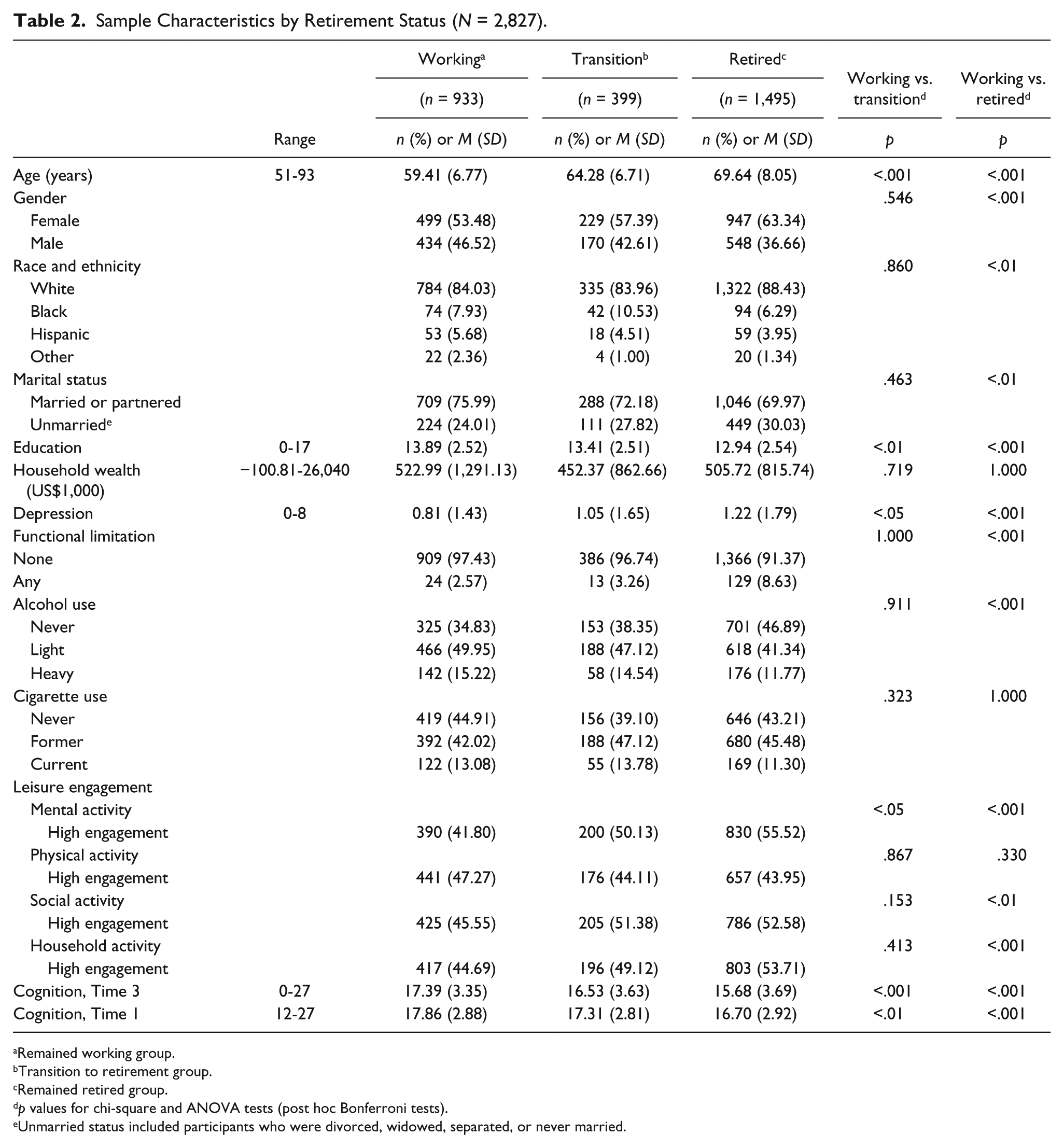
Table 2 provides mean and frequencies of major study variables by retirement status. In this sample of 2,827 individuals during the study period, a majority of participants (n = 1,495, 52.88%) remained retired, whereas 933 (33.00%) remained working and 399 (14.11%) transitioned from work to retirement. The p values presented in the last two columns of Table 2 are based on chi-square and ANOVA tests (post hoc Bonferroni tests) and indicate any significant differences in major study variables across retirement groups. All study variables were compared between (a) remained working and transitioned to retirement and (b) remained working and remained retired.
Sample Characteristics by Retirement Status (N = 2,827).
Remained working group.
Transition to retirement group.
Remained retired group.
p values for chi-square and ANOVA tests (post hoc Bonferroni tests).
Unmarried status included participants who were divorced, widowed, separated, or never married.
Cognitive function at Time 3 significantly differed across retirement groups. Compared with the remained working group (M = 17.39, SD = 3.35), those who transitioned to retirement (M = 16.53, SD = 3.63) or remained retired (M = 15.68, SD = 3.69) showed significantly lower cognitive function (p < .001). There was a significant difference between the remained working and transitioned to retirement groups in terms of engagement in mental activities (p < .05). There was a significant difference between the remained working and remained retired group in terms of engagement in mental (p < .001), social (p < .01), and household activity (p < .001).
Path Models for Retirement, Leisure Activities, and Cognition
Figure 1 shows the model fit indexes and specific direct paths between variables. The explained variance for cognitive function was .345. The correlations between domains of leisure activities are also presented in Figure 1. The fit indexes indicated good fit, CFI = .979, RMSEA = .033, CI = [0.025, 0.042]. Although χ2(16) = 66.335 (p < .001) was statistically significant, this is not an uncommon result for studies with large sample size. Larger sample sizes are considered to increase the likelihood of poor model fit when using chi-square as a goodness-of-fit test (Barrett, 2007).

Path analysis of retirement, leisure activity engagement, and cognition.
The significance of unstandardized coefficients and standard errors for each pathway is shown in Figure 1. Solid lines indicate statistically significant direct paths, whereas dashed lines indicate nonsignificant paths. Retirement was negatively related with cognitive function (Time 3) after controlling for other covariates including baseline cognitive function (Time 1). Specifically, those who remained retired showed significantly lower levels of cognitive function (b = −0.321, SE = 0.164, p < .05) compared to the remained working group. However, the transitioned to retirement group did not show significant difference in cognitive function compared with the remained working group.
The path result for the association between leisure activity engagement (Time 2) and cognitive function (Time 3) showed that only mental activities were positively related with cognitive function. Individuals with high level of engagement in mental activities (b = 0.191, SE = 0.075, p < .01) had better cognitive function compared with those with a low level of engagement in these activities. However, having a high level of engagement in physical, social, and household activities did not significantly affect cognitive function.
Transition to retirement was positively associated with a high level of engagement in mental (b = 0.221, SE = 0.083, p < .05) and social (b = 0.194, SE = 0.081, p < .05) activities compared with the remained working group. Remaining retired was positively associated with high engagement in mental (b = 0.234, SE = 0.070, p < .01), social (b = 0.208, SE = 0.069, p < .01), and household (b = 0.197, SE = 0.072, p < .01) activities.
Testing the Significance of Indirect Effects
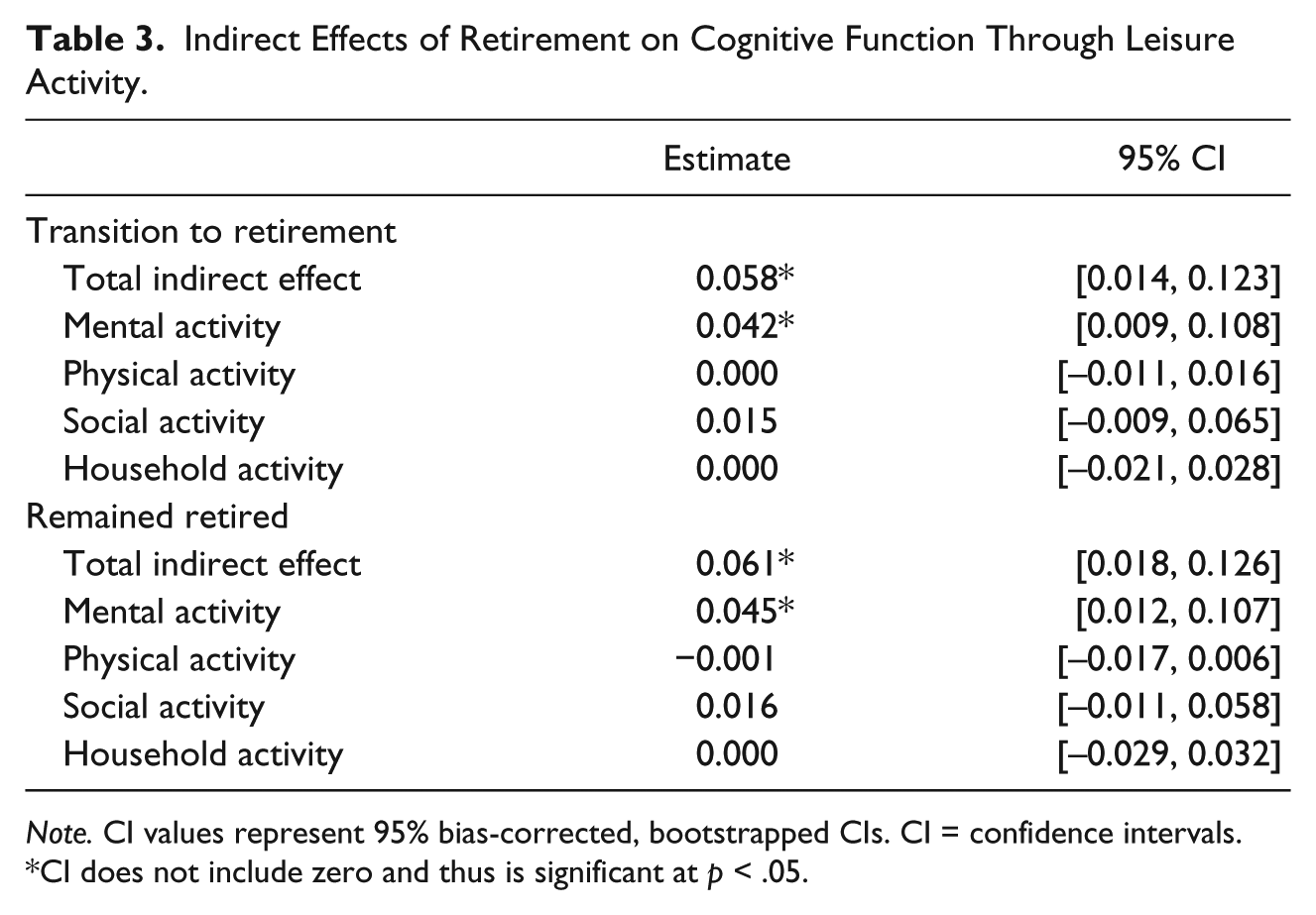
Table 3 shows the statistical significance of the indirect effect of retirement on cognitive function through leisure engagement. Both total indirect and specific indirect effects are presented with 95% bias-corrected, bootstrapped CIs. The total indirect effect of transition to retirement on cognitive function was statistically significant through one mediator (mental activities; b = 0.058; 95% CI = [0.014, 0.123]; p < .05). The specific indirect effect of mental activities (b = 0.042; 95% CI = [0.009, 0.108]; p < .05) was significant. Similarly, the total indirect effect (b = 0.061; 95% CI = [0.018, 0.126]; p < .05) of remaining retired on cognitive function was statistically significant through the specific indirect effect of mental activity engagement (b = 0.045; 95% CI = [0.012, 0.107]; p < .05). However, physical, social, and household activities were not significant mediators in the relationship between retirement and cognitive function.
Indirect Effects of Retirement on Cognitive Function Through Leisure Activity.
Note. CI values represent 95% bias-corrected, bootstrapped CIs. CI = confidence intervals.
CI does not include zero and thus is significant at p < .05.
Discussion
This is one of the first studies to examine the mediating effect of leisure activities in the relationship between retirement and cognition using national longitudinal data (HRS and supplementary CAMS data), specifically using information from 2,827 older adults aged 51 or older during a 4-year period while controlling for both baseline cognitive function and leisure activity participation. Results indicate a negative association between retirement (remained retired only) and cognition. Moreover, this relationship was attenuated by engaging more in mental activities (e.g., reading newspapers, reading books, playing cards or games, solving puzzles, doing arts and crafts, listening to music, singing or playing music, and praying or mediating), as evidenced by the significant indirect path from retirement to cognition via mental activities. However, physical, social, and household activities had no significant effect on this path.
Our finding of lower cognitive function among those in the remained retired group compared with their counterparts who remained working supports previous studies that found a negative relationship between retirement and cognition (Bonsang et al., 2012; Rohwedder & Willis, 2010). Cessation of a previous role as a worker may have decreased brain stimulation upon retirement. Rohwedder and Willis (2010) referred to this as the “unengaged lifestyles hypothesis” of mental retirement as one way to explain why retirement might cause cognitive decline (i.e., retirees engage less in a cognitively stimulating environment than workers). This is also in line with the “use it or lose it” hypothesis, which posits that continuous use or practice of cognitive skills in activities may help maintain cognitive performance in later life (Hultsch et al., 1999).
Moreover, we found that this negative association between retirement and cognitive function was mediated by mental activity engagement. This significant indirect effect of mental activities in the retirement–cognition relationship implies that activities such as reading, playing card games, or doing puzzles may play a significant role in reducing the effect of retirement on cognition. However, other domains of activities (physical, social, and household) had no direct or indirect effects on cognition. Indeed, previous studies have shown more consistent benefits of mental activities, compared with less consistent results regarding physical or social activities in terms of cognition (Verghese et al., 2003; J. Y. Wang et al., 2006; Wilson et al., 2002). For example, Verghese et al. (2003) examined the role of cognitive and physical activities on dementia risk regardless of retirement status and found that only cognitive activities reduced risk of dementia. In addition, J. Y. Wang et al. (2006) found that only cognitive leisure activities were related with reduced risk of cognitive impairment but not physical or social activities. Similarly, Wilson et al. (2002) found that participation in cognitive activities, but not physical activities, was significantly associated with reduced risk of Alzheimer’s disease. Wilson et al. (2002) noted that “the association of cognitive activity with disease risk reflects mental stimulation rather than a nonspecific result of being active” (p. 746), which implies that mental activities may be one of the most beneficial activities for cognitive function.
The present study has several implications for older Americans who experience retirement. First, the negative association between retirement and cognitive function suggests that more employment policies may be needed that encourage individuals to work longer and delay retirement, potentially helping them prolong their time engaged in mentally engaging lifestyles. Second, the indirect effect of mental activities in the relationship between retirement and cognition suggests that promoting leisure engagement, specifically focusing on mental activities in senior centers or retirement communities, may help maintain cognition in this population after retirement. Last, more development of programs that enhance older adults’ cognitive function are suggested. Thus far, several randomized controlled trials of cognitive training programs such as Advanced Cognitive Training for Independent and Vital Elderly (Willis et al., 2006) or Improvement in Memory With Plasticity-Based Adaptive Cognitive Training with computer-based brain fitness (Smith et al., 2009) among cognitively healthy older adults have shown benefits in terms of cognitive skills (e.g., processing speed). Nevertheless, La Rue (2010) argued that “training benefits were task-specific and usually did not extend to apparently similar, more naturalistic cognitive tasks (e.g., remembering a shopping list rather than a list of unrelated words of the type used in training)” (p. 104). Thus, developing a cognitive training program whose benefit expands to the daily lives of older retirees is necessary. Moreover, creating mentally stimulating activities (e.g., memory games) using smartphones or smartwatches for the baby boomer generation will provide a tech-friendly approach to retaining cognitive function among older adults in the present era.
Limitations
The present study featured several notable limitations. First, the endogeneity of retirement decisions was not controlled for in this study. Although this study excluded individuals who were cognitively impaired at baseline and controlled for baseline cognitive function, individuals experiencing greater cognitive decline might have been more likely to retire than their cognitively healthier counterparts. Retirement decisions may be also influenced by individuals’ acute or chronic health conditions or different social policy regulations across countries (e.g., Social Security; Mazzonna & Peracchi, 2012).
Second, the categorization of leisure domains was based on previous studies, but these distinctions may still be ambiguous. For example, some domains may share same items (e.g., playing a musical instrument can be both mental and physical). In addition, one activity may be more demanding than others in the same domain (e.g., playing sports may be physically more demanding than walking). Indeed, some studies assigned weights for leisure activities, although this may also be difficult because weights for an item may vary based on the study sample (Verghese et al., 2003). Moreover, using seven items (e.g., reading, doing puzzles, doing arts and crafts) to assess mental activities may not have been sufficient to inform interventions or specific programs. Unfortunately, no common tool has been used to measure cognitive activities, and each relevant study measured mental activities (e.g., specific activities to include, intensity, number of activities) in its own way. Thus, more effort is necessary in future research to establish a standard measure for level of engagement in mental activities with improved validity and reliability (La Rue, 2010).
Third, we used a total score of global cognitive function instead of exploring each domain of cognitive function; each domain might influence different outcomes related to retirement. Thus, future study is suggested to investigate the domain-specific effect dependent on retirement status. Moreover, occupational complexity (e.g., an occupation with high mental demands vs. low mental demands) was not controlled for in this study, despite the potential for variability in level of mental stimulation after retirement. Fourth, although we dichotomized the level of leisure activity engagement due to nonnormal distribution (e.g., highly skewed and kurtotic), this could have overlooked the variability in each group. Also, the staggered one year for data collection of the leisure activities via CAMS compared with data collected in HRS is another limitation of the study.
Last, the CAMS survey does not ask about the specific context of activity participation (e.g., whether the activity was pursued alone or with other people, whether individuals chose to engage in an activity), instead focusing solely on involvement (Morrow-Howell et al., 2014). Thus, greater consensus in this field of study to validly measure leisure is needed to generate more consistent results. Future studies that test how to classify leisure activities or incorporate the context of leisure activities in survey questionnaires are necessary.
Conclusion
This study indicated a negative relationship exists between retirement and cognitive function, evidenced by lower cognition among individuals who remained retired compared with those who remained working over a 4-year period. This study also showed that this negative relationship was mitigated by engaging in a high level of mental activities (e.g., reading newspapers, reading books, playing cards or games, etc.). The findings suggest that more support is needed at practice and policy levels to encourage older adults to work longer and promote mental activity engagement in later life. From a research perspective, this study also suggests future studies should investigate whether factors such as socioeconomic status and health conditions provide a better picture of the mechanisms among retirement, mental activities, and cognitive function. For example, individuals with higher household wealth or better life satisfaction may be able to engage in higher levels of mental activity compared with their counterparts. This will delineate whether the path from retirement to cognitive function via mental activities differs among individuals with distinguishable levels of socioeconomic status or health conditions.
Footnotes
Authors’ Note
Iris Chi and Lawrence A. Palinkas are currently affiliated to Suzanne Dworak-Peck School of Social Work, University of Southern California.
Declaration of Conflicting Interests
The authors declared no potential conflicts of interest with respect to the research, authorship, and/or publication of this article.
Funding
The authors received no financial support for the research, authorship, and/or publication of this article.