



Abstract
Introduction
Dementia, a clinical syndrome characterized by progressive deterioration in cognitive function and the ability to perform everyday activities, is the leading contributor to disability in old age in low- and middle-income countries (LMIC; Sousa et al., 2009; Wimo et al., 2013). It has been designated by the World Health Organization (WHO) as a public health priority, and its burden on LMIC is expected to increase in the coming decades. In 2010, 57.7% of all people with dementia lived in LMIC, and this proportion is predicted to rise to 70.5% in 2050 (Prince et al., 2013; Prince et al., 2015; WHO & Alzheimer’s Disease international, 2012).
Recent studies using longitudinal data have documented declines in the age-specific prevalence of dementia in high-income countries that are associated with increases in educational attainment, lifestyle changes, and better chronic disease management (Ahmadi-Abhari et al., 2017; Kosteniuk et al., 2016; Langa et al., 2017; Satizabal et al., 2016). Langa et al. (2017) found that the prevalence of dementia for older adults aged 65 and above in the United States decreased from 11.6% in 2000 to 8.8% in 2012, and the decline was associated with an increase in educational attainment. Satizabal et al. (2016), using longitudinal data from the Framingham Heart Study in Massachusetts, United States, found a decline in the incidence of dementia by about 20% per decade from 1977 to 2008 for those with at least a high school diploma. The decline was associated with improvements in cardiovascular health and chronic disease management. Consistent with the findings in these studies, improvements in access to education and health care, as well as reductions in risk factors of vascular disease and other chronic conditions, have been advocated as a means to addressing major public health challenges that dementia will pose for LMIC (Barnes & Yaffe, 2011; Epping-Jordan, Galea, Tukuitonga, & Beaglehole, 2005; Prince et al., 2013; WHO & Alzheimer’s Disease International, 2012). However, notwithstanding the evidence of their success in high-income countries, the adoption of these strategies in LMIC may be slowed by the practical reality of public health systems with limited resources and already overstretched by the burden of communicable diseases and child/maternal care (Epping-Jordan et al., 2005).
Some LMIC provide access to health care for low-income individuals through fee waivers or conditional cash transfer programs, which provide cash or in-kind resources on the condition that recipients comply with certain behaviors such as regular visits to health care facilities. Coverage of older adults through these programs is low, as they are often targeted to children and women of child-bearing age, and most of them rely on limited local health care infrastructure (Barber & Gertler, 2009; Lagarde, Haines, & Palmer, 2007). The largest safety net programs targeting older adults in LMIC are income supplemental programs, also called noncontributory or social pensions. These programs provide a fixed amount of cash for adults above a specific age and generally place no restrictions on how the cash can be spent. After being advocated by the World Bank, the United Nations, and the Economic Commission for Latin America and the Caribbean (ECLAC) as key strategies to tackle old-age poverty, they have been implemented in more than 80 countries including Bolivia, Mexico, Brazil, and South Africa (Aguila et al., 2014; ECLAC, 2006; Holzmann, Hinz, & von Gersdorff, 2005; Newson & Bourne, 2011; The World Bank, 1994).
Previous studies have found consistent evidence that income supplemental programs reduce household poverty (Barrientos et al., 2003; Case, 2004; Case & Deaton, 1998; Delgado & Cardoso, 2000; Galiani, Gertler, & Bando, 2016; Lund, 2002; Oliveira, Kassouf, & Aquino, 2017; Pestieau, Ali, & Dethier, 2010; Salinas-Rodríguez et al., 2014; Schwarzer & Querino, 2002), increase consumption (Lund, 2002), and increase food availability (Aguila, Kapteyn, & Smith, 2015).
Supplemental income programs have also been found to increase health care utilization (Lloyd-Sherlock & Agrawal, 2014; Schwarzer & Querino, 2002; Aguila, Kapteyn, & Smith, 2015). In addition, there is some evidence that these programs improve physical and mental health and subjective well-being. For example, (Aguila, Kapteyn, & Smith, 2015) found positive effects on physical health markers of an income supplementation program in urban areas of Mexico, whereas Galiani et al. (2016) and Salinas-Rodríguez et al. (2014) reported improvements in mental well-being for elderly Mexicans after the introduction of an income supplemental program in rural areas. In Brazil, Lloyd-Sherlock, Saboia, and Ramírez-Rodríguez (2012) found positive effects on subjective well-being of an income supplemental program targeting older adults. The effects on health are mixed for the South African case. Although Case (2004) and Schatz, Gómez-Olivé, Ralston, Menken, and Tollman (2012) found that individuals receiving a social old-age pension report higher self-reported health, happiness, and life satisfaction, Lloyd-Sherlock and Agrawal (2014) found no association between the old-age pension and self-reported health or quality of life.
Although supplemental income programs for older adults are not specifically designed to prevent dementia, they may affect cognitive function by modifying known risk factors for cognitive impairment, including chronic conditions such as cardiovascular disease, diabetes, and hypertension (Barnes & Yaffe, 2011; Beaglehole et al., 2008); depression (Paterniti, Verdier-Taillefer, Dufouil, & Alpérovitch, 2002; Plassman, Williams, Burke, Holsinger, & Benjamin, 2010; Wilson et al., 2014); functional decline (Farias et al., 2017; Fauth et al., 2013); and malnutrition and anemia (Denny, Kuchibhatla, & Cohen, 2006; Leist, Novella, & Olivera, 2018; Saka, Kaya, Ozturk, Erten, & Karan, 2010). Income supplemental programs may also contribute to the prevention and/or management of the aforementioned risk factors through increases in health care use.
The first aim of this study was to examine whether the provision of supplemental income in the form of a noncontributory, non-means-tested pension to older adults in the Mexican state of Yucatan improved cognitive function, measured using scores on immediate and delayed word recall tasks. The scores are assessed from two memory tasks similar to those included in screening tools for cognitive dysfunction such as the Brief Alzheimer Screen (BAS) and the Short Blessed Test (SBT; Carpenter et al., 2011; Katzman et al., 1983; Mendiondo, Ashford, Kryscio, & Schmitt, 2003), and they have been used, together with additional instruments, to evaluate abnormal cognitive impairment and dementia of older Mexican adults (Mejia-Arango & Gutierrez, 2011; Miu et al., 2016).
The second aim of the current study was to determine whether the intervention had an impact on some of the risk factors for cognitive decline (chronic conditions, depression, activities of daily living [ADLs], anemia, and food availability) and health care utilization, as well as establish whether these are causal mechanisms mediating the relationship between the intervention and cognitive functioning.
The empirical analysis is carried out separately by gender. Allowing for differential responses is important given some evidence from previous research that men and women may use funds from cash transfer programs differently (Bobonis, 2009; Evans & Popova, 2014). Other studies, such as Benhassine, Devoto, Duflo, Dupas, and Pouliquen (2015), found that targeting cash transfers to women makes no difference to outcomes.
The question of whether supplemental income provision can improve markers of cognitive function is of great importance because noncontributory pensions could become valuable complementary strategies for dementia prevention. This type of intervention requires no ongoing monitoring of individual behavior and is therefore potentially less costly to implement than conditional cash or in-kind transfers aimed at improving health behaviors (Lagarde et al., 2007). Moreover, it can deliver faster results than strategies that require substantial improvements in the infrastructure for primary care provision in LMIC (Epping-Jordan et al., 2005).
Method
Study Design
In 2007, the Mexican state of Yucatan began to implement a noncontributory pension program (“Reconocer”) for adults aged 70 and above. Noncontributory pensions, also called social pensions or unconditional cash transfer or income supplemental programs, are comparable with the Supplemental Security Income (SSI) program for low-income older adults in the United States (Duggan, Kearney, & Rennane, 2015).
The program was introduced in stages. In the first phase, started in September 2007, noncontributory pensions were rolled out in 10 localities of between 2,500 and 6,500 inhabitants. The second phase, started in December 2007, was implemented in 16 localities with more than 6,500 but less than 20,000 inhabitants. In this study, we exploit data from the third phase, aimed at localities with more than 20,000 inhabitants, which followed a cluster-randomized control trial design.
Among 11 localities initially selected for the third phase, a pairwise matching procedure was used to ensure similarity across treatment and control groups in terms of household and other community-level indicators measured from the 2005 Census. One of the matched pairs was chosen randomly, and within that pair, one of the localities (Valladolid) was randomly allocated as a treatment group and the other (Motul) as a control. Disbursement of the noncontributory, flat-rate pension of 550 Mexican pesos per month (US$58.7 per month at 2014 purchasing power parity [PPP]) to age-eligible individuals started in Valladolid in December 2008.
Baseline surveys (W1) were conducted in Valladolid and Motul between August and November 2008 among all households with persons aged 70 or above. A double-blind design ensured that neither interviewers nor interviewees knew which city would eventually be designated as treatment. The supplemental income program was implemented in Valladolid in December 2008, that is, between 1 and 4 months after W1. Follow-up surveys (W2) were conducted in Valladolid and Motul between July and September 2009. Primary and secondary outcomes were measured in W1 and W2 surveys. Response rates—computed using the American Association for Public Opinion Research (2011) guidelines—were 94.3% in Valladolid and 96.7% in Motul in W1, and 91.9% in Valladolid and 92.7% in Motul in W2.
The survey questionnaires were designed to be comparable with those used by the Mexican Health and Aging Study (MHAS) and the U.S. Health and Retirement Study (HRS) and included a comprehensive assessment of health, disability, and socioeconomic characteristics. The original sample consisted 1,136 men and 1,215 women aged 70 or above. A detailed description of the study design, sampling frame, and follow-up procedures has been previously published (Aguila et al., 2014).
Study Sites
The Mexican state of Yucatan ranks slightly below the national average in terms of social and economic development levels (Programa de las Naciones Unidas para el Desarrollo en México, 2015; United Nations Development Programme, 2016). The treatment (Valladolid) and control (Motul) communities are both located in the northeastern part of the state. Table A1 in the supplemental appendix shows that the two sites share similar socioeconomic and demographic characteristics, although Motul is somewhat poorer.
Table A2 in the supplemental appendix compares levels of participation in Reconocer and other government programs for treatment and control communities. Consistent with Motul’s higher poverty rate, this locality exhibits higher participation rates in the poverty alleviation programs “Oportunidades,” a conditional cash transfer program for families with children, and “PROCAMPO,” an income supplemental program for agricultural workers. The populations targeted by those programs only somewhat overlap with that targeted by Reconocer, as both are specifically targeted at low-income individuals. Of more significance for the interpretation of our results is the fact that participation in 70 y Más, a federal-level, noncontributory pension with a target population similar to that of Reconocer, is higher in Motul than in Valladolid during the posttreatment interview. This program was rolled out toward the end of the data collection period in W2 and effectively provided a noncontributory pension to individuals in our control group, potentially biasing our estimates. We analyze the robustness of our statistical results to exclude individuals who received 70 y Más from the empirical sample, and the findings were very similar, most likely because 70 y Más was introduced too late into the W2 data collection period to have a measurable effect in our sample. We describe these results in the Results” section.
Despite the differences in levels, the poverty distribution follows similar trends in Valladolid and Motul in the years pre-intervention. Specifically, Figure A1 in the supplemental appendix shows no evidence of pretreatment differential trends in the dispersion of the income distribution (measured by the Gini coefficient; 2000-2010) and overall economic development (measured by the Human Development Index, 1990-2010) between the two sites. Furthermore, Table A3 in the supplemental appendix reports results from a regression-based test for differential pretreatment trends between control and treatment sites in a number of household-level socioeconomic measures obtained from the 1990 to 2010 Censuses. Ordinary least squares (OLS) estimates show a significant coefficient for the treatment dummy, indicating differences in levels, but no statistically significant coefficients for the interactions between treatment and year, implying that the assumption of common trends cannot be rejected for any of the outcomes considered. The joint F test also indicates that the interactions terms before 2008 are not jointly statistically significant.
Definition of variables
Primary outcomes
Cognitive ability is assessed using two-word recall tasks. Each respondent was read a list of eight nouns (e.g., mouse, house, and cat) and then asked to recall as many of them as possible. This task provided an immediate word recall score (0-8). After a 5-min delay, the respondent was again asked to recall as many words from the list as possible. This task provided a delayed word recall score (0-8). Immediate and delayed recall are measures of episodic memory (Fisher, Hassan, Faul, Rogers, & Weir, 2017), an outcome that is used in the early assessment of dementia (Spaan, Raaijmakers, & Jonker, 2005).
Secondary outcomes
The secondary outcomes examined in the article are grouped into three categories, namely, health status, health care utilization, and malnutrition.
Health Status
A diagnosed dementia risk factors score (0-5) is constructed by aggregating five binary variables, each of them equal to 1 for individuals who have ever been diagnosed with a heart attack, stroke, hypertension, congestive heart failure, and diabetes, respectively. There is limited information on respondents’ mental health status. A depression indicator is constructed based on answers to the question, “Have you had feelings of being sad, blue, or depressed for 2 weeks or more during the past 3 months?” (1 = yes, 0 = no). Functional status is proxied by the number of ADLs that the individual has difficulties performing (0-5), including bathing, dressing, eating, getting into or out of bed, and sitting down or standing up from the toilet.
Health Care Utilization
The measures of health care utilization include a variable counting the number of doctor visits in the last 3 months and a health care utilization score (0-3) which aggregates three binary variables measuring whether (1 = yes, 0 = no), in the last 3 months, the individual visited a doctor, did not avoid going to the doctor when facing a serious health problem, and did not avoid taking medicines even when they were too costly.
Malnutrition
A binary anemia indicator measures whether (1 = yes, 0 = no) the individual’s hemoglobin level, obtained with a blood test, is below the cutoff values: 13 g/dL for men and 12 g/dL for women (WHO, 2011). A food availability score (0-9) is constructed aggregating questions asking whether (1 = no, 0 = yes), over the last 3 months, the individual sometimes did not have enough to eat, ran out of food before receiving money to buy more, ran out of food and could not get more, skipped meals, ate less than they felt they should, felt hungry but did not eat, did not eat all day, received emergency food from an institution, and received food they did not have to pay for.
Control variables
The covariates used in the analysis include age, age2, marital status (1 = married or in consensual union, 0 = otherwise), and total years of formal education.
Statistical Analysis
The statistical analysis focuses on post-intervention changes in cognition and secondary outcomes. Changes were estimated by performing an intention-to-treat (ITT) analysis within a difference-in-differences (DID) framework. A treatment-on-the-treated (TOT) analysis was also carried out. The results, available upon request, are very similar to those reported here, as expected given that the take-up rate of the program is above 90%.
Point estimates of the effects of the intervention using DID can be directly calculated by comparing the difference in means for the outcome of interest between treatment and control site, before and after the intervention is implemented. However, to evaluate statistical significance, we report estimates obtained from a linear regression model, expressed as follows:

where Yit is the outcome of interest for individual i in wave t,
The main identification assumption of the DID analysis is that of parallel trends, which requires that, in the absence of treatment, the differences in levels between treatment and control are constant over time. The comparison of several relevant outcomes in the section “Study Sites” suggests both towns follow parallel trends before the intervention.
The presence of differential attrition and mortality in control and treatment sites is a further threat to identification in the DID context. We examine the presence of differential attrition and mortality by comparing the characteristics of all baseline versus panel respondents, and panel versus deceased respondents, respectively. We further test for robustness of our results to exclude from the estimation sample individuals in the control site who participated in the federal noncontributory pension program 70 y Más toward the end of W2.
Estimates reported in the “Results” section are obtained from regressions that include measures of age, marital status, and years of education as covariates to improve statistical accuracy. Tables A6 and A7 in the supplemental appendix test the sensitivity of the estimates to using no covariates or adding predictors of dementia, measured at baseline, as additional covariates.
To further establish the role of the secondary outcomes in explaining post-intervention changes in cognition, we performed separate mediation analyses for each of the potential mediators. The analyses were conducted following the methodology put forward by Imai, Keele, and Tingley (2010) and Imai, Keele, and Yamamoto (2010) and are based on 1,000 bootstrap replications.
All analyses were done using STATA version 13.1 software (StataCorp, 2013). The mediation analysis used the Stata mediation package developed by Hicks and Tingley (2011). Significance is set at p ≤ .05. Standard errors are robust to heteroscedasticity and clustered at the household level. To test multiple hypotheses, a Holm–Bonferroni (HB) correction (Holm, 1979) is applied.
Ethical Considerations
The Internal Review Board at RAND Corporation revised and approved the protocol (approval number 2008-0513-CR07). The study complied with U.S. and Mexican requirements and standards for conducting ethical research. An informed consent form that followed the Helsinki Declaration II was provided to each participant. Informed written consent was obtained separately for anthropometric and biomarker assessments (Aguila et al., 2015).
Results
Baseline Characteristics
Table 1 shows the descriptive statistics for the empirical sample at baseline, stratified by site (control vs. treatment) and gender. Immediate recall was higher at baseline in the control than in the treatment site (2.7 words in Motul vs. 2.6 in Valladolid for men, and 3.1 words in Motul vs. 2.9 words in Valladolid for women), although the differences were not statistically significant (0.1, p = .468 for men and 0.2, p = .068 for women). Delayed recall was also higher in the control site (2.7 words in Motul vs. 2.4 in Valladolid for men, and 3.1 words in Motul vs. 2.9 words in Valladolid for women). The difference was statistically significant for men (0.3, p = .039) but not for women (0.3, p = .083).
Covariates and Outcomes at Baseline.
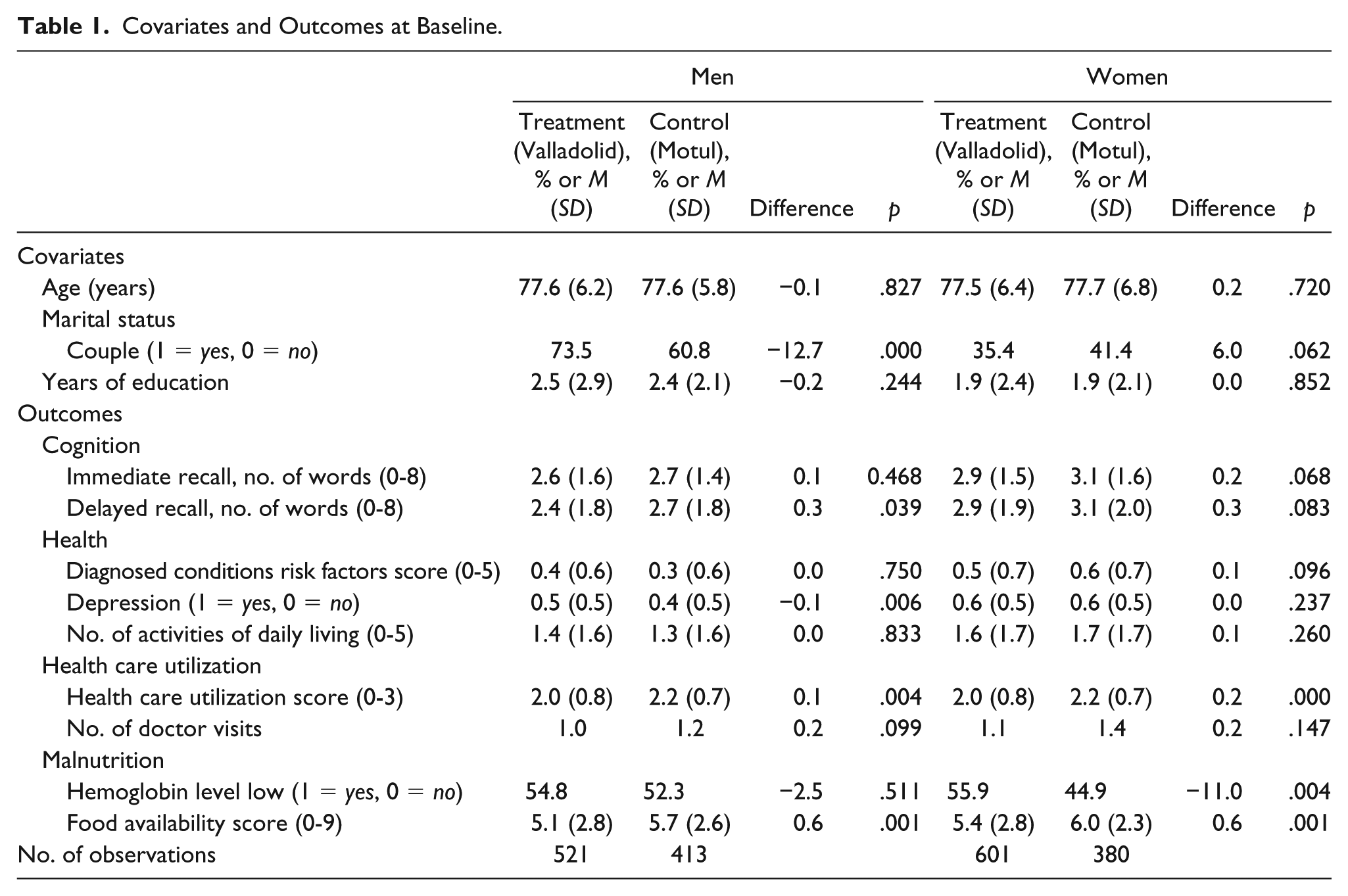
In terms of the secondary outcomes, both men and women in the control group displayed a significantly higher health care utilization score (difference = 0.1, p = .004 for men; 0.2, p = .000 for women) and food availability score (0.6, p = .001 for men; and 0.6, p = .001 for women) relative to the treatment group. The proportion of older adults with low hemoglobin level was lower in the control site, although the difference was statistically significant for women only (−11.0, p = .004). The depression indicator was significantly lower among males in the control group (−0.1, p = .006). No statistically significant differences were found in the number of diagnosed dementia risk factors, the number of ADLs individuals have trouble performing, or the number of doctor visits for either men or women and in depression scores for women.
Focusing on demographics, men were more likely than women to live in a couple and had more years of education. Comparing the control and treatment sites, men in the control group were significantly less likely to live in a couple (difference = −12.7, p = .000) than those in the treatment group, while there were no statistically significant differences in age or years of education. No statistically significant differences were found between women in control and treatment sites for any of the demographic factors considered in the analysis.
Impact of Income on Cognition
The first two rows of Table 2 display estimates of the impact of supplemental income on immediate and delayed recall, respectively, for men. Post-intervention, immediate recall decreased by 0.03 words (1.1%) in the control site and increased by 0.27 words (10.3%) in the treatment site. Delayed recall decreased by 0.06 words (2.3%) in the control site and increased by 0.81 words (34.0%) in the treatment site. According to the DID estimates, the intervention had a statistically significant impact on cognition for men. Relative to the control group, the immediate recall score increased by 0.41 words (p = .002, 95% confidence interval [CI] = [0.15, 0.68]), and the delayed recall score increased by 0.94 words (p = .000, CI = [0.62, 1.26]) in the treatment group.
Effects of the Noncontributory Pension Program for Men.

Note. Treatment effects reported. Full regression results reported in Table A4 in the supplemental appendix. The DID for depression and hemoglobin level low are estimated with a logistic regression with odds ratio. DID = difference-in-differences; OR = odds ratio; CI = confidence interval; HB = Holm-Bonferroni correction.
p < .05 after HB correction.
Estimates of the impact of supplemental income on immediate and delayed recall for women are presented on the first two rows of Table 3. Post-intervention, immediate and delayed recall decreased by 0.27 words (8.7%) and 0.2 words (6.4%), respectively, in the control group, whereas they increased by 0.27 words (9.3%) and 0.65 words (22.7%), respectively, in the treatment group. As was the case for men, we found that the intervention had a significant effect on both cognition markers, increasing the immediate recall score by 0.64 words (p = .000, CI = [0.37, 0.90]) and the delayed recall score by 0.91 words (p = .000, CI = [0.56, 1.27]) in the treatment group, relative to the control group.
Effects of the Noncontributory Pension Program for Women.
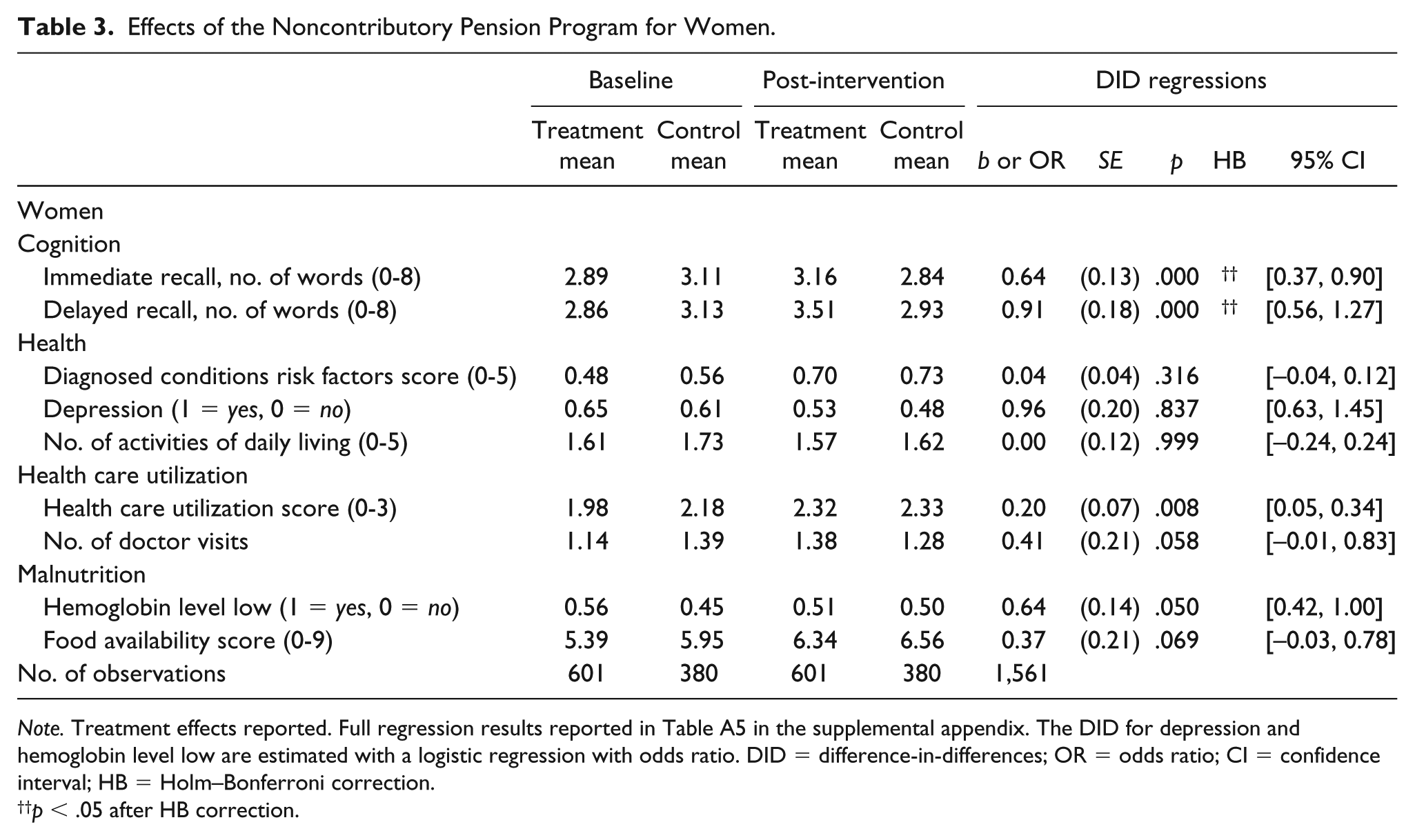
Note. Treatment effects reported. Full regression results reported in Table A5 in the supplemental appendix. The DID for depression and hemoglobin level low are estimated with a logistic regression with odds ratio. DID = difference-in-differences; OR = odds ratio; CI = confidence interval; HB = Holm–Bonferroni correction.
p < .05 after HB correction.
The increases in immediate and delayed recall for both men and women remained statistically significant after applying the HB correction for multiple hypothesis testing.
Impact of Income on Secondary Outcomes
The third to last rows of Table 2 show DID estimates of the impact of the intervention on secondary outcomes for men. Post-intervention, the treatment group experienced statistically significant increases in the health care utilization score (0.17, p = .007, CI = [0.05, 0.29]) and the food availability score (0.60, p = .007, CI = [0.17, 1.04]), together with a statistically significant decrease in anemia (OR = 0.55, p = .008, CI = [0.35, 0.86]), relatively to the control group. These effects remained statistically significant after applying the HB correction. Instead, we found no statistically significant impact of the intervention on the number of diagnosed conditions risk factors, depression, number of ADLs, or the number of doctor visits for men.
DID estimates of the effect of the intervention on secondary outcomes for women are shown in Table 3. Relative to the control group, we found a significant increase in the health care utilization score (0.20, p = .008, CI = [0.05, 0.34]) and a significant decrease in the incidence of anemia (OR = 0.64, p = .050, CI = [0.42, 1.00]). Significance, however, was lost after applying the HB correction. No statistically significant changes were detected in the number of diagnosed conditions risk factors, depression, number of ADLs, number of doctor visits, or food availability score for women as a result of the intervention.
Mediation Analysis
The analysis above shows that the intervention significantly improved health care utilization and anemia for both men and women, and food availability for men, suggesting these outcomes as potential mediators of its impact on cognitive functioning. Next, we performed a mediation analysis to test whether these are indeed causal mechanisms.
A separate mediation analysis was performed for each secondary outcome. Results are presented in Table 4. For men, we found that the food availability score was a statistically significant mediator of the impact of the intervention on both immediate and delayed recall, mediating 5.9% and 3.4% of the total effect, respectively. The health care utilization score played a significant mediating role in the delayed recall regression, explaining 2.6% of the total effect. For women, the health care utilization score was found to mediate the relationship between the intervention and both immediate and delayed recall, explaining 2.9% and 3.4% of the total effect in each regression.
Mediating Effects of Secondary Outcomes for Men and Women.
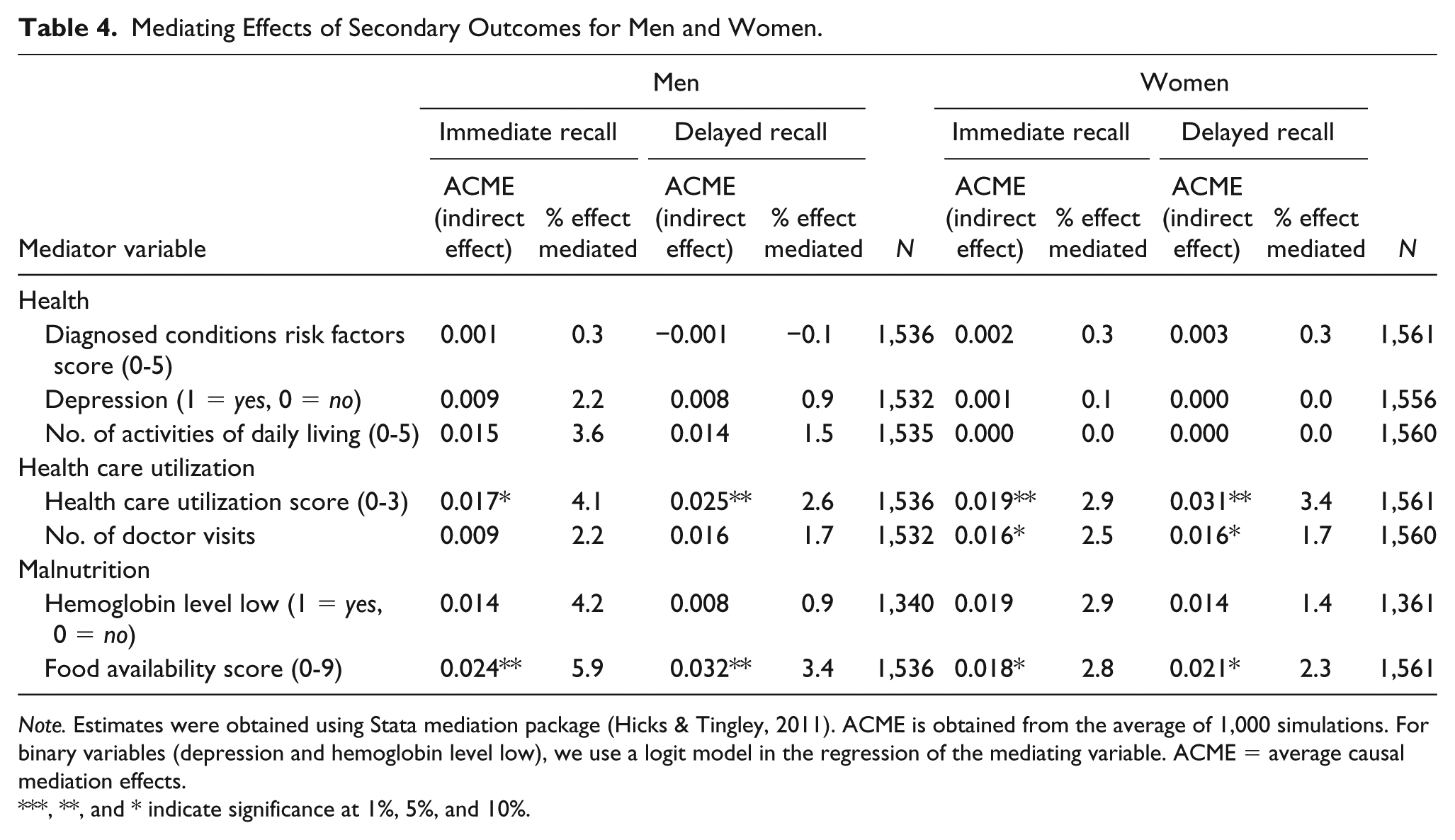
Note. Estimates were obtained using Stata mediation package (Hicks & Tingley, 2011). ACME is obtained from the average of 1,000 simulations. For binary variables (depression and hemoglobin level low), we use a logit model in the regression of the mediating variable. ACME = average causal mediation effects.
, **, and * indicate significance at 1%, 5%, and 10%.
The results also indicate that the health care utilization score mediated 4.1% of the treatment effect in the immediate recall regression for men, while the number of doctor visits mediated 2.5% of the impact of the intervention on immediate recall and 1.7% of its impact on delayed recall for women, and the food availability score mediated 2.8% of the impact on immediate recall and 2.3% of the impact on delayed recall for women. In all these cases, however, the average causal mediation effects were not statistically significant at the 5% level.
No evidence of a mediating effect was found for any of the other outcomes considered, namely, all health measures (diagnosed conditions risk factors score, depression, and number of ADLs) and the anemia indicator. We also did not find evidence of a mediating effect of number of doctor visits for men.
Robustness Checks
Tables A6 and A7 in the supplemental appendix report DID estimates for the main outcomes for men and women, respectively, using different sets of covariates. The estimates of DID treatment effects remained qualitatively and quantitatively unchanged when we performed the analysis without covariates or with additional covariates controlling for baseline differences in health conditions, health risk behaviors, health care utilization, low hemoglobin level, and food availability between treatment and control sites. This result was expected, as assignment of the treatment was random and, specifically, independent of observed covariates.
Tables A8 and A9 in the supplemental appendix report DID estimates for main and secondary outcomes excluding from the empirical sample individuals in the control group who received a federal noncontributory pension from 70 y Más toward the end of the W2 data collection period. By eliminating those individuals’ records, we lost 286 (19%) observations for men and 210 (13%) observations for women. The estimated treatment effects changed slightly but remained well within the bounds of the 95% CIs from the baseline results. As expected, given the loss of observations, the size of the standard errors increased, but all outcomes that were significantly affected by the intervention at baseline remained statistically significant.
Tables A10 and A11 in the supplemental appendix investigate the presence of nonrandom attrition and mortality for men and women, respectively. The first panel of each table tests for significant differences in baseline characteristics between the sample of all individuals who were respondents in W1 and that of individuals who were respondents in both W1 and W2 (the second sample is smaller because of attrition). DID estimates comparing baseline characteristics of the two samples across treatment and control sites were not significant for any of the outcomes considered for either men or women, providing no evidence of differential attrition. The second panel of each table tests for significant differences between the sample of individuals who were respondents in both W1 and W2 versus those who were deceased between W1 and W2. Not surprisingly, individuals who are deceased between W1 and W2 tended to be older, but the age differential between treatment and control was significant for women only. In the case of men, deceased individuals were significantly less likely to live alone in the control site, relative to the treatment site. For all other outcomes, the difference between the sample of survivors and that of individuals who were deceased between W1 and W2 was not significantly different between control and treatment sites.
Discussion
In this study, an intervention providing supplemental income in the form of a noncontributory pension to Mexican adults aged 70 and above was found to have had a positive, significant impact on two indicators of cognitive function for men and women, namely, immediate and delayed word recall, when measured between 6 and 9 months post-intervention. Specifically, we found that the intervention increased immediate recall by 0.41 (0.64) words for men (women), a 16% (22%) increase relative to the baseline value. For delayed recall, there was a larger increase of 0.94 (0.91) words for men (women), a 39% (31%) increase relative to the baseline value.
The magnitude of our estimates was comparable with those from other types of interventions aimed at improving cognitive function. Kelly et al. (2014), who performed a meta-analysis of 31 randomized controlled trials of cognitive training and mental stimulation interventions, identified six studies that analyzed the effect of interventions on either immediate or delayed recall. They found that the three interventions targeting immediate recall increased baseline scores between 0.18 and 0.24 standard deviations, whereas our estimates implied a 0.27 standard deviation increase in immediate recall for men and a 0.36 standard deviation increase for women. The three interventions targeting delayed recall increased baseline scores more than immediate recall, by between 0.33 and 1.05 standard deviations. We also found larger increases in delayed recall compared with immediate recall, equivalent to 0.48 standard deviations for men and 0.43 standard deviations for women (regressions for standardized version of the outcome variables are available on request).
Based on available evidence, we identified three mechanisms that can delay or prevent cognitive decline and are potentially affected by the provision of supplemental income in LMIC. First, the intervention may improve physical health, mental health, or functional status. Second, it may increase health care utilization. Third, it may improve nutrition. We found evidence of the second and third mechanisms, but not the first.
The supplemental income program had no effect on any of the three health measures considered. Neither new diagnoses for dementia risk factors, nor depression, nor the onset of new ADLs evolved differentially in treatment versus control site post-intervention for either men or women. The mediation analysis confirmed that the impact of the intervention on cognition was not mediated by changes in any of the health measures included in the analysis. The lack of change in new diagnoses of chronic conditions may be due to the short time span (6-9 months) between the baseline and post-intervention interviews. The absence of an impact on the depression indicator contrasts with the findings of Galiani et al. (2016) and Salinas-Rodríguez et al. (2014), who observed an improvement in the mental health of older adults within a year of the introduction of a federal income supplemental program in rural areas of Mexico. It is plausible that the discrepancy in results is explained by the shorter follow-up time in our study, but it may also owe to the lack of a detailed depression measure in our survey. Both Galiani et al. and Salinas-Rodríguez et al. use the Geriatric Depression Scale to identify depressed individuals, whereas we must rely on a single question asking whether the respondent felt symptoms of sadness or depressions in the previous weeks. Unlike them, we cannot rank individuals according to the number of depressive symptoms, which may explain the lack of an effect if the intervention affected the severity but not the number of people affected by the condition. Finally, there are at least two reasons that may explain the absence of an impact of supplemental income on ADLs. First, it has been shown that once some functional limitation has set in, it may become permanent, with the probability of recovery being particularly low for older individuals (Ferrucci et al., 2004). Second, as was the case for the other two health measures, we cannot rule out the possibility that the follow-up period is too short to detect changes in functional status. The onset of difficulties with ADLs, when not caused by acute events such as strokes or bone fractures, is progressive, and reversing them may require a longer time frame than the 6- to 9-month follow-up period in our study.
The intervention had a significant impact on health care utilization. Specifically, we found that it significantly increased the health care utilization score for both men and women. The mediation analysis confirmed that the health care utilization score was a significant mediator for delayed recall for both genders and immediate recall for women only (for men, the mediating effect of the health care utilization score in the immediate recall regression was only marginally significant at the 10% level). The number of doctor visits increased more in the treatment than the control group for both genders, but in this case, the effect was not statistically significant for either gender. In the mediation analysis, doctor visits were found to mediate the relationship between the intervention and immediate and delayed recall for women, although the indirect effect was only significant at 10%. We interpret the evidence of a causal mediating effect of health care utilization as suggestive that, even though the number of chronic conditions and mental health did not change differentially in the treatment group post-intervention, the management of those conditions may have been improved through medication adherence and increased contact with primary care services.
The intervention was also associated with improvements in nutrition. It had a positive and statistically significant impact on the share of both men and women diagnosed with anemia, even though the mediation analysis revealed that anemia was not a causal mediator for either gender. On the contrary, the food availability score increased in the sample of males as a result of the intervention, and the mediation analysis confirmed that it was a causal mediator of the intervention’s impact on both immediate and delayed recall in the male sample. For women, we found that the intervention led to increases in the food availability score, although those were not significant at the 5% level (p = .069). The mediation analysis confirmed that improvements in food availability mediated the impact of the intervention in both immediate and delayed recall although the estimates were not significant at the 5% level.
There are some limitations of this study. First, future work should examine the impact of supplemental income interventions on a wider array of instruments used in screening for cognitive impairment. The intervention we studied was not specifically designed to impact cognition or dementia and, and as a result, the number of questions related to cognitive status was limited to the immediate and delayed word recall scores considered in the analysis. Second, although we found that improvements in health care use and nutrition mediated the impact of the intervention on cognition, there may be additional dementia risk factors modified by the intervention that we did not consider in the analysis. Third, follow-up interviews took place between 6 and 9 months post-intervention, and hence we can only provide estimates of short-run effects for primary and secondary outcomes. Future work should focus on long-term effects to determine whether improvements in word recall scores are sustained and, more importantly, whether they translate into fewer or delayed dementia diagnoses.
Notwithstanding these limitations, there are several strengths worth mentioning. First, this is the first study to analyze the impact and mediating effects of an intervention supplying older adults with supplemental income in the form of a noncontributory pension on cognitive markers of older adults. Although these interventions are typically targeted to reducing poverty, our study suggests that they may have a positive, unintended effect on cognitive function through improvements in health care use and nutrition. Second, the results of this analysis provide important policy and public health implications. LMIC are facing a large and increasing burden of what has been described by the WHO as a “dementia epidemic” in the face of rapid population aging (Prince et al., 2016). Although significant, efforts to implement the type of dementia-preventive strategies currently in place in most high-income countries remain in their infancy in LMIC (Prince et al., 2013), and the process of adapting already overstretched public health systems will be slow. Supplemental income programs can serve as a complementary strategy that may deliver improvements in cognition in a shorter time framework.
Supplemental Material
Supplementary_File_011719 – Supplemental Material for Short-Term Impact of Income on Cognitive Function: Evidence From a Sample of Mexican Older Adults
Supplemental Material, Supplementary_File_011719 for Short-Term Impact of Income on Cognitive Function: Evidence From a Sample of Mexican Older Adults by Emma Aguila and Maria Casanova in Journal of Aging and Health
Footnotes
Acknowledgements
We thank the staff in Yucatan—supervisors, directors, coordinators, interviewers, programmers, and administrators—who made the project possible. We would like to thank Jorge Peniche for his excellent research assistance.
Declaration of Conflicting Interests
The authors declared no potential conflicts of interest with respect to the research, authorship, and/or publication of this article.
Funding
The authors disclosed receipt of the following financial support for the research, authorship, and/or publication of this article: This work was supported by funding from the State of Yucatan, the National Institute on Aging (NIA; grant numbers R01AG035008, P01AG022481, and R21AG033312), and the RAND Center for the Study of Aging (grant number P30AG012815 from NIA).
Supplemental Material
Supplemental material for this article is available online.

References
Supplementary Material
Please find the following supplemental material available below.
For Open Access articles published under a Creative Commons License, all supplemental material carries the same license as the article it is associated with.
For non-Open Access articles published, all supplemental material carries a non-exclusive license, and permission requests for re-use of supplemental material or any part of supplemental material shall be sent directly to the copyright owner as specified in the copyright notice associated with the article.
