



Abstract
Sleep is a fundamental health behavior that has consequences for cardiovascular disease, diabetes, cognitive decline, as well as, mortality (Cappuccio et al., 2010; Faubel et al., 2009; Hall et al., 2015). As people age, they experience increasing problems with sleep, and their complaints include difficulty in falling asleep and maintaining asleep, daytime sleepiness, and not feeling rested upon getting up in the morning (Phelan et al., 2010). Studies regarding physical and psychosocial risk factors for aging adult’s sleep have increased in Western countries over the past two decades (e.g., Knutson, 2013; McHugh et al., 2011). However, relatively little attention has been paid to sleep quality of older adults in China, which has the largest population of older adults globally. In China, adult children have been the major source of support for older adults due to normative expectations rooted in cultural traditions (Cong & Silverstein, 2012) and limited public resources for caring for older adults in need (Feng et al., 2011). As such, relationships with adult children are crucial for older Chinese adults’ well-being (Chen & Jordan, 2018a; Guo et al., 2018; Silverstein et al., 2006). Some studies examined living arrangements as a type of family support, and the results showed that Chinese older adults living with family members had better sleep quality compared to those who lived alone (Gu et al., 2010; Lee et al., 2020). However, a comprehensive examination of the association between parent–child relations and sleep among Chinese older adults is warranted.
Moreover, Chinese families are changing rapidly with respect to past fertility policies, the migration of younger generations to urban areas, and evolving attitudes toward filial piety (Du, 2013). Families with only one child account for one-third of Chinese families and the proportion is projected to increase over the next decades (Feng et al., 2013). One-child and multiple-children families may exhibit different family roles and responsibilities (Chen & Jordan, 2018b), which may lead to different levels of psychological distress, such as anxiety and worry, that may affect sleep patterns for older adults (Arber et al., 2009). Thus, it is important to consider the implications of parent–child relations for Chinese aging parents’ sleep quality in the context of one-child and multiple-children families.
Sleep Quality among Older Adults in China
The rapid aging in China over the past few decades has created challenges for Chinese older adults to maintain healthy aging. One understudied aspect of health is sleep quality, which is essential for physical and mental health; however, researchers have begun to explore the health consequences of poor sleep in China. Studies suggest that poor sleep quality and inadequate sleep are associated with higher levels of inflammation (Dowd et al., 2011), poor cognitive function (Niu et al., 2016), memory impairment (Xu et al., 2011), high body mass index (Sun et al., 2015), and mortality (Cai et al., 2015) among Chinese older adults.
Estimates of sleep quality among Chinese older adults vary across studies. One study examining rural older adults from Anhui province demonstrated that 49.7% of the study sample reported poor sleep quality (Li et al., 2013); another study found that the prevalence of poor sleep was 20.67% among Hong Kong community-dwelling adults aged over 45 years (Zhang et al., 2017). A study of middle-aged and older adults in Beijing and Shanghai, however, reported that only 19% of Beijing and 13% of Shanghai respondents experienced poor sleep quality (Haseli-Mashhadi et al., 2009). Estimates of sleep quality using nationally representative data showed that 62%–65% of Chinese older adults reported good quality of sleep (Gu et al., 2010; Lee et al., 2020). The discrepancies may be due to the fact that these studies focused on different regions of China, used different age criteria for defining old age, and utilized different measures of sleep quality (e.g., a single-item scale or the Pittsburgh sleep quality index scale).
Parent–Child Relationships and Sleep
Sleep is not only a health behavior but also a fundamental attachment behavior influenced by family members and the sleep environment. Healthful sleep requires a relative cessation of awareness and downregulation of vigilance. People enjoy better sleep when feeling a sense of physical and emotional security (Troxel et al., 2010). Attachment theory posits that attachment security with social partners, especially close family members, provides an elevated sense of security and decreased vigilance that promote sleep quality (Cassidy, 2000). Meanwhile, attachment insecurity creates a heightened sense of threat and increased vigilance that undermines sleep. Therefore, attachment bonds and characteristics of interactions with family members are directly associated with sleep health.
There is a growing literature in Western societies that demonstrates how family relationships are related to one’s sleep quality. Studies find that having strained family relationships is associated with more troubled sleep, while supportive family relationships are helpful for sleep quality (Ailshire & Burgard, 2012; Chen et al., 2015; Troxel et al., 2010). However, prior studies focused on aggregated measures of social ties (e.g., Ailshire & Burgard, 2012; Chung, 2017; Kent et al., 2015) or spousal relations (e.g., Chen et al., 2015; Troxel et al., 2010). Less is known about whether, and to what extent, parent–adult child relationships in China, which are one of the most important social ties for older adults in later life, are associated with sleep quality.
The intergenerational solidarity model (Bengtson & Schrader, 1982; Silverstein & Bengtson, 1997) serves as a useful framework for understanding intergenerational relationships along different dimensions: (1) structure (e.g., living arrangements, contact, and gender composition of households), (2) function (e.g., financial and instrumental support exchanges), and (3) emotional quality (e.g., affection or closeness). Each dimension of aging parent–child ties has distinct consequences for older adults’ physical and psychological health, including sleep (Fingerman et al., 2008; Thomas, 2010).
The structural aspect of Chinese parent–child relations is characterized by son preferences in multiple-children families. Having a son and multiple children, which indicates one’s generativity and the fulfillment of filial obligation, is associated with better well-being for Chinese older parents (Guo, 2014). However, these norms are changing over time, in part due to China’s former one-child policy (discussed in the next section). Additionally, a large body of literature on Chinese family structure focuses on the living arrangements of older Chinese adults’ and their well-being. Studies suggest that older Chinese adults who lived alone had a lower level of subjective well-being; those who lived with others (e.g., spouse, children, and/or grandchildren) had better well-being than those who lived alone, and those who lived with daughters enjoyed higher levels of well-being than those who lived with sons (Chen & Short, 2008; Silverstein et al., 2006). However, research has yet to examine other structural aspects of Chinese aging families, such as families with one child versus multiple children.
Regarding the functional aspect of Chinese parent–child relations, studies provide mixed evidence regarding the provision and receipt of financial and instrumental support for Chinese parents’ well-being. When parents receive financial transfers from children, they are usually better off because filial expectations regarding children’s financial support of older parents are met (Cong & Silverstein, 2008). Some studies find no evidence linking the provision of financial assistance to adult children and older parents’ well-being (Chen & Silverstein, 2000; Chi & Chou, 2001; Silverstein et al., 2006), whereas other research finds providing financial support is related to lower levels of depression and better cognitive function among older Chinese parents (Chao, 2011). Providing instrumental support to children seems to be physically demanding for older parents but older Chinese parents who provide instrumental support to children enjoy greater well-being (Chen & Silverstein, 2000). Receiving instrumental support may exert either a negative or no impact on older Chinese adults’ well-being, largely because receiving instrumental assistance from adult children is associated with older adults’ loss of self-efficacy and power within the family context (Chen & Silverstein, 2000).
Finally, evidence regarding the emotional and quality aspects of intergenerational relationships suggests that closeness with children is positively associated with parents’ well-being (Silverstein et al., 2006). The majority of studies regarding the quality of Chinese parent–child relations and parents’ well-being focus on perceived filial piety, which includes showing respect, being obedient, and providing care to older parents (Cheng & Chan, 2006; Chong & Liu, 2016). Filial piety is essential in East Asian societies and considered crucial for parents’ well-being in later life. As China is experiencing rapid shifts in family demographics, emotional closeness and frequent contact still represent key elements in children’s filial behavior (Chong & Liu, 2016). Nonetheless, research has yet to examine the association between the emotional dimensions of parent–child relations and older adults’ sleep quality in China.
One-Child versus Multiple-Children Families in China
Sleep behavior is embedded in the family system and the sociocultural environment. Comparative studies of sleep quality suggest that sociocultural beliefs and practices are related to heterogeneity in sleep health across different countries (Knutson, 2013). However, the social environment may also shape family dynamics, which are associated with individuals’ sleep behavior. When it comes to the well-being of older adults in China, it is important to pay attention to the increasing number of aging families with only one child resulting from the Chinese government’s one-child policy (Deutsch, 2006).
The one-child policy, implemented in 1978 and officially terminated in 2015, resulted in enormous changes to the structure and function of Chinese families. From the parents’ perspective, having more children increases the chances of receiving support from adult children when parents are in need (Zimmer & Kwong, 2003). However, from the singleton child’s perspective, they may have to take full responsibility for supporting their aging parents because there is no sibling to share caregiving duties (Guo et al., 2016). A recent study showed that children from one-child families had increased chances of receiving both financial and instrumental support from their parents, but they did not differ from their counterparts from multiple-child families with regard to providing support to their older parents (Chen & Jordan, 2018b). However, this study did not examine the emotional and quality aspects of parent–child relations in these two types of Chinese families. The study also simplified support exchanges by focusing only on whether any support was provided or received. More importantly, the implications of different family dynamics in one-child and multiple-children families for aging parents’ well-being remain under-investigated.
For families with multiple children, evidence shows substantial differences in the overall level of support, as well as variations in types of support, exchanged between aging parents and their multiple children (Ward, 2008). One study found that the maximum levels of financial support received from and emotional cohesion with adult children were associated with better psychological well-being, whereas the variations in financial support from and emotional cohesion with children were related to more depressive symptoms and lower life satisfaction for Chinese older parents living in rural areas (Silverstein et al., 2006). The within-family variation in intergenerational relationships may represent the existence of weak family ties, which is related to worse well-being among older parents (Kim et al., 2020). Thus, we expected that Chinese older parents would have more sleep difficulty when they experience greater variation in the multiple parent–child ties.
Covariates
Previous research revealed that several individual characteristics are associated with sleep quality among Chinese older adults, including age, gender, marital status, education, income, physical health, and rural-urban residence. Chinese older adults were found to have sleep problems resulting from physiological changes associated with aging, such as longer sleep latency, shorter sleep duration, and lower sleep efficiency (Li et al., 2013). Older women had a higher rate of poor sleep quality than older men (Luo et al., 2013). Being unmarried, having a lower education level, experiencing a recent illness, and number of chronic diseases were related to an increased risk of poor sleep (Zhang et al., 2017). Rural residents reported better sleep quality than urban residents (Haseli-Mashhadi et al., 2009). Additionally, we also considered family characteristics that may be associated with Chinese older adults’ well-being. According to the Confucius culture that focuses on the generativity of family, parents tend to be better off with more children, “the more, the merrier.” Chinese parents may fare better if they have at least one son because of traditions associated with son preference and gendered caregiving responsibilities (Cong & Silverstein, 2012).
The Current Study
Using a nationally representative sample, this study examined the association between parent–child relationships and older parents’ sleep quality in Chinese aging families. For parent–child relationships, we considered structural (i.e., living arrangements), functional (i.e., upstream and downstream transfers of financial and instrumental support), and emotional dimensions (i.e., closeness). Furthermore, we compared one-child and multiple-children families. For Chinese families with multiple children, we examined family-level maximum values of support exchanges and closeness across multiple children (e.g., “the greatest helper”) as well as SD scores (e.g., “dispersion among children”; Silverstein et al., 2006). Specifically, we proposed the following research questions: RQ 1: Are older parents’ living arrangements associated with their risk of sleep difficulty in one-child and multiple-children families? RQ 2: Are financial transfers from and to children associated with older parents’ risk of sleep difficulty in one-child and multiple-children families (i.e., for multiple-children families, the maximum financial transfer across children; for one-child families, the financial transfer with the child)? Is the variability in financial support received and provided across all children associated with older parents’ risk of sleep difficulty in multiple-children families? RQ 3: Is instrumental support received from and provided to children associated with older parents’ risk of sleep difficulty in one-child and multiple-children families (i.e., for multiple-children families, the maximum instrumental support across children; for one-child families, the instrumental support with the child)? Is the variability in instrumental support received and provided across all children associated with older parents’ risk of sleep difficulty in multiple-children families? RQ 4: Is emotional closeness with children associated with older parents’ risk of sleep difficulty in one-child and multiple-children families (i.e., for multiple-children families, the maximum closeness across children; for one-child families, the closeness with the child)? Is the variability in closeness across all children associated with older parents’ risk of sleep difficulty in multiple-children families?
Methods
Data and Sample
Data were taken from the 2014 Chinese Longitudinal Aging Social Survey (CLASS). Utilizing a multi-stage stratified sampling design, the CLASS was a nationally representative sample of the Chinese population aged 60 and older. The study covered a variety of issues about health, social life, psychological well-being, family, and social network characteristics among Chinese older adults. The baseline survey was conducted by Renmin University in 2014. The study included 11,550 respondents aged 60 years and older living in 462 villages and communities. The study sample was restricted to respondents aged 60 years and older who had at least one living adult child (N = 8,450). Respondents with three or more mistakes on a cognitive function screening test were excluded because they were not considered able to provide reliable answers on subjective evaluation measures, such as sleep quality.
Measures
Sleep quality
CLASS measured sleep quality using a single item “Did you find it hard to sleep well last week?” Original responses for this question were 1 = no, 2 = sometimes, and 3 = yes. We combined responses of “no” and “sometimes” to create a new dummy variable “poor sleep quality” (i.e., sleep difficulty; 1 = yes and 0 = no). No other sleep measures were available in the survey.
Parent–child relationships
Respondents provide demographic characteristics and relationship information for each of their adult children (up to five children). Six indictors were considered to represent the structural, functional, and emotional dimensions of parent–child relationships. The structural dimension was measured by (1) living arrangements (1 = lived alone, 2 = lived with spouse only, and 3 = lived with a child or grandchild). The functional dimension included (2) financial transfers received from each child (1 = none to 9 = more than ¥12,000), (3) financial transfers provided to each child (1 = none to 9 = more than ¥12,000), (4) instrumental support (i.e., help with housework) received from each child (1 = never to 5 = almost every day), and (5) instrumental support (i.e., help with housework) provided to each child (1 = never to 5 = almost every day). The emotional aspect of the parent–adult child relationship was assessed with (6) emotional closeness (1 = not close at all, 2 = somewhat close, and 3 = very close).
Covariates
Covariates known to be associated with older Chinese adults’ sleep quality were included. Parent characteristics included age (in years), gender (1 = female and 0 = male), education (1 = illiterate/no formal education, 2 = elementary or middle school, and 3 = high school and above), annual income (in yuan, transformed by the natural log and centered at the mean), self-rated health (1 = unhealthy or very unhealthy and 0 = very healthy or healthy), and activities of daily living limitations (ADL; a sum score of six items including dressing, bathing, eating, toileting, going to bed, and walking; 1 = yes and 0 = no). Analyses also controlled for several family-level characteristics, including number of adult children and gender composition of adult children (for multiple-children families: 1 = both sons and daughters, 2 = only sons, and 3 = only daughters; for one-child families: 1 = has a son and 0 = has a daughter).
Analytic Strategy
First, differences in parent–child relationship characteristics (i.e., living arrangements, financial and instrumental support, and emotional closeness) were examined between respondents with multiple children and those with only one child. For families with multiple children, we presented the mean, maximum, and SD values of each parent–child relationship indicator across multiple children. The mean and maximum values of each relationship indicator in multiple-children families were used for comparisons with parent–child relationship characteristics in one-child families.
Because of the multi-stage stratified survey design of CLASS, in which respondents were nested within 486 urban communities and rural villages, we estimated 2-level logistic regression models for parents’ sleep difficulty. However, intraclass correlation (ICC) coefficients were .02 and .09 for parents’ sleep difficulties in multiple-children families and one-child families, respectively. The very low ICC scores indicated that most variances in sleep difficulty were explained by individual-level characteristics. Therefore, we decided not to include community-level variation in our models for parents’ sleep difficulty.
We estimated logistic regression models for older parents’ sleep difficulty stratified by family type (i.e., multiple-children and one-child families, separately). We began by examining how older parents’ individual characteristics (i.e., demographics and health characteristics) were associated with their sleep difficulty. Next, we examined parent–child relationship dimensions by adding each group of indicators (i.e., dimension-specific models): respondents’ living arrangements (RQ 1), financial transfers (RQ 2), instrumental support (RQ 3), and emotional closeness with children (RQ 4) while controlling for family characteristics. For parents with multiple children, the maximum and SD values for financial transfers, instrumental support, and emotional closeness were used as the main predictors; for parents with one child, the financial transfers, instrumental support, and emotional closeness with the only child were used as the main predictors for parents’ sleep difficulty. Finally, we conducted sensitivity analyses by considering all parent–child relationship indicators in a comprehensive model for multiple-children and one-child families separately. Models were controlled for parents’ individual and family characteristics.
In our study sample, the majority of respondents (92%) had complete data on all study variables; variables with more than 1% missingness included individual income (8%) and financial transfers from children to parents (4%). Missing data diagnostics revealed no clear pattern in missingness and results from sensitivity analysis showed that the missingness of income and financial transfers was not significantly associated with respondents’ sleep difficulty. Missing data were imputed using the multiple imputation by chained equations method (MICE; Schafer, 1997). MICE allowed researchers to maintain a larger final sample size and protected against potential bias from listwise deletion of cases. A total of 10 imputed data sets were created with and all analyses were conducted with Stata, version 16.
Results
Characteristics of Chinese Older Parents by Family Type.
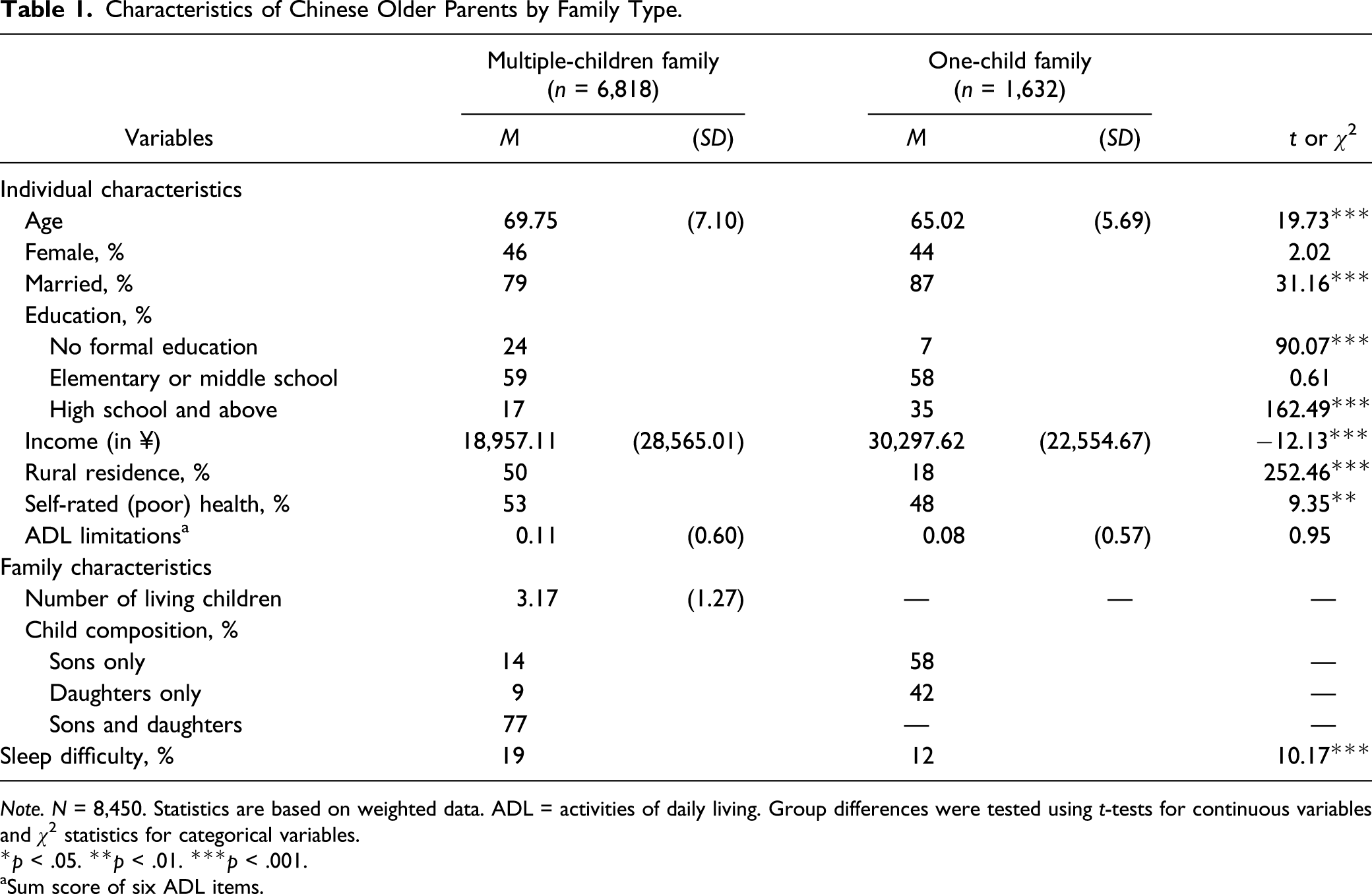
Note. N = 8,450. Statistics are based on weighted data. ADL = activities of daily living. Group differences were tested using t-tests for continuous variables and χ2 statistics for categorical variables.
*p < .05. **p < .01. ***p < .001.
Sum score of six ADL items.
Intergenerational Relationship Indicators of Chinese Older Parents by Family Type.
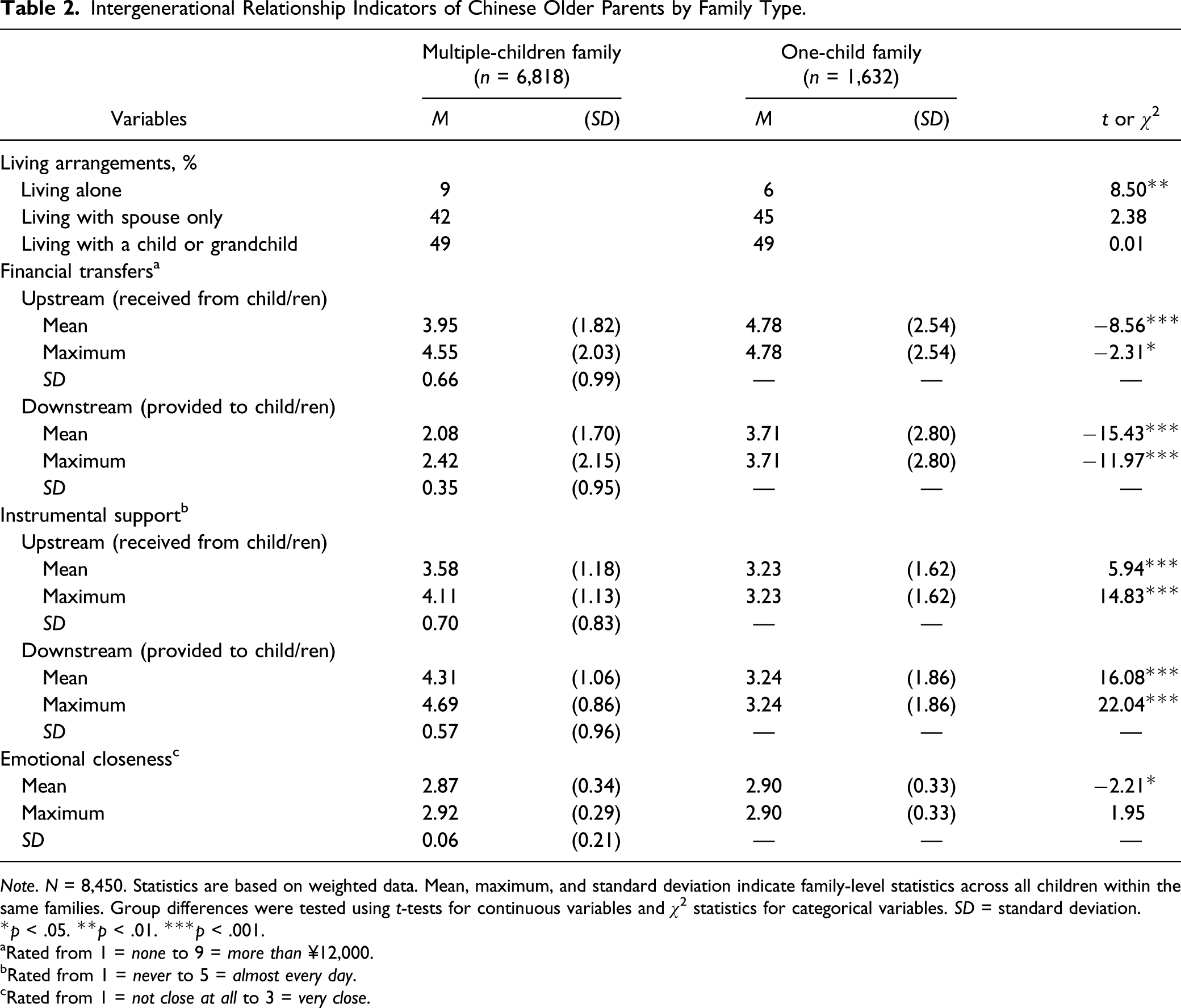
Note. N = 8,450. Statistics are based on weighted data. Mean, maximum, and standard deviation indicate family-level statistics across all children within the same families. Group differences were tested using t-tests for continuous variables and χ2 statistics for categorical variables. SD = standard deviation.
*p < .05. **p < .01. ***p < .001.
Rated from 1 = none to 9 = more than ¥12,000.
Rated from 1 = never to 5 = almost every day.
Rated from 1 = not close at all to 3 = very close.
Logistic Regression Model Results for Aging Parents’ Sleep Difficulty in Multiple-Children Families.
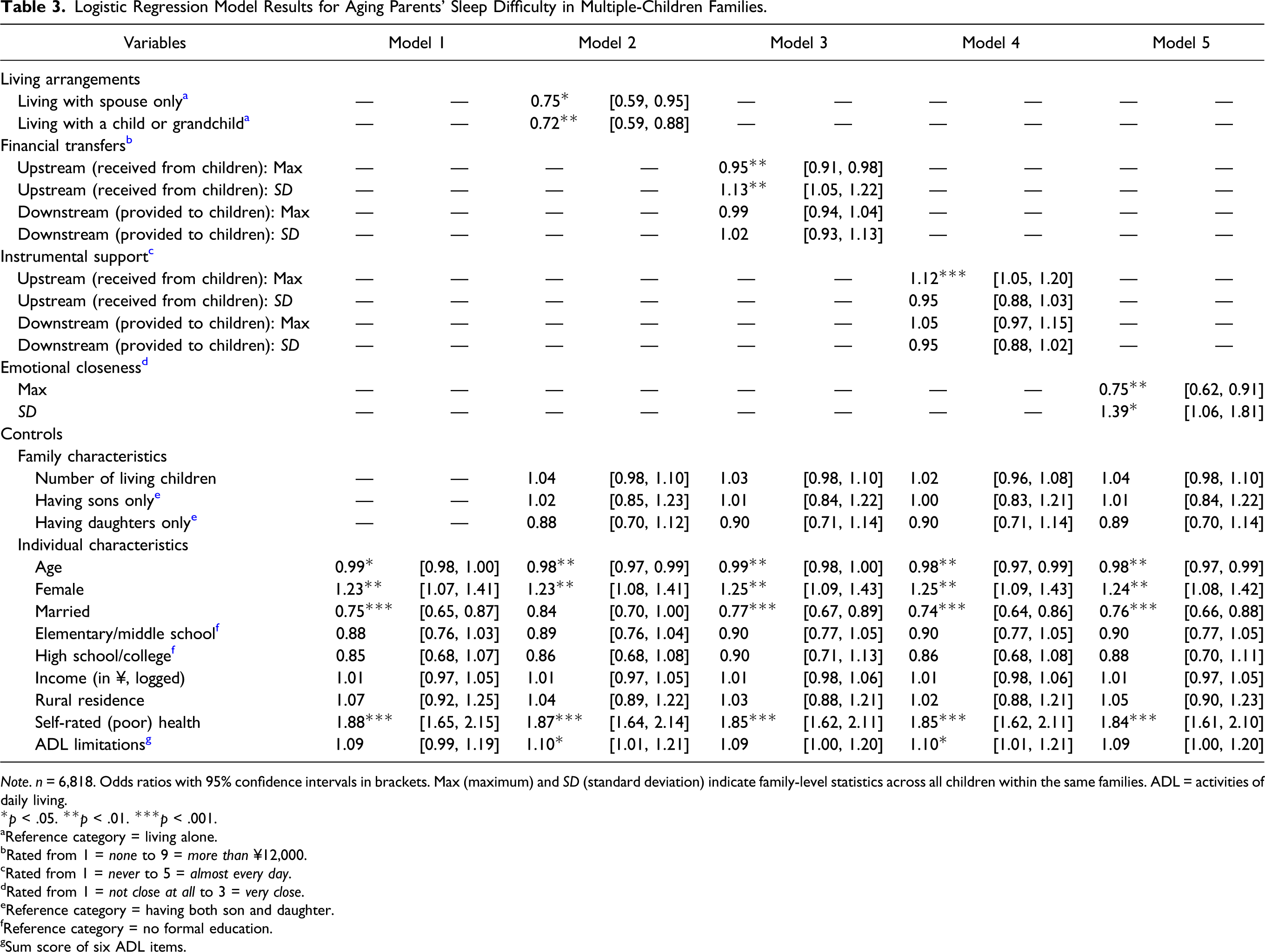
Note. n = 6,818. Odds ratios with 95% confidence intervals in brackets. Max (maximum) and SD (standard deviation) indicate family-level statistics across all children within the same families. ADL = activities of daily living. *p < .05. **p < .01. ***p < .001.
Reference category = living alone.
Rated from 1 = none to 9 = more than ¥12,000.
Rated from 1 = never to 5 = almost every day.
Rated from 1 = not close at all to 3 = very close.
Reference category = having both son and daughter.
Reference category = no formal education.
Sum score of six ADL items.
Logistic Regression Model Results for Aging Parents’ Sleep Difficulty in One-Child Families.
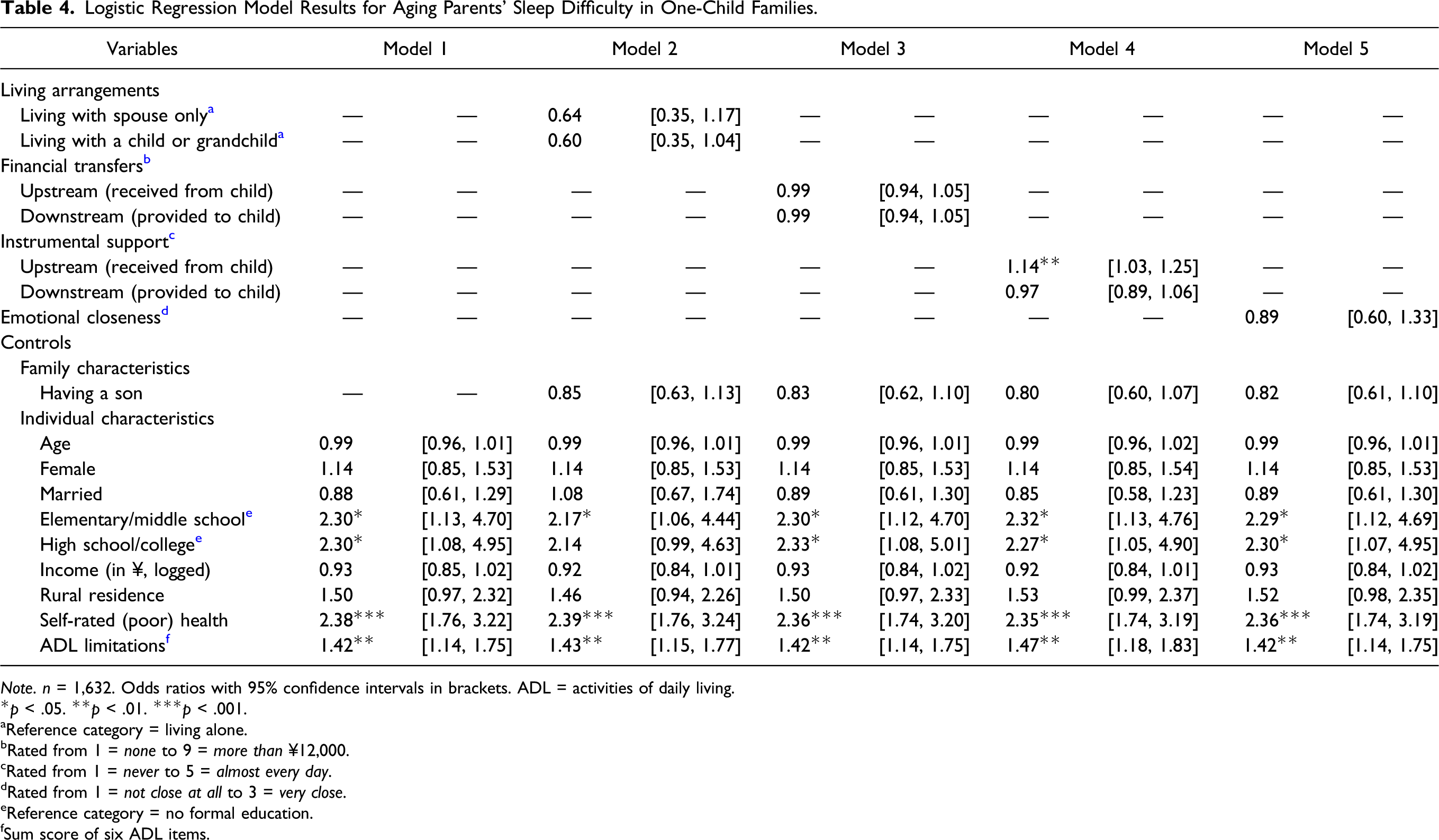
Note. n = 1,632. Odds ratios with 95% confidence intervals in brackets. ADL = activities of daily living.
*p < .05. **p < .01. ***p < .001.
Reference category = living alone.
Rated from 1 = none to 9 = more than ¥12,000.
Rated from 1 = never to 5 = almost every day.
Rated from 1 = not close at all to 3 = very close.
Reference category = no formal education.
Sum score of six ADL items.
Results for the comprehensive models with all three dimensions of intergenerational relationships were very similar to the results from the dimension-specific models (Supplementary Table 1). One difference was that for older parents with multiple children, emotional closeness with children (maximum and SD values) was no longer significantly associated with sleep difficulties.
Discussion
Sleep is an emerging public health concern among Chinese older adults. This study showed Chinese older parents with multiple children were at a higher risk of have sleep difficulties than parents with only one child. Three dimensions of parent–child relationships had implications for sleep difficulties among Chinese older parents, especially for older Chinese adults in multiple-children families.
Drawing on intergenerational solidarity theory and extant empirical findings, we generated models to explore the association between structural, functional, and emotional dimensions of parent–child relationships and older parents’ sleep in two types of Chinese families. Structurally, living alone emerged as a salient risk factor for sleep difficulty among Chinese older adults. Traditionally, intergenerational coresidence in China has been valued as the most desirable living arrangement for older adults due to the Confucius culture and family-oriented values. However, the migration of younger adults from rural to urban areas in search of employment represented a demographic, economic, and social phenomenon contributing to changes in family life among older Chinese adults. This pattern of migration, along with the demographic consequences of China’s one-child policy, established a context for potential challenges to the traditional ways in which social support is provided from adult children to their aging parents (Du, 2013). According to Chinese census data, living alone among older adults rose from 9.6% in 1990 to 12.5% in 2010 (Hu & Peng, 2015). Living alone is related to increased loneliness and lower life satisfaction among Chinese older adults (Gu et al., 2019). The current study revealed that Chinese older adults who lived alone were also more likely to have sleep difficulties. Considering health consequences of poor sleep, programs that support Chinese older adults who live alone should be implemented.
Regarding the functional dimension of parent–child relationships, we found that only upstream support received from children was associated with Chinese older parents’ sleep. This was consistent with previous studies that found nonsignificant associations between providing parental support to children and Chinese older parents’ psychological well-being (Silverstein et al., 2006). Intergenerational support exchanges are more likely to flow from parents to younger adult children. As for aging families, adult children and parents are more likely to engage in mutual support and children often eventually become the major providers of support when parents experience health problems. In China, receiving support from adult children was part of the Chinese filial piety culture. Xu et al. (2019) found that the majority of Chinese older parents (90.6%) received financial support from their adult children but did not give monetary support to their children. Our findings also revealed more upstream financial transfers than downstream transfers in both one-child and multiple-children families (Table 2). Thus, this study only observed that upstream support was related to Chinese older parents’ sleep difficulties.
Moreover, financial and instrumental support were associated with older parents’ sleep in different ways. The findings demonstrated that older parents receiving more financial support from children were less likely to report sleep difficulty, whereas those receiving more instrumental support from children were more likely to have sleep difficulty. This finding revealed subtle differences by type of intergenerational support (monetary vs. instrumental). Receiving monetary support may indicate children’s financial independence and fulfillment of filial piety. Chinese parents often benefitted from such support for their psychological well-being. However, adult children’s frequent instrumental assistance may be indicative of support needed to help overcome physical limitations of older parents. Children’s involvement in their parents’ daily activities may not be “the more, the merrier” but perceived as intrusive by parents. As a result, parents have better sleep when receiving financial support but have trouble sleeping when receiving other forms of instrumental assistance.
The implications of emotional closeness for older parents’ sleep were in line with studies of the benefits of family emotional support for individual well-being (Thoits, 2011). Emotional closeness with children provides a sense of security in social relationships for older adults. The sense of security and belonging helps people cope with negative events and reduce physiological and psychological stress responses (Mikulincer & Shaver, 2005). In contrast, individuals in insecure relationships may be more vulnerable to stress because of a lack of support and their increased vigilance associate with a less than ideal relationship. This results of this study suggested that emotional closeness with children may play an important role in preventing Chinese older parents from experiencing poor sleep quality.
This study found profound differences in sleep quality for two types of Chinese aging families—families with multiple children and families with only one child. First, older Chinese parents with multiple children were more likely to have sleep difficulties than those with only one child. Although having more children is perceived as being beneficial in the Confucius culture, multiple-children families are facing increasing challenges in Chinese society. Parents with multiple children likely felt responsible for each child’s entry into adulthood (e.g., finishing required education and getting a job) and maintaining successful social relations (e.g., getting married and having a child). Thus, more children also brought more worries to older parents. Additionally, Chinese older parents with multiple children were predominantly rural residents and had lower education and income than those with only one child. Beyond increased options for family support, older parents from multiple-children families may have had less access to public support systems and healthcare services (Feng et al., 2011). The lack of formal support may have taken a toll on older parents’ sleep quality, especially as they were getting older and developing functional limitations.
Moreover, greater variation in financial support and emotional closeness was associated with a higher risk of sleep difficulty for older parents with multiple children. Research has demonstrated the existence of substantial variation in parents’ relationships with multiple children in a family (Ward, 2008). Studies of multiple parent–child ties found that family members tended to fare worse in terms of well-being with the variability in parent–child relationships (Kim et al., 2020). In one-child families, our findings suggested that adult children engage in more intense financial transfers but less frequent instrumental support with their parents. This revealed a “money-for-time” intergenerational support pattern; that is, when the parent or child does not have time to provide in-person support, he/she gives more financial support (Cong & Silverstein, 2008). In addition, among different parent–child relationship indicators, this study found only upstream instrumental support was associated with parents’ sleep difficulties in one-child families. This was in part due to older parents with only one child having more resources from their extended social network and government programs.
Results regarding differences between multiple-children and one-child families are informative for policy makers and social workers. The findings highlight the importance of sleep health for China’s aging population, especially for older adults with multiple children. Different family dynamics in one-child and multiple-children Chinese families have implications for sleep quality of Chinese older parents. Social workers and physicians should consider the family relations of older persons who struggle with sleep problems. Intervention programs are warranted to help older adults who are at risk of having sleep problems, such as those who live alone, lack support available from children, and have strained relations with their children.
Limitations and Directions for Future Research
This study had some limitations. This cross-sectional research design with observational data did not allow for statement of causality. Furthermore, omitted variables likely confounded the association between parent–child relationships and older parents’ sleep quality. Future research should employ panel data and also consider distinct parent–child dyads in families, allowing researchers to control for other unobserved family variables. Furthermore, the CLASS study sample is relatively healthy compared to the older Chinese population, especially in terms of cognitive health; this calls into question the representativeness of the sample. Finally, the CLASS survey only included one item measuring subjective sleep quality. Future studies with other measures of sleep characteristics and appropriate measures of parent–child relationships should be conducted to confirm the results reported here.
Conclusion
Using a large, national dataset, this study contributed to the literature by examining parent–child relationships and aging parents’ sleep quality in aging Chinese families. This study considered multiple dimensions of parent–child relationships within the context of multiple-children and one-child families. Findings from this study showed that three dimensions of parent–child relationships were associated with sleep difficulty among Chinese older parents and the associations varied across multiple-children and one-child families. The results of this study point the way toward future research for investigating intergenerational relations and sleep health in China.
Supplemental Material
Supplementary_Table – Supplemental Material for Parent–Child Relationships and Aging Parents’ Sleep Quality: A Comparison of One-Child and Multiple-Children Families in China
Supplemental Material, Supplementary_Table for Parent–Child Relationships and Aging Parents’ Sleep Quality: A Comparison of One-Child and Multiple-Children Families in China by Haowei Wang, Kyungmin Kim, Jeffrey A. Burr and Bei Wu in Journal of Aging and Health
Footnotes
Acknowledgments
We thank the Population Development Studies Center and Institute of Gerontology at Renmin University of China for providing the China Longitudinal Aging Social Survey (CLASS) data.
Declaration of Conflicting Interests
The authors declared no potential conflicts of interest with respect to the research, authorship, and/or publication of this article.
Funding
The authors received no financial support for the research, authorship, and/or publication of this article.

Supplemental Material
Supplemental material for this article is available online.
References
Supplementary Material
Please find the following supplemental material available below.
For Open Access articles published under a Creative Commons License, all supplemental material carries the same license as the article it is associated with.
For non-Open Access articles published, all supplemental material carries a non-exclusive license, and permission requests for re-use of supplemental material or any part of supplemental material shall be sent directly to the copyright owner as specified in the copyright notice associated with the article.
