



Abstract
Objectives
This study aimed to replicate music’s positive effects on dementia-related symptoms, determine whether a 6-month intervention would lead to greater positive outcomes than typical 3- to 4-month interventions, and examine changes in sundowning symptoms after music listening.
Methods
282 nursing home residents with dementia listened to personalized music playlists 1–3 times weekly for 30 minutes across 6 months. Standardized assessments of affect, behavior, and cognition and direct observations of sundowning symptoms comprised the outcomes.
Results
Results documented significant improvements in residents’ general neuropsychiatric symptoms, agitation, and depression across the first 3 months, but no additional improvements across the subsequent 3 months. Seven sundowning symptoms significantly improved following music listening, with some (e.g., disengagement) being more amenable to music than others (e.g., aggression).
Discussion
Results support short-term individualized music listening as an effective non-pharmacological approach for improving dementia-related symptoms in nursing home residents and suggest new applications of music-related interventions.
Keywords
Around six million people in the United States live with dementia, and this number is expected to grow exponentially over the next few decades (Alzheimer’s Association, 2018). One non-pharmacological intervention that is quickly gaining popularity for use with older adults with dementia is music. Music remains important in the lives of individuals as they age despite declines in cognitive status (Cohen et al., 2002). Research suggests that this may reflect music’s ability to activate multiple areas of the brain, allowing brain regions significantly affected by neurodegeneration to be co-activated by less affected regions (Owens, 2014; Spiro, 2010). Connectivity between the brain regions activated by music and the brain’s reward system (Belfi & Loui, 2020) may explain the pleasure most individuals derive from listening to music. Regardless of the neurological underpinnings, ample evidence shows that personal, highly meaningful music positively influences older adult nursing home residents with dementia, as well as the residents around them, family members, and staff members in the facility (e.g., Baird & Thompson, 2019; Buller et al., 2019; Farrer & Hilycord, 2018; McDermott et al., 2014; Thomas et al., 2017).
Several studies have documented positive outcomes associated with listening to music playlists that are developed specifically for individuals with dementia (Blackburn & Bradshaw, 2014; Garrido et al., 2018; Pedersen et al., 2017; Raglio et al., 2013, 2015). However, no past studies have investigated sundowning symptoms as specific outcomes after music intervention in this population. The current study aimed to replicate music’s positive effects on dementia-related symptoms, to determine whether extending the duration of the music listening intervention from a typical 3- to 4-month timeline to a 6-month timeline would lead to more notable outcomes, and to examine changes in sundowning symptoms after music listening.
The Effects of Music on Affect, Behavior, and Cognition
When examining music’s effects on symptoms commonly associated with dementia, researchers have focused mainly on three types of outcomes: affective, behavioral, and cognitive, also termed the ABCs of dementia (Owens, 2014; Shiltz et al., 2015).
Previous studies have shown that individualized music listening can improve affect and mood, the first of the ABCs (Buller et al., 2019; Garrido et al., 2017, 2018; Maseda et al., 2018; Sakamoto et al., 2013). For example, Buller et al. (2019) administered surveys to caregivers of adults with dementia 2.5 years after the start of a Music and Memory program and found that approximately 78% of the individuals enrolled in the program demonstrated increased overall happiness and improved positive emotional expression according to their caregivers. In a study comparing multisensory stimulation to individualized music listening, Maseda et al. (2018) found positive changes in participants’ happiness, enjoyment, and relaxation in both conditions. Sakamoto et al. (2013) examined active versus passive music listening across a 2-week baseline, a 10-week intervention, and a 3-week post-intervention. Both active and passive music listening relaxed and reduced stress in individuals with severe dementia immediately following the music sessions. Finally, Särkämö et al. (2016) reported that a 10-week music listening intervention reduced depression compared to standard care in people with dementia.
The most common behavioral challenge associated with dementia is agitation, and agitation is one of the most difficult issues for caregivers to manage (Sung & Chang, 2005). Therefore, much research has focused on determining music’s effects on this prevalent and problematic symptom. Raglio et al. (2013) discovered that implementing 15-week interventions of either individualized music listening or music therapy significantly improved agitation in individuals with dementia. Similarly, Gerdner (2000) documented a significant decrease in the frequency of agitated behaviors in dementia patients who listened to individualized music over a 6-week time frame. In a 16-week intervention comparing multisensory stimulation and individualized music listening, Sánchez et al. (2016) found improvements in agitation in both groups. Two recent meta-analyses also suggested that listening to preferred or individualized music results in overall positive effects on agitation symptoms (Garrido et al., 2017; Pedersen et al., 2017).
Cognition, the last of the ABCs, is less frequently examined as an outcome related to music listening in patients with dementia, perhaps because cognitive decline inevitably occurs with disease progression. Whereas some studies that have examined cognition have shown non-significant results (Raglio et al., 2008), others have documented positive short-term and long-term effects. Bruer et al. (2007) examined music therapy’s short-term effects on cognition and found that participants exhibited significant improvements in their cognition the morning after their therapy sessions. Shiltz et al. (2018) examined longer-term outcomes and found that, after completing a 3-month intervention, changes in cognition were dependent upon the participant’s baseline level of dementia. Participants with severe dementia showed significant decline in their cognition over the 3 months, while those with moderate dementia declined early in the intervention but showed a significant improvement at the final assessment. Finally, when Särkämö et al. (2016) compared the effects of singing, music listening, and standard care on several neuropsychological measures in their 10-week study, they found that music listening improved general cognition and working memory in adults with moderate dementia, regardless of their age, dementia etiology, or musical background.
Sundowning Symptoms
One final characteristic of dementia that has received very little attention in the music listening research literature is sundown syndrome or “sundowning.” Sundowning symptoms have been defined as “any disruptive behaviors in the late afternoon or early evening hours” potentially caused by circadian rhythm abnormalities that may accompany neurodegeneration (Sharer, 2008). Common manifestations include increased confusion, agitation, aggression, restlessness, and unresponsiveness (e.g., Khachiyants et al., 2011). Because these symptoms can be challenging to manage, most treatments for sundowning involve the use of medications, such as antipsychotics, benzodiazepines, and hypnotics (Bachman & Rabins, 2006; Canevelli et al., 2016; Cipriani et al., 2015). Some have argued against this approach due to the side effects associated with these treatments (Lebert et al., 1996), leaving caregivers with few options to manage these difficult symptoms. To date, no research has examined the effects of personalized music on sundowning symptoms. Potential reasons for this lack of empirical research may be that sundowning affects each dementia patient differently and there is not one universally accepted definition of this syndrome (Bachman & Rabins, 2006; Nowak & Davis, 2007). However, the overlap in sundowning symptoms and other behavioral and psychological symptoms of dementia that are responsive to music suggests that music also has the potential to reduce sundowning in nursing home residents.
Current Aims and Hypotheses
The current study aimed to expand upon previous research that has examined how individualized music listening affects the quality of life of nursing home residents with dementia. Based on the promising short- and long-term effects on affect, behavior, and cognition documented in past studies and the lack of research focused on how music can impact sundowning symptoms, the current study had three goals. The first objective was to replicate past findings of positive effects of individualized music listening on the affect, behavior, and cognition of nursing home residents with dementia. This was done using a large sample of patients across multiple long-term care facilities and multiple measures of each of the ABCs. The second objective was to extend the intervention time period beyond that typically used in past studies (from 3–4 months in most past research to 6 months in the current study) to see if a longer intervention would result in enhanced positive outcomes. We hypothesized that long-term improvements in affect, behavior, and cognition in response to the personalized music intervention would occur from baseline to mid-study (3 months after the start of the intervention), thus replicating the past literature, as well as from mid-study to post-intervention, thus demonstrating additional benefits of a longer-term intervention than typically utilized in the past. The third objective of this study was to determine whether personalized music positively affects the sundowning symptoms commonly exhibited by dementia patients. Since personalized music has decreased agitation (one of the common sundowning symptoms) on a more long-term basis (Garrido et al., 2017; Gerdner, 2000; Pedersen et al., 2017; Raglio et al., 2013; Sánchez et al., 2016), we hypothesized that it would also result in short-term improvements in at least some sundowning symptoms in the current study.
Method
This research was conducted with the approval of our university’s Institutional Review Board following the recommendations established by the World Medical Association Declaration of Helsinki.
Participants
We partnered with 15 nursing homes in the local community to recruit participants. Nursing home staff identified residents who (1) were diagnosed with moderate to severe dementia and (2) either exhibited a significant neuropsychiatric symptom (i.e., agitation, delusions, hallucinations, anxiety, disinhibition, irritability, rapid mood fluctuations, or unusual/repetitive motor behaviors) or received a scheduled or PRN medication targeting one of these neuropsychiatric issues. Residents were excluded from participating if they had a diagnosis of schizophrenia, schizoaffective disorder, Huntington’s disease, or Tourette’s syndrome or if they failed an audiological evaluation. Once residents were identified as qualifying for the study, nursing home staff obtained written informed consent from the residents’ healthcare representatives. In total, 282 participants enrolled in the study (202 women, 239 white, Mage = 84.63, SD = 9.20, range = 51–102). If residents chose not to participate in any assessment or intervention sessions, the session was discontinued, and the participant was re-approached later.
Procedure
This study was completed over the course of 2 years and included three separate phases of implementation to allow for rolling admission into the study for multiple facilities and participants. Participants were active in the study for 8 months, which included a 1-month baseline and a 1-month follow-up assessment stage together with the 6-month intervention period. The three different phases of the study allowed us to adjust and adapt our study methodology as needed (e.g., we discontinued using one outcome measure and added two new outcome measures during the second phase of the study). However, the majority of our procedures remained consistent across all three phases, and, thus, we collapsed all data available across the three phases for analysis.
Assessments of participants’ affect, behavior, and cognition occurred at baseline (before playlists were generated and before the initiation of the music intervention), mid-study (3 months after the start of music intervention), and post-study (after the completion of the 6-month intervention period). Individual playlists were built following the baseline assessment and were continuously updated throughout the 6-month music intervention.
During the 6-month intervention, the research team, composed of student researchers and full-time research team members, aimed to administer individualized music listening sessions at least once a week. Before starting the 30-minute music listening session, researchers spent time interacting with each resident and rating the seven sundowning symptoms assessed by the full listening log (FLL). After each researcher-led music intervention session, researchers had a short conversation with the resident and rated the seven sundowning symptoms once again.
Staff at each of the nursing homes and residents’ family members were encouraged to implement the music when researchers were not present at the facility. Staff were instructed to encourage residents to listen to their music for at least 30 minutes each time and were asked to fill out a simple listening log (SLL) any time they provided music to a resident.
Materials
Music Playlists
Questionnaires assessing each participant’s preferred musical genres, favorite artists, and favorite songs were completed by participants, their family members, and/or nursing home staff members. Trained researchers worked individually with each resident to build a personalized music playlist. Researchers played short clips of musical selections from the genres, artists, and songs suggested on the questionnaire, as well as Top 40 hits from the years that the resident was 15–22 years old. Music from this era was selected because music from individuals’ late teens to early 20s has been linked to the reminiscence effect, the finding that older adults are more likely to remember emotionally salient autobiographical events from their past when listening to music from that time in their lives (Cohen et al., 2002; Gerdner, 2000; Krumhansl & Zupnick, 2013). Residents with adequate communication skills indicated whether they wanted each song to be added to their playlist; researchers carefully observed the behavior of residents who could not explicitly share their preferences and added songs that elicited positive reactions (e.g., straightening of posture, increased alertness or engagement, smiling, and moving to the rhythm of the music). Using this approach, researchers created individualized music playlists of approximately 15–30 songs for each resident and loaded them onto an iPod shuffle kept at the long-term care facility.
Music Listening Sessions and Short-Term Sundowning Symptom Outcomes After Music Listening
We used two types of listening logs to track the frequency with which the residents enrolled in our study listened to their personalized music playlists: a SLL and a FLL. The FLL also comprised our measure of sundowning symptoms before and after each music listening session.
Simple Listening Log
The SLL asked nursing home staff or family members to document the date and start and end times of each music listening session when they administered music to a participant. They also noted why they administered the music (i.e., resident request, family request, scheduled time, prevent agitation, and treat agitation) and the resident’s response (i.e. worsened, no change, and improved). Although we believe that staff and family members who recorded data on the SLLs did so correctly, we also know that they did not always complete a log each time they played the music. Thus, we only used the data from the SLL to get a rough estimate of the minimum number of times residents listened to music since many music listening sessions went unrecorded.
Full Listening Log
The FLL recorded when each researcher-led music listening session occurred and its duration and also measured seven sundowning symptoms (i.e. confusion, restlessness, agitation, aggression, disengagement, repetitiveness, and unresponsiveness) before and after each music listening session. These sundowning symptoms were drawn from the Mayo Clinic website (www.mayoclinic.com) when we created the outcome measures for this study. Although this website has since changed (https://www.mayoclinic.org/diseases-conditions/alzheimers-disease/expert-answers/sundowning/faq-20058511), this list of symptoms is highly similar to those offered by several other websites (e.g., https://www.nia.nih.gov/health/tips-coping-sundowning), as well as by expert researchers in the field (Canevelli et al., 2016; Cipriani et al., 2015; Khachiyants et al., 2011).
Researchers rated each sundowning symptom using a 5-point Likert-type scale, with 1 being indicative of more symptomatic behavior (more sundowning) and 5 being indicative of less symptomatic behavior (less sundowning). For example, the scale for confusion ranged from 1 = “confused” to 5 = “clear.” Thus, higher scores on the FLL sundowning symptom scale reflect less sundowning and improved levels of functioning.
Long-Term ABC Outcomes After Music Listening
Affect: Profile of Mood States–Brief–Revised Form (POMS; McNair et al., 1992)
We selected a subset of items from the Brief Form of the Profile of Mood States to assess residents’ anger/hostility (5 items), depression (5 items), and anxiety (5 items). Individual items were read aloud to residents, and residents indicated whether they were currently experiencing that emotion (e.g., annoyed, unworthy, and uneasy). If residents indicated they were not feeling that way, the item was scored as a 0, but if residents responded that they were experiencing the emotion, they were next asked whether they were feeling that way “a little bit” (score of 1), “moderately” (score of 2), “quite a bit” (score of 3), or “a lot” (score of 4). For residents with responses to all 15 items, we averaged their responses to provide an indication of residents’ negative affect. Combined scores could range from 0 to 4, with higher scores indicating more emotional distress (Cronbach’s α in our sample = .90)
This measure was only used for participants enrolled in the first two phases of the study. Phase 3 participants did not complete the POMS due to difficulty getting accurate responses from non-verbal residents or residents experiencing more severe dementia who struggled to self-report their affective state (N = 200 observations across three timepoints).
Affect: Patient Health Questionnaire-Other Report Version (PHQ-9; Centers for Medicare and Medicaid Services, 2015)
Nursing home staff rated each participant’s depression by indicating the presence of each of nine common symptoms of depression along with their frequency (if present) over the previous 2 weeks. Example symptoms included: “little interest or pleasure in doing things” and “feeling or appearing down, depressed, or hopeless.” For any symptom endorsed as having been observed over the previous 2 weeks, staff reported the frequency on a scale that ranged from 0 = “never or 1 day” to 3 = “12–14 days (nearly every day).” Frequency scores were totaled across symptoms for each participant, with possible scores ranging from 0 to 27 and with higher scores indicating more frequent symptoms of depression (Cronbach’s α in our sample = .73). The PHQ-9 was only administered to participants who were enrolled in the last two phases of the study; it was added as an alternative to the POMS in an attempt to obtain a measure of affect reported by care providers that has been shown to be valid in nursing home populations (Bélanger et al., 2019; N = 660 observations across three timepoints).
Behavior: Neuropsychiatric Inventory-Nursing Home Version (NPI; Cummings, 1994)
Added during the second phase of the study, the NPI asked nursing home staff to indicate the presence of each of 10 neuropsychiatric symptoms including delusions, hallucinations, agitation/aggression, depression/dysphoria, anxiety, elation/euphoria, apathy/indifference, disinhibition, irritability/lability, and aberrant motor behavior. For each symptom marked as present, staff reported its frequency, severity, and disruptiveness. The frequency scale ranged from 1 = “rarely” to 4 = “very often.” The severity scale ranged from 1 = “mild” to 3 = “severe.” Total neuropsychiatric symptom scores represented the frequency of each symptom multiplied by the severity of each symptom, summed across the 10 symptom domains, with possible scores ranging from 0 to 120 (Cronbach’s α in our sample = .68). Overall, higher NPI scores indicated a greater degree of neuropsychiatric symptomatology (N = 620 observations across three timepoints).
Behavior: Cohen-Mansfield Agitation Inventory–Short Form (CMAI; Cohen-Mansfield, 1991)
On the CMAI, nursing home staff rated each resident’s level of agitation by indicating the frequency of 14 different sets of behaviors across a two-week period of time on a scale from 1 = “never” to 5 = “a few times an hour or continuous for half an hour or more.” Example behavior sets included “hitting, kicking, pushing, biting, scratching, or aggressive spitting,” and “pace, aimless wandering, and trying to get to a different place (out of the room or building).” Possible total scores on the CMAI ranged from 14 to 70 with higher scores indicating greater levels of agitation (Cronbach’s α = .86 to .91; Finkel et al., 1992). The CMAI was used for all three phases of the study (N = 736 observations across three timepoints).
Cognition: Mini-Mental State Examination, 2nd edition (MMSE; Folstein et al., 2010)
The 30-item MMSE, a standardized cognitive screening measure commonly used to document the presence and severity of dementia, evaluated orientation to time and place, learning and memory, attention and concentration, naming, verbal repetition, auditory comprehension, reading, writing, and drawing. Possible total scores on this test ranged from 0 to 30 with lower scores reflecting more severe cognitive impairment (Cronbach’s α = .66 to .79; Folstein et al., 2010). The MMSE was used across all phases of the study (N = 734 observations across three timepoints).
Cognition: Saint Louis University Mental Status Examination (SLUMS: Tariq et al., 2006)
The SLUMS is composed of 11 items (five of which contain multiple parts) designed to assess cognitive impairment. The SLUMS was utilized during the second two phases of the study. Similar to the MMSE, the SLUMS assessed orientation to time and place, learning, memory, arithmetic skills, and visuospatial abilities. Possible total scores ranged from 0 to 30 (Cronbach’s α = .70; Szcześniak & Rymaszewska, 2016), with lower scores reflecting more severe cognitive impairment (N = 660 observations across three timepoints).
Statistical Analysis
Demographic Characteristics of Study Participants.

Note: FLL = full listening log; SLL = simple listening log.
Estimated Means (95% CI) for the Long-Term ABC Outcome Measures.

Note: POMS = Profile of Mood States; PHQ-9 = Patient Health Questionnaire-9; NPI = Neuropsychiatric Inventory; CMAI = Cohen-Mansfield Agitation Inventory; MMSE = Mini-Mental State Examination; SLUMS = Saint Louis University Mental Status.
aBecause these data were analyzed with GLMM, all available data were included at each time point. N represents the total number of observations across all three time points.
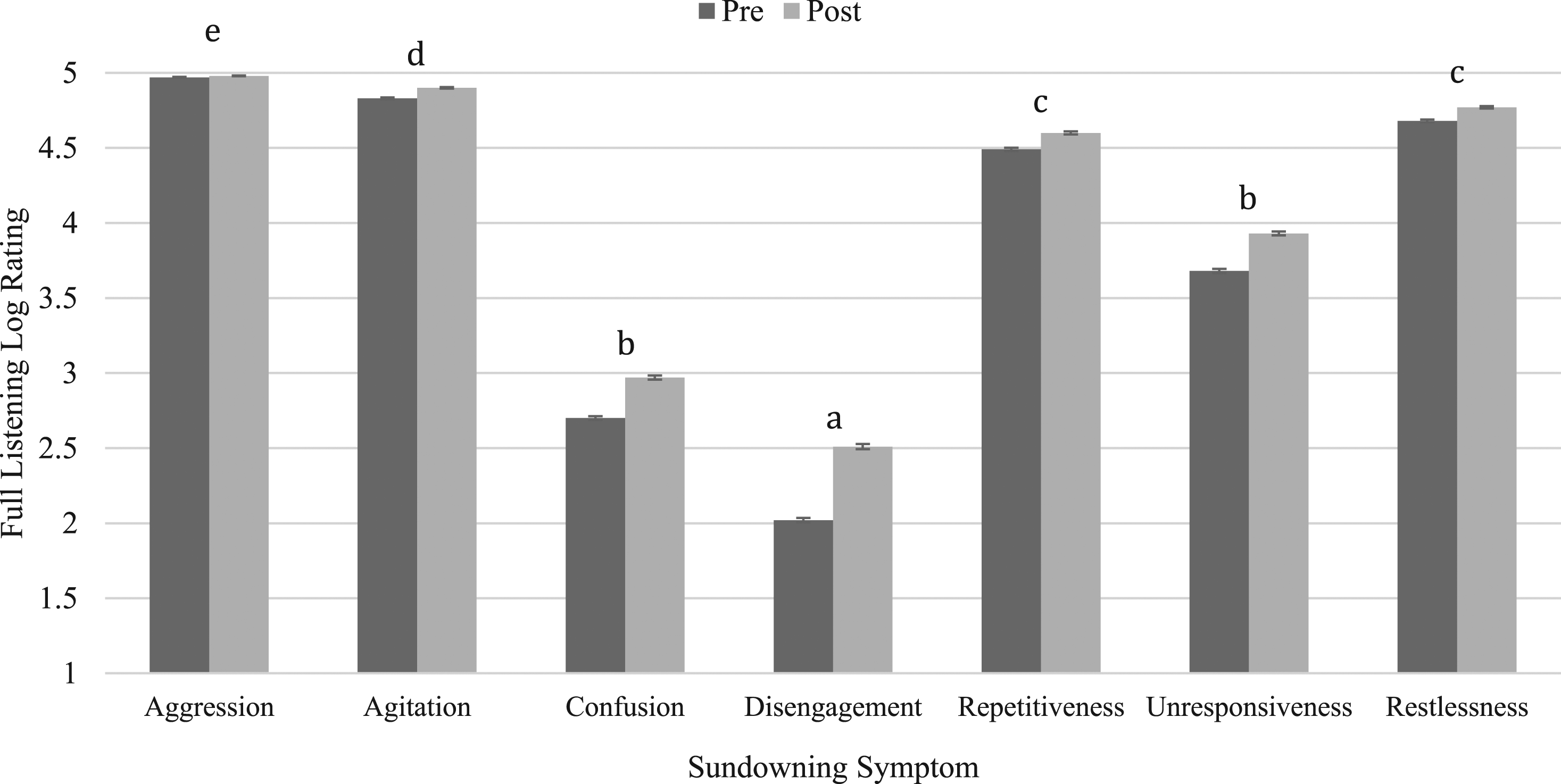
Change in sundowning symptoms from before to after music listening. Note. Error bars represent ±1 standard error. Symptoms marked with different superscripts denote significantly different degrees of improvement after music listening (p < .05), with “a” signifying the most improvement and “e” signifying the least.
Relationships Between Baseline ABCs and Change in Sundowning Symptoms from Before to After Music Listening Controlling for Phase of the Study and Six Demographic Factors.
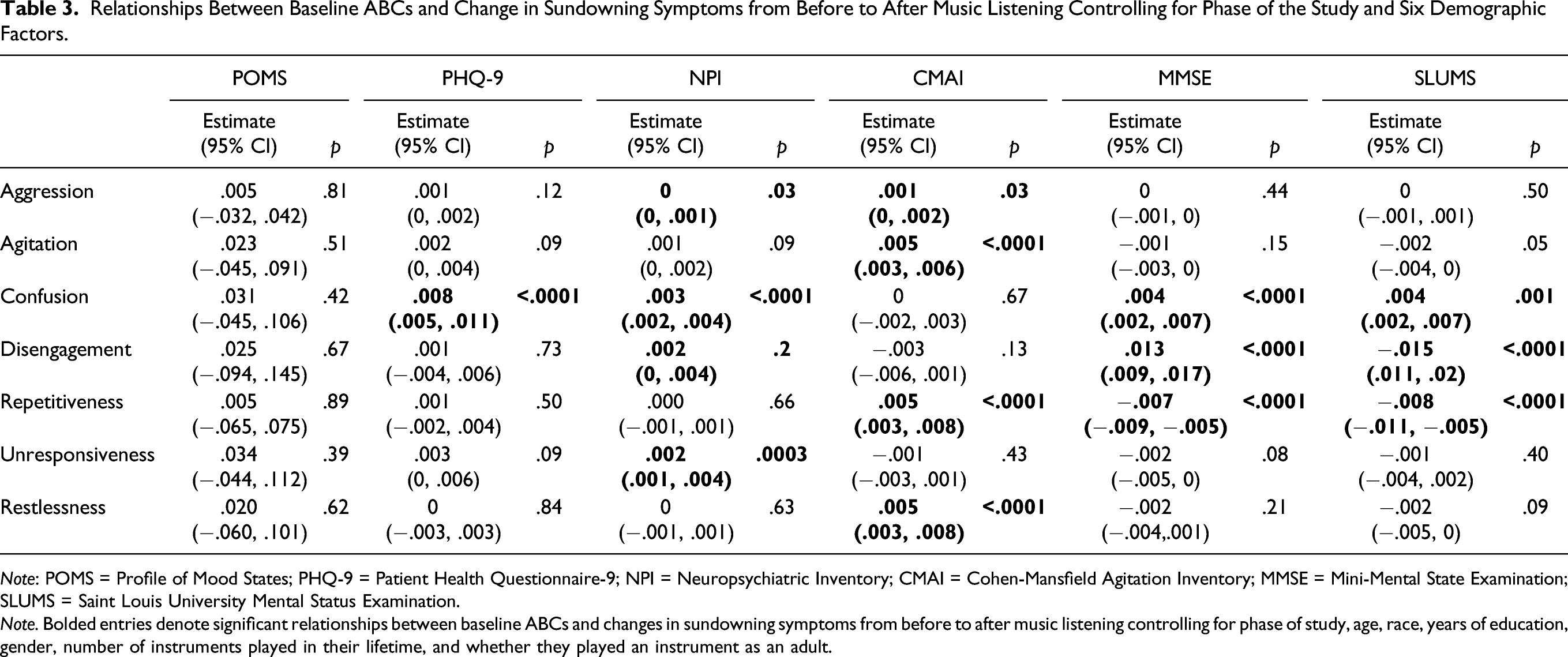
Note: POMS = Profile of Mood States; PHQ-9 = Patient Health Questionnaire-9; NPI = Neuropsychiatric Inventory; CMAI = Cohen-Mansfield Agitation Inventory; MMSE = Mini-Mental State Examination; SLUMS = Saint Louis University Mental Status Examination.
Note. Bolded entries denote significant relationships between baseline ABCs and changes in sundowning symptoms from before to after music listening controlling for phase of study, age, race, years of education, gender, number of instruments played in their lifetime, and whether they played an instrument as an adult.
Results
Music Listening
Table 1 summarizes the average number of SLLs and FLLs recorded for each participant from baseline to mid-study, mid-study to post-study, and across the entire length of enrollment. On average, participants listened to their music approximately 37 times or more across the 6-month music intervention. This is equivalent to approximately 1.5 listening sessions per week. The number of listening sessions varied greatly across participants as indicated by the wide range (1–163). Although the number of FLLs is an accurate representation of the number of researcher-administered music sessions, the number of SLLs and total listening sessions is likely an underestimate since nursing home staff and family members, at times, administered listening sessions without recording them.
Changes in the ABCs During and After the 6-Month Intervention
The long-term changes in affect, behavior, and cognition observed in residents across their 8 months of enrollment in the study are summarized in Table 2. Although self-reported POMS scores did not vary significantly during the music intervention (F(2, 96) = .01, p = .9880), residents demonstrated a statistically significant improvement in their staff-reported PHQ-9 scores during the study, F(2, 408) = 6.62, p = .0015. Residents’ depression as assessed by the PHQ-9 improved from baseline to mid-study (t(408) = 3.56, adjusted p = .0009), but scores remained stable from mid- to post-study, t(408) = −1.11, adjusted p = .5118.
Both of the measures of problematic behaviors improved significantly. Residents significantly improved in their overall psychiatric symptoms as measured by the NPI (F(2, 370) = 13.80, p < .0001) and significantly improved in their agitation as measured by the CMAI, F(2, 453) = 8.44, p = .0003. Similar to their changes in depression, both of these outcome measures showed a significant improvement from baseline to mid-study (NPI: t(370) = 4.22, adjusted p = .0004; CMAI: t(453) = 4.08, adjusted p < .0006) with some regression from mid-study to post-study on the CMAI (t(453) = −2.45, adjusted p = .0381), but no statistically significant change from mid-study to post-study on the NPI (t(370) = .70, adjusted p = .7684).
Finally, cognition remained stable across the 8 months of the study regardless of whether it was assessed by the MMSE (F(2, 451) = .62, p = .5409) or the SLUMS, F(2, 407) = .85, p = .4294.
Pre-Music to Post-Music Changes in Sundowning Symptoms
Figure 1 illustrates the means and standard errors for each sundowning symptom prior to and following music listening. All of the sundowning symptoms evidenced a statistically significant improvement from pre- to post-music. Residents demonstrated significant improvements in their aggression (S = 40.0, p < .001), agitation (S = 210.5, p < .001), confusion (S = 878.0, p < .001), disengagement (S = 1050.5, p < .001), repetitiveness (S = 297.0, p < .001), unresponsiveness (S = 856.5, p < .001), and restlessness (S = 207.0, p < .001) from immediately before to immediately after their music listening session.
Differences in the extent of improvement in these symptoms are denoted in Figure 1 by superscripts. A series of t-tests (p < .05) revealed that disengagement was most amenable to the music intervention, showing the largest improvement from pre- to post-music listening (Mchange = .49). Confusion (Mchange = .26) and unresponsiveness (Mchange = .25) demonstrated the next largest response to music listening. Repetitiveness (Mchange = .11) and restlessness (Mchange = .09) improved more modestly from pre- to post-music, followed by agitation, Mchange = .07. Finally, aggression (Mchange = .01) demonstrated the least improvement during the music listening sessions, perhaps due to considerably low baseline levels of aggression (baseline M = 4.97) in residents who were willing to comply with the music sessions when offered.
Finally, because of the inconsistent improvement in the ABCs from baseline to mid-study compared to mid-study to post-study, we conducted a longitudinal analysis examining the extent of change in each of the seven sundowning symptoms during the music listening sessions that occurred during the first 3 months of the music intervention to that which occurred during the second 3 months of the music intervention. When analyzing the baseline to mid-study period only, the results did not converge for two of the seven symptoms, unresponsiveness and confusion. For four of the remaining five symptoms, the extent of improvement in response to music was consistent across the two time periods (aggression: t(225) = .21, p = .831; agitation: t(225) = .45, p = .651; repetitiveness: t(225) = −.99, p = .326; restlessness: t(225) = 1.56, p = .120). In contrast, change in disengagement was significantly more pronounced during the first 3 months of the study than during the second 3 months of the study, t(225) = 2.54, p = .012.
Relationships between Baseline ABCs and Change in Sundowning Symptoms
Although not a planned analysis, we were interested in whether we could predict which residents would show the greatest improvement in sundowning symptoms in response to music listening based on their affect, behavior, and cognition at baseline. Thus, we investigated the relationships between baseline behavioral and psychological symptoms and changes in residents’ sundowning symptoms from before to after the music listening session controlling for phase of the study and several demographic characteristics (see Statistical Analysis section for details and Table 3 for a summary of the results). Baseline affect was not a common predictor of pre-music to post-music changes in sundowning symptoms. Baseline depression as assessed by the PHQ-9 significantly predicted improvements in confusion after music listening (t(228) = 5.44, p < .0001), but neither PHQ-9 scores nor POMS scores predicted any other changes in sundowning symptoms. Baseline neuropsychiatric symptoms on the NPI and baseline agitation on the CMAI were frequent predictors of improvements in sundowning symptoms following music listening. Baseline NPI scores were the only significant predictor of improvements in responsiveness (t(217) = 3.69, p = .0003) and were one of the several significant predictors of improvements in aggression (t(220) = 2.31, p = .0217), confusion (t(212) = 4.85, p < .0001), and disengagement (t(212) = 2.37, p = .0189). Similarly, baseline CMAI scores were the only significant predictor of improvements in restlessness (t(264) = 4.47, p < .0001) and also co-predicted changes in aggression (t(264) = 2.25, p = .0255), agitation (t(262) = 5.34, p < .0001), and repetitiveness, t(258) = 4.83, p < .0001. Baseline cognition also significantly predicted pre-music to post-music improvements in several sundowning symptoms. Although baseline scores on the MMSE and SLUMS were never unique predictors of sundowning improvements, scores on both cognition measures contributed to the prediction of changes in confusion (MMSE: t(256) = 4.10, p < .0001; SLUMS: t(228) = 3.32, p = .0011), disengagement (MMSE: t(257) = 7.04, p < .0001; SLUMS: t(229) = 6.54, p < .0001), and repetitiveness, MMSE: t(260) = −6.46, p < .0001; SLUMS: t(228) = −5.79, p < .0001.
Discussion
Building on the past literature that has demonstrated positive effects of individualized music listening on the quality of life of nursing home residents with dementia, our study first replicated past research by documenting long-term improvements in affect, behavior, and cognition in participants who experienced a personalized music intervention across a 3-month period of time. Despite extending the duration of the music intervention from the 3–4 months typical of past studies to 6 months, we were not able to show continued improvement in dementia-related symptoms across this longer intervention. Results do point, however, to an expanded set of symptoms that appear to improve significantly immediately following music listening sessions: that is, symptoms typically associated with sundowning syndrome. Thus, our study extends the types of dementia-related symptoms that might be targeted with individualized music listening interventions in the future.
Long-Term Changes in Affect, Behavior, and Cognition
In the current study, nursing home residents with dementia showed significant improvements in their depression and agitation, but not their cognition, after 3 months of listening to music several times a week for 30 minutes or more a session. These results are similar to those of Gerdner (2000), Maseda et al. (2018), Raglio et al. (2013), Sánchez et al. (2016), and Särkämö et al. (2016), who found improved agitation and/or mood after 6–16 weeks of music listening and Raglio et al. (2008) who did not document improvements in cognition following a music intervention. These findings also support Ho et al. (2019), who observed improvements in agitation, aberrant motor behavior, and dysphoria after 4 months of live music intervention. Despite the lack of improvement in cognition in the current study, scores on the two dementia screening instruments did not decline significantly across the 6 months of music intervention either. Without a control group of matched residents who did not listen to music during these same 6 months, the clinical importance of this stability is difficult to interpret.
We extended the amount of time we exposed residents to their music playlists with a goal of documenting additional improvements in their affect, behavior, and cognition. One previous study (Thomas et al., 2017) examined antipsychotic use, mood, and behavior over a similar 6-month period of music listening. These researchers found significant improvements in behavior (but not mood) in dementia patients at facilities that utilized a Music and Memory program compared to patients at facilities that did not. However, their study was conducted retrospectively, and the researchers did not examine outcomes at the individual patient level nor did they know the exact timing of the program implementation at each facility. They also did not assess outcomes at the mid-point of their study, so they could not determine when these behavioral improvements occurred in the course of the intervention.
Unfortunately, in the current study, residents did not show additional significant improvements in any of the ABCs during the second 3 months of the music intervention. Thus, inconsistent with our expectations, extending the duration of the music intervention did not expand the positive effects of music listening on nursing home residents’ quality of life. Nonetheless, residents did maintain the gains they made during the first 3 months of the intervention across the duration of this study. Although we updated residents’ playlists across the 6-month intervention, we did not substantially alter the music residents listened to across the course of their participation. Thus, they may have become bored with the music on their playlist after listening to it several times a week for 3 months, interfering with music’s ongoing ability to exert positive effects on affect and behavior. Another possible explanation is that music listening can only improve the affect and behavior of older adults with dementia to a limited extent, and residents reached the limit of that improvement during the first 3 months, leading their affect and behavior to stabilize during the second 3-month time period. Finally, it is possible that progressive neurodegeneration associated with the underlying cause of the residents’ dementia across the 6 months they were enrolled in the study overrode any additional improvements associated with the music listening. Future studies implementing a short 1- to 2-month break after 3 months of music listening might help differentiate these possible explanations for why the music did not continue to improve psychological or behavioral symptoms of dementia across the full 6-month intervention. Alternately, including different outcome measures in future studies might allow longer-term positive effects of music to be documented more effectively. Buller et al. (2019), for example, surveyed caregivers 2½ years after the initiation of a music listening program. Caregivers reported very positive perceptions of the music program even after this prolonged period of implementation, suggesting that objective measures like the ones we utilized in this study may not provide a complete picture of the advantages of this type of non-pharmacological intervention.
Short-Term Changes in Sundowning Symptoms Immediately Following Personalized Music
We expanded on past studies by adding sundowning symptoms as measurable outcomes following personalized music listening. All seven sundowning symptoms that we assessed immediately before and immediately after each music listening session showed significant improvements after the music intervention. Residents were more engaged and responsive, as well as less confused, agitated, aggressive, repetitive, and restless immediately after listening to their personalized music playlists for 30 minutes several times a week. This result has tremendous implications for the use of music listening in nursing home settings. No research to date has examined the effect of music on sundowning symptoms specifically. However, past research has shown that sundowning symptoms, particularly agitation, can be challenging to treat and can be highly disruptive in nursing homes (Bachman & Rabins, 2006; Canevelli et al., 2016; Cipriani et al., 2015). These symptoms often result in the prescribing of medications that can be harmful and dangerous for older adults (e.g., Lebert et al., 1996) and that may increase other problematic symptoms (e.g., unresponsiveness or disengagement may increase after the administration of medications designed to decrease agitation or aggression). Thus, documenting music listening’s potential to improve all sundowning symptoms offers a beneficial and healthier alternative approach to targeting symptoms associated with dementia than those commonly utilized in current nursing home settings.
Our results also indicated that some sundowning symptoms improved more than others. Disengagement, confusion, and unresponsiveness were the most amenable to the music intervention, showing the greatest improvement after the music listening. This supports past research that has documented short-term improvements in cognition in response to personalized music (Särkämö et al., 2016; Thompson et al., 2001). These findings also suggest that using music listening as an intervention before introducing nursing home residents into social settings with each other or before loved ones visit them may enhance the interactions they can share with their fellow residents, friends, and relatives (Farrer & Hilycord, 2018). Improvements in engagement, cognitive clarity, and responsiveness to others could also help residents engage in more meaningful interactions with nursing home staff, thus improving their relationships more generally.
Unlike the ABCs, music’s positive effect on most sundowning symptoms was continuous across all 6 months of the study. Thus, even though the long-term affective, behavioral, and cognitive outcomes stabilized after 3 months of music listening, immediate improvements in aggression, agitation, repetitiveness, and restlessness were equally apparent during the second half of the study (only improvements in engagement were less robust during the second 3-month time period). Perhaps these more short-term immediate responses to music are what led caregivers in the Buller et al. (2019) study to report continued positive perceptions of the outcomes associated with music listening even across 2½ years of program implementation.
When we examined which of the baseline ABCs best predicted improvements in sundowning symptoms, both baseline behavior (neuropsychiatric symptoms and agitation) and baseline cognition were common predictors of residents’ positive responses to music. Residents with more neuropsychiatric symptoms and higher baseline agitation levels evidenced larger improvements in all seven sundowning symptoms compared to their peers with fewer behavioral symptoms at the outset of the study. Although they predicted improvement in fewer symptoms, scores on baseline cognitive measures did significantly relate to changes in four of the seven sundowning symptoms. Residents with more severe dementia at baseline showed greater pre-music to post-music improvements in confusion, agitation, disengagement, and repetitiveness. Thus, these results suggest targeting residents with moderate cognitive deficits who struggle with agitation or other neuropsychiatric symptoms when implementing this type of intervention in nursing homes, particularly if resources are limited and a music program cannot be offered to all older adults in residence.
Limitations
Although results supported two of our three hypotheses, our findings are limited by several factors. We were fortunate to have an excellent team of researchers working on this study, allowing us to have many nursing home residents frequently listening to personalized music playlists. However, the vast number of listening logs that we collected across the study may have led to some of our results being statistically significant without the changes we documented necessarily being clinically meaningful. For example, the .01-point change in aggression from prior to music to after music was highly significant (p < .001) across the 7846 FLLs we analyzed. However, it is unlikely that a change that small would make a meaningful difference in a long-term care unit of a nursing home. On the other hand, the .25- to .49-point improvements in engagement, confusion, and responsiveness would be much more likely to be noticeable to staff and loved ones and would be much more likely to result in a meaningful change in how residents interact with others in their everyday lives.
A second limitation of this study was the variability in the amount of music listening that different residents received, as well as the variability in the length of their music playlists. Because this study was conducted simultaneously across multiple local nursing homes (improving the generalizability of our findings), researchers were not present at every site every day. Thus, if a resident was unwilling or unavailable to listen to their music when offered, they may have experienced far fewer music listening sessions than their peers. It is also possible that the amount of variety on residents’ playlists affected their responses, particularly because we extended the duration of the intervention to 6 months. Residents with fewer songs on their playlists may have tended to become more acclimated to their musical selections limiting their continued improvement across time.
Third, although patients with dementia most commonly experience sundowning syndrome in the late afternoon or early evening, we implemented our music listening intervention throughout the day whenever researchers were able to visit the nursing homes where the study was conducted. It was not possible to only play music for residents late in the day and still reach the large number of people we did with our intervention. Although our study, therefore, focuses on sundowning symptoms rather than sundowning syndrome per se, we expect that we would have documented an even greater incidence of sundowning symptoms with an even larger potential for improvement if we had limited our intervention to the late afternoons and evenings. Our results provide a glimpse at music listening’s potential to affect the psychological symptoms of dementia and sundowning symptoms. However, future studies will be necessary to pinpoint the precise amount of music listening necessary to inspire these positive outcomes in individual residents, particularly at times of the day when sundowning symptoms might be most prevalent.
Fourth, the researcher who conducted the music listening session was the same researcher who observed and recorded sundowning symptoms before and after the intervention. Although we could have had different researchers assess pre-music sundowning and post-music sundowning, we chose to have the person who had the current rapport with the participant and who was monitoring the music session complete both evaluations. This allowed post-assessment to occur immediately after the discontinuation of the music. Although investigator bias might have influenced ratings of sundowning symptoms, we found differential rates of improvements across participants and across symptoms, lending validity to our approach. We did not have prior expectations about which symptoms would show the most improvement nor did we find that all symptoms changed equally as we might have if researchers were simply making post-music ratings that were higher than pre-music ratings.
Fifth, because this was a clinical study, we could not control the experiences residents had when researchers were not present. Although we tried to document instances when nursing home staff, family, or friends administered residents’ personalized music playlists, we do not believe our estimates are accurate. We also did not ask the nursing homes where we conducted the study to limit or minimize other music-related or other enriching experiences residents might have had when we were not present. Ongoing music programs, such as sing-alongs, live music performances, or music therapy interventions, may have overlapped with the personalized music listening at the center of our study and may have confounded the results. Also, because this was a clinical study, many of our residents did not complete the entire 6 months of the study either because they moved facilities, because they passed away, or because they chose to discontinue their participation. Thus, a selection bias could have influenced these results. We analyzed all available data from those who participated in the study, but our statistical analyses weighed the data of residents who participated more fully heavier than those who participated more minimally.
Finally, we did not incorporate a no-music control group in our study. Although this would have helped us to determine whether the lack of significant changes in some of the ABCs were actually positive outcomes rather than null results and would have helped us to guarantee that the changes in sundowning that we documented were due to the music and not simply the very brief social interactions researchers had with residents while assessing baseline and post-music symptoms, we did not want to deny or delay any of the residents’ access to personalized music playlists. Because time is of the essence for older adults with dementia, we did not include either a no-music control group or a waitlist control group in this study design.
Conclusion
The results of the current study strongly indicate that nursing home residents with dementia evidence significant improvements in their depression, agitation, and neuropsychiatric symptoms across the first 3 months of listening to individualized music playlists consisting of songs from their late teens to early 20s and maintain these gains across an additional 3 months of music listening. Additionally, they experience significant short-term improvements in sundowning symptoms (i.e., disengagement, confusion, agitation, aggression, restlessness, repetitiveness, and unresponsiveness) following music listening sessions. Together, these results support individualized music listening as an effective non-pharmacological intervention that can significantly improve the quality of life of nursing home residents with dementia. Future studies should (1) examine how these behavioral and psychological outcomes might subsequently affect the necessity of utilizing medications to treat these dementia-related symptoms, (2) investigate additional individual differences that might influence or predict residents’ responses to music listening, and (3) differentiate potential explanations for why long-term improvements in this study did not expand across the second half of our music intervention. Nonetheless, these results speak to the promising nature of this non-pharmacological, simple intervention as a means to significantly improve the psychological, behavioral, and sundowning symptoms of older adult nursing home residents with dementia.
Footnotes
Acknowledgments
We would like to thank Terry Whitson who helped us secure the funding needed to proceed with this project and the five data collectors who worked in the nursing homes every day to make this project possible: Tim Gallagher, J. D. Hall, Chelsea Reynowsky, Nick Trinoskey, and Priya Whittman. We would also like to acknowledge the large number of Butler University students who collected data while improving the lives of the nursing home residents enrolled in the study, and the families of those participants who agreed to allow us to play music for their loved ones.
Author Note
Kendall Ladd is now with Life Company at State Farm. Heather Johnson is now at Cumberland Trace Senior Living. Monical Ott is now at Optum Chronic Care Management. Hannah Bolander is now at the University of Cincinnati. Sarah Vitelli is now at the Regenstrief Institute. Mikala Lain is now at Seattle University.
Declaration of Conflicting Interests
The author(s) declared no potential conflicts of interest with respect to the research, authorship, and/or publication of this article.
Funding
The author(s) disclosed receipt of the following financial support for the research, authorship, and/or publication of this article: This project was supported by funding from the Indiana State Department of Health, the Central Indiana Community Foundation Glick Fund, and the Central Indiana Community Foundation Central Indiana Senior Fund.
Data Availability Statement
Access to the data set associated with this study may be requested from the corresponding author.

