



Abstract
Objectives
This study identified distinct social isolation profiles among caregivers, each formed by varied combinations of social disconnectedness and loneliness, and examined if and how the profiles were associated with caregiver burden.
Methods
Latent class analysis and multivariable regression were applied to data from 266 caregivers of community-dwelling older Singaporeans with cognitive impairment.
Results
Two caregiver social isolation profiles were identified: strongly connected, not lonely (86%), and moderately connected, lonely (14%). Moderately connected and lonely caregivers tended to perceive a higher level of burden than strongly connected and not lonely caregivers. Moderately connected and lonely caregivers were also more likely to be burdened by their care recipients’ poor health than their connected and not lonely counterparts.
Discussion
Caregivers who feel “lonely in a crowd” are vulnerable to caregiving stress and burden. Tailored interventions, such as cognitive behavioral therapy, are needed to reduce the loneliness of moderately connected caregivers.
Background
Social isolation is a multidimensional construct that comprises social disconnectedness and loneliness (Cornwell & Waite, 2009; Newall & Menec, 2019). Social disconnectedness indicates an objective state of a lack of social ties, whereas loneliness refers to distressing feelings that mainly stem from the discrepancy between social relationships one has and one desires (de Jong Gierveld et al., 2018; Hawkley & Cacioppo, 2010). Conceptually, lack of social connectedness and feelings of loneliness overlap. Nevertheless, they are moderately associated and have different implications on health and well-being (Courtin & Knapp, 2017).
A nascent study suggested that social disconnectedness and loneliness should be considered in tandem (Newall & Menec, 2019). This is to consider four theoretically distinct profiles of social isolation, specifically “disconnected but not lonely” and “connected but lonely” profiles, in addition to “connected and not lonely” and “disconnected and lonely” profiles (Newall & Menec, 2019). Socially disconnected individuals may not feel lonely when they have chosen to be isolated and are content with their social life (Capitanio et al., 2014). In contrast, individuals can feel lonely despite being socially connected if they are dissatisfied with their existing social relationships (Lee & Ko, 2018). Although this theoretical distinction is informative, less is known if all four profiles are prevalent in a given population. In addition, there may be a profile with varying degrees of social isolation and loneliness, such as moderately isolated and lonely, that cannot be depicted by the four profiles.
Recent empirical studies have applied a clustering methodology to examine the social isolation profiles among older adults (Farmer et al., 2022; Smith & Victor, 2019). Using nationally representative data on older adults in the United Kingdom, Smith and Victor (2019) found six social isolation profiles: (1) no loneliness or disconnectedness; (2) moderate loneliness; (3) living alone; (4) moderate disconnectedness; (5) moderate loneliness, living alone; and (6) high loneliness, moderate disconnectedness (with a high likelihood of living alone). Farmer et al. (2022) identified five profiles among older adults in the United States: (1) connected, nonparticipators; (2) connected and active; (3) moderately disconnected and lonely; (4) alone but not lonely; and (5) alone and lonely. These studies suggest that different populations have distinct social isolation profiles, varying in levels of loneliness and social disconnectedness.
This study applied this clustering approach to identify the social isolation profiles among family caregivers. The physical and emotional demands of providing care to a family member may be a barrier to maintaining social relationships (Lee et al., 2022; Tatangelo et al., 2018). Furthermore, family caregivers face unique stressors and may not receive the necessary support from friends and family who do not understand the extent of their caregiving role (Tatangelo et al., 2018). Therefore, family caregivers are susceptible to social disconnectedness and loneliness. Nevertheless, most studies have paid attention to either loneliness or social disconnectedness, or both independently (Hajek et al., 2021). How are loneliness and social disconnectedness intertwined in shaping social isolation profiles among caregivers?
Identifying caregiver social isolation profiles provides unique opportunities to examine if and how different combinations of social disconnectedness and loneliness are associated with caregiver burden. The caregiving role brings about positive and negative experiences (Pristavec, 2019). On the positive aspect, caregiving provides a sense of accomplishment and purpose in life and may increase family cohesion (Roth et al., 2015; Yu et al., 2018). On the other hand, if the demands of caregiving exceed their social and financial resources (Roth et al., 2015), family caregivers may suffer from emotional strains, health problems, life disruption, and financial adversity, broadly known as caregiver burden (Zarit et al., 1986).
Social disconnectedness and loneliness have been known to intensify caregiver burden (Adelman et al., 2014). Social ties with family, friends, and acquaintances offer instrumental, emotional, and informational social support (Thoits, 2011). Thus, a lack of social connectedness lowers the likelihood of receiving necessary help, increasing caregiver burden (Rodakowski et al., 2012). The loneliness model proposes that lonely people tend to be hypervigilant to external circumstances while selectively capturing negative social interactions (Hawkley & Cacioppo, 2010). Lonely caregivers, therefore, may perceive a higher level of burden because they are more sensitive to negative emotions and anxiety arising from caregiving (Beeson et al., 2000; Ekwall et al., 2005).
Moreover, it is plausible that social disconnectedness and loneliness intensify the negative impact of caregiving stress on caregiver burden. A caregiver stress-process model proposes that primary stressors, such as care recipients’ poor health, increase caregiver burden (Pearlin et al., 1990). At the same time, the model highlights the role of personal and social resources, including self-esteem and social networks, in buffering the negative consequences of caregiving stressors (Sung, 2020). A lack of buffering resources thus may make caregivers vulnerable to stressors. For instance, socially disconnected caregivers are more severely burdened by poor health of their care recipients than their connected counterparts in the absence of social support (Cheng et al., 2013). Likewise, due to diminished self-control and self-esteem, lonely caregivers may perceive a higher level of burden when their care recipients suffer from poor health (Hawkley & Cacioppo, 2010).
Therefore, the present study investigates (1) distinct social isolation profiles among caregivers, (2) the association of social isolation profiles with caregiver burden, and (3) the moderation effect of social isolation profiles on the association between care recipients’ poor health and caregiver burden. Based on the literature, we expect to identify at least two social isolation profiles among caregivers: connected and not lonely and disconnected and lonely. A previous typology study reported that older adults with a high level of loneliness and a moderate level of social isolation, compared to those with no loneliness and no social isolation, were more likely to report poor physical, functional, and mental health (Smith & Victor, 2019). We thus hypothesize that disconnected and lonely caregivers report a higher level of caregiver burden, compared to connected and not lonely caregivers. Also, in line with the stress-buffering process, we posit that disconnected and lonely caregivers are more severely burdened by their care recipients’ poor health than their connected and not lonely counterparts.
Methods
Data
We utilized dyadic data on 266 family caregivers and their care recipients, who were older persons with cognitive impairment (PCI), from the “Caring for persons with dementia and their caregivers in the community: Towards a sustainable community based dementia care system (COGNITION)” study. The COGNITION study aimed to provide a comprehensive understanding of the health and social lives of PCI and their caregivers in the community. The study was approved by the institutional review board of the National University of Singapore.
In 2018, the study team approached 9828 households in a Whampoa community in Singapore. A total of 3589 older Singapore citizens or permanent residents aged 60 years and older and interested in the study were administered a validated 10-item screener: the Eight-item Interview to Differentiate Aging and Dementia (AD8) and two items (copying intersecting pentagon and three-item recall) from the Mini-Mental State Examination (MMSE) (Tew et al., 2015). Of them, 323 older adults, who scored equal to or less than eight on the screener (Tew et al., 2015), were considered as PCI and invited to participate in the COGNITION study. At the end, 266 older adults and their caregivers gave written informed consent and were interviewed face-to-face. A caregiver was defined as a family member or a friend of PCI who was most involved in providing care or ensuring the provision of care to PCI. The COGNITION study focused on family caregivers. Hence, live-in foreign domestic workers (FDW) were disqualified, although they play an important role as caregivers in Singapore (Yeoh & Huang, 2009).
Measures
Social Isolation Indicators
We used seven indicators to derive social isolation profiles. These were (1) lack companionship; (2) feel left out; (3) feel isolated; (4) hardly ever/never eat together as a family; (5) hardly ever/never communicate with close family or friends outside the house; (6) hardly ever/never have close confiding relations; and (7) hardly ever/never have someone that you trust to talk through your troubles with. The first three indicators were from the 3-item Loneliness Scale, which has been commonly used in the literature to measure perceived social isolation (Hughes et al., 2004). These items had three response categories: hardly ever, some of the time, and often. The next four items were adopted from the ComSA risk screener, which aimed to screen biopsychosocial health and related risks of older Singaporeans (Aw et al., 2020). These items measured social connectedness in the Asian cultural context (e.g., do you tend to eat together as a family?) with two response categories: often or sometimes and hardly ever or never.
Caregiver Burden
The Zarit Burden Interview (ZBI) measured caregiver burden (Zarit et al., 1986). This 22-item instrument (e.g., Do you feel that because of the time you spend with your relative that you don’t have enough time for yourself? Do you feel your health has suffered because of your involvement with your relative?) had five response categories: never = 0; rarely = 1; sometimes = 2; quite frequently = 3; nearly always = 4. The summated score, ranging from 0 to 86, was used (Cronbach’s α = 0.96). A higher score reflected a higher level of caregiver burden.
Covariates
We accounted for PCI health status and sociodemographic characteristics, caregiver sociodemographic characteristics, and caregiving contexts, known to be associated with caregiver burden (Sung & Chan, 2022).
PCI characteristics PCI health status included cognitive function, memory/behavior/mood problems, and functional difficulties (Pinquart & Sorensen, 2006). First, MMSE evaluated cognitive function. The 30-item instrument assessed the orientation, attention, memory, language, and visual-spatial skills of PCI (Creavin et al., 2016). A summary score was used, ranging from 0 to 30 (Cronbach’s α = 0.94). A higher score indicated better cognitive function. Second, the revised memory and behavior problems checklist (RMBPC) assessed memory/behavior/mood problems of PCI from the perspective of caregivers (Teri et al., 1992). This 24-item instrument had five response categories: “never occurred at all = 0”; “not in the past week = 1”; “1 to 2 times per week = 2”; “3 to 6 times per week = 3”; “daily or more often = 4.” A summated score from 24 items, ranging from 0 to 96, was used (Cronbach’s α = 0.93). A higher score indicated more severe memory, behavior, and mood problems. Third, functional difficulties were measured by instrumental activities of daily living (IADL). PCI’s difficulties in seven types of activities, such as shopping, preparing meals, and taking medicine, were evaluated with three response categories: “completely unable,” “with some help,” and “without help.” The former two items were collapsed into one, and the total number of difficulties was counted (range: 0–7; Cronbach’s α = 0.94). Other PCI demographic characteristics comprised age (range: 61–103 years), female (female = 1; male = 0), and married (married = 1; widowed/separated/divorced/never married = 0).
Caregiver characteristics Caregiver sociodemographic characteristics included age (range: 23–93 years), female (female = 1; male = 0), minority ethnicity (Malay, Indian, and other nationalities = 1; Chinese = 0), married (married = 1; widowed/separated/divorced/never married = 0), highest completed education (no formal education = 1; primary school = 2; secondary = 3; post-secondary and tertiary = 4), working (working full-time or part-time = 1; not working and never worked = 0), and financial adequacy (usually inadequate = 1; occasionally adequate = 2; adequate = 3; more than adequate = 4).
Caregiving contexts Three variables regarding caregiving contexts were further considered. They were the relationship to PCI (Spouse, and others, vs. Children), long-term caregiver (helping PCI for memory problems for more than 5 years = 1; the rest = 0), and foreign domestic worker (employing foreign domestic worker for caregiving = 1; the rest = 0).
Analytic Strategy
We used Latent Class Analysis (LCA) to identify caregiver social isolation profiles and multivariable regression to estimate the association of social isolation profiles with caregiver burden. In the LCA, seven indicators measuring loneliness and social disconnectedness were used to categorize individuals into distinct social isolation profiles, internally homogeneous and externally heterogeneous (Nylund-Gibson & Choi, 2018).
Determining the optimal number of profiles is a core part of LCA. Models with a different number of profiles are estimated and fit indices are compared (Nylund-Gibson & Choi, 2018). The model with the lowest information criteria (IC), which include Bayesian Information Criterion (BIC), Sample size Adjusted BIC (SABIC), Consistent Akaike Information Criterion (CAIC), and Approximate Weight of Evidence Criterion (AWE), is considered to fit the data better than the others (Nylund-Gibson & Choi, 2018). Two likelihood tests—the Lo–Mendell–Rubin (LMR) adjusted likelihood ratio test and the bootstrapped likelihood ratio test (BLRT)—compare neighboring models: A statistically significant test result (p < 0.05) indicates that the model with the k profile outperforms the model with the k-1 profile (Lo et al., 2001). The profile distinction is further evaluated by the entropy index and the proportion of the smallest profile. The entropy index, ranging from 0 to 1, assesses classification accuracy: A value greater than 0.80 indicates a precise assignment of individuals into profiles. The smallest profile should be sufficiently large (more than 5–8% of the sample) for classification reliability and replicability (Nylund-Gibson & Choi, 2018).
Once the model with the best fit was chosen, individuals were assigned to a specific profile, based on the highest posterior probability. This profile information was then used in multivariable regression models to examine the direct association of social isolation profiles with caregiver burden, and the moderation of social isolation profiles on the association between PCI health and caregiver burden. Multiple imputations with predictive mean matching handled six missing values: three in MMSE and three in financial adequacy (Morris et al., 2014).
Results
Sample Characteristics
Descriptive Statistics.
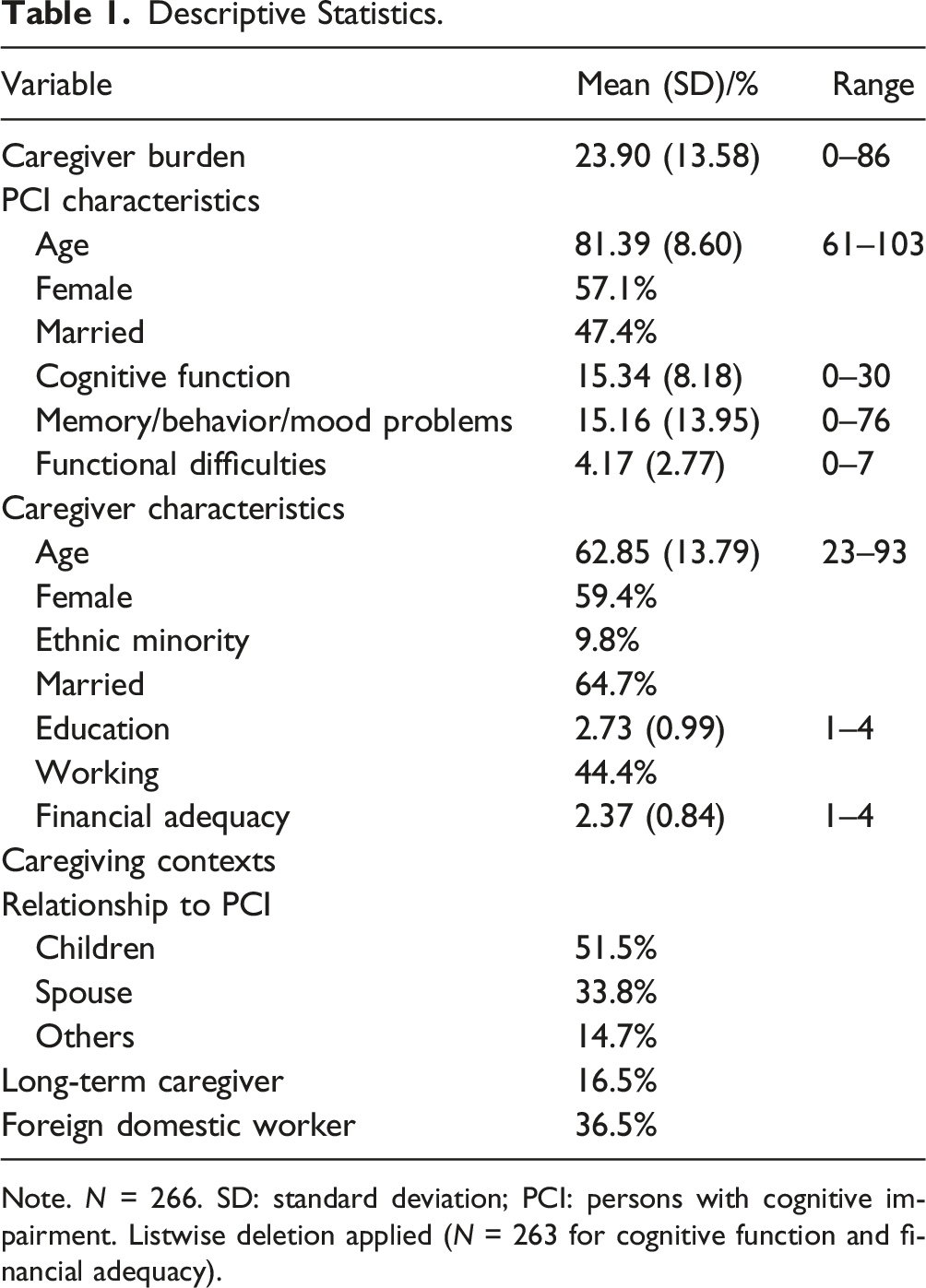
Note. N = 266. SD: standard deviation; PCI: persons with cognitive impairment. Listwise deletion applied (N = 263 for cognitive function and financial adequacy).
The average caregiver reported mild caregiver burden with a mean score of 23.9 (SD = 13.6) (Hébert et al., 2000). The average age of the caregivers was 63 years, 59% were female, and 10% were ethnic minorities. About 65% of them were married and 44% were working. The average caregiver completed secondary school and reported that their financial resources were occasionally adequate to cover their monthly expenses. About half of caregivers were children of their PCI; 17% provided help to their PCI for more than 5 years, and 37% hired a FDW for caregiving.
Model Selection
Model Fit Indices.
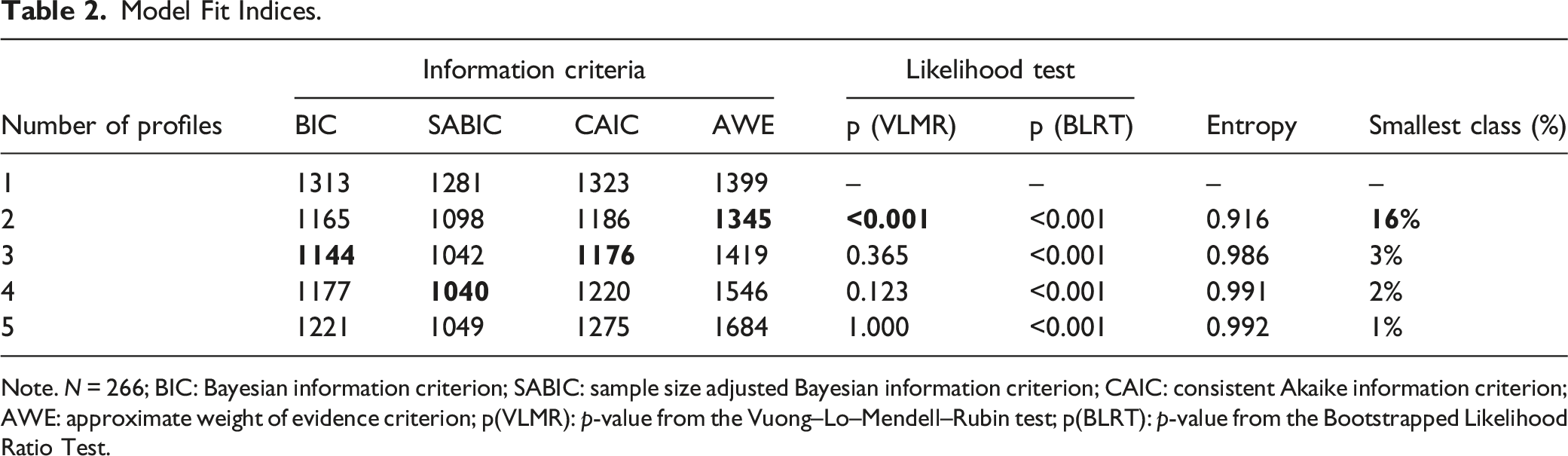
Note. N = 266; BIC: Bayesian information criterion; SABIC: sample size adjusted Bayesian information criterion; CAIC: consistent Akaike information criterion; AWE: approximate weight of evidence criterion; p(VLMR): p-value from the Vuong–Lo–Mendell–Rubin test; p(BLRT): p-value from the Bootstrapped Likelihood Ratio Test.
Two Social Isolation Profiles Among Caregivers
Profile-specific Indicator Response Probabilities.
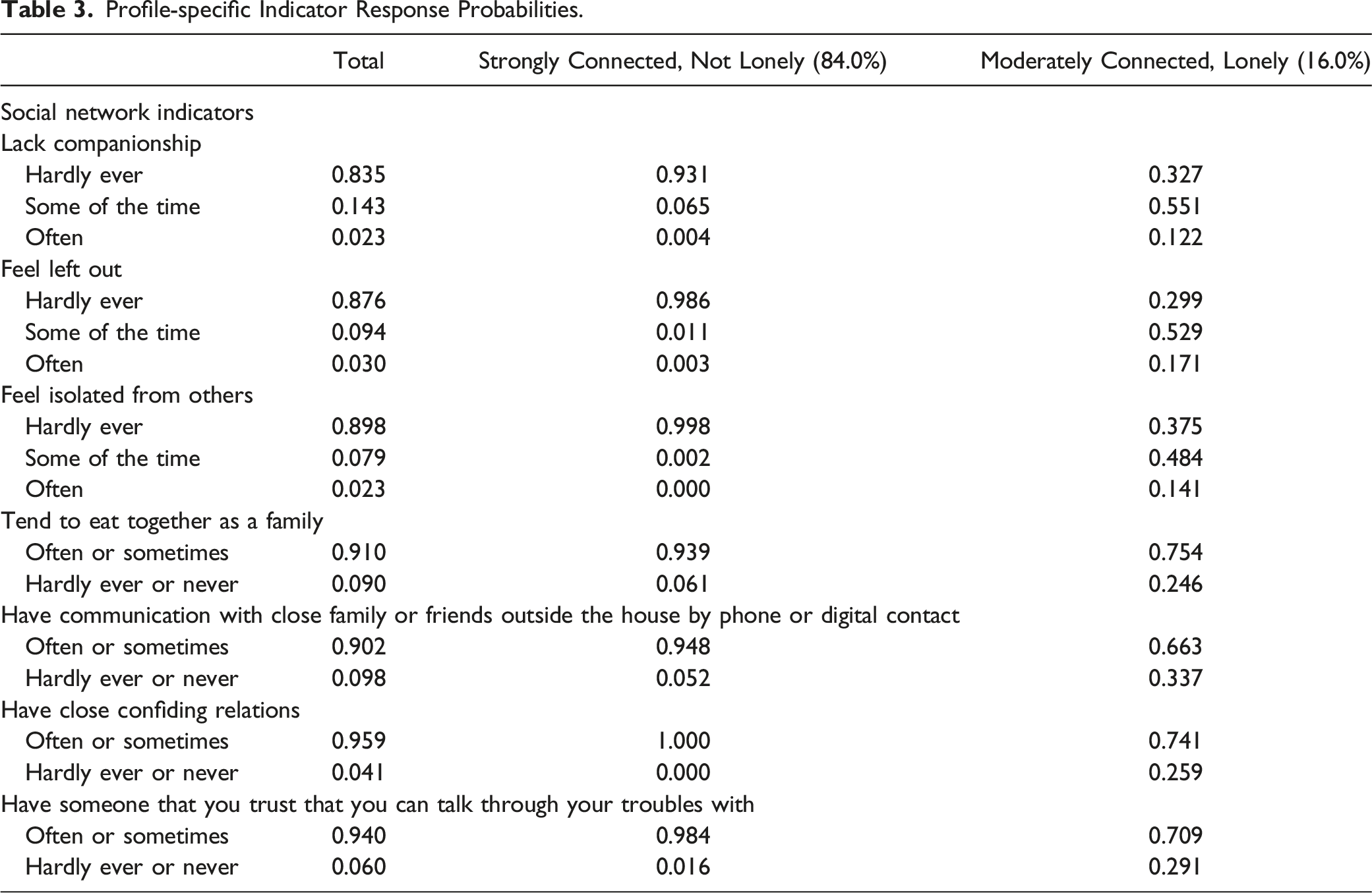
First, a majority of caregivers (84%) were classified into the “strongly connected, not lonely” profile. Caregivers with this profile hardly ever lacked companionship, felt left out, and felt isolated from others. They also often or sometimes ate together as a family, had close confiding relations, and had someone to trust. Second, about 16% of caregivers were classified into the “moderately connected, lonely” profile. More than 60% of caregivers with this profile sometimes or often felt a lack of companionship, left out, and isolated. Nonetheless, they tended to eat with family, communicate with family and friends, and maintain confiding and trusting social relationships.
Supplementary Table 1 provides distributions of caregiver burden, PCI and caregiver characteristics, and caregiving contexts by profiles. Caregivers with the strongly connected, not lonely profile reported a significantly lower level of caregiver burden and memory/behavior/mood problems of their PCI, compared to caregivers with the moderately connected, lonely profile. Strongly connected and not lonely caregivers were also more likely to consider their financial resources adequate than moderately connected and lonely caregivers.
Social Isolation Profiles and Caregiver Burden
Association of Caregiver Social Isolation Profiles With Caregiver Burden: Results From Multiply-Imputed Linear Regression Models.
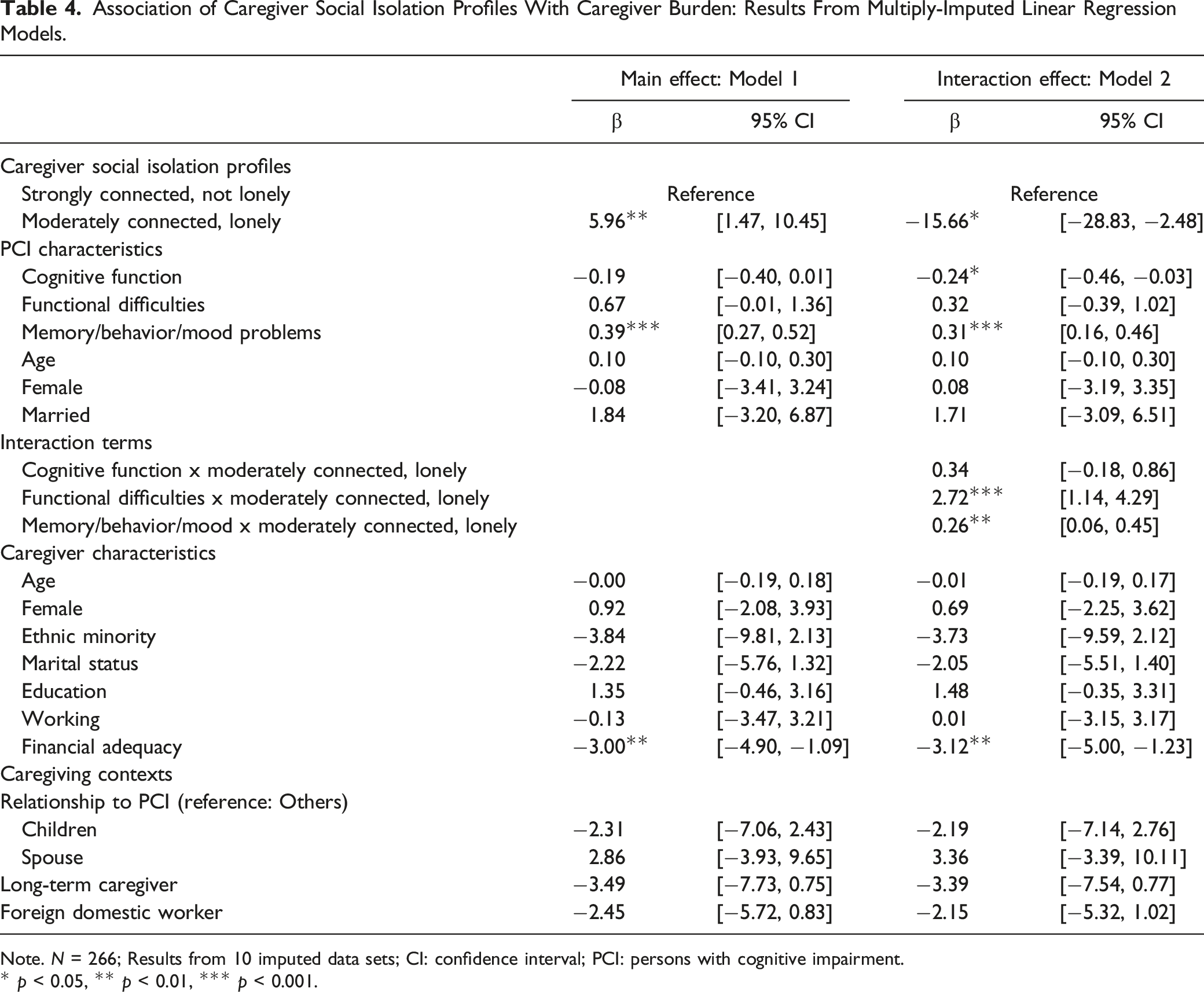
Note. N = 266; Results from 10 imputed data sets; CI: confidence interval; PCI: persons with cognitive impairment.
* p < 0.05, ** p < 0.01, *** p < 0.001.
Model 1 shows that the moderately connected, lonely profile (vs. the strongly connected, not lonely profile) was associated with an increased level of caregiver burden. Model 2 reports that interactions between functional difficulties and the moderately connected, lonely profile, and between memory/behavior/mood problems and the moderately connected, lonely profile, were associated with an increased level of caregiver burden.
To aid interpretation of the significant interaction terms, Figure 1 plots the estimated association of PCI functional limitation (left) and PCI memory/behavior/mood problems (right) with caregiver burden by caregiver social isolation profiles (moderately connected, lonely vs. strongly connected, not lonely). The figure shows that the association of PCI functional limitations and memory/behavior/mood problems with caregiver burden varied considerably by caregiver social isolation profiles. Caregivers with the moderately connected, lonely profile were more likely to be severely burdened than caregivers with the strongly connected, not lonely profile when their PCI had a greater number of functional difficulties and a higher level of memory/behavior/mood problems. Interactions between PCI health and social isolation profiles in their association with caregiver burden. Note. N = 266; Based on the 10th imputed data set. PCI: Persons with cognitive impairment.
Regarding covariates, according to Model 1 in Table 4, PCI functional difficulties and memory/behavior/mood problems were associated with higher levels of caregiver burden, whereas financial adequacy was associated with lower levels of caregiver burden.
Discussion
Prior studies used a clustering approach to investigate the intertwinement of social disconnectedness and loneliness in shaping social isolation profiles among older adults, and their implications for physical and mental health (Smith & Victor, 2019) and substance use (Farmer et al., 2022). The present study extended this approach to family caregivers by identifying caregiver social isolation profiles and their associations with caregiver burden.
LCA identified two social isolation profiles: strongly connected, not lonely (84.0%) and moderately connected, lonely (16%). The social isolation profiles among family caregivers were less varied compared to five or six profiles identified among older adults (Farmer et al., 2022; Smith & Victor, 2019). In particular, the proportion of caregivers with the strongly connected, not lonely profile in this study was substantially higher than the similar profile identified among older adults in the literature (Farmer et al., 2022; Smith & Victor, 2019). Due to the use of varying indicators, the profiles were not fully comparable across studies. Nevertheless, it is plausible that caregivers are more strongly connected and less lonely than older adults because they are younger, employed, and have frequent social interactions for social support exchanges. This is in line with a recent study showing the association between family caregiving and increased social network size (Zwar et al., 2020). It is also probable that caregivers in Singapore fare better than caregivers in other countries: The economic prosperity and the geographical proximity of caregivers to their family and friends in a small city-state may facilitate regular social interactions.
One in six caregivers in this study was classified into the moderately connected, lonely profile. This profile has not been identified in the older adult population, thus unique to our study (Farmer et al., 2022; Smith & Victor, 2019). Although more than 70% of caregivers with this profile eat together with family and have confiding and trusting relations, two-thirds of them sometimes or often feel a lack of companionship, left out, and isolated. As shown in Supplementary Table 1, moderately connected and lonely caregivers were less financially adequate and provided care for PCI with poorer health. We speculate that these caregivers might have maintained a moderate level of social connectedness to obtain instrumental and emotional social support to meet the demands of caregiving, even when the quality of social ties had not met their expectations (Lee & Ko, 2018; Newall & Menec, 2019). The discrepancy between objective and subjective social connectedness might result in dissatisfaction with their social relationships, making caregivers feel “lonely in a crowd.”
Caregivers with the moderately connected, lonely profile were more likely to report a higher level of caregiver burden than caregivers with the strongly connected, not lonely profile. The findings thus lend credence to the scant studies that showed the detrimental effect of social connectedness and loneliness on caregiving distress among caregivers (Beeson et al., 2000; Ekwall et al., 2005). Moreover, our findings revealed that moderately connected and lonely caregivers were more vulnerable to caregiving stressors such as poor PCI health than strongly connected and not lonely caregivers, which led to severe caregiving distress. The stress-exacerbating effect of loneliness and lack of social connectedness is thus verified (Pearlin et al., 1990; Thoits, 2011).
The robustness of the study findings was further tested by using two summated, continuous measures of loneliness and social disconnectedness. These two variables were added simultaneously to the regression models to check if either loneliness or social disconnectedness, or both, was significantly associated with caregiver burden. The results shown in Supplementary Table 2 largely supported our main findings: (1) Loneliness but not social disconnectedness was significantly associated with a higher level of caregiver burden and (2) only loneliness moderated the association between PCI memory/behavior/mood problems and caregiver burden. In summary, the supplementary analyses suggest that feelings of loneliness—the discrepancy between objective and subjective social connectedness—may be more detrimental to caregiver well-being than social disconnectedness.
Practically, the study findings can help inform the design of tailored interventions for moderately connected and lonely caregivers in the community. A recent review suggested five interventions that may reduce loneliness among caregivers: mindful meditation, computer applications, music therapy, peer support, and community programs (Velloze et al., 2022). Studies also recommended that enhancing social skills or providing social support should help reduce loneliness among caregivers (e.g., Burholt & Scharf, 2014). Interventions that strengthen social connectedness, however, may not be suitable for moderately connected and lonely caregivers. Instead, psychological interventions that include cognitive behavioral therapy (CBT) may help counteract caregiving distress and loneliness by changing patterns of dysfunctional thoughts and behaviors (Burholt & Scharf, 2014; Hawkley & Cacioppo, 2010; Kate et al., 2018; Steffen et al., 2021). For instance, a meta-analysis of 131 randomized controlled trials between 2006 and 2018 showed that psychoeducational programs, counseling and psychotherapy, care coordination/case management, and multicomponent interventions helped reduce caregiver burden and stress (Cheng et al., 2020). Specifically, various on and offline psychoeducational programs with CBT techniques gain research and policy attention as they can be flexible, cost-effective, and far-reaching (Cheng et al., 2019, 2020; Kate et al., 2018). A recent study further suggested that interventions for dementia caregivers should be guided by addressing the diversity and heterogeneity among caregivers and care recipients (Gallagher-Thompson et al., 2020). Our findings contribute to the literature by revealing heterogeneity in loneliness among family caregivers who maintain their social connectedness to some extent.
This study has several limitations. First, cross-sectional data were utilized. Thus, the dynamics of social isolation profiles were not captured. Also, the regression analysis may suffer from endogeneity bias that includes reverse causality and omitted confounders. The bidirectional relationship between social isolation profiles and caregiver burden is plausible (Ross et al., 2020). Also, unobserved caregiver characteristics, such as caregiver personality traits, may influence both loneliness (Buecker et al., 2020) and caregiver burden (Melo et al., 2011), leading to the spurious association between the two. Multi-wave longitudinal data may help explore stability and change in social isolation profiles and their impact on caregiver distress.
Second, the social disconnectedness indicators used in this study were unable to comprehensively capture caregiver social networks in a subtle manner, even though they were effective in detecting older adults at risk of social isolation (Aw et al., 2020). The same applies to other key measures in this study. For instance, MMSE and ZBI have been widely used in the literature and validated in Singapore (Ng et al., 2007; Seng et al., 2010). Nevertheless, these measures have limitations: The use of ZBI is limited in intervention studies due to its insensitivity to change (Acton & Kang, 2001) and MMSE may not be suitable for detecting early-stage dementia (Devenney & Hodges, 2017). Future studies replicating and extending this study may use more sophisticated indicators of social disconnectedness (e.g., Lubben et al., 2006), and try alternative measures of cognitive impairment and caregiver burden, such as the Mini-Cog test or the Montreal Cognitive Assessment (Tsoi et al., 2015), and the Burden Assessment Scale or the Dementia Management Strategies Scale (Seng et al., 2010), respectively. Lastly, similar to many other caregiver data, our sample was not nationally representative. Therefore, interpretation of the findings is limited to caregivers of community-dwelling PCI in a developed city-state.
Despite these limitations, this study contributes to the literature by identifying latent profiles of social isolation among caregivers and their implications for caregiver burden. The two caregiver social isolation profiles identified in this study confirmed the need to simultaneously consider social disconnectedness and loneliness to a varying degree. Most caregivers of community-dwelling PCI in Singapore were strongly connected and not lonely. Nevertheless, about one in six was moderately connected and lonely, and these “lonely in a crowd” caregivers were vulnerable to caregiving stress and burden. Tailored interventions, therefore, are needed to reduce loneliness among caregivers. Future studies need to investigate social isolation profiles among caregivers in other sociocultural contexts and their implications on health and well-being.
Supplemental Material
Supplemental Material - Lonely in a Crowd: Social Isolation Profiles and Caregiver Burden Among Family Caregivers of Community-Dwelling Older Adults With Cognitive Impairment
Supplemental Material for Lonely in a Crowd: Social Isolation Profiles and Caregiver Burden Among Family Caregivers of Community-Dwelling Older Adults With Cognitive Impairment by Pildoo Sung, June May-Ling Lee, and Angelique Chan in Journal of Aging and Health
Footnotes
Declaration of Conflicting Interests
The author(s) declared no potential conflicts of interest with respect to the research, authorship, and/or publication of this article.
Funding
The author(s) disclosed receipt of the following financial support for the research, authorship, and/or publication of this article: Caring for persons with dementia and their caregivers in the community: Towards a sustainable community based dementia care system (COGNITION) study was supported by the National Innovation Challenge on Active and Confident Ageing Grant (award no.: MOH/NIC/COG05/2017).
IRB Approval
The study was approved by the institutional review board of the National University of Singapore.

Supplemental Material
Supplemental material for this article is available online.
References
Supplementary Material
Please find the following supplemental material available below.
For Open Access articles published under a Creative Commons License, all supplemental material carries the same license as the article it is associated with.
For non-Open Access articles published, all supplemental material carries a non-exclusive license, and permission requests for re-use of supplemental material or any part of supplemental material shall be sent directly to the copyright owner as specified in the copyright notice associated with the article.
