




Abstract
Introduction
Mexico is among the Latin American countries with the highest number of deaths due to the spread of COVID-19 among the population (Statista, 2022). Due to the suggestion of voluntary seclusion issued by the federal government on March 23, 2020, the immediate consequence in terms of mental health was an increase in the perception of stress at both the individual and social level (Secretaría de Salud, 2020). According to WHO reports (2020), physical isolation linked to the pandemic increased levels of loneliness, depression, anxiety, harmful substance use, and self-harm in the general population. In addition, the economic crisis associated with employment loss for more than a million people (Feix, 2020)—with the consequent worsening of social inequalities (Montes de Oca, et al., 2021)—represented the breeding ground for a foreseeable mental health crisis. Therefore, governmental, and social initiatives to offset, reduce, or, in the best of cases, eliminate pernicious consequences for the mental health of the population should be a priority for implementation (Márquez & Ryder, 2020). In this context, it is of utmost importance to understand phenomena such as stress, coping strategies, or resilience in the population affected by the pandemic. This paper aimed to document the impact of voluntary confinement due to COVID-19 on psychological variables related to the mental health of older adults, considering a national sample of the population in Mexico.
Theoretical Framework
We can understand stress as a physiological and psychological response to threats, real or perceived, in contexts of uncertainty. When experiencing psychological stress, people make use of coping strategies, both adaptive and maladaptive depending on the context. These strategies involve different psychological elements, varying in complexity and magnitude (Mella-Morambuena et al., 2020).
At the same time, we can understand coping as a complex and multidimensional process that involves cognitive and behavioral efforts for the management or control of both external demands coming from the environment and internal demands linked to personality characteristics or emotional states. These demands are usually evaluated as conditions that exceed the person’s normal resources or abilities to process them, which he or she has to manage (Campos & Iraurgui, 2004; Lazarus & Folkman, 1984; Simpson et al., 2018) Lazarus and Folkman (1986) propose that there are at least 6 types of coping: (a) avoidance, (b) religious support, (c) socioemotional support, (d) emotional expression, (e) positive reappraisal, and (f) acceptance.
Resilience, according to the conceptual review by Rodríguez (2018), involves two attributes: on the one hand, the overall ability shown by the person to maintain effective functioning in the face of environmental adversities (Cuervo, Yanguma & Arroyave, 2011; Trujillo, 2011) and, on the other hand, an efficient adaptation to meeting the various tasks of personal development in the face of the demands of the context in which they develop (Aracena, et al., 2000). Thus, resilience is considered as a combination of cognitive, emotional, and behavioral abilities that allows the person not only to efficiently face the demands of the context but also to transcend them and transform themselves, emerging stronger and more integrated.
Although the definition of resilience is controversial (Parada-Fernández & Herrero-Fernández, 2022), the specialized literature refers to some important components that allude to elements of the environment, the person, or the interaction between the two. Thus, notions such as transcending adversity, overcoming situations of risk or stress, and rebuilding or recovering from critical events, are concepts that are linked to resilience (Fraser et al., 1999; Ruiz Párraga and López Martínez, 2012).
While the perception of stress depends on the individual’s perceived physical, psychological, social, and contextual resources, coping strategies are associated with behaviors that seek to restore the psycho-emotional balance disturbed by stress (Simpson et al., 2018). When stress episodes are efficiently and constructively transcended, it can be assumed that the coping strategies have been effective and that individuals showed resilience, since not only have they behaved efficiently in the face of the demands of the context, by restoring the balance lost by the stress, but they have also acquired a new perspective of the situation and their psychological resources.
In the context of the COVID-19 pandemic, it is interesting to note the contrast between the mass media coverage of the fragility and high risk of older adults during the first stage of the pandemic and the data reported in the specialized literature. In the systematic review of research on stress and well-being in adults during COVID-19 quarantine by Sterina et al. (2022), older adults generally presented lower stress levels and less negative emotions under quarantine than younger adults. Vannini et al. (2021) studied the impact of the COVID pandemic on measures of perceived stress, resilience, and behavioral coping strategies in a sample of older adults from an open population in Massachusetts and reported that participants demonstrated moderate levels of stress related to COVID-19 and showed relatively high levels of resilience. Also, Burke-Garcia et al. (2021) documented the effectiveness of a community intervention program promoting mental health and addressing feelings of grief, worry, and stress experienced during this time. These results highlight the importance of understanding the perspectives and experiences of participants to identify effective support and services.
The study reported by Fuller & Huseth-Zosel (2021) evidenced that older adults efficiently employ coping strategies to deal with the stress experienced by the COVID-19 pandemic. Meanwhile, several studies (Carriedo et al., 2020; Keisari et al., 2021; Lim et al., 2021; Weitzel et al., 2021; Zach, Zeev & Ophir, 2021) agree that the higher the scores on measures of resilience, the lower are those on measures of anxiety and depression presented by older adults. Because statistic data also showed that older people, despite the social over-identification of their fragility, survived COVID infections more frequently than middle-aged people, it is thus reasonable to inquire which psychological resources allowed them such efficient adaptation or resilience.
There are few studies documenting similar processes in Latin American cultures (González-González, et al., 2020; Montero, 2020). In this regard, it is important to be aware of the mental health profile in developing countries because it is known that the perception of stress is a function of the demands that individuals perceive in the contexts in which they live. Particularly, Brazil and Mexico were the countries with the highest fatality rate during the first wave of the COVID-19 pandemic, while they are the countries with the highest population and social disparity in the region. Therefore, it is of strategic interest to conduct studies to document the magnitude of perceived stress, the profile of coping strategies employed by individuals according to their age, and which variables can contribute to developing and increasing their resilience in the face of events as threatening as the COVID-19 pandemic, amid a context of social and economic uncertainty.
In Mexico, Rivera-Ledesma & Montero-López Lena (2007) reported that for older people, spiritual life seems to play an important role in coping with stress and maintaining health in older adulthood. On the other hand, Verdugo-Lucero (2013) documented that adolescents most frequently use acceptance of responsibility as a coping mechanism, while avoidance is the least employed coping strategy.
Differences in coping may also be reflected when sex is considered as a variable. Several studies (Cabanach et al., 2009, 2015; Di-Colloredo, et al., 2007; Guadarrama et al., 2018) coincide in documenting that women prefer socially supportive coping strategies, while men employ positive reappraisal.
Little is known about the factors that increase people’s resilience. Usually, indirect measures such as closed questionnaires or scales are used in the evaluation of this psychological resource. These options, although they create specific scores of variables associated with resilience, have the limitation of reducing the possibility of identifying critical components that promote and increase resilience strategies specifically in older people. In 2011, Windle, et al. reported that there were 19 instruments measuring resilience that met psychometric criteria. While numerical precision allowed for the derivation of profiles of resilient behaviors, the phenomenological subtlety of the personal, social, and contextual contributors that enable an adaptive response to adverse events is lost in contrast. In addition, in consideration of the psychosocial and health exceptionality of COVID-19 confinement, particularly during the first stage of its pandemic dissemination, it was considered pertinent to use other tools to explore openly the components associated with resilient behaviors in the Mexican population. Therefore, in the present study, the incomplete sentence format was considered more appropriate to detect patterns of resources that would promote resilience. In this way, it will be understood that, in general, people could use intrapersonal resources (related to the development of individuality, self-esteem, confidence, autonomy, etc). and interpersonal resources (related to the interaction with other people to share affections, emotions, beliefs, and values) (Suárez & Mendoza, 2008).
Given the contrasting findings, this paper aimed to document the impact of voluntary confinement due to COVID-19 on psychological variables related to the mental health of older adults, considering a national sample of the population in Mexico. In congruence with the described purpose, three variables were evaluated: (a) magnitude of perceived stress, (b) type of coping behaviors employed, and (c) intra- and interpersonal resources that could favor resilience.
Method
Data
The CoBESS-2020 survey was applied online, based on a multistage probability sampling that allowed statistical inferences with a margin of error of less than .05 and a confidence level of 95%. The sample design considered two study domains, the first of which included the Valley of Mexico, and was made up of six states: Mexico City, State of Mexico, Hidalgo, Morelos, Tlaxcala, and Puebla. The other domain corresponded to the rest of the states. Within each domain, a proportional distribution to the population size of each state was used. The sample, albeit national, was not representative.
The final sample consisted of 2775 participants, with a predominance of women (70.3%). The age range fluctuated from 15 to more than 80 years, with the most prevalent decade being between 20 and 29 years of age (23.5%). In contrast, the percentage of people aged 60 years or older was 17.56%. 20.25% of the sample were unable to ascribe themselves to a race, while 75.7% identified themselves as mestizo, 2.7% as indigenous, 1.2% as white, and only .1% as Afro-Mexican. In terms of educational level, 70.5% of the participants said they had undergraduate or graduate studies, 28.75% reached secondary or high school and only .7% indicated that they had only elementary level education. Finally, the average number of people living per household was 3.4 (sd = 1.68).
Procedure
The CoBESS-2020 was uploaded to social networks (Facebook and WhatsApp) on June 10th, 2020, and remained uploaded for 2 months until August 30th, 2020. University professors and researchers were contacted and acted as facilitators to distribute the CoBESS-2020 questionnaire in the social networks of each federal entity, using the “snowball” technique. Less than 1% of the questionnaires were administered by telephone, specifically when the participant was unable to answer the questionnaire independently due to difficulties in the handling of digital devices.
The responses were recorded automatically using the Google Forms platform. Before this application, informed consent was obtained from the participants and they were informed of the confidentiality and treatment of their data.
The survey Cost Benefits of Adaptation Strategies in Health, Economy, and Society-CoBESS-2020 was applied. (Montes-de-Oca et al., 2020). This survey is part of a broader study funded by UNAM (op. cit.) whose main objective was to document the losses and possible gains in the areas of health, economy, and social convenience that the Mexican population presented as a consequence of the COVID-19 pandemic.
The CoBESS-2020 survey consisted of five sections. The first section collected sociodemographic data that enabled the authors to know the particularities of the sample (Alonso, Montero, and Montes de Oca, 2021). The second section explored some variables linked to the economic dimension, such as whether the person remained employed during the pandemic, what facilities were provided to continue performing work, or how the family was provided with the financial resources to support themselves during the pandemic, among other aspects. The third section explored variables on physical and mental health, enquiring about the prevalence of chronic illnesses and substance use. The occurrence of stressful experiences and some of the coping behaviors employed were also explored.
The fourth section explored the socio-spatial dimension of the housing where participants resided. Household density and facilities available for mobility were documented. We also documented whether they had any social support network and the means of communication they used, from personal to digital, and the use they made of their free time. We also explored the perception of housing security during pandemic confinement. Finally, the fifth section included four semi-open questions in the form of incomplete sentences, which sought to explore the possible manifestation of resilience behaviors
Stress and Coping Measures
To document the possible fluctuations in the scores corresponding to two of the three variables considered: stress perception and types of coping, validated questionnaires adapted to the Mexican population were used (Montero, 1999, 2019; Montero et al., 2020). These adaptations were based on the questionnaires by Cohen, et al. (1983) for stress perception, and by Lazarus and Folkman (1986) for coping behaviors. The coping scale assessed 6 different types of strategies: (a) avoidance, (b) religious support, (c) socioemotional support, (d) emotional expression, (e) positive reappraisal, and (f) acceptance. Both stress perception (10 items) and coping behaviors (18 items) were 4-point Likert-type scalar items, where the higher the score, the higher the quality of the variable measured. Attention was given to making the appropriate adjustments to the phrasing of the item so that it would be congruent with the impact of COVID-19 confinement. Stress perception (α = .87) as well as the six coping factors assessed: avoidance (α = .83), support in religion (α = .97), socioemotional support (α = .93), expression of emotions (α = .79), positive reappraisal (α = .86), and acceptance (α = .75) showed acceptable internal consistency indexes.
To evaluate the intrapersonal and interpersonal resources associated with resilience, it was considered pertinent to report, for this study, the data derived from the item that explored more directly what the participant identified as most significant and what had helped them to cope with the confinement. A semantic analysis was made out of this item and the emotions expressed in the response to the question “What has helped me to cope with this confinement is…” were explored.
Analysis
We first describe the sample by age, sex, marital status, education, and socio-economic status. The age variable was taken into account as a categorical variable. Stress means were obtained according to age group and sex. The means of each type of coping by age group and sex were obtained and tests were performed to evaluate the differences in the types of coping and the level of stress. We use ordinary least squares (OLSs) regression to examine the association between coping mechanisms, age, and sex, controlling for the level of stress. These statistical analyzes were made with the R software (2021).
Finally, text analysis (Silge & Robinson, 2017) was performed to detect possible patterns in the use of resources associated with resilience to the incomplete sentence described. All Stopwords were removed and a TermDocumentMatrix was created containing all the words before the incomplete sentence and sparse was removed at 0.99. The frequency of the top words was obtained for the total sample and for the younger adults (n = 20–39) and older adults (n = 60 and +) groups so as to make comparisons between the words used. To classify the resources associated with resilience, two categories were identified. The first category is intra-personal (or individual) resources which allude to the transactions between emotional, cognitive, and behavioral components that distinguish the development of each individual. The second category is interpersonal (or social), which includes the interactions that participants establish with their immediate environment and that allows them to establish communication networks among family members, friends, and members of the community. Based on this categorization, we sought to identify the resources (intra vs. interpersonal) associated with resilience in the participants, and a comparison was made between two age groups, those aged 60 years and older versus young people aged 20–39 years.
Results
Comparison by Age and Sex Groups Considering Stress Perception Scores and Types of Apprehension.
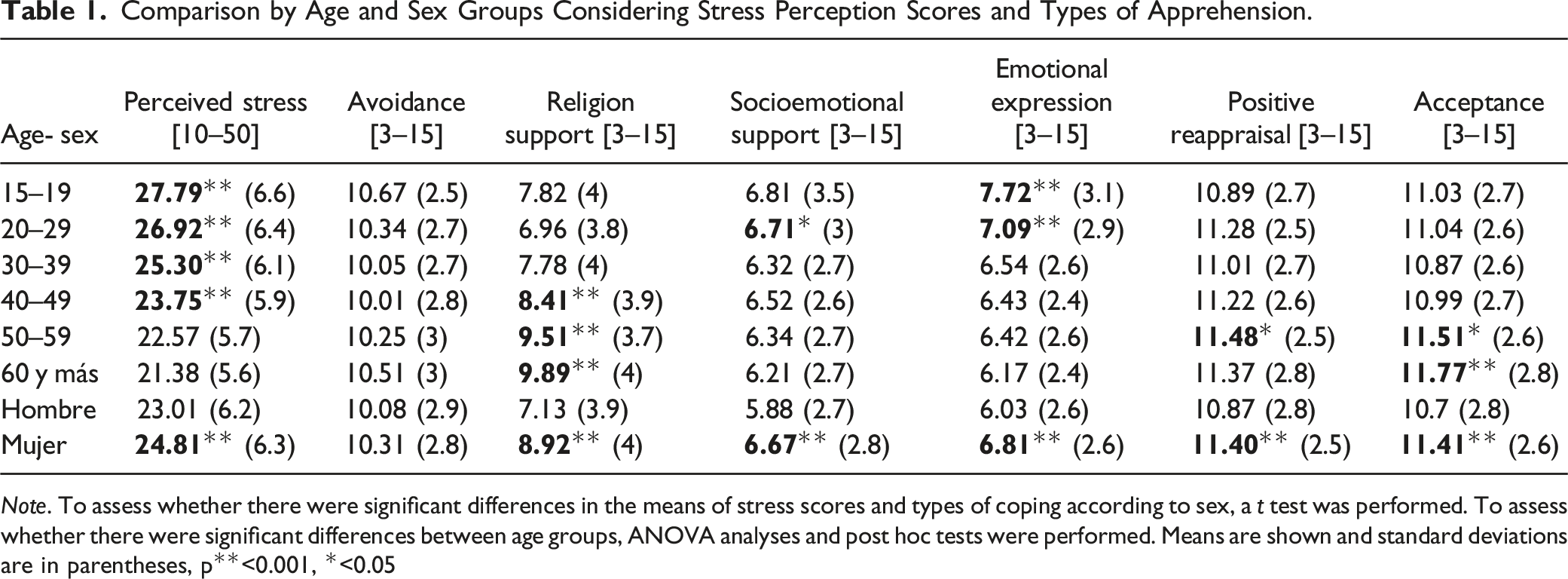
Note. To assess whether there were significant differences in the means of stress scores and types of coping according to sex, a t test was performed. To assess whether there were significant differences between age groups, ANOVA analyses and post hoc tests were performed. Means are shown and standard deviations are in parentheses, p**<0.001, *<0.05
At the same time, significant differences were found between the group aged 15–19 years and those aged 60 years and over, with the former reporting higher scores in the perception of stress. In the religion-focused coping subscale, it was the group aged 60 and over that obtained the highest mean. This same pattern was replicated when considering the socioemotional support-focused coping subscale, where differences were identified where the 60 and over group differed significantly from the 20–29 year-old group. In the emotional expression subscale, it was the group aged 15–19 years that obtained the highest mean.
Linear Regressions by Coping Type.
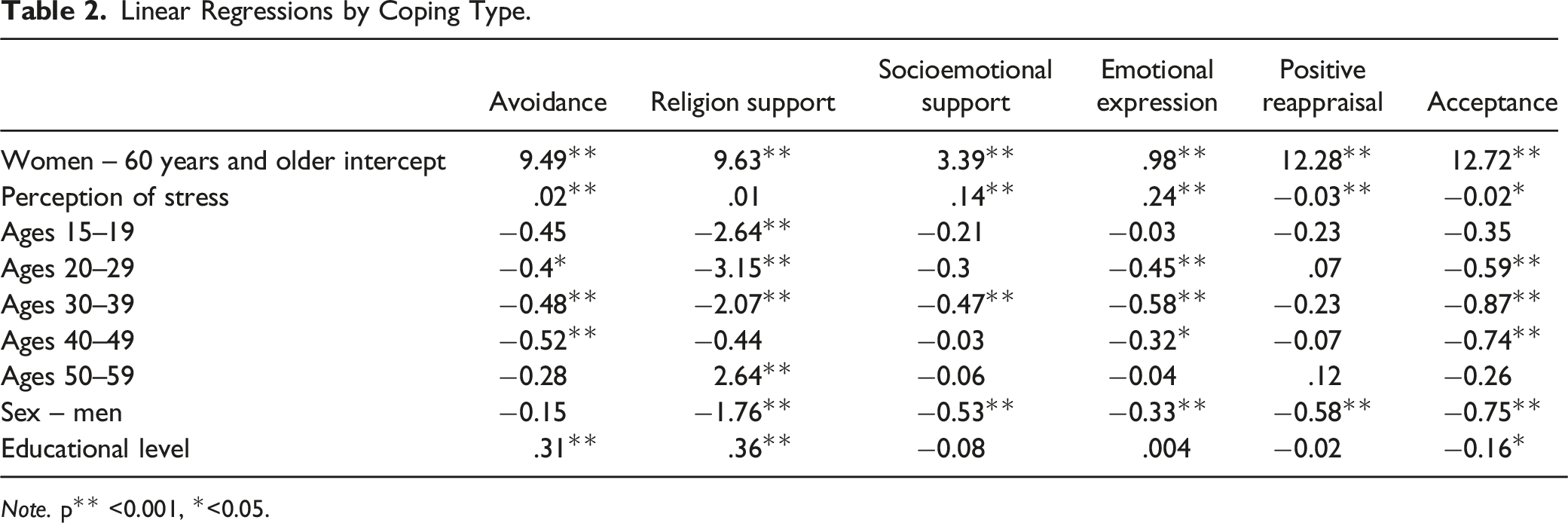
Note. p** <0.001, *<0.05.
As for sex, men reported significantly lower scores for all coping strategies except avoidance. Finally, when analyzing the effects of education, it was found that the higher the level of education, the greater the use of avoidance and religious support coping strategies and the lower the use of acceptance.
To analyze the possible groupings of resources (intra vs. interpersonal) linked to resilience in the face of COVID-19 confinement, Figure 1 shows the most frequent words used in the incomplete sentence “What has helped me to cope with this confinement is…”. As can be seen, 16 words were the most used by the participants, of which 6 represented an interpersonal resource, 7 an intrapersonal resource, and the remaining 3 words described a combination of both resources. The word family was the most frequently used word by participants, followed by valuing and health. This suggests that family constitutes the main interpersonal resource for the sample in general. Most frequent words used before the incomplete sentence “What has helped me cope with this confinement is…” as a function of the type of resource linked to resilience.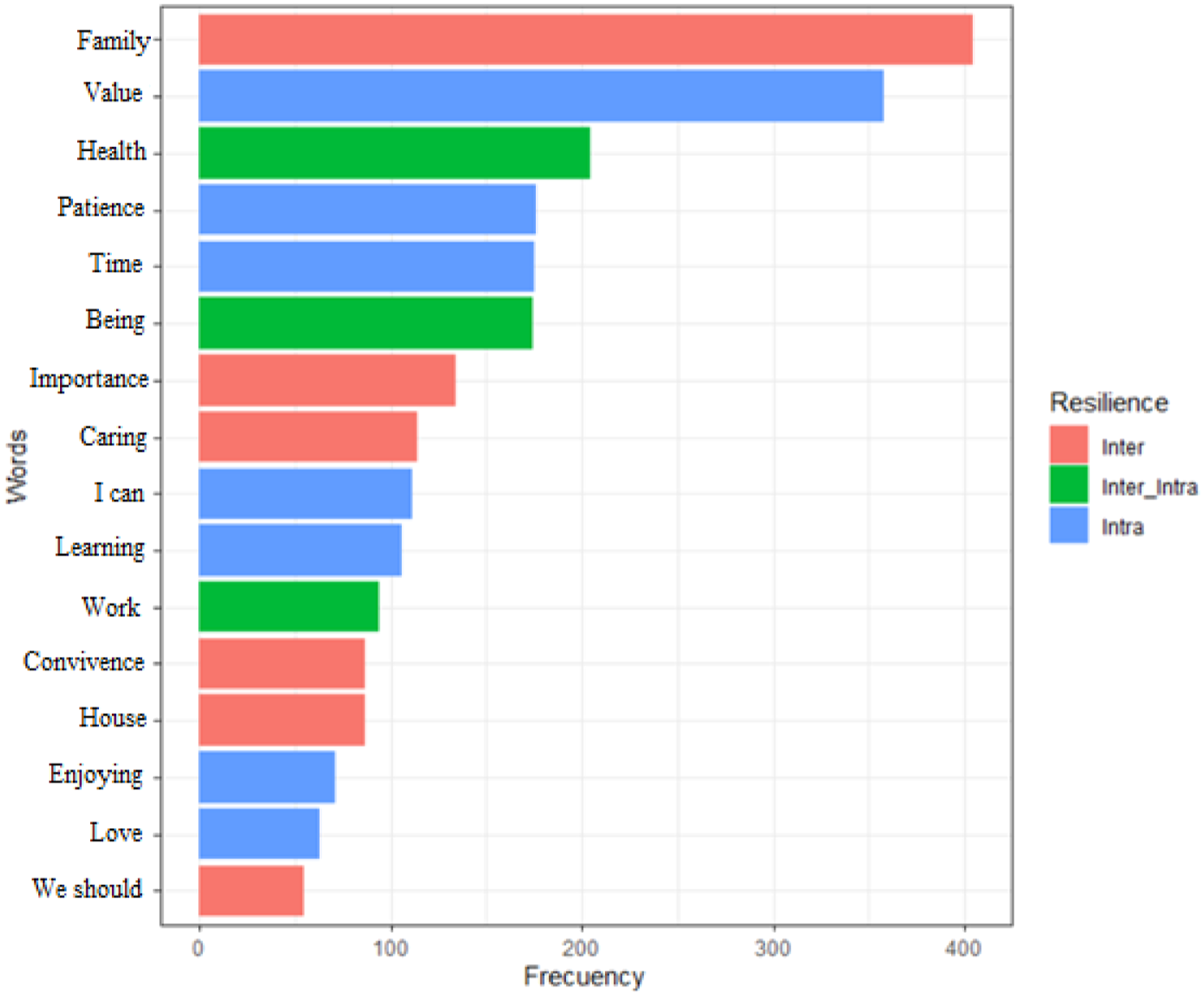
As a second step in the analysis of resilience resources, the responses given by young adults to the incomplete sentence referred to were separated by comparing them with those of older adults. For young adults, the most frequent words were: value (n = 85; intrapersonal resource), family (n = 72; interpersonal resource), patience (n = 49; intrapersonal resource), and time (n = 40; intrapersonal resource). On the other hand, the words most frequently used by the older adults were: alive (n = 55; intra-interpersonal resource), value (n = 51; intrapersonal resource), family (n = 49; interpersonal resource), health (n = 43; interpersonal-intrapersonal resource), patience (n = 36; intrapersonal resource), and being (n = 28; interpersonal-intrapersonal resource). There were coincidences in both groups in the reference to three concepts: value, family, and patience. Together, this suggests the need to value the family and to have patience in the situation of COVID-19 confinement. It is interesting to note that young adults (aged 20–39 years) referred to interpersonal concepts, while older adults (aged 60 years and over) used words with a combination of interpersonal and intrapersonal resources.
Discussion
The recognition of mental health as a human right (De la Fuente et al., 1997) emphasizes the promotion of mental health, especially among the most vulnerable groups, in which older adults stand out due to their population representation (INEGI, 2021). Accordingly, this study aimed to document the impact of confinement due to COVID-19 on some psychological variables related to the mental health of older adults. Three variables were considered: (a) magnitude of perceived stress, (b) coping strategies employed in the face of COVID-19 confinement, and (c) intrapersonal and interpersonal resources that favor resilience in the face of the stress produced by the pandemic.
From data obtained from a nationwide sample, we provided evidence of the level of stress experienced by participants, documented the use of different coping strategies employed in the face of perceived stress, and identified some intra- and interpersonal resources linked to resilience that participants were likely to develop in the face of extreme physical and social stress due to the COVID-19 pandemic.
To make a comprehensive analysis of the findings obtained, this discussion was organized according to the level of perceived stress, the coping strategies employed, and the intra- and inter-personal resources that facilitated resilience in the participants in the studied sample.
On the Level of Perceived Stress
The results showed that women are more likely to perceive greater stress in crises in contrast to men. This agrees with the findings of Meda-Lara, et al. (2022); Zamarripa, et al., (2020), and González-González, et al. (2020). It ratifies the perceptual characteristics of women to detect changes in the environment both physical and social and to develop perceptual sensitivity. It is interesting to note that the older the participants of the sample studied, the less perceived stress they showed (see Table 1). This is consistent with the theory of socioemotional selectivity proposed by Carstensen, et al. (1999) in the sense that older people filter more the information they receive from their environment and only respond to stimuli that are meaningful to them.
On Types of Coping Strategies
Avoidance coping did not show differences by age, group, or sex. Support in religion showed that older women employed this type of coping strategy significantly more often in contrast to men and younger people (see Table 1). This could be a cultural manifestation (Berry, 1990; Díaz-Guerrero, 1982) that allows older women to adapt more efficiently to the demands of the context.
Regarding socioemotional support coping, participants in the 20–29 age group were those who sought the most socioemotional support. Similarly, people between the ages of 15 and 29 reported significantly higher levels of emotional expression coping strategies. This evidence accounts for the type of coping used by younger people focused on emotional processes.
Regarding the positive reappraisal type of coping, the group aged 50–59 was the one with the highest score when compared to the other age ranges. A possible hypothesis that explains this result consists in what Erickson (1982) calls a generativity crisis. In this crisis, the person focuses on building a legacy for the generations that follow, and positive reappraisal, as well as acceptance, are efficient coping strategies to rescue significant lessons from lived experiences and relabel them as a legacy. This conjecture is supported by the results found with the acceptance type of coping, where the groups of 50 and 60 and over, and women, were the ones who most often presented this type of coping.
We found that age was significantly associated with five of the six types of coping evaluated. Only in the emotional support coping strategy did age not show a significant association. Thus, the results of the regressions showed that, when considering avoidance, the higher the age, the lower the avoidance, and the higher the education level, the higher the avoidance. As for religious support coping strategy, the older the age and the higher the education level, the greater the support for religion. However, age was not significant for the use of socio-emotional support as a coping strategy. Being female and older did predict the expression of emotions and acceptance as forms of coping regarding the COVID-19 confinement.
On the Categories of Intra- and Inter-personal Resources Linked to Resilience
For the total sample, interpersonal resources (related to interaction with other people to share affections, emotions, beliefs, and values) followed by intrapersonal resources were the most used. The group aged 20–39 years showed that they used intrapersonal resources more, in contrast to the resources indicated by the participants aged 60 years and older, who used both resources. This evidence is significant because it shows, on the one hand, the preeminence of the family as a resource “sine qua non” both to face crises and to transcend and overcome them, with greater psychological, social, and emotional strength.
The approach to detecting resilience resources in this sample was incipient because priority was given to the free expression of the resources identified by the participants, rather than classifying them in advance and waiting for their response on pre-established categories.
It is pertinent to emphasize that in this study the indirect measurement of psychosocial processes was transcended and participants were given a voice through the use of the incomplete sentence technique (Sacks & Levy, 1967). This technique allowed participants to describe directly and in their own words the emotions they experienced during confinement, as well as the resources they used to transcend the negative experiences associated with the pandemic.
Scope and Limitations
Although this study was based on a national sample, and this represents one of its advantages, it is important to point out that the exhaustiveness in the inclusion of a total of 66 items could facilitate a halo effect in the responses and thus bias the results.
The distribution of the CoBESS-2020 questionnaire by digital means also represented a bias in obtaining the sample, since literate digital-savvy people could’ve had an easier time answering this questionnaire. A lot of Mexican Older Adults do not have access to a computer or other digital means, and those who might have it, might not be as digital-literate as younger adults, so a very specific profile of an older adult is the one who could’ve had access to the questionnaire. It would be desirable for future studies to obtain a national representation with multistage sampling that guarantees the inclusion of all the groups that make up the population profile of Mexico.
Among the achievements of this study, the opportunity to obtain a vivid and close record at a crucial time in the development of the COVID-19 pandemic stands out. This study covered the first wave of dispersion of this disease and represents an invaluable base for future population contrasts, considering similar variables.
Conclusion
The confinement due to the COVID-19 pandemic has ended. Now is the time to tend to the mental health needs of the population. As stated at the beginning of this paper, governmental and social initiatives to offset, reduce, or eliminate pernicious consequences for the mental health of the population should be a priority for implementation. The results of this study might help those initiatives to have a common ground of knowledge. Knowing how older adults perceive stress; cope with the stress regarding the confinement, and the important elements regarding those coping mechanisms, like the importance of family for older adults, might be of use for the stakeholders in charge of public policies.
Another study should be conducted in the future to document possible fluctuations in the different variables considered after almost 2 years of the pandemic. It will be interesting to evaluate the degree of adaptation achieved and the challenges perceived by citizens after the health, economic, and socio-political measures were adopted. The possible costs and benefits achieved in terms of mental health will be reported shortly.
Footnotes
Declaration of Conflicting Interests
The author(s) declared no potential conflicts of interest with respect to the research, authorship, and/or publication of this article.
Funding
The authors disclosed receipt of the following financial support for the research, authorship, and/or publication of this article: This research project was completed with the support of the 2021-2023 cycle Programa de Apoyo a Proyectos de Investigación e Innovación Tecnológica (DGAPA-PAPIIT-IG300221) granted by the National Autonomous University of Mexico.
