



Abstract
Objectives
Among nursing home (NH) residents with Alzheimer’s disease (AD) and AD-related dementias (AD/ADRD), racial/ethnic disparities in quality of care exist. However, little is known about quality of life (QoL). This study examines racial/ethnic differences in self-reported QoL among NH residents with AD/ADRD.
Keywords
Introduction
Roughly 1.3 million older adults (≥65 years) in the U.S. receive nursing home (NH) services every year, a number, that is, projected to increase to 3 million by 2030 (Harris-Kojetin et al., 2019). Older adults with Alzheimer’s disease (AD) and AD-related dementias (AD/ADRD) are more likely to reside in NHs, with the prevalence of AD/ADRD among long-stay (100+ days) NH residents reaching nearly 60% (2020 Alzheimer’s Disease Facts and Figures, 2020). Two-thirds of people with cognitive impairment will enter a NH prior to death (Gaugler et al., 2014). The incidence of AD/ADRD is highest among people who identify as African/American/Black or American Indian/Alaska Native, but people who identify as Hispanic/Latino and/or Pacific Islander also experience high rates of AD/ADRD compared to Asian or White counterparts (Matthews et al., 2019; Mayeda et al., 2016). Differences in the incidence of AD/ADRD across racial/ethnic groups, coupled with inequitable access to residential care settings (i.e., assisted living), have driven changes in the demographic composition of NHs; a setting that has historically served mostly non-Hispanic White older adults (Feng et al., 2011).
The proportion of older adults residing in NHs who are Black and Hispanic/Latino and those from other communities of color (hereafter referred to as “minoritized”) has increased dramatically in the past decade, and will surpass that of non-Hispanic White adults by 2030 (Cai et al., 2011; Feng et al., 2011; Travers et al., 2022; Weech-Maldonado et al., 2021). We use the term “minoritized” to denote that being minoritized refers not to the numerical numbers but inequities and access (or lack of access) to opportunity in the U.S. (Wingrove & McLeod, 2022). Due to systemic racism and other factors, individuals in the racially/ethnically minoritized groups have systemically experienced worse outcomes in healthcare and long-term care settings versus their non-Hispanic White peers (Travers et al., 2021). In comparison to White residents, racially/ethnically minoritized NH residents with AD/ADRD are more likely to be underdiagnosed or misdiagnosed (Lennon et al., 2022; Xu et al., 2022). Racially/ethnically minoritized adults are also more likely to be admitted to NHs with more advanced stages of AD/ADRD and have unmet care needs (Cooper et al., 2010). Given the high concentration of minoritized residents with AD/ADRD in NHs, there is an urgent need to understand if the resident experience in NHs differs by race/ethnicity.
Policy to address disparities in access to care and outcomes of care for people with AD/ADRD is of considerable state and federal interest (National Institute on Aging, 2022; National Academies of Sciences, Engineering, and Medicine, 2022). One key quality outcome is quality of life (QoL). QoL refers to an individual’s self-reported psychological and social well-being and captures non-medical aspects of life beyond quality of care (QoC). QoL emphasizes personhood, resident choice, and relationships, and is highlighted in the new National Academies of Science, Engineering, and Math (NASEM) recommendations for improving NH quality (Kane et al., 2003; Kane, 2003; National Academies of Sciences, Engineering, and Medicine, 2022). Moreover, recommendations from the Centers for Medicare and Medicaid Services (CMS) have identified QoL measures as key areas to concentrate regulatory efforts, with the purpose of ensuring person-centered care in NHs.
Understanding differences in QoL for different groups of NH consumers is necessary for the delivery of person-centered care. Racially/ethnically minoritized residents report lower QoL compared to their White counterparts and receive care in facilities that have lower aggregate QoL scores (Bowblis et al., 2021). This is likely due to the fact that NHs are more racially segregated than any other health care setting (Konetzka & Werner, 2009). NH segregation is associated with poorer QoC and resident health outcomes. These demographic and care realities led us to examine the role of individual race/ethnicity and facility racial composition in predicting QoL of NH residents with AD/ADRD. While individual-level and facility-level factors may alter the pattern of these disparities racial/ethnic disparities in NH QoL persist even after controlling for physical and mental health conditions (Shippee et al., 2015, 2016). Additional research has shown that despite the increasing demands for and higher use of NHs by racially/ethically minoritized residents, NHs with higher proportions of minoritized residents are poorly prepared to adequately meet their residents’ QoL needs (Shippee, Davila, et al., 2022). However, previous work has not explicitly focused on examining QoL for residents with AD/ADRD, who have different needs than residents without AD/ADRD, as described below. To further build research in this space, we will ask the following research questions: What is the role of individual race/ethnicity and facility racial composition for QoL of NH residents with dementia? What is the role of modifiable facility factors to inform interventions to address QoL?
Background and Context
Existing Literature Demonstrates Racial Differences in Certain QoC Measures for NH Residents With AD/ADRD
A growing body of work has documented racial/ethnic disparities in QoC measures for people with AD/ADRD. Studies among NH residents with AD/ADRD have found that racially/ethnically minoritized residents, compared to non-Hispanic White residents, were more likely to be physically restrained, have higher risk of acquiring pressure ulcers, and less likely to receive pain control, or to receive the influenza vaccine (Cai et al., 2011; Li et al., 2011; Shippee, Ng, Duan, et al., 2020). However, these studies either were restricted to residents with AD/ADRD or controlled for cognitive performance but not AD/ADRD diagnosis. Some evidence also suggests different use of antipsychotic medications, which are sometimes used to address behavioral symptoms of dementia (Fashaw-Walters et al., 2021). For example, Hudson et al. (2005) found that older racially/ethnically minoritized NH residents in Arkansas were more likely to receive first-generation antipsychotics versus second-generation antipsychotics, with the latter known to have fewer side effects (Hudson et al., 2005). A more recent study reported some evidence of implicit racial bias in staff decisions about environmental modifications for residents, which could be beneficial for those at risk for falls, including people living with AD/ADRD (Colón-Emeric et al., 2017). Importantly, minoritized persons have poorer access to NHs with specialized dementia care units, which may be associated with better outcomes (Rivera-Hernandez et al., 2019). Finally, Rivera-Hernandez et al. (2019, 2022) examined differences in NH QoC among Medicare beneficiaries (Rivera-Hernandez et al., 2019, 2022). They found that a larger share of Hispanic Medicare residents who are admitted to NHs have AD/ADRD compared with Black and White beneficiaries. Both Hispanic and African American residents with AD/ADRD were more likely to receive care in segregated NH with fewer resources and lower QoC compared to White residents (Rivera-Hernandez et al., 2019).
While previous studies have broadly examined individual QoC indicators, there is a paucity of data on QoL. Good dementia care should be individualized to address each resident’s cognition, physical and social function, medical needs, mental health, and physical environment (Gaugler et al., 2014). These factors are not completely represented by QoC indicators and require direct measurement through QoL indicators. Furthermore, existing studies have not focused on the interaction between individual minoritized status and high-proportion minoritized facilities (refers to facilities with higher proportion of minoritized residents) for QoL, which is the focus of our approach. Finally, we know of no other study that has examined the role of facility-level factors (e.g., staffing) for QoC of residents with AD/ADRD. Our study will address these gaps to yield a far more comprehensive understanding of variations in QoL among NH residents with AD/ADRD.
Conceptual Framework
This work is informed by two frameworks, (1) person-environment fit theory and (2) the behavioral model for vulnerable populations. The person-environment fit framework (P-E) has been the seminal theory for understanding how aspects of housing impact older adults’ well-being (Lawton, 1986). P-E fit comprises two interactive components: (a) the personal component that includes physical health, sensory and motor skills, and cognitive function and the (b) environmental component that includes aspects of the physical environment, the personal environment, the small-group environment, and those of the external community (Nahemow, 2000). The personal and environmental components interact to influence outcomes, with specific application to residents’ QoL.
The behavioral model for vulnerable populations includes three components: predisposing, enabling, and need factors (Gelberg et al., 2000). Predisposing factors include demographic and structural characteristics such as race/ethnicity, age, gender, and marital status as well as financial and psychological resources, mental health, and substance abuse. Enabling factors include personal/family resources that promote or restrict access to healthcare, such as income, wealth, health insurance, and receipt of public benefits, in addition to community availability of social services. Need factors are both objective (health status and diagnoses) and subjective health outcomes (respondent perceptions of their unmet needs). All of these factors are dynamic and can influence each other. Importantly, and in line with the P-E framework, factors do not just cluster at the individual level but also include the role of the external environment such as economic, physical, and social aspects of the facility and community where the NH is located. Our work is informed by this model with a focus on disparities in health and health care among racially/ethnically minoritized communities.
Drawing on both of these frameworks, we posit that due to systemic racism present in the U.S. long-term care system, race/ethnicity is an important predisposing factor for residents’ QoL (Shippee, Davila, et al., 2022). Racially/ethnically minoritized residents who receive care in NHs likely have unique needs that may be unaddressed and thus result in lower QoL. Minoritized residents may also lack enabling factors such as family support or financial resources to help them maintain higher QoL, combined with physical and mental health needs that may vary from the health profiles of White residents. As the P-E model states, these individual factors interact with the environmental factors of the NHs, including facility racial composition, which has been associated with access to resources or lack of resources, and supportive physical, personal, and small group environments to meet the needs of racially/ethnically minoritized residents receiving NH care. This paper examines the interplay of individual and facility factors in how they shape QoL for minoritized NH residents with AD/ADRD and why it differs by race/ethnicity. Specifically, this study has three goals: (a) identify the role of individual race/ethnicity as well as facility racial composition for QoL of NH residents with dementia; (b) quantify these differences; and (c) identify the role of modifiable facility factors for interventions to address QoL.
Design and Methods
This study was approved by the Institutional Review Board at the University of Minnesota.
Data Sources
This study uses four years of data (2012–2015) from the state of Minnesota, including the Minnesota Resident Quality of Life (RQoL) survey for NH residents, Minimum Data Set (MDS), the Certification and Survey Provider Enhanced Reporting system (CASPER) reports, and Minnesota Medicaid cost reports. The Minnesota RQoL survey consists of in-person interviews conducted by an independent survey firm that randomly selects residents from every NH in the state. The typical NH has 35 resident respondents, with a survey response rate of about 85% (Vital Research, 2021). The MDS is a federally mandated assessment required of all NH residents upon admission, discharge, and at quarterly intervals in-between. It contains each resident’s demographic information, functional status, and physical health information. To obtain facility-level characteristics we used CASPER data, which are CMS-mandated inspections of NHs that are regularly conducted by state inspectors, and Minnesota Medicaid cost reports, which are annual reports submitted to the state containing numerous financial and NH characteristics.
In constructing our resident-level analytic sample, we linked each QoL survey to every NH respondent’s closest MDS assessment (closest assessment to time of QoL survey administration date). We then merged in the CASPER and Medicaid cost report data corresponding to the year of the QoL survey. Our sample includes 12,562 residents with a diagnosis of AD/ADRD who took part in the Minnesota QoL survey between 2012 and 2015. Those with the most severe cognitive impairment are not included in the survey due to barriers to interviewing these residents. Our key inclusion variable was the presence of AD/ADRD and degree of cognitive impairment recorded in the MDS. If the nearest MDS assessment was missing information on AD/ADRD diagnosis, we used information from previous assessments during the same NH stay to fill in immutable characteristics. Despite concerns that residents with AD/ADRD might have difficulty responding to the QoL survey related to cognitive impairment, we checked rates of missingness at the item level, and found them about the same in residents with AD/ADRD. Missing data were imputed at the item level to the full sample using multiple imputation by chained equations (MICE). Predictors in the imputation model included all variables of interest described below, including AD/ADRD diagnosis. Only about .5% of AD/ADRD diagnoses were missing and fewer than 1.7% residents had missing QoL scores, the predictor variable of interest. For certain control variables, we used the Cognitive Function Scale (CFS) that combines information from the Brief Interview of Mental Status (BIMS), which is based on performance (self-report), and the cognitive performance score (CPS) from staff report for those unable to complete the BIMS (Thomas et al., 2017). The CFS reports cognitive status as intact, mildly impaired, or moderately to severely impaired.
QoL Variables
Domain-Specific and Summary Quality of Life Scores by Race/Ethnicity for Nursing Home Residents with Alzheimer’s Disease and Related Dementias in Minnesota, 2012–2015 (N = 12,562).

p < .5, **p < .01, ***p < .001; p-values are calculated using chi-square test, with White residents as the reference group; #Minoritized refers to residents from all racial/ethnic groups other than Non-Hispanic White, who have been historically marginalized in the United States of America.
Race/Ethnicity Variables
The race/ethnicity of the respondent was originally measured as White, Black or African American, Hispanic, American Indian or Alaska Native, Asian, Native Hawaiian or other Pacific Islander, or missing race/ethnicity. We recoded race/ethnicity to a three-level variable due to small numbers in some groups: Non-Hispanic White, Black or African American (hereafter referred to as Black), American Indian, and other residents of color (Asian, Hispanic, and Native Hawaiian or other Pacific Islander residents). We also included a “minoritized” variable (all racial/ethnic categories other than non-Hispanic White combined).
We used a 100% sample of MDS assessment data from Minnesota across all study years to calculate the annual proportion of minoritized residents in each NH. A binary variable was constructed for whether the facility was composed of relatively high-proportion or low-proportion of minoritized residents (henceforth referred to as “high-proportion minoritized” and “low-proportion minoritized” facility). Since the threshold for what is considered a relatively high-proportion minoritized composition varies across states, we defined a facility as high-minoritized if it was above the 90th percentile in the state of Minnesota (>14% minoritized residents) (Shippee, Ng, Duan, et al., 2020). Using this definition, on average, high-proportion minoritized facilities had 25.8% minoritized residents and low-proportion minoritized facilities had 1.59% minoritized residents in 2012. We conducted several sensitivity analyses to test for different thresholds to define high-proportion minoritized facilities, in addition to treating the percent of minoritized residents as a continuous variable with linear and quadratic terms. None of these sensitivity analyses substantively changed our findings.
Control Variables
We included control variables that have been previously associated with resident QoL (Shippee, Ng, Duan, et al., 2020). Eight variables were pulled from the MDS: (1) gender (male/female); (2) marital status (married vs. never married, separated, divorced, or widowed]; (3) anxiety or depression diagnosis; (4) serious mental illness (SMI) diagnoses (any major mental disorder not associated with a primary diagnosis of dementia, which leads to chronic disability, as defined for the Preadmission Screening and Resident Review in MDS); (4) count of chronic conditions (congestive heart failure, diabetes, stroke, asthma, and cancer); (5) presence of agitation symptoms (physical and verbal); (6) seven activities of daily living (ADL) coded from 0 (no assistance) to 4 (total dependence) and summed for an overall ADL score (0–28); and (7) length of stay (number of days from NH admission to the date of survey). We reported cognitive status (three levels: intact, mildly impaired, or moderately to severely impaired) as found in the CFS. Facility characteristics were linked from CASPER or Medicaid cost reports and include: geographic location (metro [Minneapolis/Saint Paul Metropolitan Statistical Area] vs. other); facility ownership (three categories: government [owned by county, municipal, or state governments], non-profit, or for-profit); number of beds; resident acuity; staff retention (all staff); and percentage of Medicare, Medicaid, and private rooms (percent of days billed to each payer).
Analytical Approach
We first compared summary and domain-specific QoL scores for non-Hispanic White residents (henceforth referred to as “White”) to Black, American Indian, other residents of color, and all minoritized combined, using bivariate analysis (t-tests and chi-squared tests). We next compared resident and facility characteristics by race/ethnicity using bivariate analysis (t-tests; reference group = White). Differences in prevalence and severity of cognitive impairment across different racial/ethnic groups could be a strong confounder. To this end, we evaluated the distribution of severity of cognitive impairment among residents with AD/ADRD across the different racial/ethnic groups and compared it to residents without AD/ADRD. Lastly, we used facility-level random intercept linear regression models to examine summary and domain-specific QoL scores by race/ethnicity, controlling for all other resident and facility characteristics and including an interaction between resident race/ethnicity (White vs. minoritized) and proportion of racially/ethnically minoritized residents in the facility. As secondary analysis (due to low power), we also calculated a model using three separate interaction terms between proportion of minoritized residents in facility and each of the Black, American Indian, and other residents of color variables. All regression models were estimated using Stata 13/MP (StataCorp, 2013) and included a normally distributed random intercept for each facility to account for between-facility heterogeneity, and standard errors to account for heteroscedasticity. A two-tailed p-value <.05 was considered statistically significant.
Results
Bivariate Analysis
Resident and Facility Characteristics By Race/Ethnicity For Nursing Home Residents With Alzheimer’s Disease And Related Dementias in Minnesota, 2012–2015 (N = 12,562).
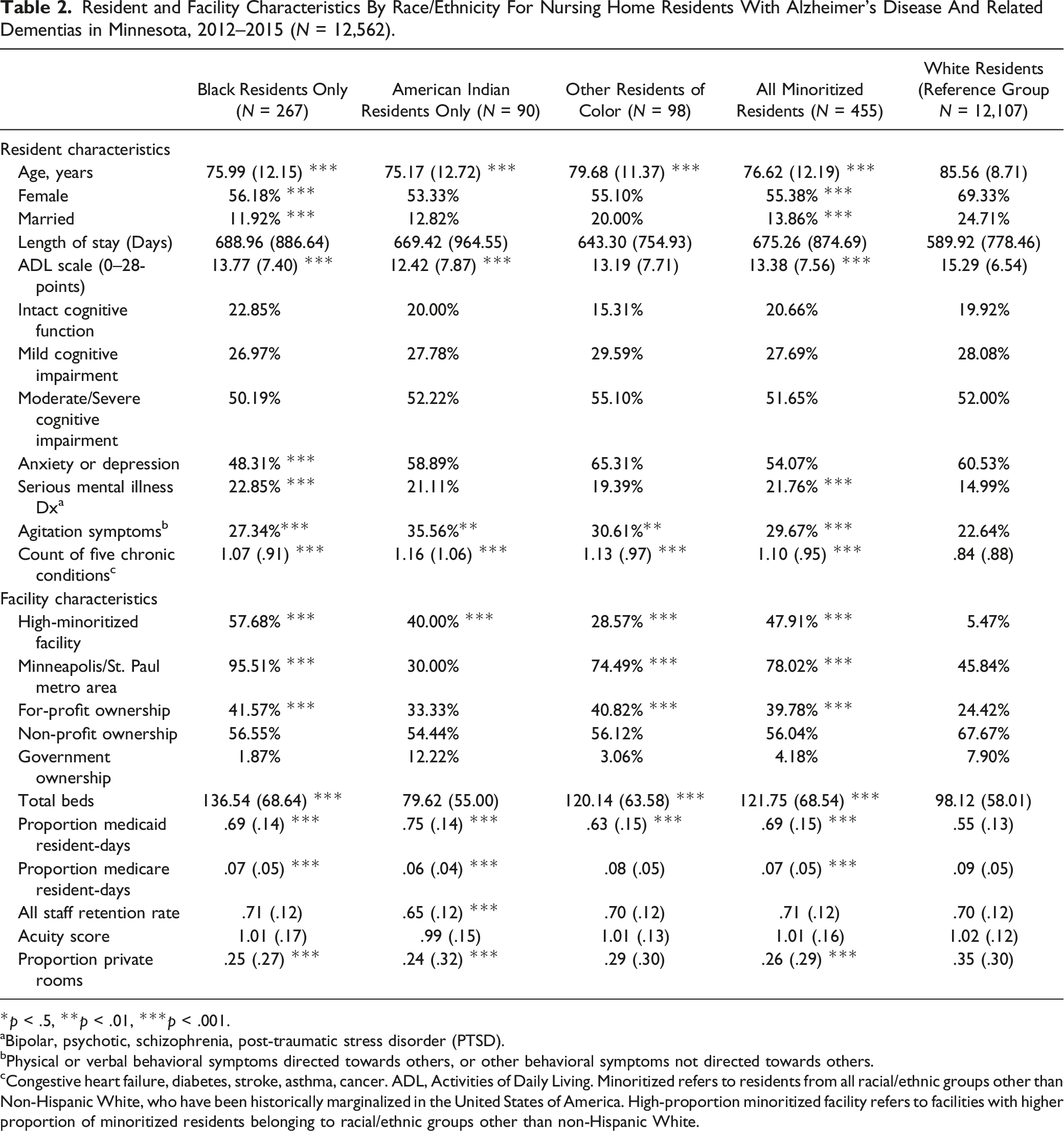
*p < .5, **p < .01, ***p < .001.
aBipolar, psychotic, schizophrenia, post-traumatic stress disorder (PTSD).
bPhysical or verbal behavioral symptoms directed towards others, or other behavioral symptoms not directed towards others.
cCongestive heart failure, diabetes, stroke, asthma, cancer. ADL, Activities of Daily Living. Minoritized refers to residents from all racial/ethnic groups other than Non-Hispanic White, who have been historically marginalized in the United States of America. High-proportion minoritized facility refers to facilities with higher proportion of minoritized residents belonging to racial/ethnic groups other than non-Hispanic White.
Facility characteristics differed between White and minoritized residents. Compared to White residents, minoritized residents were more likely to reside in urban/metropolitan areas, and in larger volume, for-profit facilities with a higher proportion of number of days paid by Medicaid and lower proportion of number of days paid by Medicare (Table 2). We found no significant differences in the distribution of severity of cognitive impairment among residents with AD/ADRD across the different racial/ethnic groups (Figure 1). As a sensitivity analysis, we evaluated the distribution of severity of cognitive impairment stratified by diagnosis of AD/ADRD. Overall, cognitive function was lower among NH residents with diagnosed AD/ADRD, which was expected. However, across residents with and without AD/ADRD, the distribution of cognitive function was similar across racial/ethnic groups (Supplementary Figure 1 in Appendix). Comparing Cognitive Function Scale By Race/Ethnicity Among Residents With a Diagnosis of Alzheimer’s Disease and Related Dementias in Minnesota Nursing Homes (2012–2015). BIMS- Brief Interview for Mental Status. Distribution of cognitive impairment was similar between Whites (n = 12,107), Blacks (n = 267), American Indians (n = 90), and other racial/ethnic groups (n = 98).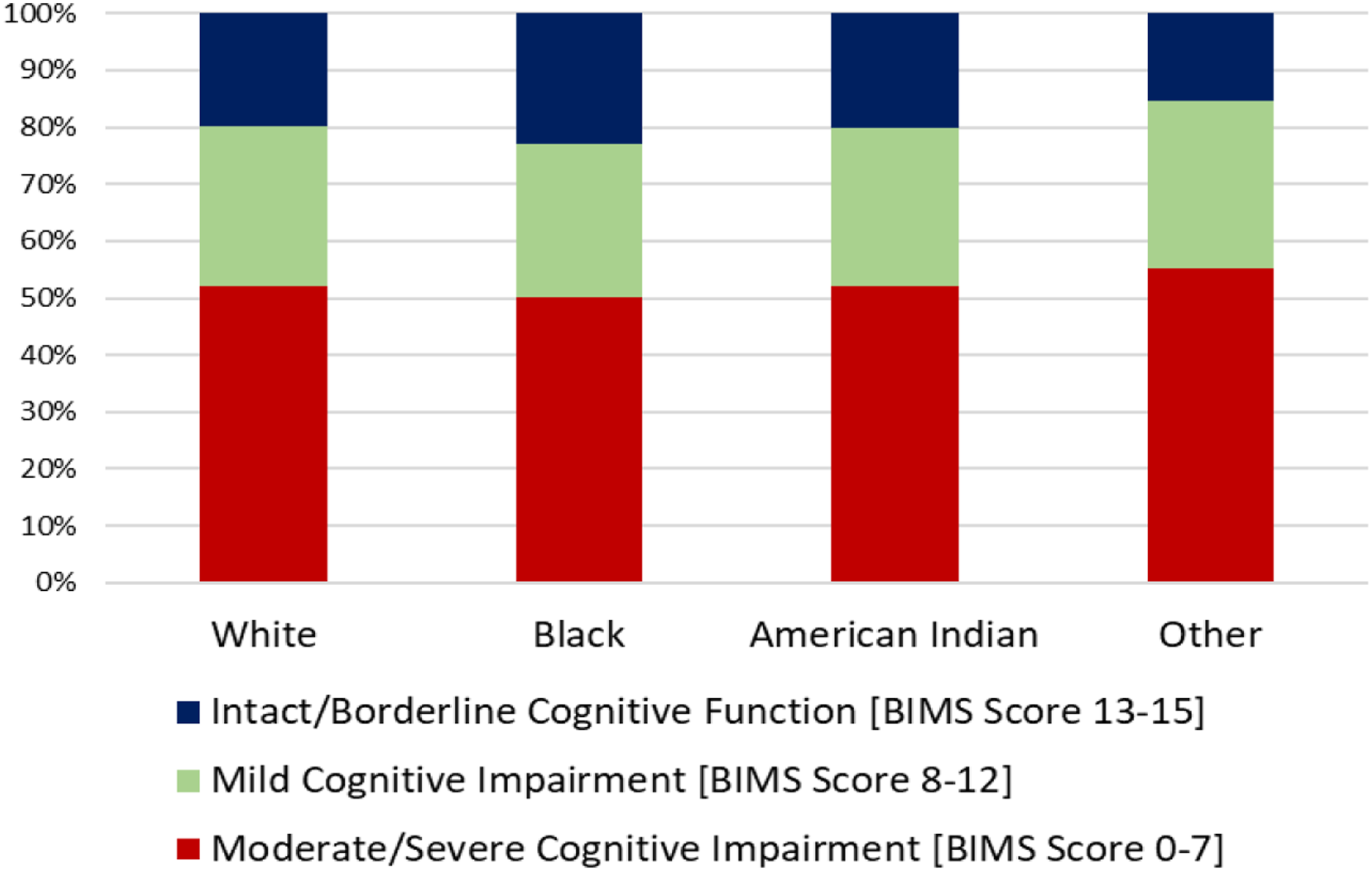
Regression Analyses
Hierarchical Linear Model for Quality of Life Scores for White Residents Compared to Minoritized Residents From Other Racial/Ethnic Groups Among Minnesota Nursing Home Residents with Alzheimer’s Disease and Related Dementias (2012–2015).
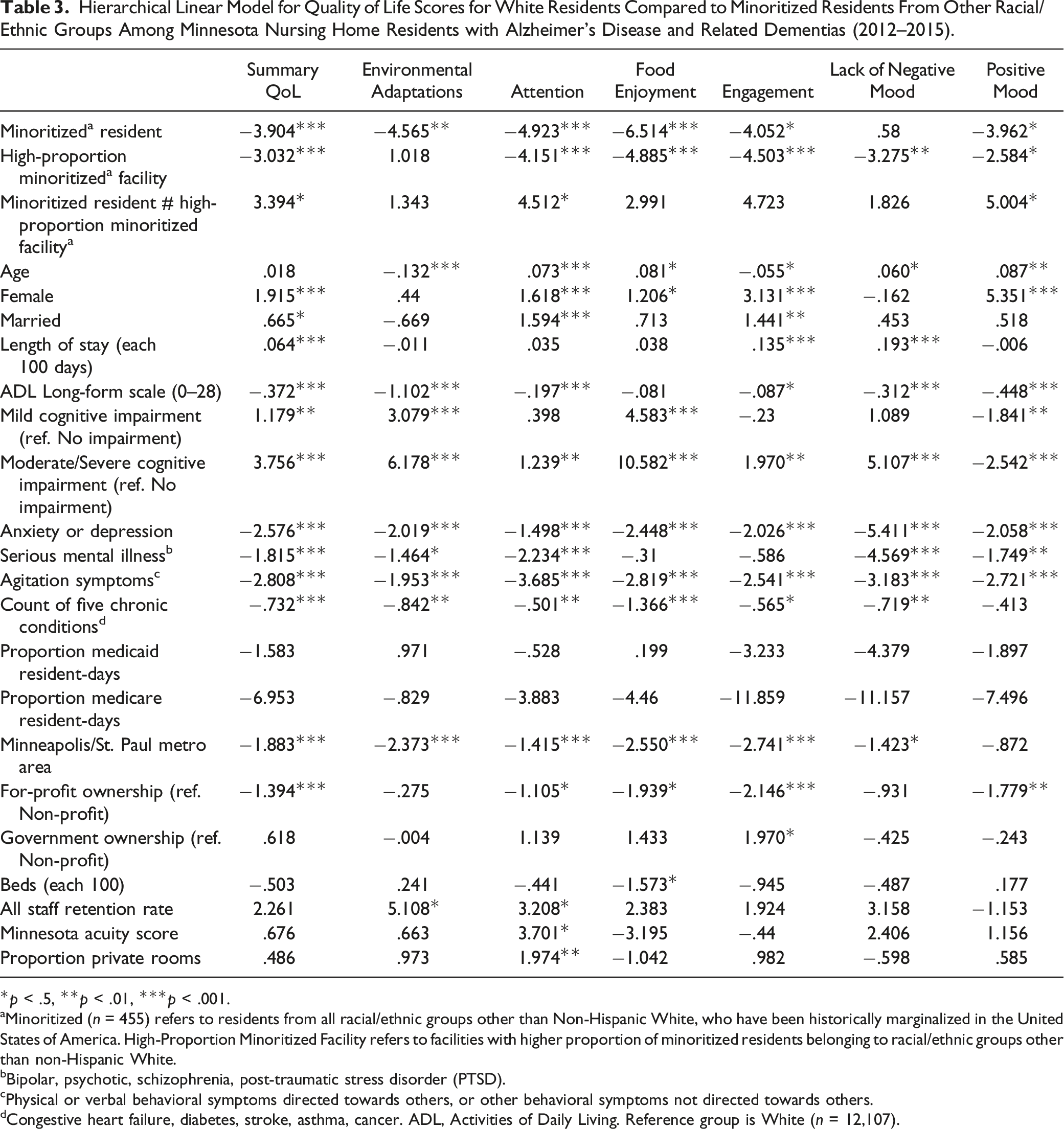
*p < .5, **p < .01, ***p < .001.
aMinoritized (n = 455) refers to residents from all racial/ethnic groups other than Non-Hispanic White, who have been historically marginalized in the United States of America. High-Proportion Minoritized Facility refers to facilities with higher proportion of minoritized residents belonging to racial/ethnic groups other than non-Hispanic White.
bBipolar, psychotic, schizophrenia, post-traumatic stress disorder (PTSD).
cPhysical or verbal behavioral symptoms directed towards others, or other behavioral symptoms not directed towards others.
dCongestive heart failure, diabetes, stroke, asthma, cancer. ADL, Activities of Daily Living. Reference group is White (n = 12,107).
Discussion
U.S. NHs are becoming more racially/ethnically diverse, with more than half of long-stay NH residents reporting diagnoses of AD/ADRD. Yet, little work has examined racial/ethnic disparities in QOL domains measured by validated instruments studied in AD/ADRD populations (Qin et al., 2021). While previous studies have found racial/ethnic disparities in NH QoC outcomes for people with AD/ADRD (Rivera-Hernandez et al., 2019, 2022), this is the first study to use multiple sources of data to examine racial/ethnic disparities in QoL for NH residents with AD/ADRD, giving voice to a vulnerable population’s experience.
Minoritized residents with diagnoses of AD/ADRD reported lower QoL when receiving care in NHs as compared to White residents. Findings were similar for models controlling for resident and facility characteristics (Table 3). This is an important finding because previous studies have suggested that some of the disparity in QoL is due to resident case-mix (Shippee et al., 2015); our study focuses only on residents with diagnoses of ADRD and still finds a large and significant disparity after adjusting for case-mix and other resident- and facility-level characteristics.
In our study, three QoL domains had modestly larger disparities than others for both being a racially/ethnically minoritized resident and residing in a facility with a higher proportion of minoritized residents (controlling for other resident and facility level confounders) and could be modifiable targets for intervention. These include engagement, food enjoyment, and attention from staff. Regarding the engagement domain, these findings could be explained by several modifiable factors. Previous research suggests that engagement for a long-stay NH resident is highly dependent on the facility, particularly in the context of fixed schedules (Tak et al., 2015). More research is needed to determine whether increasing resident involvement in activity planning and scheduling might help reduce disparities and promote equitable QoL among all NH residents. Sexual expression and companionship are important factors that impact engagement and QoL of NH residents with AD/ADRD and might contribute to racial/ethnic disparities (Syme et al., 2017). Regarding the food enjoyment domain, a systematic review identified four categories of caregiver-resident interaction important to mealtime care: social connection, tailored care, empowering the resident, and responding to food refusal (Faraday et al., 2021). More research is needed to (1) examine how these potentially modifiable factors vary across racial/ethnic groups and (2) evaluate whether they might be effective targets for interventions to reduce racial disparities in food enjoyment among NH residents.
Our findings generally point to different care profiles for minoritized versus White residents with AD/ADRD. Incidence of SMI among White residents (15.0%) in bivariate analysis was significantly different from Black residents (22.9%) and all other minoritized residents (19.4%), but not American Indian residents (21.1%) or other residents of color (19.4%). These results align with previous research in this space and are important results in light of policy related to antipsychotic prescribing and the disproportionate impact this has had on Black residents and other residents of color (Aschbrenner et al., 2011; Fashaw-Walters et al., 2021; Grabowski et al., 2009). SMI could impact the underlying severity of ADRD; similarly, psychosis or similar symptoms may be a phenotype of AD/ADRD with faster progression and worse prognosis (Connors et al., 2018; Vilalta-Franch et al., 2013). We also found that in bivariate analysis that minoritized residents were more likely to reside in NHs with higher bed counts and a higher proportion of Medicaid resident-days. Future research should determine whether crowding in NHs and funding sources (i.e., Medicaid vs. Medicare vs. private pay) mediate racial disparities in QoL of NH residents with AD/ADRD (Bowblis & Applebaum, 2017; Shippee, Ng, Duan, et al., 2020). Prior literature reports that factors such as nurse staffing have a significant impact on QoC outcomes. When we added staffing variables (RN, LPN, and CNA hours per resident per day) to our analysis, in addition to the current covariate of staff retention, they were not statistically significant and hence were not included in final models. Notably, there is poor correlation between QoC and QoL measures in NH residents (Kane et al., 2003; Li et al., 2016) which might explain the lack of significant associations between clinical staff hours and residents’ QOL.
Residing in a facility with a high proportion of minoritized residents was significantly associated with summary and all domain-specific QoL scores in regression models except the environmental adaptation, which is consistent with previous findings in residents without AD/ADRD (Bowblis et al., 2021). These findings emphasize the need for more research focused on system-level interventions to help dissolve disparities attributable to systemic racism in NHs.
This paper had several key strengths when adding to the existing literature on racial/ethnic disparities in care for people with AD/ADRD in NHs. First, a notable strength was our use of a validated measure of QoL that can be linked with residents’ diagnosis and facility characteristics by race/ethnicity, a strategy that aligns with recommendations from the Dementia Care Summit (National Institute on Aging, 2022). Second, our work extended the literature on including person-reported measures of well-being for people with AD/ADRD. Lastly, we paid explicit attention to the interaction between individual race/ethnicity and facility racial/ethnic composition for residents’ QoL.
Limitations
Our study has several limitations. Our sample excluded those with severe cognitive impairments as the QOL survey is not administered to residents in locked units. However, such residents are intrinsically different from the broader NH resident population, which would warrant a separate study for such a specialized population. Second, our analyses were limited to long-stay residents with ADRD (100 days or more) due to the availability of QoL measures (post-acute residents have different care needs and fill out a rehabilitation focused assessment). Third, the racial and ethnic composition of Minnesota does not allow us to have enough power to study several racial and ethnic groups, and therefore associations observed in Minnesota may not apply to other states with different demographic compositions. Larger studies targeting each minoritized group are warranted to better understand the status quo and the needs of each minoritized group. Lastly, we were unable to measure use of dementia special care units or antipsychotic use in our data, which should be, explored in future research.
Conclusion and Implications for Policy and Practice
NH residents with AD/ADRD are particularly vulnerable to having diminished QoL. It is crucial that policy focuses on eliminating disparities in QoL for racially/ethnically minoritized residents with AD/ADRD (Shippee et al., 2022). Current practice guidelines need to consider the different care needs of racially/ethnically minoritized NH residents with AD/ADRD. Disparities in QoL are associated with interpersonal staff-resident dynamics, such as attention, engagement, and food enjoyment, which are modifiable factors; future research should focus on evaluating the effectiveness of culturally tailored interventions targeting such modifiable factors affecting QoL of NH residents. Evidence-based, culturally sensitive interventions that meet race/ethnicity-specific needs of NH residents are needed to materialize the recommendations from the NIA Dementia Care Summit regarding efforts to improve person-centered care for people with AD/ADRD across different settings.
Supplemental Material
Supplemental Material - Racial Differences in Nursing Home Quality of Life Among Residents Living With Alzheimer’s Disease and Related Dementias
Supplemental Material for Racial Differences in Nursing Home Quality of Life Among Residents Living With Alzheimer’s Disease and Related Dementias by Tetyana Pylypiv Shippee, Romil R. Parikh, Zachary G. Baker, Taylor I. Bucy, Weiwen Ng, Stephanie Jarosek, Xuanzi Qin, Mark Woodhouse, Manka Nkimbeng, and Teresa McCarthy in Journal of Aging and Health
Footnotes
Declaration of Conflicting Interests
The author(s) declared no potential conflicts of interest with respect to the research, authorship, and/or publication of this article.
Funding
The author(s) disclosed receipt of the following financial support for the research, authorship, and/or publication of this article: This work was supported by the National Institute on Aging (K99AG073463 and R01MD010729-03S1).

Supplemental Material
Supplemental material for this article is available online.
References
Supplementary Material
Please find the following supplemental material available below.
For Open Access articles published under a Creative Commons License, all supplemental material carries the same license as the article it is associated with.
For non-Open Access articles published, all supplemental material carries a non-exclusive license, and permission requests for re-use of supplemental material or any part of supplemental material shall be sent directly to the copyright owner as specified in the copyright notice associated with the article.
