



Abstract
Why do levels of public trust in NGOs vary across postcommunist countries? How does media independence influence these trust levels? The authors begin from the premise that citizens develop trust in NGOs when they believe that NGOs function according to their normative expectations and they receive regular information about NGOs’ activities. Media has a crucial role in both these regards, especially in the context of countries in Eastern Europe and the former Soviet Union, where the NGO sector is in a nascent stage and citizens lack prior experiences with NGOs as activist organizations and providers of public goods and services. First, media can provide information about NGO activities that enables citizens to develop opinions about individual NGOs and NGOs as a category of social actors. Second, media can serve as a vehicle to monitor the activities of NGOs and make them accountable. However, media may have its own biases and provide misleading information about NGOs. Thus the authors expect that media independence is associated with trust in NGOs. They analyze the relationship between NGO trust and media independence using a time-series and cross-section panel of 28 postcommunist countries from 1997 to 2006, controlling for a range of domestic and international factors that might influence trust in the NGO sector. Our analysis suggests that independent media is positively associated with trust in NGOs.
Introduction
Many western scholars, policymakers, and ordinary citizens hold implicit expectations that nongovernmental organizations (NGOs) are trustworthy for two reasons. First, NGOs are assumed to be value-oriented, normative actors that selflessly champion the public interest (Keck & Sikkink, 1998). Second, their institutional design makes NGOs “trustworthy” actors because they are bound by the nondistributional constraint (Hansmann, 1980; for critique, Ortmann & Schlesinger, 2003; Prakash & Gugerty, 2010a). That is, NGOs can generate profits but, unlike firms, NGOs cannot distribute them to their “owners.” Because the opportunity to corner profits can corrupt organizations and their leaders, NGOs are expected to be immune from such temptations and are, therefore, considered trustworthy. Yet, levels of public trust in NGOs 1 vary substantially across the 28 postcommunist countries of Eastern and Central Europe and the former Soviet Union (henceforth, postcommunist Eurasia). How might one explain such variations?
The common communist legacies of institutional distrust (Jowitt, 1992) and the comparatively recent emergence of NGOs would lead many to expect public trust toward NGOs to be uniformly low throughout postcommunist Eurasia. Given the lack of prior experience with NGOs as activist organizations and providers of public goods and services, citizens in postcommunist Eurasia have little historical evidence of NGOs’ contributions to their social, economic, and political lives. Moreover, unlike most western democracies where NGOs emerged from the bottom up and rely on domestic patrons for their sustenance, NGOs in postcommunist Eurasia tend to depend on international donors for their financial support. This funding structure creates the possibility that the objectives of foreign patrons and the expectations of local clients do not cohere. Consequently, citizens face confusion regarding which “principals” NGOs serve, and some regional leaders, exploit this confusion to portray NGOs as tools of foreign powers that seek to dominate domestic politics (Jones Luong & Weinthal, 1999; Pannier, 2004). In addition, scandals about financial irregularities have raised questions about the trustworthiness of NGOs. 2
Across the region, however, we see a wide variation of trust in NGOs. In Georgia, for example, citizens see NGOs as tools of foreign countries or donors, not as representatives of local interests (United States Agency for International Development [USAID], 2001). In the USAID NGO Sustainability Index, which reports public trust in NGOs on a scale from 1 to 7, with 7 indicating a low or poor level of development and 1 indicating a very advanced level of progress (USAID, 2006), Georgia’s public trust of NGOs is a 4.0. By contrast, citizens in Slovakia have an NGO trust rating of 2.4 and regard NGOs as trustworthy actors that deserve support and financial contributions (USAID, 2007). These statistics represent just a sample of the variation within the postcommunist region. Why do citizens across postcommunist Eurasia have different views on NGOs? How do citizens acquire such views? And while citizens may have had dealings with a small number of individual NGOs, how do they arrive at decisions about the trustworthiness of NGOs as a category of social actors? What explains the variation in trust in NGOs across countries, over time?
We argue that an independent media plays a crucial role in explaining variations in NGO trust levels. Our premise is that citizens develop trust in NGOs when they believe that NGOs function according to their normative expectations and they receive regular information—both positive and negative—about NGOs’ activities. Media has a crucial role in both these regards. First, media can provide information about NGO activities that enables citizens to form opinions about individual NGOs and about NGOs as a category of social actors. In western democracies where the NGO sector tends to be indigenously funded, NGOs have incentives to publicize their activities and accomplishments. In contrast, NGOs in postcommunist countries receive substantial funding from foreign donors or even from the state. Consequently, while NGOs have incentives to disseminate information about their activities to potential funders, they seldom have the same incentives to do so among local citizens who are viewed as beneficiaries instead of donors or principals. Second, media can serve as a vehicle to monitor NGOs and make them accountable by naming and shaming them. In this case, citizens would become aware of individual NGOs that are untrustworthy and could feel more confident about those NGOs that receive more positive media attention. Thus an independent media that bridges information deficits and serves as a watchdog becomes important in shaping citizens’ understanding about the roles and contributions of NGOs, thereby enhancing trust levels in postcommunist Eurasia.
But what if the media is not an independent actor? As western countries demonstrate, democracy does not guarantee an impartial media. Just as state ownership might bias media coverage, so, too, corporate media monopolies may lack incentives to provide balanced and unvarnished accounts of NGOs and other actors. For example, media mogul and now Prime Minister Silvio Berlusconi’s control of the Italian media and Rupert Murdoch’s growing media empire in Europe and the United States are criticized as stifling free speech and fair coverage of a variety of social actors (Reuters, 2007; United Press International, 2009; EUXTV, 2009). Thus, all things equal, an independent media that faithfully provides a plurality of information (positive and negative) and serves a watchdog role is likely to generate trust in NGOs.
We analyze the relationship between NGO trust and media independence using the USAID NGO Sustainability Index, a time-series and cross-section panel of 28 postcommunist countries from 1997 to 2006. The USAID index develops a “public image” score as a measure of “the growing public knowledge of and trust in NGOs (USAID, 2004, p. 25). 3 Controlling for a range of domestic and international factors that might influence trust in the NGO sector, our analysis indicates that trust in NGOs is positively associated with independent media. The following section presents the theoretical context for our study. The next section discusses the methods, data, and results of the statistical analysis. We conclude with a discussion of the implications of impartial information for trust and how citizens might gain high quality information about NGOs and other actors.
Trust, NGOs, and the Media
In this article, we employ a conception of trust that, to trust, individuals must have information about the actions of other individuals and/or institutions (Levi, 1998; Ortmann & Schlesinger, 2003). As such, Actor A trusts Actor B if Actor A believes that Actor B has incentives to act in ways which are consistent with A’s interest (Levi, 1998). This relationship does not require that Actor B know exactly what Actor A’s interests or preferences are. The preference set of Actor B is so structured that this actor tends to behave in ways which cohere with what A might want. 4 Further, A’s trust is contingent on it having information about what B is doing. If such information disconfirms prior beliefs about Actor B, then Actor A may withdraw its trust. While this conception of trust is applicable to interpersonal trust as well as trust in institutions, our focus is on trust in a particular category of social institutions, NGOs.
NGOs are expected to serve the citizens. Citizens might trust NGOs to fulfill their missions because they are principled actors that selflessly work for the common good (Keck & Sikkink, 1998)—an assumption found in much of the NGO politics literature—and because the nondistributional constraint makes NGOs less prone to corruption that undermines the objective of serving the common good (Hansmann, 1980). Given this understanding, individuals might be willing to invest in NGOs through donation of money and/or time to the organizations or consume goods and/or services of uncertain quality. Such a willingness to “trust” NGOs is crucial to their long-term organizational survival, and citizens require information to reduce potential uncertainty and vulnerability.
Trust represents an individual’s or, aggregated to the country-level, the public’s confidence in NGOs as organizations that fulfill specific social and political obligations within society. By having confidence in NGOs, citizens are not necessarily making themselves vulnerable to these organizations, but make assessments of them based on higher investments of information, monitoring, and other mechanisms (Levi, 1998, p. 79). Again, the normative orientation and the nondistributional constraint help explain why NGOs should be trustworthy, but these characteristics do not explain why citizens are confident in or “trust” NGOs. An independent media that provides information about and monitors NGOs is critical in this regard.
Scholars identify three broad factors that generate both interpersonal trust and trust in social institutions. First, people learn to trust through voluntary membership in civic associations (Granovetter, 1985; Knack & Keefer, 1997; Putnam, 1993). In this “social capital” approach, face-to-face participation in voluntary associations establishes skills of cooperation, norms of reciprocity, and trust that are crucial to good economic and democratic outcomes. An important critique of the social capital approach is the unsatisfactory demonstration of how voluntary associations actually create trust and cooperation outside of the personal relationships established in groups (Stolle, 2001). This article explores trust in voluntary associations, and we do not explore how NGO membership might develop generalized trust. Instead, we explore why societies have varied levels of trust in voluntary associations and how media might play a role in generating trust in NGOs. We do, however, take seriously the possibility that generalized trust in society might influence trust in NGOs and we include a number of proxy measure for generalized trust in our controls.
In a second approach, culture, such as religious beliefs and values (Uslaner, 2000, 2002), or ethnic and linguistic homogeneity (Bahry, Kosolapov, Kosyreva, & Wilson, 2005; Delhey & Newton, 2005; Nannestad, Svendsen, & Svendsen, 2008) leads to trust. In these explanations, multiculturalism is seen as a threat to generalized trust and a sense of national community because social diversity leads to conflicting group interests, different conceptions of the public good, and different social expectations and beliefs (for a discussion, see Knight, 2001). 5 Trust is transmitted within groups through socialization processes, and perceptions of inequality are the primary explanations of trust or distrust (Knight, 2001, p. 367). Researchers identify religious traditions as among the most important modes of transmitting attitudes of trust. Surveys, such as the World Value Survey (http://www.worldvaluessurvey.org/), often attempt to classify attitudes about generalized trust, cooperation, and social capital at the national and cross-national levels, but critics worry that these surveys may not be asking culturally appropriate questions or may identify cultural causal variables while overlooking more important causes of social distance such as income inequality (Nannestad, 2008). Certainly cultural differences are important to consider in understanding any type of trust, and our regression analysis controls for cultural and religious differences within countries of postcommunist Eurasia. Because we are concerned with a specific trust relationship between citizens and NGOs, that is, how media influence societal trust in NGOs, and not questions of generalized trust, we are exploring a question of trust that lies outside of the culturally deterministic debate.
A third perspective identifies “high quality” or “good” political, social, and economic institutions as necessary conditions for trust (Knight, 2001; Levi, 1998; Rothstein, 2000; Rothstein & Stolle, 2002). As Levi explains, institutions in society detect and sanction betrayals of trust and thus create a rational basis for trust (Levi, 1996). Good institutions thus reduce the risk of trusting. Conversely, institutions that allow and/or promote bureaucratic bribe-taking and corruption lead to broad perceptions of dishonesty in society and generalized distrust (Rothstein, 2000; Rothstein & Stolle, 2002). The corruption associated with Eurasia’s communist past could be hypothesized to have an enduring influence on trust in institutions (see, for example, Jowitt, 1992 and discussion below), but the variation in levels of trust in NGOs that we observe in the 28 postcommunist countries indicates that enduring “bad” institutions are not the whole story. Indeed, as we explain subsequently, corruption levels are not a statistically significant predictor of trust in NGOs.
Our study helps to improve the empirical study of trust by focusing on how an important social actor—the media—might give citizens the confidence to trust NGOs. An independent media sanctions NGOs through naming and shaming the organizations that betray the public’s trust. Thus trust is generated through the media’s provision of information and watchdog role, not through a punishing institution that induces trustworthiness by wielding a “big stick.” Rather than examining generalized trust, we explore the determinants of trust toward a specific set of social actors, NGOs. Our premise is that trust in a given set of actors is hampered by the absence of high quality information about these actors. We agree with Levi (1996, 1998) that trust is enhanced if citizens can identify and rely on social institutions to provide information about and detect and sanction the betrayal of trust.
Given the recent vintage of NGOs in the postcommunist Eurasian region, citizens do not have much historical knowledge or cumulative experience to form opinions about these actors. Such information deficits can be bridged not necessarily by more information but by unbiased, high quality information. Such information must portray both the positives and negatives of NGOs. Thus, instead of whether information about NGOs is predominantly positive or negative, an independent media that provides an unbiased account of NGOs and fulfills its watchdog function is key. In the long term, the desire to earn positive media coverage is likely to create incentives for NGOs to act as trustworthy organizations.
Emergence and Operation of Postcommunist NGOs
NGOs are new phenomena in postcommunist Eurasia. The earliest nonstate organizations emerged in the late 1980s and formed around issues of environmental degradation. Since the end of communism, hundreds of thousands of NGOs have emerged throughout the region (Zinnes & Bell, 2003; Ekiert & Kubik, 1999). NGOs are now active in virtually all realms of social, religious, and political life in postcommunist Eurasia. These NGOs emerged at a time of political opening and in unusual economic and political circumstances. In the late 1980s, Soviet policies banning nonstate social organizations were lifted. After the fall of the Berlin Wall in 1989 and the collapse of the Soviet Union in 1991, international development organizations and foreign governments began to invest millions of dollars to stimulate democratization via civil society. Local economies were in collapse and salaries in state jobs were meager, if paid at all. NGOs were an attractive alternative to working in the public sector as their salaries were paid on time and were often substantially higher than official monthly salaries. Furthermore, training and international travel opportunities were abundant. Thus NGOs emerged as important and sometimes envied social actors.
Most academic studies of NGOs in the postcommunist region have focused either on the weakness of postcommunist civil society (Grzymala-Busse & Jones Luong, 2002; Howard 2003; Jowitt, 1992) or on relationships between local NGOs and foreign donors (Adamson, 2002, 2004; Cooley & Ron, 2000, 2002; Henderson, 2002; Mendelson & Glenn, 2002). Many of these scholars and practitioners are pessimistic about the prospects for trust, civil society, and associational life to flourish in postcommunist states. They believe that forced participation in Soviet-era “civil” organizations and Leninist institutional and cultural legacies of distrust prevent collective action throughout the postcommunist world (Howard, 2003; Jowitt, 1992; Kornai & Rose-Ackerman, 2004; for a challenge to this position, see Letki, 2004). These scholars argue that the Leninist party-state undermined community by displacing many local activities once accomplished through reciprocity and voluntary collective action, repressing citizen advocacy, allowing rampant corruption, and instilling attitudes that service and public goods provision are a responsibility of the state (Kamp, 2004; McMann, 2004). While some studies strive to understand how to generate trust in postcommunist institutions (Kornai & Rose-Ackerman, 2004; Rose-Ackerman, Rothstein, & Kornai, 2004), obstacles to voluntary associational behavior and trust were expected to persist for generations.
Nevertheless, since 1989 thousands of NGOs and other community-based associations have emerged throughout postcommunist Eurasia (Adamson, 2004; Ekiert & Kubik, 1999; Henderson, 2002; International Crisis Group 2004; USAID, 2008; Zinnes & Bell, 2003). These organizations take a wide variety of forms and orientations, ranging from community-based funeral, microfinance, and work assistance associations, to service provision, charitable foundations, promotion of environmental consciousness, and political advocacy. 6 Arguably, NGOs are important actors in these societies precisely because they are new. They are not as linked in traditional networks and do not carry the baggage of state capture of more traditional social actors, such as unions and political parties. Moreover, in many postcommunist Eurasian countries, labor organization is weak and ineffective or nonexistent (Crowley, 2002; Crowley & Ost, 2001; Kubicek, 1999) and, in the authoritarian postcommunist regimes, the ruling presidential administrations create “independent” political parties that are allowed to function only in exchange for loyalty to the regime. By contrast, NGOs are new social and political players and their lack of state capture might be expected to make them more trustworthy actors than other social organizations (Johnson, 2009). Nevertheless, the variation in citizens’ responses suggests that NGOs are not uniformly perceived as trustworthy in the postcommunist Eurasia.
Conversely, one could argue that a lack of historical engagement with these actors and a relative deficit of reliable information might stymie the development of citizen’s trust in NGOs. This situation might be especially true in postcommunist countries, where foreign donors were the primary drivers of NGO and civil society development. As a result, some scholars suggest that the contracts with donors force local NGOs into “ghettoized” (Mendelson & Glenn, 2002) and “perverse” (Cooley & Ron, 2000) behavior. Likewise, local citizens and governments might be distrustful of foreign donor support of the NGO sector, as an imperialistic advance from the West (Lattimore, 1950). 7 In this environment, unlike the idealized organizations noted for the centrality of principled beliefs or values as motivation for their formation (Keck & Sikkink, 1998, p. 1), NGOs sometimes compete with one another and prioritize resource acquisition over their broader societal purposes (Prakash & Gugerty, 2010b). It is fair to say that NGOs in postcommunist Eurasia behave as collective actors that have both normative and instrumental motivations (Sell & Prakash, 2004; Johnson & Prakash, 2007).
The literature focusing on the foreign capture of postcommunist NGOs also asserts that foreign donors drive the agendas of local organizations and that aid to NGOs has distanced local groups from their communities. Scholars and practitioners argue that foreign aid leads local NGOs to adopt the agendas, goals, and strategies of their international funders, weakening connections to domestic constituents and increasing accountability and agency problems (Adamson, 2002; Henderson, 2002; Howard, 2003; Jones Luong, 2004; Jones Luong & Weinthal, 1999; Mendelson & Glenn, 2002; Sundstrom, 2005; Weinthal, 2004). In addition, local NGOs that receive substantial funding from foreign donors may not have incentives to disseminate information about their activities among local citizens, creating doubt in the minds of local citizens about whose interests the NGOs serve. 8 At the same time, however, support from international donors might increase the capacity and effectiveness of local NGOs in countries where domestic memberships and financial contributions are small or nonexistent.
Indeed, international donor agencies are helping the postcommunist Eurasian region to develop the appropriate frameworks to regulate NGOs. 9 Fearing competition from NGOs, autocratic governments in postcommunist Central Asia refused to create regulatory frameworks that would allow independent NGOs to operate and instead created impediments to NGO registration, financing, and functioning (Johnson, 2009, Adams, 2005; Erlich, 2006; Evans, Henry, & Sundstrom, 2005; Human Rights Watch, 2008; Jones Luong & Weinthal, 1999). Yet, in other postcommunist Eurasian countries, such the Czech Republic, Poland, and Hungary, the regulatory environment allows NGOs to function with few political barriers (Gregoire, 2000) and they enjoy political and social success in addressing a range of popular and unpopular issues within their societies, including poverty alleviation, micro-lending, democratization, and minority rights, among others (O’Dwyer & Schwartz, 2010; Partners for Democratic Change, 2009). While the regulatory environments that might ensure long-term sustainability are still works in progress, NGOs in many Eastern and Central European countries (unlike their former Soviet counterparts) have long enjoyed the ability to operate independent of government intervention and can plan for the future of their operations (Popson, 2009). While we might expect differences in regulatory environments to influence public trust in NGOs, throughout the region, regulations that enforce legal and ethical actions of NGOs—and would thus be most closely associated with public trust—are still only in development.
By the early 2000s, some postcommunist governments grew wary of NGOs, their roles as political agitators, and their connections with international donors. The Rose, Orange, and Tulip Revolutions in Georgia, Ukraine, and Kyrgyzstan, respectively, reinforced governments’ fears as their authoritarian counterparts were disposed allegedly by NGO campaigns with foreign financial support (Kimmage, 2005). As a result, the authoritarian governments of postcommunist Eurasia began crackdowns on NGOs, implemented new procedures on registration of organizations and financial transparency, and severely limited access to and/or closed down operations of foreign donors within their borders. A similar, if less overt, process of “managing” civil society is also underway in Russia and sets an example for the other quasi-authoritarian regimes of postcommunist Eurasia (Robertson, 2009).
This discussion demonstrates the similar conditions—lack of knowledge, disconnect from local issues, suspicion of foreign donors, and uncertain regulatory environments—that the postcommunist countries faced in incorporating NGOs as new social actors over the past two decades. In addition, we have attempted to show that the political space available to NGOs has varied not only across countries but also within countries over time. Indeed, as Figure 1 shows, patterns of trust within 16 selected postcommunist countries have varied between 1997 and 2006. We do not assume identical levels of trust in NGOs in all 28 countries in the initial postcommunist years nor do we assume that the levels of trust at independence remained static. Instead, as the remainder of the article will demonstrate, independent media has a strong influence on shaping public trust in NGOs.
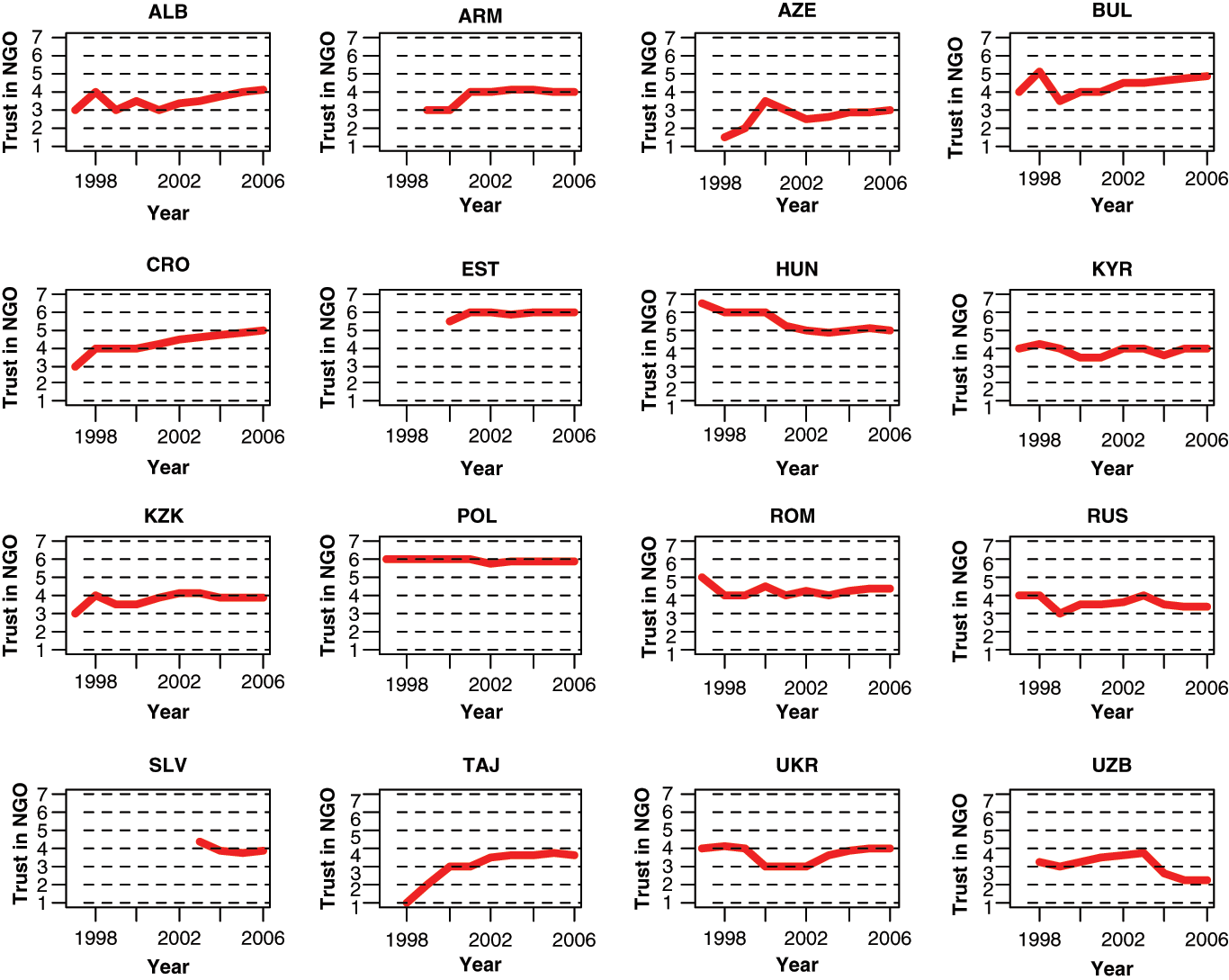
Trust in NGOs, 1997-2006 (selected countries)
Media and Information Provision
Becker suggests that “it is the responsibility of a mass political media system to provide information to citizens to participate in processes of governance” (Becker, 2004, p. 145), including assessments of NGOs. For media to have this desired effect, citizens
must have access to the media; there must be a significant degree of pluralism in all media, either internal or external; the press should reflect different views and ideologies; and the press must not be under the control of the state or under the control of such a limited number of private owners that pluralism is limited. (p. 146)
These factors allow citizens to assess the quality and validity of the information they receive and, thereby, judge the trustworthiness of the subjects the media covers. Distinct variations on these conditions exist throughout postcommunist Eurasia, with implications for citizens’ assessments of NGO trustworthiness.
Some argue that the enduring influence of the state creates a uniquely “indigenous” model of mass media in postcommunist Eurasia (Smaele, 1999). Throughout the postcommunist region, there are important distinctions among structures of mass media systems, particularly the method and scope of state control over the media. While state capture is not a pervasive problem in the more democratic countries of Eastern Europe, the nondemocratic states of postcommunist Eurasia demonstrate the repressive effects of government control on information and media freedom. According to the 2008 Freedom House assessment of postcommunist Eurasia, 8 countries are classified as “free,” 10 were “partly free,” and 10 were “not free” (Freedom House, 2009). Within these classifications, 56% of the postcommunist region’s population lives in not free media environments and 18% have access to free media (Freedom House, 2008). Moreover, Reporters without Borders consistently classifies the autocratic governments of the postcommunist region as “enemies of the Internet” (Reporters Without Borders, 2003-2010). Western public broadcast systems demonstrate that state ownership of media need not have a negative influence on the autonomy of the media and the plurality of views, ideologies, and topics covered (Becker, 2004), but state repression can have a detrimental impact on these issues and the resulting citizens’ attitudes about topics the media covers.
Others argue that commercial and/or private ownership in postcommunist Eurasia has an equally negative influence on the media as that of the state (Downing, 1996; Nordenstreng, 2001; Sparks, 1998, 2000), and western countries are not immune from these problems as media are increasingly concentrated in corporate hands with a negative impact on civic engagement (Bagdikian, 1997; Bennett, 2002; Capella & Jamieson, 1997). Citing the politicization of media and the integration of media and political elite, Splichal (1994) bemoaned the “Italianization” of media in East and Central Europe. This concentrated ownership structure differs from that found in the postcommunist region’s authoritarian countries, where media is dominated by one person or one political coalition and where views that challenge the state’s authority are prohibited (Becker, 2004, p. 140).
Differences in ownership structures must be acknowledged when considering the biases of media, but concentration of ownership need not impair media pluralism or “the articulation of divergent, sometimes conflicting, political views both within and between media empires” (Gunther & Mughan, 2000, p. 422). Indeed, some have argued that concentration of ownership strengthens the capacity of the commercial media to compete with and challenge the official state news and become independent of political interference (Mickiewicz, 2000; Sukosd, 2000). Media owners may have biased views of NGOs, the areas in which they work, and/or their relationships with local communities. Thus media ownership can have widely varied effects on the portrayals of a multitude of social actors, including NGOs.
We argue that an independent media has two important roles to play in contributing to the public’s levels of trust in NGOs. First, the media provides regular information about NGOs’ activities—both positive and negative information. In this respect the independent media will provide pluralism in opinions both about individual NGOs and the NGO sector as a whole. The broad range of information allows citizens to form opinions about the trustworthiness of NGOs. In addition, we view independent media as a watchdog over NGOs. In this role, positive media coverage would be expected to induce the spread of NGO “best practices.” Conversely, negative media coverage would “name and shame” individual NGOs and induce NGOs to correct their behavior or lose public trust. Independent media’s coverage of occasional NGOs scandals are likely to cause short-term reduction in public trust in the NGO sector or a more enduring impact if NGOs do not modify their actions over time. Because we explore public trust in NGOs at the country level between 1997 and 2006, we avoid the short-term highs and lows surrounding any individual positive or negative event and are able to capture longer term trends in trust in NGOs.
In no way do we mean to imply that exclusively negative coverage would increase public trust, especially over time. In fact, we would expect the opposite, regardless of media ownership and/or independence. Likewise, a media bias that only covers positive aspects of NGOs while intentionally overlooking NGO transgressions would not necessarily result in more public trust in NGOs. Instead, we suggest that enduring, balanced reporting from an independent media that airs negative and positive information about NGOs strengthens citizens’ abilities to form opinions on whether individual NGOs, and NGOs as a category of social actors, are worthy of their trust.
We are not the first to suggest that an independent media has positive effects on political and social outcomes. Indeed, international organizations such as Organization for Security and Cooperation in Europe, the United Nations, and the World Bank run programs throughout the world to improve media independence because of its positive impact on democratization, reform, and improving both generalized trust and trust in public institutions. In addition, many international NGOs promote the development of independent media as a mechanism to improve citizen trust in public institutions and the accountability of political systems in established democracies and transitioning countries around the world. See, for example, program descriptions of the Pew Research Center on the People and the Press (http://people-press.org), the International Research and Exchanges Board (www.irex.org), Internews (www.internews.org), the Center for International Media Assistance (www.cima.ned.org), Strengthening Independent Media Initiative (http://sim.salzburgglobal.org/), Open Society Institute (www.osi.org), and Transparency International, among many others.
Such programs demonstrate an enduring belief in the theoretical impact of an independent media on trust in public institutions, but there is also empirical evidence to support the claim. For example, studies highlight the relationship between media coverage and citizens’ knowledge of politicians and political institutions (Snyder & Stromberg, 2010) and citizen trust in government (Gross, Aday, & Brewer, 2004). Snyder and Stromberg (2010) find that lower media coverage of politicians actually lowers the accountability of elected officials to their constituencies, which would have obvious implications for citizens’ trust in their representatives and government institutions. Indeed, academic studies demonstrate that independent media coverage has many important outcomes, including increasing citizens’ political knowledge and voter turnout (Leeson, 2008), helping to build trust and overcome ethnic tensions in postconflict societies (Botan & Taylor, 2005; Pardew, 2000), curbing corruption in public institutions (Chandler, 2006, Eigen, 2002), and increasing the likelihood of successful economic reform in transitioning countries (Leeson & Coyne, 2007). These studies demonstrate an important link between independent media and citizens’ trust in public institutions and actors. While none of these earlier studies specifically looks at the role of independent media in building trust in NGOs, we suggest that such arguments also extend to our unit of analysis.
Figure 2 presents a scatter plot of the relation between media independence and trust in NGOs in 28 postcommunist countries as of 2006. Countries in USAID’s “consolidation stage,” including Poland and Lithuania, show high levels of media independence and trust in NGOs, whereas countries in “early-transition,” such as Turkmenistan and Uzbekistan, show low levels of media independence and trust in NGOs. 10 The shaded region around the regression line depicts 95% confidential interval. We discuss our measures of media independence and its relationship to public trust in NGOs below.
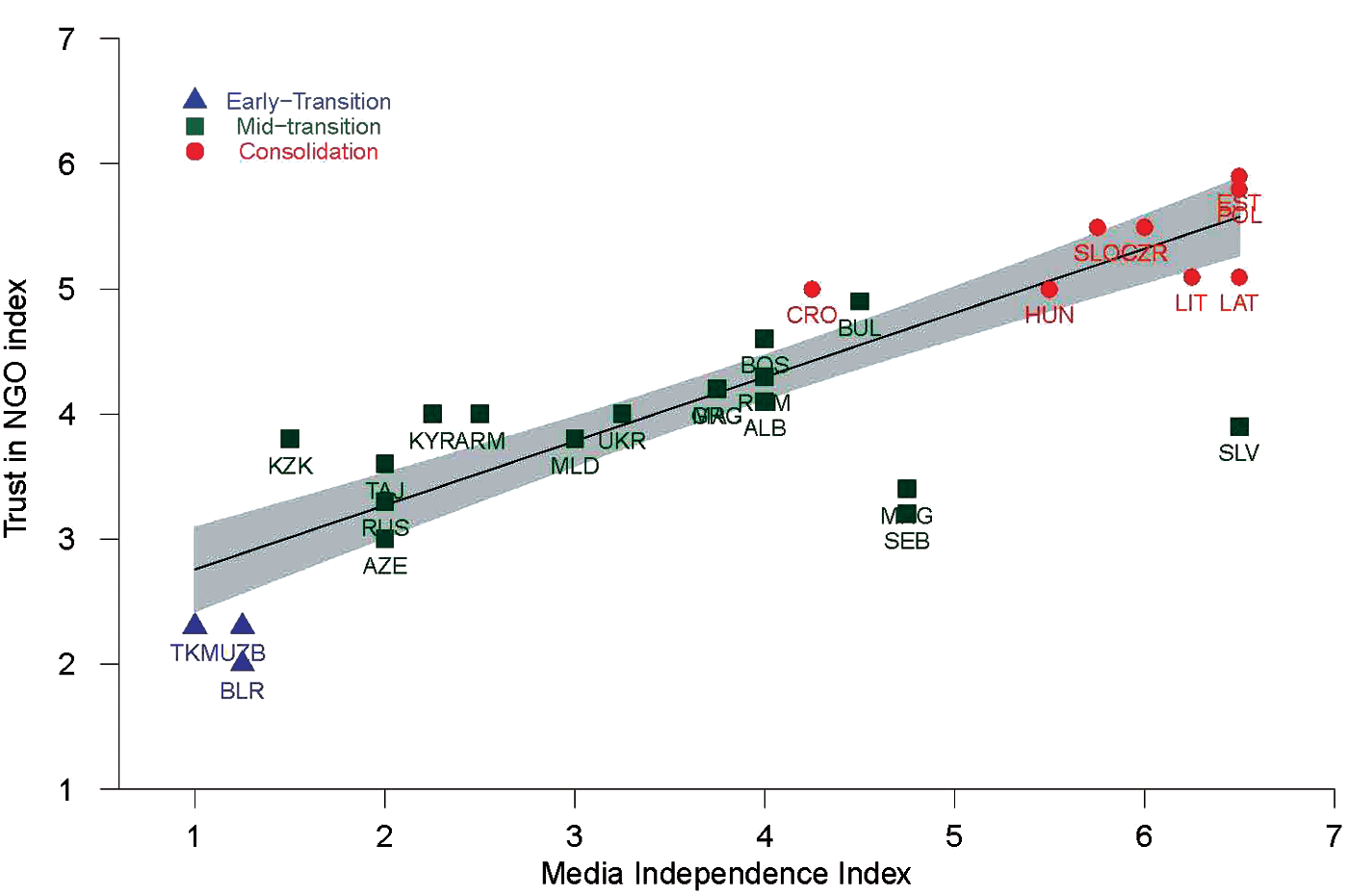
Media independence and trust in NGOs
Data and Model
We analyze the relationship between NGO trust and media independence in a cross-section of 28 postcommunist countries for the period 1997 to 2006. The data on trust in NGOs is from the NGO Sustainable Index for Central and Eastern Europe and Eurasia. Developed by the USAID, this index assesses seven dimensions of the NGO sector: legal environment, NGO infrastructure, financial viability, advocacy, service provision, organization capacity, and public image (USAID, 2007). We use the “public image” dimension as our measure of public trust because, as USAID states, the public image index is intended to capture the “growing public knowledge of and trust in NGOs (USAID, 2007, p. 25). The Index measures public image by evaluating media coverage of NGO sector at the local and national level, government and business sector engagement with NGOs, and public’s knowledge of the sector as a whole (USAID, 2007, p. 15). The index also assesses the extent to which individual NGOs publicize their activities or promote their public image, have adopted codes of ethics or tried to demonstrate transparency in their operations, and publish annual reports—all of which are expected to influence public trust in the NGO sector. Thus, this index does not assess media coverage of NGOs only or assess how free the NGO sector is from criticism and noticeable scandal. Overall, we believe that “public image” component of the NGO Index is a comprehensive and valid measure of public (media, elite, general public) trust toward the NGO sector.
The individual country ratings are drawn from empirical observations of NGO sector development by USAID staff, implementing partners, and regional specialists. The specialist observations are augmented with assessments of NGO observers and activists and can be assumed to reflect citizen trust rather than elite trust. The country ratings are clustered into three stages: Consolidation (corresponding scores between 1 and 3 points), Mid-Transition (scores between 3 and 5 points), and Early Transition (scores between 5 and 7 points). An important strength of this data is that it captures all 28 postcommunist countries across the entire period of 1997-2006. In this respect, it captures trends in public trust rather than temporal peaks and dips caused by particularly positive or negative events. By simply subtracting the values from 8, we rescale the variable with 7 representing the highest level and 1 representing the lowest level of trust in the NGO sector. Our dependent variable is continuous in the sense it can take any value between 1 and 7.
The data on our key independent variable, “independent media,” are from two sources. First, we use Freedom House annual reports on “Nations in Transit.” In these reports, Freedom House measures the status of political development, including media freedom, in 29 postcommunist Eurasian countries. Freedom House asked report authors and a panel of academic advisors questions about the legal protection for press freedom, the protection of journalists, media’s editorial independence, the ownership of media, and access to the Internet. 11 This measure provides a score in the scale of 1 to 7, with 1 representing the highest and 7 the lowest level of media independence (Goehring, 2007). Following the same method described above, we rescaled the values so that higher values (7) indicate more freedom in the media.
Second, we use the Reporters Without Borders (Reporters Sans Frontieres) Press Freedom Index, which measures the level of freedom that the media and journalists enjoy in specific countries. By surveying local journalists, foreign correspondents, scholars, and legal experts, the Press Freedom Index measures the legal environment and government behavior toward public media and foreign press. Survey questions ask details about direct attacks on journalists, censorship and confiscation on the media, and the free flow of information in the Internet. The index ranges from 0.5 to 100, with lower numbers representing higher degrees of media freedom (Reporters Without Borders, 2002). By subtracting the Press Freedom Index values from 100, we rescaled the index so that higher numbers would indicate higher freedom of press.
Our model includes a battery of variables that control for alternative drivers of trust in NGOs. First, we control for levels of democracy. NGOs need political space to function and become visible and democracies provide such political opportunities (Bernhard & Karakoc, 2007). Furthermore, citizens might have more avenues to gather information on NGOs in a democracy. Finally, if democracy breeds generalized trust because it provides mechanism for accountability and verification, this might be reflected in citizens’ trust in NGOs. We use a democracy index developed by the Polity IV project. This index assesses the institutional characteristics of regime type by examining democratic institutions, electoral procedure, institutional constraints on the executive power, and the openness of political participation (Marshall & Jaggers, 2008). While Polity scores range from +10 (strong democracy) to –10 (strong autocracy), we simply add 11 so that the values are all positive and range from 0 to 21, with higher numbers representing stronger democratic systems.
In addition to the media, citizens can access information on NGOs from a variety of sources, and the Internet is an especially important source of political, social, and economic information. The Internet also allows NGOs to disseminate information on their activities, recruit new members, to raise funds for their activities (Rooy, 2004; Warkentin, 2001). To test whether citizens might acquire information about NGOs from nontraditional media sources, we control for the number of Internet users per 1,000 population, reported by the World Bank’s World Development Indicators.
A variety of economic factors might also affect citizens’ attitudes toward NGOs. We control for the Gross National Income per capita (logged) to capture the wealth of a given country. Overall wealth is critical for NGO sector development because it can translate into greater charitable giving, and therefore greater trust in the NGO sector. Also, wealthier citizens might have more time and resources to gather information on NGOs. Similarly, trust in NGOs might vary with levels of economic growth: Trust may be higher in tough economic times when governments cut back on the provision of public goods and services and NGOs remain key sources of support for citizens. On the other hand, tough economic times might lead to widespread feeling on anger and distrust toward social institutions including NGOs. This might be more pervasive if NGOs receive funding from foreign sources and NGO functionaries enjoy a more prosperous lifestyle, creating envy in the local population. We, therefore, control for economic growth.
The NGO sector in postcommunist Eurasian countries is highly dependent on foreign donors. While aid can provide necessary resources for NGOs to undertake their activities, it can also raise questions as to whose interests NGOs serve. In addition to receiving direct funding, much of the aid provided to governments tends to be disbursed through local NGOs. Thus our model controls for the salience of foreign aid in the local economy (aid/GDP). Similarly, attitudes toward NGOs may reflect a country’s openness to and engagement with the outside world. We therefore control for trade salience (trade/GDP) and foreign direct investment salience (inward FDI inflow/GDP).
Trust in NGOs, and more broadly the development of domestic NGOs, could also be influenced by a country’s engagement with regional and international organizations. To account for the influence of regional intergovernmental organizations (IGOs), we control for a country’s membership of the European Union (EU) 12 and in the Commonwealth of Independent States (CIS). 13 The EU community emphasizes the important role of NGOs in the governance processes. Thus engagement with the EU might be expected to socialize a prospective or new member country to broader norms that emphasize trust in NGOs. In contrast, we expect that memberships in the CIS may have a negative impact on public trust in the NGO sector. Even though the CIS is a symbolic organization focused on trade, lawmaking, and security of member countries, it serves as a proxy for the continuation of Soviet political and social legacies of institutional centralism (Hoffmann, 1998). Thus CIS membership might strengthen Soviet-style cultural and political legacies that impede the development of a positive image of the NGO sector.
Trust in NGOs may also reflect a country’s embeddedness in global networks of international nongovernmental organizations (INGOs; Lee, 2010). INGOs influence the activities and images of domestic NGO sector by enhancing ideational and financial support for the domestic NGO sector and drawing international attention to local issues (Keck & Sikkink, 1998). Our INGO variable is the total number of international nongovernmental organizations that a country’s citizens had joined, as reported in the Yearbook of International Organizations (Union of International Associations [UIA], various years).
NGOs are social actors and trust in NGOs might be a reflection of the general level of social trust. Indeed, in his study of the Netherlands, Bekker (2003) suggests that trust in NGOs is reflective of generalized social trust. What might drive such generalized trust? In addition to democracy, which we already control in our model, cultural heterogeneity can play an important role in influencing levels of generalized trust: Some scholars argue that greater heterogeneity leads to higher levels of distrust (Knight, 2001) while others suggest that multicultural societies are more trusting (Bahry et al., 2005; Nannestad, 2008). To factor in the impact of cultural heterogeneity on trust in NGOs, we employ ethno-linguistic fractionalization measure from Fearon and Laitin’s data set (2003). This index measures the probability that two randomly drawn individuals in a country belong to different ethno-linguistic groups. We also control for the number of politically relevant ethnic groups as a measure of cultural heterogeneity, using Wimmer, Cederman, and Min’s (2009) Ethnic Power Relation data set, which codes the number of all politically relevant ethnic groups around the world from 1946 to 2005. 14 However, the results are similar and the variable is not statistically significant. Therefore, we do not include this variable in the models reported below and we cannot weigh in on the debate about whether cultural heterogeneity would have a positive or negative impact on generalized trust.
In addition to democracy and ethno-linguistic fractionalization, we also tried controlling for corruption and inequality, which arguably can influence levels of generalized trust (O’Connell, 2003; Putnam, 1993; Rosenfeld et al., 2001). Neither of these variables was significant and their exclusion from the model does not alter our substantive results. While individual-level trust may also influence overall trust in NGO sector (Petrova, 2007), micro-level survey data sources on trust, such as the World Value Survey, the Eurobarometer survey, and the European Social Survey, exclude most of the 28 postcommunist countries for the period under study. 15 We have, therefore, not controlled for individual-level trust in the models presented below. This decision is not problematic because eventually individual-level trust will be reflected in generalized trust and the model includes several proxies for generalized trust.
Method and Results
We estimate the empirical model of following form:

Where Yit is the score of trust in NGOs in ith country in time of t, and Xkit−1 is a vector of explanatory variables pertaining to the political and economic context and characteristics, including the level of media independence in ith country in time of t–1. To mitigate the potential problem of reverse causality, we lag all explanatory variables by 1 year. β k is the vector of parameters, and ϵit is an random error term.
We use OLS as our main model. Our dependent variable, the level of trust in NGOs, is truncated; it is continuous between 1 and 7 but arguably truncated beyond these values. Thus, as a specification check, we report a Tobit model for the censored dependent variable (Long, 1997). We fit the models with Autoregressive (AR) 1 correction to account for serial error correlation. Following Beck and Katz (1995), we report “panel-corrected standard errors” to address the issue of panel-dependent error heteroskedasticity. Finally, to address the issue of neighborhood effect, we include a spatial variable reflecting the average score of public image of NGOs in neighboring countries.
Table 1 presents the result of the panel data analysis. Model 1 shows that our key explanatory variable, media independence, is a statistically significant predictor of trust in NGOs (p < .01). Its coefficient suggests that when the media independence index shifts by 1 unit in the 1 to 7 scale, trust in NGOs tends to shift by 0.34 in the same direction. In Kyrgyzstan, for example, the value of independent media dropped from 3 in 2002 to 2 in 2004, and the level of trust in NGOs went down correspondingly from 3.9 to 3.6. State controlled media in Kyrgyzstan criticized NGO activities in human rights and democratization. This negative media campaign against NGOs hurt public image toward NGO sectors and most NGOs did not have sophistication to counter such attack and attract positive media coverage (USAID, 2004). We also find that level of embeddedness in the INGO network has a significantly positive effect on trust in NGOs. The coefficient suggests that INGO (In) shift by 1 %, then the trust in NGOs tend to shift by .0043 units in the same direction along the 1 to 7 scale.
Media Independence and Trust in NGOs

Note: Numbers in parentheses are standard errors.
p < .05. **p < .01, two-tailed.
In Model 2, we run regression without our Internet variable that counts the number of Internet users per 1,000 population. Freedom House’s independent media indicator assesses the Internet as part of the independent media by asking, “Does society enjoy free access to and use of the Internet?” “Is a diversity of opinions available on the Internet?” and “Does government attempt to control the Internet?” These questions capture important qualitative aspects of Internet and media independence. Yet dropping our quantitative measure of Internet variable in Model 2 does not change our basic results.
In Model 3, we employ another measure of media independence, the Press Freedom Index developed by Reporters Without Borders. The positive and statistically significant coefficient of the Press Freedom Index indicates that as the levels of media freedom increase, trust in the NGOs sector is enhanced. The magnitude of coefficient in Model 3 is much smaller (.026) than that of NGO independence index in Model 1 (.337) because the scale of the Press Freedom Index ranges from 1 to 100. While a country’s embeddedness in the international network of NGOs (INGOs) is significant in both models, the neighborhood effect is statistically significant in Model 3 only.
Measures of economic globalization, trade, and FDI salience are not significant in our models. This suggests that while sociological globalization in terms of engagement with global civil society enhances trust in local NGOs in Models 1, 2, and 3, economic globalization does not have a comparable effect. Also, somewhat surprisingly, foreign aid levels (aid/GDP) are not influencing trust in NGOs. We get similar results when we employ an alternative measure of aid salience, namely, foreign aid per capita. These results may reflect the fact that we use only a proxy for the level of NGO dependence on foreign funds: Our measure does not differentiate between foreign funds provided directly to NGOs and the aid which governments receive from foreign donors (although NGOs might be serving as subcontractors for these governments).
The OLS model we employ assumes an unbounded dependent variable. Our, dependent variable, however, is censored. There is a potential problem if, theoretically, trust in NGOs extends beyond the lower (1) bound or the upper (7) bound of our measured variable. To respond to the censoring issue in a latent measure of trust in NGOs, we use a Tobit model or censored regression with double censoring in Model 4. As Model 4 shows, our key variable, independent media, remains positively associated and statistically significant predictor of trust in NGOs. In addition, in Model 4, levels of democracy, GNI per capita (logged), EU and CIS membership, and INGOs membership are statistically significant. Neither the measures of economic globalization or foreign aid reach the conventional levels of statistical significance, however.
Implications for Future Research
NGOs are often viewed as principled actors working for public welfare. Their institutional design prohibiting the distribution of profits to their owners is expected to enhance public trust (Hansmann, 1980). Because NGOs are viewed as grass-root organizations, they are expected to be connected with citizens who have ample opportunities to observe them. Thus their normative foundations, institutional design, and the nature of their activities often lead both scholars and practitioners to believe that citizens trust NGOs. Yet trust in NGOs varies across postcommunist Eurasia. We have provided some evidence suggesting that independent media is crucial to shaping citizens’ trust in NGOs. An independent, impartial media performs two complementary roles in this regard: It supplies information about successes and failures in the NGO sector and it serves as a watchdog institution that names and shames violations of public trust. When the media acts as an institution that sanctions betrayals of trust, it enables citizens’ to differentiate the good NGOs from the bad ones. 16 Because individuals can take a more nuanced perspective on NGOs, their overall attitudes about the trustworthiness of NGOs improves.
For NGOs in postcommunist Eurasia, acquiring public trust is essential to survival. For two decades, foreign donors have been the primary form of support for these organizations. However, NGOs recognize that international funding is not a limitless resource; in fact many donors have begun to decrease or terminate NGO funding throughout the region. To secure stable long-term funding and ensure organizational sustainability, NGOs must find domestic patrons for their activities and missions. If citizens view NGOs as actors worthy of their trust, they are more likely to contribute money and time to their causes. An independent media helps bridge the information gap between NGOs and citizen-patrons, thereby strengthening citizen’s trust in NGOs.
Our article raises a broader question regarding the conditions under which citizens develop trust in social actors more generally, how citizens might seek to bridge the information deficits, and how the impartiality of the information suppliers influence citizens’ trust. By itself, tainted information, positive or negative, does not enhance trust. Trust is enhanced when independent media provides balanced and impartial information, even when the information they receive is sometimes critical of NGOs.
We emphasized that the role of media in bridging information deficits about NGOs might be particularly critical in postcommunist Eurasia given the lack of prior experience with the NGO sector, high levels of distrust of public institutions, and low levels of generalized trust in society. Bekkers (2003) shows that, in the Netherlands, trust in NGOs is associated with higher levels of generalized trust. In our model, a range of proxy measures for generalized trust such as democracy, ethno-linguistic fractionalization, corruption levels, and income inequality were not statistically significant predictors of trust in NGOs. It is possible, however, that future studies could systemically compare the experiences of societies that have varying prior experience with the NGO sector and varying levels of generalized trust.
Another future direction might be to explore variations in public trust in NGOs based on both attitudes and behavior. For example, examining evidence from both opinion polling and citizen self-reporting of volunteering and giving behavior, O’Neill (2009) challenges the assumption that public confidence in U.S. charities is on the decline. 17 Following this study’s example, future work might also usefully disaggregate of range of postcommunist NGOs to explore levels of trust in different NGO subsectors.
Future research might also examine how the regulatory framework influences trust in NGOs. For example, some countries might have regulations that enforce legal and/or ethical action of NGOs. Likewise, governments can compel NGOs to disclose information that citizens can access. But do they? What are the transaction costs? The emergence of charity watchdogs such as Charity Navigator, Charity Register, Wise Giving Alliance, Ministry Watch, and the American Institute of Philanthropy suggest the limitations of relying on citizens to access information nonprofits mandatorily provide to the government, and how intermediary organizations might be needed to reduce the costs of accessing and interpreting such information to citizens (Szper & Prakash, 2010). For example, in the United States, where the federal government compels nonprofits to annually report financial information on Form 990, citizens seldom access such information (Keating & Frumkin, 2003). We believe a systematic inquiry into how various actors seek to bridge information deficits and with what effectiveness is a productive avenue for future research. Such an approach will help both scholars and practitioners develop a more nuanced understanding of why and when citizens trust NGOs and whether the presence of independent information sources such as charity watchdogs and media improve trust in NGOs.
Finally, NGOs may not passively wait for citizens to access information via newspapers or charity watchdogs. Some NGOs may proactively seek to differentiate themselves from other NGOs and signal their trustworthiness. They could do so by joining voluntary programs (Gugerty & Prakash, 2010) or accreditation systems (Bekkers, 2003), which are instruments to signal trustworthiness to outside stakeholders that cannot observe internal workings of NGOs. Thus future research could examine how NGOs navigate the mix of governmental regulation, media monitoring, charity watchdogs, and voluntary programs in seeking to enhance the public image and trustworthiness of their sector and, at the same time, seeking to differentiate themselves from other NGOs that compete for donor resources.
Footnotes
Acknowledgements
The authors are grateful to Elizabeth Bloodgood and Clifford Bob, who each gave insightful comments as discussants at these presentations, to the participants of the panels, and to two anonymous reviewers for their constructive suggestions to improve their article.
Earlier versions of this article were presented at the Annual Research Conference of the Association for Public Policy Analysis and Management in November 2009 and at the annual meeting of the International Studies Association in February 2010.
The author(s) declared no potential conflicts of interest with respect to the authorship and/or publication of this article.
The author(s) received no financial support for the research and/or authorship of this article.