



Abstract
This article explores antecedents of nonprofit directors’ self-reported confidence and participation in two board functions: monitoring (executive performance appraisal, selection, fiscal operations, and implementation of strategy) and the provision of resources (advice and counsel, fundraising, and ties to external constituents). We propose that board member’s experience and background in conjunction with other factors such as commitment to the mission, a sense of community with other board members, and training will influence confidence and participation in board functions. Data were collected via a survey from 591 board members in 64 different nonprofit organizations. Regression analyses showed that gender, experience as a nonprofit board member, service on other nonprofit boards, mission attachment, and training were the most consistent predictors of confidence and participation in board activities. Implications are noted for enhancing the contribution of board members to nonprofit organizations.
Fostering active participation of directors in the roles and responsibilities of the board is a challenge for practitioners long acknowledged by scholarly researchers. When asked to identify the most important roles of directors, nonprofit executives identified “board member vitality” or “active participation” as among the top five things board members should do (Brown & Guo, 2010). Researchers have also struggled to explain task performance within boards of directors (Forbes & Milliken, 1999; Payne, Benson, & Finegold, 2009). Here, we explore the role of board capital or the human and social capital of directors (Hillman & Dalziel, 2003) on nonprofit directors’ monitoring and resource provision. We build on existing models by examining directors’ attachment to the organizational mission, sense of community and board training on their confidence, and participation in monitoring and resource provision. With a focus on the individual behavior of board members (Petrovic, 2008), we hope to provide insights for both research and practice.
Board member capabilities are recognized as significant determinants of individual contributions and overall board performance (Brown, 2007; Preston & Brown, 2004). Specifically, Hillman and Dalziel (2003) theorize that directors’ human and social capital predicts their engagement in resource provision and monitoring activities but incentives also play a role in motivating this behavior. Their model focuses on for-profit director behavior and considers compensation and independence from management. The notion of financial incentives is not applicable for nonprofit directors, but the principle is still intriguing. This study will explore other factors more appropriate to the nonprofit context that may encourage engagement. Like Hillman and Dalziel (2003), we propose that human and social capital characteristics will explain the degree to which board members engage in board functions. Performance is contingent on individual capabilities as well as other factors that support and encourage the tendency to be forthcoming with one’s knowledge and skills. Specifically, we focus on directors’ attachment to the organizational mission and sense of community among directors as factors that increase directors’ confidence and participation in monitoring and resource provision. Given the nature of nonprofit organizations as values-based institutions and the voluntary aspect of board leadership, we believe attachment to group members (Forbes & Milliken, 1999; Haski-Leventhal & Cnaan, 2009; Okun & Michel, 2006) and organizational mission (Jenner, 1984; Minichilli, Zattoni, & Zona, 2009) will be particularly salient factors for nonprofit directors. This study also explores the role of training. Although training is touted as an important mechanism to improve board performance, there is relatively modest research exploring impact on directors’ behavior (Wright & Millesen, 2008). As depicted in Figure 1, the current study examines the relationships between board capital, three factors (training, sense of community, and mission attachment), and board member engagement in two areas (monitoring and resource). Specifically, we ask board members to report both their confidence and level of participation in these roles. We also explore if board capital characteristics interact with these factors.
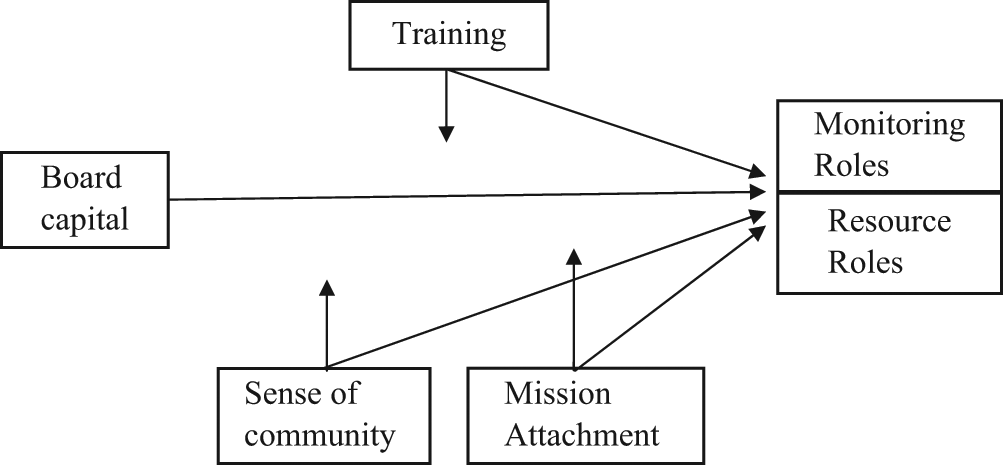
Model to explain board member role performance
Method
Executives were contacted via a mailed one-page survey and asked if they would be willing to help administer a survey to their board members. Over a 2-year period from fall of 2006 through summer of 2008, the survey was administered to executives in two metropolitan areas. The sample was drawn from tax return data. Several strategies were used to ensure some consistency in the participants and to increase the response rate. Only organizations with revenue above US$1 million were included. Hospitals and institutions of higher education were excluded. The remaining organizations were randomized and then contact information was verified through various venues (websites, regional directors, etc.). Only entities that could be verified were contacted. We contacted 300 organizations in one region and 200 in another. Response rates were comparable between the two regions. Thirty percent of the executives (n = 153) responded to the one-page survey and of those, 73% agreed (n = 110) to distribute a survey to their board members in exchange for receiving a report on the board’s strengths and weakness. The board-member survey was available electronically or in hard copy. The majority of executives distributed the survey electronically. It is difficult to know if all executives who agreed to participate actually distributed the survey to their board members. There was at least one board member from each of 64 different organizations who returned the survey (58% of the organizations that agreed to participate); a total of 620 surveys were returned. It is estimated that there were 1,280 board members in these 64 organizations (based on an average of 20 members per board). After incomplete responses were removed, there were 591 usable responses, an estimated 46% of the invited respondents.
Measures
The study investigated six constructs, and some of these had subcomponents. The predictors included board capital, training, sense of community, and mission attachment. The dependent variables were engagement in monitoring and service roles. Engagement was assessed by asking board members to report their confidence and participation in each area. Scale items with descriptive statistics for Sense of Community, Mission Attachment, Monitoring Roles, and Resource Roles are listed in the appendix of this article (available online at http://nvs.sagepub.com/supplemental).
Board capital
Board capital was assessed by asking board members to indicate their experience serving on the board for which they received the survey (hereafter designated the current board). Specifically, we asked how long they had served on the current board and whether they had served as an officer of the board (coded 0 = no service and 1 = service as an officer). In addition, we asked about service on other nonprofit boards. Participants were asked how many other nonprofit boards they served and the length of time they served on other nonprofit boards. We also asked individuals about the number of community groups to which they belong and their professional work experience. These measures were standardized and analyzed to determine if one or two index measures should be created. Removing two items (membership with community associations and professional experience), a factor analysis revealed two factors. One factor reflected experience on the current board, and a second factor reflected experience with other boards. Separate indices were created by calculating the mean of the items in each factor.
In addition, we asked individuals to indicate their profession. We grouped individuals with executive and legal experience (54% of the respondents) into one category and grouped program-level professionals and volunteers (28% of the respondents) into a second. The remaining respondents were clustered into a third “other” category (18%). Each professional experience category (executive, program, and other) was dummy coded (0 = does not have that experience and 1 = does have that experience). One additional question asked respondents to indicate the number of community associations to which they belong. These items were analyzed independently.
Training
Training was assessed through two questions. Respondents rated the level of training they received at orientation and the level of current/ongoing training along six gradations ranging from excellent training (5) to limited training (1) and none (0). Average response was 2.98 (SD = 1.59) for level of training received at orientation. About 20% of the respondents indicated that they received limited or no orientation to the board. Average response for current/ongoing training was 3.12 (SD = 1.46). About 15% indicated that they receive limited or no ongoing training.
Sense of community
Nine items were drawn from existing research (Okun & Michel, 2006; see appendix for list of items). These items asked respondents to indicate their level of agreement on a 5-point scale from strongly agree (5) to strongly disagree (1) related to their sense of community with other board members. A reliability analysis confirmed that the nine items formed an internally consistent scale (Cronbach’s α = .80). A composite index score was computed by calculating the mean across all items. On average, respondents reported a mean of 4.28 (SD = .53) reflecting a strong sense of community on their respective boards.
Mission attachment
Mission attachment was measured using an existing scale (Brown & Yoshioka, 2003) that consisted of 10 items (see appendix). Respondents indicated their level of agreement on a 5-point scale from strongly agree (5) to strongly disagree (1). Cronbach’s alpha for all 10 items was .87. A composite index score was computed by calculating the mean across all items. On average, respondents reported a mean of 4.52 (SD = .46) reflecting a strong sense of attachment to the mission.
Board roles
Board members were asked to indicate their level of confidence and frequency of participation in 11 activities (see appendix for list of items). Five statements reflected monitoring roles, and six represented resource roles. The items were drawn from prior research with nonprofit boards (Brown, 2005). Sample items tapping into monitoring roles included, “Overseeing the financial management systems and procedures of the organization” and “Selecting and monitoring the organization’s chief executive.” Sample items tapping into service included, “Helping raise funds or other resources for the organization” and “Setting the organization’s mission, values and strategic direction.” Respondents indicated their level of confidence on a scale of 1 (low confidence) to 5 (high confidence), and they indicated their reported level of participation on a scale ranging from 0 (did not participate at all) to 5 (participated often). A confirmatory factor analysis and scale reliability analysis revealed four indexes: (a) confidence in monitoring, (b) participation in monitoring, (c) confidence in resource activities, and (d) participation in resource activities. A score was computed for each index by calculating the mean across all items. These four index measures were used as dependent variables. On average respondents reported high levels of confidence in monitoring (M = 3.62, SD = .90) and resource roles (M = 3.89, SD = .77) and moderate participation in monitoring (M = 2.75, SD = 1.18) and resource roles (M = 3.00, SD = 1.08).
Results
An initial analysis was conducted to determine the effect of board members being nested in organizations and whether the organizational-level attributes affect the individual responses. Ordinary least squares regression may be used in lieu of multilevel modeling when the design effect does not exceed 2.00 (Hox & Maas, 2002; Kwok et al., 2008). As the design effect in the current study ranged from 1.08 to 1.29, we used ordinary least squares regression to test our hypotheses.
In a preliminary analysis, we examined the magnitude and direction of the relationships among the variables in the model (see Table 1). We found modest to strong positive correlations between nearly all predictor variables and the dependent variables (self-reported confidence and participation in board roles). The correlations between mission attachment and sense of community (r = .72, p < .001) and between orientation and ongoing training (r = .73, p < .001) were very strong. Examination of the variance inflation factors (VIF) and tolerance levels revealed that the lowest value tolerance level was 0.42 and the highest VIF was 2.37, suggesting that multicollinearity did not create problems with the tests of significance for the individual predictors (O’Brien, 2007). As would be expected, the relationships between the ratings of confidence and participation in the monitoring and resource roles were substantial.
Correlation Matrix
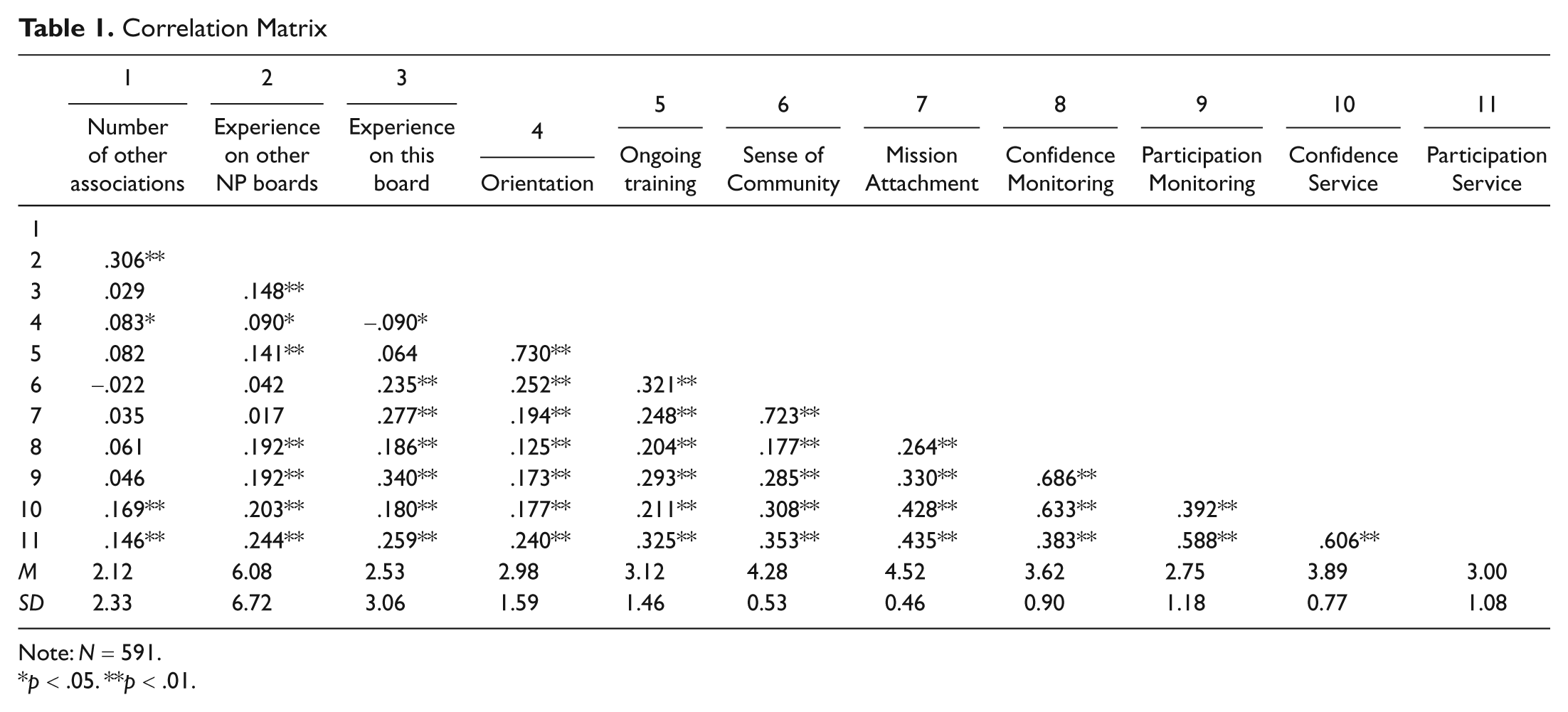
Note: N = 591.
p < .05. **p < .01.
A number of differences were observed between men and women. Most notably, women were significantly less likely than men to hold “executive” positions, χ2 (2, N = 591) = 34.47, p < .001. As compared with men, women tend to belong to more community associations, t(589) = 2.78, p < .01, expressed high levels of sense of community, t(580) = 3.01, p < .01, and stronger attachment to the mission, t(580) = 4.07, p < .001. Relative to men, women were less likely to express confidence in monitoring, t(587) = -4.40, p < .001, reported less participation in monitoring, t(589) = -2.24, p < .05, and more participation in resource activities, t(577) = 2.84, p < .01. Consequently, we controlled for gender (1 = male and 0 = female) in all of our regression models. Separate multiple regression analyses were carried out for each of the four dependent variables (confidence in monitoring, participation in monitoring, confidence in resource roles, and participation in resource activities). Prior to the analyses, all predictors were standardized or centered.
Confidence and Participation in Monitoring Roles
We entered all predictor variables in the regression model and explored the extent to which any interaction effects accounted for additional variance beyond the direct effects on confidence and participation in monitoring roles (see Table 2). Results indicate that women report less confidence and participation in monitoring roles. Experience on the current and other boards is a consistent predictor of self-reported confidence and participation. Similarly, mission attachment and ongoing training are significant predictors of confidence and participation in monitoring roles. The only significant (p < .05) interaction effect was sense of community and experience on the current board. Through further analysis, we found, among board members who were low in board capital, confidence decreased as sense of community increased. With 10 variables in the model, we explained 21% of the variance in board member’s self-reported confidence to fulfill the monitoring role, F(10, 546) = 14.60, p < .001. With nine variables in the model, we accounted for 27% of the variance in self-reported participation in monitoring roles, F(9, 549) = 22.61, p < .001.
Confidence and Participation in Monitoring Roles
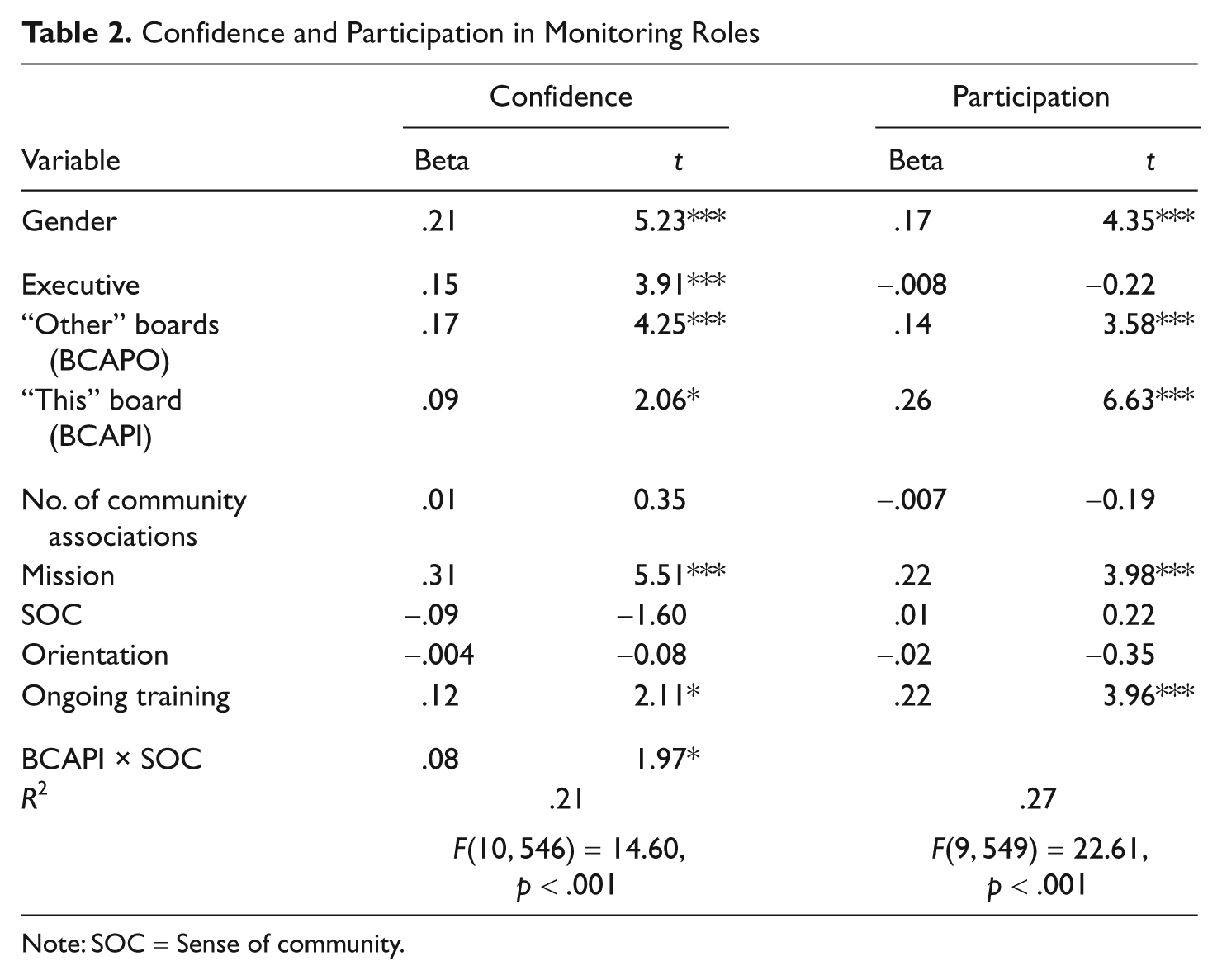
Note: SOC = Sense of community.
Confidence and Participation in Resource Roles
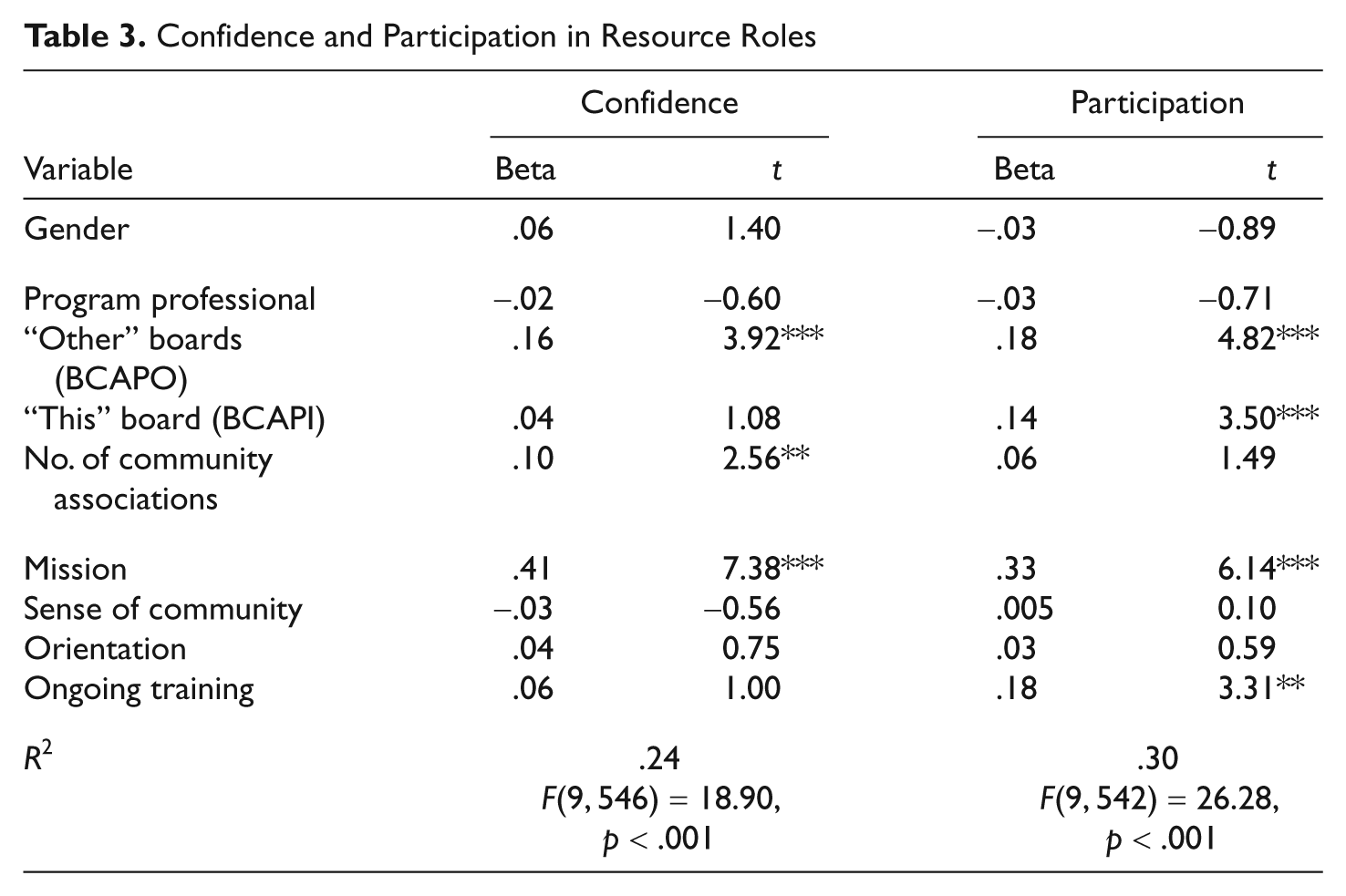
We entered all predictor variables into the regression model and explored the extent to which they explained self-reported confidence and participation in resource roles (see Table 3). Experience as a board member on other boards and mission attachment were consistent predictors of confidence and participation in resource roles. Experience on the current board and ongoing training did not predict confidence but did account for variance in participation. Number of community associations was a positive predictor of confidence in resource roles. There were no significant interaction effects. In total, the nine predictors explained 24% of the variance in board member’s confidence in resource activities, F(9, 546) = 18.90, p < .001, and 30% of the variance in self-reported participation in resource roles, F(9, 542) = 26.28, p < .001.
Confidence and Participation in Resource Roles
Discussion
We proposed and tested a model that investigated antecedents of nonprofit directors’ confidence and participation in board functions, namely, monitoring (executive performance appraisal, selection, fiscal operations, implementation of strategy) and the provision of resources (advice and counsel, fundraising, ties to external constituents). Using a board capital perspective, we proposed that board member experience and background in conjunction with other factors such as commitment to the mission, a sense of community with other board members, and training influence confidence and participation in board functions. This study contributes to nonprofit governance literature by expanding our understanding of the factors that explain board members’ reported participation and confidence. Using individual board member responses and original data, the study supports and extends prior research and practice in the field.
Board capital as reflected in experience as a nonprofit board member was consistently a strong predictor of both confidence and participation in service and monitoring roles. This suggests the importance of tenure on the board. In this sample, tenure on the current board was relatively modest with about 40% of the sample reporting 2 years or less of service. Even modest experience (more than 2 years), however, makes a difference in participation, and engagement continues to increase with years of service. Increased tenure is also positively associated with confidence, mission attachment, and sense of community, but the most distinctive relationship is with participation in the monitoring role. Tenure and/or experience as a nonprofit board member, that is, human capital, might increase capabilities through various mechanisms including commitment, knowledge, role clarity, and social capital benefits (Stephens, Dawley, & Stephens, 2004). The ability to extract necessary information and follow-through on key monitoring tasks will be facilitated by board members that have prior experience and effective working relationships. Consequently, executives and regulators need to consider if limitations on board service are always in the best interest of the organization. Other aspects of human capital modestly explained confidence in board roles but not actual participation. Further research is needed to consider when and how confidence is related to participation.
Mission attachment was the most robust predictor in the model. As mission attachment increases, so does confidence and self-reported participation in board roles. In contrast, sense of community did not affect confidence and participation. Sense of community had an unanticipated inverse relationship with confidence in monitoring roles among board members with less experience. As relatively new board members expressed more attachment to the group, they also tended to report less confident about their ability to fulfill the monitoring role. One explanation for this finding is that directors with a strong attachment to the group are likely to trust other board members and as a result might defer to more experienced colleagues.
Ongoing training was a fairly significant predictor of participation in both resource and monitoring roles. This was distinct from orientation training which did not have a robust effect. Such a result is not too surprising as orientation is a one-time event. We did explore if orientation had more salience for newer members 1.5 years or less, but it did not. How training influences behavior was not explored and would be a good venue for future research.
Gender played a significant role in the analysis. Women report lower confidence and are less inclined to participate in monitoring roles. Some of these associations may reflect professional differences between men and women in that executives express more confidence and women were significantly less likely to be categorized as executives. Other human capital characteristics (board member experience) were not significantly different, except that women are members of more associations. Women report slightly more attachment to the group and the mission as well as more satisfaction with the training, but these factors did not account for differences in the monitoring role. This suggests an important venue for further research and reiterates the role of gender dynamics in the boardroom.
This study contributes to understanding nonprofit governance by using a research frame that is suitable for additional investigation. The question explored in this study—Which factors account for confidence and participation by nonprofit board members?—is adopted from the corporate governance literature. It has been only modestly explored in the nonprofit governance literature. By relying on individual-level responses, the study removes some of the complexity in group and organizational analysis, which is often present in other studies.
Limitations
The study has some limitations that suggest caution when interpreting the results. The data consisted of self-reports from board members. Although self-report data can be as valid as supervisor ratings of performance (Meyer, Stanley, Herscovitch, & Topolnytsky, 2002), self-report data are subject to biases such as the tendency to exaggerate socially desirable behavior. In addition, relying on a single source of information increases common methods bias, which might conflate intercorrelations among the measures in this study. The measures of board capital, although self-reported are reasonably specific and concrete, thus reducing the tendency to misrepresent previous experience. Furthermore, most of the constructs under investigation relied on multiple item scales to minimize unreliability. Nevertheless, the reported level of participation and confidence are the board member’s perception of their engagement and may or may not correspond to assessments that might be made by another board member or the executive.
Implications for Research and Practice
For managers, the study reaffirms the importance of values congruence and commitment to organizational purposes as a significant predictor of board member engagement. Asking board members to explain why they want to become associated with the organization and selecting those who align with organizational purposes may eliminate some challenges managers have with board members. For retention, it would seem prudent to periodically discuss the mission with board members and determine if organizational activities and board member perceptions are congruent with the mission. Experience as a board member was a strong predictor suggesting that executives should consider various ways to reduce turnover and retain board members so that they will grow in confidence and understanding of organizational practices. Training plays an important role as well and is a viable mechanism through which executives can affect board member participation. They can use ongoing training to help board members understand their roles and to develop strategies to overcome governance challenges.
Future research is needed to better understand how and in what way training can improve individual board member engagement as well as how and to what degree training can improve the performance of the group overall. More research is needed to identify both the content and the pedagogical approaches that work best for training board members. With respect to mission attachment, it would be interesting to identify mediators of its effects on performance. For instance, does mission attachment affect motivation to expend effort on board-related tasks? Additional research that considers group dynamics such as group norms and leadership style could provide significant insight into the practices of individual board members and the performance of governing boards.
Footnotes
The authors declared no potential conflicts of interest with respect to the research, authorship, and/or publication of this article.
The authors received no financial support for the research, authorship, and/or publication of this article.