



Abstract
This research examined motivational factors of college students to volunteer in various capacities using the Volunteer Function Inventory. Volunteering characteristics, scope of volunteerism, volunteer segments, and type of contributions were investigated. In addition, constraints to participation based on the leisure constraint model were explored. Data were collected at a major university in the southeast United States. Results identified that the majority were involved in volunteerism in some capacity. Organizations that focused on human services were the most important type of organizations to volunteers. Families and teachers were responsible for introducing almost the majority to volunteerism. Also, more than half reported time as their most important contribution. The strongest motives were related to the values and understanding dimension which reflected helping others and expanding one’s own perspective on an issue. Structural constraints were most likely to limit volunteerism. Several associations between motivations and constraints were further examined and discussed.
Introduction
Throughout history, public and private agencies of all types and sizes have relied on the use of volunteers to ensure continued success of their programs (Liao-Troth & Dunn, 1999; Silverberg, Backman, Backman, & Ellis, 1999). Volunteering is a contribution to society in one form or another without monetary compensation. Although there is no financial return for volunteering, research has shown that volunteers do expect other considerations for the work that they do (Farmer & Fedor, 1999). Furthermore, many people seek out opportunities to provide service to others as a way to satisfy their own needs. Numerous studies have been conducted to analyze the benefits of volunteerism to both the organization and the volunteer. Researchers have examined how social activities such as volunteering contribute to a higher quality of life for older adults (Kelly, Steinkamp, & Kelly, 1987), the effects of service learning on college students (Bringle & Hatcher, 1996), effects of volunteerism during a person’s lifespan (Wilson & Musick, 1999), and the development of ecological sensitivity through volunteering in environmental stewardship programs (Ryan, Kaplan, & Grese, 2001). Other research has shown that volunteers can ease the labor burden for nonprofit organizations (Martinez & McMullin, 2004) as well as government agencies (Kaczynski & Crompton, 2006) and other contributions that volunteers can make to their organizations (Bruyere & Rappe, 2007; Ryan et al., 2001).
Given the budgetary challenges many organizations are facing and the fact that the demand for health care, human services, recreation, and education programs continues to grow, organizations have become increasingly dependent on the services provided by volunteers (Jensen, 1995). However, human service agencies and nonprofit organizations are experiencing shortages of volunteers which has often severely hampered their abilities to fulfill their missions (Burns et al., 2005). Operating expenses comprise 80% of the total budgets of most government agencies, and employee salaries and benefits usually constitute the primary expenditures (Kaczynski & Crompton, 2006). Similarly, nongovernmental organizations have comparable employee expenses. As a result, government agencies as well as nongovernmental organizations seek sources of free labor to offset expenses. It is becoming increasingly important to understand the factors that drive people to provide financial support as well as free labor to these organizations (Campbell & Smith, 2006; Wilson, 2005).
Examples of volunteer activities are evident in all sectors of society across nearly every sociodemographic category (Clary & Snyder, 1999; Liao-Troth & Dunn, 1999; Silverberg et al., 1999), and volunteerism represents a major source of labor in the United States (Dutta-Bergman, 2004). In 1995, 93 million American adults (49% of the population) engaged in some form of volunteer activity that totaled more than 20.3 billion working hours (Clary & Snyder, 1999). In 1999, volunteer contributions equated to more than US$150 billion worth of service (Silverberg et al., 1999). According to the U.S. Bureau of Labor Statistics (2010), approximately 27% (63.4 million) of American adults volunteered at least once between September 2008 and September 2009. About 30% of women and 23% of men above the age of 16 years volunteered. Generally, volunteering among women reflected a higher rate across all major sociodemographic categories. Also, individuals between 35 and 54 years were most likely to volunteer (32%) whereas those in their early 20s tended to be the least likely group to volunteer (19%). A substantial portion of the volunteers in the latter age category were currently enrolled in college. In addition, more than 43% of college graduates (aged 25 years and above) volunteered compared with 19% of high school graduates and about 9% of those without a high school diploma (U.S. Bureau of Labor Statistics, 2010).
Volunteer programs must be efficiently planned and monitored to be successful, but measures must be adopted to ensure that the program is not perceived to be controlling (Wilson & Musick, 1999). Mandating volunteerism may be counterproductive, as applying external pressure to perform some action will not necessarily lead to the behavior once the pressure is removed (Clary & Snyder, 1999). Nevertheless, as managers often cannot offer financial compensation, an understanding of the factors that drive an individual to volunteer is the key to success and effectiveness (Liao-Troth & Dunn, 1999). Silverberg et al. (1999) denotes that altruistic motives are characteristics of volunteers who have little interest in personal benefits to be gained from noncompensated service provision. Basically, altruism is contribution in time, energy, and resources to an organization with the sole intention of helping others. However, although altruism is often reported as a primary motivation to volunteer, it is widely believed that serving others is mutually beneficial for the donor and recipient (Wilson & Musick, 1999). Contemporary volunteer research tends to discount purely idealistic motives in favor of exploring personal advantages to the volunteer (Serow, 1991). Though community service is rarely undertaken out of necessity and rarely produces extrinsic rewards (Serow, 1991), there are usually underlying motives to volunteer. Although altruism may lead a person to volunteer initially, self-interested motivations are more important for continued participation (Ryan et al., 2001). Also, embarking on volunteer activities and then maintaining those activities over extended periods of time depend on matching the motivational concerns of the individuals with situations that can satisfy those needs (Clary & Snyder, 1999). Therefore, a thorough knowledge of the factors that motivate an individual to service is crucial to recruitment and retention of volunteers (Bruyere & Rappe, 2007).
Conceptual Framework
The motivation model has four components: needs or motivations, behaviors or activities, goals or satisfactions, and feedback (Mannell & Kleiber, 1997). Motivations are the factors that impel a person to action, and this occurs in two stages. First, a disequilibrium is created that causes a desire to correct the imbalance. This imbalance could be physiological (e.g., hunger, thirst, fatigue) or psychological (e.g., loneliness, boredom). The second part of motivation is when the individual recognizes or believes that a certain action will correct the disequilibrium (e.g., eating to relieve hunger, kayaking to relieve boredom; Mannell & Kleiber, 1997). Only after this belief is established can the individual take action toward satisfying the need. After the individual performs the intended action, the level of satisfaction will be addressed. If the behavior fulfilled the need, the individual will feel satisfied and will show positive feedback (e.g., performing the activity again in the future, recommending the action to others). If the behavior did not satisfy the motive, the individual will show negative feedback and will modify or abandon the activity (Mannell & Kleiber, 1997).
Generally, once a motive is satisfied, it is no longer active (e.g., after eating, an individual no longer feels hungry), but in leisure research, it has been found that satisfaction of one’s needs can often heighten the motive (Mannell & Kleiber, 1997). For example, if a mountain climber has a need for self-esteem development and that need is satisfied by reaching the summit of the mountain, he or she may have a stronger desire to climb other peaks, rather than a decreased interest in doing so. Because of this inherent difference, much research has been conducted on motivation in the context of leisure and recreation.
Many authors have identified that the same activity may be undertaken by individuals for different reasons or to satisfy numerous motivations (Clary et al., 1998; Clary & Snyder, 1999; Graefe, Thapa, Confer, & Absher, 2000; Wilson, 2005). For this reason, most contemporary volunteer motivation research takes a functional approach (Katz, 1960). This approach arranges motivational items into groups or functions based on the needs that they fulfill. Each function is scored independently to assess which motivation types are most important (Clary et al., 1998; Clary & Snyder, 1999). The strength of this theory is that it directs inquiry into the personal and social processes that initiate, direct, and sustain action (Katz, 1960). In other words, there are several underlying motivational factors that lead a person to begin an activity and to remain active over time. By breaking motivations into categories or functions, researchers can reach higher levels of specificity with regard to the motivational factors of different groups or individuals. Clary and Snyder (1999) states that the core of functionalist inquiry is that people can and do perform the same actions in service of different psychological functions. Basically, people engage in the same activity but do so to fulfill different motives (Clary & Snyder, 1999). The leisure motivation construct goes beyond activity participation and seeks to reveal what the activity means to the individual (Mannell & Kleiber, 1997).
Although functionalist theory is widely used in qualitative and quantitative terms with respect to analysis of volunteer motivation, it is important to note that other approaches are common as well. As opposed to the functionalist approach, other psychological models do not rely on a finite set of functions that can be served by motivations (Batson, Ahmad, & Tsang, 2002; Musick & Wilson, 2008). Furthermore, some models are based on economic theories and emphasize the role of incentives, whereas models developed by sociologists tend to focus on contextual factors as well as psychological motives (Musick & Wilson, 2008). Other models that are qualitative and quantitative in nature include the 2 × 2 model of seeking and escaping (Iso-Ahola, 1989), person–environment fit theory (Sergent & Sedlacek, 1990), psychological contract (Farmer & Fedor, 1999), and the octagon model of volunteer motivation (Yeung, 2004). However, in-depth analysis of these approaches is beyond the scope of this article.
In addition to motivation, it is important to understand the factors that may prevent or limit participation in volunteerism. There has been a paucity of research with respect to constraints to volunteerism, but a body of literature does exist on constraints to leisure in general. As volunteering is undertaken during an individual’s leisure time, leisure models are useful to examine constraints to volunteerism. Crawford, Jackson, and Godbey (1991) identified three categories of constraints to leisure: intrapersonal, interpersonal, and structural. Intrapersonal involve individual psychological states and attributes which interact with leisure preferences, rather than intervening between preferences and participation. Interpersonal are those that occur when known coparticipants themselves are perceived to be prevented from participation because of structural constraints. Structural are intervening factors between leisure preference and participation (Crawford et al., 1991; Crawford & Godbey, 1987).
Raymore, Godbey, Crawford, and von Eye (1993) determined that there is a hierarchical relationship between these categories of constraints. It was found that intrapersonal constraints are the first to be encountered and the easiest to overcome whereas structural constraints are the most difficult to negotiate. To expand on the hierarchical model, Jackson, Crawford, and Godbey (1993) posited a balance between motivations and constraints must be established if leisure participation is to take place. As each level of constraint is encountered along the hierarchy (intrapersonal–interpersonal–structural), the rewards from participation (motivations) must be checked against the costs (constraints). If motivations exceed constraints, the individual will proceed along the continuum. If not, the activity will be abandoned or modified (Jackson et al., 1993). This three-dimension model of leisure constraints has been empirically tested in the context of tourism (Hinch & Jackson, 2000; Pennington-Gray & Kerstetter, 2002; Thapa, Pennington-Gray, & Holland, 2002; Tian, Crompton, & Witt, 1996) and specific recreational activities (Gilbert & Hudson, 2000; Jackson, 1994; Nyaupane, Morais, & Graefe, 2004; Pennington-Gray, Thapa, & Holland, 2002). However, to date, it does not appear to have been empirically tested with respect to volunteerism.
Overall, numerous studies have largely focused on individual’s volunteer motivations (Anderson & Moore, 1978; Boz & Palaz, 2007; Bruyere & Rappe, 2007; Burns et al., 2005; Clary, Snyder, & Stukas, 1996; Clary & Snyder, 1999; Francies, 1983; Okun, Barr, & Herzog, 1998; Okun & Schultz, 2003; Wilson, 2005). Though this body of work is large and spans several decades, there are still areas that have not been fully explored. More specifically, further examination of the motivations and constraints of undergraduate college students is needed. Although it has been reported that volunteers in their early 20s account for the smallest percentage of volunteers, it has been shown that those with a college degree are as much as four times more likely to volunteer than those who have less education (U.S. Bureau of Labor Statistics, 2010). Furthermore, up to 90% of college students report to have volunteered at some point in their lives (Carlo, Okun, Knight, & de Guzman, 2005). This population is worthy of further investigation because of their tendency to volunteer and for their viability as a valuable source of volunteer service. Similarly, little research has been conducted to examine constraints to volunteerism. As volunteering is a leisure-time activity, constraints models from leisure and recreation research are applicable to analyze constraints. Hence, the objectives of this study were to examine motives and constraints to volunteerism among college students.
Volunteerism and College Students
Volunteering became popular on college campuses in 1960s and 1970s primarily through campus-based programs that encouraged community service (Ellis, 1978). In 1984, 29% of college students volunteered for a charity organization and 40% became involved in fund-raising activities during their undergraduate years (Sergent & Sedlacek, 1990). In 1991, it was reported that nearly two out of three incoming freshman had volunteered during the previous year (Serow, 1991). Bringle and Hatcher (1996) stated “a significant number of college students actively participate in extracurricular community service through student organizations, the activities of student service offices, and campus-based religious organizations” (p. 1) and that many faculty, staff, and students, particularly those at urban campuses, were involved in their communities, independent of the university (Bringle & Hatcher, 1996). In addition, Bringle and Hatcher (1996) found that there was a sharp decline in student volunteer activities between high school and college. Astin and Sax (1998) found that the most important factor that influences volunteerism in college is whether the student volunteered in high school. Other factors include leadership ability, involvement in religious activities, commitment to participating in community action programs, tutoring other students during high school, being a guest in a teacher’s home, and being a woman (Astin & Sax, 1998).
In 1998, 40% of freshmen noted to have spent one or more hours volunteering (Cress & Sax, 1998) and in 2005, 90% of college students reported to have volunteered in some capacity, 19% were currently volunteering, and 45% indicated that they intend to volunteer in the next 2 months (Carlo et al., 2005). In addition, a recent survey found that 33% of students enrolled at member universities participated in service, service learning, or civic engagement activities during the 2008-2009 academic year that totaled more than 366 million hours of service (Campus Compact, 2009). School enrollment appears to have the most significant effect on volunteering activities among young adults. People enrolled in colleges or universities have been observed to volunteer at twice the rate of those in the same age range who are not enrolled. Furthermore, recent college graduates volunteer twice as much as high school graduates and four times as much as high school dropouts (Boraas, 2003).
It was identified that 48% of students volunteered independently through a noncollegiate organization, whereas entering freshmen who were most likely to volunteer tended to be less materialistic than their nonvolunteering counterparts (Astin & Sax, 1998). Also, students’ rising interest in volunteering may be manifestations of core values and attitudes as one in three freshmen considered to become a community leader as a very important or essential life goal. In addition, 4 out of 10 freshmen reported a desire to influence social values (Cress & Sax, 1998). Furthermore, Astin and Sax (1998) reported that volunteer service during a student’s undergraduate years enhances academic development, civic responsibility, and life skills. Students were more strongly committed to helping others, serving in their communities, promoting racial understanding, doing volunteer work, and working for nonprofit organizations. They were also less inclined to feel that individuals have little power to change society (Astin & Sax, 1998).
There are several benefits reported for students who volunteer, such as enhanced grade point average (GPA), general knowledge, knowledge of a field or discipline, and aspirations for advanced degrees (Astin & Sax, 1998; Bringle & Hatcher, 1996; Sax & Astin, 1997; Wilson & Musick, 1999). Volunteerism is also associated with increased time spent on homework and preparation for exams and increased contact with faculty (Astin & Sax, 1998). Finally, institutions of higher education provide an atmosphere conducive to learning and communication of new ideas and current issues and can be a foundation for activism behavior (Thapa, 1999). As college students tend to be inclined to volunteer and have the potential to provide tremendous support to agencies and organizations, this group should not be overlooked for volunteer recruitment. This unique demographic holds tremendous potential for volunteer recruitment efforts as they are the future educators, policy makers, planners, and administrators (Thapa, 2001). The undergraduate population is an important demographic with respect to volunteerism.
Purpose of Study
The purpose of this study was to investigate the motivational factors of undergraduate students to volunteer in various capacities. More specifically, it examined volunteering characteristics, scope of volunteerism, volunteer segments, and type of contributions. In addition, this study explored factors that motivate as well as act as constraints to participation in volunteerism. By understanding these underlying issues, volunteer managers can more effectively recruit and retain high-quality volunteers. The following research questions were formulated and empirically examined in this study:
Research Question 1: What are the volunteering characteristics of college students?
Research Question 2: What motivates college students to volunteer?
Research Question 3: What constrains volunteerism among college students?
Research Question 4: What is the association between volunteer motivations and constraints?
Method
Selection of Participants
Participants in this study were selected from an introductory level undergraduate course with three sections that was offered at a large university in the southeastern United States. Each of the three sections had more than 100 students and consisted of freshmen, sophomores, juniors, and seniors. Large campuses tend to support a wide array of volunteer activities both on and off campus (Bringle & Hatcher, 1996), and this particular university is exemplar of this type of institution. The community is not a large metropolis but is larger and heavily populated than the surrounding areas in the predominantly rural county. In addition to the large student body (50,000+ enrolled), there is a wealth of volunteer opportunities within close proximity to the campus. There are several city, county, and state parks, human services organizations, and other volunteer opportunities within a few miles of the University, and the campus boasts one of the most active student bodies in America in terms of student-run organizations on campus. The majority of these organizations also tend to have a focus on volunteer service and community outreach.
An electronic version of a five-page survey was developed with the assistance of a technology professional at the university. The tool consisted of four major sections. The first section addressed volunteer participation and included the scope of volunteerism, types of volunteer activities the students are involved in, and ways the student contributes to the organizations with which they are associated. The second section addressed volunteer motivations, and the third section measured constraints to participation in volunteer activities. Finally, the fourth section inquired about select sociodemographic characteristics such as age, gender, race/ethnicity, year of schooling, academic major, and city of residence. The online questionnaire was used during the spring 2009 semester for three classes, and responses were received from 270 of the 305 students enrolled that yielded a response rate of 88.5%. Participation was voluntary, and no extra credit or compensation was provided.
Operationalization of Variables
Volunteerism
In the literature, there has been a lack of consensus with respect to the operationalization of volunteerism. It has been defined in terms of the organizational structure of the volunteer activity (Liao-Troth & Dunn, 1999), level of activity and involvement of the volunteers (Fischer, Mueller, & Cooper, 1991; Heidrich, 1990; Wilson & Musick, 1999), and characteristics of the volunteers (Carlo et al., 2005; Clary & Snyder, 1999; Sergent & Sedlacek, 1990). In this study, elements of each of these conceptualizations were used as volunteerism was operationalized with three measures: Scope of Volunteerism (Range, Amount, and Length), Volunteer Segment, and Type of Contributions.
Scope of Volunteerism addressed the extent to which the individual had volunteered in the past based on three measures of volunteerism (Wilson & Musick, 1999). Volunteer Range was based on the number of organizations that the individual had volunteered for in the past. Volunteering Amount was the total number of hours that the volunteer contributed each year. Finally, Volunteering Length was the number of years that the individual had been providing volunteer service (Wilson & Musick, 1999).
Volunteer Segment identified six categories of volunteer service; political, environmental, recreational, cultural, human services, and educational. Examples of each category were provided on the survey. In addition, a category was added for “informal” volunteering or service provided independent of an organization (Fischer et al., 1991). Type of Contributions addressed the level of support with five items: time (e.g., attend meetings, sit on a committee, fundraising drives), money (e.g., donations, annual dues), leadership (e.g., hold office, chair a committee, and act as a team leader on a project), resources (e.g., allow the use of personal tools, vehicles, property), and skills (e.g., physical labor, expertise/specialized knowledge).
Motivation
The Volunteer Function Inventory (VFI) developed by Clary et al. (1996) has been the standard tool to measure volunteer motivation (Burns et al., 2005; Clary & Snyder, 1999; Okun et al., 1998). Since its development, it has been widely used to examine volunteer motivation and was also used in this study. The VFI consists of six dimensions: understanding, social, values, protective, career, and enhancement. Understanding involves a sense of learning and development of new skills. The social function relates to participation with friends or doing work that is viewed as important by the people who matter to the volunteer. Values relates to an individual putting their own beliefs and values into action. The protective function involves using the volunteer experience to cope with inner conflicts or stress. The career function applies to situations where the individual is using the volunteer experience to build career experience. Enhancement deals with psychological development and personal growth (Clary et al., 1996). In this study, motivations were operationalized using 30 items from the VFI with the addition of two new items: “I feel volunteering is a religious duty” and “Volunteering is a way for me to help the natural environment.” These two items were included because they were deemed relevant to this study and were not represented in the original VFI. All items were rated on a 7-point Likert-type scale from not at all important (1) to extremely important (7).
Constraints
Constraints to volunteerism were operationalized with 15 items based on three dimensions: interpersonal, intrapersonal, and structural (Crawford et al., 1991). The three-dimensional constraints model has been empirically tested and confirmed in numerous studies within recreation, leisure studies, and tourism. Due to stability of the conceptual domains and also the relevancy to the current research, it was deemed applicable. In addition, this was likely to be the first research study to use the constraints model in the context of volunteerism. The constraints to volunteerism items as adapted from the literature (Nyaupane et al., 2004; Pennington-Gray & Kerstetter, 2002; Thapa et al., 2002) were rated using a 5-point Likert-type scale from no influence (1) to very strong influence (5).
Results
Profile of Respondents
Nearly two thirds of the respondents were women (62.1%) and as expected with a college student sample, the age of respondents were skewed to be below 21 years (78.3%), whereas 21.7% were 22 years or older. The respondents were largely White (74.5%), followed by Hispanic/Latino (11.5%). A sizeable percentage of the sample was seniors (60.6%) whereas freshmen were least represented (4.2%). The sample was largely composed of students from the United States with 19 States represented, though 81.9% were from Florida. More than half of the students grew up in a large city (26.9%) or a small city (24.6%), and less than 10.0% grew up in a small town (8.3%) or a farm, ranch, or rural area (1.1%; see Table 1).
Sociodemographic Profile
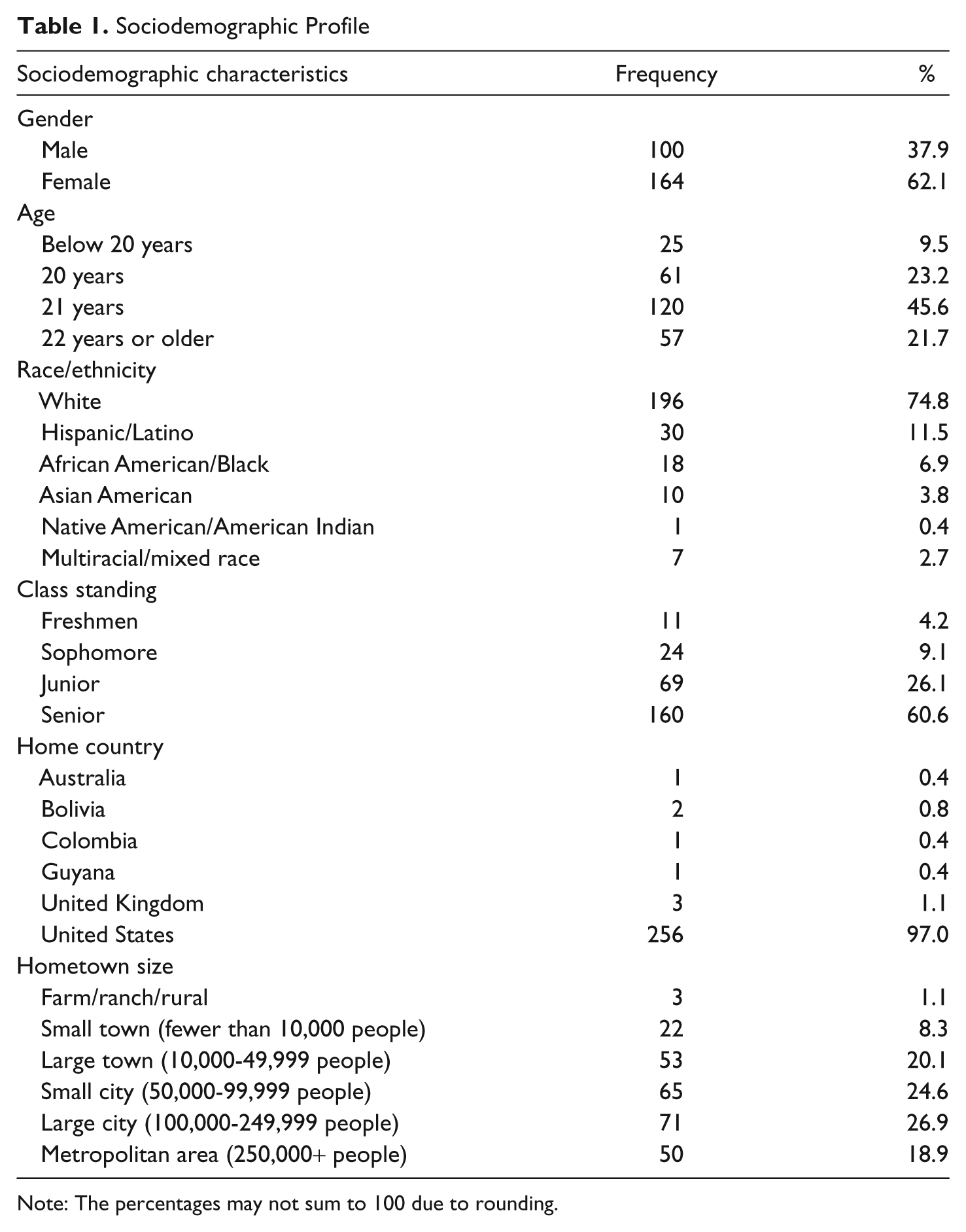
Note: The percentages may not sum to 100 due to rounding.
Research Question 1: Volunteering Characteristics
In the 12 months prior to the study, 80.0% had volunteered, and more than half of those volunteered for two or more organizations in that time period. In addition, 39% reported to have volunteered independently, outside of an organization. Moreover, 41.6% of respondents spent between 1 and 5 hr per month volunteering, whereas 14.8% spent less than 1 hr per month. More than half of the respondents began volunteering between 2001 and 2005, and 36.3% began between 1996 and 2000. For the majority of respondents, these years represent the time spent in high school.
More than 97% of respondents volunteered in high school, and 88.7% were required to participate in a compulsory volunteer program such as “Service Learning” or “Community Service Hours.” Of those, 82.6% served beyond the mandatory requirement. Family was responsible for introducing 40.2% to volunteerism, while teachers (23.4%), friends (15.9%), and religious leaders (11.2%) accounted for more than half. Nearly three fourths of respondents volunteered in natural areas (e.g., parks, beaches; see Table 2).
Volunteer Characteristics

Note: The percentages may not sum to 100 due to rounding.
In addition, the majority (60.6%) of respondents volunteered between 1 and 5 hr per week, whereas 41.7% noted between 26 and 50 hr per year. About 27.9% noted to have spent more than 8 years in volunteering followed by 24.5% (5-6 years). Organizations that focus on human services (41.3%) and educational (29.1%) were reported as the most important type of organization to volunteer. Finally, respondents noted their most significant contribution to the respective volunteered organization was time (54.5%), which includes attending meetings, serving on a committee, fundraising activities, and the like (see Table 3).
Volunteer Scope, Segment, and Contribution

Note: The percentages may not sum to 100 due to rounding.
Multiple responses.
Research Question 2: Motivations to Volunteer
First, a descriptive analysis with mean scores of each item was conducted. Items with the highest means were, “I feel it is important to help others” (M = 5.91), “I am concerned with those less fortunate than myself” (M = 5.73), “I can do something for a cause that is important to me” (M = 5.73), “I am genuinely concerned about the particular group I am serving” (M = 5.66), and “Volunteering allows me to gain a new perspective on things” (M = 5.64). Items with the lowest means were, “I feel volunteering is a religious duty” (M = 3.51), “By volunteering, I feel less lonely” (M = 3.60), “Volunteering is a good escape from my own troubles” (M = 3.79), “Doing volunteer work relieves me of some of the guilt over being more fortunate than others” (M = 3.79), and “Volunteering helps me work through my own personal problems” (M = 4.00).
Second, an exploratory principal component analysis using varimax rotation was employed which yielded five dimensions: values and understanding, protective, social, career, and enhancement. The results differs from the original study where the authors found six dimensions but was acceptable as it was noted that more or fewer dimensions are likely to be found when used on unique populations (Clary et al., 1998). Prior to this study, the VFI had rarely been used to measure volunteer motivation on a sample including only undergraduate college students who were all active in volunteering. The items within each dimension were checked for internal consistency based on Cronbach’s alpha.
The values and understanding dimension (α = .92) composed of 11 items that related to helping others and expanding one’s own perspective on an issue. The protective dimension (α = .89) consisted of six items that dealt with using volunteerism as a way to escape from one’s own troubles. The social dimension (α = .87) composed of six items that involved social interactions and doing something that was seen as important to the volunteer’s social circle. The career dimension (α = .87) composed of six items that related to development of skills or network for the purpose of furthering one’s career. Finally, the enhancement dimension (α = .82) dealt with personal growth and development. Following reliability analysis, the mean values of the items were computed to devise a single composite index score for each of the five dimensions. The values and understanding dimension scored the highest among respondents (M = 5.45), followed by career dimension (M = 4.72), enhancement dimension (M = 4.70), social dimension (M = 4.07), and protective dimension (M = 4.01; see Table 4).
Factor Loadings for Volunteer Motivations

Items coded on a 7-point scale from not at all important (1) to extremely important (7).
As the values and understanding dimension involved helping others and giving back to society, this supports the findings of Astin and Sax (1998) that students were strongly committed to helping others, serving in their communities, promoting racial understanding, doing volunteer work, and working for nonprofit organizations (Astin & Sax, 1998). Clary and Snyder (1999) also found that the values and understanding dimensions were the highest among respondents, though in their study, values and understanding represented two separate dimensions. Conversely, on comparison to this study, the career dimension did not rank high among volunteers. According to Clary et al. (1998), people can be recruited into volunteer work by appealing to their own psychological functions or motives. As values and understanding rated the highest among respondents, this statement was supported by the fact that human services organizations were the most popular. The motives represented by the items in the values and understanding dimension can all be satisfied by volunteering for human services organizations. The main goals of such organizations are to help other people and to give back to the community.
The strength of the items in the career dimension seems to be somewhat unique to this demographic (i.e., college students). This finding suggests that college students are more interested in furthering their career paths through volunteerism than the general population. This could be due in part to the fact that most college students are not currently employed full time, whereas the majority of nonstudent volunteers are employed or retired. Nonstudents may have less of a need to volunteer to enhance their résumés, build social networks, or explore new careers. College students may be more concerned about building their résumés than other volunteer populations, which would help to explain the higher scores in the career dimension found by this study. Similar results have been found in other studies of college students (Handy et al., 2010; Hustinx et al., 2010; Musick & Wilson, 2008).
Research Question 3: Constraints to Volunteer
First the mean values of the constraint items were computed. The items with the highest means were, “I have too many other commitments” (M = 3.25), “I have no time to volunteer” (M = 3.00), and “I am unaware of opportunities to volunteer” (M = 2.50). Items with the lowest means were, “I have an injury, handicap, or ill health” (M = 1.63), “I do not feel safe at volunteer sites” (M = 1.64), “My family does not volunteer” (M = 1.69), and “I do not have the necessary skills” (M = 1.69).
Second, due to the validity of the three dimensions of constraints (Gilbert & Hudson, 2000; Jackson, 1994; Nyaupane et al., 2004; Pennington-Gray et al., 2002), a factor analysis was not conducted but each dimension was checked for internal consistency using Cronbach’s alpha. Intrapersonal constraints (α = .73) composed of five items that represented potential barriers that involved only the individual in question. Interpersonal constraints (α = .84) composed of five items which dealt with the perception of constraints to other individuals. Finally, structural constraints (α = .67) composed of five items that reflected external barriers to participation. Following reliability analysis, the mean values of the items were computed to devise a single composite index score for each of the three dimensions. Mean scores ranged from 1.00 to 3.67 with a mean of 2.13 for the entire sample. Structural constraints (M = 2.54) were the strongest dimension whereas interpersonal constraints (M = 1.98) and intrapersonal constraints (M = 1.87) demonstrated relatively weak mean values (see Table 5).
Reliability Analysis for Constraints Dimensions
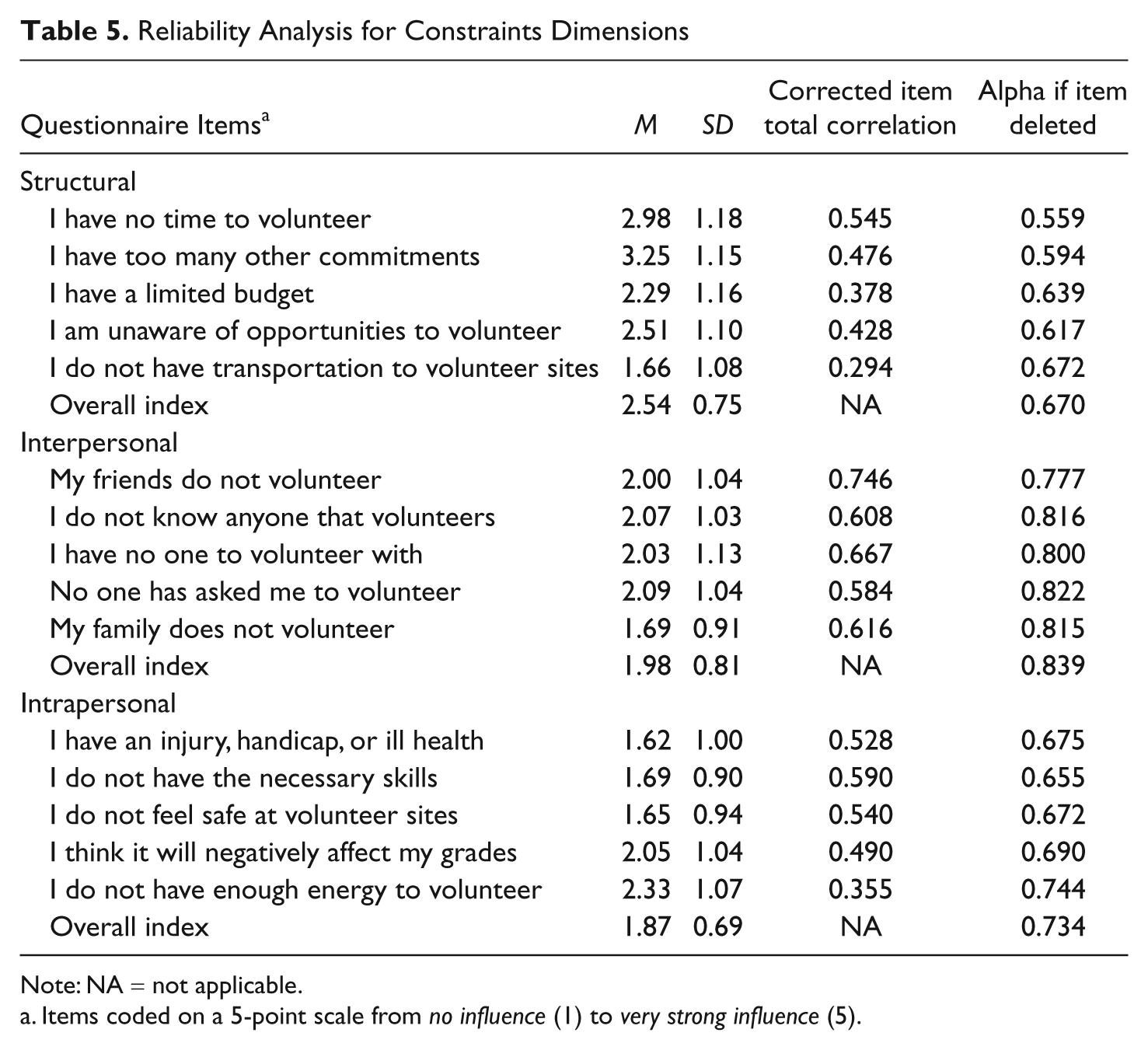
Note: NA = not applicable.
Items coded on a 5-point scale from no influence (1) to very strong influence (5).
This finding supports the hierarchical model of constraints as proposed by Crawford et al. (1991) which states that intrapersonal constraints are the first to be encountered and the easiest to overcome, whereas structural constraints are the most difficult to negotiate. It was reported that the most common objection that college students have toward volunteering is that it consumes time and energy that might otherwise be devoted to academic pursuits (Astin & Sax, 1998). As these items represent structural constraints, the results of this analysis support this statement.
Research Question 4: Volunteer Motivations and Constraints
The association between volunteer motivations and constraints was examined with bivariate linear correlation analysis between the five motive dimensions and the three constraint dimensions using Pearson’s r correlation coefficients. Based on the results, 5 out of the 15 relationships were statistically significant. The intrapersonal constraints dimension was positively correlated with the social (r = .18), protective (r = .16), and enhancement (r = .14) motivation dimensions. The findings indicated that as intrapersonal constraints increased, social, protective, and enhancement motivations also increased. However, the values and understanding motivation dimension was negatively correlated with both the interpersonal (r = –.22) and structural (r = –.15) constraints dimensions. This finding denoted that as interpersonal and structural constraints increased, the values and understanding motivations simultaneously decreased. Furthermore, there were lack of statistically significant relationships between the career motivation dimension and any of the constraints dimensions (see Table 6).
Correlations Between Volunteer Motivations and Constraints

Significant at the .05 level (two-tailed). **Significant at the .01 level (two-tailed).
Discussion
In this study of college students, an overwhelming majority (80%) had volunteered in the past year with more than half volunteering for two or more organizations. These numbers are very encouraging and reflect, in part, the 97% of respondents who had volunteered in high school on their own or as part of a compulsory volunteer program. The findings resonate with the literature as 90% of college students reported to have volunteered in some capacity (Carlo et al., 2005). Also, the most important factor influencing volunteerism in college is whether the student volunteered in high school (Astin & Sax, 1998). In this study, the role of family as an influencing factor was a major reason to volunteer, and the majority (75%) noted volunteering in natural areas (e.g., parks, beaches). Most respondents volunteered for human services (59%) and educational (57%) organization, whereas few volunteered for political (13%) or environmental (20%) organizations. This finding was unexpected as the study was conducted during a historic election year in which students were reported to have been particularly active.
This study found five motivational and three constraint dimensions with respect to volunteerism among college students. Furthermore, several significant relationships were found between motivation and constraints. Correlations were identified between the values and understanding dimension and structural and interpersonal constraints, and between intrapersonal constraints and the social, protective, and enhancement dimensions. Interestingly, no relationship was found between the career dimension and any constraints category. As this sample consisted entirely of college students preparing for their future careers, it seems likely that no constraints category was sufficiently strong enough to discourage participation in activities that were perceived to lead to achieving these goals.
These relationships indicated that social interaction was important for this sample. In the first relationship, as the respondent perceives higher levels of constraints for friends and family (interpersonal constraints), they are less motivated to help other people and serve the community (values and understanding function). This is interesting because the values and understanding was the strongest motivation function. This finding may be an indication that the items represented by the values and understanding function (altruistic in nature) are not as important to the individual as reported. Rather, they are perceived as being important to those around the individual and by volunteering, the individual is able to improve the way others perceive them. This supports the altruistic deception construct presented by Francies (1983), whereby people tend to socially portray their volunteer work as being altruistic, regardless of any other actual reason for engaging in the activity.
In addition, as the respondent perceives more structural constraints (lack of time, money, transportation, etc.), they are less motivated by values and understanding items. This supports Martinez and McMullin (2004), who found that efficacy (values and understanding items) had the greatest effect on the decision to be active in a volunteer organization and that competing commitments (structural constraint) had the most influence on the decision not to participate. This could be attributed to a desire to fulfill one’s own needs before serving others. If an individual perceives that spending time, money, or resources volunteering will have a negative impact on themselves or their friends and family, they will be less motivated to use those resources in serving others. It is difficult to convince a person to suppress their desire to advantage themselves and their own families in favor of advantaging the group (Fennell, 2008). The literature has stated that although altruism may lead a person to volunteer initially, self-interested motivations are more important for continued participations (Ryan et al., 2001). Values and understanding motives may not be strong enough on their own to overcome certain structural constraints. Hustinx and colleagues (2010) suggest that this trend may be more apparent in a liberal regime such as the United States, rather than in more collectivistic societies such as China.
Furthermore, as intrapersonal constraints increase, social motivations also increase. The finding shows that students who perceive a high level of intrapersonal constraints may rely on the support of the people around them to volunteer. As shown in the previous relationship, if that support is not available (an interpersonal constraint), the individual may not be able to successfully negotiate the constraints hierarchy and participate in volunteerism. Similarly, Wickham and Graefe (1998) found that in addition to altruistic and egoistic motives, some volunteers desire a social setting in which to interact with other people. It seems likely that this social interaction may be more important to some student volunteers than other motives. It has been stated that people may initially participate in volunteer programs for altruistic reasons but are more likely to stay active if they perceive other benefits (such as social benefits) as well (Ryan et al., 2001).
Volunteer managers should be aware of these relationships and promote volunteer activities to address them. Programs should highlight the importance of the program and offer awards or recognition to volunteers. Public recognition serves the need for peer support, acknowledgement, and other social benefits while appealing to the volunteers desire to satisfy values and understanding motives as well. This can create more incentive to overcome interpersonal and structural barriers. Social relationships, learning, and project organization have all been shown to be significant predictors of continued participation (Ryan et al., 2001), which suggests that organizations need to have a dynamic program that meets the changing motivations of volunteers as time progresses.
It has been illustrated that an individual’s motivation to volunteer is a better predictor of future behaviors than current volunteer activities as the extent of one’s current behaviors is often influenced by the amount of time an individual has for volunteering (Burns et al., 2005). Volunteer managers should provide programs that make the most use of a volunteer’s time. Programs should focus not only on organizational benefits but also on reduction of volunteers’ structural constraints. Respondents in this study indicated that lack of time was a major constraint to volunteerism. They would rather spend their time studying, socializing, or advancing their career goals. Volunteer managers could design programs that incorporate relevant learning, socialization, or networking into their programs, thereby reducing a major structural constraint and satisfying additional motivation goals. Managers must recognize that the activity of volunteering may not be as important to the individual as the meaning derived from the activity (Mannell & Kleiber, 1997). In many cases, volunteerism means not only helping others but also achieving personal benefits. To overcome constraints, potential volunteers must be aware of opportunities to achieve these personal goals through participation in volunteer programs.
These findings are not generalizable to the general population of college students because the sample was drawn from one university. In addition, the study relied on self-reported measures of motivation and volunteer behaviors which can be subjected to degrees of bias. Furthermore, the majority originated in one state in the southeast, where compulsory volunteerism is a standard in most high schools. This could have had a significant impact on volunteerism in college and further limits the generalizability of these results.
Future Research
Due to the exploratory nature of this study, further research on motivations and constraints to volunteerism among undergraduate students is needed among other student populations to verify these results. Additional research should compare motivations and constraints of current student volunteers with the following: (a) those who have volunteered in the past but are no longer active; (b) nonstudents in the same age range; and (c) participants in Service Learning or other compulsory volunteer programs and volunteers who were introduced to service by other means. Research could also be conducted to identify the functions served by different volunteer organization types. If different volunteer segments satisfy different motivations, volunteers could be matched up with organizations that would fulfill their personal needs, while still accomplishing organization’s goals. It is evident that motivations and constraints play a role to determine whether an individual will volunteer. High levels of motivations do not ensure participation, whereas high levels of constraints do not necessarily prevent it. Further research is needed inclusive of sociodemographic factors to understand that interplay of motivations and constraints in the decision to volunteer.
The social nature of the relationships between motivations and constraints is a new finding and shows that college students are a unique demographic with respect to volunteerism. These relationships should be explored to gain a better understanding of the factors that motivate and constrain volunteerism. Values and understanding are consistently reported as being the most important motivations, but analysis has shown that the altruistic nature of these motivations may mask other underlying motives. Future research could focus on how peer perception and other social influences affect volunteer motivation.
Overall, the VFI and three-dimensional constraints model have proven to be useful tools in the examination of the motivations and constraints to volunteerism among college students. However, it has been stated that the structural constraints dimension may be more complex than originally conceptualized and should be reexamined and possibly expanded to two or more separate dimensions (Nyaupane et al., 2004; Thapa et al., 2002). Thapa et al. (2002) suggested personal structural constraints associated more with the individual and environmental structural constraints geared more toward the activity setting. Volunteerism research may benefit from this line of conceptualization and analysis. In addition, there may be other factors that were not included in this study and could be further developed.
Footnotes
The author(s) declared no potential conflicts of interest with respect to the research, authorship, and/or publication of this article.
The author(s) received no financial support for the research, authorship, and/or publication of this article.