



Abstract
This study explores the antecedents to trust among the participants in a cross-sectoral interorganizational network. We offer hypotheses for nine potential antecedents of trust divided into three categories: attributes of the trustor, of the trustee, and of their relationship. We analyzed dyadic data collected from a network of community-based organizations collaborating to promote change in a south Los Angeles community. The results of our analysis reveal that trust building is not a simple process but results from a combination of attributes of trustors, trustees, and their relationships. Trustors’ general tendency to trust other participants in the network, trustees’ reputation in the network, whether a trustee is from the same sector as the trustor, whether a trustee is important to the trustor, and the multiplexity of interactions between a trustor and trustee significantly influenced the level of trust. Some suggestions for developing trust among participants in such networks are offered.
A trend toward broader use of cross-sectoral interorganizational networks to achieve various public purposes is readily apparent (Bryson, Crosby, & Stone, 2006). This includes growing popularity of such networks in the context of efforts to bring about improvements in the delivery of public services and the quality of community life (Agranoff & McGuire, 2003; Kernaghan, 2009; Mandell, 2001). It is quite common now for community-based nonprofit organizations to be involved in one or more alliances with public agencies, other nonprofits, and sometimes private businesses, working together to address common concerns and/or identify viable approaches for generating desired changes. The focus of these collaborative endeavors can be quite broad and diffuse, as in the case of comprehensive community initiatives that aim to address the social, physical, and economic needs and circumstances of people in a community (Chaskin, Joseph, & Chipenda-Dansokho, 1997; Jackson & Marris, 1996); more targeted, as in the case of community health partnerships that aim to improve the quality of health among community members (Mitchell & Shortell, 2000; Roussos & Fawcett, 2000); or fairly narrow, as in the case of service delivery networks whose goal is to provide integrated services to a particular client base (Chen, 2008; Robertson, 1998).
While collaborative networks are frequently viewed as having considerable potential for being able to effect meaningful change and improvement, the reality is that the results generated through the activities of these networks are often quite limited. The potential for “collaborative advantage” that can be generated through the interactions of network members is too readily constrained by “collaborative inertia” that slows the rate of progress and/or leads to negligible output (Huxham, 2003). While a number of factors can undermine the effectiveness of a network, a primary challenge stems from the fact that such networks are usually composed of people from organizations with diverse backgrounds, perspectives, and interests, trying to balance their involvement in the network with their own desire for autonomy (Provan & Milward, 2001). The tensions and conflicts inherent in these situations can readily cause process problems (Briggs, 1998; Bryson et al., 2006; Chaskin, 2005) that preclude network members from working together effectively enough to have much success.
Given the many challenges involved in getting independent organizations to work cooperatively toward some shared objectives, it is clear that trust among network members plays an important role in facilitating collaborative dynamics that enable positive outcomes to be achieved more readily (Bardach, 1998; McGuire, 2006; Provan & Kenis, 2007; Vangen & Huxham, 2003). Trust helps to maintain cohesion among network members (Agranoff & McGuire, 2001) and enables them to avoid or address potential conflicts and to achieve needed cooperation (Hosmer, 1995; Isett & Provan, 2005; Ring & Van de Ven, 1994). Networks composed of members who trust each other require fewer resources on the part of network managers, as they can have greater confidence that others share common purposes and beliefs (McGuire, 2002). Even institutionally adversarial parties (e.g., labor and management) can more readily find shared interests and develop cooperative relationships as interpersonal trust increases through daily interactions (Ospina & Yaroni, 2003).
While trust is a significant factor shaping network dynamics, it has been studied more frequently in private sector networks, maybe because it is more critical and harder to obtain in this more competitive context. However, it is important to have a good understanding of the conditions giving rise to trust in cross-sectoral networks as well, as participants are likely to perceive a mix of motives and agendas that leave them uncertain as to who they should and should not trust. Yet only a few studies have investigated the antecedent conditions leading to trust among participants in more publicly oriented networks, especially those involving nonprofit organizations. For example, Hansen (2010) investigated the effect of facilitative management practices on the level of trust between nonprofit organizations collaborating in an antiwar campaign. Snavely and Tracy (2002) examined how government policy mandates, nonprofit leadership, and rural location influenced trust building among nonprofit and public organizations. Willem (2010) investigated how mandates the public sector imposed on network participants to safeguard the creation of public value impeded trust building among participants.
While such contextual factors can be meaningful determinants of the level of trust among network members, these studies fail to take into account the attributes of the people and/or organizations directly involved in the (potentially) trusting relationship. Although contextual conditions can influence the overall level or likelihood of trust among network participants, there is also typically variation within a network in terms of the level of trust between any two participants. Variation in trust levels across network dyads is likely to be a function of characteristics of the two parties involved as well as of their unique relationship. The purpose of this study is to explore a more complete set of potential antecedents of the level of trust reported among participants in a community-based, cross-sectoral, interorganizational network.
Theoretical Foundations
Trust among members of groups, organizations, networks, and communities has been a popular topic among scholars in various social science disciplines (Kramer & Tyler, 1996; Rousseau, Sitkin, Burt, & Camerer, 1998). Many researchers have become interested in trust because of its relevance to the notion of social capital. Social capital refers to the knowledge, skills, and resources available to an actor, derived from its network of social relationships, that it can draw on to accomplish its objectives (Baker, 1990; Bourdieu & Wacquant, 1992). Social capital has been identified as an important factor influencing outcomes at various levels of analysis (Brehm & Rahn, 1997; Lin, Cook, & Burt, 2001; Nahapiet & Ghoshal, 1998; Putnam, 1993). In particular, it has been identified as a key ingredient in the success of community change and development efforts (Dale & Newman, 2010; Gittell & Vidal, 1998; Potapchuk, Crocker, & Schechter, 1997). While social capital is a broad, multifaceted concept, it seems to be related to, and maybe to an extent dependent on, the level of trust among members of the collective (Fukuyama, 1995; Onyx & Bullen, 2000; Veenstra, 2002).
A comprehensive definition of trust can be found in the work of Mayer, Davis, and Schoorman (1995). They view trust as
the willingness of a party to be vulnerable to the actions of another party based on the expectation that the other will perform a particular action important to the trustor, irrespective of the ability to monitor or control that other party. (Mayer et al., 1995, p. 712)
This perspective suggests that trust yields voluntary cooperation (Hosmer, 1995) based on the willingness of the trusting person to cooperate in spite of perceived risks (Johnson-George & Swap, 1982; Kee & Knox, 1970). The basis of this voluntary choice lies not on the ability to monitor or control others but on one’s confidence in another’s goodwill. Research on the relationship between trust and organizational outcomes suggests that trust is an alternative to direct control via the use of bureaucratic rewards and sanctions. In contrast, a lack of trust within an organization can lead to excessive micromanagement that undermines efficiency, flexibility, and adaptability (Behn, 1995). Thus, in the context of devolutionary and participative organizational changes, fostering trust among people may be a better strategy for managing them effectively than primary reliance on hierarchical mechanisms (Bradach & Eccles, 1989; Hosmer, 1995; Lane & Bachmann, 1996; Morgan, Bacon, Bunch, Cameron, & Deis, 1996; Zaheer & Venkatraman, 1995).
Trust is particularly important in the context of interorganizational networks, given that the involvement of participants and their mutual cooperation are voluntary. O’Toole (1997) noted that, in these situations, managerial action guided by assumptions of hierarchy can be counterproductive and that public managers should instead help to find common ground, build trust, and develop supportive coalitions. Astley and Fombrun (1983) demonstrated that it is easier to form collective strategies when organizations trust each other. For example, in the rebuilding effort after hurricanes Katrina and Rita, organizations with preexisting relationships based on respect, trust, and familiarity were able to capitalize on such relationships when the rebuilding began (Simo & Bies, 2006). Likewise, Lundin (2007) found that trust positively affected the level of cooperation among Swedish local offices that had similar objectives with regard to implementing labor market policy. Trust also facilitates collective learning (Dodgson, 1993) by encouraging participants to disclose and exchange fine-grained information transparently (Hamel, 1991; Muthusamy & White, 2005; Sako, 1992; Uzzi, 1996), enabling collaborative networks to implement creative and innovative solutions through which to pursue their objectives.
Given interdisciplinary interest in the topic of trust, research on its causes and consequences has explored these relationships at multiple levels of analysis. Rousseau et al. (1998) argue that trust can be thought of as a “meso” concept that integrates microlevel psychological processes and group dynamics with macrolevel institutional arrangements. Just as microlevel trust relationships are constrained and enhanced by macro processes, “Conversely, broader forms of trust, particularly between firms, can be influenced by microlevel arrangements—in particular, how individuals representing each firm relate to each other” (Rousseau et al., 1998, pp. 397-398). In the context of interorganizational networks, then, the trust relationships among participants in the network invariably reflect a mix of factors operating at both the individual and organizational levels of analysis. Thus, in the following explication of the rationale for hypotheses regarding potential antecedents of trust in a cross-sectoral network, we draw on literature pertaining to both interpersonal and interorganizational trust.
Antecedents of Trust
There is a broad array of theoretical and empirical research that provides insights regarding potential antecedents of trust in the context of community-based collaborative networks. Drawing on this literature, we develop a model that focuses on three categories of antecedents to trust: trustor attributes, trustee attributes, and relational attributes.
Trustor attributes
Early researchers studying trust tended to conceptualize it as a behavioral tendency stable across different situations, thereby characterizing it essentially as a dispositional attribute of a trustor that influences the likelihood that he or she is likely to trust other people. From this perspective, whether people trust or distrust others is attributable to a stable personality trait, such that those who generally trust other people will be more likely to trust specific others in a given situation as well. Indeed, some empirical studies have found that individual differences in this general tendency to trust do exist (e.g., Sorrentino, Holmes, Hanna, & Sharp, 1995). Rotter (1967) provided an early explanation of the basis for these individual differences in the tendency to trust other people. He argued that people’s past experiences form a “generalized expectancy,” that is, a belief as to what can generally be expected from unspecified others. This generalized expectancy, in turn, is extended toward specific others with whom one currently interacts. As a result, a trustor’s history of positive or negative experiences in relationships with others creates an expectation that is readily transferred to new people with whom he or she interacts in similar situations. Mayer et al. (1995) posited that this general propensity to trust explains some of the variance in the levels of trust demonstrated in interpersonal relationships, and empirical research has found it to be associated with trustworthy behavior (Glaeser, Laibson, Scheinkman, & Soutter, 2000) and trusting choices (Evans & Revelle, 2008).
Hypothesis 1: Participants’ general propensity to trust is positively related to their level of trust of specific partners in the network.
The level of trust among network participants could be affected by how proactively they are involved in the network collaboration. Empirical studies have shown that people’s degree of participation in community activities or civil society affects their propensity to trust (Shah, 1998; Stolle, 1998; Veenstra, 2002), partly because participation in these activities allows them to gain positive experiences with others and thus helps them appreciate the trustworthiness of people in general (Shah, 1998). Furthermore, those who engage in more civic activities are more readily socialized as good citizens, such that they are more likely to have positive attitudes toward society and people in general (Stolle, 1998). This positive attitude toward others leads people to be trusting more consistently across a variety of situations (Rotter, 1967).
Hypothesis 2: Participants’ level of involvement in the network is positively related to their level of trust of their network partners.
Trustee attributes
Most organizational researchers have viewed the attributes of trustees as the key determinants of how much they are trusted. Reflecting the premise that people are more likely to trust someone who is trustworthy, researchers have endeavored to identify individual characteristics that give rise to perceptions of trustworthiness. Based on their review of relevant literature, Mayer et al. (1995) identified three primary components of trustworthiness, namely, ability, benevolence, and integrity. In the context of a network, assessment of others’ trustworthiness often relies on their reputation (Putnam, 1993). Especially when choosing those with whom to start collaborating, potential partners’ reputation is often a primary basis for gauging their trustworthiness (Kollock, 1994). For example, Uzzi’s (1996) study of relationships among apparel firms found that the establishment of a new relationship was often based on a referral from a third person who had interacted with both potential partners. Furthermore, given a tendency for reputation to spread within a network, partners who are viewed as trustworthy by some network participants are likely to be viewed as such by others as well. For these reasons, Butler and Cantrell (1984) measured trustworthiness in part by trustees’ reputation regarding their honesty and truthfulness.
Hypothesis 3: Participants’ reputation within the network is positively related to the degree to which they are trusted by their partners in the network.
One of the important drivers for nonprofits to form alliances with other organizations is the possibility of using resources embedded in the network or of learning from other organizations how to improve their own practice (Sowa, 2009). In this context, organizations may want to collaborate with leading organizations that have expertise and know-how specific to their fields. These leading organizations also have some motivation to collaborate with a greater number of other organizations in the network, as proactive involvement in the network is a way for them to maintain their own reputation in the field (Sowa, 2009). Given these motivations underlying organizations’ networking activity, those participants connected to a large number of others in the network are more likely than peripheral participants to be perceived as competent. Since competence is a domain-specific facet of trustworthiness, these central organizations are likely to be trusted more by others in the network.
Hypothesis 4: Participants’ level of involvement in the network is positively related to the level to which they are trusted by their partners in the network.
Another signal used to assess potential partners’ trustworthiness is their relationship with certain groups. For example, association with reliable entities can be seen by others as a good signal of one’s capability (Sydow, 1998). Likewise, involvement in groups that are compatible with the trustor’s values or principles can be taken as an indicator of the trustee’s integrity. Furthermore, the shared norms of obligation and responsibility that develop among members of a common social group are a key determinant of trust building (Bradach & Eccles, 1989; Powell, 1990). Williams (2001) posited that the degree to which people identify themselves with a certain group will influence their affect for group members, and this affective response will eventually enhance their beliefs about members’ trustworthiness. For participants in a cross-sectoral network, one type of affiliation that might shape the level of trust is the sector of the partner organization. To the extent that organizations in the same sector as the trustor are more likely to be seen as having compatible goals, values, and perspectives, it may be easier to trust them than organizations from a different sector.
Hypothesis 5: Participants have higher levels of trust for network partners from the same sector as their own organization.
Another factor that might influence the level of trust felt toward a network partner is its importance to the trustor. Numerous scholars have emphasized the role that mutual dependence or interdependence can play in building trust among partners in interorganizational networks (e.g., Ring & Van de Ven, 1994; Zaheer, McEvily, & Perrone, 1998). Dependence implies that one partner has a need and the other partner has what it takes to help address that need, such that mutual dependence provides a potent precondition for trust to exist between partners (Rousseau et al., 1998). This trust is likely to be more robust when the degree of interdependence is high enough, and thus the relationship important enough, to motivate people to act in a trustworthy manner. Hardin’s (1992) conception of trust as “encapsulated interest” reflects this notion that dependence on each other plays a central role in maintaining a trusting relationship. In short, more trust might be expected when collaboration with a partner is important to the trustor.
Hypothesis 6: Participants have higher levels of trust for network partners with whom they have a relationship that is important to their own organization.
In addition to interdependence, shared common purpose between partners may be an important precursor to a trusting relationship. Interdependence may simply mean that both parties can fulfill their needs by engaging in some kind of joint activity that neither party can accomplish by itself, even though they do not necessarily agree on the purpose of that activity. However, an incompatibility in their missions can be a source of discrepancies in their approaches to the issue they are addressing, and thus a potential cause of conflict that undermines the level of trust between the partners. On one hand, public and nonprofit organizations are often driven by mission, with the very existence of a nonprofit often dependent on its faithfulness to its mission. On the other hand, collaboration among nonprofits is a dynamic process in which the specific objectives or activities of a joint program are likely to change over time based on evaluations or assessments of how effectively the program has achieved its intended outcomes. To the extent that their missions are aligned, this process of adaptation and mutual adjustment can be relatively easy and harmonious. However, without such alignment, organizations may fear that collaboration with other organizations will result in a loss of organizational identity or their distinct reason for existence (Schindler-Rainman, 1981). In this way, the degree to which partners’ missions are aligned is likely to influence the level of trust in their relationship.
Hypothesis 7: Participants have higher levels of trust for network partners that have a mission compatible with that of their own organization.
Relational attributes
Organizational behavior research provides support for the idea that trust grows out of regular and stable interactions among people. For example, Rousseau (2004) argued that the norms produced via repeated interactions help to establish a stable and open-ended commitment, that is, loyalty, in contrast to legally bound relationships with little interaction that often result in fragile commitment that is limited and short term (Sitkin & Roth, 1993).
Regular interactions support the development of loyalty and trust due in part to the fact that repeated interactions cast a “shadow of the future” (Axelrod, 1984; Heide & Miner, 1992) that reduces incentives for opportunism and motivates people to act in a trustworthy manner in the present so as to maintain their reputation in the future (Lahno, 1995; Putnam, 1993). Collaboration or even altruism can be reasonable behavior when relationships with others are expected to persist, whereas opportunism or other behavior that undermines trust may preclude the ongoing benefits from these relationships. Stable, regular interactions also give trustors more complete information about the trustworthiness of their partners. In contrast to the importance of reputation effects in the early phase of a relationship, repeated interactions can provide richer and more reliable information on which to make confident assessments regarding who can or cannot be trusted. Confidence in one’s expectations regarding another’s actions is an important determinant of trust (Coleman, 1990; Cook & Wall, 1980; Deutsch, 1960; Frost, Stimpson, & Maughan, 1978).
Hypothesis 8: The regularity of interaction between network partners is positively associated with the level of trust between them.
Organizations can engage in a variety of different types of interactions with each other, and the notion of “multiplexity” (Burt, 1980) refers to a relationship in which partners interact in multiple ways. On a personal level, for example, two individuals who interact both at work and socially have greater multiplexity than those who interact in just one of the two contexts. Organizations collaborating in a network may, for example, share information or resources with each other, provide services together, and/or engage in joint lobbying activities, and the more of these different types of interactions reflected in a particular relationship, the greater its multiplexity. Alliances between organizations often require a resource commitment and some loss of autonomy (Zajac & D’Aunno, 1993). As a multiplex relationship typically reflects a higher level of commitment and need for adaptation to each other, it tends to support the development of higher levels of trust. Multiplex alliances often evolve gradually from a rudimentary relationship to a more complex entanglement that requires greater commitment (Snavely & Tracy, 2002). The evolution of these relationships naturally proceeds apace with the development of trust between the partners (Ring & Van de Ven, 1994), as decisions to expand their collaboration into a new dimension would likely depend on adequate trust having been generated in previous stages of their relationship.
Hypothesis 9: Relationship multiplexity between network partners is positively associated with the level of trust between them.
Given the above hypotheses, the purpose of this study is to contribute to a better understanding of the antecedents of trust in community-based, cross-sectoral, interorganizational networks. To investigate this issue, we focus on the level of trust at the dyad level, as reported by a set of trustors with regard to their relationships with a set of trustees. We examine the impact on trust of the potential antecedents identified above, including attributes of the trustor, the trustee, and their relationship.
Method
Data and Sample
The network of interest in this study was convened by Community Health Councils, Inc. (CHC), a Los Angeles–based nonprofit organization that focuses on improving the quality of health care and health outcomes among priority populations in the community it serves. CHC was one of 35 organizations in the United States selected in 1999 to participate in Racial and Ethnic Approaches to Community Health (REACH) 2010, a national demonstration project managed by the Centers for Disease Control and Prevention (CDC). The primary objective of REACH 2010 is to mobilize communities to identify and secure resources to support programs that eliminate the health disparities experienced by racial and ethnic minorities. CHC’s project, African Americans Building a Legacy of Health (AABLH), was one of 24 projects selected by CDC in 2000 for subsequent implementation.
To develop and implement its REACH 2010 community change approach, local organizations and individuals committed to reducing health disparities in the South Los Angeles African American community (focusing specifically on cardiovascular disease and diabetes) were invited by CHC to participate in the AABLH coalition. Through a year-long planning process, this coalition developed a community action plan that specified a number of strategies intended to help accomplish its mission, such as improving the quality and availability of healthy foods in local markets, restaurants, and schools; establishing organizational wellness programs and increasing opportunities for physical activity; providing workshops and other educational sessions; and facilitating community discussions and supporting community empowerment. CHC activities designed to broaden community participation in the AABLH campaign have included awarding minigrants to community organizations to support activities aligned with project objectives; engaging community members in the research process to collect data necessary for planning and evaluation; soliciting sponsors from the business community to support AABLH activities; and hosting quarterly consortium meetings to enable the exchange of information with community members.
The model developed for this study was examined using data collected from representatives of participant organizations in the network who attended a CHC consortium in November of 2005. At this consortium, the attendees were asked to complete a survey questionnaire in which they provided information about the relationships between their own organization and their collaboration partners. They were given a list of organizations involved in the REACH 2010 project and were asked to specify whether they had any of four types of working relationships with these organizations. They also were asked to provide information regarding the regularity and importance of these relationships as well as their level of trust in their partner organizations. Surveys were completed by 23 respondents, providing data on the nature of their relationships with 39 organizations involved in the AABLH campaign. The questionnaire also asked for some information about the respondent and his or her organization. The survey yielded a data set of 897 dyads among the organizations in the network (23 respondents multiplied by 39 organizations), 231 of which were included in the analysis (as explained below).
Since the dependent variable, trust, in our study is nested within higher level units (i.e., the trustors), the trust scores rated by the same trustor are not independent observations, which renders the conventional inferential statistics unusable. To resolve this problem, we analyzed the data using ordinal hierarchical linear modeling (HLM). The HLM is known to estimate unbiased parameters when observations are nested within higher level units (Bryk & Raudenbush, 1992). This analytic approach has been used in a number of studies estimating dyad-level effects within egocentric networks (e.g., Chua, Ingram, & Morris, 2008; Wellman & Frank, 2001).
Trust
Respondents were asked to rate their level of trust in their partner organizations using a 4-point scale from 1 = little to 4 = high, and this score is the dependent variable in the analysis. Most of the respondents provided a rating for trust only if they had at least one type of working relationship with that organization. The large majority of the dyads (n = 655) did not entail any working relationships and thus did not have a trust score either, so these dyads were not included in the analysis. A few dyads (n = 11) did have some type of working relationship but no trust score was reported, so these were omitted from the analysis as well. Of the remaining dyads, most (n = 196) involved at least one working relationship and also included a trust score, and these comprise the bulk of the sample. However, a number of dyads (n = 35) did not have any working relationship, yet the respondent (i.e., the trustor) rated his or her trust in the organization (i.e., the trustee) anyway. As such trust could feasibly be based on factors other than having a direct working relationship with the organization, including other antecedents we are investigating, we decided to include these dyads in the analysis. Thus, the analysis is based on information from 231 of the 897 dyads.
Attributes of the trustor
Propensity to trust is the primary trustor attribute identified in previous research. As a greater propensity to trust should be reflected in the “relative” degree of trust (Rotter, 1967), we created a measure of propensity to trust by using standardized scores. This measure was calculated as follows. First, each trust score that a respondent gave to a trustee was transformed to a z score based on the mean and standard deviation of all the trust scores received by that trustee. Second, for each trustor, all the trust z scores given to trustees were summed. Thus, if a trustor gives scores that are systematically higher than average, the propensity to trust score will have a higher positive value. The measure for a second trustor attribute, level of involvement, was based on attendance information collected by CHC staff at the monthly steering committee meetings from January 2005 to March 2006. We used the total number of meetings attended by a respondent as a measure of his or her involvement in the AABLH network.
Attributes of the trustee
The primary trustee attribute identified in this research is reputation regarding trustworthiness. The reputation of an organization within the network is likely to influence others’ assessment of its trustworthiness, which can lead to more or less consensual assessment of network members’ trustworthiness. As reputation for trustworthiness is reflected in the trust scores a trustee received from others in the network, this variable is measured by the average of the trust scores each trustee received from all other trustors. As a second trustee attribute, we assessed the level of their involvement in the network based on information provided by respondents regarding their regular interactions with other network participants. Respondents assessed how regularly their organization interacted with each of their partners, using a 4-point scale from 1 = little to 4 = very. These responses were dichotomized, with scores of 3 and 4 recoded as regular interaction (1) and scores of 1 and 2 recoded as not regular (0). We then calculated the number of respondents indicating they had regular interaction with that trustee, and this number served as a measure of that organization’s involvement in the network.
To measure the level of importance, we used a dummy variable reflecting whether a respondent indicated that the other organization was particularly important to his or her organization’s work. The shared mission variable was based on whether a trustee was affiliated with the same committee as the trustor. The AABLH campaign was guided by three steering committees that focus on different areas of activity, namely, economic parity, disparities in health care, and organizational wellness. As affiliation with the same committee suggests that the two organizations shared a general interest in the mission of that committee, a dummy variable was coded as 1 if the trustor and trustee were affiliated and 0 if they were not. Likewise, to measure sectoral affiliation, we used a dummy variable indicating whether the trustor and trustee were from the same sector. If they were both nonprofits, both private organizations, or both government agencies, the variable was coded as 1 and as 0 otherwise.
Attributes of the relationship
The measure for relationship multiplexity was simply the number of the four types of interaction, namely, sharing information, sharing resources, joint programming, and policy advocacy, that a trustor reported having with the other organization. Finally, the regularity of interaction between two organizations was measured using the original 4-point scale of 1 = little to 4 = very.
Results
As trust, the dependent variable, is measured using a 4-point scale from 1 = little to 4 = high, ordinal hierarchical linear modeling (HLM) was used to investigate the relationships between the antecedents identified above and the level of trust in these network dyads. Table 1 provides the descriptive statistics and correlation matrix for the variables in the study. The two relationship attribute variables, regularity and multiplexity, are highly correlated to each other. However, the Variance Inflation Factor (VIF) for these two variables are 2.418 and 2.688, respectively, whereas a multicollinearity problem is indicated by a VIF of more than 5 or 10 (O’Brien, 2007).
Descriptive Statistics and Correlation Matrix
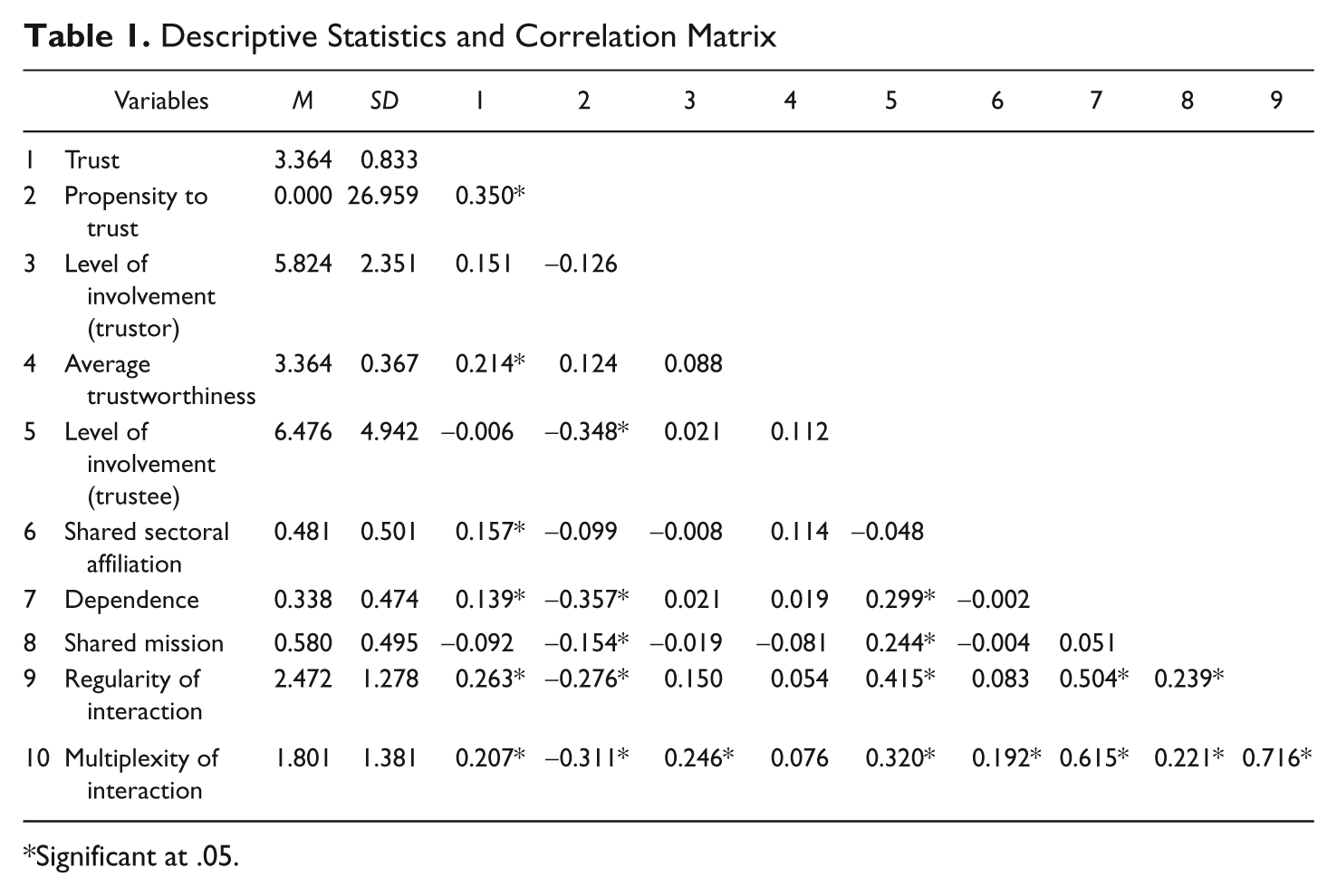
Significant at .05.
Table 2 reports the results from the HLM analysis. The coefficients indicate the change in the probability (i.e., the log-odds) of the trust score being in the lowest category as a result of a unit change in that predictor when all other variables are fixed. Thus, a negative coefficient represents a positive relationship between a predictor and the outcome variable, and a positive coefficient indicates a negative relationship. First, as for trustor attributes, propensity to trust is a significant predictor of trust in these dyads while the level of trustor involvement is not significantly related to trust. Three trustee attributes also demonstrate a significant relationship with trust, namely, the trustee’s reputation for trustworthiness within the network, a shared sectoral affiliation with the trustor, and the importance of the trustee to the trustor. In contrast, a trustee’s involvement in the network and a shared mission with the trustor do not significantly predict the level of trust in these relationships. Finally, as for attributes of the relationship, the multiplexity of the interaction between the trustor and trustee significantly predicts the level of trust, but the regularity of interaction does not.
Ordinal HLM Result on Trust
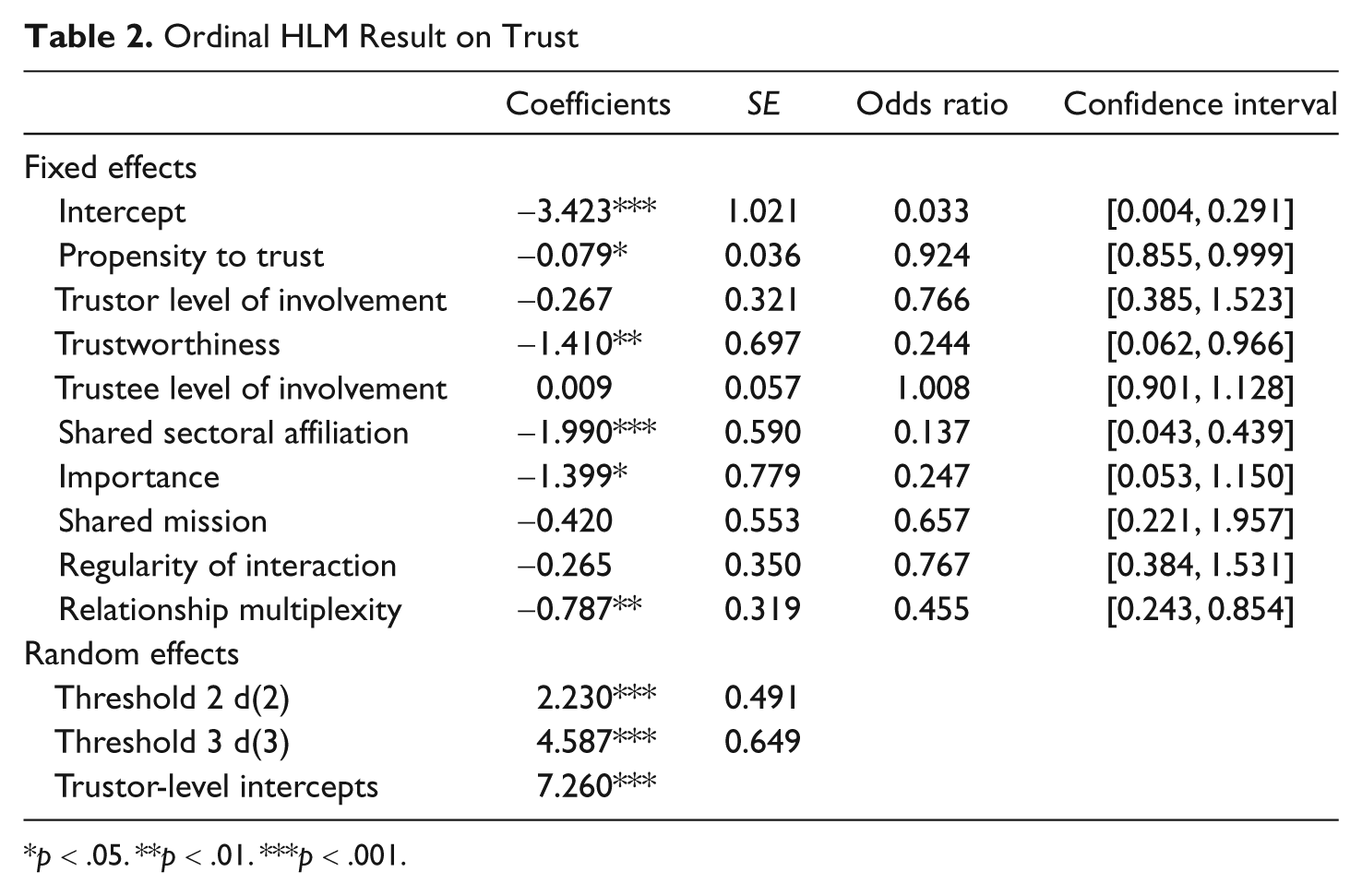
p < .05. **p < .01. ***p < .001.
Discussion
The results of our analysis suggest that the level of trust among the participants in this collaborative network is affected by a number of factors, including trustor, trustee, and relationship attributes, rather than being influenced primarily by any particular antecedent or category. This finding is consistent with the conclusion generally accepted by a variety of scholars (e.g., Hardin, 1992; Kenny, 1994; Kramer, 1999; Lambright, Mischen, & Laramee, 2010; Mayer et al., 1995) that interpersonal trust is influenced by all three components of a dyadic relationship: the trustor, the trustee, and their particular relationship. Not surprisingly, trustors’ propensity to trust was an important antecedent of trust levels among participants in this interorganizational network, supporting the long-standing notion (Rotter, 1967) that this dispositional tendency readily influences one’s level of trust in specific relationships.
Of the five trustee variables in our model, reputation for trustworthiness within the network, shared sectoral affiliation, and importance to the trustor were identified as key antecedents of trust. The significant role of reputation suggests that trust in the network is “contagious” in the sense that it can transfer from one actor to another due to these reputation effects, resulting in shared perceptions regarding network members’ trustworthiness. This finding is compatible with that of Lambright et al. (2010), who found that trust transferability (i.e., the number of third parties who trust the trustee and are also trusted by the trustor) is associated with trust among network participants. The significance of shared sectoral affiliation indicates that network participants are more likely to trust partners from the same sector, compared with those from other sectors. This likely reflects the fact that it is easier to trust those who are perceived as having compatible goals, values, and perspectives. The importance of the trustee to the trustor was also a significant predictor of trust, indicating that some level of dependence on another organization in the network can serve as a key precondition for cultivating trust. This suggests that mutual trust can be developed more easily if or when network partners come to rely on each other more so as to increase the amount of interdependence in their activities.
As for the relationship attributes, multiplexity was significantly related to trust while regularity of interaction was not. When partners engage in a variety of different kinds of activities together (e.g., information sharing, resource sharing, joint programming, and/or joint policy advocacy), the level of trust in the relationship tends to be higher. To the extent that multiplexity is a reasonable indicator of the level of development of the relationship between network partners (Isett & Provan, 2005), this result implies that trust plays a useful role in the process of relationship evolution among organizations in the network. As trust develops, partners are more willing to take the risk and/or make the commitment to increase the level of shared activity with a network partner. In short, trust appears to be associated with more meaningful relationships, that is, those that are important and/or rooted in more shared commitments.
One general conclusion from this study is that the quality of interaction between partners is a more important determinant of trust than is the quantity of interaction. The fact that regularity of interaction was not related to trust suggests that more interaction does not, in and of itself, necessarily build trust. This is not entirely surprising since regular interaction, while providing more opportunity to build trust between partners, also provides more opportunity for trust to be undermined by a partner’s decisions or actions. This conclusion is also supported by the fact that trust was not significantly related to the level of involvement of either the trustors or the trustees. It appears that more active involvement in the network, and the greater chance for interaction with other network members it affords, does not necessarily translate into higher levels of trust. These findings run counter to those of Lambright et al. (2010), however, who found that frequency of interaction was significantly related to whether social workers from different organizations trusted each other. One interpretation is that frequency of interaction is likely to be related to relationship multiplexity; as a relationship develops from a single mode of interaction to multiple modes, partners will typically need to interact more frequently with each other. In this situation, trust could be associated with both frequency of interaction and relationship multiplexity, even though the factor exerting the greatest influence on trust is the latter rather than the former. This appears to be the case in the network we studied: regularity, multiplexity, and trust are all significantly correlated (see Table 1), but regularity of interaction did not have an impact on trust when controlling for relationship multiplexity. This pattern indicates that multiplexity mediates the relationship between regularity and trust (Baron & Kenny, 1986).
The results of this study suggest that trust building is not a simple process but is the result of a complex interaction among the attributes of trustors, trustees, and their relationships. This implies that network managers should take a holistic approach toward the task of building trust among network participants. Given that prior positive or negative experiences in relationships with partner organizations can contribute to the formation of a generalized expectancy that is readily extended to other particular participants in a network, it is useful to include trust-building activities early on in the development of a network, and especially when new members come on board. If trust is somehow breached early on, it can easily lead to negative attitudes toward the network as a whole, which may preclude the possibility of developing trusting relationships with other participants in the network. Network managers need to stay informed about the quality of the dyadic relationships in the network, so as to be aware of situations in which one partner acts so as to undermine the trust of another partner. By helping to address such issues, managers can even use the conflict-resolution process to develop better mutual understanding between the partners and thus establish a foundation for maintaining their trust in each other down the road.
Given the importance of reputation for trustworthiness, network managers can proactively help to establish a positive reputation within the network of its various participants. One suggestion is the strategic use of “praise gossip” (Soesters & van Iterson, 2002) to disseminate information and shape perceptions about participants’ trustworthiness. For example, in network meetings, they can identify situations in which positive outcomes are being generated through some joint activity of two or more of the network participants, and highlight the fact that these outcomes reflect the ability and integrity of the partners involved. For organizations that may be the target of some suspicion, for example, a large business operating in the community or an unresponsive public agency, managers can clarify to others that their involvement in the network is a signal of their interest in working collaboratively with the community. Given a natural tendency for participants to trust more readily others from the same sector, managers can take steps to insure that participants from different sectors have an opportunity to identify their common interests and goals, shared values, and concerns. Such areas of agreement are key factors influencing organizations’ willingness to engage in network activity (Robertson, 1998), and they provide a good foundation on which to take future steps to bring about desired improvements.
Network managers can further facilitate the development of trusting relationships by identifying dyads within the network that might benefit from working together in some way. They can help identify situations in which two partners could both gain from the exchange of information or resources, for example, or where they might be able to improve efficiency and/or produce synergy if they jointly offered a program instead of running them separately. By helping to nurture these relationships at the beginning, getting them off to a good start, managers can provide a solid basis for the partners to continue to develop their relationship on their own, increasing their mutual dependence and evolving into a multiplex relationship. By initiating and supporting these dyadic relationships, network managers are simultaneously developing the density of the network, that is, the number of links among members, which in turn is conducive to the larger objective of the network to effect community change. Community networks with greater density typically have more social capital as well and thus greater potential for success in their efforts to bring about desired improvements.
This study makes useful contributions to the study of nonprofit management in two ways. First, this research contributes to a very small literature on the topic of trust in the context of the nonprofit sector in general and specifically the interorganizational networks in which nonprofit organization are now frequently involved. The topic of trust has been studied fairly extensively in the context of private sector firms, reflecting the important role trust can play in helping to develop collaborative relationships within and between organizations in what is otherwise a typically competitive environment. Nonprofit organizations operating in the same community, and in many cases competing for the same limited resources needed to continue their operations, also can find it difficult to develop and maintain the collaborative relationships that will enable them to work together more effectively and thereby create synergies that enhance their individual and collective impact. Despite the importance of trust as a valuable precursor to effective collaboration, only a few studies (e.g., Hansen, 2010; Snavely & Tracy, 2002; Willem, 2010) have investigated the factors influencing trust in interorganizational relationships involving nonprofit organizations. Our research contributes to this small literature by exploring a relatively broad array of factors that influence the trust levels of participants in one such network of relationships and by offering some ideas regarding the implications of our findings for building trust in other similar cross-sectoral networks.
Second, our research design, with respondents providing information about their level of trust with other specific organizations collaborating in a larger network, enabled us to examine the antecedents of trusting relationships at the dyad level of analysis. Moreover, this novel data structure allowed us to examine the effects of trustor, trustee, and relationship attributes simultaneously (cf. Wellman & Frank, 2001). Although the extant research on factors influencing trust usually focuses on only one or another of these three types of antecedents, we found that factors in all three categories explain unique variance in the level of trust among these network partners. The attributes of trustors in particular have been largely overlooked in the literature, yet we found a significant effect that yields meaningful implications for managers. More generally, as noted above, a better understanding of the complex array of factors that influence the level of trust among participants in a cross-sectoral network can suggest useful guidelines for those leading, managing, or facilitating the development of such networks.
In addition to these contributions, this study has some limitations that should be noted. First, while the structures and purposes of collaborative networks vary, we only investigated one specific type: a network intended to build social capital and stimulate improvements in the quality of community life. As participation and cooperation in this network are voluntary, staff from the lead organization do not have many mechanisms at their disposal to insure consistent, reliable involvement, compared with other types of networks such as those established through government mandate. Factors influencing the development of trust among participants in other types of networks may be different than those found in this network, such that it is not clear to what extent our results are generalizable. While the significant antecedents identified above seem potentially if not probably relevant in other kinds of networks as well, one should be cautious about assuming this is the case. More research on the antecedents of trust in other kinds of networks is warranted, to generate a better understanding of the conditions under which different types of antecedents are and are not important to the development of trust.
Second, while collaborative relationships among organizations within a network tend to evolve over time, the analysis in this study is based on a “snapshot” of trust relationships in the network. The cross-sectional nature of our data make it impossible to draw firm conclusions about the causal relationships among our variables, and some of the antecedents we investigated, such as the importance of the trustee to the trustor organization and the multiplexity of their relationship, may just as likely be consequences of trust as causes. It seems probable that these phenomena have a reciprocal effect on each other, such that increased trust supports the development of more meaningful relationships and vice versa (cf. Isett & Provan, 2005). This would be another useful focus of future research, especially longitudinal research that allowed better investigation of the dynamic causal relationships between trust and other relational characteristics.
Research exploring the evolution of trust over time would also enable an investigation into whether different antecedent factors are more important at different stages of a relationship. This study was not able to take into account the effect of the length of relationship between organizations, even though it is known to affect whether trust is influenced more by the trustor’s or the trustee’s attributes. It has been argued that a trustor’s propensity to trust will be a dominant predictor of trust when parties have no direct information as to each other’s trustworthiness (Mayer et al., 1995). Likewise, the effects of sectoral differences and reputation for trustworthiness may be stronger when the relationship is at an early stage, when direct information about another’s trustworthiness is not readily available (McKnight, Cummings, & Chervany, 1998). Conversely, as the relationship develops further, “history-based trust” will set in (Zucker, 1986). In other words, the level of trust in more mature relationships is likely to be determined more by previous firsthand experiences and the resulting quality of relationship that develops (e.g., its importance and multiplexity). Future research could contribute to the literature on trust building in collaborative networks by investigating the relevance of factors such as these in the development of trust among network participants.
Footnotes
Declaration of Conflicting Interests
The author(s) declared no potential conflicts of interest with respect to the research, authorship, and/or publication of this article.
Funding
The author(s) disclosed receipt of the following financial support for the research, authorship, and/or publication of this article: This work is supported by the REACH 2010 and REACH US cooperative agreements funded by the Centers for Disease Control and Prevention (02153).