



Abstract
Innovation is a critical issue for nonprofit organizations and the ability to innovate over time represents an important, unresolved challenge. In this article, we examine continuous innovation in nonprofits from a political perspective. We explore the role of power in shaping how and whether nonprofits are able to continuously innovate. More specifically, we examine how different forms of power are tied to different stages in the innovation process and the implications when those forms of power are under- or overdeveloped. We argue that certain characteristics of nonprofits can complicate the power dynamics associated with each stage of the innovation process. We propose that power imbalances in nonprofits can lead to four innovation pathologies: “nothing happens,” “nothing changes,” “nothing scales,” or “nothing adapts.” This article provides a framework to guide future research into nonprofit innovation as well as a practical tool for individuals and organizations who seek to facilitate continuous innovation.
Introduction
Innovation—“the process whereby organizations transform ideas into products, services or process” (Baregheh, Rowley, & Sambrook, 2009, p. 1334)—is a centrally important issue for the management of nonprofit organizations. Nonprofits have been described as inherently innovative (Nielson, 1979) and identified as leading innovators in tackling social problems (Drucker, 2005; Morris, 2002). Collectively, the nonprofit sector has been identified as “a laboratory for experimentation and risk taking, a place where new ideas are tested and evaluated” (Frumkin, 2002, p. 32). The role of innovation in nonprofit organizations is a critical one because the social problems and challenges that nonprofit organizations address are continuously changing (Wei-Skillern, Austin, Leonard, & Stevenson, 2007). There are facets of the nonprofit organizational form—being self-governing, voluntary, nonprofit distributing, private from government and organized (Salamon & Anheier, 1997)—that may make nonprofit organizations particularly well suited to creating new ideas and establishing new practices (Sokolowski, 1998). Despite the link between nonprofit organizations and innovation and the importance of innovation to their effectiveness (McDonald, 2007), an important challenge for many nonprofits remains the ability to engage in continuous innovation: establishing and maintaining a cycle of generating new ideas and translating those ideas into value for clients or other stakeholders. Achieving such a cycle is so difficult for many nonprofit organizations (Kramer, 1987; Light, 1998; Osborne & Flynn, 1997) that we see innovations developed in one organization but implemented in another (Letts, Ryan, & Grossman, 1999).
Scholarly examination of continuous innovation has focused largely on for-profit organizations (e.g., Crossan, Lane, & White, 1999) while largely ignoring nonprofits and the characteristics of the nonprofit form, such as goal complexity, voluntary participation, and multiple stakeholders that might affect this process. Research that has examined innovation in nonprofit organizations highlights a diversity of factors that seem to distinguish nonprofits able to continually innovate. While some researchers emphasize external factors, for example, the dominant institutional environment and the importance of particular forms of funding (e.g., Osborne, 1998), others point to the importance of internal factors, for example, leadership (Jaskyte, 2004), organizational structures (e.g., Light, 1998), or a combination of factors (e.g., Crutchfield & Grant, 2008). Where there is more agreement is that the challenge involves two dimensions: the need to repeatedly develop new ideas while exploiting exist knowledge (Grant & Crutchfield, 2007); and the challenge to overcome organizational inertia and resistance to change (Dees, Emerson, & Economy, 2001). In researching innovation in nonprofits, Grant and Crutchfield (2007) found that many were either so focused on maintaining existing systems they lacked creativity, or were able to generate ideas but then struggled to implement them. This presents a significant organizational challenge especially for those nonprofits that seek innovations that extend beyond their organizational boundaries to make a significant difference to those they serve.
We adopt a political lens on the problem of continuous innovation in nonprofit organizations. While power and politics in organizations are often cast as negative phenomena, associated with the dark side of organizational life (Vaughan, 1999) or illegitimate behavior on the part of members (Mintzberg, 1983), our position is agnostic. From our perspective, power and politics are undeniable facets of organizations that have both positive and negative consequences. The potentially positive side of power is highlighted in writing on innovation and organizational learning in which power is viewed less as a dysfunctional aspect than as an intrinsic part of the process (Blackler & McDonald, 2000; Vince, 2001). Lawrence, Mauws, Dyck, and Kleysen (2005) argue that power and politics play a key role in the processes through which organizations create, adopt, institutionalize, and extend innovations. More specifically, they argue that different forms of power are crucial to specific stages of organizational learning, such that “organizations in which some forms of power are under- or over-developed may be unable to complete the whole organizational learning cycle” (Lawrence et al., 2005, p. 189). This model points to power as an important factor in understanding the ability of some nonprofit organizations to continuously innovate while others fail to do so.
Our aim in this article is to draw on Lawrence et al.’s (2005) model of power and learning to explore the challenges associated with continuous innovation in nonprofit organizations. In doing so, we make two principal contributions. First, we provide a framework that could guide empirical work in this area. The framework we develop has three sets of elements. First, we apply the learning model developed by Crossan et al. (1999) to the context of innovation in nonprofit organizations. We argue that this framework, which we term in this article as the “innovation cycle,” provides a useful and distinctive way of understanding the challenge of continuous innovation in these organizations. Second, we draw on Lawrence et al.’s (2005) model of power to show how continuous innovation in nonprofit organizations is a fundamentally political process and that power can play a positive, generative role, as well as a debilitating one. Third, we introduce a set of four characteristics associated with the nonprofit form and examine how they can potentially complicate the innovation process and the role of power in that process. Research guided by this framework could adopt either a deductive or an inductive approach. Deductive research could examine the degree to which the stages in the innovation cycle, forms of power, and complicating nonprofit characteristics holds in nonprofit organizations, how different kinds of nonprofits affect the validity of each aspect of the cycle model, and what elements of the model are most powerfully predictive of successful continuous innovation. Inductive research could use the cycle model as a guide to explore how the different elements—innovation stages, power, and nonprofit characteristics—are linked in specific organizations, focusing on specific situations faced by nonprofit managers and how they attempt to manage those situations.
Our second contribution is a practical one. Our discussion of the role of power in continuous innovation focuses attention on a set of dynamics that can be directly addressed by nonprofit managers. The first dynamic that is of practical importance to nonprofit managers is understanding innovation as a cycle of stages through which ideas are generated, translated into language, put into practice, and embedded in organizational systems. This cycle provides the foundation for a diagnostic approach to understanding why a nonprofit might not be achieving its goals around innovation. The second dynamic is the political one. The forms of power we employ to understand continuous innovation are all potentially under the control of nonprofit managers. The third dynamic involves characteristics of the nonprofit form and provide a way for nonprofit managers to target specific aspects of their own organizations and see the role they play in facilitating or impeding innovation. Finally, we present a set of four common nonprofit innovation pathologies and suggest the kinds of nonprofit organizations most likely to be affected by them. These pathologies may be familiar to many nonprofit managers, which should make utilizing the framework we have developed simpler and more appealing.
We present the article in three main sections. First, we review the literatures on continuous nonprofit innovation and the role of power in innovation in organizations to establish how a focus on power and politics might shed light on the potential for continuous innovation in nonprofits. Second, we examine how different forms of power might affect the innovation process in nonprofit organizations. Here, we examine four stages of innovation, the distinctive challenges faced by nonprofits at each stage, and the consequences of specific forms of power being under- or overdeveloped. We conclude the article with a discussion of the implications of our arguments for research and practice.
Continuous Nonprofit Innovation and Power
The innovative potential of the nonprofit sector is seen by many as its defining characteristic. Nonprofits are associated with innovations in tackling local, national, and international social problems (Light, 2004). Focusing on the sector as a whole, however, can gloss over the heterogeneity in the innovative capacity of nonprofit organizations and the significant challenge many face in attempting to innovate on a continuous basis (Kramer, 1987; Light, 1998; Osborne & Flynn, 1997). In this section, we review the literature on continuous innovation in nonprofit organizations and introduce a political lens to consider how a focus on power might provide new insights into the innovative capacity of nonprofits.
Nonprofits and Continuous Innovation
Nonprofits have long been encouraged to embrace innovation as a central organizing principle to accomplish their missions and ensure a sustainable future for themselves and their communities (Drucker, 1990; Hudson, 1999; Kanter & Summers, 1987; Letts et al., 1999). How to achieve this in practice, however, remains an unresolved question. Nonprofit organizations that have found ways to continuously innovate display a diverse range of characteristics. On one hand, research has connected innovation to organizational characteristics and strategies, including strong leadership (Light, 1998), a clear mission (McDonald, 2007), particular values (Light, 1998), and a dynamic Board (Knauft, Berger, & Gray, 1991). Kanter and Summers (1987) argue for a holistic approach that emphasizes senior management sponsorship, teamwork, collaborative mechanisms that bring together individuals from across the organization, and access to external resources. Other research has pointed to the importance of extraorganizational factors, including the organization’s environment and institutional context (Osborne & Flynn, 1997). This work has documented innovation in unlikely organizations, including large, bureaucratic, professional organizations that use public funds (Kramer, 1987) when they operate in complex social environments with rich interorganizational networks (Osborne, 1998).
Where there is some agreement, however, is around the significant challenge of engaging in the development of new ideas while efficiently and effectively managing internal operations (March, 1991). Crutchfield and Grant (2008, p. 151) describe this as an issue of balance: “The challenge for every nonprofit is to find the sweet spot between exploring new opportunities and shoring up the best existing programs,” which “means balancing discipline and freedom.” Achieving this balance, they argue, involves learning sequences that focus on how new ideas can be fostered and then embedded. Dees et al. (2001) point, for example, to the importance of establishing innovation as a cultural value by investing not only in the capabilities to identify new ideas but also in systems of reinforcement that connect innovation to rewards. Similarly, Eadie (1997) argues that nonprofits should work to institutionalize both the creativity associated with generating new ideas and the planning that translates ideas into concrete practice.
Achieving the balance of creativity and stability that is needed for continuous innovation is made more complicated by the tendency of most organizations toward inertia. Over time, the substantial investments organizations make in maintaining and refining their operations can make it progressively difficult to innovate (Hannan & Freeman, 1984) and lead to “core rigidities,” deeply embedded knowledge sets that constrain creativity (Leonard-Barton, 1992, p. 18). There is an irony that successful past innovation can act as brakes on new ideas. Past success in nonprofit organizations has been shown to lead to complacency (Dees et al., 2001), structural barriers to innovation (Light, 1998), and a lack of questioning the status quo on the part of organizational leaders (Drucker, 1994). Eadie (1997) suggests three central barriers to change: a failure to see the need, a fear of change, and a focus on day-to-day operations. Moreover, innovation may lead to resistance when new ideas challenge existing approaches, values, and competencies (Dees et al., 2001; Storey & Salaman, 2005). While researchers have identified these challenges of exploration, exploitation, and inertia that face those nonprofits seeking to repeatedly innovate, less is known about how they these challenges might be navigated.
Power and Continuous Innovation
Innovation and power have long been recognized as connected: “For he who innovates will have enemies of all those who are well off under the old order of things, and only lukewarm supporters in those who might be better off under the new” (Machiavelli cited by Tushman & O’Reilly, 1997). If politics is power in action and it involves the exercise of power to get something accomplished (Pfeffer, 1981) then politics will be at the heart of any innovation process.
Power and politics are not normally associated with innovation, at least not in any positive way. When innovation and power are discussed together, it is often with the view that politics reduces the innovative capacities of organizations (Amabile, 1998). But this is a rather one-sided view of power that can overlook its variety of forms and effects within organizations. The now classic view of power offered by French and Raven (1959), for example, associated power not only with coercion, but also with expertise, legitimacy, rewards, and affiliation. More recently, the potentially positive role of power in organizations has been examined in detail, with power shown to support learning and innovation, as well as less positive processes (Clegg, 1989; Clegg, Courpasson, & Phillips, 2006).
Lawrence et al. (2005) present a comprehensive theoretical framework connecting power and organizational learning that has potentially significant insights for the study of continuous innovation in nonprofit organizations. Lawrence et al.’s (2005) theory is rooted in a learning framework (Crossan et al., 1999) that identifies four key learning processes: interpretation (the naming and connecting of new ideas to existing ways of thinking); integration (the enacting of ideas in group-level practice); institutionalization (the embedding of ideas into organizational practices and systems); and intuition (the development of novel insights based on experience). Lawrence et al. (2005) argue that each of these learning processes is facilitated by a different form of power. Their argument provides an explanation of how new ideas circulate and become patterns of behavior that enable organizations to simultaneously explore opportunities and exploit their existing competencies.
Lawrence et al. (2005) point to two categories of power as critical in understanding how new ideas are translated and embedded into organizational systems. They argue that episodic power—discrete acts of power initiated by self-interested actors—underpins the processes through which ideas are interpreted and integrated into practices. They associate the interpretation process with influence, which is an episodic form of power that works by affecting the costs and benefits of an individual’s choices. Interpreting involves shifting the language and cognitive maps within an organization in ways that enable the incorporation and adoption of a new idea. Lawrence et al. (2005, p. 184) argue that influence is key to this process because it can affect the costs and benefits associated with the adoption of new ideas that “organizational members often perceive as having important but ambiguous consequences” and often emerge in organic, unpredictable ways that limit the effectiveness of force as a mechanism. In contrast, they argue that force can be essential to the integration of news ideas into collective action. Force is an episodic form of power that differs from influence in that rather than affecting the costs and benefits of an individual’s choices, it restricts the choices that are available. Force is important at this stage because of the “difficulties associated with accomplishing collective action without some restriction of alternatives on the part of those involved” (Lawrence et al., 2005, p. 186). The use of force facilitates uniform integration of an idea into coherent action.
Systemic forms of power involve routine ongoing practices such as socialization, and are crucial, according to Lawrence et al. (2005) to the embedding of ideas in everyday practice and the ongoing development of ideas that extend the strategic direction of the organization. Institutionalization involves embedding new ideas in systems, structure, and culture so that they become a part of everyday practice throughout an organization (Crossan et al., 1999). Lawrence et al. (2005) argue this process depends on domination—a systemic form of power that works by restricting the choices available to individuals. Domination relies on a variety of systems, including material technologies and information systems to “support patterns of practice in an ongoing way, without the complicity of those on whom they act” (Lawrence et al., 2005, p.187). Domination is crucial to institutionalization because it overcomes resistance and unpredictability by managing “organizational stakeholders ‘in place,’ “affecting their behaviors without necessarily shaping their preferences, attitudes, or beliefs.” In contrast, intuition—the stage of the process that reenergizes the cycle and provides the foundation for continuous innovation—depends on discipline. Intuition describes a subconscious process “through which individuals first recognize patterns in their experience that allow them to imagine new solutions or opportunities” (Lawrence et al., 2005, p. 187). Discipline is a systemic form of power that affects the costs and benefits of an individual’s choices, not through direct intervention, but through shaping the perceptions and identities of organizational members through ongoing relationships and experiences (Knights & Willmott, 1989). Thus it supports intuition by providing organizational members with work experiences that help them gain expertise and connect their experiences to the organization’s strategy.
Although the different forms of power are likely to operate across the innovation cycle, Lawrence et al. (2005) argue that in each stage one form of power is particularly important. By connecting power to learning in this way it becomes possible to not only view the means by which organizations can repeatedly innovate but also to explore how failed innovative capacity may be the result of particular power imbalances. Lawrence et al. (2005) argue that when some forms of power are underdeveloped or overdeveloped organizations may not be able to complete the whole learning cycle. So, if episodic acts of power are disconnected from systemic forms of power, new ideas will appear but will not be institutionalized, and if there is an overreliance on systemic forms of power there may be a danger in “convergent behavior but uninspired thinking” (Lawrence et al., 2005, p. 189). In the remainder of this article, we explore how this cycle of power and learning can illuminate the challenges and opportunities for continuous innovation in nonprofit organizations.
A Cycle Model of the Politics of Nonprofit Innovation
To explore the relationship between forms of power and continuous nonprofit innovation, we examine each stage of the innovation cycle and consider the possible effects of an under- or overdevelopment of power (see Table 1 for a summary).
The Role of Power in the Innovation Cycle
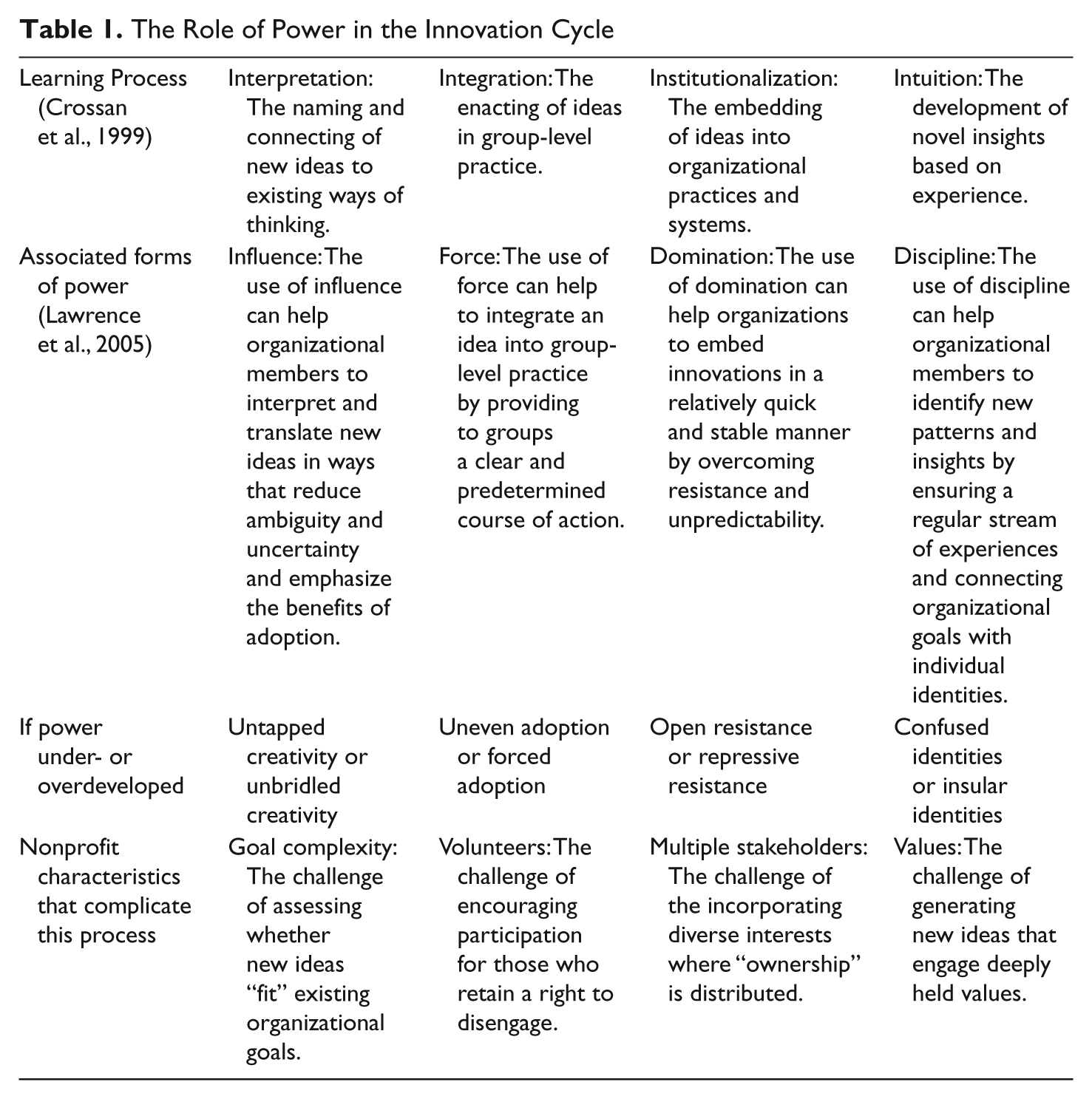
In this section, we describe and integrate these effects in an exploration of the politics of four key learning processes: the interpretation of new ideas, the integration of new ideas into practice, the institutionalization of innovations into organizational systems, and the intuition to develop new ideas. Under each stage in the cycle, we explore how certain characteristics associated with the nonprofit form—goal complexity, volunteers, multiple stakeholders, and values—might enable or constrain particular power imbalances.
Making Sense of New Ideas: The Politics of Interpretation
The first stage of the innovation cycle involves the “explaining, through words and/or actions, of an insight or idea to one’s self and to others” (Crossan et al. 1999, p. 525). The key challenge of this stage is for individuals to articulate new ideas and make explicit how these ideas connect to existing ways of thinking. Lawrence et al. (2005, p. 184) argue that the form of power most critical in this stage is influence, which involves “affecting the costs and benefits that organizational members associate with specific interpretations of a new idea.” Influence is particularly important, they argue, because new ideas can be perceived as having “ambiguous consequences” (Lawrence et al., 2005, p. 184). The use of influence can help organizational members to interpret and translate new ideas in ways that reduce ambiguity and uncertainty and emphasize the benefits of adoption.
This stage of the innovation process may be especially challenging in nonprofit organizations because of the nature of those organizations’ complex, often intangible goals (Anheier, 2000; Handy, 1990). On one hand, the ambiguity around existing organizational goals may provide members with greater flexibility in how they interpret new ideas. On the other hand, the complexity of organizational goals can make it difficult to assess whether new ideas fit the organizational mission (Kendall & Knapp, 2000). In the ideal situation, organizational members would have enough influence to create and articulate a regular stream of new ideas that strengthens and revitalizes organizational goals.
We argue that the innovation process in nonprofit organizations can be weakened by the politics of those organizations. Whereas previous writing has focused on the use of power to stall or undermine an innovation, we follow Lawrence et al. (2005) in their focus on the distribution of forms of power in these organizations—the degree to which the different forms are facilitated or not by the structures, systems, processes, and cultures of the organizations. In the case of interpretation, the distribution of influence is critical to its ongoing success. The degree to which members can exert influence in an organization is closely tied to the skills and abilities of individuals as well as enabling and constraining organizational structures (Lawrence et al., 2005; Pfeffer, 1981). In some organizations, individuals attempting to establish new ideas may find that the value of traditional sources of individual influence such as expertise or rewards (French & Raven, 1959) are diminished by cultures or structures that privilege formal, bureaucratic routines (Burns & Stalker, 1966). Organizational arrangements may also contribute to underdeveloped influence when, for example, there are few forums for people to interact, share, and explore new ideas (Maitlis, 2005). In contrast, influence can be overdeveloped in an organization, in the sense that individuals have an extraordinary ability to affect the day-to-day interpretations and understandings of the organization and its environment. This might occur when individuals are empowered to articulate and champion new ideas without adequate checks and balances and when this process is actively facilitated by organizational systems. This can lead to too many ideas for organizational members to process and heightened political activity as different proponents of ideas vie for attention.
Both situations are particularly problematic for continuous innovation in nonprofit organizations. We argue that in nonprofits where influence is underdeveloped—where individuals lack the skills and opportunities to affect organizational conversations—new ideas will tend either to remain invisible or be seen as unnecessary or overly risky. In such organizations, especially when organizational goals are particularly complex, proponents of new ideas will struggle to explain their ideas in terms of already accepted ways of thinking about the organization and its agenda. The risks of such a situation are that the potential creativity within the organization is left untapped. In contrast, we argue that in nonprofit organizations in which the use of influence is overdeveloped—where individuals are highly motivated and skilled in articulating their ideas and opportunities to do so are relatively unlimited—organizations may find themselves awash in a range of conflicting ideas championed by a wide range of individuals. Again, highly complex goals may accentuate this problem, as skilled proponents of new ideas leverage that complexity to legitimate a wide spectrum of ideas. Although creativity is key to innovation, we argue that an overdeveloped influence environment can have a paralyzing effect as the organization attempts to assess the costs and benefits of an abundance of ideas. Thus the risks of such a situation involve the nonprofit organization being overwhelmed by members’ unbridled creativity.
Adopting Ideas Into Practice: The Politics of Integration
The second stage of the innovation cycle involves the integration of new ideas into “coordinated action” (Crossan et al., 1999, p. 525). The key challenge at this stage is to achieve a relatively uniform representation of the idea across members that results in coherent, collective action (Lawrence et al., 2005). Lawrence et al. (2005, p. 186) argue that the form of power most critical to this stage is force, which involves “the construction of circumstances that restrict the options available to organizational members.” The criticality of force at this stage, they argue, stems from the “difficulties associated with accomplishing collective action,” and especially the “willingness of all group members to cooperate and on their ability to uniformly translate a new idea into actions” (Lawrence et al., 2005, p. 186). The use of force overcomes these problems by providing to groups a clear and predetermined course of action.
This stage of the innovation process may be complicated by the nature of nonprofit organizations, and especially those within which volunteers play a significant role. The integration of ideas into practice in nonprofit organizations can be assisted significantly by volunteers, who often have deeply held commitments to organizational goals that make them receptive to innovations they perceive as supporting those goals (Frumkin, 2002). At the same time, however, volunteer commitment to the organization may be more fragile than that of paid employees, and motivated by a diverse set of interests (Cnaan & Goldberg-Glen, 1990) with a “special mix of competing, complementary and overlapping values, rationales and evaluation criteria” (Klausen, 1995, p. 285). New ideas may be integrated into practice by some groups but misunderstood or resisted by the majority. Alternatively, the integration of new ideas into practice may occur without consultation or other forms of volunteer participation such that volunteers are left alienated from rather than supportive of the innovation. In the ideal situation, the integration of new ideas into practice would involve a degree of force that ensured a broad uniformity of practice, but that left open the possibility of dialogue and tailoring of practices to local needs.
As with the politics of interpretation, the politics of integration may fail to meet that ideal because the use of force is either under- or overdeveloped in a nonprofit organization. The use of force in organizations is closely tied to formal hierarchies, with the bases of such power often connected to formally legitimate organizational roles or the ability to coerce people into compliance through the ability to impose sanctions (French & Raven, 1959). Thus organizations in which force as a form of power is overdeveloped are those in which positions of authority are associated with a relatively unrestricted ability to impose new practices on members. In contrast, when force is underdeveloped in an organization, managers lack sufficient legitimacy or access to tools of coercion so that they are unable to establish and enforce compliance with new practices.
Both situations are problematic with respect to continuous innovation in nonprofit organizations. Where force is underdeveloped, we argue that nonprofits will tend to see incomplete or inconsistent integration of new ideas into practice. In such organizations, members and especially volunteers may fail to comply with new practices or withdraw entirely, because they remain ambivalent regarding their benefits or support alternative ideas. Compliance in such situations may often be halfhearted, taking on only those aspects of new practices members and volunteers find appealing or easy to adopt. The risks of such a situation include uneven adoption of new practices with some clients receiving services of a kind or in a way that differs from the experience of other clients. In contrast, in nonprofit organizations in which the use of force is overdeveloped, where managers are invested with extraordinary abilities to impose their will on members and volunteers, ideas may be put into practice without resistance but with disagreements and problems with the idea artificially suppressed. While the process of integrating ideas into practice is usually “successful” in these organizations, the possibility of critical engagement is removed. This is especially problematic in organizations where volunteers make up a critical component of the workforce; alienation in these cases is likely to lead to withdrawal, putting the ability of the organization to deliver its services at risk.
Embedding Ideas Into Routines and Structures: The Politics of Institutionalization
The third stage of the innovation cycle involves institutionalizing an innovation into organizational systems, structures, procedures, and strategy. If successful, this process ensures that new ideas become organizational fixtures, independent of the energy of their originators (Crossan et al., 1999). A key challenge of this stage is that organizational members and groups are often resistant to changes in established practice. Lawrence et al. (2005) argue that the form of power most critical at this stage is the power of domination that restricts the actions available to organizational members and overcomes resistance. Domination is particularly important, they argue, because it minimizes the reliance on individual choices that are “potentially unreliable or unpredictable” (Lawrence et al., 2005, p. 187). The use of domination can help embed innovations in organizations in a relatively quick and stable manner.
This stage of the innovation process may be affected by the complex and challenging stakeholder relationships associated with the nonprofit organizational form (Anheier, 2000; Hudson, 1999; Kanter & Summers, 1987). Although all organizations must manage the needs of stakeholders, the complexity and diversity of these needs can pose significant challenges for innovation in nonprofit organizations. On one hand, heterogeneity of interests in a nonprofit organization, such as volunteers, funding bodies, individual donors, staff and service users, can provide the impetus and diversity of knowledge to ensure new ideas get connected to existing working practices and thus become taken-for-granted. The embedding of a new idea may be particularly assisted when a diverse group of individuals with particular forms of power, such as referent, expert, and legitimacy (French & Raven, 1959), combine to provide their support. On the other hand, the wide range of interests means that stakeholders “invariably have different views of priorities and sometimes on the style and culture of the organization as well” (Hudson, 1999, p. 19). Some stakeholders may then resist attempts to routinize an innovation if they perceive it as threatening or undermining their interests. In the ideal situation, the institutionalizing of new ideas would involve a degree of domination that ensured that ideas were embedded in organizational systems in ways that accessed the collective intelligence of the stakeholders and overcame divisive resistance.
As with the other stages of innovation we have considered, the politics of institutionalization may fail to meet that ideal because the potential for domination in a nonprofit organization is either under- or overdeveloped. The potential for an organization to institutionalize new ideas through the use of domination is closely tied to its capacity to design and implement systems that manage “organizational stakeholders ‘in place,’ thereby affecting their behaviors without necessarily shaping their preferences, attitudes, or beliefs” (Lawrence et al., 2005, p. 187). Where systems of domination are undeveloped, individuals are able to ignore the innovation, adopt it selectively or actively seek to undermine it. In contrast, where systems of domination are overdeveloped they can become coercive and so the reduction in individual choice is not enabling and productive but repressive, potentially leading to significant, destructive resistance (Lawrence & Robinson, 2007).
Both situations present difficulties with respect to continuous innovation in nonprofit organizations. If the power of domination is underdeveloped, we argue that nonprofits will tend to see failed attempts at institutionalizing and experience open resistance to new ideas. This may especially be the case for those organizations dealing with multiple stakeholders who can hold very different perspectives on organizational priorities and different conceptions of how to embed practices. The risks of such a situation are that any new idea will only be adopted by some groups but not others so that it is still possible for individuals to choose not to engage. In contrast, in nonprofit organizations in which domination is overdeveloped—where systems can be imposed on organizational members and supporters—short-term successes may mask long-term problems. In the short term, the systems of domination that overcome initial resistance might damage the organization’s long-term capacity to innovate.
Generating a Flow of New Ideas: The Politics of Intuition
The fourth stage of the innovation cycle involves individuals coming “to discern and comprehend something new, for which there was no prior explanation” (Crossan et al., 1999, p. 526). The key challenge of this stage is for individuals to gain and learn from their experiences so that they can identify patterns and insights from these situations in ways that support the organization’s values. Lawrence et al. (2005) argue that the form of power most critical at this stage is the power of discipline. Discipline, they argue, “supports and shapes the intuitions of organizational members by providing them with an ongoing stream of experience and affecting the way they perceive that experience by shaping their identities” (Lawrence et al., 2005, p. 188). Thus discipline in nonprofit organizations is embedded in the work arrangements of paid and volunteer labor, whose experience in that work affects how they see the world and themselves in relation to it. Discipline supports innovation by helping organizational members to gain a “deep level of substantive experience in a domain” from which they are able to generate intuitions (Lawrence et al., 2005, p. 187).
In nonprofits, this stage of the innovation process may be complicated by the distinctively important role of values in these organizations (Frumkin, 2002; Frumkin & Andre-Clark, 2000; Jeavons, 1992; Paton, 1996). On one hand, nonprofit values have been identified as “important sources for innovation and experimentation” (Frumkin, 2002, p. 26) that enable individuals to “give expression” to social, philosophical, moral, or religious values (Jeavons, 1992, p. 404). On the other hand, nonprofits can experience significant “value issues” (Paton, 1996, p. 30), conflicts over the meanings of values and how they are prioritized and demonstrated, that may constrain innovation. Values may be particularly difficult to change because the demonstration of values is said to be integral to organizational members’ participation and the public’s trust in nonprofits (Jeavons, 1992). New ideas that appear “core value changing” are likely to experience considerable resistance (Dees et al., 2001). Ideally, the politics of intuition would involve a degree of discipline that energized members’ experiences in support of the organization’s values while creating the potential for intuitions that challenged or tested them.
The politics of intuition may fail to meet this ideal because the use of discipline is either under- or overdeveloped in a nonprofit organization. The level of discipline in an organization is closely tied to processes of socialization, training, and teamwork that help organizational members to both gain and reflect on their experiences as well as develop their identity in relation to organizational goals (Lawrence et al., 2005). Where discipline is underdeveloped, organizational members may find their work experiences are relatively disconnected from the broader aims and mission of the organization, and thus lead to intuitions unrelated or difficult to connect to current organizational issues. In contrast, where discipline is overdeveloped, individuals may find that their work and training are tied extraordinarily tightly to the organization’s mission, and so their intuitions tend primarily to support and maintain existing organizational practices and systems. This can encourage individuals to become too closely identified with organizations such that significant innovations may be difficult to imagine, let alone implement.
Both situations cause difficulties with respect to continuous innovation in nonprofit organizations. In nonprofits where discipline is underdeveloped, we argue that the intuition of members will tend to be left unconnected to the organization’s values and consequently undeveloped and unexplored. This may lead to considerable frustration and confused identities: individuals would be left uncertain as to what aspects of their experience and expertise are most important, and thus which of their intuitions are most relevant to their organizations. In contrast, an overdevelopment of discipline in a nonprofit could result, we argue, in a strong commitment to generate new ideas and expertise but within strict parameters. Members of such organizations might become overly socialized to the point that their association with the organization and its values closes them off to divergent ways of thinking. This may be particularly the case for those working in nonprofits whose values are viewed as nonnegotiable and act to reinforce a particular set of beliefs about the world. Individuals may find that their identities become so insulated from alternative ways of thinking to the point that intuitions are focused solely on incremental change.
Looking Across the Stages: Nonprofit Innovation Pathologies
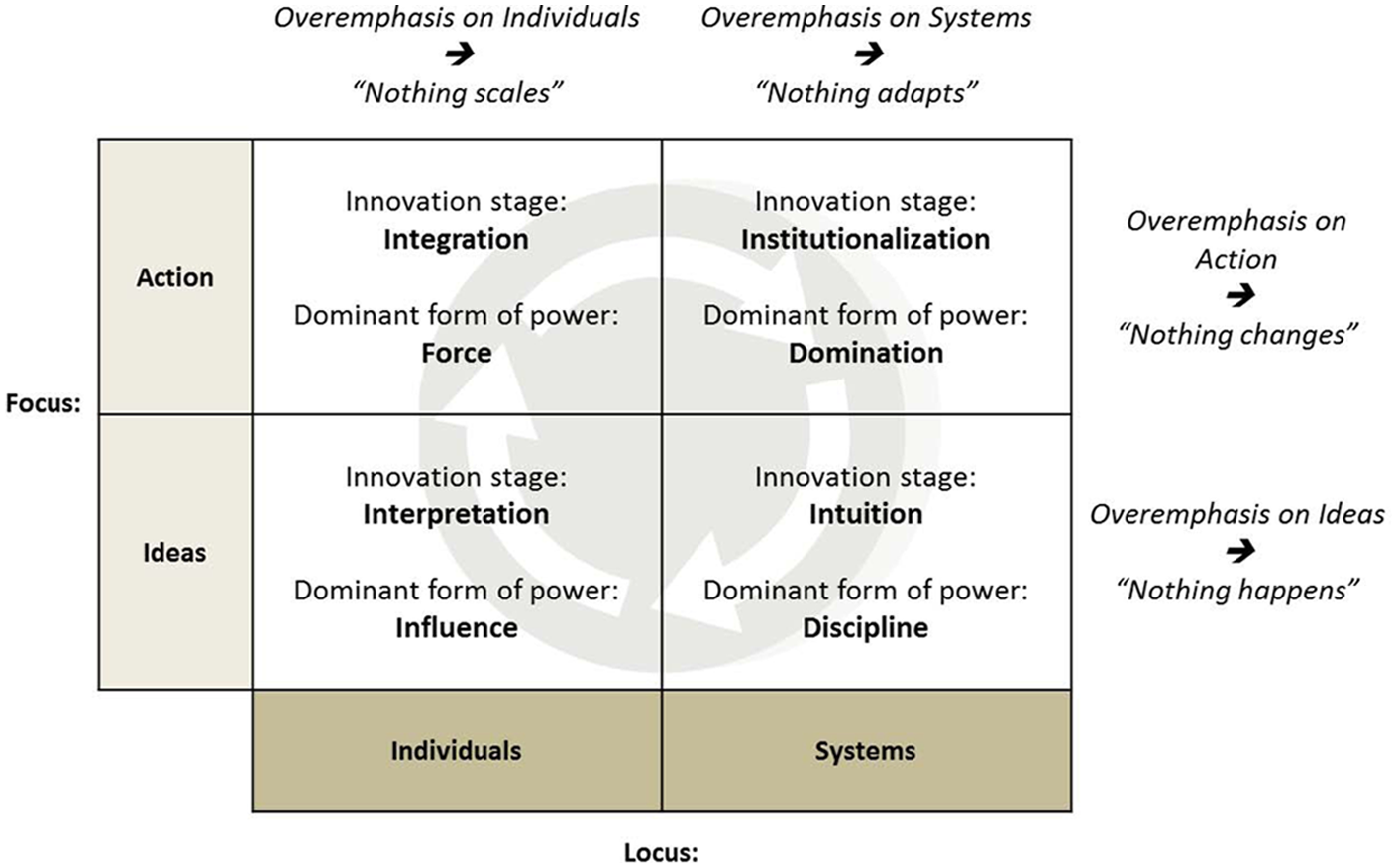
To this point, we have examined each stage of the innovation process separately, identifying single characteristics of nonprofits that might be particularly salient at each stage. We recognize that the nonprofit characteristics we have examined could affect the dynamics of innovation at other stages in the innovation cycle. Focusing on specific sets of interactions between unique characteristics of nonprofit organizations and forms of power, however, highlights what we believe are particularly important factors and potential risks at each stage of the innovation cycle. In the remainder of this section, we pan out to explore the tendency of power imbalances to cluster in the innovation cycle. We identify two dimensions that shape this clustering, first distinguishing between organizations in which power tends to be located predominantly in either individuals or systems, and then the tendency in the innovation cycle toward ideas or actions. From here we are able to identify four pathologies that nonprofit organizations seeking to continuously innovate may experience (see Figure 1 for a summary).
Four nonprofit innovation pathologies
Privileging Individuals Versus Systems
One set of power imbalances occurs when organizations privilege individuals at the expense of systems or vice versa. For the innovation cycle in nonprofits, the result of either of these imbalances is that two stages of the cycle flourish while two struggle—a situation we describe as an innovation pathology.
Pathology 1: Nothing scales
Some nonprofits privilege individuals over systems: individuals hold key resources, are perceived as the roots of organizational success, and are motivated with idiosyncratic rewards, titles, and opportunities (Rousseau, 2005). In such organizations, the innovation cycle will reflect this imbalance: individuals will have the influence to articulate and translate new ideas and the capacity for force to integrate them into practice, but there will not be adequate systems of domination to institutionalize new ideas into organizational routines or disciplinary systems to provide members with a stream of experience that leads them to identify new patterns and insights. The effect of this imbalance, we argue, is to create frustration within a nonprofit that might be expressed as “nothing scales.” This lament reflects an organizational inability to replicate across the organization new ideas that have been articulated and put into the practice at a local level. The kinds of nonprofits in which we might expect to see this pathology are those that strongly prioritize decentralized decision making, local autonomy and freedom, individual initiative, where fitting with local conditions are understood as the primary drivers of successful initiatives, and where the organization is viewed as a family or community. None of these characteristics is, of course, necessarily negative in and of themselves. What we are arguing is that, taken too far, they can have significant negative consequences for the ability of nonprofits to engage in continuous innovation because of their inability to reproduce new ideas across organizational units and foster insights that tie to the broader strategy of the organization.
Pathology 2: Nothing adapts
The contrasting situation occurs in organizations that privilege systems over individuals—resources and priorities are focused on developing and maintaining physical, information, HR, and financial systems. In these organizations, the innovation cycle will be characterized by ideas becoming well embedded into organizational routines and work experiences, but overlooked is the crucial role that individuals play in the innovation process to adapt and translate ideas in ways that fit the local context. The result, we argue, is to create organizational dissatisfaction that might be articulated as “nothing adapts”—a feeling across the organization that organizational practices and routines achieve internal consistency and global reach but often fail to meet local needs because they are not adequately tailored to idiosyncratic conditions. Some characteristics of nonprofits we expect would make them vulnerable to this tendency include highly formalized structures and roles, centralized decision making, a view of social problems as relatively universal, and a pride in the ability of the organization to provide consistent treatment of client populations independent of location.
Privileging Ideas Versus Action
Another set of power imbalances involve organizations favoring ideas rather than action, or the reverse. Again, this leads to the possibility of two stages of the cycle working well and two being neglected, with resultant pathologies in either case.
Pathology 3: Nothing changes
In nonprofits that exhibit a strong tendency toward action, the organization can expect to see ideas rapidly and effectively translated into practice and institutionalized into organizational systems, but a dearth of insights generated and new ideas introduced. In such organizations, members might complain that “nothing changes”: they perceive that the organization is good at doing, but not so good at thinking about what it is doing. We argue that the nonprofits most likely to suffer from this pathology are those in which the culture is dominated by an action orientation, where results are measured exclusively in terms of concrete outcomes, where the social problem it addresses is conceptualized as relatively concrete and immediately addressable, and where investments are made on the basis that they help “get things done.”
Pathology 4: Nothing happens
Finally, some nonprofits are associated with a strong emphasis on the importance of ideas and consequently experience a steady stream of new insights and ideas translated into powerful metaphors and concepts. An overly strong focus on ideas, however, can lead to organizations that neglect the crucial stages of converting these ideas into practice and embedding them in systems. These are the organizations in which disappointment is conveyed that “nothing happens.” Intuition and ideas abound; conversations about the organization’s aims and means are generative and frequent. There is, however, a distinct inability to take new ideas that have been identified and articulated and convert them into practice and systems. The sorts of nonprofits likely to wrestle with this pathology are those in which ideas, knowledge, and dreams are sacrosanct, accountability is complicated and/or resisted, measurement is denigrated, problems are conceived of as complex, multilevel phenomenon for which fixes are always problematic, networks are dense and built around information sharing, and where careers are built on trading in “good ideas” and powerful stories.
Conclusion
In this article we have explored the challenge of continuously innovating in nonprofits. We drew on the work of Crossan et al. (1999) to conceptualize innovation as a four-stage cycle, and that of Lawrence et al. (2005) to apply a political lens to this process. These foundations provided a way to examine the types of power important for each stage of a nonprofit innovation cycle and to identify how the under- or overdevelopment of power at each stage might create problems. The challenge of managing such power imbalances, we argued, is complicated by certain characteristics of nonprofits—complex goals, volunteers, multiple stakeholders, and values. We then outlined four potential pathologies for nonprofits when power imbalances exist across more than one stage of the innovation cycle. We conclude the article by considering the implications of our arguments for research and practice.
Implications for Research
Studies of nonprofit innovation have identified a wide range of organizational and environmental characteristics associated with the successful conversion of ideas into products, processes, and services. Although this literature provides important insights, less well understood is how nonprofits can best manage the complexity of innovating over time—a process that demands continually exploring new ideas and exploiting existing ones (Crutchfield & Grant, 2008; March, 1991). This article provides a way to explore continuous innovation by offering an integrative framework to study nonprofit innovation.
The first set of implications for research stem from our application of the works of Crossan et al. (1999) and Lawrence et al. (2005) to the issue of innovation in nonprofit organizations. Innovation is often studied as an event, rather than an ongoing process: the Crossan et al. (1999) model helps focus on innovation in nonprofits as a cyclical process, with each stage potentially fueling the next. Similarly, the role of power and politics in nonprofit innovation has remained largely unexplored despite a recognition that innovations are social phenomena open to multiple, shifting interpretations (Mordant, 2005). Lawrence et al.’s (2005) framework points to the specific forms of power that are in play at different points of the innovation cycle in nonprofits. This approach to power and innovation provides nonprofit researchers with a clear framework to design research studies—power dynamics can now be examined within and across four distinct stages—and more generally a conceptualization of organizational politics in innovation that goes beyond its usual association with resistance (e.g., Dees et al., 2001) to an integral role in the creation and implementation of new ideas. The application of the Crossan et al. (1999) and Lawrence et al. (2005) frameworks provides a foundation for research that could usefully examine the degree to which these frameworks accurately describe innovation in nonprofits and how the specific nature of this context affects both the innovation cycle and the politics of the processes therein. Research focused on these issues might usefully adopt a comparative, longitudinal design that could incorporate both multiple kinds of nonprofit organizations and multiple cycles of innovation.
An important issue that we raise in this article is the impact of organizational characteristics distinctive of nonprofits on innovation. We have argued that the importance of complex goals, volunteers, heterogeneous stakeholders, and organizational values in nonprofits can complicate each stage of the innovation process. Our arguments provide a route for researchers to investigate whether and how different nonprofit organizational characteristics affect specific stages in the innovation process. More broadly, researchers can draw on our arguments to explore how combinations of these characteristics shape the innovation cycle in nonprofits, and whether those nonprofits that appear to continually innovate have particular configurations of characteristics. It could be that some stages are in practice more pivotal than others, which may in turn make certain characteristics more and less important.
The framework we have developed here could also provide the basis for exploring a set of issues that we did not directly address in this article. First, attention could be directed to examining the relationship between the cycle of innovation, power, and nonprofit characteristics we have outlined and different types of innovation outcomes, focusing for instance on the difference between fundamental changes to service and beneficiary groups, evolutionary changes to services provided to existing beneficiary groups, and expansionary innovation where existing services are provided to a new beneficiary group (Osborne, 1998). Second, researchers could explore whether and how the outcomes of innovation cycles change over time for a single organization as well as across an organizational field or social problem domain. Finally, the innovation cycle we have described points to the potential importance of examining transition points in the cycle—the mechanisms through which new ideas are “handed off” between different changes agents who might have access to different forms of power and are thus able to move the cycle forward.
Implications for Practitioners
Power and politics are often associated with the private and public sectors—epitomized in movies such as Wall Street and Primary Colors. In some ways, the myth that power and politics are absent from the nonprofits sector reinforces the idea that nonprofits are distinctively worthy of public trust. When organizational politics is viewed as synonymous with unethical behavior and self-interest, it makes sense for nonprofits to distance themselves from it. But a key implication of this article is that power and politics are not only undeniable aspects of nonprofit organizations but also essential elements in the innovation process. Denying the centrality of power and politics in the innovation process, we argue, will leave nonprofit managers unable to adequately manage that process. Nonprofit leaders and managers who accept the potentially positive role of power are more likely to engage with organizational politics intentionally and as part of a potentially generative process rather than stepping back from what they might perceive as the dark and Machiavellian side of organization. More specifically, our framework offers three practical steps for those engaged in managing and facilitating innovation.
First, the four-stage innovation cycle can be used as a diagnostic tool, with past and current innovations evaluated at each stage of the innovation process. Outcomes at each stage can be indicative of potential power imbalances that, if identified and explored, may be better managed. Engaging in this process as a collective exercise may bring significant benefits, as it may lead not only to better diagnosis with respect to innovation processes but also organization-level learning and a more shared understanding of the organization’s successes and failures. The four pathologies of nonprofit innovation we identified could provide a useful springboard to engage in this work because they provide a systematic understanding of how organizational cultures and structures may underpin chronic innovation challenges, thus moving blame away from individual managers or leaders.
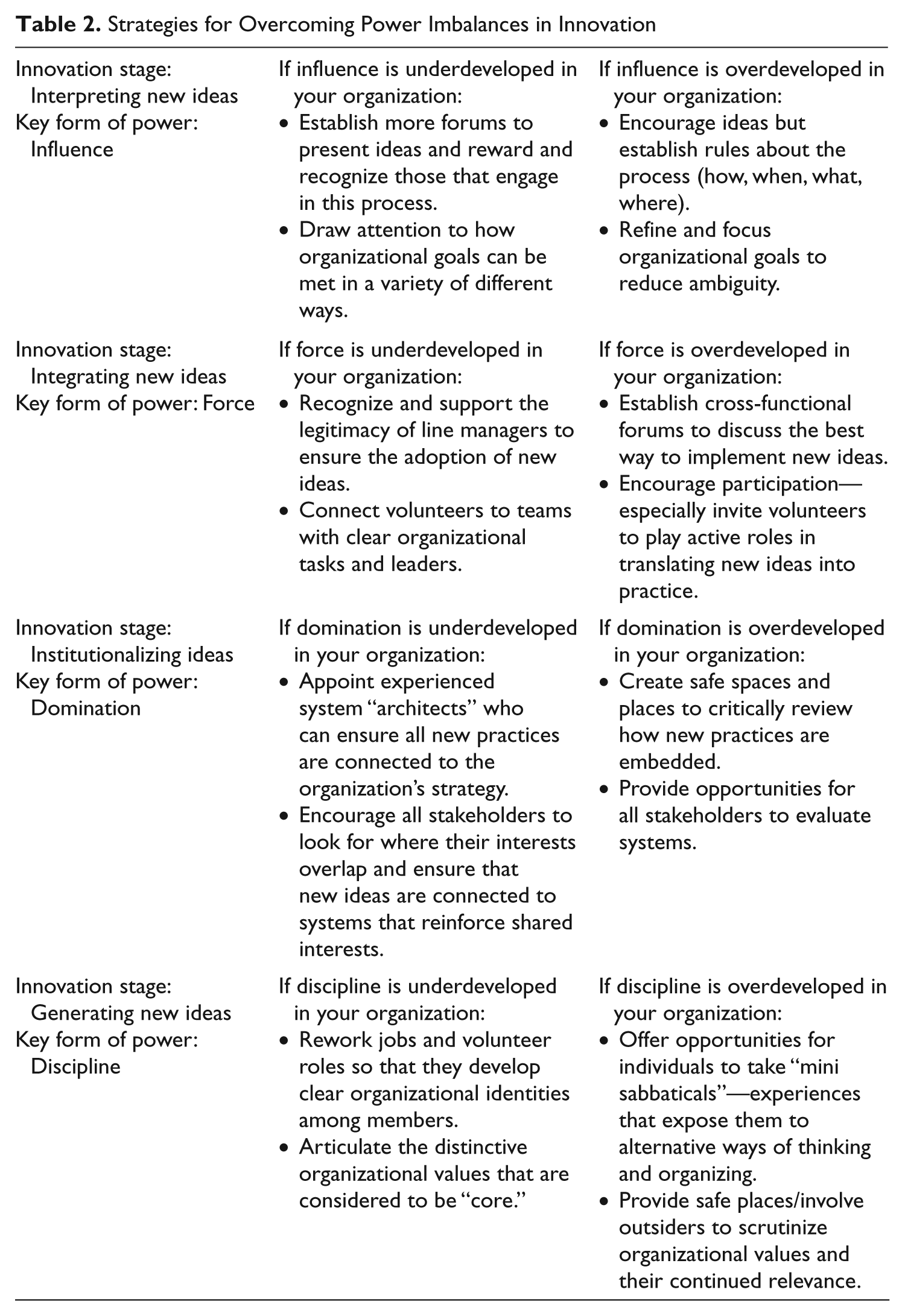
Second, the forms of power in the innovation cycle are all potentially under the control of organizational leaders and managers, and so potential power imbalances in an organization can be acted on once they are identified. In Table 2, we provide some illustrative examples of strategies that organizations could employ in response to imbalances at each stage of the innovation process.
Strategies for Overcoming Power Imbalances in Innovation
Finally, the four characteristics of nonprofit organizations that we have argued can affect the organizing of continuous innovation may be useful in making salient the idiosyncrasies of the sector and specific organizations. Although we have provided a general framework for understanding continuous innovation in nonprofits, managers will need to adapt this framework to the particular innovation challenges in their own organizations. Popular accounts of innovation often present it as a generic process but in doing so neglect local organizational characteristics. When examples of innovation are drawn from for-profit organizations, there is a potential for an even greater disconnect. This article recognizes the complexity of organizing innovation that is distinctive of the nonprofit form as well as offering a way for managers to target specific aspects of their own organizations that may currently facilitate or impede innovation.
Footnotes
Acknowledgements
For their constructive comments on earlier drafts of this article, the authors would like to thank the participants at the 2008 ARNOVA conference and the two anonymous reviewers.
Declaration of Conflicting Interests
The authors declared no potential conflicts of interest with respect to the research, authorship, and/or publication of this article.
Funding
The authors disclosed receipt of the following financial support for the research, authorship, and/or publication of this article: Financial support of the Social Science and Humanities Research Council, the CMA Centre for Strategic Change and Performance Measurement, and the Beedie School of Business, Simon Fraser University.