



Abstract
The situation of the Korean labor market and welfare system evolved in the 2000s during a period that witnessed civil society playing a prominent role both as a provider of welfare and an inspirer for the implementation of welfare schemes (Labor Market and Welfare System in South Korea section). Emergence of a New Form of Collaboration Between Civil Society and Government section details the process that led to the installation of an ambitious minimum income scheme (the National Basic Livelihood System) and established the basis for a new form of collaboration and partnership between civil society and government in the fields of poverty alleviation and work integration. As a next step in this direction was enacted in 2006 the Law for the Promotion of Social Enterprises, which is presented and discussed in Social Enterprise Model As An Original Way of Addressing Different Social Issues section in reference to other experiences and social enterprise models. The conclusion insists however on the difficulties of preserving what was originally a balanced collaboration between government and civil society in a traditionally state-centered country.
Keywords
The Labor Market and Welfare System in South Korea: Recent Evolutions
Compared with other Organization for Economic Cooperation and Development (OECD) countries, the Korean labor market and structure of its human capital have specific features that have often been praised in international comparative studies. As for the labor market, South Korea has long had one of the lowest unemployment rates among OECD countries (3.2%). The Korean education system has also often been presented as one of the top performers in the world, for example in the OECD PISA surveys, and highlighted as a key factor for economic growth in the numerous economic works inspired by the theory of endogenous growth.
However, an increasing number of works stress that the Korean labor market presents as well important structural weaknesses that generate both important disparities among workers and a need for specific welfare policies. Among recent studies, Yun (2010) insists that South Korea has a typical demographic imbalance in the labor market with a combination of “overworked elderly and underworked youth” that is unique among developed countries. Young South Korean graduates encounter great difficulties in entering the labor market and finding stable employment, whereas the elderly often have to work as the pension system does not provide them with enough resources to live decently. What such an analysis reveals is the growing problematic transition between the education system and the labor market on one hand and the insufficiency of a welfare system that drives many elderly people to stay in jobs on the other one.
Another specific feature of the Korean labor market is its strict division between a well-protected primary labor market offering good working conditions and social protection and a very flexible secondary labor market where wages, job stability and social protection are much lower. Official data about the labor force show that 60% to 70% of all Korean workers are either nonregular salaried workers (daily or temporary in the administrative nomenclature) or nonsalaried workers (see Table 1). The large majority of them can be considered to be outside the so-called primary labor market and confined to the secondary labor market that put them de facto in a situation of job precariousness. As argued by Cho, Kim, and Kwon (2008), one of the main reasons is that many South Korean employers are dodging their social security responsibilities through the strategic use of irregular workers who represent a cheaper and more flexible workforce. 1
Employed Persons by Status of Workers in South Korea (Thousands)
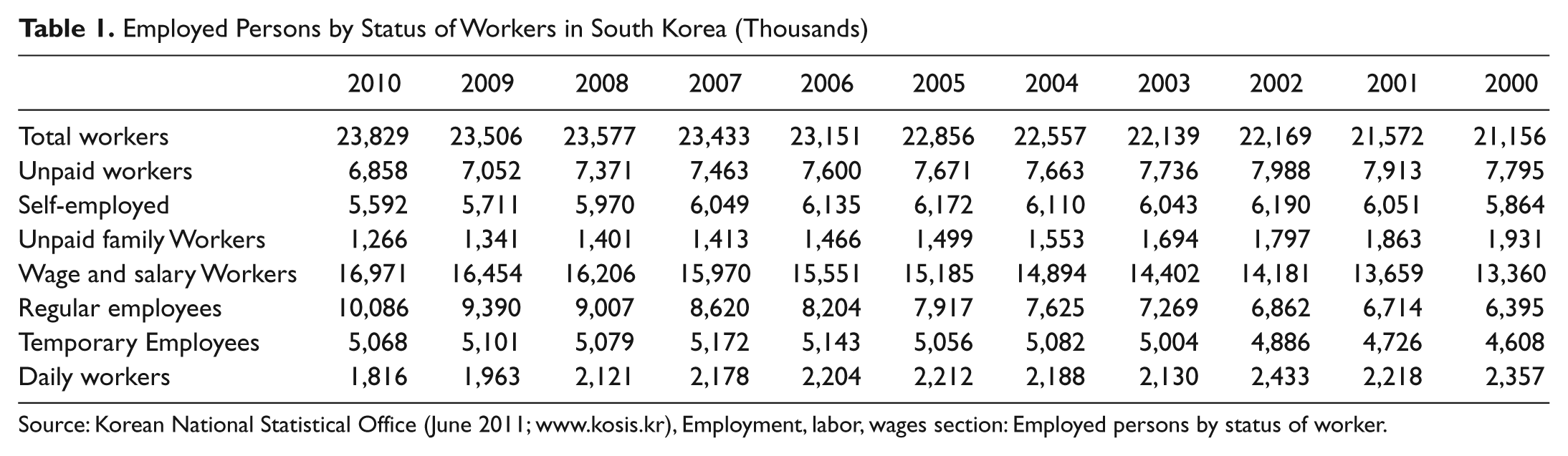
Source: Korean National Statistical Office (June 2011; www.kosis.kr), Employment, labor, wages section: Employed persons by status of worker.
Such an employment strategy has a cumulative double effect. It increases the number of vulnerable jobs and the number of working poor, and it also directly contributes to limiting the resources and coverage of the national welfare schemes. In other words, it creates the conditions for a potential vicious circle beginning with job insecurity that can turn into unemployment, long-term job market exclusion, and social exclusion all the more so since the social protection network does not provide effective assistance. Such a scenario occurred during the late 1997 financial crisis and the following 2 years (1998-1999) when many insecure jobs turned into unemployment and generated social exclusion through the accumulation of various handicaps such as social isolation, health problems, psychological disorders, and the like, because the social schemes and solidarity processes were insufficient (OECD, 2000).
The very specific Korean labor market structure, with a low percentage of stable jobs on the primary labor market and a dominant secondary labor market, presents a potentially high risk of generating social exclusion and poverty, especially if the welfare system does not provide an effective safety net. According to OECD data, the poverty rate as based on 50% of the median income has been increasing in South Korea from around 10% in 2002 to almost 15% in 2010, which is much higher than the average 10.6% in OECD countries. Especially worrying is the rise of the working poor, who account for 60% of all poor in Korea. This is a trend that lends support to the hypothesis of a poverty trap with more and more people unable to escape from poverty despite engaging in high-intensity work. In 2010, South Korea was ranked by the OECD as the member country with the highest rate of low-wage employment at 25.6%, ahead of the United States (24.5%) and Japan (15.4%).
The so-called “growth absolutism” that dominated in South Korea for several decades produced a large consensus arguing that income growth and economic development would produce jobs and increase incomes and therefore solve social problems and eradicate poverty. The remarkable economic development of South Korea gave much legitimacy to this argument as the country, which was one of the poorest countries in the world in the mid 1950s, became in 1996 an OECD member. This large consensus encouraged and justified the creation of a very limited and residual welfare system that was in accordance with both a political ideology that praised limited public spending and a traditional Confucian culture that favored strong family ties through the central concept of filial piety and community-based solidarity. As a consequence, South Korean welfare expenditure as a percentage of GDP remained very marginal for a long time and was seen as very residual in early comparative studies by Jones (1993) and Goodman and Peng (1996). Comparing the share of public social expenditures when the national income per capita reached the 10,000 US$ level, the OECD (1999) noted that this share was only 4% in South Korea compared with 10% in Japan, 20% in the UK and 25% in Sweden. Such an achievement has long been viewed positively as stressed by Kuhnle (2004), who writes that Asian welfare systems “not only attracted increasing attention among Western scholars and politicians, but were actually pointed out as potential welfare models for the West” (p. 54).
However, when South Korea became an OECD member in 1996, the external pressure by other OECD members for a more balanced socioeconomic model to weaken the competitive advantage of South Korea in terms of labor costs influenced the Korean agenda. The request for a more extensive social safety net was rapidly validated by the disastrous effects of the late 1997 financial crisis. The financial collapse degenerated into an economic and social collapse as a large part of the poor and unemployed did not receive any benefits from the welfare system. Within a few months, the unemployment rate increased from less than 3% to almost 9%, and several signs of social dislocation rapidly appeared, for example, a rise in the number of homeless people, suicides, divorces, and overindebted households. This dramatic situation revealed the weakness of both the Korean labor market and welfare protection and the need for more extensive welfare programs. It was also a sign that South Korea could not pursue its economic development plans without any consideration for social policy standards.
Among other countries, South Korea was severely hit and had to struggle to escape from the miseries of declining income, rising unemployment, and increasing poverty that had not been experienced for years. The crisis also revealed that certain categories of the population were especially vulnerable and in need of appropriate policies. As stressed by Lee (1999), “it is the marginal groups such as the poor, the less experienced, the less educated, women, and young workers” (p. 36) that were most severely affected by the crisis. Elderly (i.e., individuals aged 65 or older) are another of those vulnerable groups with a poverty rate around 30%, significantly higher than other OECD countries as asserted by the OECD (2008) and more recently by Lee and Phillipps (2011).
In fact, the South Korean socioeconomic model of development that was successful for so long has been progressively challenged under economic, social and political pressures, reflecting both endogenous characteristics (new demographic trends, emancipation of women, increased democratic demands, rise in individualism and liberalism) and exogenous characteristics (entry into world trade, opening and liberalization of markets). These different elements weakened traditional community-based solidarity and contributed to the rise of a more individualistic ideology. One of the main consequences was a reform and extension of the whole Korean welfare system during the late 1990s. The organization and management of the health insurance system was revamped in 2000, the unemployment insurance scheme was modified several times in the 1998-2000 period, and the pension system was formally extended to all workers in 1999. In 1999 the very innovative National Basic Livelihood System Act was also enacted, which guarantees all households whose incomes do not meet the minimum cost of living welfare benefits from the government equal to the difference. This introduced for the first time the idea that society should provide every citizen with a decent standard of living (see details in Section 2).
The new orientation of the South Korean welfare system was studied by many scholars. Gough (2001) noted that South Korea moved toward “a more Western welfare system: not only a stronger safety net and more generous unemployment benefits, but also a restructured National Health System, more liberal pension entitlements and an expanded Labor Standard Law” (p. 17). And Kuhnle concluded an article in 2004 by writing, “It looks as if the Korean welfare system may in due time have more in common with the ‘Nordic’ or Scandinavian, ‘social-democratic’ welfare regime than any of the other European and Western types” (p. 86). Other scholars, especially Holliday and Kwon (2007), did not share this view and considered that the extent of the South Korean reforms that took place in the late 1990s “has been exaggerated by many observers” and did not “alter the fundamental character of the Korean welfare state.” Such a view is stressed when comparing Korea’s welfare expenditures with other developed countries. Despite the different extensions, Korea’s welfare expenditures as a percentage of GDP was the second lowest level among OECD members at 11% in 2008 and the South Korean government welfare expenditures less than half the average government spending among OECD member nations.
Both arguments are actually right. South Korea achieved a remarkable extension of its welfare system that few countries matched in an era of liberalization and reduced public spending, but the gap between the supposed scope of many welfare schemes and their actual scope limits de facto the real impact of the changes. Jones noted in 2005 that a third of nonregular workers were still not covered by any worksite-based social insurance system and that almost half of all wage and salary earners were estimated not to be actually covered by employment insurance. The majority of low income earners, including regular workers in small companies with fewer than 5 employees and nonregular workers, have been left outside the social safety net. The proportion of uncovered workers is especially high when considering the unemployment insurance scheme. Besides the nonsalaried workers, who are by definition not covered, only 65% of eligible salaried workers and less than 55% of all wage and salary earners are estimated to be actually covered. According to the data provided by the Korean Ministry of Labor, although the number of workers covered by the unemployment insurance scheme has been steadily increasing, the rate of covered workers in the total active population remains below 40%. As for health insurance, 98% of the population is covered by national health insurance, but the share of out-of-pocket payments, which accounts for 38% of total health expenditure, remains much higher than the OECD 20% average as pointed out by Kwon (2009). The pension programs, supposed to be mandatory since 1999, actually accept a large number of exempted candidates who are not accumulating eligibility for future benefit, and the lack of maturity of most of these programs still leaves many people above 65 without any pension, whereas demographic forecasts indicate a probable financial collapse of the system before 2050 if not revised.
Emergence of a New Form of Collaboration Between Civil Society and Government
The early 1990s witnessed the creation of pioneering experiences of job creation inspired by the European model of workers’ coops, although a specific legal status still does not exist in South Korea for this type of cooperative. For this reason, these first organizations legally operated under a nonprofit status. Most of these early independent experiences failed in the late 1990s for financial reasons but, in a context where civil society remained for long mostly informal or controlled by the state, they can be considered as one of the first formal and independent initiatives by South Korean civil society for dealing with societal issues such as unemployment and poverty. These nonprofits paved the way for the first organized response to dealing with the issues of unemployment and social exclusion in 1998. This response took the form of a coalition formed by more than 40 civic groups engaged in helping the poor and underprivileged at the time of the economic crisis. The so-called Solidarity to Overcome Unemployment program handled issues that had been ignored or were insufficiently addressed by existing public schemes. As many civil society leaders decided to collaborate with the public sector, these first experiences helped introduce and promote in political circles the concepts of self-help and self-sufficiency and the model of social entrepreneurship that would later be adopted by the government for shaping its policies in the fields of work integration and poverty (see Section 3).
In the late 1990s, the existing social safety net for the poor was indeed largely insufficient both in coverage and in amount for dealing effectively with the sudden mass unemployment caused by the economic crisis. The Korean government hurriedly promoted public works programs targeted at those who were not eligible for unemployment benefits and not poor enough to get public assistance although this was at a very low level. These programs offered modest livelihood support to their beneficiaries in exchange for their enrollment in temporary jobs, but they were of little help in terms of work integration and did not provide a decent and stable income to the recipients. The public works programs did not succeed in creating stable and skilled jobs. They only provided temporary and unskilled jobs. To deal with the work integration of the disadvantaged, the South Korean government contracted out a significant part of the public works to civil society, which proved to have more appropriate responses to this issue. This involvement of civil society organizations in the public work programs has been considered the first balanced collaboration between government and civil society in a country that until its democratization in the late 1980s was either repressive or authoritarian toward civil society. South Korean civil society, especially the most challenging part of it, was systematically stifled by authoritarian military governments until the democratization of the late 1980s. The new political context of the 1990s generated what has been called a “civic revolution” to express both the quantitative importance of the phenomenon (the number of civic organizations almost doubled within the 3 years of 1996 to 1999) and its new main orientation (most of these new citizens’ movements were less radical politically as democratization was achieved and more oriented toward socioeconomic issues and the reshaping of public policies). However, as argued by Kwon (2002), until 1997 “social policymaking was confined only to a small number of top policy makers, leaving most citizens without a voice” (p. 26).
Whereas the government was used to designing laws through a typical top-down process, important welfare reforms began to be introduced through active lobbying by influential civic organizations. One of the major results obtained by the civil society movement was the enactment of the National Basic Livelihood System Act that came into effect in 2000 and produced the first ambitious scheme for work integration in South Korea 2 . The first livelihood protection program was implemented in South Korea in 1961 but remained very limited in coverage, concerning only families with no able-bodied adults and provided very limited benefits to the few eligible recipients. Because it relied on the idea that citizens in need should get a decent level of support from government as a social right, the NBLS was stressed by Holliday and Kwon (2007) as “the most distinctive change in the entire reform package” that took place recently in South Korea and “posed the greatest philosophical challenge” to what they call the “productivist welfare capitalism in Korea.”
As mentioned before, the NBLS is an allowance supposed to be given to any household which is living under an absolute poverty line defined according to the family structure. Like many other national basic incomes, the NLBS is a residual allowance, i.e. anyone with a monthly income below the poverty line can get the difference to meet the line. In 2010, this monthly line amounted to about 1,000 US$ for a four-person household, which represented about one third of the average urban income in South Korea. What is more notable is that this level is much higher than the Korean minimum wage, which could raise concerns about it being a disincentive to work. However, additional requirements, especially the primacy given to family support, exclude in fact many people from the NBLS. Only people who do not have any relatives that are legally responsible for them or supporting them (parents, spouses, children and their spouses, and siblings) are eligible for the NBLS.
According to the law, a beneficiary of the NBLS, if considered able to work, must enroll in a work integration scheme to get the full NBLS allowance. Otherwise the work integration part of the allowance included in the NBLS is withheld. With the introduction of a work integration dimension in the NBLS scheme, the Korean administration set up the first large-scale work integration policy in its history. Work integration is promoted through different programs with specific aims according to the profile of the recipients. “Simple labor” programs only aim to provide temporary and unskilled work to the most socially marginalized recipients for whom work integration in the short term is not possible. “Market-type” programs aim to provide short-term sustainable and viable work integration. Both are overseen by the Ministry of Labor. “Social-type” or “public interest type” programs supervised by the Ministry of Health and Social Affairs are designed for activities that are unlikely to be profitable on the market but provide socially useful services to the community and so deserve to be supported.
Except for the “simple labor” programs that remain mostly monitored by the public authorities, the other programs have been for a large part contracted out to specific nonprofit organizations called self-help support centers (SHSC) that largely rely on public funding. This introduced a large-scale collaboration with civil society as nonprofits are one of the main actors in the scheme. Every SHSC initially applies to the Ministry of Social Affairs to get an agreement and then to receive the main part of their resources from public subsidies through an annual financial allocation earmarked for the work integration programs. For this reason they are in fact closely dependent on the authority of the Ministry and hardly enjoy any significant degree of autonomy.
Regarding work integration as a whole, there were in 2006 some 60,000 recipients of the different types of support for work integration in Korea. Altogether the work integration programs run by the nonprofit sector concerned around 18,000 participants, which represents 30% of the total 60,000 persons involved in a work integration program. The rest were involved in public schemes and public works programs that were organized by central and local governments and focused on the provision of “simple labor.” One can note that the contracting out of work integration to the nonprofit sector, which was at 10% in 1999, was three times higher in 2006. It is also interesting to point out that women represent 80% of all the participants in the SHSC programs and more than 95% in specific fields like care services. This reflects the fact that women, especially women in atypical family situations (divorced women, widows or unmarried mothers), represent a sizeable share of the poor and persons in a situation of potential or real social exclusion in South Korean society.
The major industries concerned by the work integration programs run by the nonprofit sector were in 2006 the following: (a) care services, especially services to the elderly and disabled, (25% of the programs and 40% of the participants); (b) building and housing renovation for the poor (12.7% of the programs and 8.6% of the participants); (c) agriculture and forestry (9.4 of the programs and 9.1% of the participants); (d) business services (10.7 and 7.5% respectively); (e) waste recycling (8.9% and 7.9% respectively), (f) cleaning services, especially in primary schools, (11% and 9.5% respectively). Care services take the lion’s share with some 7,500 participants in 450 programs, whereas each of the other industries mentioned has less than 2,000 participants in 150 to 250 programs.
The Social Enterprise Model As An Original Way of Addressing Different Social Issues
The concern for work integration was soon matched by another concern on the political agenda: the need to address new social issues resulting from socioeconomic changes, especially the growing need for social and/or personal services related to the rapid ageing of the population, growing concerns over the environment, and the rising demand for childcare generated by the increasing number of working women. New policies were therefore designed for promoting “social jobs,” a term that appeared for the first time on the official public agenda in the early 2000s to designate jobs that are socially useful but lack clear market profitability. South Korean authorities tried to address two issues together: rising unemployment and new emerging demands generated by structural social changes. Inspired by this idea, the South Korean government launched in 2006 a very ambitious policy entitled Social Vision 2030 with the aim of enforcing social services provision by increasing public expenditure, encouraging the formation of a social services market, and promoting social enterprises as an important delivery system through the Law for the Promotion of Social Enterprises.
With this law, South Korea was the first Asian country to officially enact a specific law supporting and labeling social enterprises
3
. Under the 2006 law for the Promotion of Social Enterprises, a social enterprise is defined as a
Certified organization which is engaged in business activities of producing and selling goods and services while pursuing a social purpose of enhancing the quality of local residents’ lives by means of providing social services and creating jobs for the disadvantaged.
Additional features include an obligation to reinvest a majority of the profits for social purposes and to include different stakeholders in the decision-making process (Bidet and Eum, 2011). Organizations which want to be certified should have one of the following legal forms. They can be an associative corporation registered under civil law, a company registered under the Commercial Act, a nonprofit private organization, a consumer cooperative or a welfare corporation registered according to the respective laws defining the last three forms.
A Social Enterprise Support Committee, which is under the authority of the Ministry of Labor, is responsible for deciding if an applying organization can be certified as a social enterprise. To be certified, organizations must provide the proof of the relationship between their activities and a social goal (an activity benefiting disadvantaged persons or related to environmental issues). Four main sorts of social enterprises have emerged from this law according to their social goal: (a) social enterprises for the work integration of disadvantaged persons (49% of all certified social enterprises); (b) social enterprises providing social services to disadvantaged persons (12%); (c) a mix of both (24%); (d) any other form that does not fit either one of the previous three categories (15%), for example social enterprises created with an environmental focus. Consequently some 75% of all certified social enterprises include work integration in their main purpose, which shows the emphasis on employment creation. The law for the promotion of social enterprises rapidly met a certain success: some 50 social enterprises were certified at the end of 2007, 250 by mid-2009, and some 500 so far, including more than 200 registered in 2010. The main activities of these social enterprises are education, social welfare, environmental activities (including recycling), care services, culture and the arts.
The emergence of social enterprises in Europe and the United States is considered to be related to two main factors. The first is the decline of public funding for organizations engaged in social services. Kerlin (2006) explains that the growth of social enterprises in the United States resulted from “cutbacks in government funding that nonprofits had grown to rely on.” In Europe, as noted in early works by Borzaga and Defourny (2001), social enterprises also developed in relation to a general trend of the retrenchment of welfare states. In both contexts, it led to the search for private financing and/or an emergence of private actors to deal with social issues. The second factor is the rise of new needs that the established schemes and actors did not address or were not fit to address in the fields of social and personal services and work integration of disadvantaged groups of people (Spear and Bidet, 2003).
The same two main factors explain as well the interest in social enterprises in South Korea. However, rather than finding a solution to a drop in public funding for welfare, which is actually increasing in Korea as explained in Section 1 while remaining at a low level compared with OECD standards, the concern here is finding a way of keeping the expansion of public spending within reasonable limits and with a counterpart from the recipients. New needs emerged as well in South Korea in relation to the rapid aging of the population (one of the most rapid in the world according to the OECD’s comparative studies) and to the transformation of traditional family structures and roles (which contributes to relocating solidarity processes outside the family that functioned for a long time inside the family). Provision of health care for those with low incomes is a worrying problem as the private medical sector’s stake in Korea’s national health care system is very high and the share of the public sector extremely low.
Work integration of specific groups has been a permanent and growing issue since the late 1990s crisis revealed the weaknesses of both the labor market and the existing safety net. In the Korean context, this issue is closely related to the elderly as already mentioned, but also to the problem of female unemployment as many South Korean women tend to leave the labor market in their late 20s to raise children (the employment rate of female Koreans aged 30-34 is over 10% lower than that of their counterparts aged 25-29, and there is a 30-point difference in the 30-49 age bracket between employment rates of Korean men and women). A frequently quoted social enterprise that illustrates how these different issues can be addressed together are the Kyobo Dasomi care centers, started by the Dasomi Foundation in 2007 with the support of the Kyobo insurance company, which have so far created jobs for some 800 middle-aged women as caregivers providing nursing care to the elderly.
European and American conceptions of social entrepreneurship present specific features as stated in the comparative studies by Kerlin (2006) and more recently Defourny and Nyssens (2010). In its architecture, the Korean approach of social entrepreneurship combines specific features of both conceptions. Compared with the European experiences and legal frameworks, the Korean legislation has features in common with the 2005 Italian law on impresia soziale that also enables various types of organizations, for-profits as well as nonprofits, to obtain the legal “brand name” or certification of a social enterprise. The concern for “enhancing the quality of local residents’ lives” indicates the influence of other European legal frameworks like the Community Interest Company in the United Kingdom. More generally, the Korean approach shows (and claims) an influence from European experiences that stress the importance of democratic governance and the role of multistakeholders and therefore value the collective dimension of the project, considering the social benefit as “the main driving force” (Kerlin, 2006). Health coops, as a specific form of consumer coops, are a good example of such an approach. They have been started by and involve different stakeholders like medical practitioners, social workers, local residents, religious groups, farmers’ groups, and the like.
However, the Korean view is deeply influenced by the American conception of social entrepreneurship, which Dees and Anderson (2006) describe as inspired by two schools of practice and thought: the “social enterprise” school, which stresses the capacity of an enterprise to generate market revenues while addressing social issues, and the “social innovation” school, which emphasizes the individual role of the entrepreneur and the entrepreneur’s creativity, dynamism and ability to imagine innovative ways of managing a social business. The social enterprise as “an enterprise which does good for the society while making a profit” (Working Together Foundation) illustrates this influence, which values the importance of income-generating activities with a social objective and the ability of an entrepreneur to combine efficient business practices and a philanthropic spirit to generate market revenues while addressing social issues. Emphasizing “a job as the best welfare for one’s life” (Working Together Foundation), this view can be seen as a modern and sophisticated version of the traditional “growth absolutism” that long delayed the establishment of public welfare systems in South Korea. According to Borzaga and Becchetti (2010), philanthropic foundations, micro-credit systems and corporate social responsibility are central pillars of this approach.
Compared with the European conception of social enterprises, which tends to put greater emphasis on the mix of resources (market, nonmarket, monetary and nonmonetary) as a way of resisting isomorphism (Nyssens, 2006), and the American conception, which is more exclusively oriented toward market reliance for financial independence, the South Korean approach is an intermediate one because of the strong public support and the specific role of government. After South Korea’s progressive civil society introduced the social enterprise model in the late 1990s, it was indeed rapidly adopted and monitored by the South Korean government as a particularly relevant form for promoting the ideals of self-help and self-sufficiency in line with the liberal ideology favoring the implementation of active policies of work (McCabe & Hahn, 2006) and limiting the allocation of public expenditures without any counterpart from the recipients. Therefore the government quickly supported the social enterprise model that emerged in civil society in the late 1990s and eventually adopted the term with the 2006 Law for the Promotion of Social Enterprises. The official Korean website of social enterprises is a government website, and “social enterprise” is now a brand name controlled by the Ministry of Labor. The Korean administration keeps a close control on the work integration scheme and the different structures involved via an approval process. As a consequence, the official, legal, South Korean approach of social entrepreneurship is embedded in the welfare-to-work public policies and in close state monitoring that tends to emphasize an “income oriented” strategy and market profitability rather than the original “service-oriented” dimension and aim of helping to integrate the most marginalized.
Such a feature is in line with the long tradition of a strong state and state control in Korea, but it generated tensions between the rising legitimacy of bottom-up initiatives and the traditional top-down policies that have not always been sufficient and in accordance with their claimed objectives. The introduction of a protected label for social enterprises has created a division between the so-called “certified social enterprises” and other existing forms that share the same main features, such as self-help enterprises, work teams in Senior Clubs, voluntary groups that help the disadvantaged, associations with commercial activities set up to employ disadvantaged people, and the like. As a result, there are growing tensions and debates between different conceptions of the social enterprise, ranging from a narrow view limited solely to certified social enterprises to a broad view embracing all or several of the other forms.
Conclusion: Collaboration or Instrumentalization?
As explained in this article, the involvement of South Korean civil society in addressing the problems of poverty and unemployment followed a new path in the early 1990s and took two complementary forms. On one hand, civil society actors, namely civic movements launched after the 1987 democratization, organized themselves and rapidly developed, leading to a “civic revolution” in the decade of the 1990s. They actively engaged in what Kwon (2007) calls an “advocacy coalition” that influenced public and social policies 4 , especially during the decade when the Progressive Party governed South Korea (1998-2008). On the other hand, civil society was also directly involved in providing solutions and developing original schemes to tackle urgent social problems that existing policies and schemes did not address. This second form of intervention nurtured the first one, which in turn gave legitimacy and recognition to experiences and practices that were mostly local and experimental.
What this process shows is the decisive role of civil society in revealing the need for new welfare policies and schemes focused on specific categories of the underprivileged, providing the first solutions for dealing with these issues, lobbying the government to set up more appropriate public schemes, and then acting as providers in relation to the public policies and schemes. Such a process, which is typical of Western civil society, was rather unusual in South Korea, where central government has long held the initiative and civil society stifled and therefore prevented from expressing its capacity for social innovation. As stated by Kim (2008), the Korean welfare system has for a long time “contained a mixture of welfare providers,” but the role of civil society was mostly under the strict control of the state according to a typical top-down process that has its roots in both Confucian culture and the dictatorial regimes that governed South Korea for the 40 years of 1948-1987 (Bidet, 2002). Consequently, traditional cooperative movements as well as the most important NGOs launched during this period acted in fact as government agencies.
New initiatives taken by civil society in the 1990s challenged this balance of power and inspired significant welfare policies and specific schemes thanks to intense lobbying by civic movements that advocated ideas in line with the new political orientation of the center-left majority that governed South Korea for 10 years (1998-2008). As providers, civil society organizations have been enrolled as key actors in the work integration and social services provision scheme that was established in accordance with the 1999 NBLS Act and the 2006 Law for the Promotion of Social Enterprises. What is remarkable here is the speed in setting up in less than 10 years (1998-2006) a comprehensive and sophisticated scheme relying on specific legal frameworks whereas almost nothing existed before.
As a result however, the original and independent involvement of civil society in addressing social issues in the 1990s has gradually given ground for increasing supervision by central government. Thus, although the recent South Korean schemes to deal with work integration and social services provision clearly have their roots in initiatives and ideas spread by civil society through the pioneer workers’ cooperatives of the early 1990s and the larger civic movement against unemployment in the late 1990s, the most recent trends and orientations show a stronger influence and control by public authorities according to “welfare-to-work” priorities and therefore a weakening of the cobuilding experienced in the 10 years of 1998-2008. Such an evolution tends to indicate that the equal partnership between civil society and government that emerged in the framework of the late 1990s crisis was likely an illusion in a South Korean context shaped by both a state-monitoring tradition and a recent liberal orientation governed by a ideology of workfare that especially values “income oriented” strategies through the limitation and efficiency of public spending. As stated by Kim (2008), many voluntary organizations “can be seen as agencies of the government working for social integration.” The question thus arises to what extent the ideas, dynamism, and human and financial resources of civil society have served above all else the government’s objectives of reducing public social expenditure and keeping the official unemployment rate at low levels while contributing to social cohesion.
Footnotes
Declaration of Conflicting Interests
The author(s) declared no potential conflicts of interest with respect to the research, authorship, and/or publication of this article.
Funding
The author(s) received no financial support for the research, authorship, and/or publication of this article.