



Abstract
In this second of a two-part focused review of the nonprofit business and corporate social responsibility (CSR) literature, the authors present the third and fourth components of the collaborative value creation (CVC) framework: the partnering processes that unpack the value creation dynamics and the collaboration outcomes that examine the benefits and costs on multiple levels. The authors suggest that greater value is created at all levels of analysis, micro, meso, and macro, as collaboration moves from sole creation to co-creation of value. The CVC framework assigns equal importance to all forms of value (economic, social, and environmental), types of actors (individuals, organizations, and societies), and time scales (short/long term), providing the analytical paths for assessing value creation holistically. Examining systematically the processes and the outcomes of value co-creation allows for greater specificity, dimensionality, and inclusivity. The article concludes by delineating the contribution of the CVC framework and offering recommendations for future research.
Keywords
Purpose and Content
This article is the second part of a focused review of the nonprofit–business collaboration and related corporate social responsibility (CSR) literature. It extends the elaboration and application of the collaborative value creation (CVC) conceptual and analytical framework, presented in our previous NVSQ Part 1 review article (Austin & Seitanidi, 2012), to the research question:
Research Question 1: How can collaboration between nonprofits and businesses most effectively co-create significant economic, social, and environmental value for society, organizations, and individuals?
The predecessor article presented the growing importance of partnering between nonprofits and businesses and identified a set of problematic aspects of how value creation has been treated in the literature, which pointed to the need for a new framework. The first article specified and applied the first two components of the CVC framework: (a) the value creation spectrum, which provides new reference terms for defining the spectrum of value creation, and (b) collaboration stages, which reveals how value creation varies across different types of collaborative relationships. In this article we examine the next two components: (c) the nature of value creation processes in collaboration, to reveal the value creation dynamics in the formation, selection, and implementation stages, and (d) the resultant internal and external benefits costs, and partnership outcomes at the micro, meso, and macro levels. These CVC framework components are used to interpret and extend the existing literature where our review revealed an insufficient treatment of the dynamics of how different underlying collaboration processes contribute differentially to value creation, as well as an often underspecified, vague, and uneven assessment of different levels, types, and location of value. Consequently, these two components particularly respond to the growing interdependence of the sectors with continuously evolving new rules of collaboration, which require greater clarity, more precise specification, and deeper understanding of the value generation processes and delivery of outcomes.
CVC Component 3: Partnership Processes
In this component we first examine the value creation processes involved in the partnership formation and selection phase and then analyze the subsequent implementation phase in terms of collaboration design, operations, and institutionalization. We employ the value terminology set forth in CVC Component 1: the value creation spectrum referring to the four sources of value (resource complementarity, resource nature, resource directionality and use, and linked interests) and the four types of value (associational, transferred resource, interaction, and synergistic), in order to make explicit the interrelationships across the components of the framework that provide the different windows for the analysis of the co-creation process. We will also refer to the collaboration Stages analyzed in CVC Component 2: philanthropic, transactional, integrative, transformational. As such, the application of the components suggest that greater value is created at all levels of analysis—micro, meso, and macro—as collaboration moves across the value creation spectrum from sole creation to co-creation of value.
Partnership Formation
Partnership formation (Selsky & Parker, 2005) is usually expressed in the literature as initial conditions (Bryson, Crosby, & Middleton Stone, 2006), problem-setting processes (Gray, 1989; McCann, 1983), coalition building (Waddock, 1989), and preconditions for partnerships (Waddell & Brown, 1997). Some scholars present formation as part of the partnership selection process (Gray, 1989; McCann, 1983; Waddock, 1989); hence the processes of formation and implementation appear to “overlap and interact” (McCann, 1983, p. 178); others suggest that partnership formation consists of a distinct phase or a set of preconditions (Seitanidi, Koufopoulos, & Palmer, 2010; Waddell & Brown, 1997) that occur prior to the partnership implementation. We propose that the selection stage is positioned in a grey area functioning as a bridge between partnership formation and implementation. Conceptually and analytically we follow Seitanidi et al. (2010) and Seitanidi and Crane (2009) by separating the two to analyze more systematically the determinants of the co-creation of value. As Vurron, Dacin, and Perrini (2010) remark, the time dimension in the analysis of cross-sector social partnerships (Selsky & Parker, 2005) is represented by studies that examine the static characteristics of partnerships (Bryson et al., 2006) and by process-based views (Seitanidi & Crane, 2009) that “extend the debate to the variety of managerial challenges and conditions affecting collaborations as they progress through stages” (Vurron et al., 2010, p. 41). Consequently, we focus first on the formation stage with particular emphasis on the initial assessment of the organizational fit potential, which is a fundamental determinant of the realization of value emerging from resource complementarity.
Formation can be seen as an early informal assessment mechanism that evaluates the suitability of a collaboration to evolve into an integrative or transformational relationship where the long-term value creation potential of the partnership for the partners and society is higher (Austin, 2000a). Underestimating the costs and negative effects of poor organizational pairing can be the result of insufficient experience in co-creation of value, planning, and preparation (Berger, Cunningham, & Drumwright, 2004; Jamali & Keshishian, 2009). Often managers “think about it,” but they do not usually invest “a huge amount of time in that process” (Austin, 2000a, p. 50). Such neglect carries consequences, as due diligence and relationship building are key process variables that can determine the fit between the partners. This process will increase managers’ ability to anticipate and capture the full potential for the partnership for both the business and the nonprofit partner. More importantly, the steps that we discuss below will provide early indications of the benefits that are likely to be produced by both partnering organizations collectively (Clarke & Fuller, 2010; Gourville & Rangan, 2004) indicating the co-creation of value and the potential to externalize the value to society. However, deciding which partner holds the highest potential for the production of synergistic value is time consuming and challenging.
Fit within a partnership refers to the degree the collaborating organizations can achieve congruence in their respective perceptions, interests, and strategic direction. As pointed out by Weiser, Kahane, Rochlin, and Landis (2006, p. 6) “The correct partnership is everything”; hence organizations should seek early indications of partnership compatibility. An important mechanism (Bryson et al., 2006) that offers an indication of value co-creation potential is the identification of linked interests expressed through the initial articulation of the social problem that affects both partners (Gray, 1989; Waddock, 1986). Hence, examining partners’ social problem frames reveals commonalities or differences on how they perceive the dimensions of a social problem (McCann, 1983). The process of articulation can identify incompatibilities signaling the need for either frame realignment or abandoning their collaborative efforts. This moves the concerns “beyond how the benefit pie is divided among the collaborators . . . to the potential of cross sector partnerships to be a significant transformative force in society” (Austin, 2010, p. 13). More important, moving to the societal level is encouraging the partners to look at the partnership’s “broader political implications” (Crane, 2010, p. 17), elevating social partnerships to global governance mechanisms (Crane, 2010). In effect, if the partners are able to link their interests, and also draw links with the broader societal betterment, it would provide an early indication of high potential for co-creation of value for the social good, that is, synergistic value capture at the societal level. The more the social problem is linked to the interests of the organizations the higher the potential to institutionalize the co-creation process within the organizations, which will lead to better value capture by the partners and intended or unintended beneficiaries (Le Ber & Branzei, 2010a).
Realizing the potential value creation from resource complementarity is dependent on achieving organizational compatibility. The difficulties in developing high-value integrative and transformational collaborations are extensively documented in the literature (Austin, 2000a; Berger et al., 2004; Bryson et al., 2006; Crane, 2010; Kolk, Van Tulder, & Kostwinder, 2008; Seitanidi & Ryan, 2007; Teegen, Doh, & Vachani, 2004). Differences in goals and characteristics (McFarlan, 1999), values, motives, and types of constituents (Alsop, 2004; Crane, 1998; Di Maggio & Anheier, 1990; Milne, Iyer, & Gooding-Williams, 1996), objectives, (Heap, 1998; Stafford & Hartman, 2001), missions (Shaffer & Hillman, 2000; Westley & Vedenburg, 1997), and organizational characteristics and structures (Berger et al., 2004) require early measures of fit that can provide indications for the potential of co-creation of value. Berger et al. suggest that many of the partnership problems, but not all, can be predictable and dealt with. Such problems include misunderstandings; misallocation of costs and benefits; mismatches of power; lack of complementary skills, resources, and effective decision-making styles; and mismatching of time scales and mistrust. They propose a useful set of nine measures of fit and compatibility that can assist the partners to assess the existing and potential degree of fit. We extend this fit framework by adding further measures of fit that contribute to the anticipation of problems while focusing on the maximization of the potential of the co-creation of value at the partnership formation stage.
The compatibilities and differences across the partners allow for diverse combinations of tangible and intangible resources into unique resource amalgamations that can benefit not only the partners in new ways but also externalize the socioeconomic innovation value produced for society. In order to assess the complementarity of the resources and their value creation potential it is important to recognize the nature of the resources that each partner has the potential to contribute, including tangible (money, land, facilities, machinery, supplies, structures, natural resources) and intangible resources (knowledge, capabilities, management practices, and skills). The more the partners are willing to deploy their distinctive organization-specific resources, the greater will be the potential for value creation. This value potential is also dependent on the directionality and use of the resource flow across the partners, that is, the extent the exchange of resources is unilateral, or bilateral and reciprocal, or a conjoined intermingling of the organization-specific and complementary resources. Unilateral flows or parallel exchanges can create value, but combining resources can co-create greater value. Potential partners’ resource availability and likely directionality of flows can be assessed if the organizations had previous interactions (Goffman, 1983) or information is available from collaborations with other partners (Seitanidi, 2010).
Examining the partners’ motivations can reveal linked interests by providing an early indication of partners’ intentions and expected benefits (Seitanidi, 2010), offering some evidence of the transformative intention of the partnership (Seitanidi et al., 2010). Due to the required time horizon (Austin, 2000a; Rondinelli & London, 2003) of such integrative and transformational relationships, it is useful to include in the formation analysis instances of previous value creation through the transfer of assets of what Gourville and Rangan (2004) label “first-order” (e.g., money) and subsequent resultant “second-order” associational or interaction value (e.g., improved employee morale, increased productivity, better motivated sales force). Linked to the motives, a particularly important measure to assess organizational compatibility is the mission fit, a key indicator of linked interests. When the mission of each organization is strongly aligned with the partnership (Berger et al., 2004; Gourville & Rangan, 2004) the relationship has more potential to be important to both organizations.
The previous experience of the partners (Hardy, Lawrence, & Phillips, 2006), including their unique organizational histories (Barnett, 2007) in developing value relationships, is an important determinant for the partnership fit indicating the ability of the partners to uncover novel capabilities and improve their prospects for social value creation (Brickson, 2007; Plowman, Baker, Kulkarni, Solansky, & Travis, 2007). This will indicate the degree of “structural embeddedness” (Bryson et al., 2006, p. 46), that is, how positively the partners have interacted in the past (Jones, Hesterly, & Borgatti, 1997; Ring & Van de Ven, 1994) in producing value. Therefore, the history of interactions indicates potential for moving toward integrative or transformative relations (Seitanidi et al., 2010).
One important motive for the formation of partnerships for both partners is to gain visibility (Gourville & Rangan, 2004) that may enhance reputation (Tully, 2004), public image (Alsop, 2004; Heap, 1998; Rodinelli & London, 2003), and public relations (Milne et al., 1996). Visibility contributes to social license to operate, access to local communities (Greenall & Rovere, 1999; Heap, 1998) for high-risk industries, credibility (Gourville & Rangan, 2004), and increased potential for funding (Heap, 1998; Seitanidi, 2010). In effect, positive visibility, a form of associational value, is a highly desired outcome for the partners, which we consider a fit measure that takes place either explicitly or implicitly during the formation phase. It is essential that both partners are comfortable with the potential benefits and costs of their partner’s visibility, which will contribute to the organizational fit and the potential for co-creation of value.
Finally, Rondinelli and London (2003) refer to the importance of identifying prepartnership champions, particularly senior executives with a long-term commitment who will play a key role in developing cross-functional teams within and across the partnership.
Figure 1 summarizes the measures of fit that were discussed above.

Partnership Formation: Organizational Fit
Partner Selection
The processes of selecting a partner build on and extend the previous assessment of partner fit potential carried out in the formation phase. Despite being a common reason for partnership failure, poor partner selection (Holmberg & Cummings, 2009) has received relatively limited attention even in the more advanced strategic alliances literature (Geringer, 1991). Selecting the most appropriate partner is a decision that, to a large extent, determines the value creation potential of the partnership.
Simonin (1997) refers to the “collaborative know-how,” encompassing “knowledge, skills and competences” (Draulans, deMan, & Volberda, 2003). It requires skills in searching and negotiating as well as terminating early low-potential relationships (Kumar & Nti, 1998). Partner selection might consist of a long or brief process (London & Rondinelli, 2003; Seitanidi, 2010). Inadequate attention to the selection of partners is associated with organizational inexperience (Harbison & Pekar, 1998), which can result in short-lived collaborations. The highest potential for partnership benefits is associated with long-term collaborations (Pangarkar, 2003). Thus, accurate value assessment potential is a predictor of partnership longevity.
Developing partnership-specific criteria facilitates the process of assessing potential partners; examples of selection criteria suggested in the literature include industry of interest, scope of operations, cost-effectiveness (investment required vs. generation of potential value), time scales of operation, personal affiliations, availability and type of resources (Holmberg & Cummings, 2009; Seitanidi, 2010; Seitanidi & Crane, 2009). One approach to systematize this process would be to specify criteria that would reveal how well the potential partnership could tap into each of the four sources of value, resource complementarity, resource nature, resource directionality and use, and linked interests and how that resource configuration would produce what mix of the four types of value, that is, associational, transferred, interaction, and synergistic.
Despite the important role of risk management in partnerships (Andrioff & Waddock, 2002; Bendell, 2000b; Heap, 1998, 2000; Le Ber & Branzei, 2010b; Selsky & Parker, 2005; Tully, 2004; Warner & Sullivan, 2004; Wymer & Samu, 2003), models of partnership implementation do not usually incorporate risk assessment (for exceptions, see Andrioff, 2000; Le Ber & Branzei, 2010b; Seitanidi, 2010; Seitanidi & Crane, 2009). The risk assessment would be a necessary process, particularly in the case of high adverse visibility (i.e., negative associational value) of one of the partners, due to exposure to public criticism or due to early termination of the partnership as a result of failure to adjust their value creation frames (Le Ber & Branzei, 2010c). The formal internal risk assessment process aims to collect interaction intelligence across the potential partner organizations (e.g., internal process and output reports, external assessment of previous collaborative projects). The formal external process aims to collect intelligence from previous partners in order to develop an awareness of any formal incidents that took place or any serious concerns that may be voiced by previous partner organizations. Moving to the informal risk assessment process, we follow the suggestions of Seitanidi and Crane (2009) consisting of open dialogue among the constituents of each partner organization (in the case of the nonprofit organization: employees, trustees, members of the board, beneficiaries) and informal meetings between the partners, particularly the potential members of the partnership teams. The informal external process consists of open dialogue of each partner with its peer organizations within their own sector and across other sectors to collect intelligence (e.g., anecdotal evidence) revealing accountable decision-making mechanisms (Hamman & Acutt, 2003). The partnership selection consists predominately of microprocesses (Seitanidi & Crane, 2009) that take place on the organizational level of each partner. Interactions across multiple stakeholder groups are encouraged as a way of managing power distribution, demonstrating that collaboration can be a different model of political behavior rather than being devoid of political dynamics (Gray, 1989; Seitanidi, 2010).
Figure 2 offers an overview of the process of partnership selection. We agree with the incorporation of feedback loops suggested by Clarke and Fuller (2010), which are particularly important in the role of the risk assessment informing the final options of potential partners.
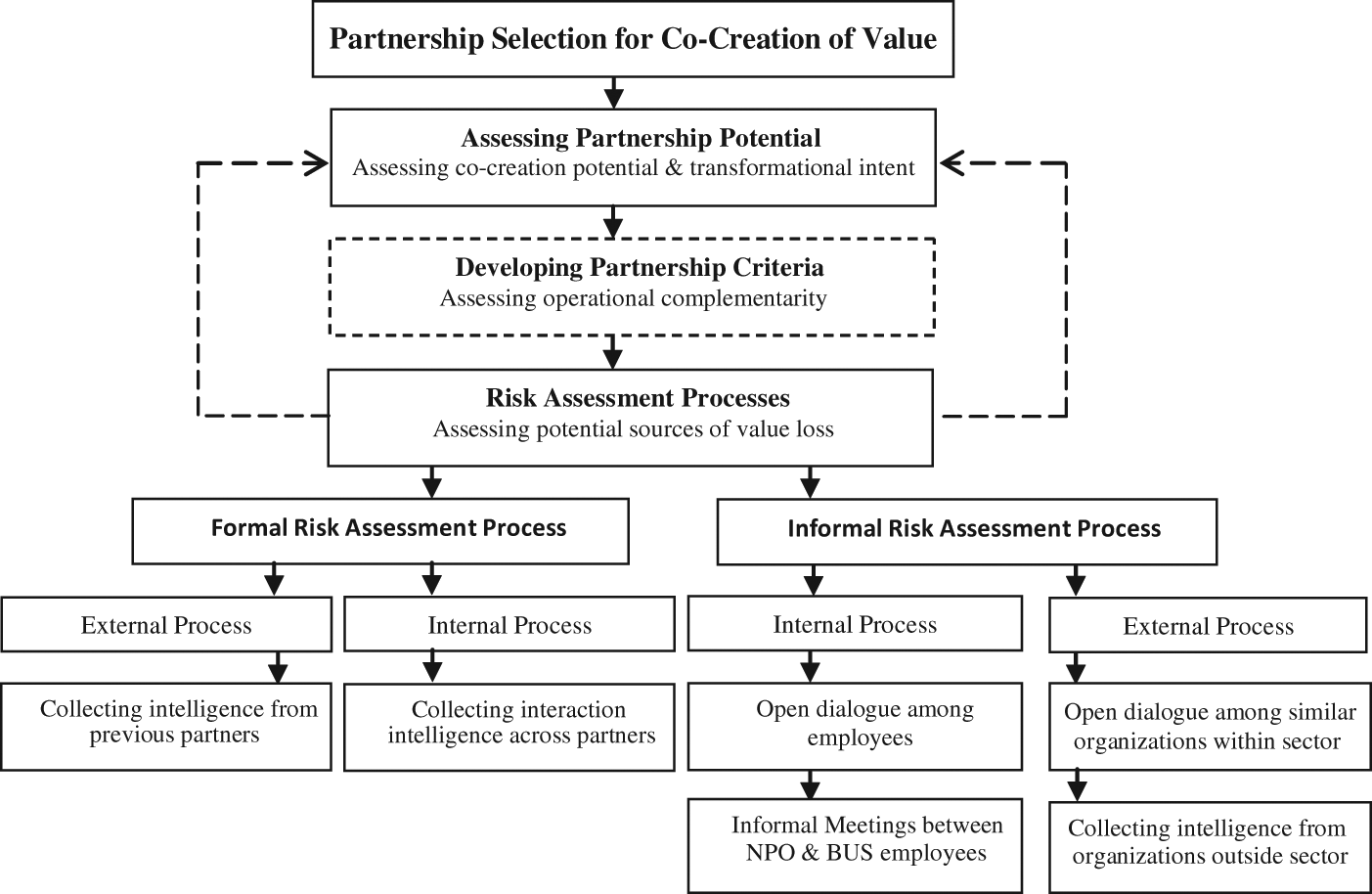
Partnership Selection for Co-creation of Value Adapted From Seitanidi and Crane (2009)
Partnership Implementation
Implementing the partnership is the value creation engine of cross-sector interactions where the value creation process can be either planned or emergent. The co-creation process not only requires the partners to have linked interests but also to be embedded in the local communities of beneficiaries and stakeholders in order to incorporate perceptions of value beyond the partnership dyad. This facilitates the value capture and diffusion on different levels. In order to examine the value creation processes in the implementation phase involving design and operations and partnership institutionalization, we employ the microstage model of Seitanidi and Crane (2009), which responded to previous calls (Clarke, 2007a, 2007b; Godfrey & Hatch, 2007; Waddock, 1989) for more studies on the processes of interactions required, in order to deepen our understanding. The model moves beyond the chronological progression models that define broad stages (Berger et al., 2004; Bryson et al., 2006; Googins & Rochlin, 2000; McCann, 1983; Westley & Vredenburg, 1997; Wilson & Charlton, 1997) to a process-based dynamic view (Vurron et al., 2010), introducing microprocesses as a way of overcoming implementation difficulties (Pressman & Wildavsky, 1973) and demonstrating the quality of partnering. The model focuses only on the implementation of partnerships rather than incorporating outcomes as part of the examination of partnership processes (Clarke & Fuller, 2010; Dalal-Clayton & Bass, 2002; Hood, Logsdon, & Thompson, 1993). We extend the model of Seitanidi and Crane by discussing how the dynamics between the partners can facilitate the co-creation of social, environmental, and economic value. Responding to the call of Clarke and Fuller (2010), we further indicate the two levels of implementation (organizational and collaborative).
Partnership Design and Operations
Partnership design and operations encompass formal processes that influence the implementation leading to outcomes. The literature has pointed to several design parameters and operating actions that contribute to partnering effectiveness. In social partnerships, Austin, Leonard, Reficco, and Wei-Skillern (2006) suggested that social value is created by missions and design. Partnership design includes the experimentation with the procedural and substantive partnership processes (Gray, 1989) such as: setting objectives and structural specifications (Andreasen, 1996; Arya & Salk, 2006; Austin, 2000b; Bryson et al., 2006; Glasbergen, 2007; Googins & Rochlin, 2000; Halal, 2001); formulating rules and regulations (Das & Teng, 1998; Gray, 1989); drafting a memorandum of understanding (Seitanidi & Crane, 2009); establishing leadership positions (Austin, 2000a; Waddock, 1986); deciding organizational structures (Berger et al., 2004; McCann, 1983); agreeing on the partnership management (Austin & Reavis, 2002; Seitanidi & Crane, 2009).
The above processes add structural and purpose congruency (Andreasen, 1996), which contributes to organizational compatibility and generates interaction value. They take place individually and jointly by the partners (Bowen, Newenham-Kahindi, & Herremans, 2010; Bryson et al., 2006; Clarke & Fuller, 2010). Coordination is required to codesign mechanisms that will collectively add value to the partnership (Brinkerhoff, 2002; Bryson et al., 2006; Milne et al., 1996; Seitanidi, 2008; Selsky & Parker, 2005). Value creation requires and produces the valuable intangibles through the processes of working together. Decisions gradually reach operationalization, structures form, passing through several adaptations due to internal or external factors (Austin, 2000a; Gray, 1989), leading to stabilization of partnership content, processes, and structures (Seitanidi & Crane, 2009) until the next cycle of iteration.
Recent literature on social partnerships presented factors that determine the social change potential within the partnership relationship. Seitanidi (2008) suggested that partners are required to embrace their adaptive responsibilities allowing them to move away from their limiting predefined roles and transcend beyond a single dimension of responsibility to offer solutions to problems that require fundamental change. The above confirms our assertion that the company’s CSR and perception of its responsibilities need to evolve to higher levels to coproduce synergistic value. Similarly, Le Ber and Branzei (2010b) proposed that deliberate role recalibration can tighten the coupling between social value creation and risk. As such, the above research stresses the need for change within the partnership facilitated by the partners’ linked interests to contribute to the potential for change outside the relationship, for example, moving the relationship to the transformational stage.
The above processes constitute forms of formal control mechanisms in collaboration (Das & Teng, 1998) that are generally introduced during early stages and play an important role in developing familiarity across the organizations. However, informal measures are more likely to be effective in dealing with tensions around indeterminacy, vagueness, balancing the interpretations between the partners (Ben, 2007; Orlitzky, Schmidt, & Rynes, 2003), and uncertainty (Waddock, 1991) by exerting symbolic power that can influence individual organizations and industry macroculture (Harris & Crane, 2002). Informal measures of control such as trust-based governance may play an important role in nonprofit–business partnerships (Rivera-Santos & Rufin, 2010a) in determining the alliance viability (Arya & Salk, 2006) and co-creation of value. These include: managing alliance culture to blend and harmonize two different organizational cultures (Wilkof, Brown, & Selsky, 1995); charismatic leadership inspiring employee participation (Andreasen, 1996; Berger et al., 2004; Bhattacharya, Sen, & Korschun, 2008); forms of communication that enable formation of trust (Austin, 2000a; Googins & Rochlin, 2000), mutual respect, openness, and constructive criticism to both external and internal audiences (Austin, 2000a); continual learning (Austin, 2000a; Bowen et al., 2010; London & Rondinelli, 2003; Senge, Dow, & Neath, 2006); managing conflict (Covey & Brown, 2001; Gray, 1989; Seitanidi, 2010), and encouraging open dialogue (Elkington & Fennell, 1998).
The above produce interaction value and also serve as enablers and preservers of value. Among the intangible resources that are produced are trust, relational capital, learning, knowledge, joint problem solving, contributing to the co-creation of value, thereby generating benefits for partners, individuals, and society.
Figure 3 below summarizes the partnership design and operations that set up the structures and processes generating value. This is the first instance that partners identify their value distance between their resources, goals, perceptions, and capabilities. The partnership design may be the end if the partners realize that their value distance is too great. The double arrows in Figure 3 demonstrate feedback loops across processes that lead to redesign and adaptations.
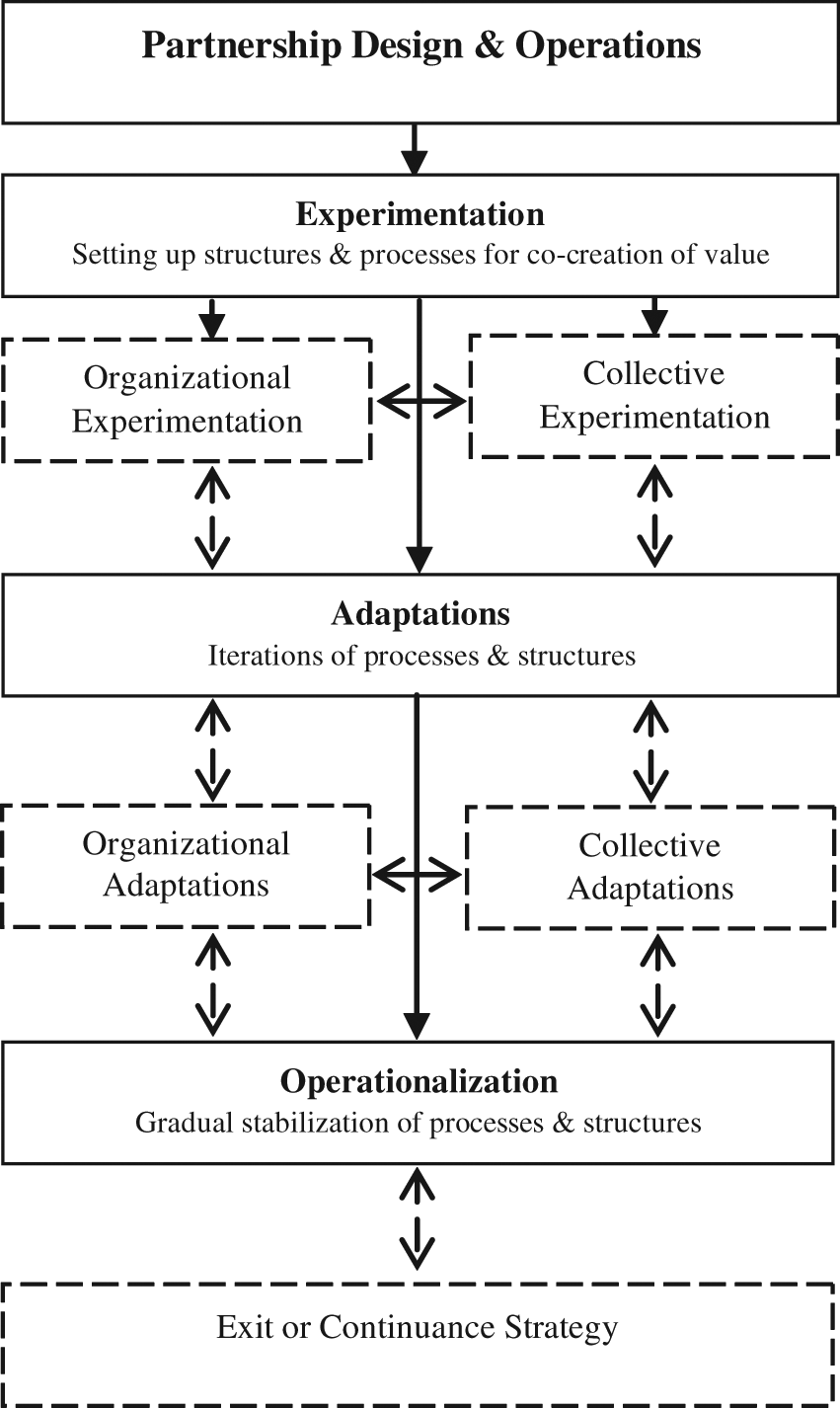
Partnership Design and Operations
Partnership Institutionalization
A partnership has reached institutionalization when its structures, processes, and programs are accepted by the partner organizations (Seitanidi & Crane, 2009) and their constituents and are embedded within the existing strategy, values, structures, and administrative systems of the organizations. Organizational and personal familiarization solidifies the partnership relationship within and between both organizations and enables it to survive the exit of key leaders on both sides.
One of the important institutionalization processes is interaction value accumulation that iteratively builds from information to knowledge to capabilities. This has been an implicit process emerging from our examination of various nonprofit–business partnership cases. Below we suggest explicitly how information transforms to capability as a result of the partners’ interactions and as such contribute a new process in the literature that focuses on partnership implementation. During the formation, selection, and the early design of the partnership the partners have originally only information about each other. The basic information about the key product/service proposition gradually increases, first within the members of the partnership team and later it diffuses within other departments of the organization; the intensification of interactions gradually transforms the information to knowledge. The explicit knowledge grows and the interactions increase familiarity, incorporating tacit knowledge about each other. This knowledge, together with positive informal conditions, lock in the emotional engagement of partners; hence a higher level of knowledge is integrated with enthusiasm, pride, trust, and with the explicit aim to share the unique resources of the organizations. As the partnership progresses the knowledge about the partner organization, its resources and use of resources becomes deeper and turns into a capability; that is, at this stage the partner is able to apply the knowledge in the contexts of both organizations. The partners are able to speak the “same language” and embark in co-creation that may produce innovative products, services, and skills. This is a manifestation of the iterative and accumulating generation of interaction value that can also progress to synergistic value.
If partners are to co-create social, environmental, and economic value, adjustment of their value frames is required to reach frame convergence (Noy, 2009) or frame fusion (Le Ber & Branzei, 2010b). Frame fusion is defined as “the construction of a new prognostic frame that motivates and disciplines partners’ cross sector interactions while preserving their distinct contribution to value creation” by retaining the identity and differences of each partner 1 (Le Ber & Branzei, 2010b, p. 164). Value frame fusion assists in overcoming the partners’ disagreements and allows for transformation of the “current means into co-created goals with others who commit to building a possible future” (Dew, Read, Sarasvathy, & Wiltbank, 2008, p. 983). The above process takes place by each partner perceiving the strategic direction of the other’s decisions (Kaplan, 2008), observing organizational change processes (Balogun & Johnson, 2004), participating in multiplayer interaction (Croteau & Hicks, 2003; Kaplan & Murray, 2008), and monitoring and interpreting each other’s frames (Le Ber & Branzei, 2010c). Value frame fusion plays an important role in the alignment of perceptions and the creation of a mutual language by developing a vocabulary of meaning (Crane, 1998) and is likely to take place within the advanced integrative or transformational relationship stages. Stafford, Polonsky, and Hartman (2000, p. 122) provide evidence on how the partners align their socioeconomic value frames to co-create “entrepreneurial innovations that address environmental problems and result in operational efficiencies, new technologies and marketable ‘green’ products.” They demonstrate that partners may consciously decide to embark onto a transformational collaboration (Stafford & Hartman, 2001); however, we assume that in most cases the social change or social innovation potential emerges within the process (Austin, 2000a; London & Rondinelli, 2003).
If frame fusion is not successful, then frame divergence will shape the degree to which the organization will pursue its strategy and to what extent change will be created (Kaplan, 2008). In fact, “it is the interactions of individuals in the form of framing contests” that shape the outcomes (Kaplan, 2008, p. 744). The plurality of frames and the existence of conflict (Glynn, 2000; Gray, 1989) within a partnership allow for divergent frames that can consist of opportunities for co-creation. Particularly novel tasks (Heap, 2000; Le Ber & Branzei, 2010c; Seitanidi, 2010) allow for balancing potential bias associated with power dynamics (Bendell & Lake, 2000; Crane, 2000; Hamman & Acutt, 2003; Millar, Choi, & Chen, 2004; Tully, 2004; Utting, 2005). Adaptations are essential for survival (Kaplan, 2008) and present opportunities on the individual, organizational, and sectoral levels (Seitanidi & Lindgreen, 2010) to unlearn and (re)learn how to frame and act collectively to develop a synergistic framework, which is essential for providing solutions to social problems. The value capture will depend on the linked interests of the partners that will influence the level of institutionalization of the co-creation of value (Le Ber & Branzei, 2010a).
The institutionalization process enters a point of emerged collective meaning between the partner organizations, which require a reinstitutionalization of partnership processes, structures, and programs after each cycle of co-creation of value. When the partners have captured either unilaterally or jointly (Le Ber & Branzei, 2010a; Makadok, 2001) some value, a necessary prerequisite for continuing, they are ready for the next iteration of co-creation of value, including synergistic value arising from further innovation.
Partnerships are still faced with concerns, including issues of accountability (Reed & Reed, 2009), appropriateness of the standards developed, effectiveness and enforceability of mechanisms, decision-making differences, and control (Brown, 1991). Hence, calls for shared (Ashman, 2000; Austin, 2000a), consensus (Elbers, 2004) decision making and coregulation (Utting, 2005) have been suggested to balance the power dynamics across the partners (Seitanidi & Ryan, 2007). Decentralized control by allowing multiple stakeholders to voice concerns, incorporating feedback loops (Clarke & Fuller, 2010), and decentralized social accountability checkpoints, inviting suggestions from the ground to facilitate answerability, enforceability, and universality (Newell, 2002; Utting, 2005) can address previous criticisms.
In effect, the co-creation of social, environmental, and economic value, particularly as one moves into a transformational stage, would be the result of a highly engaged, decentralized community of voices allowing for the diffusion of outcomes pointing toward a participative, network perspective (Collier & Esteban, 1999; Heuer, 2011). This could include engagement with fringe stakeholders as a means to achieve creative destruction and innovation for the partners and society (Gray, 1989; Murphy & Arenas, 2010). The above expands prioritization of a few stakeholders to the engagement of many stakeholders associated directly or indirectly with partners.
Social betterment becomes central in the integrative and transformational stages of collaboration; hence, multiple stakeholders become a key component in the co-creation process and in reshaping the dialogue (Barrett, Austin, & McCarthy, 2002; Cornelious & Wallace, 2010; Fiol, Pratt, & O’ Connor, 2009; Israel, Schulz, Parker, & Becker, 1998), allowing for value capture on multiple levels. Embedding the partnership across interested communities introduces a new layer of partnership institutionalization outside the dyad of the profit and nonprofit organizations.
Figure 4 below presents the partnership institutionalization process commencing by embedding the partnership within each organization, reaching value frame fusion, including reinstitutionalization of partnership processes, structures, and programs based on newly emerged shared perceptions. There is an inner circle of iterative process change to develop new capabilities, value propositions, and frame fusion. Institutional viability and expanding value co-creation also requires ongoing inputs from outside stakeholders. Partnerships have the potential to deliver several cycles of value creation or may end unexpectedly depending on: the quality of the processes; the evolution of the partners’ interests, capabilities, and relationships; and changes in the environment.

Partnership Institutionalization
Partnering Processes Case Illustration
We present an illustration of the above partnering processes based on the descriptions and analyses of Austin and Reavis (2002) and London and Rondinelli (2003) of a multiyear collaboration between Starbucks and Conservation International (CI), perceived by both partners as very successful. The partnering centered initially on assisting small coffee growers in southern Mexico to improve their environmental practices and quality of coffee.
Formation and selection
Both organizations were experienced in cross-sector partnering and consequently engaged in systematic due diligence focused on assessing potential fit with each other relative to other candidates. They discovered shared values regarding environmental conservation and strategic linked interests in small coffee growers—a major source of supply for Starbucks but whose practices could have adverse impacts on the environment in terms of habitat destruction and waste disposal pollution. CI, with its conservation and field-level project management expertise, was assisting farmers to shift to shade-grown and organic cultivation techniques but needed to provide farmers with greater market knowledge and access, capabilities held by Starbucks. Value creation potential assessment in the early dialogues between the potential partners focused primarily on resource complementarity and deploying their respective distinctive competencies. High aspirations for significant change were expressed, revealing potential for synergistic value creation with transformative effects. Early project champions emerged on both sides.
Design, operations, and institutionalization
A memorandum of understanding clearly and formally delineated implementation roles, responsibilities, and timelines that leveraged and combined the partners’ distinctive capabilities. Risk was managed explicitly by starting with a small scale in terms of numbers of farmers and without an obligation to buy their coffee output. As the partners worked together and with the farmers, they engaged in collaborative discovery and learning leading to adaptation and redesign. Shared working experiences in the field deepened their understanding of each other’s organizational cultures and created interpersonal bonds, mutual trust, and shared commitment to the project. These intangibles represented interaction value and became enabling capabilities and informal control and coordination mechanisms for further advancement of the collaboration. The program expanded the number of farmers assisted, added production credits, instituted quality standards, and increased the quantity of coffee purchased at premium prices. The project became integrated into Starbucks procurement operations. The collaboration then moved into a more transformative stage aimed at creating new procurement guidelines, not just for Starbucks but for the entire industry, based on scaled premium prices that rewarded and aimed to achieve quality, environmental betterment, economic fairness, and social standards. The formulation of these guidelines involved a multistakeholder initiative and deliberative dialogue encompassing many environmental and advocacy NGOs, coffee growers, processors, and marketers. In effect, the collaboration moved from an integrative stage into a higher and broader institutionalization and transformation phase, co-creating additional and different types and levels of value outcomes, which we shall continue to elaborate as illustrations in the next and final component of the CVC framework.
CVC Component 4: Collaboration Outcomes
We are experiencing an unprecedented proliferation of “accelerated interdependence” (Austin, 2000b, p. 69) across the public, profit, and nonprofit sectors due to the double devolution in functions, from central governments to the local authorities, and in sectors, from the public to the private and nonprofit (Austin, 2000b). The increasing fiscal needs of the public and nonprofit sectors contribute to the diffusion of responsibilities promoting cross-sector collaboration as an effective and efficient approach to manage assets and provide solutions to social problems (Austin, 2000b). However, the intense needs for resources can capture and perhaps divert the critical role of the state and, in some cases, of the nonprofit sector (Bendell, 2000a, 2000b; Mitchell, 1998; Ndegwa, 1996; Raftopoulos, 2000; Seitanidi, 2010). Hence, criticism toward partnerships (Biermann, Chan, Mert, & Pattberg, 2007; Hartwich, Gonzalez, & Vieira, 2005; Reed & Reed, 2009) and the outcomes achieved (Austin, 2010; Brinkerhoff, 2007; Seitanidi, 2010) is not a surprise, but rather a call for a paradigm change. The examination of nonprofit–business partnership outcomes (Selsky & Parker, 2005) is an evolving area in practice and research, particularly when the focus is not only on the benefits for the partners but also for the society (Austin, 2000, 2010; Margolis & Walsh, 2003; Seitanidi, 2010). Although what makes collaboration possible is “the need and the potential” for benefit (Wood & Gray, 1991, p. 161) given that social partnerships aim to address social issues (Waddock, 1988), the definition of what constitutes positive partnership outcomes “should encompass the social value generated by the collaboration” (Austin, 2000b, p. 77) on different levels of analysis (Seitanidi, 2008, 2010).
The shift in the literature from social partnerships (Waddock, 1988) to strategic partnerships (Andrioff, 2000; Birch, 2003; Elkington & Fennell, 2000; Warner & Sullivan, 2004) is turning full circle as new found significance is assigned to collective impact (Kania & Krammer, 2010), social value measurement (Mulgan, 2010), and the very recent creation of a new class of assets, named by JP Morgan and the Rockefeller Foundation, ‘impact investment’ that aims to “create positive impact beyond the financial return” (O’Donohoe, Leijonhufvud, Saltuk, Bugg-Levine, & Brandeburg, 2010, p. 5). The Monitor Institute (2009, p. 9) estimates that social impact investing will reach US$500 billion over the next decade.
Reconfiguring the meaning of financial value by incorporating social and environmental value is of critical importance (O’Donohoe, Leijonhufvud, Saltuk, Bugg-Levine, & Brandeburg, 2010, p. 7). The reconstitution of value creates a unique opportunity for intentional social change mechanisms to provide opportunities for social and environmental impact as forms of superior value creation for economic and social returns, not only for few but for many, what Porter and Kramer refer to as “shared value” (Porter & Kramer, 2011). To assess whether nonprofit–business partnerships constitute such intentional mechanisms for social change and innovation, we need to move forward by locating where value is created, that is, loci 2 of value creation.
Where Value Is Created: Loci of Value Creation
In our (Austin & Seitanidi, 2012) definition of collaborative value as “the transitory and enduring benefits relative to the costs that are generated due to the interaction of the collaborators and that accrue to organizations, individuals, and society” the locational dimension is central. The CVC framework incorporates multilevel value assessment by introducing three levels of analysis: meso, micro, and macro. The focus in this element of the framework is on who benefits from the collaboration. Collaborations generate value, often simultaneously, at these multiple levels. For our purpose of examining value, we distinguish two loci: within the collaboration and external to it. Internally, we examine value accruing at the meso level for the partnering organizations and at the micro level for the individuals within those organizations. Externally, we focus on societal welfare and its improvement as a result of the collaboration in the form of benefits at the micro (to individual recipients), meso (other organizations), and macro (systemic changes) levels.
Internal Value Creation
Meso level
The most common focus in the literature and in practice is on the value accruing to the partners, which are the organizational benefits that enhance the performance of the nonprofit or the company. The literature abounds with long and at times confusing arrays of benefits. To create greater coherence and identify areas of focused analysis, we apply the CVC framework’s referent terms to organize below the cited benefits into the value constellations using the four different types of value explained in Austin and Seitanidi (2012), first for nonprofits and then for businesses.
For nonprofits the summarized cited benefits of collaboration include the following.
Associational value:
higher visibility (Austin, 2000; Elkington & Fennell, 1998; Gourville & Rangan, 2004; Seitanidi, 2010), and credibility (Austin, 2000b; Googins & Rochlin, 2000; Heap, 1998; Huxham, 1996; Yajizi & Doh, 2009); increased public awareness of the social issue (Gourville & Rangan, 2004; Waddock & Post, 1995); greater support for organizational mission (Pearce & Doh, 2005).
Transferred value:
financial support received by the business (in cash or in kind) and additional support (Brown, & Kalegaonkar, 2002; Galaskiewicz, 1985; Googins & Rochlin, 2000; Yaziji & Doh, 2009); increased volunteer capital (Googins & Rochlin, 2000; Vock, van Dolen, & Kolk, 2011); complementary and organization-specific assets (Austin & Seitanidi, 2012).
Interaction value:
opportunities for learning (Austin, 2000b; Googins & Rochlin, 2000; Huxham, 1996; Yajizi & Doh, 2009); development of unique capabilities and knowledge creation (Googins & Rochlin, 2000; Gray, 1989; Hardy, Phillips, & Lawrence, 2003; Huxham, 1996; Porter & Kramer, 2011; Yaziji & Doh, 2009); access to networks (Heap, 1998; Millar et al., 2004; Yaziji & Doh, 2009); greater technical expertise (Austin, 2000a; Seitanidi, 2010; Vock et al., 2011); increased ability to change behavior (Le Ber & Branzei, 2010a, 2010b; Stafford et al., 2000); improved relations with profit sector (Austin, 2000a; Vock et al., 2011); market intelligence (Austin, 2000b; Yaziji & Doh, 2009).
Synergistic value:
innovation (Holmes & Moir, 2007; Stafford et al., 2000); process-based improvements (Seitanidi, 2010); positive organizational change (Glasbergen, 2007; Murphy & Bendell, 1999; Seitanidi, 2010; Waddock & Post 2004); sharing leadership (Bryson & Crosby, 1992); increased long-term value potential (Austin, 2000a, 2000b; Le Ber & Branzei, 2010a, 2010b); greater ability to change behavior (Gourville & Rangan, 2004; Waddock & Post, 1995); more political power within sector and society (Seitanidi, 2010).
As a result, attainment of its social mission can be strengthened.
Costs for the nonprofit organizations are often reported to be more than the costs for business (Ashman, 2001; Seitanidi, 2010; Yajizi & Doh, 2009) and may include the decrease in potential donations due to the high visibility of a wealthy partner (Gourville & Rangan, 2004), increased need for resource allocation and skills (Seitanidi, 2010), internal and external skepticism ranging from decrease in volunteer and trustee support to reputational costs (Millar et al., 2004; Rundall, 2000; Yaziji & Doh, 2009), decrease in employee productivity, increased costs due to unforeseen exit of a partner from partnership, effectiveness and enforceability of the developed mechanisms, and legitimizing mechanism of “greenwashing” (Utting, 2005).
For businesses the summarized cited benefits of collaboration per type of value generated include the following.
Associational value:
credibility (Austin, 2000a, 2000b; Heap, 1998); company, brand reputation, and image (Alsop, 2004; Greenall & Rovere, 1999; Heap, 1998; Yaziji & Doh, 2009); legitimacy (Glasbergen & Groenenberg, 2001; Heugens et al., 2002; Yaziji & Doh, 2009); increased sales (Gourville & Rangan, 2004; Polonsky & Macdonald, 2000; Steckel & Simons, 1992), broader usage of products/services (Gourville & Rangan, 2004; Polonsky & Macdonald, 2000), and improved media exposure (Seitanidi, 2010); public support (Gourville & Rangan, 2004); greater stakeholder loyalty (Gourville & Rangan, 2004; Ishikawa & Morel, 2008); stakeholder communication and accountability (Andreasen, 1996; Bowen et al., 2010; Pearce & Doh, 2005).
Transferred value:
market intelligence and development (Milne et al., 1996); competitiveness (Porter & Kramer, 2002); second-generation customers (Seitanidi, 2010).
Interaction value:
access to networks (Ishikawa & Morel, 2008; Millar et al., 2004; Seitanidi, 2010); technical expertise (Polonsky, 1996; Stafford & Hartman, 1998); community and government relations (Austin, 2000a; Pearce & Doh, 2005; Seitanidi, 2010); corporate values (Austin, 2000b; Crane, 1997); decreased long- and short-term costs (Newell, 2002); speeding up approval for license to operate (Ishikawa & Morel, 2008); exposure to different organizational culture (Seitanidi, 2010); increased potential meeting government’s and society’s priorities (Seitanidi, 2010); more political power within nonprofit sector (Seitanidi, 2010); improved accountability (Seitanidi, 2010); employee-specific benefits: morale, recruitment, motivation, skills, productivity, and retention (Bishop & Green, 2008; Googins & Rochlin, 2000; Pearce & Doh, 2005; Porter & Kramer, 2002; Seitanidi, 2010; Turban & Greening, 1997); investor-specific benefits: increased allegiance, investor recruitment fit (Gourville & Rangan, 2004); consumer-specific benefits: consumer preference (Brown & Dacin, 1997); reduced asymmetry between consumer and business; market, product, process innovation, and learning (Austin, 2000b; Googins & Rochlin, 2000; Kanter, 1999); external risk management (Bendell, 2000a; Das & Teng, 1998; Selsky & Parker, 2005; Tully, 2004; Wymer & Samu, 2003); psychological satisfaction of employees and new friendships (Seitanidi, 2010).
Synergistic value:
product and process innovation and learning (Austin, 2000a; Kanter, 1999; London et al., 2005; Seitanidi, 2010; Stafford et al., 2000; Yaziji & Doh, 2009); better risk management skills (Tully, 2004); adaptation of new management practices due to the interaction with nonprofit organizations (Drucker, 1989); increased long-term value potential (Austin, 2000a, 2000b); more political power within sector and society due to partnership networks (Seitanidi, 2010).
As a result, the financial performance and corporate sustainability can be strengthened. In the above cases the value of the partnership is located within the partner organizations.
On the other hand, business can incur costs, including increased need in resource allocation and skills; increased risk of losing exclusivity in social innovation (Yaziji & Doh, 2009); internal and external skepticism and scrutiny (Yaziji & Doh, 2009); potential for reduced competitiveness due to open access innovation (Stafford et al., 2000); increased credibility costs in case of unforeseen exit of a partner from partnership or reputational damage due to missed opportunity of making a difference (Steckel, Simons, Simons, & Tanen, 1999).
Micro level
Collaborations can produce benefits within the partnering organizations for individuals. This value can be two fold: instrumental and psychological. For example, instrumental benefits can include new or strengthened managerial skills, leadership opportunities, technical and sector knowledge, broadened perspectives; emotional benefits encompass the individual’s psychic satisfaction from contributing to social betterment and developing new friendships with colleagues from the partner organization. The micro-level benefits are largely underexplored in the literature despite the broad acceptance that implementing CSR programs should benefit a wide range of stakeholders beyond the partner organizations (Bhattacharya & Sen, 2004; Green & Peloza, 2011; Vock et al., 2011). In a recent study Vock et al. (2011) argue that the participation of employees in partnerships can affect consumers either favorably or unfavorably.
Bhattacharya et al. reported that a company’s involvement in CSR programs can satisfy several psychological needs, including personal growth, the employees’ own sense of responsibility for the community and reduction in levels of stress; the precondition is that employees should get involved in the relevant programs. More instrumental benefits comprise the development of new skills, building a connection between the company and the employee, particularly when there are feelings of isolation due to physical distance between the employee and the central office; potential career advancement (Burchell & Cook, 2011); and using the resultant positive reputation as a “shield” for the employee when local populations are negative toward the company (Bhattacharya et al., 2008). Similar psychological mechanisms associated with the enthusiasm of employees have the potential to cause spillover effects, triggering favorable customer reactions (Kolk, Van Dolen, & Vock, 2010). Employee volunteering, an important component of transactional partnerships (Austin, 2000a; Austin & Seitanidi, 2012), may improve the work motivation and job performance (Bartel, 2001; Jones, 2007), customer orientation, and productivity, and in effect, benefit consumers (Vock et al., 2011).
The partnership literature makes extensive reference to the partnership outcomes, concentrating more on the benefits rather than on the costs, that contribute to the value creation internally, either for the profit or the nonprofit partners as demonstrated above. However, there is a notable lack of systematic in-depth analysis of outcomes beyond the descriptive level; in effect, the full appreciation of the benefits and costs remains relatively unexplored. The majority of the literature discusses outcomes as part of a partnership conceptual framework or by reporting outcomes as one of the partnership findings. A limited number of studies are available on addressing outcomes as a focal issue and offering an outcomes-centered conceptualization (Austin & Reavis, 2002; Hardy et al., 2003; Seitanidi, 2010). A precondition to address the above deficiency is to study the links across levels and loci of benefits. As Bhattacharya, Korschun, and Sen (2009) remark, to understand the full impact of CSR initiatives we first need to understand how CSR can benefit individual stakeholders. Similarly, Waddock (2010) refers to the individual level of analysis as the “difference makers” comprising the fundamental element for the development of institutional pressures. Hence, either the effects of initiatives on individuals or the role of individuals in affecting value creation require further analysis on the micro level.
Table 1 presents the categorization of benefits on different levels of analysis and according to the loci of value. Understanding the links across the different levels of value creation and value capture is challenging. Interestingly, the most recent research on the micro level of analysis is leading in capturing the interaction level across the internal/external dimension (employees/customers) of benefits (Kolk et al., 2010; Vock et al., 2011). The conceptualization of the links between employees and customers herald a new research domain that captures the missing links of cause and effect in partnerships either directly or indirectly and focuses on interaction as a level of analysis. In Table 1 value creation is divided also according to the types of value generated and it provides examples of benefits and costs as evidenced by the literature. As such it provides a time and value dimension in the categorization.
Loci of Value Creation: Partnership Outcome per Level of Analysis

Note. CFE: corporate financial performance.
External Value Creation
Macro level
Beyond the partnering organizations, collaborations aim to generate social, environmental, and economic value for the broader external community or society. Although actions that alleviate problems afflicting others can take countless forms, we define CVC at the macro level as societal betterment that benefits others beyond the collaborating organizations but which happens only with their joint actions. External to the partnering organizations, the collaboration can create social value for individuals—targeted beneficiaries with needs that are attended to by the collaborative action. It can also strengthen other social, economic, or political organizations that are producers of social value and, hence, increase society’s capacity to create social well-being. At a broader societal level the collaboration may also contribute to welfare-enhancing systemic change in institutional arrangements, sectoral relationships, societal values and priorities, and social service and product innovations, as well as improving the environment with multiple societal benefits.
The benefits accruing to the partnering organizations and their individuals internal to the collaboration are ultimately due to the value created external to the social alliance. Ironically, although societal betterment is the fundamental purpose for cross-sector CVC, this is the value dimension that is least thoroughly dealt with in the literature and in practice.
We provide examples of value creation external to the partnership in Table 1. On the macro level the benefits for individuals or beneficiaries include the creation of value for customers as we have seen above, an indirect benefit (Kolk et al., 2010; Vock et al., 2011) mediated by the direct benefit that accrues to the employees as a result of partnerships. Creating direct value for customers is an important distinction between philanthropic and integrative/transformational interactions for socioeconomic benefit (Reficco & Márquez, 2009). Rivera-Santos and Rufin (2010b) pointed to the linearity that characterizes business value chains, that is, “a sequential process in which different actors members contribute to value creation in a chronological sequence, with each member receiving a product and enhancing it through the addition of value before handing to the next” (Reficco & Márquez, 2009, p. 6). However, in nonprofit–business partnerships the duality of the nature of benefits (economic and social) exhibit nonlinearity (Reficco & Márquez, 2009) in the process of value creation. Hence, the isolation and attribution of socioeconomic benefit is rather complex. An example of a socioeconomic customer benefit is derived from the collaboration of HP and an African social enterprise mPedigree. The solution they developed using cloud and mobile technology allows customers to check the genuineness of drugs in Africa and avoid taking counterfeit drugs, which in effect saves lives (Bockstette & Stamp, 2011). Individuals who may benefit from partnerships include the beneficiaries of the partnership programs such as the dairy farmers receiving support in rural areas, for example, creation of jobs for women in rural India (Bockstette & Stamp, 2011). Costs might include accountability and credibility issues and possible problems with administering the solution.
The benefits for other organizations result from the complexity that surrounds social problems and the interdependence across organizations and sectors. The overall benefits, for example, reduced pollution and deaths, increasing recycling, improved environmental standards, result in value to society at large benefiting many people and organizations either directly or indirectly. Moving to systemic benefits for other organizations can include the adoption of technological advantage through available open innovation/intellectual property, changing processes of “doing business” that may result in industry-wide changes. For example, developing environmentally friendly technology in partnership between a firm and an environmental organization to decrease the environmental degradation and in effect creating new industry standards (Stafford et al., 2000); changing a banks’ lending policies to facilitate job creation for socially disadvantaged young people, leading to change in banking industry policies (Seitanidi, 2008); contributing to the development of community infrastructure; increasing the paid-time allocation for employee community service; and developing a foundation that supports community initiatives (Austin, 2000a). In all the above examples the value is located outside the partner organizations. In cases where partners raise claims that are unable to be substantiated, possible costs can include decrease in the credibility of the institution of partnerships to deliver societal benefits, increase in cynicism, and potential decrease in institutional trust in business and nonprofit organizations.
Waddock and Post (1995) suggested that catalytic alliances focus their efforts for a brief period of time in the generation of public awareness through the media for complex and worsening social problems. Some of the characteristics of catalytic alliances are quite different from the nonprofit–business partnerships (temporary nature vs. long term; direct vs. indirect long-term shifts in public attitude). However, they have some unique characteristics that potentially can be beneficial for partnerships: They are driven by a core central vision rather than the instrumentality that predominately characterizes cross-sector partnerships (Selsky & Parker, 2005). Hence, catalytic alliances successfully link the work of previously fragmented agencies that work on related issues, for example, hunger and homelessness. They can also create an expectations gap between the public’s awareness of an issue and action on it, inducing other organizations and institutions to address it. New funding emerges, but the money’s importance “paled by comparison to the [value of the] organizational cooperation the process stimulated” (Waddock & Post, 1995, p. 959). Social partnerships develop socioeconomic value for a broad constituency and can function increasingly as governance mechanisms (Crane, 2010) while providing diverse and multiple benefits. In effect, they will be required to move from an instrumental to an encompassing normative approach focusing on a central vision that can assist in the engagement with internal and external stakeholders early on and produce “catalytic- or ripple-effect” (Waddock & Post, 1995) that will be beneficial on all levels of analysis directly or through the virtuous circle of value creation.
Partnering Value Creation Case Illustration
We return briefly to the partnership between Starbucks and Conservation International to illustrate some of the above-mentioned types and levels of value creation outcomes. Although associational value was not a primary objective or motivator for either partner, it was generated nevertheless. The project’s first shipment of shade-grown coffee attracted major press coverage due to its novelty resulting in 45 million free news impressions, thereby giving positive visibility to both partners and their relationship. This produced internal value at the meso level, but it also has external value at the societal level, as it creates awareness of a desirable innovation and perhaps stimulates imitation. Transferred value was more important to the partners. Although there was a philanthropic component, more valuable was the deployment of their distinctive assets. By combining their environmental and market knowledge and systems, the partners were able to change the supply system in ways that they could not have done either alone or in parallel. This gave rise to synergistic value in which social and environmental benefits produced economic value in the form of higher-value coffee and higher farmer prices. This, in turn, motivated and enabled the continuation of the conservation practices and environmental benefits, thereby stimulating a virtuous value creation circle.
At the micro level, the farmers were benefitted by income increases of 40% with the resultant social betterment of their families and communities. At the meso level, the farmer cooperatives were strengthened organizationally and economically as export sales rose 100%. Starbucks benefitted financially from achieving a new quality supply source and a distinctive addition to its product line, also a benefit to its customers. The farmers’ environmental knowledge and technical capabilities were increased and the natural habitat conserved. CI was able to contribute to its conservation goals and to societal benefit, by preserving the habitat surrounding the major biosphere reserve adjacent to the coffee producers. Both partnering organizations and their members were enriched by the interaction value in the form of intangibles such as learning, new knowledge, relational capital, trust, teamwork skills, and motivation. Those intangibles, increasing and accumulating over time, enabled the partners to undertake the more ambitious task of creating new purchasing guidelines by involving a broader set of stakeholders and moving toward the co-creation of a larger, industry-wide impact with potentially greater value creation at all levels internally and externally. Furthermore, the partners replicated and expanded their collaboration into Central and South America.
Filling the Gaps and Pushing the Frontiers
We end with concluding observations about what the CVC framework in its totality, as elaborated in the Part 1 article (Austin & Seitanidi, 2012) and this Part 2 article, adds to the field and then suggest some avenues of further exploration to advance our collective knowledge. Our review of the nonprofit–business collaboration and related CSR literature focused on the research question: “How can collaboration between businesses and NPOs most effectively co-create significant economic and social value for society, organizations, and individuals?”
First, a summary description of the proposed CVC framework: It is a conceptual and analytical vehicle for the examination of partnerships and aims to assist researchers and practitioners to position and assess collaborative interactions as multidimensional and multilevel value creation vehicles. The first CVC component examines what the sources of value employed by the partners are, what types of value are produced, and how these change as one moves across the value creation spectrum from sole creation to co-creation; the second component aims to position partners’ cross-sector interactions within the collaboration continuum’s stages and examine the nature of the relationship according to the value descriptors; the third component presented in this article answers the question how do the partnership processes contribute to the value co-creation of the partners. The final component of partnership outcomes positions the benefits and costs created internally and externally at the micro, meso, and macro levels, and it categorizes value outcomes according to the type of value produced.
The CVC framework provides a distinct perspective on and approach to four basic questions: Where does collaborative value come from? How is it created? What gets created? Who benefits? The framework’s value creation spectrum moves us beyond the literature’s evolving important recognition and conceptualizations of multiple value, such as triple bottom line (Elkington, 1997), blended value (Emerson, 2003), and shared value (Porter & Kramer, 2011). The new frontier is to launch research into the next deeper level of analysis underlying the generation of economic, social, and environmental value. The CVC framework moves to a more disaggregated and deeper process-based understanding of the types of value and their underlying sources. Furthermore, unlike previous concepts, our primary emphasis is on the level of co-creation, where the value is generated. It enables the analytics of value co-creation with greater specificity, dimensionality, and inclusivity. Although the literature abounds with long lists of benefits from collaboration, they are neither equal in importance nor share the same origins or genesis. The framework organizes these benefits into value constellations that facilitate focused analysis and helps identify and examine differences and interrelationships of benefits more systematically. This allows one to think more strategically about the sources, their combinations and interactions, and the resultant value they produce. Accordingly, partners can more systematically and rigorously identify and weigh trade-offs across types of values and beneficiaries at the micro, meso, and macro levels. This permits a more refined examination of value creation than existing conceptualizations. Whereas other conceptualizations have focused primarily on businesses as primary actors and have given salience to the compatibility of social and environmental value with economic value, the CVC framework gives equal importance to all forms of value, as well as types of actors (individuals, organizations, and societies) and time scales (short/long term), providing the analytical paths for assessing value creation holistically.
The framework enables one to specify and analyze what in effect is a “collaboration value chain” and the underlying “critical pathways of the co-creation of value.” The framework’s focus on partnering processes and microprocesses identifies the specific drivers and dynamics of value creation and relates them to the sources of value they affect and the kinds of value they produce. This analytical approach is not only more specific in its identification and definition of the value creation pathways, it also takes a more comprehensive approach by examining the evolution of value creation through the phases of formation, selection, operation and design, and institutionalization. In addition, the framework recognizes that the collaborative relationship can pass through stages and take different forms, each of which has different value creation dynamics and potential in terms of which value sources are tapped and which types of value are generated.
The framework’s formulation of new referent terms contributes to the development of a common linguistic currency for the discussion and assessment of value in collaboration, advancing theoretical discussions about value creation in interaction and collaboration research. It extends Austin’s (2000a, 2000b) “Collaboration Continuum” by adding a fourth “Transformational” stage with distinct value creation characteristics. Moreover, the CVC framework regroups and extends partnership processes adding significant level of detail; for example, it introduces “interaction value accumulation” as part of the institutionalization process. The outcomes component contributes to overcome the narrowness or lack of evaluation analysis of value creation. The framework enables one to envision and formulate a “collaboration value portfolio” in terms of loci and levels of analysis (internal/external and micro/meso/macro) as well as by type of value created. Through these multiple levels the framework is compatible with assessing any type of social, environmental, or economic problem and the interrelationships over any time frame. At the higher levels of co-creation, it spotlights synergistic value and the virtuous value circle and also flags the general lack of analysis of the value created at the macro level. There is a tendency to assume societal betterment rather than provide the necessary evidence. Consequently, the core question, “How is society better off due to the collaboration?,” remains underdocumented in practice. The framework does not remove the many well-known assessment complications, for example, of precision and attribution of impacts that occur over long periods of time. However, it does provide an organizing frame for categorizing measurements and measurability as well as for formulating theories of change and tracking causal chains of value creation. Finally, the levels of analysis, meso-macro-micro, previously presented by the extant literature as linear systems, are conceptualised in our framework as nested systems representing more closely social reality. As such it contributes a dynamic perspective to our understanding of complex social issues demonstrating the connections across the levels of analysis and types of benefits.
For Practitioners
Galbreath suggested that what constitutes value and what the rules of value creation are is one of the most far-reaching changes in the 21st century: “what becomes easily apparent is that the firm’s success is ultimately derived from relationships, both internal and external” (Galbreath, 2002, p. 11), with cross-sector social partnerships constituting a central mechanism for value creation. Large and varied amounts of resources are required for the generation of value in multiple combinations for the production of economic, social, and environmental value. The CVC framework can assist practitioners manage the value creation variable by guiding deeper and systematic analyses of the following core questions: (a) What and where are the sources of value? (b) How and in what mix can these sources be most effectively tapped in each partnering phase: formation, selection, implementation, and outcomes? (c) How can different partnering processes affect differentially value creation across different collaboration relationships: philanthropic, transactional, integrative, transformational? What value outcomes are being produced by the collaboration for which organizations, individuals within and outside of the partnership, and for society in general? (d) What value outcomes are being produced by the collaboration for which organizations, individuwithin and outside of the partnership, and for society in general?
For Researchers
Collaborations do not always produce value as sometimes partners may reach bad solutions, create new problems, or not solve the target problems (Bryson et al., 2006; Austin, 2000a). The partnership literature is in the early stages of addressing issues of mapping the value creation road on different levels of analysis. Some macro-level benefits and costs require longitudinal studies by groups of researchers collaborating across interrelated fields across multiple organizations in order to capture how a direct social benefit has long term economic and social effects across organizations. Such research teams are just emerging as policy makers have only recently demonstrated an interest in capturing such impacts (ESRC, 2011). Furthermore, multilevel value assessment, that is, introducing all three levels of analysis: organizational, individual, and societal is a recent focus in the literature (Seitanidi, 2008, 2010; Seitanidi & Lindgreen, 2010). Examples include the study of the impact of social regeneration through partnership in disadvantaged communities (Cornelious & Wallace, 2010); studying the orchestration of multilevel coordination that shapes relational processes of frame fusion in the process of value creation (Le Ber & Branzei, 2010c); and addressing the reciprocal multilevel of change through the interplay between micro, meso, and macro levels of reality in the stage of partnership formation (Seitanidi et al., 2010). The empirical studies that aim to capture societal or systemic benefits (Seitanidi, 2010) tend to employ the perceptions of organizational actors in the focal organizations without involving beneficiary voices, or if they make reference to the beneficiaries, they generally employ a theoretical perspective (Le Ber & Branzei, 2010a). Overcoming the existing limitations of research that focus on single organizations requires a shift in focus, means, and methods. Such changes will allows us to capture the interconnections of cross-sector social interactions on multiple levels and possibly unlock the secrets to the ability of our societies to achieve positive social change intentionally in a short period of time.
Just as we provided at the end of the Part 1 article for Components 1 and 2, Table 2 provides sets of research avenues for the Components 3 and 4 of the CVC framework.
Research Avenues by Collaborative Value Creation Component

What partners do and how they implement partnerships will have a significant impact on the micro, meso, and macro levels whether or not partners are considering co-creation of value explicitly or implicitly during the partnership processes. Furthermore, there is a need to demonstrate how and to what extent social and environmental value creates economic value and vice versa, whether simultaneously or sequentially. Understanding more deeply this virtuous value circle is at the heart of the paradigm change. As for any theoretical construct, we expect and hope that for the CVC conceptual and analytical framework researchers and practitioners will apply, test, refine, and expand it.
The starting premise for our framework was that co-creating value is the fundamental purpose of cross-sector collaboration. The aim of the CVC framework is to improve our understanding of the value creation spectrum, collaboration stages, partnering processes, and outcomes on multilevels and multidimensions of analysis to facilitate systematic thinking of partnerships as internal and external value creation mechanisms. As such our ending and enduring aspiration remains that every collaboration scholar and practitioner should strive to have their research or actions create significant value for society, organizations, and individuals.
Footnotes
Acknowledgements
The authors thank Ulrike Veske for her valuable assistance with reference documentation.
Declaration of Conflicting Interests
The author(s) declared no potential conflicts of interest with respect to the research, authorship, and/or publication of this article.
Funding
The author(s) received no financial support for the research, authorship, and/or publication of this article.