



Abstract
Private nonprofit organizations (NPO) involved in publically funded welfare programs face the challenge of maintaining autonomy in their strategic decision-making processes. In this article we study the extent to which NPO managers perceive this autonomy vis-à-vis government in defining the NPO’s mission, their working procedures, the target groups to be served and the results to be achieved. Empirical evidence is taken from a large-N sample of 255 NPOs engaged in social welfare provision in Belgium. Our findings suggest that public resource dependence does have a negative impact on the perception of NPOs about the level of organizational autonomy. Still, we will argue that, when looking at the relative share of public income in the NPO’s total budget, the nature and intensity of the consultation process between government and NPO and some measures of organizational capacity, this picture is less black and white than presumed.
Keywords
Introduction
In contemporary welfare states, governments increasingly rely on private actors for delivering public welfare services to citizens (Anheier, 2005; Salamon, Sokolowski, & Associates, 2004; Snavely & Desai, 2001). Due to their grassroots bottom-up nature and rather small scale of operation, NPOs have become an appealing partner for public policy makers. The argument is that NPOs, by their nature, have greater opportunities for tailoring services to clients’ needs and are better able to influence local social behavior as well (Boris & Steuerle, 1999; Salamon, 1995). For governments that engage with nonprofit actors, the key challenge then becomes one of ensuring that NPOs remain publically accountable for the deployment of sometimes very substantial public funds. Still, this may not reap some of the indisputable benefits attributed to NPOs’ activities, which to a large extent derive from their flexibility and autonomy of not just being another arm of government (Boyle & Butler, 2003; Huxham, 1995). This article approaches the above issues of NPOs’ accountability and autonomy from the perspective of NPOs involved in publically funded welfare programs. A large of amount of scholarship has already focused on the impact of governmental interference on the NPOs’ functioning and autonomy, but this discussion remains far from being settled (Toepler, 2010). Generally speaking, there seem to be two opposing perspectives in the debate on the impact of close relationships between the government and nonprofits, or as Jung and Moon argue, the dependence on public resource can be seen as a double-edged sword for many NPOs. In a more positive view, public resources can help NPOs to scale up their activities by ensuring financial stability and institutional legitimacy as being a preferred partner for policy implementation (Froelich, 1999; Salamon, 1995). In a more negative view, involvement with governmental funding programs, and the control measures and bureaucratic pressures attached to it, can lead to goal displacement for NPOs and unintentional effects on the choice of programs and clientele. An overlarge dependence on the government might thus diminish the NPOs’ flexibility to respond to societal needs (Anheier, Toepler, & Sokolowski, 1997; Gazley, 2010; Gjems-Onstad, 1990; Gronbjerg, 1991, 1993; Jung & Moon, 2007; Kirk & Kutchins, 1992; Lipskey & Smith, 1990; Never, 2011; Nikolic & Koontz, 2007; Smith & Lipsky, 1993). In the remainder of this article, we first discuss the research topic and questions. Next, we present some hypotheses. Third, we discuss our method and the measurement of the variables in this study. Part four deals with the empirical results, and we close with a discussion of these results.
Research Topic and Research Questions
The objective of this article is to study two related research questions.
Research Question 1: To what extent do NPO managers perceive their organizations as being autonomous from the government in their strategic decision making?
This perception of organizational autonomy can give us an indication of the extent to which NPOs perceive their ability to maintain their flexibility to respond to new needs, as this is one of the core characteristics for which they are valued by the government (Salamon, 1987). A second objective is to test whether or not resource dependence on governmental subsidies impedes this autonomy.
Research Question 2: Does governmental funding of NPOs lead to less autonomy in strategic decision making?
These research questions are particularly relevant in a country like Belgium, an example of a contemporary Western welfare state in which governments offer a significant amount of resources to NPOs in return for public service delivery (Anheier, 2005; Salamon & Anheier, 1999). In the introduction we argue that the debate on the impact of public resource dependence on the NPOs’ autonomy is far from being settled. In the nonprofit literature we can observe two main perspectives (Toepler, 2010). One perspective sees a positive relationship between the government and private nonprofits for the purpose of public service delivery: In many Western welfare states (such as Belgium but also many other countries) the post–World War II influx of government monies enabled a significant scaling-up of nonprofit activity that catapulted the sector to its current position of prominence in social service delivery to citizens (Salamon, 1995). Accordingly, NPOs have gained financial stability and increased their institutional legitimacy as a preferred partner for policy implementation (Froelich, 1999). Still, although public funding seems to have enabled NPOs to broaden their scope of activities, questions may arise concerning the concrete impact of governmental interference on the NPOs’ working methods and procedures. Therefore, a second perspective in the literature has focused on the effects of governmental support on the culture, structure, and behavior of NPOs (Smith & Lipsky, 1993). Empirical research supports this latter perspective: maintaining a close relationship with the government, especially in terms of public funding, can have a negative impact on the NPOs’ capacity and willingness to perform a radar function in civil society and thereby raise a critical voice to advocate the interests of their constituents (Chaves, Galaskiewicz, & Stephens, 2004; Child & Gronbjerg, 2007; Nicholson-Crotty, 2007; Schmid, Bar, & Nirel, 2008). In general terms, Salamon points to “vendorism” or the fact that the NPO’s initial mission statement could be distorted in the pursuit of governmental support. Throughout the academic literature several studies have been conducted to examine the impact of governmental interference on the NPOs’ mission and other strategic decisions. Anheier et al. (1997) did not ask nonprofit managers about their perception of organizational dependence but tried to solicit assessments and strategic reactions in crisis situations. They found that managers whose organizations are financially dependent on the government (e.g., government funding representing more than half of the total budget) typically prefer rather state-oriented strategies. Stone (1989) found that the type of planning within NPOs is equally related to the type of funding source. This is because NPOs may lack direct control over resource flows and therefore operate in an uncertain environment (Stone, Bigelow, & Crittenden, 1999). It is argued that features and preferences of these external resource providers will affect different components of the NPOs strategic management, such as the strategy formulation or the strategy content, and tempts NPOs to shift away from their original mission in order to cope with actual or perceived funder priorities (Tober, 1991; Wolch, 1990). Furthermore, Froelich found that funding authorities, and especially governments, might exert pressure on the NPOs to change some of their internal processes. In that respect it has been claimed that government interference has influenced the choice of clientele, as funding has frequently been contingent on efforts to broaden target groups in social services (Kirk & Kutchins, 1992; Lipsky & Smith, 1990; Smith, 2010). In a similar vein, Gronbjerg (1991) found that public agencies explicitly attempt to control program choices in social service organizations. Through a longitudinal case study of collaborative partnerships in the environmental area, Nikolic and Koontz (2007) showed that government involvement may impact organizational resources, issue definition, organizational structure, and internal decision-making processes. Another study, conducted by Jung and Moon (2007), showed that Korean cultural NPOs are constrained by public funding, particularly in goal setting, resource allocation, and program choices.
Hypotheses on NPOs’ Autonomy Vis-à-Vis Government
In order to be able to pursue sufficient levels of organizational autonomy, NPOs must take into account both external and internal factors. From a theoretical point of view, the application of resource dependence theory and resource mobilization theory may be helpful here in explaining the autonomy of NPOs in strategic decision making. First, there is a set of external factors that are related to the characteristics of the relationships NPOs develop with governments at the national (federal), the regional (Flemish), and the local level. These relationships are primarily characterized not only by public funding streams but also through the accountability requirements attached to these funds (Anheier, 2005; Toepler, 2010). Both variables are important as they tell us something about the way in which and the extent to which NPOs are controlled and steered by government. These relational characteristics can be linked to a resource dependence framework in order to explain the observed levels of autonomy. In general, resource dependence theory suggests that organizations often become dependent on their environments for resources that are critical for their survival, and this generates uncertainty (Pfeffer & Salancik, 2003). Acquiring and maintaining adequate resources require an organization to interact with individuals and groups that control resources. In that respect, the organizations are not totally autonomous entities pursuing desired ends at their own discretion but are rather constrained by the environment as a consequence of their resource needs (Froelich, 1999). Hence, we argue that NPOs will be less likely to pursue full autonomy in making strategic decisions as they might fear losing legitimacy in the eyes of their (public) dominant funding source. This leads to our first hypothesis:
Hypothesis 1: NPOs that develop a close relationship with governments, especially in terms of public funding and the accountability pressure associated with it, will report lower levels of organizational autonomy vis-à-vis these governments.
A second set of factors is related to the NPO’s internal capacity to pursue its autonomy. By relying on ideas from resource mobilization theory, we could argue that the pursuit of autonomy is positively related to organizational capacity (Child & Gronbjerg, 2007; McCarthy & Zald, 1977). This organizational capacity could be measured in terms of organizational budget and workforce, two key resources that are applied in organizations to fulfill tasks or achieve the mission. A certain level of capacity is needed if the organization wants to be able to fulfill task and achieve mission. Such capacity will allow organizations to start mobilizing and communicate within their internal and external environments in order to perform the roles and mission they have set out for themselves (e.g., service delivery, defending the interest of their clients to policy makers, etc.). In other words, having sufficient capacity will allow the organizations to better pursue their initial mission and strategic goals through day-to-day practice. This results in a second hypothesis:
Hypothesis 2: NPOs that have more internal capacity in terms of budget, (professionalized) staff, and volunteers will report higher levels of autonomy vis-à-vis governments.
Research Method and Measurement of Variables
Data Collection
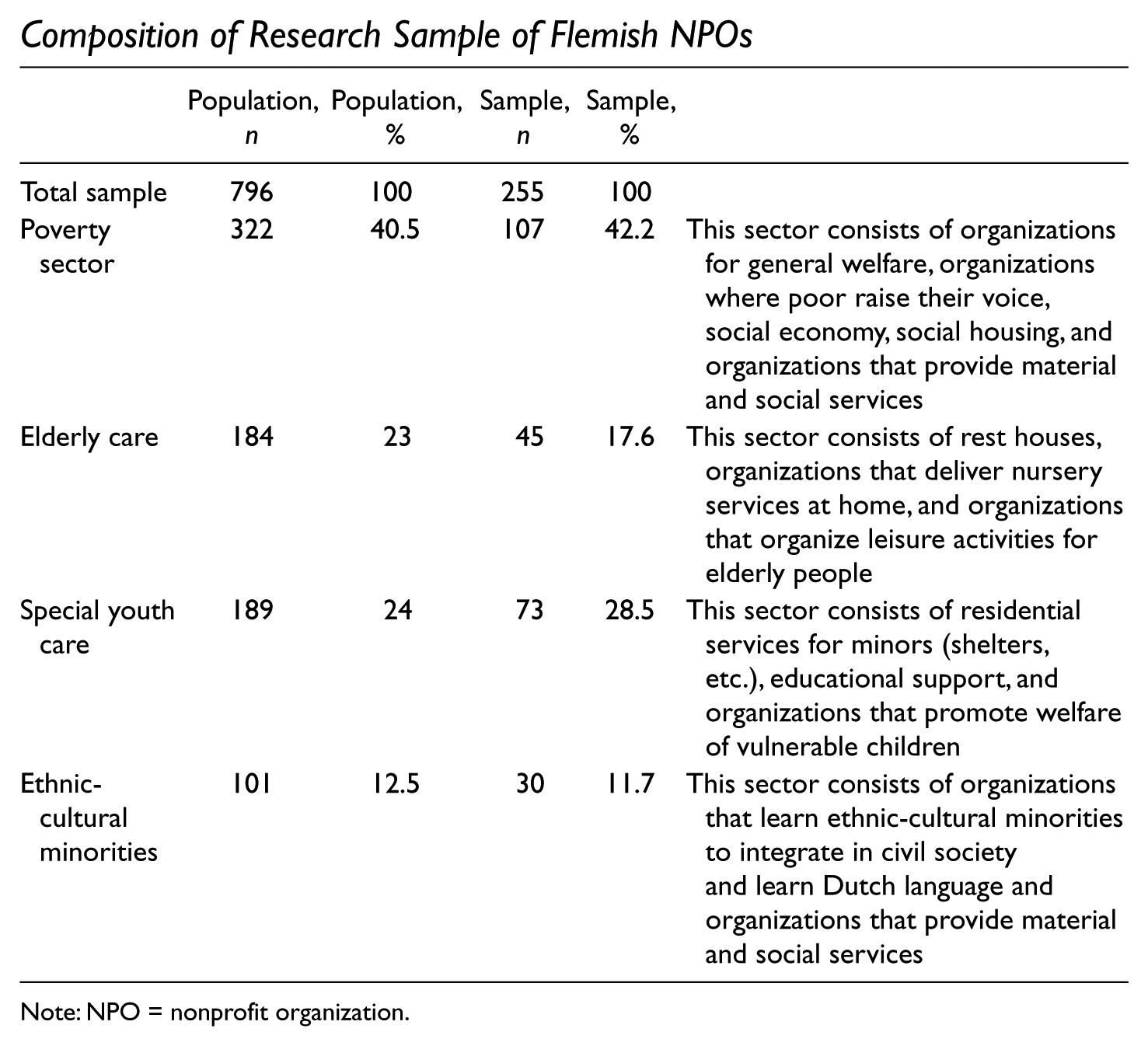
Our units of analysis are service-delivering NPOs active in four areas of current welfare policy in Flanders that received increased governmental attention in recent years: the field of poverty reduction, elderly care, youth care, and the integration of ethnic-cultural minorities. Having listed all organizations active in these “booming” service areas, we then started to further delineate our population. First, we limited ourselves to those organizations that have a permanent and formal character. This was reflected in the presence of paid staff. We recognize that purely voluntary organizations do play an important role in vitalizing contemporary civil societies. However, given the particular aim of this article (determining levels of NPOs autonomy), we only selected the more professionalized service agencies that have been able to develop long-term relationships with policy makers under the third-party government regime in Flanders. Second, the selected NPOs also have a private character. The fact that they receive large amounts of their income from public authorities may thus not prevent them from being self-governed as private entities. This implies that all public service providers in these areas were deleted from the population. Third, we only selected one particular legal type of organizations, the so-called “associations without for-profit motives” (known as VZWs—Verenigingen Zonder Winstoogmerk—in Flanders). This is the dominant legal form in the Flemish nonprofit sector (and especially in the domain of welfare) and implies that these organizations are legally bounded by the nondistribution constraint. Finally, we limited ourselves to organizations that are active in one of the 13 biggest cities in Flanders, being the Dutch-speaking region of Belgium. It is important to acknowledge that, especially in a densely populated region such as Flanders, these urban NPOs do not limit their activities to the city in which they are established but also perform a pivotal role in attracting and serving customers and citizens from surrounding areas as well. Furthermore, many of the societal issues dealt with in the selected policy domains, especially poverty reduction and the integration of ethnic-cultural minorities, are predominately typical urban phenomena in Flanders. Finally, and on the basis of the above criteria, we identified an initial research population of almost 800 private NPOs active in an urban context and spread over the four policy domains being studied in this article. For a more detailed view of the composition of these sectors, we refer to Appendix 1.
The data used in this study are collected via a questionnaire that was sent to the CEOs of these organizations. A total of 255 organizations responded, resulting in a sample of 44 in elderly care, 30 in ethnic-cultural minorities, 73 in special youth care, and 108 in poverty policy care (also see Appendix 1). We acknowledge that we only have a response of 33% (255 responses from a population of 796 organizations to which the survey was sent). The relative distribution of the four sectors in the sample is similar to the relative distribution of the sectors in the total population (see Appendix 1), which makes our sample fairly representative in terms of sectoral distribution. We also analyzed for nonresponse bias. We compared (via analysis of variance [ANOVA]) the scores on the dependent variable (index of autonomy, see Appendix 4) between the early respondents and the late respondents (those who responded after reminders). The analyses show that there are no significant differences in terms of autonomy between either group of respondents. Although care is needed, this could be an indication that the group of nonrespondents too would show a similar distribution on the variable of autonomy, compared to the early and late respondents.
Measuring Organizational Autonomy
A first set of questions in our survey deal with the relationship between the government and NPOs in terms of both actors’ impact in the strategic decision making of the NPO. This is what we call “organizational autonomy” in strategic decision making. We rely on a definition of autonomy as “the organization’s freedom from both internal and external constraints to formulate and pursue self-determined plans and purposes” (Stainton, 1994). We selected four concrete strategic organizational decisions in which this autonomy is reflected. All variables were pretested and validated through pilot interviews with NPO managers to verify whether these indicators were seen as meaningful in the eyes of the practitioners. These four strategic decisions were the extent to which NPOs may act autonomously from the government in defining their mission, their target groups, the results to be achieved, and the processes through which these results must be obtained (Elbers & Schulpen, 2011; Verhoest, Roness, Verschuere, Rubecksen, & Muiris MacCarthaig, 2010).
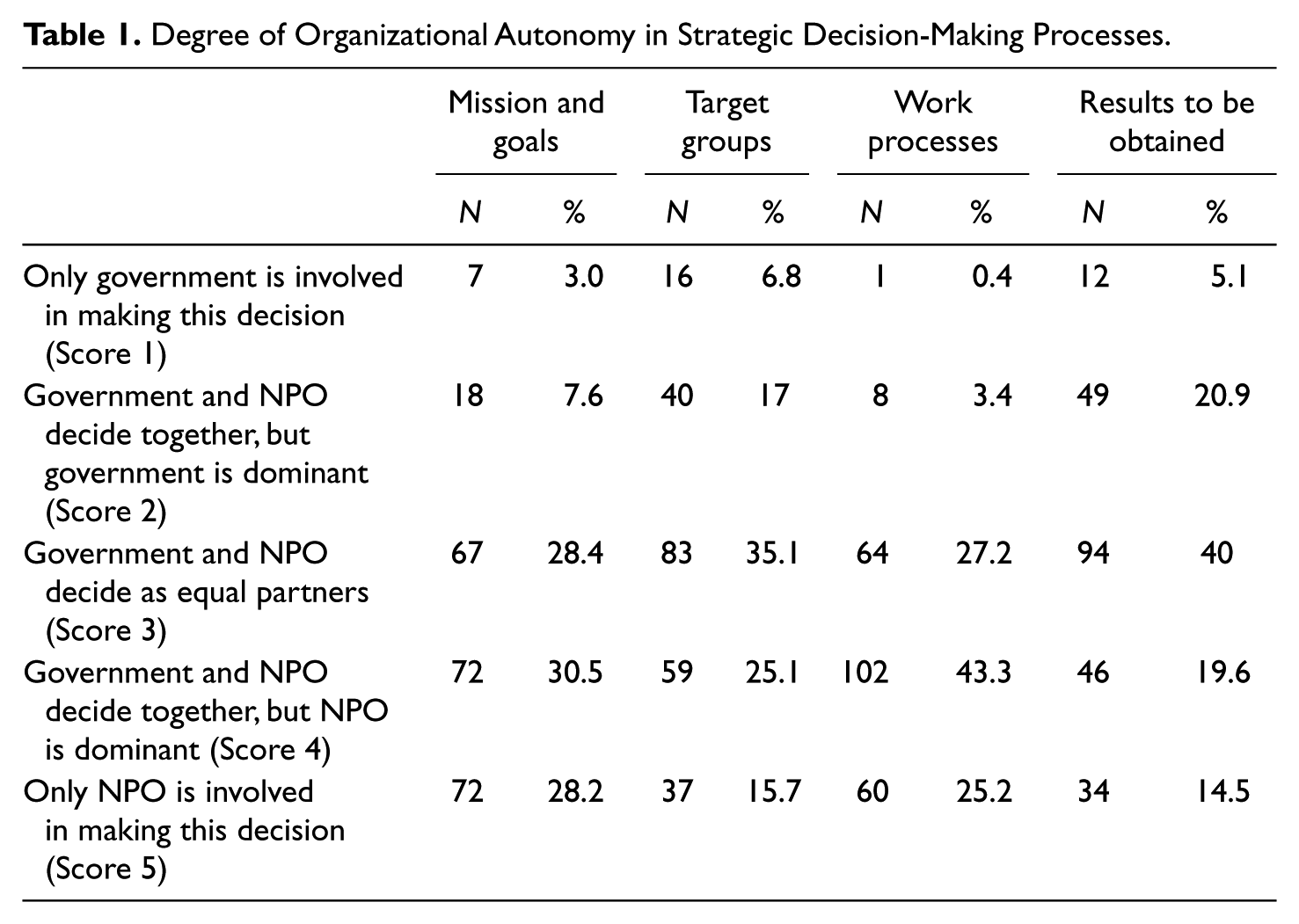
These decisions all reflect a part of the NPO’s identity and could give us an indication about the NPO’s ability to meet both internal and external challenges in a flexible way (Gronbjerg, 1991; Jung & Moon, 2007; Kirk & Kutchins, 1992; Lipsky & Smith, 1990; Nikolic & Koontz, 2007; Smith, 2010; Varda, 2011). NPO managers were asked to give a perception of organizational autonomy vis-à-vis government on these four separate issues on a 5-point scale. The lowest score on this scale (1) indicates that the government alone decides on these issues and the highest score (5) reflects a situation in which NPOs make autonomous decisions without any governmental interference at all. The scores in between indicate the relative role of the government and the NPOs in deciding on these strategic issues, with varying degrees of mutual impact. The results for the observed levels of organizational autonomy are presented in Table 1. For the measurement of the dependent variable we thus rely on NPO managers’ self-reported data, on how they perceive the autonomy of their NPO vis-à-vis government in deciding on strategic organizational issues. Also, we did not ask them to specify the governmental level to which they are autonomous (or not) because it is our aim to find evidence concerning the autonomy of an NPO vis-à-vis government in general and not about the interference of specified governments at different levels.
Degree of Organizational Autonomy in Strategic Decision-Making Processes.
Measuring Resource Dependence
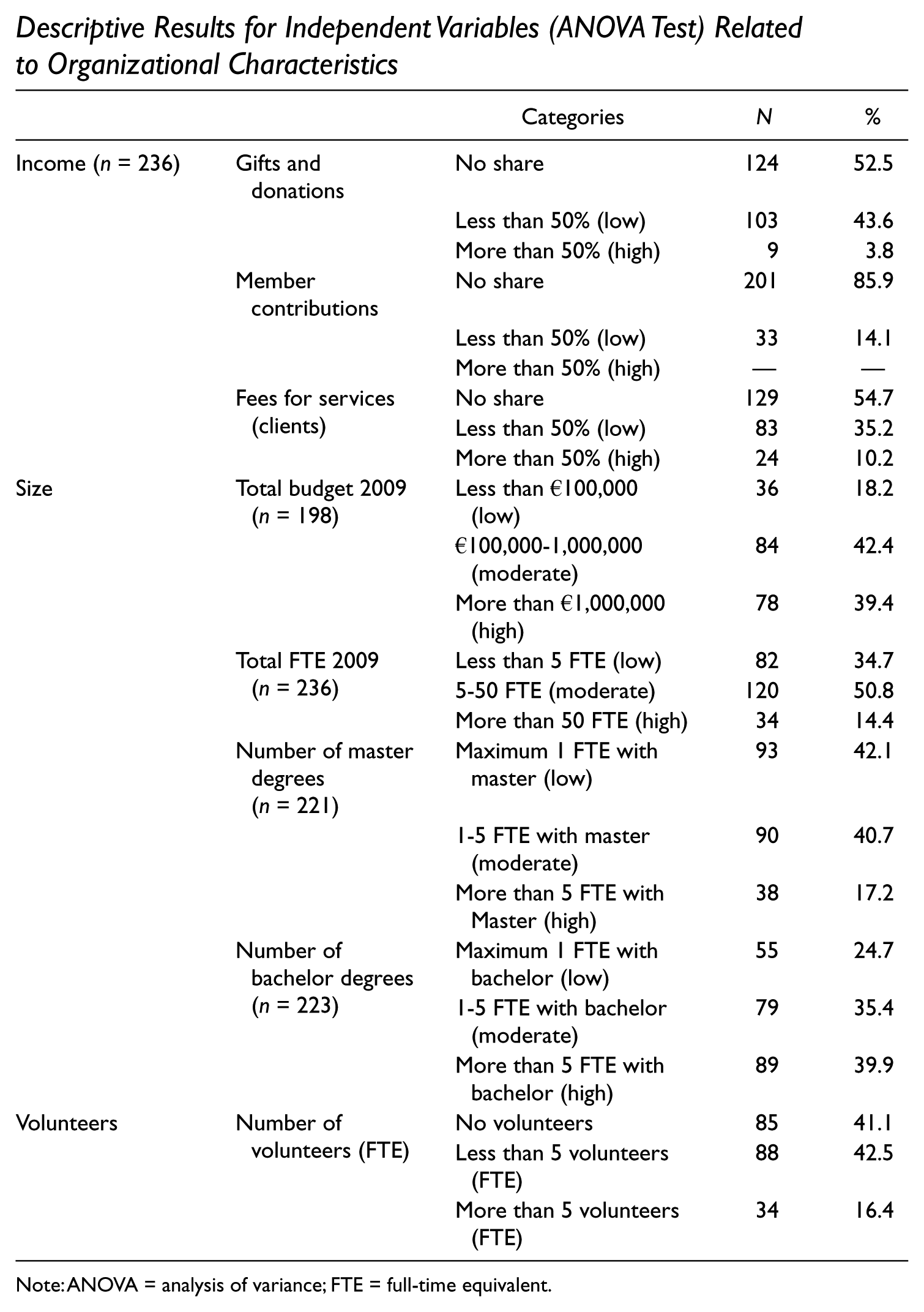
We first asked NPO managers to indicate the relative shares of different revenue sources comprising their total budget. It must be noted, however, that under the third-party government regime in Flanders, these public funds are generally provided as long-term subsidies to the organizations in our sample. Descriptive statistics show that the Flemish government is by far the most important source of income. In fact, more than three out of five of all NPOs in our sample receive more than half of their budget from the regional Flemish government. This also implies that both the federal and the local governments do only play a role as a supplementary funding source for most NPOs. For a more detailed view on the NPOs’ revenue structure we refer to Appendix 2 and Appendix 3. Second, we also questioned the NPO executives about the accountability requirements that were attached to these funds. In a narrow view, accountability could be defined as the answerability to a higher authority in a bureaucratic or interorganizational chain of command (Kearns, 1996). Such a definition reveals three fundamental questions: Who is accountable (NPOs), to whom (upward accountability toward government), and for what (Candler & Dumont, 2010; Christensen & Ebrahim, 2006; Verbruggen, Christiaens, & Milis, 2011). In the context of this article it is especially the latter question that deserves further attention because the parameters to which NPOs must adhere give us an indication of the nature of their relationship with the government. On the basis of a literature review and pilot interviews with managers within all subsectors of our sample, we selected six parameters: the need to provide reports on the financial performance of the NPO, the obligation to follow specified administrative procedures. requirements to ensure the quality of the services the NPO delivers, requirements about the quantity (number of services) of the NPO’s service delivery, demands for serving specific groups within civil society (target audience), and finally the need to report on the social effects that are made possible through their services (outcomes). 1 Descriptive results (see Appendix 2) show that most NPOs are primarily held accountable by the Flemish government.
Measuring Organizational Capacity to Mobilize Resources
In our study, organizational capacity is measured in two different ways. First, we looked at the size of the organization, measured in terms of the organization’s total budget. In this regard we note that less than 20% of all NPOs can be considered as rather small organizations (budget less than €100,000). However, almost 40% of the NPOs have a budget higher than €1,000,000 and, hence, are labeled in our sample as large organizations. Second, we rely on the organization’s workforce as a measure of organizational capacity. On one hand, in terms of professionalized staff (full-time equivalents or FTEs), we see that more than one third of all NPOs are rather small organizations (less than five FTEs) and only 14% are larger ones (more than 50 FTEs). On the other hand, workforce is also measured as the number of volunteers active within an organization. Six out of 10 organizations in our sample do (at least partly) rely on the efforts of volunteers, but in only 16% of the cases are there more than 5 volunteers active in the organization. For a more detailed overview of these variables related to organizational capacity we refer to Appendix 3.
Results
The Observed Levels of NPO Autonomy
As mentioned earlier, we selected four strategic organizational decisions that could give us an indication of different aspects of the NPOs’ autonomy: the extent to which NPOs may act autonomously from the government in defining their mission, their target groups, the results to be achieved, and the processes through which these results must be obtained. Table 1 shows the descriptive results for a total sample of 236 NPOs regarding their organizational autonomy in making strategic decisions.
Only 10% of the organizations in our sample indicate that the government is the only or the dominant actor in deciding on the NPO’s mission and goals. For approximately 30% of the NPOs, defining the organization’s mission statement is the result of a consultation between NPO and the government as equal partners, implying both actors have a strong role. The results thus show that 61% of all NPOs see themselves as being the dominant, or even the only, actor in deciding on mission and goals. In the view of almost one in four NPOs, the government is the only or the dominant force in defining the target groups the organizations primarily have to serve. Furthermore, more than one third of all NPOs hereby report cooperation between equal partners. This leaves us with somewhat more than 40% of cases in which the NPO is dominant or may act with full independence in setting the target groups.
Only a very small share of the NPOs studied (3.4%) report that the government has authority in deciding on the organization’s working processes. For somewhat more than one in four organizations these internal procedures on how to organize service delivery are established as a collaborative effort by equal actors. Still, in almost 70% of the cases, it is the NPOs, either following consultation with the government or even completely autonomously, that decide on these issues. Finally, we see that for 25% of organizations the government is the dominant actor in defining the results the NPO has to achieve. Yet it is also noted that for 40% of all NPOs this decision is made as a result of joint effort between equal partners. This implies that approximately one in three NPOs are able to decide themselves, either following consultation with the government or autonomously, on the results they want to achieve through their service delivery.
Which Factors Have an Impact on Organizational Autonomy?
To answer the second research question, and because of the nonmetric scales through which most variables were measured, a series of ANOVAs are being conducted. This will allow us to determine variables that might restrain the NPOs’ ability to act autonomously. Accordingly, we are conducting additional tests to further analyze the significant relationships between our dependent and independent variables: post hoc Scheffe for variables consisting of three or more categories and Mann–Whitney tests for variables consisting of only two categories. A first set of independent variables are related to the extent to which NPOs are receiving income from public authorities, or not, and the accountability requirements attached to this governmental funding. In this respect, we primarily rely on insights from resource dependence theory. We will also test a second set of independent variables that are related to a resource mobilization framework and give us an indication of the organizational capacity to collect resources that allow them to function: the NPO’s total budget, the number of (professionalized) staff, and the presence of volunteers. Finally, we use the sector as a control variable to compare perceptions of organizational autonomy between the four subsectors in our sample.
As we also discussed before, the autonomy of NPOs is measured by questioning respondents about their perception of strategic autonomy in four management decisions: defining the organizational mission and goals, determining the target groups, defining the results to be obtained, and determining the processes through which these results must be achieved. A principal component analysis (PCA) was conducted on these four items with orthogonal rotation (varimax). The Kaiser–Meyer–Olkin measure verified the sampling adequacy for the analysis (KMO = .712). Bartlett’s test of sphericity (χ2 = 248,799, p < .000) indicated that correlations between items were sufficiently large for PCA. An initial analysis was run to obtain Eigenvalues for each component in the data. Here, just one component was found to explain 58.08% of the total variance (see also table in Appendix 4). In other words, this analysis allows us to state that all four items refer to only one underlying construct (NPOs’ perception of autonomy in making strategic decisions). All NPOs in our total sample are therefore given a unique factor score, which may tell us something about their autonomy in taking strategic organizational decisions. These factor scores will thus serve as dependent variables in the ANOVA.
The results of these tests are presented in Table 2. All values reflecting a statistically significant relationship between two variables (p < .010) are marked in italics. In the first column we see the results of the ANOVA. It seems that our dependent variable (NPOs’ autonomy) is related to a considerable number of the factors being studied: the amount of income from the Flemish government (significant at .003), the extent to which the NPOs are held accountable by the Flemish government (all six Flemish accountability parameters are significant at .000), and the number of volunteers (significant at .002). When considering the above associations we also conducted a series of additional tests (post hoc Scheffe for variables with three or more categories and Mann–Whitney tests for the binary variables) to specify the associations between these dependent and independent variables. These results are shown in the second and third column of Table 2. When considering the first independent variable (income from the Flemish government) associated with the NPOs’ perception of autonomy, we notice that NPOs that do not receive any income from the Flemish government report higher levels of organizational independence in strategic decision-making processes. By contrast, receiving income from this particular source of revenues does indeed hamper the NPOs’ autonomy. This is shown in fourth column of this table (post hoc test).
Results for Bivariate Analysis Between Independent Variables and NPOs’ Autonomy (Dependent Variable) by Means of One-Way Analysis of Variance (ANOVA).
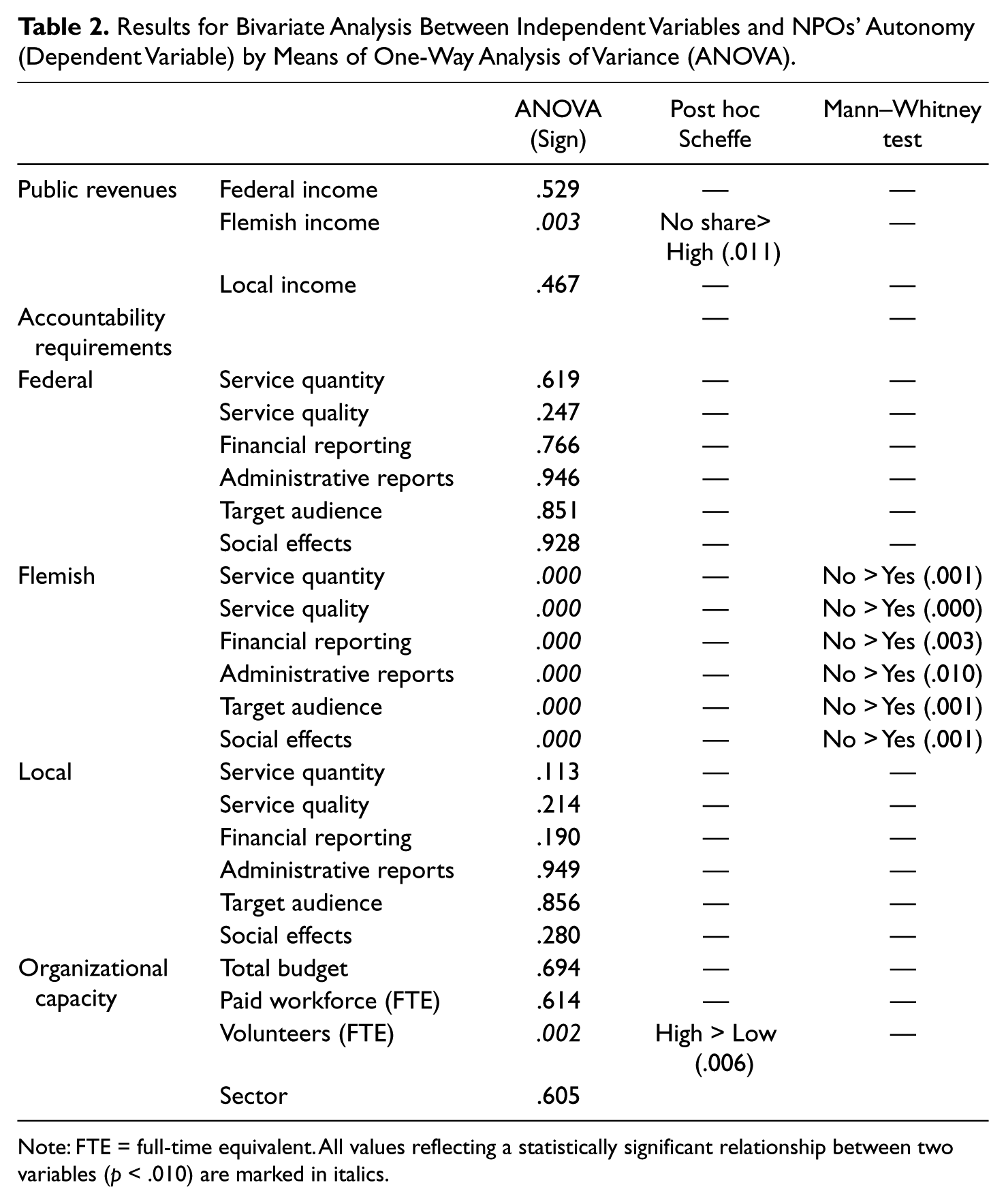
Note: FTE = full-time equivalent. All values reflecting a statistically significant relationship between two variables (p < .010) are marked in italics.
In a similar vein, when considering the accountability requirements attached to these public funds, we found that NPOs that are not held accountable by the Flemish government also have a higher ability to act autonomously. As shown in the last column of Table 2, we found this effect for all six Flemish accountability parameters studied in this article (significance for these parameters ranges from .000 to .010). Results for the second set of independent variables (measures for organizational capacity) are slightly more ambiguous to interpret. The main finding is that NPOs that do rely more on volunteers report higher levels of organizational autonomy in strategic decision making (see post hoc test score for this variable, which is significant at .006). Furthermore, it is worth noticing that no effect was found for other control variables such as the number of FTEs and the NPO’s total budget on the NPO’s perception of autonomy.
Finally, we also analyzed whether or not differences in autonomy of NPOs vis-à-vis government do occur among the four policy domains being studied in this article. When comparing perceptions of organizational autonomy on all four strategic decisions together (the unique factor score resulting from the factor analysis, see Appendix 4) we found no significant differences between the four subsectors studied in this article: There are thus no differences observed between organizations from different sectors in terms of their autonomy vis-à-vis government. 2 This observation may strengthen the generalizability of our findings, at least with regard to different policy sectors in the same institutional setting.
Discussion and Conclusion
We are aware that this study has its limitations. First, for measuring the dependent variable (organizational autonomy vis-à-vis government in deciding on strategic organizational issues) we strictly rely on self-reported data from NPO managers, which involves the risk of socially desirable answering. Second, we did not specify the governmental level to which NPOs are autonomous (or not). This choice should, however, not be problematic, as it is our aim in this research to say something about the autonomy of an NPO vis-à-vis government in general and not about the interference of specific governments at different levels. Third, we must be aware of the fact that we relied on some specific criteria (e.g. NPOs established in urban regions, having professionalized workforce and active in four welfare domains in Flanders) to delineate our research sample.
Notwithstanding these limitations, this study is able to add to the literature, especially due to its empirical scope (NPOs in a modern welfare state like Belgium). Our findings apply to urban NPOs in a country that is characterized by third-party government (NPOs delivering public services on behalf of, and subsidized by, the government in a continental European welfare state). We have studied NPOs that are professionalized (in terms of having paid and specialized staff), are mainly service delivering, and operate in politically salient welfare domains. Our study brings some empirical evidence to the discussion concerning the impact of public resource dependence on the ability of NPOs that build close relationships with the government to maintain sufficient levels of organizational autonomy in strategic decision making.
The main finding of our research, in response to our second research question, is that the NPOs’ dependence on public resources seems to have a negative impact on the organizational autonomy to take strategic decisions such as defining the NPOs’ mission, the working procedures, the results to be achieved, and the target groups to be reached. Starting from a resource dependence framework these findings seem to confirm the assumption that NPOs that have closer financial connections with government, and subsequently face more pressure to adhere to accountability standards imposed by that same government, will report lower levels of organizational autonomy in strategic decision making. This concurs with the work of others, who found that involvement with governmental funding programs, and the control measures and bureaucratic pressures associated with it, can diminish the NPOs’ flexibility to make their own strategic choices concerning programs, clients, and desired outcome (Gjems-Onstad, 1990; Gronbjerg, 1993; Jung & Moon, 2007; Kirk & Kutchins, 1992; Lipskey & Smith, 1990; Nikolic & Koontz, 2007; Smith & Lipsky, 1993).
In response to our first research question, the results are mixed. In general, the overall levels of autonomy, as reported by NPOs in our sample, are quite substantial, although there are differences depending on the strategic decision under study. We also found that a considerable number of NPOs report that government and NPOs decide on strategic decisions as equal partners, implying that both actors have a substantial amount of input in the decision made. As a result from this study, we can bring some issues into the discussion: (a) the varying levels of organizational autonomy reported by the NPOs depending on the type of strategic decision under study, (b) the meaning of the relatively high levels of reported cooperation as being totally equal partners, (c) the existence of factors (such as the number of volunteers) that are related to organizational capacity and that might foster the NPOs’ ability to maintain their autonomy as well, and (d) the varying impact that different governmental levels have on the NPOs’ autonomy due to the amount of (public) income provided.
A first issue that may put our findings into a broader perspective is related to the observation that variations in perceived levels of governmental interference do occur, depending on the type of strategic decision. Governmental actors seem to have much more influence in the decisions about target groups and results to be obtained, compared to the definition of mission and goals, and work processes. For the latter decisions, the NPO is often the dominant decision maker. Thus, although all four strategic decisions in this study do rely to only one underlying construct (see Appendix 4), there seem to be differences, and further research could examine each strategic decision in more detail in search for explanations for this variation. One explanation could be found in the institutional framework through which government regulates NPOs activities in Flanders. The Flemish government is in many cases the dominant funding source and also the designer of the regulatory framework in which NPOs in the welfare sector function. In these regulatory frameworks, a lot of attention is paid to the eligible of the services provided by the NPO: What specific target groups are the services for? In all four sectors under scrutiny (poverty, elderly care, minorities, and special youth), regulatory frameworks define these target groups in detail. Especially in times of austerity and pressure on subsidies for NPOs, even more attention is paid to whom is eligible for service delivery or not. So we could argue that, via its regulations, government rather focuses on “outcomes,” such as the audience to be serviced but also the quality of the services to be delivered by the NPO, rather than it would intervene in the NPOs “internal” working procedures or their initial mission statements.
Second, there is the observation that approximately one out of three NPO managers classifies their relationship with the government in strategic decision making as a process between equal partners. This is the case for all four strategic decisions. This suggests that government has an important input in deciding on strategic issues, according to a substantial number of NPOs, and thus is able to reduce organizational autonomy. From a policy relevant point of view, this provides some opportunities in terms of government–NPO cooperation. If both actors consider themselves as equal partners in strategic decision making, government and NPOs might be able to establish a more profound relationship that paves the way for further cooperation and the development of true partnerships in which policy and practice become increasingly adjusted to one another. This sheds another light on government–NPO relationships that goes further than the dichotomy between on one hand the perspective of governments “capturing” NPOs, thereby distorting the NPO’s initial reasons of existence, and on the other, the view of NPOs being free riders that escape from governmental influence although they function in the public domain, providing public services.
A third issue stems from the observation that there is a positive effect of the presence of volunteers in an organization (as a measure of organizational capacity) and the extent to which NPOs are able to maintain their autonomy in making strategic decisions. Referring to resource mobilization theory, we expected that measures of organizational capacity, such as the number of volunteers, would indeed have a positive impact on the NPOs’ autonomy due to the fact that these organizations have more motivation and resources to mobilize and to come into action in defending what they standing for (e.g., mission). Regarding the nonpaid workforce within an organization, this positive relationship may also be explained by the fact that the presence of volunteers, as additional workforce, allows the NPOs to be involved in a broader array of activities. It could also be argued that volunteers in an NPO are typically engaged and driven by the mission of that NPO: They are involved because they believe in the mission and values of that NPO. Hence, these volunteers may act as a kind of “watchdog,” with a strong interest to preserve the NPO’s autonomy in defining that mission with regard to other important organizational stakeholders (such as the subsidizing government). This suggests that explanations of NPOs’ autonomy might benefit from taking into account other theoretical frameworks, or variables, than resource dependence alone. We might for example think of variables that are related to organizational capacity (to act independently) or traditions and cultures in the relationship between NPOs and their governmental counterparts (e.g., the level of trust, induced by the extent to which NPOs have direct access to policy makers, and the quality and intensity of these direct contacts).
Finally, one must be aware that the amount of income received from a particular funding source seems to play a role. After all, the NPOs in our sample do receive varying degrees of income from the national (federal), the regional (Flemish), and the local governments. However, not all governmental levels being studied seem to influence the NPOs’ autonomy in the same way. The relationship with the regional Flemish government is especially negatively associated with the perception of organizational autonomy because it is the Flemish government that is indeed the dominant funding source and also regulator for most NPO activities in the four sectors under scrutiny (see Table 2). These negative relationships between funding and accountability and autonomy of the NPO are not observed at the federal and the local governmental level. It seems that only when a particular funding source is the dominant one, representing for example more than half of the NPO’s total budget, there is an impact on the levels of autonomy in strategic decision making.
To conclude and in sum, our research brings some empirical evidence from a European ‘government dominant’ country (in terms of Salamon, Sokolowski, & Associates, 2004) into the discussion concerning the impact of public resource dependence on NPOs’ autonomy in strategic decision making vis-à-vis government. We found evidence for the claim that dependence on governmental funding may lead to a loss of strategic autonomy by NPOs. Future research however should investigate this assumption further, by bringing other explanations to the research design, by further distinguishing between different strategic decisions and the impacts of different governmental levels, and by further refining measures of the dependent variable of autonomy.
Footnotes
Appendix 1
Composition of Research Sample of Flemish NPOs
| Population, n | Population, % | Sample, n | Sample, % | ||
|---|---|---|---|---|---|
| Total sample | 796 | 100 | 255 | 100 | |
| Poverty sector | 322 | 40.5 | 107 | 42.2 | This sector consists of organizations for general welfare, organizations where poor raise their voice, social economy, social housing, and organizations that provide material and social services |
| Elderly care | 184 | 23 | 45 | 17.6 | This sector consists of rest houses, organizations that deliver nursery services at home, and organizations that organize leisure activities for elderly people |
| Special youth care | 189 | 24 | 73 | 28.5 | This sector consists of residential services for minors (shelters, etc.), educational support, and organizations that promote welfare of vulnerable children |
| Ethnic-cultural minorities | 101 | 12.5 | 30 | 11.7 | This sector consists of organizations that learn ethnic-cultural minorities to integrate in civil society and learn Dutch language and organizations that provide material and social services |
Note: NPO = nonprofit organization.
Appendix 2
Descriptive Results for Independent Variables Related to Characteristics of the Relationship With Governments
| Categories | N | % | ||
|---|---|---|---|---|
| Income (n = 236) | Income federal government | No share | 152 | 64.4 |
| Less than 50% (low) | 65 | 27.5 | ||
| More than 50% (high) | 19 | 8.1 | ||
| Income Flemish government | No share | 40 | 16.9 | |
| Less than 50% (low) | 76 | 32.2 | ||
| More than 50% (high) | 120 | 50.8 | ||
| Income local government | No share | 97 | 41.1 | |
| Less than 50% (low) | 117 | 49.6 | ||
| More than 50% (high) | 22 | 9.3 | ||
| Accountability federal (n = 255) | Service quantity | Yes | 45 | 17.6 |
| Service quality | Yes | 45 | 17.6 | |
| Financial reporting | Yes | 56 | 22.0 | |
| Administrative reports | Yes | 68 | 26.7 | |
| Target audience | Yes | 56 | 22.0 | |
| Social effects | Yes | 35 | 13.7 | |
| Accountability Flemish (n = 255) | Service quantity | Yes | 189 | 74.1 |
| Service quality | Yes | 182 | 71.4 | |
| Financial reporting | Yes | 184 | 72.2 | |
| Administrative reports | Yes | 191 | 74.7 | |
| Target audience | Yes | 198 | 76.6 | |
| Social effects | Yes | 185 | 72.6 | |
| Accountability local (n = 255) | Service quantity | Yes | 89 | 34.9 |
| Service quality | Yes | 88 | 34.4 | |
| Financial reporting | Yes | 86 | 33.7 | |
| Administrative reports | Yes | 79 | 31.0 | |
| Target audience | Yes | 105 | 41.2 | |
| Social effects | Yes | 98 | 38.4 |

Appendix 3
Descriptive Results for Independent Variables (ANOVA Test) Related to Organizational Characteristics
| Categories | N | % | ||
|---|---|---|---|---|
| Income (n = 236) | Gifts and donations | No share | 124 | 52.5 |
| Less than 50% (low) | 103 | 43.6 | ||
| More than 50% (high) | 9 | 3.8 | ||
| Member contributions | No share | 201 | 85.9 | |
| Less than 50% (low) | 33 | 14.1 | ||
| More than 50% (high) | — | — | ||
| Fees for services (clients) | No share | 129 | 54.7 | |
| Less than 50% (low) | 83 | 35.2 | ||
| More than 50% (high) | 24 | 10.2 | ||
| Size | Total budget 2009 (n = 198) | Less than €100,000 (low) | 36 | 18.2 |
| €100,000-1,000,000 (moderate) | 84 | 42.4 | ||
| More than €1,000,000 (high) | 78 | 39.4 | ||
| Total FTE 2009 (n = 236) | Less than 5 FTE (low) | 82 | 34.7 | |
| 5-50 FTE (moderate) | 120 | 50.8 | ||
| More than 50 FTE (high) | 34 | 14.4 | ||
| Number of master degrees (n = 221) | Maximum 1 FTE with master (low) | 93 | 42.1 | |
| 1-5 FTE with master (moderate) | 90 | 40.7 | ||
| More than 5 FTE with Master (high) | 38 | 17.2 | ||
| Number of bachelor degrees (n = 223) | Maximum 1 FTE with bachelor (low) | 55 | 24.7 | |
| 1-5 FTE with bachelor (moderate) | 79 | 35.4 | ||
| More than 5 FTE with bachelor (high) | 89 | 39.9 | ||
| Volunteers | Number of volunteers (FTE) | No volunteers | 85 | 41.1 |
| Less than 5 volunteers (FTE) | 88 | 42.5 | ||
| More than 5 volunteers (FTE) | 34 | 16.4 |
Note: ANOVA = analysis of variance; FTE = full-time equivalent.
Appendix 4
Factor Analysis (Dependent Variable)
| Cronbach’s alpha | N | Total variance explained, % | Components with eigenvalues > 1 | Communalitie a | Component matrix b | |
|---|---|---|---|---|---|---|
| Autonomy in strategic decision making | .761 | 235 | 58.08 | 1 | ||
| Autonomy in defining NPO’s mission | .552 | .743 | ||||
| Autonomy in defining the audience to be served by NPO | .726 | .852 | ||||
| Autonomy in defining the processes through which services will be delivered | .577 | .759 | ||||
| Autonomy in defining the results the NPO has to achieve | .498 | .706 |
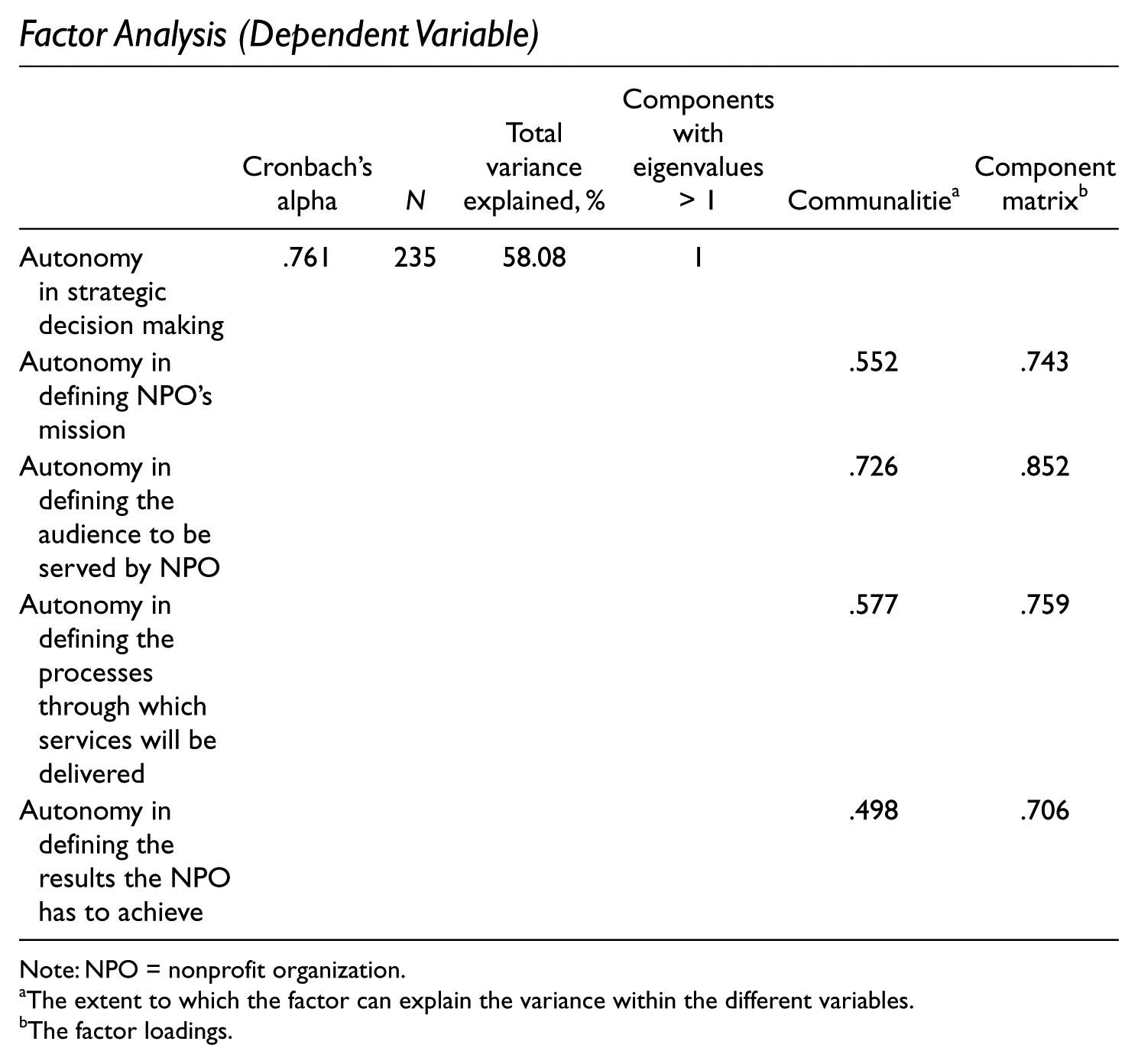
Note: NPO = nonprofit organization.
The extent to which the factor can explain the variance within the different variables.
The factor loadings.
Declaration of Conflicting Interests
The authors declared no potential conflicts of interest with respect to the research, authorship, and/or publication of this article.
Funding
The authors received no financial support for the research, authorship, and/or publication of this article.