



Abstract
Even though previous research indicates that an organization’s pursuit of strategic orientation (SO) has positive effects on its performance, we have deepened and expanded our understanding of how this concept can also be applied to social enterprises (SEs). Using data collected from British and Japanese social enterprises, we examined the mediating roles of market effectiveness and consumer satisfaction in both the social and commercial domains with regard to SO effects on performance, as well as how performance in one aspect of practice positively moderates the impact of SO behavior in another. The results contribute to the development of a theory for understanding the concept of SO associated with social enterprise performance. More generally, this article contributes to the ongoing efforts to understand the strategic management aspect of social enterprises.
Keywords
Introduction
The purpose of the current article is to extend our existing knowledge about the association between strategic orientation (SO) behaviors and performance in the social enterprise (SE) sector. SO behaviors refer to the process, practices, principles, and decision-making styles that guide organizations’ activities when reacting to the external environment and generate the behavior intended to ensure the organization’s viability and performance (Voss & Voss, 2000; Zhou & Li, 2010). In this article, we investigate, in particular, market orientation (MO) and entrepreneurial orientation (EO), two of the most fundamental and widely discussed SO behaviors that lead to improved performance (Atuahene-Gima & Ko, 2001; Li, Wei, & Liu, 2010). We address several important knowledge gaps in the current literature.
First, we seek to deepen the understanding of the relationship between SO behaviors and performance by examining potential mediators. Previous researches have suggested the direct impact of MO or EO behavior on SEs’ performance (Morris, Webb, & Franklin, 2011; Shoham, Ruvio, Vigoda-Gadot, & Schwabsky, 2006). However, few studies have specified the contingencies through which this association might be shaped. For example, Gainer and Padanyi (2005) suggest that MO behavior will enable the building of a market-oriented organizational culture which will impact on performance. In this research, we propose that pursuing an SO allows SEs to enhance their market effectiveness—the degree to which their market-based goals are achieved (Vorhies & Morgan, 2003)—and their customer satisfaction—the degree to which their customers experience the quality of their goods and services (Fornell, Johnson, Anderson, Cha, & Bryant, 1996)—through which their SO behavior contributes to their performance. To enhance the generalizability of our findings, we collected data from both British and Japanese SEs. Second, we aim to clarify the moderating effects among SEs’ social and commercial performance. 1 Seelos and Mair (2007) suggest that commercial performance can help to improve SEs’ social performance because the revenue generated by commercial activities can be used to improve SEs’ social activities. However, researchers argue that uncertainty within the context of business activities may create structural tension, leading to the underachievement of both the commercial and social objectives (Foster & Bradach, 2005; Weisbrod, 2004). Since each side provides valid propositions, we investigate how the potential effects of one aspect of practice (i.e., social and commercial) positively moderate the impact of SO behavior in another. Third, we answer the call from scholars regarding the urgent need to conduct a large scale quantitative data analysis of SEs (e.g., Dacin, Dacin, & Tracey, 2011).
Theoretical Background
Brief Summary of SE Researches
The pursuit of transforming a traditional third sector organization into a more commercialized entity—an SE—has become increasingly popular over the last decade, due to the strong economic and political forces encouraging traditional third sector organizations to seek financial independence (Coombes, Morris, Allen, & Webb, 2011; Dacin et al., 2011). Recent studies on SEs can be divided into three major streams of literature. The first emphasizes the definition of SEs’ concept and domain (e.g., Austin, 2000; Mair & Marti, 2006), and debates what they are and what constitutes SE practice. The second research stream studies the SE business model (e.g., Cooney, 2011; Foster & Bradach, 2005; Weisbrod, 2004), focusing on investigating the uniqueness of the SE hybrid business model that combines both the commercial and social aspects of business operations, highlighting the structural tensions of the model and the legitimacy of SEs’ commercial involvement, and developing managerial implications regarding SEs’ operation. Finally, the third stream of studies documents the impact on performance when SEs adopt strategic marketing or management tools for their business operations. For example, numerous articles adopt the resource-based perspective to explore the development of SEs’ organizational capabilities (Brooks, 2008; Dees, 1998; Voss & Voss, 2000). Here, we attempt to contribute to this particular stream of studies on SO behavior, with a particular focus on how SO behavior impacts on SEs’ performance.
Strategic Orientation and Performance in Third Sector Studies
SO behaviors refer to how organizations should interact with their customers, competitors, the technology, and other external factors to make the optimal strategic choices. The literature almost unanimously suggests that SO behavior has a direct positive impact on performance (Li et al., 2010; Zhou & Li, 2010). Table 1 summarizes the studies examining the relationship between the different types of SO behavior and a wide range of performance indicators.
Key Quantitative Studies.

Although the constructs of SO behaviors may differ, these studies generally attempt to capture two fundamental aspects of an organization’s posture in responding to market demands (MO) and exploiting market opportunities (EO). MO, on the one hand, is an organizational philosophy that inspires a particular form of organizational behavior which enhances the willingness of organizations to learn more information and knowledge about the market and thus helps them to respond to their customers, competitors, and other stakeholders more effectively (Kohli & Jaworski, 1990; Shoham et al., 2006; Slater & Narver, 1995). EO, on the other hand, studies the methods, practices, and decision-making styles that managers adopt to act entrepreneurially in developing new products, implementing them before their competitors, and taking bold steps to capture the opportunities in the marketplace (Lumpkin & Dess, 1996; Morris, Coombes, Schindehutte, & Allen, 2007).
The link between MO and EO behavior has long been recognized by researchers. For example, Atuahene-Gima and Ko (2001) found that firms which place equal emphasis on MO and EO enjoy a competitive advantage through both their adaptability and management of their market environment. An organization with strong MO behavior places more emphasis on gathering and disseminating market intelligence. However, this does not necessarily mean that the organization will use this knowledge proactively to develop new products to satisfy its consumers’ latent needs (Narver, Slater, & MacLachlan, 2004). The limitation of MO behavior can be compensated for by combining it with EO behavior, because the latter encourages a proactive organizational culture. Bhuian, Menguc, and Bell (2005) suggest that, at times, organizations are too entrepreneurially driven, which leads them to assign a low priority to collecting information to attain a broad understanding of the market. In other words, the organization is more likely to trust its internal assessment of the market and take greater risks.
Previous studies used a wide range of measurements to assess the third sector organizations’ performance (see Table 1). For SEs, in particular, performance usually refers to two aspects of organizational accomplishment—commercial and social (Chell, 2007; Cooney, 2006). Although SEs’ ultimate objective is to pursue a social mission, this does not necessarily mean that there are contradictions prior to the creation of social and economic value. To provide social services continuously and incorporate entrepreneurialism into their endeavors, an SE must adopt survival strategies entailing economic value creation that are premised on self-sustainment (Chell, 2007; Dacin et al., 2011; Mair & Marti, 2006). However, other groups of experts express different opinions. For example, Foster and Bradach (2005) and Weisbrod (1998) illustrate that commercial venturing may not realize the financial contributions that SEs anticipate due to structural tensions (i.e., conflicting priorities). More specifically, the engagement in commercial activities will not only produce disappointing business results but also further damage SEs’ social performance. To develop our understanding of the relationship between SO behavior and performance, we aim to focus on MO and EO behaviors and their impact on both the commercial and social performance, as well as examining the possible moderating effects of the impact of one aspect of SE performance on SO behavior on another.
Mediators: Market Effectiveness and Consumer Satisfaction
We examine the effect of two mediators: market effectiveness and consumer satisfaction. The former refers to “the degree to which desired market-based goals are achieved” (Vorhies & Morgan, 2003, p. 104). To achieve a high degree of market effectiveness, organizations must possess specific characteristics that allow them to implement a business strategy that enables them to deploy their resources properly (Vorhies, Morgan, & Autry, 2009). One of SEs’ key motives is the desire to earn additional income to enable them to continue to pursue their social mission. SEs also compete with each other to obtain third sector specific resources, supported mainly by donor funding and volunteers’ time. Previous researches suggest that SEs recognize the importance of securing resources from private contributors (Balabanis, Stables, & Phillips, 1997; Macedo & Pinho, 2006). Obtaining a higher percentage of their funding from private donors and possessing a great number of volunteers allow SEs to provide more social services for the public for free or at a discounted price (Balabanis et al., 1997; Dacin et al., 2011).
The second mediator is customer satisfaction, which refers to “the quality of the goods and services as experienced by the customers that consumes them” (Fornell et al., 1996, p. 7). Field researchers often divide the theory of customer satisfaction into two distinct perspectives: transaction specific and cumulative (Anderson, Fornell, & Lehmann, 1994). The former is a person’s evaluation of satisfaction during a specific purchase transaction, while the latter is the overall evaluation of the total purchase and consumption experience with regard to the good and service over time. Of these two perspectives, the cumulative perspective of customer satisfaction is a more fundamental indicator of the firm’s organization, and current and future perspective (Anderson et al., 1994). Before proceeding, it is important to clarify what is meant by the term “customers” in the SE context. For third sector organizations, the meaning of the term differs from that employed in the for-profit context; namely, donors/volunteers, enterprise customers, and communities served (Jenkinson, Sain, & Bishop, 2005). In this research, we specifically focus on evaluating the customer satisfaction of two specific groups of customer: donors/volunteers and enterprise customers, who are the major contributors to SEs’ revenue (Cooney, 2006; Jenkinson et al., 2005).
Hypotheses Development
Hurley and Hult (1998) suggest that MO behavior allows organizations to develop a specific organizational culture that enables them to learn rapidly to adjust to change. Due to changes in the external environment, SEs should adopt different abilities when formulating their strategy to attract enterprise customers, donors, and volunteers. The pursuit of MO enables SEs to learn how to channel their resources appropriately to attain their market-based goals (Bennett, 1998; Carmen & Jose, 2008; Pearce II, Fritz, & Davis, 2010). However, organizations with strong EO behavior place greater emphasis on taking calculated risks, being innovative, and demonstrating strategic proactiveness, which provides an incentive for them to acquire the necessary knowledge to fill the gap between their current resources and their proactive vision (Li et al., 2010; Zhou & Li, 2010). In the SE context, Morris et al.’s (2007) study suggests that SEs with strong EO behavior are more likely to take bold actions and challenge the conventional thinking among their members, which is considered the source of new ideas and opportunities. EO behavior amplifies the SEs’ ability to gain access to resources from contributors, as well as finding new market opportunities for fund-raising and volunteer recruitment (Pearce II et al., 2010; Voss, Voss, & Moorman, 2005). As discussed in the previous section, complementing EO behavior with MO behavior provides the necessary incentive for SEs to gather more market intelligence before taking the decision to enter a market. From the above discussion, we suggest:
Hypothesis 1: The positive relationship between SO behavior (MO, EO, and their interaction) and performance in both the social and commercial domains is mediated by SEs’ market effectiveness
At the same time, an organization with stronger MO behavior places a greater emphasis on developing sufficient knowledge of its target customers to create superior value for them continuously (Narver & Slater, 1990). Therefore, this motivates SEs to make efforts to understand how to match their customers’ needs and desires, and thus improve the level of customer satisfaction. SEs with strong MO behavior prefer to meet their enterprise customers’ demands and quickly respond to their competitors’ movements. Furthermore, SEs with strong MO behavior also pay greater attention to and establish better communication with their donors/volunteers (Gainer & Padanyi, 2002; Pearce II et al., 2010). Waters (2011) found that engaging donors in more conversations to let them know that they are appreciated will lead to greater donor loyalty and satisfaction. EO behavior, however, enhances organizations’ ability to focus on the utilization of their market knowledge resources to discover and exploit opportunities (Li et al., 2010; Zhou & Li, 2010). In the case of SEs’ activities, EO behavior enable them to make better use of their market knowledge to assess the value of potential opportunities in the social and commercial domains, and have the ability to extract value from these opportunities. With the strengthening of EO behavior, SEs are more likely to provide products and services that satisfy both their social and enterprise customers’ needs. Similarly to the argument presented earlier, we also suggest that MO and EO behavior have complementary effects on customer satisfaction. In summary, the following hypothesis can be formulated:
Hypothesis 2: The positive relationship between SO behavior (MO, EO, and their interaction) and performance in both the social and commercial domains is mediated by SEs’ customer satisfaction.
Finally, we also expect that a relationship exists between SEs’ commercial and social practices. The literature suggests that the primary difference between commercial and social enterprises is that the former focuses on maximizing their commercial value, while the latter puts emphasis primarily on creating social value (Brooks, 2008; Dees, 1998). Although SEs’ primary mission is to create social value, this does not necessarily mean that commercial objectives are unimportant to them. Dacin et al. (2011) argue that a high level of commercial performance will enhance SE’s achievement of social activities. SEs that generate additional revenue from their commercial practice can use this to organize large scale fund-raising programs and provide more social services, which subsequently enhance their ability to achieve high market effectiveness and customer satisfaction in social practice. Moreover, Massarsky and Beinhacker (2002) found that SEs operating ventures tend to view themselves as more entrepreneurial than those who have never ventured, and are able to transfer their success to provide social benefits to the public. Similarly, SEs’ social value creation can also support their commercial practice. SEs’ high level of achievement with regard to social performance often correlates with a high social brand value (Napoli, 2006), which is often able to yield commercial benefits with some strategic marketing maneuvers. In other words, SEs with a high level of social performance can enjoy high achievement with regard to commercial activities. SEs with a high social brand value can leverage this to attract more customers to their commercial practices and create psychological effects, such as “concern for the community” (Liston-Heyes & Liu, 2010), and thus can generate high market effectiveness and customer satisfaction through their commercial practices. We therefore propose:
Hypothesis 3: SEs’ higher level of performance in one aspect of practice (i.e., social and commercial) positively moderates the relationship between market effectiveness and customer satisfaction, and performance in another aspect of practice.
From the above discussion, we summarize our proposed theoretical model in Figure 1.

Model.
Research Method
Research Design
A survey research was conducted within SEs in two different countries, the United Kingdom and Japan, for two reasons. First, both countries’ governments have encouraged the development of SEs and adopted a similar system for managing social business. In the United Kingdom, according to research conducted by the National Council for Voluntary Organizations in 2009, SE activities now account for 71% of the total third sector income (NCVO, 2009). In Japan, the discussions of the future development of the Japanese third sector often refer to the case of the United Kingdom, and its system. For example, the report of the Japanese Ministry of Economy, Trade and Industry in 2008 also suggests considering the UK system when exploring the development of a new system for the future development of social business in Japan (Japanese Ministry of Economy Trade and Industry, 2008). A survey by the Japanese Cabinet Office (2010) found that revenue from commercial activities accounted for 69.9% of the total income of third sector organizations in 2009. Thus, in both countries, the third sector organizations are more involved with SE activities. Second, Morgan, Zou, Vorhies, and Katsikeas (2003) suggest that a multicountry, cross-sectional research design can enhance the variability and generalizability of the data used for the hypothesis testing. The United Kingdom and Japan have been identified as differing with regard to their national and business cultures, which affects how managers run the organization and develop new products (Nakata & Sivakumar, 1996). Collecting data from two countries with distinct national and business cultures but a similar policy of encouraging social enterprise development may enhance the generalizability of our research findings.
Sample and Data
The samples for the survey were SEs that met the criteria of: (a) generating income from enterprise business activities; and (b) being large enough to practice sophisticated business operations. For the first criterion, we looked for organizations whose sources of revenue were enterprise business activities, such as introducing subscription services, business franchises, and so on (Weisbrod, 1998). For the second criterion, we limited the sample to those with a medium to high level of revenue in each country; specifically, over £100,000 (approximately US$160,000) in the United Kingdom and ¥5,000,000 (approximately US$62,500) in Japan. The list provided by the Charity Commission UK, that regulates UK-registered charities’ administration and affairs, was used in selecting the UK sample, while a list of Japanese organizations and their contact details were obtained through NPO database websites, such as NPO Hiroba and Social Ecoo, and the Ministry of Economy, Trade and Industry website. From those that met the criteria, we obtained a total of 534 usable responses. The profiles of the organizations are presented in Table 2.
Profile.
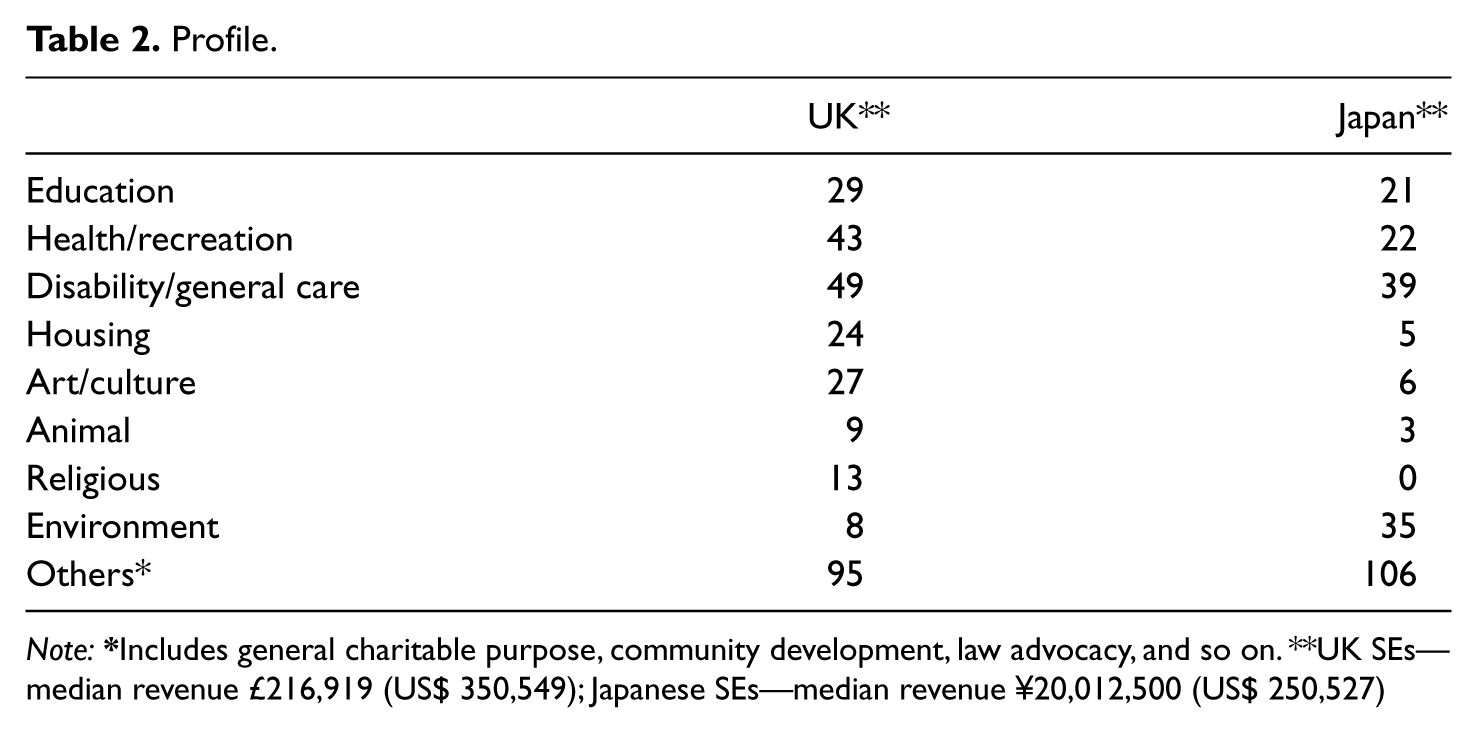
Note: *Includes general charitable purpose, community development, law advocacy, and so on. **UK SEs—median revenue £216,919 (US$ 350,549); Japanese SEs—median revenue ¥20,012,500 (US$ 250,527)
Measurement
We adapt the existing measurements and modify them to suit the purpose of this study. Our initial measures were refined following several personal interviews and a pilot test in both the United Kingdom and Japan to enhance their validity and improve any potential deficiency. We employed a subjective measurement (seven-point Likert-type scale) for all of the variables, given that previous researches suggested that subjective measurement tends to produce results consistent with the objective measures, because the managerial decisions and actions are primarily driven by the managers’ perceptions (Day, 1994; Dess & Robinson, Jr., 1984). More specifically, in the context of this article, we argue that the pursuit of MO and EO is based on the SE managers’ perceptions that these will lead to higher market effectiveness and customer satisfaction, which ultimately leads to greater social and commercial performance.
Strategic orientation
To assess MO behavior, we adapted 18 items assessing market intelligence generation, marketing intelligence dissemination, and responsiveness (Balabanis et al., 1997; Macedo & Pinho, 2006), such as “We do a lot of marketing research.” To assess EO behavior, we used nine items examining proactiveness, innovativeness, and risk-taking used by Covin and Slevin (1989), after adjusting them to suit the context of this research, such as “We have been or expect to be strongly emphasizing research and development.”
Market effectiveness
We measure market effectiveness in both the social and commercial aspects through representatives’ subjective assessment of the degree to which SEs’ market-based goals had been achieved by adapting the scales of Vorhies and Morgan (2003) and Vorhies et al. (2009). We used two items to assess the social aspects of market effectiveness, such as “We are acquiring new donors,” and three to assess the commercial aspects of market effectiveness, such as “We acquire new business sponsor/donation/support.”
Customer satisfaction
We measure customer satisfaction through representatives’ subjective assessment of their customer satisfaction by synthesizing the previous measures from Fornell et al. (1996) and Gainer and Padanyi (2005). We adapted three items to assess the social aspects of customer satisfaction, such as “We have been experiencing an increase in volunteer hours from our current volunteers.” and four to assess the commercial aspects of customer satisfaction, such as “We have been experiencing an increase in customer satisfaction.”
Performance
To assess SE’s commercial performance, we used a four item scale adapted from Voss and Voss (2000) to gather SE representatives’ perceived opinions about certain key economic performance indicators over the past twelve months, employing items such as “We have been experiencing an increase in revenue” and “We have been engaging in more enterprise activities.” To access the SEs’ social performance, we adapted the three item scale of Coombes et al. (2011) and Balabanis et al. (1997) to gather the SE representatives’ perceived opinions about certain key social performance indicators over the past twelve months, employing items such as “We have been providing more social services” and “We have been serving more beneficiaries in the community.”
Control variable
We control the SEs’ size, given that this may affect their ability to achieve high performance with regard to fund-raising and attract business sponsorship opportunities (Liston-Heyes & Liu, 2010). Many of the SEs which participated in this study failed to differentiate their revenue sources (i.e., commercial sales, charitable donations), so we used total revenue as the measurement of their size. We used a five-point scale to indicate the extent of the SEs’ size (1 = very small, 5 = very large). The interval between each point scale is £100,000 (¥13,000,000; approximately US$160,000).
Findings and Analysis
Measurement Validation and Reliability
We first assessed the reliability and validity of the constructs by confirmatory factor analysis (CFA) using AMOS (Byrne, 2010). We followed the acceptable model fit guideline using the comparative fit index (CFI) and report the root mean square error of approximation (RMSEA). The CFA results suggest that our measures demonstrate a good measurement property (CFI > .937, RMSEA < .067, p < .05). The Cronbach’s α coefficients for all of the constructs for both samples exceed the threshold value of .70, so construct reliability is established. Since our data were collected from the same respondents, this study may be prone to common method bias. We use Harman’s single factor test (Podsakoff, MacKenzie, Lee, & Podsakoff, 2003) to assess whether a single latent factor may account for all of the manifest variables of our basic model and find that no common method factor emerged and no individual factor accounted for the majority of the variance explained, so concerns regarding common method bias were minimized. The descriptive statistics are presented in Table 3.
Construct Means, Alphas, and Correlations.
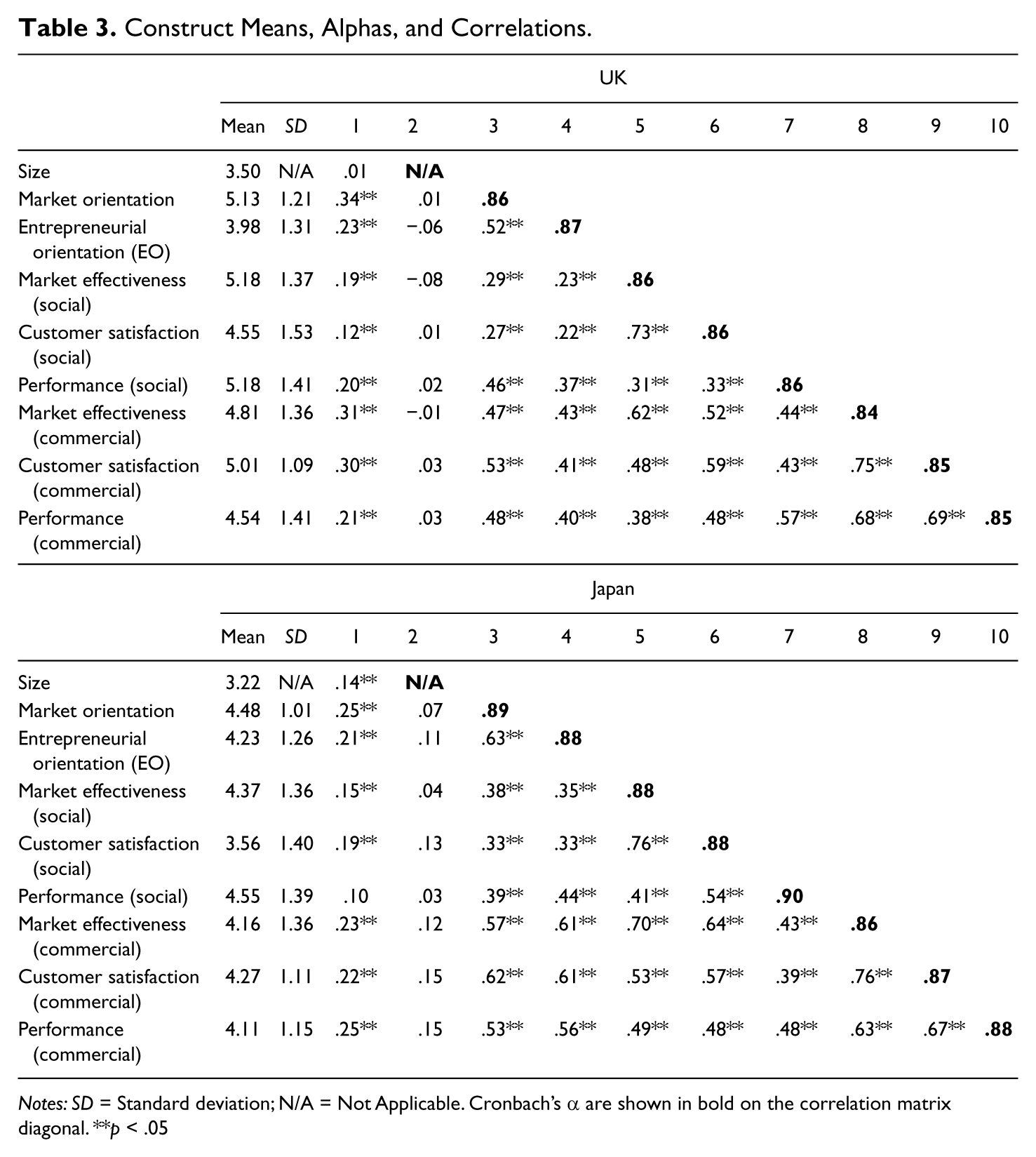
Notes: SD = Standard deviation; N/A = Not Applicable. Cronbach’s α are shown in bold on the correlation matrix diagonal. **p < .05
Hypotheses Testing
We tested our hypotheses using hierarchical regression analysis. All of the variables are mean-centered to minimize the threat of multicollinearity in the equations. Tables 4 and 5 illustrate the results of each test.
Regression Analysis—Commercial Aspect.

Note: *p < .10. **p < .05. ***p < .01.
Regression Analysis—Social Aspect.

Note: *p < .10. **p < .05. ***p < .01
To explore the mediating effects, we followed Baron and Kenny’s (1986) recommendation in examining the situation in both the United Kingdom and Japan. First, we found that there is a positive and significant relationship between MO and EO behavior and the SEs’ commercial and social performance. Second, we found that the SEs’ MO and EO behavior has a significant positive relationship with market effectiveness and customer satisfaction. Finally, we found that the direct effect of MO and EO behavior on performances has been weakened because of mediation effects. However, in all situations, we found that the interaction between MO and EO behaviors does not have any positive and significant effects on the SEs’ commercial and social performance, which in contrary to the findings of previous studies (e.g., Atuahene-Gima & Ko, 2001). Moreover, we found that MO–EO interaction has negative and significant effects on British SEs’ market effectiveness (β = –.10, p < .10) and customer satisfaction (β = –.10, p < .10), exclusively in the social aspect. Therefore, we performed additional tests to strengthen our results. We median split (high EO and low EO) and then run a separate regression for each to see if organizations with weaker EO have a significant relationship between MO behavior and consumer satisfaction or market effectiveness, and another regression to assess the relationship when the EO is stronger. It turned out that the regression results were the same. MO and EO behaviors have negative and significant effects on market effectiveness and customer satisfaction for UK SEs, when we measure the social aspect of performance (see Table 6). To summarize the above analyses, hypotheses 1 and 2 are partially supported.
Additional Analysis.

Note: *p < .10. **p < .05. ***p < .01.
We employed the hierarchical regression analysis to test the hypotheses about the moderating effects (Aiken and West, 1991). We first entered the variables (i.e., size, MO, EO, market effectiveness, and customer satisfaction), then added the interaction terms. We found that the SEs’ performance in one aspect has a positively moderated relationship between customer satisfaction and performance in the alternative aspect, but not market effectiveness in all situations (see Table 4 and 5). Hence, hypothesis 3 is partially supported.
Discussion
By building conceptual models connecting various variables and testing them via a large amount of survey data obtained from two countries (the United Kingdom and Japan), we found the generalizable answer to our research questions. Our theory and results advance the theory and inform the practice while also suggesting promising directions for future research.
Theoretical and Managerial Implications
This study has important implications for both theory and practice. First, we answer the call from scholars regarding the urgent need to conduct a large scale quantitative data analysis of SEs and highlight the importance of being MO and EO to foster superior social and commercial performance in the SE sector. This means that SE managers need to pay more attention to market forces, adjust their strategies to respond to market demands, need to continue searching for ways to improve their current offerings or develop new offers before their potential competitors realize the changes in the market needs, and take necessary risks when they spot either commercial or social opportunities in the marketplace.
Second, this research contributes to the theory and literature on SO by developing and testing a model that suggests that SO behavior enhances SEs’ performance through enhancing market effectiveness and customer satisfaction. Our findings demonstrate that the achievements of market effectiveness and customer satisfaction are an important measurement for explaining and understanding the association between SO and SEs’ performance. More specifically, the positive effects of both MO and EO behavior on market effectiveness and customer satisfaction might be enhanced to the extent to which SEs implement institutional arrangements, a support structure and feedback systems to help their managers to design business strategies and monitor the results of these achievements. When testing MO–EO interaction effects, to our surprise, we did not find that MO–EO interaction behavior had a positive and significant impact on performance. For this reason, it is important to highlight that there may be limits when applying this argument to SEs’ situation. Furthermore, interestingly, we found that MO–EO interaction has negative and significant effects on British SEs’ market effectiveness and customer satisfaction, exclusively in the social aspect. Additional analyses suggest that this effect is mainly caused by SEs with weaker EO behavior. One explanation is that, without strong entrepreneurial behavior, SEs may not use their market knowledge proactively to develop social products/services to satisfy the United Kingdom donors and volunteers’ demands.
Third, we found that the SEs’ performance in one aspect positively moderates the relationship between customer satisfaction and performance in the alternative aspect, but not market effectiveness. These findings are important, because they provide further insights into whether third sector organizations should pursue both social and commercial objectives to become SEs. Our findings support the suggestion that a high level of the achievement in one aspect of SEs’ performance can enhance that in another (Dacin et al., 2011; Seelos & Mair, 2007). We found that one aspect of SEs’ performance can enhance the effects of customer satisfaction on performance in another aspect. Massarsky and Beinhacker (2002) suggest that the success of a commercial venture can create a halo effect by improving its overall services and programs’ delivery. In this sense, the people are more likely to experience and be satisfied with a better quality of goods and service delivered by the SEs. Our findings add to the literature by suggesting that high social performance can also have a halo effect on commercial performance. However, our findings also provide some indications for the structural tension argument, although we found that performance in one aspect negatively moderates the relationship between market effectiveness and performance, which reinforces the suggestion that SEs that concentrate their resources on improving one aspect of their performance may cause a lack of resources for achieving their market-based goals in another aspect (Foster & Bradach, 2005; Weisbrod, 2004). Nevertheless, even though we found that one aspect of SEs’ performance can weaken the effect (i.e., not statistically significant) of another aspect of their activities, the improved aspect, on the other hand, may strengthen the effect of customer satisfaction significantly with another aspect of their performance. Therefore, the findings challenge the argument that SEs should try to balance the social and commercial aspects of their business (Cooney, 2006; Dacin et al., 2011), or should place social value above commercial value (Weisbrod, 2004), by arguing that, provided that SEs seriously engage in both commercial and social activities continuously, with the right management strategy, the success of one aspect of the business may enhance that success of another. In practice, SE managers should focus on developing the necessary skills to leverage SEs’ advantages between different aspects of the business.
Limitations and Future Research
Our research is subject to several limitations, which produce future research opportunities. First, this research focuses on the impact of SO behavior, so we chose the behavioral approach of the MO (Kohli & Jaworski, 1990) and EO (Coombes et al., 2011) construct. We might have generated different results had we considered including the culture approach of the SO construct. Future research might attempt to compare the results of two different types of SO construct in relation to SE performance. Second, we used the same sets of questions to examine MO and EO behaviors. This precludes the possibility that there may be separate MO and EO constructs for capturing SEs’ behavioral tendency toward the commercial and social aspects of the business. Future researchers might attempt to use different types of MO and EO scales that relate specifically to SEs’ social and commercial activities. Third, to enhance the variability and generalizability of our findings, we chose to use data from the United Kingdom and Japan. While our model did not include any country-specific factors, the effects of these on SO may be considered in future research. Fourth, due to its design, this research only examines the subjective measure of SEs’ social and commercial performance. Future researchers may consider including objective measurements, such as financial performance (i.e., ROI). Finally, we did not detect big difference between SEs’ commercial and social practices with regard to the relationship among the variables. One explanation is that our data were collected from the same sources, aiming at understanding the preferences from the SEs’ perspective, and the same respondents answered both the dependent and independent variable. Although we conducted further tests to ensure that there is no common method bias, future researchers might conduct multilevel research to collect data from different sources, such as SEs’ managers, and social and commercial customers, further to verify our findings. Furthermore, having established the linkage among the variables using cross-sectional data, it may be worth utilizing longitudinal research to assess the performance outcomes over time.
Conclusion
Our results demonstrate that the pursuit of SO has positive effects on SEs’ performance in both the social and commercial aspects. Moreover, we have deepened and expanded our understanding of the relationship between SO and performance by investigating the mediating effects of market effectiveness and consumer satisfaction in both the social and commercial domains, together with the moderating effects of SEs’ performance from one aspect to another. In general, this article contributes to the ongoing efforts to understand the strategic management aspect of SEs.
Footnotes
Acknowledgements
The authors would like to give special thanks to Dr. Petr Kadlec for the helpful comments on an earlier draft of this article. The authors thank Editor Meijs and the three anonymous NVSQ reviewers for their constructive reviews and suggestions.
Declaration of Conflicting Interests
The author(s) declared no potential conflicts of interest with respect to the research, authorship, and/or publication of this article.
Funding
The author(s) received no financial support for the research, authorship, and/or publication of this article.