



Abstract
The concept of values “fit” has been a significant theme in the management literature for many years. It is argued that where there is alignment of staff and organizational values a range of positive outcomes are encountered. What is unclear is how this translates into the charity sector. This study explores the phenomenon of values alignment in two U.K. charities. Questionnaires were used to measure staff values, perceptions of organization values, and staff commitment. Drawing on the work of Finegan, an interaction term is used as a proxy for fit. Analyses of data from 286 participants indicated that it was the perceptions of organization values that had the greatest impact on staff commitment. The alignment of staff values and perceptions of organization values only had a degree of effect within one of the charities. This challenges the dominant view on such alignment and the implications of this are discussed.
Despite the centrality of values to charitable organizations (Batsleer, Cornforth, & Paton, 1991; Sargeant & Lee, 2004) and the apparent importance that values play in determining staff commitment (Megginson & Clutterbuck, 2005; O’Reilly, Chatman, & Caldwell, 1991), there is a dearth of research to help the sector understand the role that values play in building a committed workforce (Elson, 2006). In fact, there are concerns that the charity sector is being ignored by the academic community in terms of conducting research with employees (Nickson, Warhurst, Dutton, & Hurrell, 2008).
Popular wisdom has suggested that it is the concept of values “fit” that drives behavior in organizations (Hudson, 1995; O’Reilly et al., 1991). In the commercial sector it has been shown that values congruence improves staff motivation (Brown, 1976) and impacts commitment (Chatman, 1991). Congruence between the values of an organization and those of an individual is said to be particularly important in not-for-profit organizations (De Cooman, De Gieter, Pepermans, & Jegers, 2011). Organizational identification has traditionally drawn on the principles of self-concept theory to explain such behavior. Some research in the commercial sector, however, has challenged the importance of values fit, suggesting instead that it may be perceived organization values that are more important in determining commitment (Finegan, 2000). What is unclear is how these findings translate into the charity sector. This article aims to address this question by exploring the relationship between staff values, staff perception of organization values, and their respective impact on organizational commitment and, in particular, the types of values that drive staff commitment in U.K. charitable organizations.
Background
Charities as Values-Based Organizations
The word charity has Latin origins; caritas means beneficence to those in need and, like philanthropy, it means love of people (Bruce, 1998). Values therefore are a charity’s raison d’être (Batsleer et al., 1991). The idea of charities as values-based organizations is even enshrined in law with charities being required to provide services that are of benefit to wider society (U.K. Charity Commission, 2012). Elson (2006) found that the values most frequently referred to in charity literature are Schwartz’s (1992) benevolence and universalism values types such as forgiveness and social justice. These observations are supported by empirical research, which shows that senior charity personnel and staff value benevolence and altruism (De Cooman et al., 2011; Elson, 2006)
Individual Values
A value is defined as “an enduring belief that a specific mode of conduct or end-state of existence is personally or socially preferable to alternative modes of conduct or end-states of existence” (Rokeach, 1973, p. 5). Values therefore guide social behavior by providing individuals with principles for interacting with others. While it is usual in common discourse to refer to values as normative—or how things “should be” (Kluckhohn, 1951)—others suggest that this is not helpful and argue that values can be both personally preferable as well as socially preferable (Rokeach, 1973). Schwartz (1992) supports this view, finding that values divide into those that serve the individual interest as well as those that serve the collective interest.
Schwartz (1992) found that values can be grouped into 10 values types some of which are diametrically opposed to others (see Figure 1). The values on the left-hand side (e.g., power) have an individual focus and those on the opposite side have a collective focus (e.g., benevolence). People, therefore, can have conflicting values within their values system. When an individual values, for example, not only authority but also loyalty, then this hierarchical organization of values forms the basis of an individual’s system of values (Katz, 1960). The extent to which a value forms part of a values system, affects the likelihood of it changing over time. Notwithstanding the hierarchical nature of values (see Rokeach, 1973), values are central to who we are and underpin an individual’s sense of self or self-concept (Rogers, 2003). While this is primarily achieved through developing relationships with people, organizational identification is also important for reinforcing one’s self-image.

Schwartz Values Grouping.
Organization Values
Organization values are said to be “evaluative standards relating to work or the work environment by which individuals discern what is right or assess the importance of preferences” (Dose, 1997, pp. 227-228). The exploration of values in an organizational context has taken place primarily in the popular, business literature and has focused on the concept of “shared values.” It is argued that effective and “visionary” organizations have at the heart of their culture a set of values shared by employees (Collins & Porras, 1996; Deal & Kennedy, 1982) and that when an organization has a strong, identifiable set of shared values it leads to corporate success (Collins & Porras, 1996; Peters & Waterman, 1986)
The process by which organizations and individuals come to share common attributes, including values, can be explained by the theoretical model proposed by Schneider (1987) that explores the three areas of Attraction, Selection, and Attrition (the ASA model). Schneider claims that people choose careers that will enable them to achieve valued outcomes in terms of their own interests and “personality profile” (Schneider, 1987). This means that similar people will be attracted to the same organizations (Schneider 1987). For those who discover that their desired outcomes will not be met, their most appropriate option is to leave. Schneider (1987) argues that companies select and hire people based on the personal attributes that they have in common with other members. While Schneider (1987) suggests that congruence can be measured using a range of different variables, Chatman suggests that it is useful to focus the discussion on values as they are “a fundamental and enduring aspect of both organizations and people” (Chatman, 1991).
The concept of shared values, however, is not without its critics. This “unitarist” view of culture, where employees embrace the espoused values of the leaders, fails to take into account any ambiguity, focusing only on values as a shared concept (Murphy & Mackenzie Davey, 2002).
This notwithstanding, there is sufficient evidence to suggest that organizational integration helps individuals develop their sense of self by providing them with “meaning and connectedness” (Lyons, Duxbury, & Higgins, 2006; O’Reilly et al., 1991). One’s sense of self plays an important role in determining self-esteem, so effort is invested in building and maintaining the self-image (Sirgy, 1982). In their influential study, O’Reilly et al. (1991) measure organizational integration as values fit and show its impact on commitment and intention to leave. Further research has shown that it is, in particular, fit between self-direction type values such as creativity and development (entitled vision values by Finegan) that drive commitment (Finegan, 2000).
There is evidence that the process of organizational integration is as relevant in the charity sector as it is in the commercial sector (Schwartz 1967; Sheth, Newman, & Gross, 1991). De Cooman et al. (2011) found that not-for-profit employees reported a greater fit between their values and the values of their organization than employees in commercial organizations. Katz refers to this as the value-expressive function of attitudes, which gives individuals satisfaction by providing them with the opportunity to express their “cherished beliefs and self-image” (Katz, 1960).
In acknowledgement of the growing importance of the concept of shared values in an organizational context, McDonald and Gandz (1991) sought to identify a values’ taxonomy that could be used to measure individual and organization values congruence. McDonald and Gandz developed their instrument because they believed that existing taxonomies “lack[ed] the relevance necessary for application in the current context of business corporations” (McDonald & Gandz, 1991, p. 218).
The Role of Values Irrespective of Fit
While recognizing the contribution made by Chatman and her colleagues (Chatman 1989, 1991; O’Reilly et al., 1991) to the discussion on values and commitment, Finegan (2000) challenges the use of differences scores employed by them to measure fit. This challenge is explained further below. In research that explores the relationship between values and staff commitment, Finegan (2000) found that fit between a person’s values and those of the organization was less important than the individual’s perception of organization values. Finegan (2000) found that organization values irrespective of fit were more important in impacting behavior. In addition to organization vision type values, Finegan (2000) found that organization benevolence type values were also driving the levels of staff commitment. The importance of vision-type values reflects earlier research in which a flexible, adaptable approach to working is positively valued by staff in the public sector (Zeffane, 1994). Organization compliance type values, such as obedience (conceptually similar to Schwartz’s tradition and conformity values types), also affect staff commitment although the relationship is nonlinear (Finegan, 2000). The only individual values that were found to drive commitment to an organization were compliance type values (Finegan, 2000).
Commitment
The work of Meyer and Allan (1997) suggested that employee commitment to an organization is a multidimensional construct that includes not only a behavioral component but also affective and normative elements. Affective commitment related to someone being committed to an organization because they wanted to be, and normative commitment related more to a sense of duty (Meyer & Allen, 1997). Subsequent research has indicated that affective and normative commitment are conceptually similar (Eby, Freeman, Rush, & Lance, 1999).
Much of the early writing on commitment as an attitudinal concept focuses on its affective dimension (Buchanan, 1974; Wiener, 1982). In fact, during the 1970s and 1980s, organizational commitment and identification were considered to be conceptually similar (Buchanan, 1974; Hall, Schneider, & Nygren, 1970). Such a view of commitment (i.e., affective commitment) has been shown to correlate strongly with staff retention (Meyer & Allen, 1997). In more recent research in human services, findings have shown that commitment is a defining factor in driving organizational performance (Packard, 2010). Given this study’s interest in organizational identification, the focus is on commitment as an affective construct.
In developing the work of Meyer and Allen (1984) and Mowday, Steers, and Porter (1979), Morgan and Hunt created a scale to measure relational, affective commitment. Relational commitment is defined as an “on-going relationship with another [that] is so important as to warrant maximum effort to maintain it” (Morgan & Hunt, 1994, p. 23). Their scale allows the researcher to move beyond the realm of the organization and its staff, to include external stakeholders. Having been successfully applied in the charity arena (Sargeant & Lee, 2004), the authors chose this option for the current research. The term commitment hereafter refers to affective commitment.
Development of Hypotheses and Conceptual Model
In reviewing the literature, we have noticed that there is relatively limited work that directly relates to values and staff commitment in the charity sector. In formulating the following hypotheses, therefore, we have also drawn on the commercial sector literature that has been reviewed.
Hypotheses
Values fit, which has been shown to drive commitment in the commercial sector (O’Reilly et al., 1991), has been found to be greater among staff in the charity sector (De Cooman et al., 2011). In particular, research has shown that benevolence values, which are ranked highly by charity staff (De Cooman et al., 2011), are also featured extensively in charity literature (Elson, 2006). Therefore
Hypothesis 1a (H1a): Fit between staff and organization benevolence values will positively affect levels of commitment to charitable organizations.
Universalism values (e.g., social justice) are also featured extensively in charity literature and are ranked highly by charity staff (Elson, 2006). Therefore
Hypothesis 1b (H1b): Fit between staff and organization universalism values will positively affect levels of commitment to charitable organizations.
While there is limited evidence in charity literature to support the claim that “fit” of vision type values (e.g., development) drive staff commitment, it is supported by research in the commercial context (Finegan, 2000). Given that one of the primary roles of many charities is to improve people’s lives, it is hypothesized that such values alignment will have a positive impact on the behavior of staff in this sector. Therefore
Hypothesis 1c (H1c): Fit between staff and organization vision values will positively affect levels of staff commitment to charitable organizations.
Individual values have been linked to organizational commitment (Finegan, 2000). The charity sector, where people are found to value benevolence values (De Cooman et al., 2011), provides an opportunity for the expression of such values. Therefore
Hypothesis 2a (H2a): Staff benevolence values will positively affect their level of commitment to a charitable organization.
Research has shown that universalism values are ranked highly by Trustee Chairs and CEOs of U.K. charities (Elson, 2006). It may not be unreasonable therefore to think this may also be true for other staff. Therefore
Hypothesis 2b (H2b): Staff universalism values will positively affect their level of commitment to a charitable organization.
Staff compliance (e.g., obedience) values have been shown to impact staff commitment positively (Finegan, 2000). As there is a strong normative component to charity work, it can be reasonably assumed that the same will be found in this research. Therefore
Hypothesis 2c (H2c): Staff compliance values will positively affect their level of commitment to a charitable organization.
Organization benevolence values are prevalent in charity literature (Elson, 2006). As research in the commercial sector has shown that staff perception of organization benevolence values drive staff commitment (Finegan, 2000), the same is likely to be true in the charity context. Therefore
Hypothesis 3a (H3a): Staff perception of organization benevolence values will positively affect the level of commitment to a charitable organization.
Once again, organization universalism type values are discussed extensively in the charity literature (Elson, 2006). Therefore
Hypothesis 3b (H3b): Staff perception of organization universalism values will positively affect their level of commitment to a charitable organization.
Given that research in the commercial sector has shown that vision values drive staff commitment (Finegan, 2000), and given that charities more than companies help people become independent, it can be reasonably assumed that such values will increase the commitment of staff in charitable organizations.
Hypothesis 3c (H3c): Staff perception of organization vision values will positively affect the level of their commitment to a charitable organization.
Drawing, in particular, on the work of Finegan (2000), a conceptual framework is presented (see Figure 2). The hypotheses of her generic model are summarized by the following equation:


Generic model.
These terms are explained in Table 1 below:
Terms in Finegan’s Model.
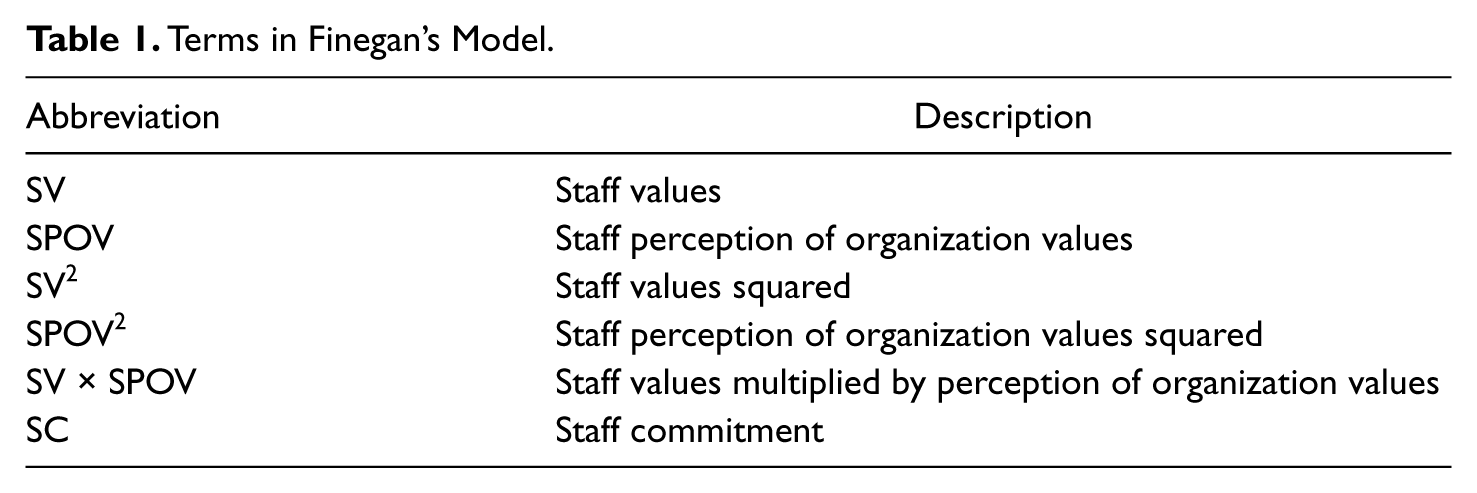
In the absence of a theoretical justification for the inclusion of squared terms, SV2 and SPOV2 have been included for exploratory purposes. A further explanation for the equation is provided below.
Method
Data Collection
The setting for this research was the staff and contract volunteers drawn from two U.K. charities. Charity 1 is an advocacy organization, dedicated to improving animal welfare throughout the world. Specifically it campaigns against animal cruelty, aiming to bring to justice those who are responsible for neglecting and abusing animals. It also provides rehabilitation for animals that have suffered the effects of abuse and cruelty. Charity 2 is primarily a service delivery organization, providing training and work opportunities for people who are in some way disadvantaged in the employment market. It is one of the largest suppliers of such services in the United Kingdom and is also a leading authority on disability. One of the main reasons that these charities were chosen for the current study was their differences, both in terms of the role they play and the causes they represent.
In the case of Charity 1, questionnaires were mailed to the population of 140 staff. A total of 84 responses were received representing a response rate of 60%. In the case of Charity 2, 650 members of staff were randomly selected from a population of 1,300. This generated a response rate of 31% (202 responses; see Appendix 1 for demographic data).
Participants received two identical values questionnaires. At the beginning of one questionnaire, participants were asked to rate each value according to the extent to which it was a guiding principle in their life. At the top of the second questionnaire, participants were asked to rate how important they believed the value to be to their organization. Each value was rated on a 7-point Likert-type scale (with 7 being very important and 1 being not important). Participants were also asked to complete Morgan and Hunt’s (1994) commitment scale. The primary techniques for analyzing the data were confirmatory factor analysis (CFA), multiple hierarchical regression analysis, and multiple regression.
Measurement
A 30-item values scale was employed to measure the values of staff and their perception of organization values. The instrument was a variation of McDonald and Gandz’s (1991) 24-item values taxonomy that was successfully used by Finegan (2000). The rank-order instrument has a test-retest reliability of .76, and Finegan reported an interrater reliability of .77 (Finegan, 2000, p. 156). As McDonald and Gandz (1991) omitted values that are relevant to charities (such as protecting the environment and social justice), the authors followed Finegan’s (2000) recommendation and included values from Schwartz’s Values Survey (Schwartz & Bilsky, 1987). The instrument being used in this research includes, therefore, six items from Schwartz’s values types benevolence, universalism, tradition, and conformity (see Appendix 1).
To establish content and face validity of the instrument, interviews were conducted with senior personnel from one of the participating charities. It was agreed that the items were representative of the values domain in the charity environment with the exception of “aggressiveness.” The item was retained, however, as its removal may have affected the reliability of the instrument.
For the reasons outlined below, commitment was operationalized using a seven-item scale developed by Morgan and Hunt (1994; see Appendix 1).
Operationalization of Commitment
While recognizing that the omission from the research of a normative commitment measurement is a limitation, it was decided to operationalize commitment using Morgan and Hunt’s (1994) affective scale. The reasons for selecting this scale are outlined below:
In acknowledging the role of organizational identification in determining commitment to an organization, affective commitment is the most relevant for the reasons already stated (Hall et al., 1970; O’Reilly et al., 1991).
In her work Finegan (2000) found that values fit related only to affective commitment of staff.
The scale that has a reliability (α) of .895 (Morgan & Hunt, 1994) has been successfully applied in the charity context (MacMillan, Money, Money, & Downing, 2005; Sargeant & Lee, 2004).
Normative and affective commitment are conceptually similar (Eby et al., 1999).
In the current research, commitment is therefore conceptualized as an intention by charity staff to remain with a charity and to make maximum effort to maintain the relationship.
Confirmatory Factor Analysis
As the primary objective of the research was to establish the relationship between values fit and commitment, a common scale is needed for both own and organization values. The precedent for creating a scale from own values had been set by Finegan (2000). A factor model of own values is likely to be more robust than one created from a person’s perception of which values are important to an organization. As the staff sample from Charity 1 was below the optimum size for factor analysis, the decision was taken to combine the two staff values samples. Combining values data sets in this way can also be defended theoretically. At a fundamental level, values are the response to three universal requirements that are essential for human survival (Schwartz, 1992). This means that the structure of values is universal in nature (Schwartz, 1992). The order of values within the values structure, however, is culturally determined (Schwartz, 1992). Culturally similar experiences, as shared by the staff involved in this research, result in “shaping the value systems of large numbers of people in more or less similar ways” (Rokeach, 1973, p. 23).
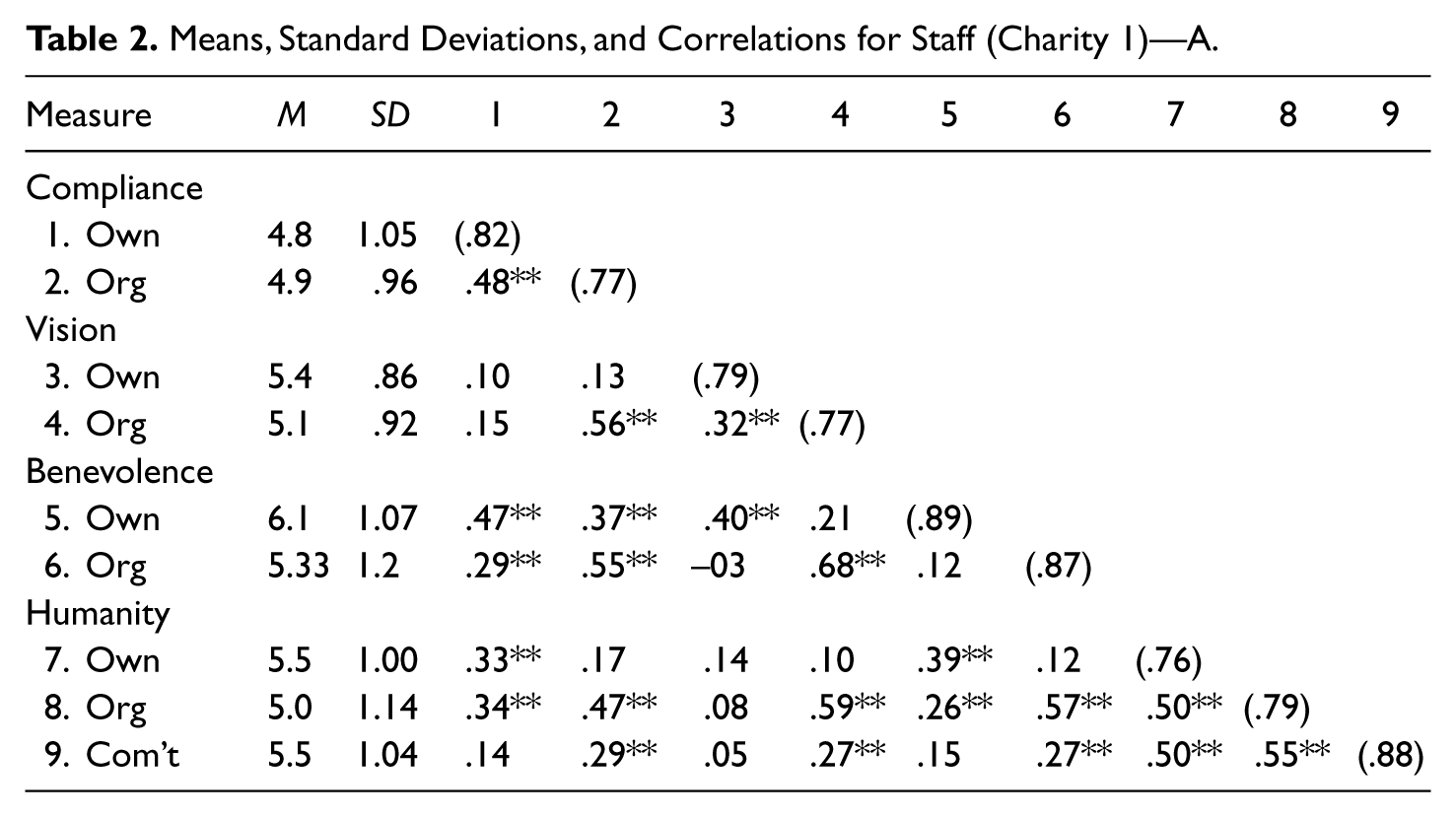
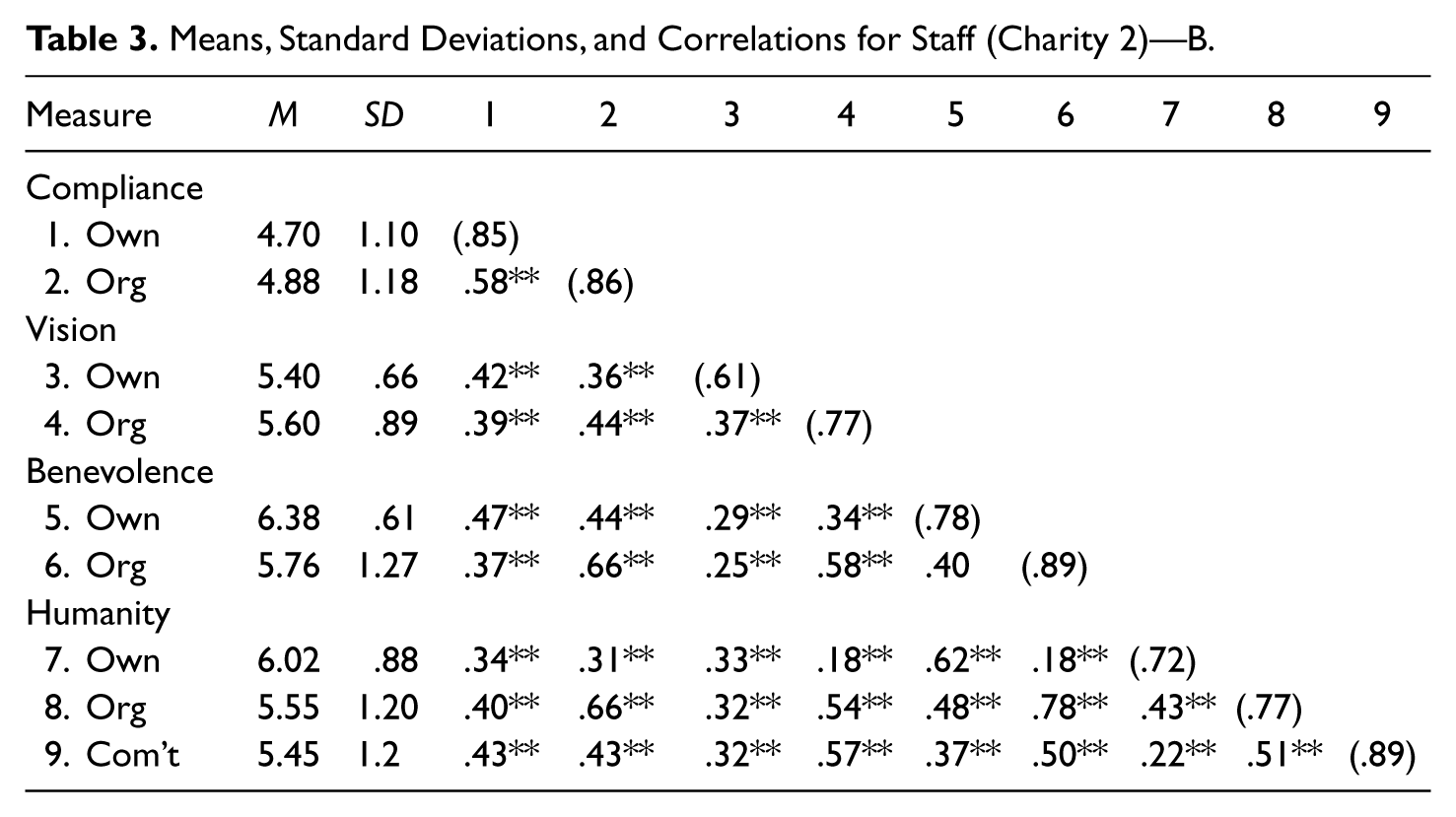
Combining staff values data sets created a robust set of four factors, which were labeled as follows: compliance (obedience, formality, moderate, orderliness, cautiousness, economy, and humble), vision (development, creativity, adaptability, autonomy, aggressiveness, and logic), benevolence (cooperation, consideration, courtesy, and forgiveness), and universalism (protecting the environment, world peace, social justice, and moral integrity). Each factor has a Cronbach alpha in excess of .7 (see Appendix 2 for Cronbach alphas and key goodness-of-fit statistics). The mean, standard deviation and correlation coefficients are shown in Tables 2 and 3.
Means, Standard Deviations, and Correlations for Staff (Charity 1)—A.
Means, Standard Deviations, and Correlations for Staff (Charity 2)—B.
Limitations
The authors acknowledged that when applying significance criteria of 1%, 5%, and 10% with stepwise regression results have been shown to be biased (Steyerberg, Eijkemans, Harrell, & Habbema, 2001). The use of the nonlinear function and the fact that the research involves only U.K. charities are also limitations. Common methods variance is a limitation as both instruments were completed at the same point in time (Podsakoff, Mackenzie, Lee, & Podsakoff, 2003). However, the use of CFA indicates that risk is relatively low (Podsakoff et al., 2003).
Data Analysis
As shown in Table 1, SV and SPOV terms represent the main effects of staff values and their perception of organization values on their commitment to the organization. The two squared terms (SV2 and SPOV2) are included to capture any nonlinear relationship between the variables. The interaction term (SV × SPOV), as used by Edwards (1991) and adopted by Finegan (2000), is used as a proxy for fit. Fit is traditionally measured using profile correlations or differences scores (Chatman, 1989; O’Reilly et al., 1991). However, the reduction of the different measures to a single index to establish a difference score has been criticized for creating a range of methodological problems (Edwards, 1991). Perhaps the main criticism is that information is lost by collapsing the individual and job or organization data into a single index, ignoring the independent contribution of each variable (Edwards, 1991).
Instead, Edwards suggests a three-dimensional approach using the equation above. Edwards is therefore taking the algebraic difference (SV – SVOP)2 and expanding it to include five predictors SV, SPOV, SV2, SPOV2, and SV × SPOV in “an unconstrained equation” (Kristof, 1996). Higher order terms (e.g., the squared terms and the product) are required to ensure that the shape of the hypothesized relationship is accurately depicted (Edwards, 1991). This is supported theoretically by Finegan’s (2000) findings. Fit, in this research, is therefore measured as an interaction between a predictor variable and a moderator, a technique that is well supported in literature (Edwards, 1991; Kristof, 1996; Venkatraman, 1989).
The hypotheses are tested using hierarchical multiple regression. As a result, two models emerge that may be expressed as a linear equation:


The first model measures the main effect terms and the second model includes the squared and interaction terms.
In Model 1, individual and organization matching factors are paired. Model 2 includes each of the variables from Model 1 plus the interaction and squared terms. Model 2 is only analyzed if more of the variance is explained.
Results
Hierarchical Multiple Regression
In support of Finegan’s (2000) findings, it is organization main effect factors (see previous Data Analysis section) that are more important in explaining variance than the interaction of the factors (see Tables 4 and 5). The interaction term is not significant for either of the two data sets. We can see that organization main effect factors are significant in seven cases and individual main effect factors are significant in four cases. R2 is significant in all but one case.
Multiple Hierarchical Regression (Charity 1).
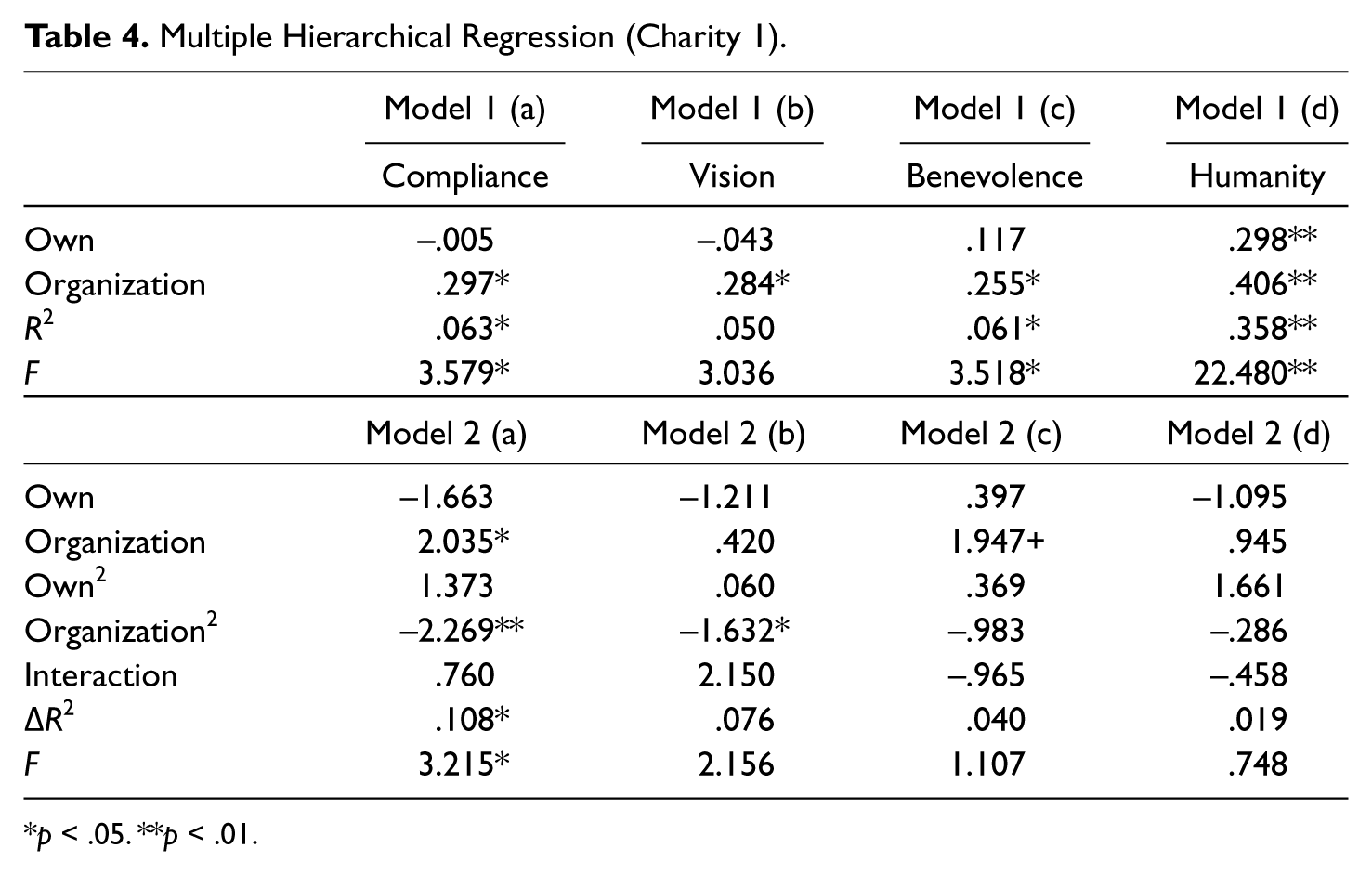
p < .05. **p < .01.
Multiple Hierarchical Regression (Charity 2).

Multiple Hierarchical Regression—Staff Charity 2.
p < .06. *p < .05. **p < .01.
The only higher order term that explains more of the variance relates to Charity 1. Model 2 shows that organization compliance values squared is significant and explains more of R2 than in Model 1. As found by Finegan (2000), this suggests that too few or too many organization compliance values negatively impact commitment.
While the analysis of pairs of factors gives some indication of the role of own and organization factors in driving commitment, in cases where both are significant it is not possible to attribute the variance to either one. Therefore, the authors extend Finegan’s (2000) work and apply multiple regression to all factors simultaneously. The findings from this approach are shown below.
Multiple Regression
Charity 1
In the case of Charity 1, the squared terms are excluded to reduce the number of variables given the relatively small sample size. The remaining variables are added to the regression model. To arrive at the findings, the variables with the highest “p” value were removed one at a time. The model that explains the highest R2 (.31) is shown in Table 6. Confirming the findings from the multiple hierarchical regression analysis, it is universalism values that are driving staff commitment to Charity 1 (see Table 7). This analysis, however, allows us to see that it is specifically organization universalism values (universalism2), not individual universalism values (universalism1) that impact commitment. We can also see that the benevolence interaction term is significant although it has a negative beta. So in this case, a fit between staff values and perception of organization values negatively impacts commitment.
Charity 1—Model Summary.
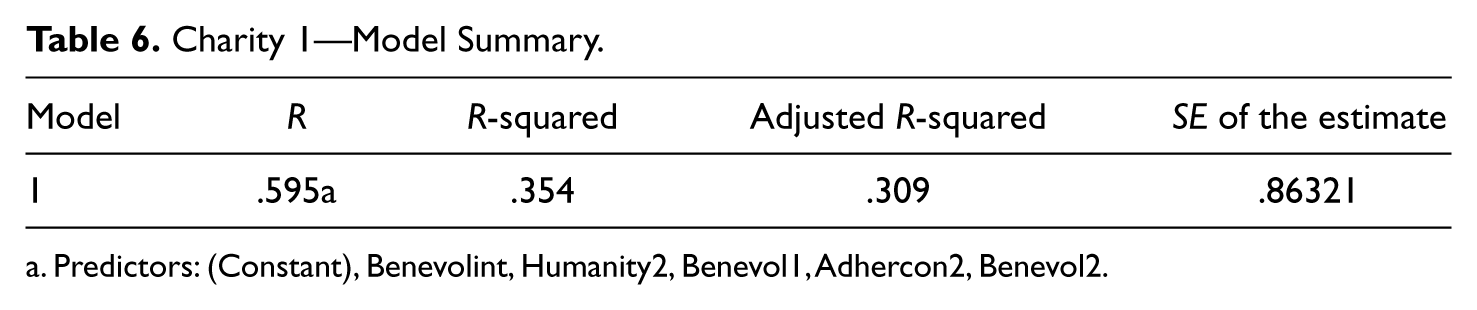
Predictors: (Constant), Benevolint, Humanity2, Benevol1, Adhercon2, Benevol2.
Charity 1—Coefficients (a).
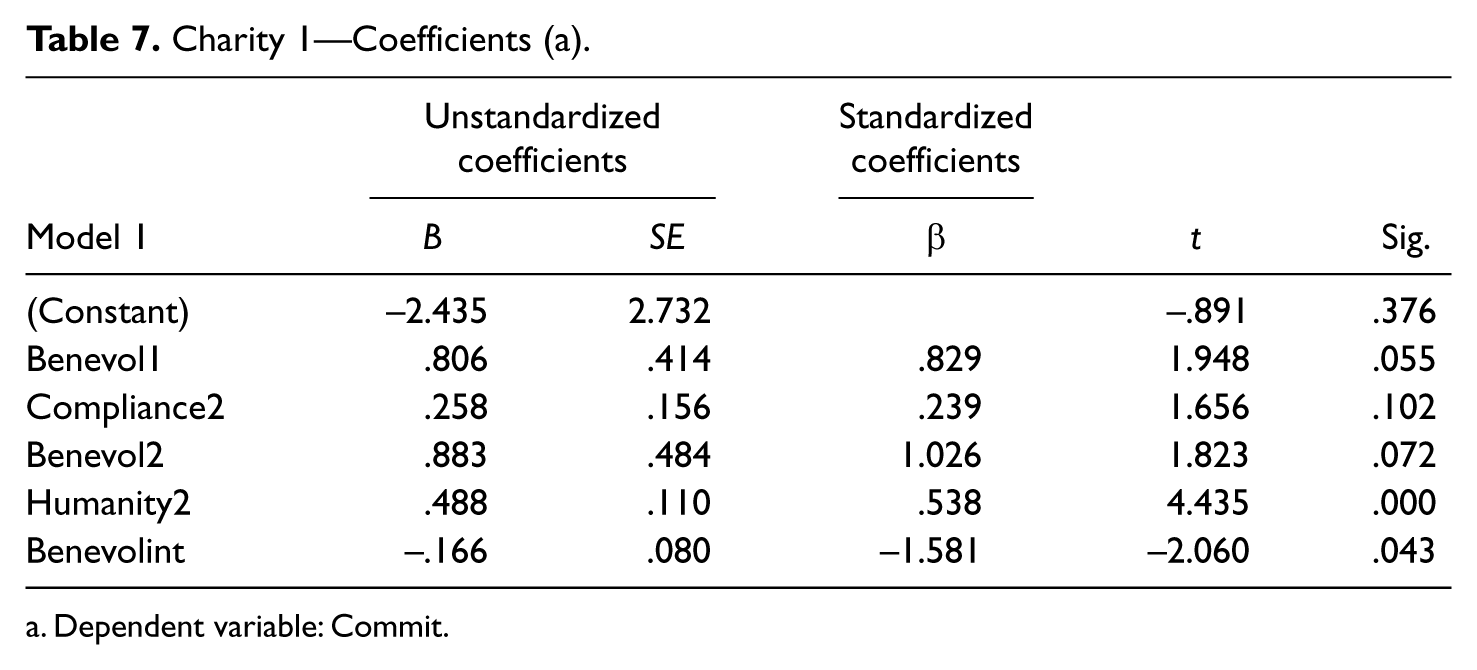
Dependent variable: Commit.
When the organization compliance variable is removed, it is only the organization universalism values that remain significant. R2 falls to .29. This suggests that while the benevolence interaction term is significant, it is primarily the organization’s universalism values that have the greatest effect on staff commitment.
Charity 2
All variables were again added to the regression model with the exception of the squared terms, and variables with the highest p value were removed one by one until the highest level of R2 was explained. The results are shown in Tables 8 and 9.
Charity 2—Model Summary.
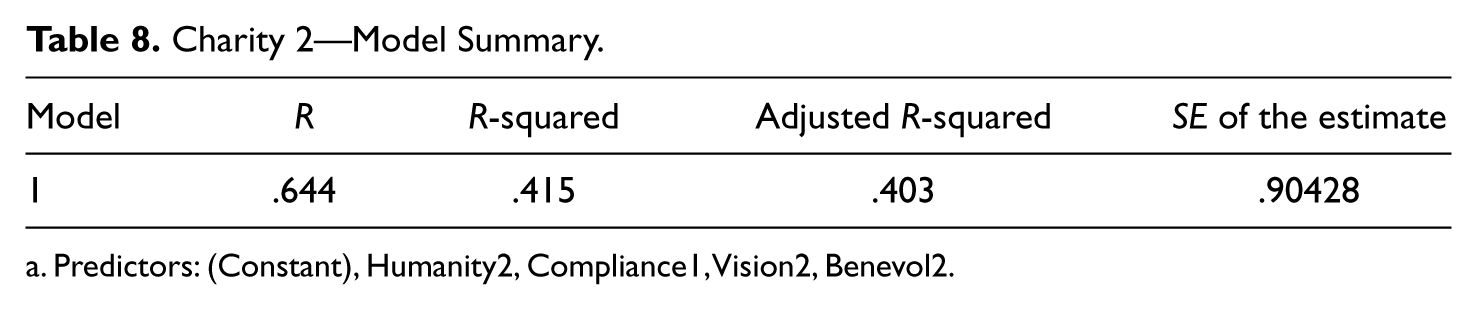
Predictors: (Constant), Humanity2, Compliance1, Vision2, Benevol2.
Charity 2—Coefficients (a).

Dependent variable: Commit.
As seen in Tables 8 and 9, individual compliance (compliance1) and organization vision (vision2) values together explain .403 of the commitment of staff of Charity 2. This means that when compliance values are perceived to be important as a guiding principle in the life of a member of staff, or when staff perceive vision values to be important to the charity, commitment is also high.
Control Variables
Recognizing the importance to control for the influence of certain characteristics on value perceptions and commitment, gender, age, and length of tenure of staff were added to the two regression models. In neither case did the respondent’s gender nor their length of service with the charity impact the findings. However, in both cases, age had a significant impact on R2. In the case of Charity 1, the change in R2 is .14 and is highly significant and, in the case of Charity 2, the change in R2 is .016. Therefore it is important to factor in variable bias caused by the age of respondents.
Discussion
The discussion will first consider those hypotheses that have been positively supported. It will then discuss those that have been negatively supported and those that have not been supported.
Positively Supported Hypotheses
H2c Staff compliance type values affect staff commitment.
H3b Staff perception of organization universalism values affect staff commitment.
H3c Staff perception of organization vision values affect staff commitment.
The findings show that individual compliance values impact levels of staff commitment. Finegan’s (2000) work in the commercial sector also found that those who scored highly in individual compliance values had high levels of normative commitment (Finegan, 2000). As normative commitment relates to what someone feels they should do, it is not surprising that values such as obedience and formality drive commitment in the charity sector where there is likely to be a strong sense of duty. As already mentioned, normative commitment correlates highly with affective commitment (Eby et al., 1999), which is being measured in this study.
Organization universalism values and organization vision values also appear to be important in driving the commitment of staff in charitable organizations. Universalism values such as social justice are regarded as traditional charity values and are mentioned extensively in charity literature (Elson, 2006). In relation to vision values, although there is evidence in the commercial literature of the positive impact that such values have on commitment of staff to organizations (see Finegan, 2000, and Zeffane, 1994), these types of values have received little coverage in the charity literature. In the charity context, where the mission is often to empower people who are in some way disadvantaged, the importance to staff of other exemplars of vision values such as development and autonomy is also easy to understand.
Negatively Supported Hypotheses
H1a Fit between own and organization benevolence.
In this study, the only occasion on which the interaction term is significant is in relation to benevolence values where values fit has a negative impact on staff commitment. Given the prevalence of benevolence values in charity literature (see Elson, 2006), the relationship between such values and commitment appears to be complex and is worthy of further research.
Hypotheses Not Supported
H1b and H1c Fit between individual and organization universalism and vision values positively affect levels of staff commitment.
H2a and H2b Staff benevolence and staff universalism values affect levels of commitment to a charitable organization.
H3a Staff perception of organization benevolence values affect staff commitment.
On no occasion does the research positively support the hypotheses that values fit impacts staff commitment. This suggests that organizational integration is not as important to people as previously thought, or that values fit is not a good indicator of it. It is of interest that the finding in the commercial sector that fit of vision values impacts staff commitment does not appear to translate into the charity sector.
Despite research suggesting that individual universalism values are ranked highly by senior personnel in charities (Elson, 2006), according to the findings from this research, these values are not driving staff commitment in general. While the hypothesis relating to individual benevolence values is also not supported by the current findings, for Charity 1 these values are significant at the .06 level, which suggests that further research would be useful. The story is the same for organization benevolence values despite evidence from the commercial context that they do impact staff commitment (Finegan, 2000).
In support of Finegan’s (2000) findings, this research suggests that it is the perceived values of the organization and staff individual values rather than values fit that have the greatest impact on commitment of staff. The study highlights, however, the significant role that values appears to play in determining staff behavior in U.K. charities.
The findings that relate to fit may be highlighting more the complexity of the values concept rather than the need to abandon the idea of organizational integration altogether. In this study, although organization universalism and vision values are explaining the majority of the variance of staff commitment, the hierarchical multiple regression analysis shows that individual universalism values (Charity 1) and individual vision values (Charity 2) are also playing a significant albeit small role. So while it is overwhelmingly the values of these two organizations that are driving staff commitment, in each case they may be providing some sense of organizational integration for the staff concerned.
While universalism values may not be at the top of an individual’s values system, values such as social justice will no doubt be important at some level and the direct experience of them within an advocacy organization such as Charity 1 is likely to be influential in determining behavior. Staff who have been attracted to an organization that campaigns against animal cruelty are likely to respond positively to acts of integrity and displays of global goals. Staff of Charity 2, however, which provides employment services for people with a range of disabilities, are more likely to respond positively to behaviors that encapsulate values such as development and autonomy irrespective of where such values sit in their own values hierarchy. The importance of organization vision values in determining commitment of staff perhaps helps to explain further the nature of the nonlinear relationship between compliance values and commitment.
Given that charities are underpinned by a normative ideology and sense of duty, then the finding that individual values such as obedience and formality are driving the behavior of staff is to be expected.
Perhaps the most surprising findings from the current study relate to benevolence type values that feature extensively in charity literature. Not only were organizational benevolence values found not to impact staff commitment in this study but also the interaction of organization and individual benevolence values was found to have a negative impact on commitment in the advocacy charity. These findings suggest that of the more traditional charity type values (benevolence and universalism), it is the more global goals associated with universalism values type that are driving staff commitment, rather than values associated with “conduct.” Perhaps it is not to charities that individuals turn for an expression of these types of values, but elsewhere such as human relationships.
Contribution to Method, Theory, and Practice
In terms of methodological contribution, items from the McDonald and Gandz (1991) taxonomy have been merged with some of those from the list compiled by Schwartz (1994), which has created a separate set of universalism values. Confirmatory factor analysis has also been applied to the data. In terms of theory, the main contribution supports Finegan’s finding that the importance of values fit in driving commitment may need to be reviewed. This is of particular interest given that the study takes place within the charity sector. The study also broadens the discussion in terms of the traditional charity values of universalism and benevolence. The study introduces the importance in the charity context of organization vision and staff compliance values and highlights the nonlinear relationship between organization compliance values and staff commitment.
The study makes a number of practical contributions. The instrument developed for this research provides an important tool for measuring individual and organization values and for exploring their impact on behavior. This is particularly useful in terms of recruiting people and building commitment to the organization. Specifically, the study suggests that charities should recognize the importance of developing their identity around not just traditional charity values but also around values such as creativity and development. The importance of creating order is also important although scope must remain for the expression of more creative values.
Future Research
To test these findings, research needs to be conducted with a larger number of national and international charities representing a range of different causes. Given the limitations associated with the instrument used in this study, future research would benefit from the inclusion of values types such as power and achievement to allow for a comparison between values in the not-for-profit sector and the commercial sector. There is clearly a need to explore in more detail the issues uncovered in this study relating to benevolence values. Finally, perhaps a piece of qualitative research would be useful to explore further the self-perception of respondents in relation to benevolence type values, and whether it really is these that are guiding their actual behavior or whether there are other values that are underpinning their social conduct.
Conclusions
There are conclusions that we can draw, however, that helps the sector to better understand the role that values play in building staff commitment. First, values are driving high levels of staff commitment. Second, the role of organization and individual values irrespective of fit should not be overlooked. Third, there are greater similarities between the types of values that impact behavior in the charity and commercial sectors than previously thought, with vision and compliance type values being important in both. Finally, of the more traditional charity values, it would appear that it is universalism values, which are associated with global goals, rather than benevolence values, which are associated with conduct, that are having the greatest impact on the commitment of staff in the charity context.
Footnotes
Appendix 1
Appendix 2
Declaration of Conflicting Interests
The authors declared no potential conflicts of interest with respect to the research, authorship, and/or publication of this article.
Funding
The authors received no financial support for the research, authorship, and/or publication of this article.