



Abstract
This article presents and explains differences in governmental implementation strategies of volunteer centers in Norway and Denmark. In the first part, we describe the emergence of centers, focusing on shifting policies and governmental initiatives. The second part aims at explaining the observed variations. First, we found that the functions of the centers were strongly affected by centralistic trends in Danish social policy in contrast to a broader acceptance of local welfare variations in Norway. Second, we found that Danish centers managed to establish a national umbrella organization, while the Norwegian centers lacked a national coordinating unit. Third, an independent legal form in which local associations are members may have helped Danish centers bring about a sense of local ownership. In Norway, volunteer centers had weak ties to other local voluntary associations and were at times perceived as a threat to them.
Keywords
Within the Scandinavian welfare model, ideas of volunteering for social purposes have, traditionally, been overshadowed by ideologies of state responsibilities: welfare services should be provided by professional agents, distributed and financed by public authorities (Esping-Andersen, 1990; Kuhnle, 2000; Seip, 1994). According to Salamon and Anheier’s (1998) social origin theory, the relatively small share of voluntary welfare providers calls for historical explanations linked to social class interests. But also the rise of professional expertise after 1945 and the hierarchical structure of public administration can explain why the tolerance for amateurism and volunteerism have been low (Alm Andreassen, 2008).
During the last 10 to 15 years, Nordic governments have, however, increasingly turned to voluntary associations, asking for their problem-solving capacities (Regeringen, 2010; Stortingsmelding 25, 2005-2006; Stortingsmelding 39, 2006-2007). As the voluntary sector has grown in importance there has been a parallel growth in the interest of infrastructure organizations whose function is to support local nonprofit and voluntary units.
In this article we apply a comparative approach to investigate variations in the implementation of volunteer centers between Denmark and Norway. While there is a growing literature that tries to classify and establish a taxonomy of different forms and types of infrastructure organizations (Abramson & McCarthy, 2002; Brown & Kalegaonkar, 2002; Haski-Leventhal, Meijs, & Hustinx, 2009; Kimberlin, 2011; van den Bos, 2012), we find relatively little empirical evidence about how such innovative organizational structures are implemented (see Brudney, Dayoung, & Zarcone, 2012, for an exception).
Furthermore, the extensive use of social origins theory (Salamon & Anheier, 1998, 2006) have paved the way for the assumption that the voluntary sectors of the Nordic countries represent one category with common structural and historical traits. On a generalized level, this may be true. But there also exist considerable differences. Volunteer centers represent a particular good case to investigate inter-Nordic differences since they emerged about the same time in the two countries and symbolized a response to the same set of perceived challenges.
Background
Volunteer centers are a relatively new invention in the local welfare architecture (van den Boos, 2012). As infrastructure or support organizations, volunteer centers typically aim to mobilize volunteers by either improving the visibility and accessibility of existing local associations, or by inventing activities that can attract new (groups of) volunteers. They also aim to improve the quality of services provided by local associations and strengthen the cooperation between public and private welfare providers. More generally, volunteer centers have been described as part of a new “third party model” (Haski-Levenhal et al., 2009) in which it is no longer the exclusive responsibility of voluntary organizations to recruit volunteers and encourage volunteering, but increasingly also a matter for governments, corporations, and educational institutes.
In Norway and Denmark, the background of the centers can be traced to the years between 1980 and 1990. At least two political reasons seem to lie behind. First, important ideological impulses came with the new liberalism of the 1980s, arguing a need for a broader array of welfare activities than those provided by the state (Hadley & Hatch, 1981; Hogget, 1990). A second, less visible, motive was the growing acknowledgement of mutual dependence between public and private welfare resources. The question, however, was how this could be done without giving in to philanthropic and liberal ideologies that would fundamentally challenge deep-rooted governmental responsibilities for people’s welfare.
The ambition to boost civil resources, furthermore, was challenged by the history and the composition of the voluntary sector. First, since the late 19th century the majority of voluntary organizations in Scandinavia have been organized as membership-based associations with a democratic organizational structure (Klausen & Selle, 1996, p. 103). In 2005, 80% of the Danes who volunteered did this for an organization they were at the same time a member of (Henriksen, Boje, Ibsen, & Koch-Nielsen, 2008). Similar figures account for the Norwegian case (Wollebæk, Selle, & Lorentzen, 2000). As such, no traditions have, till now, opened for other actors to engage in recruitment and encouragement of volunteering. Second, the voluntary sector only plays a small and supplementary role as service providers within the welfare fields. Although volunteering, in comparative perspective, is extensive in the Nordic countries, more than half of all volunteers and volunteering hours are found within sport and recreation (Sivesind & Selle, 2009). Third, because of the strong membership model, most local voluntary associations rely solely on unpaid volunteers and have very scarce administrative capacities. This makes it difficult for many of them to engage in public–private partnerships and meet demands for accountability and professional solutions. As membership-driven units, they are also less affected by public demands for their activities.
Data and Outline
We use data collected in Denmark and Norway as part of national evaluation programs for which the authors have been responsible. A national evaluation of Danish volunteer centers was carried out from 2005 to 2009, following the implementation of a national investment plan for more and better volunteer centers (Henriksen 2008a, 2008b, 2009; Henriksen & Marthedal, 2006). In Norway, volunteer centers were continually evaluated for a period of 10 years; from their start in 1991 to 2000 (Lorentzen, Andersen, & Brekke, 1995; Lorentzen & Røkeberg, 1998). Later, the hybrid character of many volunteer centers and the issue of ownership forms have been investigated (Dugstad & Lorentzen, 2008; Kloster, Lidén, & Lorentzen, 2003; Lorentzen, 2010a).
History of Volunteer Centers in Denmark and Norway
In Denmark, the first three centers were supported and funded by a development program (“SUM-programmet”) initiated by the Ministry of Social Affairs in 1989. The aims were defined rather loosely and broadly as giving more citizens the opportunity to volunteer and to support local volunteering and voluntary organizations. From the beginning, the centers focused their attention mainly on the area of social policy. Especially relevant at that time was the idea of volunteer work as an alternative to ordinary labor market jobs. Denmark had a comparatively high unemployment rate of 9.5% (Statistics Denmark), and the centers were seen as a possible device, which could connect people in need of a meaningful activity to voluntary organizations in need of volunteers.
This idea, however, quickly proved more difficult to implement than expected. Consequently, the centers took on new initiatives and, at the beginning of the 1990s, they brought more attention to prevention of isolation and loneliness of marginalized groups by starting projects and initiatives to strengthen social networks, neighborhood contacts, and self-help programs.
In 1994/1995, the Ministry of Social Affairs funded seven so-called “model projects” that should develop a closer cooperation between local governments and local associations. The agenda transformed the centers in the direction of local units, which should mediate volunteering opportunities and improve the problem-solving capacity of voluntary social service organizations. By the turn of the century, this trend was followed by the enactment of a new Social Service Act in which it was made compulsory for local governments to cooperate and financially support local voluntary social organizations. Several municipalities did this by supporting a volunteer center.
Finally in 2005, the Parliament decided to boost the development of local volunteer centers by entering an agreement of a 3-year development fund. The intentions were first to enhance the quality of existing volunteer centers and second, to establish new centers in municipalities where none existed.
At the same time, the national investment plan indicated that until then, the centers had not been able to live up to political expectations. Two arguments were made: first, the centers did not recruit enough volunteers for the voluntary organizations; second, while some centers performed very well others did not. The aspiration of the development fund was to standardize and homogenize the centers and raise their general standard. To achieve this, the Ministry of Social affairs set up six core functions for what was termed “a fully equipped volunteer center” in its call for applications 1 (Socialministeriet, 2005). These were used as evaluation criteria when the centers applied for funding. It is worth noticing that these core functions were the result of a process originally initiated by the national umbrella organization for the volunteer centers, FriSe, describing a number of “best practice” guidelines for volunteer centers (FriSe, 2005).
In 2007, a municipal reform reduced the number of municipalities from 275 to 98. As a consequence, smaller volunteer centers merged, while bigger ones typically had their geographic district substantially enlarged. The result was a concentration of resources in bigger centers and a more even geographic distribution of centers throughout the country. The municipal reform, thus, served as a stream of opportunity to reorganize the field of volunteer centers. As of today (2013) 54 centers operate in Denmark. After the expiration of the development fund, the government in 2010 decided to permanently support centers, provided that the financial responsibility is split evenly between central and local government. Virtually all Danish centers are organized as independent nonprofit units with local voluntary associations as members, but they rely heavily on public financial support.
In Norway, the idea of volunteer centers was launched in 1990 when the Norwegian Parliament decided to grant money to a 3-year pilot program (Lorentzen & Røkeberg, 1998, p. 7). The government would pay the costs of an administrative leader, housing, and operating expenses for a period of 3 years. This organizational frame should be filled from below with new and innovative activities. Voluntary organizations, municipalities, congregations, and individuals were allowed to apply for public grants. By using a “bottom-up” process, local initiatives were allowed to shape activities according to local culture, norms, and practices.
By the time of their establishment, the centers represented a loose organizational concept formulated by government, which should serve as a catalyst for the release of hitherto unused voluntary capacities (Lorentzen et al. 2005, p. 20). The centers were the result of a general political intention to find and support more willing and capable volunteers, particularly within the field of social policy. According to a white paper from the central government, the centers should . . . promote voluntary engagement and function as a partner between community initiatives and local authorities (St.meld nr. 39, 2006/2007, p. 204).The program was launched as an “experiment in testing practical models” by which the government through a number of so-called pilot centers could collect information on best ways of mobilizing volunteers. The volunteer centers should function as an agency where volunteers, associations, local authorities, and people in need of help could meet. The guidelines made clear that the centers should focus on caring activities. Administratively the centers were linked to The Ministry of Health and Social Affairs, but still placed outside public responsibility.
The increasing number of centers was, on the national level, administered by a quasiautonomous unit called Frivillighetens samarbeidsorgan (FRISAM). As an umbrella organization, this unit included most of the large philanthropic and voluntary social organizations in Norway. In 2004 FRISAM was replaced by Frivillighet Norge (FRINOR); likewise a national umbrella unit, but exempt from public, administrative responsibilities (St. meld. nr. 39, 2006/2007). FRINOR, however, did not accept the volunteer centers as voluntary bodies, and consequently denied them membership. As a result, the volunteer centers were left without a national umbrella organization to voice and bargain their interests (Lorentzen, 2012).
Also in 2004, the national responsibility for the funding of centers was moved from the Ministry of Health and Social Affairs to the Ministry of Culture. This shift was followed by attempts to decouple the activities of the centers from labels and concepts related to the “social” field, like for instance charity, client, marginal, help, isolation, and deprived. Instead the volunteer centers should seek to enhance and bridge civic engagement across the cultural, leisure, health, and “social” fields.
In 2006, following the transfer to the Ministry of Culture, the government for the first time made attempts to give direction to the profiles of the centers by presenting a more detailed plan for their role and functions (St.meld nr. 39, 2006/2007). Inspired by local innovations, the government envisioned volunteer centers as Community centers (“nærmiljøsentraler”). Their main role should be to coordinate and mediate resources and initiatives between citizens, voluntary organizations, and local authorities. They should not primarily establish and arrange their own activities, but support new as well as existing activities and projects, to stimulate participation and voluntary work in the local community. Here, the government indicated a need for less direct service provision and more infrastructure functions.
Parallel Trends—Different Outcomes
During the years from the launch (1989 in Denmark and 1990 in Norway), we observe a steady growth in the number of centers. Denmark started out with a small number that have increased to about 50 (equivalent to one in every second municipality) in 2011, whereas Norway started out with 90 units, a number that increased to 335 by the end of 2009. In 2011, centers existed in more than 300 of altogether 430 municipalities.
This variation reflects two differences. First, whereas Denmark started out with limited government development funds, Norway launched an ambitious program from the beginning. Second, despite the fact that the population size is about 5 million in both countries, there are significant spatial differences. Denmark covers a small area and is densely populated, while in Norway the population is scattered over a very large area. This means that Denmark has a significant smaller number of municipalities (98) compared to Norway (430). Since a municipality has been regarded a suitable administrative unit for the centers, their number is considerably higher in Norway, while at the same time the size of the population each center serve, is much smaller. On average, a Danish center serves at least five times as many inhabitants as a Norwegian one.
Besides the steady growth, it is a common feature that national funding has been an essential precondition in both countries. Volunteer centers primarily have emerged as results of governmental ambitions to mobilize civic engagement within what we broadly label the field of social policy. As such, the volunteer centers have been set up as an innovative, but loose organizational concept, designed to encourage volunteering and develop the quality of voluntary organized welfare activities. From the beginning, the centers targeted both the supply side, that is, the recruitment of volunteers, and the demand side, that is, the voluntary organizations and their ability to attract and cultivate volunteers as well as their capacity to cooperate with other public and/or private agencies and improve services.
However, in both countries governments lacked specific ideas of how such an activation of volunteers and civic engagement could be advanced. Rather than top-down implementation, the development have been characterized by a bottom-up process in which local actors have had considerable discretionary power to frame and structure the volunteer centers according to local needs, norms, and practices. In the formative period, this had the effect that the centers in both countries were struggling to define their common, national organizational identity. They were, in the famous words of March and Olsen (1984, p. 740), “solutions looking for problems.”
On a more substantial level, we observe two important differences. First, while Norwegian centers were formed as and remained activity-providing organizations with a relatively high degree of in-house social care activities, Danish centers over time changed their organizational identity to become more of a catalyst and mediator within the local associational life as well as between municipalities and voluntary organizations. The Danish infrastructure model corresponds rather closely to how volunteer centers function in other central-European countries (like the United Kingdom and Germany), while the Norwegian model till now has only been observed in Finland (Dugstad & Lorentzen, 2008; Hilger, 2008; Howlett, 2008; van den Boos, 2012).
Second, we also observe different governmental policies: In Norway, central government in general has refrained from attempts to create task or organizational uniformity among the centers. In Denmark, central government has much more actively made attempts to shape and define what should be their core functions and roles.
Activity Profiles
While activities at a first glance seemed to be rather similar, a closer examination revealed substantial variations. Danish, as well as Norwegian centers reported that recruitment of volunteers was an important task. But in Denmark, the centers recruited volunteers mainly for their member organizations, while the Norwegian centers mainly recruited volunteers for their own activities. The first evaluation report showed that the Norwegian centers succeeded in recruiting volunteers from socially disadvantaged groups that usually fall outside voluntary organizations. At this stage, the Norwegian centers were not perceived as a threat to “ordinary” associations. But as their number increased, they increasingly were regarded as competitors to public resources: More money to the centers meant less to “ordinary” associations.
More than 90% of the Danish centers reported that they performed coordinating activities, such as (a) supporting local social innovation and development by, for example, helping new projects and organizations with funding applications, loan of premises, and office facilities; (b) support and consultation to existing associations and organizations, for example, courses for volunteers and staff; and (c) creating networks among citizens and associations. Activities like these can be labeled infrastructure services designed to support member organizations, and the bulk of the Danish volunteer centers spend a considerable amount of time performing these functions (Henriksen, 2009). In comparison, a case study of Norwegian centers (Dugstad & Lorentzen, 2008) found that some infrastructure activities took place in 2 to 4 of 14 Norwegian centers. This study did not, however, find any Norwegian center that provided courses for volunteers from any other units than their own, or assisted local associations with loans or other facilities. This indicates that a much smaller share of the Norwegian centers give priority to activities that aim at supporting local voluntary associations.
Individual service provision was found in both countries. However, it seems that the Norwegian centers put much more weight on this kind of activity. This is supported by the observation that social care for elderly, disabled, and marginalized individuals, performed by volunteers recruited for this purpose by the volunteer center, forms the bulk of activities at the Norwegian centers, while this was generally not the case in Denmark. Leisure activities, excursions for elderly and disabled, organizing self-help groups and individual care aggregated to around two thirds of all activities registered by the Norwegian centers (Kloster et al., 2003). Two thirds of the Danish centers also organized self-help groups, but leisure activities and excursions was only found among a smaller proportion of the centers and did not enjoy a top priority among any of them (Henriksen, 2009).
Table 1 above provides an overview of the most important differences between the local volunteer centers in Denmark and Norway.
Activity Profile of Volunteer Centers in Denmark and Norway.
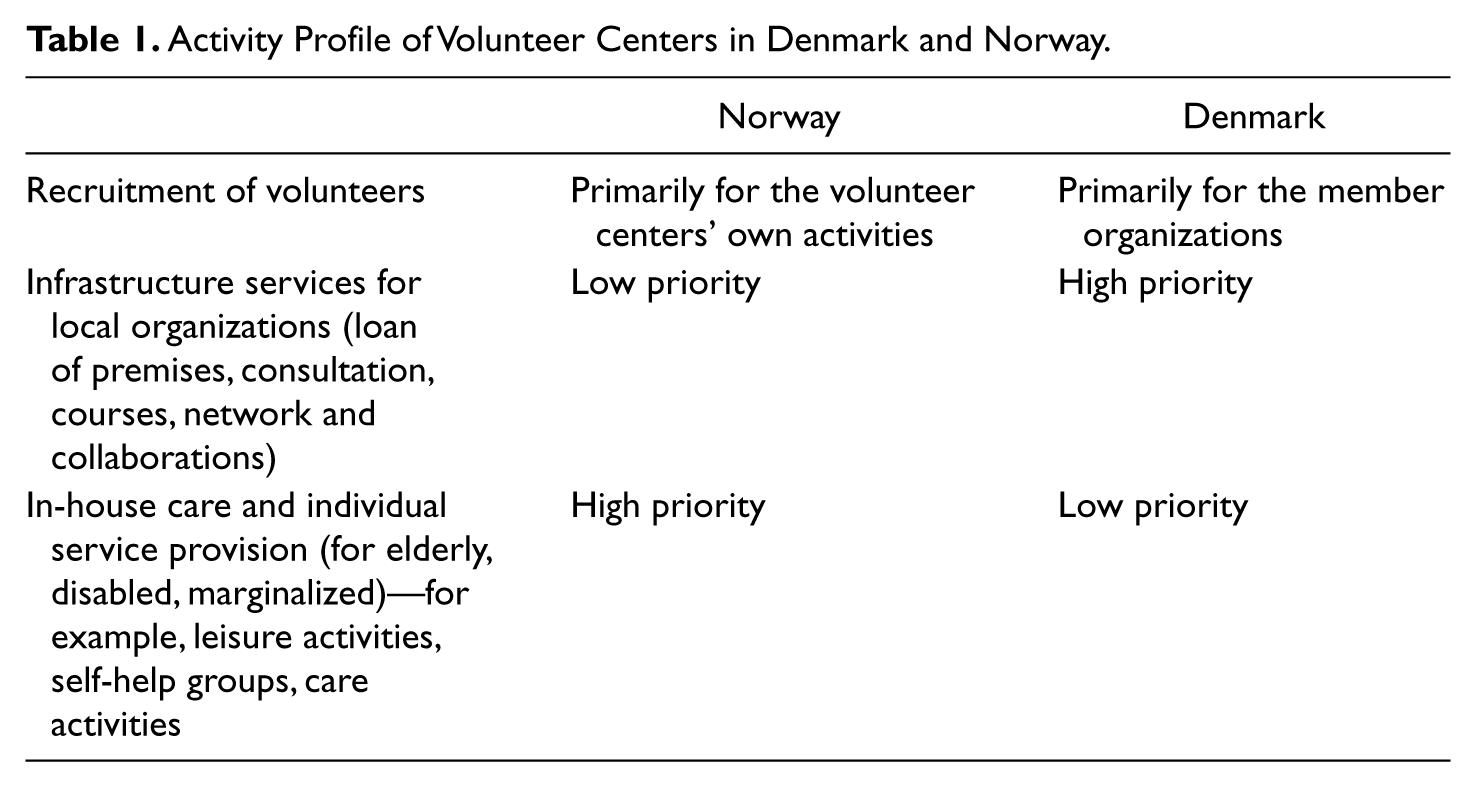
In both countries, volunteer centers have added a layer of complexity (Haski-Leventhal et al., 2009, p. 140) to the local field of volunteering, but they have done so in different ways. By supporting networks among local associations and by providing support and consultation to existing as well as new voluntary organizations and initiatives, Danish centers in many cases have strengthened and improved internal cooperation among local associations and facilitated contact between public and private organizations. By developing new activities aiming at groups and people in need of help and support, Norwegian centers have, on one hand, succeeded in mobilizing volunteers from groups that most often fall outside the membership of “ordinary” civic associations. On the other, the centers at times appear as competitors rather than support agents for local associations.
This, rather brief discussion of activity profiles reveals that the Norwegian centers developed a complementary role that filled a gap. However, as a new actor they also developed into a competitor facing the ordinary voluntary organizations in a zero sum game for local grants. Danish centers, though not originally established as such, over time evolved into infrastructure actors, with the intent of supporting existing associations. Contrasting the Norwegian case, evaluation studies found little evidence that other local voluntary organizations regarded the volunteer centers as competitors (Henriksen, 2008b).
Conventional Explanations
Below, we investigate to what extent two conventional theories can explain the different roles played by the centers in the two countries. First, we look at ownership form, and next we look at their funding profiles.
Ownership, Legal Form, and Membership
Ownership is related to legal control of the organizational unit in which the centers are embedded and the power to govern and control activities (Lorentzen, 2010b). This dimension is important because one may expect that organizational identity and perceptions of what constitutes core functions and legitimate tasks will be shaped and framed by the constituency and stake holders behind the centers (Abzug & Webb, 1999). Thus it is possible that the variations in activity profile we have found could be explained by differences in legal form and ownership.
Table 2 provides an overview of the distribution of ownership forms identified in the countries.
Ownership Forms, Denmark (2008), Norway (2006).

“Associational ownership” means that the volunteer center is organized as an association that is governed by the individual and/or collective members of the association.
“Independent ownership” means that the volunteer center is run as a nonprofit foundation or cooperative (DK: “selvejende institution”; N: “stiftelse,” “andelslag/BA”).
Table 2 shows that Denmark has a much smaller share of centers that are owned and run by local government; only 7%, compared to 37% in Norway. Still, the major part in both countries are organized and run as either voluntary associations or another independent ownership form. In Denmark, this means that about 95% of all centers control their own budget and close to 90% are run by an independent board that is elected at an annual general meeting by the members, which can be either individuals or local associations. In 2008, four out of five Danish centers had local associations as members. On average, the centers had about 50 local associations in their membership (Henriksen, 2009). Also the Norwegian centers, even those owned by the municipality, have their own boards, but an important difference is that they have no members (neither individual nor associational) and in general they have not established a democratic structure.
The figures above leave the impression that a larger share of the Danish volunteer centers, as compared to the Norwegian ones, should be characterized as relatively independent and autonomous civic organizations. This status is supported by various reports and white papers from the Danish government. It underlines the importance of an autonomous voluntary sector, as does the Ministry of Social Affairs (2005), which in its call for applications for the 3-year development fund recommended volunteer centers to be organized as a member-based association or a “self-governing institution.” The argument for this position was that volunteer centers need broad local support. Accordingly, the choice of organizational form should reflect the attitude that volunteer centers should be open for influence from local associations and citizens alike. Along the same lines, the national umbrella organization for volunteer centers and self-help organizations (FriSe) stressed independence, political and religious neutrality, and impartiality as core values in their paper on “best practice” (FriSe, 2005). In Norway, the relatively large number of centers owned by local authorities has raised doubt whether municipalities are about to emerge as competitors to voluntary associations. Since unpaid labor is regarded as a scarce resource, one may ask if volunteer centers intend to compete with local associations for this labor (Lorentzen, 2010a). Still, we cannot take for granted that formal ownership makes a real difference for task and activity portfolio. A basic question is to which degree an independent ownership form leads to activity profiles that are different from those of publicly owned centers.
Because of the small number of centers owned by local government in Denmark, we were unable to analyze whether ownership form showed any significant correlation with organizational activities or performance. This was possible, however, in the Norwegian data. Interestingly, the result was that ownership form did not seem to have any significant impact on the activity profiles (Lorentzen, 2010b). One plausible explanation originates from the neo-institutional idea of niches, referring to fields or segments of public policy where actors representing different types of ownership compete for resources. One important hypothesis here is that . . . conditions within organizations’ niches are better predictors of priorities and tactics than legal form (Galaskiewicz & Bielefeld, 2001, p. 27). According to this theory, the regulating framework of the niche to which the centers belong, can explain why ownership form is less important.
Consequently, we suggest that the differences in ownership form between the two countries are products of historical and institutional forces. While Danish governments have actively supported volunteer centers to be organized as independent organizations, and in addition have been supported in this effort by the national umbrella organization for the centers, the Norwegian government explicitly stressed that ownership could take many different forms and that no particular form should enjoy privilege over others.
In conclusion, there have been different “logics of appropriateness” in the two countries when it comes to ownership. We hypothesize that choice of ownership forms reflect different political attitudes toward the civic field in Denmark and Norway. Though ownership form does not necessarily in itself explain variations in activities and task portfolios, it may still matter. The fact that local welfare associations form a membership constituency in the Danish case may be decisive for the fact that local associations to a higher degree than in Norway seem to have an interest in the services provided by the centers and maybe even experience a sense of ownership to them. The democratic structure inherent in the legal form furthermore may pave the way for more dialogue between volunteer centers and local associations lowering the conflict potential.
Funding
From a resource dependence perspective (Pfeffer & Salancik, 1978), variations in structure and activities between volunteer centers in the two countries may be explained by differences in funding patterns.
In Norway, centers were from the start and in the initial 3-years period funded by government grants alone. Later, costs were shared between central government and local sources, most often grants from local authorities. In 2011, central government provided € 36,000 to each center, while new ones in addition received € 18,000. Additional costs were provided by local sources. A precondition for state grants was that 40% of total costs were covered by local sources.
For small, local associations it will normally be difficult to raise a sufficient amount of money to establish a new center. For local authorities, government grants represent a “subsidy” as well as an incentive. The result is that local funding, in almost all cases, are provided by local authorities.
The situation in Denmark very much resembles the Norwegian. The first Danish centers were 100% financed by central government development funds. Later municipalities started cofinancing the centers. From 2000 onwards, volunteer centers typically received from 25% to 50% of their total income from the national budgets. The government development fund for the centers, which was enacted in 2005, was a major financial boost. On average, total income rose from about € 75,000 in 2005 to € 125,000 in 2008 for each center. However, the composition of the income did not change. In 2008 about 47% of total income came from central government funds and about 41% from local government. The rest was supplied by other sources, such as membership fees, private foundations, and sales.
As of 2010, a new permanent financial model was decided by the Danish government. According to this, a central fund provides a basic amount to all existing volunteer centers (and from 2012 in addition 5-6 new centers every year) provided that they meet the following conditions: The local municipality must provide a cofinancing of no less than € 44,000. Centers should be organized as an independent association or self-governing institution, and it should have at least 20 local associations as members; Finally, centers should, according to the Ministry of Social Affairs, be able to document at least one annual activity, which supports local associations, and at least one activity that promotes local volunteering. In this way the financial model institutionalized the organizational model and the task portfolio, which had been developing since 2005. This model has solved the problem of financial uncertainty, which many volunteer centers faced before 2010. The prize, however, has been stricter performance criteria and more strings attached to the role and the task they play in the local welfare architecture.
This short analysis of funding patterns reveals that volunteer centers in Norway, as well as Denmark, have been almost exclusively reliant on public funding. Likewise, the sharing of costs between local and central government is more or less identical. Thus differences in funding sources do not account for the observed organizational variation. However, we find significant variation in the policies behind the similar funding patterns. In Denmark public grants have over time become more tied to both organizational model and activity profile, while in Norway no strict performance criteria have been set up. In the next section we go deeper into some of these differences in national policies toward the voluntary sector.
Differences in Government Strategies
In the previous sections we have observed significant national variations in central government attitudes and policies toward this part of the voluntary sector. First, there seems to be fundamental differences with regard to the kind of strategy that central governments have pursued. In both countries, the centers were in the beginning left to define their own role amid the interests of central government, local authorities, and local voluntary organizations. Gradually, central governments attempted to adjust and correct the (lack of) course. In Denmark, their infrastructure role was articulated around 2005, whereas the Norwegian authorities around the same time attempted to introduce the idea of community center (“nærmiljøsentral”). Thus, two different strategies can be observed: (a) To improve the functions of existing social and welfare associations and their work (Denmark) and (b) to reduce barriers and enhance collaboration between welfare and other fields like sports, leisure, and culture, and thereby bridging the different parts of the community (Norway).
We also observe differences with regard to how actively governmental strategies have been pursued. The Danish government has, especially since 2005, actively tried to frame and shape the role and identity of the centers by connecting funding closely to activity profile, legal form, and performance criteria. Danish policies, thus, can be characterized as a soft form of coercive isomorphism (DiMaggio & Powell, 1991, p. 67). The Norwegian government presupposed in the formative years that each center “produced” 3,500 hours of voluntary work per year, which in Norway corresponds to two full-time man years of paid work. This criterion was, however, never enforced, and later, the government refrained from any attempt to connect funding to performance measures.
In combination with accepting a high share of municipality-owned centers, and by overlooking civic norms of democratic structures, the Norwegian government gave room for a new type of service and activity-oriented hybrid, which in their pursuit for local grants compete with ordinary local associations. Central regulation is thus much more visible in the Danish case, while in Norway local initiatives and variations are given much more leeway.
Second, we observe important differences in the interest constellation around the centers. In Denmark, after 2005, there seems to have evolved an overlap of central and local interests, which may have been instrumental in legitimizing the role and position of the new organizational structures. In general, central and local governments have shared an interest in advocating volunteer centers as a local device, which should enhance the willingness, capability, and availability of individuals to volunteer, as well as the ability of volunteer organizations to recruit and maintain volunteers (Haski-Leventhal et al., 2009, pp. 141, 142). This shared interest has been promoted and negotiated by the national umbrella organization for the centers, which have played a very active role in the reframing after 2005. Danish centers, in other words, seem to have been more successful in establishing and connecting to actors that have enhanced their legitimacy. Finally, the preferred legal form in Denmark, in which local associations are members of the volunteer centers, means that local associational life has an interest in the services provided by the centers and maybe even experiences a kind of ownership to them. In contrast, the Norwegian centers lack a national, coordination unit, which can mediate viewpoints and interests of the local centers toward central authorities. Here, the umbrella unit for all voluntary associations (Frivillighet Norge) refused to incorporate volunteer centers, mainly because of their high proportion of municipality-owned units. We assume that the absence of a coordinating unit in Norway has both weakened the centers’ bargaining power and made it more difficult for them to legitimize their role vis-à-vis the local associations.
One possible consequence of the different constellations of interests in the two countries has been a kind of normative pressure (DiMaggio & Powell, 1991, p. 70) in Denmark, which has led to a higher degree of homogenization with regard to activity profile and task portfolio, compared to Norway. The Danish situation, thus, contains a potential conflict. On one hand, the centers have a legal form that ties them to the local social and welfare associations. On the other hand, they operate in accordance with government wishes and policies which, in effect, may comprise their independence.
Norwegian centers also contain a latent conflict. Originally, they were directed toward groups and challenges within the responsibility sphere of the Ministry of Health and Social Affairs. Later, the government gave them a new and expanded mandate as community centers, adding cultural and leisure activities to their profile. But still, many centers insist on their original identity as “social” actors. Today, “social” and community approaches tend to clash, as they represent conflicting strategies.
Conclusion
The emergence of volunteer centers in Denmark and Norway reflects a shift in the lack of governmental enthusiasm toward “social” volunteering in the Scandinavian welfare states. After 1980, the interest in “mixed” and “innovative” welfare solutions gradually have increased (Evers & Wintersberger, 1988; Gutch, Kuntz, & Spencer, 1990). The idea of volunteer centers, boosted in many European countries around 1990, can be related to these policy shifts. Governments had, at this time, vague intentions of mobilizing the voluntary workforce to take part in public problem solving, but did not know exactly how.
Our in-depth study documents the different implementation of volunteer centers in the two countries despite very similar starting points. In Denmark the volunteer centers over time were transformed into infrastructure organizations that support and seek to strengthen the capacity of existing social and welfare associations. In Norway the centers targeted marginalized groups in the local communities and developed new and complementary activities. In this effort they were also successful in mobilizing socially disadvantaged groups as volunteers. However, their activity profile made them vulnerable to criticism from other organizations because of competition for scarce resources. Later efforts to cultivate their bridging role between the different fields of the voluntary sector have not been successful and they are currently left with a less clear organizational identity compared to their Danish counterparts.
In this article we have argued that these differences are best explained by a different constellation of factors in the two countries. We have identified three key sets of factors.
At the level of national policies we have observed divergent orientations on the dimension of centralism versus localism. In Norway local self-government is a highly appreciated political value and local authorities have a right to adapt public service provisions to local needs. To a large extent, local solutions are favored and discretionary power are transferred to decentralized actors. This preference for local autonomy from the state has a strong legacy in Norway (Cruickshank, 2009, p. 104), and our study has documented how national authorities refrained from instructing local centers. In combination with a preference for public solutions (rather than nonprofit) this resulted in many semipublic volunteer centers whose legitimacy was questioned. By contrast a centrist heritage has always been visible in Danish state building and the attitude toward local autonomy is more ambivalent (Knudsen, 1991, p. 89). In line with this, our study revealed stronger governmental standardization and stricter performance criteria vis-à-vis the Danish volunteer centers; a trend that has also been visible in other areas of social policy (Henriksen, Smith, & Zimmer, 2012). The tradition for nonprofit solutions, however, is stronger in Denmark compared to Norway and this may have contributed to more legitimacy for the Danish volunteer centers once they followed national guidelines.
At the level of collective organizational agency we noted an important difference in the fact that a national umbrella organization promoted and negotiated the joint interests of the Danish volunteer centers toward an ambitious state while the Norwegian centers were left to their own fate. On one hand, this made monitoring and control easier for the Danish authorities, on the other hand it also made it possible to balance mutual expectations. In the absence of such collective structures, the Norwegian centers found themselves caught up in more boundary struggles and lacking coherent organizational profile.
Finally, at the level of the individual organizational agency we found that the independent legal form in which local associations are members may have helped Danish centers bring about a sense of local ownership and an interest in their services. In contrast, we found that volunteer centers in general lacked connections to other local voluntary associations in Norway and in some instances were perceived as a threat to existing organizations because they competed for the same public funds.
Our case bears evidence to the fact that volunteer centers, as part of the voluntary sector, are embedded in wider political and cultural structures. Their position in the two countries reflects historical developments as well as current choices by institutions and actors. This far our study is in line with the social origins theory (Salamon & Anheier, 1998, 2006). The social origins theory is also correct in pointing to the importance of an extensive state-sponsored and state-delivered social-welfare protection (Salamon & Anheier, 2006, p. 106), which limits direct service provision by nonprofit organizations in the Scandinavian countries. In some sense, the volunteer centers grew out of this situation and the perceived need to supplement public responsibilities for people’s welfare with private and voluntary initiatives.
The social origins theory, however, is also rather abstract and tends to focus on a limited number of factors. In the Scandinavian case, the importance of working class political power is especially underlined as an explanation for the extensive welfare states (Salamon & Anheier, 1998, p. 242). Working class mobilization is beyond any doubt important, but it was not of uniform significance in all Scandinavian countries, and there is evidence that social-democratic power was both stronger and more pervasive in Sweden compared to Norway and Denmark (Knudsen, 1991, p. 76). As a consequence, other factors shaped government–voluntary sector relationships in Norway and Denmark. For instance the centralization/decentralization dimension, which is central to our analysis, must be understood as a product of historical forces that was in place before the influence of social-democratic parties. In Denmark the centrist heritage can be traced back to the influential role played by the central administrative elite under absolutism from the 17th to the 19th century (Knudsen, 1991, pp. 31, 89). In Norway, values of local autonomy from the state runs deep in political culture as a consequence of slower urbanization and stronger dominance of primary industries (Cruickshank, 2009, p. 104).
The other two dimensions we have identified as important illustrates another problem with the social origins theory. Due to the aim of the theory, which is to explain the path dependency of the size and character of the nonprofit sector within regime types spanning several countries, the theory necessarily must focus on the broad historical tendencies (Salamon & Anheier, 2006, p. 107). This has two consequences: First, current institutional interests and forces, which we have found shape both the choice of legal form and the opportunities for collective interest representation around the volunteer centers, is given a less prominent place. Second, as our study also suggests, the internal variation between the Scandinavian countries are underestimated. Thus, based on our experience, we would advocate studies that are more sensitive to the differences and complexities characterizing voluntary-statutory relationships in specific countries (Ragin, 1998, p. 262).
Our study furthermore documents how previous hesitation toward the voluntary social sector is gradually under transformation in Scandinavia. The steps toward an improved integration of government and civic resources may be more firm in Denmark than Norway. For instance, the Danish government in 2010 launched a “national civil society strategy” (Regeringen, 2010) which exclusively aimed at activating people to volunteer for health, social, and human service organizations. Also in Norway we can observe a recent policy shift. Increasingly, government grants toward voluntary purposes explicitly should contribute to the fulfillment of public welfare goals (Lorentzen, 2007). Additionally, a compact or agreement between local authorities and voluntary associations has been published (Kommunenes Sentralforbund, 2011). Still, the outcomes of such central state initiatives may be difficult to predict, despite likely convergence among elite policy discourse in the two countries (Goul Andersen, 2012). Our study has documented how complex the voluntary sector’s situation is within a web of historical forces and current institutional interests (see also Ragin, 1998). Therefore, we should devote more attention to the different constellation of factors that shape voluntary sector activities even within countries that share many structural similarities.
Footnotes
Acknowledgements
In addition to the editors, the authors want to thank the three anonymous reviewers for very helpful comments.
Declaration of Conflicting Interests
The author(s) declared no potential conflicts of interest with respect to the research, authorship, and/or publication of this article.
Funding
The author(s) received no financial support for the research, authorship, and/or publication of this article.