



Abstract
Contemporary nonprofit management research generally assumes that nonprofit managers are intrinsically motivated and has disproportionally emphasized the importance of intrinsic motivation. This is misleading as individuals can be simultaneously propelled by both extrinsic and intrinsic factors. By testing variables from the NASP-III data set and employing self-determination theory (SDT), the author obtained the following findings. First, nonprofit managers’ motivational styles fall into five different categories as suggested in SDT. Second, their external motivation (e.g., a desire for pay and security), a type of extrinsic motivation, is not necessarily weaker than their intrinsic motivation. Finally, the five categories vary in their relationships with their job satisfaction, job involvement, and pride working for the current organization. The author urges scholars to pay more attention to nonprofit managers’ multidimensional motivational styles.
Scholars generally contend that nonprofit managers are motivated intrinsically. The theory of psychological contract (Rousseau, 1995), among others, gives us reasons why nonprofit managers are intrinsically motivated. It is believed that nonprofit workers work for “ideological currency” and form an ideological contract with their employers (Thompson & Hart, 2006). Indeed, studies show that, compared to their business sector peers, nonprofit sector workers are apt to demonstrate a higher level of service and altruistic motivation (Light, 2002; Schepers et al., 2005). However, studies also show that their desire for wages, benefits, job security, and a pleasant physical environment is not necessarily weaker (De Cooman & Pepermans, 2012; Lyons, Duxbury, & Higgins, 2006). Looking at nonprofit workers only, we even find that their desire for financial security and benefits is almost as high as their altruistic motivation (De Cooman, De Gieter, Pepermans, & Jegers, 2011; Lyons et al., 2006). Therefore, it may be inappropriate to argue that nonprofit managers are intrinsically motivated or more intrinsically motivated than extrinsically motivated.
Our stereotype that “nonprofit managers are motivated intrinsically instead of extrinsically” is misled by the intrinsic-extrinsic dichotomy and the comparison with business sector workers. This stereotype is further entrenched by motivation crowding theory (Frey & Jegen, 2001), a theory claiming that intrinsic motivation can be undermined when nonprofits start to imitate enterprises and provide fiscal rewards. However, when we put aside the dichotomy and the comparison with the business sector and focus on general individual motivational structures, we may find that intrinsic motivation and extrinsic motivation are not two mutually exclusive terms. Individuals can be simultaneously propelled by both intrinsic and extrinsic factors without any conflicts (Covington & Mueller, 2001). For example, an assistant professor is likely to pursue job security, good salary, promotion, and his or her interest in research concurrently simply because extrinsic factors such as basic pay and security sustain people’s daily life. In a nutshell, while a majority of nonprofit managers may be intrinsically motivated, it does not imply that they are not extrinsically motivated.
However, current nonprofit management literature has disproportionately emphasized the importance of intrinsic motivation. Our understanding of nonprofit managers’ extrinsic motivation is, unfortunately, very limited. The current study intends to fill this gap by asking the following questions. First, if nonprofit managers’ intrinsic and extrinsic motivations coexist, is there evidence of more nuanced motivational styles beyond the extrinsic-intrinsic dichotomy? Second, what are the possible consequences of high levels of extrinsic motivation? How is extrinsic motivation related to work attitudes such as job satisfaction, job involvement, and pride working for the current organization? Is this relationship endorsed by any existing literature? To answer these questions, this study employs self-determination theory (Ryan & Deci, 2000a, 2000b) as the underpinning theory and tests variables from the National Administrative Studies Project (NASP)-III data set. NASP-III data, collected from 430 nonprofit managers working in Georgia and Illinois in a survey, contributes to our understanding of work motivation and career development of nonprofit managers. More details about data collection and sample will be addressed in a later section.
There are three important findings in this study. First, nonprofit managers’ motivational styles fall into five categories—intrinsic motivation, identified motivation, introjected motivation, external motivation, and amotivation—as suggested in self-determination theory. A simple extrinsic-intrinsic dichotomy is misleading. Second, nonprofit managers’ external motivation (i.e., salary and job security) is not necessarily weaker than intrinsic motivation. Finally, these five motivational styles resemble a spectrum in terms of their relationships with work-related attitudes, ranging from strongly positive to strongly negative. A crucial concluding remark is that researchers engaged in nonprofit management research should lay more emphasis on multidimensional motivational styles of nonprofit working staff and executives.
This article starts with a thorough literature review regarding our understanding and misunderstanding of nonprofit managers’ motivational styles with a focus on intrinsic-extrinsic dichotomy. The next section is an introduction of self-determination theory (SDT), an alternative approach that debunks nonprofit manager’s motivational styles and related behavioral outcomes. After discussing how SDT can be applied to the nonprofit context, the author statistically examines the impacts of different motivational styles on job satisfaction, job involvement, and pride working for the current organization. Statistical analysis is followed by discussion and conclusion.
Nonprofit Managers’ Motivation: Understanding and Misunderstanding
The theory of psychological contract (Rousseau, 1995) espouses the claim that nonprofit managers have strong intrinsic motivation. A psychological contract representing mutual beliefs, understandings, and unofficial obligations between employers and employees appears in two major forms (Lester, Kickul, Bergmann, & De Meuse, 2003). A transactional contract exists when an employment relationship is based on the exchange of “economic currency” such as pay and benefits, whereas a relational contract is grounded in the exchange of “socioemotional currency” such as job security, advancement, and career development (Thompson & Bunderson, 2003). They appear more often in the public and private sectors. However, some scholars find that “ideological currency” (Thompson & Hart, 2006), a unique form of psychological contract, exists more pervasively in the nonprofit sector. Ideological currency refers to one’s “credible commitments to pursue a valued cause or principle” (Thompson & Bunderson, 2003). It also implies obligations rooted in the organization’s fidelity, ideological mission, and espoused principle instead of personal benefits.
Structural reasons also hint that those working in nonprofits have fewer chances to access instrumental attractions, so nonprofits are not likely to hire extrinsically motivated people. First, nonprofits are usually small in size, and a large size implies job openings, a long vacancy chain, and opportunities for promotion (White, 1970). In addition, nonprofits from time to time suffer from constrained funding and a need to rely on flexible staffing, a feature resulting in fewer available positions. Second, empirical studies show that wages and benefits are lower among nonprofit sector workers than among public and private sector workers (Hallock, 2000; Mirvis & Hackett, 1983). Their willingness to accept low wages may be a result of trading lower wages for higher social benefits. 1 It is also possible that nonprofit employers use wages as a screening device to deter those motivated by pay checks from seeking nonprofit employment (Preston, 1989). Third, unlike public organizations, nonprofit managers are not protected by the merit system. Those who care about job security may avoid nonprofit jobs.
Indeed, several empirical studies find that nonprofit workers, compared to their for-profit peers, demonstrate stronger service and altruistic motivation (see De Cooman et al., 2011, for an example). They care about mission, activism, and personal growth instead of sizeable income (Schepers et al., 2005). A stark example provided by Light (2002) shows that nonprofit managers exhibit a strong concern about “the opportunity to accomplish something worthwhile,” “the chance to make a difference,” and “helping the public,” implying a high level of intrinsic motivation and altruistic motivation. However, evidence also indicates that nonprofit managers’ extrinsic motivation is not necessarily weak. Their desire for job security, a good salary, and a pleasant physical environment could be as strong as that of their business sector peers (Borzaga & Tortia, 2006; De Cooman & Pepermans, 2012; Lyons et al., 2006). When we put aside the comparison with the business sector and only look at nonprofits, we surprisingly find that nonprofit managers’ desire for financial security and benefits is almost as high as their service motivation (De Cooman et al., 2011; Lyons et al., 2006).
The intrinsic-extrinsic dichotomy (Lawler, 1971) may have imposed a stereotype on us that simultaneous presence of intrinsic motivation and extrinsic motivation is unlikely. If we accept this proposition, the aforementioned findings may look controversial and incompatible. However, this proposition could be misleading. The theory of psychological needs hints that needs can function as motivational drivers (Sheldon, 2011). Max-Neef (1992) views basic human needs (i.e. safety, security, property) as ontologically universal and invariant in nature. They do not dim or disappear with the growth of higher level needs such as self-esteem, making a difference, or altruism. Focusing on intrinsic and extrinsic motivations, Covington and Mueller (2001) claim that “both intrinsic and extrinsic tendencies blend within the same individual, so everyone can be placed somewhere along a single continuum” (p. 163).
In other words, while a majority of nonprofit managers are intrinsically motivated, they may at the same time pursue instrumental rewards. Unfortunately, we have been poorly informed about nonprofit managers’ extrinsic motivational styles: What are they? Are they as strong as intrinsic motivation? We know that intrinsic motivation leads to positive attitudinal outcomes such as job satisfaction and job involvement (Lawler & Hall, 1970), but does extrinsic motivation lead to negative outcomes? Perhaps self-determination theory (SDT; Ryan & Deci, 2000a, 2000b), a complete and encompassing motivational typology that goes beyond the intrinsic-extrinsic dichotomy, can provide answers for these questions.
Self-Determination Theory
The paucity of extrinsic motivation research stems from the misunderstanding that extrinsic motivation pertains to behaviors performed without self-determination (Vallerand & Bissonnette, 1992). Scholars thus treat extrinsic motivation as a unidimensional category. SDT, unlike the traditional perspective that sees extrinsically motivated behavior as invariantly nonautonomous, holds that motivations resemble a spectrum moving from intrinsic motivation, to different levels of extrinsic motivation, to “amotivation,” as displayed in Figure 1.

Self-determination theory.
The Typology of Motivational Styles
Autonomy, a concept connoting “an inner endorsement of one’s actions, the sense that they emanate from oneself and are one’s own” (Deci & Ryan, 1987, p. 1025), makes each style of motivation distinctive. Intrinsic motivation means that the task itself is a reward. Intrinsically motivated people thus consider themselves as initiators of their own behavior, select desired outcomes, and choose their own ways to achieve them (Deci & Ryan, 1987). They also demonstrate a strong internal locus of control (Spector, 1988) and absolute autonomy. Autonomy of extrinsic motivation can vary. For example, students do homework for different reasons such as fearing parental sanctions or identifying it as valuable for their future career. Although both reasons belong to extrinsic motivation, individual autonomy is apparently higher in the latter case as threats and negative sanctions are not immediate when students stop doing homework. Based on the logic of “hierarchical autonomy,” SDT scholars (Ryan & Deci, 2000a, 2000b; Sheldon, Turban, Brown, Barrick, & Judge, 2003; Vallerand & Ratelle, 2004) separate extrinsic motivation into three categories: identified motivation, introjected motivation, and external motivation. 2
Identified motivation means that people accept the regulation because the activity is judged valuable/useful and it fits their value system. That is, the locus of control is less internal compared to intrinsic motivation. For example, a manager may join training programs because he or she needs updated skills to perform new work. Identified motivation and intrinsic motivation represent autonomous motivation (Gagné et al., 2010). Just to the left of identified motivation is introjected motivation. People falling into this category perform an action out of obligation to avoid anxiety, shame, and pressure (Vallerand & Ratelle, 2004). Therefore, introjected behaviors are lower in autonomy and reflected in a rather external locus of control. For example, a manager may have a desire to buffer himself or herself from the vexation and pressure originating from a conflicting environment. The last type of extrinsic motivation is external motivation, the type generally portrayed in the literature (Vallerand & Ratelle, 2004). Craving for bonus pay and security is a typical example. Externally regulated people often act to satisfy an external demand or obtain an external reward contingency, so the locus of control is purely external. Both introjected motivation and external motivation represent controlled motivation (Gagné et al., 2010).
A unique classification of motivational style in SDT is amotivation, a regulatory style implying “not valuing an activity” and consequently “not believing it will yield a desired outcome” (Ryan & Deci, 2000a, p. 61). For example, facing economic recession, a manager chooses a repugnant job among extremely limited alternatives and accordingly does not expect any internal or external reward. Amotivated people frequently feel helpless and question the value of engaging in an activity, so they are likely to quit the current task or activity (Vallerand & Ratelle, 2004). The locus of control for amotivated people is neither internal nor external. It is impersonal.
SDT-Based Empirical Studies
Scholars have conducted several empirical studies to explore how different motivational styles in SDT are related to people’s performance and behavior. Blais, Sabourin, Boucher, and Vallerand (1990) find that dyadic adjustment, positive comparison, and marital happiness in couples’ relationships can be fostered by intrinsic and identified motivations, while intrinsic motivation has a greater impact. These positive behaviors and perceptions are undermined by introjected, external, and amotivated styles, while amotivation has the strongest impact. Vallerand and Bissonnette (1992) show that studying persistence is related to intrinsic and identified motivations but not related to introjected and external motivations. Pelletier and his colleagues (Pelletier et al., 1995) find that university athletes’ perceived own competence, effort, and attention are positively related to intrinsic and identified motivations, unrelated to external and introjected motivations, and negatively related to amotivation. Hayamizu (1997) indicates that intrinsic, identified, and introjected motivations can lead to active coping among students, but external motivation can not. Amotivated students are weakest in active coping.
According to these early studies, first, the outcome of intrinsic motivation is universally positive, whereas the outcome of amotivation is negative. Second, not all extrinsic motivational styles are negative predictors of behavior and performance. Identified motivation, resembling intrinsic motivation, generally leads to a positive behavioral consequence. The impact of introjected motivation is unstable. It can be negative, positive, and sometimes insignificant. The impact of external motivation is usually negative although sometimes insignificant. Third, the impacts of intrinsic, identified, introjected, external, and amotivated styles generally resemble a spectrum, moving from strongly positive to strongly negative. Finally, the impacts of adjacent motivational styles are close.
The Application of SDT to Work Settings in Nonprofits
Although SDT is based on a strong empirical foundation, limited studies have tested the theory within organizational settings or work settings. Indeed, some scholars have made efforts to conceptually link SDT to management and organization studies. Sheldon et al. (2003) in an early article briefly introduce multidimensional motivations in SDT to human resources management scholars, but they fail to differentiate consequences led by the five motivational styles. Gagné and Deci (2005) correct this problem in their later work. They propose that controlled motivation and autonomous motivation associate with performance and work persistence differently. They also urge scholars to consider how job satisfaction, organizational commitment, and citizenship behavior are affected by disparate motivational styles. Recently, Gagné et al.’s (2010) study of Canadian workers in different industries suggests that the structure of motivation at work is in line with the multidimensional SDT pattern. Their article is one of the few empirical studies that link SDT to organizational settings. Unfortunately, SDT in management studies has not received much attention in the nonprofit domain. To fill the gap, the author attempts to study (a) how SDT helps us more systematically differentiate nonprofit managers’ motivational styles and (b) how these motivational styles differ with respect to their importance for nonprofit managers as well as their impacts on job satisfaction, job involvement, and pride working for the current organization.
Some points deserve special attention. First, literature suggests that different extrinsic motivational styles may not be equally strong for nonprofit managers. This is especially obvious when we compare nonprofit workers’ external motivation (e.g. salary and job security) and identified motivation (e.g. career development). Compared to service motivation, their external motivation is almost equally strong, but their identified motivation is significantly weaker (De Cooman et al., 2011; De Cooman & Pepermans, 2012; Lyons et al., 2006). This study reexamines this proposition.
Second, related to the first point, the consequence of identified motivation requires our attention as well. Although identified motivation as a form of autonomous motivation should positively predict work attitudes, its impact may be compromised in the nonprofit sector. Many nonprofits are small in size, which leads to limited positions for promotion (Jason, 2005), limited funding, scarce resources for training, and a low level of professionalism (Berman, 1999). As a result, nonprofit managers who care about advancement and training may suffer from a person–environment mismatch, undermining managers’ positive attitudes (Mount & Muchinsky, 1978; Smart, Elton, & McLaughlin, 1986).
Finally, introjected motivation is a ubiquitous but often neglected motivational style in the nonprofit sector. Using church activities as an example, Baard (1994, 2004) finds that among those who participate in religion and attend worship, more and more people admit that they do it simply because “it might look bad if I did not attend,” or alternatively, because they “feel guilty” when they are absent from church attendance. This implies that introjected motivation should not be neglected when we apply SDT to study nonprofit management. In a more general nonprofit context, introjected motivation can be represented by, for instance, one’s desire to avoid a conflict environment because nonprofit managers often face multiple and conflicting demands from different funders (Campbell, 2002). Is nonprofit managers’ introjected motivation strong? What are the attitudinal consequences of introjected motivation? A lack of previous empirical evidence further strengthens the importance of the present study.
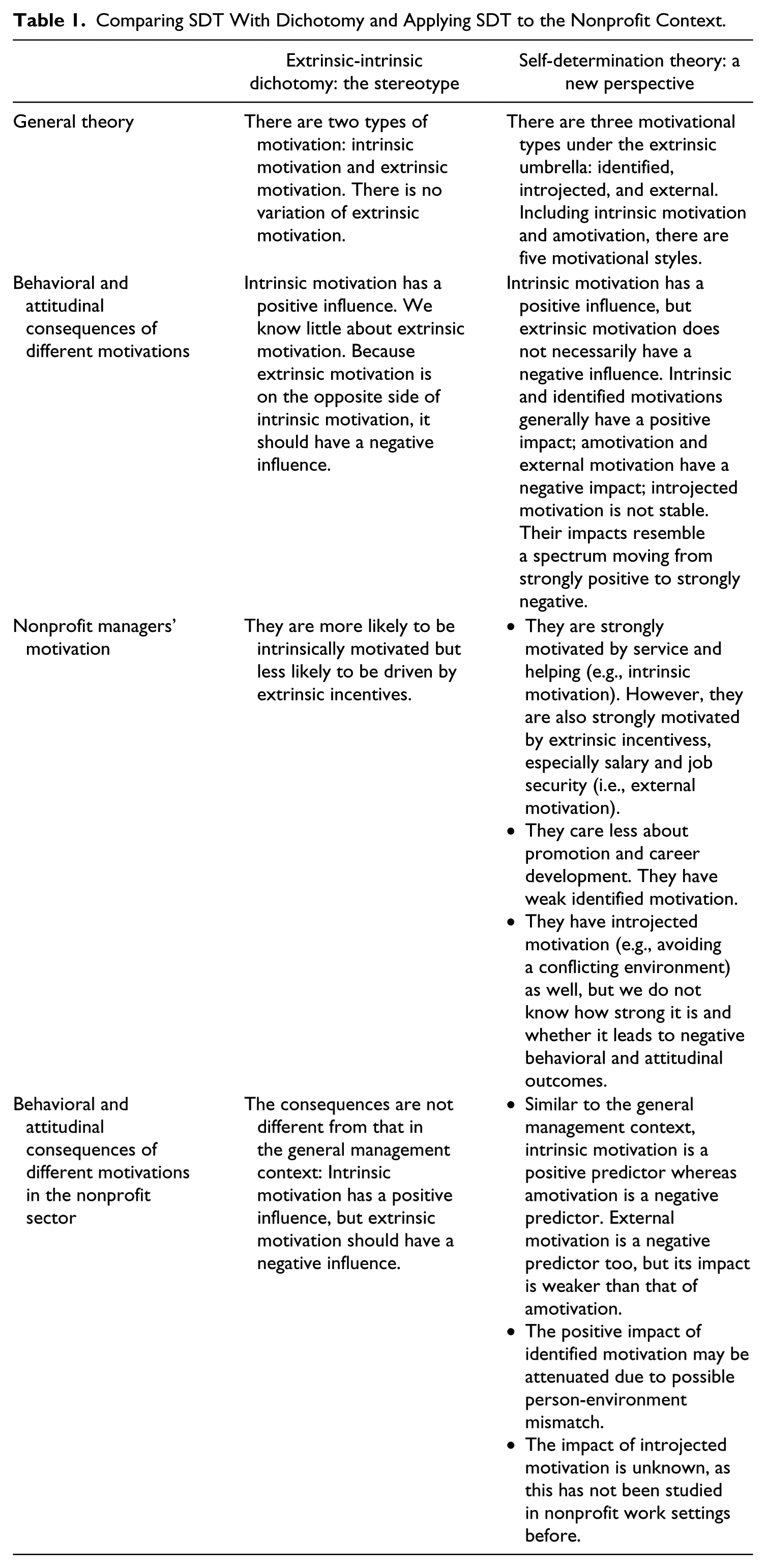
To recapitulate, the present study questions the validity of the oversimplified intrinsic-extrinsic dichotomy and aims to challenge the stereotype that “nonprofit managers have strong intrinsic motivation and weak extrinsic motivation” by analyzing nonprofit managers’ motivational styles with SDT and examining their impacts on job satisfaction, job involvement, and pride working for the current organization. The author prepares a summary of literature review in Table 1 for readers to more efficiently capture key points.
Comparing SDT With Dichotomy and Applying SDT to the Nonprofit Context.
Data and Variables
The author tests hypotheses by using survey data from managerial-level respondents in nonprofit organizations, a subsample of the National Administrative Studies Project (NASP-III). The population of NASP-III covers both the state of Georgia and Illinois. The NASP-III research group purchased a list from Infocus Marketing, Inc. This list includes members of the American Society of Association Executives (ASAE) with titles of Administration/Operations Manager, Executive Director/VP, Company President/Owner, Development Manager/Director, Education Manager/Director, Government Relations, Marketing, Personnel, Public Relations/Public Affairs, Sales/Marketing, Financial/Bookkeeping, Information Systems, Legal Counsel-Internal, and Chief Executive Officer. 3 This list provides 280 nonprofit managers from Georgia and 1048 from Illinois. The survey started from April 2005, when the research team ran a pretest of the mail survey to a random sample of 200 individuals. After the research team shortened the questionnaire based on the results of pretest, the first wave precontact letters were sent out in July 2005. There were three waves of the survey: September 23, 2005 to January 19, 2006 (1st wave), October 24, 2005 to February 20, 2006 (2nd wave), and March 29, 2006 to June 01, 2006 (3rd wave). At the end of this survey, the NASP-III research team obtained 430 (266 from the 1st wave, 72 from the 2nd wave, and 92 from the 3rd wave) out of 1,307 reduced N with a response rate of 33% (39% in Georgia and 31% in Illinois). 4
The SDT-related motivational items in NASP-III were designed to solicit information about reasons for respondents to accept their current jobs. 5 The original question was stated as “Please indicate the extent to which the factors below were important in making your decision to take a job at your current organization.” Respondents were asked to score from very important (4), somewhat important (3), somewhat unimportant (2), to very unimportant (1). The author selects 12 items (please refer to Table 2 and Table 3 for these items) that best represent different motivational styles in SDT. Although a few earlier studies based on NASP-III use some of these items and find that these items significantly predict work attitudes or sector preferences, the authors of these articles either employ the oversimplified intrinsic-extrinsic dichotomy as their research framework (Lee & Wilkins, 2011; Word & Park, 2009) or fail to investigate all types of motivational styles in SDT (Chen, 2012). With the aim of correcting the intrinsic-extrinsic dichotomy, this study analyzes the above-mentioned items with the use of SDT, in hopes of transcending earlier studies with respect to theory construction. Concerning work-related attitudes, the main dependent variable (DV) in the current study, the author selects the following three ordinal scale items (4 = strongly agree; 1 = strongly disagree). First, “time seems to drag while I am on the job (reverse)” has long served as common measure of job involvement in much of the psychological research (Kanungo, 1982). Second, “I feel a sense of pride working for this organization” is usually used to measure general organizational commitment (see Blau 1987 for more related items). Finally, “all in all, I am satisfied with my job” is used to acquire the overall level of job satisfaction.
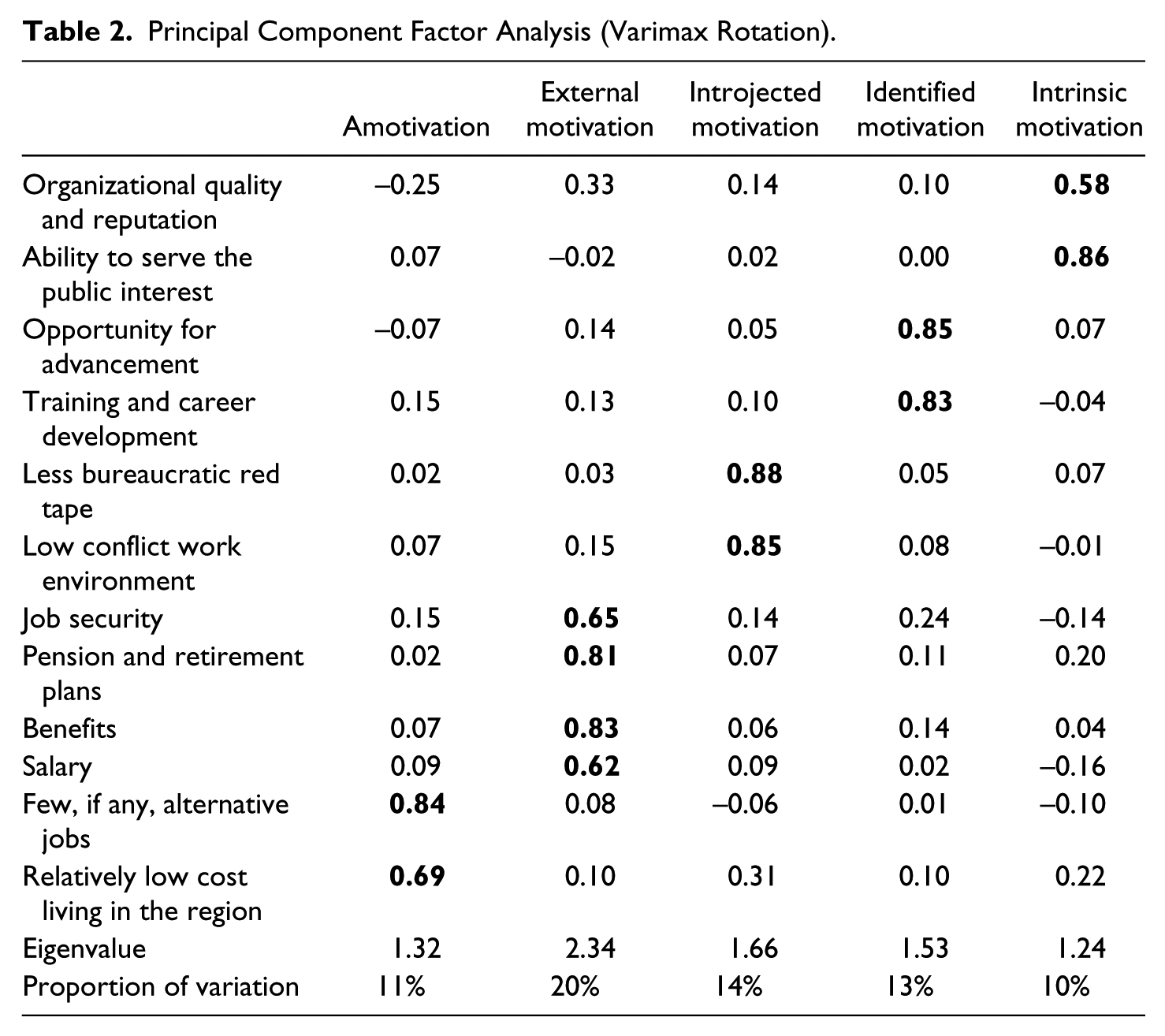
Principal Component Factor Analysis (Varimax Rotation).
Comparing Motivational Styles.
The current study controls for several confounding variables. Organizational size as represented by the number of employees implies possible hierarchical control, which is detrimental to work attitudes. Conventional wisdom suggests that females, older, and well-educated people are more likely to exhibit positive work attitudes (Arvey, Bouchard, Segal, & Abraham, 1989; Brown, 1996; Mathieu & Zajac, 1990). Thus age, gender, and education are controlled for. In addition, this study controls for “an upward move position” and current job tenure. An upward move position implies a person’s a sense of pride and should positively influence attitudes. Current job tenure can be influential as organizational socialization (Schein, 1968) in the long run facilitates adaptation and ameliorates managers’ attitudes. Finally, mental health problems can undermine one’s work attitudes (Cooper, Rout, & Faragher, 1989). Therefore this study controls for a manager’s absent days “because he/she cannot face working.”
Findings
This study first examines whether the selected motivational items fall into the five categories suggested in SDT and then explores whether extrinsic and intrinsic types of motivation are similarly strong among nonprofit employees. The author employs principal-component exploratory factor analysis (EFA) with varimax rotation to analyze latent dimensions of the selected motivational items. The results of analysis are reported in Table 2.
According to the results, two items belong to intrinsic motivation: organizational reputation and the ability to serve the public interest. While an organization’s reputation often implies one’s sense of pride (Cable & Turban, 2003), the ability to serve the public interest refers to altruistic motivation. Both are internal rewards to individuals. Advancement opportunities and career development refer to identified motivation, implying prestige and “being a winner.” A desire for less red tape and a low conflict work environment belongs to introjected motivation. Nonprofit managers often suffer from conflicting orders from funders (Campbell, 2002). Salary, job security, pension, and benefits are typical external motivations. Finally, amotivation embraces “few, if any, alternative jobs” and “relatively low cost living in the region.” They imply that a person does not value his or her job selection, as the nature of selection is not related to work. “Not valuing an activity” matches the definition of amotivation.
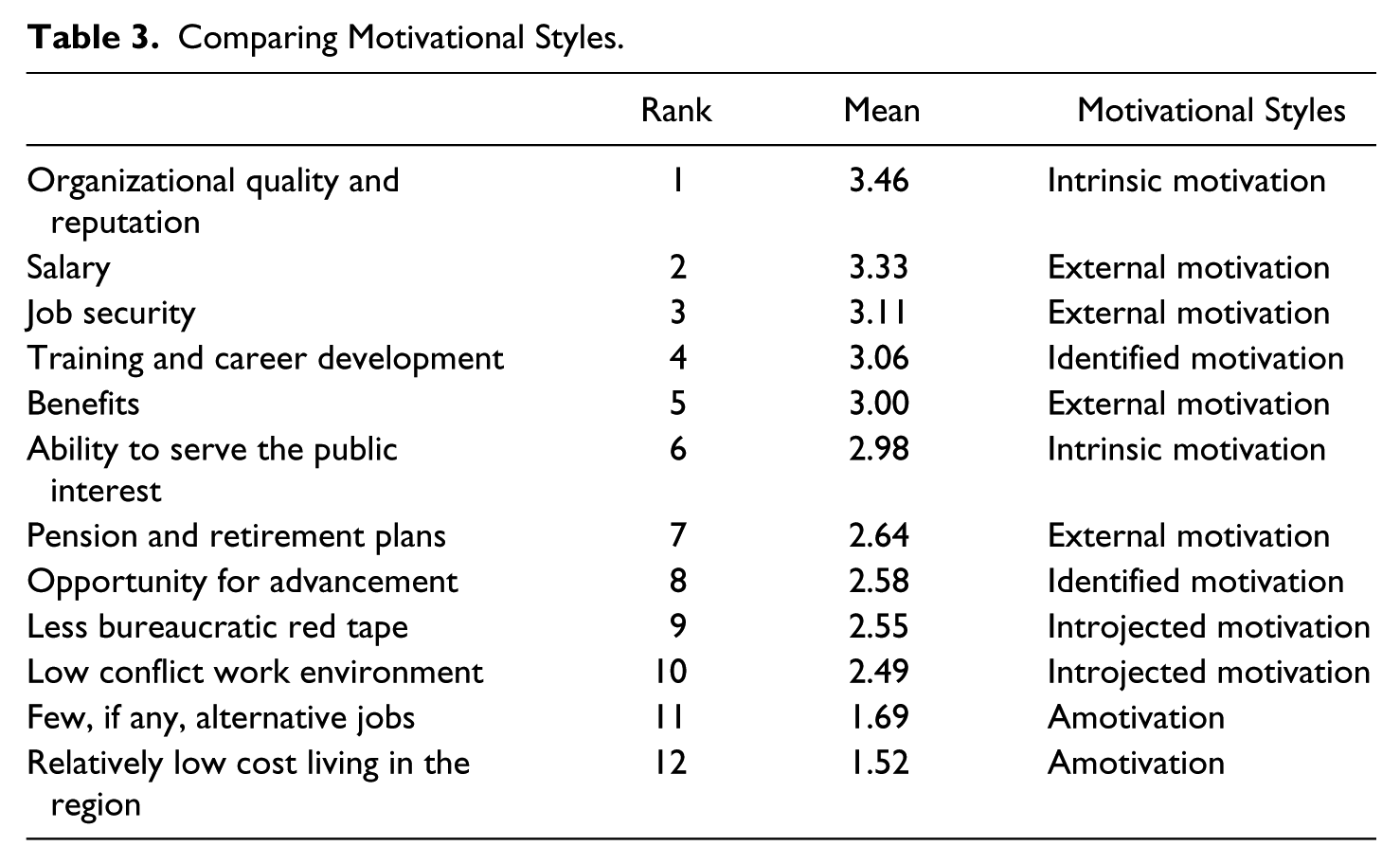
Based on the results of factor analysis, the author compares the 12 motivational styles in Table 3. According to this table, nonprofit managers’ first concern is organizational quality and reputation (mean = 3.46), an intrinsic style. Their desires for salary (mean = 3.33), job security (mean = 3.11), and benefits (mean = 3.00), three external motivation items, are ranked second, third, and fifth. Service motivation (mean = 2.98) is ranked sixth, lower than the aforementioned extrinsic motivations. By looking at the first half of these 12 motivational styles, the author infers that nonprofit managers are not purely motivated by internal rewards. Although their first concern, organizational reputation, is intrinsic, their desire for many extrinsic factors is stronger than their service motivation. Finally, this table also shows that amotivation and introjected motivation are low among nonprofit managers.
After analyzing the ranking, the author saved five factor scores generated from Table 2. The saved scores will be used to examine the next research proposition: whether the five motivational styles differ in their impacts on job involvement, job satisfaction, and pride working for the current organization. Given the ordinal nature of the three variables, ordinal logit regression is an appropriate method. In addition to these three items, the author created a general attitude index variable by conducting factor analysis for the three items and saving the factor score (factor loading for each item was 0.73, 0.82, 0.83; Eigenvalue = 1.90). Ordinary least square (OLS) regression is a more adequate modeling method when attitude index (on the interval level) is used as the dependent variable.
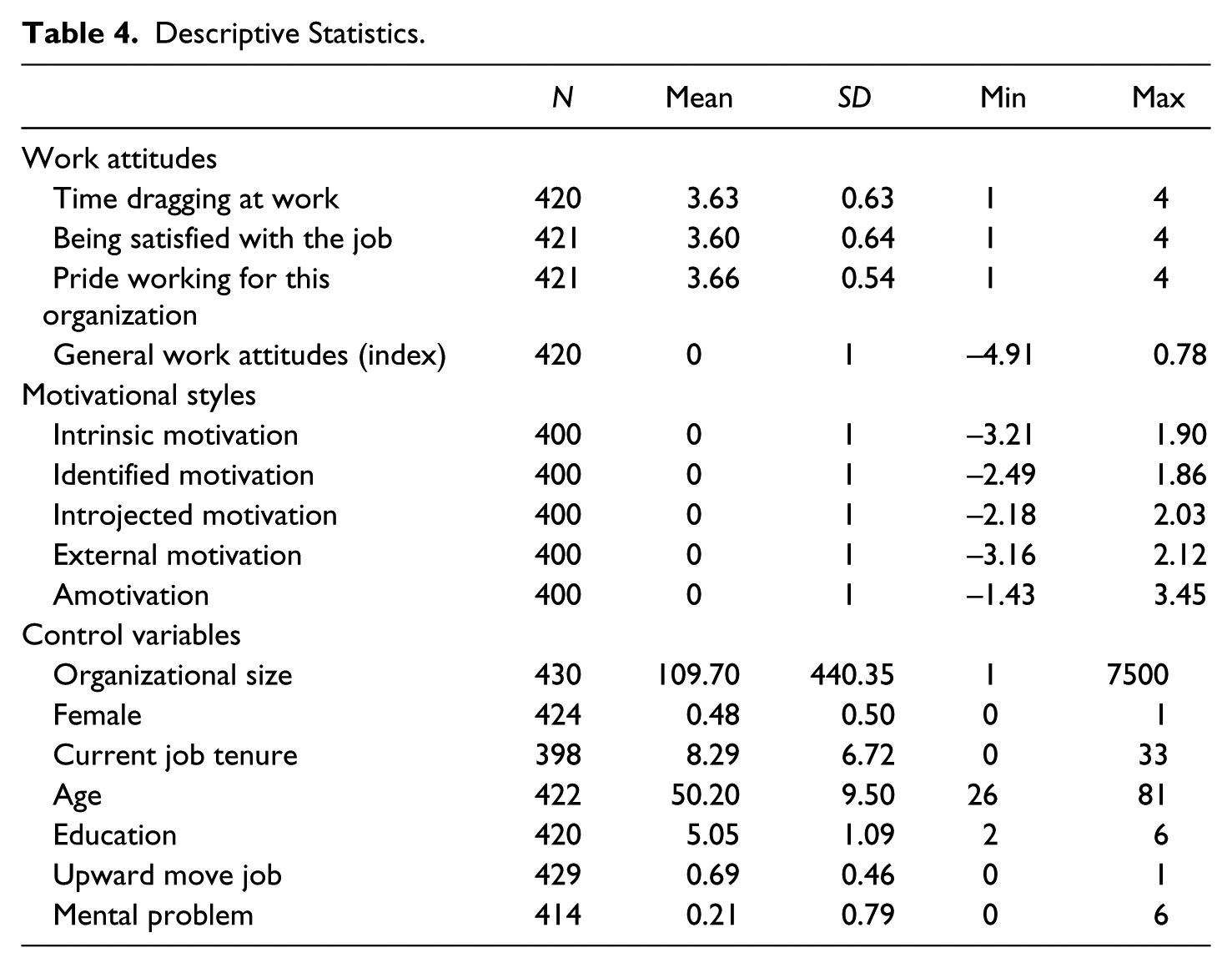
Please refer to Table 4 for descriptive statistics and Table 5 for regression results. Because five motivational styles are saved factor scores and their ranges are not constant (see Table 4), it is inadequate to compare their normal regression coefficients. As a result, standardized coefficients are used in these models. In reporting regression results, the author juxtaposes models with control variables and without control variables to examine whether control variables change regression outcomes. According to the findings in Table 5, the coefficients of intrinsic motivation are positive in general, as suggested in SDT. The positive impacts are especially significant in the model of “pride working for this organization” and the model of general work attitudes (the index variable). The coefficient is also statistically significant in the model of job satisfaction with the presence of controls. Amotivation leads to negative attitudinal outcomes in all models, also in line with SDT. Regarding extrinsic motivations, external motivation negatively predicts job satisfaction, with and without controls. It is also negatively associated with the index variable at the 90% confidence level, but only in the model without controls. In other words, its negative impact is weaker than that of amotivation, matching the SDT pattern. Both identified motivation and introjected motivation are almost unrelated to any dependent variable except that introjected motivation has a negative and significant impact on “time seems dragging.” A greater extent of discussion will be carried out in the next section. With respect to control variables, age and upward move are influential positive predictors to work attitudes. Mental health problems (i.e., absent days due to one’s inability to face work) and organizational size, by contrast, are influential negative predictors to the dependent variables. Gender and current job tenure are not statistically significant in all models.
Descriptive Statistics.
Regression Analysis.

Note. Standardized coefficients reported in all models.
p < .10. *p < .05. **p < .01.
Discussion of Findings
There are some general findings in this study. First, SDT is an encompassing theory that goes beyond the extrinsic-intrinsic dichotomy. Nonprofit managers’ motivational styles can be best represented by SDT, including intrinsic motivation, identified motivation, introjected motivation, external motivation, and amotivation. Second, while nonprofit managers have a high level of intrinsic motivation, their external motivation (e.g., a desire for salary and job security) is not necessarily weaker than their intrinsic motivation. 6 Third, both their introjected motivation and amotivation are low in ranking, a good sign for managers in the practical world. Finally, the impacts of the aforementioned five styles on job involvement, job satisfaction, and pride working for the current organization resemble a spectrum, moving from strongly positive to strongly negative as suggested in SDT.
Some points deserve discussion to a greater extent. First, both external motivation and intrinsic motivation are strong for nonprofit managers, but their impacts on work attitudes are negative and positive, respectively. Therefore, nonprofit managers’ positive attitudes grounded in high intrinsic motivation can be compromised by the negative effects stemming from high external motivation, also known as offset effects. 7 To combat offset effects, some nonprofits start to increase the pay of their managers to reduce negative influences brought up by their external motivation. A more thorough analysis regarding the adequacy of pay increase is placed in the next section.
Identified motivation as a form of autonomous motivation does not generate a positive attitudinal outcome, not in line with the SDT pattern. This is probably a result of person–environment or person–organization misfit, a point addressed earlier. Empirical evidence shows that a misfit at entry can eventually lead to turnover due to attrition, even with the presence of the socialization effect (De Cooman et al., 2009). It would be interesting if we can track whether nonprofit managers having a high level of identified motivation are more likely than other people to quit their job in the long run.
Introjected motivation in the present study fails to predict most of the dependent variables, except job involvement. According to SDT, introjected motivation as a type of controlled motivation is a negative predictor to work attitudes, but its effect is less strong than that of external motivation. While some studies support this view (Blais et al., 1990), others find that the impact of introjected motivation is either insignificant (Pelletier et al., 1995) or positive (Hayamizu, 1997). Two work-related SDT empirical studies also find that introjected motivation is positively associated with job satisfaction and organizational commitment (Gagné et al., 2010; Tremblay, Blanchard, Taylor, Pelletier, & Villeneuve, 2009). Inconclusive findings imply that introjected motivation has more than one dimension and should be observed from different angles. It is often measured by questions such as “I don’t want to feel disappointed” or “I would be ashamed if I don’t succeed” (Gagné et al., 2010; Tremblay et al., 2009). In the current study, “avoiding a conflict environment” and “avoiding red tape” are used to address the unique nonprofit context. Perhaps different findings between this study and earlier studies originate from a disparate design of questions. In sum, incompatible findings call for more future research to further investigate introjected motivation.
Finally, scholars interested in motivation studies often neglect the existence of amotivation under the influence of intrinsic-extrinsic dichotomy. This negligence is very unfortunate, especially when we consider that amotivation carries a negative and significant impact on work attitudes, and even a minor level of amotivation can offset managers’ positive work attitudes. A complete motivational typology should never exclude amotivation.
Implications
The present study shows that intrinsic motivation is the only autonomous style positively associated with work attitudes. Some methods can be used to foster intrinsic motivation (especially service motivation) as well as work attitudes. According to SDT, improving employees’ competence (i.e., necessary skills) and autonomy can ensure that they maintain the interest in serving people (Ryan & Deci, 2000a, 2000b). In addition, skill variety, task identity, and task significance can prevent nonprofit workers from losing their intrinsic motivation (Millette & Gagné, 2008; Schepers et al., 2005).
We are also informed that nonprofit managers’ external motivation is strong as well, and external motivation is detrimental to positive work attitudes. To “quench the thirst” for nonprofit managers and reduce the negative impact of external motivation, more and more nonprofits start to provide managers with attractive compensation. Some recent studies find that, compared to their business peers, nonprofit CEOs enjoy a similar level of monetary compensation (Ballou & Weisbrod, 2003; Ruhm & Borkoski, 2003). Carroll and his colleagues (Carroll, Hughes, & Luksetich, 2005) find that the compensation of executives in large NPOs is fully determined by their performance. However, are competitive wages desirable in nonprofits? Do these attractive monetary compensation packages really bring positive outcomes?
This question is still debatable. First, a view holds that we are “economically forced to work” for a living (Paulsen, 2008), so raising income does not necessarily increase happiness (Easterlin, 1995, 2005). Income may increase subjective well-being, only when it means meeting basic needs and avoiding poverty, and such an increase is accompanied by a declining marginal effect (Diener & Biswas-Diener, 2002; Diener, Ng, Harter, & Arora, 2010). In a worse situation, pay increase reinforces selfish external motivation and accordingly crowds out intrinsic motivation (Frey & Jegen, 2001; Frey & Osterloh, 2005). According to SDT, motivation crowding occurs when perceived self-determination suffers from external interventions such as monetary compensation. Money engenders an external locus of control so that individuals perceive their actions to be controlled (Hagger & Chatzisarantis, 2011). The crowding out effect is particularly obvious when pay raise is introduced in the form of contingent performance-based pay (Baker, Jensen, & Murphy, 1988; Langbein, 2010). This is why scholars call for the use of alternative methods such as profit sharing (Kuvaas, 2006) or pay raise for base salary (Kuvaas, 2003), claiming that these measures can enhance affective commitment without harming intrinsic motivation.
Although pay increase leads to motivation crowding out, it can enhance work effort as well as performance if the pay is high enough. According to an experiment by Gneezy and Rustichini (2000), a group that receives no performance bonus performs better than a group that receives a low level of performance bonus, implying the occurrence of motivation crowding. However, a group that receives a high level of performance bonus can perform even better than a group that receives no performance bonus. This study shows that undermined performance brought up by motivation crowding can be remedied by an even higher pay level. Another study (Weibel, Rost, & Osterloh, 2010) indicates that performance contingent pay reduces the effect of intrinsic motivation on effort due to motivation crowding but increases the effect of extrinsic motivation on effort. Therefore, the net effect is not purely negative. A similar view is provided by Gagné and Forest (2008), who contend that compensation induces more work effort and undermines intrinsic motivation simultaneously, so the offset effects occur. They also urge scholars to treat base pay as a basic need instead of a hygiene factor (Herzberg, 1966) and discover whether pay satisfaction enhances performance and mental health through the function of improved autonomy and competence. The topic of pay level goes beyond the scope of the current study. In the future, nonprofit management researchers should pay more attention to how pay influences managers’ motivation and whether increasing pay is adequate in nonprofits.
Suggestions for Future Research
It is imaginable that limitations exist in a preliminary study of SDT applied to nonprofit work settings. The limitation is especially salient in the design of motivational style items. Only two items measure intrinsic motivation in the present study: “the ability to serve the public interest” and “organizational reputation.” They are not comprehensive. In fact, intrinsic motivation is multidimensional as many SDT-based studies demonstrate (Pelletier et al., 1995; Vallerand et al., 1992). To study nonprofit motivation, intrinsic motivation should be reflected in both altruism and interest in the job itself. The measurement of introjected motivation, similarly, needs to include more typical items in other SDT-based studies such as “I will become a despicable person if I quit now” or “I don’t want to lose.” With these items, measuring intrinsic motivation and introjected motivation could be more precise. Future research should consider including more motivational items to faithfully reflect the meaning of each motivational style. Another important limitation is the use of cross sectional data, making it unlikely to determine the causality between motivational styles and work attitudes. Perhaps experimental or longitudinal studies can be considered to improve the research quality. In sum, this preliminary study only scratches the face. More research effort in the future is required to unveil the intricacy of nonprofit managers’ motivation.
Footnotes
Declaration of Conflicting Interests
The author(s) declared no potential conflicts of interest with respect to the research, authorship, and/or publication of this article.
Funding
The author(s) received no financial support for the research, authorship, and/or publication of this article.