



Abstract
Research on diaspora philanthropy is in its infancy, primarily focused on individual country case studies, and often prone to over-generalization. Based on an extensive survey of the Coptic diaspora in three countries of residence (CORs), this article analyzes the experience and potential of a minority and faith-based diaspora. The survey findings inform a nuanced reading of diaspora philanthropy as practiced and understood. Placing this experience in the context of knowledge to date suggests several findings about diaspora philanthropy. Diasporas are extremely heterogeneous. Members of minority diasporas do not necessarily target their giving only to their fellow minorities in the country of origin (COO). COR giving norms may be integrated alongside faith-based and heritage culture giving norms, possibly displacing the latter at least at the margins. Despite integration in the COR, even over long periods of time and across generations, diasporans may retain a strong interest in philanthropy targeted to the COO.
The new millennium has witnessed an increasing recognition and interest among researchers, policymakers, and diasporans themselves of the potential role diasporas can play in contributing to the development of their countries of origin (COOs). While this interest was initiated with an almost exclusive focus on the impressive volume of remittances, it has broadened to include a burgeoning interest in diaspora philanthropy. U.S. private philanthropy to developing countries was estimated at US$37.5 billion in 2009, surpassing U.S. Official Development Assistance (Center for Global Prosperity, 2011). These flows include diaspora philanthropy, which is sometimes directed to countries and locations without broad appeal to more traditional foundations and donors. Diaspora philanthropy can reach into places and respond to crises that may not otherwise be adequately addressed by the broader international community. Furthermore, it may come with its own implementation mechanisms and advantages, including knowledge of and access to local organizations. When a diaspora is religiously based, the related faith-based institutions can provide important reach to needs, dissemination of resources, and sometimes execution of projects to support philanthropic aims. In short, diaspora philanthropy has enormous potential to reach people in need who may otherwise be left out of the global giving landscape.
In her 2007 overview, Johnson concluded, Despite its potential, diaspora philanthropy remains one of the least understood components of the philanthropic landscape. There is little existing research that captures the experience of organized diaspora philanthropy . . . . New research, discussion, and creative thinking will all be needed if diaspora philanthropy is to realize its full potential (p. 4).
More than 5 years later, Johnson’s conclusions still stand. There has been a plethora of publications on single-country diasporas and project-specific case studies of varying quality and depth. 1 There are still many unanswered questions, including how minority diasporas, and particularly those who face a relatively hostile COO government, frame their philanthropic efforts, and how faith-based diasporas engage philanthropically. Studies of diaspora philanthropy still largely focus on U.S.-based diasporas only (see Sidel, 2008), raising questions about the generalizeability of research to date.
One of the persistent challenges for research in this arena concerns lack of data. Anecdotal evidence is frequently referenced and many interesting examples garner noteworthy attention, but these alone do not advance analysts’ ability to speak to a broader diaspora philanthropy phenomenon in a meaningful way. Examples of diaspora philanthropy abound, but they do not tell us about why people give and often not even about how they give. For example, what types of intermediary organizations do diasporans use and with what expectations? And how might these giving patterns reflect exposure to philanthropic norms and institutions in the country of residence (COR)? Answering these and other questions requires reaching into the psyche of diaspora philanthropists. It requires asking them directly.
A survey of the Coptic diaspora in the United States, Canada, Australia, and the United Kingdom aimed to do just that. This survey addresses several identified challenges to understanding diaspora philanthropy (see Johnson, 2007; Sidel, 2008). Asking people to self-report enables an identification of total giving, including what is channeled informally through individuals, formally through charitable organizations that do not differentiate between diaspora and non-diaspora giving, and through faith-based institutions that do not generally report separately tithing for philanthropic purposes abroad. 2 Our survey also allowed us to query respondents about their volunteer time both in the COR but directed to support Egypt, and in Egypt proper. This volunteer time includes knowledge transfer both as individuals and through professional associations. This may be the first diaspora survey of a subnational group and a religiously identified one.
This article examines the philanthropic attitudes and behavior of a minority and faith-based diaspora. I investigate three sets of questions. First, how does minority status in the COO influence diasporans’ giving patterns? Do they necessarily identify with a subgroup notion of “home” or with a national homeland? And how might this influence how they target their contributions? Second, how do heritage and faith-based giving norms interact with COR philanthropic norms and practices? And what types of changes in this interaction and relative emphasis might we expect across years of settlement and in subsequent generations of diaspora? Third, do diasporans necessarily lose interest or reduce their commitment to philanthropy in the COO over time and with increasing integration in the COR?
Following a review of diaspora philanthropy, I introduce the Coptic diaspora and describe the survey, sample, and methods. I then summarize relevant findings related to identity and philanthropic attitudes and practices. Demographic and comparative COR analyses of these findings highlight the differentiated behavior among subgroups of this diaspora, enabling a more thorough examination of the questions posed in the literature to date. Following a discussion of these as applied to the Coptic diaspora, I outline implications for the evolution of diaspora philanthropy.
Diaspora Philanthropy: Current Knowledge of Giving Norms and Practices
Diaspora philanthropy is not just a characteristic or behavior of diaspora communities; diaspora philanthropy is fundamentally about diaspora identity. As Werbner (2002) puts it, “the imagination of diaspora is constituted by a compelling sense of moral coresponsibility embodied in material performance which is extended . . . across and beyond national boundaries” (pp. 129-131). This sense of responsibility, both to the COO and to the diaspora community, drives much of diaspora philanthropy. Diasporas have several philanthropic advantages. Beyond comparative resource impacts (e.g., a U.S. dollar may go a lot further in the COO) and understanding of specific needs, locations, and context, “With the buffer of distance, diaspora giving may be more able and willing to address more ‘controversial issues’ than local philanthropy” (Johnson, 2007, p. 14). Following is a discussion of the role of faith in diaspora philanthropy, the difference and heterogeneity of diaspora, and the potential influence of the COR on giving norms and practices.
The Role of Faith
Studies to date suggest diasporans are both inspired by and channel their philanthropy through faith-based institutions. Anand (2004) provides a guide to faith-based tenets of philanthropy from several religious perspectives. Some faith traditions may emphasize giving to individuals. The U.S.-based Pakistani diasporans’ tendency to give to individuals (Najam, 2005) is consistent with zakat’s emphasis on giving to the poor and the needy (Bhatti, 2008). Faith-based institutions can also play an important intermediary role for diaspora philanthropy. Hindu religious movements have established separate charitable organizations in the United States with 501(c)3 status, and compliance with related tax filings, including transparency in the amount of funds raised and disbursed (Anand, 2004). The Colombian diaspora gives directly to the Catholic Church and also through religious charitable organizations and diaspora affiliates (Aysa-Lastra, 2007).
The Heterogeneity of Diaspora
Demographic distinctions influence diasporans’ giving norms and practices. Demographic distinctions include features of the diaspora as a whole, including where they settle, as well as characteristics of individual diasporans and subgroups. Settlement patterns may reflect different origins of diaspora and waves of migration (for a discussion, see Brinkerhoff, 2008). Bhatti (2008) finds the U.K.-based Pakistani diaspora reflects its origins and experience in the COR (it is generally less wealthy and less educated than the U.S.-based Pakistani diaspora), and tends to identify with being “Muslim” above being “Pakistani.” Filipino diasporans settled in the United States tend to be among the most generous (Garchitorena, 2007). Indian diasporans settled in South East Asia practice philanthropy that is “more personal, less organized, and less institutional” (Shiveshwarkar, 2008, p. 137; Viswanath, 2003, p. 14 ) than those in the United States; it is also more targeted to the COR than to the COO (Shiveshwarkar, 2008).
Within a diaspora in a particular COR, age, education, income, and COR language proficiency may influence philanthropy practices. Since the probability of naturalization in the United States increases with each of these, Johnson (2007) implies these groups will become less interested in directing philanthropy to the COO. In fact, income and integration into the COR are far more complex influencing factors. Brinkerhoff (2011) examined differentiated behavior based on education and income. She found labor diasporans (unskilled with little formal education) are likely to prefer remitting money and engaging in philanthropic projects through individuals and Church groups rather than NGOs and other formal institutions, but this does not generally hold for entrepreneurial diasporas and the highly skilled. At lower levels, income may enhance the capacity to do more; but at higher levels, the inclination to contribute may wane for a variety of reasons. At still higher levels, a limited number of diasporans may choose to make targeted, yet quite substantial, contributions (Brinkerhoff, 2011).
Contrary to expectations, studies show increased integration may actually enhance diasporans’ engagement on behalf of the COO (Portes, Haller, & Guarnizo, 2002); case study research suggests this engagement becomes increasingly sophisticated with COR integration. In the Pakistani diaspora, many first-generation migrants have now retired, enabling them to focus on giving larger sums of money; and, since they have been in the COR a long time, they are less likely to know individual poor people and thus more likely to give to formal organizations (Bhatti, 2008). Subsequent generations may retain and even reenergize interest in diaspora philanthropy to the COO (for Vietnam see Sidel, 2008; on Afghanistan see Brinkerhoff, 2004). The U.S.-based Vietnamese diaspora enjoys an increasingly sophisticated organizational sector for facilitating philanthropic donations to Vietnam (Sidel, 2007). The U.S.-based Pakistani (Bhatti, 2008) and Kenyan diasporas (Copeland-Carson, 2007) have experienced a similar evolution of “strategic philanthropy” and organizational sophistication. The Indonesian diaspora (Rusdiana & Saidi, 2008), on the other hand, has not yet so evolved.
When might diaspora characteristics yield bias in giving targets? Johnson’s (2007) review of diaspora philanthropy motivation suggests political or conflict-created diasporas are less likely to engage in philanthropy for the COO. However, there are exceptions. The Vietnamese diaspora was remitting money home as early as the 1970s despite the considerable obstacles; more formal philanthropy was initiated in the mid- to late 1980s (Sidel, 2007). Of course, conflict-generated, minority, and faith-based diasporas can be partisan, selectively supporting communities and causes in the COO. Several Hindu charitable organizations have been associated with the Hindutva (Hindu nationalist) movement (Anand, 2004). Somali diaspora philanthropy is frequently clan-based (Horst, 2008). Particularism is a general feature of the voluntary sector as a whole (Salamon, 1987) and diaspora philanthropy is no exception. One of the main conveyances of diaspora philanthropy is collective remittances through hometown associations which, by definition, target specific locations over regional and national concerns (see, e.g., Orozco & Lapointe, 2004).
Influence of the COR
Do diasporans retain COO giving norms in the COR? Johnson’s (2007) review of diaspora philanthropy identified a strong preference among diasporans to give to individuals rather than institutions and credits this to faith-based traditions and a distrust of NGOs and other formal institutions. There is evidence to support this claim for several groups—for example, Pakistani-Americans (Najam, 2005), the U.S.-based Kenyan diaspora (Copeland-Carson, 2007), and Indonesian diasporans (Rusdiana & Saidi, 2008). However, Johnson cites as evidence a household survey conducted in India about Indians (Sampradaan Indian Center for Philanthropy, 2001). In doing so, she presumes diasporans share the giving norms of their compatriots in the COO. This approach ignores that migration self-selection and the diaspora experience may impact diaspora philanthropists’ preferences and behavior.
CORs do influence philanthropic norms and practices. Curtis and Associates (2001) find that volunteerism tends to be higher the longer a country has experience with democratic institutions and the higher its national economic development level. By extension, individuals who have no experience with associations and volunteering may acquire an interest and develop capacity once they settle in such countries, as in North America. While Moya (2005) cites several studies noting voluntary association proliferation even within COO cultures whose adherents previously might shun associational life, he attributes this to the diaspora experience. Much of this organizing, he argues, responds to the functional needs of migrants. Moya’s argument does not address philanthropic norms and behavior directed to the COO, leaving open the question of whether learned associational behavior in the COR can impact the norms and practices of diaspora philanthropy targeted to the COO.
The 2007 Canada Survey of Giving, Volunteering, and Participating (see Hall, Lasby, Ayer, & Gibbons, 2009) examined immigrants’ philanthropic behavior, comparing it to Canadian giving norms more broadly. The survey found some similarities (e.g., the likelihood of making financial contributions, and volunteering among 15-24 year olds), as well as differences (e.g., immigrants gave larger donation amounts, and were less inclined to volunteer for a formal organization) (Hall et al., 2009). Differences between native-born and foreign-born giving behaviors diminished with individuals’ age and length of residence in Canada (Hall et al., 2009), and immigrants’ donation amounts and number of volunteer hours increased with length of time residing in Canada. Immigrants engaged more with religious organizations than native-born Canadians, including making donations and at higher amounts, volunteering, and being motivated by faith more often than cause-related or social motives.
Integration into the COR may influence diasporans’ selection of philanthropic intermediaries. More established immigrants may prefer more formal and institutionalized initiatives (Portes, Escobar, & Radford, 2007). Sometimes these are reflections or extensions of traditional American nonprofits, such as Lions and Kiwanis clubs (Portes et al., 2007). U.S. Pakistani diasporans use religious organizations as intermediaries far less frequently then their compatriots in Pakistan, and Bhatti (2008) attributes the evolution of strategic philanthropy of the Pakistani diaspora to them being “more educated, more aware, and more affluent” and thus, “more likely to adopt more modern approaches to their giving” (pp. 193-194).
Philanthropic motivations in the COO and among diasporans in the COR may differ in their emphases. The emphasis on faith in Pakistan (a motivation for 98% of donations) remains important among the U.S. Pakistani diaspora, but coexists alongside more secular motivations and causes (Bhatti, 2008; Najam, 2005). The U.S. Pakistani diaspora is also far more interested in knowing the results of their giving than their COO counterparts (Bhatti, 2008; Najam, 2005). Different norms can lead to conflict. In Israel, the naming of a museum, a standard practice for large donors in the United States, was met with such public outrage the donation was withdrawn (Blum, 2009).
Studies to date suggest diasporans’ philanthropic norms and behaviors result from a complex interaction of COO values, religious socialization and norms, demographic features, and, with exposure over time, COR philanthropic norms and behavior. Yet precisely how and how persistently these factors influence philanthropic practice remains for the most part untested. When subgroups settle in different CORs, additional variation may result. Many diasporas have already evolved from giving to individuals, and sometimes exclusively through faith-based institutions, to utilizing a more varied and sophisticated organizational sector. The eventual norms and practices are difficult to predict and generalization across an entire diaspora is not realistic.
This early literature on diaspora philanthropy is unsurprisingly characterized by overconfident assumptions and contradictions, leading me to three questions and related hypotheses. First, the literature provides some evidence that political and conflict-generated diasporas do still engage in philanthropy in the COO (e.g., Sidel, 2007) and that diaspora philanthropy is particularistic in targeting subnational compatriots (e.g., Anand, 2004; Horst, 2008). But do minority diasporas necessarily target their philanthropy only to their minority compatriots in the COO?
Hypothesis 1 (H1): Minority diasporas may demonstrate a concern for COO compatriots as nationally defined.
Hypothesis 1a (H1a): Minority diasporas do not give exclusively to their minority compatriots in the COO, but may base their giving on perceived needs.
Hypothesis 1b (H1b): Second-generation diasporans, in particular, may demonstrate a broader nationalistic concern.
Second, beyond anecdotal evidence and the findings from the 2007 Canada Survey of Giving (Hall et al., 2009), can we expect diasporas to assume COR giving norms over time?
Hypothesis 2 (H2): In the second generation, with time in the COR, and especially among those with higher levels of income and education, diasporans adopt COR giving norms and practices more generally:
Hypothesis 2a (H2a): Second-generation and integrated diasporans’ portfolio of intermediary organizations is likely to expand beyond faith-based institutions,
Hypothesis 2b (H2b): Second generation and integrated diasporans adopt a greater expectation for learning the results of their giving, and
Hypothesis 2c (H2c): Second generation and integrated diasporans become increasingly interested in empowering others rather than simply providing welfare support or solving others’ problems.
Finally, it is often assumed that over time and across generations, diasporans may lose interest in targeting their philanthropy to the COO (e.g., Johnson, 2007). However, research suggests those with greater integration (Portes et al., 2002) and new generations (Sidel, 2008) may actually become more engaged and/or reinvigorate a diaspora’s COO giving.
Hypothesis 3 (H3): Greater integration in the COR does not diminish interest in giving in the COO:
Hypothesis 3a (H3a): With time in the COR, and higher education and income, diasporans’ interest in philanthropy targeted to the COO increases, and
Hypothesis 3b (H3b): Subsequent generations retain interest in philanthropy targeted to the COO.
I explore these hypotheses through our survey of the Coptic diaspora.
The Coptic Diaspora
Copts are Egyptian Christians who follow the Coptic Orthodox Church, under the auspices of Pope Shenoudah III. 3 The exact number of Copts residing in Egypt is contested, with estimates ranging anywhere from 8% to 12% of the total population. Historically, Copts enjoyed periods of improved position in Egyptian society and government, though with intermittent periods of discrimination and backlash. For over a decade, the Copts have been singled out as victims of discrimination and human rights violations in reports on religious freedom in Egypt (see, for example, U.S. State Department, 2010). Recent years, especially immediately before and after the 2011 revolution, have seen an escalation in violence directed at Copts. Emigration of Copts began in earnest in the 1960s when Canada (1964) and the United States (1967) relaxed their immigration requirements, though the U.S.-based Coptic communities began as early as 1955 (Boulos, 2006). Emigration is largely attributed to discrimination in the pursuit of senior positions, for example, in the academic, government, and medical professions, and the rise of Islamic extremism (see Tadros, 2009).
Exact numbers of Copts living in diaspora, as well as their destination countries, are difficult to trace as destination countries do not collect data on subnational identity. A review of available data reveals estimates ranging from 91,200 (Hartford Institute for Religion Research, 2010) to 750,000 in the United States alone (Ibrahim and Ibrahim, 2009). Another scholar puts the numbers of Copts in the United States at 350,000 and in Canada at 150,000 (Saad, 2010). As with most diasporas, the Coptic diasporans estimate their numbers to be much higher than official estimates, even higher than the estimates of all Egyptian national immigrants.
The GW Coptic Diaspora Survey, Sample, and Variables
The online self-administered survey (open from November 8, 2011 to January 13, 2012) aimed to identify the factors keeping Coptic diasporans interested in engaging in Egypt and in what particular ways. The link was promoted primarily by Coptic Orphans, a U.S.-based international development diaspora-founded NGO, through multiple methods including: telephone calls to all Coptic priests listed in the Coptic Orthodox Church Directory, requesting promotion of the survey with their congregations; email to Coptic Orphans’ donor base, Coptic priests, and bishops; Coptic Orphans’ webpage, Facebook page, and Twitter; and announcement using Coptic media such as diaspora webpages, newspapers, and Coptic TV.
Reliance on an Internet-based English language survey and promotion by a Coptic philanthropy could bias the data in terms of education, language, and representation from a particular philanthropy’s donor base. Efforts were made to counter these biases, and some characteristics of the sample are encouraging. The GW research team directly requested assistance from the Diocese for Los Angeles, Southern California, and Hawaii; and the Diocese for the Southern United States. 4 Churches were encouraged to make available computer terminals with the survey at the Church and to assist congregants with language or technical difficulties. The sample includes a large proportion of Arabic speakers. A close examination of the U.S. sample confirmed the distribution maps to the location and density of Coptic Churches and bears little to no relation to Coptic Orphans’ donor base. Our methods to counter expected biases may have introduced a bias toward a disproportionate sampling of Coptic diasporans who regularly attend and participate in their Churches.
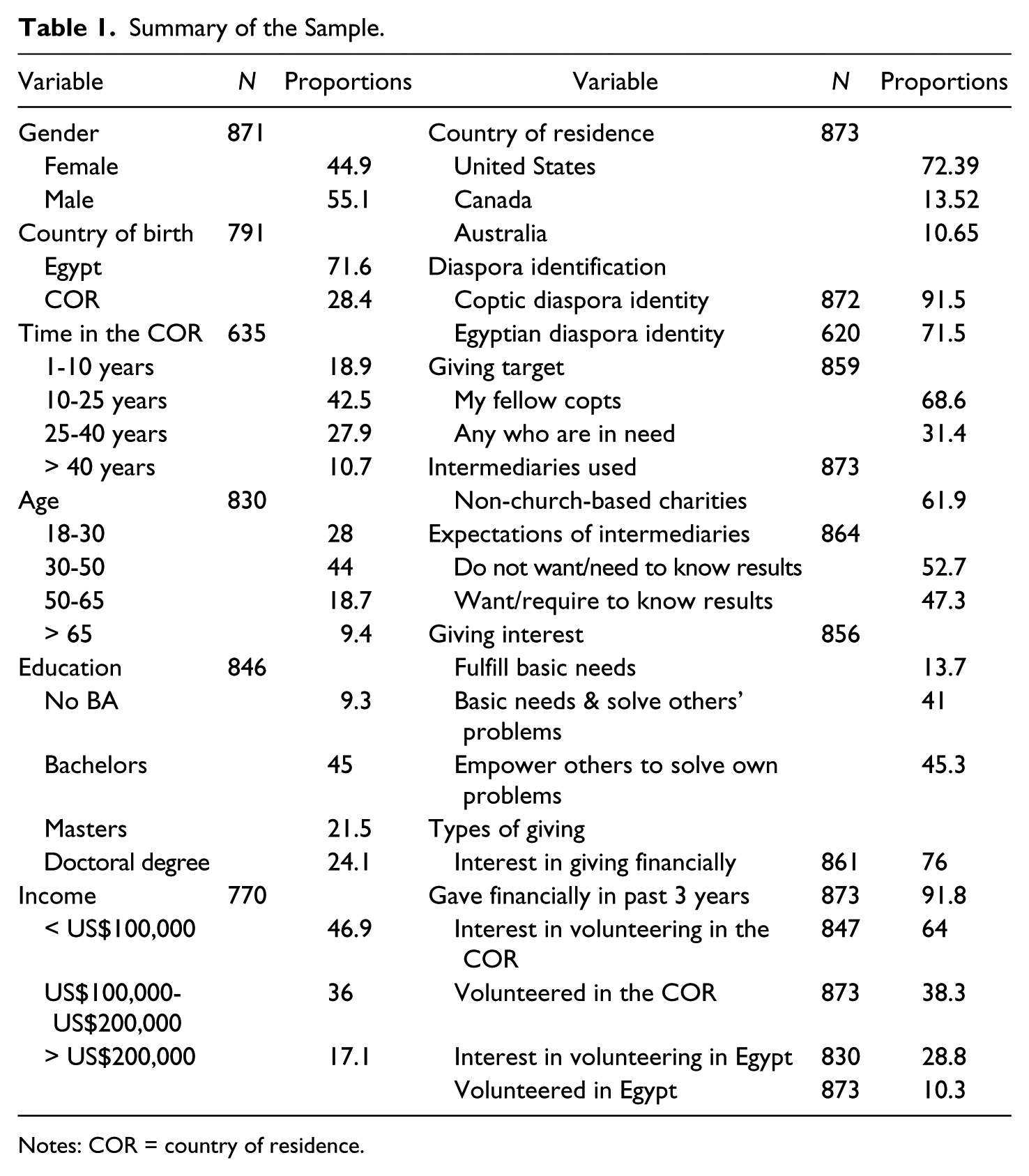
The resulting sample contains 1,570 respondents to Part 1 of the survey, focusing on identity, with diminishing completion of subsequent sections on philanthropy, investment, demographics, religion, and politics (see Brinkerhoff and Riddle, 2012). Demographic questions, including income, appeared in the middle of the survey and such information may be particularly sensitive, especially in this culture; this section had 873 respondents. Table 1 summarizes the demographic sample and provides an overview of the variables.
Summary of the Sample.
Notes: COR = country of residence.
Identity questions addressed the Coptic diaspora, the Egyptian diaspora, and attitudes toward Egypt and respondents’ COR. For each identity, respondents were asked to indicate their relative agreement (scale 1-7) with the following statements: What the community stands for is important to me; I talk about how great the community is to other people; and I am proud to tell others that I am part of the community. Cronbach’s α was used to determine reliability of the composite mean scores. Participants were asked who their preferred giving target was, either fellow Copts or any who are in need. They also had the opportunity to complete an open-ended “Other” category.
Intermediaries were defined as “organizations that connect you to those who are in need.” Respondents were asked to indicate all of the types of intermediaries they used, including: my local Church, the Mother Church in Egypt, my ancestral church in Egypt, Coptic philanthropic organizations in the diaspora, Coptic philanthropic organizations in Egypt, and Other Egyptian philanthropic organizations. New variables were calculated into dichotomous variables (yes/no) indicating use of Church-based intermediaries and non-Church intermediaries. Respondents were also asked about their expectations of these intermediaries, with the following mutually exclusive options: I do not want to know the results of my donations (I give for the sake of giving), it is not necessary for them to inform me of the results of my donations, I would like to know the results of my donations, and my support depends on knowing the results of my donations. New variables were calculated, combining these four into two variables: does not want or need to know the results of giving, and would like or it is necessary to know the results of giving.
Mutually exclusive options for primary giving interest included: fulfilling basic needs, fulfilling basic needs and helping to solve problems for others, and empowering individuals to solve problems and become independent. Respondents were also asked about their current degree of interest (scale of 1-5) and actual participation (yes/no) in specific philanthropic activities over the last 3 years. Degree of interest was recalculated into a binary variable (yes/no), with those indicating four or five defined as interested. Options included: financial donations, donations in-kind, volunteering time in Egypt, and volunteering time in the COR on philanthropic projects targeted to Egypt.
Method
A series of regression analyses was used to test the hypotheses. In each case, I included the country of residence and age, respectively to investigate if there were any significant differences in the sample between those living in the United States, Canada, or Australia, or among different age groups. 5 Binary regression analysis was used to investigate the majority of the investigative questions, where the dependent variable represented two mutually exclusive options. A multinomial logistic analysis was used to investigate respondents’ primary giving interest. Multinomial analysis is used when the dependent variable is categorical, with more than two categories. The results yield relative risk ratios, similar to odds ratios in a logistic regression. The risk ratios depict the probability that a respondent would fall into one of the categories relative to the probability of being a member of the referent category.
Survey Results and Discussion
The results and discussion are organized according to the hypotheses. The referent group for the multinomial analysis of primary giving interest was born in the COR, has lived in the COR more than 40 years, is above 65 years of age, holds a doctoral degree, has more than US$200,000 annual household income, lives in Australia, and is primarily interested only in empowering others. For all other analyses, the referent group was born in Egypt, has lived in the COR for 1 to 10 years, is aged 18 to 30 years, does not hold a bachelors degree, earns less than US$100,000 annual household income, lives in the United States, and—for the analysis of giving target—did not agree that they identify with the Coptic diaspora or with the Egyptian diaspora.
Hypothesis 1: Identity and Giving Target
The analysis of identity and giving target examines whether respondents give exclusively to Copts in Egypt or if they consider needs more generally. The demographic analysis also investigates if second-generation diasporans are likely to give more broadly.
Results
Identity results for the sample are as follows. All respondents self-identify as members of the Coptic diaspora, and 71.5% also indicated they belong to a broader Egyptian diaspora. Questions about belonging to the Egyptian diaspora may be sensitive and fewer participants (N = 620) answered these questions. The averaged mean scores reveal respondents identify most strongly as Copts (6.21) and next as COR citizens (6.16). Almost 95% agreed “The future of Egypt is important to me,” and over 79% indicated they are committed to Egypt’s success.
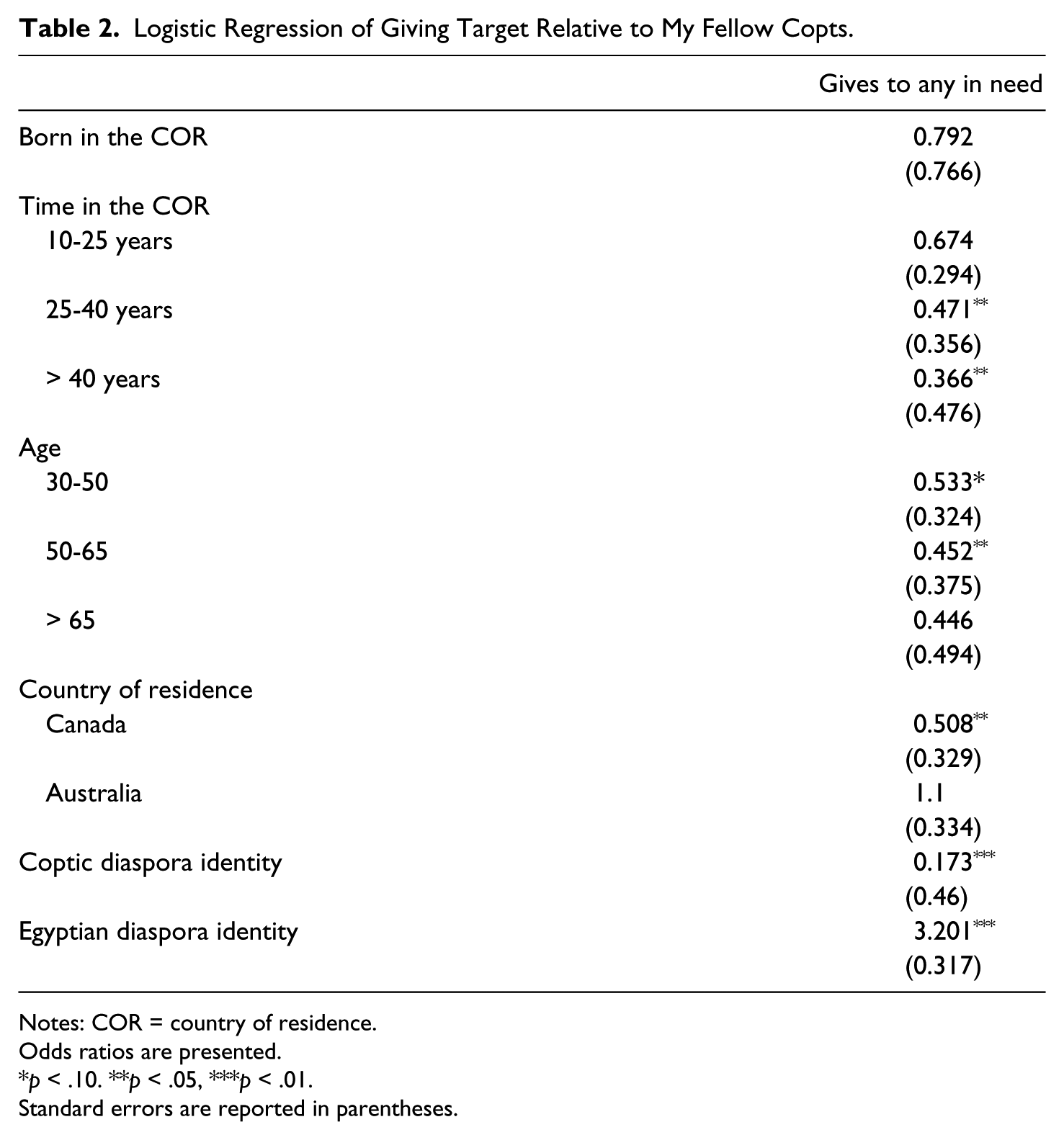
When asked about preferred beneficiaries, 68.6% of respondents (N = 859) indicated they want to support “My fellow Copts,” while 31.4% indicated they want to support “Any who are in need.” Those completing the “other” category (an additional open-ended question) largely indicated they would give to any in need but believe Copts in Egypt to be in most need of support. Table 2 presents the findings of a binary logistic regression of support to any who are in need. Because respondents’ strength of identification with the Coptic diaspora and the Egyptian diaspora are likely to influence the breadth of their targeted beneficiaries, I include binary variables indicating whether respondents identify with these diasporas. The odds that respondents would support any who are in need diminished after 25 years in the COR, compared to those who have lived in the COR for 1 to 10 years. Those aged 50 to 65 years were less than half as likely to want to support any who are in need compared to those aged 18 to 30 years. Canadians were half as likely as those living in the United States to want to support any who are need. Identifications with the Coptic and Egyptian diasporas were the most statistically significant findings. As expected, those who identify strongly with the Egyptian diaspora were significantly more likely (more than three times as likely) to want to support any who are in need.
Logistic Regression of Giving Target Relative to My Fellow Copts.
Notes: COR = country of residence.
Odds ratios are presented.
p < .10. **p < .05, ***p < .01.
Standard errors are reported in parentheses.
Discussion
The findings support the first part of Hypothesis 1: Minority diasporas do not give exclusively to their minority compatriots in the COO, but may base their giving on perceived needs. Coptic diasporans do not necessarily contribute exclusively to their minority compatriots in the COO. Slightly less than a third of respondents are interested in giving to a generalized population of the needy, and 14.2% of respondents give to non-Church-based Egyptian charitable organizations. The desire to support Egyptian nationals generally (i.e., any who are in need) is not universal. This finding could be explained by historical sensitivities and may not reflect actual giving for all of the respondents so indicating.
Seemingly counterintuitive, those chronologically closest to Egypt (who have lived in the COR the fewest years) had the highest percentage of wanting to support any who are in need. These results could reflect the sensitivity in Egypt of distinguishing Copts from “Egyptians” more broadly. Members of the Church have been historically resistant and more recently divided about the appropriateness of lobbying for or supporting specific laws and policies for Copts, even when these concern protecting them from discrimination (see Hasan, 2003). There is considerable concern that doing so undermines the viewpoint, as expressed during the recent revolution, that “We are all Egyptians.”
Why do over two thirds of respondents want to target their fellow Copts in Egypt as beneficiaries of their philanthropy as opposed to all Egyptians? Comments in the open-ended question imply some ambivalence on this point, as they indicate a desire to help any in need, but a strong sense that Copts are those who are most in need. This perception could be the result of respondents’ familiarity with the quality of life of Copts in Egypt. Older respondents were more likely to target their philanthropy to fellow Copts, perhaps owing to a longer history and understanding of the plight of Copts in Egypt. Those who have lived in the COR longer were less likely to want to support any who are in need. These findings are consistent with a tendency of some living in diaspora to fixate on and/or “freeze” their COO identity (see Brinkerhoff, 2008).
This latter finding suggests that with time, newer generations may similarly become more interested in supporting the Coptic minority in Egypt rather than Egyptians more generally. In fact, the data do not support the second part of Hypothesis 1: Second-generation diasporans, in particular, may demonstrate a broader nationalistic concern. Country of birth was not a statistically significant variable in predicting targeted beneficiaries.
Hypothesis 2: Intermediaries, Expectations, and Primary Giving Interest
The first analysis examines if second-generation respondents and those more integrated into the COR (with education and income as proxies) are more likely to use non-Church-based charities and want or require to know the results of their giving. The second analysis examines if second-generation respondents and those more integrated into the COR (with education and income as proxies) are more likely to want to empower others compared to the other giving interests.
Results
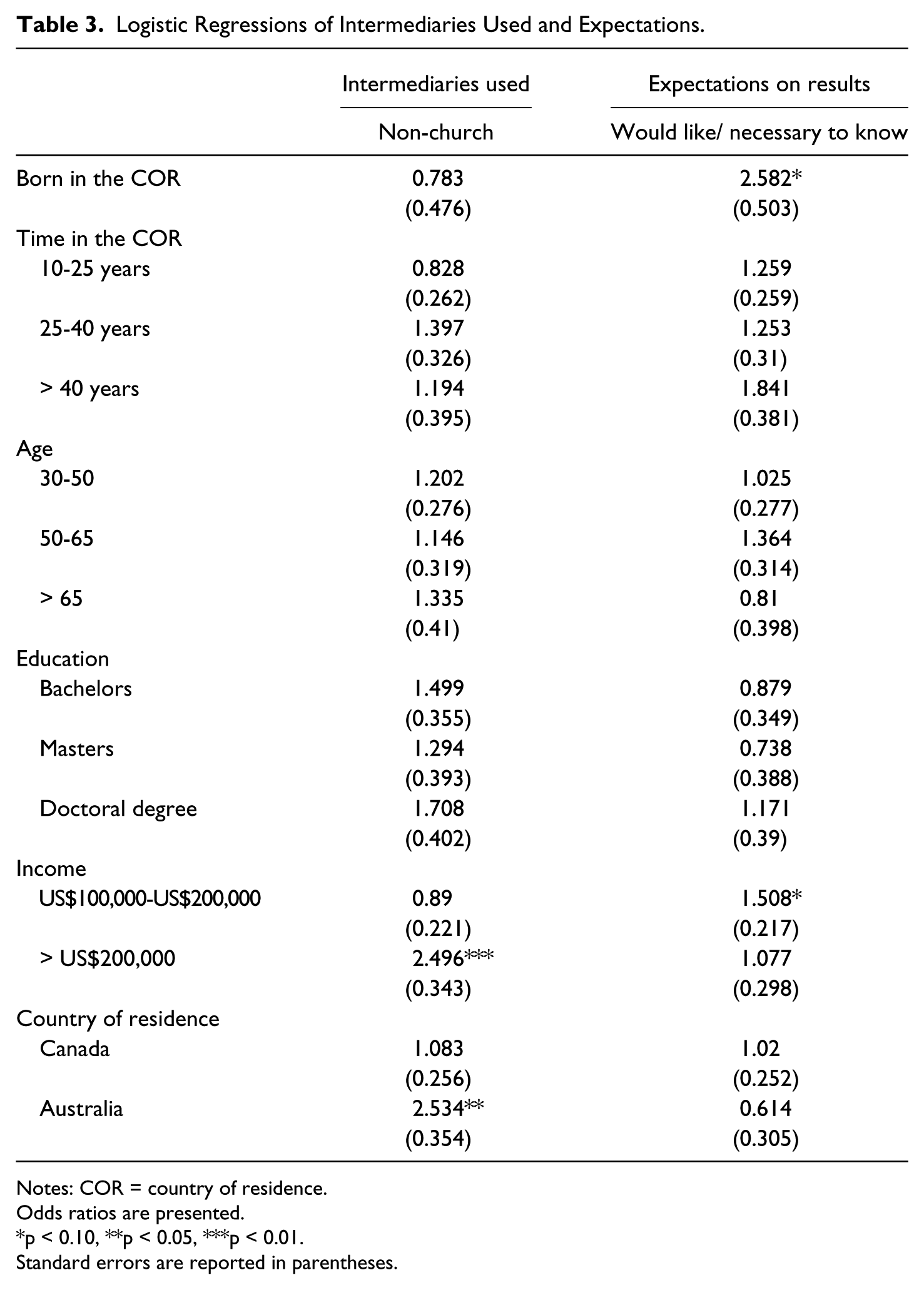
Respondents channel their giving through more than one organization. The Church and Church-related charities are the most popular intermediary (92.2%), followed closely by those based in the COR (92%, which includes respondents’ local Church). Table 3 reports the results of binary logistic analyses of respondents’ use of non-Church charities, and respondents’ expectations of these intermediaries with respect to reporting results. Those in the highest income group (US$200,000) were almost 2.5 times more likely than the lower income group to use non-Church-based charities. Those living in Australia were almost 2.5 times more likely than those living in the United States to use non-Church-based charities. Respondents reported not wanting or needing to know the results of their giving slightly more often (52.7%) than indicating they want or require knowing these results (47.3%). Those born in the COR were more than 2.5 times more likely than those born in Egypt to want or require knowing the results of their giving. Those in the middle-income group (US$100,000-US$200,000) were 1.5 times more likely to want or require knowing results than those in the lowest income group.
Logistic Regressions of Intermediaries Used and Expectations.
Notes: COR = country of residence.
Odds ratios are presented.
p < 0.10, **p < 0.05, ***p < 0.01.
Standard errors are reported in parentheses.
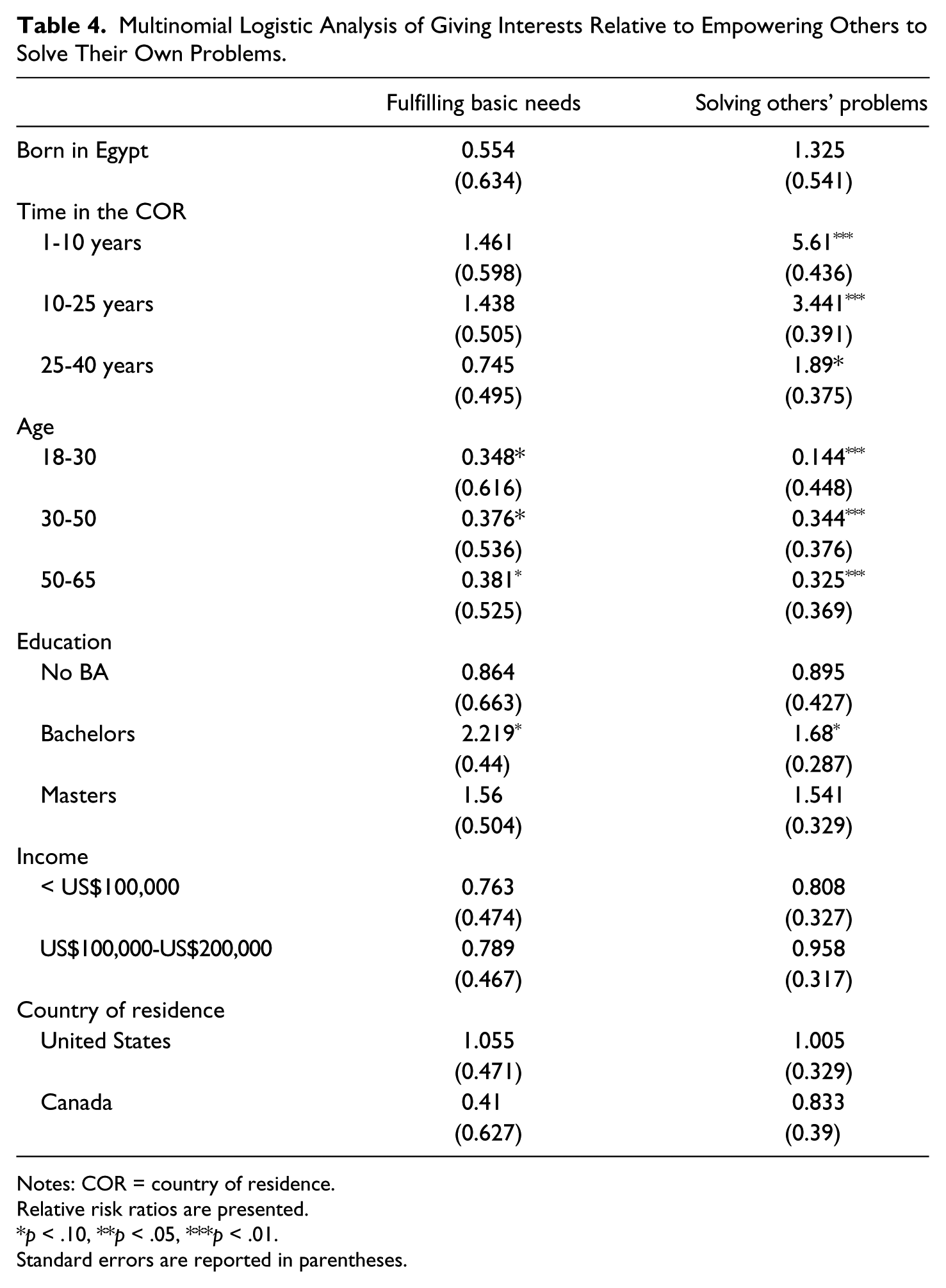
The majority of respondents are interested in more than simply providing charity to fulfill basic needs. Only 13.7% indicated wanting to fulfill basic needs; 41% indicated fulfilling basic needs and helping to solve problems for others; and 45.3% indicated empowering individuals to solve problems and become independent. Table 4 presents the findings of the multinomial logistic analysis. Those with only a bachelors degree were more than twice as likely to want to fulfill basic needs and 1.6 times more likely to want to solve others’ problems rather than empower others compared to those with doctoral degrees. Compared to solving others’ problems, those who had lived in the COR fewer years were significantly less likely than those who had lived there over 40 years to want to empower others. Those who have lived in the COR only for 1 to 10 years were 5.6 times, and those living in the COR for 10 to 25 years were 3.4 times more likely to want to solve others’ problems than empower others to solve their own problems. The younger the respondents, the less likely they were to want to solve others’ problems rather than empower others. Those with only a bachelors degree were more than 1.6 times more likely than those with doctoral degrees to want to solve others’ problems rather than empowering them to solve their own.
Multinomial Logistic Analysis of Giving Interests Relative to Empowering Others to Solve Their Own Problems.
Notes: COR = country of residence.
Relative risk ratios are presented.
p < .10, **p < .05, ***p < .01.
Standard errors are reported in parentheses.
Discussion
The findings provide some support to Hypothesis 2: In the second generation, with time in the COR, and especially among those with higher levels of income and education, (a) diasporans’ portfolio of intermediary organizations is likely to expand beyond faith-based institutions, (b) diasporans adopt a greater expectation for learning the results of their giving, and (c) diasporans become increasingly interested in empowering others rather than simply providing welfare support or solving others’ problems.
Coptic diasporans maintain a strong interest in giving through the Church, suggesting the Coptic Church is instrumental in both inspiring giving and providing an institutional infrastructure for connecting donations to needs. Hasan (2003) credits the Church infrastructure outside of Egypt for expanding the Church’s donor base from a limited number of successful Copts living in diaspora to enabling “numerous Copts of modest incomes” to make regular contributions to social services in Egypt (p. 243). The preferred intermediary most often mentioned was the local Church in the COR, and 92.2% of the sample gives through the Church and/or Church-related charities.
At the same time, almost 62% of respondents also use non-Church-based charities to channel their philanthropy on behalf of Egypt. Those most capable of giving on behalf of Egypt—the highest income level group—were significantly more likely (almost 2.5 times more likely) to give to non-Church-based charities than the lowest income group. This could reflect a demand for more professionalism for the larger donations they may make. However, since only 50% of average donations of US$10,000-US$50,000 annually came from this income group, it may be that the higher income level group is also subject to socialization beyond wanting accountability due to the large amounts given. Higher incomes could signal greater integration in the COR (as is often presumed in the assimilation literature, e.g., Waters & Jiménez, 2005), thus influencing a philanthropic norm of expecting accountability for results.
While more than half of respondents appear to abide by the Church’s doctrine of giving for its own sake, there is some evidence to suggest those who do want or require knowing the results of their giving reflect second-generation respondents or those who may be more integrated in the COR society, including those born in the COR, and those who are in the middle-income group (compared to the lowest income level).
The data suggests the diaspora does not share the giving preferences of the Church. The Coptic Orthodox Church maintains a range of charities and services both coordinated through the Bishopric for Public, Ecumenical, and Social Services (BLESS), as well as those organized independently through dioceses and individual Churches. While the Church emphasizes charity (welfare), it has made concerted efforts to expand its services into the development arena with funding from international Christian organizations. Bishop Youannes (2011), the Bishop for BLESS, explained: “as the development agencies can’t support charity work, they support development. But the Copts would like to support charity work because they know very well how these people are in need.” Over 86% of respondents are interested in more than simply providing charity to fulfill basic needs, suggesting that while the Church provides an instrument for giving, its influence over the aspirations of philanthropists is not determinant. This may explain the use of non-Church charitable organizations by almost 62% of the sample.
The Coptic experience is comparable to other diasporas’ evolution towards more strategic philanthropy in an increasingly sophisticated organizational sector. Traditional giving interests may include not only welfare, but also solving others’ problems. The findings highlight the evolution toward a giving norm of empowering others for those more integrated into COR societies: those with higher income, more education, and more years in the COR. Younger respondents were also more inclined to prefer empowerment over solving others’ problems.
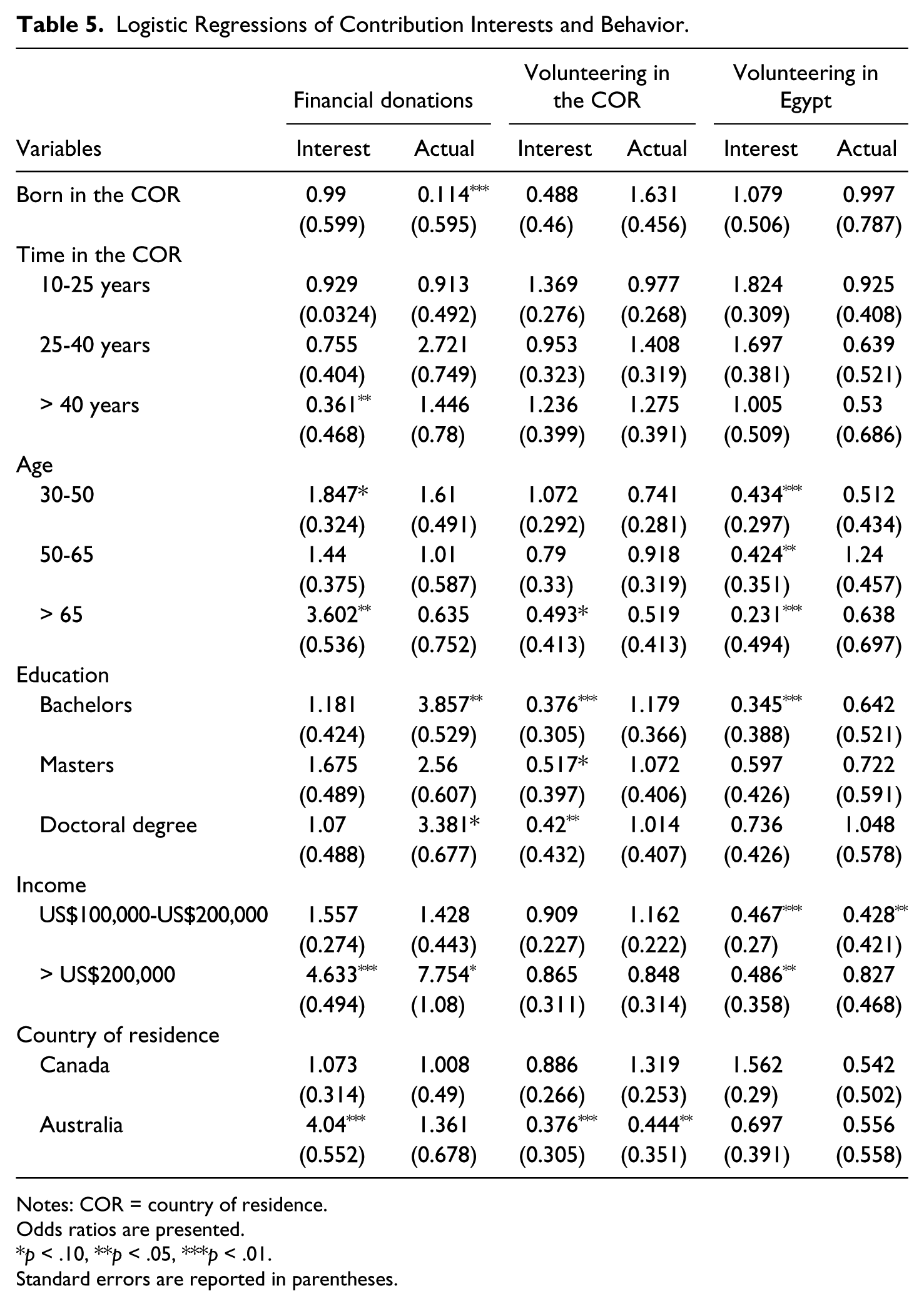
The influence of COR context on philanthropic norms is further supported by a comparative COR analysis. There were statistically significant differences between those living in the United States and those living in Australia. Australians had the highest odds for contributing in the US$10,000 to US$50,000 range and were the most likely to use non-Church based intermediaries (see Table 5). They were more than four times more interested in making financial donations for Egypt, but were less likely to be interested and have actually volunteered in the COR on behalf of Egypt. Canadians were half as likely as those living in the United States to want to support any who are need. These findings may reflect different giving norms in these societies, or different giving options and socialization provided by the Church. Differences in the demographics of settlement groups may also be a factor.
Logistic Regressions of Contribution Interests and Behavior.
Notes: COR = country of residence.
Odds ratios are presented.
p < .10, **p < .05, ***p < .01.
Standard errors are reported in parentheses.
Hypotheses 3: Interest and Contributions Targeted to Egypt
The analysis examines whether or not integration in the COR (with time in the COR, education, and income as proxies) increases respondents’ interest and engagement in philanthropy in Egypt, and whether or not second-generation respondents retain this interest.
Results
Table 5 presents the results of binary logistic analyses investigating respondents’ interest and actual engagement in different types of contributions for Egypt.
Age, income, and COR were statistically significant predictors of interest in making financial donations. Those aged 30 to 50 years were over 1.8 times more likely, and those above 64 years were over 3.6 times more likely than those aged 18 to 30 years to be interested in making financial donations. Not surprisingly, those in the highest income group were more than 4.6 times more likely than those in the lowest income group to be interested in making financial donations. The likelihood of actually making financial donations was influenced by other factors. Those who were born in the COR were significantly less likely (only 11.4% as likely) than those born in Egypt actually to have made financial donations in the past three years. Those with a bachelors degree were over 3.8 times as likely and those with a doctoral degree were over 3.3 times as likely as those without a bachelors degree to have made financial donations. Those in the highest income level were more than 7.7 times more likely to have made financial donations than those in the lowest income level group.
Regarding volunteering, those with a bachelors degree and those with a doctoral degree were significantly less likely to be interested in volunteering in the COR than those without a bachelors degree. Compared to the youngest respondents (18 to 30 years), with age, respondents were much less interested in volunteering in Egypt. Those with only a bachelors degree were significantly less likely to be so interested than those without a bachelors degree. Those earning above US$100,0000 annual income were less than half as likely than those earning less to be so interested. Those in the middle-income range were significantly less likely to have actually volunteered in Egypt than those in the lowest income group.
Discussion
The findings may provide partial support for Hypothesis 3a: with time in the COR, and higher education and income, diasporans’ interest in philanthropy targeted to the COO increases. The findings support Hypothesis 3b: subsequent generations retain interest in philanthropy targeted to the COO.
While relatively more integrated Copts retain their interest and actual engagement in philanthropy targeted to the COO, many of the proxy variables for integration were not statistically significant or indicated diminished interest and engagement. The length of time residing in the COR was not a statistically significant predictor of interest and engagement in any of the giving options, with one exception: those who had lived in the COR the longest (more than 40 years) were significantly less likely to be interested in making financial donations for Egypt than those who had lived in the COR the least number of years (1-10). On the other hand, education and income suggest greater integration may increase interest and engagement in philanthropy targeted to Egypt. These findings may reflect the practicalities of giving more than the influence of relative integration.
Respondents have a deep and abiding commitment to Egypt, this includes those who were born in the COR, those who have lived in the COR a long time, and younger respondents. Copts strongly associate with an Egyptian identity and concern themselves deeply with Egypt; 95% are more than interested, they say they are committed to Egypt’s success. Identification with Egypt and as Egyptians is grounded in the Coptic identity, as “Copt” is synonymous with Egyptian and Copts consider themselves the descendants of the Pharaohs. It is also reinforced by the Church. As the late Pope Shenoudah III was famous for stating: “Egypt isn’t a country we live in, but a country that lives within us” (Fathi, 2012). Living in diaspora, then, does not take Egypt out of the Copt. Respondents’ active diaspora philanthropy confirms this commitment. Respondents actually made financial donations more often their stated interest in doing so (91.8% compared to 76% interested). On the other hand, those born in Egypt were significantly more likely to have made financial contributions.
The findings on volunteering on behalf of Egypt demonstrate enduring interest across time and in the second generation. Country of birth and time in the COR were not statistically significant predictors of respondents’ interest and actual volunteering either in the COR or in Egypt. Interest was higher than actual follow through for volunteering in the COR (almost twice as high) and in Egypt (almost three times as high). These findings suggest respondents would volunteer much more often if there were opportunities to do so, and regardless of how integrated they are in the COR societies. The youngest respondents (18-30) had the highest odds for being interested in volunteering in Egypt, perhaps reflecting a desire to investigate Coptic and Egyptian heritage—a further indication of a potential sustained interest in Egypt.
Evolving Understandings of Diaspora Philanthropy
This analysis confirms: it is inappropriate to assume that minority diasporas, even those who have encountered discrimination and persecution in the COO, will necessarily shy away from participating in philanthropy in the COO (Johnson 2007) or, if they do so, to target only their minority compatriots. The experience of minority diasporas is far more complex. Their engagement with the COO and their national compatriots depends on politics, culture, and culture transmission mechanisms. For the Coptic diaspora the latter includes the Coptic Church.
The analysis also confirms and extends previous findings based on singular case studies and largely anecdotal evidence regarding diaspora philanthropy evolution. Diasporans’ philanthropy in the COO is, indeed, influenced by their integration in the COR, and differences among CORs of the same diaspora may ensue. The Coptic diaspora case confirms the likelihood that diaspora philanthropy will evolve from reliance on faith-based and informal mechanisms and norms to more strategic philanthropy based on organizational effectiveness, sustainable impact, and donor responsiveness (Bhatti, 2008; Najam, 2005; Portes et al., 2007). These findings are consistent with survey findings from Canada (Hall et al., 2009), and also with observed experiences within the Pakistani and Vietnamese diasporas. However, this case also suggests that these effects may exist alongside traditional giving practices. The majority of the sample continues to donate to Church-based charities, and over half of the sample does not want or need to know the results of its giving. The degree to which COR philanthropic norms penetrate a diaspora may be contingent on the cohesiveness of that diaspora and its cultural maintenance and socialization mechanisms. Especially in the case of faith-based diasporas, these may be formidable. Even an institution as structured as the Coptic Church is also not monolithic. Its socialization mechanisms and priorities may vary across CORs.
This leads to an important extension of previous findings with respect to diaspora philanthropy evolution over time and across generations. Earlier assumptions that diasporans eventually lose interest in the COO and may redirect their philanthropic energy are premature. These assumptions are largely based on Hansen’s (1952) linear model of assimilation, which has been seriously challenged by contemporary experience. Today’s diasporans have many more options and facilitative mechanisms for maintaining their connection to and engagement with the COO. The Coptic diaspora demonstrates that such engagement can persist despite extensive time in the COR, and, with socialization, across new generations.
The Evolution of Diaspora Philanthropy: Implications
Several patterns emerge from placing the Coptic diaspora in the context of other diaspora experiences, though generalizations should be made cautiously. Confirmed are diasporas’ relative faith-based motivations and facilitation, the concomitant interests and practices of traditional COO identity and changing ideas and opportunities represented in the COR, and the enormous capacity of diasporas to contribute to their COOs and potentially in increasingly impactful ways over time. Minority diaspora philanthropy may differ from nationally defined diaspora philanthropy, and likely in ways that are quite particular to the history and present socioeconomic and political predicament of compatriots who remain in the COO.
The evolution of diaspora philanthropy over time and across generations suggests both good news and bad news from the COO-perspective. On the one hand, persistent philanthropic attention to the COO could signify important contributions to quality of life in the COO. On the other hand, socialization in the COR seems to influence diasporans’ preferences for giving, selection of intermediaries, and, possibly, expectations of results; evolving norms may not always rest easily with COO recipients. One Coptic bishop bristled at a U.S.-based donor’s request for confirmation that his contribution be made to development projects; he “raged at this impudence and sent it back with a note saying that he did not need the money” (Hasan, 2003, p. 152). The Church and individual clergy will need to consider how best to respond to such demands as they may become more common into the future.
Diaspora philanthropy is distinct from philanthropy more generally precisely because it can represent a sometimes unique blend of a particular diaspora history, COO, COR, and integration experience. This distinctiveness can yield potential comparative advantages among philanthropists as well as challenges. Potential advantages include: (a) a visceral understanding of needs, which may be particularly important for addressing the needs of neglected minorities in the COO; (b) a faith-based infrastructure that may provide for ongoing socialization regarding those needs as well as mechanisms for transferring funds and implementing projects and programs; and (c) the insertion of new norms and practices that may encourage philanthropy programming in the COO to become more impactful and accountable. Potential challenges emerge as counterpoints to these advantages. Diasporans’ understanding of needs may reflect a “frozen-in-time” understanding that becomes progressively less accurate. A reliance on faith-based socialization and mechanisms may privilege some philanthropic objectives over others, whether or not these reflect the intentions of the donors or the highest priority needs. And conflicting norms and practices between diaspora philanthropists and implementers in the COO may alienate some actors leading to their withdrawal from working together to the detriment of potential beneficiaries.
Diasporas and their philanthropic norms and practices must be assessed with an understanding of their diversity, which includes the causes and timing of migration, the countries of settlement, and the generations within a diaspora, as well as more common demographic distinctions such as gender, age, education, and income. With more sophisticated analyses going forward, we can better understand the potential and reality of diaspora philanthropy. Such understanding opens the door to better advice to actors interested in improving philanthropic impact. These may include diasporans themselves, religious leaders, or policymakers in the COO or the COR.
Footnotes
Declaration of Conflicting Interests
The author declared no potential conflicts of interest with respect to the research, authorship, and/or publication of this article.
Funding
The author disclosed receipt of the following financial support for the research, authorship, and/or publication of this article: This research was funded by the Elliott School of International Affairs, George Washington University. Special thanks to my colleagues at George Washington University and anonymous reviewers for their feedback on methods.