




Abstract
Workforce learning has become a fundamental need for organizations that face a quick-changing world growing more complicated by the day. In this study, we focused on an examination into the factors that affect the design of employee training in nonprofits, including a discussion into the training practices of nonprofits as a result of those factors. Smaller nonprofits in Taiwan were studied; larger nonprofits, such as the Red Cross and World Vision, were not included in the present study. Through interviews with and surveys of 20 participating nonprofits in Taiwan, we found that the widely used linear training design framework, including assessment, design, development, implementation, and evaluation, might not be appropriate for many nonprofits due to organizational factors such as human resources, financial environments, and managerial systems. Due to the influence of these factors, the practice of training in nonprofits has moved beyond structured design, and diverse on-the-job approaches are now being applied.
The quality of human resources in organizations is strongly connected to the quality of service. As the number of nonprofit organizations (NPOs) increases and standards for their accountability rise, the question of how to maintain workforce competence through continued learning has become an issue for many NPO staff and managers. For many decades, employee training has been viewed as an effective way to maintain and develop organization members’ work capacity. In NPOs, workers’ learning is viewed as an important means to improve organizational effectiveness and service quality (Hodgkinson & Nelson, 2001; Riddoch, 2009).
In the existing NPO research, discussions about training have shown three trends. First, more discussions involved volunteer training (Clary & Snyder, 1999; Eisner, Grimm, Maynard, & Washburn, 2009; Evans & Clarke, 2010; Field & Johnson, 1993; Gesthuizen & Scheepers, 2011; Hutchinson & Quartaro, 1993; Potter-Efron & Potter-Efron, 1982) and school education (Dolan, 2002; Mirabella & Wish, 1999; O’Neill & Fletcher, 1998; Paton, Mordaunt, & Cornforth, 2007), whereas administrative staff training received relatively less attention.
Second, business training paradigms are often used as major references to guide training practice in NPOs. For example, Paton et al. (2007) discussed the emergence of nonprofit management education (NME) in the United Kingdom. In the late 1970s, the government promoted enterprise culture, and one of the important policies was to use knowledge and experience from the private sector to enhance the quality of public services. During the process, the voluntary sector was not immune to such changes. Many people in the voluntary sector perceived the need to be business oriented and wished to learn business practices from the private sector (Paton et al., 2007), and until recent developments intervened, this trend had endured.
Third, in the research, training practice in NPOs is often described as less than systematic. For example, when programs targeting the nonprofit sector emerged, Dolan (2002) described how only a few programs have been designed in a “systematic fashion,” and how the best methodology for NPO training programs has not yet been determined. In addition, Paton et al. (2007) stated that “resources for management education and development are often inadequate, provision remains patchy, and there is still an overreliance on short courses” (p.150S). Similarly, Chen and Chang (2007) examined NPO training programs in the social work field in Taiwan and found that most of the staff training was sporadic, without a systematic framework.
The aforementioned three trends are related. For example, when training in NPOs is described as patchy and lacking a systematic design, we must be cautious regarding the criteria used for such a conclusion. It is important to examine the paradigm and assumptions embedded in these criteria, and to understand whether they consider the organizational context of NPOs. Training design and practice is strongly connected to their context, and involves an evolutionary process. Applying models from the for-profit sector to nonprofit organizations did not always go smoothly. For example, Paton et al. reported that the Youth Hostels Association found itself caught between reinforcement of its social mission and commercial hotel business practices. Opposing criteria derived from a different paradigm (e.g., economic scale) might lead to unrealistic strategies for improvement.
This concern regarding the potential mismatch between NPO organizational characteristics and frameworks indicates a need to more carefully examine the context and training design of the NPOs. Organizational context is the foundation on which employee training is constructed. Therefore, recognizing NPOs’ characteristics serves as a critical step toward understanding their training design. Some scholars have suggested that it is not appropriate to directly apply the principles and methods from for-profit organizations to training in NPOs without considering their different organizational characteristics (Hutchinson & Quartaro, 1993). However, studies regarding the differences between profit and nonprofit organizations are still limited (Nair & Bhatnagar, 2011), and it remains unclear which NPO characteristics would affect the design of employee training.
Therefore, in the present study, we conducted an inquiry regarding what factors would affect the design of employee training in the nonprofit sector, and how. Specifically, the present study aimed to respond to the following two research questions:
What factors affect the design of employee training in the nonprofit sector?
How do these factors affect the design of employee training in the nonprofit sector?
In the present study, employee training was defined as planned activities that were designed to provide employees with the opportunities to learn necessary skills to meet current and future job demands (Werner & DeSimone, 2012).
Literature Review
Employee Training
Regardless of the type or mission, organizations must recruit competent employees and must keep their competence updated to handle challenges from a changing environment (Poell & van Woerkom, 2011). Employee training has been used as an important means to maintain organizational effectiveness. According to a survey administered by the Association of Training and Development (ASTD, 2011), although organizational leaders in the United States were faced with some of the worst economic conditions, they continued to dedicate substantial resources to employee learning in 2009, spending US$125.88 billion on employee learning and development. Nearly two thirds of the total (US$78.61 billion) was spent on the internal training function. Employees accessed an average of 31.9 hr of formal training content in 2009, which demonstrates that organizations expect employees to allocate a meaningful amount of time to formal learning and development activities. Smaller and midsized firms spent an average of US$140,040 for training (Fernald, Solomon, & Doshna, 2003). Although these numbers were based on data from the business sector, in past decades, as NPO functions expanded and the accountability issue received more attention, the demand for professional and continued learning for nonprofit personnel also increased significantly (Liu & Ko, 2011; Pospíšilová, 2011).
For employee development, both formal and informal learning formats are used by organizations (Field & Leicester, 2000; Marsick & Watkins, 1997; Rogers, 2004). Formal learning refers to the training that is primarily controlled by an organization while informal learning means that the control is primarily in the hands of the learner. Without a rigid structure, informal learning takes place in employees’ experience and provides more flexibility. According to the Institute for Research on Learning (IRL), 80% of corporate learning is informal (Cross, 2007). To help employees obtain necessary skills for their current and future job demands, learning relies on both formats in organizations. Formal learning includes classroom training, structured on-the-job training (OJT), or coaching, and informal learning can occur in self-paced/computer-based training and through experience sharing (Werner & DeSimone, 2012). The National Center for Vocational Education Research (NCVER, 2003) found that Australian companies strengthened new workers’ abilities in four ways, including formal and informal learning formats:
Complete training system: progressive courses and a structured plan for employee learning.
Regular team meetings: discussion of work progress, and communication of expectations for employee behavior.
Buddying and mentoring: new staff works and interacts with veteran staff members who have experience based on informal learning.
Other groups’ assistance: external experts and individual supporting groups.
Based on the scope of involvement, Swanson and Holton (2001) divided training and development into four levels, including individual, group, work progress, and organizations. Among the four levels, activities on the individual and group levels are often used in small organizations due to fewer participants and the need for flexibility. On the individual level, the most common method is to learn on the job and arrange for experienced staff to guide new staff members, as through coaching, mentoring, and apprenticeship (Daloz, 1986, 1999; Harvard Business School, 2004). At the group level, the common methods included action learning and problem solving; both were team based and used practical problems to achieve learning and development. In addition, experiential learning has been identified as an important way for employees to gain work skills through various informal formats (Kolb, 1984; Robert, 2012). Today’s technologies enhance the usage of informal learning for both large and small organizations. New technologies are making it possible for both very large and very small organizations to have the economic benefits of informal learning (Cross, 2007). Such a format enhances freedom, flexibility, motivation, and creativity in organizations. As different learning methods have their strengths for different purposes, design serves as an important step to provide organizations with a guideline to implement the training process in practice by identifying training needs, selecting appropriate methods, delivering content, and evaluating the results.
Design of Employee Training
To design training programs, the literature suggests various models (Dick & Carey, 2004; Gustafson & Branch, 1997; Milano & Ullius, 1998). Based on the system theory (von Bertalanffy, 1950), Glaser (1962) developed an instructional system, which stimulated more discussion regarding training program design (e.g., Odiorne, 1965; Saettler, 1968). Following the concept of instructional system design (ISD), the Center for Educational Technology at Florida State University created the ADDIE framework (analysis, design, development, implementation, and evaluation), which was applied to all of the U.S. Armed Forces (Watson, 1981). In this model, training design begins from an organizational-level assessment, in which designers must first examine the context of a particular organization. Similarly, Mager (1997) suggested an eight-step, basic module floor plan for instruction design, and the first step was also to examine the big picture of training, including both learners and their environment. This step served as an environmental scan for training design. In other words, training format (formal or informal) and level (individual, group, work progress, and organization) are inevitably connected to an organization’s particular context.
However, discussions regarding the training design often overlook the context. For example, due to its broad application, the ADDIE framework was often assumed to serve as criteria to evaluate the maturity of training design in various types of organizations, regardless of the fact that it was originally designed for a large-scale organization, the military. On the other hand, some researchers have suggested that NPOs should not directly apply training systems from business sectors. However, such a suggestion may also stumble into a similar pitfall, because some small businesses and small NPOs actually share certain similarities in terms of resource constrains for training design. For instance, Hill and Stewart (1999) described the difficulties faced by many small businesses, pointing out that when managers state that their small business needs to be fluid, spontaneous, and flexible, this can be a reflection of reality, but could also be terminology that is a more palatable justification of the organization’s subjugation to unpredictability and untenable market forces. While many small NPOs also emphasize fluidity and flexibility in their management, they actually face similar challenges as small businesses. Therefore, the denial of all types of training designs from business sectors for nonprofit sectors may lead to a superficial dichotomy that overlooks both similarities and uniqueness. However, although textbooks provide various guidelines for training design (e.g., Noe, 2012; Werner & DeSimone, 2012), a context for application to NPOs is often missing.
Factors Affecting NPO Employee Training
The design of employee training programs is connected with a given organization’s internal and external context. Betcherman et al. (1998) and McMullen and Brisbois (2003) investigated NPOs in Canada and identified several characteristics, including smaller organizational size, emphasis on values, a shared decision-making process, more female full-time employees, less opportunities for promotion, lower salaries compared with government and business organizations, and more constraints in training budgets. Similar characteristics also appeared in Taiwan. For example, regarding organizational size, the Himalaya Foundation (2005) investigated 300 foundations in Taiwan and found that 10.7% of organizations have one to two employees, 32.1% have three to five employees, and 26.8% have six to eight employees. In other words, 70% of the organizations have a staff that numbers less than 10 people. Storey (1994) suggested that external uncertainty is the central distinction between large and small organizations. Organizations with a smaller size usually face a higher external uncertainty, and this also applies to many NPOs due to their unstable funding from government and public donations.
In addition to size and human structure, the nature of the psychological contracts of NPO members is likely to be more relational than transactional, with members displaying a high degree of self-selection based on values affiliation (Fenwick, 2005). Nair and Bhatnagar (2011) also identified six factors that differentiate nonprofits from business organizations. NPOs are largely driven by values and ideology, with a structure that is both more informational and looser, and a greater diffusion of accountability, which lends itself to a relatively weak level of internal accountability, and the increase in ambiguity that comes with a less structured environment. Furthermore, employees of NPOs have stronger motivations and commitments that are linked to a greater meaningfulness in their work, and they are often dominated by charismatic leaders who ascend in a system that is less formal in leadership selection and succession. Such informality is a prized value in small business, but can also be an enforced response to external uncertainty (Hill & Stewart, 1999).
For employee learning, Dolan (2002) identified three factors that affect training in NPOs: size, funding base, and the age of the organization. Some studies have found that a number of potential factors can hinder the development of staff training in NPOs. For example, Chiu (2002) and Cai (2002) found various obstacles that prevented NPO staff from attending training, including lack of time, limited organizational resources, lack of support from supervisors, negative attitudes of coworkers, and a lack of systematic planning for training. Among these factors, the financial factor has often been highlighted (Riddoch, 2009). For example, based on a study of disability charity organizations, Bentley (2007) found that a lack of financial resources can prevent NPOs from providing training for staff. Blyth (2006) also indicated that the greatest challenge for charitable organizations is how to deal with a dearth of organizational resources, especially money.
Another factor is the multiple roles of NPO staff, which often affect their training. As Netting, O’Connor, Thomas, and Yancey (2005) describe, “people can wear different hats” (p. 190). Because staff members take on overlapping roles within a stressful environment, they often do not have time to attend training programs. Related to multiple work roles, the workload is another critical factor. Finally, an effective evaluation system is identified as another key. Hodgkinson and Nelson (2001) indicated that NPOs often face difficulties in building clear indicators and measures, which increases the problem of turnover. To identify the factors affecting NPO employee training, the present study obtained information from NPOs in Taiwan. Data were collected and analyzed through the following three-stage research process.
Research Methods
To understand the characteristics of NPOs and the influence on training design, a qualitative approach was utilized in the present study. Data were collected mostly through interviews, during which a brief questionnaire was used to assist collecting descriptive background information.
Participating Organizations
Among the participating 20 organizations, 75% were small or middle-size organizations with the number of employees less than 30. The organizations were established between 1950 and 2001. Their service areas included community service, medical assistance, social welfare, social work, international cooperation, child welfare, NPO research, service for people with disabilities, and service for people with mental disease.
Procedure
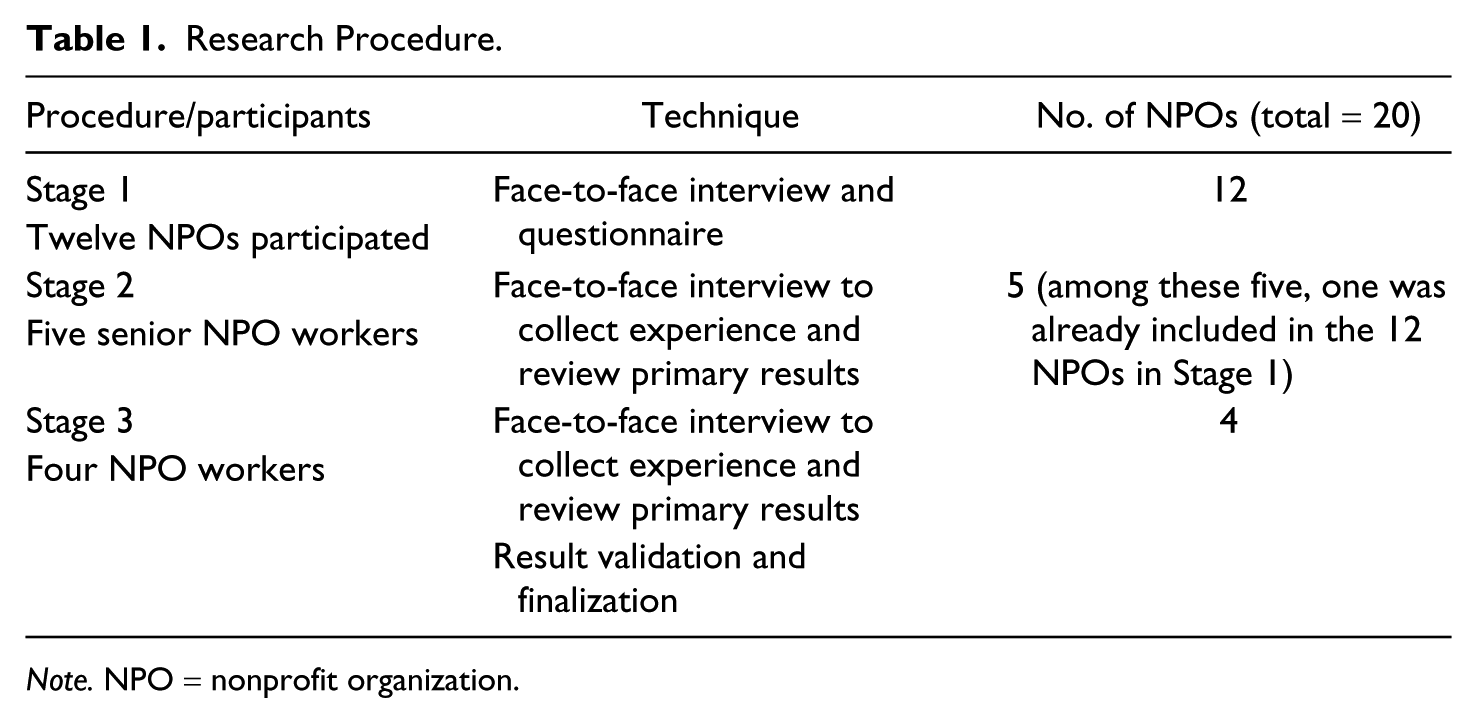
In this study, the data collection was conducted in three stages. Multiple stages and methods were applied for triangulation to help enhance the credibility of this inquiry (Mertens, 2009). The research procedure is summarized in Table 1.
Research Procedure.
Note. NPO = nonprofit organization.
Stage 1
Questions validation
The interview questions and questionnaire were reviewed by two NPO practitioners. The first practitioner had 2 years of working experience in NPOs. The second was a NPO documentary director who was familiar with NPOs and practitioners in Taiwan. They helped review the clarity and wording of the questions, and the research team used this input to revise and finalize the questions. The interview questions focused on NPO characteristics, philosophy for employee training, how employee training activities were conducted, and difficulties during implementation. The questionnaire included descriptive background information such as the year of establishment, service area, training formats, content, frequency, and the reasons for not having training (if they checked no training).
Participants and methods
In the first stage, we contacted NPOs in Taiwan that provided service domestically and internationally, and 12 agreed to participate. We used interviews and a questionnaire to explore training practices.
Data analysis
For analysis, we transcribed the interviews and followed the techniques of open coding, categorizing, and comparison, suggested by Corbin and Strauss (2008). All the transcription was broken into small pieces. Then we assigned codes, grouped similar concepts into categories, and identified themes that emerged from the empirical data. Information from the questionnaire and a literature review regarding NPO characteristics were included in the data analysis.
Stage 2
Participants
To validate the primary results regarding NPO characteristics and training practices derived from the first-stage data collection, we then enlisted five senior NPO practitioners for semistructured interviews. In the second stage, following the principles of purposeful sampling, we used two criteria to select senior NPO participants:
The practitioner had been involved in NPO work for more than 5 years.
The practitioner had experience in NPO training work.
We used these two criteria to ensure that interviewees had experience in both NPO administration and training program implementation. Based on the criteria, five practitioners (four female, one male) were invited to express their observations regarding training design in NPOs. Their backgrounds included psychology, communications, social work, NPO research, and rehabilitation. Three of them had more than 20 years of work experience in the NPO field. The other two had 5 and 7 years of experience.
The primary findings from Stage 1 became the foundation for the interview question design in the second stage. The interview questions for the second stage included four parts: (a) NPO characteristics, (b) their influences on employee training design, (c) training formats, and (d) feasibility of the structured training framework. In the first two parts, we listed NPO characteristics and their influence derived from the first stage, so the interviewees could choose and also add their opinions. In the third part, we invited participants to choose the frequency of various training formats (0 = never, 4 = very frequent). Finally, we invited participants to express their opinions regarding the training design framework in NPOs.
Data analysis and primary findings review
For the data analysis, similar to that in the first stage, all the interviews were transcribed, and went through the procedure of open coding and categorization for data analysis. After the categories emerged, a constant comparison method was used to generate the major themes in the present study (Corbin & Strauss, 2008). Then, we shared the primary findings with the research participants and other two NPO practitioners who were involved in NPO management and research. Based on their feedback, we revised the themes and identified eight factors (in four dimensions) and five categories of training design in NPOs.
Stage 3
Participants
In the third stage of data collection and analysis, existing themes and patterns were examined in more depth within each category. With the foundation from previous stages, we enlisted five more experienced NPO practitioners (three female, two male) from four NPOs to discuss the design of employee training. They had also been involved in NPO training work for more than 2 years, and their background included social work, children welfare, and psychology. Their work experience ranged from 2.5 to 6 years. Based on the interviews, we continued to revise the themes.
Result validation
Lincoln and Guba (1985) recommended sampling until a point of saturation was reached, which meant no new information was forthcoming from new sampled units. Findings consisted of themes that were supported by interviews in the three stages. Through data analysis and revisions, we finalized the results, and seven factors (in three dimensions) affecting NPO employee training and four categories of learning design in NPOs were identified (see Figure 1).

Design of NPO training programs and relevant factors.
Research Results
Factors Affecting the Design of NPO Training Programs
This study first explored the factors that affect the design of employee training in the nonprofit sector. The factors derived through data analysis were categorized into three dimensions, including human resources, financial environment, and managerial systems. For employee training in NPOs, there was not one preferred method, but several methods that were shaped by the following factors.
Human Resources
Capacity challenges
The first factor identified was capacity challenges. In Taiwan, although some large NPOs have been established, most of the organizations are small. According to a study of 300 selected NPOs, about 70% of the organizations have fewer than 10 full-time employees (Himalaya Foundation, 2005). Most of the interviewees also had similar observations. For example, Lee mentioned, “Like our organization, in the beginning, we only had three. Now we only have five and a half (part-time). . . . However, some organizations are even smaller than us; one employee covers all the work” (personal communication, May 24, 2007). Capacity challenge was identified as a critical factor affecting learning program design. While Taiwan also has large NPOs such as the Red Cross and World Vision, interviewees’ discussions for this study focused more on smaller organizations.
Workload and job overlap
Due to the small human resource structure of many NPOs, heavy workload and job overlap were common situations. Interviewee Chen mentioned, “some projects only have one person. You need to provide services, handle accounting, interact with the government, etc. It is hard” (June 4, 2007). Lee also stated that if the NPO has only three to five people, everyone must play multiple roles. For example, very often, the executive also needs to play the roles of general service officer, accountant, and secretary. Although there were job distributions and descriptions, the line between positions was blurred and the workload was usually heavy. Such situations affected employees’ motivation to learn, and the results. As Cherry said, heavy workloads made people feel that learning was a waste of their time: “Even though you sat in the classroom, you were nervous and still thinking about the unfinished work. It affected learning outcomes.” (April 30, 2011).
Emphasis on value
As NPOs play a role in alleviating social problems and aim to provide services for people in need, people who joined NPOs felt an identity with such missions. Participants of this study indicated that employees in NPOs often show strong believes in social responsibilities, altruism, and service. The primary drive for their work is often a matter of moral or religious values instead of financial benefits or transactional exchanges. Such characteristics have been identified in previous studies (e.g., DiMaggio & Anheier, 1990; Lewis, 2003; McMullen & Brisbois, 2003; Nair & Bhatnagar, 2011). For example, Betcherman et al. (1998) suggested that values, norms, and ideology are important elements for defining the nonprofit sector, which provide rationale for its practice. Instead of profit-seeking or social regulation, a sense of community ties actually inspires the workers in NPOs. Similar viewpoints were also confirmed by the NPO practitioners in Taiwan in the present study. In the research, NPOs are often described as value based, and such a characteristic was influenced by the nature of their employees, and such an organizational feature in turn continues to influence these workers.
Financial Environment
Compensation range
According to the research, the compensation in NPOs is generally lower than that in the business and government sectors (Sun, 2004). However, research participants (Chang, Chen, and Ben) in the present study explained that actually the starting pay was not lower than that in business and government, particularly for professionals (e.g., social workers, medical workers). However, the range of wage increases was limited. For example, practitioner Chang explained that many businesses would adjust employees’ wages based on increasing performance, but NPOs had no such policies. Ben further clarified that the salaries could not compete with businesses. He said the range for adjustment is very limited: No matter how long you work here, you would never get $40,000 NT per month (about $1,300 US) because our organization does not have the room to increase salaries. . . . For example, if you work here for three years, you have reached the highest salary. If you continue to stay here, there is no room for wage increases. Therefore, the starting pay is not necessarily lower (than business and government), but the range for salary adjustment is almost zero. (Chang, personal communication, May 23, 2007)
In management theory, it is generally agreed that compensation adjustment can be used to reflect employees’ performance, which becomes an important means for recognition and motivation. While this principle is often applied in the business context, limited room for wage adjustment, due to financial constraints, becomes a reality that NPOs need to face in management.
Financial instability
The major income sources for NPOs in Taiwan are public donations and government funding, and these constantly change. Therefore, the projects and objectives for NPOs also change, depending on their financial situation. Based on more than 20 years of observation, one interviewee, Chang, described NPOs as “flexibly using loose organizations to reach uncertain objectives” (May 28, 2007). These three terms (flexibly, loose, uncertain) illustrate the instability of NPOs. Ben also explained that they cannot always be sure if government support will continue. If it does not, their service must cease. In addition, some NPOs rely on outside funding to support their salaries. When the funding changes, the human resources structure has to change, which really jeopardizes organizational stability.
Managerial Systems
Perception of professionals
In the workplace, learning is a continuous improvement process for becoming more professional. Therefore, the definition of professionals affects the learning path and design in NPOs. Interviewee Lee explained that “in NPOs, the definition of professionals is different from our general understanding. Only those who provide direct services (e.g., social workers) are viewed as professional workers” (May 24, 2007). Another director also mentioned that the professionals in NPOs, such as dietitians, therapists, or social workers, receive similar pay as those in other types of organizations. However, administrative staff members (e.g., personnel workers) receive lower pay. In other words, an NPO administrator is usually not viewed as a professional, and such a viewpoint has affected the design of training programs. For example, government funding for training is focused more on the professionals, so they receive more training opportunities. In addition, these professional workers are often required to pursue a certificate and must continue to update it. With these conditions, these workers often have clearer training goals that help encourage motivation. In contrast, the opportunities for administrative workers are relatively limited.
NPO managers’ attitudes and definitions regarding professionals have great influence on training practices, one interviewee mentioned, particularly in small organizations. When asked whether the employee-training budget would be cut due to financial constraints, interviewee Chang said, “It totally depends on the leaders” (May 28, 2007). Similarly, a manager in another NPO also mentioned, “It depends on the leader’s attitude” (April 30, 2011). Several interviewees (Ben, Bob, Chen, Chang, Lee, Chi) suggested that direct supervisors have a significant influence on training because they decide the training priorities, which affect workers’ motivation and professional growth.
Reward and disciplinary systems
Limited human resources, heavy workloads, and financial constraints also affect the establishment of a fair reward and disciplinary system. For example, even though employees work extra hours, the organizations do not have the ability to provide rewards such as overtime pay and vacation (no extra human resources to cover their jobs). These situations make people burn out easily, and some people slack off as a way to adjust. Lee explained some employees’ reactions: For example, (they felt that) I was very tired due to yesterday’s activities (overtime work), but I could not take a day off. Since I was tired but I had to come to the office, I slacked off in the office. Some people use slacking off as a way to respond to fatigue. (Personal communication, May 24, 2007)
However, without proper resources for rewards, managers often hesitate to apply any punishment. An interviewee stated, “If the organization could not provide rewards, how could you carry out punishment? It was a significant difficulty” (June 7, 2007). Mary also stated, “If workers cannot meet performance criteria, we would remind or warn them. But we would not really punish them” (May 7, 2011). Without proper reward and disciplinary systems, many managers also hesitate to fire employees. Evaluation and quality control is one of the basic components for organizational operations. These organizations seem to lose an important mechanism for motivation and evaluation. When the reward and disciplinary mechanisms are weak, the control power shifts from managers to employees themselves. More self-management can attract employees seeking autonomy, but can also be a challenge for NPO development.
Characteristics in the three dimensions—human resources, financial environment, and managerial systems—demonstrated the unique context of NPOs and affected the training design of the organizations. The influence of these three dimensions on training design is discussed in the following section.
Design of Training in NPOs
The results of this study showed that the earlier identified contextual characteristics shaped the training design of NPOs. For example, due to internal capacity constraints and financial instability, most NPOs do not have specific human resources or a particular department that is responsible for training design. Therefore, they moved beyond the structured approach and relied on an external learning network. In addition, a heavy workload prevented many NPO workers from seeking formal training, and instead they learned from performing their daily jobs (OJT). Furthermore, capacity challenge (no extra human resources for training design) and various types of professionals in the workforce have led NPOs toward the use of self-directed learning. However, limitations in the range of compensation and in the reward/discipline systems have also created challenges for learning motivation and accountability. Taken together, these characteristics have constructed the grounds by which the employee training in NPOs has developed. The design affected by these mentioned characteristics has been sorted into four categories: diverse on-the-job training approaches, moving beyond structured designs, dependence on external training networks, and self-directed learning opportunities and challenges.
Diverse OJT approaches
Through interviews and surveys, the present study showed that, due to organizational size and capacity challenges, NPOs rely on learning in individual and group levels and use various methods of on-the-job training, such as mentoring, apprenticeship, group discussion and work meetings (horizontal and vertical departments). Furthermore, team-based action learning and problem-solving discussion, although often informal, become a critical way for employee continued development. During this process, the experienced and senior employees in the organizations play an important role as learning program designers and instructors. In addition to OJT, the data of this study also showed other learning methods, including self-paced study (video, e-learning), speeches, and participating in school courses. Some programs were designed by experienced employees while some relied on NPO collaboration. In contrast to the formal training process followed by many business sectors, employee training design in NPOs was relatively fluid and diverse.
Moving beyond structured designs
Due to their smaller size and blurred work boundaries (workload and job overlap), employee training design in NPOs displayed flexibility in terms of formats. When asked about the implementation of a linear and structured framework, such as assessment, design, development, implementation, and evaluation, interviewees explained why it was used less in their organizations.
First, although NPOs provided training activities for their volunteers, they often do not have human resources to carry out training design responsibilities for internal full-time employees. For example, Ms. Lee mentioned the following: We do not have enough human resources. It is impossible to have a full-time staff member for training. We do not even have this (full-time workers) for fundraising. It is even less possible to have an employee fully responsible for human resource development. (Personal communication, May 24, 2007)
In a similar manner, Ben mentioned, “It is very difficult.” He said, “Even if you want to do it (following the structured design approach), our time and human power is very limited” (May 23, 2007).
Second, informal and flexible training designs have been used in many NPOs for cost–benefit considerations. Linear and structured training approaches require enormous time and human resources to implement. Due to the small number of training participants (usually fewer than 10 people), using a large-scale model was a waste of the organization’s resources. For these organizations, using such a structured model was not an economical and appropriate choice.
In the research, the training systems in NPOs were often portrayed as immature, incomplete, or unstructured. However, if such judgments are based on the criteria of a large-scale, linear, step-by-step model, the real training needs and obstacles faced by many NPOs may be overlooked.
Dependence on external training networks
Due to their limited human resources and financial instability, NPOs often rely on external networks for their training. Such networks include government, universities, and other nonprofit organizations. Relying on such a network for training can reduce some training costs. However, it generates another challenge of NPOs: unstable training systems. The courses are often not able to maintain consistency because they depend on the other institutes’ plans and budgets. As Candy mentioned, “Learning programs were not stable” (April 30, 2011). With such limitations, therefore, it is sometimes difficult for NPOs to plan training courses and learning paths over a long-term period, because the courses are determined and offered by other organizations.
Self-directed learning opportunities and challenges
Volunteerism is an important characteristic of NPOs. Research participants in the present study suggested that most workers joined NPOs because they identified with the organizational goals. Therefore, the organizations also provided workers with opportunities and responsibilities to design learning for themselves (self-directed learning). This is an opportunity because individuals have more control of their own learning content and pace. However, it is also a responsibility, because the organizations usually do not have staff that can help design other employees’ training programs. Managers can assist in planning their training; however, workers themselves play a major role as their own learning designers to help improve the organization. Chen said, When new professional workers come in, I tell them that it is not me who leads you. You are the one who leads us. After three months, your sensitivity should tell me what you can do here and what we should improve. (Personal communication June 7, 2007)
Although self-directed learning provides individuals with more rights to control their own careers, it also presents NPOs with another challenge. As discussed in the previous section, unclear reward and disciplinary systems provide NPO managers with almost no effective tools to maintain and evaluate workforce competence. Employees sometimes lose their learning motivation for various reasons (e.g., heavy workload, fatigue, burnout, slacking), but organizations often do not have a proper mechanism to intervene. As some interviewees mentioned, in NPOs, managers almost never fired people, even if they were no longer suitable for the job. One interviewee, Chen, used cabbages to describe those who stayed in organizations but were no longer capable of their jobs, and she emphasized how important it is for managers to maintain workforce ability. She said, Some managers complained that organizations just gave me cabbages; how could I cook. However, for managers, if you made all your skilled workers become cabbages, you had no one to blame. (Personal communication, June 7, 2007)
In a similar manner, Chang also mentioned the difficulty of conducting evaluation. She said, “(after the outside training program), people came back and were tired. They still used the old ways of doing things. You really cannot evaluate the effectiveness of the training” (May 28, 2007). While NPOs provide employees with more autonomy in their own training design, the issue of how to keep accountability for learning outcomes to maintain workforce competence is faced by many NPO leaders.
Discussion
Although NPOs are sometimes described as lacking systematic design in their training, the results of the present study indicated that NPOs develop their own formats in training design according to the context in human resources, finical environment, and managerial systems. The formats emphasize an OJT approach and self-control in learning activities.
OJT Approaches
The present study found that training in NPOs occurred mostly at the individual and group levels, with various formats. On-the-job training was particularly widely used in practice. This format provided organizations and employees with flexibility. However, it also had drawbacks; for example, the teaching content and learning pace changed due to different instructors, without consistency, and learning outcomes were rarely evaluated. To make this format effective, NPO managers should avoid several myths of OJT that have led to failure (Levine, 1996). That it is free, training time is production time, workers can carry the OJT load in addition to all of their other responsibilities, and that anyone can be an OJT trainer are myths about OJT. Levine stated that, even with good learning materials and content, a poor trainer could jeopardize the training program. While flexibility was found to be a common way for NPOs to respond to an uncertain environment, it did not mean that organizations should skip the design or planning steps in training. Without proper understanding and preparation, OJT could fail at any step.
To alleviate these problems and ensure effectiveness, Jacobs (2003) suggested structured OJT that requires a clear review of current organizational conditions to replace the traditional unstructured OJT that often lets workers learn by trial and error. While a large-scale, formal training format is not always appropriate for the reality of NPOs, structured OJT provides them with an alternative that includes both flexibility and the advantages of systematic planning.
Self-Control and Accountability
In business sectors with a training department, training staff would design the training path and programs for employees to follow. Structured design, although clearer and more systematic, left limited room for worker control. In contrast, in NPOs, workers had more autonomy to design their own learning due to their voluntary characteristics and lack of organizational resources (e.g., no staff for training design). Previous research suggested that compared with workers in for-profit organizations, employees in NPOs experience greater autonomy and less organizational control (Mirvis & Hackett, 1983; Nair & Bhatnagar, 2011). Knowles, Holton, and Swanson (1998) divided adult learning into two categories, organization control and individual control. Organization control is often connected to formal learning while individual control is associated with informal learning (Cross, 2007). This study found that given the limited resources of NPOs for training design, more self-management in learning was not only a right for the individual to control, but also an expectation of the organizations.
Like a coin has two sides, more self-control requires more accountability, and this issue has received much attention in the past decades. Research has suggested increasing accountability through strengthening evaluation and outcome measurement. However, based on the research results of the present study, those external mechanisms should be placed with caution for two reasons. First, as shown in the findings, heavy workload and fatigue often become main reasons for decreasing employees’ motivation and preventing them from learning. Simply adding more measurements and evaluations with the hope to enhance their motivation and accountability might lead to opposite outcomes. Ebrahim (2005) challenged the assumption that more accountability is better. He used the results of a survey from 391 agencies of the United Way to show that although the outcome measurement is viewed as an important means to communicate results, it overloaded the organization’s record-keeping capacity and cost organizational resources at the expense of other important results. Overwhelming paperwork and documenting processes might worsen workload problems and deteriorate employees’ capacity and motivation for continued learning and improvement.
Second, the results of this study agreed with the findings from previous studies that employees in NPOs displayed a high degree of self-selection based on value affiliation rather than transactions. For these employees who placed more emphasis on intrinsic factors, adding external mechanisms would hardly increase internal engagement and self-improvement for accountability (Seidman, 2010). Hayek (1960) suggested the concept of spontaneous order, which indicated that organizational order does not necessarily rely on external control; it also comes from group members’ internal management. With the characteristics of NPOs and their employees, such a connection between external mechanisms and internal values is even more important when we construct the concept and practice of accountability in NPOs.
Implications
Although employee-learning design is a common need in various types of organizations, the results of the present study indicate that organizational characteristics shape the formats of the design in practice. The results provide two implications for training design in NPOs.
Meshing Employee Training Design with Organizational Characteristics
In NPOs, characteristics in aspects of human resources, financial environment, and managerial systems affect employee training formats, networks, motivation, control, and accountability. Practitioners and researchers should consider an appropriate framework as the criteria to evaluate the maturity of training design in NPOs. From an organizational resource perspective, spending large amounts of human resources in designing a course for only a few participants is not economically effective. Failure to consider the relationship between organizational characteristics and the criteria may lead to conclusions that fall far from the NPOs’ realities and needs. To address their needs for flexible formats in training, theoretical frameworks such as a learning community or mentoring network would be more appropriate choices for many NPOs.
Considering the Learning Needs of Various Types of Workers
This study found that NPO managers’ and workers’ perceptions of who is a professional affected training design and implementation. The learning path for those positions defined as professional was clearer, because of its requirement for national certificates. For this reason, learning resources (external and internal) and opportunities for workers in these positions were greater than those who worked in general management and administration. To address a similar situation in the United Kingdom, a Management Development Unit was established at the National Council for Voluntary Organizations to promote management development in the sector. The major purposes were to develop professional administrators, and in particular, to reach those staff members working in small organizations who previously had little access to management education and training (Paton et al., 2007). Employee learning is the means to maintain workforce competence. The professional components in various types of positions must be recognized and continually improved.
Conclusion
The present study explored the characteristics of NPOs and discussed how these characteristics affect the design of training programs. The results indicate that, due to their features in human resources, financial environment, and managerial systems, employee training in NPOs relies on on-the-job approaches, moves beyond structured design, depends on an external training network, and has self-directed learning opportunities and challenges. The traditional formal and linear training framework may not be fully suitable for NPOs. To enhance employee learning in NPOs, how to maintain workers’ engagement and self-control through strengthening the linkage between practice and values is a critical issue. In addition, the present study indicated a need for NPO mangers in Taiwan to change attitudes toward general management and administrative positions concerning their professional status. Such an attitude significantly influences how employee training is designed and implemented for people working in these positions. While it has been suggested that the practice in profit sectors should not be directly transplanted into NPOs, the factors affecting employee training in NPOs identified by this study can provide a reference framework for future training system development and adjustment.
Footnotes
Acknowledgements
We would like to thank all the research participants for their valuable contribution to this study.
Declaration of Conflicting Interests
The author(s) declared no potential conflicts of interest with respect to the research, authorship, and/or publication of this article.
Funding
The author(s) disclosed receipt of the following financial support for the research, authorship, and/or publication of this article: Wei-Wen Chang received financial support from the National Science Council in Taiwan (Grant NSC 95-2413-H-003-056).