



Abstract
Drawing on comparative case studies, this article critiques the positioning of accountability as a benign and straightforward governance function. From a critical management studies perspective, I offer a conceptualization of the relationship between governance and accountability in which issues of power, beliefs about the nature of organizing, and social relations are integral features. The article clarifies how principal-agent governance assumptions, based on a central logic of unitarism, can drive narrow compliance-based interpretations of accountability. Such an approach appears at odds with the values embedded in the social missions of many nonprofits insofar as they prioritize small sections of powerful stakeholders over sustained periods of time. Conversely, a pluralist logic appears to create space for broad accountability to multiple stakeholders. Here, expressive, values-based accountability is seen as a source of legitimacy and can produce complex relationships, which challenge the instrumental orientation to social relations that principal-agent theories assume.
Numerous governance theories—including agency and stewardship theory—address principal-agent relationships (Tosi, Brownlee, Silva, & Katz, 2003; Caers et al., 2006; Hernandez, 2012). Essentially, such relationships explain the behavior of actors within a hierarchical order insofar as agents are expected to act on behalf of principals and in pursuit of principals’ interests above their own. While some scholars have questioned the foundations and applicability of principal-agent governance theories to nonprofit governance (see Cornforth, 2004; Steinberg, 2010), such theories remain popular as a way to explain relations between organizational actors within nonprofits and between nonprofits and external stakeholders (see Olson, 2000; Caers et al., 2006; de Andrés-Alonso, Azofra-Palenzuela, & Romero-Merino, 2009).
This article adopts a critical management studies perspective, which generally involves skepticism about the moral defensibility and social sustainability of dominant models of organization (Adler, Forbes, & Willmott, 2007). Viewed through this frame, consideration is given to how different governance theories shed light on the prioritization and marginalization of internal and external accountability relations. It is posited that agency, stewardship, democratic and stakeholder theory are useful lenses to expose implicit assumptions about the nature of work and organization, which have significant implications for forms and processes of accountability. Specifically, I address the question, “What implications are there for the nature of accountability in a range of governance theories and their associated practices?”
The article takes the following form. First, I review the extant literature surrounding theories of corporate governance and their implications for nonprofit accountability. Second, the comparative case study methods and organizations are outlined in the “Method” section. The “Findings and Analysis” section presents and discusses key case study findings, exposing how—often tacit—assumptions about the nature of work organizations act to shape governance practices and constructs of accountability within nonprofits. The orientation of the four cases is explored to compare and contrast prevailing unitary and pluralist logics to governance and accountability. The “Concluding Remarks” section concludes the article.
Theories of Corporate Governance: Assumptions About Work Organizations and Accountability
Governance is of central concern to nonprofits, yet theories of nonprofit governance are underdeveloped in comparison with corporate governance (Cornforth, 2004, 2012). Morrison and Salipante (2007) specifically suggest that knowledge of governance practices to achieve broadened accountability to multiple and diverse stakeholder groups has lagged. To develop arguments in the spirit of critical inquiry, this section aims to expose and question the assumptions and asymmetrical power relations that are often taken for granted in particular governance theories. In doing so, I challenge the notion of accountability as a somewhat benign and straightforward governance function and recast it as a challenging, complex choice.
Drawing on insights from institutional theory, I argue that different perspectives on governance are founded on distinct logics. Fundamentally, these logics constitute organizing principles based upon a set of belief systems and associated practices (Friedland & Alford, 1991; Scott, 2001). One of the rudiments linking principal-agent theories such as agency and stewardship theory is that they are founded on what Watson (2006) refers to as a “systems-control” approach to framing organizational realities. Essentially these approaches aspire to maximize control over human circumstances by presenting organizations as goal-based controllable systems. The central logic is thus one of unitarism; a perspective built on the assumption that everyone—employees, beneficiaries, and the wider community—will benefit from decisions made at a senior level: As regards the role of the CEO, structures will assist them to attain superior performance by their corporations to the extent that [they] exercise complete authority over the corporation and that their role is unambiguous and unchallenged . . . the organization will enjoy the classic benefits of unity of direction and of strong command and control. (Donaldson & Davis, 1991, pp. 51-52)
There are, however, departures between agency and stewardship theory in the assumed interests of principals and agents, which hold implications for associated governance practices, that are worth attention here. Within agency theory assumptions, people are individualistic and motivated by self-interest (Sundaramurthy & Lewis, 2003), there is goal conflict between principals and agents, and agents will not always act in the interests of principals (Jensen & Meckling, 1976). A core organizing principle is that the board should ensure conformance through: safeguarding founders’ interests, overseeing management and checking compliance within a principal-agent relationship (Cornforth, 2004; Letza, Kirkbride, Sun, & Smallman, 2008). The board’s role is thus to control or constrain the behavior of agents in order that they conform to principals’ 1 interests. Much attention within this tradition is therefore given to motivating agents to act in the interests of principals through selection policies and processes, monitoring and pay incentives, for example (Davis, Schoorman, & Donaldson, 1997; Tosi et al., 2003; Besley & Ghatak, 2005).
In contrast, stewardship theory (see Barney, 1990) assumes board members and managers either share interests (Sundaramurthy & Lewis, 2003) or that agents will at least be motivated to act in the interests of principals even in the presence of goal conflict (Davis et al., 1997). The approach is thus based on Chief Executive Officer (CEO)–board partnership (Block, 1998), with some proponents of stewardship theory advocating CEO duality where the CEO acts simultaneously as chair of the board (Muth & Donaldson, 1998). Here, board members are often “experts” whose role is to add value to top-level decision and strategy making (Cornforth, 2004). The CEO under this theory is not an opportunistic shirker and essentially wants to do a good job by being an effective steward of the assets (Caers et al., 2006). While some stewardship scholars take a broad view, acknowledging the interests of groups that extend to the broader community, the degree of this “prosocial” behavior appears dependent upon manager’s conceptions of beneficiaries, their emotional connection to beneficiary groups, and their willingness to protect beneficiaries’ interests (Hernandez, 2012). In this sense, power and control is retained by organizational elites.
Within the logic of unitarism, conflicting objectives are seen as dysfunctional and agents’ accountability to principals takes precedence and is enacted through adherence to monitoring, accounting and auditing and the law (Davis et al., 1997; Sternberg, 1997; Jegers, 2008). Roberts (2001) argues that such formal hierarchical accountability creates “a sense of self as singular and solitary within only an external and instrumental relationship to others” (p. 1547). Here, we can draw parallels with narrow constructs of accountability presented in the nonprofit literature where the relationship between nonprofits and their evaluators constitutes a typical principal-agent relationship founded on instrumental, rule-based accountability involving explicit and objective standards of assessment (Morrison & Salipante, 2007; Knutsen & Brower, 2010). Indeed, Sternberg (1997) argues that accountability is only legitimate in circumstances where principals have the authority to hold agents to account and attacks stakeholder theory for “destroying” conventional accountability. In short, she posits that just because organizations are affected by and affect certain factors, such as the environment, does not mean they are accountable to them. Principal-agent theories thus cast accountability as “the means by which individuals and organizations report to a recognized authority and are held responsible for their actions” (Edwards & Hulme, 1996, p. 967). This may act to marginalize broader constructs of accountability based on “felt responsibility” or taking responsibility for one’s own actions (Cornwall, Lucas, & Pasteur, 2000, p. 3), which would be central to critical management endeavors and their deliberate attempts to enhance empowerment and the voices of the less powerful.
Such broad notions of accountability have been debated extensively in the nonprofit literature, not least due to the notion that nonprofits will be driven by “expressive” forms of accountability involving self-perceptions of their community roles and mission (Knutsen & Brower, 2010). Relations founded upon expressive or felt accountability are thus values-driven and negotiated, often based upon implicit, subjective standards of assessment (Morrison & Salipante, 2007); no external evaluator directly demands these accountabilities and there is no hierarchical authority. This approach is not unique to the nonprofit sector, however. Governance theories such as stakeholder and democratic theory were developed in the corporate governance literature, directly challenging the foundations of unitary, principal-agent theories. One of the key purposes of this challenge was to extend companies’ responsibilities beyond those enshrined in law, which are often premised on minimal standards (Vinten, 2001).
Stakeholder and democratic theory are thus driven by what Watson (2006) terms a “process-relational” view of work and organizations, characterized by the acceptance of multiple individuals and groups with divergent interests and priorities, requiring “continuous social, political . . . and moral processes” (Watson, 2006, p. 52). The central logic is one of pluralism, where diverse groups’ pursuit of disparate interests can produce conflict (Darwin, Johnson, & McAuley, 2002), which is considered both inevitable and a possible driver of social transformation (Fox, 1966). There are, however, differences between the practices associated with stakeholder and democratic theory, which I will briefly draw out.
Stakeholder theory assumes stakeholders have different interests and it is therefore important that the governing board is made up of stakeholder representatives (Kochan & Rubinstein, 2000); there is a focus on how specific stakeholder groups exercise oversight and control over management. A core conviction is that organizations have more extensive duties to key stakeholder groups than is strictly required by law (Gibson, 2000). Vinten (2001) defines the stakeholder corporation as one which not only recognizes its direct legal and statutory responsibilities, but its need for a “license to operate” and responsibilities to those indirectly affected by its activities and decisions.
Democratic theory is built on the premise that organization actors and the public have different interests and that democratic political order allows for protection of individual liberties/rights against the potentially corrupt and tyrannical power of the state (Moravcsik, 2004). Under this theory, good governance begins with implementing traditional democratic structures and focuses on the process through which decisions are made as a source of legitimacy (Dahl, 1999). Indeed, Gomez and Korine (2008) argue that all corporations must take into consideration society’s views on what constitutes a legitimate exercise of power based on the view that directors cannot govern the corporation in opposition to the values of the society in which the organization is embedded.
The board’s role under a pluralist logic is thus political: to represent diversity of interests and balance stakeholder needs, to make policy, and to control management (Cornforth, 2004). Indeed, those who address the underlying philosophical and relational issues in corporate governance argue that it is a social and dynamic process, rather than an economic, fixed and enduring “reality” and therefore must be considered in relation to concepts of politics, power, culture, ideologies, modes of thought, and social relations (Letza & Sun, 2004). Stakeholder and democratic theories require corporations to move beyond their legal and statutory responsibilities and this immediately broadens the scope of accountability, constructing it as a combination of being “held responsible” by external actors and “taking responsibility” for one’s own actions (Cornwall et al., 2000, p. 3).
Roberts (2001) posits that “socializing forms of accountability . . . constitute a sense of the interdependence of self and other, both instrumental and moral” (p. 1547). Similarly, in a nonprofit context, commentators have suggested that staff, volunteers, and trustees can require both instrumental and expressive accountability (Knutsen & Brower, 2010). As resource suppliers, these groups can expect returns for their contribution to the organization through implementation of human resource management legislation and practices, or networking opportunities for self-interested purposes (Morrison & Salipante, 2007; Knutsen & Brower, 2010). In addition, organizational actors may expect their treatment will honor the moral and social values the organization projects in its service work (Jeavons, 1992). This requires expressive, values-driven forms of accountability and increases its complexity as organizations move away from rule-based accountability involving explicit and objectified standards of assessment toward implicit, subjective standards of assessment where no external evaluator directly demands accountability (Morrison & Salipante, 2007).
The theories reviewed thus represent distinct schools of thought on corporate governance, which are infused with particular and sometimes opposing assumptions about the nature of work and organization. This holds major implications for the treatment of stakeholders and the construct of accountability. Table 1 provides a summary of and integrates the key concepts evoked within the literature review.
Logics, Governance, and Accountability.

In a nonprofit context, principal-agent assumptions, and the instrumental forms of accountability associated with them, can be problematic. This is particularly the case where nonprofits are motivated to adopt alternative, democratic forms of organization in line with the societal change they aim to bring about and/or legitimacy in the eyes of the nonprofit’s host society is central to organizational viability. It is difficult to conceive of an environmental nonprofit, for example, maintaining legitimacy if it did not account for its own impact on the ozone layer or natural environment simply because these factors are “not the sorts of things that can hold agents to account” (Sternberg, 1997, p. 6).
Method
A grounded, interpretive approach to comparative case analysis is used to answer the research question about the implications of particular governance theories and their associated practices for the nature of accountability. Such an approach builds on understanding the experiences of nonprofit actors, rather than imposing a predetermined framework. Fieldwork included collection of different types of qualitative data from multiple sources across four nonprofits in England. Engagement with theories of corporate governance and their implications for nonprofit accountability took place following data collection through recursive cycling between data, emerging theory and extant literature.
The data presented here constitutes part of a wider program of research, incorporating five focus groups and an exploratory survey of 400 nonprofits. The four cases discussed were chosen based on their potential to shed light on my area of theoretical interest in relation to governance and accountability processes. Specifically, they highlighted challenges pertaining to relational dynamics (e.g., between staff and trustees or between the nonprofit and statutory agencies) within the earlier exploratory survey. In addition, cases were selected to represent a range of organizational forms and purposes (including membership, advocacy and service organizations and a museum), adopting a variety of governance structures and practices. Table 2 provides a summary of the four organizations.
Case Organizations.
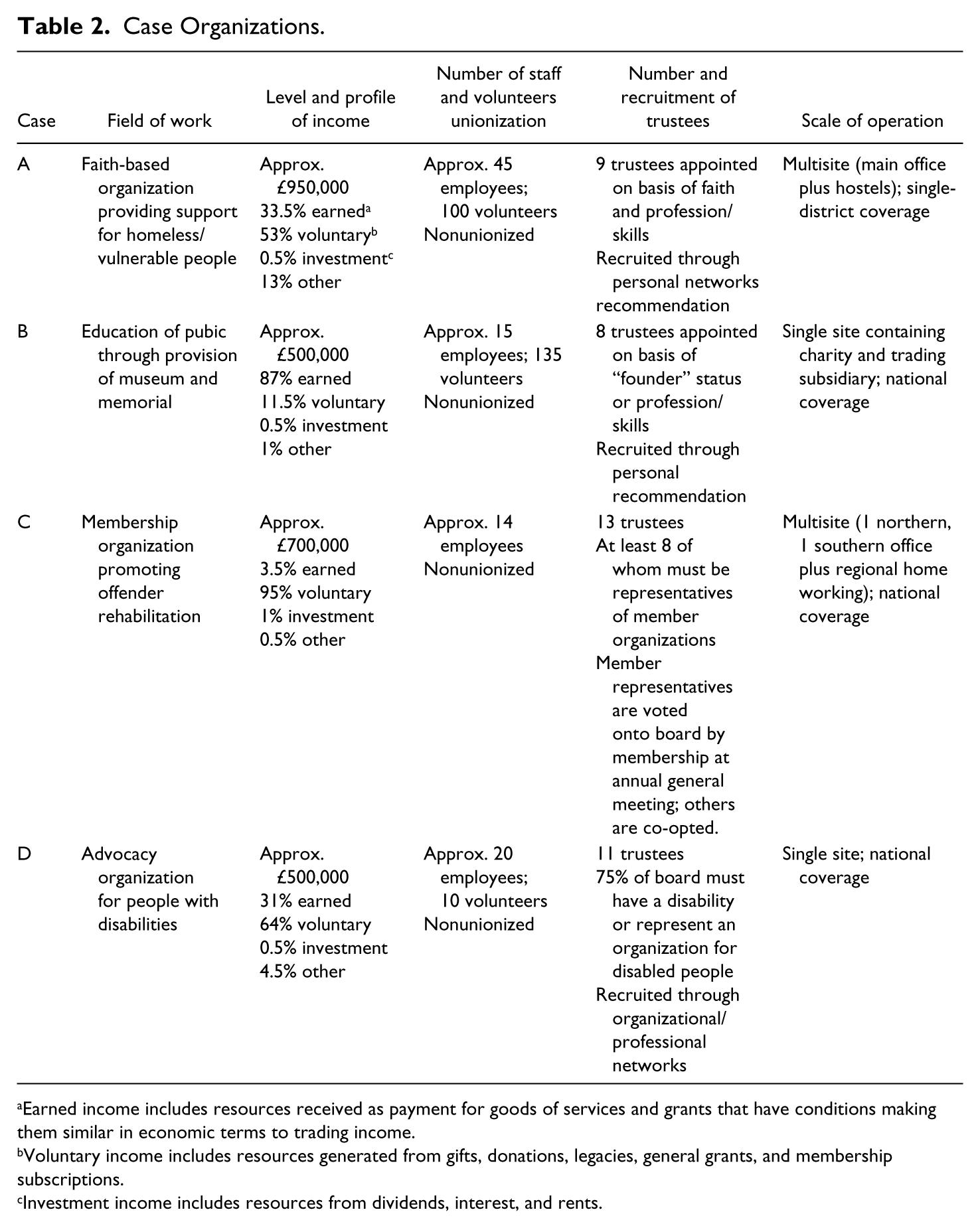
Earned income includes resources received as payment for goods of services and grants that have conditions making them similar in economic terms to trading income.
Voluntary income includes resources generated from gifts, donations, legacies, general grants, and membership subscriptions.
Investment income includes resources from dividends, interest, and rents.
Table 2 illustrates that the cases are heterogeneous with respect to their fields of work, income profile, level and nature of human resources, constitutional requirements for board composition, and scale of operation. Yet, the cases are homogeneous with respect to funding levels and nonunionization. It should be noted that the purpose of case selection is not to establish causal explanations for particular governance and accountability approaches, based on variables such as organizational size, field of work, scale of operation, and so on. Rather, they illustrate how different governance assumptions and practices can be seen to produce different accountability forms and processes. The relationship between these processes and specific organization forms and purposes are considered later in this article.
Data Sources
Fieldwork with the four organizations took place over a 6-month period, and data were collected from three main sources:
Interviews: In all, 23 interviews were undertaken with three categories of actors: board members, CEOs, and staff. A total of 7 interviews took place with board members (1 from Case A; 3 from Case B; 1 from Case C; and 2 from Case D), 4 with CEOs (1 from each case) and 12 with staff from various hierarchical levels (3 from Case A; 2 from Case B; 3 from Case C; and 4 from Case D). Early interviews were largely investigative and resulted in emergent themes that were pursued in subsequent interviews. Interviews with nonprofit actors lasted between 40 and 120 min and had four foci: governance structures, processes and challenges; the nature of relations between staff, volunteers and trustees; the nature of inter-organizational relations and/or collaborative efforts; and how such relational dynamics affect decision making and the setting and safeguarding of mission and values.
Documents: Four categories of information were consulted in the fieldwork period: business/strategic plans, annual reports and accounts, minutes of board meetings, and promotional material. This allowed corroboration of interview material with formal text.
Observations: During field visits, observations of organization activities were recorded in a field diary. This involved the observation of a board meeting at Case A, informal coffee breaks involving all staff at Cases B, C, and D, and at least 1 day of observing general daily activities at each case. Although these observations are not featured in this article, they provided a useful context to aid understanding and theoretical development.
Data Analysis
My analysis followed established procedures for grounded approaches to theory building across multiple organizations (Eisenhardt, 1989; Miles & Huberman, 1984). It consisted of a series of steps, the first of which involved the coding of transcripts and documents for each organization. These codes comprised phrases, terms or descriptions, all revolving around the nature and dynamics of governance and accountability. Such descriptions included, for example, comments on honoring the organization’s original purpose, stories of the organization’s founding era, narrations of the importance of meeting legislative requirements, developing policies and procedures or involving service users. These formed first-level codes, which were constantly compared across documents for possible conceptual patterns within each case.
The second step of the analysis involved looking for codes across interviews and documents that could be grouped into higher level themes. For example, comments on founding eras and honoring the original purpose could be grouped under “Elevation of organizational history to socialize employees into sharing leaders’ beliefs, assumptions and vision for the organization,” forming a set of first-order categories. Importantly, a key analytical task in this and all subsequent steps was to juxtapose cases against each other, searching for similarities and differences.
The third step developed links among first-order categories to develop theoretically distinct clusters through a recursive process. For example, categories containing instances of actors emphasizing (a) the development of policies and procedures to control work, (b) conflict as illegitimate and/or dysfunctional, and (c) organization history to socialize employees into sharing leaders’ visions were collapsed into a theme called “control and conflict.”
The fourth step involved organizing these themes into dimensions that eventually provided a basis for theorizing. The first theme is the logic of unitarism as a driver of narrow, compliance-based accountability; the second emphasizes pluralist logics as a driver of broad, expressive forms of accountability. Steps 2, 3, and 4, and the links between them, are depicted in Figure 1.
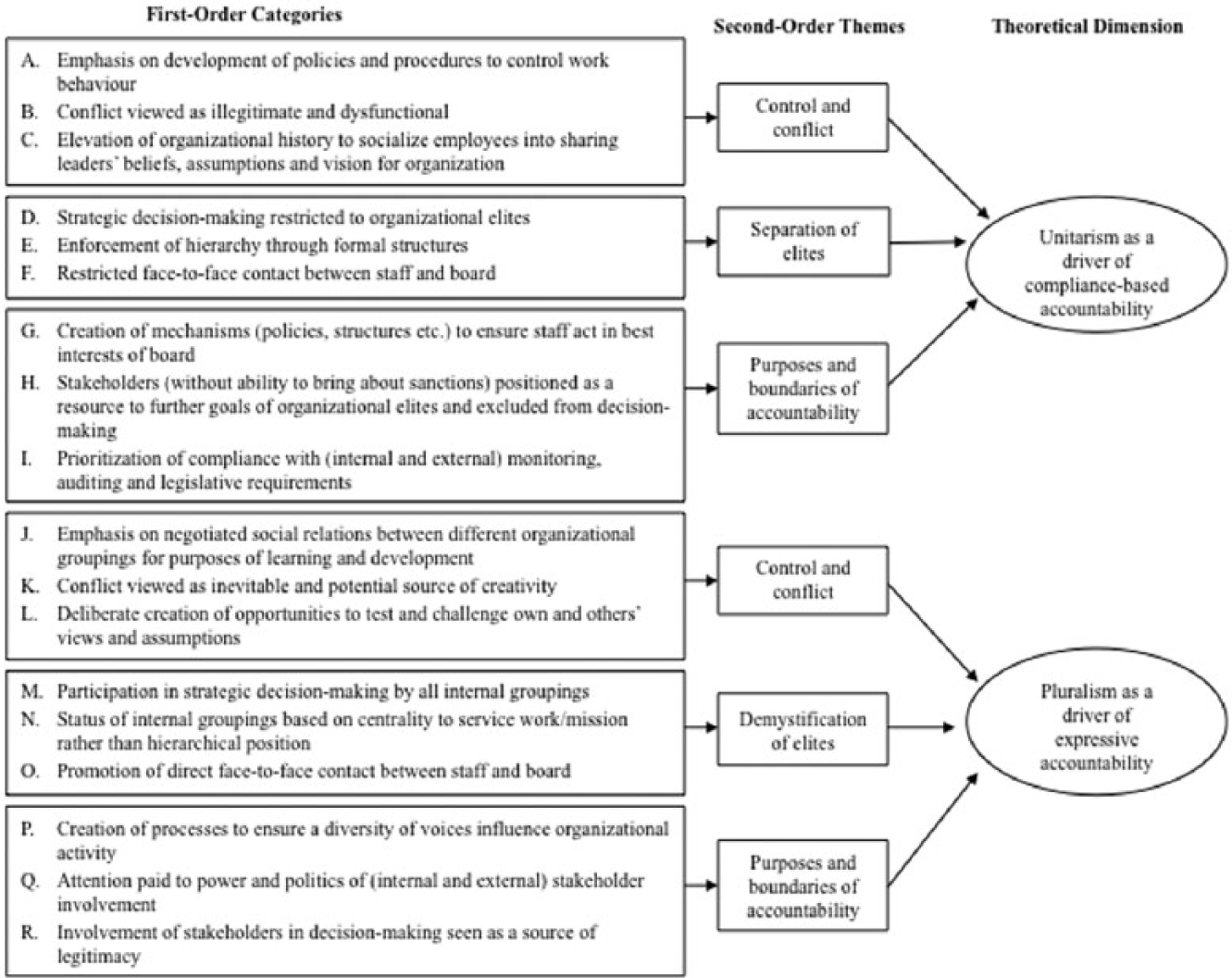
Data structure.
Findings and Analysis
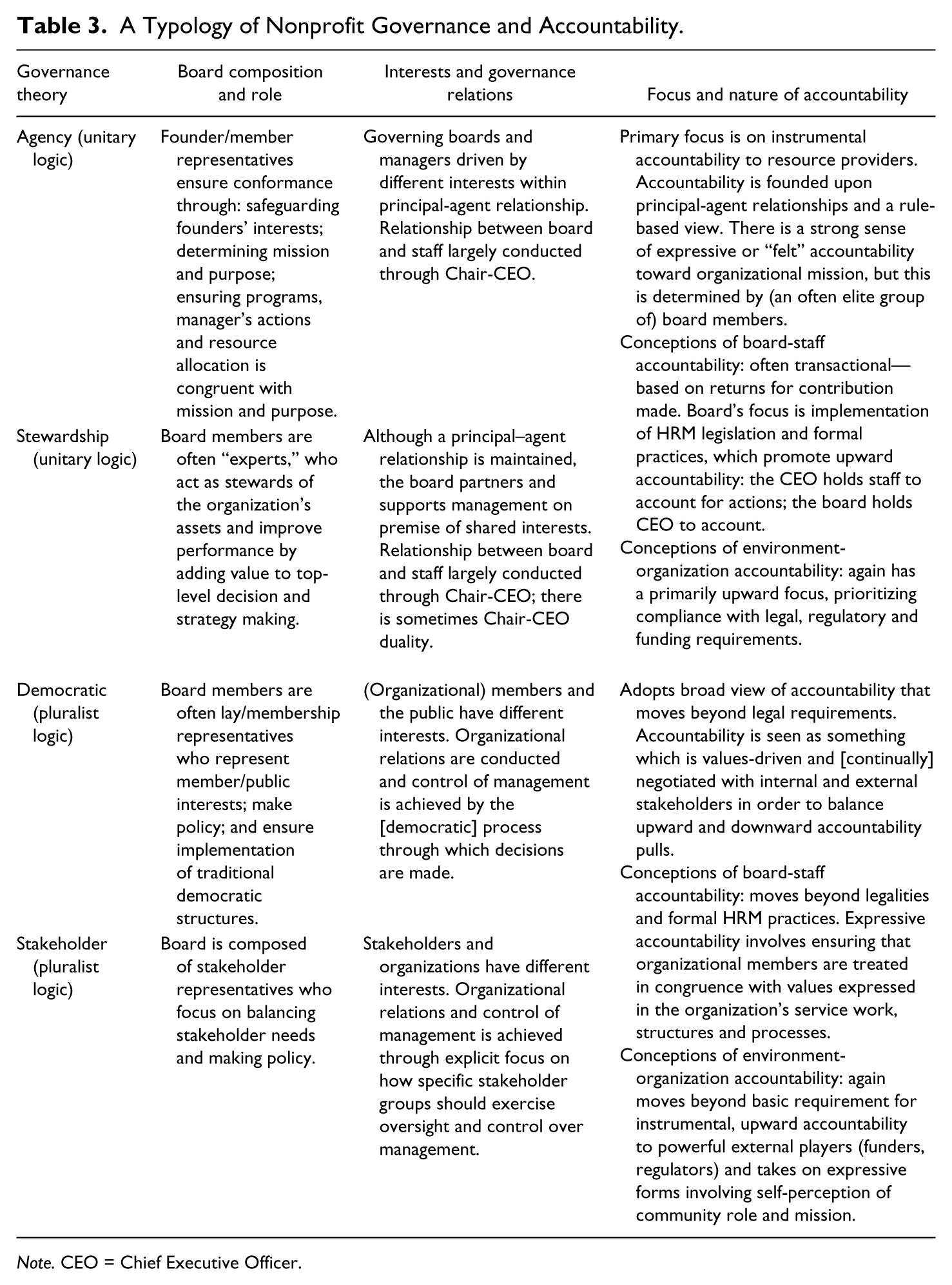
To frame the empirical findings and address the question of what implications exist for accountability in various governance theories and practices, Table 3 delineates the potential consequences of diverse governance assumptions for the nature of accountability in nonprofit organizations. Specifically, the implications of the governance theories foreshadowed in the literature review are linked to board composition and role, board-staff interests, and the subsequent focus and nature of accountability relations. It should be noted, however, that practitioners do not necessarily operate consistently within a particular stance and often vary their approach within a specific context. Rather than claiming the taxonomy presented is exhaustive, I would point to its heuristic value that exposes the possibility of diverse views of governance and accountability, thus illustrating the range of choices available to nonprofit practitioners.
A Typology of Nonprofit Governance and Accountability.
Note. CEO = Chief Executive Officer.
This section proceeds by discussing the analysis underpinning development of the typology in Table 3.
Unitary Theories of Governance and Conceptions of Accountability
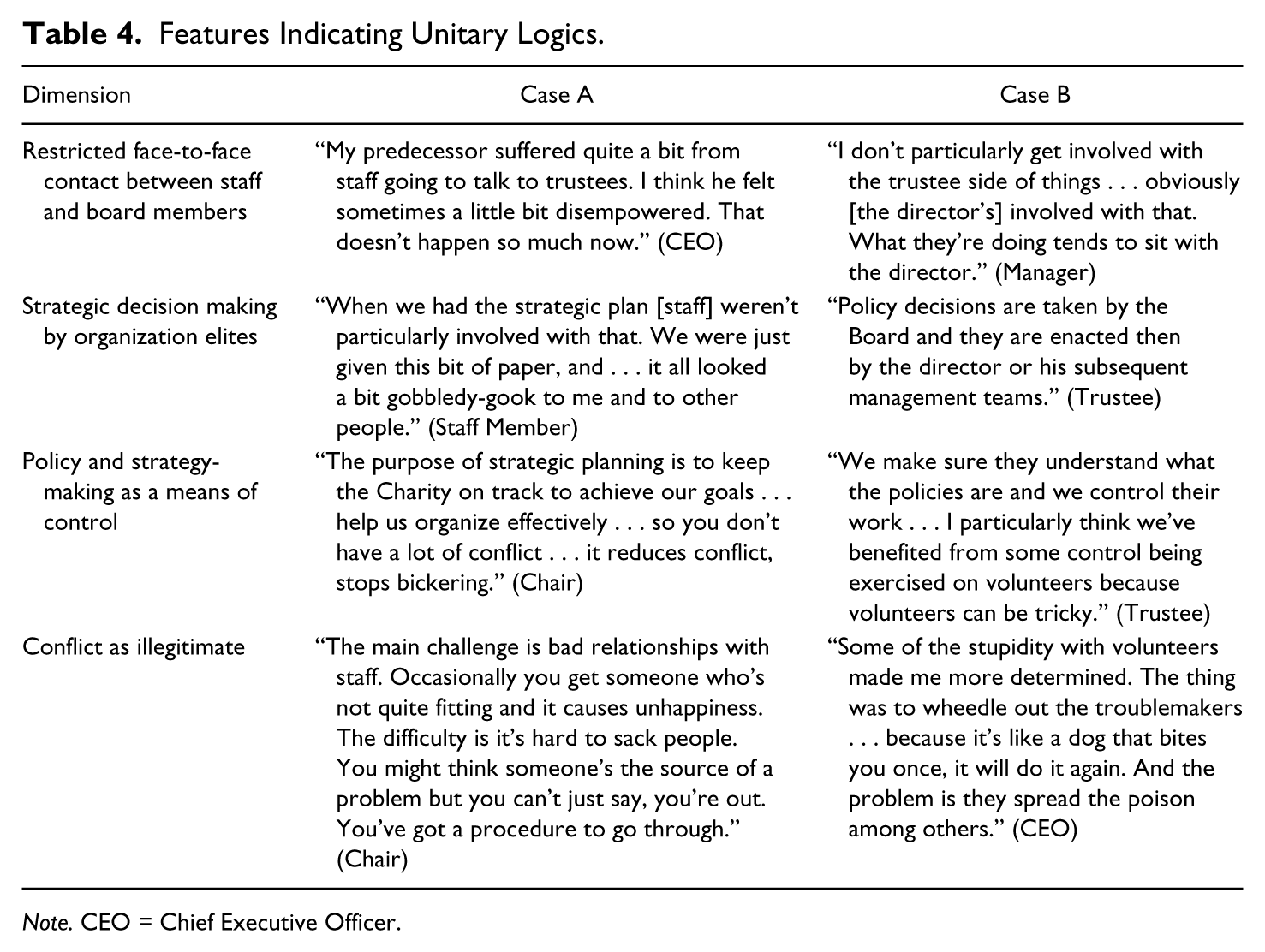
This subsection illustrates how agency and stewardship governance assumptions, based on a unitary logic, can produce particular effects on the nature of accountability. First, however, it is important to highlight the distinguishing features, which suggest the central logic of Case A and B to be unitary (see Table 4).
Features Indicating Unitary Logics.
Note. CEO = Chief Executive Officer.
Both cases appear to be united by overarching unitary logics, where the goal for organization is harmonious, consensual entities that exist for common purposes. There are, however, differences in how they pursue this goal. Case A largely appears to operate within agency governance assumptions where relationships are viewed as nothing more than a series of implicit and explicit contracts with associated rights (Jensen & Meckling, 1976). Within such contracts, a key challenge is how to ensure agents will act in the best interests of principals (Turnbull, 1997). Within Case A, the board—made up of long serving members—assumes its role in the monitoring and control of the CEO to limit any divergence from their interests: In terms of the board, it’s our job to make sure the CEO is properly monitored. I see him fortnightly for an hour, hour and a half, see he’s doing the job and I’m just trying to help him by holding him accountable. (Chair)
In contrast, Case B seems to adopt a partnership approach between CEO and board, indicating parallels with stewardship governance assumptions and the associated adoption of CEO duality (Muth & Donaldson, 1998). Though U.K. charity law generally prevents it, Organization B developed complex structures to allow the CEO to act as a trustee; the CEO simultaneously holds the position of Honorary (unpaid) Museum Director of the charity and Chief Executive of the wholly owned trading subsidiary, for which he is remunerated. The board obtained an Order from the Charity Commission to enable him to continue to be a trustee of the charity when he took on the role as CEO of the trading subsidiary. Despite a collectivized approach between board and CEO, however, the CEO exercises complete authority over the organization and his role is unambiguous and unchallenged by staff, thereby suggesting adoption of a unitary logic (Donaldson & Davis, 1991).
Although interpretation of the data signals Case A and B start from opposite assumptions regarding the interests of the board (as principals) and CEO (as agent), they share the idea that control emanates from the top of the organization where elites rule: “You have, as Trustees, people who are eminent in their professions and skilled . . . that’s where the expertise comes from. It’s assumed they’re capable and expert and they sit on the Trustees, showing their wisdom” (Chair, Case A). Thus, considering the relationship between board and staff more widely appears to illustrate that agents’ accountability to principals takes precedence and is enacted through adherence to monitoring and implementation of HR legislation, policies, and procedures. Accountability thus acts as a constraint upon an opportunistic and self-interested human nature (Roberts, 2001). Roberts argues that such processes and practices of accountability create individualizing effects, which are associated with formal hierarchal accountability, and drive development of instrumental relationships. The associated monitoring and organization surveillance takes place within formal hierarchical accountability and, arguably, creates disciplinary effects (Rose, 1989) and processes that attempt to prevent circumvention of formal hierarchy.
At an informal level, there seems to be an attempt to “build strong cultures” where employees share their leader’s beliefs, assumptions, and vision for the organization (Martin, 2001, p. 8). Case A’s employees are socialized with the founding story of a visionary faith leader who identified the need and established provision for “the needy,” while within Case B, there is constant reference to the historical military links of the museum and maintaining an authoritarian approach consistent with that tradition. In each case, the historical roots of the organization are used to legitimize the authority of a select group of leaders (principals) over a group of subordinate followers (agents) and to ensure the principal’s goals are accepted as natural, unchallengeable and given. Table 5 illustrates the various ways in which Cases A and B reinforce instrumental accountability within internal relations.
Mechanisms to Reinforce Hierarchical, Instrumental Accountability in Internal Relations.
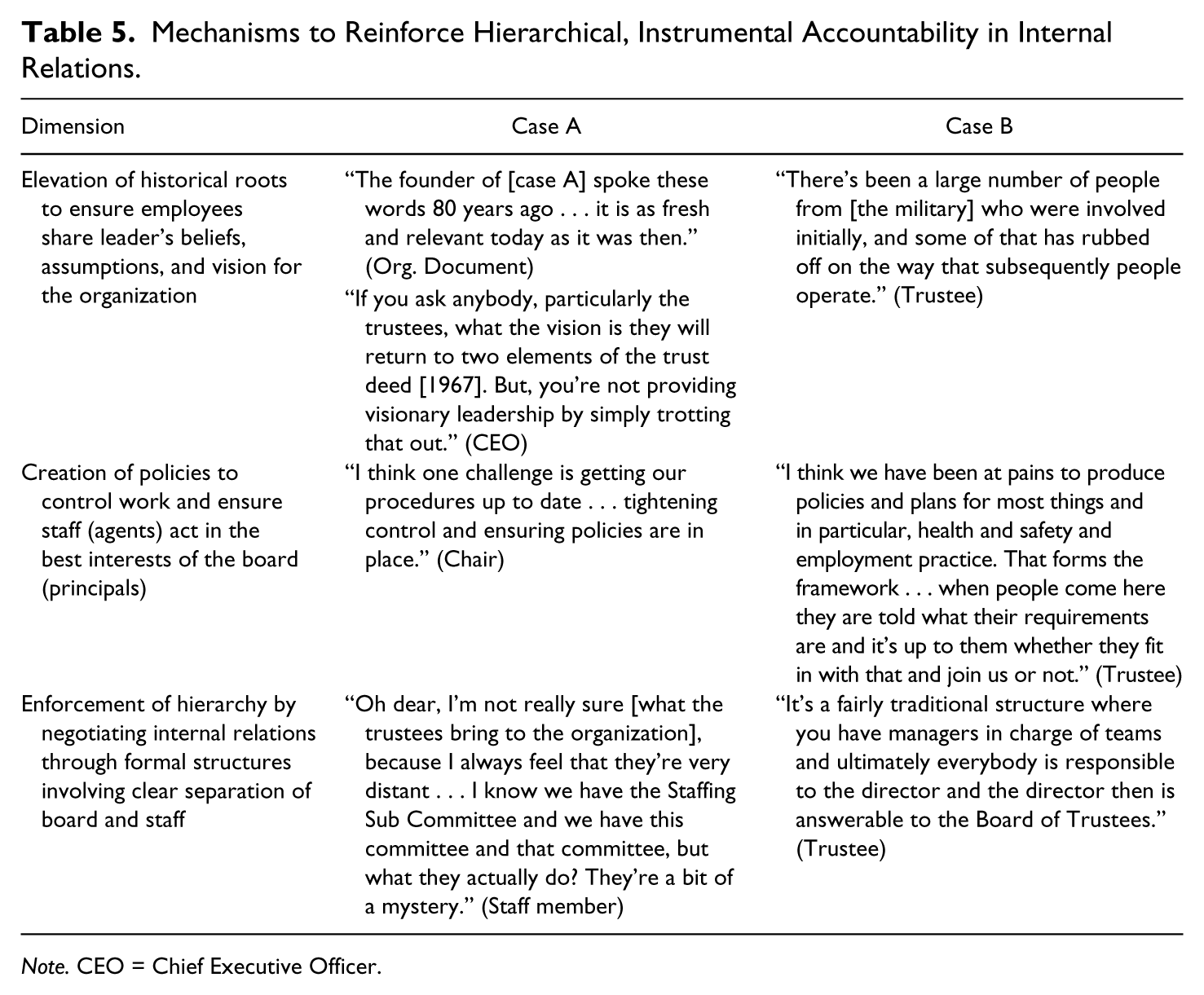
Note. CEO = Chief Executive Officer.
Within such contexts, the construct of instrumental relationships at the individual level seems to reproduce at the organizational level, leading to the prioritization of instrumental, transactional relationships to external stakeholders. Roberts (2001) argues that dominance of external market mechanisms contributes to producing such forms of accountability and it is noteworthy that Case B has the highest level of earned income and is run as “an attraction business,” while Case A has the second highest proportion of earned income—albeit marginally—with the ambition to increase this type of income. Within both cases, references to “professionalization,” “amateurism,” and “business” are prevalent within the narratives of senior organizational actors and compliance with legal and regulatory obligations seems to take priority. External stakeholders who lack the authority to bring about sanctions, such as service users, appear marginalized in decision-making processes in favor of viewing them as customers or consumers of services. Moreover, donors and other players in the external environment are looked upon as an instrumental resource to further the goals set by the organizations’ elite (see Table 6).
Privileging of Upward, Instrumental Accountability in External Relations.
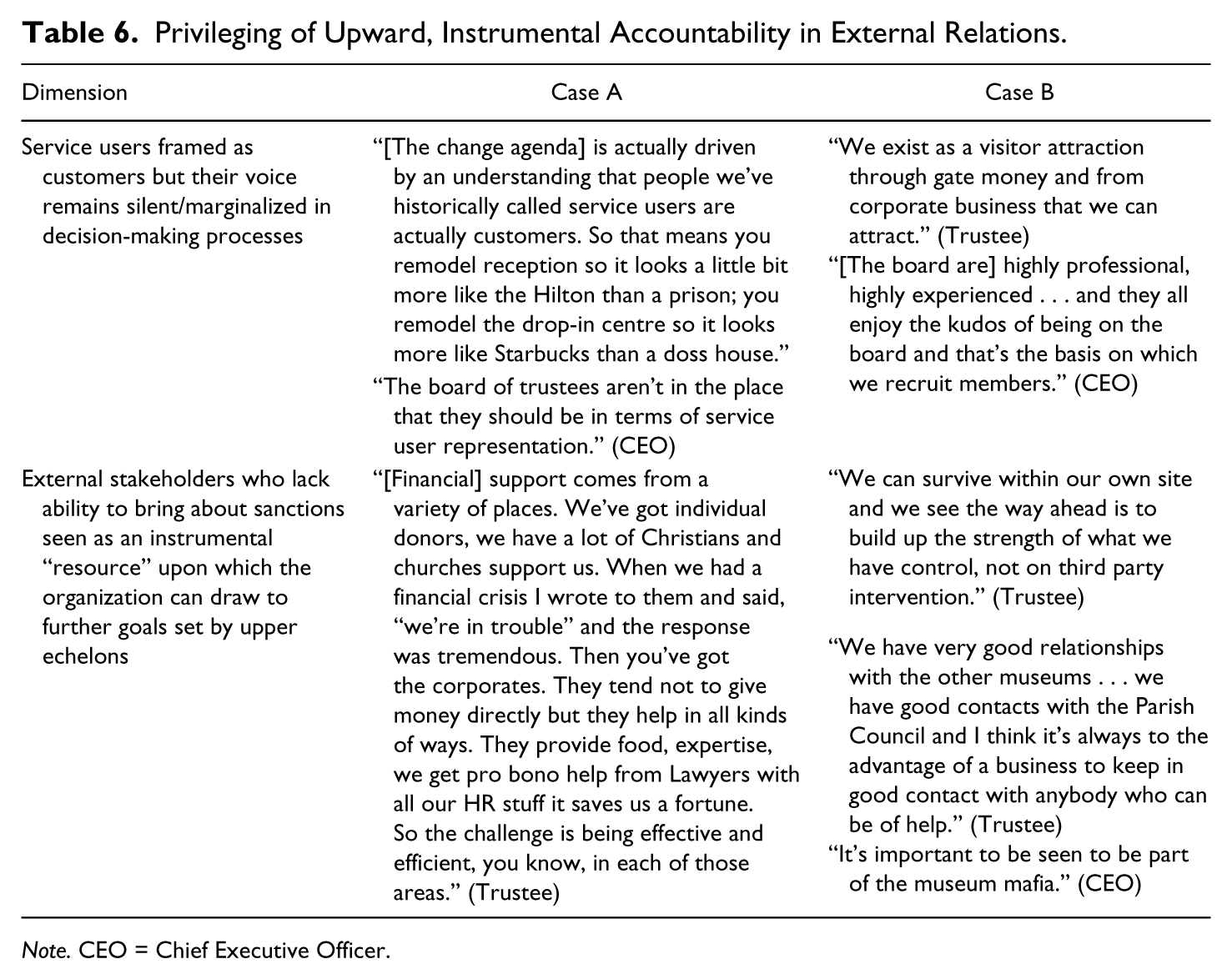
Note. CEO = Chief Executive Officer.
My analysis indicates that if missions, visions, and goals are developed and governed solely by organization elites, it is their perspectives that become prioritized and legitimized at the organization level. Prioritization of principals’ interests is not considered a problem if principals’ appointments are assumed to be based on merit. They are assumed to be the rightful guardians of the overall purpose of the organization that is pursued in the best interests of all members, whether they realize it or not (Johnson & Gill, 1993). As Table 4 suggests, rationality is “automatically accorded to decision making of the leadership and the behavior of subordinates who might be recalcitrant or even resistant to such direction becomes deemed to be irrational” (McAuley, Johnson, & Duberley, 2007, p. 15). I find that in this situation, broader conceptions of expressive accountability based on moral foundations often can be marginalized in favor of narrow conceptions of hierarchical accountability within instrumental principal-agent relationships. By conceptualizing accountability in this way, the priorities of the majority of organization members and wider community stakeholders who are affected by the organization’s operation may be marginalized or excluded. Moreover, this narrow instrumental view of human nature can appear at odds with the values embedded in the social mission of many nonprofit organizations.
Pluralist Governance Theories and Accountability
Before contrasting the above governance approaches and their accountability implications with democratic and stakeholder governance assumptions, Table 7 evokes the central logic of Case C and D as pluralist.
Features Indicating Pluralist Logics.
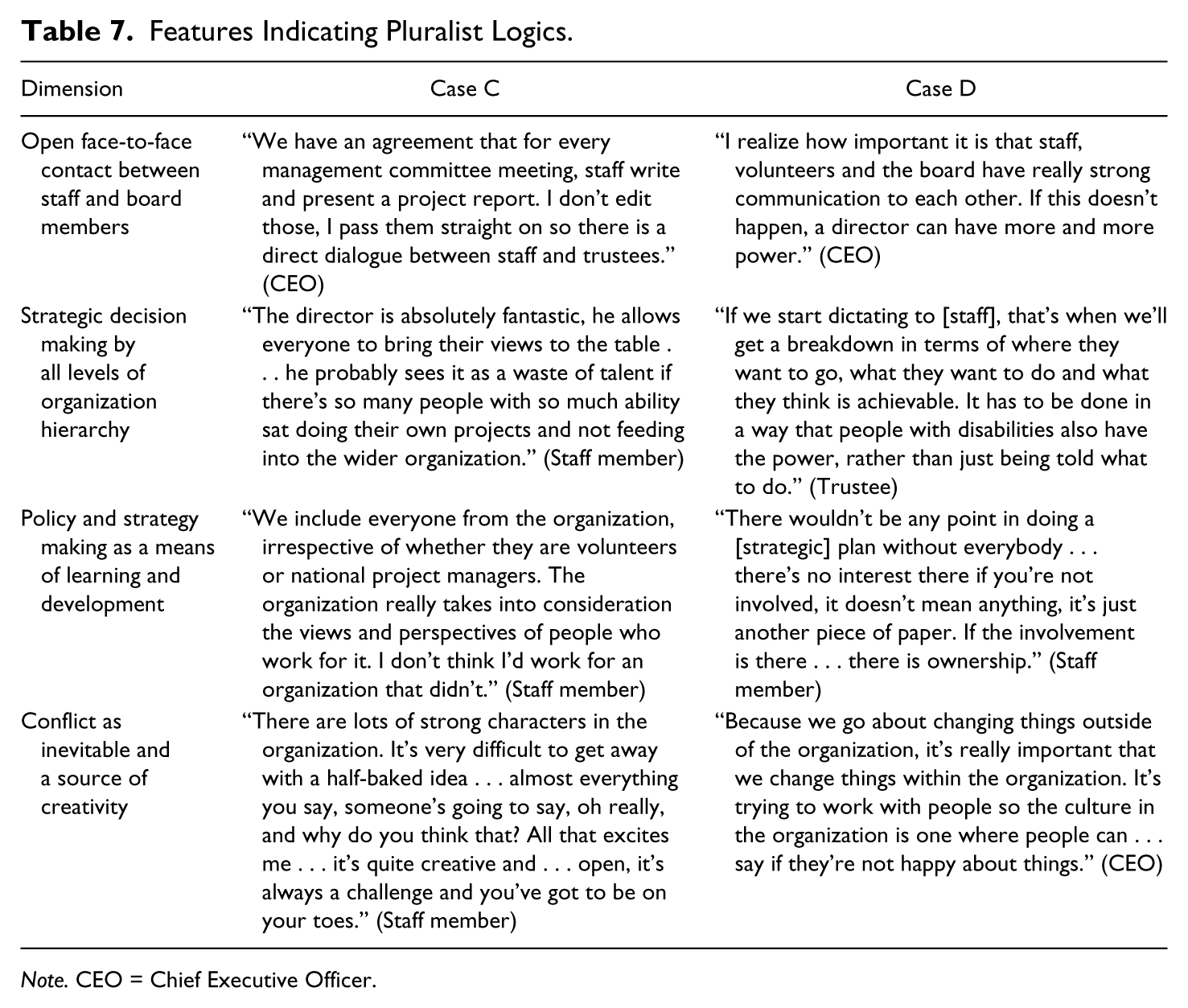
Note. CEO = Chief Executive Officer.
Though Cases C and D appear to be founded upon pluralist logics, where organizations are constituted by diverse groups who pursue disparate interests, there are subtle but important differences which deserve attention. Case C seems to operate under the premise that to prevent the organization from adversely affecting stakeholders it requires governance processes that allow stakeholders to participate in decision making. In a practical sense, this plays out formally through the election of trustees by Case C’s membership and the co-option of other board members, representing statutory agencies, to ensure a sufficiently wide representation of stakeholder interest groups. The board, in turn, charges the CEO with the responsibility of stakeholder involvement in wider organizational endeavors: The trustees usually give me a steer . . . a recent issue has been to what extent we build relationships with the private sector and how that is presented to members; we will also not compete to provide any service that our members could provide. The general instruction I have from the trustees is that we want people in the tent rather than outside the tent and we should work to accommodate what they want. (CEO)
Case D appears strongly driven by the principles of democratic theory, built on the protection of individual liberties and rights (Moravcsik, 2004). Such ideological foundations are endemic in both the formal charitable objects of the organization, which talks of helping a particular section of society “obtain their full rights and privileges,” and its processes and practices: Because we go about changing things outside of the organization, it’s really important that we change things within the organization. We don’t just accept how things “should” be; we’re always trying to change things and that thing about the process is really important . . . if we don’t get the process right then the end result is never right. (CEO)
Despite maintaining a structural separation of board and staff, a requirement of U.K. charity law and also often a strategy to reassure funders, regulators and other interest groups (Turnbull, 1997), the reality of organization life is very different. Much value, for example, is placed on locating decisions in democratic discourse (see Dimension 3, Table 7), perhaps based on the recognition that transactions are “conducted on the basis of mutual trust and confidence sustained by . . . mutually obligated and legally non-enforceable relationships” (Hollingsworth, Schmitter, & Streeck, 1994, p. 6). It is particularly notable that there is an element of “self-governance” as appointment of trustees is conditional on prospective board members spending time with and receiving “approval” from the “governed” who are, in turn, often people with disabilities.
Despite these differences, actors within both organizations arguably display skepticism about the moral defensibility of dominant models of management and organization (Adler et al., 2007) and the automatic rights of organizational elites’ to govern and manage (Johnson & Gill, 1993). I find that such an approach often leads Cases C and D to go beyond instrumental, hierarchical forms of accountability to a broader, expressive view of accountability involving ongoing social, political, and moral processes (Watson, 2006) between internal groups. Roberts (2001) posits that such processes and practices of accountability create socializing effects often involving face-to-face accountability between people of relatively equal power, in a cultural if not structural sense. The ability of trustees and managers to pursue organizational strategy in this context seems to require account to be taken of employees’ perceptions of its legitimacy. Table 8 suggests various ways in which Cases C and D reinforce expressive accountability within internal relations.
Mechanisms to Reinforce Felt, Expressive Accountability in Internal Relations.
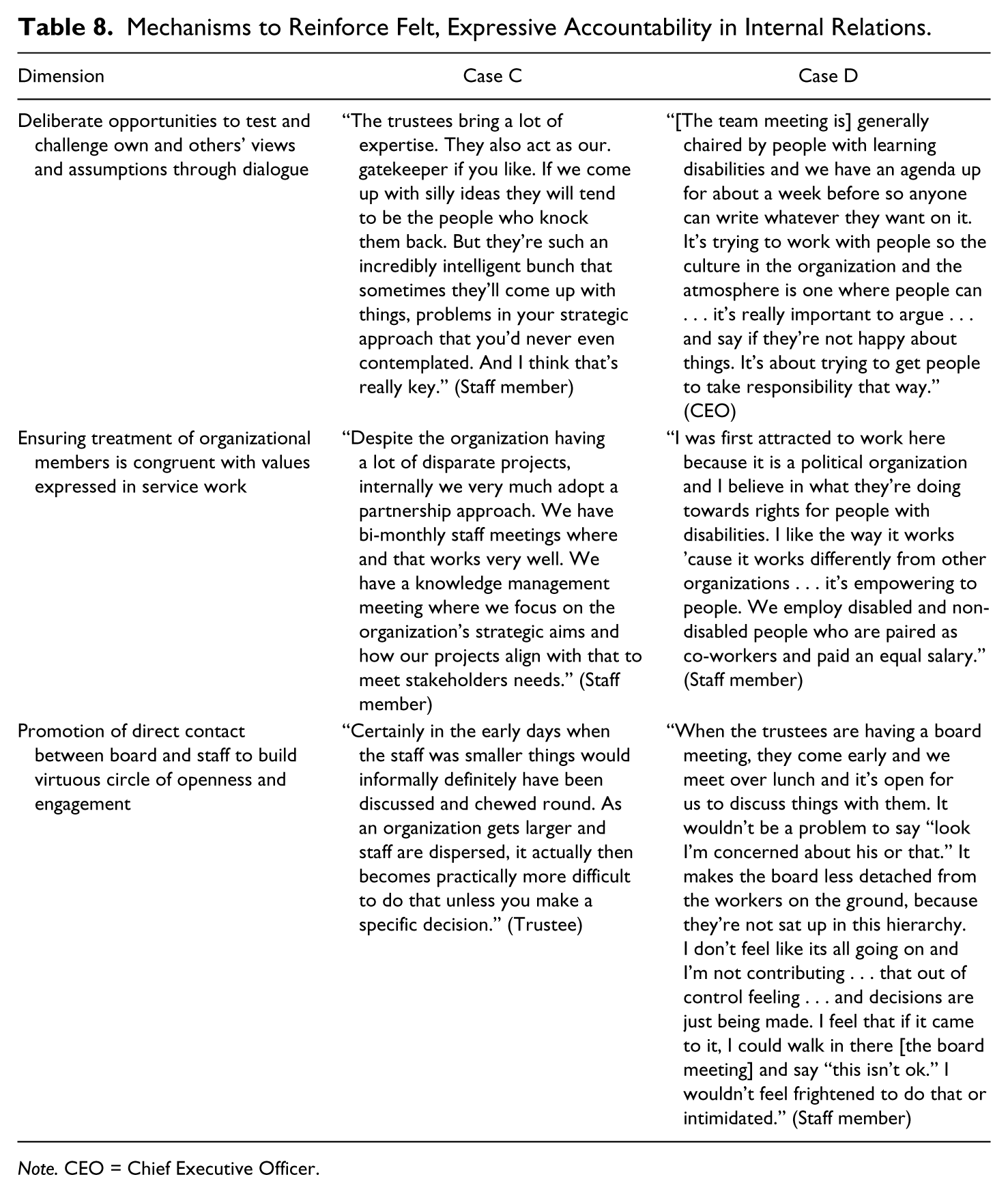
Note. CEO = Chief Executive Officer.
Within such contexts, the view that social relations involves moral, ethical, and political processes is also applied to relationships with external stakeholders. Here, the focus moves beyond instrumental, upward accountability to those who have the authority to hold the organization accountable and can take on expressive forms based upon sets of relationships and understandings of community roles and mission (see Table 9).
Privileging of Expressive, Values-Based Accountability in External Relations.

Note. CEO = Chief Executive Officer.
From the perspective of Cases C and D, organizations appear to be viewed as social collectives, where, “through critique, reflection, debate and the development of democratic relations, the status quo might be challenged and alternative forms of organization developed that express the perceived interests of those currently excluded from a say in how organizations are organized” (McAuley et al., 2007, p. 26). Such practices challenge a narrow view of accountability relations within and between organizations and their stakeholders as essentially instrumental and instead construct them as a potential source of legitimacy. This broad view of accountability, however, would come under attacked by those who adopt the assumptions of principal-agent relations as the “best” way to organize. Here, the only legitimate form of accountability is to those who have the (legal) authority to hold agents to account (Sternberg, 1997).
Concluding Remarks
While theorization of corporate governance has become increasingly sophisticated, theories of nonprofit governance are comparatively underdeveloped (Cornforth, 2004, 2012). In the context of this article, advances have been made regarding the effects of particular systems of governance on processes of accountability within the corporate domain (see Roberts, 2001). In the nonprofit arena, however, theoretical developments surrounding the nature of accountability transcend understanding of nonprofit governance. In particular, understanding of governance to achieve broad accountability—as called for by numerous nonprofit scholars—has lagged (Morrison & Salipante, 2007). Drawing on multiple governance theories and empirical work with nonprofits from a critical management studies perspective, this article contributes a framework to deepen understanding of the effects of different governance assumptions and practices on the production of different forms and processes of accountability in a nonprofit context. By addressing the underlying philosophical and relational issues in governance, the article frames nonprofit governance and accountability as social and dynamic processes.
Each governance theory is infused with assumptions of how organizations work and the interests of the diverse parties involved. The analysis presented suggests that unitary logics tend to focus the work of principals on producing policies and procedures to control the work behavior of agents. The purpose of internal accountability is to constrain an opportunistic and self-interested human nature through trustees and, subsequently, senior managers, attempting to institutionalize their power over others. This can result in transactional or instrumental relationships governed by the “system” created by those at the apex of the organization. Equally, organizational members often prioritize compliance with the formal rules of powerful players within the external environment who have the authority to hold the organization to account. Accountability can thus take on a narrow, hierarchical form.
In contrast, while pluralist logics do not reject the notion of control, they recognize that only partial control can ever be achieved. Organizations exist only through human relationships and whatever control is achieved is “brought about as much through processes of negotiation, persuasion and manipulation as through system devices like rules and official procedures” (Watson, 2006, p. 56). Similarly, external stakeholders are seen as part of social groups where interests diverge. Expressive, negotiable accountability to a broad range of stakeholders is often seen as central to organizational mission and legitimacy within society. It has been argued that framing organizations as social collectives in this way is a “vital source of learning and can produce complex relationships of respect, trust and felt reciprocal obligation, which far exceed the purely instrumental orientation to action that agency theory assumes” (Roberts, 2001, p. 1567).
The four governance theories reviewed thus represent distinct schools of thought, which are infused with specific and sometimes opposing assumptions about the nature of work and organization that hold major implications for the treatment of stakeholders through producing particular forms and processes of accountability. My intention is not to position any particular approach as inherently superior to another in economic or efficiency terms; indeed, all four cases demonstrated a growth trajectory over the 5-year period prior to this program of research. Rather, I am encouraging theorists and practitioners to be aware of, and explicit about, the value systems underpinning work organizations and the implications of their assumptions. In the context of increasing calls for broad accountability, a core question for nonprofit scholars and practitioners is the extent to which treatment of internal and external stakeholders honors the moral and social values projected through the organization’s social mission.
Finally, it would be inappropriate to conclude such an article without situating my own position within the contested terrain presented given the importance I have placed on reflexive engagement with knowledge and practice constituting assumptions. My position inevitably brings its own limitations. Through the act of developing a framework located in a critical analysis of governance and accountability, I unavoidably undermine some of the schools of thought I have analyzed. By emphasizing the need to take into account issues of power, beliefs about the nature of organizing, and the negotiation of social relations, I oppose the instrumentalist view of principal-agent theories. Equally, by attempting to interrogate how notions of governance and accountability might variably be conceived and the ensuing implications of this variability, postmodernist researchers may charge that I have presented a meta-narrative. The article does not endeavor to provide prescriptions of “how to” govern nonprofits. Rather, I hope it exposes some of the various views on corporate governance that exist precisely because different scholars investigate organizations from diverse viewpoints, cultural contexts, intellectual backgrounds, and interests (Turnbull, 1997).
Footnotes
Acknowledgements
My sincere gratitude goes to Penny Dick for insightful suggestions, which contributed greatly to the article’s development. I am also grateful to the three anonymous reviewers for valuable comments on numerous iterations of the article.
Declaration of Conflicting Interests
The author(s) declared no potential conflicts of interest with respect to the research, authorship, and/or publication of this article.
Funding
The author(s) received no financial support for the research, authorship, and/or publication of this article.