



Abstract
Internal branding refers to an organization’s attempts to persuade its staff to buy-in to the organization’s brand value and transform it into a reality. Drawing from self-determination theory and leadership theory, we seek to develop a deeper understanding of the process of internal branding in the nonprofit sector. More specifically, we propose and examine the mediating effects of the staff’s emotional brand attachment, staff service involvement, and the moderating effect of charismatic leadership on the brand orientation behavior–organizational performance relationship using data obtained from the representatives of 301 nonprofit organizations in the United Kingdom. On a general level, the findings suggest that staff emotional brand attachment and staff service involvement are linked to brand orientation and organizational performance. Moreover, charismatic leadership increases the strength of this linkage. All of these findings extend the literature on internal branding.
Keywords
Introduction
An organization’s brands, defined as a name, term, design, symbol, or any other feature that identifies one organization from another, have long been recognized by scholars as one of the most important assets of nonprofit organizations (NPOs; for example, Ewing & Napoli, 2005; Hankinson, 2001). Prior studies suggest that NPOs’ brands play a critical role in attracting donation income and volunteers (Hankinson, 2002; Sargeant, Ford, & Hudson, 2008). Brand orientation refers to the practice of an organization that deliberately creates, develops, and protects its brands with the aim of achieving their organizational objectives. This has been widely studied in the context of NPOs (e.g., Ewing & Napoli, 2005; Hankinson, 2000). One stream of literature specifically focuses on exploring the theoretical foundations of brand orientation behavior and its impact on an organization’s competitive advantage (Ewing & Napoli, 2005; Hankinson, 2002; Napoli, 2006). Despite the considerable amount of research done on this area, three knowledge gaps remain. This research attempts to address these three knowledge gaps.
First, this study contributes to the existing research on internal branding (e.g., Morhart, Herzog, & Tomczak, 2009; Punjaisri & Wilson, 2011) by providing a theoretical logic for understanding this phenomena. We propose and test a conceptual framework that integrates self-determination theory and leadership theory to explain the process of internal branding, together with the critical roles that leadership plays in facilitating this process. Second, many researchers report a positive relationship between brand orientation behavior and organizational performance (e.g., Hankinson, 2002; Napoli, 2006). Few studies have explored the intermediate mechanisms explaining this relationship. Here, we propose and test a causal chain relationship whereby an organization’s brand orientation behavior may influence its staff’s emotional brand attachment (the extent to which the staff have strong feelings toward that organization’s brand) and staff service involvement (the degree to which the staff perceive the services provided under the organization’s brand to be personally relevant to them), and ultimately lead to improved organizational performance. Third, the recent literature on internal brand management has recognized the critical role that leadership plays in facilitating the management process (e.g., Morhart et al., 2009; Wieseke, Ahearne, Lam, & van Dick, 2009). In this study, we examine the effect of a specific type of leadership style—charismatic leadership, a type of leadership that is focused on inspiring subordinates to follow the leader’s attitudes and behavior (Conger & Kanungo, 1998)—on internal brand management. There has been little studied in this subject before, as most previous research has focused on the transactional and transformational leadership style (e.g., Morhart et al., 2009). This study offers fresh insights into the importance of selecting a charismatic leader to manage social mission–driven organizations. Finally, this study contributes to the brand orientation literature on a specific industry context, that is, NPOs. Empirical studies on brand orientation that are relevant to the NPO context differ in nature from our current study. Although extensive studies have examined the direct relationship between brand orientation behavior and organizational performance (Ewing & Napoli, 2005; see also Hankinson, 2000; Napoli, 2006), only a few have specified the contingencies through which this association might be shaped (e.g., Mulyanegara, 2011). This study contributes to the existing pool of knowledge on brand orientation with regard to NPO sector–specific applications.
Theory Development and Hypotheses
An organization’s brand can also be viewed as a promise that an organization has made about the expected benefits of its products or services. Brands can be used to distinguish its products or services from those of its competitors (Hankinson, 2004; Sargeant et al., 2008). The literature suggests that an organization’s brand can be developed through either external or internal activities, or sometimes both. External activities emphasize using marketing techniques to communicate to external audiences (i.e., customers) to influence their thoughts, feelings, perceptions, images, experiences, beliefs, and attitudes toward an organization’s brand (e.g., Madhavaram, Badrinarayanan, & McDonald, 2005). Conversely, the internal activities seek to promote the brands inside an organization for the purpose of ensuring that its internal audiences, that is, employees, accept the value that the organization’s brand represents and transform it into a reality when serving customers (Punjaisri & Wilson, 2011; Thomson, de Chernatony, Arganbright, & Khan, 1999). In this study, we focus on exploring the development of an organization’s brand through internal branding. We begin by elaborating on the theoretical logic of our argument. Figure 1 presents our conceptual framework and the associated hypotheses.

Conceptual model.
In developing this conceptual framework, we integrate two different theories commonly used to explain the brand building process or brand management: self-determination theory and leadership theory. The self-determination theory proposes that an individual’s behavior is self-determined by internalizing externally encourage role behaviors into intrinsic motivated acts (Deci & Ryan, 2004). In connection with the concept of internal branding, extrinsic motives such as rewards and external demands can be assimilated with the staff’s intrinsic values such as the acceptance of an organization’s brand value and behavior in reflecting the organization brand value. For example, Morhart et al. (2009) suggest that internal branding can be viewed as a tactic through which managers promote organization-wide, regulated behaviors (extrinsic motives) in relation to brand building and hope that their employees will internalize these as part of their role identity to become the representatives of the organization’s brand. Leadership theory, on the other hand, is a school of thought that describes how the traits, behavior, attitude, powers, charisma, and other characteristics of a leader can influence the attitudes and behavior of his or her followers or staff (e.g., Hiller, DeChurch, Murase, & Doty, 2011; Walter & Bruch, 2009). In connection with the concept of internal branding, leadership activities can have a profound influence on the staff’s attitudes and behaviors in reflecting the brand promise that the organizations wish to promulgate. For example, Vallaster and de Chernatony (2006) conducted 30 in-depth interviews and found that the organizational leaders serve as “integrating forces” in facilitating the internal branding.
In this research, we propose that the integration of self-determination theory and leadership theory can be used to explain the process of internal branding. We argue that this is because both self-determination theory and leadership theory highlight the important role of the managers in creating a favorable organizational environment for the process of internal branding to take place. Self-determination theory argues that individuals internalize the extrinsic motives into intrinsically motivated behaviors (Deci & Ryan, 2004). In the sense, the outcomes of internalization depend on the extrinsic motives and the different types of extrinsic motives can lead to very different outcomes. These extrinsic motives can be viewed as an organizational environment that managers create to persuade the staff to transform them into intrinsic motivation (Deci & Ryan, 2004; Ryan & Deci, 2000). Leadership theory, on the other hand, argues that, for the leaders to organize their followers to achieve a common goal, they need to create an organizational environment that satisfies the followers’ needs (Hiller et al., 2011; Walter & Bruch, 2009). According to both theories of internal branding, whether or not the staff embrace organization’s brand values and transform them into reality depends on the organizational environment that managers choose to create. As a result, self-determination theory and leadership theory complement each other in explaining the process of internal branding. Drawing on self-determination theory, we can make an assumption that an organization can only engage in internal branding when its staff can internalize its brand value and are willing to act accordingly when providing services (de Chernatony & Segal-Horn, 2003; Miles & Mangold, 2004; Shamir, House, & Arthur, 1993). However, it is important to note that this internalization process may not be equally pronounced for all situations. As discussed earlier, we can use leadership theory to predict how likely it is that the followers will be willing to comply with the leaders to achieve common goals (Wieseke et al., 2009). Taken together, we can argue that the staff will reflect the brand value when serving customers, only if they determine their role identity as representative of the organization brand, and leaders may play a critical role in facilitating this internalization process by persuading the staff to live the brand values. We will now develop our hypotheses in detail.
The Causal Chain Relationship and Mediation Effects
From the perspective of internal branding, an organization attempts to persuade its staff to buy-in to the organization’s brand value and transform it into a reality through enabling them to have a clear understanding of its brand value (Morhart et al., 2009; Vallaster & de Chernatony, 2006). Drawing on self-determination theory, we propose a causal chain relationship with regard to the process of internal branding in which an organization’s brand orientation behavior will enhance the staff emotional brand attachment, then trigger the development of staff service involvement, and ultimately lead to superior organizational performance. According to self-determination theory, Ryan and Deci (2000) identified six stages of motivation (from extrinsic to intrinsic) relatively to their autonomy: amotivation (lacking an intention to act), external regulation (performed activities because of an external demand), introjected regulation (performed activities because of a wish to avoid guilt or anxiety or attain ego enhancement or pride), regulation through identification (performed activities because of identifying with personal importance), integrated regulation (performed activities because of who they are—becoming part of himself or herself), and intrinsic motivation (self-determined activity). Moreover, the individual may originally be exposed to an activity because of one stage of motivation (i.e., introjected regulation—it is unnecessary to have progressed through each stage of internalization with respect to a particular regulation), and such exposure might allow the person to adopt another stage of motivation (i.e., integrated regulation). In this research, we argue that three components in our framework, such as the organization’s brand orientation behavior, the staff emotional brand attachment, and the staff service involvement, represent the process of internal branding and different stages of motivation as described earlier. With the increasingly internalized organization’s brand value, the staff will adopt another stage of motivation until full internalization (intrinsic motivation) occurs. Once the staff fully assimilate the organization’s brand value, they will transform it into the reality when serving customers. Thus, it will lead to superior organizational performance. We elaborate our arguments below.
First, we propose that the organization’s brand orientation behavior is the starting point for internal branding and represents the external regulation stage of motivation. Urde, Baumgarth, and Merrilees (2013) suggest that brand orientation can be considered a strategic platform from which the top management systematically integrates the organization’s mission, vision, and values into its brand. The concept of brand orientation is applicable to both the NPO (e.g., Ewing & Napoli, 2005; Hankinson, 2000) and the for-profit organization (e.g. Baumgarth, 2010) context, and can be divided into two aspects: behavioral and cultural. In the “cultural” aspect, brand orientation is a certain type of organizational culture that represents the organization-wide beliefs, guidelines, stories, systems, and symbols (Baumgarth, 2009; Hatch & Schultz, 2001). From the “behavior” aspect, brand orientation is a series of concrete actions that are undertaken when communicating an organization’s brand in a way that will influence the external assessment of its reputation (Hankinson, 2002; Madhavaram et al., 2005). In this research, we focus specifically on the behavior aspect of brand orientation.
Brand orientation behavior comprises three types of concrete action in communicating an organization’s brand: orchestration, interaction, and affect (Ewing & Napoli, 2005; Napoli, 2006). Orchestration is the degree to which the organization effectively communicates its brand promise to both its internal and external stakeholders. Interaction is the degree to which an organization uses market feedback and responses to inform its changes. Finally, the affect capability is the degree to which the organization understands the stakeholders’ preferences (both positive and negative) about the brand. When an organization deliberately undertakes all three activities, Ewing and Napoli (2005) suggest that it will become more capable of aligning its brand values with the experiences of its internal and external stakeholders, and engaging in the necessary brand-related activities to maximize the effects of the brand. Since the staff must perform the actions to communicate to the stakeholders about the organization’s brand to satisfy the managers’ demands, the brand orientation behavior represents the external regulation stage of motivation according to self-determination theory. The engagement of internal branding requires organizations to create and promote the brand inside themselves that aligns the behavior of the staff with the brand values (Punjaisri & Wilson, 2011). We argue that brand orientation behavior can play a vital role in initiating the process because it forces the staff to develop a greater understanding of the meaning of the organization’s brand and feel that they are connected with it, to communicate it to the organization’s stakeholders.
Second, we propose that staff emotional brand attachment is the first intermediate variable in our framework and represents the integrated regulation stage of motivation. In the personnel or customer psychology literature, emotional brand attachment has often been defined as a relationship-based construct that reflects the emotional bond connecting an individual with a specific brand (Malär, Krohmer, Hoyer, & Nyffenegger, 2011; Park, MacInnis, Priester, Eisingerich, & Iacobucci, 2010). A similar rationale of emotional brand attachment has also been used to explain the emotionally charged relationship between an NPO’s stakeholder and its brand (Voeth & Herbst, 2008). Accordingly, we define staff emotional brand attachment, in this research, as to the extent to which the staff have strong feelings toward the organization’s brand.
The exposure to the organization’s brand orientation behavior (external regulation) allows the staff to consider that the organization’s brand is part of themselves, because it gives the staff an opportunity to develop a better understanding about an organization’s brand and feel connected with it. Park et al. (2010) suggest that emotional brand attachment depends on the degree to which individuals view a brand as being part of themselves, reflecting who they are, and feel a personal connection between themselves and the brand. This kind of enthusiasm toward an organization’s brand is similar to the stage of motivation that Ryan and Deci (2000) describe as “integrated regulation,” which occurs when identified regulations are fully assimilated with individuals’ self-evaluation and beliefs. The staff perceive their role as that of representatives of the organization’s brand, at this stage (emotional brand attachment), because of who they are (i.e., integrated regulation), not because of the external demand. This is in line with the suggestion by experts that there is a strong relationship between the staff’s emotional connection with the organization’s brand and their willingness to deliver the quality of service that the brand promises (e.g., de Chernatony & Segal-Horn, 2003; Punjaisri, Wilson, & Evanschitzky, 2009).
Third, we propose that staff service involvement is the second intermediate variable in our framework and represents the stage of intrinsic motivation. Adopting the concept from product involvement as the level of involvement with an object, situation, or action to determine the degree to which an individual perceives that concept to be personally relevant (Celsi & Olson, 1988), service experts also use this rationale to explain the degree of personal relevance of particular types of service (e.g., Ganesh, Arnold, & Reynolds, 2000). As discussed earlier, the primary objective for NPOs is to achieve their social mission through providing social services related to a particular cause. Thus, staff service involvement, in the context of this study, refers to the degree to which the staff perceive the services provided under the organization’s brand to be personally relevant.
The staff can self-determine the services provided under the organization’s brand by the extent to which they are interesting and important to them. If so, this means that they feel that (a) they are part of the organization’s brand community, (b) they influence the organization’s brand value and feel capable of performing the organizational activities that are consistent with the organization’s brand standard, and (c) they can freely interpret and express their likes and dislikes about the value that the organization’s brand represents, as we can expect because of the organization’s brand orientation behavior and staff emotional brand attachment. This sense of relatedness, competence, and autonomy, according to social determination theory, will trigger the internalization process through which the staff can transform externally driven behavior into self-determined behavior (Deci & Ryan, 2004), that is, the potential intrinsic motivation of becoming the representatives of the organization’s brand.
Finally, the dependent variable in our framework is organizational performance. Generally speaking, organizational performance refers to the outputs of the organization (Dess & Robinson, 1984). NPO researchers frequently use two major frameworks to assess organizational performance: the goal and system resource approach. By definition, the goal approach refers to the degree to which the organization achieves specific objectives, while the systems resource approach refers to the degree to which the organization obtains the necessary resources to survive and work effectively (Dess & Robinson, 1984). In the NPO context, the primary goal of the organization is to deliver social services to the public (Coombes, Morris, Allen, & Webb, 2011; Mulyanegara, 2011). As Grønbjerg (1993) puts it, an NPO is a collection of individuals whose primary objective is to accomplish its social mission by delivering social services that aim toward a particular cause. To survive in the marketplace and work effectively in delivering social services, the NPO needs to generate sufficient funds and recruit enough volunteers (Macedo & Pinho, 2006). In this research, we adopt both the goal and system resource approaches to assess NPOs’ organizational performance related to their ability to deliver social services and obtain resources (i.e., donations and volunteers). When staff become the representatives of the organization’s brand, they transform the organization’s brand value into a reality (Punjaisri & Wilson, 2011; Thomson et al., 1999). In other words, the staff will deliver the services provided under the organization’s brand to the standard set by the organization’s brand. In doing so, these acts will lead to superior performance in achieving the social mission and generating resources.
In the context of NPOs, we suggest that the earlier arguments all hold true. In recent decades, the demographic and social changes have continued to expand the need for services, leading to an increase in the number of new entrants, which has intensified the competition for funding and other resources among NPOs (Froelich, 1999). With the promotion of the U.K. government and increasing social demand, an average of 7,000 new charities have been registered each year with the Charity Commission since the mid-1990s (Chew & Osborne, 2008). This movement implies that both private individuals and the government may have insufficient funds to support NPOs to a level that will enable them to deliver social services. In response, NPOs are increasingly adopting marketing strategies to help them to obtain sufficient resources and deliver quality social services (Macedo & Pinho, 2006; Sargeant et al., 2008), among which the practice of brand orientation behavior appears to be one of the key drivers of organizational performance. Previous research suggests that NPOs’ brand orientation behavior can improve their brand communication, help their staff to develop a better understanding of the value of the brand, and develop a sense of feeling and responsibility for the brand. For example, Hankinson (2004) advises NPO managers to use brand orientation behavior and an internal branding strategy to motive staff and guide them to provide a social service that is consistent with the NPO’s brand values. NPO staff who are more emotionally attached to their organization’s brand are more likely to perform better in delivering services and fundraising (Hankinson, 2002; Thomson et al., 1999). Thus, in this research, we predict that a link exists between brand orientation behavior, staff emotional brand attachment, staff service involvement, and organizational performance. On the basis of these considerations, we posit the following hypothesis:
Moderating Effects
According to leadership theory, leaders can influence the behavior of their followers to achieve certain goals (e.g., Hiller et al., 2011; Walter & Bruch, 2009). Given that there are different kinds of leadership traits, characteristics, and styles, experts have produced different types of leadership theory to explain the role of leaders and the contextual nature of leadership in different situations (Hiller et al., 2011). In this study, we focus particularly on charismatic leadership. A charismatic leader refers to an individual who possesses a degree of high sensitivity with regard to assessing the unfulfilled needs and opportunities in their environment, articulating and communicating their belief in their vision, engendering trust among their followers, and inspiring them to secure their commitment rather than using any form of external power or authority (Conger & Kanungo, 1998; Shamir et al., 1993).
Drawing on leadership theory, we first propose that charismatic leadership moderates the relationship between an organization’s brand orientation behavior and the staff emotional brand attachment. Previously, we argued that an organization’s brand orientation behavior can be considered as externally regulated behavior for creating an organizational environment that allows the staff to feel that the organization’s brand is part of themselves (i.e., emotional brand attachment). Shamir et al. (1993) suggest that charismatic leadership can help to motivate staff to accept the organizational goals as their own because followers are more likely to be attracted to and comply with the vision and mission articulated by charismatic leaders. Drawing on this perspective, we argue that charismatic leadership can improve staff’s motivation to accept the organizational goals of engaging internal branding through the organization’s brand orientation behavior and feel that they are personally connected with the organization’s brand. This is because charismatic leaders can help to make the actions toward the accomplishment of the organizational goals, such as “being a representatives of the organization’s brand,” more consistent with the staff’s self-concept (Shamir et al., 1993; Walter & Bruch, 2009). In doing so, charismatic leaders make the organizational goal more meaningful for the staff and therefore more likely to be incorporated into action.
Second, we argue that charismatic leadership also moderates the relationship between staff emotional brand attachment and staff service involvement. In addition to making the organizational goal more meaningful, Shamir et al. (1993) argue that charismatic leaders can also (a) increase their followers’ participation in the effort to express a collective identity, (b) enhance their followers’ perceived self-efficacy, and (c) increase their followers’ commitment to the organizational goal. More specifically, first of all, as Shamir et al. (1993) further advised, charismatic leaders find it easier to persuade their followers that their collective identity is unique or superior (i.e., the organization’s brand is great) or create a desirable social category for the followers (i.e., “our brand represents our efforts toward delivering a high-quality social service”). Thus, we argue that charismatic leadership can make the followers more closely related to the organization’s brand. Moreover, charismatic leaders find it easier to persuade followers to believe that they have the competence to perform certain activities, as self-efficacy is defined as the judgment of one’s capability to accomplish a certain level of performance (Shamir et al., 1993). In the context of this research, we argue that the specific activities in which the staff are competent to perform under charismatic leadership can be relevant to internal branding, such as influencing the organization’s brand value or performing activities that are in alignment with the organization’s brand standard. And, charismatic leaders find it easier to persuade their staff to develop a commitment toward the organizational goal because they can make their followers feel that they (the charismatic leaders and followers) share a common mission (Shamir et al., 1993; Walter & Bruch, 2009). Because of this, we argue that charismatic leadership may enable the staff to feel drawn toward performing tasks (i.e., internal branding–related activities) independently, rather than being told by the leaders to do so. Thus, we argue that charismatic leadership will create a sense of autonomy about performing activities that is consistent with the organization’s brand standard that is personally relevant. As outlined in our earlier discussion, the staff’s emotional brand attachment will enhance their level of service involvement because they feel that the organization’s brand is highly relevant to them (relatedness), and they can freely associate (autonomy) with and influence the value of organization’s brand and are capable of performing the organizational activities that are consistent with the organization’s brand standard (competence). Thus, when an organization has charismatic leaders, it is more likely to create an environment that satisfies its staff’s needs for relatedness, competence, and autonomy to feel that the services provided under the organization’s brand are personally relevant to them.
In the context of NPOs, the previous empirical research suggests that charismatic leadership can have a great influence on the staff’s attitudes and behavior (e.g., Rowold & Rohmann, 2009). In other words, we suspect that having a charismatic leader enhances the effects of brand orientation, and NPO staff members are more likely to make an emotional connection with the brand. Once the staff members have established an emotional connection with an organization’s brand, having a charismatic leader can also ensure that they are more involved in delivering a service that is consistent with the organization’s communicated brand values. The reason for this is that a charismatic leader can consistently influence the staff’s attitudes and behavior by motivating them to engage in delivering a “service,” reflecting the organization’s brand promise. Therefore, it is hypothesized that
Research Method
Research Context
To test our hypotheses empirically, we adopt a cross-sectional research design to collect data from NPOs in the United Kingdom. We adopted and modified the variable measurement from the existing literature and further refined it on the basis of the comments obtained from a pilot test to enhance the validity. Primary data were collected via an e-mail survey of organizations registered with the Charity Commission UK (2012). We randomly selected 2,000 organizations and sent out three waves of e-mails to increase the response rate. We obtained 301 usable questionnaires from representative UK NPOs (see Table 1). The overall response rate was 15%. Despite the low overall response rate, which is typical for organization-based survey research, the results of this survey can provide valuable insights because they capture characteristics in proportion to their existence in the full sample of 2,000 (Baruch & Holtom, 2008; Rogelberg & Stanton, 2007). Furthermore, we also test for nonresponse bias. We found that there were no significant differences between the early and late respondents. Therefore, the probability of nonresponse bias is minimal.
Profiles.
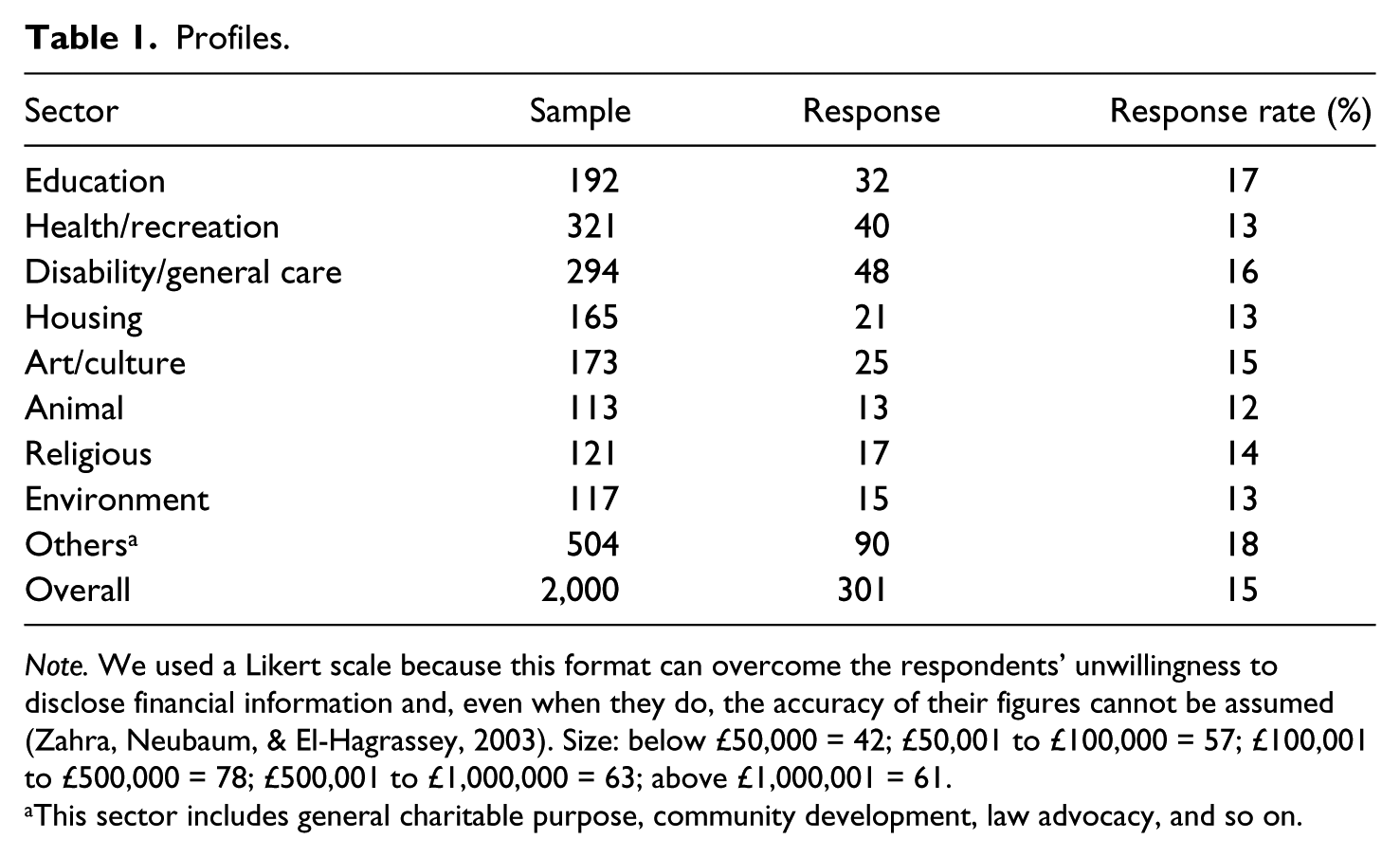
Note. We used a Likert scale because this format can overcome the respondents’ unwillingness to disclose financial information and, even when they do, the accuracy of their figures cannot be assumed (Zahra, Neubaum, & El-Hagrassey, 2003). Size: below £50,000 = 42; £50,001 to £100,000 = 57; £100,001 to £500,000 = 78; £500,001 to £1,000,000 = 63; above £1,000,001 = 61.
This sector includes general charitable purpose, community development, law advocacy, and so on.
Measurement
We assessed NPOs’ brand orientation behavior using the scale of Ewing and Napoli (2005) and Napoli (2006). Orchestration, consisting of four items, measures the NPOs’ ability to assess the degree to which the brand portfolio and related marketing activities are suitably structured and effectively communicated to the stakeholders (Ewing & Napoli, 2005). Interaction measures the NPOs’ ability to assess the extent to which an organization establishes a dialogue with its key stakeholders, consisting of three items (Napoli, 2006). In terms of affect, two items were used to measure the degree to which an organization understands its stakeholders’ likes and dislikes about the brand (Ewing & Napoli, 2005).
To measure staff emotional brand attachment, a four-item scale was adopted using four facets of emotional brand attachment to measure the extent to which the staff’s feeling toward an NPO’s brand are affectionate, connected, passionate, and committed (Malär et al., 2011; Thomson, MacInnis, & Park, 2005). We measured staff service involvement using four items adopted from Malär et al.’s (2011) measurement of product involvement, and modified them to reflect the personal importance based on values and attitudes toward the organization’s brand, and to what extent these personal feelings will influence the way in which the staff provide service to the stakeholders. We measured charismatic leadership using five items based on the assessments that are widely accepted in the behavioral model of the charismatic leader, modified for the NPO context (Conger & Kanungo, 1998; Homburg, Wieseke, Lukas, & Mikolon, 2011).
In terms of organizational performance, we attempted to assess this using five items modified from works of Coombes et al. (2011) and Napoli (2006). As in many empirical studies, subjective ratings are used to measure financial performance in this study, because published financial data about small operations are difficult to obtain and/or the respondents are often unwilling to share sensitive “hard” data (e.g., Narver & Slater, 1990). Moreover, many scholars have suggested that managerial decisions and actions are primarily driven by the perceptions of the organizational performance (Morgan, Kaleka, & Katsikeas, 2004). Therefore, we employed perceptual measures of performance to assess NPOs’ ability to delivery social service and obtain resources.
Measurement Validation and Reliability
Initially, we assessed the potential common method bias using Harman’s single-factor test (P. M. Podsakoff, MacKenzie, Lee, & N. P. Podsakoff, 2003). The result indicated that a single method factor does not explain the majority of the variance (the highest single variance extracted from the data is 26.95%) and, therefore, that common method bias is not a problem in this study. During the data collection period, we also took several actions to control for common method bias by following P. M. Podsakoff et al. (2003), such as guaranteeing the anonymity and confidentiality of the responses, emphasizing that there are no right or wrong answers, and covering items related to the independent variables before the dependent variables.
Second, we assessed the measurement properties of our scales using a series of confirmatory factory analyses (CFAs) and followed the acceptable model fit guidelines from Byrne (2010). According to these indicators, our measurement model fits well with the data, as indicated by the CFA results, suggesting an acceptable fit for brand orientation constructs (χ2 = 20.16, p < .00, comparative fit index [CFI] = .99, root mean square error of approximation [RMSEA] = .03), staff emotion brand attachment, staff service involvement (the CFA results indicate a perfect fit, CFI = 1.00; RMSEA = .00), charismatic leadership (χ2 = 8.80, p < .00, CFI = .99, RMSEA = .06), and organizational performance (χ2 = 4.09, p < .00, CFI = 0.99, RMSEA = .06).
Finally, we assessed the correlations of the framework variables and reliability (see Table 2).
Descriptive Statistics, Correlations, and Reliabilities.

Note. N = 301. Correlations are significant at p < .05. Cronbach’s alpha values are shown in bold on the correlation matrix diagonal.
The correlations show that all variables have a significantly positive correlation with each other. This means that they are moving relative to each another. A reliability analysis produced Cronbach’s alpha coefficients exceeding the threshold value of .70; thus, construct reliability is suggested.
Analyses and Results
With the properties of our measures established, we followed the recommendation of Schumacker (2002) to use aggregate measures as the latent variable scores in the model by creating composite variables from latent factors taking into account the weights of each of the measurement items on the latent factor. We first tested the NPO classification and size effect that may potentially influence our outcome and found that there are no significant differences between the different types of NPO in terms of classification and the size of all the variables. We then used AMOS 17.0 to perform structural equation modeling to test the path relationships posited by our conceptual framework.
H1 predicts that staff emotional brand attachment and staff service involvement mediate the relationship between an organization’s brand orientation behavior and performance. Given the complexity of our model, we follow the suggestion by Murray, Gao, and Kotabe (2011) to analyze mediating effects by estimating a series of structural equation models (see Table 3).
Mediation Test.

Note. N/A = not available; CFI = comparative fit index; RMSEA = root mean square error of approximation. Standardized coefficients are reported with t values in parentheses. Italic values indicate mediating effects on weakening direct effects.
p < .10. **p < .05. ***p < .01.
According to the Baron and Kenny’s (1986) proposed steps for mediation test, we first estimated the direct paths among the relevant variables in Models 1 (brand orientation behavior → staff service involvement, β = .86), 4 (staff emotional brand attachment → performance, β = .39), and 7 (brand orientation behavior → performance, β = .56), and found a positively significant relationship among the relevant variables in all models. We then estimated the indirect paths among the relevant variables in Models 2, 5, and 8 (see Table 3), and found that all of the relationships among the relevant variables were positive and significant. Finally, we estimated the model that includes all the relevant variables in Models 3, 6, and 9, and found that the positively significant standard coefficient estimate in Models 1 (brand orientation behavior → staff service involvement, β = .74), 4 (staff emotional brand attachment → performance, β = −.02), and 7 (brand orientation behavior → performance, β = .38) turned out to be weakened or insignificant. According to Baron and Kenny (1986), the partial mediational model is correctly specified. Moreover, we also conducted additional analysis, as suggested by Holmbeck (1997), to calculate the change in the chi-square value between the mediation models where the direct path relationship is constrained and where it is unconstrained. We found that the changes in the chi-square value are not significant in all situations when the mediators are taken into account. This means that there is significant mediation (Holmbeck, 1997). Taken together, our results indicate that staff emotional brand attachment and staff service involvement partially mediate the relationship between an organization’s brand orientation behavior and performance. Thus, H1 is partially supported.
Our hypotheses also predict that charismatic leadership moderates the relationship between an organization’s brand orientation behavior and staff emotional brand attachment (H2a), and the relationship between staff emotional brand attachment and staff service involvement (H2b). To test this, we adopt the method suggested by Dabholkar and Bagozzi (2002) for a median split (high and low charismatic leadership, respectively) and compare both groups using structural equation modeling (see Table 4).
Moderation Analysis.

Note. Standardized coefficients are reported with t values in parentheses. Multigroup analysis Δχ2 = 5.28, p < .05. S is the significant difference found between the two groups when standardized coefficients were compared.
p < .10. **p < .05. ***p < .01.
We first compare the overall chi-square value (model estimated: brand orientation behavior → staff emotional brand attachment → staff service involvement) between the high and low charismatic leadership groups and found that the change in the chi-square value is significant (Δχ2 = 5.28**, p < .05). Second, we compare the chi-square value between models where our hypothesized paths are constrained and unconstrained. The estimation results show that, in both situations, the changes in the chi-square value are significant: brand orientation behavior → staff emotional brand attachment (Δχ2 = 3.82**, p < .05) and staff emotional brand attachment → staff service involvement (Δχ2 = 2.71**, p < .05). Finally, we compare the change in the standard coefficients between the high and low charismatic leadership groups. According to Dabholkar and Bagozzi (2002), when the change is more than .05, this means that the difference is at a significant level. Our results suggest that the changes in the standard coefficients are also significant. By combining all the above, our results indicate that charismatic leadership moderates the relationship between an organization’s brand orientation behavior and staff emotional brand attachment, as well as that between staff emotional brand attachment and staff service involvement. Thus, H2a and H2b are supported.
Concluding Discussion
Our findings have several important implications for both academic research and managerial practice. First, using data obtained from 301 U.K. nonprofit organizations, our research affirms the theoretical logic and extends the academic insights into the integration of self-determination theory and leadership theory. The integration of these two theories can provide a possible explanation for the process of internal branding, and the critical roles that leadership plays in moderating this process. More specifically, drawing from self-determinate theory (Deci & Ryan, 2004; Ryan & Deci, 2000), the present study was premised on the ideal that staff need to first embrace an organization’s brand value from organizational environment that managers create to persuade them to have a greater understanding of the value of the organizational brand until it has been fully assimilated to the self before they can transform it into reality by providing high-quality services to the customers that reflects the organization’s brand standard. Drawing on leadership theory (Hiller et al., 2011; Walter & Bruch, 2009), our study presupposed that leaders play a critical role in influencing staff’s decision to embrace an organization’s brand value. Our results support both ideas, highlighting the important role of mangers to create a favorable organizational environment for the process of internal branding to take place.
The second important contribution is to provide knowledge regarding the specific process by which brand orientation behavior influences organizational performance. Previous researchers have identified the direct relationship between brand orientation behavior and organizational performance (e.g., Hankinson, 2000; Napoli, 2006). We propose and test the causal chain relationship in which an organization’s brand orientation behavior will enhance the staff emotional brand attachment, and then trigger the development of staff service involvement, ultimately leading to superior organizational performance. Our findings support our proposed causal chain relationship, as illustrated in Table 2. This is an important finding because it furthers our understanding of brand orientation behavior–organizational performance relationship. More specifically, our results indicate that there are different stages of behavior. It starts with organizationally imposed demand (i.e., brand orientation behavior) to persuade staff to develop a greater understanding of the value of organization’s brand (i.e., staff emotional brand attachment) and a higher degree of interest in delivering services that are consistent with the organization’s brand standard (i.e., staff service involvement). Ultimately, these behaviors will lead to the improvement of organizational performance. In other words, there was a developmental process for staff to transform externally encouraged behavior regarding how to act accordingly in reflecting organization’s brand values into truly self-determined behavior. Besides the double mediation (Models 1-3 and Models 4-6), results from our data analysis before arriving at final results (Models 7-9) reinforce the idea that each stage of behavior is important for staff to reach the next stage. This suggests that managers should not count on the immediate effects when implementing brand orientation behavior. Instead, managers should allow time for staff to transform externally encouraged behavior (i.e., acting as the representative of organization’s brand) into self-determinate behavior and monitor each stage of the behavior to ensure that the staff members are in the process of reaching it. According to our findings, this process will ultimately lead to superior organizational performance.
Third, previous studies have suggested that leadership, mainly transactional and transformational leadership, plays a critical role during the brand building process (Morhart et al., 2009; Wieseke et al., 2009). Our research adds to existing knowledge on the effects of charismatic leadership on internal branding. We believe this is the first study to explore the effect of charismatic leadership on internal branding. We found that by having a charismatic leader involved in the organization’s efforts to promote the brands inside an organization, the staff find it easier to form an attachment to the organization’s brand and perceive the services provided under the organization’s brand to be personally relevant to them. This is an important finding because, in addition to transactional and transformational leadership, we have identified another type of leadership, charismatic leadership, which also plays an important role in facilitating the process of internal branding. In comparison with other type of leadership that emphasizes leaders’ governance style (i.e., transactional leadership), charismatic leadership focuses more on the quality of the leaders’ personality traits and accomplishments (Conger & Kanungo, 1998; Shamir et al., 1993). Therefore, our findings indicate that to identity and recruit individuals with abilities to inspire followers is just as important as to acquire individuals with appropriate governance style, for managerial roles in charge of internal branding. However, it also means that it might be difficult for organizations to “train” their existing managers who do not possess the personality traits and accomplishments of a charismatic leader to become good managers at handling internal branding in a short period of time.
Finally, this research has implications for wider NPO research. Prior research has recognized the importance of the effects of internal branding on the service staff who deliver the services under the organization’s brand to the stakeholders (e.g., Morhart et al., 2009; Punjaisri et al., 2009). As discussed earlier, one of NPOs’ main objectives is to deliver social services to the public (Coombes et al., 2011; Grønbjerg, 1993). Even through NPO staff are often drawn to work for this type of organization due to their personal commitment to the NPOs’ social mission, experts in the field still suggest that, by communicating the organization’s brand value clearly to their staff, NPOs can further encourage their staff’s brand commitment and contribution toward transforming the brand promise into reality (e.g., Hankinson, 2002, 2004). Based on data from U.K. NPOs, we broaden and deepen our understanding about the approach of internal branding in NPO context. As experts suggest, a brand can be considered as the most important asset for NPOs, because it helps them to attract supports from private and business donors and volunteers (Hankinson, 2004; Napoli, 2006). Our study highlights the importance for NPO managers to implement brand orientation behavior to encourage the staff to engage emotionally with the organization’s brand and feel personally connected with the social service provided under the organization’s brand, to become the representative of the NPO’s brand. Furthermore, in comparison with brand building through external activities (i.e., advertising), internal branding not only provides less costly options for NPOs that suffer decreasing public funding and private donations (Hankinson, 2002) to build NPOs’ brand, but also capitalizes on NPOs’ significant full-time and voluntary staff to reflect the NPOs’ brand value when serving customers.
Limitations and Future Research
This study suffers from certain limitations that suggest caution in interpreting its empirical findings as well as suggest directions for future research. First, we adopt and modify measurements that have been used to analyze phenomena in the for-profit setting. Future research could explore undiscovered types of marketing capability that are related specifically to social enterprise performance. Second, in this research, we focus on examining the effects of organization’s brand orientation behavior rather than brand orientation culture. However, this does not mean that the latter is unimportant. As Gotsi, Andriopoulos, and Wilson (2008) suggest, for staff to buy-in to an organization’s brand value, managers need to find ways to align the organizational subculture with it. Moreover, the relevant literature suggests that emotional brand attachment can also be developed through establishing a brand-oriented organizational culture, organizing brand-supporting activities within the organization, and ensuring that the staff understand the value of the brand (Hatch & Schultz, 2001). Future research might consider exploring the effects of an organization’s brand orientation culture and building an integrated internal branding model for NPOs. Third, the cross-sectional design of our study does not allow for definite conclusions to be drawn about the causal processes that might occur in the proposed relationships. Although the vast majority of the structural equation model studies used cross-sectional data, researchers still need to verify whether the relationships among the variables take place simultaneously, or are causal in nature (Holbert & Stephenson, 2002). In this research, we have established the links between the variables using cross-sectional data, and future researchers may use a longitudinal research design to suggest the causality empirically and assess the performance over time.
Footnotes
Acknowledgements
We would like to thank editor Lucas Meijs and anonymous reviewers for their helpful comments on earlier versions of this article.
Declaration of Conflicting Interests
The author(s) declared no potential conflicts of interest with respect to the research, authorship, and/or publication of this article.
Funding
The author(s) received no financial support for the research, authorship, and/or publication of this article.