



Abstract
This special issue on membership associations publishes eight articles from a variety of disciplines that illustrate the continuing advancement of scholarship related to member-based nonprofit organizations. Each addresses one or more enduring questions about the existence and influence of associational activity. The articles are ordered according to the level of analysis from the cognitive/intrapersonal to the systemic/societal. Taken together, they demonstrate the scholarly and practical value of explicitly addressing membership dynamics and associational structures within the broad field of nonprofit studies. They also suggest important areas for future study. After introducing the special issue and articles, to further build understanding of membership association dynamics, we review recent publications that complement the issue and offer ideas for additional research.
Introduction
Membership associations serve diverse social, political, cultural, sports, religious, industry, occupational, and professional groups. Defined broadly, membership associations are formally organized groups of members who are not financially remunerated for their participation (Knoke, 1986). While mainly associated with the mutual benefit and instrumental end of the civil society spectrum, many associations also produce public benefits and some can be classified primarily as expressive organizations. They represent a large subset of the global nonprofit sector, across a range of purposes, legal forms, geographic areas, and membership characteristics.
Little scholarly attention has been paid to the special characteristics and dynamics of membership associations. David Knoke wrote in 1986, “Put bluntly, association research remains a largely unintegrated set of disparate findings, in dire need of a compelling theory” (Knoke, 1986, p. 2). Two decades later, Tschirhart (2006) concluded that Knoke’s assessment still holds and noted that the field of association scholarship had not yet progressed beyond the state of scientific immaturity observed by Gordon and Babchuk in 1959, and Knoke in 1986. Concerns over the lack of empirical studies and theoretical grounding for understanding membership associations, their lack of cross-national literature and their weak application, also have been expressed by Schofer and Fourcade-Gourinchas (2001), Webb and Abzug (2008), Gazley (2012), and Johnson (2014). For example, in arguing for greater attention to application, Haynes and Gazley (2011) observed how little attention scholars interested in public sector professionalism pay to professional association activity. With respect to giving behavior, Hoolwerf and Schuyt (2010) noted the enormous amount of unobserved and unmeasured philanthropic activity carried on by membership associations such as service clubs, including many associations with a global scope.
Amassing an integrated literature base is challenged by the difficulty of generalizing empirical findings across different types of associations and the nonprofit sector as a whole. The diversity of the sector, and the membership associations that are part of it, is reflected in the articles selected for this special issue. The authors in this special issue examine credit unions, service clubs, professional associations, trade associations, sports clubs, and micro-finance institutions. The national contexts of the studies are varied, covering Australia, Canada, China, Northern Ireland, the United Kingdom, and the United States. Yet, despite the varied purposes and locations of the associations they study, the authors grapple with recurring issues and enduring questions.
This special issue highlights both predominant orientations to research on nonprofit membership associations (such as joining behavior) and some less explored but promising angles, for example, the socio-demographics of collective action. They illustrate the varied levels of analysis and research methods that can come into play when studying membership dynamics. Data used come from focus groups, personal interviews, surveys, media reports, subject narratives, and secondary data sets. Analyses employ qualitative and quantitative methods with both exploratory and hypothesis-testing objectives. The articles vary in the strength of their theoretical and empirical foundations reflecting the variety in the field of association scholarship as a whole.
This special issue is sponsored by the ASAE Foundation. We thank the ASAE Foundation along with the manuscript reviewers and Nonprofit and Voluntary Sector Quarterly (NVSQ) editors who helped make this issue possible. Their interest in encouraging scholarship on member-serving associations was instrumental in giving us, as guest editors, the privilege of working with the authors submitting manuscripts. We could not accept all the submissions for the special issue and encourage readers to look for more articles on associations in other issues of NVSQ.
Introducing the Special Issue Articles
It is our pleasure to briefly introduce the eight articles included in the special issue. They are ordered by the level of analysis. The first two articles examine dynamics of individual members of associations. Consistent with traditional NVSQ interests, they focus on philanthropic giving and voluntary engagement. The authors of these articles advance understanding of how institutional characteristics matter in explaining individual action. More specifically, they help us see how the context for associational activity, membership composition, and the perceived incentives from participation may affect members’ attitudes and behavior.
Xiaonan Kou, Amir Hayat, Debra Mesch, and Una Osili’s (2014) article on “The Global Dynamics of Gender and Philanthropy: A Study of Charitable Giving by Lions Clubs International Members” assesses micro- and macro-level factors on charitable giving in China. While researchers have long studied gender of an individual as a predictor of giving, this article expands the approach, finding that female-dominated chapters may encourage greater giving by members than male-dominated chapters, even when differences between the giving of males and females within the same chapter are insignificant. The article demonstrates the value of looking at group and larger system effects, not just individual characteristics in models of giving.
In his contribution to the special issue, “Engagement Motivations in Professional Associations,” Mark Hager (2014) also focuses on individual members, in this case, looking at self-reports of members’ giving of charitable contributions to their association, volunteering within the association, and willingness to recommend the association to a friend or colleague. Taking advantage of a data set developed by ASAE (Gazley & Dignam, 2008), Hager tests Knoke’s argument that members are motivated to participate in associations for their public and private benefits. Hager finds this to be true and identifies the incentives that drive organizational commitment as well as giving and volunteering on the association’s behalf. Furthermore, his finding that members of engineering profession associations differ from members of health profession associations in the incentives they value illustrates the limits to generalizing across professional associations.
Lili Wang and Robert Ashcraft (2014) also use a data set developed by ASAE (Gazley & Dignam, 2010) for their article titled “Organizational Commitment and Involvement: Explaining the Decision to Give to Associations.” They find that members’ financial donations to their associations are influenced by members’ commitment, level of engagement, and whether they were solicited for a gift. The effect of a solicitation was particularly influential for members with low educational attainment. As in the Hager article, we see multiple incentives and motivations that can affect giving. In contrast with some authors of other studies of giving in general, Wang and Ashcraft do not find that demographic characteristics, such as income and gender, are useful predictors of giving. By focusing on professional associations, they help establish a case that there may be special dynamics of members’ giving behaviors.
At the organizational level of analysis, we offer three articles. The first is Atul Teckchandani’s (2014) “Do Membership Associations Affect Entrepreneurship: The Effect of Type, Composition, and Engagement.” In his exploratory analysis of associations and entrepreneurship in communities in the United States, Teckchandani finds that an association’s ability to encourage entrepreneurial activity does not depend on association type and participation intensity but is connected to whether an association’s membership is socio-demographically diverse and members are involved in other associations. Teckchandani argues that the networking and resource-linking strength of the members of associations in a community is critical to the creation of new enterprises. He offers us a glimpse into what can happen inside and at the boundaries of associations that help transform their members’ business environments.
John Forker, Johanne Grosvold, and Anne Marie Ward (2014) also look at how associations affect their environments. In “Management Models and Priorities: Is Credit Union’s Community Involvement Crowded Out?” the authors compare and contrast the effects of different models for credit union operation in Northern Ireland on community involvement. They find that, despite critics’ concerns, the use of a “new model” in credit union management, which encourages for-profit financial management practices, does not underperform old models in terms of their community impact. Member-serving credit unions can successfully pursue both financial growth and community development objectives. This article calls our attention to the regulatory context for associations, encouraging more research on what influences choices of association models for serving member and community interests and the outcomes of those choices.
Alison Doherty, Katie Misener, and Graham Cuskelly (2014) provide us with a qualitative look at volunteer-run membership associations in their article “Towards a Multidimensional Framework of Capacity in Community Sports Clubs.” Their interest is in understanding the relationship between association capacity and outcomes. Using focus groups, the authors identified multiple capacity dimensions that Canadian sports clubs leaders believe influence their club’s achievement of goals. An important next step is to link perceptions of capacity challenges to actual goal achievement and to test differences between professionally staffed and all volunteer-run sports clubs. The authors’ nuanced description of capacity elements can advance the measurement of them.
Moving up a level of analysis, we turn to Nicole Esparza and Edward T. Walker’s (2014) article “Trade Associations and the Legitimation of Entrepreneurial Movements: Mobile Food Vendors’ Associations in the Emerging Gourmet Food Truck Industry.” The authors artfully describe the evolution of the gourmet food truck field and the key role trade associations play in legitimizing the industry and reducing the uncertainty experienced by food truck entrepreneurs in the United States. We learn how trade associations generated collective identity, created cultural capital, and provided other means to serve the industry as a whole and buffer it from potentially destructive self-interests of members (e.g., food truck owners) and competitors (e.g., restaurants). This conceptually and descriptively rich article paints a picture of contested terrain and shows how trade associations can make sense and create order in a nascent industry.
The final article in the special issue is Eric Johnson’s (2014) “Toward International Comparative Research on Associational Activity: Variation in the Form and Focus of Voluntary Associations in Four Nations.” Johnson takes on one of the most long-standing questions in association research—Which countries have more associational density? He pays particular attention to politically active associations addressing social equity issues and he distinguishes between those with and those without members. Johnson’s findings undermine Tocquevillian notions (Tocqueville, 1835-1840/1956) that the United States in particular is a nation of joiners. He shows that the United States does not have significantly more association density than the three other countries he examines—Australia, Canada, and the United Kingdom. Each nation has a distinct character in the structure and regulatory environment for its associations.
What Association Questions Remain to Be Answered?
In our call for papers, we suggested a variety of research questions that need addressing, including but not limited to the following: Who joins and is served by membership associations? Are assumptions about individual behavior derived from research on other organizations applicable to membership associations? What structural, political, and other influences explain the structure and performance of membership associations? How do membership associations in different societies compare? What are membership associations’ social, political, technical, and economic outcomes and their public and mutual benefits? Whose voices are being heard in membership associations? What models of strategic planning, management, business enterprise, and evaluation are used in membership associations? What financial models are in play, and how does their use affect outcomes? How are innovations diffused through association members? How do membership associations identify and manage competing interests? How does lobbying vary across membership associations and compare with lobbying of nonprofit organizations that do not have membership bases? How, if at all, do associations prepare members for civic engagement or otherwise serve as schools of democracy?
This special issue makes strides on some of these questions but all need additional attention. Indeed, all eight articles in this issue recommend future research directions that can help address the questions, improving the generalizability of findings while acknowledging the diversity of membership associations. Scholarship on nonprofit membership associations is growing but it has not yet reached full fruition.
The Broader Literature Base
Based on a search of peer-reviewed articles (published from January 2010 to July 2013), we identify 67 articles that complement the articles in this issue. They deserve recognition for helping build the theoretical and empirical foundation for research related to nonprofit membership associations and, while not a comprehensive list, demonstrate currently active research questions. They also illustrate the wide range of journals and disciplines concerned with membership associations.
Forty-one of the 67 publications were identified using a search of the Web of Science database with the topic keywords “association,” “membership,” and “member.” Another 12 were found using abstracts in the 2012 association research bibliography on the website of the Institute for Nonprofits at North Carolina State University (http://nonprofit.chass.ncsu.edu/asae/overview/asae-bibliography-2012/) accessed on July 1, 2013. Removing overlaps, an additional 14 publications were found searching NVSQ archives using the terms “membership” and “member.” Table 1 sorts the articles we found by the enduring question(s) they address.
Snapshot of Recent Literature on Nonprofit Membership Associations.
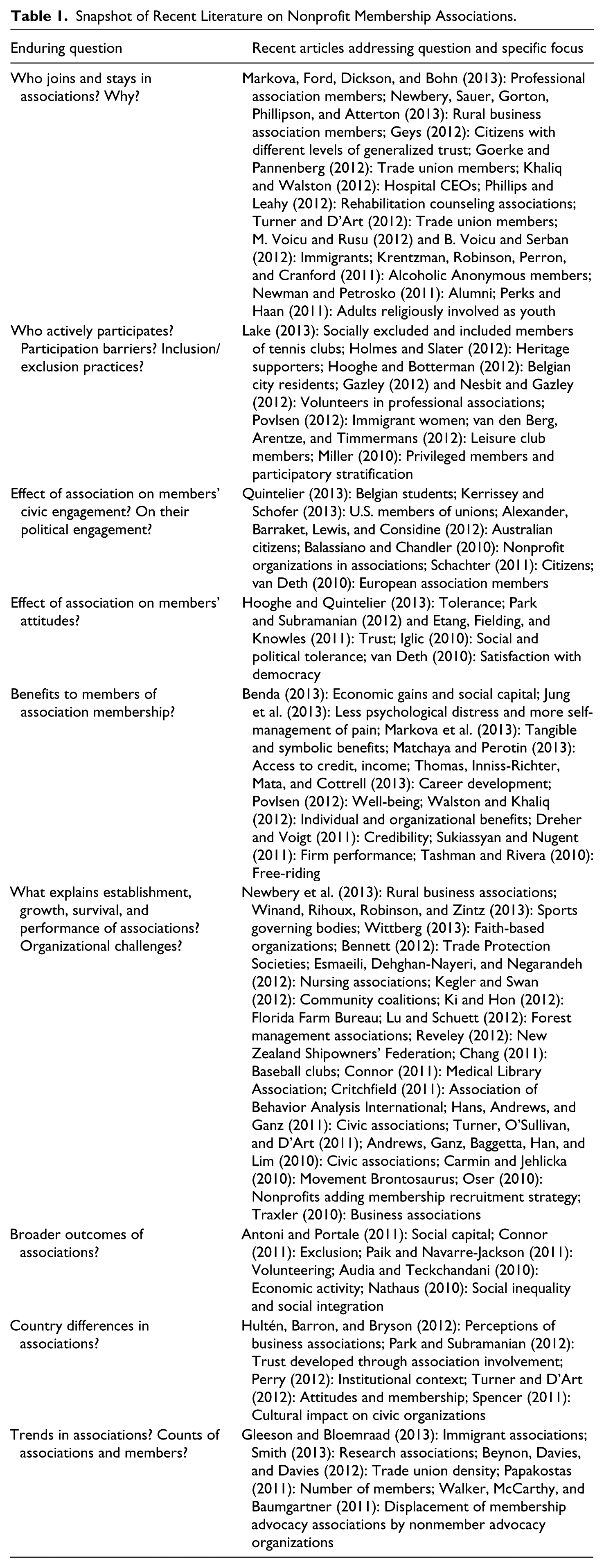
The range of work categorized in Table 1 reflects not only the diversity of the association field generally but also the diversity of disciplines with an interest in associational activity. Much of this work is being published in domain-specific publications that are read by those only in single industries or professions, such as community development, health, sports, recreation, and library science. From a practical perspective, association managers are unlikely to view the current state of the scholarship as sufficiently rich or integrated to provide the advice they seek as they address practical matters of membership recruitment and engagement.
Our literature review reveals the intellectual breadth of recent association scholarship. Economics and sociology have arguably made the strongest contributions to the study of membership associations, particularly in addressing rationales for engaging in private sector collective activity and joining behavior. Historians and other scholars are chronicling how some associations are transforming in line with changing or competing demands. We see an ever-increasing body of work in management journals on the establishment, growth, survival, and performance of membership associations. Management sciences are also reflected strongly in the articles in this special issue. Management scholars are bringing explanatory power and practical value to association research, as they are with other aspects of civil society and public affairs scholarship (Nesbit et al., 2011). In studies of associational activity, as in many other streams of civil society scholarship, we see efforts to use sociological, socio-demographic, motivational, interpersonal, cultural, political, leadership, historical, and institutional explanations—often in combination.
The 67 articles we highlight help demonstrate the range of national and international contexts for association research. There are 23 countries represented by the authors’ university affiliations: Australia, Austria, Belgium, Canada, China, England, France, Germany, Iran, Ireland, Israel, Italy, Luxembourg, the Netherlands, New Zealand, Norway, Romania, Scotland, Slovenia, South Korea, Sweden, Wales, and the United States. The authors examine international associations, as well as associations confined to particular countries. In addition to studies of associations in the countries named above, the set of articles offers analyses focused on associations or members of associations in Cameroon, Czechoslovakia, Malawi, Moldova, Norway, Russia, Rwanda, and Spain. This geographic breadth attests to the role that associations play in a variety of countries and the need to build greater understanding within their particular cultural and political environments. The findings from the cross-national comparative studies suggest caution in generalizing across geographic borders.
Explaining the
Why
and the
What
of Associational Activity From a Systems Perspective
Many of the questions noted in Table 1 relate to why individuals join and actively participate in associations, and what outcomes result from their collective action, with varied focus on outcomes at the individual to societal levels. We suggest more use of systems theories to capture the complexity of associational activity and its outcomes. When applied to social science questions, a systems perspective offers a holistic strategy for understanding the related dynamics of human and organizational behavior (Von Bertalanffy, 1950). Human, organizational, environmental, social, political, and other levels of influence can be integrated to explain association and member outcomes.
For example, as our snapshot of the association literature illustrates, instrumental incentives alone are less likely to explain joining and participating behaviors than models that incorporate bridging and bonding dynamics; socialization effects; and structural, technical, and political barriers to membership. Associations offer a range of benefits to members for joining and participating, but members find value and access these benefits in highly contextual ways. As several of the authors included in this special issue demonstrate, examining characteristics of the membership base as a whole, not just studying individual members, reveals robust theoretical and practical findings.
A systems perspective on associations allows us to understand outcomes not only in the sense of individual member behavior but also how these behaviors relate to organizational impacts, social impacts, and even—as Teckchandani, Esparza, and Walker find in this special issue—economic and industry impacts. Drawing on just one example from the literature reflected in Table 1, Andrews, Ganz, Baggetta, Han, and Lim (2010) offered a systems perspective in their analysis of Sierra Club chapter performance. Although tightly focused on one context, the authors test a potentially generalizable model of association effectiveness that accounts for the environmental conditions that generate not just committed members but also the organizational capacity for effective leadership, for a strong chapter network, and for successful fund-raising. Another example of a systems perspective is seen in an American Society of Association Executives analysis of board performance among member-serving organizations (Gazley & Bowers, 2013). Building on prior systems-oriented board research by Cornforth (2011), Ostrower and Stone (2010), and Miller-Millesen (2003), Gazley and Bowers (2013) argued that association board performance is not just contingent on human and organizational capacity considerations but also on external dynamics such as competition for members and variations in regulatory pressure on associations due to tax status.
A systems perspective also helps us understand why desire for and pursuit of benefits of associations are likely to vary. For some individuals and organizations, no matter the incentives and benefits, participation as active or even passive members may not be possible. As Holmes and Slater (2012) argued, a member may be highly committed even when unable to participate actively. Patterns of inclusion and exclusion exist. Scholars are showing that there can be unequal access to the benefits of association membership and differences in opportunities to join and participate (e.g., Lake, 2013; Nathaus, 2010).
Carrying forward this thought, in assessing the articles included in Table 1, we find an emphasis on the positive outcomes of associational activity, including enhanced trust, democratic behavior, credibility, firm performance, and career and economic gains. Claims about positive outcomes are not typically generalized by the authors beyond their specific samples, though the underlying theoretical arguments that link associational activity to positive outcomes may be transferrable to new settings. Future research on outcomes would benefit from more attention to the potential negative effects of collective action, such as weaker political and social tolerance, or the potential for inequitable exclusion of some members (e.g., Holmes & Slater, 2012).
In the last 3 years of publications, we find new work on cross-national comparisons and historical trends in associational activity. These pieces join a long list of studies addressing patterns in associations across time and place (see Tschirhart, 2006, for a review of some of the earlier work). But there is still much to be explored. We encourage scholars to consider not just how numbers of associations and members are changing but also how lifecycles of members change associations. There is little research to be found on member loyalty and longevity. This topic is especially intriguing for professional associations. As professions change and individuals switch professions, how do professional associations change? Also, how are associations changing in an increasingly global society, both for associations that are spreading cross-nationally, and also for those with members who move across national borders? We encourage more attention to comparisons of local-community-based associations with more global associations.
Conclusion
The articles in this special issue, combined with recent publications in other venues, are helping us connect the dots among studies, most especially those with greater use of interdisciplinary and systems perspectives. It is unlikely we will ever find Knoke’s (1986) longed-for compelling theory that integrates the existing disparate findings. However, we do observe more research than we did a decade ago that acknowledges the diverse geographical contexts in which membership associations operate and that reflects the field’s growing empirical sophistication. We applaud scholars’ increasing attention to the practical applications of their research on membership associations. Perhaps most of all, we are delighted that this special issue could achieve its goal of offering scholarship with both practical and conceptual values to NVSQ readers and leaders of membership associations.
Footnotes
Authors’ Note
Both authors have conducted work for ASAE: The Center for Association Leadership. Two of the articles chosen for the special issue and described in the intro article use ASAE data collected by one of the authors under contract with ASAE. Sponsor of special issue is the ASAE Foundation.
Declaration of Conflicting Interests
The author(s) declared no potential conflicts of interest with respect to the research, authorship, and/or publication of this article.
Funding
The author(s) received no financial support for the research, authorship, and/or publication of this article.