



Abstract
This study examined the determinants of student contributions to their senior gift campaign while currently enrolled at a university and whether student giving predicted young alumni giving patterns after graduation. Determinants of student giving were largely consistent with those of alumni giving, although parental support was found to be an important difference. Financial aid in the form of parental support and scholarships, but not loans or grants, increased the likelihood of student giving. College experiences including group participation and positive subjective evaluation also increased the likelihood of giving. Student giving was then found to be a strong predictor of future donation patterns of young alumni. Students who did not contribute to the senior gift campaign despite repeated, in-person solicitations from peers were less likely to donate after graduation.
Why do some recent graduates choose to donate to their alma mater when so many other options for charitable giving are available? Understanding the motivations behind young alumni 1 giving is important for institutions of higher learning as alumni donations represent the single-largest source of voluntary support for higher education (Kaplan, 2010). In 2009, alumni provided 26% of the US$27.9 billion donated to colleges and universities, accounting for 7.6% of total expenditures for the average institution and nearly 20% percent for private liberal arts colleges. Large principal gifts, typically between US$5 million and US$10 million, often provide the funds necessary for institutions to make transformative changes (Schervish, 2005; Schubert, 2002). As institutions seek to expand their donor base, they are paying greater attention to young alumni, defined as those who have graduated in the past 10 years (Drezner, 2013).
Young alumni are often overlooked because they have lower participation rates and giving capacity compared with older donors. However, mounting evidence suggests that cultivating early patterns of giving small amounts could yield significant long-term returns (Billings, 2013; Center on Philanthropy at Indiana University, 2008; Drezner, 2011; Lindahl & Winship, 1992; Monks, 2003; Nayman, Gianneschi, & Mandel, 1993; Piliavin & Charng, 1990). Research demonstrates that prior giving to an institution is a strong predictor of future giving and outweighs all other factors in explaining major gifts later in life (Kelly, 2002; Lindahl & Winship, 1992; Marr, Mullin, & Siegfried, 2005). Meer (in press) found that 94% of young frequent givers—those who consistently gave in the first 5 years following graduation—also gave when they were older, compared with 63% of infrequent young givers. These young consistent donors also gave 3 times as much on average, and were more than twice as likely to be among those whose gifts were in the top 10% of their class when older.
Senior class gift campaigns are an increasingly common strategy for educational institutions to cultivate giving patterns at an early stage, but little empirical research exists on student giving and its relationship with alumni donation patterns. Hurvitz (2013) argues that applying the lessons learned from traditional alumni studies to students “does not take into account either the subtle or obvious differences between alumni and student or their frames of reference” (p. 139). Despite extensive research on alumni donation behavior after graduation, no study has systematically explored the factors that predict student giving while enrolled or whether student giving directly affects giving after graduation. Researchers have overlooked student giving for two main reasons. First, those focused on immediate economic returns rather than long-term giving behavior may dismiss the small dollar amounts involved, generally US$20 or less. Second, researchers have not previously established student giving as a significant predictor of alumni donations. This study seeks to address these shortcomings by developing and analyzing a unique data set that links data on student and alumni donations to a multiyear panel study that tracked the contribution records of students from matriculation through the end of their senior year. This data set allows us to examine the direct effect of student giving on subsequent giving while controlling for background characteristics and student experiences.
This study proceeds in two steps. First, a series of logistic regression models explores whether the factors associated with student giving to the senior gift campaign at an elite, private university are consistent with the predictors of alumni giving. After exploring the determinants of student giving, models examine whether student giving predicts young alumni donation patterns after graduation.
This study adds to the literature in several ways. First, understanding student giving is important not only because it provides an early indicator of future giving patterns, but also because this is the time period when school administrators have the ability to alter the student experience: Students’ attachment to their alma mater is still developing. Second, this study provides the first empirical evidence that student giving has a direct effect on subsequent giving patterns of young alumni after graduation. Establishing this link provides practical guidance to university development offices regarding the importance and possible improvement of senior gift campaigns. Last, by exploring patterns of alumni donation, both giving and not giving, this study highlights the need to examine the factors that influence some potential donors to choose not to give.
Theories of Alumni Giving
Researchers have explored a wide range of factors influencing the decision to give to one’s alma mater over alternative outlets for charitable giving. Particular attention has been paid to the characteristics of the college or university, characteristics of the individual (especially family wealth), factors that foster student attachment to their school, and institutional efforts to solicit donations.
A large volume of research has centered on individual characteristics, including sociodemographics such as income, gender, race, legacy, and marital status (Baade & Sundberg, 1996; Bruggink & Siddiqui, 1995; Clotfelter, 2001, 2003; Dugan, Mullin, & Siegfried, 2000; J. Holmes, 2009; Meer & Rosen, 2010); geographic distance (Bruggink & Siddiqui, 1995; Dugan et al., 2000); and personal values (Bennett, 2003; Wymer, 1997). Financial aids such as scholarships, grants, and loans have also been shown to be an important set of predictors (Dugan et al., 2000; Marr et al., 2005).
Extra-individual factors center on characteristics of the college or university and macroeconomic conditions that constrain budgets and the ability to make financial contributions. Studies of school characteristics have examined the type of institution such as public, private, liberal arts, or research universities (Cunningham & Cochi-Ficano 2002; Harrison, Mitchell, & Peterson, 1995); athletic programs (J. A. Holmes, Meditz, & Sommers, 2008); admission policies (Baade & Sundberg, 1996); and development office efforts (Harrison et al., 1995). Macroeconomic conditions affecting contributions include unemployment rates, stock market fluctuation, economic confidence, and tax changes (Bruggink & Siddiqui 1995; Leslie, Drachman, Ramey, & Conrad 1983; Okunade, 1996).
Because individuals have alternative outlets for charitable contributions, scholars have theorized why some graduates develop a preference for giving to their alma mater over alternative outlets. Important aspects of this process include satisfaction with their college experience and developing school identification (Clotfelter, 2003; Monks, 2003; Mount, 1996; Schervish & Havens, 1997; Sun, Hoffman, & Grady, 2007). Participation in school organizations is of particular importance because these organizations provide a basis for students to learn about institutional needs and develop attachment to an institution (Schervish, 2005; Schervish & Havens, 1997).
Because the giving behavior of donors evolves over their life cycles, institutions have developed a set of programs to maintain and foster the donor–institution relationship that can be represented as a four-level pyramid (Dunlop, 1993; Worth, 2002). When depicted by the number of participants, the base contains all individuals who may be interested in providing support, including alumni, family, friends, faculty, and staff. This base layer is followed by those who make annual or regular gifts (typically to the annual fund drive), then those who make major gifts (generally US$10,000 to US$100,000) and at the top are those who make principal gifts (generally US$5,000,000 to US$10,000,000).
Although the annual fund drive is the most visible program with the widest participation, it constitutes a surprisingly small percentage of the total dollar amounts. Viewed in terms of dollar amounts, this pyramid is inverted with approximately 90% of the dollars coming from the top 10% of donors (Worth, 2002). The total average lifetime contribution made by regular donors is approximately US$300 to US$800, with fewer than 10% giving more than US$200 in any single year (Clotfelter, 2003; J. Holmes, 2009; Marr et al., 2005; Monks, 2003). Scholars have argued that the primary importance of the annual fund campaign lies not in the immediate economic return but in “acquiring, retaining, and upgrading donors” (Schroeder, 2002, p. 79). Worth (1993) states that the annual fund is a “means of involving new donors, identifying those who have a particular interest in the institution, and developing their habit of giving” (p. 67). Major and principal gifts that constitute the vast majority of dollars donated are not so much paid out to institutions. Instead, donors entrust the institutions with this money based on trust built over a lifetime of positive experiences and communication (Schervish, 2005; Schubert, 2002). When examined from this theoretical perspective rather than as immediate economic returns, student gift campaigns may play an important part in developing future giving patterns.
Determinants of Alumni Donations
The first part of this study examined the similarities in the predictors of student and alumni giving by exploring whether the determinants of student giving are consistent with the factors that influence alumni giving. The primary determinants of alumni giving can be grouped into three broad categories: (a) sociodemographic characteristics, (b) financial support, and (c) college experience.
Sociodemographic Characteristics
Socioeconomic measures, including income and wealth, are among the most consistent predictors of alumni giving. Increased giving is consistently associated with greater personal and family income (Baade & Sundberg, 1996; Bruggink & Siddiqui, 1995; Clotfelter, 2003; Marr et al., 2005; Monks, 2003; Taylor & Martin, 1995). Families from the top three income deciles gave more than the bottom seven (Marr et al., 2005). Unlike income, studies on the effect of gender and race/ethnicity on giving have been mixed. Some early studies found women to be more generous (Bruggink & Siddiqui, 1995; Eckel & Grossman, 1998), but because men have higher earnings on average, they are more able to contribute (Okunade, 1996). More recent studies employing large samples from multiple universities (which allow assessing the effect of gender while controlling for income) found no gender difference when controlling for other factors such as income (Clotfelter, 2003; Cunningham & Cochi-Ficano, 2002; Marr et al., 2005). Research finds that ethnic minorities and multiracial individuals give less than Whites, but is due in large part to wealth and income differentials (Monks, 2003). Because student giving occurs prior to entering the workforce, neither gender nor ethnicity is expected to have a significant effect on student giving.
Financial Aid
Scholars theorize that a sense of reciprocity influences giving, particularly for those who receive scholarships or grants that do not require repayment. Loan payments, however, may be viewed as requiring sufficient repayment (Cunningham & Cochi-Ficano, 2002). Research confirms this pattern and further demonstrates that the type of financial support is more important than the amount of the support (Cunningham & Cochi-Ficano, 2002; Marr et al., 2005). While researchers have found scholarships to increase the likelihood of alumni donations (Cunningham & Cochi-Ficano, 2002; Marr et al., 2005), the evidence regarding loans is less consistent. Marr et al. (2005) found that need-based loans reduced the probability of giving, whereas Cunningham and Cochi-Ficano (2002) found no effect of loans on alumni giving. Based on this research, we expect that scholarships and grants will be significant predictors of student giving, while loans will not.
An important difference between the structural position of students and alumni that may affect giving patterns is parental support. Because parental support is not generally considered in alumni studies, it is unclear how parental financial support may affect student-giving patterns. On the one hand, parental support originates outside the university; thus, students may not see the school as the proper target of reciprocity. On the other hand, students may give to the school as an available target of reciprocity. In addition, because higher income and wealth have been found to be positively associated with alumni giving, parental support may also act as a proxy for family wealth. Viewed as a family wealth proxy, parental support is expected to increase student giving.
College Experience
After prior instances of giving, research finds that the affective quality of student experiences represents the next strongest predictor of alumni giving (Clotfelter, 2003; Marr et al., 2005; Monks, 2003). In reviewing the literature, Gaier (2005) concludes that “simply stated, the higher the level of satisfaction with the academic experience, the more likely alumni are to give and/or participate with the university” (p. 279). Clotfelter (2003) states that this is because people give to causes and organizations that have meaning for them personally. It is therefore expected that students who positively identify with their school will have a greater likelihood of making a student donation.
Schervish and Havens (1997) theorize that meaningful attachment to a school and future giving are functions of identifying with the needs of an organization. They posit that future donors must develop a sense of attachment and identification through group participation because it provides the infrastructure for communicating institutional needs and socializing them to respond. Similarly, social psychologists theorize that school clubs and organizations significantly influence identity formation because they act as proximate social structures that condition day-to-day role-based interactions (Merolla, Serpe, Stryker, & Schultz, 2012). Research has consistently found that participation in groups such as fraternities, sororities, and athletic teams is positively associated with increased giving (Bruggink & Siddiqui, 1995; Marr et al., 2005; Monks, 2003; Schervish, 2005). Studies further suggest that the specific type of organization is not as important as simply being involved in some form of special-interest group (Okunade, Wunnava, & Walsh, 1994). A diverse range of activities such as clubs for the performing arts, politics, charitable volunteering, student government, and religion have been found to significantly increase the probability of alumni giving (Monks, 2003; Okunade et al., 1994; Wunnava & Lauze, 2001). We thus expect that participating in a school club or organization will increase the likelihood of student giving, net of controls.
Data and Method
Sample
The development office of a private elite university provided donation data for the senior gift campaign and subsequent alumni donations for two consecutive cohorts of undergraduate students. The researchers used student identification numbers to link both donation data sets to a separate multiyear panel study that tracked students from matriculation through the end of their senior year. The sample consists of two cohorts that began enrollment in 2001 and 2002 (graduating in 2005 and 2006, respectively). Researchers (including the third author) collected background characteristics including demographic, socioeconomic, and financial-aid measures in a precollege survey during the summer preceding matriculation via a mail-in questionnaire. The initial data set includes 1,209 or approximately 95% of eligible participants. Casewise deletion produced a consistent number of cases across models, eliminating cases that had missing data on any of the background or financial-aid measures, producing an analytic sample of 1,062 cases. 2 Another survey in the cohorts’ senior years collected ratings of their student experiences and group participation. Of the original 1,209 students who participated in the precollege survey, 842 (69.6%) responded to the senior-year survey. Table 1 shows weighted descriptive statistics and coding of all variables.
Description of Variables and Measurement.
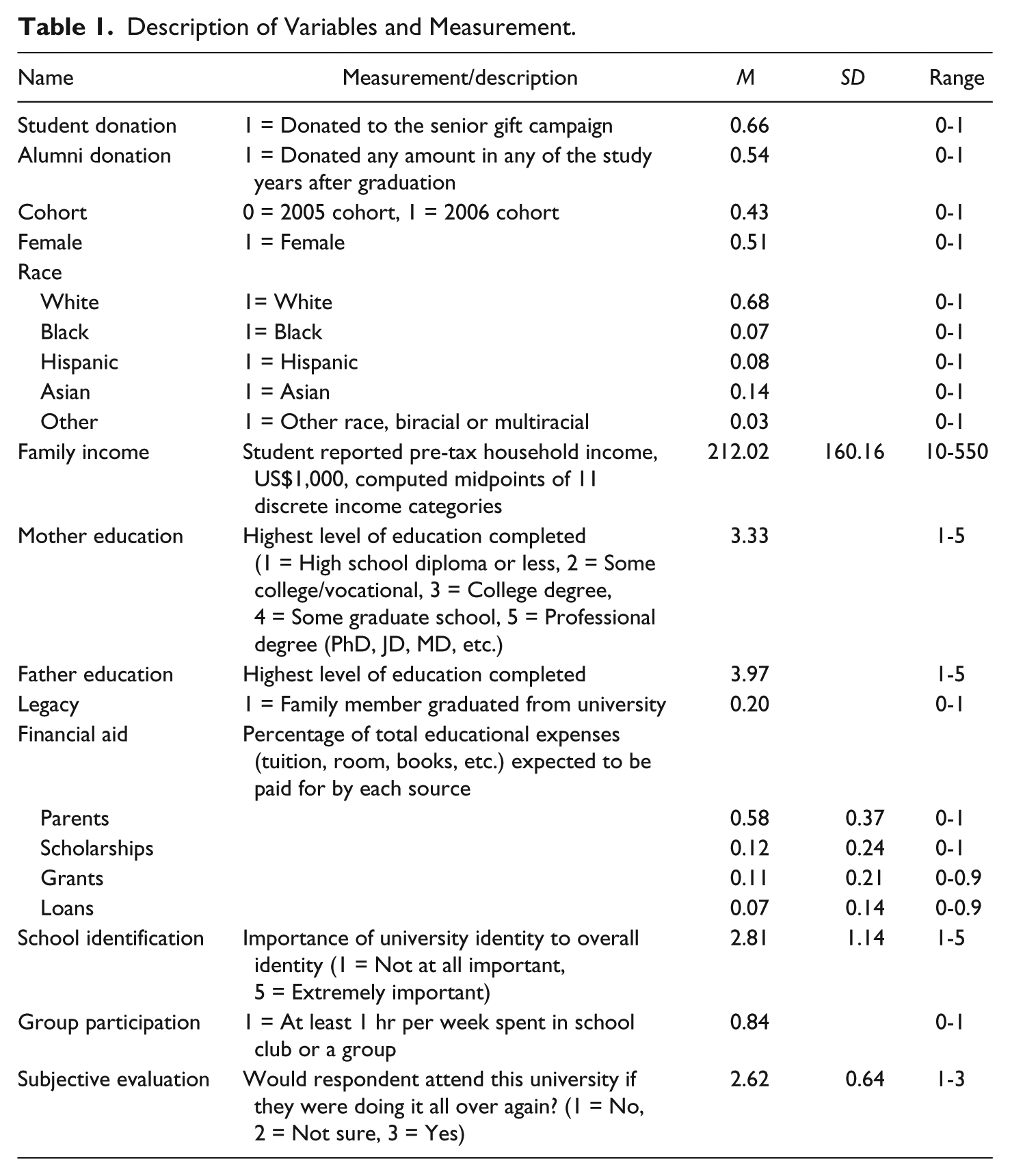
Because researchers designed the panel study to address a wide variety of questions pertaining to student life, they oversampled certain racial groups to ensure data availability across diverse racial and demographic conditions. Postsurvey sampling weights maintain proportionality of their population frequency. Roughly one third of White students, two thirds of Asian students, and one third of biracial and multiracial students were randomly selected, as well as all Black and Latino students (based on self-reported identification on their admission application form). Because the proportion of Black and Hispanic students in the sample (7% and 8%, respectively) was lower than their population frequency (13% and 15%, respectively), weighting makes the analyses sensitive to conditions within these groups (United States Census Bureau, 2013). As a result, readers should exercise caution when interpreting coefficient magnitude for these controls.
Dependent Variables
The development office collected student donation data during the senior gift campaign from February of the student’s senior years through the end of June. The data set for this study did not include donations after June 30 or donations made by others in the student’s name. The primary dependent variable for student giving was a binary variable coded 1 if the student donated any amount to the senior gift campaign, 0 otherwise. Although students could donate any amount, the gift campaign requested that students donate the specific amount of US$20 plus the number of cents corresponding to the last two digits of their graduation year. For example, students in the graduating class of 2005 were asked to donate US$20.05. The majority of donations were small and generally consistent with the requested amounts (57.3% of total donations were between US$20 and US$21, with 90% giving US$50 or less). The development office compiled alumni donation data through the 2009 fiscal year, providing 4 years of data for the first graduating cohort and 3 years for the second cohort. Because this study explores patterns of giving behavior before and after graduation, the dependent variable for alumni donation is a binary measure coded 1 if respondents donated any amount in any fiscal year after graduation.
Independent Variables
The precollege survey provided demographic, socioeconomic, and financial-aid data. Demographic characteristics include race, gender, and cohort. The sample consisted of a slightly larger proportion of students from the 2001 cohort (55.7% of the total weighted sample). Socioeconomic measures included family income, father’s education, mother’s education, and legacy status. Income and parental education controls measured family social class. The models also controlled for legacy status (having a family member who previously graduated from the school) as researchers have found that this characteristic is associated with increased alumni giving (Clotfelter 2001, 2003). The precollege survey asked students about the sources of income that they were expecting to use to cover the cost of their education. Four financial-aid variables measured the primary sources of financial support: grants, scholarships, loans (to either self or parent), and parental support. Each variable measured the percentage of total expenses that each form of aid contributed, and these are therefore continuous variables ranging from 0 to 1. Model 1 examines the effect of background characteristics, including financial aid, on the likelihood of giving to the senior gift campaign.
Clotfelter (2003) found alumni giving highly correlated to expressed satisfaction with satisfaction in turn systematically and consistently related to one’s college experience. Because identification, participation, and subjective evaluation are separate yet related factors in predicting alumni giving, this study used a series of logistic regression models to examine the effect of each on the likelihood of student giving. College experience measures were collected in the senior survey. To account for missing data in the senior survey, the analysis used multiple imputation to fill in missing college experience values. 3 A question that asked respondents to rate on a scale from 1 to 5 how important their school identity (indicated by the school nickname) was to their overall identity assessed school identification. Model 2 used logistic regression to test whether greater school identification is significantly associated with student giving. Next, Model 3 included measures of participation in a school club or organization. Group participation is a binary measure coded 1 if the respondent spent at least 1 hr per week participating in a school club or organization and 0 otherwise. Respondents could select from a list of 14 different organizations, including an “Other” category. 4 A question that asked whether the student would choose this university if he or she had it to do all over again assessed the student’s subjective evaluation of the overall college experience. Subjective evaluation is a binary measure coded 1 if the respondent indicated yes or 0 if they indicated no or maybe. Model 4 included this measure of subjective evaluation. Because variables including financial support and identification may be interrelated, collinearity diagnostics were run on all measures with results within normal tolerances.
Results
Model 1 in Table 2 shows the results of the logistic regression of background characteristics on the likelihood of student giving to the senior gift campaign. Consistent with Eckel and Grossman’s (1998) study of alumni giving, Model 1 shows that females are 41% more likely to give than males. Although studies such as Clotfelter (2003) found no significant effect of gender on giving, our finding may differ because our sample consisted of students prior to entering a gender-stratified workforce.
Logistic Regression Results for Student Giving.

p < .05. **p < .01. ***p < .001.
Significant cohort differences also appear in Model 1. The second cohort gave significantly less often than the first cohort by a factor of 0.62. To understand this significant cohort difference, all models tested for interaction terms between the cohorts and all demographic, financial-aid, membership, and experience measures. No interaction terms were significant in any of the models, indicating that the cohorts did not significantly differ on the effect of any dimension used in this study. Interviews with campaign organizers asked if they could identify salient cohort differences. Organizers revealed that students in the first cohort donated at historically high rates, while the second cohort gave at rates comparable with previous years. Campaign organizers stated that the cohorts were essentially identical but added that the student campaign leadership for the first cohort was particularly charismatic and effective at generating widespread enthusiasm and support for the campaign.
There may also be another source of reduced giving by the second cohort. A well-publicized scandal occurred in the middle of the second cohort’s senior gift campaign that may have dampened school enthusiasm and the willingness to donate. However, examination of the distribution of donations before and after the scandal occurred showed neither a discernible drop in donation levels nor a change in the shape of the distribution compared with the previous year. Combined with the analyses showing no significant differences in other measures, including subjective evaluation, and that giving levels were consistent with previous years, the preponderance of the evidence suggests that the cohort difference was primarily a product of an unusually robust, effective campaign leadership in the first cohort. This finding is interesting in its own right, in the sense that it shows that campaign leadership and organization can have an effect on giving levels, possibly influencing later trajectories of giving.
Model 1 also shows that neither race nor family socioeconomic background variables were significant predictors of giving, net of other factors. While this finding contradicts studies of alumni giving that find income to be a significant predictor, our finding of nonsignificance is likely due to three factors. The first factor is that income may not be significant because our sample had not yet begun their professional careers. The second factor is the small and specific amount requested by the campaign. The campaign asked for US$20.05 or US$20.06 (depending on cohort), but students were encouraged to give smaller amounts if they could not afford this amount. The encouragement of very small donations likely reduced the significance of income. Finally, financial support from parents may be a better proxy of the student’s income than the measure of family income.
The effect of financial-aid measures was consistent with studies of alumni giving by Marr et al. (2005) and Cunningham and Cochi-Ficano (2002). These studies found that scholarships increased alumni donations while grants and loans did not. Our results indicate that receiving a scholarship significantly increases the probability of giving by a factor of 2.65. The coefficients for grants and loans were close in magnitude to scholarships but did not achieve significance. Students may not view the school as the proper target of reciprocation as grants (e.g., Pell grants) and loans often do not originate in the university. However, the coefficient for grants was similar in size to the coefficient for scholarships and was close to being statistically significant at p value of .07.
A unique addition to the literature on giving is the strong and significant effect of parental support on giving, with an odds ratio of 3.67. This result may be the result of two factors. First, students may be giving to the school out of a sense of reciprocity. As they generally do not repay parents while attending school, the school may act as an alternate and easily available target of reciprocity. Second, greater parental support may be acting as a proxy for family income and wealth as families with greater wealth may contribute more to their child’s education. Given that student reports of family income may be inaccurate, parental contribution to the respondent’s education may be a more valid measure of family resources. It may be a useful indicator of family class background for future studies of alumni giving.
Model 2 adds the effect of student identification on the likelihood of student giving. Results indicate that greater school identification increased the likelihood of giving by 32%. This finding is consistent with previous research that posits that people are more likely to give to organizations with which they identify. It also suggests that understanding the mechanisms that lead to greater school identification may help increase attachment and thus future contributions.
Model 3 examines Schervish and Havens’s (1997) position that group participation is critical because it provides the infrastructure for communicating institutional needs and soliciting and collecting donations. The results support this position as group participation increases the likelihood of student giving by 62%. School identification remains significant with a slightly reduced odds ratio of 1.30. Gender loses significance with the inclusion of participation. While the loss of significance could be interpreted to mean that differential participation accounts for gender differences, the gender coefficient remains relatively consistent across models, from 1.42 to 1.36 in Models 1 and 3, respectively. Most importantly, the borderline t score of 1.96 suggests that the difference may simply be a function of sample size. This pattern suggests that the relationship between gender and participation could be a fruitful line of inquiry in future research.
Model 4 shows the results of our full model that incorporates all background and college experience measures. Measures for cohort, scholarships, and parental support remain significant and largely unchanged, with odds ratios of 0.57, 2.86, and 3.72, respectively. Subjective evaluation has a strong and significant effect with an odds ratio of 2.43. Group participation remains significant with a slightly lower odds ratio of 1.50, whereas school identification barely loses its significance (with a p value of .06). The results are consistent with Schervish and Havens’s (1997) assertion that meaningful identity formation and subsequent giving are influenced by both a positive evaluation of college experiences and organizational mechanisms that motivate students to give. The results of these models confirm that the factors that influence student giving are largely consistent with the previous literature on alumni giving, with the addition that parental support is an important predictor that appears to be acting as a proxy for family income.
Relating Student and Young Alumni Giving
The second part of this study examines the association between student and young alumni giving. In addition to parental support, student gift campaigns differ significantly from alumni fund drives, in that prospective donors are personally solicited by peers with whom they regularly interact at the university. This unique situation introduces several mechanisms typically not found in alumni fund drives (Bekkers & Wiepking, 2011). Whether due to social pressure (DellaVigna & Gentzkow, 2010) or reputation seeking (Glazer & Konrad, 1996; Harbaugh, 1998), personal solicitations by peers significantly increase donation rates and contribution amounts (Meer, 2011; Meer & Rosen, 2011). Maas and Wiepking (2009) find that solicitation through personal ties affects contributions by increasing the number of solicitations. Because the private, elite university environment structures frequent and recurring interactions between student organizers and prospective donors, the likelihood of receiving one if not several solicitations throughout the campaign was very high. Finally, the fixed donation amount of the senior campaign (US$20.05 or US$20.06) signaled to prospective donors how much they should give. Signaling affects contributions because donors tend to increase or decrease contributions based on knowledge of how much others have given (Reinstein & Riener, 2012; Smith, 2012). These processes combine to make student gift campaigns a powerful mechanism in motivating early giving as demonstrated by the large majority (66%) of students who contributed. As the act of giving can lead to a habit of future giving, it is reasonable for institutional development offices to assume that fostering student donations will lead to greater alumni contributions. However, this assertion has yet to be directly evaluated (Meer, in press).
To address this, our analysis used binary logistic regression to examine the effect of student giving on the likelihood of subsequent alumni donations while controlling for the factors included in previous analyses, such as demographics, financial aid, and college experience. The results shown in Table 3 indicate that student giving is positively associated with alumni giving, with an odds ratio of 45.1 and p value of .000. While previous giving has been shown to be the strongest predictor of subsequent giving (Lindahl & Winship, 1992), this extremely high value warrants both caution and further examination.
Logistic Regression Results for Alumni Donation.

p < .05. **p < .01. ***p < .001.
The results of a cross tabulation between those who gave to the senior gift campaign and those who contributed as alumni, as well as chi-square tests, are shown in the first half of Table 4. The results indicate sparse data issues, with only 49 cases (4.6%) of young alumni making a donation after graduation after choosing not to give as students. This has several implications. First, sparse data can overinflate logistic regression odds ratios, which likely contributed to the high odds ratio (Greenland, Schwarzbaum, & Finkle, 2000). While the results support the conclusion that student giving is a significant predictor of future giving among young alumni, coefficient inflation due to sparse data warrants against drawing conclusions regarding the magnitude of its effect.
Chi-Square Test of Student and Alumni Donation for Analytic Sample and Population.
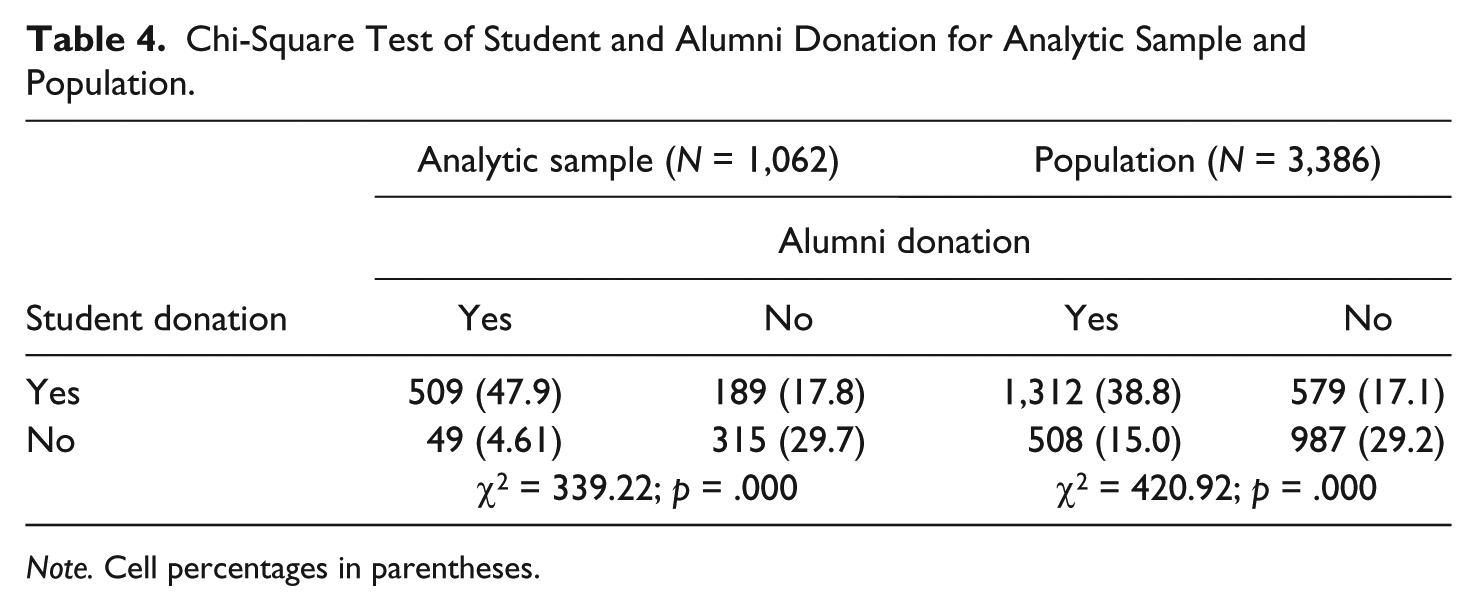
Note. Cell percentages in parentheses.
To further examine the relationship between student giving and subsequent alumni donations, a second analysis used a data set that included the entire population of both graduating cohorts tracked by the development office, regardless of participation in the panel study. The contribution period was also extended from fiscal year 2009 to 2011, allowing 2 more years for the careers of graduates to mature. Ten outlying cases who gave between US$20,000 and US$600,000 were excluded. The mean total alumni donations were US$210 for all cases and US$390 for those making a donation, which are consistent with averages of young alumni found in other studies. The inclusion of 2,324 cases who did not participate in the college survey precludes statistical controls, but differences between the sample and population do provide added insight. Table 4 shows the cross tabulation and chi-square test between student and alumni giving including the analytic sample and the larger population. The proportion of alumni who did not donate as alumni remained virtually unchanged. Although the proportion of graduates who made contributions as alumni but not students increased to 15%, this value remains relatively low.
Several conclusions can be drawn from these data. First, the addition of two more years of donation data did increase occurrences of alumni giving after not giving as students, which suggests that a 5-year time period is adequate for future similar studies of this phenomenon. Second, these results in conjunction with the logistic regression results demonstrate that student giving is highly predictive of donation patterns among young alumni after graduation. In particular, these results suggest that those who give or do not give as students will likely continue these giving patterns after graduation, with relatively few switching from one condition to the other.
It is not surprising that few young alumni chose to give after graduation when they refused to contribute even small amounts to repeated in-person solicitations from their peers. Given that student gift campaigns involve strong inducements to contribute, it is reasonable to conclude that these campaigns provide an early indicator of individuals strongly predisposed to not give. An additional factor may be that student campaigns actively create a subset of nondonors. In an article in the Chronicle of Higher Education, Ensign (2010) explores the effects of high-pressure student gift campaigns at two Ivy League institutions that included practices such as publishing the names and photos of students who would not contribute. While these high-pressure tactics led to nearly universal contribution rates, in some cases they also backfired as some students stated that they experienced shame and resentment; one student stated that the more she was pressured to give, the more she was turned off.
Discussion
Student gift campaigns have become a common feature at college campuses as educational institutions seek to expand their donor base, but this practice has received so little scholarly attention that many fundamental questions remain unanswered. One primary concern, especially for institutional development offices, is how student giving is related to the subsequent giving behavior of alumni after graduation. While it seems reasonable to speculate that student giving leads to future alumni contributions, this assertion has not been empirically evaluated. This study sought to address two central questions regarding student gift campaigns: (a) Are the determinants of student giving consistent with predictors of alumni donations, and (b) is student giving positively associated with the donation pattern of young alumni after graduation? The study finds that the determinants of student giving are largely consistent with the predictors of alumni donations and that student giving is positively associated with patterns of young alumni donations after graduation. In addition, those unwilling to give even small amounts as students are very unlikely to donate after graduation.
Parental financial support was the strongest predictor of student giving, followed by scholarship receipt. Parental support may be acting as a proxy for family income and wealth not directly measured by student estimates of family income. In addition, students may be reciprocating the generosity of parental financial support by viewing the school as an available target of reciprocity for the university experience. Finally, students may view their donation as an investment in the future capabilities of the university and the added prestige that these improvements may facilitate. Future research examining the reasons for student giving could provide information useful to development offices in structuring their campaigns to align with student motivation.
Consistent with Marr et al. (2005), scholarships were one of the strongest significant predictors of student giving. Although neither grants nor loans achieved statistical significance at the .05 level, the coefficients for grants were similar in scale to scholarships and nearly significant with a .07 p value. Clearly, receiving support creates some impetus to reciprocate. School identification, group participation, and subjective evaluation all increased the likelihood of student contributions. Those who identified more with the school were initially 32% more likely to give, but the significance of this effect was eliminated with the addition of subjective evaluation. Subjective evaluation, indicating whether the respondent would choose this university again if they had to do it again, was found to increase the likelihood of student giving by a factor of nearly 2.5, suggesting that students are more likely to give to an organization that they identify with but that their experiences must be positive. Finally, participating in a school club or organization has a positive effect independent of subjective evaluations. This finding is consistent with Schervish and Havens’s (1997) assertion that organizations play a critical, independent role in fostering charitable contributions by providing the structure needed to convey the needs of the university and allowing students to respond to that need.
Measures for cohort and gender were the only significant sociodemographic measures. However, the inclusion of group participation reduced the significance of being female below the .05 significance level, suggesting that gender differences might be a function of gender differences in the amount of time spent in organized activities. As such, these results suggest that the relationship between gender, organizational memberships, and satisfaction may be a fruitful line of inquiry for future research.
Students in the first cohort were 75% more likely to give compared with students in the second cohort. Analyses of interaction terms indicate that the cohorts were similar in their response to all of the measured dimensions included in our study. Interviews with senior-gift-campaign organizers attribute the cohort difference largely to the charismatic leadership of campaign organizers in the first cohort, who started the campaign earlier in the year and managed to elicit broad campaign support throughout the student body. Additional analyses reveal that the average and total amounts given by students in both cohorts were statistically similar, but the campaign was able to persuade more students in the first cohort to make a donation. Together the weight of the evidence supports the conclusion that the primary cohort difference was a more robust campaign drive that produced a wider support base.
Turning to the second part of this study that examined the association between student giving and donations among young alumni, the results of the logistic regression model indicate that student giving is strongly associated with alumni giving. There were very few cases of alumni (4.6%) who gave shortly after graduation after choosing not to give as students. The rarity of this occurrence is problematic from a strictly statistical perspective, but conversely provides evidence for the strong link between donation behavior as a student and subsequent alumni donation behavior. The expanded analysis, using a larger data set comprised of the entire population of graduates from these cohorts tracked by the development office and including 2 additional years of donation data, provides supporting evidence of the positive association between student and alumni giving. Giving to the senior gift campaign is highly indicative of giving among young alumni.
The strong association between student and alumni giving patterns could be explained by several factors. First, the student gift campaign may simply be providing an early indicator of individuals’ predisposition to donate. It is not surprising that individuals unwilling to donate even small amounts after repeated, in-person solicitations from peers would likely not respond to less-personal solicitations after graduation. A second possibility is that getting students to contribute to the university while enrolled causally shapes their giving behavior after graduation. The campaign may not only be making future alumni more aware of the needs of the university, but once an act of giving occurs it may continue out of habit (Meer, in press). Finally, the pressure from repeated peer solicitation may actively create a subset of nondonors. A recent article in the Chronicle of Higher Education highlights the resentment and anger some students felt when subjected to high-pressure tactics. (Ensign, 2010).
Conclusion
While this study of a private, elite university provides insights regarding the determinants of student giving and its relationship to subsequent giving among young alumni, it does have its limitations. The primary limitation is that the data are from a single institution. This limits the generalizability of our results, but because student giving has not been established as an important predictor of alumni giving, a single university study is an important first step. The fact that many of the traditionally observed patterns of giving appear in our data is reassuring.
However, as a first study of student giving, there are several issues raised by our results that deserve future attention. The relationship between gender, organizational participation, satisfaction, and giving is a complex and important one, which will take large sample sizes or multiple studies to disentangle. Other important issues for future research to address include the following: (a) What mechanisms underlie the strong link between parental support and student giving, and (b) is the strong association between student giving and subsequent young alumni donation behavior causal or indicative? It is unclear whether student giving simply provides an indicator of those predisposed to giving or causally shapes future giving behavior. Given that student-giving campaigns are a widespread practice, scholars need to more fully investigate the impact of features of these campaigns. As demonstrated by Ensign’s (2010) study, in some cases peer pressure may be undermining the very processes they hope to invoke. In our results, it is clear that effective campaign leadership can raise student giving. Understanding these processes could be important, especially if student giving is causally related to young alumni giving and sustained giving later in the life course.
Footnotes
Acknowledgements
The authors would like to gratefully thank Lynn Smith-Lovin, Scott Fitzgerald, and David Brady for their very helpful comments on earlier drafts and Nathan Martin for this assistance with the data. We are also grateful for the generous support of the Fred and Barbara Sutherland Research Fellowship.
Declaration of Conflicting Interests
The author(s) declared no potential conflicts of interest with respect to the research, authorship, and/or publication of this article.
Funding
The author(s) received no financial support for the research, authorship, and/or publication of this article.