



Abstract
This article examines the state of nonprofit and philanthropic studies doctoral education using several data sources: PhD student surveys, faculty surveys, the number of nonprofit articles published in academic journals, and completed dissertations in nonprofit and philanthropic studies. This article contributes to the nonprofit literature by capturing overall trends in nonprofit and philanthropic studies doctoral education, while asking fundamental questions about doctoral education—particularly about coherence and knowledge production. It presents several implications for both our understanding of the current state of nonprofit doctoral education—where we are—and where the field may be headed.
Introduction
Education in nonprofit and philanthropic studies at all levels in the United States—undergraduate, graduate, continuing education, and noncredit coursework—has expanded tremendously over the past two decades (Mirabella, 2007). O’Neill (2007) predicted that “the future will see more expansion upward and downward into the doctoral and undergraduate levels” (p. 173). While researchers have focused on undergraduate education (cf. Dolch, Ernst, McClusky, Mirabella, & Sadow, 2007) and continued to focus attention on the master’s level (cf. Denhardt, 2001), the current state of doctoral-level nonprofit education in the United States has received limited attention (Allison et al., 2007).
Allison et al. (2007) began a conversation about the nature and state of doctoral education in nonprofit and philanthropic studies highlighting the “near absence” of studies on the subject. Based on their findings, they argued for (a) annual core doctoral-level courses on nonprofit and philanthropic studies, (b) periodic courses on nonprofit and philanthropic studies, (c) seminars or consortiums at the national and regional levels for intellectual sharing among doctoral students, (d) the establishment of web-based forums, and (e) the formation of student collaboratives—with faculty guidance—to discuss foundational nonprofit and philanthropic theories and concepts.
Anecdotal evidence suggests that some advances have been made in this direction. For instance, just 5 years after the first assessment by Allison et al. (2007), a number of seminars and consortiums that cater to doctoral studies in the nonprofit field had emerged. 1 However, the extent to which these new opportunities are only isolated changes or part of a more comprehensive trend toward better preparing PhD students interested in nonprofit studies is not clear. It is a fitting time to return to the ideas and recommendations of Allison et al. (2007) to understand which recommendations have been embraced and examine recent trends in nonprofit doctoral education. Using several sources of data, this article examines the state of nonprofit and philanthropic studies doctoral education.
In advance of the empirical analysis, relevant literature about doctoral education—whose central role is to advance knowledge and prepare students for the professorate (White, Adams, & Forrester, 1996)—is explored. We use the field of public administration in the United States for further insights about doctoral education. Tenets of high-quality doctoral education include a solid core curriculum, opportunities to research specific projects, sufficient financial support, and good mentoring from research-active faculty (Brewer, Facer, O’Toole, & Douglas, 1998, 1999). Our discussion of literature on doctoral education can inform nonprofit and philanthropic studies doctoral education and grounds the present empirical inquiry in a valuable extension of Allison et al. (2007).
In addition, building on the scholarship and empirical work of Allison et al. (2007), this study includes four sources of data: a PhD student survey, PhD faculty survey, a number of nonprofit studies-related articles published in academic journals, and a number of dissertations published focusing on nonprofit and philanthropic studies. The authors use the same survey instruments as Allison et al. (2007) but add key questions about student productivity, scholarly opportunities for students, and anticipated career tracks; expand Allison et al.’s (2007) 2000-2005 examination of published articles on nonprofit and philanthropic studies, extending these data to include 2006-2011; and examine the number of nonprofit and philanthropic studies dissertations conferred 2000-2011 to measure nonprofit doctoral student productivity. Inclusion of these new data should provide a more robust understanding of the state of nonprofit and philanthropic studies doctoral education in the United States.
Doctoral Education
Discussion of doctoral education has received scholarly attention over the last several decades and increased U.S. media coverage more recently (Lyden, 2013; Weissmann, 2013). Although scholarship specific to nonprofit and philanthropic studies doctoral education is limited, we can draw on theoretical and empirical studies from across disciplines, and we take a more focused approach informed by the field of Public Administration in the next section. Golde and Dore (2001) assert that a doctoral student must learn to generate knowledge, think critically, and become a “steward of the discipline” (p. 5). While each discipline has its variations in doctoral education (Gardner, 2009), studies about doctoral education across several disciplines—as diverse as chemistry, education, English, history, mathematics, and neuroscience—find that the common purpose of doctoral education “is to educate and prepare those to whom we can entrust the vigor, quality, and integrity of the field” (Golde, 2006, p. 5).
In the 1980s, 1990s, and throughout the 2000s, challenges to doctoral education became more pressing, and concerns about its direction surfaced (Ehrenberg & Kuh, 2009; Golde & Dore, 2001). An apprehension resonated that the supply of PhD students was too great for the market, and it was becoming clear that there were not enough tenure-track positions for the number of new PhDs (Weissmann, 2013). Moreover, doctoral student preparation has been criticized for making research and publication priorities over teaching and the dissemination of knowledge outside of academia. Another challenge across the disciplines is that levels of doctoral student attrition are cited to be as high as 40% to 50% (Cassuto, 2013; Council of Graduate Schools, 2004; Golde, 2005; Lovitts, 2001). Empirical evidence highlights additional challenges. Golde and Dore (2001) surveyed doctoral students across 11 arts and sciences disciplines and found that doctoral students were unable to successfully navigate their graduate studies and were trained in areas that did not match the jobs they took. Overall, doctoral students were found to have a poor sense of what doctoral study actually entailed (Golde & Dore, 2001).
Coherence and Knowledge Production in Doctoral Education: Insights From the Field of Public Administration
Two prevalent issues in the literature about doctoral education frame the present research: the coherence of a disciplinary field and the importance of knowledge production. Indeed, the idealized concept of a coherent field of inquiry, or one that has clear lines that delineate it from other fields of scientific inquiry, may not exist even in the hard sciences. Some fields seem to retain enough structure to be considered coherent fields (e.g., nuclear physics or structural engineering), while some scholarly disciplines have become more diffuse and interdisciplinary (Golde, 2006). The intellectual coherence or what might be also called the “intellectual identity” (Golde, 2006, p. 4) of a discipline can manifest itself in several ways, including the growth of the number of students, publications and journal titles using its name, as well as endowed positions and research centers (Brewer et al., 1998; Brush et al., 2003). Another signal of disciplinary coherence includes having key intellectual bases in the field and its curriculum development, what Allison et al. (2007) observed as “key foundational and theoretical knowledge” (p. 52S). The field of nonprofit and philanthropic studies crosses multiple boundaries, making its coherence less obvious and less definable. Despite this, nevertheless Allison et al. (2007) argued that there was a need for additional theoretical emphasis in doctoral programs in the field of nonprofit and philanthropic studies to comprehend “major concepts, key thinkers, and influential work” (p. 53S). They argued that the discipline—as a field of inquiry—needed to identify the core problems of nonprofit research and “distinct research questions” (Allison et al., 2007, p. 53S).
Several scholars in social science disciplines have discussed coherence (Buchmann & Floden, 1992; Golde, 2006), particularly in the field of public administration (e.g., Brewer et al., 1998). The professional field of public administration offers insight to exploring coherence—and knowledge production—and informs our study. Consistent with other fields outlined above, issues about coherence became prominent in the 1980s by academics discussing public administration doctoral education (cf. McCurdy & Cleary, 1984; Stallings, 1986; White, 1986). Stallings (1986) argued that doctoral education in public administration needed to focus more on the abstract and analytical—the form—where a focus on content and the everyday issues of practice was more appropriate for master’s-level education as “[a] focus on form rather than content provides for a clear-cut distinction between the practitioner-focused master’s degree program and the doctoral degree” (p. 238). In the 1990s, further concerns were raised about doctoral education and the perceived lack of a solid theoretical foundation, with academics across public administration asking if the field of public administration was too incoherent (e.g., Brewer et al., 1998). In particular, Hambrick (1997) referred to doctoral education in public administration as having “a mild disorientation” and an “identity crisis” (p. 133). According to Brewer et al. (1998, 1999) and as argued by Allison et al. (2007), a coherent intellectual core curriculum was a key factor in doctoral student preparation.
In addition to field coherence, knowledge production—the contribution of scholarly work to academic fields of inquiry—remains an integral component of any academic discipline. The depth and breadth of academic publications by scholars is a metric used consistently across the social sciences and the professional fields. Again we turn to the field of public administration and discussion about knowledge production in doctoral education. As an example, White et al. (1996) explored the contribution of doctoral education to knowledge production and dissemination by examining the publication records of recent PhD graduates. By reviewing the publication record of new public administration PhDs, White et al. (1996) determined that there was a very low level of research production across 7 cohorts (1981-1987): Only 12% of graduates had articles published in the 26 core public administration journals. They found that “some programs may produce a lot of doctorates, but they do not produce many researchers” (p. 447) and argued that the low publication rate signaled there was little knowledge production and dissemination. While publication of academic articles is only one of the requirements of tenure-track professors, it remains critical to achieving tenure and provides a useful measure of knowledge production across multiple academic disciplines.
Encouraging students to publish and present articles is fomented by “affinity for mentors, peer pressure, funding and support tied to performance, annual student evaluations, workshops, regular channels of information for students, joint papers in doctoral courses, and research papers” (Brewer et al., 1998, p. 132). Conducting a survey of doctoral programs in the field of public administration, Brewer et al. (1998) found a perception that PhD students were publishing more than they actually were as self-reported survey results were not corroborated by a search of publications in the Social Science Citation Index, casting questions on how productive PhD doctoral students actually were.
Building on the work of Allison et al. (2007), the present inquiry examines the current state of nonprofit and philanthropic studies doctoral education, focusing particularly on the coherence of nonprofit and philanthropic studies as field of inquiry and its knowledge production.
Data and Method
Allison et al. (2007) collected and analyzed three sources of data: a faculty survey, a survey of nonprofit and philanthropic studies PhD students, and a search of the peer-reviewed academic literature to gauge the impact of nonprofit studies in academic publications. They found “a disconnect between supply and demand for doctoral-level education in nonprofit and philanthropic studies” requiring “that students and faculty members need to be innovative and experimental to meet” (p. 59S) the expectations of doctoral students, but indicated that the disconnect between supply and demand for nonprofit courses and coursework was slowly being addressed through the introduction of new courses and/or enhanced coursework to meet the demand of PhD students. This study seeks to understand what has happened in an analogous population of PhD students and faculty engaged in nonprofit and philanthropic doctoral education since their novel study in 2007.
To replicate the three sets of data collected and analyzed by Allison et al. (2007)—a PhD student survey, a faculty survey, and a systematic journal search—the authors recreated and implemented two online surveys: one for nonprofit and philanthropic studies PhD students and one for faculty members. The original search of published nonprofit journal articles was replicated and updated. This study also expands the data collected by Allison et al. (2007) to better understand nonprofit PhD student productivity over the last several years by researching doctoral dissertations related to nonprofit and philanthropic studies published from 2000 to 2011. The expanded sources of data allow for better exploration of the concept of coherence, particularly through the surveys collected from the PhD students and faculty members in 2012. The issue of knowledge production in the field is examined through the analyses of academic articles and dissertations related to nonprofit and philanthropic studies published between 2000 and 2011.
PhD Student Survey Data
The PhD student survey was distributed electronically to the Association for Research on Nonprofit Organizations and Voluntary Action (ARNOVA) and The International Society for Third Sector Research (ISTR) listservs, which include the target audiences of academics and doctoral students interested in nonprofit and philanthropic studies. Two weeks after the initial recruitment e-mail, an additional reminder e-mail was sent. Concurrently, the faculty survey directly requested nonprofit faculty to distribute the PhD student survey to relevant PhD students. At the close of the research period, a total of 101 responses were received, resulting in 80 usable surveys.
It is important to note that the results obtained from this nonprobability survey should be interpreted with caution as using listservs to distribute the survey introduces the risk of response bias. For example, not all the doctoral students interested in nonprofit and philanthropic studies subscribe to the listservs used to distribute our survey. Even if they are subscribed, there is the risk of self-selection bias if the students who answered our survey are systematically different from those who did not answer the survey. Although the results of nonprobability samples cannot be used to make definite inferences about the population of doctoral students interested in nonprofit and philanthropic studies, they can be useful for collecting some descriptive (noninferential) statistics (Fricker, 2008), such as the data used in our study to explore the overall trends in nonprofit and philanthropic studies in doctoral education.
Faculty Survey Data
Similar to the student survey, the faculty survey was also distributed electronically. The initial invitation was a series of personal emails sent to the department directors of 75 universities in the United States with nonprofit-related courses, a list compiled based on the Census of Nonprofit Management Education. 2 Because the response rate to the initial e-mail was low, the survey was distributed using the same strategy as the PhD student survey and distributed through the two major nonprofit listservs, resulting in a total of 37 usable responses. The results of the faculty survey should be interpreted with caution as they are subject to the same response biases described above.
Nonprofit Article Publication
Extending the 2000-2005 research of Allison et al. (2007), this study replicated their search of academic articles to include articles published in English language and peer-reviewed journals from 2006 to 2011, resulting in an overview of articles that focused—as evidenced by words found in the abstracts—on nonprofit and philanthropic studies from 2000 to 2011. Allison et al. (2007) used the keywords: “nonprofits (and variations of this word such as not-for-profit, non-profits), nonprofit organizations, third sector, philanthropy, civil society, voluntary associations, voluntary sector, voluntarism, charitable organizations, grassroots organizations, community based organizations, nongovernmental organizations, and NGOs” (p. 57S, emphasis in original). We replicated this study using identical search terms.
PhD Student Dissertations
To advance the research started by Allison et al. (2007), this study explored the productivity of PhD students from 2000 to 2011 with respect to the production of doctoral dissertations. Similar to the publication of academic articles by nonprofit scholars, this study explored how many English language dissertations were produced with key nonprofit and philanthropic terminology in their abstracts and/or titles.
Findings
Analysis of these four sources of data substantiate findings and answer some questions raised by Allison et al. (2007), while raising new questions that require additional study.
PhD Student Survey Results
Similar to the student population that responded to Allison et al. (2007), and as evidenced by Table 1, our respondents represented “the truly interdisciplinary nature of nonprofit studies” (p. 56S). Also similar to Allison et al. (2007), 86% of respondents indicated that nonprofit organizations and voluntary associations were a substantial focus of their doctoral studies (as compared with 83% in 2007), with 96% of respondents indicating that nonprofit organizations and voluntary associations would be/are a substantial focus of their dissertation research (as compared with 94% in 2007).
The Disciplines of PhD Students Exploring Nonprofit and Philanthropic Studies That Responded to Our Survey (n = 80).
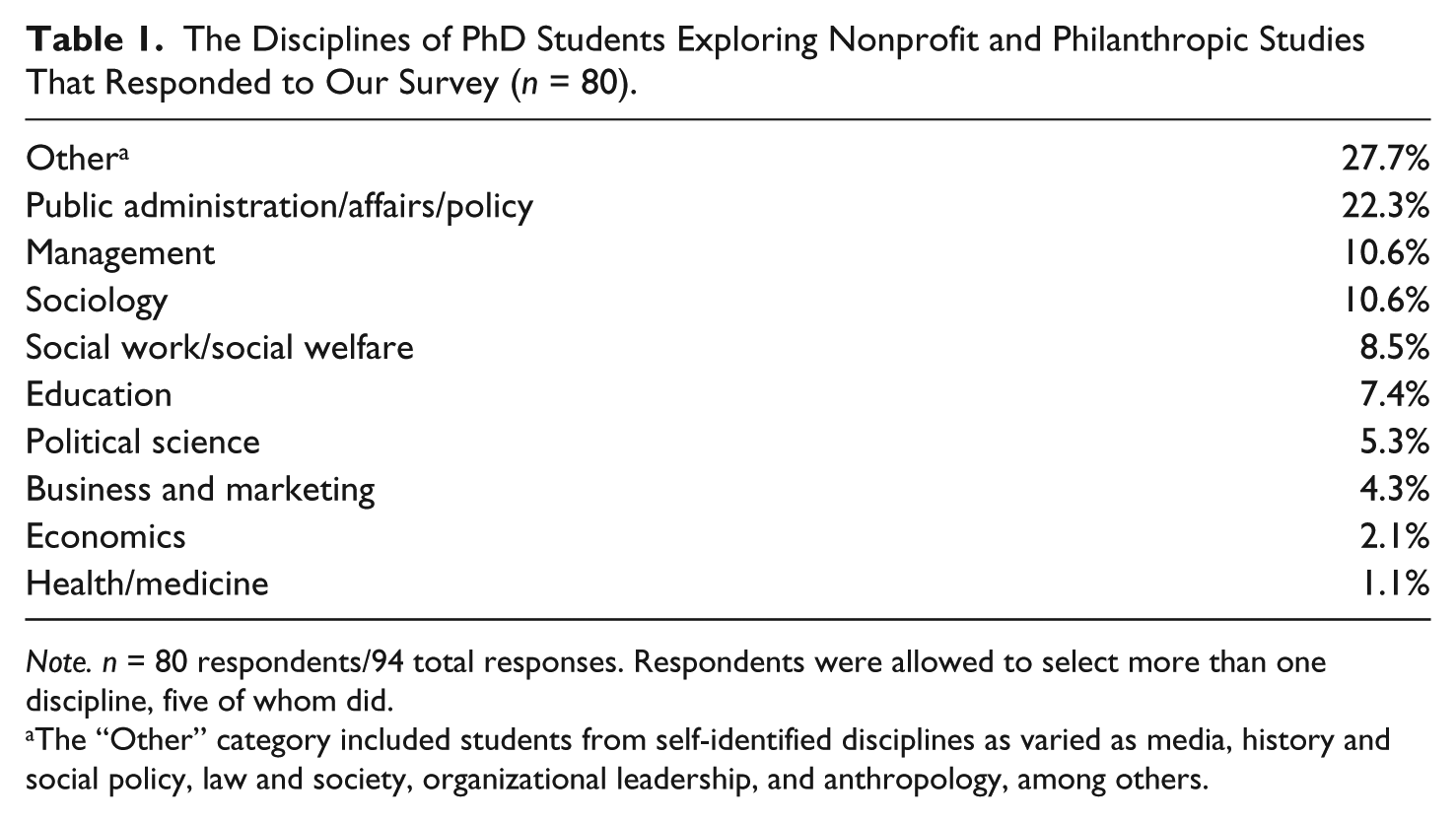
Note. n = 80 respondents/94 total responses. Respondents were allowed to select more than one discipline, five of whom did.
The “Other” category included students from self-identified disciplines as varied as media, history and social policy, law and society, organizational leadership, and anthropology, among others.
One seemingly surprising result from this survey was that only just over half (41 of 80) of the student respondents had taken courses directly related to nonprofit or philanthropic studies. Similarly, Allison et al. (2007) found “that less than half of the doctoral students planning to complete nonprofit-related dissertations have taken any courses related to nonprofit and philanthropic studies” (p. 59S). As two of their five recommendations urged access to courses specific to the foundations of nonprofit theories and texts, it is surprising that access to nonprofit and philanthropic study courses in the intervening years between the surveys has not been greater. A plausible explanation for this result is that doctoral students might be gaining their knowledge through activities other than coursework. For instance, 71% of the doctoral students surveyed (n = 57) indicated having gained their foundational knowledge of nonprofit and philanthropic studies from noncredit activities, independent readings, and research, while only 33% (n = 26) indicated having gained this knowledge from coursework. This issue is further explored in discussion of the faculty survey results section.
PhD Student Productivity
To understand nonprofit doctoral education more fully, data were sought to capture PhD student productivity. PhD student productivity was measured by the number of nonprofit and philanthropic dissertations produced (discussed further below) and by student survey questions about opportunities for PhD students to present at conferences and/or author or co-author academic articles with professors and/or colleagues. The results show that a majority of respondents had an opportunity to present at a conference, author or co-author a conference paper, and also conduct independent research with a faculty advisor. A smaller number of respondents co-authored published academic journal articles (n = 22), and even fewer respondents published as a lead or sole author (n = 11).
Faculty Survey Results
The student survey revealed insights into the “demand” for nonprofit doctoral education. The purpose of the faculty survey was to complement this examination by focusing on the “supply” of nonprofit doctoral education, gathering information on how universities are meeting the demand for nonprofit doctoral education and the curriculum changes introduced to meet the demand.
A total of 37 faculty members responded to our survey. The overwhelmingly majority of faculty members were affiliated with public administration, affairs, and/or policy departments (n = 24), which may have biased our results; therefore, these results must be interpreted with caution. The number of faculty who taught nonprofit graduate courses in these departments varied considerably: The responses ranged from just 1 faculty member to 10. Most commonly, between 2 and 3 faculty members in each department taught graduate-level nonprofit courses (n = 17 or 45.9% of the sample). The results suggest that universities rely heavily on adjunct instructors to provide a substantial share of their nonprofit graduate course offerings. For instance, the department with 10 professors teaching nonprofit courses does so by relying on 8 adjunct instructors and 2 tenured professors. In addition, five other respondents indicated that they use adjunct faculty to teach their nonprofit courses (one respondent was not sure about the total number of professors in the department because she or he was an adjunct herself or himself). The most common topics of nonprofit courses are theories of nonprofit organizations, fundraising and marketing, and management (n = 28 respondents for each topic). Other common topics identified were governance (n = 26), nonprofit financial management (n = 24), and program evaluation (n = 23). These nonprofit courses are largely offered at the master’s level, which in combination with the focus on topics such as management, fundraising and marketing, and the reliance on adjunct faculty suggests a practical orientation to nonprofit studies in graduate education. 3
As found by Allison et al. (2007), to match doctoral student interests, faculty members often make adjustments to their courses geared toward offering doctoral students an experience more in line with their interests. For example, it is common for faculty members to require additional assignments that are more research focused rather than practice oriented. In addition, faculty set more rigorous grading standards for doctoral students. Finally, some faculty members said that they offer doctoral students teaching experience by requiring them to prepare and teach some sections of the class. In sum, these activities and increased academic rigor supplement the existing applied, practice-oriented curricula and course structure.
The survey also explored changes in curricula to meet the demand for nonprofit doctoral education. The most common changes identified by the faculty members were an increase in the number of nonprofit-related courses (n = 19), making arrangements with other departments to offer cross-listed courses (n = 11), and/or creating a specific concentration related to nonprofit-related studies (n = 11). Other common changes to the curriculum included integrating nonprofit content into core courses (n = 9) and offering a PhD-level nonprofit course in the overall curriculum (n = 7). Finally, one faculty member indicated that his or her department recently created a nonprofit research center. Two faculty members indicated that their programs are so new that they are just starting to develop the curriculum, so these responses appear to represent a range of programs at different stages of development. Future changes to curriculum described by some of the respondents include broadening the focus of the nonprofit concentration. Here, three faculty members indicated that they plan to incorporate a more international perspective to their concentration and offer courses on nongovernmental organizations (NGOs).
Academic Article Search Results
Using a range of relevant search terms, Allison et al. (2007, p. 57S) conducted a review of the academic literature to quantify the number of academic journals publishing articles related to nonprofit organizations and/or philanthropy. 4 They found over 2,000 peer-reviewed journals published articles across a range of relevant topics between 2000 and 2005. Replicating this search of abstracts and keywords using SCOPUS, the authors found that well over 2,000 journals (2,741) published relevant articles in the 6-year period of 2000-2005, also finding that 4,175 academic journals published articles the following 6 years, 2006-2011 (see Table 2). The total number of articles published across a 6-year interval (2000-2005 and 2006-2011) increased by just over 65% (see Figure 1). One limitation to these data is that the substantial growth may not only be attributed to a growth in production of nonprofit-centered academic articles, but may also be a result of the increased number of academic journals indexed by SCOPUS since Allison et al.’s (2007) study, as electronic access to academic articles has become more common. However, the change is large and represents a clear trend of increased academic publications related to topics associated with nonprofit organizations and/or philanthropy.
Peer-Reviewed Academic Articles That Focus (At Least in Part) on Nonprofit and/or Philanthropic Topics, Themes, or Organizations.

This figure represents the total number of unduplicated journal titles.

Nonprofit and philanthropic studies articles published, 2000-2011.
Nonprofit Dissertation Production, 2000-2011
In addition to the three data sources used by Allison et al. (2007), this study explores the number of dissertations related to nonprofit organizations and/or philanthropy as a measure of PhD student productivity and knowledge production in doctoral education. Using the ProQuest Dissertations and Theses database, a preliminary search of abstracts using the same nonprofit- and/or philanthropy-related terminology as the nonprofit academic article search resulted in 2,071 dissertations. A random sample of 200 titles and abstracts was then coded and uncovered many titles—especially those associated with the term civil society—that were clearly not nonprofit and philanthropic studies dissertations. As a result, the authors reviewed the abstracts of all 2,070 dissertations initially found and eliminated those not explicitly related to nonprofit and philanthropic studies. This exercise resulted in a final database with 691 dissertations that use the term nonprofit organization, 186 that use alternative terms such as voluntary association or third sector, and 357 dissertations that use the term nongovernmental organization, resulting in a total of 1,035 nonprofit and philanthropic-studies-centered dissertations completed between 2000 and 2011.
Nonprofit and philanthropic dissertation production increased between 2000 and 2011, most notably between 2005 and 2010, also increasing as a percentage of the total output of dissertations during that same time period (see Figure 2). The 20 universities with most nonprofit and philanthropic studies dissertations include some of the largest and the most prestigious academic institutions in the United States, one university in Canada, and three online academic institutions. 5

Nonprofit and philanthropic-studies-related dissertations by number per year, and as a percentage of all dissertations conferred.
Discussion
Although the PhD student and faculty surveys reveal that little change has been made in the direction of the recommendations made by Allison et al. (2007), the focus of this updated study begins a discussion about the coherence of nonprofit and philanthropic studies doctoral education and its contribution to knowledge production in this field of inquiry. There appears little difference in survey results since the first iteration regarding the concept of coherence: There does not appear to be any consistent core doctoral-level courses or any courses offered even periodically that are focused on nonprofit and philanthropic studies; in general, the survey results show limited course options offered specifically to doctoral students interested in nonprofit organizations; nonprofit concentrations are appearing but tend to be more practice oriented and are focused mainly to master’s degree students. The survey responses of some students reveal their frustration with the current state of nonprofit and philanthropic studies doctoral education. For example, surveyed doctoral students mentioned having to be “self-directed learners,” receiving “no support and being left to sink,” and lamented that “there are few funding sources to support our work and studies.” Some faculty members also noted frustration about the little support for nonprofit studies. For instance, one surveyed faculty member wrote: As a whole, academia underserves the nonprofit community. Relatively few programs exist (in relation to for-profit management schools and programs, for example) and most faculty are primarily affiliated with outside departments. The sector needs more schools devoted to nonprofit studies with full time faculty attached to departments of nonprofit studies.
Despite limitations, nonprofit faculty members have found ways to meet some of the demands of nonprofit doctoral students by making adjustments to their courses. Consistent with Allison et al.’s (2007) findings, faculty members continue to accommodate nonprofit doctoral student needs on a case-by-case basis based on departmental resources, as well as university and programmatic opportunities.
Perhaps the most important change that these data reveal is the increase of knowledge production in the field. Based on measurement of knowledge production using dissertations and academic article production as proxies, the field is growing. In comparison with Allison et al. (2007), there has been an increase in academic journal articles that include nonprofit or philanthropic topics. Although this increase may be in part due to an expansion of academic journal titles in the recent years, the rise in peer-reviewed articles on these topics is evident. In addition, the data collected for the present study indicate that there are a large number of PhD dissertations that include nonprofit or philanthropic topics since 2000. The growing number of dissertations may be an indication that doctoral programs are preparing more doctoral students interested in nonprofit and philanthropic studies for scholarly knowledge production—a key requisite for a scholarly discipline (Golde & Dore, 2001).
Conclusion and Next Steps
This updated study presents several implications for our understanding of the current state of nonprofit doctoral education. The broader discussion of the raison d’être for doctoral education grounds this empirical inquiry and constitutes a valuable extension of Allison et al. (2007). The expansion of data collection (adding questions to the survey instruments and covering further years of data) and data sources (published dissertations) contributes to better understanding of the field of nonprofit and philanthropic studies and its coherence generally as well as its production of knowledge, particularly in relation to doctoral education. However, the results derived from the faculty survey in our study produce a limitation to the research as the response rate was low, and responses were dominated by public administration and policy faculty, which does not capture the diversity of nonprofit and philanthropic doctoral education. For further insight into doctoral education in the field of nonprofit and philanthropic studies, next steps might include sampling programs that identify as having nonprofit and philanthropic doctoral education and inquiring about their location and curricular content, the range of dissertation topics, and graduate placement. 6
Indeed, if the trends of the past several decades serve as an indication of where the field is headed, doctoral programs will have to grapple with many issues. The data suggest that steps toward a shared “body of knowledge” have started to be taken. However, based on survey data, the core curriculum and issues associated with nonprofit and philanthropic studies are still weakly defined, signaling little coherence in the field of study. Knowledge production is on the rise, and the next steps might include creating instruments that also examine the quality of the knowledge. For example, one might measure quality of knowledge production by tracking the number of dissertations or dissertation chapters that are subsequently published through the peer-review process.
Finally, with debates around online education emerging in popular media and policy discussions (Gabriel, 2011; Pappano, 2011) and scholarly work (Wegener & Leimeister, 2012), it will be important to examine in greater detail the increasing number of PhD degrees conferred in nonprofit and philanthropic studies by online academic institutions, especially when one considers that 3 online institutions that confer doctorates focusing on some aspect of nonprofit studies organizations were identified in the top 15 academic institutions graduating doctoral students. Online doctoral education has been explored across myriad fields of academic inquiry, including business administration (Combe, 2005), library and information sciences (Klingler, 2007), kindergarten through 12th grade education (Ghezzi, 2007), as well as technical education (Baltzer, Lazaros, & Flowers, 2007; Flowers & Baltzer, 2006a, 2006b). In addition, almost 70% of higher education administrators report online education as “critical to their long-term strategy” (Allen & Seaman, 2013, p. 4). And if we believe that this topic concerns only younger scholars, this is a misconception. “Although younger students may have grown up using various types of computer technologies, most students in online doctoral programs are nontraditional students—many are between 45 and 60 years of age” (Bolliger & Halupa, 2012, p. 82). More work needs to be done on this topic, especially concerning questions that range across several disciplines related to online education at the doctoral level, including assessing the quality of instruction, mitigating challenges to measuring learning outcomes, and ensuring opportunities to be part of the field’s broader academic community.
In sum, the field of nonprofit and philanthropic studies needs to continue to explore doctoral education—its coherence and contribution to the production of quality knowledge—through additional studies looking at the scope of nonprofit doctoral education. Given that the field of nonprofit and philanthropic studies is relatively young, graduate students, faculty members, academic departments, and institutions have an opportunity to be reflective, strategic, and innovative moving forward.
Footnotes
Acknowledgements
The authors thank those whose work provided the inspiration to pursue this line of inquiry. We would like to especially thank Angela Dalton (Xiaolei Chen), Shawn Flanigan, and Triparna Vasavada for their gracious consent to our moving this research forward, granting us access to their data more than 5 years after they completed their study and providing insight into their methodology.
Declaration of Conflicting Interests
The author(s) declared no potential conflicts of interest with respect to the research, authorship, and/or publication of this article.
Funding
The author(s) received no financial support for the research, authorship, and/or publication of this article.