



Abstract
Performance is a key concern for nonprofits providing human services. Yet our understanding of what drives performance remains incomplete. Existing outcome measurement systems track the programmatic activities staff complete and the extent to which participants respond in programmatically intended ways. However, clients do not just receive services and respond as intended and staff do not simply complete program activities. Drawing on a data set of 47 interviews with frontline staff in eight human service nonprofits, we show how frontline staff work in a partnership with clients to set an agenda for change and achieve desired results. We call this co-determination work and argue that it represents a critical and often neglected dimension of nonprofit performance.
Performance is a key concern in the nonprofit sector. A wide range of models and metrics are used to measure performance, including financial metrics, outcome measurement models, staff evaluations, and capacity assessments. Each approach brings certain elements of nonprofit performance into clearer focus; none captures the full picture. Organizations that deliver human services face particular challenges in describing and measuring the essential attributes of what they do (Schorr & Farrow, 2011; Smith, 2010). Staff in these organizations frequently report that existing outcome measurement models do not fully capture the changes they see in clients as a result of their work 1 (e.g., Carman & Fredericks, 2008; Hwang & Powell, 2009; Salamon, Geller, & Mengel, 2010). One recent study summarized staff concerns about performance measurement: “While client progress may be measurable, the measurement system being used is unable to capture the complex progression of improvement” (Carnochan, Samples, Myers, & Austin, 2013, p. 7).
We argue that one reason that outcome measurement systems miss “the complex progression of improvement” is that they miss important aspects of how frontline staff work with clients. In particular, they fail to adequately account for how client agency shapes frontline encounters. Far from simply receiving services and responding in programmatically intended ways, clients are active agents whose desires, attitudes, needs and situational constraints play key roles in the change process (Keith-Lucas, 1972). Consequently, to support clients in achieving desired outcomes, frontline staff have to build partnerships with clients, define desired outcomes and strategies, and support client capacity to take positive and often novel action. We call this work co-determination work. By not fully accounting for co-determination work, outcome measurement systems miss important causal mechanisms that contribute to client outcomes and overlook important nonprogrammatic outcomes resulting from this co-determination work. Bringing co-determination work into focus deepens our understanding both of how nonprofits achieve outcomes and of what outcomes matter.
To better understand co-determination work, we examine data from 47 interviews with frontline staff in eight nonprofits providing human services. The data reveal three common co-determination tasks and for each, an associated dilemma, which staff repeatedly confront. The dilemmas, rooted both in the reality of client agency and the desire to nurture and expand this sense of agency, resist easy solutions. They require skillful, iterative staff judgment amid considerable flux and uncertainty. Persistence and attention to details matter; today’s small victories may be undercut by clients’ circumstances or choices tomorrow. The highly individualized nature of co-determination work makes it inherently elusive, yet data provide considerable evidence of a plausible connection between this work and the ability to achieve client outcomes. The concept of co-determination thus helps solve the puzzle of why staff feel that existing performance models miss key aspects of their work and the small but important client victories they see.
More empirical work will be needed to confirm and refine the understanding of co-determination we present here. We believe our analysis has the potential to make three original contributions to the literature on nonprofit performance. First, by shifting the unit of analysis from organizations and programs to frontline encounters, we open a window on a relatively neglected aspect of nonprofit performance: How “street-level” staff practices, choices, and judgments shape outcomes. Second, while others have pointed to various limits of performance measurement frameworks, we are not aware of any critique that has pointed to client agency as an important missing variable. Finally, we discuss how existing outcome measurement models could better account for the agency of clients and the co-determination work of frontline staff, taking our cues in part from recent work on co-production in the public administration literature. Our intent is not to discount the insights made possible with the existing repertoire of performance models and metrics, but to add a critical dimension that has been neglected or missing.
Our article proceeds as follows. In the section “Measuring Nonprofit Performance: Accounting for Client Agency,” we situate our work in the literature on nonprofit performance. In the section “Data Set and Analysis,” we describe our research approach, data set, and methods. In the section “Co-Determination in Nonprofit Human Services,” we describe key dimensions and dilemmas of co-determination work as identified by our interviews with frontline staff. In the final section “Re-Considering Nonprofit Performance,” we discuss the implications of our analysis for how we conceptualize and assess nonprofit performance.
Measuring Nonprofit Performance: Accounting for Client Agency
In an earlier review of the literature, we found several reasons why staff continue to express concerns that outcome measurement models miss important outcomes they see in their work with clients, including resource constraints limiting the data nonprofits can collect, data collection systems that are structured to meet funder demands not organizational priorities, and the failure of performance measurement frameworks to capture the expressive work of nonprofits such as citizen engagement (Benjamin, 2012; Carman & Fredericks, 2008; Ebrahim, 2003; Smith, 2010). Our work has taken a different approach, inspired by the literature on street-level bureaucracy, which demonstrates that—whatever their original design and intentions—policies and programs are in reality defined and redefined continually as they are enacted in frontline encounters (Brodkin, 2008; Lipsky, 2010; Maynard-Moody & Musheno, 2003). Analysis of frontline encounters provides a unique vantage point for conceptualizing nonprofit performance. The discretion of frontline staff can support, undermine, or redefine objectives, but in no case can it be ignored in analyzing outcomes.
Yet, our own earlier work found that popular nonprofit outcome measurement models are based on assumptions that do not fully capture how frontline staff achieve outcomes (Benjamin 2008). One important reason is because these models focus, with considerable justification, on programmatic activities and outcomes (Benjamin, 2012; Benjamin & Campbell, 2014). This programmatic focus began with the emergence of evaluation as a field of practice in the 1960s, when the goal was to identify causal relationships between policy interventions and observable outcomes. Given this goal, programs were a reasonable unit of analysis, and this approach spawned a growing field of program evaluation research (Chen, 1990; Shadish, Cook, & Leviton, 1991). As nonprofit outcome assessment guides came along, they built on this legacy, typically putting programs at the center of attention. However, while programmatic activities clearly guide and structure the work of frontline staff, particularly in human service provision, staff members’ day-to-day encounters with clients, residents, and constituents include a much wider repertoire of activities and tasks. We have identified four types of frontline work that are less self-evidently tied to program implementation: relational work, adjustment work, co-determination work, and linking work (Benjamin & Campbell, 2014).
While all four of these types of work are important, co-determination poses a particular challenge for conceptualizing and measuring nonprofit performance. Despite its many benefits, the programmatic lens on performance inadvertently casts clients into a relatively passive role. Our previous analysis of 10 outcome measurement guides targeted to nonprofits found that most popular outcome measurement models describe the process of working with clients as simply completing programmatic activities, to which clients respond in programmatically intended ways, or not. 2 This is not to say that the guides portray clients in a uniform way, they do not, or that the authors of the guides think that clients are passive. However, even models that portray clients as making active choices, such as the Rensselaerville Institute’s Outcomes Funding framework, pose those choices in reference to programs (e.g., deciding to find out about the program, deciding to enroll in the program). Whether the creators of these guidebooks intended it or not, their frameworks focus on program interventions as the primary driver of client outcomes, inadvertently neglecting client agency.
Despite inadequate attention to client agency in almost all the performance models we are aware of, the idea that clients are active agents in generating desired outcomes is not new. Some of the most prevalent normative ideas about nonprofit organizations rest on staff working in partnership with clients and communities to determine courses of action. Nonprofits are seen as being responsive to community needs, as a vehicle for the voice of underrepresented and marginalized groups, and as places where individuals develop civic leadership (Evans & Boyte, 1992; Smith, 2010). A burgeoning literature on co-production of public services in public administration and user involvement in social care (primarily coming out of the United Kingdom) also calls attention to the agency of service recipients (Hunter & Ritchie, 2007).
The term co-production is used to describe a wide range of citizen engagement strategies deployed by public agencies, including efforts to involve citizens in reporting crimes, cleaning up litter, and placing household recycling in proper bins, as well as co-governance strategies that involve nonprofits as co-producers (Alford, 2009; Bovaird & Loeffler, 2012; Brudney & England, 1983; Ostrom & Whitaker, 1973; Whitaker, 1980). The literature has been principally concerned with citizen motivations for co-production, the conditions that make co-production effective, and whether co-production results in better service outcomes (Verschuere, Brandsen, & Pestoff, 2012). The literature on user involvement in social care looks at consumer-led models of service provision. For example, mental health and elder care studies show that consumer-led service models lead to strong recovery outcomes (Corrigan, 2006). Research shows that user involvement in service planning, design, management, delivery, and evaluation not only affects desired program outcomes but can also lead to the redefinition of what is needed to effect change.
The emphasis in these literatures on the agency, knowledge, and expertise of those receiving services provides a counter-narrative to the image of clients in popular outcome measurement frameworks widely used in the nonprofit sector. In light of this contrast, our analysis here seeks the answer to three empirical questions:
Presumably, answers to these questions can open up new possibilities for how we think about the work of nonprofit human service staff and the performance of their organizations.
Data Set and Analysis
Data Set
To pursue our research questions, we took advantage of data gathered during two previous studies with distinct purposes, each conducted independently by one of the two authors. The first study examined frontline practices in two nonprofits providing mental health services, one with victims of trauma and torture and the other with persons experiencing severe and persistent mental illness. The purpose of this study was to understand accountability and performance in nonprofits by collecting practice stories from frontline staff. The study involved in-depth interviews with 21 frontline staff. The second study was an evaluation of six nonprofit organizations that were funded to provide workforce development services during a California community and faith-based initiative. This study included 26 interviews to document how frontline staff support work readiness and employment among unemployed or underemployed persons who are not typically served by existing government programs. In total, the data set includes 47 interviews with frontline staff in 8 nonprofits.
Despite the different study purposes, the interviews with frontline staff covered four common topics: (a) background (e.g., position, responsibilities, professional training, tenure), (b) daily work (e.g., activities, choices and decisions, regular interactions), (c) client interactions (difficult/easy clients, how they work with clients, client characteristics that affect what they do), and (d) performance (definitions of success, stories about success). All eight nonprofits served marginalized populations—the mentally ill, recovering drug addicts, refugees, domestic violence victims, and so on. Table 1 presents profiles of these organizations. The frontline staff included therapists, drug rehabilitation counselors, case managers, nurses, housing specialists, employment specialist/job developers, lawyers, social workers, and recreational staff. In some cases, client support work was the main or full-time role of interviewees; in other cases, particularly in small nonprofits, staff provided frontline client support while also wearing other hats, such as a director or administrator.
Profile of Sample Organizations.
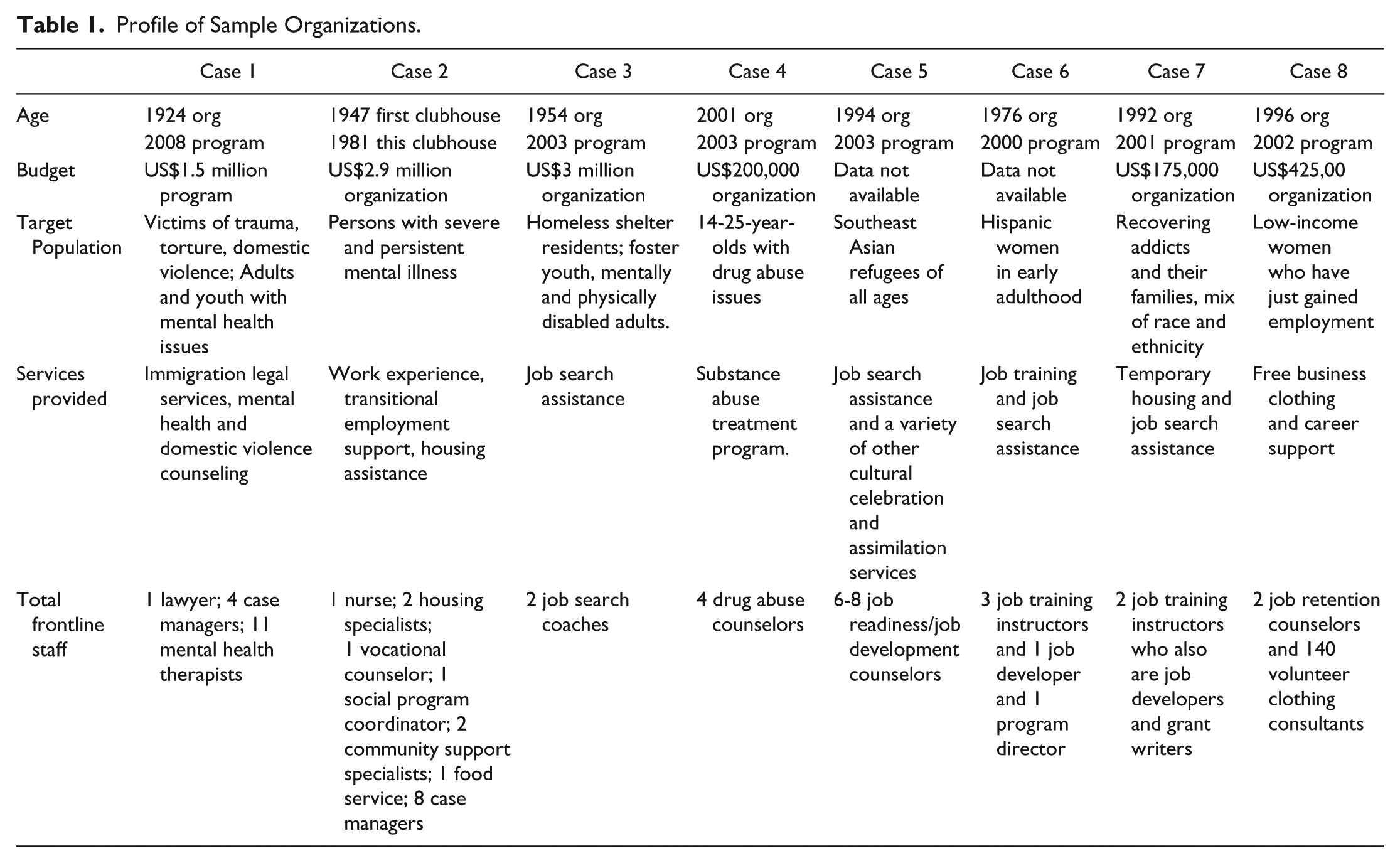
The conversations were tape recorded and transcribed, providing a complete text of the interview. Respondents were promised confidentiality and we use pseudonyms here. Most conversations took place on-site in the offices used by the staff; a few were conducted by phone. In both studies, all frontline staff who worked directly with clients were invited to participate.
Content Analysis
With this data set of 47 interviews, our analysis proceeded through 3 iterations. The first iteration of coding was guided by our broad conceptualization of four categories of frontline work—relational work, adjustment work, co-determination work, and linking work—based on our previous review of the literature. After coding data from the two studies into these categories separately, we reviewed each other’s application of the codes to the data, clarifying concepts, examining how well the categories captured the descriptions of the work offered by frontline staff, identifying data that were more central and more peripheral to the code, and reassigning data to ensure all the data in one code captured the core concept or meaning of that code (Miles & Huberman, 1994).
The second iteration of coding focused on developing a more robust picture of the different types of frontline work. For this article, we focus on co-determination data: How staff worked with clients to set an agenda and work toward change. We repeated the same process as in Step 1, coding our data separately and then exchanging data, commenting and raising questions about the application of the codes. During this coding process, two distinct but inter-related types of categories emerged. The first concerned three common tensions or dilemmas that staff faced: (a) when to be more personal and when to be more professional in building a client relationship, (b) when to challenge clients and when to let go in deciding what steps to take, and (c) when to do something for the client and when not to because it would create dependency. The second concerned the larger category of tasks to which these three dilemmas applied, which we labeled connecting (establishing a relationship with clients), deciding (working out an agenda for change with clients), and acting (working with clients toward that change).
In the third iteration of coding, we went back through the co-determination data, coding intentionally for the three dilemmas and the larger category of tasks. Our goal was to develop a full and robust picture of co-determination work, to understand the prevalence of the three dilemmas we identified, and to look for counter evidence suggesting that client agency was not important. While client agency is clearly in the background during many staff narratives, and while we sometimes found ourselves disagreeing about whether a particular narrative strand belonged with one or another of our sub-codes, we were able to code 279 distinct blocks of interview text in which co-determination work is mentioned. Based on this sample, we can say that co-determination exists, can be coded, and is central to frontline staff work with clients. This is particularly notable if one considers that the interview protocols for the two studies were not specifically designed to probe for co-determination work. If anything, our estimates are probably somewhat conservative, because presumably a more directive set of questions might have revealed more co-determination data.
Limitations
While our data set provides an illuminating window on frontline work, it is limited in size and scope. The interviews were conducted with a relatively small number of frontline staff in human service organizations, as opposed to other forms of nonprofits such as grassroots organizing, advocacy, or member-based nonprofits. Consequently, the initial attempt here to describe the tasks and dilemmas association with co-determination work will need to be refined with further study. The working conceptualizations below are intended to provide initial examples in support of the thesis that prevailing models of nonprofit performance are missing important aspects of nonprofit work.
Co-Determination in Nonprofit Human Services
Our interviews gave frontline staff broad leeway to describe how they work with clients to achieve intended outcomes. We organize our discussion around the three frequently mentioned tasks that constitute key aspects of co-determination work: (a) establishing a relationship, (b) working out an agenda, and (c) taking action. For each of these tasks, we provide examples of the types of activities involved, highlight a central dilemma that staff confronted in pursuing these activities, and offer evidence suggesting a plausible connection between co-determination work and client outcomes. We conclude the next section with a summary of the prevalence of these three tasks and associated dilemmas across the 47 interviews.
Establishing a Relationship
Nature of the task
Building quality relationships with clients is necessary in most social service work. Staff skills such as listening well and establishing rapport are important for achieving program outcomes. However, we found that in building these relationships, staff often used strategies that sought to develop real partnerships that were more egalitarian and which ensured that clients owned the change process. Building relationships where this can happen is a complex undertaking, requiring staff judgments that call on experience and practical know-how (Hager, 2000). An initial issue is that clients are not equally ready to partner. They may lack many obvious skills, feel helpless, and/or suffer from depression or low self-esteem. Staff respond with a wide variety of strategies to encourage clients to recognize their worth, capacity, and agency. These include providing small tasks that clients can pitch in to do, reminding clients of their gifts, asking clients to teach them things, and so on. The most common themes we heard in staff interviews related to this task were recognizing client knowledge (“We want people to teach us things . . . you’re more than your illness”; Case 2, Interview 8), reminding clients of their worth and capacity, and stepping outside the professional expert role. This latter theme points to a core dilemma associated with this task.
A core dilemma
In building partnerships with clients, staff reported a tension between this work and with their role as professionals (e.g., therapist, lawyer, drug counselor, case manager, work supervisor). Most staff we interviewed were trained to maintain professional boundaries and bring their professional expertise to bear on client problems. However, their narratives describe ways they attempt to step out of the professional expert role, or at least to hold that role with greater humility, because it gets in the way of building a working partnership with clients. For example, one staff member explained she accepted gifts from clients although this was seen as inappropriate for a professional, because not to do so would be to suggest that she was somehow above her clients (Case 1, Interview 11). Another states, “I might swear (laughs) you know, to show that equality. I’m just like you. I’m not any better. I’m not any worse. So you can talk to me honestly” (Case 4, Interview 3). This stance sets up a difficult balancing act, putting them at odds with established organizational or professional norms, including the need for clear boundaries to protect both themselves and clients from abuses. However, staff also explained that they did not indiscriminately cross professional boundaries, instead trying to strike a balance: I try to be as personable and as real as possible without being overly personable and overly real. And social workers kind of frown on that, because people end up thinking you’re their friend. But, that’s kind of what this model calls for, so that we can communicate on a real level. (Case 2, Interview 2)
Consequences for client outcomes
The skill by which staff navigate this dilemma has important consequences for outcomes. Beth, an immigration attorney, explained a scenario where she stepped out of her professional role, and how that affected the confidence of her client, Julia, and helped Beth get what she needed from Julia to put together a solid case for asylum: If I asked a question, she barely made eye contact with me. She was tiny too. She was bunched over in this little ball and sat in the chair. She often spoke in euphemisms because she couldn’t talk about what had been done to her. Finally, it had been an hour and half and I said, you know let’s go get some lunch . . . I remember just jabbering, do you like to cook, she was talking about that she did like to cook and she talked about what she liked to cook and then she asked me what I liked to cook and I think that was the first time that she asked me anything . . . The second half of the interview, was certainly still hard but that moment of rapport, that moment of allowing us to have an interaction outside her just talking about all these awful things that had happened to her—was transformative and made the rest of the day easier . . . She got more competent. She was able to talk for longer periods of time without needing to stop and take a break. She looked at me more . . . There is a lot of discussion in the legal field, of how close do you allow your clients to become. Some lawyers never talk about their personal lives with clients, ever, period. I don’t take that tack. I think there are times that it can really benefit you, to give windows into your own experience, so that the clients can see you as a person as well, relate to you as a person . . . It has its perils . . . (but) it gave her strength to get through the rest of the interview and it gave me the opportunity to get what I needed to help her. (Case 1, Interview 2)
Setting an Agenda
Nature of the task
Clients arrive with different resources, circumstances, and goals. Consequently, working out what steps clients can and want to take and at what pace is a big part of co-determination work. While many programs include intake processes with elements of joint agenda setting, co-determination work involves nuanced work to honor client autonomy, even when it runs at odds with program parameters. A common example in employment programs occurs when a client’s articulated employment goals do not fit easily with established protocols. The program may be set up to secure entry level jobs, but the client dreams of being a teacher, or owning his or her own business. Staff must navigate this tension carefully, discerning whether and when to let clients learn for themselves by testing the market, to reframe the client choice by honoring the motivation but helping them identify a series of doable steps that get them moving toward their longer-term goal, or simply to provide a blunt reality check that may save the client from experiencing failure. Depending on the client, it may take considerable time to work through the options and arrive at a mutually agreed on and effective course of action. It may even never lead to short-term employment, if the two decide that more education is really what is needed. Even when it does lead to employment, typical program accountability models will overlook the co-determination work that was needed to get there.
A core dilemma
In the course of this work, staff frequently mentioned their struggles knowing when to challenge clients and when to let go. Navigating this dilemma requires nuanced attention to client circumstances and to their own needs. It means having a feel for whether clients are ready to take risks by trying something new or letting go of something old, such as encouraging a woman to leave an abusive relationship. For example, one caseworker described her work with domestic violence victims: “[They] need to do it when [they] are ready. No one can push [them]. If they are not ready, they will go back” (Case 1, Interview 8). Another staff member talked about the need to preserve client autonomy: Even if I wish they would make a different choice it is still their right, their integrity. I always try to preserve someone’s integrity because I think historically we’ve been way too quick to take away people’s civil liberties, especially people with mental illness. (Case 2, Interview 2)
However, we also found evidence that staff sometimes let go to protect themselves from emotional burnout or to reallocate their energy to those clients more likely to succeed. Letting go can also simply reflect the realization that the broader conditions and circumstances affecting the client’s life are overwhelming the benefits of any help they can provide: When all is said and done, it’s really up to them. We can support them, but unless they make a decision to change, their lives are not going to improve. It’s discouraging to work with someone and then see them throw it all away again by going back to drugs or ending up back in prison. (Case 3, Interview 1)
Consequences for outcomes
How staff handle this dilemma has consequences for client outcomes. Not challenging adeptly can set someone up for failure, risk the relationship, or leave them stuck in circumstances that are detrimental. One interviewee explains, You have to know when to be a little bit pushy and you have to know when to back off. That’s a decision that you have to make every day. Because if you push when it’s the wrong time you’re going to lose somebody. And if you back off when you should be pushing, then harm might come to them. (Case 2, Interview 2)
Another staff member, Christie, recounted the consequences of when she pushed too hard: But, I’ve had some situations that if I look back on it I wonder, hmm, should I have gone that route, should I have gone that aggressive with my approach? Should I have gotten this guy a rep payee. He still doesn’t manage his money well but now he has one more way that somebody runs and controls his life that he has to try to coordinate things through. Should I have gotten this guy into the hospital and got the courts to try to do a hold on him? When the whole thing went down the toilet anyway? He stayed in the hospital three days. They took him to the court for his hearing and he snuck out of the bathroom [not] to be found again for months. (Case 2, Interview 1)
In another example, Lisa, an employment counselor, described how she trusted the client’s readiness to take a certain action and how this enabled him to keep his job. She had placed a client with a history of drug issues into a job, only to find him with a bottle in a brown paper bag sitting at a bus stop. She might have immediately insisted on complete abstinence as the next goal, probably costing the client the job. Instead, after talking with the client, they negotiated a harm reduction approach for managing his addiction, which worked in this case by enabling him to keep his job.
In the end, co-determination work is a fundamental reality and rationale: Co-ownership of the change agenda increases motivation exponentially, which typically leads to better results. Doing this so that clients can and do own both the goals and the steps to reach them requires considerable skill and judgment on the part of frontline staff.
Taking Action
Nature of the task
Ultimately, human services are about supporting client action to achieve new results for their lives. Considerable client apprehension often accompanies this dimension of co-determination work, particularly if this is uncharted territory or if there is a history of past failure. This might involve something as simple as learning a new skill, or more complex tasks such as how to clean up their credit history, or even bigger challenges such as figuring out how to cope with mental illness or escape addiction. The data suggest that this hand-off process requires staff to discern when to (a) show clients what to do (because they do not know how), (b) do it for them (to model the skill), (c) “walk with them” as they try something new (as a form of support), (d) “not do” (when to get out of the way of a client doing something, when to refuse to assist so that a client will try on their own), and (e) do something on behalf of a client (e.g., advocate for them). Staff find that they have to remind clients that their actions are for themselves, not for the staff: They think always they do things for you, and I go, “No.” And that’s what I tell everybody, “Do you think you do things for me?” He goes, “Yeah.” I go, “No. See. You are not doing this for me; you’re doing it for yourself.” (Case 3, Interview 1)
A core dilemma
When is staff support truly needed and when is it going to create dependency? There are no formulaic answers; frontline staff spoke about the challenge of having to constantly make this judgment amid uncertainty: As a program we have a lot of discussions about when is assisting impeding or empowering. I feel really strongly that clients need to take responsibility over their own cases, they have to want whatever benefit they are getting, they have to do the work. I do my part of the work; they have to do their part of the work. (Case 1, Interview 2)
How staff handle this dilemma is shaped in some part by organizational rules and program logic. For example, in one nonprofit, there were rules that a client had to try something 3 times on his or her own before staff would assist. Language issues for non-English speaking clients were often cited as justifications for “doing for” clients, at least in the short run. State mandates or regulations also can push staff to “do for.”
Consequences for outcomes
While staff offered several examples of how discerning what and when to do with or for clients mattered for outcomes, one in particular stood out. In the program that served victims of trauma and torture, victims would seek asylum and have to go to court before a judge. Quite by accident a staff member happened to observe a hearing. The client found it so helpful to have a supportive anchor in the courtroom that it gave her the confidence she needed to testify. So staff started to sit in the courtroom on a regular basis, finding that being with clients as they testified seemed to result in better outcomes for their case, a relationship that the agency is now studying empirically. This was an organization that previously discouraged staff from going with clients to avoid creating dependency.
In the end, co-determination work requires staff to recognize that clients’ paths are not linear, that there are setbacks and failures along the way, and that those setbacks and failures can be important for the client’s eventual success. Moreover, it requires recognizing that what may look like failure from a programmatic perspective can in fact be a real success for a client whose choices do not always conform to the program logic. The example of John is a case in point. Laurie, a case manager, worked with John for more than a year, charged with helping him become economically self-sufficient (e.g., stable housing, stable employment). Laurie had been working with John on employment issues but they also talked about fear a lot, helping him reframe some of his beliefs. He finally had a good job that he liked but after a year, the firm downsized. The manager approached John and explained that the firm would be letting go of one of his co-workers and as a result, John would get more hours. Instead of accepting this, John said that the firm should lay him off instead because his colleague needed the job more than he did. John came into Laurie’s office after the incident and explained that he was no longer afraid. From a programmatic perspective, it would appear that John has taken a step back, with no job, but in reality, his work with Laurie has resulted in a different outcome, a greater belief in his own capacity. It was not the work Laurie did to help him line up an interview that led to this outcome, but instead the work on fear, an issue that John brought to the table (Case 1, Interview 4).
Summary
Overall, evidence supporting the regularity and importance of co-determination work and our particular task and dilemma categorizations was fairly robust. As summarized in Table 2, we found at least one mention of co-determination work in 45 of the 47 interviews. The accounts we coded included brief, one- or two-sentence references as well as much longer narratives that described the trajectory of work over time with a particular client, such as the story of John.
Number of Interviews Having at Least One Mention of Co-Determination, by Category Codes and Nonprofit Case.
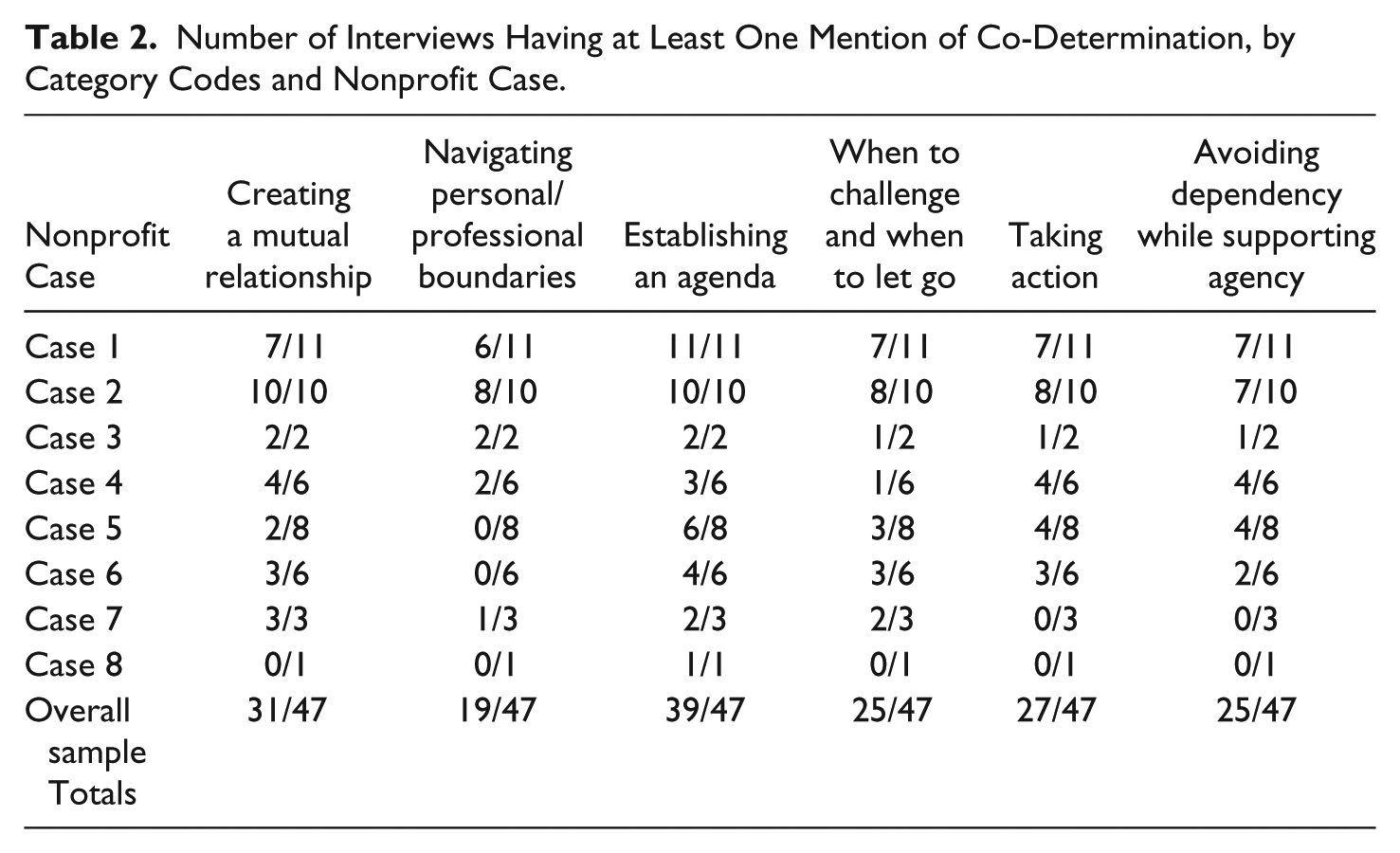
Each of the three dimensions of co-determination work was found with relative frequency in the interviews. Of the 47 interviews, 31 (66%) had at least one reference to creating a mutual relationship, and of these, 19 (40%) mentioned the dilemma of navigating personal/professional boundaries; 39 (83%) had at least one mention of establishing an agenda jointly, and of these, 25 (53%) mentioned the dilemma of when to push clients and when to let go; 27 (57%) had at least one mention of taking action, and of these, 25 (53%) mentioned the dilemma of avoiding the creation of dependency while supporting client agency.
Re-Considering Nonprofit Performance
Co-determination work is predicated on the fact that clients are agents. 3 If clients are not simply passive program recipients but active agents who partner with staff to craft service options, and decide and act on those options, what is left of the notion that it is the nonprofit program that is solely responsible for client outcomes? To the extent that co-determination work is indeed prevalent in nonprofit human services, it would appear to call into question outcome measurement models, which portray staff simply as program implementers and participants as merely recipients of services. Programs matter, but they are not all that matter in achieving client outcomes. Thus, we need to consider performance models that take co-determination work more fully into account. In our view, this will require more than simply adding another box into existing program logic models.
Our data support three new understandings that can inform how we measure nonprofit performance. First, we need to value client-defined, short-term outcomes that may be different from those articulated in program logics. Recognizing that staff work in partnership with clients to determine a course of action, it is clear that not all clients will choose to take the same steps toward achieving longer-term goals. It is those micro-level variations that can make the difference between client success and failure and that get missed by pre-set performance models, as in the case of Lisa using a harm reduction approach instead of an abstience approach to allow her client to remain employed. Second, co-determination work has its own outcomes. We find that how staff carry out co-determination work and how they resolve key dilemmas in this work shape whether a client develops a greater sense of his or her own agency or remains dependent and accepting of his or her current state. Importantly, this enhanced sense of agency can be transferred to a range of client issues and problems beyond those specified by a particular program intervention. The story of Laurie’s work with John is a case in point, as is the case of Beth’s work with Julia. Third, co-determination work would seem to be related to the sustainability of client outcomes. If staff co-determination work is poorly done, such as by pushing a client too quickly or forcefully toward actions that they do not own, then program outcomes are less likely to be sustainable. For example, Margarita’s emphatic point about not pushing domestic violence survivors to leave before they are ready because they will just go back, or Christie’s story of when she pushed too hard.
Several insights being generated into the literature on the co-production of public services help underscore the broader importance of our findings. First, there is the potential for linking the particular outcomes of human service nonprofits to the broader sectoral goal of advancing the capacity and agency of marginalized communities and individuals. Co-production research has brought into focus the importance of ancillary outcomes beyond those intended by the immediate service intervention, such as cost savings, greater citizen satisfaction as the services reflect their needs; and greater trust in government as civic capacity is honored. Recent co-production research suggests that marginalized populations are the least likely to be involved in co-production (Jakobsen & Andersen, 2013; Verschuere et al., 2012), raising the possibility that co-determination work in human service nonprofits might be a promising vehicle for expanding the benefits of co-production to less advantaged groups. For example, Alford (2009) examines successful workforce development programs and finds that essential strategies are those that repair confidence, self-esteem, and hope—the sense of one’s capacity to act: Even more potent in this regard is the activity agreement. To the extent that it is formulated in a bilateral manner, it casts the client as an equal partner with the agency (thereby reducing the sense of powerlessness), and re-establishes a defined social role for the client, from which he or she can refashion missing parts of his or her self-concept. (p. 132)
Second, the co-production literature echoes our finding that a key dynamic to confront is the difficulty managers and staff experience in reconciling their professional roles with the meaningful engagement of “non-professional” users/clients. Professionals may contend that their own education and experience are more important than user involvement, or they may simply lack the skills needed to facilitate user voice (Vamstad, 2012). We also know from other research on human service nonprofits that failing to skillfully navigate this can result in paternalistic attitude and lead clients to avoid interactions with service providers (e.g., Edin & Lein, 1998; Hasenfeld, 2010). Attending more closely to co-determination work may begin to suggest useful principles for resolving what research suggests is an inherent dilemma in frontline staff work.
Finally, the co-production literature suggests several variables that may be useful in further exploring the co-determination work of frontline staff, including (a) the extent to which clients are voluntarily seeking services (Brudney & England, 1983), (b) skill and capacity level of the clients, (c) the organizational structure (e.g., a decentralized structure often makes co-production easier), (d) the network of supports and constraints in the organization’s external environment (which can influence how much citizens participate), and (e) the type of intervention in which citizens are being asked to co-produce.
As next steps in this work, we see three priorities for additional research. First, we need empirical work that tests our initial conceptualization of co-determination work, especially studies that compare how this work varies across distinct service areas or types of nonprofit organizations. Second, we need to specify additional core tasks and dilemmas that appear as we look across service areas and nonprofit types. Third, we need a more definitive account of how co-determination affects both programmatic and nonprogrammatic outcomes, a connection that our research has not fully established. Fourth, we need to better understand the conditions that support skillful co-determination work. Here, it will be important to draw on the street-level bureaucracy literature, which points to a number of key variables shaping frontline worker discretion, including the organizational technology, professional autonomy, relationships with peers/supervisors, practice ideologies, whether workers identify as state agents or citizen agents, strategies for increasing client subjectivity, and so on. In this vein, Thomas (2013) provides a useful conceptualization, drawing on the co-production literature to offer guidelines for engaging the public as partners and citizens rather than simply as customers.
We hope our description of co-determination work has opened up questions that other researchers can begin to explore in greater depth. For example, we can imagine an effort to explore whether and how to incorporate co-determination work into existing program outcome measurement models. This might involve building into these models a greater focus on client outcomes such as “increased self-confidence” or “decreased feelings of isolation” or “greater efficacy.” However, our data point to the need for efforts that step further outside the existing program outcome measurement paradigm. For example, we can envision research that uses client outcome data to identify cases where above average results are found and then backward map to identify the drivers of high performance, privileging not just what organizations and their staff do but what clients do on their own behalf. We could also see this research aligning with growing efforts to examine the effficacy of constituent feedback mechanisms, which also recognize the importance of client agency and voice (Campbell 2010). Whatever tack researcher and practice take, we can no longer afford to ignore or deny the central role of client agency in nonprofit performance.
Footnotes
Acknowledgements
The authors thank Richard Hoefer for his helpful comments on an earlier draft and the anonymous reviewers and the editor for their constructive comments.
Declaration of Conflicting Interests
The author(s) declared no potential conflicts of interest with respect to the research, authorship, and/or publication of this article.
Funding
The author(s) received no financial support for the research, authorship, and/or publication of this article.