



Abstract
The study examines a hybrid theory containing individual characteristics, resources, and social factors and volunteering of older adults living in Belgium. As scholars have pointed out the underresearched importance of taking the recruitment potential of older adults into account, this study investigates whether potential volunteers, actual volunteers, and non-volunteers in later life are different from each other in terms of individual characteristics (e.g., religiosity), resources (e.g., socioeconomic status), and social factors (e.g., social networks and social roles). Data for the present research were derived from the Belgian Aging Studies, a sample of 31,581 individuals aged 65 to 80 years. Logistic regression analyses indicate that altruistic and religious values, physical health, frequent contact with friends, and providing help to others are important predictors for potential volunteers as well as actual volunteers. Overall, the results indicate important insights for recruitment and retention of older volunteers.
Introduction
The 21st century is confronted with an aging population. In 2013, worldwide, there were more than 700 million older adults (11.7%) aged 60 years or above. It is expected that by 2050, 21.1% of the population in developed countries will be aged 60 years or above (United Nations, 2013). This development is frequently called “the problem of aging” (Peace, Wahl, Mollenkopf, & Oswald, 2007) due to the perspective that older adults are often an economic burden because they are no longer active or are less active in the labor market while being entitled to pensions (Baars, 2006; Walker, 2006). However, many people in retirement contribute to society through social roles that go beyond paid employment (Scharf, Phillipson, Kingston, & Smith, 2001) and have independent and productive lifestyles (Musick & Wilson, 2008).
These ideas have been furthered by Rowe and Kahn’s (1998) “successful aging” theory and by the World Health Organization’s (WHO; 2002) policy framework on “active aging.” Rowe and Kahn’s (1998) proposed “successful aging” theory focuses on avoiding disease and disability, maintaining high physical and cognitive function, and sustaining engagement in social and productive activities. Within the WHO framework, active aging is considered an international policy response counteracting societies’ negative ageist views. Active aging refers to the notion that older adults, including frail and disabled individuals, should have the possibility to exert roles as active agents in their life course and participate in social, economic, cultural, spiritual, and civic affairs according to their abilities, needs, and desires (Walker, 2005; WHO, 2002).
However, much work is still needed to create opportunities for engagement, for instance, through volunteering, to “further respect older people who do not volunteer, for whatever reasons, to embrace aging in all its forms, lives, abilities and meanings” (Martinson & Minkler, 2006, p. 323). Policy should focus on enabling opportunities for people who wish to engage and according to their desires and abilities (Martinson & Minkler, 2006).
Within both frameworks, volunteering is seen as a type of work beyond retirement perceived as a social activity and role beneficial to older adults (Callow, 2004; Warburton, Terry, Rosenman, & Shapiro, 2001) and their community (Choi, 2003; van der Meer, 2008). Older individuals have accumulated substantial amounts of skills and knowledge useful for volunteering (Morrow-Howell, Hinterlong, & Sherraden, 2001; Musick & Wilson, 2008). Moreover, volunteering is associated with positive outcomes, such as higher rates of longevity and reduced risk of mortality (Musick, Herzog, & House, 1999), higher levels of quality of life, greater well-being, and a sense of purpose (Fraser, Clayton, Sickler, & Taylor, 2009).
Despite evidence of the value of volunteering in later life, substantial questions about volunteering within this age group remain. First, unified theories of volunteering combining different disciplines and a broad range of variables, especially those concerning older adults (Morrow-Howell, 2010), are scarce (Musick & Wilson, 2008). Second, a major research focus has been on people already volunteering leading to a shortcoming of crucial knowledge on people who are willing to volunteer (Mutchler, Burr, & Caro, 2003). In response to this lacuna, this article aims to examine a hybrid theory of volunteering by Einolf and Chambré (2011) in older adults within the context of Belgium, making a distinction between potential volunteers, actual volunteers, and non-volunteers.
Limited Measurement of Volunteering
Volunteering is defined as institutional voluntary work taking place in not-for-profit organizations or in the community undertaken by individuals without coercion and without financial payment (or minimal compensation to offset private costs; Cnaan, Handy, & Wadsworth, 1996). As Musick and Wilson (2008) documented, commonly used indicators of volunteering include (a) whether respondents volunteered, (b) for how many organizations they volunteered, (c) in how many areas they volunteered, and (d) for how much time they volunteered.
One possible new way of assessing volunteering is to measure the “recruitment potential.” Potential volunteers are people who do not volunteer at the moment but are willing to do so in the future. Caro and Bass (1995) found that for every two older adults who volunteer, there is one willing and able to volunteer. However, research regarding older individuals who are willing to volunteer is almost non-existent. For example, who are potential older volunteers? Do potential older volunteers differ from older volunteers in terms of values, individual resources, or social factors? From a societal standpoint, it is crucial to explore those characteristics identifying potential older volunteers. Understanding more who these older individuals are can help non-profit organizations comprehend how personal and social factors affect the availability of volunteers (Butrica, Johnson, & Zedlewski, 2009).
A Hybrid Theory of Late-Life Volunteering
In research on volunteering, more theoretical explanations began to emerge (Musick & Wilson, 2008; Warburton & Stirling, 2007) through the construction of a unified theory by combining a number of predictors associated with volunteer behavior in older people (i.e., Chambré, 1987; Choi, 2003; McNamara & Gonzales, 2011; Sundeen, Raskoff, & Garcia, 2007; Tang, 2008). Wilson and Musick (1997) were the first to develop a structural approach, leading to an integrated theory of predictors (human, social, and cultural capital) influencing volunteer behavior. Einolf and Chambré (2011) constructed a hybrid theory for volunteering by representing classifications comparable with Wilson and Musick (1997), namely, individual characteristics (cultural capital), resources (human capital), and social factors (social capital). However, the hybrid theory further focuses on the social factors by dividing them into context, integration, and roles. The scholars revealed that each set of determinants elucidates a significant amount of variation in volunteering. Planning future volunteering and social contribution appeared better predictors than the well-known resource education and religious participation. The purpose of this study was to understand differences between non-volunteers, potential volunteers, and actual volunteers with regard to individual characteristics (religiosity and altruism), resources (education, household income, and health status determinants), and social factors (social context, social integration, and social roles).
Individual Characteristics
Several studies have documented the association between individual characteristics—values and religiosity—and volunteering (Musick & Wilson, 2008; Penner, Dovidio, Pillavin, & Schroeder, 2005). In regard to explaining volunteering in later life, the value of altruism, or the desire to help others, has been found to be an important predictor (Perry, Brudney, Coursey, & Littlepage, 2008). Likewise, religiosity has also been identified as a key variable for volunteering (Forbes & Zampelli, 2014). One study in 40 European countries has demonstrated that being religious is positively related to volunteering (Voicu & Voicu, 2009).
Resources
Resource variables, such as education, household income, and health resources, act as assets that make it possible for people to volunteer or be interested in volunteer work (Wilson, 2012). Researchers have acknowledged the particular relevance of these resources, showing that higher levels of education and household income are associated with a greater likelihood of volunteering (Musick & Wilson, 2008; Tang, 2008). Health status resources, measured by physical and mental health, are also crucial resources, particularly in older adults. In later life, physical limitations become more commonly experienced (e.g., Baltes & Smith, 2003), potentially restricting volunteer engagement (Hank & Erlinghagen, 2009; Komp, van Tilburg, & van Groenou, 2012). Older adults in good health are more likely to volunteer than peers with poor health (Choi, 2003).
Social Factors
Einolf and Chambré (2011) disaggregated the well-known social capital variable into social context, social roles, and social integration to gain more insight into the relation between volunteering and social factors related to social capital.
Social context
The social context refers to someone’s social environment; people assess their environments and make decisions regarding voluntary participation based on this context (Musick & Wilson, 2008). Within this perspective, homeownership is an important predictor. Homeowners tend to be more attached to their neighborhood and also more likely to volunteer than renters, regardless of the value of their home or how long they have lived in the neighborhood (Rotolo, Wilson, & Hughes, 2010).
Social integration
Social integration variables refer to the social contacts people have. Research has shown that older people who have maintained wide-ranging informal ties are associated with an increased likelihood of volunteering (e.g., Lee & Brudney, 2010; Paik & Navarre-Jackson, 2011). Several studies documenting the association between recruitment and social ties have shown that volunteers tend to be recruited by friends, acquaintances, and neighbors, indicating the importance of also having contacts outside the family (Paik & Navarre-Jackson, 2011; Tang, 2006).
Social roles
In later life, many changes occur in terms of marital and parental statuses. For example, later life entails role losses in partnership and parental statuses (Greenfield & Marks, 2004). Although evidence related to widowhood and volunteering is mixed, marital disruption through divorce or separation may negatively affect broader social engagement by generating emotional and financial stress (Pudrovska, Schieman, & Carr, 2006) and increased negative social exchanges (Milardo, 1987). Experiencing multiple resource restrictions (e.g., widowhood and poor health) affects individual resources, social opportunity structures, and motivational factors, which may hamper volunteering.
The presence of children appears to increase the likelihood of volunteering, although research on this subject is limited to parents with school-aged children or younger (e.g., Butrica et al., 2009). Studies regarding the effects of adult children on older adult volunteering are relatively scarce (Foster-Bey, Grimm, & Dietz, 2007; Li & Ferraro, 2006). Nevertheless, the departure of children from home entails a major change in the role identities of parents (Greenfield & Marks, 2004). These changes may lead to lower levels of salience for existing roles, some of which might have involved voluntary activity.
Finally, other social roles, such as the informal helping of relatives, friends, and neighbors, may encourage or discourage volunteering. Furthermore, older adults seem more likely to help others given an expectation of the same return in the near future (Choi, Burr, Mutchler, & Caro, 2007). The time devoted to providing informal help appears to bear a positive relationship with late-life volunteering (Einolf, 2010; McNamara & Gonzales, 2011). Likewise, helping someone outside the household expands one’s social ties and may increase the likelihood of being recruited (McBride, Gonzales, Morrow-Howell, & McCrary, 2011).
The Belgian Context
Volunteering is a worldwide phenomenon that varies by cultural and political context and also depends on how societies are organized (Anheier & Salamon, 1999). Consequently, research in different countries is crucial for attaining a full understanding of volunteering among older adults. The focus of the present article is older Belgians, and the intent is to explore volunteering by older people within the Belgian context.
Belgium is a Western European country and the 10th oldest population of the world. According to the “aging” index of the United Nations, 23.8% of the Belgian population is 60 years or above (United Nations, 2013). Moreover, the average age for leaving the labor force is the age of 59 (Herremans, Boey, Vansteenkiste, Theunissen, & Sels, 2012), and less than 1% of the population above 65 years is still engaged in paid employment (Organisation for Economic Co-Operation and Development [OECD], 2013). Subsequently, Belgium is a country with an extremely high proportion of retirees. According to SHARE data (Haski-Leventhal, 2009), 20.6% of Belgian people aged between 61 and 70 years and 10% aged 71 years and older volunteer. Compared with other European countries, Belgium is located in the middle, with a medium rate of older adults who volunteer. Although there have been studies of older people’s volunteer activities in different countries (e.g., SHARE), Morrow-Howell (2010) stated that only a few studies have involved a large representative sample of older adults and none have occurred in Belgium.
Research Aim
As noted above, there is strong empirical evidence of a relationship between volunteering in later life and individual characteristics, resources, and social factors. However, social factors often include a limited range of variables (Einolf & Chambré, 2011). This study will examine a hybrid theory of volunteering by making a distinction between potential and actual older volunteers in a Belgian context. The distinction between the three groups of people can be seen as a gradual line of association ranging from most negative for non-volunteers to most positive for actual volunteers, with potential volunteers in the middle. Using individual characteristics (religiosity and altruism), resources (education, household income, and health status), and social factors (social context, social integration, and social roles), we aim to determine which resources are key determinants for potential and actual volunteers. Hence, a first distinction is made among older adults by comparing the group of non-volunteers with the group of (potential and actual) volunteers. Both groups are distinguished on the basis of individual characteristics, resources, and social factors. A second distinction is made between older adults willing to volunteer and people actually volunteering. According to the hybrid theory of volunteering, both groups may be different in individual characteristics: (a) We expect volunteers to give greater importance to religiosity and altruistic values compared with non-volunteers (Forbes & Zampelli, 2014; Perry et al., 2008). As for potential volunteers, we expect altruistic values to have a greater impact on volunteers compared with potential volunteers.
Second, examples of potential differences between the three groups may also be linked to resources: (b) We assume that volunteers have more resources compared with their non-volunteering and potential volunteering peers (Musick & Wilson, 2008; Tang, 2008).
A third set of factors—social factors—is also crucial in regard to establishing differences between the levels of engagement: (c) Regarding social context, we expect owning a house to have a greater effect on formal volunteers as well as potential volunteers (Rotolo et al., 2010). We also expect social integration through informal social ties to have a greater positive effect on volunteers than on potential and non-volunteers. Next, we assume that being divorced and volunteering are negatively related because marital disruption might hamper volunteering (Milardo, 1987; Pudrovska et al., 2006). We also expect that being a parent will be more strongly related to formal volunteering than to non-volunteering and willingness to volunteer; people with children are more likely to have been in contact with volunteer opportunities (Musick & Wilson, 2008). Finally, we expect a positive relation between providing informal help and volunteers and potential volunteers because providing such help indicates one’s embeddedness in a social network (McBride et al., 2011).
Method
Data Collection
The data are derived from the Belgian Aging Studies (BAS). This survey assessed the quality of life and participation of home-dwelling people aged 60 years and above (e.g., volunteering, civic participation, physical health, well-being), with 31,581 respondents in 128 municipalities from the Dutch-speaking part of Belgium (Flanders). The participating municipalities were not randomly selected. Each municipality could freely decide whether to participate in the research project. The participating 128 municipalities did not differ in average yearly income/inhabitant (€16,452) from the average of all 308 Flemish municipalities (€16,323), but were more densely populated (572 vs. 457 inhabitants/km2). Nevertheless, home-dwelling persons aged 60 and older were randomly sampled in each municipality, stratified for age and gender (60-69, 70-79, and 80 years and above) identically as in the underlying population within the participating municipalities. The representative sampling fraction depended on the size of the municipality, varying between n = 184 and n = 1,592. To reduce the potential bias of non-response, replacement addresses in the same quota category from an additional sample were used to substitute respondents who refused or were unable to complete the questionnaire. Consequently, these numbers were not representative at a national level, but every sample was representative for the specific municipality.
Survey data were collected through a participatory peer-research methodology, which is a method that embraces older people not only as the research group but also as an essential partner of the project. In each municipality, between 30 and 80 older volunteers were recruited to facilitate and monitor the data collection process, in particular through delivering questionnaires to respondents personally and collecting them when completed. The questionnaire was self-administered, although volunteers were allowed to clarify the meaning of questions if requested when collecting the questionnaire. All volunteers attended training. Respondents were assured of the voluntary nature of the involvement in the study, their right to refuse to answer, and the privacy of their responses. Neither the respondents nor the volunteers received any remuneration for their participation. The response rate varied between 65% and 85% depending on the municipality.
Measures
Dependent variable
The dependent variable is based on two questions. First, respondents were asked if they had volunteered in the past 12 months. If they did, they were asked which type of voluntary work they performed using a list of 10 different categories of activities. These activities were recreational, manual labor, keeping company, domestic, educational, caring in hospices, sociocultural, administrative, social, and managerial. Respondents who indicated at least one of these were labeled as actual volunteers. Those who reported no volunteering were asked whether they were willing to volunteer in the near future, leading to a distinction between non-volunteers and potential volunteers. Therefore, the categorical dependent variable enclosed three values: actual volunteers, potential volunteers, and non-volunteers. The dependent variable is included in the imputation model (Young & Johnson, 2010).
Independent variables
Individual characteristics
To measure the importance of altruism and religiosity, we asked whether altruistic values (important to help others) and religiosity (praying, spirituality) were important in their lives. Respondents could answer on a 1 to 7 Likert-type scale from completely not important to completely important.
Resources
Level of education was dichotomized using the highest educational qualifications to limit the number of parameters: (0 = lowly educated [less than senior high school, until the age of 14], 1 = highly educated [senior high school or graduate, from 15 years]). Respondents were asked to report their monthly household income using six categories (€500-€999, €1,000-€1,499, €1,500-€1,999, €2,000-€2,499, €2,500-€3,999, €4,000-€4,999).
Physical health
The Medical Outcome Scale (MOS) (Cronbach’s a = .89) consists of six items with three response options: (1) longer than 3 months, (2) 3 months or shorter, and (3) not restricted. Respondents were asked whether they had difficulty doing vigorous activities, bathing or dressing themselves, and so on. In accordance with the manual of the MOS short-form General Health survey of Kempen, Brilman, Heyink, and Ormel (1995), these items were combined into a continuous scale ranging from 1 to 2, signifying that a higher score (closer to 2) means better physical health.
Mental health was assessed using a five-item index that used three items from the Rand Mental Health Inventory (Rand Health, 2011) and two items from the Affect Balance Scale (Bradburn, 1969). This combination generated the reliability index (Cronbach’s α = .87). The participants were asked to what extent they agreed with items related to the following mood disorders: (a) feeling bored, (b) feeling depressed and dispirited, (c) feeling so low nothing could cheer them up, (d) feeling nervous, and (e) feeling upset. Five response options were offered: (1) totally agree, (2) agree, (3) agree/do not agree, (4) do not agree, and (5) totally do not agree. Scores in our sample range between 1 and 5 (M = 3.95, SD = 0.58). A higher score on the scale indicated less psychological distress or greater psychological well-being.
Social factors
Social context.
Home ownership was coded 1 for respondent who owned their homes and 0 otherwise.
Social integration
To measure the quantity of social ties, respondents were asked how often they had contact (paying a visit, receiving a visit, or calling over the telephone) with their 1 = nuclear family (children or children in-law and grandchildren), 2 = extended family (brothers and sisters and other relatives), 3 = neighbor, and 4 = friend or acquaintance. 0 = never to monthly, and 1 = weekly to on a (almost) daily basis.
Social roles
Marital status was measured by four dummy variables: (a) never married, (b) divorced, (c) cohabiting, and (d) widowed, with married respondents as reference category. Parental status was coded 1 for respondents having children and 0 for respondents without children. Regarding informal help, respondents were asked whether they provided help to relatives (outside the home), neighbors, or friends, where 0 = no and 1 = yes.
Control variables
Age
The entire sample ranged between 60 and 99 years with a mean of 71.5 years. The study was limited to respondents aged between 65 and 80 years (with a mean of 71.4 years), signifying that 47% of the sample was excluded (60-64 years and 80+).
Gender
Because studies have shown that older men and women volunteer equally but in different activities (Okun & Michel, 2006), the analyses were controlled for gender.
Statistical method
The dataset contained a limited amount of missing data (less than 5% across all of the study variables except for income). To increase the accuracy of the estimates, we imputed all missing values through a multiple imputation technique with multivariate correlates. A preferred technique for handling missing data by multiple imputations is through the Markov Chain Monte Carlo method (Little & Rubin, 2002; Schafer, 1997). The multiple imputations generated five independent datasets without missing data (Schafer, 1997). Moreover, the Monte Carlo Error was performed; the overall maximum for the models and all coefficients’ was 1.006% (well below 10%; Dimov, Vassil, Branford, & Weihrauch, 2006). Hence, identical regression analyses were conducted on each dataset, and the results were combined to produce less biased estimations of parameter estimates and standard errors (Gelman & Hill, 2007). The intercorrelations between independent variables were assessed, and there were no problems related to multicollinearity (less than r < .5 for all intercorrelations).
The analysis consisted of two main phases: (a) a comparison between (potential + actual) volunteers and non-volunteers (n = 31,581), and (b) a comparison between potential volunteers and actual volunteers (n = 8,349). In both phases, we used logistic regressions to determine the influence of 13 predictors.
The logistic regressions are built in four models. Models 1 to 3 include the predictors of the three independent categories (individual characteristics, resources, and social factors) separately with demographic controls in every logistic regression. For each category, the logistic regression indicates significant predictors. Model 4 combines the three independent categories together with the demographic controls of age and gender. Given the large sample size, stricter significance cutoff of 0.01 and 0.001 were applied for all analyses (Pallant, 2013).
Results
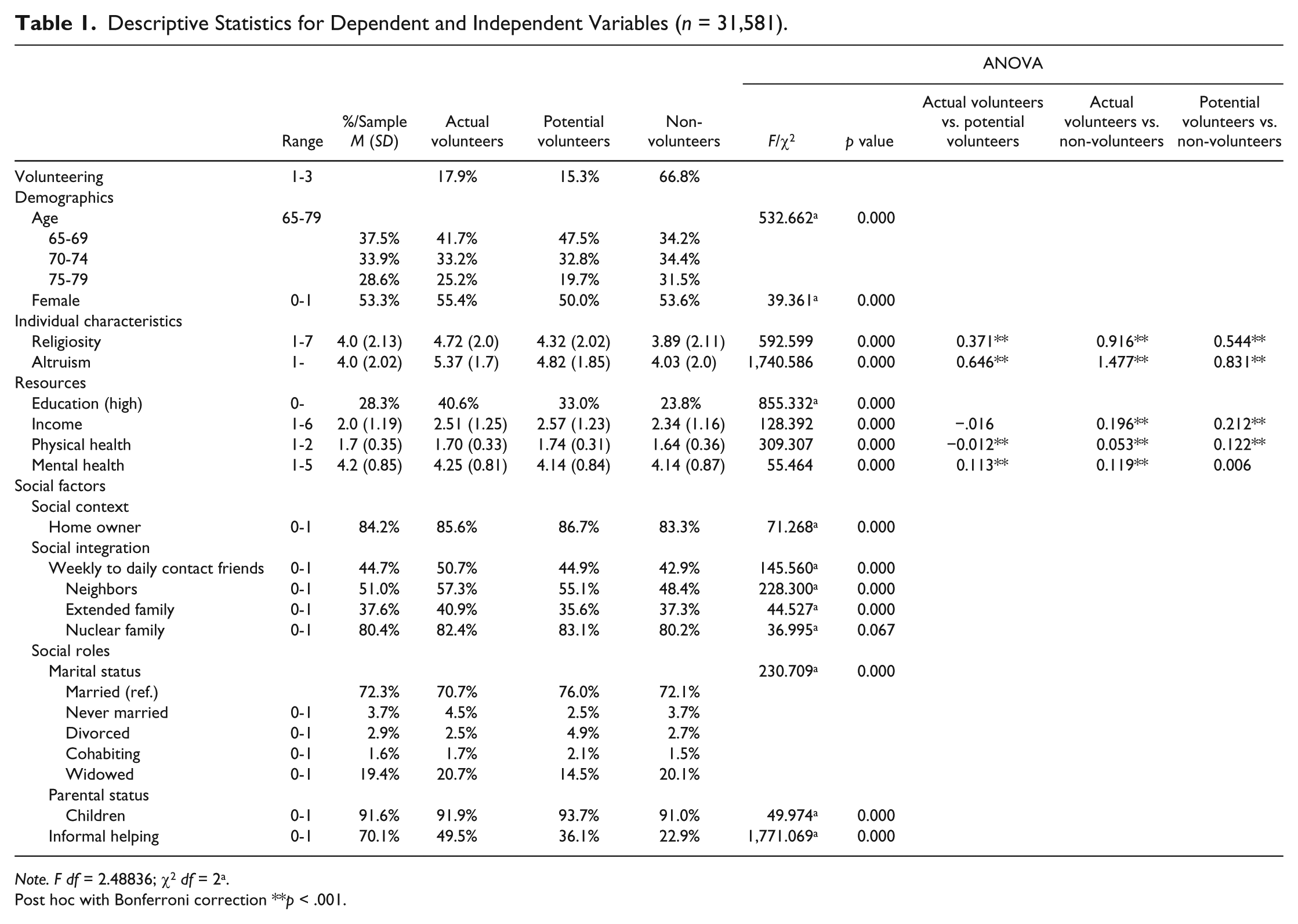
Table 1 reports ranges, percentages, means, and post hoc tests for the volunteering and variables used in the study: 17.9% of respondents reported volunteering, 15.3% were willing to volunteer, and 66.8% were neither volunteering nor willing to volunteer.
Descriptive Statistics for Dependent and Independent Variables (n = 31,581).
Note. F df = 2.48836; χ2 df = 2 a .
Post hoc with Bonferroni correction **p < .001.
In terms of the demographic characteristics of the sample, the mean age of the sample was 71.4 years. Potential volunteers were younger compared with actual volunteers. 53.3% was female.
The first set shows individual characteristics of the sample. Altruism yielded a mean score of 4.0. In particular, volunteers (5.37) indicate altruism as a more important value in life than potential volunteers (4.82). The next set of variables reflects resources. As in most samples of volunteers, the proportion of older adults with a higher level of education was much higher among actual volunteers (40.6%) compared with peers who were willing to volunteer (33.0%) or not volunteering (23.8%). Concerning the household income, unexpectedly potential volunteers (2.57) had a higher income compared with the actual volunteers (2.51). Physical health yielded a mean score of 1.7, with potential volunteers physically healthier (1.74) than actual volunteers (1.70). For social context, a majority (84.2%) of respondents were homeowners. Of the sample who owned a house, 86.7% were willing to volunteer, and 85.6% volunteered. Regarding social integration, 50.7% of the respondents who indicated having contact with their friends on a weekly to daily basis were actual volunteers, and 44.9% were potential volunteers. In line with the aforementioned results, 57.3% of actual volunteers, 55.1% of potential volunteers, and 48.4% of non-volunteers reported having contact with their neighbors on a weekly to daily basis.
For social roles, in terms of marital status, remarkably, potential volunteers (76%) were more often married than their actual volunteering peers (70.7%). In all, 91.6% of the sample respondents were parents. Among them, the highest proportion of having children was among potential volunteers. Of the sample who provided informal help, 49.5% were actual volunteers, and 36.1% were potential volunteers.
The first comparison is made between non-volunteers and (actual + potential) volunteers (Table 2). Representing the three dimensions of the hybrid theory of volunteering, 11 factors were significantly related to (potential/actual) volunteering in Model 2 (Table 2).
Estimated Net Effects of Individual Characteristics, Resources, and Social Factors on (Potential and Actual) Volunteering Compared With Non-Volunteering (n = 31,581).

Note. OR = odds ratio.
Reference outcome: *p < .01. **p < .001.
Demographic Controls
Only age was significantly negatively related to being a volunteer. Both older age groups are less likely to volunteer and be potential volunteers compared with those in the youngest age group (exp β = .923, p = .000; exp β = .651, p = .000). As for sex, women are slightly less likely to be actually volunteering or willing to volunteer (exp β = .909, p = .000).
Regarding the individual characteristics, religiosity was significantly positively related to being (potential/actual) a volunteer (exp β = 1.090, p = .000). Likewise, for altruism, every additional category of altruism increased the odds of potential and actual volunteering by 29% compared with non-volunteering peers (exp β = 1.285, p = .000).
As for the resources, the education predictor shows that respondents with a high level of education were more likely to volunteer or to be potential volunteers. For example, older adults who enjoyed a high level of education were 1.7 times more likely to volunteer than older adults with a low level of education (exp β = 1.681, p = .000). For the physical health variable, a better physical health was associated with a greater likelihood of (potential/actual) volunteering (exp β = 1.675, p = .000). In contrast, better mental health is associated with a smaller likelihood of (actual/potential) volunteering (exp β = .956, p = .003).
Social factors have been disaggregated into three categories. The second set, social integration, illustrates that older adults are more likely to volunteer or willing to volunteer when they have weekly to daily contacts with their friends. For instance, a one-unit change in the independent variable increases the odds of being a (potential/actual) volunteer by a factor of 1.296, indicating that the more frequent contact older adults have with their friends, the more likely (1.3 times) they will be (potential/actual) volunteers compared with older individuals who never to monthly have contact with their friends (exp β = 1.296, p = .000). On the contrary, the odds ratios of having contacts with extended family are below 1, indicating that more contacts on a weekly to daily basis indicate a lower likelihood of being a (potential/actual) volunteer (exp β = .891, p = .000).
Concerning social roles, among the marital status items, cohabiting increased the likelihood of being an actual volunteer or potential volunteer (exp β = 1.769, p = .000). Having children was associated with a higher likelihood of (actual/potential) volunteering (exp β = 1.210, p = .000). Finally, a significant positive relation was observed for providing informal help. Respondents reporting to provide informal help were 2 times more likely to be actually volunteering or willing to volunteer (exp β = 2.045,p = .000).
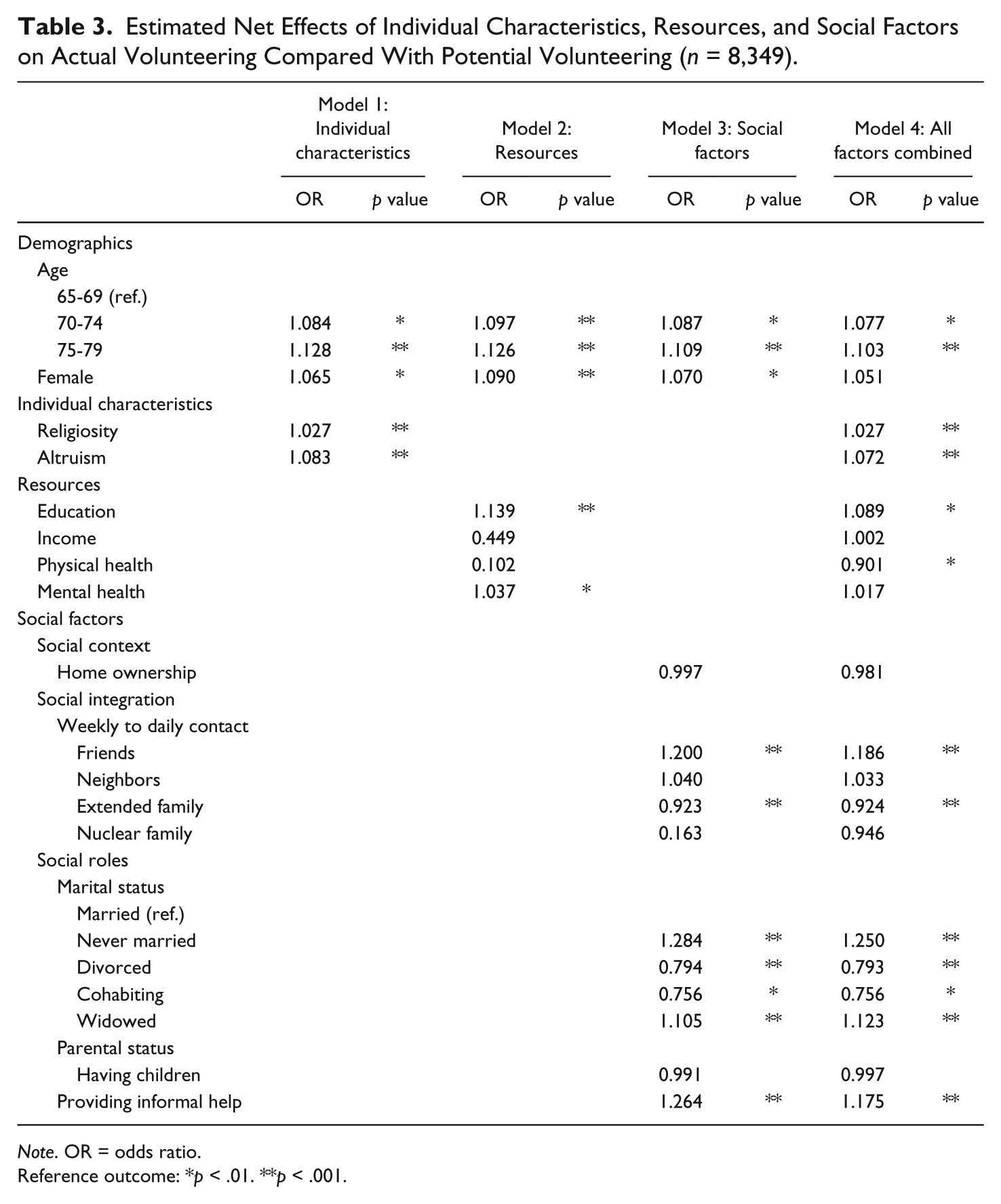
The next portion of the analysis, shown in Table 3, examines the effect of different predictors between potential and actual volunteers. Representing the three dimensions of the hybrid theory of volunteering, 11 factors were significantly related to (potential/actual) volunteering in Model 3, Table 3.
Estimated Net Effects of Individual Characteristics, Resources, and Social Factors on Actual Volunteering Compared With Potential Volunteering (n = 8,349).
Note. OR = odds ratio.
Reference outcome: *p < .01. **p < .001.
Concerning demographic controls, age was significantly positively related to being an actual volunteer (exp β = 1.077, p = .002; exp β = 1.103, p = .000), indicating that the older the people are, the less likely they are willing to volunteer.
Individual Characteristics
Concerning religiosity, a significant positive relationship was observed for volunteers compared with potential volunteers, the odds are 1.03. However, the odds ratio is very close to 1, indicating a weak relationship (exp β = 1.027, p = .000). As for altruism values, the higher the altruism value, the more likely to be a volunteer (exp β = 1.072, p = .000).
Furthermore, concerning resources, a positive educational gradient was detected. Having obtained a higher educational degree increased the probability to be volunteering compared with their peers with a low level of education (exp β = 1.089, p = .000). Respondents reporting better physical health were 9% less likely to be volunteering (exp β = .901, p = .001).
Social factors
Regarding social integration, frequent contact with friends was significantly positively related to being a volunteer. Older adults having on a weekly to daily basis contact with their friends were 19% more likely to volunteer than their peers who did not have frequent contact with their friends (exp β = 1.186, p = .000). In contrast, the odds ratio for contact with extended family is below 1, indicating that having contact with extended family members weekly to daily slightly lowers the likelihood of being an actual volunteer compared with a potential volunteer (exp β = .924, p = .000).
As for social roles, never been married was significantly positively related to being a volunteer (exp β = 1.250, p = .000). On the contrary, being divorced or cohabiting was significantly negatively related to actual volunteering. Divorced older adults were 20% less likely to volunteer, and cohabiting respondents were 24% less likely to volunteer compared with those who were married (exp β = .793, p = .003; exp β = .756, p = .001). Being widowed was significantly positively related to being a (potential/actual) volunteer (exp β = 1.123, p = .000). Finally, for providing informal help, the odds ratio is above 1, with older adults providing help being 18% more likely to volunteer compared with those who do not provide informal help outside the household (exp β = 1.175, p = .000).
Discussion
Against the background of rapidly aging populations in modern societies, older adults’ social participation and especially the issue of successful and active aging have become important topics on the agenda of policymakers and social scientists across the aging world (e.g., Bukov, Maas, & Lampert, 2002; Einolf, 2009; Morrow-Howell, 2010). The most important contributions of this article to the literature are the following aspects: (a) a focus on the differences between potential and actual volunteers, (b) a multivariate model in which particular various aspects of the social context are included, and (c) the Belgian case.
A key finding of this study is that there is no gradual distinction between non-, potential, and actual volunteers in all observed variables. For instance, potential volunteers are younger, physically healthier, have a higher household income and are more often married compared with their actual volunteering peers. Nevertheless, a lack of social resources appears more important than the aforesaid resources in preventing older adults from actually volunteering.
Regarding differences between (actual and potential) volunteers and non-volunteers, our results demonstrate that volunteers have more resources compared with non-volunteers. Certain “attitudes/dispositions” (religion, altruism, education, and physical health condition) and “social contexts” (friends, cohabiting, being a parent, and helping others) indicate that volunteers are more oriented toward volunteering. Volunteers also appear to be younger.
As for differences between actual and potential volunteers, remarkable differences are discovered. Potential volunteers with certain “attitudes/dispositions” (lower levels of religiosity, altruism, education, and feeling mentally less healthy) and “social contexts” (divorced/cohabiting and helping others less) are less oriented toward volunteering despite the fact that they are younger and in better physical health. This finding is in line with Martinson and Minklers’ (2006) conclusion that predominantly older individuals with more resources are recruited. However, potential volunteers appear to enjoy better physical health compared with actual volunteers. A plausible explanation is that actual volunteers have encountered health issues while volunteering but continue volunteering because the benefits outweigh the costs (Fischer, Mueller, & Cooper, 1991). For potential volunteers, physical health may not be a barrier per se, but rather social factors, for instance being asked personally, weigh more (i.e., Sundeen et al., 2007). Likewise, the mental health condition instead of the physical health condition may also act as a barrier for potential volunteers. Potential volunteers feel mentally less healthy compared with actual volunteers, which can be attributed to the plausibility that they may not feel up to be actually volunteering (Lawton, 2001). In addition, making the decision to actually engage in volunteer work is often the hardest part (Butrica et al., 2009). However, the causal direction of the relationship between (potential/actual) volunteering and health variables could not be determined with our data.
Second, potential volunteers may express willingness, but for some reason they are still not ready to do it. This finding may reflect a certain failure in the recruitment of older adults. A possible solution may be by working with this group through their social network (solicitation). The multivariate model demonstrates that especially older adults’ social integration and social roles determine whether people actually volunteer.
For instance, having frequent contact with friends appeared to be the only positive significant predictor. In line with Tang (2006) and Paik and Navarre-Jackson (2011), having contacts outside the family and immediate neighborhood is crucial for volunteering. Older adults who are socially integrated may have more opportunities to be informed about participation or directly asked to participate in volunteer activities (Okun & Michel, 2006).
As for social roles, especially divorced and cohabiting people are more likely to be potential volunteers, compared with older adults with partner. An explanation may be linked to the loss of role identities (Greenfield & Marks, 2004) such as partnerships, family-in-law relationships, friendships, and changes in the relationship with children. Volunteering may be perceived as a way of staying connected to others, replacing lost roles (Musick & Wilson, 2008) and staying in or developing a social network. Finally, potential volunteers also appear to be less involved in helping others outside the household. By providing informal help outside the household, new contacts may yield as well as more opportunities to be aware off volunteer activities and being asked to join volunteer activities (McBride et al., 2011; Okun & Michel, 2006).
Limitations and Future Research
Several limitations of our study should be considered, each of them raising questions to be addressed in future research. In line with the hybrid theory of volunteering, several variables could be further developed. Motivational variables were not included in the BAS but remain important (Finkelstein, 2008). Furthermore, social networks and the physical-social dimensions of neighborhoods (Okun & Michel, 2006; Musick & Wilson, 2008) may be important predictors for volunteering in Belgium. On that matter, research is necessary to specify which neighborhood dimensions can either impede or promote individuals’ involvement in volunteer work.
Finally, the cross-sectional nature of these data prevents us from determining temporality. For instance, several scholars have indicated that causality is difficult to establish because higher levels of well-being can be a predictor as well as an outcome of one’s volunteering commitment (Hao, 2008; Li & Ferraro, 2006). Consequently, the causal direction of the relationship between volunteering and individual features cannot be determined. Longitudinal data could offer more insights on this matter (i.e., Bukov, Maas, & Lampert, 2002; Butrica et al., 2009; Hao, 2008; Tang, 2008).
Policy and Practical Recommendations
To conclude, the current study indicates that a multifaceted perspective on volunteering in later life is required. By means of a hybrid model of volunteering specifically in older adults, theoretical insights on late-life volunteering are expanded. The study also adds to our understanding of the complex interplay between older individuals, their individual characteristics, resources, social factors, and volunteering. Certainly, older adults’ social factors and networks, such as their contacts and roles, appear to be important predictors and provide crucial insight for volunteer organizations and policymakers. Several reasons can be proposed. First, being retired entails losing social roles and networks (Greenfield & Marks, 2004). When implementing projects, managers and policymakers could emphasize the social aspect of volunteering as well as the meaningful nature of volunteering. The values of helping others and contributing to society motivate older adults (e.g., Tang & Morrow-Howell, 2008). Moreover, potential volunteers appear to be divorced or cohabiting. Organizations could attract these potential volunteers with volunteer roles that include socialization with others and enhances their social networks (Tang, 2008). Second, managers and policymakers should focus on older adults’ social contexts and roles; often, volunteers encourage other friends and acquaintances to join volunteer activities (Sundeen et al., 2007). Hence, in addition to managers and policymakers focusing on the social context, older adults can play a crucial role in their own social networks as the solicitors.
Third, to encourage potential volunteers to start volunteering, organizations need to take into account that these potential volunteers have fewer resources compared with actual volunteers. Thus, creating volunteer activities that all older adults, regardless of their resources, can perform according to their willingness and preferences is important for getting potential volunteers to start volunteering (Tang, 2008). Many organizations are able to create volunteer tasks that are attractive to older individuals with fewer resources. For instance, the provision of flexibility in choosing volunteer activities and schedules can overcome barriers to commitment (Tang, Morrow-Howell, & Hong, 2009). Short-term and sporadic engagement appeared effective for recruiting older adults but was also positively related to turnover (Tang, Morrow-Howell, & Choi, 2010). In addition, capacity building, such as inclusive opportunities for social and physical accommodations (McBride, 2007), is a crucial factor for promoting voluntary engagement at older ages. Physical accommodations are accommodations that are accessible to everyone, including people with disabilities. Many older adults (certainly economically disadvantaged older people) also lack transportation to reach the volunteer site (McBride, 2007). Social accommodations can be understood in light of training opportunities to empower volunteers in role performance. In addition, by recruiting older individuals with fewer resources and vulnerable people, this segment of older adults can, in turn, promote and recruit potential volunteers among this segment.
From this perspective, more research is needed on which potential volunteers are important research targets to help non-profit organizations to gain insights into who these individuals are. Likewise, there is a need to examine the relation with the structural features of the government, local policies, and the non-profit sector, as well as the social and physical aspects of the neighborhood and co-occurring activities (Morrow-Howell, 2010) that older adults undertake.
Finally, this study allowed for a preliminary exploration of volunteerism issues in the context of Belgium. In particular, this article adds a uniquely Belgian dimension to the growing body of literature and theory building on older potential and actual volunteers. In addition, this study also contributed to building knowledge about the recruitment potential of older adults. Crucial to this large untapped recruitment potential is the targeting of not only older adults with more resources but also the more vulnerable groups of people. Specific strategies to recruit a diversity of people are necessary. However, further evidence is needed on the social factors, that is, through a multifaceted perspective. Exploring the variety of social activities individuals undertake in later life will also be a vital challenge (Morrow-Howell, 2010).
Footnotes
Acknowledgements
An earlier version of this article has been presented at the ARNOVA Conference 2011 in Toronto, Canada. Furthermore, the authors would like to acknowledge Prof. Dr. Musick, Prof. Dr. Jegers, and the three anonymous reviewers for the helpful suggestions on this article.
Declaration of Conflicting Interests
The author(s) declared no potential conflicts of interest with respect to the research, authorship, and/or publication of this article.
Funding
The author(s) received no financial support for the research, authorship, and/or publication of this article.