



Abstract
This article builds upon existing research to approach self-regulation from the theoretical perspective of resource dependency. The underlying assumption is that an organization is more likely to adopt self-regulation practices if it has a high level of resource dependence. Using regression analysis to evaluate data collected from one-sector nongovernmental organizations (NGOs) in Lebanon, results provide moderate support for some claims, mainly that diversity of funding sources is positively correlated with self-regulation practices. Without being able to deal with many of the reasonable alternative explanations, these results are at best “suggestive.” Self-regulation among this small subset of Lebanese NGOs is not necessarily adaptive or resource-based; it is more likely to be proactive and a result of voluntary adherence to informal norms and expectations. Further empirical research is needed to sort out between resource dependency explanations and plausible alternatives.
Introduction
Self-regulation is defined as “a set of institutions or informal arrangements for affecting organizational behavior with a key feature of self-regulation being that standards and rules of conduct are set by an industry-level organization rather than a governmental or firm-level apparatus” (Bies, 2010, pp. 1062-1063). Self-regulation is motivated by a continuous push for accountability and a strict scrutiny for legitimacy as these organizations affect public policies at national and international levels (Brody, 2002; Irvin, 2005). As nongovernmental organizations (NGOs) outpace governmental ability to effectively regulate their areas of operations, and donors are more concerned with allegations of corruption in the NGO sector, these organizations have been prompted to secure and sustain public trust and support (Bies, 2010; Bothwell, 2001; Irvin, 2005; Jung & Moon, 2007; Sidel, 2003, 2010).
Several studies address trends and driving forces or expected outcomes or results of self-regulation in the NGO sector (Bies, 2010; Gugerty, 2008, 2010; Sidel, 2003, 2010; Verbruggen, Christiaens, & Milis, 2011). This article inquires whether resource dependence theory (RDT; Pfeffer & Salancik, 1978) can explain trends in self-regulation in a subset of the NGO sector in Lebanon. According to the theory, an organization strives to acquire and ensure the flow of necessary resources. In controlling these resources, external actors place demands on NGOs. The theory leads this article to consider that NGOs that are resource-dependent—especially those organizations with limited internal revenues—are more likely to concede to demands of these external actors by adopting self-regulation practices, whereas other NGOs with the ability to generate internal revenues whether through membership fees or income-generating projects can buffer the demands. However, the reliance on internal resources, substitutability of the source for external resources, and the availability of other alternatives the theory highlights do not make the organizations less dependent in absolute terms (Cook, 1977). Consequently, NGO behavior might be shaped by each of these factors separately or through their interplay.
This article expands on the resource dependency perspective by verifying whether the variation in an NGO’s resource criticality, concentration, and discretion motivates its decision to adopt self-regulation practices. Drawing on a small dataset of one-sector NGOs in Lebanon, regressing these three independent variables on the dependent variable of self-regulation practices sets out to test whether self-regulation can be adaptive and resource-based. However, this is a small-scale theorizing study, where the main threat remains the missing variable bias, along with the small sample size. We acknowledge that the results should be interpreted as suggestive, although they provide some of the first empirical evidence for sorting out resource dependency explanations of self-regulation practices.
Self-Regulation: Interpretation, Impulses, and Impact
Self-regulation has been attracting attention since the early 1980s. Scholars (Bies, 2010; Ebrahim, 2003a; Lewis & Opoku-Mensah, 2007; Sidel, 2003; Sloan, 2009) underscore the growing trend and interest in self-regulation among nonprofits around the world. Although both the imperatives and the motivations of individual actors differ from one sector to another, four major forces can drive NGO self- regulation: (a) The expansion in the number and role of NGOs, along with the influx in individual philanthropy, encourages responsibility and accountability (Gugerty, 2010; Salamon et al., 1999; Sidel, 2010). (b) NGOs’ impact on public policies at both the local and international levels puts them under increased scrutiny for legitimacy (Ebrahim, 2003a, 2003b; Kaul, 2001). (c) “The rapid growth [in number and diversification in operation] has outpaced the government’s ability to effectively regulate the areas in which NGOs operate” (Argandoña, 2007, p. 3). (d) Competitive relationships with the private sector and adversarial relationships with the government prompt NGOs to secure public trust and support (Sidel, 2010).
NGO self-regulation is also popular as it can provide an alternative to strict government regulation and helps mitigate government control (Sidel, 2003, 2010; Sinclair, 1997). In addition, self-regulation is a learning exercise for NGOs; it helps shape the NGO sector’s values and norms and facilitates exchange of information. This can lead to less ambiguity in relationships among organizations and, consequently, less duplication of efforts. Potential outcomes include shared identity, better collaboration, and enhanced efficiency and performance (Sidel, 2003).
Furthermore, self-regulation contributes to better NGOs’ accountability to different stakeholders and reflects on the reinforcement of legitimacy and the empowerment of the sector to play an active role in society (Argandoña, 2007; Brody, 2002; Ebrahim, 2003a, 2003b). Consequently, “a positive reputation leads to increased power and access to resources” (Thomas, 2007, p. 112). Self-regulation develops the sector’s ability to access, diversify, and attract external funding. As Oliver (1990) noted, funders need a “common basis of comparison regarding the worthiness of the recipients” (Oliver, 1990, p. 253). Self-regulatory standards serve as this common basis. These standards also form a market mechanism through which free-riders, low performers, and outliers are excluded for failing to meet the standards; as the number of organizations decrease, there is less competition over resources. Moreover, additional sources or forms of funding (e.g., tax exemptions, contracts, grants, and subsidies) are more likely to be secured if funders recognize that the sector meets requirements and standards (Argandoña, 2007; Sidel, 2003).
Self-regulation does not necessarily start and operate independently from government or other authority (Irvin, 2005). Self-regulation can be government-driven as an alternative to direct regulatory involvement when the government lacks the human resources and expertise to implement regulation (Sidel, 2003; Sinclair, 1997). NGO self-regulation also facilitates government oversight but at a lower cost as the burden is shifted to the regulated sector (Ogus, 1995). The government can stipulate and endorse the NGO sector’s self-regulatory efforts and monitors and sanctions the system through measures such as tax exemption benefits. Self-regulation and government regulation are two ends of the same spectrum (Gugerty, Sidel, & Bies, 2010).
A comparative perspective indicates that nonprofit self-regulation could be supplemented with enforcement tools or strong incentives (Sidel, 2005). For example, the Credibility Alliance initiative in India was not successful as it did not entail any disciplinary measures. The successful experience of the Philippine Council for NGO Certification (PCNC) was based on tax exemptions offered by the government to local nonprofits. Incentives such as funding, contracting, and tax exemption are resource-based, controlled by actors (such as government and donors) who exercise wide discretion over the environment of the nonprofits (Gugerty, 2010; Gunningham & Rees, 1997; Sidel, 2005). Succinctly stated, “The emergence and form that self-regulation takes is also shaped by resource dependency concerns—in many developing countries this takes the form of dependency on donors who provide much of the funding to support efforts at self-regulation” (Gugerty et al., 2010, p. 1035).
Externally Constrained and Controlled Self-Regulation: RDT
Self-regulation depends on the nature, structure, and capacity of the regulated sector. Bies (2010) relates nonprofit self-regulation to three factors:
1) The relationship between nonprofits and key stake-holders, typically either donors or the state; 2) market structure, such as organizations’ access to resources and relationships with resource brokers in their environments; and 3) internal characteristics of the nonprofit sector itself, such as the institutional capacity of the nonprofit sector, professional norms, and performance expectations. (p. 1059)
While the emergence and effectiveness of self-regulation can be explained through institutional theory (Bies, 2010; Hwang & Powell, 2009; Kearns, 1994; Verbruggen et al., 2011), principal-agent theory (Ebrahim, 2003b; Gugerty & Prakash, 2010; Prakash & Gugerty, 2010), or signaling theory (Gugerty, 2009; Prakash & Gugerty, 2010; Simaens & Koster, 2013), the market structure drives the attention to RDT as “resource allocation is a primary determinant of organizational behavior and design” (Reed, 1996, p. 39).
Resources are “anything of value, tangible or intangible, that can be exchanged between organizations” (Saidel, 2000, p. 381; see also Jung & Moon, 2007). A single organization cannot produce and control needed resources; interacting with other organizations is inevitable. Interdependence characterizes the exchange of resources between organizations, especially between NGOs and donors, as the former rely on donors for funding and donors rely on NGOs for legitimacy and program delivery (Bies, 2010; Verbruggen et al., 2011). The interdependence affects the structure, decisions, strategies, and efficacy of an organization, providing motivation to proactively pursue response strategies (Jaffee, 2001; Johnson & Prakash, 2007). This “interdependent dependence [itself . . .] stimulates non-profits to demonstrate their ability to self-regulate” (Bies, 2010, p. 1068).
RDT links organizational stability and survival to an organization’s ability to acquire and maintain resources (Jaffee, 2001). External actors control resources, entitling them to exert demands on the organization. The heavier the dependence of the organization on a resource, the more influential the demand is. With incompatible and competing demands, the organization becomes a “market for influence and control” (Pfeffer & Salancik, 1978, p. 32). For the organization, the challenge is to proactively and effectively manage these demands within existing patterns of constraints and contingencies (Guo & Acar, 2005; Pfeffer, 1982).
The organization’s environment is not deemed as “a set of intractable constraints; it can be changed and manipulated to fit the objectives of the organization” (Astley & Van de Ven, 1983, p. 249). RDT recognizes that the organization can use a variety of measures to manipulate and reduce uncertainty in its external environment or to try influence demands and the flow of critical resources (Oliver, 1991). Organizations are coalitions buffering demands by “altering purposes and domains to accommodate new interests, sloughing off parts of themselves to avoid some interests, and when necessary, becoming involved in activities far afield from their stated central purposes” (Pfeffer & Salancik, 1978, p. 24).
To elaborate, three factors determine the degree to which an organization depends on the external environment (and resources) and consequently how much it has to comply with the influence of external actors. These factors, which are not completely independent, are as follows:
The importance or criticality of resources assessed through the relative magnitude of the exchange in the relationship (proportion of total output or input) and the criticality of the input or output to the organization;
The concentration of resources, or the availability of other sources for the same resources, or of alternative resources, as the availability of alternative sources increases an organization’s power and autonomy by decreasing its dependence upon other organizations;
External actors’ discretion over resource allocation and use (possession of, access to, actual use of, and abilities to regulate the employment of resources; Cho & Gillespie, 2006; Cook, 1977; Pfeffer & Salancik, 1978; Verbruggen et al., 2011).
RDT indicates that an NGO can comply with, adapt to, control or attempt to manipulate, and alter the environment. However, the criticality, concentration, and discretion of resources confine the measures an organization can employ to manipulate its environment and buffer external demands (Cho & Gillespie, 2006). Furthermore, RDT specifically addresses organizational needs to assess the anticipated repercussions of noncompliance with the cost of abandoning the available resources and securing others, and the degree of conflict between the various demands of actors on whom the organization is dependent (Galaskiewicz & Bielefeld, 1998; Grønbjerg, 1993; Oliver, 1990).
NGOs are financially dependent on a wide array of actors including their own members and beneficiaries as well as external funders. Through membership fees and service charges, an NGO’s members and beneficiaries contribute to its financial resources. External funders (government, private and individual donors, and international and foreign aid agencies) provide a significant percentage of any NGO’s resources, with a varying degree (Johnson & Prakash, 2007).
Particularly in the case of NGOs in developing countries, including Lebanon, donor funding is critical. This funding is often associated with a huge push on behalf of donors toward professionalism in the NGO sector. Professionalism comes in different forms and shades: standardization, planning, evaluation, monitoring, and reporting (Ebrahim, 2003a; Mawdsley, Townsend, Porter, & Oakley, 2002; Wallace, Bornstein, & Chapman, 2006). While the push was framed in terms of promoting greater managerial and policy expertise for NGOs, and transparency and efficiency in the appropriation of funding, extant research (AbouAssi, 2013; Carothers & Ottaway, 2000; Henderson, 2002; Jellinek, 2003; Markowitz & Tice, 2002) shows that NGOs were diverted from their main mission to chase funding and attend to these time-consuming and complicated quantifiable data systems and procedures, which together depleted good intentions or purposes. Focusing on Lebanon, AbouAssi and Trent (2013) claim that this push is rhetoric in its nature in light of a lack of serious commitment by donors and weak organizational readiness of local NGOs.
According to RDT, the relative magnitude of the exchange in the organization’s relationship with external actors—such as donors—is a driving factor for organizational conformity to external demands or manipulation of the environment (Galaskiewicz & Bielefeld, 1998). “Nonprofits’ efforts to control their resource environments to be favorable to their survival stimulate entrepreneurship in the self-regulation arena, as self-regulation is seen as a means to access or preserve resources” (Bies, 2010, p. 1067). In addition, external donors can also “create a market for voluntary programs by creating demand for certification” (Bartley, 2007; Gugerty, 2009; p. 265).
Following the same line of thought, the assumption is that the higher the resource dependence, the greater the desire to practice self-regulation. Lebanese NGOs, as other NGOs in developing countries, deal with volatile needs and demands and face instability in the flow of internal revenues (Lyons & Hasan, 2002). Many Lebanese NGOs’ services are free of charge and some NGOs are unable to collect their membership fees; more noticeable is that environmental NGOs cannot easily launch income-generating projects that serve their missions and supplement their budgets with additional revenues. These organizations rely more on external funders. Adopting self-regulation practices could help reduce uncertainty in an NGO’s resource environment. Self-regulation then promises enhanced access to sources of funding (Oliver, 1990) and reduced competition over existing resources by differentiating the organization.
Consequently, an NGO heavily reliant on external funding finds itself compelled to comply with external demands (Pfeffer & Salancik, 1978). External actors have discretion over resource allocation and use; donors can earmark or limit availability of funding and government can further restrict access to other sources of funding and affect the employment of resources through regulation and legislative measures (Cho & Gillespie, 2006). Consequently, NGOs with high resource dependence are less likely to resist self-regulation mandated by the source of funding, be it the government, private donors, or international organizations and bilateral donors (Fernandez, 2008; Guo & Acar, 2005; Hager, Galaskiewicz, & Larson, 2004), as reflected in the first of three hypotheses.
However, NGOs with multiple external donors already have a wider pool of resources to draw from. An NGO “that depends heavily on one or very few resource providers are likely to experience stronger constraining influences from their environment” (Verbruggen et al., 2011, p. 8). Diversification is the most obvious and commonly granted recommendation for NGOs (Froelich, 1999). An NGO with diverse external sources of funding is in a better position to avoid external pressure and balance demands. The pressure of one particular donor can be balanced through the reliance on another, or through sequentially attending to the demands of various funders, or playing these demands off against each other explicitly (Pfeffer & Salancik, 1978). The NGO enjoys more flexibility in the course of action; self-regulation is not the first or only option.
Nevertheless, the substitutability of the source and the availability of other alternatives do not make an organization less dependent in absolute terms (Cook, 1977); its dependence simply shifts from one source to another. In other words, one donor might be controlling the bulk of an NGO’s external funding, despite the fact that the NGO might have multiple external sources of funding. For example, Marshall and Suárez (2013) argue that funding from specific donors is more likely to be associated with monitoring and evaluation. The NGO adopts self-regulation practices either to comply with the in-control donor’s demand or to buffer the influence of this donor by seeking means to access other resources (Bies, 2010). That is why it is important to discern the effect of discretion over NGO resources separately.
This article dissects resource dependence by applying the three factors (criticality—H1, concentration—H2, and discretion—H3) on NGOs’ application of some form of self-regulation. This allows for understanding the overall impact of resource dependence, as well as the individual impact of each factor, on adopting self-regulation by an NGO.
Method
Background on the NGO Sector
This article focuses on a subset of NGOs in Lebanon. Various factors should incentivize Lebanese NGOs to pursue self-regulation as a means to reinstate public trust and legitimacy and dismiss allegations of widespread corruption: the vitality of their role in society, the volume of funding these organizations receive, and the absence of external control, by government (AbouAssi, 2013).
The characteristics of Lebanon as a developing country, with a weak economy and a struggling democracy, and an active NGO sector provide a solid ground for this research. The country relies on external sources of revenues, including treasury bonds, foreign assistance (loans, grants), and remittances. Lebanon has the Middle East’s largest number of NGOs relative to its population.
The NGO sector is very dynamic and covers a multitude of issues. Lebanese NGOs are dues-paying membership organizations. These are organizations that have members but work to serve the general public; any member of the public who believes in the mission of the organization can join and pay a membership fee. The organizational structure is comprised of a general assembly that elects from its members an executive committee, the organization’s decision-making body. An elected executive director heads the executive committee and runs the organization.
Lebanese NGOs enjoy relatively more autonomy than their counterparts in the region. The formal NGO registration process is simple; however, in practice, the process is used by the government as a form of control over these organizations (AbouAssi, 2006,). This reflects limited dialogue, considerable distrust, and lack of collaboration with government, although some government agencies provide some financial support to NGOs (AbouAssi, 2014).
Another distinctive feature of Lebanese NGOs is that they function under no constraints on how they may be funded (AbouAssi, 2013). Lebanese NGOs can secure funding from various sources, including international donors, without any interference or control from the central government. With outdated laws on tax exemptions for philanthropy and weak fundraising mechanisms (AbouAssi, 2006), the major sources of funding for Lebanese NGOs are membership fees, international donors, and the Lebanese government (Helou, 2004).
The percentile distribution of these financial resources should be looked at with scrutiny, taking into account an influx of donor money due to increased interest in Lebanon for various political and economic reasons. A total of 22% of the total resources of the NGO sector come from within through membership fees, which are the annual fees that members have to pay as they join an organization. This is particularly the case of environmental NGOs included in the sample. Another internal source of revenue comprises the income-generating projects that few organizations, including some environmental NGOs, have launched and managed; for example, one environmental NGO operates a small bakery and another manages a plants nursery (AbouAssi, 2006; Helou, 2004). Government funding is limited and the range of organizations receiving such support is modest (AbouAssi, 2006). This funding mainly takes the form of subsidies or contract agreements between the Ministry of Social Affairs and welfare organizations to deliver health, social, and educational services. A few environmental NGOs receive modest grants from the Ministry of Environment but none work under contracts with the government.
While accurate, recent data are not available, estimates indicate that around one fourth of NGOs’ revenues come directly from international donors—including governments of foreign countries and other organizations (AbouAssi, 2013). International donors prefer to work with NGOs rather than with the government (AbouAssi, 2006). Consequently, many local organizations try to tap different donors for funding but do not develop their internally generated revenue sources (Helou, 2004). Therefore, there is a considerable degree of dependence on donor agencies among Lebanese NGOs; at the same time, there is a certain common language that the two sides share (AbouAssi, 2010). This is particularly the case of the environmental NGOs included in the sample.
Lebanese NGOs, especially environmental organizations, face management challenges. First, around 35% of these organizations are relatively new, founded after 2000; one main reason here is the increase of international funding to the environmental sector. Second, the NGOs are small organizations in terms of staff and revenue. NGOs’ human resources are barely adequate. Only 56.5% of the NGOs recruit paid staff with 10 as an average number of staff in an organization (8 in the sample environmental organizations); the majority of environmental NGOs rely on volunteers (AbouAssi, 2006). The average size in terms of revenues is around US$100,000. Some NGOs, including environmental, have an annual budget of US$5,000, while few organizations, mainly those established by business people for charity work, manage multi-million budgets. Third, instances of collaboration between NGOs are limited; competition and individualism are more dominant (AbouAssi, 2006). Networking among NGOs is weak and interorganizational communication is inadequate. Networking bodies exist but their membership is relatively small and largely ineffective (AbouAssi, 2006; United Nations Development Programme [UNDP], 2009). Fourth, there are also widespread rumors of corruption in the sector, especially due to the influx of international funding. AbouAssi (2013) further elaborates on how some environmental NGOs engage in activities that are disconnected from their missions to pursue donor funding. Lebanese NGOs recognize a need for ethical self-regulation practices. Some environmental organizations have led efforts to develop and promote a common code of ethics sector-wide. Other NGOs adopt certain best practices and international standards and few implement auditing and performance evaluations. However, these efforts remain shy, especially as there are no readily available options for self-regulation, or collective bodies or government agencies that are working on or producing self-regulation mechanisms.
In sum, this article targets environmental NGOs in Lebanon as the general population, to control for the variable of subsector. Figure 1 provides a general profile of the environmental NGO sector.

Brief profile of the sample.
Data Collection, Analysis, and Limitations
The number of registered environmental NGOs is relatively small—153 organizations. All these NGOs were targeted through online and mail survey over a period of 45 days. Continuous follow-up resulted in 49 organizations responding to the survey (a response rate of 32%). Secondary data were collected through reviewing public documents (reports, media, and websites), which provide useful qualitative data.
The data gathered through the survey and desk research cover NGOs’ financial resources and self-regulation practices. The financial resources section includes annual budget, internal revenues (membership fees and income-generating projects), external revenues, number of external sources of funding, and percentile distribution of external funding. The NGOs also indicated which of the following self-regulation practices they apply: a code of ethics/conduct, accreditation and certification, performance evaluation mechanisms, accountability and disciplinary mechanisms, formal standards, auditing, and benchmarking (Panel on the Nonprofit Sector, 2007; Sidel, 2010).
The statistical model
The dependent variable here is application of self-regulation. This is defined as a binary variable: an organization that adopts self-regulation practices (1) versus an organization that does not (0), which makes logistic regression an appropriate method to use.
The analysis assumes that organizations are inclined to adopt self-regulation practices as a way to secure and maintain resources from external sources and to manage and balance demands and interests of external actors–resource suppliers (Bies, 2010; Fernandez, 2008; Hager et al., 2004). To fully capture Pfeffer and Salancik’s (1978) resource dependence, three factors are used and measured as follows:
Criticality: degree of dependence on external resources, reflected in the percentage of internal revenue (membership fees and income-generating projects), from the total annual budget; a low ratio reflects higher dependence on external sources (Delfin & Tang, 2008).
Concentration: diversity of external sources, measured by the number of external sources of funding; multiple external sources reflect relative diversity and less dependence (Barman, 2008; Guo & Acar, 2005).
Discretion: volume of funding from one particular donor. This is particularly noteworthy as the mere presence of multiple sources of funding does not reflect a real diversity. One single source could control the bulk of such funding. Discretion is measured by the ratio of funding from the principal external donor to total external funding; a higher ratio indicates critical discretion (Mosley, 2011; Verbruggen et al., 2011).
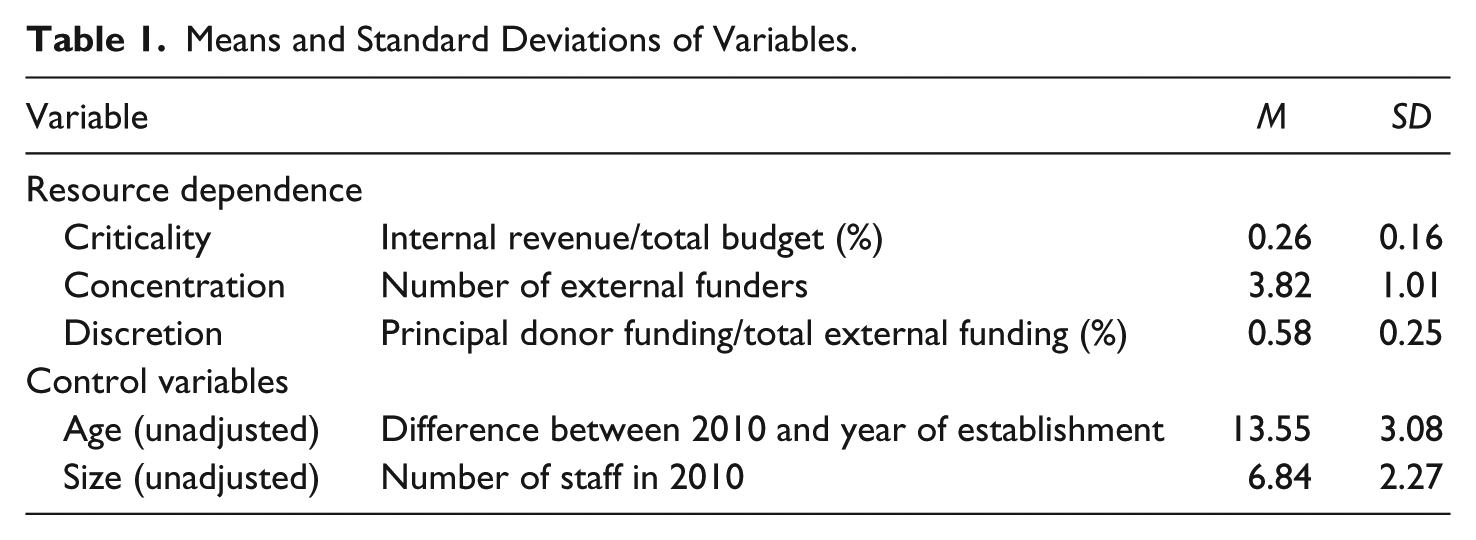
Finally, the control variables are as follows: (a) organizational age, defined as a continuous variable and measured as the natural log of the difference between 2010 and the year of establishment of the organization, and (b) organizational size, a continuous variable, measured by the natural log of an NGO’s number of staff in 2010 (Da Costa Carvalho, Camoes, Jorge, & Fernandes, 2007). Table 1 provides descriptive statistics for the main variables in the analysis.
Means and Standard Deviations of Variables.
Potential limitations
The sample size could constitute a limitation. With only 49 observations, it is difficult to identify other variables that might be important. Without being able to deal with competing hypotheses, the results should be treated as correlations, not causation. This is a weakness that should be addressed in future research, by developing and testing alternative hypotheses.
Results
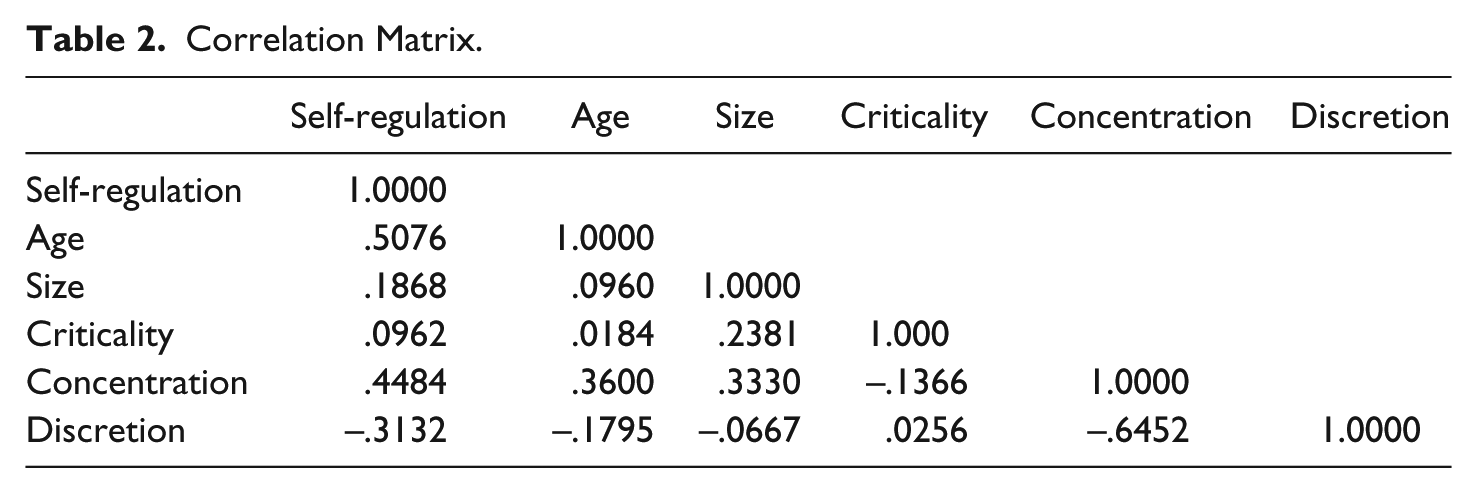
First, the correlation test was performed. The correlation matrix in Table 2 shows a noticeable negative collinearity (–.6452) between two independent variables: concentration and discretion. However, after checking the Variance Inflation Factor (VIF), the collinearity is not very high to an extent that it becomes difficult to separate the individual effects of these variables (Gujarati & Porter, 2009; Kutner, Nachtsheim, & Neter, 2004).
Correlation Matrix.
We used four models in the regression analysis (Table 3). We focus on Model 4, being more fit. We notice that the interplay of the three variables yields a moderate effect on the application of self-regulation practices. Controlling the combined effect of the variables, concentration was statistically significant (p < .01). Using the odds ratio, for each additional external donor, the odds of adopting self-regulation increase by a factor of 1.7. This means that the more diversified the sources of funding, the more likely NGOs are to practice self-regulation regardless of the criticality or discretion. The effects of both resource criticality and discretion are marginally significant (p < .1). The results show that for each additional 10% increase in internal revenues (that is a decrease in resource criticality), the odds of adopting self-regulation increase by a factor of 1.08. Discretion is likely to have an opposite effect; for each additional 10% increase in funding coming from one specific external donor, the odds of adopting self-regulation decrease by a factor of 1.08. An interesting result is age being a more significant predictor than size; this could be due to the fact that older NGOs—at least in the case of Lebanon—are not always the active ones; younger organizations can secure more resources and outperform.
Results of Logistic Regression Models.

Note. Criticality: ratio of internal revenue to total budget; concentration: number of external funders; discretion: ratio of funding from the principal external donor to total external funding; age: organizational age: natural log of the difference between 2010 and the year of establishment of the organization; size: natural log of an NGO’s number of staff in 2010.
p < .1. **p < 05. ***p < .01.
High Resource Dependence, More Self-Regulation?
According to RDT, organizations try to create an environment in which they might control resource dependence (Pfeffer & Salancik, 1978). These organizations may design standards that guide operations. The results herein do not necessarily suggest that self-regulation is used by NGOs with high resource dependence. We expected that the reliance on external funding sources more than on internal revenues would increase the likelihood of applying some form of self-regulation practices. However, controlling for the combined effect of all factors, the results indicate that the effect of criticality of external resources, that is, internal revenues to external resources, is only marginally significant; there is no noticeable difference between an environmental NGO that launches an income-generating project to boost its internal revenues and another organization that seeks grant funding. In this case, self-regulation is not particularly adaptive or market-driven as the “efficient, reliable, mutually beneficial, and profitable” market motives are not evident (Bies, 2010).
The most significant result is concentration or, in other words, the diversity of external sources. RDT argues that an organization can manipulate its environment pending the availability of other sources for the same resources or of alternative resources (Cho & Gillespie, 2006; Pfeffer & Salancik, 1978); “diversified links to sources of funding [. . .] augment an agency’s power, influence, and decision-making autonomy” (Oliver, 1990, p. 258). This increased power limits the asymmetry that characterizes the NGO’s relationship with a single external funder, as NGOs seek multiple sources to secure access to critical resources. The original assumption is that an NGO with more diverse external sources of funding is less likely to use self-regulation as an adaptation mechanism to external pressure. For example, if one donor mandates self-regulation as a condition for funding, an NGO can resist the pressure by relying on other donors that are more lenient on this issue. The NGO can possibly play other interests (such as program delivery) against this requirement to avoid compliance. However, as it turned out, self-regulation is positively and significantly correlated with diversity in external sources of funding (1.7). Environmental NGOs with multiple donors are more engaged in self-regulation practices than those with fewer donors. One explanation is that availability of multiple funding increases an NGO’s operational costs and efforts to manage these resources. The organization recruits and trains personnel, building an organizational capacity that can then be utilized in adopting self-regulation practices. The additional complexity in evaluation and reporting demanded by several donors in Lebanon, due to diversified funding, can also drive an NGO to consider self-regulation as an opportunity to select its own standards of operations and practices. This is noticeable among environmental NGOs with more diverse sources of funding in the dataset (regardless of the years of operation); these organizations follow certain best practices and performance standards in their operations in a self-attempt to ease (and possibly coalesce) complicated and diverse requirements of funding from their multiple donors.
This positive correlation between self-regulation and diversity of external sources of funding can also depend on the type of these sources (Froelich, 1999). If diversification leads an NGO to secure funding mainly from international donors, then it will probably be associated with self-regulation practices. International funding is highly volatile compared with others, especially when we are talking about funding from international and philanthropic foundations. If funding is coming from other sources, such as local donations—or even the Lebanese government, requiring limited managerial structure, monitoring, and reporting (UNDP, 2009), then we can expect a reverse effect. This is noticeable in the NGOs dataset; as mentioned above, most of these environmental NGOs depend on international donors as the main source of funding, compared with social service organizations, which secure additional funding from government agencies. Future research should carefully dissect external funding sources.
The last point to consider here is that discretion over resources decreases the likelihood of practicing self-regulation, although the result is marginally significant. The assumption is that if a specific donor controls external resources of an NGO, the organization uses self-regulation as a symbolic nonmaterial resource (Ebrahim, 2005) to negotiate interdependencies and, alternatively, tap other sources (Guo, 2007; Oliver, 1991). On the contrary, the results expose the likelihood of the opposite case. Whether self-regulation takes place depends on many factors; however, as a single donor’s control over an NGO’s resources tightens, self-regulation does not necessarily have to take place. A possible justification here is that neither the donor nor the NGO is interested in self-regulation as a mechanism to monitor behavior or as a tool to reduce dependency. The push or interest in professionalization is then more rhetoric than serious (AbouAssi & Trent, 2013). It should be noted here that although the type of the principal donor (bilateral, multilateral, or international/philanthropic organizations) has not been accounted for in this model, the critical donor of many NGOs in the sample is a bilateral donor, or—in other words—the development aid agency of a foreign country. The justification herein then aligns further with the arguments that were brought up earlier on the impact of donors and donor funding on NGOs in developing countries, such as Lebanon (Carothers & Ottaway, 2000; Henderson, 2002; Jellinek, 2003; Markowitz & Tice, 2002).
We conclude this discussion by reiterating that we set out to test one theoretical explanation, acknowledging the main threats of small sample size and missing variable bias. The results provide support for some claims and not for others, highlighting the need to consider alternative theoretical perspectives. One alternative explanation comes from the signaling theory (Gugerty, 2009; Prakash & Gugerty, 2010). Gugerty (2009) argues that “voluntary accountability initiatives among nonprofits can be understood in part as a signaling mechanism in the presence of information asymmetries between nonprofits and their stakeholders” (p. 245). Self-regulation can be used as a means to send signals to funders about the credibility and professionalism of the organization. The theory can possibly explain why discretion over resources might not motivate practicing self-regulation. An NGO with a principal donor does not need to adopt self-regulation to send a signal; the donor already knows the organization. An NGO with multiple donors might use self-regulation as a single signal of the quality of its work and services, “as a response to accountability expectations of stakeholders or, for instance, to distinguish themselves from other[s]” (Simaens & Koster, 2013, p. 1043). While these observations invite further scrutiny with a particular focus on collective and not unilateral action, existing research suggests that “voluntary regulatory programs are collective endeavors that allow credible nonprofits to collectively signal their commitment to deploy resources as per their organizational mandate” (Prakash & Gugerty, 2010; p. 24).
Another alternative theoretical explanation would focus on the institutional environment of the Lebanese NGOs (DiMaggio & Powell, 1983), underscoring the values, norms, and expectations that might motivate the design and implementation of self-regulation, more than dependence on resources. Kearns (1994) links self-regulation to certain expectations nonprofits need to meet, whether these expectations are informal, implicitly reflected in norms and values or more formal and explicitly stated on records. It is important to mention that the surveyed NGOs follow certain individual, not sector-based, self-regulation practices, reflecting lesser degrees of uniformity and means of enforcement such as code of conducts and ethics more (Ebrahim, 2003a; Panel on the Nonprofit Sector, 2007; Sidel, 2010). Furthermore, self-regulation is conditioned on the maturity of the systems of philanthropy, rule of law, civic participation, and degree of development of the sector in a specific country (Gugerty et al., 2010; Verbruggen et al., 2011). Careful analysis is required in the case of Lebanon where the rule of law and the system of philanthropy are weak, while the NGO sector is relatively developed and civic participation is high.
Practices of self-regulation could have been further motivated or incentivized through strong ties NGOs have with international donors, being the main source of funding, as those donors themselves might be following some self-regulation practices. Adoption of these practices by the Lebanese NGOs could be due to shared norms and values of practice (Bies, 2010). AbouAssi (2010) highlights learning and common language that local NGOs share with international donors. These ties open the door for adoption of practices that do not relate to resource dependence but rather to diffusion of norms, compliance with institutional environment, and reinforcement of legitimacy and credibility. A network theoretical analysis might enrich institutional perspectives. This should be a subject of future research.
Conclusion
This article aims to add a modest contribution to the field of knowledge on NGO self-regulation. Extensive literature has been produced to study this relationship. The motives for nonprofit self-regulation could be explained using RDT, as NGOs’ attempt to manage their resource environment stimulates their interest to self-regulate.
This article shows a moderate correlation between self-regulation and resource dependence. An increased reliance on external funding sources does not provide additional motives for NGOs to self-regulate. This research also exposes a possible positive effect of a diversity of funding sources on self-regulation. While the assumption derived from RDT talks about a negative effect, NGOs with diverse sources of funding are more likely to adopt self-regulation.
This article provides the first empirical evidence that might then help sorting out resource dependency explanations. We acknowledge that without being able to deal with other alternative explanations, the empirical results are at best “suggestive.” The implication here is that financial resources are not the only key determinant of NGOs’ behavior. Regardless of how dependent NGOs are, these organizations can still practice agency in their behavior and decision making; we need to dig deeper to understand how NGOs behave. Future research should expand on the results herein, use a larger sample, and discern the types of external donors. Network analysis can be another analytical approach to consider as it allows plotting NGOs’ ties and interactions and, consequently, understand the diffusion of norms and practices among these organizations and between them and their stakeholders.
Footnotes
Acknowledgements
The author is grateful to several anonymous reviewers for their helpful comments.
Declaration of Conflicting Interests
The author(s) declared no potential conflicts of interest with respect to the research, authorship, and/or publication of this article.
Funding
The author(s) received no financial support for the research, authorship, and/or publication of this article.