



Abstract
A neighborhood-representing community association (or neighborhood association [NA]) can offer community-based solutions to address problems and needs within a neighborhood. From this study, we expected to see the potential benefits that such an association could contribute to a neighborhood and its residents. A questionnaire survey was conducted in five neighborhoods in Greenville, North Carolina, in summer 2011. The study had two main research questions: “Do the NA’s tasks have an impact on resident’s overall neighborhood satisfaction?” Next, we asked, “Are there specific features that make a NA serve residents effectively and thus make people satisfied with their association?” We found significant contributions by NAs in communication and community activities that affected residents’ overall neighborhood satisfaction. We also found that an association’s contributions in maintaining active communications with residents were the most significant feature that residents appreciated.
Introduction
The Community Association Institute estimates that the number of association-governed communities in the United States has grown more than 32-fold since 1970 (http://www.caionline.org/, accessed on January 10, 2013). Association-governed communities include homeowners’ associations, condominiums, cooperatives, and other planned communities. Communities create associations for various reasons, including building a sense of community through engagement, serving as a social network, maintaining the physical quality of the neighborhood collectively, helping protect property values, dealing with external issues such as land development/redevelopment projects, and facilitating municipal services. Although each community association may have different goals to achieve and its systems may differ from one another, community associations commonly seek to strengthen the sustainability of the community (Chaskin, 2003; Chen & Webster, 2005; McCabe, 2005).
Even though a particular policy may accommodate the community’s problems and needs, the generalization may not work in every community. Chaskin (2003) emphasizes the value of a local association, which animates local knowledge, local rights, and local power for a healthy democracy and is thus beneficial in establishing the most effective and efficient policy. Successful decision making can be achieved when a policy addresses place-specific problems. A neighborhood-representing community organization can offer community-based solutions to address problems and needs within the community. Such an organization can be viewed as the most authentic form of citizen participation and local democracy. Researchers refer to such organizations with various terms (note: Some terminologies may be much broader, in which local community issues are only a part), such as voluntary organizations, civic society organizations, nonprofit organizations, community organizations, neighborhood-representing organizations, and neighborhood-based governance. Focusing specifically on a geographically bounded community, the present study concerns neighborhood-based organizations, and we use the term neighborhood association (NA) throughout the article.
The literature on NAs often addresses an association’s roles and functions, especially the public–private relationship—the relationship between the association and the local government (Chaskin, 2003; Chaskin & Abunimah, 1999; Glaser, Denhardt, & Grubbs, 1997; Logan & Rabrenovic, 1990). While most research looks at the NA as an organization playing an “intermediary” function between the neighborhood and the government, Chaskin and Greenberg (2013) argue that the NA often functions at the interstices of public and private action, stressing the liminal and shifting space in which nonprofits may engage more directly in governance decisions, as promoters of community development (Logan & Rabrenovic, 1990), or as a force affecting zoning decisions (Matejczyk, 2001).
How to promote sustainability in the community has been another major interest in the literature. Researchers propose building neighborhood democracy by fostering empowerment through actions (Chaskin, 2003; Chinman & Wandersman, 1999; Glaser et al., 1997; Quane & Rankin, 2006). It seems clear, though, that research has produced limited guidance on how to achieve viability, structure, and vitality of an association within its community (Checkoway, 1991; Cnaan, 1991; Harris, 1998; Prestby, Wandersman, Florin, Rich, & Chavis, 1990). Research participants have often comprised only local government, the leaders in organizations, or their members (Chaskin, 2003; Chaskin & Abunimah, 1999; Checkoway, 1991; Chinman & Wandersman, 1999; Prestby et al., 1990). An association’s contributions to the greater society or the perceptions of residents living in a neighborhood but not in an organization about the NA have received little attention in the literature. Kissane and Gingerich (2004) suggest that there are huge discrepancies between nonprofit directors’ and residents’ viewpoints on neighborhood problems, or future project orientations, and their perceptions of the neighborhood and other residents. As they pointed out, we should think differently about who are the actual stakeholders in such social service nonprofits and should shift research participants from the insiders (leaders and members) to the outsiders (other residents in the community). In this study, we value other residents’ perspectives about their NAs’ roles and functions.
Neighborhood satisfaction, which refers to residents’ overall evaluation of their neighborhood environment, has long been a major research subject in sociology, planning, and related disciplines (Hur, Nasar, & Chun, 2010). Research on community sustainability and quality of life greatly supports the importance of neighborhood satisfaction for residents. Researchers have identified various factors and their impacts on neighborhood satisfaction but have often argued that neighborhood satisfaction has a complex and multidimensional basis relating to both the actual and perceived environments (Amerigo & Aragones, 1997; Francescato, 2002; Hur et al., 2010; Marans & Rodgers, 1975; Marans & Spreckelmeyer, 1981; Weidemann & Anderson, 1985). Objective attributes of the physical environment affect neighborhood satisfaction (Bothwell, Gindroz, & Lang, 1998; Hur et al., 2010; Kim & Kaplan, 2004; Lee, Ellis, Kweon, & Hong, 2008; Perkins, Florin, Rich, Wandersman, & Chavis, 1990; Perkins, Wandersman, Rich, & Taylor, 1993) through social attributes (Hur & Morrow-Jones, 2008; Lansing & Marans, 1969; Spelman, 2004). Some sociodemographic attributes also affect neighborhood satisfaction (Lipsetz, 2001; Miller, Tsemberis, Malia, & Grega, 1980; Li, Wenning, & Morrow-Jones, 2013; Potter & Cantarero, 2006). Despite the rich volume of literature, there is a need for other factors to be considered in the neighborhood satisfaction model due to its complex and multidimensional nature. Moreover, previous research indicates that conditions necessary to improve overall neighborhood satisfaction are often hard to realize or require significant time and efforts—for example, enhancing safety from crime, reducing/enhancing density of housing, maximizing the distance to problematic areas, and increasing naturalness in the neighborhood. Planners and decision makers repeatedly discover such findings are difficult to apply.
Considering NAs’ roles and functions, we hope to find whether a NA can help residents to improve their neighborhood satisfaction through practical actions. Our first research question was “Do the NA’s tasks have an impact on resident’s overall neighborhood satisfaction?” Next, we asked, “are there specific features that make a NA serve residents effectively and thus make people satisfied with their association?” Along with the two main research questions, we also looked at whether there are differences in perceptions and expectations related to the geographic location of the neighborhood (inner-city neighborhood vs. suburb), the size of the neighborhood, the residents’ homeownership status, and the perceived degree to which the NA represents the neighborhood and the residents.
In this study, we anticipated findings that could encourage planners and decision makers to rethink their values in favor of sustaining stronger neighborhood-based associations. We believe that such associations could effectively enhance residents’ overall neighborhood satisfaction. When residents show higher satisfaction with their NA and its roles, it is more likely that they will participate more often and more actively in the NA, and their overall neighborhood satisfaction is enhanced. Our findings may motivate municipalities to take action to encourage the formation of neighborhood-based associations and to support them actively in various functions.
Method
The Neighborhoods and NAs
This research is a case study conducted in the City of Greenville, North Carolina. Greenville is located in the north central coastal plain region of eastern North Carolina, approximately 85 miles east of Raleigh. Greenville is one of the fastest growing large cities in the state, with a population of 84,554 (U. S. Census Bureau, 2010).
We targeted voluntarily organized NAs in Greenville. The City of Greenville plays a significant role as a logical partner to these organizations (called NAs). The city has been fostering neighborhood democracy for over 25 years. The city’s neighborhood liaison/community ombudsman actively assists and promotes every aspect of the Neighborhood Advisory Board (NAB), which serves as an intermediary between the neighborhood and the local government, by increasing citizen participation in neighborhood organizations and advocacy; by supporting the formation of new NAs; by creating and maintaining working relationships among neighborhoods and with the City of Greenville; by disseminating information important to sustaining secure, healthy, and vibrant neighborhoods; and by serving as a liaison between neighborhoods and the City of Greenville (http://www.greenvillenc.gov/departments/community_development/information/). By January 2011, the city officially recognized 57 NAs, of which 44 are active, 8 are inactive, and 5 are planned. In Greenville, NAs are a growing presence. To start a NA, the organization must fulfill two requirements: electing an executive board with president, vice-president, secretary, and treasurer and preparing bylaws, which predetermine the frequency of regular meetings, election/voting procedures, and the area that the NA represents.
All NAs have unique characteristics: Some are well established, whereas some are recently created; some have engaged many internal and/or external issues, whereas some have not experienced much conflict; some are challenged to keep higher homeownership rates in their neighborhood, whereas some are challenged to maintain the number of renters in the neighborhood; some are large in size, and some are small. For this study, we selected five NAs among the 57 listed to provide diverse community contexts and association roles, which include variations in the neighborhood size, history, physical features, geography, homeownership ratio, neighborhood challenges, and the NA’s major roles. Figure 1 maps the locations of these neighborhoods: Tar River/University, Brook Valley, Rock Springs, Stratford, and The Oaks neighborhoods.
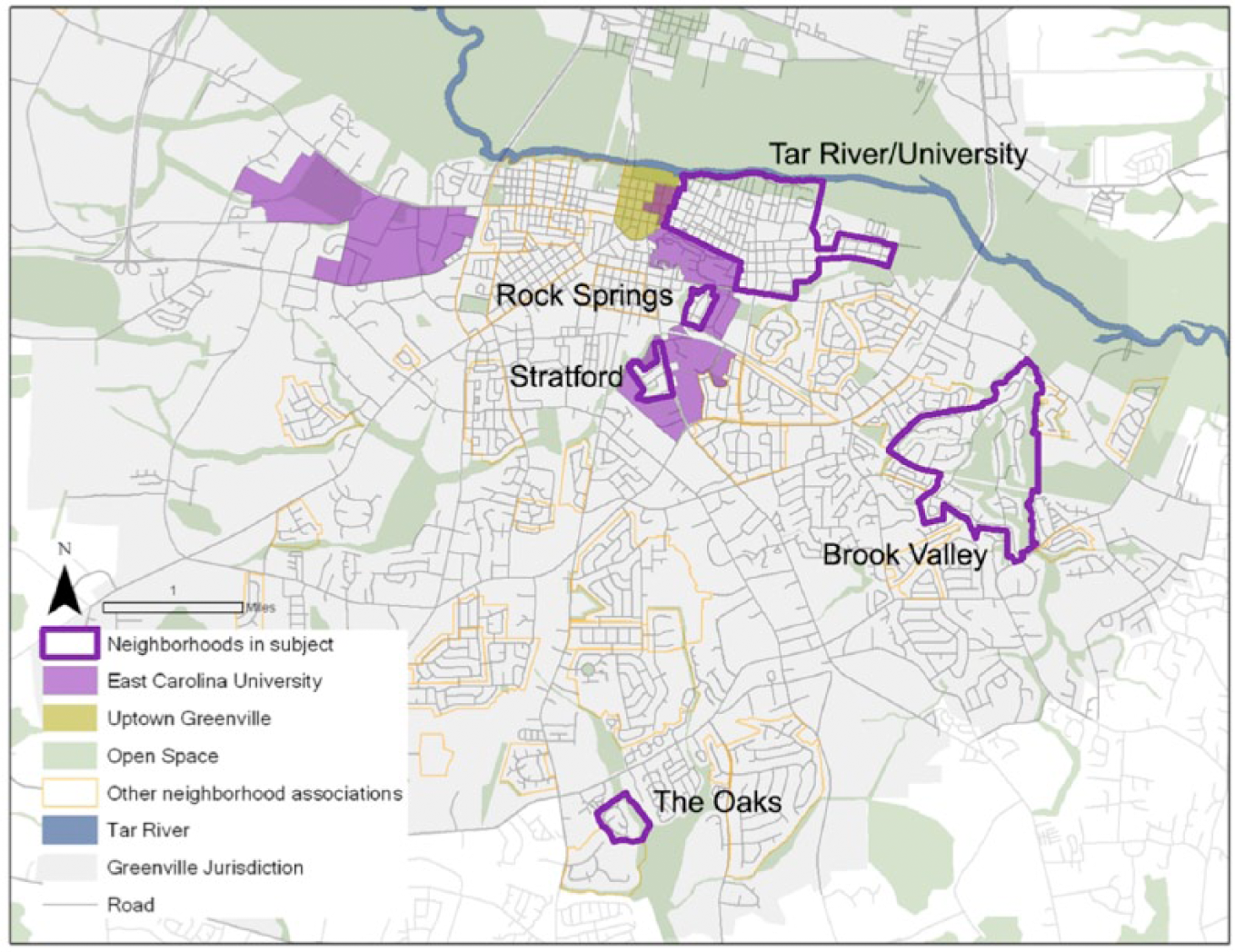
Five neighborhood associations in the study.
The historic Tar River/University neighborhood is located at the center of the city—north of the East Carolina University (ECU) main campus, east of uptown Greenville, and south of the Tar River that runs east–west through the City of Greenville, providing residents with great outdoor recreational activities. The College View Historic District, the only locally designated historic preservation district in Greenville as well as a National Register Historic District, is located at the southwest corner of this neighborhood. The Tar River/University neighborhood is one of the largest neighborhoods in Greenville: 492.53 acres in size with approximately 2,900 housing units and 5,000 residents (Census 2010). The neighborhood offers more renter-occupied houses than owner-occupied (76.4% and 13.3%, respectively). The neighborhood serves the housing needs of ECU students, staff, and faculty members. The owner-to-renter ratio among occupied housing in the neighborhood is low (17.4%)—about three times smaller than the city’s average (59.0%). Property lots are small, with various housing types built since the early 1900s. The Tar River/University Neighborhood Association (TRUNA) started for one reason: “keeping a balance between homeowners and renters” (interview with the liaison of the association to the NAB). The neighborhood has many internal and external issues and problems, such as ECU campus expansions, tensions between renters and homeowners, social issues with college students, and the declining downtown. Due to the high demand for student housing near ECU, the neighborhood has always faced the risk of losing the balance between homeowners and renters. The recent battle against the City’s zoning code change (the so-called “three-unrelated” rule) 1 illustrates TRUNA’s struggles. TRUNA has 22 elected board members, mostly homeowners in the neighborhood. Although the association is notably active, it is uncertain whether student residents (mostly short-term renters) are aware of and participate in the association.
The Brook Valley neighborhood is located at the eastern edge of Greenville. It is another large neighborhood of 519.38 acres—larger than Tar River/University neighborhood—but has only about 500 housing units. The private Brook Valley County Club is located at the east side, covering almost half of the neighborhood. The golf club provides a rich recreational environment for the residents. Established in the 1960s, the neighborhood was an early high-end suburban community with single-family detached housing and has maintained its neighborhood characteristics well. The NA was initially set up by cooperating realtors as a homeowners’ association. It eventually dissolved, and the Brook Valley Neighborhood Association started in 1965 with the vision of protecting the neighborhood covenant. The neighborhood liaison to the NAB indicates that about one third of the dues-paying members are active. However, he carefully mentioned that, unlike TRUNA, Brook Valley does not face many challenges in the neighborhood and, thus, building a sense of community through social events and ensuring physical maintenance of the neighborhood seem to be the major roles of the association. Although the covenant of the neighborhood prohibits renters in the community, a few renters were identified by the survey.
The other three neighborhoods—Rock Springs, Stratford, and The Oaks—are smaller neighborhoods with 27.03 acres, 42.88 acres, and 52.18 acres, respectively. Rock Springs and Stratford share many characteristics: Both are old (Rock Springs was established in the 1940s and Stratford was established in the 1960s) and located close to the ECU campus, and thus they deal with many of the same university and student issues as the Tar River/University neighborhood. The Rock Springs NA was once a part of TRUNA but became independent in 1989. Once a single property owned by one family in the 1960s, the neighborhood currently holds 44 housing units, which is the smallest neighborhood in the city. Partially due to its manageable size, most residents in the neighborhood are well connected not only on issues related to ECU or student renters but also to nurture a sense of community. The neighborhood covenant requires homeownership of residences but, as in the Brook Valley, there were several renters identified by the survey.
Stratford has about 119 middle-class homes in its area. The NA has maintained close-knit community characteristics via a well-established community watch program. About two thirds of the residents are active members (calling themselves “Stratfordians”). The association consists of 15 board members.
The Oaks is the newest neighborhood, built in a suburban setting established in 1990s. It is located just off Fire Tower Road, where the city’s most active residential and commercial developments are underway. The Oaks neighborhood is, however, somehow hidden behind larger roadside neighborhoods and thus is a safe and quiet residential environment. The Oaks NA was formed in 2010. Because of the relatively low degree of challenges that often ignite strong memberships as seen in TRUNA, Stratford, or Rock Springs, The Oaks NA has about 20 members of 89 housing units in the community. Table 1 summarizes the key characteristics of all five neighborhoods in this study.
Five Neighborhoods and Their Neighborhood Associations.
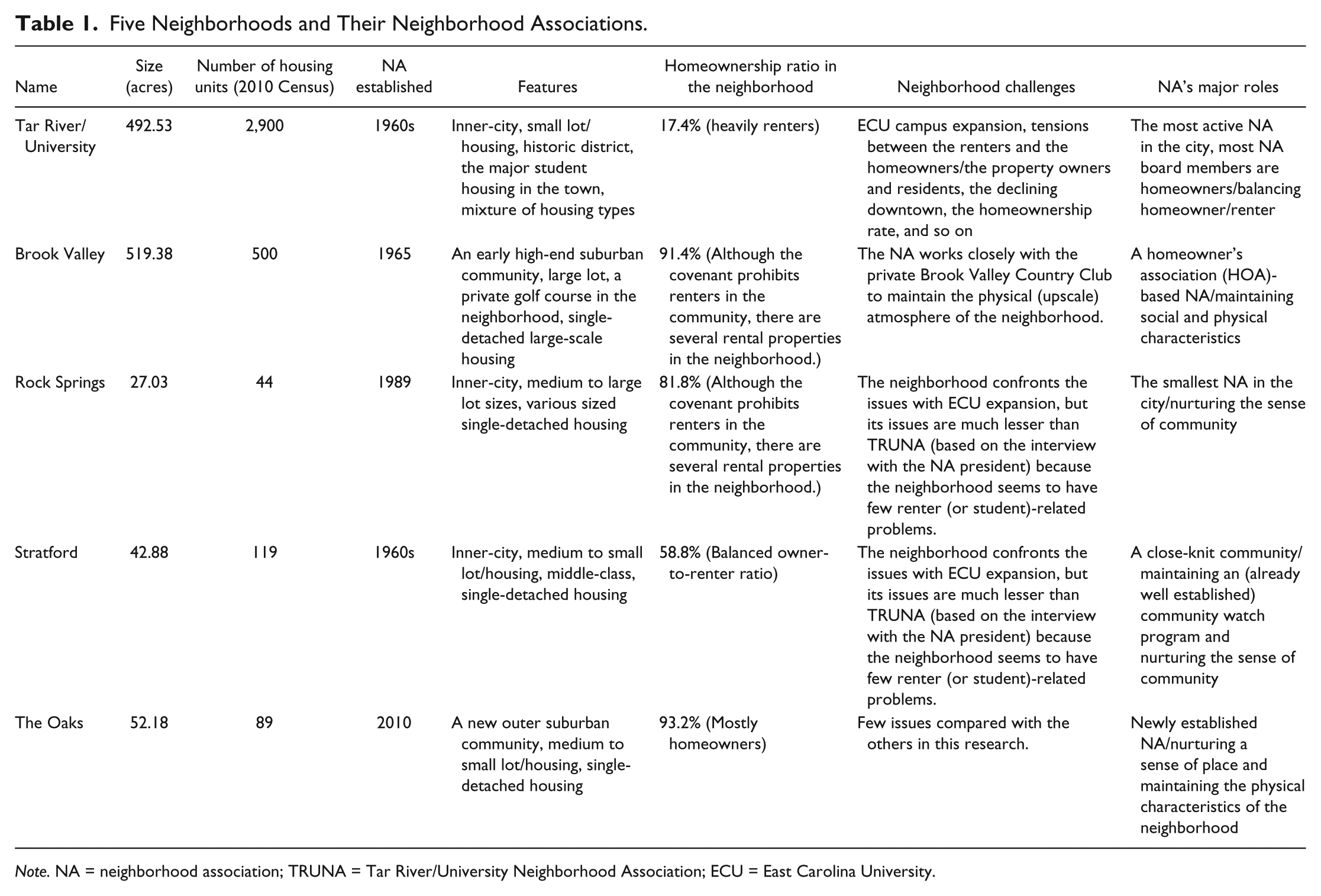
Note. NA = neighborhood association; TRUNA = Tar River/University Neighborhood Association; ECU = East Carolina University.
Questionnaire Survey and Sample
We conducted a door-to-door questionnaire survey in the five neighborhoods between May and June 2011. The survey was based on convenience sampling—a nonprobability sampling strategy where participants are selected based on accessibility (Bornstein, Jager, & Putnick, 2013); thus, the findings of this research will limit the generalization of results. A surveyor visited houses in each of the neighborhoods in the evenings on weekdays and weekends. Because the survey was conducted after the spring semester ended and the majority of student residents in Tar River/University neighborhood had left, there were many houses where no one answered the door when the surveyor visited them. When a resident opened the door, the surveyor briefly introduced herself, the research, and the survey. If the resident showed a willingness to participate in the survey, the surveyor provided an iPad with the online questionnaire form loaded. We found this on-site, online survey to be effective and efficient in many aspects: It eliminated survey expenses for printing and coding; the surveyor needed to carry only one lightweight portable device rather than paper questionnaire materials; the project manager could monitor the survey progress remotely; and, best of all, people showed an interest in answering the survey on the iPad screen. 2 The survey took an average of approximately 10 min to complete. No incentive was offered to survey participants.
Among 395 original contacts, we had a total of 275 completed survey responses (69.62% response rate). We define the response rate as those who cooperated and completed the survey over those who answered the door, rather than overall housing units in the neighborhood. Response rates differed by neighborhood: Tar River/University had 74.07%, Brook Valley had 61.73%, Rock Springs had 83.33%, Stratford had 74.47%, and The Oaks had 75.76%.
Our sample (N = 275) included more females (54.7%) than males and more married people (55.84%) than single. The gender composition of our survey participants was very similar to the city (54.2% females) population. The survey participants were well balanced in terms of age: About 55.04% fell in the most economically productive age group between 31 and 60. The sample’s age composition was also similar to the population of the city. We had more Caucasians (87.27%) than the city (56.3%), which may be linked to higher household income (21.7% of the sample gave their household income as US$100K or higher) and higher homeownership (70.70%). It should be noted that 92 of 275 respondents (33.45%) refused to answer the household income question. Generalization of the research results should reflect the representativeness of the sample.
Survey respondents other than those in TRUNA reported that they were well aware of a NA in their area. About 70% to 80% of the respondents in each neighborhood answered the question positively, whereas only about 33% of the respondents in Tar River/University neighborhood said that they were aware of TRUNA. Those who knew the association were asked whether they thought that their NA represented the neighborhood and its residents. The Oaks NA (55%) and TRUNA (67%) had lower values than Rock Springs (82%), Brook Valley (91%), and Stratford (96%).
Variables
As a neighborhood satisfaction study, we included various physical, social, demographic, and sense of community variables from the existing literature. In addition, we expanded our scope to include the roles and contributions that a NA offers neighborhood residents. Table 2 lists all variables in this study. It includes 31 variables within five categories: nine measures of the NA’s performance, five sense of community measures, seven neighborhood perception measures, four neighborhood indicators measures, and six demographic variables. All variables, except the neighborhood indicators, were addressed in the questionnaire to the residents. The NA’s role in residents’ neighborhood satisfaction was further determined using several neighborhood indicators. We anticipated that the three inner-city neighborhoods near the ECU main campus might have different needs and expectations of their NAs than the suburban ones, due to the nature of the problems and issues the inner-city neighborhoods face. We also anticipated needing to consider the neighborhood size as another indicator—a NA that covers a large geographic area, such as the Tar River/University and the Brook Valley neighborhoods, may have different challenges in reaching out to its residents, compared with the NAs with more manageable neighborhood sizes. Similarly, the residents’ perceptions about the NA’s representativeness as well as the homeownership ratio in the neighborhood may also influence the model. These neighborhood indicators were added as dummy variables to the model. Table 2 lists all the variables and their descriptions.
Research Variables.

Note. NA = neighborhood association; TRUNA = Tar River/University Neighborhood Association; SOC = sense of community.
Research Analysis
Two sets of analyses were conducted. To answer the first research question, “whether the NA’s tasks have an impact on residents’ overall neighborhood satisfaction,” we first ran factor analysis to identify factors from the variables. A Varimax rotation was used to simplify the interpretation. Then, we ran a stepwise regression analysis with the identified factors, demographic variables, and neighborhood indicators. This enabled us to see the predictive variables and their estimated relationships to residents’ overall neighborhood satisfaction. For the second research question, “whether there are specific features that make a NA serve residents effectively and thus make people satisfied with their association,” we ran another stepwise regression analysis with the residents’ overall satisfaction with their NA’s performance (NA-overall satisfaction) as the dependent variable. For this analysis, we used each NA performance variable, the demographic variables, and the neighborhood indicators individually as independent variables. Findings from the second part of the analysis were compared with what residents suggested as the most expected role of the NA. SAS 9.3 was used for statistical analysis.
Results
NA’s Impact on Residents’ Overall Neighborhood Satisfaction
The principal factor method followed by a Varimax rotation was used to extract the factors. A scree test suggested five meaningful factors, so these factors were retained. Variables with factor loading 0.40 or greater were grouped into five factors. Based on the shared conceptual meaning between the grouped variables, each given factor was labeled. The first factor, NA-maintenance and improvement, grouped the variables concerning the NA’s efforts to maintain and improve the physical environment; the second factor, sense of community, grouped all five sense of community variables in this study; the third factor, NA-communication and activity, grouped the variables that highlighted the NA’s various activities; the fourth factor, physical environmental character, included the desirable physical environmental features that a neighborhood may prefer to have or those close by; the fifth factor, crime/racial/homeownership character, grouped the residents’ perceptions of subjective ratings of neighborhood crime, racial, and owner-to-renter characteristics. Figure 2 illustrates the factor groupings: All variables in the factor analysis are listed on the left of the ovals. The ovals indicate the identified factors, and the variance explained by the factor is also marked.

Factor groupings and stepwise regression analyses on residents’ overall neighborhood satisfaction.
Stepwise regression analysis is a semi-automated process of building a model by successively adding or removing variables based on the t statistics of the estimated coefficients. Using the factor scores from the exploratory factor analysis, the demographic variables, and the neighborhood indicators, the stepwise regression analysis estimated the neighborhood satisfaction model. Figure 2 illustrates the residents’ overall neighborhood satisfaction model with the standardized regression coefficients. All variables and factors are included in the figure, with highlights on significant factors of the model. The coefficient of determination (R2) of the model was .35 (F = 20.89, p < .0001), with 263 observations used in analysis.
The model confirms the literature by suggesting the crime/racial/homeownership character factor as the most significant positive influence on resident neighborhood satisfaction (with the largest effect size; Alvi, Schwartz, DeKeseredy, & Maume, 2001; LaGrange, Ferraro, & Supancic, 1992). This indicates that people are more satisfied with their neighborhood when their perception of safety from crime in the neighborhood is high, as well as when they have a high degree of satisfaction with the racial/ethnic compositions and the homeowner-to-renter ratio in the neighborhood. The preferred racial/ethnic composition or homeowner-to-renter ratio is outside the scope of our research interest. Instead, we asked people how satisfied they were with their neighborhood in terms of these features. We are aware that residents in the same neighborhood may evaluate these features differently because their perceptions may differ depending on personal preferences and experiences.
The model also confirmed the previous neighborhood satisfaction literature by suggesting that the physical environmental character factor and the sense of community factor are two key factors in residents’ neighborhood satisfaction (Bonaiuto, Fornara, & Bonnes, 2003; Hummon, 1992; Kaplan, 1985). Interestingly, the effect of the physical environmental character factor was about two magnitudes less than the effect of the crime/racial/homeownership character factor. The literature commonly suggests that the general physical appearance of a neighborhood is the single most important factor affecting how satisfied residents are with the area where they live (Hur & Morrow-Jones, 2008; Langdon, 1988; Sirgy & Cornwell, 2002). In comparative research examining the differences between neighborhoods that are rated satisfactory and unsatisfactory, Hur and Morrow-Jones (2008) found that the less satisfied residents tended to focus on safety and other social aspects. Our study showed the crime/racial/homeownership factor as the most significant factor affecting overall neighborhood satisfaction, which confirms that the respondents who participated in this research were less satisfied with their neighborhoods and that perhaps there were negative concerns in the neighborhood.
We also found significance in the NAs’ roles and contributions to residents’ perceptions of their neighborhood environment. The model suggests that the NA-communication and activity factor is a significant positive factor on neighborhood satisfaction (with a moderate effect size). This suggests that residents’ overall neighborhood satisfaction may be increased by a NA’s role, if the NA functions well in maintaining active communications with residents, organizing community events and activities that all residents can be a part of, sustaining good relationships with the city and thus possibly bringing benefits to the neighborhood, and keeping the neighborhood safe through, for example, active block watch programs. The public–private relationship in the literature on associations’ roles was again highlighted here.
The results showed that the NA-maintenance and improvement factor was not a significant factor in the model. This suggests that residents’ perceptions of their neighborhood environment are effectively influenced by the NA’s proactive actions rather than by its expected responsibilities. We assume that people may expect a certain degree of physical maintenance and improvement as a return on the association dues that they pay to their NA (although these dues are voluntary in most neighborhoods in Greenville). The residents may have less appreciation for the NA’s contributions toward physical improvements than for other events and activities that the NA may additionally contribute.
We added four neighborhood indicators to the model as dummy variables, expecting to find whether the internal/external issues of the neighborhood, the size of the neighborhood, the homeownership status, and the residents’ perception of their NA’s neighborhood representativeness have an influence on the residents’ overall neighborhood satisfaction. However, none of them turned out to be a significant factor. We failed to show differences between the inner-city and suburban residents’ neighborhood satisfaction. Perhaps the significant urban amenities offered by a small college to inner-city neighborhoods may still be attractive to residents despite the challenges they have to deal with. We failed to support the previous research on the homeowner-to-renter ratio in a neighborhood as having an effect on neighborhood satisfaction (Lu, 1999; Rohe & Stegman, 1994; Varady, 1986). We also failed to find the NA’s representativeness of its residents as a significant factor in the model. Whether a respondent living in a neighborhood with relatively high ratings on the NA is representative of residents (with 80% and above in our research) or not, his or her neighborhood satisfaction was not influenced by that factor. We think that the problem lies in residents’ low interest in the community events “in nature” (Cnaan, 1991; Rowe & Wales, 1999). Because residents often show little interest in local events, forming new local networks for participation, debate and, consensus seeking may become critical tasks for the NA.
Among added demographic variables, the model found that residents with higher educational degrees (PhD/MD degrees) were less likely to be satisfied with their neighborhood and that older residents were more likely to be satisfied with their neighborhood. Other demographic variables, including gender, marital status, homeownership, and tenure, failed to be significant.
Ratings on NAs’ Performance
Based on the analysis above, we further investigated which specific NA roles had significant effects on residents’ satisfaction with their NA’s performance. The analysis will answer the question, “what contributions that the NA performs do people appreciate more?” To develop the model, we ran another stepwise regression analysis with NA-overall satisfaction as the dependent variable. Each NA performance variable, neighborhood indicators, and demographic variables were used as independent variables. Table 3 summarizes the standardized regression coefficients from the model. Only variables significant at the .10 and .05 levels are listed. The R2 value was .46 with F = 27.11, p < .0001 (number of observations used = 267).
The NA’s Roles as Determinants of Residents’ Overall Neighborhood Satisfaction.
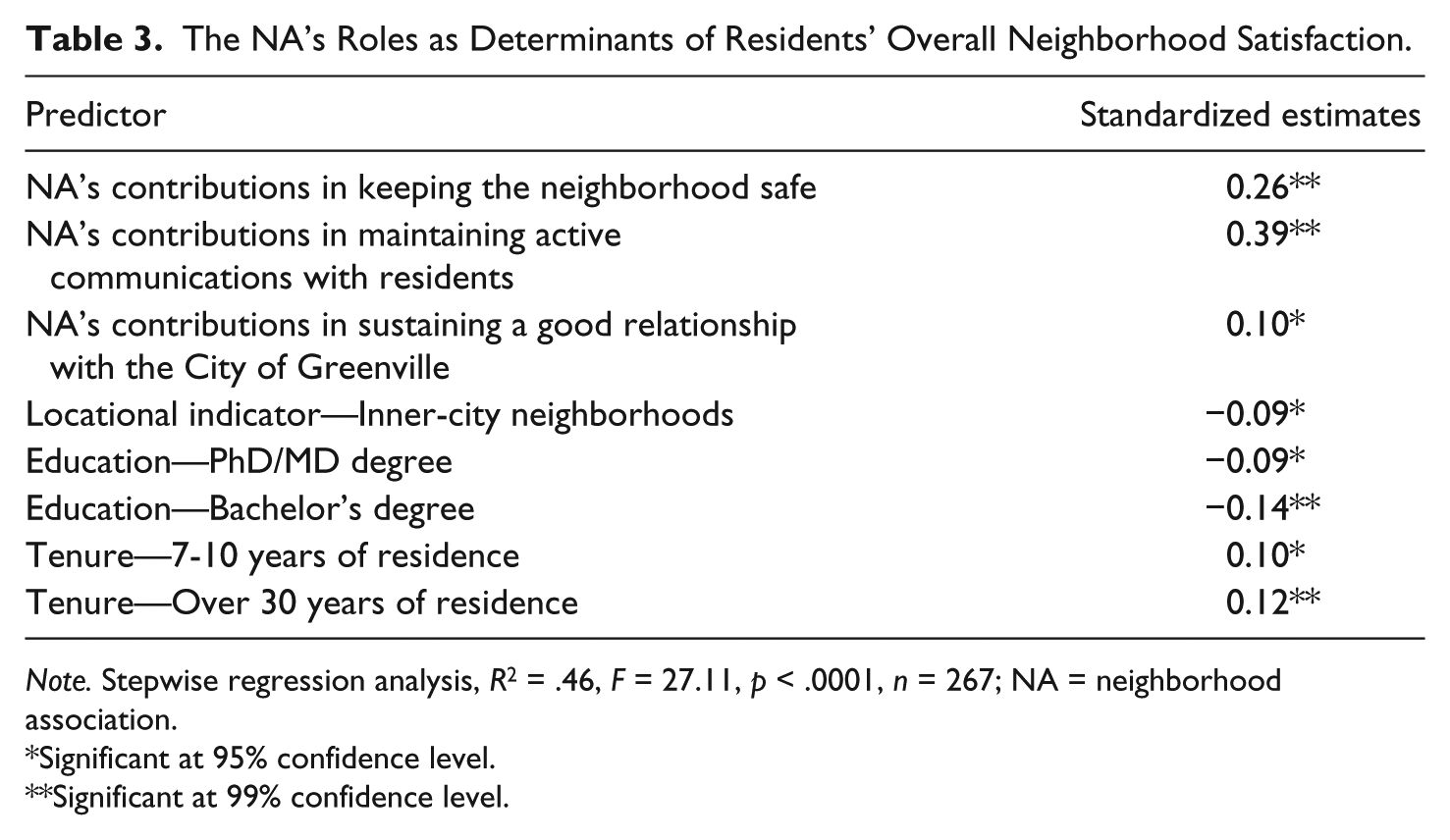
Note. Stepwise regression analysis, R2 = .46, F = 27.11, p < .0001, n = 267; NA = neighborhood association.
Significant at 95% confidence level.
Significant at 99% confidence level.
Similar to our findings in the earlier analysis, no variable grouped for the NA-maintenance and improvement factor turned out to be an effective measure of residents’ overall satisfaction with their NA’s performance. Among the variables that were grouped for the NA-communication and activity factor (see Figure 2), the NA’s roles in organizing community events and activities (NA-community events/activities) turned out to have no effect in the model. However, the NA’s roles in maintaining active communications with residents (NA-communication with residents) had the most significant impact (standard coefficient of 0.39) on the residents’ overall ratings on the NA’s performance. The NA’s contribution to keeping the neighborhood safe (NA-safety through block watch) was the second most significant effect (standard coefficient of 0.26), and the NA’s contributions in sustaining good relationships with the city of Greenville (NA-relationship with the city) was the third most significant effect (standard coefficient of 0.10). The positive and negative impacts of the local government’s sponsorship on community development have been well supported in the literature (Chaskin, 2003; Chaskin & Abunimah, 1999; Glaser et al., 1997; Logan & Rabrenovic, 1990). Jun (2010) also found that healthier communities have close relationships with the local government, which gives back to the community by helping support its sustainability. Our research confirmed the significance of a network with the local government for a neighborhood. All three significant variables showed positive effects on resident satisfaction with the NA’s performance, which indicates that the greater the number of such contributions by a NA, the greater would be the appreciation of the NA.
We also found that residents who live in an inner-city neighborhood were less likely to be satisfied with their NA’s performance. Considering the internal and external issues and problems with which these neighborhoods deal, they may have much greater expectations of their NAs. When there is a greater expectation about what NAs can do for residents, it is more likely that residents are easily disappointed with an unexpected or less desirable result. Even though the association may have fulfilled its roles, there is also the possibility that some residents will be unsatisfied.
The findings with people at different education levels were somewhat consistent with the neighborhood satisfaction model. The findings suggest that residents with tenure—those who have lived in a neighborhood for a longer period of time and especially those who have lived there for 7 to 10 years and over 30 years—were more likely to be satisfied with the association’s roles in the neighborhood. From the authors’ observations of NA meetings in the past, it seems that the active members are often longtime residents. We assume that with greater involvement in the organization, the appreciation of it may grow as well.
At the end of the questionnaire survey, we asked respondents to choose the most desired role of their NA among five choices: more community-oriented social events, better communications with residents, improvements of the physical environment, organized community support, or fund-raising activities. Only 62.5% of respondents answered this question. The respondents’ choices were somewhat consistent with our research findings. People chose better communications with residents as the most desired role from their NA (34.2%), improvements of the physical environment as the second most desired role (30.2%), and organized community support as the third most desired role (22.1%); less important to them were more community-oriented social events (9.9%) and fund-raising activities for future neighborhood improvement (3.5%).
Conclusion
Many have said that the modern neighborhood has a diminished sense of community and that arguably we Americans may no longer be interested in interactions with our neighbors within a geographically defined community (Taub, Surgeon, Lindholm, Otti, & Bridges, 1977). While this may partially be true, Hur and Morrow-Jones (2008) point out that
although neighborhoods as “foci of emotional and financial investments, and potential sources of friends for children and adults” may have become less important, the neighborhood still remains the most basic environmental unit in which our social lives occur, and it necessarily affects the quality of life of residents. (pp. 619-620)
Given the importance of the neighborhood to people, we believe that understanding the factors that affect neighborhood satisfaction and their influences may be critical. Our study supports the neighborhood satisfaction literature and expands the scope not only to residents’ perceived social, physical, and sociodemographic characteristics but also to their voluntary NA’s roles in the community.
Our model suggests that the crime/racial/homeownership factor is the most significant influence on resident neighborhood satisfaction, followed by the physical environmental characteristics, sense of community, and NA-communication and activity factor. All of these factors had positive impacts—the more of these features present, the stronger overall neighborhood satisfaction will be among residents in the neighborhood. We also found age to have a positive impact and education with PhD/MD degree to have a minor negative impact on neighborhood satisfaction. Among suggested factors, however, the NA’s role in physical maintenance and improvement turned out to have no effect on residents’ overall satisfaction with the neighborhood. No indicator variable turned out to be significant.
The specific role of the NA’s performance with the most significant impact on residents was the NA’s contributions in maintaining active communications with residents. Its contributions in keeping the neighborhood safe had the second largest effect, and its contributions in sustaining good relationships with the city had the third largest effect. Residents in the inner-city neighborhoods tended to have less satisfaction with their NA’s contributions to their neighborhoods, and residents with longer tenure tended to be more satisfied with their NA’s performance.
Our findings suggest the importance of a NA’s communication and activity as one significant factor in residents’ perceived neighborhood satisfaction. Chaskin (2003) suggested an effective process for resident participation that highlights the importance of and the need for communication/activities of the community-based organization. The more resident participation there is through active communication and the more interactions among residents, the more opportunities there are to strengthen the sense of community and the stronger overall neighborhood satisfaction is. However, we did not test the various forms of communication, which limits the applications of the findings. Future studies could test the effectiveness of various communication tools and skills.
However, we would expect that a NA that functions effectively in communication and community activities may contribute positively to the neighborhood. For example, given the impacts of crime and fear of crime as major measures for quality of life (Diener & Suh, 1997) and for neighborhood satisfaction (Hur & Morrow-Jones, 2008; Perkins et al., 1993), both features should be effectively managed in the community. A recent national poll on crime shows that a majority of Americans (55%) rate crime as an extremely or very serious problem for the nation (Dugan, 2013), although the subjective feeling of fear may not accurately reflect actual crime (Nasar & Fisher, 1993) because people often perceive crime to be more prevalent than it actually is. We anticipate that a NA with effective communication would help deliver reliable information to its residents—either good or bad—and therefore would contribute to residents establishing countermeasures that fit their needs most efficiently.
While conducting this research, we confirmed the communication gap between residents and their NA leaders (Kissane & Gingerich, 2004). We often heard from residents that their NA does not reach out to its residents; at the same time, the community leaders complained that residents do not want to be involved in the community. Good communication, supported by communicative planning theory, seems to be the key to success for both parties. A future study searching for factors that foster a NA’s effectiveness may narrow the gap between the parties.
It should also be noted that our research is unique in terms of its perspective on the role of NA. If we had surveyed only the members of NAs who are willing to suffer all the costs associated with participation and receive the benefits from their engagement, we assume that the findings would have been different, focusing more on the role of a NA as a means to promote empowerment to its members (Chinman & Wandersman, 1999; Prestby et al., 1990; Quane & Rankin, 2006). However, because neighborhood leaders need to understand which aspect their NA lacks and what function they have to focus more on, understanding the residents’ perspectives on the role of NAs is more important disregarding their membership status.
Another contribution of this research is finding a practical way to enhance overall neighborhood satisfaction. As suggested, maintaining good physical environmental characteristics or enhancing the sense of community may improve residents’ overall neighborhood satisfaction if we can identify practical ways to enhance the conditions. The reality is, however, that improving these conditions often requires substantial time and effort, or may not even be operational. For example, adding walkable/bikeable features may be possible but may require significant efforts by third parties. Similarly, building a sense of place in the neighborhood simply may not occur to someone new. However, we propose that a NA may strategically plan and manage its roles and tasks to achieve higher satisfaction among its residents. We believe that our findings will be helpful in guiding neighborhood leaders and community planners.
Footnotes
Declaration of Conflicting Interests
The author(s) declared no potential conflicts of interest with respect to the research, authorship, and/or publication of this article.
Funding
The author(s) received no financial support for the research, authorship, and/or publication of this article.