



Abstract
Philanthropic foundations play important symbolic and leadership roles in public policy debates by conferring legitimacy upon specific social problems and policy solutions, but little is known about how they respond to policy change and the roles they adopt in relationship to government. We investigate the degree to which foundations are responsive to the policy environment and ask whether they adopt roles consistent with meeting social needs, promoting social innovation, or both. We also investigate how these roles vary by foundation type (independent, community, corporate) and size. Longitudinal data on grants made by more than 1,000 U.S. foundations during the welfare reform era of 1993-2001 show that during this time foundation grants were not responsive to population need; grants to safety net and social service programs did not increase. Large foundations and independent foundations focused on social innovation by funding research and workforce development and giving more in states pursuing policy innovation.
Among private institutions, philanthropic foundations are unique in that they use accumulated private wealth to fund initiatives that they select but from which the public benefits. This has led some scholars to see them as “quasi-state actors” because they serve the public and receive tax benefits but are accountable only to themselves (Powell & Clemens, 1998; Prewitt, 2006, p. 356). It is troubling, then, that they are among our “least understood institutions” (Fleishman, 2007, p. 59; Nielsen, 1972). There are more than 75,000 active foundations in the United States, and in 2008 they gave away roughly US$45.6 billion out of their collective assets of US$533.1 billion (The Foundation Center, 2009). Although this is modest in comparison with government spending, knowing more about how foundations respond to policy change is important for two primary reasons. First, foundations play a critical role in conferring legitimacy on specific ideas and institutions, and second, foundations are important vehicles through which the wealthiest Americans exercise their influence in society (Domhoff, 1971; Dye, 2000; Mills, 1956).
While a large body of literature has shown that government actions strongly influence nonprofit organizations in general (Boris & Steuerle, 1999; Salamon, 1995; Young, 2000), the degree to which foundations are influenced by government has received comparatively less scholarly attention (for important exceptions, see Bushouse, 2009; Ferris, 2009; Sealander, 1997). Foundations have been depicted as operating largely independent of government, perhaps trying to influence government action, but not letting government action guide their activities. For example, Frumkin (2006) noted that although foundations operate in the public sphere, their giving is often “personal and individualistic” (p. 2). Hammack and Anheier (2010) argued that their autonomy results in foundations being uniquely varied in capacity, purpose, and intention. Nielson’s (1972, 2002) classic analyses of foundations support those views, arguing that foundations’ particularistic missions have often hobbled their ability to affect true social change.
The argument that foundations are individualistic and inward looking downplays the role of the political environment and suggests that the sector might not respond to policy changes in a systematic manner. From an organizational theory perspective, this argument is quite unusual as most organizational theory argues that organizations are strongly influenced by their environment (Aldrich, 1979; DiMaggio & Powell, 1983).
This article argues that foundations are likely more responsive to government action than has generally been assumed. Due to their assets and independence, we do not expect them to act like other nonprofits or expect there is a single way in which foundations relate to government and policy change. However, foundation trustees and staff may be more attentive to the political environment than has previously been emphasized—if only because that environment sets the stage for their own effectiveness. When making funding decisions, we argue that program officers, board members, and foundation staff are aware of the policy environment in which they operate and make choices accordingly. Thus, the question should not be whether or not they are responsive to the policy environment but rather to which aspects are they responsive and to what degree? Seeing how foundations respond to their environment, we can understand better their public policy roles.
We examined the complex relationship between foundations and the public policy environment by investigating two possible roles that foundations play in response to a major policy change. In the first narrative, foundations are seen as charitable agents, responding to the government’s failure to meet the needs of all citizens (Prewitt, 2006). In the second narrative, foundations are seen as engines of social innovation, working to create social change (Sandfort, 2008; Smith, 2010; Weissert & Knott, 1995). These roles are not incompatible, and foundations likely play both roles. There is a wealth of case-study research that demonstrates that foundations proactively engage with the policy environment in many ways (Bushouse, 2009; Ferris & Williams, 2010; Sealander, 1997). However, no known research has used a large sample to see which roles foundations systematically assume.
We examined foundations’ sensitivity to the policy environment by looking at how foundations responded to state-level policy trends and demographic conditions in the years immediately following the 1996 U.S. welfare reform legislation. During this time, the federal government fundamentally changed how they administered cash assistance for low-income families. Instead of providing matching funds to states for each dollar spent, the federal government provided states with block grants and regulatory guidelines, resulting in large differences in state-level policy (Soss, Schram, Vartanian, & O’Brien, 2001).
The differences in state-level policy environments allowed us to address three specific research questions. First, to what degree were foundations responsive to the policy environment? To answer this question, we look at changes in foundation funding from 1993 to 2001 in five key welfare reform-related areas (child care, family services, workforce development, safety net, and poverty research). 1 Changes in foundation grants in these areas post-policy change can inform us about the degree to which foundations responded to the changing policy environment.
Second, to the degree they responded, did foundations act in ways primarily consistent with meeting social needs or with promoting social innovation? We answer this question in two ways. First, we see whether their funding primarily supported service delivery which would indicate they focused on meeting needs, or whether they supported research which would indicate they focused on promoting social innovation. Second, we investigate whether different levels of foundation giving were associated with state-level spending, policy initiatives, and population need. If foundation funding was higher in states with greater population need or lower levels of state spending, then we can infer that foundations were likely responding to government failure. If foundation funding was higher in states where policy innovation was stronger and government expenditures greater, controlling for population needs, then we can infer that foundations were primarily concerned with promoting social innovation.
Third, how do patterns of responsiveness vary across foundations? We argue that how foundations respond to the policy environment and what roles they assume are likely to be moderated by foundation type and size. Independent, community, and corporate foundations, as well as foundations of different sizes, differ in ways that influence their ability to fund and the motivation for that funding (cf. Ostrower, 2007). For example, independent foundations may be more inclined to take risks because of their autonomy, whereas corporate foundations may be more risk averse and concerned about their public image, and community foundations may be more oriented to the local policy context. Larger foundations may have greater capacity to scan the policy environment and make strategic investments. Thus, foundations’ funding behaviors and responsiveness may be partially a function of the autonomy of the foundation and the scale of their operations.
We carry out this work with a unique data set, built from the data provided by the Foundation Center, that allows for an empirically novel analysis. Using longitudinal data on specific grants given by more than 1,000 U.S. foundations, we analyze the amounts of welfare-related funding foundations gave in each state from 1997 to 2001, using pooled cross-section regression analysis. We focus on large foundations because of their capacity to influence public policy, but highlight differences between the largest foundations and their midsize counterparts. We also investigate potential differences between independent, corporate, and community foundations. Our regressors are state characteristics, which include both policy decisions and demographic differences.
Foundation–Government Relations
Two narratives dominate our understanding of the role of foundations in society (Hammack & Anheier, 2010). Historically, foundations have been conceptualized as playing a charitable role, giving to causes and populations not well supported by government. Historical examples of this abound with a legacy of strong foundation support for various educational and health care institutions and programs for the poor (Bielefeld & Chu, 2010; Sealander, 1997). Alternatively, research on current foundation giving in the United States strongly suggests that many foundations and their staff primarily see themselves playing a social innovation role, which we define as focusing on finding new solutions to existing social problems (Fleishman, 2007; Sandfort, 2008; Weissert & Knott, 1995). Foundations support social innovation when they seek to influence public policy through research or program evaluation grants, build new institutional options, and support government innovation (Sandfort, 2008; Smith, 2010). For example, Bushouse (2009) found that the Pew Charitable Trust played a key role in persuading states to provide funding for universal preschool programs and Brown (1979) found that the Rockefeller foundation played a leading role in shaping our current health care system. Given the enormity of social problems and foundations’ limited resources, many foundations may see themselves as better positioned to facilitate institutional change than to directly alleviate need (Ferris, 2009; Weissert & Knott, 1995). For example, Marris and Rein (1967) showed how the Ford Foundation chose to support various community action approaches during the War on Poverty precisely because of their belief that eradicating poverty required societal transformation, not just more charity work. There is a historical legacy here as well. Philanthropist Andrew Carnegie, in his Gospel of Wealth, argued that it was better to give where funding would have the greatest lasting influence and would not be immediately consumed (Carnegie, 1901).
The elite power theory perspective provides further support for the idea that foundations will play a social innovation role. That body of literature discusses the role foundations play in creating social change, but treats foundations largely as tools of the elite. From this perspective, public policy reflects the interests and preferences of the elite, and foundations are an important tool used by the “governing class” in shaping such policy (Domhoff, 1971; Dye, 2000). 2 For example, work by Arnove (1982) showed that many foundations pushed for change at home and abroad throughout the 20th century, but the changes they advocated furthered class interests and global capitalism. Lagemann (1989) showed how the Carnegie Corporation worked to shape policy in just such a way. In this view, foundations cool out structural changes and have a corrosive influence that has “worked against the interests of minorities, the working class, and third world peoples” (Arnove, 1982, p. 1)—the exact people that welfare reform was aimed at. This was Domhoff’s (1971) opinion as well. If this theory is correct and foundation executives and policy makers have preferences that are in alignment, we should find foundations working to support the reform and the types of innovations contained within it by giving more in contexts that embraced the policy.
These two roles lead to two different propositions of what foundations may do during times of significant policy change. If nonprofits “fill in” when government fails to respond to citizens’ needs, then we expect that foundation giving should be greater in contexts where government spending is lower and citizens’ needs are greater. If foundations are primarily playing social innovation roles, then we expect that they will give more in contexts in which policy innovations are being debated and experimented with. If this is true, then foundation giving should be greater in contexts with more policy innovation and where government spending is higher.
Foundation Type and Size
Whether foundations are primarily concerned with alleviating need through funding services or promoting social innovation through research, 3 their ability to realize their potential is necessarily limited by institutional constraints and stakeholder interests. As organizational entities operating in highly uncertain contexts, foundations are plagued by the same problems other organizations face in regard to decision making, legitimacy, and demonstrating accountability and effectiveness (DiMaggio & Powell, 1983). Because different foundations are bound by different institutional constraints, are accountable to different stakeholders, and have varying capacities, their staff and directors will cope with these problems differently.
Foundations are comprised of four types: independent foundations (90%), corporate (4%), operating (3%), and community (1%; Prewitt, 2006). 4 Independent, corporate, and operating foundations face similar Internal Revenue Service (IRS) rules; community foundations operate under a slightly different set of rules that gives them more autonomy to be involved in policy advocacy. All four differ significantly, however, in regard to their resources and stakeholders. Independent foundations rely for the most part on donations from a single source, usually an individual’s or a family’s estate. Although board members and foundation staff are bound by the duty of loyalty to the original donor’s intent, there is very little outside control over disbursements and they have a significant amount of autonomy. Corporate foundations and their staff rely principally on gifts from one company, but there are pressures to disburse corporate philanthropy so that it serves some business interest, for example, public or customer relations (Himmelstein, 1997). Community foundations and their boards and staff rely on current donors for support and are charged with representing the community’s interests. Some community foundations serve as strong community leaders, whereas others focus primarily on service to donors (Graddy & Morgan, 2006).
Which foundations are likely to support social innovation and which will respond to social needs has much to do with their autonomy from institutional constraints and stakeholders. Independent foundations, with their high degree of autonomy resulting from an independent funding base and insulated board, have maximum freedom to act on their own organizational ideology. In contrast, community and corporate foundations—which are accountable to outside donors in the case of community foundations and media conscious parent companies in the case of corporate foundations—have much less autonomy. This difference allows independent foundations to engage in more innovative and experimental initiatives. They may also want to show that their particular institutional innovation “works” and thus invest in contexts with more policy innovations. Most of the research that has shown foundations to be policy entrepreneurs has focused on independent foundations (Bushouse, 2009; Sealander, 1997). Corporate foundations are likely to be much more concerned about their reputations in a geographical region or market niche, and making sure that company interests are served (Porter & Kramer, 2002). This may make them more responsive to social needs that play well in the media. It may also make them shy away from initiatives that are innovative but potentially controversial. The degree to which community foundations focus on social need over social innovation is less clear and particularly interesting as legally they have more room to be involved in advocacy and lobbying than do other foundations (potentially expanding the ways they can support social innovation). However, because they are embedded in a community they are under pressure from donors to respond to local needs. Millesen and Martin (2014) found that when community foundation boards are proactive, it is often the result of serendipitous environmental changes. They also found that community foundations are not particularly strategic and this inertia is influenced by both fear and tradition.
While institutional constraints and stakeholders are important, the ability of a foundation to carry out its stakeholders’ wishes is also affected by their size. With greater capacity comes the ability to employ staff to screen, monitor, and evaluate grantees. This capacity may allow larger foundations to consider a wider variety of recipients and potential solutions to social problems. For example, larger foundations can do the necessary research and allocate staff to become involved in collaborative efforts that facilitate innovation. That said, a positive correlation between large foundation giving and government innovation does not always mean that governments are leading and nonprofits are following; a positive correlation could indicate that foundations are leading and government is following or that foundations and governments are working in collaboration.
This understanding of the differences between foundation types and sizes leads us to propose that independent foundations and larger foundations may be more likely than community or corporate foundations and smaller foundations to give in contexts that are more innovative and to give relatively more money for research. However, corporate as well as smaller foundations may be more likely to give in contexts with more pressing social needs and to give relatively less money for research. Because of the complex nature of community foundations, they may be likely to be responsive to both population need and government policy initiatives.
The State-Level Context of Welfare Reform Funding
The welfare reform era provides a context to shed light on how foundations respond to policy change as the move from Aid to Families With Dependent Children (AFDC) to Temporary Assistance to Needy Families (TANF) was a controversial and highly visible policy shift (Weaver, 2000). Foundations, particularly a small number of conservative foundations, had helped shape the debate over welfare and work, and foundations with interests in alleviating poverty were actively discussing the ramifications of the policy (Mosley & Galaskiewicz, 2010; Stefancic & Delgado, 1996).
Prior to welfare reform, differences among states in regard to how welfare was funded and carried out were subtle. After welfare reform, there were large differences among states, including the stringency of work requirements and how much money was spent on welfare-related services. There were also differences in political ideologies across states as well as demographic differences, such as the unemployment rate and welfare caseloads. Seeing how foundations responded to these different contexts can show the extent to which foundations responded to community needs or pursued social innovation, holding constant the time period and specific policy area.
State-Level Policy Choices
States varied in how they approached welfare policy, both before and after the 1996 law. First, they differed in terms of “innovativeness,” meaning simply the extent to which they were trying new things. Second, they differed in the level of state funding for welfare-related services. We argue that if foundations are focused on promoting social innovation, they should provide more funding to nonprofits in states with a more extensive record of policy innovation or higher levels of government funding for welfare-related services.
Prior to the passage of the law, some states participated in a program that allowed them to waive out of the traditional AFDC model to carry out a different program in support of the same objective. Foundations had long been tracking results from the waiver programs, funding evaluations of certain aspects of these programs to promote their policy preferences (Mosley & Galaskiewicz, 2010; O’Connor, 2002). A major goal of these programs was to reduce welfare caseloads, and some states were more successful than others. Both the adoption of waivers and success in reducing welfare caseloads can be seen as indicators of an environment in which state policy makers were actively pursuing innovative ideas and practices. Foundations concerned about policy innovation may have preferred these environments.
States also differed in how restrictive their TANF policies were, for example, how severe their sanctioning policies were, how long a person could receive TANF payments before they had to return to work, the lifetime limit on cash aid, and whether they adopted a family cap. 5 Having “tougher” welfare policies can be considered innovative as well, but it is an innovation that reduces the role of the state rather than providing new types of assistance.
Finally, states differed in how much they spent on welfare-related social services. Many experts thought that for welfare reform to be successful it was necessary to increase state spending on ancillary programs to assist families in returning to work (Bane & Ellwood, 1994). Among these programs are job training initiatives, expanded funding for child day care, and transportation vouchers. Foundations focused on social innovation may have believed that states that spent more on these programs would be more successful at reducing caseloads.
Demographic Factors
States also differed in terms of their needs. First, states with larger percentages of their population receiving welfare had a much larger task in front of them if they were to be successful. Second, states with higher unemployment would likely have a more difficult time reducing welfare caseloads than those with more favorable economic conditions. Finally, states differed in the percent of children born to unmarried women. In the welfare reform debate, some policy makers argued that the need to reduce the number of births to unmarried or teenage mothers was just as important of a policy goal as increasing labor force attachment. If foundations give more to states with higher levels of population need, it demonstrates a focus on meeting needs and filling in gaps in government services.
Funding for Social Services and Safety Net Programs Versus Research
Foundations may also have chosen to fund different things during this time: research, which promotes social innovation, or social services and safety net programs, which fills in gaps in government services. Research funding is straightforward; major demonstration programs gave direction to advocates and administrators during both policy formulation and implementation. In terms of social services, we identify four areas foundations may have funded to fill gaps in government programs. If mothers with limited job skills were going to return to work full-time, they were going to need help, particularly in the form of affordable child day care and job training. Social services for adolescent parents and teen pregnancy prevention may also have been important to meet the goals of welfare reform. Finally, many advocates were concerned that without welfare as an entitlement, poor families might suffer thereby making funding safety net services, such as food security programs and emergency assistance, important.
Method
Data
These analyses were done using proprietary data procured from the Foundation Center. Each year the Foundation Center compiles grants information from approximately 1,000 of the largest independent, corporate, community, and operating foundations in the United States. The data set includes information on each grant of US$10,000 or more given by the selected foundations for the years 1993-2001. 6 Although it does not provide a full representation of grantmaking activities in the United States, it does account for about half of the total dollars given by foundations each year and the data are representative of larger grant-makers in the United States. We also used Foundation Center data on the total number of grants and the total dollar value of all grants given by the foundations in each year to code the capacity or size of the foundations. We coded foundations large if they had disbursements that were at or above the 67th percentile for a given year. 7 Those below the 67th percentile were considered midsize.
We used National Taxonomy of Exempt Entity (NTEE) codes to select a subset of grants from the larger grants file. These grants were related to five specific welfare-related funding areas and were chosen as particularly relevant to welfare reform concerns during this time. 8 We used the following codes to define each funding area:
Workforce development: J20 Employment Procurement Assistance and Job Training; J21 Vocational Counseling, Guidance and Testing; J22 Vocational Employment Training; J23 Retraining Programs
Child day care: P33 Child Day Care
Family services to adolescent parents and pregnancy prevention: P35 Prevention of Adolescent Pregnancy; P45 Family Services for Adolescent Parents
Safety net: K30 Food Service/Free Food Distribution; K31 Food Banks & Pantries; K33 Commodity Distribution Services; K34 Congregate Meals; K35 Agency/Organization Sponsored Eatery; P24 Salvation Army; P60 Emergency Assistance
Research on welfare reform policies and poverty: V39 Poverty Research/Studies; W21 Welfare Policy & Reform.
Grants could receive up to five codes. If the grant had one of the selected codes associated with a funding area, we recoded it as part of that funding area. For example, if the grant was coded J20, J21, J22, and/or J23, the entire dollar amount was included under Workforce Development funding. Occasionally, the same grant had two (or three) codes that cut across multiple funding areas, for example, Job Training (J22) and Poverty Research (V39). In this situation, we divided the amount by two (or three) and assigned the same value to the two (or three) funding areas. Once recoded, we tallied the amounts given overall to both nonprofit and government organizations in each of the 50 states for each year for each funding area. 9 We also broke this down by types of foundations (independent, community, and corporate) and by foundation size (large vs. midsize). 10 The amounts were converted into 2001 constant dollars and divided by the state’s population size for each year. In our analysis, these are the dependent variables. To test the robustness of our results, we tallied grants that went to organizations in the foundation’s home state and to organizations in different states and will present separate analyses for each. Table 1 lists the descriptive statistics at the state level for the years 1997-2001.
Descriptive Statistics (All Monetary Figures are in 2001 Constant Dollars).

Variables
State demographic statistics were used to create three variables that measured need in each year (1997-2001): welfare recipients as a percentage of the state’s population, percent unemployed, and percent of births to unmarried women. 11 We had four variables to measure policy initiatives at the state government level for each year (1997-2001). First, state expenditures on welfare reform activities were measured as spending on TANF-related noncash assistance (i.e., maintenance of effort [MOE] funds). 12 We converted the amounts into 2001 constant dollars and divided by the state’s population each year. Second, we measured the percent change in welfare recipients between 1993 and 1996. This indicates the actual progress that states had made in reducing their welfare caseloads.13,14
Third, we used Lieberman and Shaw’s (2000) data on the number of waiver requests that each state made for every year from 1977 to 1995. States requested waivers from federal government guidelines, so that they could experiment with different rules and regulations related to welfare provision. We tallied the number of waiver provisions that states pursued between 1990 and 1995. 15 Fourth, we used data from Soss et al. (2001) that measured how restrictive the welfare requirements were in each state. Using state-level welfare policies in 1997, they coded the sanction policies 16 (0 = weak, 1 = moderate, 2 = strong), the time-to-work requirements (0 = same as the federal 24 month requirement, 1 = shorter than 24 months), the time limits on welfare (0 = same as the 5-year federal requirement, 1 = less than 5 years), and whether or not the state adopted a family cap (0 = no family cap, 1 = a family cap is adopted). The average score was 2.34 (SD = 1.57) with a range of 0 to 5. We dichotomized this variable, so that states which had scores of 4 or more were coded as having the most restrictive policies. 17
The other independent variables included a number of controls: the amounts of independent, corporate, and community foundation assets per capita in the recipient’s state 1997 through 2001; the number of public charities per 10,000 residents in the recipient’s state 1997 through 2001; and personal income per capita 1997 through 2001. 18 As Soss et al. (2001) found that states with a higher percentage of African Americans tended to adopt more stringent welfare requirements, we also control for the percent of African American residents in the recipient’s state in 1997 through 2001. We also included dummy variables for year and region: West, East, South, and Midwest (the reference category).
To measure a state’s political ideology, we computed an indicator variable for political conservatism. For 1997 through 2001, we recorded the party affiliations of the governor and both senators, coding Republicans “1” and Democrats and Independents “0.” If two thirds of the congressional delegation were Republican, we coded that variable “1” and “0” otherwise. 19 We then added up the four scores for each state, with tallies ranging from 0 to 4. We cross-classified this with Conger and Green’s (2002) three-category index measuring the extent to which each state’s Republican committee was dominated by the Christian right just after the 2000 election (“weak,” “moderate,” “strong”). The state was coded as politically conservative if the Republicans controlled three of the four offices and the Conger and Green study coded the power of the Christian right as “strong.” 20
Analytical Strategy
We address three research questions:
To address the first research question, we present national trends for how foundation giving to the five welfare-related activities described above changed over the period 1993-2001. Results are presented first for all five funding areas together, and second for each funding area individually. We also separated research from social service grants and computed the percentage of each for independent, corporate, and community foundations separately. To address the second question, we present a pooled time-series cross-section analysis to investigate how state-level policy choices and local needs were related to the total dollar value of foundation grants (per capita) that each state received. We pooled our panel data across 1997, 1998, 1999, 2000, and 2001. Following Beck and Katz (1995, 1996), we estimated a random-effects model using ordinary least squares with panel-corrected standard errors (PCSEs) and a lagged dependent variable. PCSEs correct for contemporaneous correlation of the errors and heteroskedasticity (Beck & Katz, 1995) and a lagged dependent variable addresses issues of serial autocorrelation (Beck & Katz, 1996). 21 To address the third research question, we repeated our analysis for each type of foundation and for large and midsize foundations. Finally, we present a test for robustness by presenting analyses for both grants made within foundations’ home state and grants made across state lines.
Results
National Trends
The first research question asks whether foundation giving was responsive to the policy environment. Looking at the changes in foundation funding from 1993 to 2001 in five key welfare reform areas, the data suggest that in the aggregate foundations changed funding priorities, albeit modestly, in response to welfare reform. Figure 1 presents the absolute amounts given domestically to the five areas overall, in current dollars, as well as the amount as a percentage of total domestic giving in a given year over time. The latter uses the total value of all grants given by the sampled foundations for any given year as the denominator. Figure 1 shows that the overall amounts given to the five areas did increase during the late 1990s and then tailed off between 2000 and 2001. This could be partly attributed to the economic slowdown that began in late 2000 and accelerated in 2001. Figure 1 also shows that the amount given as a percent of total giving dropped off earlier, increasing until 1998 and then declining. Both trend lines show that foundations appeared to be temporarily responsive to the 1996 welfare reform legislation, although total giving to these areas never exceeded 4% of total foundation giving.
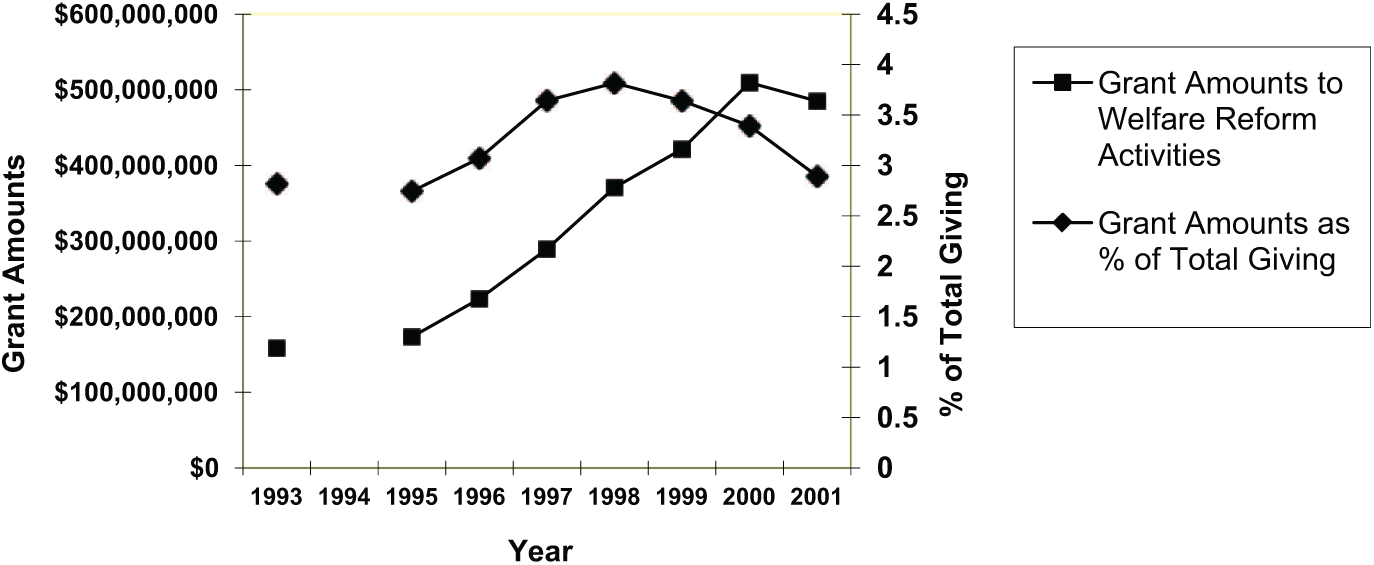
Amounts given to welfare reform activities and these amounts as a percent of all sample giving in a given year.
The second research question asked whether foundations gave primarily to meet social needs or to promote social innovation. Looking at the five funding areas in Figure 2, we see that shifts in funding were more oriented toward social innovation than meeting immediate human needs. Figure 2 shows each of the five areas of interest separately, as a percent of foundations’ total domestic giving in these years. 22 There was little change in giving for family services/pregnancy prevention, child day care, or safety net services throughout this period. In fact, the percentage of giving going to safety net services remained mostly below 1993 levels during subsequent years, perhaps because of the robust economy. In contrast, there was a significant increase in the percentage spent on both workforce development and research related to poverty and welfare reform. Both increased between 1995 and 1996 and peaked in 1998. After 1998, grant amounts as a percent of total giving drifted back to pre-1996 totals.
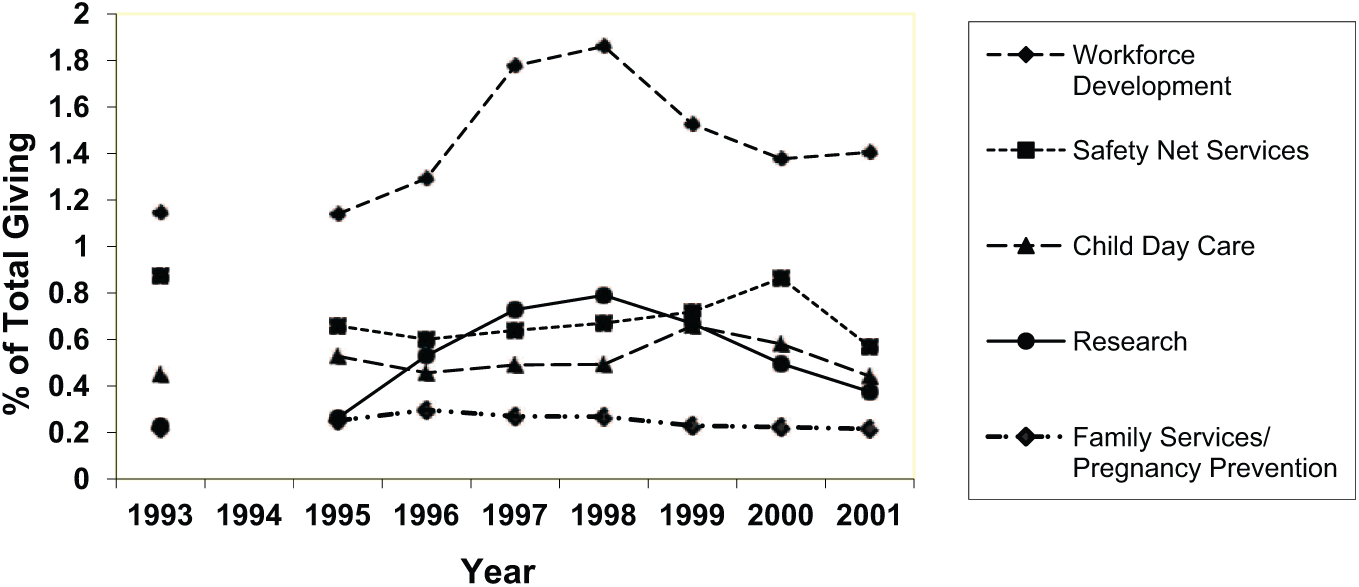
Amounts given to specific welfare reform activities as a percent of all sample giving in a given year.
Anticipating our third research question about differences between foundations of varying sizes, we find that independent foundations allocated a comparatively higher percentage of their welfare reform giving to research than corporate and community foundations. Dividing the constant dollars given to research by the total amount given to welfare reform activities between 1997 and 2001, independents directed 18.3% of their welfare-related funding to research, while community foundations directed 8.1% and corporate foundations directed only 1.8%.
Thus, in response to Research Questions 1 and 2, we find that foundations in general changed funding priorities, but they did so in ways consistent with promoting social innovation, rather than in response to population need. Foundations were responsive to the central element of welfare reform—moving people into full-time work through funding job-related programs—and the need for evidence as to what works. They responded less to what could be seen as government failure, such as funding safety net or child care programs. The increase in research funding suggests that foundations were concerned primarily with making an impact in terms of social innovation by finding out what policies and programs worked best. Independent foundations seemed most likely to disburse grants for this purpose.
Aggregate State-Level Giving
We investigate the second research question further by focusing on state-level spending, policy initiatives, and population needs within the 50 states and how much foundations gave to grant recipients in each state between 1997 and 2000. This strategy helps reveal what prompted foundation giving. The unit of analysis is the state-year, that is, each of the 50 states in each of 5 years, resulting in an N of 250. There were 21,428 grants for the five welfare reform-related activities made between 1997 and 2001 by independent, community, and corporate foundations. The quartile map (Figure 3) shows how much nonprofits in each state received from foundations on a per capita basis over the 5-year period. Contributions were higher in the Far West, Midwest, and Mid-Atlantic/New England regions. We tallied the amount given to each state in each year, added 1 to the dollar value of welfare reform grants given to a state per capita, and computed the log to reduce the influence of outliers. Multi-collinearity was a problem in our initial models. Table 1 reveals that some distributions of the state-level variables were highly skewed. To address this problem, we added 1 to the percent of welfare recipients and 1 to noncash assistance per capita and computed the logs. When analyzing a particular foundation type, for example, corporate foundations, we included in that model the amount of assets in a state appropriate to that foundation type, for example, corporate foundation assets.
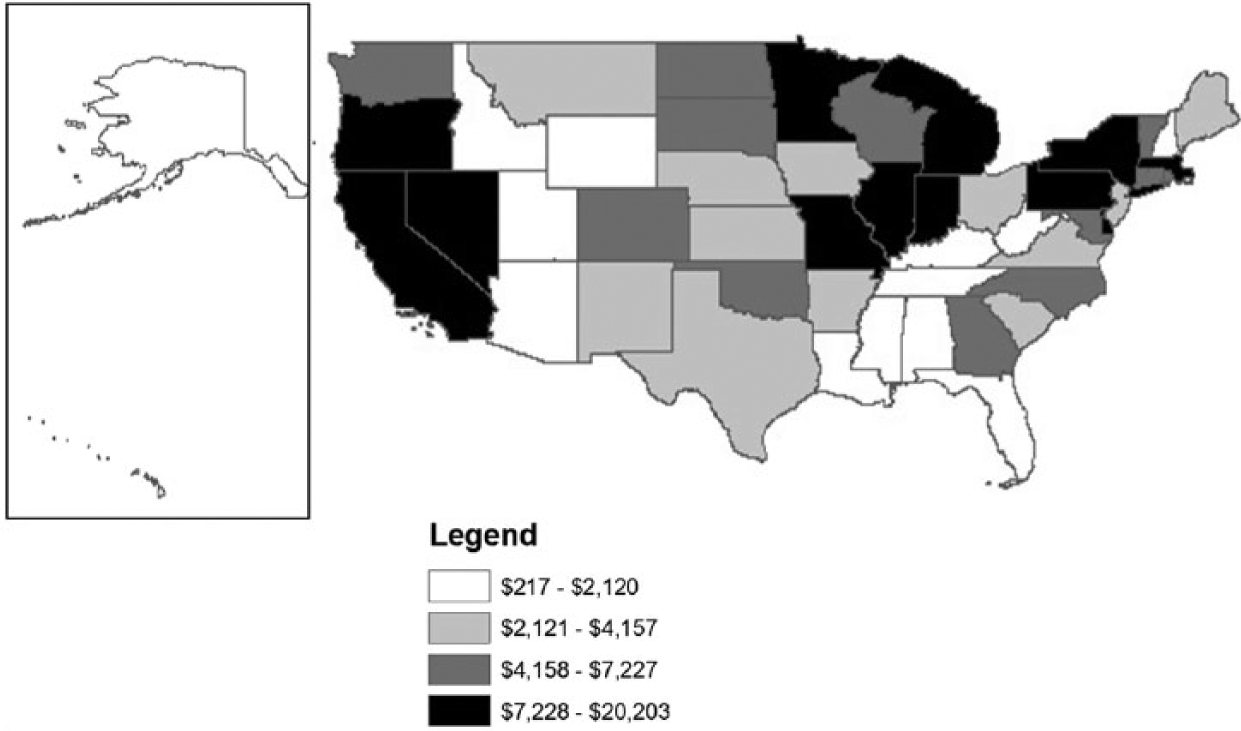
Foundation disbursements to welfare reform causes per 1,000 residents, 1997-2001 (excluding the District of Columbia).
Results are shown in Table 2. The first column looks at all foundation giving, the next two columns look at giving by large and midsize foundations, and the last three columns look at independent, corporate, and community foundation giving, respectively. When looking at all foundation giving combined (column 1), we see that foundation funding of welfare reform activities was greater if states had more lenient welfare policies, had experimented with more waivers between 1990 and 1996, or had higher state welfare-related spending per capita. Need variables such as percent of births to unmarried women, percent welfare recipients, and percent unemployed were not significant. Thus, foundation giving was responsive to local political conditions and initiatives, albeit in a seemingly politically progressive direction. However, it was fairly indifferent to local population needs. With respect to our second research question, it seems that foundations saw themselves more as social innovators focusing on shaping or supporting local policy initiatives rather than meeting local needs and mending local safety nets.
OLS With PCSE and Logistic Regression With 50 States as the Units of Analysis—All Grants (Monetary Figures in 2001 Constant Dollars).

Note. OLS = ordinary least squares; PCSE = panel-corrected standard errors; MOE = maintenance of effort.
p < .10. *p < .05. **p < .01. ***p < .001.
The last research question asked if patterns of responsiveness varied across foundations. For example, larger and independent foundations may be better able to take political risks. Columns 2 and 3 show that both large and midsize foundations gave more in states with higher welfare-related spending per capita. Large foundations also gave more if states had more waivers or less stringent welfare policies. Midsize foundations gave less if the states’ unemployment rate was higher. Thus, large foundations seemed to most strongly embrace a social innovation role. Neither large nor medium-sized foundations responded in a way that would alleviate population needs.
In the fourth column of Table 2, we see that independent foundations gave more in states with less stringent welfare policies, but number of waivers and welfare-related spending per capita were only significant at the .10 level. Independent foundation giving was unresponsive to state-level population needs. Column 5 shows that corporate foundations gave more in states that had a higher percentage of nonmarital births. This is the only evidence in Table 2 of foundations positively responding to population needs. There is no evidence that corporate foundations were responsive to states’ policy initiatives. Analyzing community foundation giving was complicated, because 40% of our observations (state-years) had no recorded community foundation gifts. To address this, we did a binary time-series cross-sectional analysis, lagging the dependent variable to address the issue of serial correlation of the errors. We found that community foundation giving to states was indifferent to both population needs and state policy variables.
Thus, to answer the third research question, giving does vary by foundation type in significant ways. Large foundations were more responsive to states’ policy conditions than midsize foundations; independent foundations were somewhat sensitive to policy conditions, whereas corporate and community foundations were not. Only corporate foundations responded positively to a need variable, which was the percent of nonmarital births.
There were additional results that should be mentioned. First, the lagged value of welfare reform grants given to states per capita was significant in all analyses. Second, foundation assets per capita were significant or close to significant in all six models. Third, only community foundation giving was responsive to the number of public charities in a state and the effect was negative. Large and independent foundations tended to give less to southern states than to midwestern states, and corporate and community foundations gave less to eastern than midwestern states. Corporate foundations gave less to western than midwestern states. Thus, overall, the midwestern states did well compared with other regions.
Within-State and Cross-State Giving
To test the robustness of our findings, we looked at giving within and across state boundaries separately. 23 In doing this, we revisit our second and third research questions. In-state and out-state giving may be different, because foundations should be more aware of state-level policies and demographic trends in their own states, and thus better positioned to respond.
Table 3 presents the within-state giving results for all foundations by foundation type and size separately. The bulk of foundation giving is within-state. Of the 21,428 grants for the five welfare reform-related activities, 15,335 were made by foundations to recipients located in the same state and 6,093 were made by foundations to recipients located in other states. Column 1 addresses our second research question regarding whether foundations were responsive to state-level conditions. The results parallel our findings in Table 2. Foundations gave more to welfare-reform-related causes in their home state if that state had less stringent welfare policies, had higher welfare-related spending, and requested more waivers, although the latter was only significant at the .10 level. Within-state foundation giving was unrelated to population needs. That is, foundations did not give more to organizations in their own state if there were more nonmarital births, more welfare recipients, or higher unemployment.
OLS With PCSE and Logistic Regression With 50 States as the Units of Analysis—In-State Grants (Monetary Figures in 2001 Constant Dollars).

Note. OLS = ordinary least squares; PCSE = panel-corrected standard errors; MOE = maintenance of effort.
p < .10. *p < .05. **p < .01. ***p < .001.
Turning to our third research question on foundation characteristics, we see in columns 2 and 3 large and midsize foundations gave more in state if the states had higher welfare-related spending, and large foundations also gave more within their state if the state requested more waivers or had less stringent welfare policies. Thus, large foundations gave more locally when their home state was more innovative and gave less when their state was less so. Clearly, local politics matters. In regard to foundation type, independent foundations gave more locally when they were located in a state that had more waivers, more lenient welfare policies, or higher welfare-related spending. Independent foundations were not responsive to needs in their own state. Corporate giving within-state 24 was also unrelated to local needs, but was higher in states with less restrictive welfare policies and more experience with waivers (the latter significant at only the .10 level). Finally, community foundations 25 were only marginally responsive to their states’ liberal welfare policies and waiver requests; the effect was only significant at the .10 level. Community foundations also tended to give more in state if the state had a larger percentage of welfare recipients, but the effect was only significant at the .10 level. Thus, independent foundations were more responsive to local policy innovations than community foundations with corporations somewhere in-between. No foundation type was particularly responsive to local population needs.
There were significant disparities across regions. Large midwestern foundations tended to give more to causes in their own state than large foundations elsewhere. Independent foundations in the Midwest also gave more in their own state than foundations in the south and east, and corporate and community foundations in the Midwest gave more in their states than comparable foundations in the east. It seems that much of the foundation response to welfare reform took place in the nation’s heartland.
Finally, the results on out-of-state giving in Table 4 are easy to summarize. 26 Large, midsize, independent, and corporate foundations gave more to causes in states other than their own if that state had a higher nonmarital birthrate. This was a very strong and consistent need-based effect, and the only evidence that foundations were positively responding to needs. The only significant policy effect was that midsize foundations gave more to organizations in other states if that state had more waiver requests.
OLS With PCSE and Logistic Regression With 50 States as the Units of Analysis—Out-of-State Grants (All Monetary Figures in 2001 Constant Dollars).

Note. OLS = ordinary least squares; PCSE = panel-corrected standard errors; MOE = maintenance of effort.
p < .10. *p < .05. **p < .01. ***p < .001.
Thus, it appears that there are scope conditions on the findings in Table 2. The effects of local policy and state need variables depend upon whether giving is in-state or out-state. In answering Research Question 3, large and independent foundations made giving in their own states contingent upon states’ welfare policies, not population needs. In contrast, independent and corporate foundations gave more to other states where the percent of births to unmarried women was larger. We will discuss the implications of these findings in the next section.
Discussion
In this article, we use the context of welfare reform to investigate the degree to which foundations are responsive to the political context, and to the degree that they are, whether they work primarily to promote social innovation or to meet population need. We find that foundations are indeed responsive to the political context and primarily act as social innovators. We also saw important differences between foundation types which produced a nuanced set of findings.
Our first research question asked whether foundation giving was responsive to the political context—in this case, welfare reform legislation. A key finding from Figure 1 was that foundation funding for welfare reform activities increased both in the aggregate and as a percent of total giving in the years immediately after the passage of the legislation, but as national attention to welfare reform began to fade, so did the attention of foundations. By looking at the time dummy variables in Tables 3 and 4, however, we see that giving within state did not decline as sharply. Overall, we find that after 1998, large foundations and independent foundations reduced their welfare reform contributions to organizations outside their state, but continued to support welfare-reform-related issues in their own state.
To address the second research question on the social innovation role of foundations and the third question about differences between foundation types, we compared giving to social services and research over time by foundations overall, and then by type. Overall, funding for research on poverty increased as a percent of total grant amounts from 1995 to 1998, as did the amounts for workforce development. Funding for social services did not increase in this way, although the total dollar amounts were higher across the study period. As expected, independent foundations gave a larger percentage of their money for research than other foundations did, demonstrating their particular focus on playing a social innovation role.
In our central regression analysis, we found that foundations gave more welfare-reform-related grant money in states that experimented more with waivers, had more liberal policies, or spent more on noncash assistance. In states where governments spent little or had “tougher” policies, foundations gave less. However, there were important distinctions depending on the type of foundation and where the giving was going. Large and independent foundations were the most sensitive to policy experimentation, state spending, and whether state policies were punitive. Upon closer analysis, we found that this was true primarily within their own state. In contrast, none of the three types of foundations were very responsive to the welfare policy initiatives in other states, but independent and corporate foundations made larger out-of-state grants in states with a higher nonmarital birthrate, a need-based criterion in our analysis. Thus, in giving out of state, foundations did not respond to policy innovation, but did respond somewhat to need—a reversal of their in-state giving behavior. This was a very consistent finding that raises interesting questions about a “foundation agenda” that begs for more research. Clearly foundations are responsive to their political environments, but their way of responding (innovation vs. social need) is contingent on who is giving, where the money is going, and the political context.
These findings challenge the idea that the foundation grants economy is national in scope. If large independent foundations had a national agenda to innovate, we would have found giving across state boundaries to be responsive to states’ policy initiatives. But we found that giving related to policy innovation seemed embedded at the state level. Foundations may have been swept up with reform efforts locally, taking cues from policy makers, or, perhaps, as suggested by elite power theory, they may have helped to stimulate these policy initiatives. In either case, they seem to have been working to help the policy succeed because when states did more to address welfare reform issues and were less punitive, local foundations gave more to welfare-related activities. When states did less or were more punitive, local foundations did less. This is still in alignment with elite power theory—in those states the prevailing wisdom may have been to do nothing and then let former welfare recipients “pull themselves up by their bootstraps.” Overall, this set of findings speaks to the issue of how redistributive foundation grants are—in this case, not much—and suggests that states with populations at greatest risk did not benefit proportionally from the activities of their local foundations.
Deciphering foundations’ roles from looking at their disbursements is not straightforward. Aggregating across foundations and analyzing the total sums of money going to nonprofits within a state cannot tell the whole story. In-depth qualitative work would complement this research by bringing out the nuance of what foundations were trying to achieve. Another limitation is that the causal direction is not certain. Finally, we investigated only relatively large foundations. Small family foundations may follow more idiosyncratic giving patterns, or they may give more to social need causes, where they can see a direct payoff from smaller grants.
Future research should address these issues, as well as pay greater attention to the ways in which foundations respond to policy change in general. Comparing how foundations respond to different types of policy shifts and in different time periods would help build theory and allow conclusions to be drawn outside of this specific policy context. The current research tells us how foundations responded to a controversial policy shift that took place in the mid-1990s. Future research should be done on other historical policy changes, as well as contemporary policy shifts, such as the recent Affordable Care Act.
Foundations fund programs and activities that ostensibly promote the greater collective good, but their funding decisions are private and not subject to public deliberation. Unfortunately, previous research often obscures both the degree to which foundations are responsive to the policy environment, as well as heterogeneity among foundation types. This research demonstrates that to understand the roles that foundations play in society, we need to understand the policy context into which foundations give, the characteristics of the donors, and the places where the donations are taking place. The complexity that we began to unravel is intriguing, and more macro-, micro-, and meso-level analyses are needed, so that we can better explain the behavior of these important, but understudied, public policy actors.
Footnotes
Acknowledgements
We would like to thank Helmut Anheier and David Hammack for their early support of this project, and Loren Renz and Steven Lawrence at The Foundation Center for their assistance with the data.
Declaration of Conflicting Interests
The author(s) declared no potential conflicts of interest with respect to the research, authorship, and/or publication of this article.
Funding
The author(s) received no financial support for the research, authorship, and/or publication of this article.