




Abstract
Research has identified that volunteering provides value to organizations, communities, and volunteers themselves. Yet, empirical research on the value that volunteers might provide to recipients of their support (i.e., clients) is very limited. Building on insights from attribution theory, we argue that clients are more likely to attribute support from volunteers to altruistic and sincere motives relative to support from paid workers, and that this provides the foundations for affect-based trust to develop between clients and volunteers. We present data from two experiments that support this indirect effect of volunteerism on affect-based trust. Our findings provide insights into why and how volunteers may provide relational value to clients and human service organizations.
Human service organizations (governmental or not-for-profit) often employ volunteers in addition to paid workers. The obvious rationale for this is that it is a cost-effective way of delivering services (Brudney, 2011). In doing so, organizations tend to overlook that volunteers might be able to provide value to clients that differs from paid workers (Handy & Brudney, 2007; Haski-Leventhal, Hustinx, & Handy, 2011; Ronel, Haski-Leventhal, Ben-David, & York, 2009). Indeed, volunteering represents distinct underlying psychological processes and approaches to organizational behavior relative to performing a paid job (N. J. Allen, 1987; Cnaan & Cascio, 1998; Laczo & Hanisch, 1999; Pearce, 1993). Hence, clients likely will perceive and evaluate support from paid workers and volunteers differently.
Few studies have examined the different value that volunteers and paid workers provide to recipients of support. These studies suggest that clients are often satisfied with (Haski-Leventhal et al., 2011), and sometimes even prefer to work with, volunteers (Ronel et al., 2009). Volunteers may also be better able to engage in meaningful relationships with clients (Jarrett, Sullivan, & Watkins, 2005). Finally, volunteers have been found to be effective helpers in Big Brother/Big Sister programs (Grossman & Tierney, 1998), and when working with individuals with a medical condition (Edgar, Remmer, Rosberger, & Rapkin, 1996; Meikle et al., 1979), at-risk youth (Ronel, 2006; Ronel et al., 2009), and the elderly (Nagel, Cimbolic, & Newlin, 1988; Thornton, 1991). Thus, clients often perceive high relationship quality with volunteers. Why would this be the case?
In the present research, we aim to provide more insights into the potential relational value of volunteers compared with paid workers by examining the level of trust in supporter–client relations. Specifically, we wanted to examine whether certain characteristics that are attributed to volunteers (i.e., altruism and sincerity) may lead to higher trust relations between volunteers and clients. Trust is a fundamental aspect of effective, coordinated, and cooperative interpersonal relationships and is seen as an important force that facilitates human interactions (e.g., Fukuyama, 1995; Hardin, 2002). There is robust evidence for the numerous benefits of trust for individuals, organizations, and society (Kramer & Cook, 2004). Whether they offer parental support, community care for the elderly, or after-school programs for children, building trusting interpersonal relationships between supporters and clients is also of great importance to human service organizations: The more trusting relationships between clients and supporters are, the more likely clients will be open to and accept the support and influence of their supporters (cf. McAllister, 1995). As such, client trust in supporters can enhance the effectiveness of support that human service organizations provide. However, at least to our knowledge, no empirical research has examined whether, and how, volunteers develop trust in clients.
We propose a model in which volunteers develop more affect-based trust (i.e., trust derived from strong emotional bonds; Lewis & Weigert, 1985) in recipients of support, which can be explained (i.e., is mediated) by higher levels of perceived altruism (i.e., a perceived positive motivation that is not attributed to presumed selfishness or other hidden motives; Ronel, 2006) and perceived sincerity of volunteers compared with paid workers. Put differently, we propose that clients are more likely to experience strong emotional bonds with volunteers because they see them as more altruistically and sincerely motivated than paid workers. We will present the results of two experimental studies 1 in which we tested this mediation model.
The Potential Relational Value of Volunteers: Trust
Trust is defined as a “psychological state comprising the intention to accept vulnerability based upon positive expectations of the intentions or behavior of another” (Rousseau, Sitkin, Burt, & Camerer, 1998, p. 395). Trust gives individuals a sense that they will not be taken advantage of by the other party (Porter, Lawler, & Hackman, 1975) and that the other does what is expected rather than what is feared (Deutsch, 1973).
Trust can have cognitive and affective foundations (Lewis & Weigert, 1985; McAllister, 1995). Cognition-based trust involves a calculative and instrumental assessment of information (Chua, Ingram, & Morris, 2008). Beliefs on competence and responsibility (Butler, 1991), reliability, and dependability have been found to be important elements in the development and maintenance of trusting relationships (Zucker, 1986). Conversely, affect-based trust involves empathy, rapport, and self-disclosure (Chua et al., 2008). Affective foundations of trust are derived from emotional bonds between individuals (Lewis & Weigert, 1985), for instance, when people express genuine care and concern for the welfare of the other party, and believe in the intrinsic value of such relationships (Pennings & Woiceshyn, 1987). The difference between cognition-based trust and affect-based trust has been illustrated as trusting with the head and trusting with the heart (Chua et al., 2008).
Cognition-based trust and affect-based trust differ experientially and have different antecedents and outcomes, and have to be regarded as distinct forms of interpersonal trust (McAllister, 1995). Affect-based trust is regarded as a less superficial type of trust than cognition-based trust and is argued to be more stable, enduring, and generalizable over situations (Lewis & Weigert, 1985; McAllister, 1995). Given that human service organizations often work with clients in vulnerable positions (e.g., at-risk youth, the elderly; Hasenfeld, 2009), they could particularly benefit from developing affect-based trust relations between their workers and clients.
Building on insights from attribution theory, it has been posited that the perceived underlying motives of other people’s actions provide the foundations for affect-based trust (McAllister, 1995). According to attribution theory, people are motivated to understand the underlying motives or intentions behind other people’s actions, particularly in interdependent relations (Kelley, 1967). The causal attributions made about the motives of others affect the attitudes, emotions, and behavior of observers: When displays of interpersonal care and concern are perceived as personally chosen and sincere rather than role-described, instrumental, or self-interested, this can be critical for the development of affect-based trust (e.g., Clark, Mills, & Powell, 1986; McAllister, 1995). Below, we develop the argument that the motives of volunteers relative to paid workers are more likely interpreted as altruistic and sincere and therefore could provide the affective foundations for affect-based trust.
Perceived Altruism and Sincerity
How do clients perceive the underlying motives of the providers of support? T. D. Allen and Rush (1998) argue that helping behaviors are attributed to either altruistic motives or instrumental (i.e., self-interested) motives. Altruism (i.e., motivation with the ultimate goal of increasing the welfare of others; Batson, Ahmad, & Tsang, 2002) likely is an important element of the client–volunteer relationship rather than the relationship with paid supporters. Indeed, Haski-Leventhal (2009; see also Ronel, 2006; Ronel, Frid, & Timor, 2013) argues that altruism and volunteerism are inevitably related: Volunteers donate their time, skills, or services to an agency or organization without obligation and without receiving direct financial compensation for their work (Cnaan, Handy, & Wadsworth, 1996). In fact, although there is some debate on altruism and its existence (e.g., Batson & Powell, 2003), volunteers are often perceived as altruists, regardless of whether they act purely out of altruism (Haski-Leventhal et al., 2011; Ronel, 2006; Ronel et al., 2013; Ronel et al., 2009). Hence, we predict the following:
Weber (2001, as discussed in Ames, Flynn, & Weber, 2004) offers three related modes for how clients might interpret social decisions such as helping: affect, cost–benefit, and role-based decisions. Affect-based decision making occurs when the helper acts on positive feelings toward the recipient. Cost–benefit decision making occurs when the helper deliberately weighs potential rewards and costs of the helping behavior. Finally, role-based decision making emerges when helping is in line with the organizational or formal role of the helper. When someone helps based on positive affect, this signals that the helper acts out of intrinsic and sincere concerns (i.e., “from the heart”; Ames et al., 2004, p. 472). Conversely, when someone helps to get something in return, or because it is in line with his or her organizational role, this will be interpreted as helping instrumentally or out of obligation. Given that volunteering in general is defined as an act of free will that is not contingent upon expectations of monetary rewards (Cnaan et al., 1996), support from volunteers is more likely to be attributed to sincere rather than instrumental or role-based motives.
Several publications offer additional support for this idea. For instance, having meaningful social interactions is often the most important driver of volunteer participation in organizations (Boezeman & Ellemers, 2009; Clary, Snyder, & Stukas, 1996; Farmer & Fedor, 1999). Volunteers also tend to be more venturesome and socially bold than non-volunteers, and are more likely to believe in the good intentions of others (Elshaug & Metzer, 2001; Spitz & MacKinnon, 1993). Furthermore, volunteers are more likely to experience concern for others’ welfare and are more sympathetic and empathic to people in need. Overall, volunteers often appear to be intrinsically motivated by the relational aspects of their work. Hence, we predict as follows:
Applying attribution theory, displays of interpersonal care and concern that are perceived as personally chosen and sincere rather than role-described or instrumental can be critical for the development of affect-based trust (Clark et al., 1986; McAllister, 1995). Based on the theoretical arguments linking (a) volunteerism to attributions of altruism and sincerity, and (b) attributions of altruism and sincere motives to the development of affect-based trust, we predict as follows:
The Present Research
We test our theoretical model in two experimental studies. In Study 1, we used an autobiographical recall task (Baumeister, Stillwell, & Wotman, 1990), a method that is often used in experimental studies to test people’s thoughts, emotions, and behavior experienced in certain situations. Half of our participants recalled a real-life experience in which they received support from a paid worker; the other half recalled an experience with a volunteer. Study 2 was a vignette study, a proven effective method to examine how people behave or feel in certain situations that are difficult to test in real life, for instance, due to their sensitive nature (e.g., Hughes, 1998). In this study, we randomly assigned participants to a scenario in which they were either helped by a volunteer or a paid worker.
Study 1
Method
Participants and design
One hundred forty-four adolescents (71 males, 73 females, Mage = 16.23, SD = 1.03) from a Dutch middle school in a large city in the Netherlands participated. Of all participants, 46.5% were Dutch, 10.4% Moroccan, 6.9% Turkish, 4.9% Surinamese, 2.8% Antillean, and 28.5% had a different ethnic background (e.g., Indonesian, Chinese). Participants were randomly assigned to a volunteer or paid worker questionnaire. Gift certificates were raffled among participants.
Procedure
A Dutch school granted our experimenters permission to enter classrooms and hand out questionnaires. On entering, the experimenters introduced themselves and explained that the questionnaire would be about persons who played a role in participants’ upbringing. The experimenters stayed in the classroom until everyone had finished the questionnaire for two reasons: (a) to ensure that students worked on the questionnaire individually rather than discussing the questions with others and (b) to answer any questions.
There were two versions of the questionnaire which were randomly distributed. The only difference between versions was that we asked half of the participants to think about a person who assisted, helped, or guided them (currently or in the past) in their upbringing and was paid to do so. In contrast, the other half were asked to think about a person who assisted, helped, or guided them (currently or in the past) in their upbringing and did so voluntarily without getting paid for it. We told participants that they could not choose their teacher, nor a family member or friend. The reason for this was to prevent same source issues (e.g., multiple participants referring to their teacher in the paid worker condition) or problems that might conflict with the interpretation of our findings (e.g., volunteering family members are likely perceived differently than non-family volunteers). In the few instances in which participants could not recall such a person, we asked whether they might know someone from their church, community center, sports organization, or someone who helped them with their schoolwork. This question was sufficient for participants to identify a person fitting the description. Subsequently, participants filled out the questionnaire with this person in mind.
Finally, we thanked and debriefed participants.
Measures
Participants responded to all measures on a 7-point Likert-type scale (1 = strongly disagree; 7 = strongly agree), except otherwise noted.
Supporter demographics
To check whether participants recalled an actual person and to gain some information about these persons, we asked several questions. To the question, “in which context does this person play a role in your upbringing,” the majority of participants indicated that this was in a sports context (51.4%), in an educational context (22.9%), at a community center (6.2%), or in youth care (2.1 %). Answers that did not fit these four categories (17.4%) could be written down. This resulted in a variety of answers including social work, music lessons, religious activities, and dietary assistance. Participants on average met this person for 9.04 times per month (SD = 6.60). In all, 62.5% recalled a person that was male. Participant also indicated in which age category they believed this person to be. For 3.5%, this was below 18 years; for 20.8%, it was between 18 and 25; for 25.7%, this was between 26 and 35; for 29.2%, this was between 36 and 45; for 18.8%, this was between 46 and 55; for 1.4%, this was between 56 and 65; and, for 0.7%, this was a person older than 65.
Affect-based trust was measured with three items adapted from the affect-based trust subscale of McAllister’s (1995) Interpersonal Trust Measure (α = .75, “I can freely share my thoughts, hopes and dreams to this person”; “I can talk freely to this individual about difficulties I am having and know that (s)he will want to listen”; and “We are both willing to make considerable emotional investments in our relationship”).
Perceived altruism was measured with three items adapted from the work of Smith, Organ, and Near (1983; α = .77, “This person is willing to do things for others that are not necessarily part of his/her tasks”; “I can rely on this person, even outside of his/her regular working hours”; and “This person is willing to help me, regardless if he/she get something for this in return”).
Perceived sincerity was measured with two items (α = .84, “This person’s support was sincere” and “This person is truly interested in spending time with me”).
Results
Measurement model
We conducted confirmatory factor analyses (CFAs) to test whether our scale items adequately indicate their intended underlying constructs (Byrne, 2010) using AMOS. We estimated a model with three latent variables (altruism, sincerity, and affect-based trust), a model in which all items loaded on one factor, and a four-factor model in which we added a common method factor that was uncorrelated to the theoretically derived factors. To quantify the degree of fit and to supplement the chi-square test, we relied on comparative fit index (CFI) and root mean square error of approximation (RMSEA).
The fit of the one-factor model was unacceptable, χ2(21) = 166.58, CFI = .73, RMSEA = .22. The three-factor model fitted our data reasonably well, χ2(17) = 44.17, CFI = .95, RMSEA = .10. However, on basis of the modification indices, when we allow two pairs of error terms (Items 1-2, and 2-3 respectively) within the affect-based trust scale to correlate, the three-factor model fits our data extremely well, χ2(15) = 14.61, CFI = 1.00, RMSEA = .00. Thus, the CFAs offer support for the validity of our specified measurement model. Unfortunately, after carefully modeling the four-factor model, the CFA results would not converge. This is not uncommon and likely due to identification problems that occur when modeling common method factors (see Podsakoff, MacKenzie, Lee, & Podsakoff, 2003).
Mediation analysis
Table 1 provides the intercorrelations of the measures, and Table 2 provides the means of the participants in the volunteer and paid worker condition.
Intercorrelations of Model Variables (Study 1).

p < .05. **p < .01. ***p < .001.
Means (SDs) for Affect-Based Trust, Perceived Altruism, and Perceived Sincerity in Study 1.

To test our mediation hypothesis, we performed the PROCESS macro developed by Hayes (2012; Model 4) with worker type as the independent variable (coded paid worker = 0, volunteer = 1), perceived altruism and perceived sincerity as the two mediators, and affect-based trust as the dependent variable. The PROCESS macro provides several benefits for testing mediation models, including greater statistical power (Hayes, 2013).
Using ordinary least squares regression analysis, the PROCESS macro allows the estimation of total and direct effects as well as the indirect effect of a causal variable on an outcome variable through proposed mediators. As recommended, particularly for relatively small samples, estimates of indirect effects were generated using bootstrapping analysis (e.g., Preacher, Rucker, & Hayes, 2007). This statistical technique resamples the data to ensure that it is more representative of the population without making assumptions about the shape of the sampling distribution of the indirect effect (Preacher & Hayes, 2008). We used 5,000 bootstrapped samples with a 95% confidence interval (CI). When zero is not in the 95% CI, the indirect effect is significantly different from zero at p < .05 (two-tailed), and evidence for mediation is obtained (Hayes, 2013).
As presented in Figure 1, the results revealed a significant positive effect of volunteerism on affect-based trust (the c path). Furthermore, volunteerism led to higher perceived altruism (the a1 path) and perceived sincerity (the a2 path). Positive effects of perceived altruism (the b1 path) and perceived sincerity (the b2 path) on affect-based trust were also found. More importantly, as predicted, the indirect effects of volunteerism on affect-based trust, via perceived altruism and perceived sincerity were significant, b = .16, standard error (SE) = .09, 95% CI (two-sided) = [.02, .36], and b = .32, SE = .13, 95% CI (two-sided) = [.11; .62], respectively. Furthermore, the direct effect (c’ path in Figure 1) of volunteerism on affect-based trust was non-significant, suggesting that perceived altruism and sincerity fully mediate this relationship.
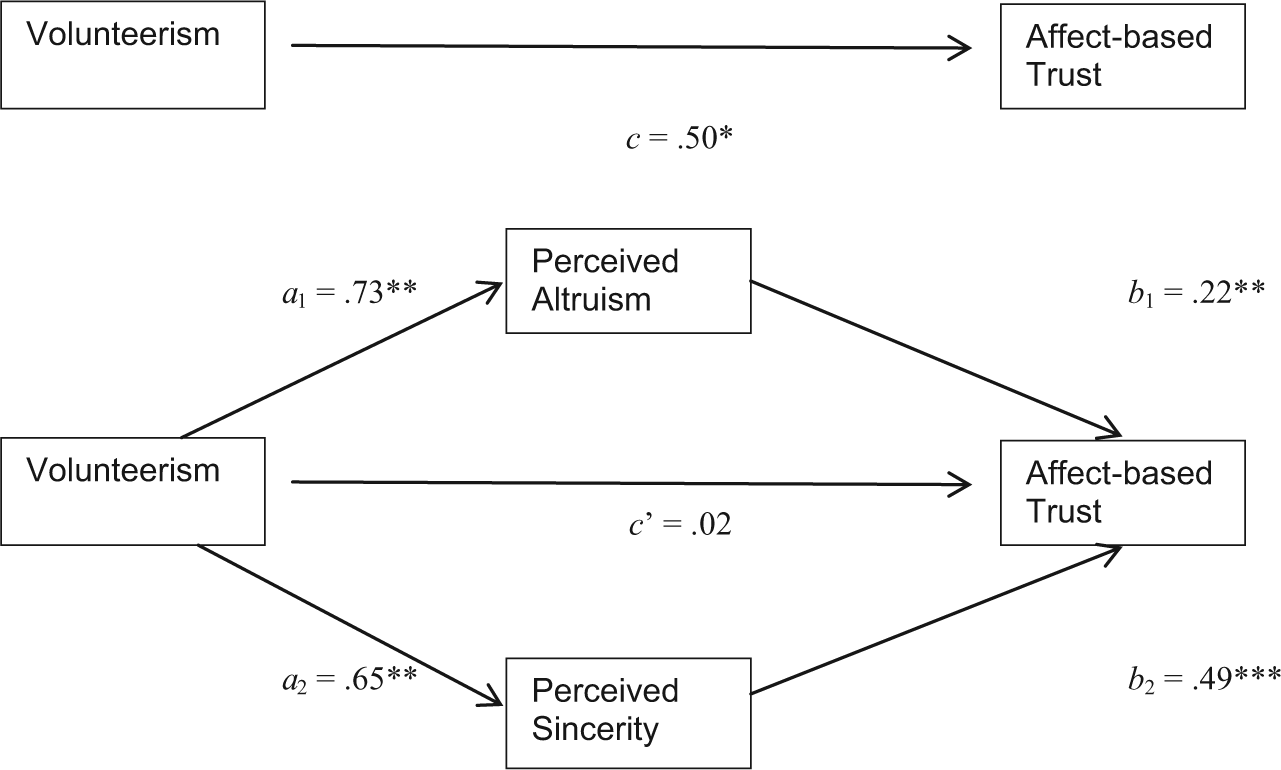
Perceived altruism and sincerity as mediators of the effect of volunteerism on affect-based trust (Study 1).
Discussion
The findings from Study 1 fully support our proposed theoretical framework: Volunteers elicit more affect-based trust in clients than paid workers, and perceived altruism and sincerity account for this relation. Given that participants recalled real-life experiences, we believe that these findings are relatively high in external validity. However, although we took several steps to prevent this, one concern with Study 1 is that we cannot be certain that all of our participants recalled an actual person. Another limitation is that we did not use the full scale to measure affect-based trust. We addressed these concerns in Study 2, which we designed as a vignette study to allow more experimental control; all participants read the same scenario, the only difference being that half of the participants read that they received support from a volunteer, whereas the other half read about receiving support from a paid worker.
Study 2
Method
Participants and design
We recruited individuals using Amazon’s Mechanical Turk (MTurk) to participate in a paid (US$0.65) online study. A total of 102 individuals from the United States (57.8% male, Mage = 30.34, SD = 9.15) participated. They were randomly assigned to a between-subjects design (volunteer vs. paid worker).
Procedure
MTurk is a platform that allows online recruitment of research participants. Research has shown that MTurk offers a high-quality and reliable method of data collection (Buhrmester, Kwang, & Gosling, 2011), and several studies have shown that no significant differences exist between findings from MTurk studies and laboratory experiments (Paolacci, Chandler, & Ipeirotis, 2010). Buhrmester and colleagues (2011) show that the participant pool of MTurk is more demographically diverse than university or college samples, and that the MTurk-data is just as reliable as data collected from more traditional research methods.
We asked participants to read the following scenario carefully and imagine that they were personally experiencing the described situation.
Imagine that you have been in an unfortunate accident in the workplace. To recover from this accident you have to stay at a rehabilitation center for an estimated period of 9 months. The rehabilitation center offers support in numerous ways, including physiotherapy. The costs of your stay will be completely reimbursed by the insurance company. Because staying in a rehabilitation center can be a tiresome and stressful experience, the center also provides a so-called buddy program, assigning a buddy to each client. This buddy may undertake activities with a client (e.g., go out on walks), but may also provide a listening ear for the client.
Subsequently, we introduced our volunteer/paid worker manipulation. Specifically, participants in the volunteer helper condition read,
Recently you have been assigned a buddy. This buddy works as a volunteer in the rehabilitation center. In other words, this person volunteered to work at the center, and is not paid by the organization.
In contrast, participants in the paid helper condition read,
Recently you have been assigned a buddy. This buddy works as a paid employee in the rehabilitation center. In other words, this person has applied to work at the center, and is paid by the organization.
Subsequently, we introduced our dependent measures. On finishing, we thanked and debriefed participants.
Measures
Participants responded to all measures on a 7-point Likert-type scale (1 = strongly disagree; 7 = strongly agree).
Affect-based trust was measured with the five-item affect-based trust subscale of McAllister’s (1995) Interpersonal Trust Measure (α = .93). To fit the context of our scenario, we adjusted one of the items: “We would both feel a sense of loss if one of us was transferred and we could no longer work together” became “I would likely experience a sense of loss if this person would be transferred (during my stay at the center) and we could no longer work together.”
Perceived altruism was measured with four items (α = .91) adapted from the Altruism subscale from Smith et al.’s (1983) Organizational Citizenship Behavior measure. The items were as follows: “This person is willing to do things that are not necessarily part of his/her task”; “I can rely on this person, even outside of working hours”; “This person is willing to help me, even in his/her spare time”; and “This person is willing to help me, regardless if he/she gets something for this in return.”
Perceived sincerity was measured with five items (α = .90): “This person’s support was sincere”; “This person is highly motivated to help me”; “This person shows a lot of dedication to helping others”; “This person is truly interested in spending time with me”; and “This person helps me from the heart.”
Results
Manipulation check
We asked participants whether their buddy was paid for their services. An independent-sample t test revealed that our manipulation was successful: Participants in the paid worker condition believed more strongly that their buddy was paid than participants in the volunteer worker condition (Ms = 6.63 vs. 1.45, SDs = 0.96 vs. 1.12, respectively), t(100) = 24.64, p < .001.
Measurement model
Similar to Study 1, we conducted CFAs to test whether our scale items adequately indicate their intended underlying constructs. The fit of the one-factor model was unacceptable, χ2(77) = 496.88, CFI = .67, RMSEA = .23. The three-factor model revealed an improved fit, χ2(74) = 223.77, CFI = .88, although the RMSEA was high (RMSEA = .14). The four-factor model including the common method factor fitted the data well, χ2(60) = 142.44, CFI = .94, although the RMSEA again was a bit high (RMSEA = .11). Overall, the CFAs suggest that there may be some common method concerns in this study, which we will address in “General Discussion” section of this article.
Mediation analyses
To test our hypotheses, we performed the exact procedure we used in Study 1. The results of the mediation analysis are presented in Figure 2 (see Tables 3 and 4 for the measurement intercorrelations and means for the study variables).

Perceived altruism and sincerity as mediators of the effect of volunteerism on affect-based trust (Study 2).
Intercorrelations of Model Variables (Study 2).

p < .05. ** p < .01.
Means (SDs) for Affect-Based Trust, Perceived Altruism, and Perceived Sincerity in Study 2.

Similar to Study 1, the results revealed a significant positive effect of volunteerism on affect-based trust (the c path, see Figure 2). Furthermore, the results revealed significant positive effects of volunteerism on perceived altruism and sincerity. Positive effects of perceived altruism and perceived sincerity on affect-based trust were also found. More importantly, as predicted, the indirect effects of volunteerism on affect-based trust, via perceived altruism and perceived sincerity, were significant, b = .37, SE = .17, 95% CI (two-sided) = [.08, .74], and b = .68, SE = .09, 95% CI (two-sided) = [.37, 1.08], respectively. In contrast to Study 1, the direct effect (c’ path) of volunteerism on affect-based trust was significant and negative, b = −.49, SE = .22, 95% CI (two-sided) = [−.93, −.07]. When both the indirect effects and the direct effect exist, but are in opposite directions, this is referred to as competitive mediation (Zhao, Lynch, & Chen, 2010). Thus, although the findings from Study 2 confirm our hypotheses, they also imply that unmeasured mediators played a role in this study. 2 We will further discuss this in the limitations section.
General Discussion
Volunteering can provide value that goes beyond economic consideration (e.g., Hager & Brudney, 2005). Indeed, volunteering positively contributes to communities (e.g., Putnam, 2000) and has positive effects not only for volunteers themselves (e.g., Musick & Wilson, 2008) but also for clients who interact with volunteers (e.g., Gilligan, 1998; Hager & Brudney, 2005; Jarrett et al., 2005; Kelleher & Johnson, 2004). Our aim was to provide insights into why volunteers may provide value to clients (see also Haski-Leventhal et al., 2011; Ronel et al., 2009). Building on insights from attribution theory, we developed the argument that clients interpret support from volunteers as more altruistic and sincere than support from paid workers, and that this could provide the foundations for affect-based trust to develop. Across two studies, we found support for this model.
Our finding that volunteers are perceived as more altruistic by clients provides further support for the notion that volunteerism and altruism are strongly linked in the eyes of receivers of support (see also Haski-Leventhal et al., 2011; Ronel et al., 2009). Our findings extend this knowledge by showing that support from volunteers is also judged as more sincere by clients. Thus, although volunteers might help others for self-interested or instrumental reasons (e.g., because it offers them career opportunities; Clary et al., 1996), they are perceived as acting out of selfless and sincere concerns.
Importantly, our findings reveal that attributions of altruism and sincerity allow volunteers to develop stronger emotional connections with clients than paid workers. Simultaneously, we show that volunteers elicit higher levels of affect-based trust in clients, and offer insights into the underlying psychological process of this relation: The attributions that clients make about volunteer motives may strongly influence their attitudes and responses toward volunteers. We believe our findings therefore help to explain why and how volunteers are often effective in establishing positive relationships with clients (e.g., Haski-Leventhal et al., 2011; Jarrett et al., 2005; Ronel et al., 2009).
Although our findings provide support for a causal relation between volunteering and increased levels of affect-based trust among clients, this does not necessarily undermine the value of paid workers. Paid workers are often better trained and better equipped to handle certain situations (Netting, Huber, Borders, Kautz, & Nelson, 2000) and perceived as more professional and competent. This could result in higher levels of client trust, albeit a distinct type of trust that is the result of a calculative assessment of information (Chua et al., 2008). Indeed, attributions about the reliability and competence of paid workers could provide the foundations for developing cognition-based trust relationships (McAllister, 1995). Whether paid staff elicit higher levels of this type of trust offers an intriguing research question.
Our focus on the psychological value (i.e., trust) of volunteers is a departure from the literature that explored the value of volunteers in terms of the number of hours contributed by volunteers and economic benefits versus costs as proxies for the value of volunteers (Handy & Mook, 2011; Handy & Srinivasan, 2004). This narrow focus might be found in organizations as well. Indeed, managers often perceive volunteers primarily as a form of inexpensive labor (Handy, Mook, & Quarter, 2008) and may underestimate that volunteers are perceived as trustworthy by clients. Our findings suggest that the value of volunteers goes beyond economics: The development of trusting relationships suggests that volunteers are able to get close to clients, and clients may feel more at ease opening up to volunteers than to paid workers (see also Fiske, 1991).
Volunteers’ ability to elicit affect-based trust in clients should be of particular interest to organizational leaders. It can help them decide where imbedding volunteers will be most effective: in situations where establishing close and meaningful relations with clients is important and it is difficult for paid workers to develop trusting relationships. For instance, volunteers might be better able in developing positive relations with at-risk youth (Ronel et al., 2009) and the elderly (Nagel et al., 1988). Organizations should openly communicate that they employ volunteers in such contexts, because this could lead to increased attributions of altruism and sincerity, and consequently, increased development of affect-based trust with clients. Thus, our findings can help human service organizations with coordinating their efforts and resources more efficiently (Bunger, 2013).
Strengths, Limitations, and Future Research Suggestions
A strength of our research is that we tested our model using experiments, a methodology seldom applied in research on volunteers (for an exception, see Boezeman & Ellemers, 2009). Past research on the value of volunteers relied on qualitative methods (e.g., Handy et al., 2008; Jarrett et al., 2005; Ronel et al., 2009), or self-reported surveys (Hager & Brudney, 2005; Haski-Leventhal et al., 2011). Although these methods offer useful insights, they do not provide clear evidence for a causal relation between the effects of interactions with volunteers (vs. paid workers) on outcome variables of interest. By utilizing experimental methods and randomly assigning participants to a volunteer or a paid worker in a scenario study, we are able to present findings with high internal validity (Aronson, Wilson, & Brewer, 1998). Moreover, we believe that the use of two different experiments and samples (Dutch adolescents and American adults) adds to the robustness of our findings.
Naturally, our studies have limitations. Although we believe that Study 1 provides findings with high external validity, we cannot be certain that all participants recalled a real-life person. Conversely, the use of an imaginary scenario in Study 2 raises concerns about the generalizability of the results. At the same time, this method allowed us to examine the different reactions of participants to being helped by a volunteer or a paid worker (Aronson et al., 1998), providing strong evidence for a causal relationship.
In addition, CFA results suggest that common method bias (CMB) could be a concern in Study 2. Note that in Study 1, the three-factor model fitted the data extremely well, and that in both of our studies, the one-factor fit was clearly unacceptable, decreasing the likelihood that CMB poses a serious threat to our studies. Moreover, the significance of common method concerns has been debated recently (e.g., Spector, 2006). To reduce the risk of CMB (Podsakoff et al., 2003), we guaranteed anonymity to participants, emphasized that there were no right or wrong answers, and used the validated affect-based trust scale in Study 2. Still, the CFA results suggest that our findings should be approached with caution. Future studies should take additional steps to minimize bias, such as the use of multiple sources or longitudinal designs.
One finding we did not anticipate was that the direct effect of volunteerism on affect-based trust became negative after controlling for the mediators in Study 2. The likely explanation for such competitive mediation to occur (i.e., a positive indirect, but negative direct effect) is that additional mediators are missing from our model (Zhao et al., 2010). In Study 2, participants imagined being in rehabilitation to recover from an accident. This, of course, is a strongly aversive experience, whereas participants in Study 1 likely recalled more neutral or positive situations. It is possible that our scenario in Study 2 activated additional concerns in participants. For example, participants may perceive less competence in volunteer supporters when personal health is a concern, resulting in lower base levels of trust. We do not believe that this detracts from our findings: Both of our studies confirm that volunteers are perceived as more altruistic and sincere (Hypotheses 1a and 1b) resulting in higher levels of affect-based trust in clients (Hypothesis 2). However, it does suggest that the generalizability of our model may vary across contexts. Future research is needed to further validate our findings.
Another important avenue for future research would be to extend our model by including outcome variables of affect-based trust. The extant literature has already revealed many benefits of affect-based trust, such as increased citizenship behaviors and cooperation (McAllister, 1995; Ng & Chua, 2006). It would be interesting to examine whether such findings may also apply to volunteer–client relationships. For example, volunteers who develop more affect-based trust may elicit more cooperative client attitudes, resulting in more effective support. In our introduction, we discussed several examples of volunteers providing effective support for clients, and we recommend testing our model in these contexts.
Concluding Remarks
The present article takes a first step toward a better understanding of the psychological value of volunteers for clients. For economic (e.g., reduced budget) and institutional (e.g., “leaner” organizations) reasons, it is likely that organizational demand for volunteers will increase in the near future. This emphasizes the importance of more research on where and when volunteers can be most effective for human service organizations and clients. Ultimately, the question should be how organization can imbed volunteers and paid workers together in the most efficient and effective manner for organizations, clients, and volunteers. This is one of the major volunteer management challenges in the new regenerative approach (Brudney & Meijs, 2009).
Footnotes
Declaration of Conflicting Interests
The author(s) declared no potential conflicts of interest with respect to the research, authorship, and/or publication of this article.
Funding
The author(s) disclosed receipt of the following financial support for the research, authorship, and/or publication of this article: This research was part of a research project on the value of volunteers in the pedagogical civil society that was funded by a grant (70-71700-98-411) from the Netherlands Organisation for Health Research and Development (ZonMW).