



Abstract
This article presents a study of supported social enterprise, a hybrid organization that not only either employs or trains members of marginalized social groups, often on disability pensions and social assistance, but also has social welfare characteristics. These organizations sell services and goods, like other forms of social enterprise, but rely heavily on external support from government programs, foundations, and a parenting nonprofit. The article presents an empirical study using a survey and interviews of participants in these organizations from Ontario, Canada, and notes that even though they earn minimally from work in these organizations, they view the experience positively. The final discussion centers on the concept of supported social enterprise and raises the question as to whether such organizations should be viewed primarily as a form of social enterprise or as a modified form of social welfare organization.
Keywords
Introduction
In Canada, under-represented groups in the labor force include less skilled individuals, youth, Aboriginal peoples, persons with disabilities, recent immigrants, and older workers (Department of Finance Canada, 2014). One type of community response to this social and economic exclusion has been the rise of supported social enterprises, quasi-commercial enterprises that serve to facilitate job training and employment (including micro-entrepreneurship opportunities), particularly for individuals who are most vulnerable to being permanently excluded. Supported social enterprises rely heavily upon external supports from government programs in particular and other sources such as foundations. This study builds on recent research of a select group of supported social enterprises serving marginalized groups in the Greater Toronto Area (Quarter, Ryan, & Chan, 2015a). The earlier research found that the participants, often on disability pensions and social assistance, earned a very modest income from their work in their supported social enterprise, but they saw great improvements in their skills and social networks. Participants also experienced some economic improvement even though their primary income was from government programs and their earned income represented a modest supplement. The primary purpose of this study is to determine whether these findings are generalizable to a province-wide sample and to theorize about this hybrid organization form, supported social enterprise, and to situate it within the broader field of social enterprise internationally.
Supported Social Enterprises
Supported social enterprises comprise a subgroup of the broader cast of social enterprises, which includes a wide range of organizations that market goods and services but are also driven by their central mission toward some social or environmental benefit, or what is often labeled as a double bottom line. From this expansive category, a supported social enterprise can be more specifically defined as an organization engaged in market-oriented activities, but also relying on government programs, foundations, and social procurement arrangements, and that is most often supported by an affiliated nonprofit organization that started the enterprise and continues in a parenting role. Because they provide employment and job training for people who often face significant and complex challenges to finding and maintaining employment, and the target group requires extraordinary supports, the operating cost of such an enterprise cannot be recovered through sales revenue alone. Substantial amounts of monetary and in-kind support of various sorts (e.g., government programs, foundation funding and volunteer labor), acquired through the parent nonprofit organization or independently, are needed for organizations to remain viable (Quarter et al., 2015a). In many cases, they have social procurement arrangements with government agencies and businesses that want to assist them to accomplish their goals by purchasing their services (Barraket & Weissman, 2009).
Supported social enterprises in Europe include social co-operatives that, depending on country of origin, may have their own legislative framework, such as type b social co-operatives in Italy that require at least 30% of their workforce be comprised of people who face disadvantages (Borzaga, Depedri, & Tortia, 2010; Defourny, 2001; Gonzales, 2010). In Canada, there is no legal framework specifically prescribed for supported social enterprises, so they share the same legal forms (typically nonprofit or cooperative) as any other incorporated organization; some supported social enterprises would not have separate registration from the nonprofit service organization with which they are affiliated. Supported social enterprise whose employees have psychiatric disabilities also are referred to as “consumer survivor” businesses (Nelson, Janzen, Trainor, & Ochocka, 2008). Other common labels are work integration social enterprises (WISEs) and affirmative or alternative business.
In this study, supported social enterprise as a label incorporates all variety of quasi-commercial enterprises that have as part of their social objective to provide employment or job training for people facing serious challenges to employment. These enterprises operate in a variety of services and industries (e.g., food services, construction, recycling, bicycle repair, cleaning, and courier), and they have a supportive, flexible job setting where workers can build technical and interpersonal skills, engage in continuous training, make connections to other employers in the larger community, and access support services directly or through referrals to other agencies. Some supported social enterprises offer transitional work as a form of bridging to the broader employment market. Others offer permanent opportunities as well as micro-entrepreneurship training and assistance, which may be suitable options for people with greater difficulties transitioning to other employment. The positions can be full-time, but most often they are part-time due to health or other challenges and restrictions related to income and health benefits from disability pensions and social assistance.
Outcome Studies on Employment-Focused Social Enterprises
There is a large body of research on social enterprises in general, but less research on supported social enterprises training and employing participants with serious disabilities and other social challenges that limit their employability. As noted in the literature review that follows, studies that have explored participant outcomes of organizations that are similar to supported social enterprises are generally consistent in revealing gains in human and social capital as well as improvements in health and general well-being. Overall, economic outcomes for participants have been mixed.
In an evaluation study of seven WISEs or WISEs working with immigrants and refugees in Australia, Barraket (2014) found improvements in knowledge and skills—notably language skills, self-confidence and self-regard, social integration, and intergenerational and cross-cultural understanding among the participants. Given the early stages of the enterprises, there had been limited success in obtaining external employment. In Hong Kong, an exploratory study with 51 WISEs operated by 16 nongovernmental organizations found some success in transitioning clients from welfare into gainful employment and in facilitating social capital gains (Ho & Chan, 2010).
In a Singapore study, a social enterprise facilitating transitional employment training for 25 individuals with psychiatric disabilities found significant improvements on work skills and behavior for all participants, with those who completed the program having higher scores compared with those who did not. The group who completed training was able to transition into supported employment elsewhere and achieved an average length of employment of 44 weeks; participants who left training early to seek employment on their own maintained employment on average for 2.5 weeks (Tan, 2009).
In a study of WISEs in 11 European countries, managers of these organizations served as informants on the characteristics and trajectories of 949 disadvantaged workers who mostly joined their enterprise in 2001 (Borzaga & Loss, 2006). Managers reported, on average, improvement to workers’ professional and interpersonal skills, autonomy, and personal situations. The study also found increased income for most of the people who remained at the enterprise at the time of the survey (approximately 2 years after the time of hire). For workers who departed their enterprises prior to the study (just more than 40%), some had been able to leverage their experience at WISE to other employment opportunities.
However, there are questions about the potential of WISEs as a poverty reduction model (Cooney, 2013). Ventures that make the simplest social enterprise start-ups and can readily take in a large volume of unskilled workers offer opportunities most often in low-wage labor market. Analysis of a U.S. national database of WISEs developed by Cooney (2013) finds almost three quarters of the jobs associated with training reside in low-skilled industries or occupations. The study in part questions whether this streaming of workers into low-wage work may make it difficult for them to transition into more stable and higher paying employment, and ultimately out of situations of poverty.
There are also Canadian studies, including the aforementioned study by Quarter et al. (2015a), that have also examined participant outcomes of supported social enterprises, including affirmative/alternative businesses. An Alberta study found that persons with psychiatric disabilities had fewer emergency department visits, ambulatory care visits, and hospital admissions, but no difference in hospital length of stay during the period that they were employed at a social enterprise as compared with pre-employment (Jackson, Kelland, Cosco, McNeil, & Reddon, 2009). In another Canadian study, researchers examined the transformation of sheltered workshops into supported social enterprises and the subsequent outcomes for workers with psychiatric disabilities (Krupa, Lagarde, & Carmichael, 2003). Overall, the research found their experiences provided a sense of legitimacy and ownership, and also contributed to illness reduction, social interactions, and some financial improvements. But there were also challenging aspects to the experience: for example, rules on disability support cap the amount workers can earn before claw-backs of their benefits, and some participants expressed concern over the disability label associated with the businesses.
This article adds to the empirical evidence related to supported social enterprises by using as a sample the workers of these organizations from the province of Ontario, and poses the following question:
In the final discussion, we will theorize on the concept of supported social enterprise and attempt to situate it within the broad field of social enterprise. In essence, we ask: based on the experience of people working in these organizations, is there sufficient evidence to refer to these organizations as a form of social enterprise?
Method
Employing sequential mixed methods, this study began with a survey of supported social enterprise workers in different parts of Ontario, followed by in-depth interviews with participants from Toronto. The survey frame was based on a recent study of social enterprises (broadly speaking) across Ontario (Flatt et al., 2013). The survey used a volunteer sample and included a two-step recruitment strategy. An initial email invitation was extended to 127 supported social enterprises, the entire population of such enterprises that we were able to find in Ontario, seeking consent at the organizational level to recruit survey participants who initially joined the enterprise as part of an employment or training initiative. Recruitment consent was obtained from 45 organizations. In total, 130 individuals from 37 supported social enterprises 1 participated in the survey, for an organizational response rate of 29.1%. Unfortunately, we were unable to calculate an individual response rate because we did not have data on the total number of employees (full- and part-time) associated with these organizations. In many cases, we relied on the organization to recruit for us. They approached people who they felt were best fit for the survey, and their recruitment often depended on timing, that is, who was available at a particular time. We recognize the possibility of sampling bias by having organizations potentially filter the pool of participants, but it was important for us to build trust with the participating organizations by having them involved in the recruitment process and guide us in deciding the best way to approach their workers.
The survey was made available using many different modes to accommodate the preference and abilities of each participant (e.g., language, literacy, access to technology), to be as inclusive as possible. Although many participants were able to self-administer the survey online, others participated in person either with one of the project’s trained survey researchers or with support from staff members in their own organization. Survey participants received a $15 (CAD) coffee-shop gift card for their involvement.
The survey gathered data on basic demographic information, history of employment status and training, community participation, and measures of well-being in five asset areas (financial well-being, self-confidence, access to services, human capital, and family and community relations). A matrix with 35 items was used to gather information on the five asset areas, where survey respondents were asked to rate their level of satisfaction on each item at two time points: prior to joining their supported social enterprise and now.
The approach to studying these five areas of emphasis was based on an asset matrix developed by the Learning Enrichment Foundation (LEF), adapted from the sustainable livelihood framework (Chan et al., 2015). Developed originally in the United Kingdom by the Institute for Development Studies at the University of Sussex and the British Department for International Development, the sustainable livelihood framework has been widely adapted in Canada, particularly for use in women’s economic development initiatives (Canadian Women’s Foundation, 2010). As a tool, it is used to assess the assets of a person or a community in developing interventions that seek to build upon existing strengths to improve security and reduce vulnerability. In contrast to a deficit model of intervention that focuses on what a person needs, this approach emphasizes the skills and resources already in possession and devises ways for their maintenance and enhancement. Advancing a person’s sustainable livelihood requires balanced development and attention to all asset areas, as opposed to a singular focus on income or employment.
The full matrix can be found as part of another survey instrument at http://bit.ly/LEF_SURVEY. Inter-item reliability was assessed for items belonging to each asset area, separately at the two time points. The Cronbach’s alpha scores for the asset area at each of the time points ranged between .831 and .895, with the exception of self-confidence now, whose alpha was .686. 2 Items scores were combined and a mean was established for the five scales at the two different time points. Only individuals who responded to more than 50% of the items on a scale were given a scale score. Paired-samples t tests were conducted using the scale scores to determine whether, on average, there have been perceived differences in the five areas of well-being from before joining their supported social enterprises to the time of the survey.
Because of time, geographic, and resource constraints for the second half of the study, survey participants from Toronto alone were considered for the follow-up interviews. Of the 13 participants from Toronto who consented on the survey to be contacted for follow-up interviews, only nine could be reached at a later time. 3 Six people participated in person, and three over the phone. The interviews lasted on average approximately 50 min. The interviews were semi-structured, conducted with a protocol that guided the discussions around changes to the five asset areas as well as the overall experience participants had in their supported social enterprise. The interviews were recorded and later transcribed, coded, and categorized through thematic analysis. Interview participants received $50 cash for their involvement.
Characteristics of the Sample
The supported social enterprises from which the survey participants were recruited operate in a wide range of services (e.g., food services, bicycle repair, custodial services, secondhand retail, courier service, recycling, and retail and training for micro-entrepreneurs). They employ and train a diverse range of workers (e.g., individuals with developmental disabilities and mental health and addiction challenges, homeless individuals, at-risk youth, immigrants, and refugees).
The largest group of supported social enterprises with participants in the sample was from the Greater Toronto and Hamilton Area (GTHA), but the sample also included enterprises from other areas of Ontario (e.g., London, Ottawa, Peterborough, Thunder Bay). Demographic details of the survey participants are found in Table 1.
Profile of Survey Participants.
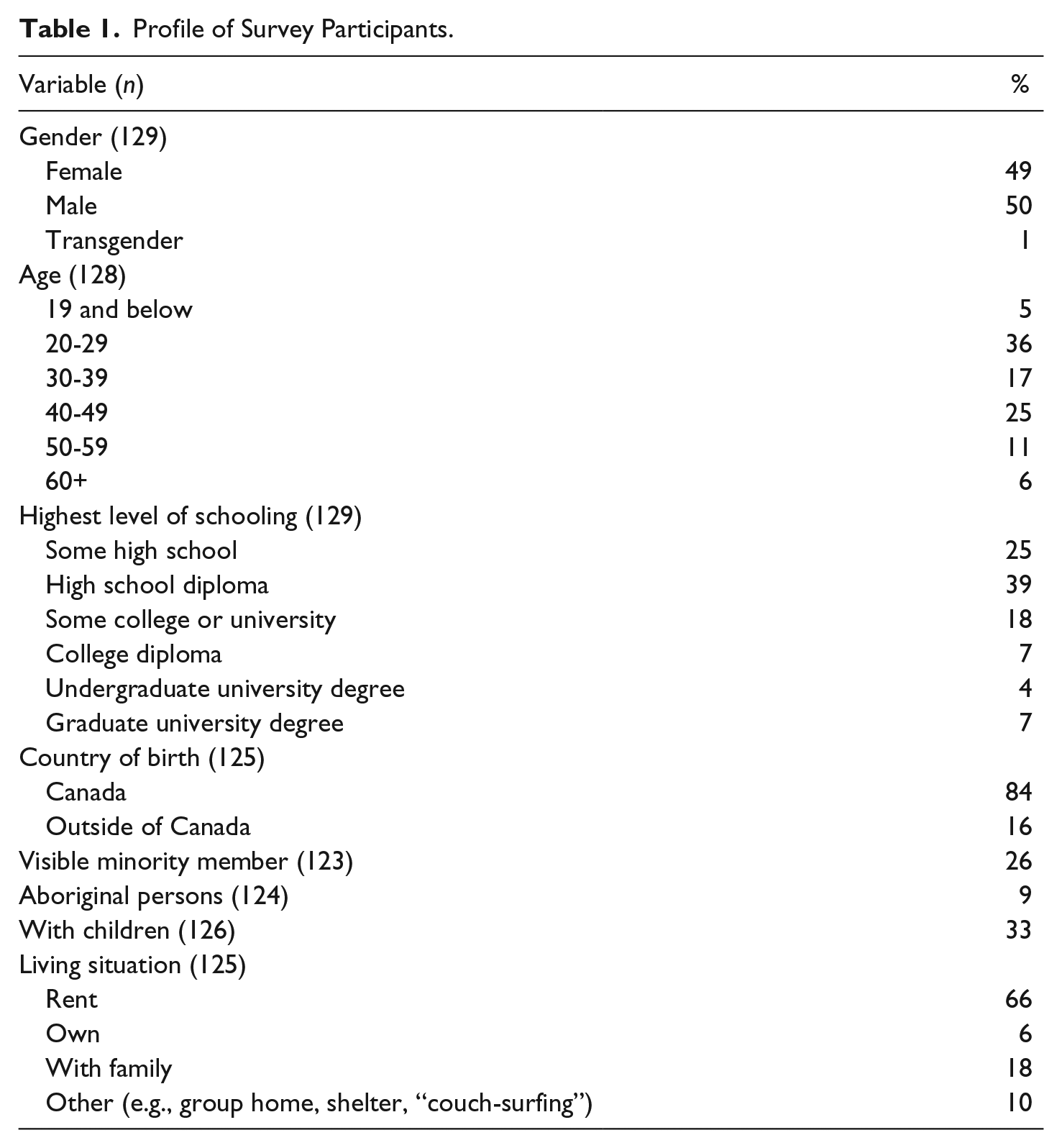
Part-time employees made up the highest proportion of respondents (46%), followed by job training participants (29%) and full-time employees (24%); 1% indicated they were employed but did not indicate their hours of work (total N = 127). Proportionately, there were fewer full-time employees and more part-time employees and training participants in the GTHA compared with the rest of the sample as a combined group (i.e., participants outside of the GTHA). Of those who were employed in the full sample, 41% had been with their enterprise for a year or less, 24% for 1 to 3 years, and 35% for more than 3 years (n = 80).
Profile of Interview Participants
Of the five women and four men who were interviewed about their experiences, three were in job training and six were employed through their supported social enterprise, including one micro-entrepreneur who had transitioned into a full-time staff position at the supported social enterprise while continuing with the micro-business on the side. Compared with the survey sample as a whole, the interview participants had more advanced formal schooling, as all but one person had at least some college or university-level schooling.
Results
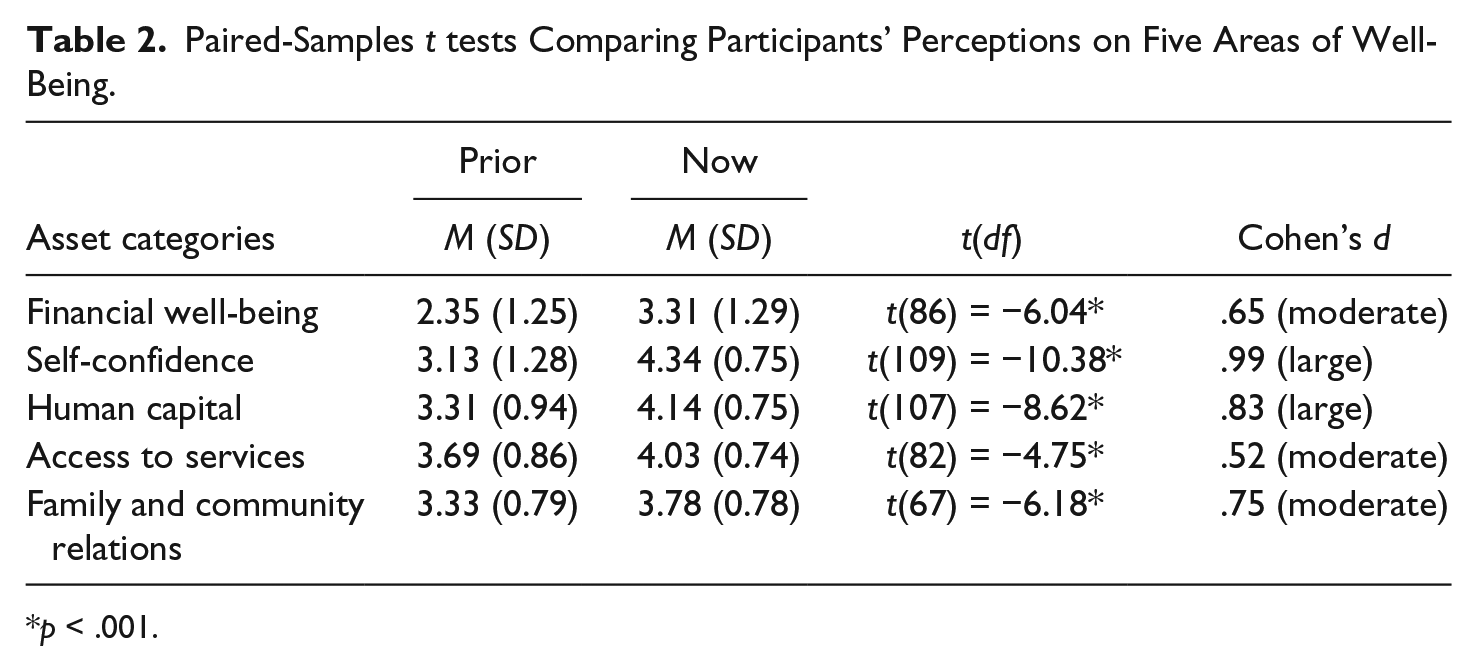
The quantitative results on the five asset categories from the survey are also summarized in Table 2.
Paired-Samples t tests Comparing Participants’ Perceptions on Five Areas of Well-Being.
p < .001.
Financial Well-Being
From the survey, participants on average perceived their current financial well-being to be better as compared with before joining their supported social enterprise, t(86) = −6.04, p < .001. This quantitative finding, moderate in effect size (Cohen’s d = .65), is surprising given the very limited monthly income many employees earned through their supported social enterprise.
At the time of the survey, 84% of people in job training and 72% of employees were receiving financial support from a government-administered assistance program (e.g., disability pensions, social assistance, employment insurance, workers’ compensation; N = 127). Of the wage-earning employees who responded to salary-related questions (n = 76), 47% estimated monthly wages from their supported social enterprises to be $200 or less a month after tax deductions. In total, almost 90% of employees earned less than $1,000 a month after taxes. The reason behind the surprisingly small earnings may be complex, and probably reflects both the workers’ personal circumstances and the limited financial capabilities of supported social enterprises. Given that 54% of the paid employees in our sample reported they were also receiving financial assistance from the Ontario Disability Support Program, it is likely that health and disability considerations were a primary factor in the employees’ income-earning capacity. However, of the part-time employees who responded (n = 52), 65% indicated they would prefer to work full-time, suggesting they would like more hours of work than perhaps their organization could offer. As such, for many respondents, their income at their enterprises served primarily as a small (but likely much needed) financial supplement to other income sources. The necessity of these multiple income streams, each seemingly small in amount, may be interpreted as a sign of continued economic difficulty.
From the qualitative data, it was clear that perceived financial improvement cannot be conflated with an unqualified level of comfort or security. For those in more precarious situations prior to joining their enterprise (e.g., unemployed but not accessing social assistance, leaving situations of violence), any additional income can make a difference, however slight.
So I can’t really say that it’s great improvement, although I can always count on a little bit of something. So I was comfortable with getting a little bit of money. It wasn’t like enough to pay rent or anything, but it was just enough to keep my hopes up that this was going to get better.
From the interviews, a notable way, aside from wages, that supported social enterprises were able to contribute to people’s financial circumstances is by making available different material supports, which ranged from forms of food assistance (e.g., meal programs or access to donated food) to access to office/storage space or equipment for micro-entrepreneurs that reduced their overhead costs.
As with the survey, some interview participants who worked part-time noted that they would prefer more hours or greater income for their work; however, they also acknowledged the financial constraints on the supported social enterprise that would prevent any changes at this time. In the interviews, some participants appeared understanding of the limited financial capacity and level of business of their social purpose enterprises. Reflecting on her hours of work, one participated noted, I understand they give me as many assignments as they can. It’s not that they’re ignoring me or something; it’s just the way it is.
Another participant attributed his lower wages directly to the policy of the enterprise: Well, what they’re trying to do at [the supported social enterprise] is to—they’d love to pay us more, but also they want to hire more staff. So it’s a 50/50 thing here.
The challenge of wanting to offer a living wage (i.e., above minimum wage) and not having the capacity to do so has been reported in other research for employment-focused social enterprises (Enterprising Non-Profits, 2014). Recent Canadian social enterprise surveys indicate external grants are an important source of income for WISEs (Elson & Hall, 2016). Both these studies appear to be consistent with ours; however, a distinctive feature of our study is that more than 80% of our sample depended on government income-support programs such as disability pensions and social assistance for their primary income, which appears to be a very high proportion for social enterprises.
Self-Confidence
From the survey, paired-samples t test showed increased self-confidence among workers and training participants from before they joined their supported social enterprises to now, t(109) = −10.38, p < .001, d = .99. Whereas some interview participants maintained they had a good sense of confidence prior to joining their organizations, for others there was great emphasis on the importance of improved aspects of self-regard, including gains on self-efficacy, self-reliance, and personal pride.
. . . Usually (before) I was hiding behind somewhere, but not now. I’m kind of—I don’t know, quite a different woman. The biggest positive change for me personally is that it’s given me a feeling of worth, a feeling of independence.
Human Capital
The survey findings demonstrated perceived improvements in human capital by participants since joining their enterprises, t(107) = −8.62, p < .001, d = .83, and the qualitative data supported this finding. Despite some interview participants having unmet expectations on training and skills development (i.e., primarily that the training could have been more in-depth or extended for a longer period of time), everyone noted at least some positive skills enhancement that resulted through their involvement with the supported social enterprises. Much of the skills development was specific to the particular supported social enterprise, including professional credentials or certification (e.g., food-handling, translation). In addition, some participants also noted complementary skills learning that are not directly related to the specification of their job (e.g., basic bookkeeping, business writing).
An information technology (IT) worker contemplated the small measure of improvement on his employability: My employment prospects are dim, but the fact that I’ve got any employment prospects is a huge change. [It used to be that] I literally would have been able to go out 3 days a week to go and do a job, so every other day, and I’d be at home curled up in pain trying to recover so I can go out the next time. I was at the point of no real employment prospects at all when I was becoming involved with [the supported social enterprise].
Through involvement with the organization, he figured out how to (re-)configure his work process and work environment in a way that he can manage his painful chronic condition effectively and be able to engage in work in a more sustainable way.
Access to Services
Paired-samples t test again showed on average an improvement in access to services for participants since joining their supported social enterprises, t(82) = −4.75, p < .001, d = .52. A number of participants noted access to material equipment (e.g., computer), services including additional work-related training or personal development opportunities (e.g., life coach, yoga classes) but also informal referrals to support services.
There are people there definitely trying to help me access services. I actually have a case manager now. And this is something that somebody at [the supported social enterprise] had suggested.
Improvements in access to services and community resources for participants have the potential for a multiplier effect through their social networks to benefit others in the community in need of support and social services.
Family and Community Relations
The paired-samples t test showed on average an improvement in family and community relations among survey participants, t(67) = −6.18, p < .001, d = .75. Also, overall, respondents indicated fewer engagements in social groups or other community interaction than expected, with only 34% belonging to other organizations in the community (e.g., religious congregation, parent/teacher association; n = 124), and only 30% participating in volunteer activities (n = 121). Although 14% of participants (n = 96) indicated they have increased their level of volunteering or time spent assisting others in the community since joining their supported social enterprise, the large majority (72%) indicated they have maintained the same level of participation in both areas. Findings related to family and community relations must be taken with caution, given the high amount of missing data for both the t test and the descriptive data. Nevertheless, the time spent working or job training at these organizations may account for a significant amount of social interaction for persons who previously were more socially isolated.
[The supported social enterprise] and the people I’ve met at [the organization] would be what I’d call my social support. The people who are working with me and we’re trying to help each other, that’s really the source of people I’m involved with in that manner. Basically, that’s become my social network now that I have one.
Many interview participants noted greater opportunities for social interaction in general, not just with colleagues but with the larger community base. Fun and friendship was an important aspect to some participants’ experience at their supported social enterprises.
Overall Change
From the survey (n = 123), 83% of participants perceived their overall situation to have improved somewhat to a lot since joining their enterprise, with 15% indicating no change, and 2% indicating their situation has worsened. Of the 44 people surveyed who provided open-ended comments, by far the greatest number of responses on positive changes connoted improved personal affect and well-being (e.g., optimism, ease of self, improved coping skills). Also prevalent are mentions of improved social well-being (e.g., social network and interaction, trust) and gains on human capital, followed by economic change, and with few mentions of improved access to services.
On the interview question, “what the biggest positive change has been since joining their supported social enterprise,” the responses could be classified under the two broad themes. The first is positive self-concept or emotional well-being including having a sense of hope, increased self-worth and independence, finding a voice and speaking out, and having less worry. The second theme is human capital or career positioning: The experience at the supported social enterprises most represented their opportunity to apply learning in a real-life setting, acquire professional credentials, live up to their potential and be able to “do more,” and to discover the best way for them to be productive despite health or other challenges.
Notably, financial reasons were not presented as the biggest change for any of the interview participants. This can be interpreted as either that the financial impact from such small income is outranked by gains made in other areas of well-being or that financial gain was perhaps not the biggest objective for being involved with the supported social enterprises. Given their circumstances, sometimes involving limitations from serious disabilities, it is possible that the participants did not have expectations for large financial gains and their hope in participating in the enterprise was gains in other facets of their well-being.
Differences in Outcomes by Individual and Geographic Considerations
Changes in the five asset areas were also examined by comparing selected subgroups within the survey sample using paired-samples t tests within subgroups. For participants who were and were not receiving government disability benefits, as well as for participants who were job training, employed full-time, or employed part-time, all groups experienced statistically significant improvements in all five areas of well-being.
Relating to perceived financial well-being, participants receiving government disability benefits on average had notably higher Time 1 and Time 2 scores (2.71, 3.93) compared with those not supported by disability benefits (2.11, 2.90). From the scores, it appears participants who were receiving government disability benefits on average perceived better financial well-being going into their supported social enterprises, and perceived greater gains in financial well-being through their experience, compared with participants not receiving disability benefits. Broadly, the changes in each of the five areas of well-being were similar among participants who were job training, employed full-time, and employed part-time.
Discussion
The data from this study are consistent with those of previous research referred to in the “Introduction” section of this article and other studies (Akingbola, 2015; Meinhard, Lok, & O’Connor, 2015; Owen, Readhead, Bishop, Hope, & Campbell, 2015). In brief, the participants in supported social enterprise experience gains in their well-being or personal assets, including their financial well-being. However, their overall income gains are small, suggesting that for the large majority of participants, economic gains are not their primary motivation for getting involved. This point is reinforced by the data that our sample were predominantly people receiving financial support from government, and the government programs may have placed limitations on how much could be earned for eligibility.
Our data also suggest that there was a difference in how persons receiving disability benefits from government perceive and those not receiving them perceive their financial well-being. Those receiving disability benefits perceived themselves as being better off financially both before they joined the supported social enterprise and at the time of testing. Of the two forms of provincial social assistance, income assistance from disability support is comparatively higher, which may in part account for participants’ perceived better financial well-being prior to joining their organization. It is not clear whether the difference in perceived gains reflects a different expectation on their part or whether they made greater financial gains and were better off. This is an issue that could be tested empirically. In fact, given how little on average the participants earned from their enterprise, it seems paradoxical that they would view their financial well-being so positively. One possible explanation that could be tested empirically by additional research is that income earned from the market by the sale of services had a greater value or social status to the participants, particularly people with disabilities, than income from government programs. To refute a common expression, a buck may not be a buck; some may have greater value than others.
Like other studies in this field, the participants in our research perceived themselves as making major gains in other facets of their well-being: self-confidence, human capital, access to services, community and family relations. It would appear that the participants were building work skills and strengthening their social networks and building social capital, as one might expect when they engage in an employment or work training relationship. Our research does not address why these outcomes occur: Is it because participants have changed their social roles and are shifting from being external to the paid workforce to an employment relationship involving interactions with clients and other employees? Is it because of particular characteristics of their firm—for example, a high degree of social support or even particular types of support (Enterprising Non-Profits, 2014)? Again, these are issues worth exploring.
Given how little the participants in our study earn, this discussion begs the question as to whether supported social enterprises should be viewed as a form of social enterprise or whether another label is needed. They have some businesslike characteristics, in that they market services from which their participants earn some income, but they also are largely a by-product of the welfare state with a reliance on social welfare programs. Their proponents prefer to label them as social enterprises, and arguably that is a socially desirable label, given the social pressure to embrace entrepreneurship. Herranz, Council, and Mckay (2011) suggested the term “tri-value social enterprises” for enterprises that generate revenue through earned income, charitable contributions, and government funding. However, given the dominance of government and charitable contributions over earned income in the case of most supported social enterprises, they could also be labeled as a modified social welfare organization. The participants in this research are mostly supported by government programs, but they supplement that support with earnings through working in their social enterprise, as has occurred in other enterprises (Quarter, Ryan, & Chan, 2015b). The label social enterprise is silent on the important supports that these organizations receive from government and other stakeholders in the community, for example, social procurement agreements to purchase their services.
Situating Supported Social Enterprise Within a Broader Typology
Internationally, social enterprise is a burgeoning movement supported by a younger generation of business people; see, for example, Net Impact (https://netimpact.org), involving students who wish to use their business skills to tackle pressing global problems. Social entrepreneurship, the first cousin to social enterprise, is supported by large foundations such as Schwab and Skoll. This social movement is relatively recent, but the idea that it is promoting has a lengthy history. Some earlier examples were the decision by Ernst Abbe in 1888 to put all of the shares of Zeiss, the huge German optical parts manufacturer, into an indivisible trust and to undertake other far-reaching reforms for the time, and similar initiatives in the United Kingdom by Spedan Lewis (the John Lewis Partnership) and Ernest Bader (the Scott Bader Commonwealth; Quarter, 2000). Without belaboring the point, businesses with a social mission have a lengthy history, and the social enterprise movement is a relatively recent renewal of that tradition.
The research on social enterprise internationally indicates that there is a divide between those that are primarily a business with a social mission and those that are primarily social welfare organizations with some business characteristics. All label themselves as social enterprises largely because there is a bandwagon effect and everyone wants to be on board. For those that are primarily businesses, being labeled as a social enterprise can be a form of social marketing indicating that they are not in business simply to make money but to do social good; for those that are primarily social welfare organizations, the social enterprise label signifies that they are selling some services in the market and doing that may facilitate obtaining support from government programs and foundations. For example, as part of Ontario’s Social Enterprise Strategy, $4 million alone has been committed to supporting intermediary organizations in their work to facilitate social enterprise development across the province (Office of the Premier of Ontario, 2015).
For varying reasons, organizations see some advantages to the label social enterprise in the current political climate. A generation from now, that may change, but at present it is a socially desirable characteristic.
Social enterprises involving businesses with a social mission are many steps removed from the social enterprises that are modified social welfare organizations. They too take many forms, which are governed by the political context in which they operate (Defourny & Nyssens, 2014; Kerlin, 2006, 2013). In Europe and to a lesser extent elsewhere, many social enterprises go under the header “work integration social enterprise (WISE).” An overview paper by Nyssens (2014) identifies more than 50 different types across Europe involving various forms of incorporation. Nyssens subdivides them into four broad groupings, the two most relevant to this article being WISEs with a long-term subsidy from government that employ people with a disability and training social enterprises that are designed to integrate people into the conventional workforce, some operating on subsidies and using volunteers. Even though there is much variety, many of these organizations approximate government-supported social welfare programs, but differ because they operate at arm’s length from government. In a comprehensive study of WISE in 12 European countries, Spear and Bidet (2005) stated that although they have problems to work through, they are relatively effective in achieving their goals. Similar findings come from a European study by Borzaga and Loss (2006).
Probably the closest European model to the organizations that we have studied in Ontario is the type B social cooperative in Italy, legislated in 1991 (Borzaga et al., 2010; Defourny, 2001; Gonzales, 2010). These organizations for people with disabilities involve a combination of public funds, social procurement arrangements from government agencies, and flexible work arrangements, much like those that we have studied. Variations of this model have been created in other parts of Europe (Nyssens, 2014). Unlike other enterprises referred to as work integration, these organizations are much less likely to integrate their participants into the mainstream workforce; in fact, that is not their primary purpose. Their participants, often on pensions and other forms of public support, engage in a livelihood that earns a modest amount of income and brings them immense social benefits.
Figure 1 places social enterprise on a continuum ranging from those that are businesses with a social mission, including community interest companies and worker co-operatives, and functioning totally from the sale of their services, to the opposite extreme of supported social enterprises in which the total external supports from government, foundations, and the business community greatly outweigh the income that is generated. Between the extremes are enterprises with varying degrees of self-sufficiency including those that employ members or train marginalized groups with a smaller subsidy relative to organization income. In essence, we suggest that the ratio of external supports, including the imputed value of volunteer services, to income from market can lead to a continuum for social enterprises.
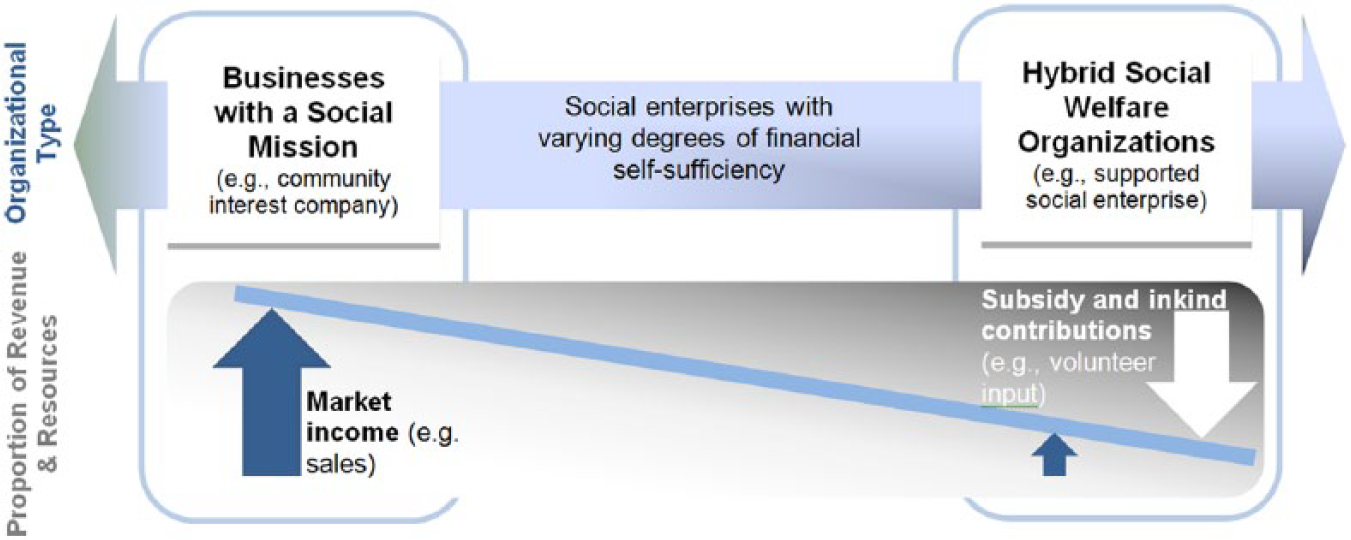
Continuum of social enterprises.
This continuum begs the question as to whether supported social enterprises should be included. Put differently, is there a minimum percentage of earned income needed for an organization to claim to be an enterprise, implying a form of business? Given that we include the word enterprise in our label, our answer is implied, though not strongly. More importantly, supported social enterprises should be recognized as a distinct organization type and not lumped together with social enterprises as a whole. Although all forms of supported social enterprise represent a form of mainstreaming, in that their participants are participating to a degree in the workforce, earning some income, and developing useful work and social skills, the term work integration may overstate the degree of involvement. Participants, particularly those with disability benefits signaling serious forms of disability, may not be seeking to integrate themselves fully into the workforce. Therefore, one option is to apply the label WISE for organizations in which the participants seek to support themselves through an employment relationship and supported social enterprise for which the participants’ goals are more partial, a supplement to their social welfare income.
Footnotes
Acknowledgements
The authors thank the organizations and individuals who participated in the study for their contribution to the research. The authors also thank the anonymous reviewers for their constructive and detailed feedback that helped strengthen this article.
Declaration of Conflicting Interests
The author(s) declared no potential conflicts of interest with respect to the research, authorship, and/or publication of this article.
Funding
The author(s) disclosed receipt of the following financial support for the research, authorship, and/or publication of this article: This research was funded by the Social Sciences and Humanities Research Council of Canada as part of a Community-University Research Alliance on Social Business and Marginalized Social Groups.