



Abstract
Past research reveals mixed results regarding the relationship between gender and charitable giving. We show gender plays a significant role in giving but only when considered alongside marital status and religion. Using the 2006 Portraits of American Life Study, we model a household’s propensity to give and the amount given. We extend past research by disaggregating unmarried households to look at divorced, widowed, and never-married households, and by including multiple religion measures. Results indicate households headed by never-married females have lower giving levels compared with those headed by divorced and widowed women. In households headed by single males, these differences are largely absent. Religious attendance has a stronger association with giving in male-headed households. The respondent’s gender is also related to the amount married households report giving to charity. Future research on giving should consider both gender and marital status to more fully capture increasing diversity in American families.
Research on the association between gender and charitable giving has produced mixed findings. Some researchers find women give more than men, others report either a male advantage in giving or no gender difference (De Wit & Bekkers, 2016; cf. Einolf, 2011; Wiepking & Bekkers, 2012). These mixed results may reflect evidence from research that shows the effect of gender on social outcomes varies by other social categories (Stryker & Burke, 2000). Two important correlates of giving, marital status and religion, likely intersect with gender to produce variable outcomes (Read & Oselin, 2008).
Marital status correlates with many important outcomes with differential effects on men and women in areas such as health (Umberson, Crosnoe, & Reczek, 2010), work (Bianchi & Milkie, 2010), and income inequality (McLanahan & Percheski, 2008). Research has shown marital status has a strong relationship with charitable giving (Einolf, 2011; Mesch, Rooney, Steinberg, & Denton, 2006; Wiepking & Bekkers, 2012; Women’s Philanthropy Institute, 2015). This research finds married households more likely to give and more generous givers. However, most studies examining the effect of marital status on giving aggregate unmarried households into a single category. This potentially masks differences among households headed by never-married, divorced, and widowed individuals. Given U.S. demographic shifts, it is increasingly important to study a full array of household arrangements. The number of single and cohabiting households has increased as fewer young people are getting married (S. Kennedy & Ruggles, 2014; Smock, 2000), more older adults are getting divorced, and divorced and widowed adults are more likely to cohabit rather than remarry (Brown, Bulanda, & Lee, 2012; Brown, Lin, Hammersmith, & Wright, 2016). As of the 2010 Census, married households no longer make up the majority of households, and one third of households are comprised of adults living alone or with a roommate (Vespa, Lewis, & Kreider, 2013). Although household composition is changing, the effect of these shifts in family composition on charitable giving is not well understood. Given women experience greater economic difficulties following divorce (Teachman & Paasch, 1994) and widowhood (Burkhauser & Duncan, 1989) and giving is positively associated with income and wealth (James & Sharpe, 2007a), it is likely that charitable giving differs between male- and female-headed households across different nonmarried statuses. Two studies disaggregating single-headed households into never-married, divorced, and widowed households find widowhood is associated with a higher propensity to give and more given (Mesch, 2010; Women’s Philanthropy Institute, 2015). These studies also find households headed by divorced, widowed, and never-married women are more likely to give and give larger amounts.
Religion powerfully motivates giving (Bekkers & Schuyt, 2008; Bekkers & Wiepking, 2011; Showers, Showers, Beggs, & Cox, 2011; Vaidyanathan, Hill, & Smith, 2011; Vaidyanathan & Snell, 2011). Giving varies with religious affiliation (Chaves, 1999), more frequent religious-service attendance (cf. Lehrer, 2004; Lindsay & Gallup, 2000; Sherkat, 2002), and the strength and content of religious beliefs (Lewis, MacGregor, & Putnam, 2013). For instance, research has shown Conservative Protestant beliefs about money affects their financial behavior, including charitable giving (Keister, 2008). Conservative Protestants are more likely to see their money as belonging to God, which may motivate them to give more to charity. We expect both increased religiosity and gender to reinforce charitable giving because women (Eagly, 2009) and more religious individuals (Saroglou, Pichon, Trompette, Verschueren, & Dernelle, 2005) tend to place higher value on communal and relational behaviors, including charitable giving (Einolf, 2011).
The association between gender and giving likely varies with religion. The effect of religious ideology on men’s and women’s attitudes and behaviors is not uniform (Darnell & Sherkat, 1997; Ellison & Bartkowski, 2002; Glass & Jacobs, 2005; Hoffmann & Bartkowski, 2008). For women, conservative theology is associated with earlier marriage and family formation, lower educational attainment and employment, lower earnings, and increased time spent on housework and child care (Glass & Jacobs, 2005). In contrast, religious conservatism has little impact on timing men’s transition to adulthood and on their time spent on housework and parenting (Civettini & Glass, 2008).
Several other factors complicate empirical investigations of the relationship between gender and giving. First, charitable giving is a household measure, and nearly half (48.7%) of the households in the United States are comprised of opposite-sex, married couples (as of the 2010 Census, 48.7% of households are opposite-gender married, see Vespa et al., 2013). As such, gender differences in giving are difficult to detect because married couples tend to make decisions jointly about donating to charity (Andreoni, Brown, & Rischall, 2003). One recent study reports 83.7% of married couples in the United States make joint decisions about their charitable behavior (Women’s Philanthropy Institute, 2016). Evidence on the impact of the way in which couples make charitable decisions is mixed. Some research reports couples who jointly make charitable giving decisions give less (Andreoni et al., 2003); other studies find no differences between couples where decisions are made by only one or by both partners (Bekkers & Wiepking, 2011; Yörük, 2010), and still others show couples give less when men alone make the decisions about charitable giving (Einolf, Philbrick, & Slay, 2013; Women’s Philanthropy Institute, 2016). Rarely do married couples run mostly or entirely separate economies (Bonke, 2015), although the degree to which individuals have influence and control varies (Andreoni et al., 2003; Treas, 1993). Although one study did try and examine the separate effect of marriage on men’s and women’s charitable giving, it is not clear how the authors “apportioned” charitable giving to each partner in the relationship (Einolf & Philbrick, 2014). Because charitable giving is a household-level characteristic, we can only see the impact of individual characteristics on charitable giving in single-headed households, where the household’s giving is directly attributable to the household heads’ action (cf. Rooney, Mesch, Chin, & Steinberg, 2005).
In this study, we make two main contributions. First, our research fills an important gap by disaggregating unmarried households into divorced, widowed, and never-married statuses and analyzing the differential association of marital status to charitable giving for men and women in each of these categories. To our knowledge, this has not been done in peer-reviewed research. Second, although past research has independently examined the role of marital status and religion on charitable giving, another contribution of this study is to examine these factors together. We assess the influence of religion on giving for each of the groups listed above. In what follows, we examine the intersection of gender and religion and look at the differential association of religion with giving across all gender by marital status categories.
Method
Data and Measures
We used data from the 2006 Portraits of American Life Study (PALS), a national face-to-face survey of the noninstitutionalized U.S. adult population. The PALS contained data for 2,610 respondents. In addition to gender and marital status, the PALS included detailed information on religious affiliation and religiosity. Other datasets that contain information on giving do not contain as much detail about religion. For example, the Center on Philanthropy Panel Study (PPS) collects information on religious attendance and religious affiliation, but it lacks information on religious salience, which is a central interest in this study (Wilhelm, 2006).
Our dependent variable was charitable giving—the dollar value of total household donations made to charities in the previous year (2005). Charitable giving included monetary gifts as well as stock and real property. The PALS defined charitable organizations to include religious or nonprofit organizations (including congregations); political contributions were excluded.
We included a dichotomous indicator for gender. For single-headed households, this was a measure of the household head’s gender. In this study, we did not attempt to untangle the impact of gender on giving in married households. We broke households into four types to evaluate the effects of marital status: married, single and never-married, divorced, and widowed. Because cohabiting unmarried couples are becoming more common, we conducted preliminary analyses in which we included never-married, cohabiting couples as a separate household type. The results of these analyses suggested no substantive differences between single and never-married, cohabiting, and noncohabiting and divorced or widowed households. This finding was consistent with previous research on cohabiting couples that indicates they are more likely than married couples to organize their economic lives individually (Brines & Joyner, 1999). Thus, we reported results with these groups as single, never-married households.
We measured religious affiliation as Conservative Protestant, Mainline Protestant, Roman Catholic, other, and no religious affiliation (Steensland et al., 2000). Although we retained an indicator for other religious traditions as a variable in the regression models, we did not report the values of these coefficients. This category was too small and heterogeneous to reliably interpret. We used three variables to measure religiosity. First, we included a dichotomous variable indicating respondents who reported attending religious services once a week or more. Including more detailed religious-service attendance measures did not improve the results. Second, we included a dichotomous variable indicating whether the respondent strongly agreed with the statement: “I try hard to live all my life according to my religious beliefs.” We experimented with other ways to measure adherence to religious ideology, but more detailed measures did not change our findings. Finally, we controlled for frequency of praying with one’s spouse (marrieds only) with indicators for never, a few times a year, and once a month or more, with never as the reference category. In ancillary analyses, using an ordinal indicator for religious attendance and strength of religious beliefs did not change the results.
We also controlled for other factors known to be associated with charitable giving. We controlled for age. Evidence suggests giving changes over the life course and important generational differences in giving exist (Women’s Philanthropy Institute, 2016). Age-squared was not included because preliminary analyses indicated no curvilinear relationship between age and giving. We measured education with dichotomous variables identifying the respondent’s highest schooling level as less than high school (reference category), high school/high school equivalent, or a 4-year degree or higher. Race/ethnicity have been shown to be associated with both giving and religiosity (Mesch et al., 2006); we controlled for respondent’s self-reported ethnicity as Black, Hispanic, Asian, or non-Hispanic White (reference category). For married couples, measures of religion, age, education, and ethnicity are individual, not household, measures. Unfortunately, these data did not allow us to look at households where spouses differed on these characteristics. We left this for future research.
Previous research has found income is positively correlated with charitable giving (Iannaccone, Finke, & Stark, 1997; Mesch et al., 2006), and we included total household income in all models. Charitable giving is often reported as a percentage of household income; however, this strategy is not ideal because households typically give a small proportion of their income to charity. Converting dollars given to a percent of income scale compresses the variance in the dependent variable, making estimation difficult and obscuring important detail. We opted, instead, to analyze giving as a continuous outcome and controlled for household income to account for the differences in the levels of household income. For the 11% of cases with missing values on income, we imputed values using a model-based imputation method. We compared the results with imputed and nonimputed data and found that excluding missing cases did not change the substantive findings.
Analytic Strategy
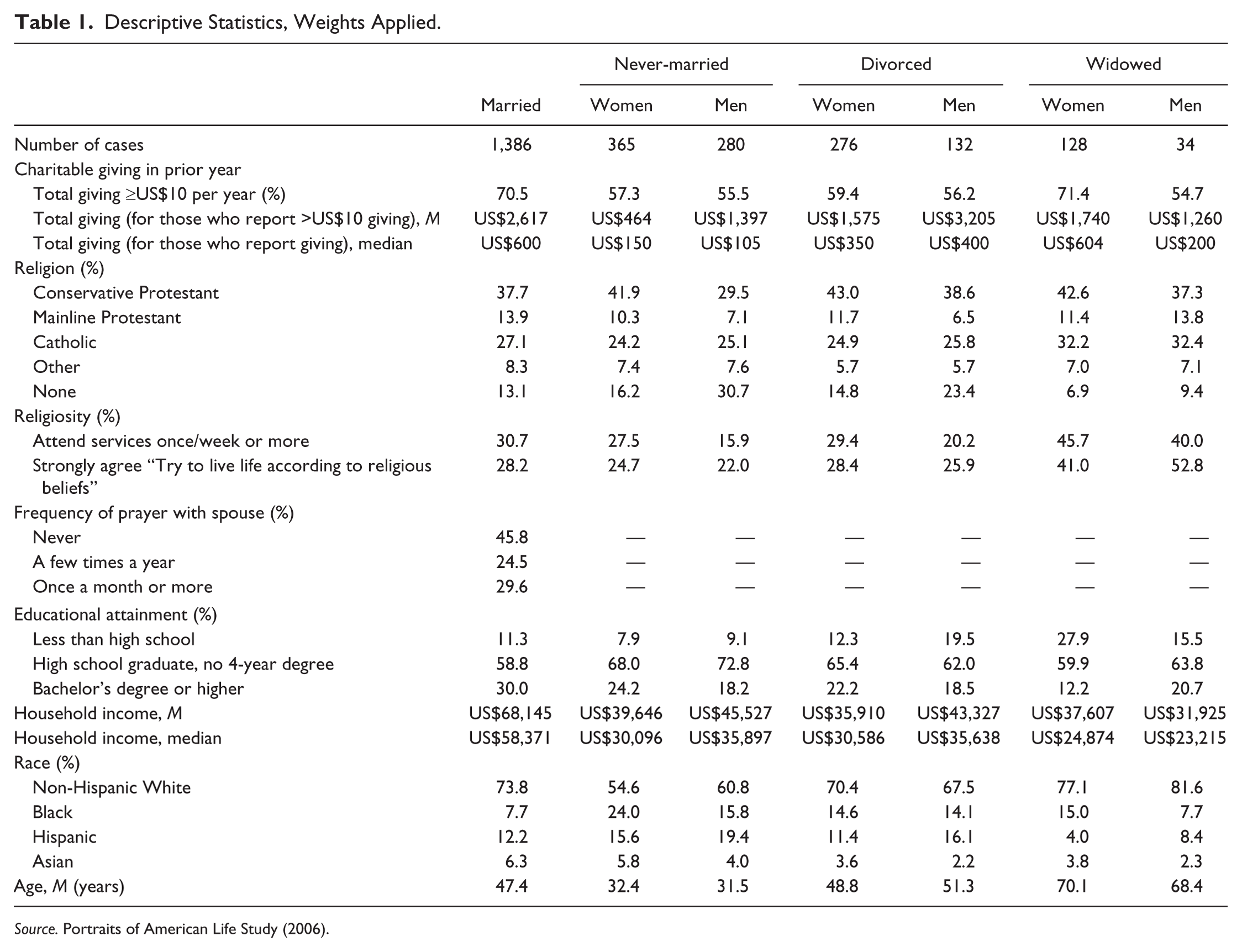
Analyzing charitable giving presents several methodological challenges (Wilhelm, 2008). As Table 1 shows, charitable giving in these data are skewed: The mean giving level for married couples was US$2,617 per household and the median US$600. The sample also contained a significant proportion of respondents who reported zero or minimal levels of household donations (29%, n = 767, report zero donations; 36%, n = 947, report US$10 or less). Empirical assessment of the distribution of logged charitable giving suggested that coding all givers with US$10 or less in household donations per year made the distribution approximately truncated-normal. Only excluding those households with zero giving created too large a left tail to the distribution, which could have biased our results. We eliminated three cases with outliers in total charitable giving (more than US$100,000), who, using Cook’s Distance, were demonstrated to be overly influential in determining the multivariate results (Cook, 1979). Taking the logarithm of givers reporting more than US$10 per year reduced the skew, but it did not deal with the abundance of nongivers. Data such as these can be conceptualized as consisting of two main data generating processes: (a) a process governing the choice to be a giver and (b) a process governing how much to give once giving is decided. One standard approach to modeling charitable giving is to employ a Tobit model (Tobin, 1958). However, this modeling approach does not produce separate estimates of the decision to give and the amount given (Blundell & Meghir, 1987; James & Sharpe, 2007b). Excluding Tobit models leaves both sample selection models and two-part models (Leung & Yu, 1996; Winship & Mare, 1992). These models also allow for cases where one factor might be negatively correlated with the propensity to give, but positively related to the amount given. To test which model was more appropriate, we ran a sample selection model without any exclusion restrictions. The variance inflation factor (VIF) on the inverse Mills ratio (IMR) was 25.2, which suggests a high colinearity between the IMR and the independent variables. When this type of colinearity is a problem, the two-part model is preferred (we used a VIF ≥ 20 as the cutoff score following Leung & Yu, 1996).
Descriptive Statistics, Weights Applied.
Source. Portraits of American Life Study (2006).
The general form of our model is


Here, pi is a continuous latent variable that represents the probability someone will give, and Yi [Yi ≥ 10] is the observed level of giving for those who give more than zero. The final form of our model is a two-part model consisting of a probit to model the decision to give and a lognormal to model the amount given.


Here,
The substantive interest in this study was determining how patterns of giving vary by gender and marital status, and assessing the influence of religion on giving for each group. To identify gender differences, it was necessary to include interaction terms for gender by marital status. Interaction terms allow for formal statistical tests of the differences between groups. Running separate models by gender only allows for qualitative comparisons. As previously mentioned, it was not possible to determine gender differences in charitable giving for married households. Among married households, any significant correlation with gender signifies a difference in the reporting of giving.
To capture the differences across gender and marital status, we ran models for the full sample (without interactions), models for single-headed households (with interactions), and models for married households only. To explore the differences by gender and marital status for singles, we added several interaction terms to the model: Female × Attend Weekly, Female × Religious Beliefs, Female × Widowed, Female × Divorced, Female × Mainline Protestant, Female × Roman Catholic, Female × Other Religion, and Female × No Religion. To look at differences by religious affiliation and gender, we added the estimated coefficients for the main effects plus the applicable interactions and calculated the estimated mean for one group and subtracted from it the estimated mean of the other group of interest. For instance, to calculate if widowed female households and divorced female households were different, we performed the following calculation (here B are the coefficients from the regression model):

This procedure allowed us to examine differences between male- and female-headed households of different religious affiliations, with differing rates of religious attendance and with different strengths of religious beliefs. Also, we compared male- and female-headed households across measures of attendance and belief, and we compared men and women across different marital statuses. Again, we reported the median and the 95% credible posterior intervals (when the intervals did not contain zero, we assumed there was a statistically significant difference between the groups being compared).
Results
Bivariate Results
Table 1 highlights differences in charitable giving by gender and marital status, comparing married households with never-married, divorced, and widowed households. Although numerous comparisons can be made within this table, our goal was to establish whether giving and other characteristics known to influence charitable giving, such as age, education, and income, vary by marital status and gender categories. To simplify the presentation, we did not conduct formal statistical tests of these differences across the gender by marital status groupings. Formal statistical tests for the key differences were conducted in the multivariate models. However, the observed differences in Table 1 establish the broader patterns. As seen in Table 1, married couples and widowed female-headed households were more likely than other groups to donate to charities (about 71% each compared with less than 60% for others). Regarding the amount given, it was difficult to see clear patterns because of the skew in the variable. It appeared widowed, female-headed households gave more than widowed, male-headed households (average giving for those who give = US$1,740 vs. widowed male households = US$1,260; median = US$604 and US$200, respectively), and divorced male households (M = US$3,205; median US$500) gave more than divorced female households (M = US$1,575; median = US$350). For never-married female- versus male-headed households, the mean differences were large (female = US$464 vs. male = US$1,397), whereas the median differences ran in the opposite direction (female = US$150; male = US$105).
Of all groups, widowed women and men appeared the most religious. A total of 43% of women and 37% of men reported being affiliated with Conservative Protestantism, 46% and 40% reported weekly religious-service attendance, and 41% and 53% reported they try hard to live by their religious beliefs. At the other end of the spectrum were never-married men, who infrequently attended services (16% attend weekly or more) and were the least likely to say they tried hard to live by their religious beliefs (22%). These figures mirrored prior research which finds single men are much less religiously active (Darnell & Sherkat, 1997; Sherkat & Darnell, 1999). Married couples also differed in their propensity to pray together. Although never praying together was the modal response (46%), significant numbers of married couples prayed together, including 30% who reported praying together at least once a month. Table 1 also shows significant differences in some demographic factors that may shape processes associated with charitable giving. For example, never-married women had higher educational achievements than most other groups (24% had a bachelor’s degree or higher) and higher household incomes than their widowed/divorced female counterparts. On the other hand, widowed women were the least educated (27.9% with less than a high school degree).
Multivariate Results—All Households Together
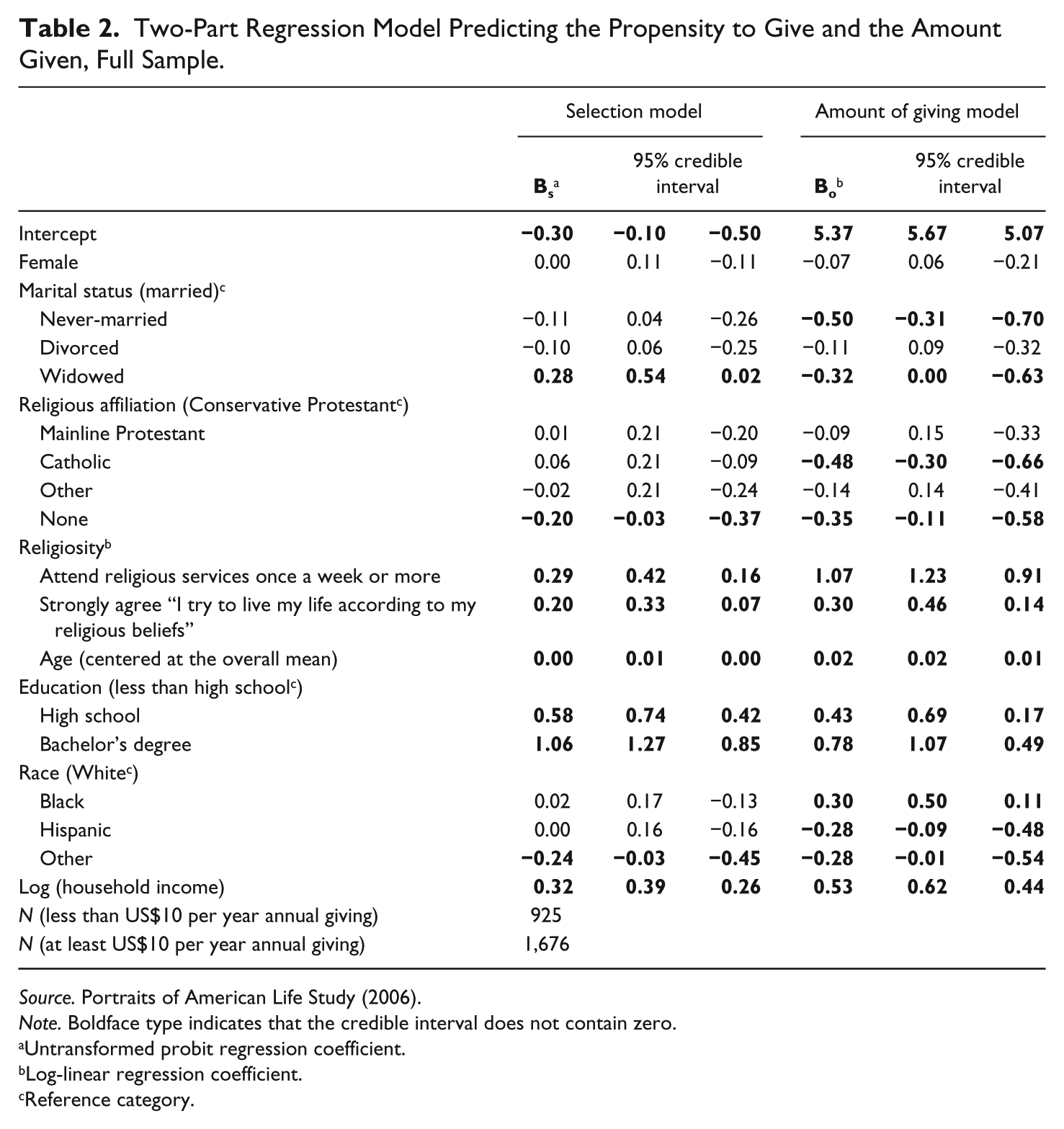
In Table 2, we report the multivariate results with all household types included in the model. The base model included measures of gender, marital status, religious affiliation, and religiosity. We found married households no more likely to give than never-married and divorced households, and less likely to give than widowed households. The probability of a widowed household giving was 0.49 versus 0.38 for a married, divorced, or never-married household. However, when married households gave, they gave more than never-married or widowed households. With age and household income set to their overall means and all other reference variables set to zero, never-married households were estimated to give 39% less than married households and 27% less than widowed households. Regarding the amount given, divorced households were not significantly different than married households.
Two-Part Regression Model Predicting the Propensity to Give and the Amount Given, Full Sample.
Source. Portraits of American Life Study (2006).
Note. Boldface type indicates that the credible interval does not contain zero.
Untransformed probit regression coefficient.
Log-linear regression coefficient.
Reference category.
Looking at the influence of religion, religiosity was only a modestly important mediator. The only significant effect for religious affiliation was for those with no formal religious affiliation—the probability of this group giving was 0.30 versus 0.37 for Conservative Protestants, and when those with no tradition gave, they were predicted to give 30% less. Among those with a religious affiliation, Catholics were significantly different from Conservative and Mainline Protestants and were estimated to give 38% less. Although our data did not provide sufficient detail to allow us to determine the mechanisms underlying our findings regarding religious affiliation, the patterns we find were consistent with research on differences across religious affiliations in financial behavior including prosocial behaviors related to finances. Evidence suggests that Conservative Protestants save less of their income than members of other religious traditions (Keister, 2003, 2011). Reasons for these patterns include the possibility that tithing obligations make saving challenging and investment in a religious community can, for some households, provide financial security similar to savings (Keister, 2008, 2011). Our findings are consistent with evidence that lower-income, Conservative Protestant households have greater obligatory religious contributions that are reflected in overall giving (James & Sharpe, 2007b).
Consistent with prior work and in contrast to religious affiliation, religiosity was strongly associated with giving (Chaves, 1999; Hoge & Yang, 1994; Wilmer, 1995). Attending services weekly or more was a strong predictor of giving—the households of those who attend weekly had a .50 probability of giving versus .38 for those where the respondent did not attend weekly. Weekly attendance also bore a strong association with the amount given—households where the respondent reported attending weekly were predicted to give 2.9 times as much as those that did not attend weekly. Expressing strong agreement with the statement “I try to live my life according to my religious beliefs” was positively correlated with increased propensity to give (46% for those who strongly agree vs. 38% for those who do not strongly agree) and an increased amount of giving (by 1.34 times). These findings were net of background factors such as age, income, and education, all of which influenced giving in the expected directions. It is challenging to identify the mechanisms underlying these findings, but they are in line with work exploring the association between religiosity and civic engagement. Although evidence suggests religious social networks act as a source of information that can encourage civic engagement (Lewis et al., 2013), participation in religiously affiliated networks is not generally associated with increased giving. This suggests giving is a more private behavior that is less likely influenced by direct social contacts.
Charitable Giving in Single Households
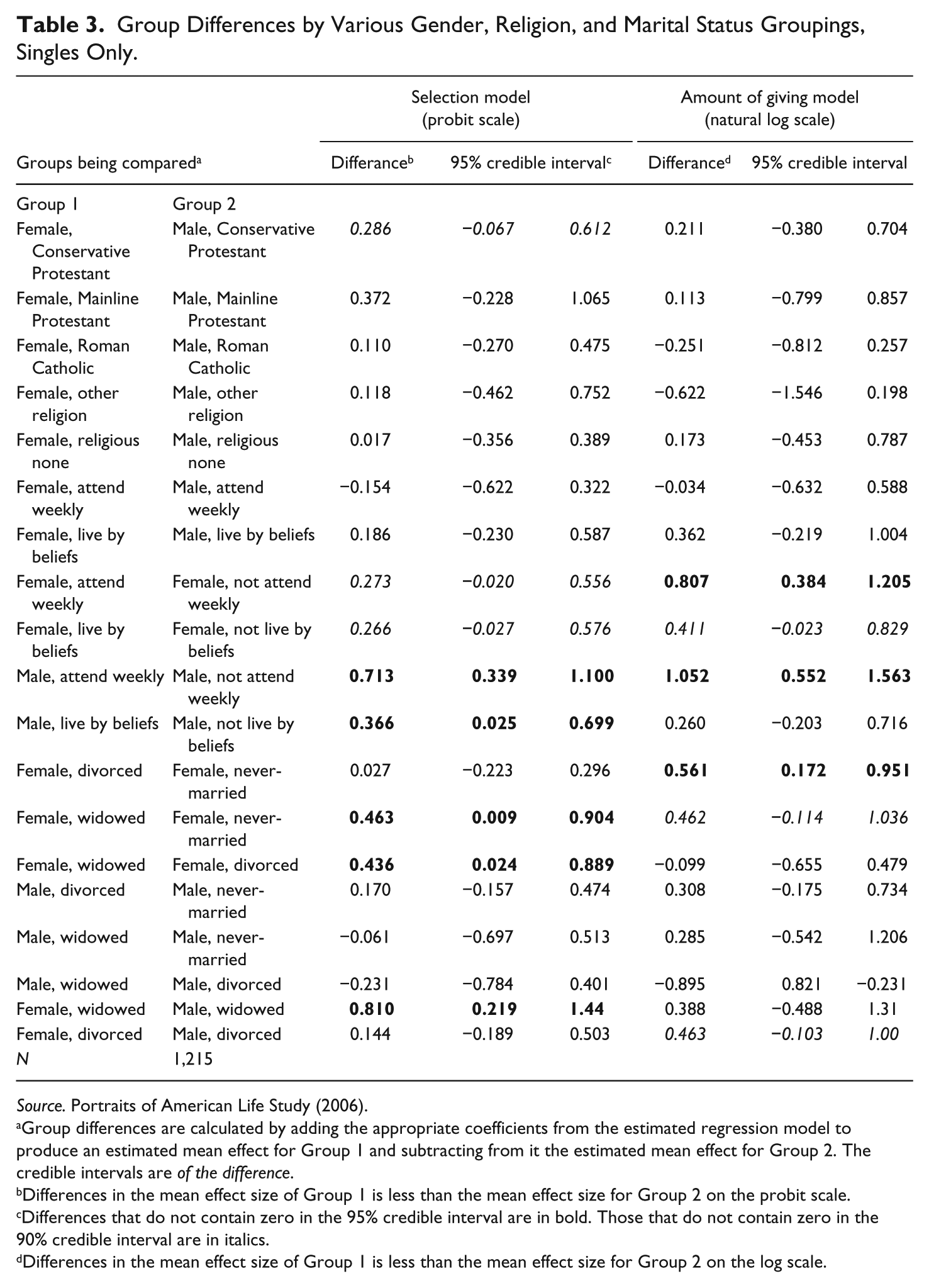
When singles were considered separately, clear evidence emerged that marital status and religion were important mediators of the relationship between gender and giving. In Table 3, we report the estimated differences in the propensity to give and the amount given between the groups of interest. To conserve space, we do not report the values of all of the coefficients and interaction terms. Several key differences emerged. First of all, in terms of religious affiliation, the only significant difference was that households headed by a female Conservative Protestant were more likely to give than those headed by a male (probability of giving for female = .32, for male, .23). A similar, but not statistically significant, difference emerged for Mainline Protestants. Concerning amount given, only in other religious traditions did female-headed households report significantly lower giving than their male counterparts. The other religion category was heterogeneous, and although it was retained in the model, we avoid making conclusions about this group because it was difficult to interpret substantively. Furthermore, there were no significant differences between male- and female-headed households in the relationship of giving to regular attendance or religious salience. Furthermore, there were no significant differences between men and women on the impact of regular attendance or religious salience on household giving. Differences emerged between women who did and did not regularly attend on both the probability of giving and the amount given. Religious salience was also positively associated with both of these outcomes. For men as compared with women, the impact of attendance on both the propensity to give and the amount given was larger. On the contrary, increased religious salience was only significantly related to the propensity to give and not the amount given in male-headed households.
Group Differences by Various Gender, Religion, and Marital Status Groupings, Singles Only.
Source. Portraits of American Life Study (2006).
Group differences are calculated by adding the appropriate coefficients from the estimated regression model to produce an estimated mean effect for Group 1 and subtracting from it the estimated mean effect for Group 2. The credible intervals are of the difference.
Differences in the mean effect size of Group 1 is less than the mean effect size for Group 2 on the probit scale.
Differences that do not contain zero in the 95% credible interval are in bold. Those that do not contain zero in the 90% credible interval are in italics.
Differences in the mean effect size of Group 1 is less than the mean effect size for Group 2 on the log scale.
For single male-headed households, there was little variability in giving by marital status. On most components of giving, there were no significant differences between never-married, and divorced and widowed statuses, save for a small significant difference in the amount given for divorced versus never-married male-headed households. On the contrary, divorced and widowed female-headed households were much more likely to give than never-married female-headed households, and when they gave, they gave more. There were no significant differences between divorced and widowed female-headed households in giving. Regarding differences between male- and female-headed households of the same marital status, single-female households were more likely to give but were not more likely to give more (the first row of Table 3). Widowed female households as compared with widowed male households were significantly more likely to give, but they did not differ in the amount given. Divorced female households did not differ from divorced male households in the propensity to give, but the model suggested divorced female households give more (only in the 90% credible interval).
Gender Differences in Married Households
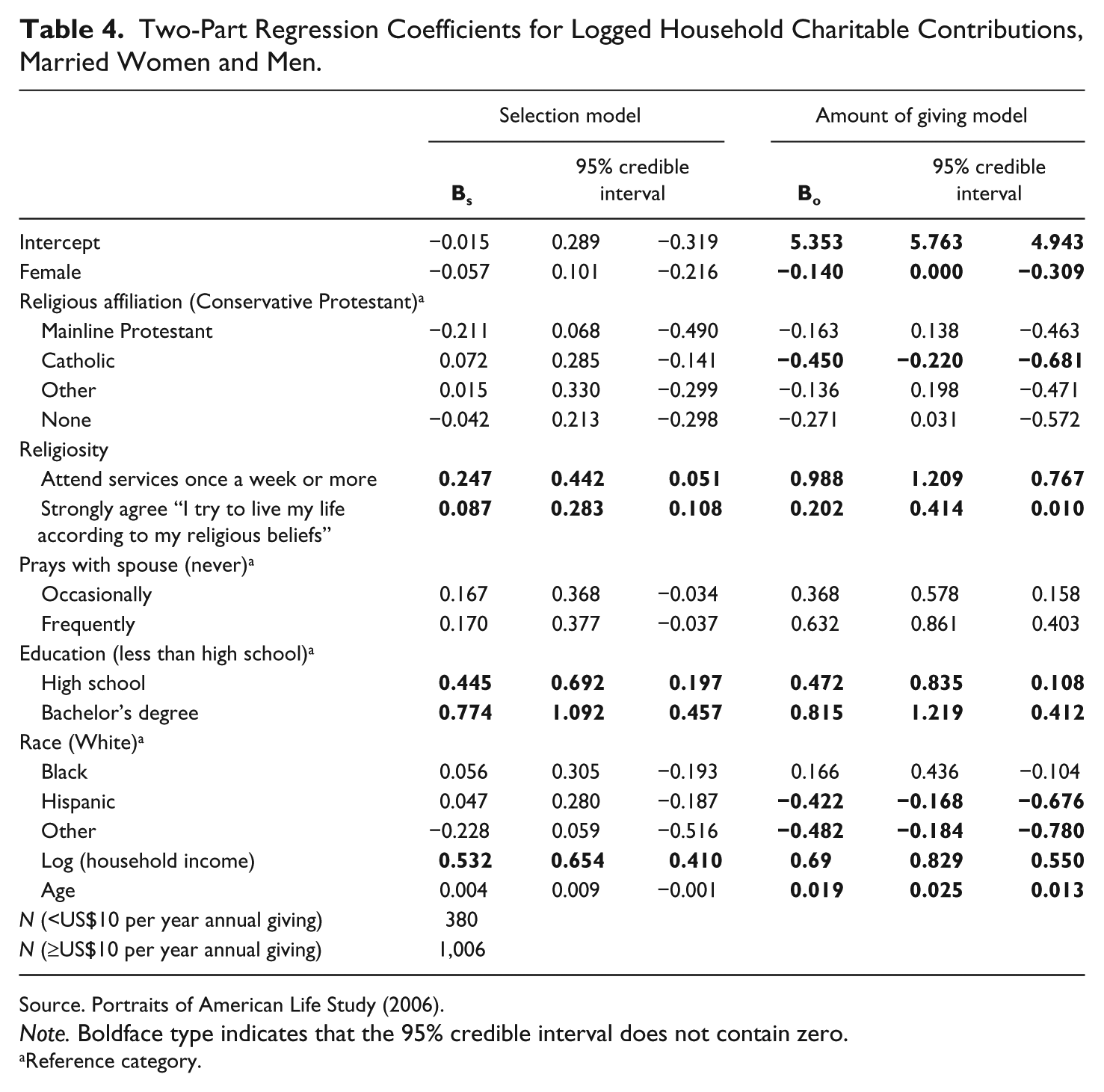
To examine gender differences in the reporting of giving, in Table 4, we provide separate analyses for married persons. An unusual pattern appeared among married couples: Although married women did not differ from married men in reporting whether they give, married women reported household giving levels 13% less than their male counterparts. Because this survey measured household giving, the amounts reported should be the same whether the husband or wife responded to the interviewer.
Two-Part Regression Coefficients for Logged Household Charitable Contributions, Married Women and Men.
Source. Portraits of American Life Study (2006).
Note. Boldface type indicates that the 95% credible interval does not contain zero.
Reference category.
This analysis also allowed us to include additional measures of religiosity that tapped into shared religious experiences, which may be important for married couples’ behaviors. Although some of the processes evidenced for unmarried men and women operated similarly for married couples, important differences emerged in the role of religious affiliation and religiosity. Religious affiliation was an important factor for married couples. Household giving where the respondent was Catholic was 36% lower than Conservative Protestant, a pattern consistent with prior work. This model also showed those who reported any level of prayer with their spouse reported higher levels of household giving than those who did not. The magnitude of the effect varied by frequency of joint prayer—those who reported occasionally praying together were in households that gave 1.4 times as much, and those who prayed together once a month or more, about 1.9 times more.
Discussion and Conclusion
Past research has found mixed results for the association between gender and charitable giving. In this analysis, we demonstrated that gender plays a major role in giving, but only when giving was considered at the intersection of gender and marital status. Because giving was a household measure, differences emerged only when single-headed households were analyzed separately from married households, and when single-headed households were broken down by marital status into never-married, widowed, and divorced. In households headed by females that were divorced/widowed or never-married, there was a large, significant gap between the propensity to give and the amount given. This difference was absent in single male-headed households, regardless of marital status. One plausible explanation for these patterns is income differentials among women are sharper at different stages of the life course, such that households headed by widowed and divorced females have greater resources at their disposal than never-married female-headed households. In contrast, men’s giving may be less tied to life course transitions because their income is more stable, which might account for the smaller differences we observed among male-headed households (James & Sharpe, 2007a).
We found few significant differences between single male- and female-headed households with the same religious affiliation and similar levels of religious salience. We did find more frequent religious attendance was a stronger predictor of the propensity to give and the amount given for male-headed households as opposed to female-headed households. In contrast, higher levels of religious salience were related to a higher propensity to give for both male- and female-headed households but were only predictive of larger amounts given for female-headed households. Although these findings resonate with others who show religion is positively related to charitable giving, our findings suggest the impact of religious attendance and salience on giving operates differently for women than for men and varies based on the specific outcome in question (i.e., propensity to give or amount given). This finding is supported by Einolf and Philbrick (2014), who find marriage increases males’ charitable behaviors, but not females’. This result was somewhat surprising given the bulk of research that has shown religious attendance exerts a stronger impact on women’s health behaviors, social contacts, and marital stability (Strawbridge, Shema, Cohen, & Kaplan, 2001). It remains an open question as to why religion may increase the prevalence of healthy behaviors more in women, but charitable behaviors more in men. One possible explanation is religion may operate to reduce gender differences in prosocial behavior. Because women, irrespective of religion, are oriented more toward communal and relational behavior (Eagly, 2009), religion, which has been shown to boost communal and relational prosociality (Schafer, 2015), may exert a stronger impact on men than women (Einolf & Philbrick, 2014). Another possibility is that females may influence male spouses to give more. One important limitation of this study was that due to a very small number of respondents reporting “other” religious affiliations, substantive conclusions could not be made for this group.
Our findings also stand in contrast to the Womengive 2014 report, which reports young, female, religious nones have much higher levels of charitable giving than their male counterparts. We did not find the same differences among religious nones, nor did we find a significant difference by age. What might account for these differences? The respondents in the Womengive 2014 report were recruited from a web-based panel of respondents. Research on the recruitment pools of these panels indicates respondents are more likely than the general population to volunteer, are more engaged in community problem-solving, and are possibly less religiously active (C. Kennedy et al., 2016). Insofar as community involvement is correlated with charitable giving, this could account for differences between our study and the Womengive 2014 report.
Our results also differ from Mesch (2010), who found women were more likely to give across all marital statuses, and, except for widowed men, women of different marital statuses give more. The present study differs in that we did not control for wealth. Male-headed households typically have higher wealth, and wealth correlates with higher giving levels (James & Sharpe, 2007a). This may suppress our findings on the impact of female gender on giving. Unfortunately, the PALS study did not include measures of household wealth, and so this possibility cannot be explored. It is also possible the small number of divorced and widowed households made differences in giving hard to detect. All of our models predicted that across marital statuses, single female-headed households were more likely to give and give more, but most differences were not significant. A larger sample could improve our ability to detect a signal.
Another question remains: Why is there such a wide mix of findings on the relationship between giving and gender, religion, and marital status? We suspect part of the variability stems from the fact that different studies analyze different datasets, include different interaction terms, and use different modeling approaches. Future research could pool datasets and analyze them with a consistent approach. This may establish how much of the “mixed-ness” is a result of sampling variability, analytical choices, and real differences. There is also a dearth of qualitative evidence on the impact of gender, religion, and marital status on giving. In-depth interviews could potentially identify the mechanisms producing these observed differences.
The finding that married women report lower giving levels than married men was surprising. Because this survey was answered by either the female or male partner in the couple and because married men and women responded in relatively similar numbers (45% of married respondents were male), it is likely gender differences in reporting—not actual differences in giving between households with a male versus female respondent—were behind these differences. If gender was responsible for this difference, this could be generated by husbands overreporting, wives underreporting, or a combination of the two. Husbands may overreport because gender norms require men to be the breadwinners and provide resources for family needs (Cotter, Hermsen, & Vanneman, 2011), including donating to organizations the family deems important. This expectation might have encouraged husbands to exaggerate their estimates upward to demonstrate their masculinity (Schrock & Schwalbe, 2009). One important implication of this finding is researchers should not assume household giving measures are reported in the same way by men and women. They should consider controlling for the respondent’s gender when analyzing married household giving measures.
Overall, we find that the processes undergirding men’s and women’s giving behaviors are different for unmarried individuals than for married couples. Gender bears an important relationship with giving when considered alongside different marital status categories. We also find religion operates differently across the groups, suggesting religiously based beliefs about giving do not translate uniformly for men and women.
Footnotes
Acknowledgements
The corresponding author would like to thank the participants of the 2015 Lake Institute Network of Emerging Scholars for their helpful feedback on an earlier version of this article.
Declaration of Conflicting Interests
The author(s) declared no potential conflicts of interest with respect to the research, authorship, and/or publication of this article.
Funding
The author(s) disclosed receipt of the following financial support for the research, authorship, and/or publication of this article: This research was supported in part by the Lake Institute at the Lilly Family School of Philanthropy at Indiana University-Purdue University.