



Abstract
Religious individuals are repeatedly found to be more civically engaged than nonreligious individuals. However, most studies of civic engagement relegate the nonreligious to the reference group; the “Nones” are treated as homogeneous and assumed to have few avenues for civic engagement. We bring the nonreligious out of the reference group and explore how variations in nonreligious identification, belief, and behavior affect civic engagement. We find important variations among the nonreligious in terms of their propensity to be civically engaged that are lost when their heterogeneity is ignored. Those who identify as “nothing in particular” (NIP) are much less likely to show interest or engagement in civic life than are atheists, agnostics, and the “spiritual but not religious,” and we show that the image of the nonreligious as uninvolved in civic life is inaccurate and most likely driven by forms of analysis that disproportionately weight the experiences of the “NIPs.”
Introduction
Numerous studies have found that religious people join voluntary associations and volunteer at higher rates than nonreligious individuals. However, this is a complex relationship. Some religious beliefs, identities, and behaviors encourage civic engagement more than others, and religious involvement has different effects on volunteering for secular versus religious groups. There is also a debate about the relative importance of religious beliefs versus congregation-based networks. Regardless, there is overwhelming consensus that religious involvement fosters volunteering and civic engagement, leading Son and Wilson (2012) to argue, “So robust is this relationship that, from a scientific standpoint, it would seem little is to be gained from continuing to study it: each new survey simply repeats what is already known” (p. 474).
We complicate this consensus by shifting the focus away from the religious and toward the nonreligious, whose civic engagement merits investigation on its own terms. Americans who claim “no religion” now account for over 20% of the adult population (Pew Research Center, 2015), and this group is becoming increasingly diverse. The nonreligious have taken on a variety of different labels and identities (Cotter, 2015; LeDrew, 2013; Lee, 2014; J. Smith, 2011), have differing stances on social and political issues (Baker & Smith, 2009, 2015; Blankholm, 2014; LeDrew, 2016), display varying levels of religious beliefs and behaviors (Cimino & Smith, 2014; Keysar, 2014; Lim, MacGregor, & Putnam, 2010), and are creating an increasing variety of activist and community groups based on their nonreligious identifications (Cimino & Smith, 2014; Garcia & Blankholm, 2016; LeDrew, 2016; Pasquale, 2009; J. Smith, 2013). And these patterns are not unique to the United States; research shows an even swifter rise in nonreligion in the United Kingdom, for example (Pew Research Center, 2014), and an uptick in atheist activism and visibility in countries like India (Quack, 2012).
While the above research highlights the growth and diversity of the nonreligious, this growing population is often treated as a homogeneous group in social surveys. In most quantitative studies of civic engagement and voluntarism, the surveys used only supply “none” or “nothing in particular” as nonreligious categories on standard religious identification (e.g., T. Smith, Hout, & Marsden, 2012). This response is then used as a reference category to be compared with the religiously identified. In this article, we argue that we cannot continue to relegate the nonreligious to the reference category, or use standard measures like the “none” category as representative of the breadth and variety of nonreligious experience. We show that taking on a more in-depth analysis of the variety of nonreligious beliefs, behaviors, and identifications generates a more nuanced understanding of civic engagement among both religious and nonreligious Americans and demonstrates the need for more careful treatment of nonreligious categories in quantitative studies more generally.
Using data from the Boundaries in the American Mosaic (BAM) survey (Croll, Tranby, Edgell, & Hartmann, 2014), we analyze how heterogeneity among the nonreligious leads to variations in their propensity to be engaged in civic and political organizations. We examine variation in nonreligious experience in two ways: (a) we analyze differences in nonreligious identification by comparing the civic involvement of those who identify as atheist, agnostic, spiritual but not religious (SBNR), and nothing in particular (NIP), and (b) we explore the implications of different ways of being nonreligious by comparing the effects of nonreligious belief (not believing in a god), nonreligious belonging (identifying with a nonreligious label), and nonreligious behavior (not attending religious services) on civic engagement.
Religion and Voluntarism
Research on religion and volunteering treats religiosity as a multidimensional social phenomenon, examining how different indicators of religious commitment combine to shape civic engagement. Belief-centered approaches argue that religious individuals volunteer and help others because they are more compassionate (Krause, 2015) and sympathetic (Loveland, Sikkink, Myers, & Radcliff, 2005; see also Einolf, 2011). Others focus on network effects, finding that congregational involvement fosters reciprocity, trust, and social capital (Guo, Webb, Abzug, & Peck, 2013); churches “provide social resources, foster norm compliance, serve as recruitment networks, and offer a place to meet socially and politically involved friends” (Lewis, MacGregor, & Putnam, 2013, p. 335). Overall, religion is seen as a “feeder-system” into volunteering activities, regardless of the mechanism (Johnston, 2013).
Furthermore, numerous studies examine the efficacy of different religious beliefs, behaviors, and identities in promoting civic engagement. Evangelical Christians are the least likely to volunteer, especially outside of their churches (Beyerlein & Hipp, 2006; Driskell, Lyon, & Embry, 2008; Guo et al., 2013), and Protestants volunteer more than Catholics (Lam, 2002). Some research finds that simply attending church is positively related to voluntarism (Guo et al., 2013; Johnston, 2013), while others have found that it is being active in the church, not simply attending, that matters (Beyerlein & Hipp, 2006; Schwadel, 2005). Conversely, being too active in religious organizations can decrease volunteering, especially outside of that organization, due to time limits and competing commitments (Becker & Dhingra, 2001). Finally, racial and economic diversity influences rates of both religious and secular volunteering among church-going populations (e.g., Polson, 2015).
Complicating the Consensus: The Heterogeneity of Nonreligiosity
In contrast to wide-ranging research on the nuances of the relationship between religion and volunteering, there is a dearth research on variations in civic involvement among the nonreligious or the mechanisms that draw different kinds of nonreligious persons into volunteering and other civic engagement. The few extant quantitative studies examine whether there is a “spillover” religious effect on voluntarism for the nonreligious (e.g., Lim & MacGregor, 2012). However, the nonreligious are again grouped into one category in these studies, leaving a gap in understanding as to how nonreligious individuals differ from one another, as well as how distinct groups of nonreligious individuals differ from religious individuals.
While the category of “nonreligion” does point to a specific population of persons who in some ways eschew organized religion, treating this category as an indicator of homogeneous beliefs and behaviors has proved increasingly problematic. Nonreligious individuals embrace a variety of labels that encapsulate distinct approaches to religion, nonreligion, and civic engagement, including labels like atheist, agnostic, humanist, spiritual but not religious, irreligious, nonreligious, freethinker, secular, skeptic, antitheist, and postatheist. Many eschew all labels and identify as “nothing in particular” (Lee, 2014). So wide-ranging are these identities that scholars have begun to categorize them into typologies of nonreligion. Silver, Coleman, Hood, and Holcombe (2014) find that there are six distinct types of atheists/agnostics, including academic atheists, activist atheists/agnostics, and ritual atheists. Cotter (2015) asserts that there are five nonreligious types, including the naturalistic, the spiritual, and the familial. He finds that many of his interview participants hold multiple nonreligious identities at the same time or move from one identity to another over time. Blankholm (2014) finds that different orientations to public religious expression can also inform nonreligious identification, and Edgell, Frost, and Stewart (2017) find that social context and stigma shape the nonreligious labels that individuals take on.
These differences in nonreligious identification correspond to demographic variations, as well as a variety of approaches to civic engagement. Atheists, by far the most studied nonreligious group, are the most vocal in criticizing religion in the public sphere and promoting nonreligious identity politics (e.g., LeDrew, 2016); they are more often male, White, and politically liberal (Edgell et al., 2017; Sherkat, 2008). Agnostics are more ambivalent toward both religion and nonreligion; some take on the label “agnostic” because it is the most “scientifically honest” position, while others use it to indicate an “openness to phenomenon other than what we can see or detect” (Cotter, 2015, p. 178). Agnosticism can also indicate a certain apathy or lack of interest in both religion and nonreligion (Cotter, 2015).
The nonreligious population also includes the “spiritual but not religious,” who are the most likely to maintain religious beliefs and behaviors, including attending religious services and prayer (Baker & Smith, 2015). Ammerman (2013) argues that SBNR individuals take on this label to indicate a moral and political distancing from organized religion (cf. Hout & Fischer, 2014), and McClure (2017) finds members of this group perform boundary work to maintain differences between themselves and those who claim a religious-and-spiritual identity (see also Mercadante, 2014). Women, older adults, and people of color are drawn to this form of nonreligion in higher numbers (Brown, Taylor, & Chatters, 2015; Edgell et al., 2017).
Perhaps the most understudied among the nonreligious are the “nothing in particulars.” This group eschews both religious and nonreligious identities, but they are still typically categorized as nonreligious (see Pew Research Center, 2015). Lee (2014) argues that one reason an individual might choose this label is that they are entirely indifferent to religion and nonreligion. However, some use this label to signal their disaffiliation from any engagement and to “locate themselves outside of religious culture in general” (Lee, 2014, p. 474).
Secular Congregations, Secular Activism, and Nonreligious Communities
Research has yet to fully investigate how involvement in explicitly nonreligious organizations may motivate civic involvement, and there has been no sustained attempt to measure such participation for nonreligious individuals using survey methods. This oversight is increasingly problematic given the increase in activism and community formation among nonreligious Americans (Cimino & Smith, 2014; LeDrew, 2013; J. Smith, 2013, 2017) There are a growing number of options for participating in explicitly nonreligious organizations, and Garcia and Blankholm (2016) identify 1,390 unique organizations in the United States alone devoted to nonreligious belief, practice, and activism. And in his study of over 1,000 secular group affiliates, Pasquale (2009) finds that over 33% see social or political engagement (including making a contribution, volunteering, political action, and helping and caring for others) as a significant source of meaning in their lives.
Participation in these communities is driven by an array of nonreligious identities and objectives. Some nonreligious groups exist to enable the expression of community, ritual, and forms of spirituality; secular congregations like the Sunday Assembly and the Houston Oasis attract nonreligious individuals who come together to do many of the same things religious people do in churches and, in some cases, explicitly mimic the institutional model of the congregation (Cimino & Smith, 2014; J. Smith, 2017). Volunteering and community involvement are core values in these communities, and they are effective for the same reason that churches are: They provide social resources, foster norm compliance, serve as recruitment networks, and offer a place to meet socially and politically involved friends (cf. Lewis et al., 2013).
Scholars have also pointed to the expansive secular activism in the United States and elsewhere over the last decade that has focused on battling discrimination, promoting identity politics, and church/state issues (Blankholm, 2014; Kettell, 2014; LeDrew, 2016). Subcultural theories of religious identification (C. Smith, 1998) argue that such an “embattled” atmosphere can sharpen boundaries, strengthen identities, and motivate involvement in organized groups that express that embattled identity. The surge in secular activism may have a similar identity and commitment-enhancing effect for the nonreligious, which in turn may foster increased engagement and volunteering.
In short, identities that are well defined and oriented to political expression or spirituality may draw the nonreligious into communities that foster civic engagement for many of the same reasons that churches and other religious organizations do. Thus, we might predict that atheists, who have a relatively well-defined identity and are the most politically outspoken among the nonreligious, will be the most civically engaged among the nonreligious. Conversely, the “NIPs” and perhaps agnostics, who have less well-defined identities, might be less engaged. Below, we investigate how different ways of being nonreligious differentially influence interest and participation in civic life.
Data and Method
Data
We use data from the nationally representative BAM survey (Croll et al., 2014), designed to measure diversity and solidarity in American life, with a particular emphasis on religion and race. The data come from a sample that was recruited through GfK’s KnowledgePanel, a probability-based online panel whose 50,000 adult members, obtained via address-based sampling methods, represent close to 97% of American households. KnowledgePanel participants are compensated with either Internet access and a personal laptop or a cash incentive per survey for those already owning a personal computer. Respondents are assigned to no greater than one 10- to 15-min survey per week.
The sample is a nationally representative sample of noninstitutionalized adults in America, oversampled for African Americans and Hispanics, drawn from the KnowledgePanel using a probability proportional to size (PPS) weighted sampling approach. KnowledgePanel members received an email link to the web survey from GfK to participate, followed by email and phone reminders after 3 days of nonresponse. Of the 4,353 people contacted, 2,521 completed the survey for a survey response rate of 57.9%. Data collection took place between February and March 2014. Combined with base and poststratification weights, 1 the survey is weighted to account for survey nonresponse and oversampling of African American and Hispanic respondents.
Dependent Variables
We use six dependent variables to measure interest and involvement in political and community groups. The first variable is the respondent’s general interest in local politics and community affairs, measured on a scale of 1 (not at all interested) to 4 (very interested). “Interest” indicates awareness and a willingness to stay informed about community and political affairs, which may precede or follow behavioral engagement (volunteering, group membership, etc.; Putnam, 2000). The nonreligious are often stereotyped as being antisocial and generally uninterested in public affairs (see Bainbridge, 2005; Edgell, Hartmann, Stewart, & Gerteis, 2016), and so we include this measure to explore that assumption. The remaining five dependent variables are measures of whether the respondent has participated in or volunteered for one of the following over the last year, each with a “yes” or “no” response option: (a) neighborhood or block association; (b) church or other religious institution; (c) local, state, or national political campaign; (d) school or recreation center; or (e) hobby, sports, or other group based on one’s interests.
These available measures do not capture all forms of volunteering or engagement. For example, service-related volunteering through health charities and social services is not one of the response options, the survey has no measure of frequency of participation, and volunteering activities are not neatly parsed from social activities. Thus, our data are limited. However, the available variables are diverse enough to explore variations in civic engagement among the nonreligious and to analyze how nonreligious identity, behavior, and belief predict different forms of engagement.
Independent Variables
Descriptive statistics for the independent variables are shown in Table 1. Our control variables include age, gender, marital status, parental status, income, education, political affiliation, and measures for if a respondent identifies as Black or Hispanic. Our measure of religious belonging compares those who claim no religious identity (“Nones”) with those who claim some form of religious identity (“Somethings”). The Somethings in our sample include Protestants, Catholics, Muslims, and Jews, among others, though a majority of our sample are Protestants or Catholics. In our bivariate analyses and multivariate models, we use the Somethings variable to create the reference category—all those who claim some form of religious identity. 2
Descriptive Statistics for Full Sample.
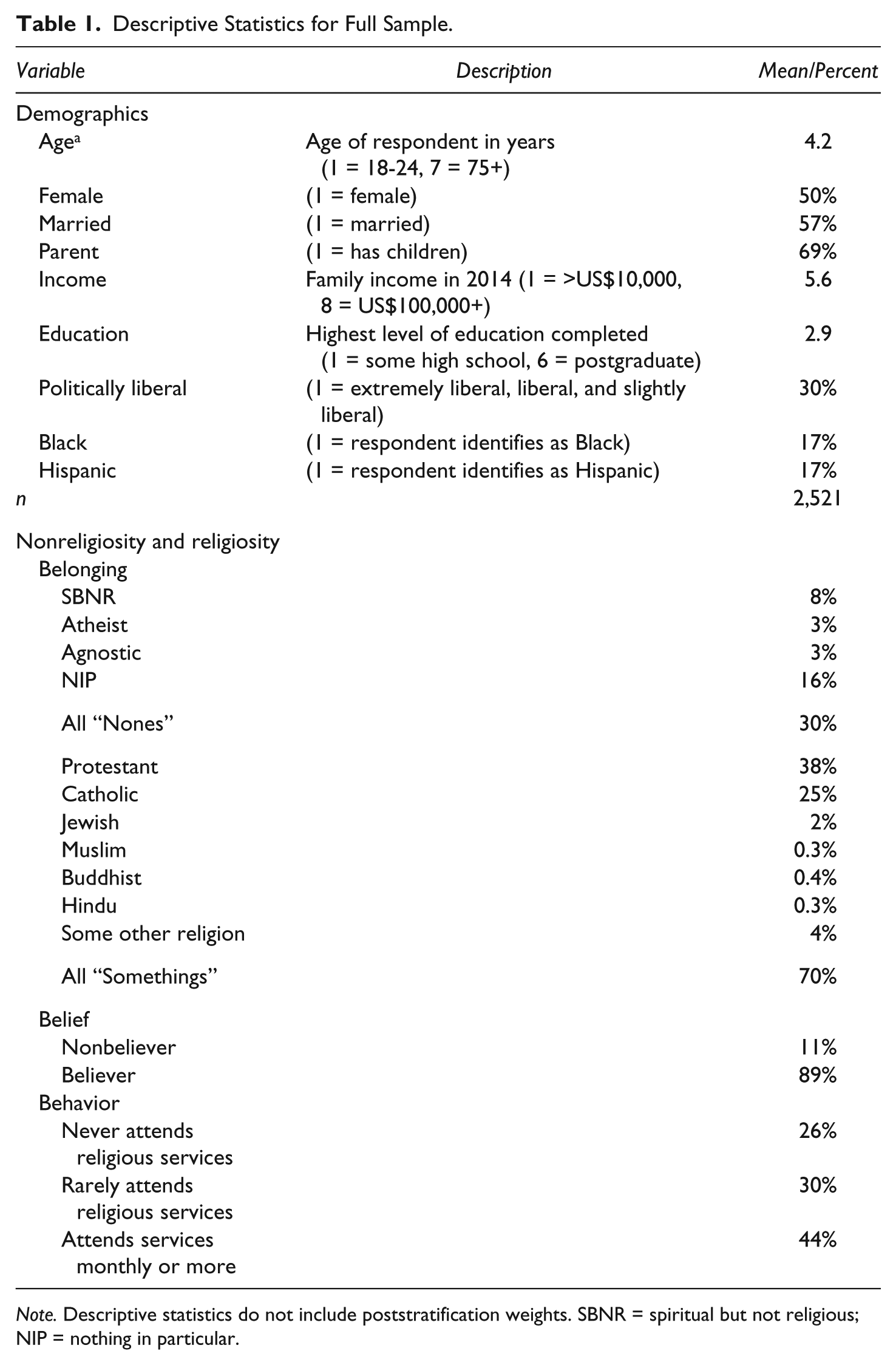
Note. Descriptive statistics do not include poststratification weights. SBNR = spiritual but not religious; NIP = nothing in particular.
For our measure of nonreligious belonging, we construct five measures from the same question, which asked respondents, “What is your current religious preference, if any?” There were several religious response options and four nonreligious response options: spiritual but not religious (SBNR), atheist, agnostic, and nothing in particular (NIP) . This gives us four distinct nonreligious identifications. In some analyses, we use these distinct measures, and in others we combine them into an aggregate measure called “Nones” (those who identify with any of the four distinct nonreligious identities). It is important to note that we included an “other” response, with a write-in option, so respondents were not forced to adopt religious or nonreligious labels that were not meaningful to them.
Our choices follow recent surveys (Pew Research Center, 2015), which give multiple nonreligious response options (“atheist,” “agnostic,” “NIP”), in contrast with earlier surveys (e.g., T. Smith et al., 2012) only allowing respondents to choose “none” or “other.” Most surveys do not give “SBNR” as a response option, however, recent work urges the provision of survey response options that distinguish between religiosity and spirituality (Cragun, Hammer, & Nielsen, 2015; Schnell, 2015). Mercadante (2014) and McClure (2017) argue that SBNRs are distinctive, with beliefs that deviate from dominant forms of Judeo-Christian theology. Therefore, we include SBNR as an additional option for expressing an intentional distancing from organized religion. Our approach allows us to contrast the entire group in our sample who eschew religious identification (Nones) with specific groups of nonreligious Americans identified as being of analytical interest in previous work.
To be clear, the categories of nonreligious identification available in the BAM survey are not the only way to parse out nonreligious identities. In a changing field of nonreligious identification and activism, researchers have outlined several different categorizations and typologies for the nonreligious and have shown how individuals may change their nonreligious identification over time (Cotter, 2015; Lee, 2014; Lim et al., 2010). As a result, these scholars have urged us not to reify religious and nonreligious identifications in our studies (Ammerman, 2013; Cotter, 2015). Understanding the changing nature of nonreligious identification and the existence of more than one classification system, our research is part of a growing body of studies (e.g., Baker & Smith, 2015; McClure, 2017; Silver et al., 2014) that use survey data to identify meaningful variation in nonreligious identification, belief, and belonging in an effort to develop better measures and to establish areas of inquiry in which such variation may affect social behavior. Our specific contribution is to analyze whether including a range of nonreligious identities, rather than a single “nonreligious” reference group, improves our understanding of the relationship between nonreligion and civic engagement. Findings that indicate a varied landscape of civic engagement among the nonreligious can provide direction for future research on what forms of nonreligious identification matter most for a wider range of civic engagement measures.
Nonreligious belief is our second main independent variable, drawn from a survey question that asked respondents whether they believe in a universal god or spirit. The response options were “yes” or “no” only, and those who said “no” were coded as 1 to represent nonbelievers, with those who said “yes” were coded as 0. Finally, nonreligious behavior, or not attending religious services, is our final main independent variable. Respondents were asked to rate their average religious service attendance on a scale from 1 (never attends) to 7 (attends more than once a week). For our bivariate analyses, we recoded this into a trichotomous variable—those who never attend, those who attend less than once a month or only on holidays, and those who attend monthly or more. However, in our regression models, we maintain religious service attendance as a scale variable, but reverse-code it so that the variable represents “low religious service attendance.” 3
Results
Bivariate Analyses
In Table 2, we show how demographic characteristics, interest in politics, and volunteering vary according to religious and nonreligious belief, belonging, and behavior. Looking first at the demographic differences, it is clear that the aggregate “Nones” variable elides important differences among the nonreligious. While in the aggregate, the Nones are younger than their religious counterparts, atheists are on average the youngest and SBNRs are on average the oldest (χ2 = 123.43, p < .001). Women are significantly more likely to be SBNR, while men are more likely to be atheist (χ2 = 47.47, p < .001); men are also more likely to be nonbelievers (χ2 = 28.82, p < .001). SBNRs and NIPs are significantly more racially diverse (χ2 = 32.67, 19.22, p < .001), and Black respondents are significantly more likely to be believers (χ2 = 24.93, p < .001) and religious service attenders (χ2 = 30.57, p < .001). The NIPs are by far the least privileged, as they make significantly lower incomes (χ2 = 93.82, p < .001) and have lower average levels of education than all other Nones (χ2 = 121.27, p < .001). Atheists, agnostics, and nonbelievers have the highest average incomes and levels of education across all measures of nonreligiosity and religiosity.
Descriptive Statistics, by Belonging, Belief, and Behavior.

Note. Descriptive statistics do not include poststratification weights. SBNR = spiritual but not religious; NIPs = nothing in particulars; HS = high school.
Means are reported for noncategorical variables.
We first explore the bivariate relationships between various nonreligious identities and levels of civic engagement. Table 2 indicates that the nonreligious as an aggregate group, nonbelievers, and those who do not attend religious services all report lower levels of interest in politics and community affairs than their religious counterparts. However, atheists, agnostics, and SBNRs report rates similar to religious respondents, with agnostics and religious service attenders reporting the highest interest (both at 62%). It is the NIPs who report a significantly lower interest than all others (χ2 = 70.10, p < .001).
Bivariate analyses of participation in or volunteering for the five types of civic and political groups show similar results. As expected, the nonreligious participate in religious organizations less than the religious, regardless of how nonreligion is measured. For all other types of volunteering, however, the Nones and nonbelievers report rates similar to believers, religious service attenders, and Somethings, though atheists and agnostics report higher levels of engagement in neighborhood/block associations and local/national political groups. Furthermore, atheists report twice as much participation in hobby group than do Somethings and other Nones (χ2 = 13.11, p < .01). The Nones are significantly less likely to volunteer for schools/recreation centers than Somethings (χ2 = 10.36, p < .001), but the difference between nonbelievers and believers in this category is not statistically significant.
Multivariate Analyses
We run ordered and binary logistic regression models to test these relationships between nonreligion and civic engagement. In Table 3, we report results from ordered logistic regressions of respondents’ general interest in local politics and community affairs. In Model 1, labeled “Belonging: Aggregated,” we report the odds ratio for the Nones aggregated into a group—SBNRs, atheists, agnostics, and NIPs were combined to constitute this variable, making all Somethings the reference group. Model 1 reports that the Nones as a group are 42% less likely to report a general interest in local politics and community affairs, with an odds ratio of 0.58. In Model 2, labeled “Belonging: Disaggregated,” we break out the nonreligious identity groups into distinct variables. Model 2 reveals that it is the NIPs, who are 58% less likely than Somethings to express interest in politics and community affairs, driving low interest among the aggregate Nones variable reported in Model 1.
Ordered Logistic Regressions of Interest in Local Politics and Community Affairs.
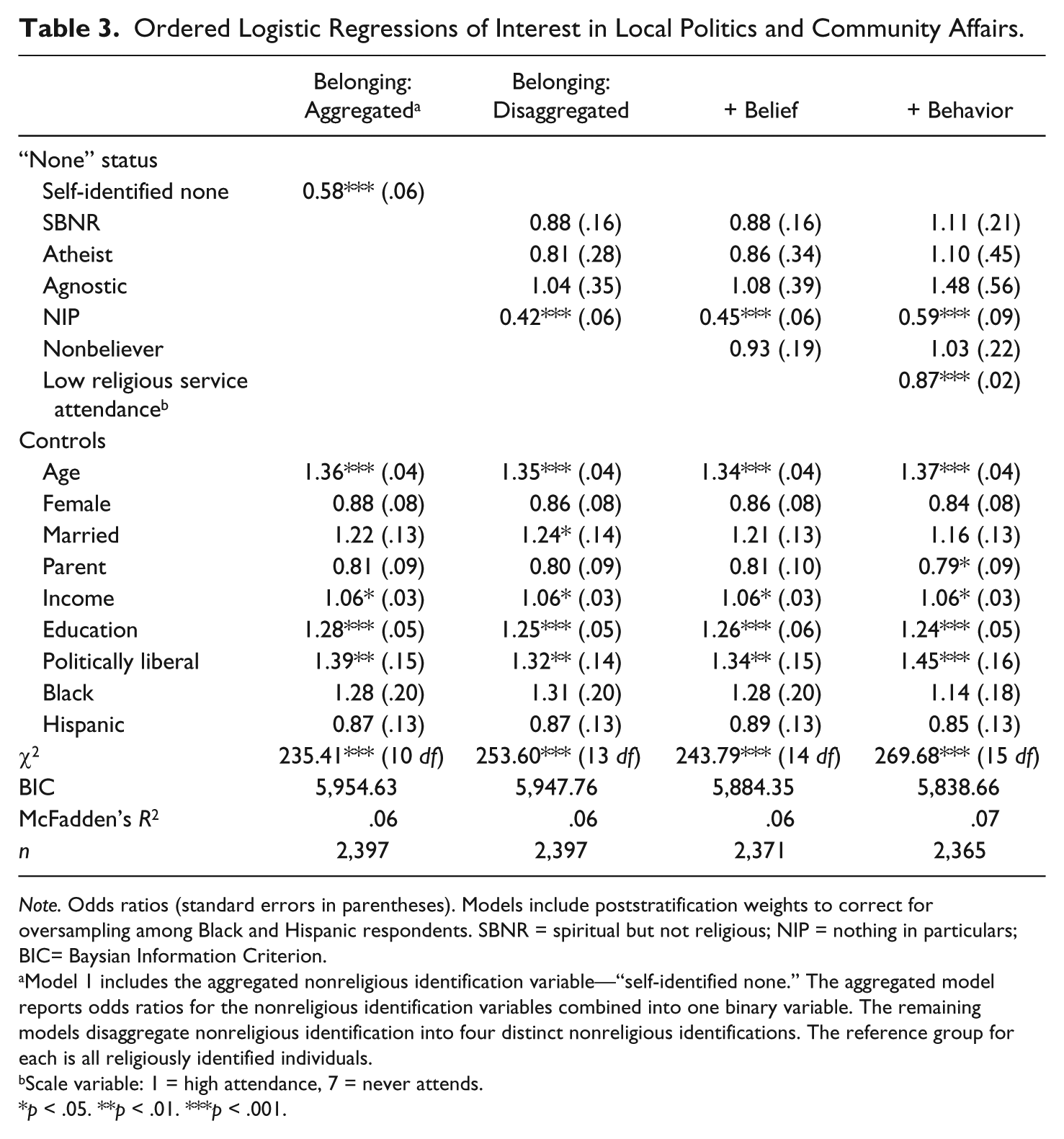
Note. Odds ratios (standard errors in parentheses). Models include poststratification weights to correct for oversampling among Black and Hispanic respondents. SBNR = spiritual but not religious; NIP = nothing in particulars; BIC= Baysian Information Criterion.
Model 1 includes the aggregated nonreligious identification variable—“self-identified none.” The aggregated model reports odds ratios for the nonreligious identification variables combined into one binary variable. The remaining models disaggregate nonreligious identification into four distinct nonreligious identifications. The reference group for each is all religiously identified individuals.
Scale variable: 1 = high attendance, 7 = never attends.
p < .05. **p < .01. ***p < .001.
In the third model in Table 3, labeled “+ Belief,” we control for nonbelief, which does little to change the model and is itself not a significant predictor of interest in local politics and community affairs. In Model 4, labeled “+ Behavior,” we include a scale measure of low religious service attendance, with low attendance being the highest category and attending more than once a week being the lowest. Model 4 reports that decreased religious attendance significantly associates with decreased interest in local politics and community affairs. Controlling for religious service attendance, however, does not account for the lack of interest among the NIPs.
In Table 4, we report binary logistic regression results of participation in five civic areas within the last year. In these models, we do not include the control variables to analyze the effects of nonreligious identification alone. 4 These analyses reveal that there are no significant differences between Nones and Somethings in participation in neighborhood/block associations or local/national politics. However, the Nones are less likely to volunteer for religious organizations, and NIPs are significantly less likely to volunteer for schools/recreation centers. Importantly, the fourth set of models shows that the low participation in schools/recreation centers among the NIPs accounts for the significant negative association of the Nones in general. Finally, the last set of models reveals that atheists are twice as likely to participate in hobby/interest groups as are Somethings, but that finding is masked when the Nones are treated as an aggregate group.
Logistic Regressions of Participation in Civic Groups Within the Last Year, Without Controls.

Note. Odds ratios (standard errors in parentheses). Models include poststratification weights to correct for oversampling among Black and Hispanic respondents. SBNR = spiritual but not religious; NIP = nothing in particular; BIC= Baysian Information Criterion.
Model 1 in all five model sets includes the aggregated nonreligious identification variable. The aggregated models report odds ratios for the nonreligious identification variables combined into one variable—“self-identified none.” Model 2 in each model set disaggregates nonreligious identification into four distinct nonreligious identifications. The reference group in both is all religiously identified individuals.
p < .05. **p < .01. ***p < .001.
In Table 5, we replicate the models from Table 4, but with the addition of our controls and adding the additional belief and behavior models. This allows us to investigate whether differences in involvement across different nonreligious groups are due to demographic patterns or whether they are driven by differences in beliefs or institutional involvement. The models are set up in the same way as in Table 3. For each dependent variable, Model 1 reports results for all Nones, Model 2 reports results with the disaggregated nonreligious belonging variables, Model 3 adds a control for nonbelief, and Model 4 adds a control for low religious service attendance. In these model sets, we also include a control for interest in local politics and community affairs, the dependent variable in Table 3, because subjective interest might drive other forms of participation (Putnam, 2000).
Logistic Regressions of Participation in Civic Groups Within the Last Year, With Controls.

Note. Odds ratios (standard errors in parentheses). Models include poststratification weights to correct for oversampling among Black and Hispanic respondents. SBNR = spiritual but not religious; NIP = nothing in particular; BIC= Baysian Information Criterion.
Model 1 in all five model sets includes the aggregated nonreligious identification variable. The aggregated models report odds ratios for the nonreligious identification variables combined into one variable—“self-identified none.” The remaining models disaggregate nonreligious identification into four distinct nonreligious identifications. The reference group for each is all religiously identified individuals.
Scale variable: 1 = high attendance, 7 = never attends.
p < .05. **p < .01. ***p < .001.
The first set of models in Table 5 predicts participation in neighborhood/block associations. In all four models, nonreligion has no significant effect, regardless of the measure of nonreligion used. Instead, it is age, education, and interest in community politics that predict participation in this form of civic group. The inclusion of the controls did not significantly alter the relationship between nonreligious identification and this form of civic engagement found in Table 4.
In the second set of models, predicting volunteering for a church or other religious institution, the nonreligious are less likely to participate. This is not a surprising finding; however, when we control for nonbelief in the third model, we find that it accounts for the lack of participation among atheists, but not other Nones. Instead, as the fourth model shows, low religious service attendance accounts for the lack of religious volunteering among SBNRs, agnostics, and nonbelievers. This suggests that atheists are the most consistent in aligning nonreligious belief and practice; in contrast, nonbelievers, agnostics, and SBNRs are simply not exposed to volunteering opportunities through religious organizations when they do not attend church.
In the third set of models, we report odds ratios predicting participation in local/national political groups. As in the first set of models predicting participation in neighborhood/block associations, nonreligion is not a significant predictor of participation in local/national politics. Interest in community politics and being politically liberal are the primary predictors of this kind of civic engagement.
In the fourth set of models, which predict participation in schools/recreation centers, we see a similar pattern as the one found in Table 4—Certain nonreligious groups are driving the association found when only the aggregate None measure is used. In the first model of the set, Nones as an aggregate group are almost 50% less likely to participate in a school or recreation center than Somethings, with an odds ratio of 0.52. However, the second model in the set reveals that it is the NIPs and atheists who are driving this relationship, with NIPs being 43% less likely to volunteer and atheists being 66% less likely. In the third model in this set, we control for nonbelief, which is not significant itself, but it does account for the lack of participation among NIPs and atheists. In the final model of the set, we control for low religious service attendance, which is significant and reveals that low attenders are around 20% less likely to volunteer for schools/recreation centers. The inclusion of the controls results in a significant negative association between atheists and participation in schools/recreation centers that was not present in Table 4, revealing a more accurate relationship between atheism and this kind of civic engagement.
In the final set of models, which predict participation in hobby and sports groups, the first model reports that there is not a significant relationship between the Nones as an aggregate group and this form of civic engagement. However, Model 2 in this set reports that SBNRs are almost 90% more likely to participate and atheists are over 2 times as likely to participate as are Somethings. Conversely, agnostics are 60% less likely to participate. Again, using the aggregate None variable elides important variation found when the nonreligious are parsed into distinct categories. In the third model in the set, we control for nonbelief, which increases the predicted probabilities for SBNRs and atheists, and accounts for the lack of participation among agnostics but is not significant in itself. This means that nonbelief drives participation in these groups, suggesting that at least some of this effect is a result of participation in organizations devoted to the expression of nonreligious ideologies. In the final model of the set, we control for low religious service attendance, which further increases the predicted probabilities of SBNR (odds ratio of 2.37) and atheist (odds ratio of 3.27) participation. Again, this suggests that religious organizations tend to draw individuals into other kinds of connections, but SBNRs and atheists, especially, do not attend religious services frequently. 5 Controlling for religious service attendance eliminates the “masking” effect of low attendance on volunteering for these groups.
Discussion
Our findings complicate the consensus that religious individuals are more likely to be engaged in civic life than are nonreligious individuals. By comparing the civic involvement of those who identify as atheist, agnostic, spiritual but not religious (SBNR), and nothing in particular (NIP), and comparing the effects of not believing in a god, not identifying with a religious label, and not attending religious services, we find that the nonreligious are indeed heterogeneous in their approaches to civic engagement. Atheist, agnostic, and SBNR Americans value civic engagement and volunteer for many social and political groups at similar or higher rates as do religious individuals; we show that grouping the Nones together as a reference category in statistical analyses elides these differences and mischaracterizes the civic engagement of many nonreligious Americans.
We draw on nonreligious identification categories increasingly used by other national surveys, but these categories may not sufficiently capture the heterogeneity of the nonreligious. We argue that paying systematic attention to different nonreligious identities and experiences can reveal previously missed variations in attitudes and behaviors among the nonreligious, and, in so doing, shed new light on what we thought were settled questions. Yes, religiosity drives civic engagement and volunteering, but as we show in this analysis, so can nonreligiosity, a finding that has been largely missed by studies using a generic “None” category for all nonreligious persons.
We find that the nonreligious as a whole are not any less likely than the religious to volunteer for neighborhood and block associations, local and national political groups, or hobby and interest groups. In fact, SBNRs and atheists are more likely to volunteer for hobby and interest groups than are the religious. This is, we argue, quite telling. The recent rise in religious disaffiliation in America has resulted in a growing number of political and community groups oriented to the nonreligious (Cimino & Smith, 2014; Garcia & Blankholm, 2016)—what we would call “non-religious values-based communities.” But surveys generally do not provide nonreligious individuals with a good option for expressing their involvement in a group oriented toward secular activism, the exploration of nonreligious identities, or the formation of nonreligious community. This is a problem, especially in research on civic engagement, as these groups have been found to act in similar ways to religious organizations in regard to being feeders into other forms of civic engagement. On our survey, the best fit from among the available response options were “political” groups and “hobby and interest” groups, and we believe this may be a contributing factor to the high levels of reported participation in these groups, particularly among atheists and SBNRs.
In contrast, our analysis reveals that those who identify as NIP have quite low rates of civic engagement. In our models that treat the Nones as a composite group, the NIPs often drive lower rates of volunteering. This is important because, in our sample, the NIPs are most similar to the Nones as measured in other influential surveys, and the most similar to the group used as a reference category in standard statistical analyses in which those answering “none” or “NIP” to a survey item on religious identification are treated as representative of the nonreligious as a whole. Measured this way, “Nones” appear not to be very involved in civic life, but this measure masks the experiences of large groups of nonreligious Americans like atheists and SBNRs whom we find to be much more active in civic life.
To explain these findings, we suggest that to identify as NIP may signal a more general experience of marginality, something we cannot explore here, but which should motivate future research. Taken as a whole, the NIPs in our sample are among the least privileged—they are less educated, poorer, and more likely to be people of color when compared with both religious and other nonreligious groups in our sample. While research on the religion–volunteering nexus has focused on networks and shared beliefs, it is important to keep in mind that privilege also shapes access to volunteering opportunities (see Polson, 2015). However, even when controlling for these demographic differences, we find that the NIPs remain significantly less interested and involved than other religious and nonreligious Americans. It may be that the NIPs are further marginalized due to their inherent status inconsistency and value uncertainty, as many still hold religious beliefs and commitments, but do not claim a specific religious identity (Keysar, 2014). A recent study finds that, compared with atheists, agnostics, and affiliated believers, nonaffiliated believers show higher levels of anxiety, worry, and obsessive thinking, and lower levels of physical and mental health due to this form of status inconsistency (Baker & Stroope, 2016). This lack of a coherent identity and associated values may be one of the reasons why the NIPs are consistently less involved and engaged than other religious and nonreligious Americans.
While the NIPs show lower levels of engagement across most of our measures, we find that all Nones show lower levels of participation in churches and religious institutions, and atheists in particular show lower rates of participation in schools and recreation centers, when compared with the religious. While the low rates of volunteering in religious organizations is not surprising, atheists’ absence from schools may be due to a combination of factors: lower rates of parenthood (shown in our bivariate analyses in Table 2), concerns over the secularizing trends in education among religious parents (which might drive more religious parents to volunteer at schools; Binder, 2004), and participation in parochial schools among Catholic parents (Coleman & Hoffer, 1987). Our results indicate that it is nonbelief, not low service attendance, that drives this relationship, meaning that nonreligious ideologies likely influence how parents involve themselves in their children’s educational institutions (see Manning, 2015). This is something we cannot further explore here, but that should motivate future research on nonreligious parenting and institutional involvement.
Our models also show previously unstudied variation in the relationship between low religious service attendance, nonbelief, and civic engagement for different nonreligious individuals. For example, low religious service attendance explains why agnostics and SBNRs do not volunteer for religious organizations, while it is nonbelief that explains low participation among atheists. And as discussed above, it is nonbelief that explains why NIPs and atheists do not volunteer at schools and community centers, not low religious service attendance. Finally, nonbelief and low religious service attendance increase participation in interest and hobby groups among SBNRs and atheists.
Our data are of course limited, particularly in the available measures of civic engagement. Even so, we believe our analysis is a useful beginning, and we call for future research to investigate how different forms of nonreligious identification, belief, and behavior influence a broader array of volunteer activities and a wider range of subjective attitudes. Bringing the Nones out of the reference category, we show that variations in nonreligious identification matter, that the combination of nonreligious identification and nonbelief matters, and that low religious service attendance is not the only mechanism driving differences in civic involvement among the nonreligious.
Conclusion
Research on the “Nones” has captured both scholarly and public imaginations. In scholarly work, those who do not claim a specific religious identity are often used as a reference category, which is interpreted to be an adequate proxy for nonreligion. This is increasingly problematic in light of a growing body of research showing the variety of nonreligious choices and experiences in the contemporary United States and abroad. With this analysis, we show that the “Nones” cannot be treated as a unitary, catch-all category in models that predict social and political beliefs and behaviors. We argue that the image of the nonreligious as uninvolved in civic life is inaccurate and most likely driven by analyses that disproportionately weight the experiences of those who identify as “NIP.” We show that atheists, agnostics, and the “SBNR” engage in community life and local politics at rates similar to those of religious Americans, and that nonreligious belief, behavior, and belonging combine in various ways to shape volunteering and interest in community affairs.
We call for attention to this issue in future research and to the development of survey instruments that can capitalize on the recent wave of excellent qualitative and historical work on nonreligious organizations to develop response options that appropriately capture the voluntary organizations in which the nonreligious participate. Future research needs to consider how these new forms of community may serve as a recruitment network for volunteering activities much in the way that churches and other religious organizations do for religious persons, offering politically and socially active groups through which nonreligious individuals are drawn into civic participation. Given the size and growth of the nonreligious portion of the American landscape and the growth in organizations oriented toward fostering nonreligious identity and community formation, we need to consider whether religious involvement is unique in its capacity to foster civic engagement or whether religious organizations like churches should be considered just one kind of value-based community among others, all of which may orient their members to civic involvement in distinct ways (e.g., Putnam & Campell, 2010).
Research of this kind is important not only because it drives conversations about the validity and accuracy of our statistical measures but because it helps to dispel myths about understudied populations that affect individual lives in the real world. The nonreligious, especially atheists, are often characterized as immoral, elitist, and antisocial, and a large percentage of Americans attempt to distance themselves from the nonreligious as a result (Edgell et al., 2016). The overwhelming “consensus” among scholars that religious individuals are more likely to volunteer and care about their communities contributes to these negative stereotypes, which our analyses show to be largely unfounded. When the Nones are rescued from the reference category, we find a more nuanced and accurate picture of nonreligious interest and engagement in civic life.
Footnotes
Declaration of Conflicting Interests
The author(s) declared no potential conflicts of interest with respect to the research, authorship, and/or publication of this article.
Funding
The author(s) disclosed receipt of the following financial support for the research, authorship, and/or publication of this article: The authors appreciate the generous support for data collection and research assistance given by the National Science Foundation (Grants 1258926 and 1258933) and the Edelstein Family Foundation.