



Abstract
This study examines how various aspects of institutional context, including the regulatory environment, government affiliation, and government work experience, shape environmental nongovernmental organizations’ (eNGOs) managerial networking in China. Data from a nationwide survey of 267 eNGOs and in-depth interviews in 2014-2015 are analyzed. The findings show that China’s restrictive political environment suppresses eNGOs’ peer and business networking but is not associated with government networking. Compared with government-organized NGOs (GONGOs), civic eNGOs network more with peers, businesses, and government agencies. Furthermore, eNGOs with leaders having government work experience conduct more government networking. Theoretically, these findings point to the importance of the political and institutional context of managerial networking. Empirically, this study provides the first set of quantitative data analysis demonstrating how institutional factors affect NGO managerial networking under authoritarianism.
Nonprofit managers build and use connections with other organizations to leverage resources and support (Hicklin, O’Toole, & Meier, 2008; Luo, 2003). Such networking helps foster connections with nonprofits’ external environment, bring in resources, and gain institutional legitimacy. For nonprofits that are small, young, and low in capacity, managerial networking facilitates interorganizational learning and strengthens organizational capacity. Overall, managerial networking helps nonprofits exploit environmental opportunities, buffer environmental uncertainty, and protect against environmental threats (Brass, Galaskiewicz, & Greve, 2004; Hicklin et al., 2008; Johnson & Ni, 2015; Luo, 2003; Meier & O’Toole, 2003; O’Toole, 2004; O’Toole & Meier, 2014).
Studies on managerial networking mostly examine why nonprofits network and what performance implications it has (Austin, 2000; Guo & Acar, 2005; Johansen & LeRoux, 2012; Suárez & Hwang, 2013). Suárez and Hwang (2013), for example, examine how cultural conformity affects nonprofits’ collaboration with businesses. Guo and Acar (2005) apply resource dependence as well as institutional and network theories to examine factors related to nonprofit collaboration forms. Isett and Provan (2005) propose that organizations partner with others to acquire resources, manage uncertainties, and obtain efficiency and legitimacy. Sandfort (2014) examines how intermediary organizations and coalitions help nonprofits gain resources and focus public attention needed for effective advocacy. Johansen and LeRoux (2012) find government networking increases advocacy effectiveness, and community networking increases organizational effectiveness. Yet, as shown by Galaskiewicz, Bielefeld, and Dowell (2006), networking is a double-edged sword for some nonprofits: While it may help a nonprofit to gain resources and status, it also is costly to network. In some circumstances, the costs of networking outweigh the gains (Hicklin et al., 2008; Torenvlied, Akkerman, Meier, & O’Toole, 2013). Agranoff (2006), for example, identifies different types of costs inside collaborative networks, such as time and opportunity costs, learning costs, and loss of organizational autonomy. The benefits of relational investments and the costs of managerial networking imply that, to maximize the potential benefits of networking, nonprofits need to strategize on the extent and methods of networking based on an evaluation of their internal operational needs and institutional environments. For instance, the manager of a nonprofit under resource constraints may prioritize in developing relationships with organizations that yield financial support, whereas the manager of a nonprofit facing regulatory pressures may network more with the government to develop positive nonprofit–government relationships.
These studies focus mostly on nonprofits in the Western context (O’Toole & Meier, 2014). Nonprofits’ networking behavior, its antecedents, and performance implications are likely to differ across varying contexts. In authoritarian regimes, restrictive political environments and weak institutional support may shape nonprofit networking differently. In the business literature, for example, studies document that in China’s transition economy, characterized by a relatively weak legal framework and inadequate property rights enforcement, managerial networking has frequently been used to compensate for these institutional inadequacies and to enhance firms’ economic and operational performance (Luo, Huang, & Wang, 2012).
In this study, we seek to expand the literature by examining the institutional antecedents of managerial networking in environmental nongovernmental organizations (hereafter, eNGOs) in authoritarian China. We distinguish three dimensions of managerial networking: peer, businesses, and government. These three dimensions capture both horizontal and vertical connections and provide NGOs with different kinds of resources and support. Drawing on institutional theory, we examine the institutional antecedents of managerial networking by analyzing data from a nationwide survey of Chinese eNGOs and in-depth interviews in 2014-2015. The findings highlight how the regulatory environment, government affiliation, and NGO leaders’ government work experience shape the dynamics of NGO networking in authoritarian China, where the party-state has constantly been on guard against the potential threat of any large-scale collective action organized by NGOs. Throughout the article, we argue that in navigating the government-dominated institutional environment, Chinese NGOs tend to weigh potential political risks heavily when considering types of networking investments. The study highlights the relevance of institutional theory, which emphasizes the influence of coercive, mimetic, and normative pressure from the institutional environment, in explaining NGOs’ networking strategies in an authoritarian context. In addition to specifying how and why various contextual factors affect NGO managerial networking under authoritarianism, the article also advances beyond existing studies on Chinese NGOs by conducting a large-N quantitative analysis, increasing the research’s generalizability.
The Development and Management of NGOs in Authoritarian China
Over the past two decades, China’s NGO sector has grown significantly in both size and scope. The number of NGOs had increased from 4,446 in 1988 to 699,523 by the end of 2016. These statistics only measure registered groups; most scholars believe that the number of active groups far exceeds the numbers reported here 1 (Teets, 2009). The Chinese government is ambivalent about NGO development. On one hand, it recognizes NGOs’ constructive role in delivering social services and conveying citizens’ concerns. It has thus loosened its control over civil society groups, providing NGOs with some political space to grow. In the environmental field, for example, local governments have recognized eNGOs’ role in monitoring firms’ polluting activities and have sought to collaborate with them. On the other hand, the party-state considers NGOs as a potential threat to its rule. Many officials are concerned that the strengthening of civil society may create social disorder and erode their own power and authority (Teets, 2013). Others do not understand what role NGOs play and what capacity NGOs have and are uncertain over which groups are appropriate to cooperate with, leading to general distrust of the overall NGO sector.
A hallmark of China’s NGO sector is the coexistence of two distinct types of NGOs: government-organized NGOs (GONGOs) and civic NGOs. Most GONGOs were originally set up by the government 2 to channel international funding and expertise and to absorb retired government officials from the administrative reform in the 1990s (Wu, 2003). In contrast, civic NGOs are mostly organized by individual citizens who are devoted to a specific social cause. As semigovernmental organizations, GONGOs have been enjoying various institutional benefits, such as extensive financial support and special personnel arrangements. Civic NGOs, however, have been institutionally discriminated against in many ways. Prior to 2016, if a civic NGO wants to seek government registration, it must find a sponsoring agency and ensure that no other NGOs focusing on similar issues exist within the same administrative jurisdiction. In 2016, the government promulgated a new Charity Law, which smoothed the way for domestic NGOs to legally register and raise funds; the law also eliminated the limit on the number of NGOs that can operate in any one area. Although reducing entry barriers, the government has also issued a variety of additional regulations to strengthen its control of the NGO sector. Domestic NGOs, for example, must establish CCP (the Chinese Communist Party) branches and not endanger “national security” or “social morality”—two vaguely defined terms that can easily trigger caution among NGO leaders. In addition, the Overseas NGO Management Law promulgated in 2016 requires foreign NGOs operating in China to “obtain the consent of a professional supervisory unit” prior to registration; it also grants Public Security Bureau unchecked power to scrutinize all aspects of NGO management, including the hiring of local staff and financial transactions. With heightened security concerns and decreased tolerance for certain kinds of activism and expression, the current political climate has become increasingly restrictive. Certain NGOs, especially those working on such issues as HIV/AIDS, legal reform, or labor rights face greater administrative interferences, police surveillance, and sometimes political crackdown.
To manage pressures from the institutional environment, many eNGOs network with peers, businesses, and government agencies. G. Yang (2010), for example, states that Chinese eNGOs are polycentric and networked, constituting a dynamic structure in which extensive interaction and learning occur. Ru and Ortolano (2009) report that eNGO leaders often network with government officials to smooth the way to registration. Xie and Mol (2006) illustrate how extensive networking within the green community helps mobilize coordinated actions and affect political authorities. Networking is thus a strategic tool for many eNGOs. The question is, How does the institutional environment affect eNGO networking? Below, we draw on institutional theory to examine the institutional antecedents of managerial networking in Chinese eNGOs.
Theory and Hypotheses
Existing studies have mostly used two theoretical perspectives, namely, resource dependence and institutional, to explain why nonprofits network (Guo & Acar, 2005). Resource dependence theory assumes that managers proactively turn to others for key resources and legitimacy to deal with external dependencies (Pfeffer & Salancik, 2003). Institutional theory highlights the influence of coercive, mimetic, and normative pressures on organizational behavior (Meyer & Rowan, 1977; Oliver, 1991; Powell & DiMaggio, 1983). Oliver (1991) compared resource dependence and institutional perspectives, arguing that the former places emphasis on coping with interdependencies, visible pressures, adaptation, and management of scarce resources, while the latter on conforming to collective norms and beliefs, invisible pressures, isomorphism, and adherence to rules and norms. This comparison sheds lights on how resource and institutional considerations shape networking differently. Whereas resource dependence theory posits that networking is a coping strategy to reduce uncertainty in relation to resource acquisition and management (Oliver, 1990), institutional theory posits that organizations tend to conform to external institutional pressures. According to the latter, organizations are likely to adopt acquiescence or avoidance strategies when legal coercion is high, enforcement is strict, and potential penalties are high (Meyer & Rowan, 1977; Oliver, 1991; Powell & DiMaggio, 1983).
Prior research has shown that in the authoritarian context of China, NGOs strive to foster a munificent resource environment to sustain their operations and, at the same time, to navigate a government-dominated institutional environment to reduce potential political hazards (Li, Lo, & Tang, 2017; Spires, 2011; Zhan & Tang, 2016). Li et al. (2017), for example, found that resource considerations shape NGOs’ advocacy investment, and political and institutional pressures shape NGOs’ advocacy tactics. Along the same line, we would expect that in a largely uncertain and, sometimes hostile, political environment, institutional factors play a crucial role in shaping Chinese NGOs’ networking strategies. Below, we first categorize managerial networking into three types: peer, business, and government. We then examine three institutional factors—the regulatory environment, government affiliation, and government work experience—and explain how each, together with related resource dependence considerations, is associated with NGO managerial networking. The three factors touch upon different levels of the institutional environment. The regulatory environment is a macro-level factor, examining the influence of the broader institutional context on NGO managerial networking. Based on their respective task environments as well as personal backgrounds and circumstances, NGO leaders form their perceptions about the relative restrictiveness of the regulatory environment and its related opportunities and constraints. Such perceptions in turn affect their networking strategies. Government affiliation examines the effect of government’s discriminatory treatment of civic NGOs versus GONGOs on their networking strategies. Government work experience examines the impact of a micro-level institutional factor—leaders’ prior experience in the government—on NGO networking.
Before moving on, we highlight two delimiting assumptions underlying our research. First, we assume that organizations make conscious, intentional decisions to establish ties with their environment. These decisions result from their rational calculations of the specific constraints and opportunities they face. Second, although most networking activities occur mainly at the individual level, we take an organizational perspective and consider NGO executives’ networking behavior at the organizational level (Ahuja, Soda, & Zaheer, 2012; O’Leary & Vij, 2012; Oliver, 1990).
Three Dimensions of NGO Managerial Networking
Organizational leaders engage in different networking activities with different types of organizations. Torenvlied et al. (2013), for example, propose three dimensions of networking, with each corresponding to different types of support, including political support, bureaucratic coping, and coproduction. In their recent study, Van den Bekerom, Torenvlied, and Akkerman (2015) propose four fundamental orientations of managerial networking activities: upward, downward, sideward, and external. Johansen and LeRoux (2012) categorize nonprofit networking into two: community and political. Extending these studies, we propose that NGO managerial networking consists of three dimensions: peer, business, and government. Each networking orientation provides distinct sources of support to NGOs.
Peer networking refers to NGOs’ interactions with foundations and other NGOs. Prevalent within the nonprofit sector, it provides nonprofits with information, resources, and learning opportunities. Through networking, nonprofits learn from each other regarding how to manage resources, deal with competing demands, build effective support networks, and use the most effective advocacy tactics (LeRoux & Goerdel, 2009; Sandfort, 2014). NGOs in China have increasingly collaborated with one another. They go to each other’s meetings or salons to offer intellectual and material support; they work together to collect signatures and petitions; they also borrow from each other’s expertise or connections to influence policy making (Wu, 2013, 2017). Thus, peer networking helps overcome NGOs’ resource barriers and foster collective action.
Business networking refers to NGOs’ interactions with businesses, which can be exemplified by monetary donations, in-kind gifts, and joint programs (Suárez & Hwang, 2013). As argued by Galaskiewicz and Colman (2006), four types of business–nonprofit collaborations exist, namely, philanthropic, strategic, commercial, and political. In China, NGOs have enjoyed great support from businesses. According to Spires, Tao, and Chan (2014), 30% of civic NGOs report various kinds of business support.
Government networking is characterized by NGOs’ interactions with government agencies. The purpose is to obtain government funding, secure political support, and influence policy making. As argued by Young (2006), nonprofits collaborate with government to provide public services; they also advocate for policy change. ENGOs in China interact with the government in various ways. They report firms’ pollution activities to the government; they file public interest lawsuits to help pollution victims; they demand policy change (Zhang, 2017).
Given that peer, business, and government networking tap different opportunities and resources, it is likely that they are affected by different institutional factors. Below, we relate institutional factors to the three dimensions of managerial networking in Chinese eNGOs.
The Institutional Antecedents of Managerial Networking
Perception of the regulatory environment
As discussed earlier, navigating the uncertain, and sometimes hostile, institutional environment and finding ways to reduce political hazards are of the utmost importance to NGOs in China. Institutional theory, which emphasizes an organization’s tendency to conform to coercive, mimetic, and normative pressures, is potentially relevant to explaining Chinese NGOs’ networking behavior in relation to political risk management. Specifically, NGO leaders who perceive a more restrictive regulatory environment are more likely to refrain from networking with one another to avoid exposure to government sanctions. Ho (2007), for example, argues that China’s stringent political environment has restrained NGOs from developing intimate linkages with other NGOs and international donors. Similarly, Hildebrandt and Turner (2009) argue that the government is wary of strong ties between groups, and if individual NGOs want to continue operation, they are better off keeping to themselves. A restrictive regulatory environment has discouraged NGOs’ peer and business networking.
Considerable regional variations exist in terms of the regulatory environment for Chinese eNGOs (Teets, 2015). In general, coastal provinces are more hospitable than inner provinces to eNGO operations and activities. Individual eNGO executives in the same region may also perceive the regulatory environment differently depending on the focus of their organization’s work; for example, eNGOs focusing on environmental education usually face a less restrictive environment than those focusing on aiding pollution victims (Zhan & Tang, 2011). Depending on their locations and individual circumstances, executives in different eNGOs may perceive different levels of restrictiveness of their regulatory environment. Thus, those who perceive a more restrictive environment are less likely to engage in networking.
Government affiliation
As semigovernmental organizations performing social or public functions, GONGOs used to be funded mostly by the government. Their top leaders are likely to be appointed by the state, have soft budgets, and be compensated regardless of performance. Even though many GONGOs have become more autonomous in financial and personnel arrangements 3 (Tang & Lo, 2009), they continue to have easier access to government officials and resources. They are also considered more legitimate by local government agencies. Hence, GONGO leaders may be less motivated than their civic NGO counterparts to cultivate various ties.
Civic NGOs, however, initially suffer from a lack of legitimacy as a new form of organization. NGO managers are strongly motivated to build ties to compensate for their “liability of newness” (Stinchcombe, 1965). Such a motivation may be especially strong in authoritarian China, which lacks formal institutional support for civic NGOs. In addition, civic NGOs often have limited financial capacity to ensure survival; many rely on founders’ personal savings to continue operation. Therefore, civic NGO leaders tend to network more to gain useful information and knowledge. By networking with their peers or more established NGOs in the field, these leaders can learn about possible funding sources and knowledge on how to manage NGOs (Ru & Ortolano, 2009; G. Yang, 2005). By networking with government officials, they can smooth their way to registration, government funding, or other institutional support. By networking with businesses, they can secure more financial support. Thus, civic NGO leaders are strongly motivated to invest time and efforts in networking, which can provide valuable, unique, and intangible resources. Teets (2013), for example, points out that civic NGOs working on community development issues intentionally forge government ties to access funding and to obtain recognition and influence.
Government work experience
A growing body of research has shown that politically connected organizations surpass their counterparts in performance and long-term viability due to their privileged access to the government (Johnson & Ni, 2015; Marquis & Raynard, 2015). Having government officials who serve as executives or board members helps organizations absorb the uncertainty created by government regulation (Hillman, 2005). Government officials act as boundary spanners who can bring valuable policy information and build effective collaboration between the organization and government. Although the impact of government ties are often examined in interlocking boards in the Western context, it may not apply to the Chinese NGO sector, in which board of directors play a much less significant role than executives in NGO governance (Xie & Mol, 2006). Many NGO executives in China are former or current government officials (Zhan & Tang, 2016). Among the 12 eNGOs studied by Cooper (2006), nine organizational leaders have previously worked for the government. These leaders usually know the nitty-gritty of the policy process and have access to various government agencies. When they need help from the government, they can easily identify and build contact with the right government agency. Nee and Opper (2010), for example, find that managers with a previous career as a government official in China can easily cultivate political connections to secure government contracts. Spires’s (2011) interview with a former government official who later became an NGO activist in China illustrates that a leader’s government background facilitates NGOs’ communication with government officials. Such communication allows the government to familiarize with NGOs’ work, thus giving NGOs better survival chances.
Data and Method
Data Sources
The data were obtained from a nationwide survey of eNGOs conducted in 2014-2015. We designed a survey instrument by drawing on existing questionnaires on Chinese NGOs and on existing literature on managerial networking (Guo & Zhang, 2013; Hildebrandt, 2013; Johansen & LeRoux, 2012; Zhan & Tang, 2011). To check the validity of the survey, we conducted 14 in-depth interviews with eNGO leaders in Beijing and Shanghai and solicited their input on the questionnaire. During the interviews, most eNGO leaders categorized their networking activities into those with peers, businesses, and government, supporting our conceptual distinction of the three dimensions of managerial networking. We constructed a directory of Chinese eNGOs by consulting several sources: The China Development Brief, the All-China Environment Federation, the Center for Environmental Education and Communication, and the Internet. The final list consisted of 1,215 eNGOs. Compared with existing studies on Chinese NGOs, this was the most comprehensive list ever constructed from publicly available information at the time.
We contacted each eNGO by phone and introduced the purpose of our study. Upon obtaining consent, we sent an email to each organization with a link to the survey. The survey was addressed to two top leaders in each eNGO. We followed up with those who did not respond to the survey or whose responses were incomplete. In all, 632 responses were received through an online portal, representing 316 eNGOs, with a response rate of 26%. To ensure data quality, we cross-checked the two responses from each eNGO and chose the more credible response based on several criteria. 4 Responses from 49 organizations were deleted because the basic organizational information provided in the survey was inconsistent with that found from other valid sources. The final dataset consists of 267 eNGOs, with one entry from each organization. The unit of analysis is each eNGO. The sample includes 150 GONGOs and 117 civic eNGOs. To check for potential nonresponse biases, we compared the organizational age and size between respondents and nonrespondents and found no major differences. Nonetheless, because we cannot be fully certain about the representativeness of the dataset, we must treat the findings in this article as more suggestive than conclusive.
We also conducted 18 more interviews with eNGO leaders and two with government officials between 2014 and 2015. These interviews were intended to help us interpret the quantitative findings and learn about specifics on eNGO networking and operations. Interviews were guided by a set of questions covering eNGOs’ founding, operation, networking, and performance. Contacts were gathered through snowball sampling, other researchers’ referrals, and personal connections. Each interview lasted about 40 to 100 min. The organizations included in these interviews are by no means representative of the whole eNGO population. As argued by King, Keohane, and Verba (1994), intentional selection of observations is more appropriate than random selection and assignment in small-N research. We also followed Yin’s (2013) suggestion and conducted the interviews sequentially. We conducted the first few cases from which we gained new information; we then selected additional cases. We stopped conducting more interviews when we felt that not much new information could be learned. Following this sequential process, we achieved data saturation, a primary goal of qualitative interviews. All the interviews were transcribed and then analyzed using Nvivo 10, a qualitative data management program. We began the analysis by identifying the initial concepts in the data and grouping them into categories (open coding). By doing so, we specified the institutional context and types of networking. Next, we engaged in axial coding, wherein we searched for relationships between and among categories developed in open coding. This process helped assemble the categories into higher order themes. Finally, we gathered similar themes into several overarching dimensions. The qualitative analysis was triangulated with the quantitative results.
Measurement
Managerial networking
A widely used measure of managerial networking in public and business management research is based on perceptions of top managers who are asked to assess, on a Likert-type scale, their networking frequency with other organizations and government officials (Hicklin et al., 2008; Johansen & LeRoux, 2012; Luo et al., 2012; Peng & Luo, 2000). Following this approach, we asked respondents to describe the extent to which they had interacted with other NGOs and various levels of government agencies over the past 3 years. This is measured on a scale of 1 to 5, where 1 = seldom in contact, 2 = yearly, 3 = monthly, 4 = weekly, and 5 = daily.
Peer networking is a single item measuring how frequently eNGOs communicate with other NGOs and foundations. Its mean is 2.10, representing a frequency somewhere between yearly and monthly contact. Business networking measures how frequently eNGOs interact with businesses. Its mean is 2.16. Government networking consists of three items, representing eNGOs’ interactions with government agencies at the district, municipal, and provincial levels. Its Cronbach’s alpha is .76, suggesting a reasonable level of internal consistency. Principal factor analysis indicates that the three items load on a single factor, with an eigenvalue of 2.04, explaining 67.92% of the variation. The three items are averaged, and the mean is 1.46. Compared with peer and business networking, eNGOs network less with government agencies.
Perception of the regulatory environment
In the survey, we asked eNGO executives to indicate the extent to which they agree with the following two statements: (a) laws and regulations governing NGOs are under-developed, preventing NGO development and (b) my organization faces much administrative interference from the government. These two items are measured on a scale of 1 to 5, where 1 = strongly disagree, and 5 = strongly agree. The Cronbach’s alpha for the two items is .84, suggesting a high level of internal consistency. Principal factor analysis shows that they fall into one factor, with an eigenvalue of 1.72, explaining 86.09% of the variation. The two items are averaged. The mean is 2.89, suggesting that most eNGO executives believe that the regulatory environment is somewhat unfavorable.
Here, a subjective measure of the regulatory environment is used. Although some studies question the accuracy of perceptual measures, most agree that archival and subjective measures of political and institutional environments have their respective advantages and disadvantages (K. Yang & Pandey, 2009). Although archival measures contain less perceptual bias and random error, perceptual measures are better able to capture internal psychological processes salient to decision making and individual behaviors. As Boyd, Dess, and Rasheed (1993) show, there is a “mediating filter” between archival and perceptual measures (p. 212). This filter includes individual cognitive factors, organizational level variables, and the organizations’ strategic focuses. Perceptual measures are thus affected by the broader institutional environment and the more focused task environment. When studying organizational phenomena, one needs to determine which measure is more theoretically appropriate for the research at hand (Boyd et al., 1993; K. Yang & Pandey, 2009). Studies that focus on organizational outcomes (e.g., survival, performance) are better off at using archival measures. However, studies that focus on organizational actions, such as executive information search or strategic decision making, benefit most from using perceptual measures (Boyd et al., 1993). Our measure of the regulatory environment is appropriate here because we are interested in how NGO executives’ perception of the regulatory environment affects their managerial action. To some extent, the perceived regulatory environment is grounded on the opportunities and constraints in the institutional environment and on the executives’ task environment and individual attributes (e.g., life history, education, and efficacy).
Government affiliation
This binary variable measures whether an eNGO is a GONGO or civic organization. Here, GONGO equals 1, 0 otherwise. As two distinct types of NGOs in China, GONGOs and civic NGOs exhibit different characteristics. Our sample shows GONGOs on average are older than civic eNGOs. Their average ages are 14.31 and 9.83, respectively. GONGOs often have more staff than civic eNGOs. On average, for a typical GONGO, 28% of its funding comes from government support, whereas for a typical civic eNGO, 15% of its funding is from the government.
Government work experience
This is a dummy variable measuring whether eNGO executives are former government officials. It is coded 1 if an NGO executive had work experience in the government, 0 otherwise. Overall, 49 out of 267 eNGO leaders held government jobs before turning to NGO management.
Control variables
Organization age is measured by the number of years an eNGO had been in operation as of 2014. Organization size is measured by the natural log of the number of full-time staff. Registration status is a dummy variable measuring whether an eNGO is registered with the government. It is coded 1 if it is registered, 0 otherwise. Executives’ education measures the highest educational level an eNGO executive had received. It consists of five categories in which 1 = “middle school or below,” 2 = “junior college,” 3 = “college graduate,” 4 = “master,” and 5 = “PhD.” 5
Findings
Table 1 presents the descriptive statistics and correlation coefficients for the variables. The three dimensions of managerial networking are correlated at .72, .61, and .58, respectively, suggesting that they tap into different aspects of networking activities.
Descriptive Statistics and Correlation Matrix.
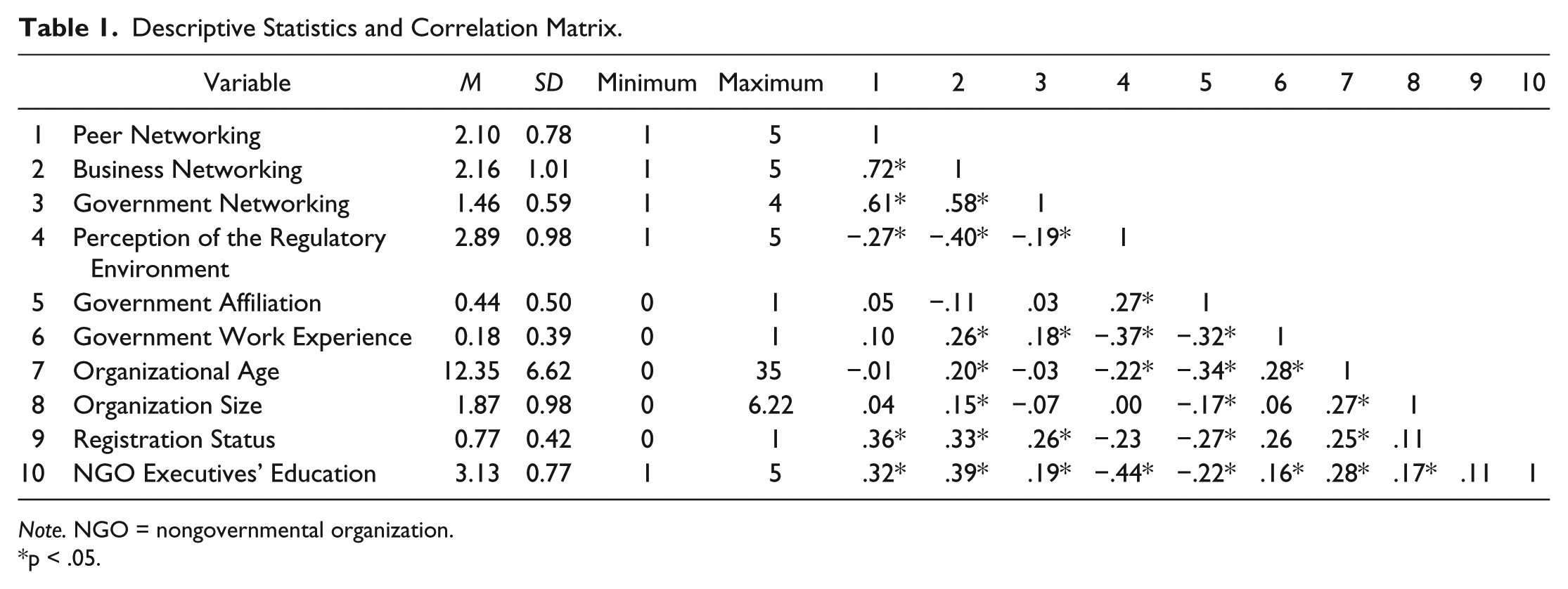
Note. NGO = nongovernmental organization.
p < .05.
Six multivariate regression models with robust options were performed using Stata 12.0 (see Table 2). The first two models examine factors associated with peer networking. Model 1 is the base model, with all the control variables explaining 24.01% of the variance in peer networking. Model 2 added the three institutional variables, and it explains 28.44% of the variance in peer networking. A perception of a more restrictive regulatory environment is associated with less peer networking (beta = −.10, p < .05). Compared with GONGOs, civic eNGOs network more with their peers (beta = .34, p < .001).
The Institutional Antecedents of Managerial Networking.

p < .10. *p < .05. **p < .01. ***p < .001.
Models 3 and 4 concern business networking. Both the models are significant. Model 4 explains 29.43% of the variance in business networking. The regulatory environment is negatively associated with eNGOs’ business networking. A perception of a more restrictive regulatory environment is associated with less business networking (beta = −.22, p < .01). Compared with GONGOs, civic eNGOs network more with businesses (beta = .25, p < .5).
Models 5 and 6 focus on government networking. Model 6 explains 15.73% of the variance in government networking. Compared with GONGOs, civic eNGOs network more with government agencies (beta = .17, p < .05). ENGOs with leaders having government work experience conduct more government networking compared with those without such leaders (beta = .22, p < .05).
Overall, as expected in H1a and H1b, eNGOs with executives who perceive a more restrictive regulatory environment network less with peers and businesses. This finding speaks to the relevance of institutional theory (Oliver, 1991), which proposes that higher legal coercion and an inhospitable political environment lead to organizational acquiescence and avoidance, which in our case means less networking with other NGOs and businesses. This finding is supported by our interviews in which several eNGO leaders expressed their concern about the current restrictive and uncertain regulatory environment and how it has stifled peer and business networking. For example, a leader said, After assessing the potential political risk in participating in the broader environmental movement like organizing a bunch of eNGOs to stop the government from developing the coastal area, many eNGOs choose not to participate. There is so much risk involved. The government does not want to see you organized together. Once you are in, your organization may face survival problems: you may be shut down, or you may not be able to pass the annual government review. (Interview A7)
Interestingly, H1c, which hypothesizes that eNGO leaders’ perception of the regulatory environment is associated with government networking, is not supported. One possible explanation is that regardless of their perceptions of the regulatory environment, eNGOs usually find it difficult to network with government agencies. Several eNGO executives, for example, mentioned that they seldom interact with the government because they do not have meaningful access to it (Interviews A2 and B11). Most government agencies (except civil affairs agencies and security departments) do not exactly know what NGOs do and are indifferent to their work (Interviews B1, A14, and B8). Among those with limited understanding of NGOs, most consider them “troublemakers” (Interviews B5, B3, A3, and A11). Therefore, many eNGOs are unwilling to network with government agencies because their perception of NGOs is perfunctory at best.
Government affiliation is negatively associated with all three dimensions of managerial networking, supporting H2a, H2b, and H2c. Compared with GONGOs, civic eNGOs are more likely to engage in managerial networking. As offshoots of government agencies, GONGOs have solid government support. As one department chief from a GONGO (Interview A10) in Beijing admits, “As an organization with strong government background, we can take advantage of many resources.” He is concerned about the ongoing service organization reform, which requires GONGOs to eventually detach from their supervising agencies, thus diminishing their government resources and identity (Interviews A10 and B2). His concern reflects the embedded advantages that GONGOs have been enjoying. Thus, GONGOs report less networking with the government, and as semigovernment organizations, they maintain some distance from other NGOs and businesses. In contrast, civic eNGOs have been institutionally discriminated against in registration and operation. To register, eNGO leaders need to communicate with government officials to show their eligibility. They also network extensively with their peers to gain useful information on how to start up and manage the organization. To keep their organizations running, they need to be well-rounded so that they can gain support from government, businesses, foundations, and the NGO community. Therefore, networking is a strategic tool for civic eNGOs to mitigate their environmental disadvantages.
As expected in H3, government work experience is positively associated with government networking. Ex-government officials consider government the best source of resources for their NGOs. They thus choose to develop alliances with state actors to access these resources. Hsu and Jiang (2015), for example, argue that NGO founders with party-state experience tend to build NGOs around alliances with government agencies. This finding is echoed by our interviews during which many NGO leaders said that NGO leaders with such experience are boundary spanners who can bring to the organization substantial government support, insider policy information, and potential government subsidies or contracts. For example, the leader of B3 is a retired government official who is well connected with officials in water management and environmental protection. With these resources, this NGO networks well with the government. Teets (2009), for example, documented this organization’s efforts in collaborating with government agencies to establish the Non-Governmental Relief Service Center after a major earthquake in Sichuan Province.
Among the control variables, organization age is negatively associated with eNGOs’ peer networking (beta = −.02, p < .01). That is, newer organizations tend to network more with their peers. This is consistent with Stinchcombe’s (1965) argument that newer organizations network more to overcome their liability of newness and smallness. Furthermore, registered NGOs network more than those without government registration. This is probably because registration provides several benefits. Compared with unregistered groups, registered NGOs can secure a wider variety of funding opportunities and build transnational linkages (Ru & Ortolano, 2009). They are more visible and can attract more participants, increasing sustainability. By staying in the sun, they can forge more formal ties with the government and can shelter themselves from government interference (Hildebrandt, 2012). In addition, executives’ education is a significant predictor for all three dimensions of managerial networking. One possible explanation is that executives with higher levels of education understand the importance of collaboration and have more skills to build partnerships. Their educational backgrounds, together with their occupations or social prominence, make them “high status” leaders who are instrumental in facilitating their organizations’ work, reaching a larger network, and fostering various types of ties (Ru & Ortolano, 2009).
Discussion and Conclusion
In this study, we examined how the regulatory environment, government affiliation, and government work experience affect eNGO managerial networking. We showed that a more restrictive regulatory environment stifles peer and business networking. This specific finding is consistent with institutional theory as it argues that a coercive institutional environment prompts organizations to adopt avoidance and conformity strategies. Perception on the regulatory environment, however, has no definite correlation with eNGOs’ government networking. One possible explanation is that regardless of how restrictive eNGO leaders think of the regulatory environment, they avoid networking extensively with government agencies due to mutual suspicion (Spires, 2011). Compared with GONGOs, civic eNGOs network more with peers, businesses, and government agencies to show legitimacy and broker resources and support. In addition, eNGOs with leaders having government work experience network more with government officials probably because they have more access and are more skilled at interacting with the government.
Our study contributes to the literature in several ways. First, following Peng and Luo (2000) and Torenvlied et al. (2013), we assume that managers differentiate their networking activities with different types of external actors and organizations. We distinguish three dimensions of managerial networking—peer, business, and government—with each being related to a specific type of support from the environment. The results suggest that eNGO leaders’ perception of the regulatory environment affects their networking priorities and strategies. When eNGO leaders perceive administrative interference from the government and are confused about laws and regulations, they tend to keep to themselves and reduce networking activities with peers and businesses. Perception on the regulatory environment, however, does not directly affect eNGOs’ networking with government agencies because many eNGOs are not inclined to network with government in the first place; if they do, that type of networking is a means for them to gain guidance and support from the government. These results suggest the need for scholars to differentiate different aspects of managerial networking, especially when undertaking research in an authoritarian context where the influence of political and institutional environment is substantial.
Second, our study responds to O’Toole and Meier’s (2014) quest for more management research in varying institutional contexts by extending the literature on managerial networking to an authoritarian setting. The study highlights the relevance of institutional theory in explaining the dynamics of NGO networking in authoritarian settings. Under restrictive and uncertain political environments, eNGOs are extremely concerned and wary about the potential political risks engendered by networking. In an authoritarian state such as China, where the political environment is generally unfavorable to civil society and collective action, eNGOs’ peer networking is often politically suppressed. Organizations with a certain kind of institutional embeddedness, such as having leaders with government work experience or having been established by the government, are more advantaged politically. These factors may hold in other similar authoritarian states (Guo & Zhang, 2014). Our study thus opens a new avenue of research by which scholars can examine how the broader political and institutional environments affect nonprofit management under authoritarianism.
Overall, in this study, we managed to acquire a relatively large and diverse sample in comparison with those used in the current literature. We also triangulated the quantitative findings with qualitative data. These efforts represent major methodological improvements over previous studies on Chinese NGOs, leading to more robust, fine-grained, and more generalizable results.
Although it is generally acknowledged that a vibrant nonprofit sector and civil society are key elements for a well-functioning open, democratic society, developing these elements in an existing authoritarian system is tricky business. Political constraints under an authoritarian regime inevitably shape the development of the nonprofit sector and civil society. NGOs operating under these constraints are so suppressed that they are afraid of any political risks their actions may carry; acquiescence and avoidance thus become their strategic response to the tight political and regulative environment. If the government wants to build harmonious and benign state–society relations, it needs to realize that NGOs are not troublemakers but potential helpers in solving entrenched social and environmental problems; it also needs to loosen its control over civil society and create a more enabling environment for NGOs to grow. If the NGO sector wants to form a bigger voice, NGOs themselves need to collaborate with and learn from each other because extensive peer networking helps build NGO capacity.
The study has several limitations. First, the dataset is cross-sectional, so we were unable to claim causality between institutional antecedents and managerial networking. It is possible, for example, that NGOs with less networking perceive the regulatory environment as more hostile. Longitudinal data are needed to better determine causality. As argued by Koka, Madhavan, and Prescott (2006), changing levels of munificence and uncertainty may affect the pattern of change in networks. The Chinese government has in recent years been sending mixed signals to the NGO sector—somehow encouraging the further development of the sector in social service delivery and meeting citizen needs while creating a more heavy-handed and uncertain regulatory environment at the same time. It remains to be seen as to how NGOs may change their networking behavior over time in response to changing perceptions of munificence and uncertainty in the regulatory environment.
Second, we relied primarily on perceptual measures of managerial networking and the regulatory environment. Also, as our measures are derived from the same survey, common source bias may be a problem. Future studies could collect archival data to measure the regulatory environment. However, subjective measures of managerial networking will probably continue to be used in future studies due to the informal nature of managerial networking. Thus, the issue is not to denigrate the use of perceptual measures but to suggest ways to enhance the reliability and validity of these measures. Third, our study focuses on a certain type of NGOs in China. It is possible that other types of NGOs, such as those focusing on human services or labor rights, exhibit different networking patterns. For future research, one may investigate whether managerial networking differs across varying types of NGOs and what institutional and organizational factors cause this difference. Finally, we focused on eNGOs’ networking activities with the three generic sectors, that is, government, business, and other NGOs, and were unable to identify the specific partners with which eNGOs interact. It is likely that eNGOs foster connections with organizational partnerships in which shared third-party ties or cross-type relations coexist. Future research may conduct network analysis to pinpoint the types and attributes of organizational ties eNGOs seek to foster.
Footnotes
Acknowledgements
We would like to thank Chao Guo and the three anonymous reviewers for their thoughtful comments, which have made this article stronger. We also would like to thank Xueyong Zhan for his assistance in developing the questionnaire and conducting some of the interviews.
Declaration of Conflicting Interests
The author(s) declared no potential conflicts of interest with respect to the research, authorship, and/or publication of this article.
Funding
The author(s) disclosed receipt of the following financial support for the research, authorship, and/or publication of this article: Research for the article was partially funded by the project “A Study of Chinese Environmental NGOs: Toward Building a Theory of NGO Development in China” (Project No. 1-ZVEY) and under the support of the Sustainability Management Research Center in the Department of Management and Marketing at the Hong Kong Polytechnic University.