



Abstract
This research makes two main contributions: (a) validates Themudo’s findings of a positive correlation between women’s empowerment and the development of the nonprofit sector by using different forms of empowerment and (b) suggests women’s empowerment causes nonprofit development, thus contributing to the formation of a gender theory. Using women’s economic empowerment by county (n = 3,428) and women’s state-level political empowerment (n = 50), the positive correlation between women’s empowerment, both economic and political, and nonprofit development is confirmed. Next, Granger causality tests (1975-2013, n = 39) suggest women’s political empowerment causes nonprofit development. These results provide insights for further research in nonprofit development and suggest that policies that increase women’s empowerment will also benefit the nonprofit sector.
Keywords
Women are an integral part of the nonprofit world. Most of nonprofit employees and volunteers are women (Lanfranchi & Narcy, 2015), and women are more likely to lead nonprofits than for-profits (Claus, Callahan, & Sandlin, 2013). Researchers have started to explore the relationship between women and the nonprofit sector in depth. Themudo (2009) identified a correlation between women’s empowerment and the nonprofit sector’s development and stated the need for a gender theory to explain this relationship. However, an accurate gender theory cannot be determined without understanding the direction of this correlation and theoretical causality. “A rigorous empirical examination of the gender theory being proposed must ultimately disentangle complex cause–effect relationships” (Themudo, 2009, p. 678). Understanding how (the theoretical cause) the empowered woman correlates and impacts (theoretical effects) the development of nonprofits and, by turnabout, how the development (the theoretical cause) of the nonprofit sector impacts and enhances (theoretical effects) women’s empowerment and influence has yet to be addressed. Themudo’s (2009) research has raised, but not answered, whether there is reciprocity between the empowered woman and a developed nonprofit sector.
The narrative is arranged by first presenting empowerment levels as they have historically developed. Next, our contribution and research questions are given. Prior background research is provided through the literature review. Metrics are explained and justified. Finally, methods used and resulting conclusions pave the way for ideas for future research.
To validate Themudo’s (2009) findings of a correlation between nonprofit sector development and women’s empowerment, the evolution, measurement, and processes of women’s empowerment are noteworthy. Doepke, Tertilt, and Voena (2012) discussed the evolution of women’s empowerment regarding stages of historical expansion: “Basic economic rights came first, political rights were next, and equal treatment in the labor market . . .” (p. 340). Although women’s equal treatment and representation, or lack thereof, in the nonprofit labor market has been studied by many (Alkadry & Tower, 2011; Faulk, Edwards, Lewis, & McGinnis, 2013; Leete, 2000; McCarthy, 2001; Preston, 1989; Pynes, 2000), few have distinguished the connection between the forms of empowerment and the development of the nonprofit sector. Some research has identified that expanding women’s economic empowerment strengthens the woman’s voice and ability to make choices not only about her person but about how she chooses to extend that empowerment outward to embrace the needs of a wider society (Kabeer, 2012; Sathiabama, 2010). It has been shown that economic empowerment results in improved quality of life via local programs and services (Roomi, Harrison, & Beaumont-Kerridge, 2009; Halkias, Nwajiuba, Harkiolakis, & Caracatsanis, 2011; Hanson, 2009), most often addressed through nonprofit organizations.
Two main contributions are made through this research: (a) validates Themudo’s (2009) findings of a positive correlation between women’s empowerment and the development of the nonprofit sector by using different forms of empowerment and (b) suggests women’s empowerment causes nonprofit development, thus contributing to the formation of a gender theory. This first contribution leads us to the following research questions:
Our second contribution is to identify the causal relationship between women’s empowerment and nonprofit development. The presence of a correlation alerts us to the existence of a relationship but does not determine the direction of that relationship. One option could be that a more developed nonprofit sector, by creating programs and opportunities for women, leads to more empowered women. We have seen an instance where programs stimulating female entrepreneurship have led to more empowered women (Datta & Gailey, 2012). Another option could be that empowered women, by having more influence in society, can create more opportunities for nonprofit development by funding, volunteering, and supporting these endeavors. We have seen an instance where more political participation, which can be understood as more political power, leads to an increase in women’s participation in political organizations (Inglehart & Norris, 2003). There is also the possibility of a third option where the relationship is circular, a virtuous cycle, where the two variables influence each other, more empowerment leads to a more developed nonprofit sector which in turn creates more empowerment. We explore each of these possibilities by testing the following research question:
Theoretical Background
Women’s Economic Power
Women’s economic empowerment can be explained as a circumstance wherein women experience financial gain and bargaining clout. As a result, substantial negotiating authority and the assurance of future economic sustainability lead to better access to essential resources. Resources such as health care, education, and other issues of particular importance and interest of women can lead to even more future empowerment (Cornwall & Edwards, 2010; Duflo, 2012; Golla et al., 2011).
With the goal of determining a reasonable metric for women’s economic empowerment, a literature review was undertaken to determine prior conclusions of women’s economic empowerment and its link to business ownership. McBride (2014) maintained that “women’s economic participation is equated with women’s economic empowerment . . . and this is seen as a means to great economic development and growth” (p. 15). Datta and Gailey’s (2012) study of the relationship between women’s economic empowerment via entrepreneurship spotted a compelling link. By examining a business focused on creating social and economic change for women, their research emphasized women’s empowerment by virtue of their entrepreneurial activities. Evidence of this conclusion can be found in women’s greater economic security, women’s education from on-the-job experiences, and the woman’s ability to contribute to family when they create their own business.
In addition, considerable research exists that confirms women firm owners enjoy transforming and contributing to their local economy. They not only increase their financial independence but also contribute to the independence of others through jobs creation, flattening of gender differences, and greater access to resources (Brush, Duffy, & Kelly, 2012; Banerjee, Galiani, Levinsohn, McLaren, & Woolard, 2008; Sharma, Dua, & Hatwal, 2012).
The parallel between women’s entrepreneurship and women’s empowerment is becoming more conspicuous within the research community. Scott, Dolan, Johnston-Louis, Sugden, and Wu (2012) used a multimethod, constructivist approach to examine women’s entrepreneurship in South Africa. The outcome suggested that support through training, networking, mentoring, and capitalization resulted in empowerment for women by increasing their earnings and raising them from poverty. Researchers also found empowerment, derived from increased economic power, changed dynamics in the family and resulted in improved self-image for the women (McLaren, 2008), thus illustrating entrepreneurship does empower women. Thus, the literature supports the use of the percentage of women firm owners as a worthy measure of economic empowerment.
Women’s Political Power
Women’s political power began to be formalized as the suffrage movement was successful. Indeed, the women’s suffrage movement was a political crusade culminating in the passing of the 19th amendment to the constitution in 1920 and expanded women’s empowerment in the public realm (Nicholson, 2010). In recent years, women have progressively moved into the political arena as agents of change; thus, creating what has been referred to as gender-related impact (S. J. Carroll, 2001). The Center for American Women and Politics (2016) documented in their data 4.5% of state legislatures in 1971 were women and in 2015, 24.2% of state legislatures are comprised of women thus highlighting a “continued pattern of incremental increases in women’s representation” (K. Dolan, 2010, p. 70). Women legislate differently, for example, female congresswomen have been shown to be more supportive of women’s interest in U.S. Congress (J. Dolan, 1998).
Providing women with a voice and platform to represent the needs of society has been recognized as an important goal. As a result, in the last several decades, quotas have been established in elected legislatures to amplify women’s policy-making influence (Chen, 2010; Dahlerup, 2012; Fréchette, Maniquet, & Morelli, 2008; Krook, 2014; Tinker, 2004). Although the effectiveness of these gender quotas is debatable (Dahlerup & Freidenvall, 2010; Verge & de la Fuente, 2014), women have become inspired to gain a political presence on a global scale (Dahlerup, 2012; Paxton, Hughes, & Green, 2006; Paxton, Kunovich, & Hughes, 2007).
Vissandjee, Apale, Wieringa, Abdool, and Dupéré (2013) stated, “. . . it would seem that initiatives which focus on increasing women’s substantive political participation would offer a more resolute means of empowering women across a wide variety of domains” (p. 125). Thus, utilizing the number of female political representatives as a measure of empowerment is a well-established measure.
Ghani, Mani, and O’Connell (2013) found that longevity of female political participation increases workplace positioning and raises women’s employment opportunities, and, in general, a reciprocal partnership exists between female political presence and economic growth and endorsement. Although less than a quarter of state legislatures are women, their legislative behavior and growing leadership abilities demonstrate the woman’s capacity to level the playing field across policy-making outcomes for significant change in political discourse (Karp & Banducci, 2008). Given the levels of representation and the reach of different policies, RQ2 will be examined at the state and national levels.
Method
Method Overview
Two main methods were used to study the research questions listed above. First, a test for correlation using cross-sectional data, women’s empowerment, the independent variable is regressed against nonprofit development, the dependent variable. We examined women’s empowerment in two forms, evaluating economic and political empowerment separately. Nonprofit development is measured using the total number of nonprofits and by the average revenue per nonprofit. Using different measures allows for a validation of results and provides more confidence in conclusions.
Second, after a correlation is verified, causality is explored using time series data and the Granger causality test. Women’s political empowerment, the independent variable, and the same two measures of nonprofit development, the dependent variable, are used. By evaluating the research questions using both cross-sectional and time-series data, our results will be more robust and we can be more confident in the contribution of this research.
Data Set 1—Women’s Empowerment: Economic (Cross-Sectional)
Women’s economic empowerment, one of our independent variables, is measured by the percentage of firms owned by women per county during the year of 2007 as reported in the 2007 Survey of Business Owners conducted by the U.S. Census Department. The 2007 data set represents the most complete data set on women’s business ownership available. The data set included county-level data; using county-level data offers more observations (n = 3,428), allowing for a more robust analysis. The data were accessed from the Census.gov website and downloaded to an Excel spreadsheet.
Data Set 2—Women’s Empowerment: Political (Cross-Sectional)
Women’s political empowerment, another of our independent variables, is measured by the percentage of women legislature for year 2015 as reported by the Center for American Women and Politics’ fact sheet on legislative data (Center for American Women and Politics, 2016). Data at the state level provide 50 observations. These data were transcribed by hand from their report into an Excel worksheet.
Data Set 3—Women’s Empowerment: Political (Time Series)
The second data set measuring women’s political empowerment is a time series data set. Time series data is a key requirement to perform a Granger causality test. We have included data from 1975 until 2013 (n = 39). The year 1975 was the starting point for our data because reporting of nonprofit data is unreliable before this date. The independent variable is measured by the total percentage of women-held seats across all state legislatures for the years 1975-2013 as reported by the Center for American Women and Politics (2016). These data were transcribed by hand from their report into an Excel worksheet.
Data Set 4—Nonprofit Development (Cross-Sectional)
Our dependent variable, nonprofit development, is measured in two ways for each form of empowerment. For political empowerment, development is first measured by the total number of nonprofits per state (n = 50). Second, by the average revenue per nonprofit by state (n = 50).
For economic empowerment, nonprofit development was measured by the total number of nonprofit per county in the United States (n = 3,428) and the average revenue per nonprofit by U.S. county (n = 3,428).
The data were reported by the National Center for Charitable Statistics (NCCS) for the same period as the independent variables (2007 for economic empowerment and 2013 for political empowerment). This information was generated using the NCCS All Registered Nonprofits Table Wizard. The data were exported to Excel.
Data Set 4—Nonprofit Development (Time Series)
Similarly, to our independent variable, a time series of the dependent variable is necessary for a Granger causality analysis. This data set is comprised of two measures of nonprofit development, the number of nonprofits and the total income of nonprofits overall in the United States. The period under study is 1975 to 2013 (n = 39). This information was generated using the NCCS All Registered Nonprofits Table Wizard and exported into an Excel spreadsheet.
Control Variable
To ensure the robustness of our regression analysis, a key control variable was included, population data. Previous research demonstrates that population size affects charitable giving (Apinunmahakul & Devlin, 2004; Bryant, Jeon-Slaughter, Kang, & Tax, 2003) and would, in turn, affect the size and income of nonprofits in a given area. Therefore, population was downloaded in Excel from Census.gov and used as a control.
Regression Analysis
Regression analysis was used to verify Themudo’s (2009) results of a positive correlation between women’s empowerment and the development of the nonprofit sector and to examine RQ1 and RQ2. In equation form,

Where Y is the dependent variable, X represents the independent variable, b is the coefficient estimate indicating the effect of X on Y, and e is the error term. Controlling for population, we use a linear regression to test for a statistically significant relationship between the different types of women’s empowerment and the development of the nonprofit sector.
Granger Causality
To examine RQ3, the causality relationship between variable, the Granger causality test is used as proposed by Clive Granger (1969). Granger causality test is a well-accepted method (Kamiński, Ding, Truccolo, & Bressler, 2001) used across disciplines. In the field of philanthropy, Lev, Petrovits, and Radhakrishnan (2010), through Granger causality tests, discussed the impact of corporate philanthropy growth on sales growth. Maddison (2004) explored the causal influences underlying changes in the level of government grants to museums. Herzer and Nunnenkamp (2013) scrutinized private donations, government grants, commercial activities, and fundraising in relationship to nongovernmental organizations (NGOs), and Brooks (1999) employed the method to evaluate whether public subsidies leverage private philanthropy for the arts.
In this research, the Granger causality test is conducted by employing the vargranger command in the Stata analytics package on time series data for the years 1975-2013. An independent variable (X) is said to Granger cause a dependent variable (Y) if Y can be better predicted using the histories (i.e., lagged values) of both X and Y than it can be by using the history of Y alone.
In equation form,
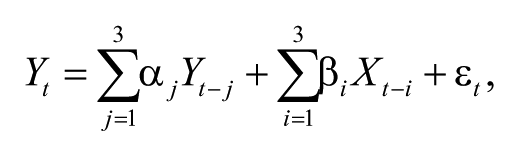
where t is time subscript denoting the year and i goes from 0 to 3.
The data available to us allowed us to run the Granger causality test on women’s political empowerment. Sadly, there is no data set that would allow us to run the Granger causality test on women’s economic empowerment.
Women’s political empowerment, characterized by percentage of women legislatures, is lagged three periods in a regression. The goal is to explain development of the nonprofit sector as measured first by average revenue per nonprofit and in a separate analysis, by total number of nonprofits. Finally, we analyze the relationship in the opposite direction, lagged values of nonprofit sector development are used in a regression looking to explain women’s empowerment.
While this analysis does not prove causality, insight is provided as to the direction of causality in a correlation. The term Granger cause is used to intentionally stress that the estimation technique follows the Granger test and while it can provide further support indicating a causality, it cannot definitively prove it. As with all statistical techniques, there is always the possibility of outside, unobserved factors driving results that might be related to nonprofit development. Granger causality can, however, give supporting evidence to one occurrence happening before the other.
Results
Correlation Tests
Regression analysis results are presented in Table 1. First, an ordinary least squares (OLS) regression of economic empowerment and the total number of nonprofits are provided. Then economic empowerment and average revenue to nonprofits is given. Both nonprofit development measures are at the county level. Both OLS regressions show a positive correlation between women’s economic empowerment and the nonprofit sector development.
Positive Correlation Among Women Economic Empowerment and Nonprofit Development.
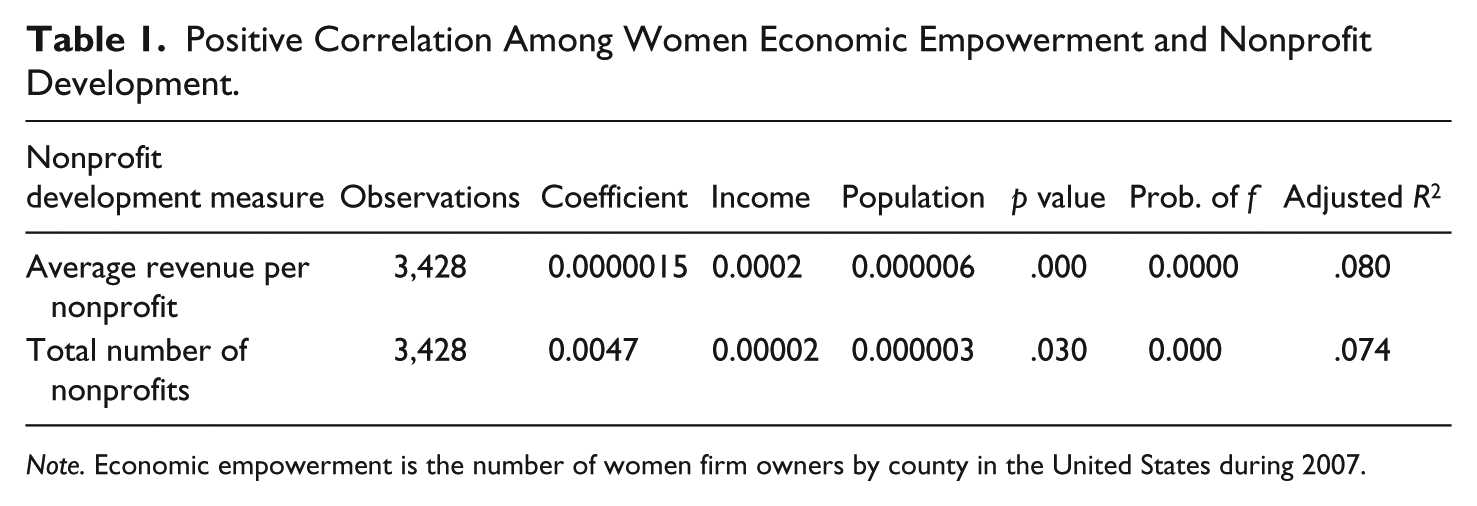
Note. Economic empowerment is the number of women firm owners by county in the United States during 2007.
When testing the correlation between the variables of women’s political empowerment as defined by the percentage of women legislators, a positive correlation exists between women’s political empowerment and average nonprofit revenue. There is also a positive correlation between women’s empowerment and the total number of nonprofit organizations. Results provided in Table 2.
Positive Correlation Among Women Political Empowerment and Nonprofit Development.
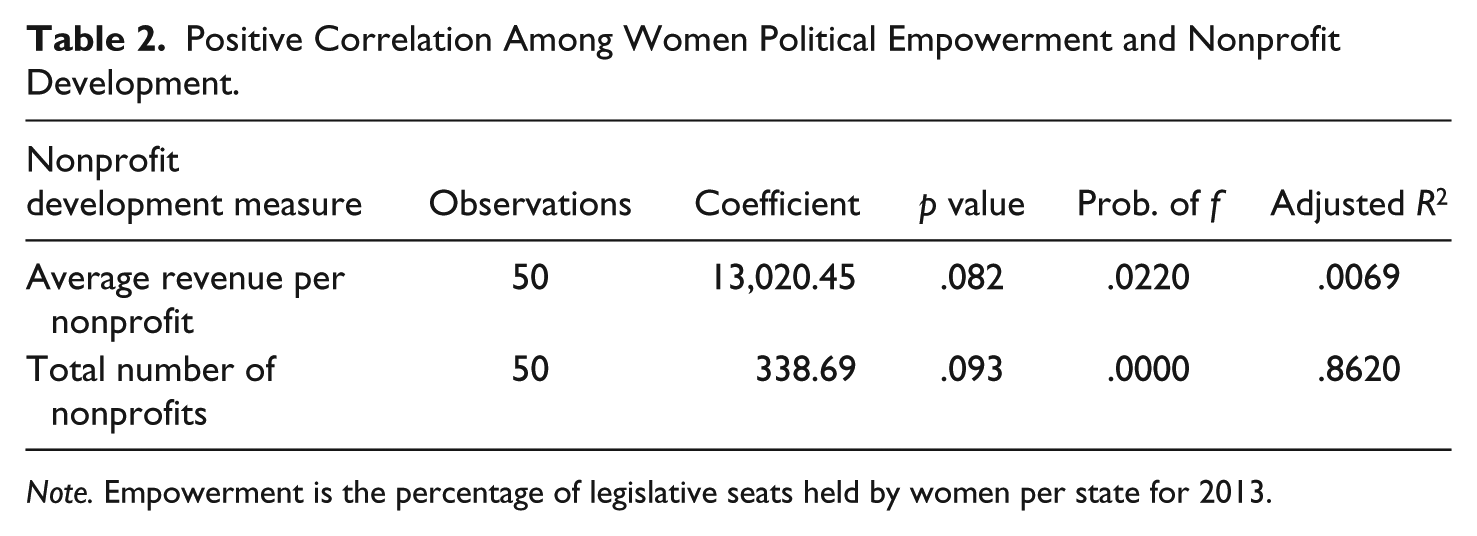
Note. Empowerment is the percentage of legislative seats held by women per state for 2013.
Granger Causality Tests
Due to the absence of time series data on women business ownership, Granger causality tests were focused on the time series data for women’s political empowerment, as defined by the percentage of women state legislators and using both measures of nonprofit development for the years 1975-2013.
When total number of nonprofits was the development measure, Granger causality tests show that women’s political empowerment Granger causes the development of the nonprofit sector, but the development of the nonprofit sector does not Granger cause women’s political empowerment. The lagged values of women’s political empowerment are strongly statistically significantly related to total number of nonprofits. The p value is .001, meaning the null hypothesis of no relationship between the lagged values of women’s political empowerment and development is rejected. Furthermore, when the terms are reversed, the equation where lagged values of total number of nonprofits is analyzed to predict women’s political empowerment, the null hypothesis is not rejected with a p value of .508. That is, the null hypothesis that lagged values of total nonprofits have no effect on women’s political empowerment is not rejected. See results in table 3.
Granger Causality Test Results: Women’s Political Empowerment and the Total Number of Nonprofits (1975-2013).
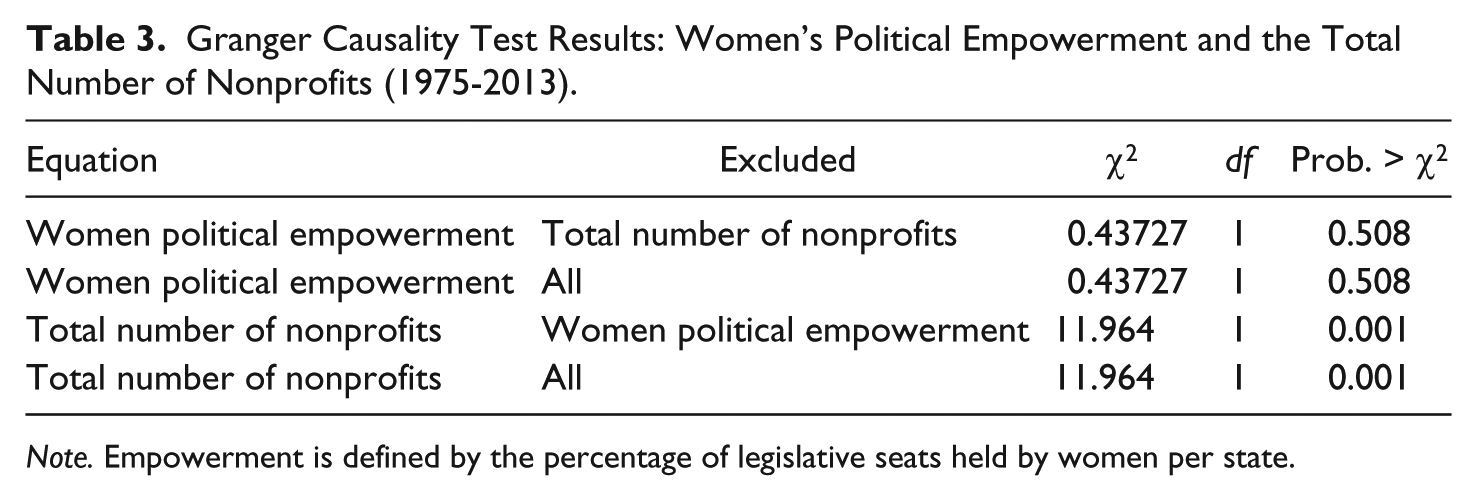
Note. Empowerment is defined by the percentage of legislative seats held by women per state.
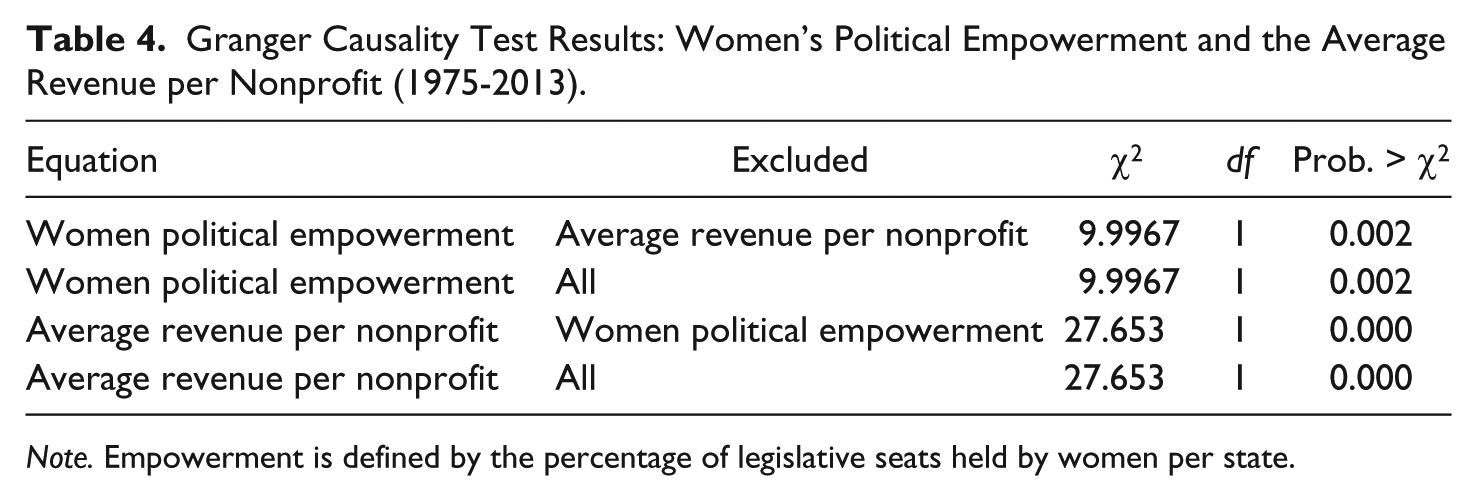
Next, the Granger causality test was again used with time series data to test the variable of women’s political empowerment as defined by the percentage of women legislators from the years 1975-2013 and the average revenue per nonprofit for the same time period. Interestingly, evidence of a circular relationship is presented with women’s empowerment causing the nonprofit development (p = .000) and nonprofit development causing women’s empowerment (p = .002). See results in table 4.
Granger Causality Test Results: Women’s Political Empowerment and the Average Revenue per Nonprofit (1975-2013).
Note. Empowerment is defined by the percentage of legislative seats held by women per state.
Discussion
This research began with Themudo’s (2009) results of a positive correlation between women’s empowerment and the development of the nonprofit sector. Themudo (2009) further suggested that because of the positive relationship, more research is needed to generate a gender theory. This research, seeking to develop that theory, expands upon the connection of women’s empowerment and nonprofit sector development by moving past correlation and exploring causality.
We acknowledge that empowerment is a complex measure that can take different forms. Being empowered in one arena does not mean one is empowered in another. Empowerment was evaluated in two distinct forms (political and economic) to confirm our results, and nonprofit development was measured using two distinct metrics (total number of nonprofits and the average revenue per nonprofit).
Economic empowerment, as measured by the percentage of firms owned by women, is statistically significantly related to both the total number of nonprofits (p = .030) and the average revenue to nonprofits (p = .000). Using the two different measures of development allows us to verify our results and say with confidence a strong correlation is apparent between women’s economic empowerment and nonprofit development. Therefore, when empowerment is defined regarding economic empowerment, results support Themudo’s (2009) findings of a positive relationship between women’s empowerment and the development of the nonprofit sector.
Political empowerment, defined as the percentage of women legislators, provided a positive correlation between women’s empowerment and average nonprofit revenue (p = .082). There is also a positive correlation between women’s empowerment and the total number of nonprofit organizations (p = .093). Although the preferred p value threshold is .05, values below .1 are acceptable as support for rejecting the null hypothesis. Again, using the two different measures of nonprofit development and having both forms demonstrate a positive correlation with women’s political empowerment; we can say that women’s political empowerment is positively correlated with nonprofit sector development.
Our results confirm and expand Themudo’s (2009) results. When we disaggregate and examine the different facets of women’s empowerment, we find that the relationship with nonprofit development is strong at the different levels and different measures. This in turn strengthens the need to create a gendered theory of nonprofit development.
We anticipated that Granger causality tests could be performed using both forms of empowerment (economic and political). However, time series data for women firm owners are not available. We explored other data to help capture or create time series data for women firm owners but again were plagued by a lack of trustworthy sets. The absence of usable data is an important limitation on this research and any research that looks to evaluate women’s empowerment.
Therefore, we could only evaluate the causal relationship using political empowerment. This variable was represented by the time series data of the percentage of women-held seats across all state legislatures from 1975 to 2013 (n = 39). Granger causality tests were used to determine whether women’s political empowerment causes nonprofit development or whether a more developed nonprofit sector results in more women’s empowerment. When development was defined as the total number of nonprofits, women’s political empowerment Granger caused development (p = .001), but development did not Granger cause women’s political empowerment (p = .508). Thus, the null hypothesis of no relationship between the lagged values of women’s political empowerment and development is rejected.
However, when development was defined by average revenue per nonprofit, Granger causality tests presented evidence for a circular relationship with women’s political empowerment causing development (p = .000) and development causing political empowerment (p = .002). Thus, the null hypothesis of no relationship between the lagged values of women’s political empowerment and development is rejected.
In both analyses, women’s political empowerment resulted in a more developed nonprofit sector. Therefore, we are confident that women’s political empowerment Granger causes the development of the nonprofit sector. Also, although not demonstrated through both development metrics, a circular relationship remains a possibility.
Therefore, we concluded that when studying the development of the nonprofit sector, women’s empowerment level must be understood as a key factor. Women legislate differently, in a way that results in a more developed nonprofit sector. This could mean that women approve increased budgets for nonprofits, or pass laws that encourage the development of the nonprofit sector. The exact mechanism needs to be studied, but we know now there is a causal relationship. It is not the case that when women become empowered, they behave as men. They have a different effect on the world. The need for a gendered theory of nonprofit development (Themudo, 2009) is strong, and we have started the process.
In addition, policies that encourage women’s empowerment will result in a positive impact to nonprofits. This provides us with another variable to study, for example, when thinking about the effectiveness of quotas in legislatures. We should measure the impact that women would have on nonprofit development as another improvement they create. Furthermore, this can also help us understand the partially supported evidence of a circular relationship as many nonprofits work on empowering women.
This powerful causal relationship leads us to ponder the impact that having more women in positions of leadership would have for nonprofits. We know that although women are the majority of the employees of nonprofits (Lanfranchi & Narcy, 2015), a proportionate level of representation in leadership positions is not apparent (Alkadry & Tower, 2011; Faulk et al., 2013; Leete, 2000; McCarthy, 2001; Preston, 1989; Pynes, 2000). Imagine then the impact that women could have if they were empowered directly into the sector. Evidence exists that shows the positive impact women in leadership have on the for-profit sector. Isidro and Sobral (2015) show that having more women on corporate boards leads to firms with higher ethical and social compliance. More women on the board of directors result in firms with better performance (Carter & Wagner, 2017; Lückerath-Rovers, 2013). What could, then, be the impact of women’s leadership on nonprofits? This makes an excellent argument for nonprofits to pursue policies that encourage female leadership.
Conclusion
Themudo’s (2009) findings of a positive correlation between women’s empowerment and the development of the nonprofit sector were tested to determine whether they are validated in a more homogeneous setting. Themudo (2009) found a positive correlation between women’s empowerment and nonprofit development and argued that this correlation calls for the “need for a gender theory that offers new insights into the nonprofit sector” (p. 1). Accordingly, we sought to verify this using different forms of women’s empowerment (economic and political) and different measures of development (number of nonprofits and average revenue per nonprofit). In all analysis, women’s empowerment (economic and political) share a positive correlation with nonprofit development using both measures of development. Therefore, we are confident in the results of a positive correlation between women’s empowerment and nonprofit development.
To further advance a gender theory, we sought to determine causality. Using Granger causality tests, it was found that women’s political empowerment Granger causes nonprofit sector development in both measures of development. Therefore, we are confident that women’s empowerment Granger causes nonprofit development. Also, limited evidence is presented (using only average revenue per nonprofit as the development metric) that a circular relationship between women’s empowerment and nonprofit development exists with each variable empowering the other.
We have shown the importance of understanding the role of women’s empowerment when studying nonprofit development. The strong relationship tells us that the nonprofit sector benefits from women’s empowerment and that it should seek to further it. For researchers, the role of women’s empowerment must be a factor when analyzing the nonprofit sector. Also thinking of this impact, which is in a way indirect, makes us speculate about the significant positive impact that women could have if their empowerment was even more direct into nonprofits, for example, by occupying positions of leadership in them.
Limitation and Future Research
Other scholars have lamented the limitations of data as they relate to nonprofit research (Bielefeld, 2000; D. A. Carroll & Stater, 2009; Evans, Evans, & Mayo, 2017; Salamon & Sokolowski, 2005). Interestingly, enough, nonprofit data with all its limitations were easier to secure than data on women firm owners. In this research, we evaluated women’s economic empowerment by using women firm owners (women entrepreneurs) as a measure. However, historically, women firm owners have only been tracked sporadically, and these inconsistencies prevented the use of time series data with the economic empowerment variable. To combat this limitation, we used another form of empowerment (political) to act as a verifier for results. Yet, it is recommended that this study be conducted again when time series data for economic empowerment are available. This will also allow for stronger controls on the data and a more complete analysis of the interactions related to women’s economic empowerment.
In addition, Themudo (2009) conducted his study using cross-national data. We used the United States to verify the results in a more homogeneous setting. However, in hopes of creating a gender theory, the variables of economic and political empowerment should be tested using a cross-national sample to determine whether these results are unique to the United States or can be replicated internationally.
Furthermore, this research only speaks to the existence of a causal relationship. The reasons for that relationship are outside the scope of this work. However, to further advance a gender theory, we must determine why causality comes to be. For example, does women’s empowerment cause nonprofit sector development because women legislate in a different way or because they focus on a broader range of issues. Before we can truly develop a gender theory, we must better understand the ways women are using their power to develop the nonprofit sector.
Finally, the statistical limitations of this method must be noted. Granger causality tests are not a definitive test for causation. It is always possible that an unobserved variable affects those tested. Also, political and economic empowerment are not the only forms or ways to be empowered. Other types of empowerment should be evaluated to see whether these trends hold.
Footnotes
Declaration of Conflicting Interests
The author(s) declared no potential conflicts of interest with respect to the research, authorship, and/or publication of this article.
Funding
The author(s) received no financial support for the research, authorship, and/or publication of this article.
