



Abstract
Resident involvement in voluntary organizations within neighborhoods is often predicted by social factors, awareness of neighborhood problems, and past involvement in activism. Less is known about what predicts involvement in gentrifying neighborhoods with a concentration of generational Latino/Latina families. The mixed methods surveys of residents (n = 195) and in-depth interviews of neighborhood association participants and leaders in the Menlo Park neighborhood of Tucson, Arizona (n = 17), determined that residents were involved in the neighborhood association this year when they were also involved in other voluntary organizations in the last year and activism since moving into the neighborhood. Latino/Latina households were more involved in faith/religious and school-focused organizations. Caucasian households were more involved in the neighborhood farmer’s market, business or civic groups, arts, and other social change efforts. Therefore, planners and organizers may need to reach out to varying demographics via different organizations where they belong and participate.
Keywords
Policy makers and community practitioners are prioritizing the engagement of community-based organizations as a key component of urban and transportation planning practices in existing neighborhoods expecting transit-oriented development (TOD; Jabareen & Ziberman, 2016; Mahapatra & Alam, 2016; United States Department of Housing and Urban Development, 2009). TOD is the investment in infrastructure, business, and housing within about a half mile of a public transportation stop. Global inclusionary planning processes outline best practices for effective and meaningful engagement in planning, including identifying interventions that residents support, improving outcomes, and helping sustain planned changes (Community Foundations of Canada [CFC], 2015; Foster-Fishman, Cantillon, Pierce, & Van Egeren, 2007; Kumpfer, Whiteside, & Wan, 1997; Mahapatra & Alam, 2016).
Social factors (such as social cohesion and sense of community), neighborhood problems, and prior involvement in local organizations predict resident involvement in neighborhood organizations and redevelopment planning efforts (Foster-Fishman et al., 2007; Ohmer & Beck, 2006; Ohmer, Walker, & Pitner, 2014; Sampson & Graif, 2009; Speer & Hughey, 1995; Walker, 2015). However, the factors that predict involvement in neighborhood organizations and voluntary associations are not established particularly in the context of neighborhoods with TOD and a concentration of low-income and Latino/Latina households. Therefore, this study seeks to describe resident involvement and activism within a gentrifying southwestern city with a generational Mexican American and Indigenous population that has a strong neighborhood association with ongoing outcomes driven by resident initiatives, as a means of describing an example of social assets, cultural perspectives, and needs in context.
Specifically, this study seeks to determine (a) what factors predict involvement in the neighborhood association in the last year; (b) what factors predict general involvement in neighborhood and voluntary associations in the last year; (c) what factors predict involvement in activism since they moved into the neighborhood; and (d) if involvement in neighborhood and voluntary associations within the last year varies by race/ethnicity. The study will also describe qualitative descriptions of neighborhood problems and involvement in the neighborhood association within a gentrifying Latino/Latina neighborhood. The study results provide both a statistically significant summary of established engagement and activism measures and a description of involvement by residents engaged in the neighborhood association within a gentrifying and generationally Latino/Latina neighborhood.
Known Cultural Differences and Predictors of Involvement in Latino/Latina Contexts
The process of identifying interventions and planned neighborhood changes should be rooted in an understanding of both existing residents who plan to stay in the neighborhood and future residents drawn to the development. New urbanist developments often market a sense of community “as an amenity to be purchased” by new residents (Doyon, 2016, p. 5); however, long-term Latino/Latina and newer often-Caucasian residents may have different frameworks for understanding common social interactions, engagement in organizations, and the use of neighborhood spaces (Doyon, 2016; Walker, Littman, Riphenburg-Reese, & Ince, 2016). Midsized cities with rural Latino/Latina and Indigenous roots may emphasize preserving the existing environment and current and historic Latino/Latina culture over increasing the density of housing and businesses (Mendez, 2005). Latino/Latina culture includes neighborhood- and institution-based social interactions as existing community strengths and cultural norms, while new urbanist planning practices seek to use design principles to draw new residents and increase social and community interactions (Mendez, 2005). As a result, a multicultural model of new urbanism in Latino/Latina contexts may emphasize many individual and cultural preferences, rather than assuming all individuals, cultures, and urban context should adapt to a single new urbanist model of development and style of social interactions (Mendez, 2005).
The multicultural realities of new urbanist developments in Latino/Latina smaller city contexts may mean different conceptions of public versus private space within a neighborhood by Latino/Latina and other newer residents (Mendez, 2005). Latino/Latina social use of neighborhood spaces (such as yards, streets, riverfronts, parks, plazas, churches, schools, and pools) for frequent spontaneous social interaction and planned large celebratory gatherings versus predominantly Caucasian definitions (such as individual activities, including bicycling through the riverfront on a pedestrian path or walking a dog, as well as more formal gathering through business, political, and social clubs; CFC, 2015, 2016; Mendez, 2005; Walker et al., 2016). The redevelopment of Latino/Latina spaces with new urbanist principles may unintentionally create physical constraints on existing social interactions (Mendez, 2005). In addition, the influx of new, predominantly Caucasian residents may have different norms focused more on tasks rather than emphasizing relationships in daily interactions and neighborhood associations, which may be visible in neighborhood interactions over common issues related to parking or pets (Mendez, 2005; Ohmer et al., 2014).
Neighborhoods with a high concentration of Latino/Latina residents are known to have (a) higher neighborhood social ties; (b) higher neighborhood social cohesion when they have a higher concentrations of older adults; (c) approximately half of residents participating in at least one neighborhood group, which is most frequently a faith-based organization, school, or neighborhood association; and (d) less involvement in farmer’s markets as the participation is more commonly from Caucasian shoppers (Alkon & McCullen, 2010; Almeida, Kawachi, Molnar, & Subramanian, 2009; Ready, Knight, & Chun, 2006; Walker et al., 2016; Zepeda, 2009). The Latino/Latina population, as the largest racial or ethnic minority group in the United States and the largest ethnic group in southwestern U.S. states such as Arizona (United States Census, 2015), are generally more involved in the Catholic Church (largest global organization), which is a known predictor of involvement in volunteering and other civic organizations such as neighborhood associations (CFC, 2016; Landale, Oropesa, & Bradatan, 2006; Putnam, 2001). Therefore, Latino/Latina involvement in neighborhood and voluntary associations such as the Menlo Park Neighborhood Association (MPNA) may be a key group for professionals to better understand and engage as the Latino/Latina population in the United States grows over time (Perea, 2004).
Sense of community (SOC) is known to develop over time in this neighborhood (Walker et al., 2016); however, less is known about predicting participation in neighborhood associations, as previous research did not indicate consistent relationships (Ahlbrandt, 1984; Ohmer et al., 2014; Wandersman, Jakubs, & Giamartino, 1981). Neighborhood SOC includes an emotional connection, membership, fulfillment of needs, and sense of influence (Long & Perkins, 2003; McMillan & Chavis, 1986). Involvement in neighborhood and voluntary organizations in places with a concentration of Latino/Latina residents predicts SOC (Walker et al., 2016); however, less is known about whether neighborhood SOC predicts involvement in neighborhood and voluntary organizations.
The community development discipline has renewed interest in belonging and SOC, particularly in neighborhoods with ethnic groups experiencing gentrification. Smart growth principles note the importance of identifying community demographics (such as race, ethnicity, religion, and socioeconomic status), as well as existing social assets (such as a sense of belonging rooted in generational formal and informal networks of families and neighborhood associations), cultural perspectives (such as visual representations of meaningful cultural festivals and rituals that preserve Indigenous culture, history, and heritage), and needs (such as feeling safe, connected, and involved in communities with recreational and arts amenities; Cameron & Potvin, 2016; Jabareen & Ziberman, 2016; Mahapatra & Alam, 2016; Sandoval, 2016).
Menlo Park Neighborhood Case Context
Menlo Park (MP) is a diverse and changing neighborhood in Tucson, Arizona, which has a history of shifting racial/ethnic concentrations most recently related to a surge of TOD-focused migration by predominantly middle- and upper-class Caucasian residents (Walker et al., 2016). The neighborhood is west of downtown and includes the last two streetcar stops opened in 2014. The Mercado District was built around the northern streetcar stop and includes both affordable and high-end housing, as well as local businesses selling coffee, food, desserts, and other retail items. MP has a strong sense of belonging, ethnic consciousness, and maintenance of languages by Mexican American and Indigenous residents who have aged in place and participated in longstanding blended Catholic cultural events and traditions that occur at the Mercado (CFC, 2015; Walker et al., 2016).
The MPNA is an association that meets monthly to work on common goals whose leadership and participation bridges block, racial, ethnic, tenure, and household income, and, therefore, has the potential to build interaction, trust, and inclusion among groups as a neighborhood in transition (Baggetta, 2016; CFC, 2015, 2016). MP is an example of a bilingual and bicultural community that may benefit from catalysts for neighborhood improvements if they can maintain a pluralistic neighborhood subculture that does not disrupt the existing identities, connections, and engagement (CFC, 2015; Mendez, 2005). The changing demographics are a potential stimulus for conflict if intentional inclusionary planning and ongoing community development practices are not implemented that proactively address barriers to ongoing engagement in a multicultural neighborhood with a mix of race, ethnicity, and household incomes (Cameron & Potvin, 2016; CFC, 2016; Jabareen & Ziberman, 2016; Mahapatra & Alam, 2016; Sandoval, 2016). The tension is particularly relevant because the neighborhood SOC is part of the draw for the gentrification.
Theoretical Explanations
Neighborhood-focused, social collectivist theory focuses on resident agency, empowerment, and working with others to solve common problems where residents live (Gutiérrez, Parsons, & Cox, 1998). Neighborhood residents have the power to act in manners that persuade those with power and authority to address problems within social structures by working together often with collective cultures that experience racial discrimination within social structures (such as housing, schools, and government agencies, i.e., the police), which they may address via multicultural coalitions that often exist within neighborhoods with concentrations of poverty (Gutiérrez et al., 1998; Harding, 1993; Hill Collins, 2000; Wilson, 2009). Therefore, a more race- and ethnicity-conscious theoretical approach includes a framework to describe the contemporary experiences of U.S. Latino/Latina residents. Latino/Latina conceptualizations of new urbanism that take into account cultural strengths and differences may lead to more effective pluralist engagement of the long-term Latino/Latina community and the more recent predominantly Caucasian residents who are likely to have different social and organizational involvement patterns and experiences (Mendez, 2005).
Neighborhoods with a higher concentration of generational Latino/Latina residents may have a higher SOC due to (a) emotional connection via social support and companionship among neighbors; (b) collectivism resulting in membership; (c) fulfillment of needs via strong commitments to family; and (d) a sense of influence to deal with generational experiences of building solidarity to address race- and class-based inequality (Landale et al., 2006; Long & Perkins, 2003; McMillan & Chavis, 1986; Tilly, 1998; Tuck & Yang, 2012; Uslaner, 2011; Van der Meer & Tolsma, 2014). SOC in a neighborhood that is rooted in family and culture may result in a set of social networks that influences residents’ joining neighborhood and civic organizations, which can then influence their ability to work together to build community and address common problems (Landale et al., 2006; Putnam, 2001).
U.S. residents’ civic engagement has declined; however, U.S. residents are most likely to affiliate with a religious organization such as the Catholic Church (Putnam, 2001). Mexican American enculturation and commitment to family are known to ameliorate some consequences of poverty for families, which often are maintained in neighborhood faith-based organizations, schools, or other neighborhood-focused groups (Landale et al., 2006). Neighborhood cohesion, ties, and SOC may contribute to involvement in voluntary and neighborhood associations even in neighborhoods with changing demographics, such as an influx of higher income and Caucasian residents, because neighborhood organizations provide a place for ongoing positive contact within and across racial/ethnic groups that are working together on common goals (Allport, 1954; Dinesen & Sonderskov, 2015; Uslaner, 2011; Wilson, 2009). Organizations such as MPNA will need to proactively address barriers and create inclusionary practices to promote ongoing engagement in a multicultural neighborhood, which is particularly relevant given the power within leadership roles given to new residents in addition to identity-based privilege of new residents (Cameron & Potvin, 2016; CFC, 2016; Jabareen & Ziberman, 2016; Mahapatra & Alam, 2016; Sandoval, 2016).
Method
This study was a community-based research project conducted in collaboration with the MPNA (Strand, Marullo, Cutforth, Stoecker, & Donohue, 2003). The research process included (a) a pilot-testing process with 13 neighborhood association leaders in March 2014; (b) 17 in-depth interviews resulting in about 12 hr of recorded interviews with neighborhood association leaders between March and May of 2014; and (c) 195 surveys conducted with residents within about a half mile of two streetcar stops that were in the testing phase during data collection between May and September 2014. Surveys included both quantitative and qualitative data. The study has a convergent mixed methods design with qualitative and quantitative data collection and analysis conducted concurrently (Creswell, 2007).
Sampling Frame and Sample Rate
All attendees of the MPNA were included in the pilot test and in-depth interview sampling frame. In-depth interviewees were recruited via flyers e-mailed by the neighborhood association president to all participants on the organization e-mail list, as well as three announcements by the principal investigator at three neighborhood association meetings. The survey sample frame included every other household within a half mile of the two new neighborhood streetcar stops (n = 409). Households received a flyer, and research assistants knocked on each door at least three times, and then that household was replaced by the nearest door if they refused. The survey sample included 195 participants, which resulted in a 49% sample rate.
Study Measures
Five established quantitative community engagement measures were used in this study. Involvement in neighborhood and other voluntary groups in the last year included 16 items rated 1 = Non-member, 2 = New member, 3 = Member only, 4 = Member and worker, 5 = Member and leader (α = .77-.97; Chaskin, Goerge, Skyles, & Guiltinan, 2006; Sampson & Graif, 2009). The involvement scale included additional neighborhood-specific items such as the MPNA, Dia de San Juan Festival, All Soul’s Procession, Fourth of July Celebration, San Agustin Farmer’s Market, Mission Garden, and space to name other groups (such as councils, committees, planning efforts, community organizing or social change groups). Neighborhood Activism since survey participants moved into the neighborhood included 15 items rated 1 = Not at all, 2 = Almost never, 3 = Once in a while (twice), 4 = Fairly often (three times), 5 = Often (4 or more times) with an α = .78 to .85 (Chaskin et al., 2006; Foster-Fishman et al., 2007; Parsons, 1999; Sampson & Graif, 2009; Speer & Hughey, 1995; Speer & Peterson, 2000). SOC in the neighborhood included 15 items rated 1 = Strongly disagree, 5 = Strongly agree (α = .83-.85; Long & Perkins, 2003; McMillan & Chavis, 1986; Obst, Smith, & Zinkiewicz, 2002; Ohmer et al., 2014; Perkins, Florin, Rich, Wandersman, & Chavis, 1990). Participation level since they moved into the neighborhood included 10 items rated 1 = Never, 2 = Almost never, 3 = Once in a while, 4 = Fairly often, 5 = Often (more than 5 times) with an α = .95 (Ohmer & Beck, 2006; Perkins et al., 1990; Perkins & Long, 2002). Neighborhood problems with housing and crime on your block included items from the neighborhood housing and social problems (α = .77) and crime (α = .84) scales (Foster-Fishman et al., 2007), as well as neighborhood-specific items mentioned in the pilot test (such as unkempt grass and weeds near sidewalks, the street, or curbs; problems with chicken or goats; problems with pets; and loud music from cars).
The surveys included three open-ended questions focused on (a) their experience living in the neighborhood; (b) their thoughts about the streetcar; and (c) what makes them want to participate in the MPNA if they do attend meetings. The semistructured interview with neighborhood association leaders utilized a guide including the following questions: (a) how long they lived or worked in the neighborhood; (b) what they like about the neighborhood; (c) what is hard about the neighborhood; (d) how they are experiencing the neighborhood development and streetcar changes; (e) whether they want the neighborhood to change or not; (f) what they would like to see changed; (g) what they would like maintained; and (h) whether the streetcar improves access to specific amenities.
Data Analysis
Quantitative data analysis was conducted in the SPSS software and includes simultaneous linear multiple regression models predicting resident involvement in neighborhood associations and activism and one-way ANOVA to check for statistically significant differences in involvement by racial/ethnic groups (Bobko, 2001). Data were screened prior to analysis to ensure assumptions of normality and linearity (Bobko, 2001).
Open-ended survey questions and in-depth interviews were transcribed verbatim. In-depth interviews varied in length from less than 10 min for newer residents to more than 2 hr for residents with a greater familiarity with the neighborhood over time. Longer in-depth interviews were predominantly Mexican American residents who, on average, had lived in the neighborhood more than 40 years. Three research assistants and the principal investigator conducted the qualitative survey and in-depth interview data analysis. The qualitative data analysis process included thematic analysis with in vivo codes and supporting quotes (Braun & Clark, 2006). The initial qualitative themes from the transcribed open-ended questions on the survey and the handwritten resident involvement in the neighborhood association responses were synthesized to increase the rigor and depth of qualitative descriptions. The interrater reliability processes with the principle investigator and the three research assistants resulted in (a) open-ended surveys (79.5% initial agreement, 97% agreement after discussion and decision to combine codes, and 100% final agreement on 40 quotes) and (b) 92.9% initial agreement and 100% final agreement on 13/14 quotes after discussion for in-depth interviews (Koch, 1994). Qualitative themes were counted for each instance of the theme within an interview (i.e., a theme such as SOC may have been noted more than once during a single interview), therefore, the number of incidents of qualitative themes may be greater than the total number of interviews.
Results
Quantitative Results
Involvement in other voluntary and neighborhood organizations and activism in the neighborhood since moving into the neighborhood predict 38.1% of the variance of involvement in the MPNA (see model 1 in Table 1). Survey participant perception of the neighborhood SOC, as well as their activism and participation level since they moved into the neighborhood explain 51.7% of the variance in Involvement in neighborhood and voluntary associations within the last year (see model 2 in Table 1). Neighborhood problems on their block, involvement in neighborhood and voluntary associations, and participation level predict 67.2% of the variance in survey participation in activism (see model 3 in Table 1).
Standardized Simultaneous Multiple Regression Results.
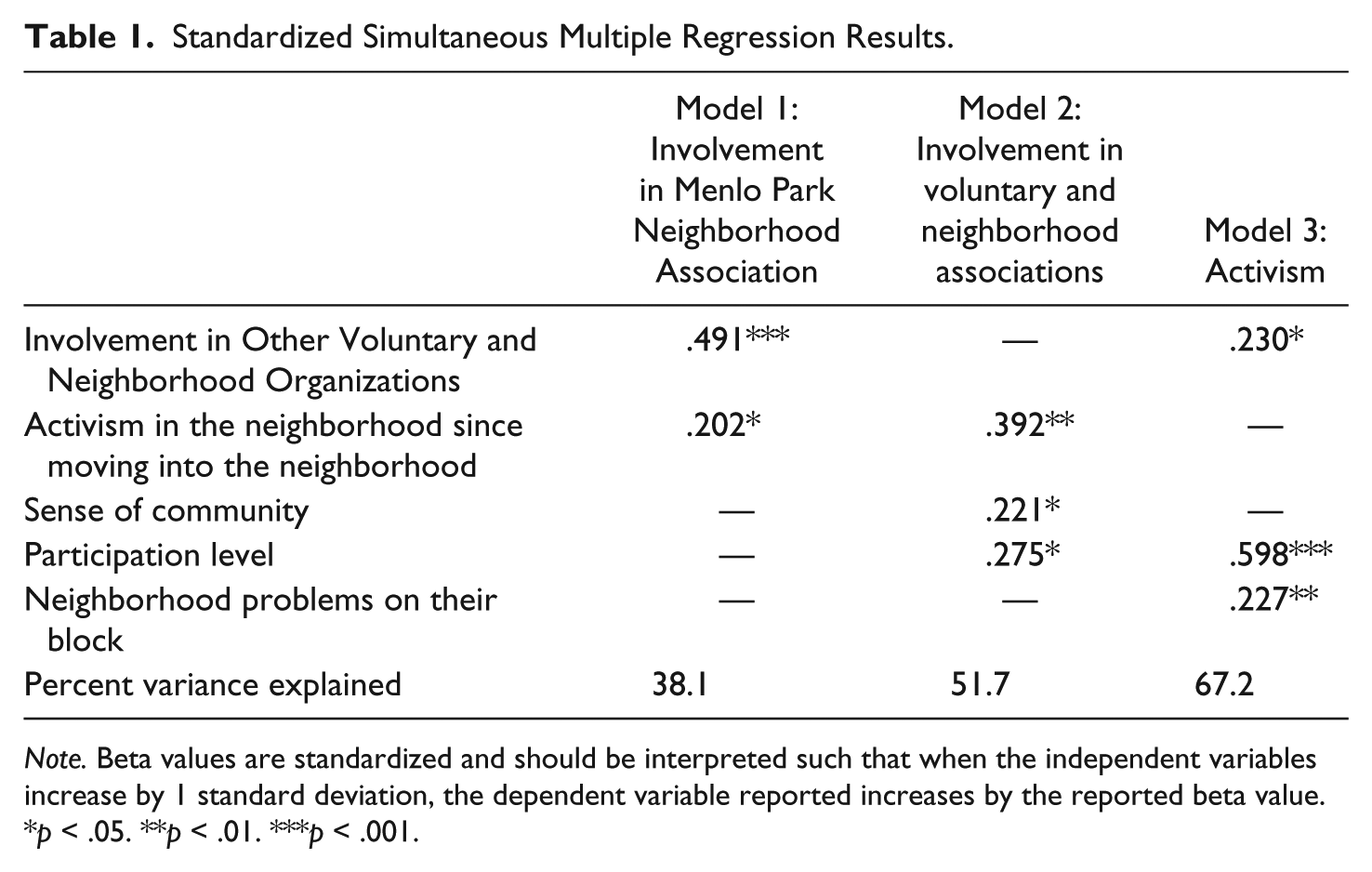
Note. Beta values are standardized and should be interpreted such that when the independent variables increase by 1 standard deviation, the dependent variable reported increases by the reported beta value.
p < .05. **p < .01. ***p < .001.
All six study variables are significant predictors of belonging and engagement. SOC as a measure of belonging only predicts involvement in other voluntary and neighborhood organizations. The length of time of residency as an important component of building SOC was not included in the analysis because it was already reported in a previously published article (Walker et al., 2016). Significant engagement variables include (a) involvement in other voluntary and neighborhood organizations predicts both involvement in the MPNA and activism; (b) activism predicts both involvement in the MPNA and involvement in other voluntary and neighborhood organizations; (c) participation level predicts both involvement in other voluntary and neighborhood organizations and activism; and (d) neighborhood problems on their block only predict activism.
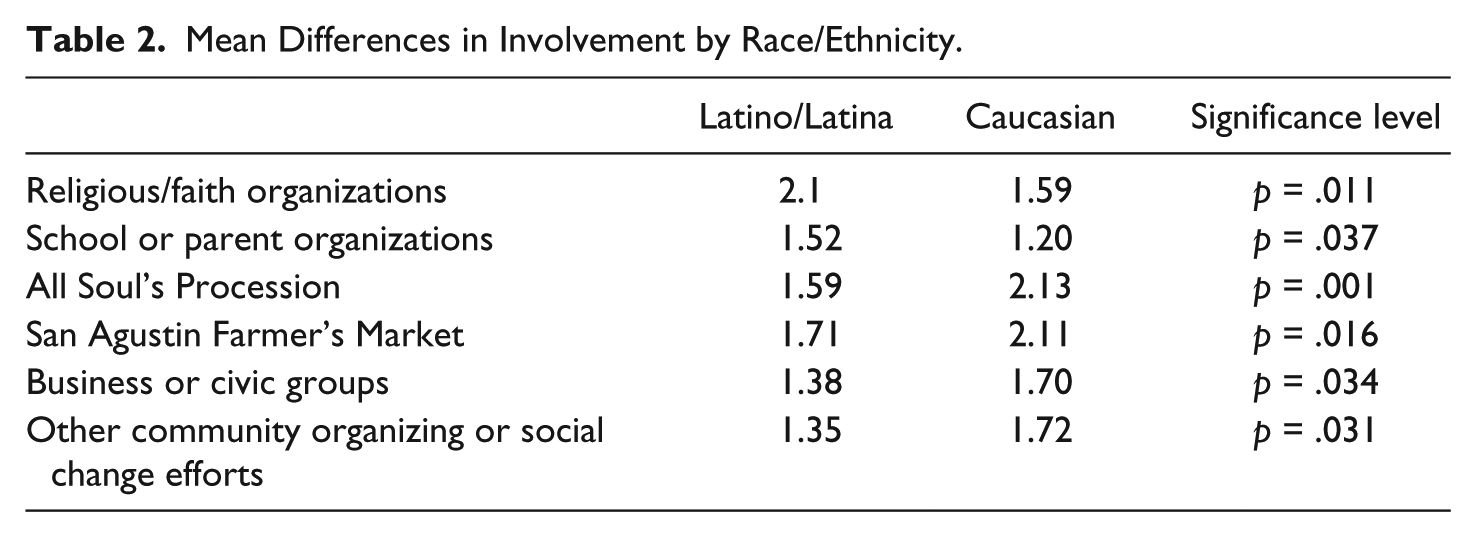
Latino/Latina survey participants were involved at statistically significant higher levels in religious/faith organizations and school or parent organizations (see Table 2). Caucasian survey participants were more involved at statistically significant higher levels in the All Soul’s Procession, San Agustin Farmer’s Market, business or civic groups, and other community organizing or social change efforts.
Mean Differences in Involvement by Race/Ethnicity.
Qualitative Results
Involvement in voluntary and neighborhood organizations
Survey participants were asked to name the types of organizations they are involved with beyond those listed in the survey scale. A total of 15 Latino/Latina participants named 12 different types of organizations they are involved with, including schools, faith-based organizations, an ethnic organization for those who consider themselves Descendants of Tucsón, the Hispanic Chamber of Commerce, bicycling, and organizations focused on neighborhood development, beautification, improving parks, parking, and adding native plants and trees to the neighborhood.
A total of 32 Caucasian survey participants named 26 additional organizations that included personal interests/hobbies (art, crafts, bicycling, dog, and gardening-focused groups), resident councils and associations, business (Chamber of Commerce), planning and development (Bond Project Advisory Committee, Urban Land Institute, a trust focused on a museum at a local fort, a downtown redevelopment-focused organization, a citywide planning organization, and a bicycle planning-focused organization), personal and political identities (a senior center, a Gay Lesbian Bisexual and Transgender-focused group, and door knocking for political candidates), immigration hospitality-focused organizations, as well as food- and dialogue-focused groups. Individual biracial and multiracial survey participants named being involved in a food bank gardening program and a local Moose Lodge. Survey participants were not asked in-depth information about their involvement in these organizations; however, the differences in organizational types across racial/ethnic groups were evident in the listing of additional organizations they participate in.
Reasons residents are involved in the neighborhood association
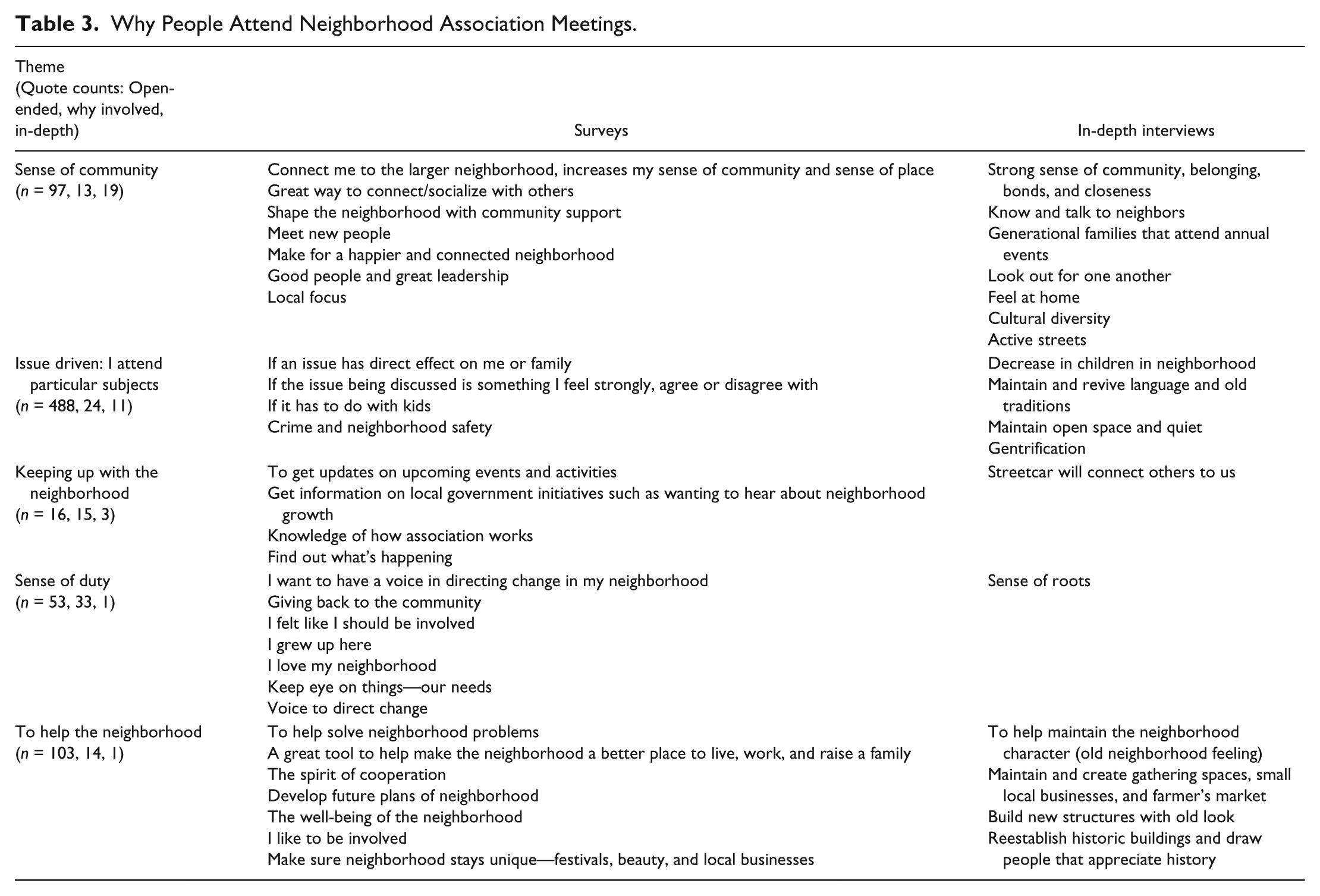
Survey and in-depth interview participants provided five reasons they are involved in the neighborhood association, including (a) a SOC; (b) issue-driven reasons for attending, such as interest in specific topics; (c) keeping up with neighborhood activities, events, and development; (d) a sense of duty; and (e) to help the neighborhood. Each of the themes is defined with a summary of how many quotes informed the theme from the survey data and in-depth interviews (see Table 3). The themes are described with supporting quotes below. The open-ended questions on the survey include an additional 800 unduplicated quotes related to the qualitative themes identified in the initial analysis of why residents are involved.
Why People Attend Neighborhood Association Meetings.
Sense of community
Survey participants state that they have social reasons for attending neighborhood association meetings. Residents describe a SOC and place, as well as their desire to socialize, meet new people, and connect to the larger neighborhood. Attendees participate because they believe the neighborhood is made up of good people, and the neighborhood organizations have great leadership. Involved residents believe they can create a happy and connected neighborhood that is shaped by community-supported initiatives. For example, one survey participant said being involved in local organizations, “connects me to the larger neighborhood, increases my SOC and sense of place, and is a great way to connect/socialize with others.”
Both long-term and newer involved residents wish to maintain the historic character of the neighborhood, which contributes to a SOC in MP. One in-depth interview participant explained the importance of the history of the neighborhood: “We’re there to reestablish the historic stuff that doesn’t exist anywhere else in this country. So to just fill it up with stuff that would be ordinary would be sacrilegious really.”
MP residents take pride in their festivals including the Dia de San Juan Festival and a large celebration for the Fourth of July. One resident explained the SOC that comes from these cultural festivals, “celebrating the Fourth of July, things like that that have been here forever, and it’s part of the ambience. It’s who we are. It’s what we are.” Another resident echoed similar sentiments when he stated, “I want to see all the historic gatherings maintained as permanent. Whatever we have to do to accommodate them, we do so that we can honor the history in that area.”
The development of the Mercado area and the influx of new restaurants and stores had a positive impact on the neighborhood for many residents. Residents see the influx of new restaurants and stores as a new gathering place, and an area to connect with different people. In addition, there is a desire for the neighborhood to embrace more active streets including increased walkability and the maintenance of hiking trails on the mountain within the neighborhood. One resident extrapolated that the neighborhood could benefit from more investment in the walking environment by stating that she would, “like to see more trees, sidewalks, reduced traffic, just more walkability, and cycling.”
In-depth interview participants also described how neighborhood SOC promotes involvement in neighborhood and voluntary associations, including (a) a mix of cultures, incomes, ages, sexual orientations, ethnicities, languages, and educational levels; (b) a long-term group of residents—that are the institutional memory of the neighborhood—who have many accomplishments to be proud of; and (c) a group of long-term and recent residents that are broad-minded people that work together across their diversity. The neighborhood association connects residents across ages and cultures. One resident said, “the elders, the youth, everybody, so that’s the kind of participation that we have in this neighborhood. Everybody works together.” Residents make a concerted effort to respect the historic nature of MP and have participated in the neighborhood association to, “make sure we get local, small business, and the neighborhood stays unique (no cookie-cutter houses), to create open spaces for festivals, [and] to make sure all streets are beautiful.” Long-term residents also described the importance of children in creating an SOC through their play within the neighborhood, school, volunteering, and sporting events.
Issue driven
Survey participants described attending neighborhood association meetings if an issue (a) has a direct effect on them or their immediate surroundings as an individual or family; (b) evokes a strong response from them; or (c) requires addressing crime and neighborhood safety. For example, two survey participants said their involvement in the neighborhood association is, “issue-driven. I attend for particular subjects,” and they attend, “when there is something on agenda which effects my area.” Many survey participants named more than one specific concern related to the streetcar (n = 205) or neighborhood affordable housing (n = 13).
In-depth interviewees talked at length about how specific issues—such as the importance of family, culture, and maintaining a quiet neighborhood—have an impact on their involvement in neighborhood association meetings. Interviewees described a trend toward a decrease in children within the neighborhood, which decreases the need to attend meetings to discuss any issues related to neighborhood youth. Involved residents also discussed their desire to maintain and revive language and old traditions. One involved resident said, I would like to see the level of participation . . . maintained. Where local community members see the best interest of the community at large, not just for looking towards future development, but trying to participate in the things that are dear to us, like the El Dia de San Juan and other festivals that represent the history and the culture of our immediate area and the people that have been here historically. I think I’d like to see maintained the quality and characteristics of our built environment, of the spirit and the personalities the people that have made this place what it is, and made it attractive for—and open-minded enough—to welcome in an equally diverse population today. I think that is an extremely strong characteristic and I’d like to see that maintained.
Involved residents also discussed the importance of maintaining open space, where it is peaceful, quiet, and where you, “can sit outside and hear the birds singing.” The residents note the importance that the neighborhood is near downtown, yet away from the university. The quietness contributes to why they choose to stay in the neighborhood and, therefore, they are not supportive of gentrification, building businesses that will increase traffic, or student housing that they associate with higher density and louder ways of living, such as college parties.
Keeping up with the neighborhood
Survey participants also described attending to (a) get updates on upcoming events and activities; (b) get information on local government initiatives such as wanting to hear about neighborhood growth; (c) gain knowledge of how the association works; and (d) generally find out what is happening. Residents stated that it is “important to know what is happening,” they are, “anxious to know what’s going on” and “like to know what is happening.” For example, one long-term survey participant from a lower income section of the neighborhood said, “I like to keep my eye on things that are of interest to the needs of the old neighborhood. Mercado people do not have needs, they are well taken care of, and so, we have different needs.” Many survey participants talked about economic development (n = 8); however, they presented polarized views of long-term residents mourning the loss of family businesses and previous ideas for development that have not come to fruition versus newer residents with shorter-term investments that see exciting possibilities for streetcar connections to downtown and the aesthetics and community developed at the Mercado. The longer-term residents’ preferences for a quieter neighborhood with historic family businesses versus the newer residents being drawn to the new streetcar-related investments invoke some of the tensions of the neighborhood changes.
In-depth interviewees described an excitement and apprehension that the streetcar will make the neighborhood more visible and connect others to the neighborhood. One involved resident said, the streetcar is an identifiable connector for our neighborhood with the other parts of the core that . . . connects east to west historically and culturally, and in terms of opportunity for business enterprise, access to services, health care, things of that nature, we had been separated from over time.
The streetcar has the potential to connect the neighborhood—which was once disconnected—to services. They described a physical and psychological connection that the streetcar creates to link city residents to festivals, entertainment, health care facilities, and employment centers.
Sense of duty
Survey participants described a sense of duty to participate in a neighborhood association that includes feeling like they should be involved and give back to the community because they grew up in and/or love their neighborhood. Many survey participants named a desire for preserving neighborhood strengths (n = 9) as well as developing youth programs, amenities, and other services (n = 33). They also noted they want to keep an eye on their collective needs being considered and have a voice in directing change. In-depth interview participants described a sense of rootedness in the neighborhood that contributes to their sense of duty in participating in the neighborhood association. In-depth interview themes describe the neighborhood SOC as (a) having a sense of roots where residents have known each other for generations; (b) having a sense of culture via cultural festivals; (c) having active streets where people visit, eat, play, walk, bike, and run; (d) fostering community through outdoor gathering places where residents can visit with neighbors and participate in community events; and (e) how neighborhood SOC promotes involvement in neighborhood and voluntary associations.
Residents stated that the importance of having a sense of roots in the community contributes to their (a) sense of belonging; (b) high regard for the maintenance of historic areas in the community; and (c) feeling of safety in the neighborhood. A long-time Mexican American resident spoke of the togetherness of MP when she said, “Well, I think it’s the feeling of belonging. This is where I belong. This is where we have all belonged. And people die from here. They don’t go somewhere else.”
Many of the residents of MP have been living in the same neighborhood for generations; some have even inhabited the same house for more than four decades. Some of the older residents lamented the closure of the MP School, as it was a place that connected the community members together over the years. A sense of roots has an impact on how residents view the historic character of the neighborhood. One resident stated in an in-depth interview, I like being in the older part of town, where there’s more of a feeling of a sense of roots here. And in the buildings you see the history of the place a little bit more here than you do in other parts of the city.
Helping the neighborhood
Survey participants also describe being involved in the neighborhood association because they like to help, want to cooperate to promote the well-being of the neighborhood, and help solve neighborhood problems. They see their neighborhood as unique and want to ensure they maintain the cultural festivals, beauty, and local businesses. They believe the neighborhood association meetings are a great place to develop future plans of neighborhood and, “are generally a great tool to help make the neighborhood a better place to live, work, and raise a family.”
Survey participants described several neighborhood problems (n = 65), including (a) a lack of road maintenance, traffic management, sidewalks, and pedestrian crossings, which led to issues with speeding traffic; (b) a lack of streetlights, which led to issues with vandalism, graffiti, and unsafe nighttime walks; (c) vacant lots and fires; (d) crime and safety issues related to graffiti; gunshots/shootings; break-ins and theft in homes or mailboxes sometimes by those who made them believe they were friends; assaults or muggings in their own yard; manufacturing, selling, and using drugs or alcohol; litter from alcohol and huffing use on the streets; and people on the streets who sometimes expose themselves; (e) noise from first-responder sirens, helicopter surveillance, barking dogs, feral cats, traffic and accidents, drug sales, and arguing; (f) parking conflicts (neighbors complain or double-park and block them in).
Survey participants described how their neighborhood is unlike other nearby barrios that are decaying. They attribute the difference to how they worked together to help improve the neighborhood in the last 15 years, which included working together to build murals, picnic areas, and speed bumps, tables, and roundabouts to slow down speeding traffic; complete neighborhood cleanups; and work with the neighborhood watch, landlords, city council, the police, and code enforcers to address neighborhood crime. More recently, residents worked together to build community, neighborhood gardens, and a farmer’s market. However, these activities are not new and were historically done in a manner that individuals planted gardens in their yards in places that people who are homeless or in need of food knew they were welcome to eat the food. At least one resident described the desire to create more informal supports such as shared gardens and food banks. The MP neighborhood now has new planned bicycling and pedestrian connections as well as housing, medical, business, and commercial development. Residents reported hoping for an increase in amenities and services, including more trees, stores (including a bigger grocery store and auto-parts stores), and improved police response times.
In-depth interviews describe more specific ways that those involved in the neighborhood association want to help the neighborhood, including (a) maintaining the neighborhood character (old neighborhood feeling); (b) maintaining and creating gathering spaces, small local businesses, and farmer’s market; (c) building new structures with old look; and (d) reestablishing historic buildings that draw people that appreciate history. When responding to the idea of specific possible businesses in the neighborhood, one resident said, A sports bar, my husband would love that. I mean think of all these neighborhood people that would have like a gathering place. I think that would be great. Maybe like a little park area other than the Mercado that people can, you know, sit out there. I guess I’m just looking for that old fashioned feeling.
Discussion
The quantitative and qualitative data results provide evidence that supports expected study results (Almeida et al., 2009; Foster-Fishman et al., 2007; Ohmer et al., 2014; Ready et al., 2006; Walker, 2015). Long-term residents have (a) interest in the development of their part of the neighborhood; (b) a sense of duty because of their generational roots; and (c) a desire to help the neighborhood maintain the culture, beauty, local businesses, and family focus (Almeida et al., 2009; Landale et al., 2006; Mendez, 2005; Perea, 2004; Putnam, 2001; Ready et al., 2006; Uslaner, 2011; Van der Meer & Tolsma, 2014). The study results provide a description of the importance of SOC across groups, which provides more contextual descriptions for a multicultural neighborhood with changing demographics than in previous research (Ahlbrandt, 1984; Ohmer et al., 2014; Wandersman et al., 1981). The long-term Latino/Latina resident responses are consistent with Indigenous cultural concepts related to having a deep sense of connection to the community, a sense of duty to serve the community, and a desire to give back to the community (Tuck & Yang, 2012). The long-term resident descriptions are less about maintaining the look and style of the neighborhood and more about maintaining the people and the culture of the neighborhood throughout the redevelopment process (Mendez, 2005). Despite detailed descriptions of crime and safety on their block, residents are involved in work to maintain a peaceful, quiet, and beautiful character of the neighborhood. Generational Latino/Latina residents described the importance of honoring and maintaining involvement in religions/faith, school-based and ethnicity-based organizations, as well as the Spanish language and Mexican American culture, gatherings, and festivals such as Dia de San Juan that teach ethnic history and traditions across generations of residents. The Caucasian residents have their own patterns of organizational involvement; however, generational and new residents interact at community events and work together in the neighborhood association. The primary study limitation is that the sample was not a large enough to test for differences among the only 20 study participants identified as multiracial (5%), Native American/American Indian (2.8%), African American (1.7%), and Other (1.1%). Therefore, study results only represent the broader perspectives of those who identify with Latino/Latina and Caucasian perspectives in one southwestern city.
Conclusion
This study provided empirical evidence of Smart Growth principles that identify community demographics (race, ethnicity, and religion), existing social assets (sense of belonging and existing informal and formal social networks among generational families involved in organizations), visual representations of culture via festivals, murals, and beautification projects, as well as the need to feel physically safe from crime (Cameron & Potvin, 2016; Jabareen & Ziberman, 2016; Mahapatra & Alam, 2016; Sandoval, 2016). The MP neighborhood had many assets prior to the streetcar-related development, which provide a strong foundation of “joiners” in ethnic, school, and religious organizations that welcome the new residents and demonstrate a willingness to work with them to maintain the neighborhood character and culture within the boundaries of maintaining a quiet neighborhood with local businesses (Baggetta, 2015, 2016; CFC, 2015). Newer residents are involved with different types of organizations; however, neighborhood associations are commonly comprised of multicultural and bilingual residents who interact and build trust within and across groups (Alkon & McCullen, 2010; Baggetta, 2016; CFC, 2015, 2016; Zepeda, 2009). Despite national trends toward noninvolvement, MP residents are engaged and involved in organizations that predict ongoing pathways to involvement and volunteerism (CFC, 2016). Given the growing Latino/Latina population in the United States and involvement in the Catholic Church, the MP neighborhood engagement is promising, assuming they effectively ameliorate any barriers to participation as the neighborhood demographics shift (Allport, 1954; CFC, 2015; Dinesen & Sonderskov, 2015; Landale et al., 2006; Perea, 2004; Putnam, 2001).
Footnotes
Declaration of Conflicting Interests
The author(s) declared no potential conflicts of interest with respect to the research, authorship, and/or publication of this article.
Funding
The author(s) disclosed receipt of the following financial support for the research, authorship, and/or publication of this article: Arizona State University and the University of Montana provided research start-up funds for this research project.
