



Abstract
Increasing third-party intervention in volunteering represents a key change in the environment of volunteering. One significant expression is “workfare volunteering”: the governmental use of volunteering to foster the economic and/or social reintegration of social assistance recipients. We contribute to existing theory on “third-party volunteering” by studying the shifting discursive field in which volunteering becomes re-entangled with workfare volunteering. Our contribution is based on a governmentality-inspired discourse analysis of internal documents on workfare volunteering in one Belgian social assistance center. We conclude that workfare volunteering entails a strong violation of “voluntary” and “unpaid” properties of volunteering, relegates volunteering to an inferior status relative to paid work, and depicts workfare volunteers as suffering from a clear deficit: the inability to work under regular labor market condition. Through the discursive entanglement of various citizenship frames, the workfare volunteer is cast as an ever-aspiring, yet permanently failing citizen.
Keywords
The increasing intervention of third parties in volunteering represents a key shift in the environment and nature of volunteering (Haski-Leventhal, Meijs, & Hustinx, 2010). In particular, government-initiated volunteering (or “volunteering through government”; see Haski-Leventhal et al., 2010) is a growing phenomenon in advanced liberal states (Neville, 2016; see also Haß & Serrano-Velarde, 2015; Kissane, 2010; Muehlebach, 2011; Strickland, 2010; Tõnurist & Surva, 2017). The phenomenon involves a dual movement. First, governments are increasingly promoting volunteering as a valuable and desirable activity (Hustinx & Meijs, 2011), making efforts to enhance the “volunteerability” of the population at large (Haski-Leventhal et al., 2010). Governments at the central and local levels are actively facilitating volunteering through such measures as legislation, campaigning, supportive initiatives, and incentives. Second, volunteering is increasingly being used as a public intervention targeted toward groups in society that are perceived as disadvantaged or “passive” (e.g., migrants, the unemployed, retirees). Such policies “reinvent” volunteering as a “politics of behavior” instrument for the ethical (re-)socialization and responsibilization of such groups toward active citizenship, self-sufficiency, and social integration (Eliasoph, 2011; Hustinx, 2010; Krinsky & Simonet, 2012; Muehlebach, 2011; Slootjes & Kampen, 2017). Although some scholars consider government-initiated volunteering a positive trend that promotes volunteering (e.g., Haski-Leventhal et al., 2010; Stukas, Hoye, Nicholson, Brown, & Aisbett, 2016), others focus on its aspects of “instrumentalization” and “normalization,” especially, in contexts in which it is enforced (Burgess, Mitchell, O’Brien, & Watts, 2000; Hustinx, 2010; Kampen et al., 2013; Muehlebach, 2011; Slootjes & Kampen, 2017; Warburton & Smith, 2003).
One increasingly significant expression of targeted government intervention in volunteering is “workfare volunteering.” Kampen, Elshout, & Tonkens (2013) coined this term to refer to the use of volunteer work in the context of workfare policies. Workfare volunteering is an instrument for the social and, if possible, economic reintegration of social assistance recipients. Such policies transform volunteering into a mandatory requirement for benefit eligibility (Borland & Tseng, 2011; Kampen et al., 2013; Peck & Theodore, 2000; Peck & Theodore, 2001; Warburton & Smith, 2003). In recent decades, this practice has become widely adopted in the West, as evidenced by publications reporting on the United States (Diller, 1998; Kissane, 2010; Krinsky & Simonet, 2012; Peck & Theodore, 2000), Australia (Bessant, 2000; Borland & Tseng, 2011; Burgess et al., 2000; Warburton & Smith, 2003), the United Kingdom (Peck & Theodore, 2001), and other European countries (Borland & Tseng, 2011; Hohmeyer & Wolff, 2012; Kampen et al., 2013; Lub & Uyterlinde, 2012; Slootjes & Kampen, 2017; Tõnurist & Surva, 2017).
Even though current policy and practices treat workfare volunteering as “volunteering” (see e.g., Kampen et al., 2013; Peck & Theodore, 2000; Peck & Theodore, 2001; Slootjes & Kampen, 2017; Spies & van Berkel, 2000; van Berkel, 2006; van Berkel & De Schampeneire, 2001; Van Oorschot, 2002; Warburton & Smith, 2003), the phenomenon has been contested and challenges the conventional understanding of volunteering, particularly, with regard to the core dimensions of “free will” and “non-remuneration” (Cnaan, Handy, & Wadsworth, 1996). The implications for the contemporary understanding of volunteering remain poorly understood. Existing literature on workfare volunteering approaches the phenomenon primarily from a workfare and/or client perspective (see Borland & Tseng, 2011; Hohmeyer & Wolff, 2012; Kampen et al., 2013; Krinsky & Simonet, 2012; Slootjes & Kampen, 2017). In contrast, we aim to contribute to existing theory on volunteering by approaching workfare volunteering as a significant new expression of “third-party volunteering” (Haski-Leventhal et al., 2010). A deeper understanding of the way in which volunteering is “re-embedded” (Hustinx & Meijs, 2011) in these new governmental practices calls for a distinct analytical approach. To this end, we develop a new analytical framework of “governing through volunteering,” based on governmentality theory inspired by Foucault (Dean, 2010; Miller & Rose, 2008; Rose, 2010). We concentrate on the critical analysis of political rationalities, discourses, and technologies supporting this type of third-party volunteering, aiming to reveal the shifting discursive terrain and meaning-production in which “volunteering” has currently become re-entangled (compare Neville, 2016). Paraphrasing Kissane (2010), we thus focus on the “bureaucratic face” of third-party volunteering. In other words, we seek to explain how workfare volunteering unfolds discursively in the concrete mission and operational strategies of public administrations and to identify its discursive effects on the meaning and dimensions of volunteering. Following governmentality theory, we assume that discourse is productive of reality (Bacchi, 2012; Dean, 2010; Miller & Rose, 2008; Rose, 2010) and, therefore, constitutes a crucial object of investigation within a broader “politics of volunteering” (Eliasoph, 2013).
Governing Through Volunteering: Shifting Rationalities and Discourses
Workfare volunteering consists of third-party volunteering in the policy and practice of social assistance and workfare. Various authors have situated the origin of workfare in the social–political shift from a welfarist to advanced liberal governmentality (e.g., Clarke, 2005; Dean, 1995; Deeming, 2016; Hamilton, 2014; McDonald & Marston, 2005; Peck & Tickell, 2002; Rose, 2000; Schram, Soss, Houser, & Fording, 2010). In contrast to earlier collectivist welfare logic, advanced liberal governmentality acts on the self-governing properties of citizens (Clarke, 2005; Dean, 1995; McDonald & Marston, 2005). In this social–political context, “citizenship becomes conditional upon conduct” (Rose, 2000, p. 335) as evidenced by novel political mentalities and practices that . . . seek to shape and regulate individuality in particular ways. Liberal strategies of government thus become dependent upon devices . . . that promise to create individuals who do not need to be governed by others, but will govern themselves, master themselves, care for themselves. (Miller & Rose, 2008, p. 204)
Workfare volunteering can thus be regarded as a “technology of citizenship” (Cruikshank, 1999). In general, activation practices aim to define and steer proper and legitimate conduct on the part of welfare recipients by micromanaging their behavior (Dean, 1995; Rose, 2000). In addition to providing financial assistance and job training, these practices “seek to shape the desires, needs, aspirations, capacities and attitudes of the individuals who come within their ken” (Dean, 1995, p. 567), up to the point at which assistance benefits become conditional upon the establishment of a particular relation to the self. The ultimate goal of this “politics of behavior” is the responsibilization of the excluded, thereby reconstructing their self-reliance and independence while re-establishing their attachment to “circuits of civility” (Caswell, Marston, & Elm Larsen, 2010; Clarke, 2005; Maron, 2012; Rose, 2000). According to Rose (2000, p. 334), moreover, the process of responsibilization and re-affiliation serves to reformulate the problems of those who are excluded in terms of ethics or morality. In other words, they are approached as “problems in the ways in which such persons understand and conduct themselves and their existence,” which should be alleviated through “empowerment” (Cruikshank, 1999; Rose, 2000). Such “ethopolitics” (Rose, 2000) are echoed more specifically in policies on workfare volunteering—a novel activation device through which inactive individuals are forced to assume a dual responsibility: for themselves and the community (Ilcan & Basok, 2004; Lub & Uyterlinde, 2012; Neville, 2016; Newman & Tonkens, 2011). This responsibility is enforced through structures of positive and negative sanctions, conditional upon their willingness (or unwillingness) to participate (Bessant, 2000; Diller, 1998; Hohmeyer & Wolff, 2012; Kampen et al., 2013; Krinsky & Simonet, 2012; Peck & Theodore, 2001; Warburton & Smith, 2003).
Scholars of volunteering have paid considerable attention to the relationship between volunteering and the labor market in general, noting increased interest in volunteering as a component of labor market policies. As observed by Kamerāde and Paine (2014), “the assumption that volunteering can contribute to employability and provide a route into employment has been a consistent feature within recent policy discourse and in government-funded programs” (p. 260). Empirical research has demonstrated that volunteering by unemployed people contributes to individual employability factors by enhancing such aspects as knowledge, skills, work attitudes, networks, confidence, mental and physical health, and well-being (Kamerāde & Paine, 2014; see also Benenson & Stagg, 2016; Piatak, 2016). More specifically, Kampen and colleagues (2013) report that workfare volunteering has the potential to help social assistance recipients regain self-esteem, even if it remains fragile. As reported by Nichols and Ralston (2011), in addition to enhancing employability, volunteering provides social inclusion benefits “by enriching volunteers’ lives and empowering them to make new choices” (p. 900). Cohen (2009) concludes that volunteering can be an effective intervention tool in empowering social work practices by enhancing self-efficacy and critical awareness in social assistance recipients.
As reported by Kamerāde and Paine (2014), the employability-related benefits of volunteering are not always sufficient to compensate for structural inequalities that limit the employment chances of certain categories of unemployed people (see also Benenson, 2017; Benenson & Stagg, 2016; Kissane, 2010; Paine, McKay, & Moro, 2013). Paine et al. (2013) argue that this could be due to the concept of “employability” as applied in policy discourses and its overemphasis on individuals’ skills and abilities. In this sense, although volunteering contributes to the supply side of the labor market, it has no effect on the weaknesses of the demand side, thus potentially negating any gains in employability through volunteering.
More generally, Slootjes and Kampen (2017) identify an odd co-existence between logics of empowerment and employability in active labor market policies and related activation practices, including workfare volunteering. Although the logic of empowerment is emancipatory, focusing on the needs, choices, and voices of “empowered citizens,” the logic of employability is conditional on the obligation and responsibility of “worker-citizens” to seize every possible opportunity to find paid jobs. Despite the apparent contradiction, Slootjes and Kampen (2017) argue that these two logics can reinforce each other as “a boost in self-confidence and control over one’s life may be expected to increase someone’s employability” (p. 1904). Instead of being an end in itself, empowerment can be a means of production that subjects vulnerable groups to the economic imperative of being productive citizens, with a unilateral focus on individuals acting on their own behalf (Zimmerman, 2017).
Critical scholarship has thus questioned the managerial and liberal individualist thrust in workfare policies, regarding both empowerment and employability as neoliberal devices that largely ignore the structural causes of inequality and excessively emphasizing the “deficits” of clients and the moral imperative to “earn one’s citizenship” (Benenson, 2017; Benenson & Stagg, 2016; Dean, Bonvin, Vielle, & Farvaque, 2005; Fuller, Kershaw, & Pulkingham, 2008; Piatak, 2016). Existing research suggests that the practice has little benefit and that it can even produce adverse outcomes. For example, Warburton and Smith (2003) report that, despite the objective of creating active citizens, the enforced nature of workfare volunteering and the associated feelings of exploitation can actually weaken the citizenship identities of those targeted. As observed by Borland and Tseng (2011), participation in workfare volunteering has a “significant adverse effect on the likelihood of exiting unemployment payments” (p. 4353; see also, Diller, 1998; Hohmeyer & Wolff, 2012). Similarly, Krinsky and Simonet (2012) argue that workfare volunteering in New York City’s municipal parks has led to the invisibilization of work performed by social assistance recipients as their activities are not fully recognized as work, whether subjectively, objectively, symbolically, legally, or monetarily (see also, Bessant, 2000; Diller, 1998). In the context of Australia, Bessant (2000) observes that the denial of legitimate entitlements is even deliberately enabled by strategically redefining the labor performed by social assistance recipients as “non-work” to avoid the applicable employer’s responsibilities. Furthermore, Cohen (2009) concludes that social assistance recipients predominantly remain “objects of volunteer work,” such that, “thus far only a relatively small number of welfare clients have been activated as volunteers” (p. 522).
More generally, scholars have argued that existing theories of volunteering fail to capture the specific reality of vulnerable groups. Piatak (2016) links this to the “social equity critique of volunteering, which, drawing on the dominant status model, suggests volunteering may perpetuate power imbalances” (p. 18). Following the philosophical thought of Amayarta Sen and Martha Nussbaum, various authors (e.g., Benenson & Stagg, 2016; Dean et al., 2005) propose a “capability approach” to the active participation of vulnerable groups in society (particularly, with regard to workfare volunteering). Human capability entails “a person’s ability to do valuable acts or to reach valuable states of being (. . .) the various ‘functionings’ he or she can achieve” (Sen, 1993, quoted in Zimmerman, 2017, p. 66). As emphasized by Zimmerman (2017), the human capabilities framework departs from the managerial understanding of “human capital,” which reduces people to “human resources” or “commodities” (compare Dean et al., 2005), as it concerns “the freedom a person has to achieve what they have good reasons to value” (Zimmerman, 2017, p. 66). “Capability” implies a true emancipatory logic that broadens conceptions of “work” and “contribution” beyond the narrow boundaries of paid employment, implying a broader focus on “human development” that transcends specific employment skills. This perspective makes it possible to approach unpaid work as a decommodified caring activity and a matter of voice: “life first” instead of “work first” (Dean et al., 2005). Moreover, capability as freedom to achieve depends on both individual action and collective frameworks that shape such action (Benenson, 2017; Benenson & Stagg, 2016; Dean et al., 2005; Zimmerman, 2017). Holistic policy approaches and interventions are needed (Dean et al., 2005).
In summary, our literature review shows that workfare volunteering re-embeds volunteering within a complex and contradictory conceptual terrain, which includes emancipatory and disciplinary approaches, as well as individual and collective frameworks, albeit with “paid work” as a main reference point. This shifts the social–political field of volunteering away from its previous understanding as clearly distinct from paid work. The analytical axes along which workfare volunteering is situated in the literature are depicted in Figure 1. In our empirical study, we explore the discursive terrain of workfare volunteering in a concrete organizational practice.
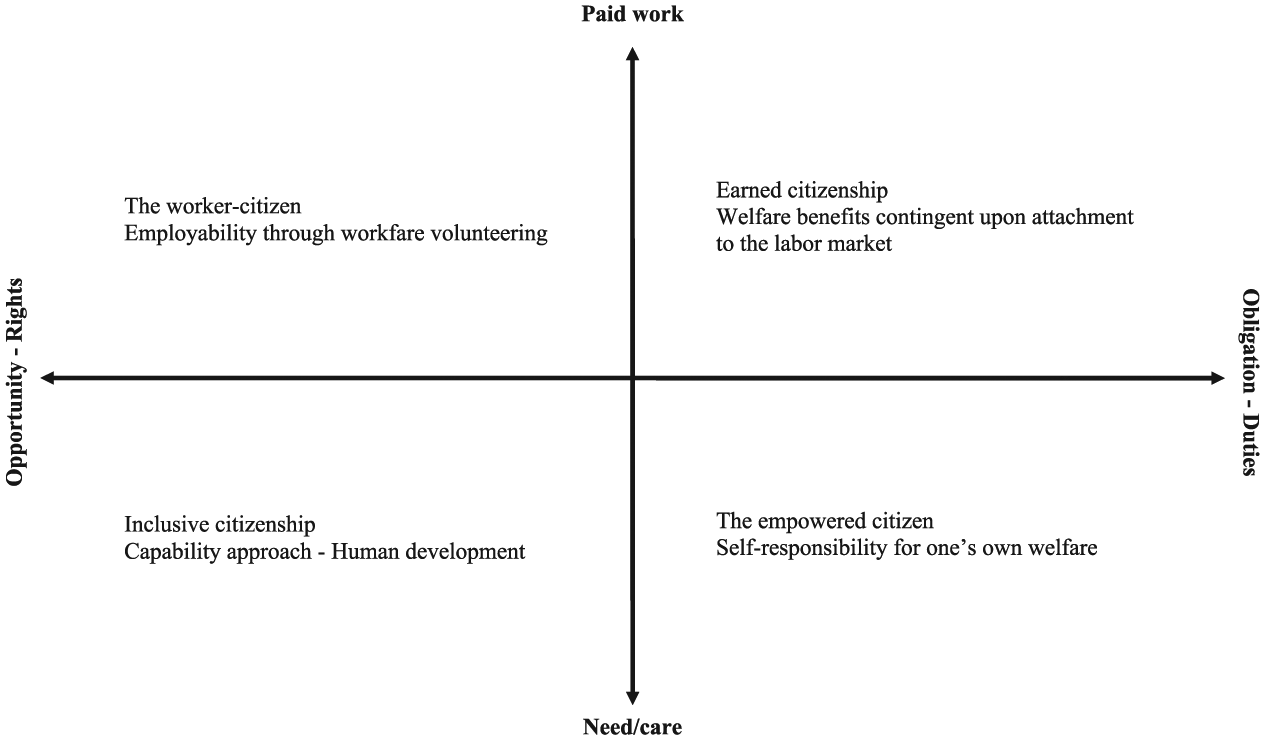
Analytical framework of workfare volunteering.
Method
Context and Case Selection
In Belgium, workfare volunteering has developed within the context of “social activation” (Van Dooren, Kuppens, Druetz, Struyven, & Franssen, 2012). This expression of activation was first developed in the Netherlands, targeting the most vulnerable social assistance recipients: those who are at “a large or even insurmountable distance from the labour market” due to personal factors (Spies & van Berkel, 2000; van Berkel, 2006; van Berkel & De Schampeneire, 2001, p. 35; Van Oorschot, 2002; Weil, Wildemeersch, & Jansen, 2005). As a “last-resort measure,” social assistance concerns clients with greater barriers toward labor market integration (Trickey, 2000, p. 255; Van Dooren et al., 2012). As argued by Trickey (2000), “passive” social assistance claiming has become increasingly problematized, thereby blurring the boundaries between “work-able” and “non-work-able.” Recipients who had previously been exempt from labor activation are now regarded as potentially economically active, and social activation activities are seen as socially valuable as they are based on the normative assumption that “activity” is preferable to “passivity.” In this regard, social activation aims to promote participation in unpaid activities (e.g., volunteering), either as preparation for labor market participation or as enabling inclusion in a wider sense (Spies & van Berkel, 2000; van Berkel, 2006; van Berkel & De Schampeneire, 2001; Van Oorschot, 2002). While participating in social activation, those involved remain on social assistance (Spies & van Berkel, 2000).
In Belgium, social activation has recently been developed within the context of Public Centers for Social Welfare (PCSWs; Hermans, 2005; Hermans, Raemaeckers, & Casman, 2010; Van Dooren et al., 2012). Based in municipalities, PCSWs are established by law (Organic Law of July 8, 1976 concerning the Public Centers for Social Welfare; hereinafter, “the PCSW Act”) and charged with providing advice and assistance regarding the rights and benefits of their clients, in addition to financial, material, and social assistance, employment services, and arranging for complementary facilities (e.g., child care, health care, elder care) adjusted to the needs of the municipality (PCSW Act, Art. 60; Luyten, 1994; Verschuere & Vancoppenolle, 2010).
During the 1990s, PCSWs gradually joined the emerging activation trend (Hermans, 2005; Raeymaeckers & Dierckx, 2009; Vranken, Geldof, & Van Menxel, 1999). On May 26, 2002, the law concerning the right to social integration (hereinafter, “the RSI Act”) was introduced. This law implied a shift in political rationality, creating a framework within which PCSWs could activate their clients (Hermans, 2005; Raeymaeckers & Dierckx, 2009). Although employment assistance was already established in Article 60, Paragraph 7 and Article 61 of the PCSW Act 1 (Hermans, 2005; Hermans et al., 2010), the RSI Act explicitly reformulated such assistance within the framework of activation. The activation framework implies a direct coupling of rights, which had been unconditional under the PCSW Act, to obligations (Bouverne-De Bie, 2005; Luyten, 1994). The Act linked eligibility for benefits to the obligation to demonstrate “willingness to work,” unless prevented by health reasons or fairness considerations (RSI Act, 2002: Art. 3, 5).
Initially, the activation of social assistance recipients focused primarily on labor activation (Hermans, 2005; Vranken, Geldof, & Van Menxel, 1997; Vranken et al., 1999). More recently, however, PCSWs have generally tended to broaden the activation concept to include social activation (Hermans et al., 2010). This tendency emerged as PCSWs were confronted with the limits of labor activation regarding clients at considerable distance from the labor market (Hermans et al., 2010; Van Dooren et al., 2012).
Our study is based on one purposively selected PCSW. As an expression of social activation, workfare volunteering is a relatively new phenomenon in Belgium, and it is not yet implemented by all PCSWs. Nevertheless, recent federal policy developments have focused on promoting the participation and social activation PCSW users. In an exploratory study, Van Dooren and colleagues (2012) found that, relative to PCSWs in smaller municipalities, those in large to very large municipalities are more likely to implement workfare volunteering to have specialized departments within which workfare volunteering is embedded and to anchor workfare volunteering in their internal policies. We therefore selected an “extreme case” (Flyvbjerg, 2006, p. 229; see also Danermark, Ekström, Jakobsen, & Karlsson, 2002) in terms of the size of the municipality in which the PCSW is embedded. Exploratory interviews confirmed that workfare volunteering is already well-established and formally rationalized within the selected PCSW, thereby suggesting the availability of abundant, well-developed data (Flyvbjerg, 2006, p. 229; see also Danermark et al., 2002).
Data Collection and Data Analysis
Our analysis was inspired by the governmentality perspective (Bacchi, 2009; Dean, 2010; Miller & Rose, 2008; Rose, 2010). The analytics of governmentality focus on how governing works (Dean, 2010), with the aim of uncovering the thinking that is presumed to underlie specific governmental assemblages (Bacchi, 2009) and unraveling how and to what effect “thought is made practical and technical” within these assemblages (Dean, 2010, p. 27). This analytical framework constitutes the general background for our data analysis, in which we specifically focus on the deployment of volunteering in the governmental assemblage within which it is embedded and the discursive effects of this deployment on the meaning and dimensions of volunteering.
Our analysis is based on formal (i.e., more or less rationalized) internal documents from the selected PCSW. As argued by Miller and Rose (2008), “language is not merely contemplative or justificatory, it is performative” (p. 57). Language and discourse are constitutive of both government (Rose, 2010) and its subjects (Warburton & Smith, 2003). Governing occurs through problematizations (Bacchi, 2009, 2012; Miller & Rose, 2008), which are informed by political rationalities (Bacchi, 2009). In their turn, political rationalities are based on framing processes: “[ways] of selecting, organizing, interpreting, and making sense of a complex reality to provide guideposts for knowing, analyzing, persuading, and acting” (Rein & Schön, 1993, p. 146). Based on these insights, the internal texts of the PCSW provided a legitimate data source for our study. Moreover, focusing on these formalized texts allowed the systematic investigation of the governmental assemblage surrounding workfare volunteering in its most rationalized form (in contrast to, for example, interviews, observations, or other methods).
For purposes of text selection, we obtained unlimited access to the internal computer drives of the PCSW’s activation department in early 2015. This department constitutes the core of the framework addressed in this study as it is by and in this department that workfare volunteering is developed and applied. All documents used in this study were selected from these drives by the researchers. To avoid misunderstandings concerning the documents that would be used for analysis, additional agreements were made after the first phase of document selection with regard to the kind of documents that the PCSW would release for analysis. The PCSW sets only one condition: We could use no documents containing personal information on individual social assistance recipients. The initial selection had not included any such documents. The unlimited access to the internal computer drives and the mild conditions for document selection allowed the researchers full control over data selection. This constituted a major advantage, given the inherently interpretive nature of text selection (Bacchi, 2009). Data selection occurred systematically (i.e., according to our selection criteria rather than the potentially ad hoc criteria of the research informants), and no key documents were known to be withheld.
Text selection occurred in two phases. In the first phase, 31 documents were selected and analyzed according to insights gained through exploratory interviews. Based on the outcomes, an additional 59 documents were selected. The selected texts were of two types: “prescriptive” and “descriptive.” Prescriptive texts are more or less rationalized “texts whose main object (. . .) is to suggest rules of conduct.” They are intended to offer “rules, opinions, and advice on how to behave as one should” and “designed to be read, learned, reflected upon, (. . .) tested, and [used] to constitute the eventual framework of everyday conduct” (Foucault, 1986, pp. 12-13). Although descriptive texts are also rationalized, they describe practices relating to workfare volunteering and its broader context. These text definitions served as criteria for systematic text selection.
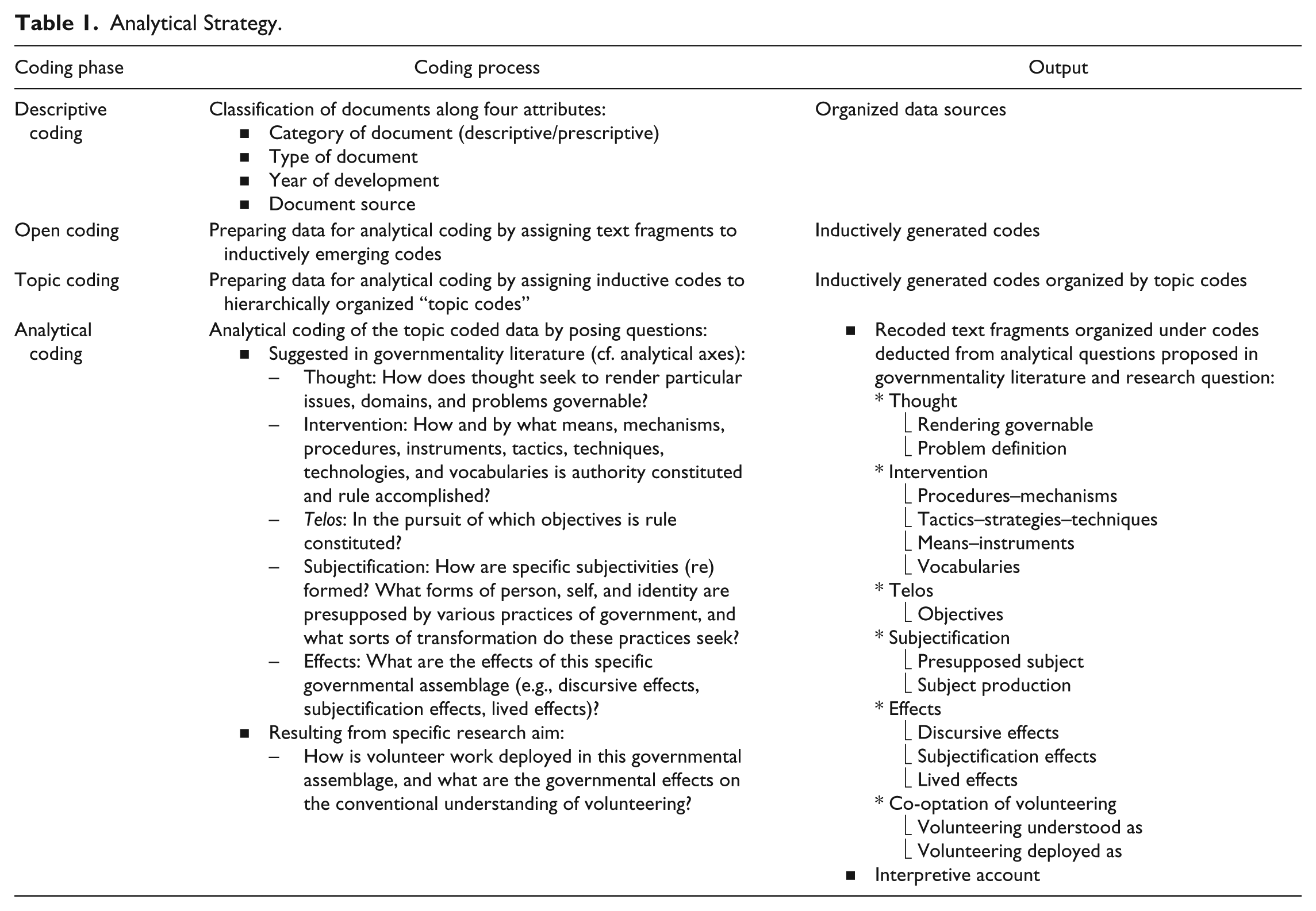
Our analysis is based on four coding phases, largely inspired by Richards (2005): descriptive coding open coding (a coding phase borrowed from Strauss & Corbin, 1990), topic coding, and analytical coding (see Table 1). We used NVivo software throughout the coding process. During the descriptive-coding phase, we classified each document along four attributes: category of document (descriptive/prescriptive), type of document, year of development, and document source (see Table 2). We discerned seven types of documents from various sources in the PCSW. They had been developed in the period 2000 to 2015. The distinction between descriptive and prescriptive documents was made according to the main goal of the documents. Those whose primary goal was interpreted as informative were categorized as descriptive. Those whose main goal was interpreted as providing an operational framework to the PCSW actors were categorized as prescriptive. Because the documents in the two categories exhibited considerable overlap (in some cases, word-for-word) in terms of content, however, the distinction between the two categories had no analytical value. In the open-coding phase, we carefully broke down the data and conducted inductive examination. Across the documents, excerpts referring to similar issues were assigned the same code (Strauss & Corbin, 1990). During the topic coding phase, we sorted and “rebuilt” the data across the texts by allocating related codes to hierarchically organized “topic codes.” Finally, during the analytical coding phase, we recoded the topic coded text fragments along five analytical axes distilled from the governmentality literature (Bacchi, 2009; Dean, 2010; Miller & Rose, 2008; Rose, 2010): (a) thought-production systems (“How does thought seek to render particular issues, domains, and problems governable?”); (b) regimes of authority (“How and by what means, mechanisms, procedures, instruments, tactics, techniques, technologies, and vocabularies is authority constituted and rule accomplished?”); (c) telos of authority (“In the pursuit of which objectives is rule constituted?”; (d) practices of subjectification (“How are specific subjectivities formed [or re-formed]? What forms of person, self, and identity are presupposed by different practices of government, and what sorts of transformation do these practices seek?”); and (e) governmental effects (“What are the effects [e.g., discursive effects, subjectification effects, lived effects] of this specific governmental assemblage?”) 2 . Interpretation involved posing analytical questions concerning the recoded text fragments with regard to the analytical axes suggested in the governmentality literature and emerging from our specific research question (“How is volunteering deployed in this governmental assemblage, and what are the governmental effects on the conventional understanding of volunteering?”).
Analytical Strategy.
Overview of Documents Analyzed.
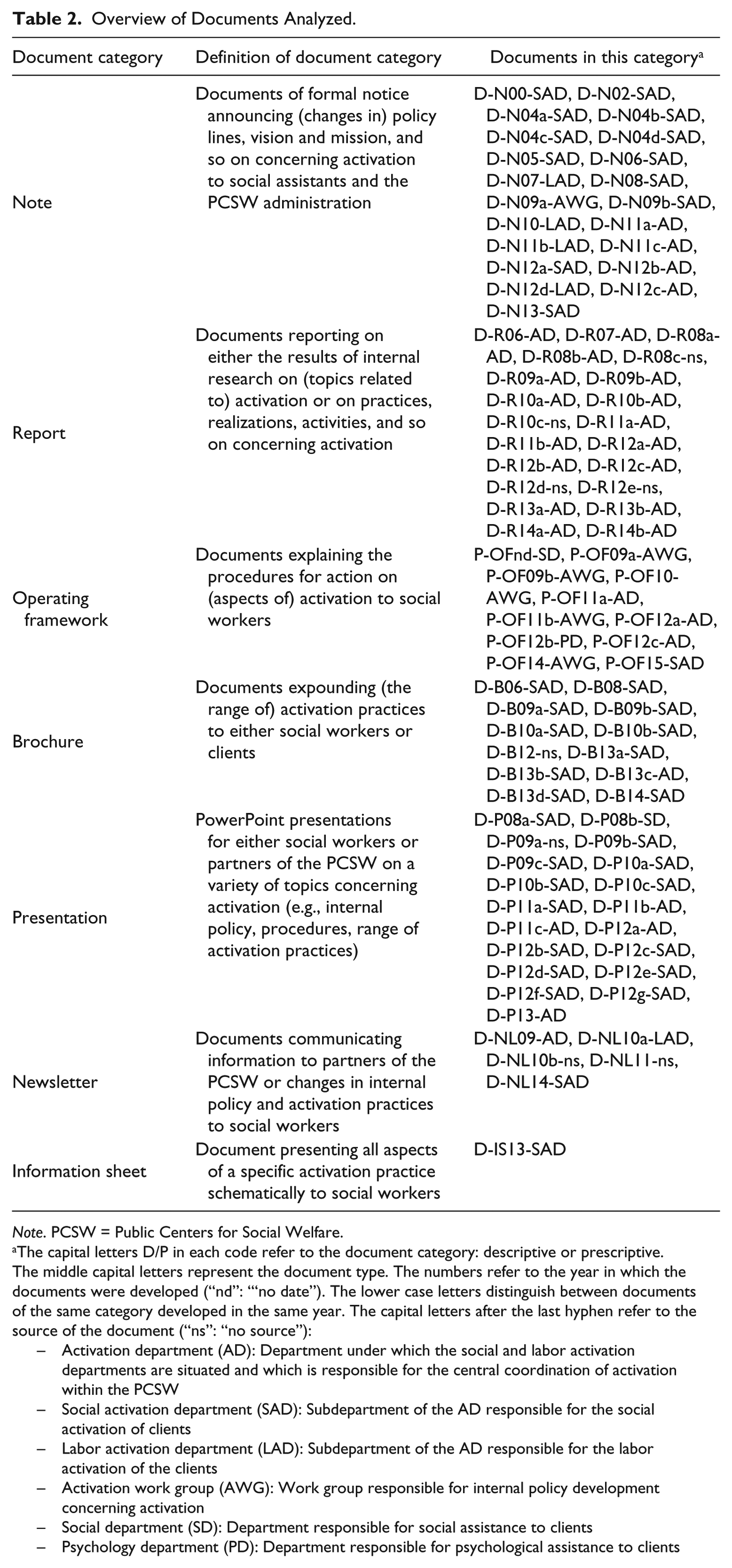
Note. PCSW = Public Centers for Social Welfare.
The capital letters D/P in each code refer to the document category: descriptive or prescriptive. The middle capital letters represent the document type. The numbers refer to the year in which the documents were developed (“nd”: “‘no date”). The lower case letters distinguish between documents of the same category developed in the same year. The capital letters after the last hyphen refer to the source of the document (“ns”: “no source”):
– Activation department (AD): Department under which the social and labor activation departments are situated and which is responsible for the central coordination of activation within the PCSW
– Social activation department (SAD): Subdepartment of the AD responsible for the social activation of clients
– Labor activation department (LAD): Subdepartment of the AD responsible for the labor activation of the clients
– Activation work group (AWG): Work group responsible for internal policy development concerning activation
– Social department (SD): Department responsible for social assistance to clients
– Psychology department (PD): Department responsible for psychological assistance to clients
Following the data analysis, we conducted a “member check” on our interpretations (Creswell & Miller, 2000; Merriam, 1995). More specifically, we discussed the interpretation of the data in a focus group consisting of the head of the PCSW’s social activation department, the chief social assistants, and several social activation assistants. In their perceptions, the findings positioned the practice of workfare volunteering within a broader whole, thereby deepening their understanding of the practice. They deemed the findings both credible and valid.
Findings
Our analysis is structured in four parts. First, we focus on the “thinking” underlying the expression of workfare volunteering addressed in this case: How is workfare volunteering deployed in the process of rendering those targeted governable? What is the general system of thought for the organizational practice in which workfare volunteering is inscribed? What is the particular problem warranting governmental intervention? Which “regime of truth” legitimizes governing the identified problem? This part of the analysis also reveals the production of a new governmental subject. In the second part, we reveal the telos of the practice, providing insight into the specific objectives of workfare volunteering in governing those targeted. Third, we take a closer look at the “intervention logics” or “technologies” of workfare volunteering. In the final part, we reflect on the discursive effects of workfare volunteering, that is, how the “governmentalization” of volunteering challenges the conventional understanding of volunteering.
Thought
In our data
3
, workfare volunteering is also referred to as “assisted volunteering” (e.g., D-R14a-AD) or work care (e.g., D-N10-LAD). The practice is a manifestation of social activation, developed as a client-adjusted, low-threshold activation offer (D-R12a-AD; D-R12b-AD; D-B13c-AD; D-R13a-AD; D-R13b-AD; D-R14a-AD) for clients who are not (or not yet) ready for economic activation, but who “nevertheless want to accept an engagement” (D-R12a-AD; D-R13a-AD; D-R14a-AD; D-R12b-AD). Social activation was thus introduced as a “bridging practice” within a broader activation trajectory, with paid employment as the highest attainable goal. The trajectory broadens activation practices, but within a clear hierarchy of types of activation, and thus types of activities and clients. This is emphasized through the use of such terms and phrases as “the bottom of the client base,” goals that are “too high to reach,” “intermediate steps in the path to work,” and the “activation ladder”
4
in selected text fragments. Although clients may be situated at the highest possible level (given their personal circumstances), paid work is clearly the dominant frame of reference and ultimate end, with “volunteering” and work care being means to that end: Some years ago, this was the conclusion: we offer an elaborate array of labor-activation practices, but there are We distinguish
More specifically, this new governmentalization practice is based on a two-dimensional thought system. First, the document analysis revealed a particular “truth” about work, as illustrated in the following description of the target group of assisted volunteering/work care and, by implication, social activation: It concerns Given the
Social activation addresses a particular problem: the temporary or permanent inability of a group of clients to work according to regular labor market conditions. These conditions—contractual relationships, volume, speed, product quality, and resilience to stress—reflect a productivity logic and a commodified approach to labor. The PCSW’s “work-first” approach thus subscribes to a prevailing market logic.
A subsequent element in the production of the overall thought system is the strategic broadening of the labor concept. After diagnosing the governmental problem as the inability of a particular segment of clients to conform to the dominant labor market norm, this problem is rendered governable by producing a subsidiary “truth” that “a broader definition of labor is necessary” (D-P12e-SAD; D-P12f-SAD): By
Although the PCSW arguably reproduces such binary thinking through its clearly articulated “work-first” approach, this second line of thought also directs strong criticism against reducing work to wage labor (Zimmerman, 2015). It seeks to overcome such reductionist thinking through two key arguments. First, it highlights the structural inequality ingrained within the current labor market, which fails to offer feasible and sustainable jobs for this target group, thus denying them real possibilities to exit their marginal positions. A truly emancipatory and inclusive policy would diversify meanings of work beyond low quality jobs and more general economic participation: On the one hand, we want serve
Given that such change-oriented advocacy work is regarded as a long-term project, a second argument emphasizes the societal value of activation beyond labor market participation. It also addresses the “latent functions” (P-OFIS-SAD) of labor, which apply to both paid employment and unpaid work. Although these latent functions are not mentioned in descriptions of labor activation, they play a crucial role in legitimizing social activation practices: We see activation more broadly than economic activation alone, but as In work care, we provide The
Although the first system of thought is legitimized through reference to the dominant framework of the capitalist market system, the second line of argumentation appeals to a logic of rights: If labor market participation (as the preferred form of participation in society) is not (or not yet) within the reach of clients, their right to work should be effectuated through other forms. This allows for societal contributions other than economic productivity. The social activation department advocates a broad conception of labor as “a source of social value” (D-P12f-SAD; D-P12e-SAD; D-N12b-AD; D-N12c-AD; D-N13-SAD; D-B13a-SAD; D-B13b-SAD; D-B14-SAD; P-OF15-SAD), redefining it as “social participation” (D-N12a-SAD) in “socially-useful initiatives” (D-P12f-SAD; D-P12e-SAD). Social activation is thus legitimized first by re-valuing unpaid work by emphasizing the psychosocial and socially valuable functions of work and, second, by opposing the exclusion of welfare recipients from these functions.
It is crucial to note that this general system of thought is inherently intertwined with the discursive production of a new governmental subject. Because existing economic activation measures are inaccessible to a large group of clients, the subjectivities of these clients should be redefined to legitimate new governmental intervention strategies. Instead of being categorized as “non-activatable”—a governmental dead end—this group is now re-conceptualized as “not (or not yet) ready for employment” but “able to perform work” and “willing to accept an engagement.” Although this group had previously been seen as facing insurmountable barriers to activation (D-R10b-AD; D-N11b-LAD), it is now approached as clients with the potential to be economically, or at least socially, active. Social activation this group contributes to an implementation of activation beyond a mere economic goal (cf. Peck & Tickell, 2002) as it renders a wider target group governable: With this method [work care/assisted volunteering] At the individual level, social activation aims to Starting from what
More specifically, the subjectification practice clearly proceeds from a “deficit model”: Social activation seeks to assist the most vulnerable PCSW clients who are unable to perform contractual labor and who will remain in a permanent position of welfare dependency. Nevertheless, such “failure” to reach the “highest” activation goal is countered by taking a client perspective, adapting activation aims to the needs of clients, as well as to their personal well-being and what they consider a valuable activity. This perspective reflects a “capability approach” (Dean et al., 2005; Zimmerman, 2017). Society is called upon to change its perspective and acknowledge that even the most vulnerable citizens have strengths and can contribute to society—even if economic self-sufficiency is out of reach.
In summary, social activation is legitimized through a two-dimensional thought system. The central point of departure is a “work-first” perspective, thus confirming paid employment as the dominant societal norm. Only if this goal is out of reach will a broader or adapted notion of work and contribution be allowed, with a social justice agenda and capability perspective coming into play. In the following section, we present a closer analysis of how volunteering is inscribed in social activation by considering its concrete objectives as part of the general rule, as well as how it unfolds as a particular governmental technology.
Telos
Volunteering is incorporated into the extended activation framework as part of the redefinition of valuable labor. Workfare volunteering is described as a form of “adapted work” or “assistance”: The work is Those who do not immediately get jobs because of a multitude of problems also
As an element of social activation and reflecting the two-dimensional general thought system, workfare volunteering has a dual objective within the hierarchy of activation ends: economic integration or, if that is beyond reach, social integration (e.g., D-B13c-AD; D-N08-SAD; D-R09a-AD; D-R10a-AD; D-R11a-AD; D-R12a-AD; D-R13a-AD; D-R14a-AD). First, workfare volunteering can be considered a route toward employment for clients capable of climbing the activation ladder. This reflects the more general insight that volunteering can serve as a springboard to labor market integration for the unemployed, thereby contributing to the “employability” of this group. Given that social activation specifically targets clients for whom economic activation is not achievable, a second objective of workfare volunteering is that it provides an alternative to employment.
The preceding discussion points to three specific functions of work. In work care/assisted volunteering, “work” is first linked to “care” (D-N00-SAD) or the “therapeutic effect of work” (D-R06-AD; D-R07-AD) as a way to meet basic psychosocial needs through the latent functions of work: The
Although the “caring” aspect is most commonly defined in terms of healing or seeking personal well-being and quality of life, the second and third functions of work care/assisted volunteering are linked to the two main objectives of social activation: “empowerment” and “activating assistance”: Empowerment strives for
In this context, workfare volunteering is applied in an effort to offer learning opportunities with the aim of “maximum growth” (D-R13b-AD, D-B13c-AD, D-R12b-AD), aiming to help clients find a “feasible perspective on the future” (D-N12a-SAD) and achieve some form of “self-reliance,” socially and, if possible, professionally/financially (D-B13a-SAD; D-B13d-SAD; D-B14-SAD; D-N11a-AD; D-N12b-AD; D-N12c-AD; D-N13-SAD; P-OF15-SAD).
It could be noted that these “caring” and “emancipating” functions remain close to conventional understandings of volunteering (clearly echoing the “understanding,” “protective,” and “understanding” functions of volunteering in the firmly established Volunteer Functions Inventory by Clary & colleagues, 1998). At first glance, it could be regarded as contributing to a more inclusive, capability-based volunteering practice (cf. Benenson & Stagg, 2016). Nevertheless, the additional objective of “activating assistance” introduces a conditional and contributory logic into social activation that clearly sets workfare volunteering apart. “Activating assistance” focuses on “integration in society” through “feasible engagement,” although “individuals must exert effort to foster their own integration” (D-N08-SAD). In this context, the “rights” of clients are explicitly linked to their “duties.” More specifically, this conditionality rests on the concept of “willingness to work” in Belgian law concerning the right to social integration (cf. “Method”), and it includes the possibility of sanctioning clients: The law stipulates that
Clients who do not comply with the willingness-to-work condition risk either a temporary, partial, or, in extreme cases, full denial of social assistance benefits (D-P09a-ns; D-P12a-AD). It should be noted, however, that “clients should preferably receive positive encouragement ‘to become active’” (D-N09a-AWG; P-OF09a-AWG) and that negative sanctions are imposed only “if there is no other option” (P-OFnd-SD).
A third way in which volunteering is incorporated into the activation framework is thus by treating it as an expression of “willingness to work,” and thus as a way of fulfilling the obligation to make an effort to contribute to and integrate in society. Volunteering facilitates such efforts through “client-adjusted engagement,” meaning that “clients must engage according to their abilities” (D-N09a-AWG; P-OF09a-AWG; P-OF09b-AWG; D-NL09-AD). Notwithstanding its “adjusted” nature, volunteering is incorporated into a contractual and obligatory relationship between the PCSW and the client, with noncompliance incurring negative sanctions: [The RSI Act] links eligibility for benefits to the Working on one’s own situation/competencies (e.g., participating in therapy, rehabilitation, agreements, social assistance, language courses, pre-trajectories or education, or group work) with a view to future social engagement Social engagement: in other words, reciprocation to the society providing the financial assistance (e.g., through volunteering, work care, subsidized labor, or regular labor). (D-R08c-ns; P-OF12a-AD) In addition to engagement on the part of the social worker and the organization, Within the RSI Act, clients must demonstrate their willingness to work in order to be eligible for financial assistance.
The conditionality within which work care/assisted volunteering is embedded ultimately draws volunteering into a logic of quid pro quo (D-P09a-ns; D-N08-SAD; D-N09a-AWG; D-NL09-AD; D-P10c-SAD; D-R08c-ns; D-R10a-AD; D-R11a-AD; D-R12a-AD; P-OF09b-AWG; P-OF0a-AWG; P-OF12a-AD; P-OFnd-SD), thus transforming it into a duty or obligation (D-NL09-AD; P-OF09b-AWG; P-OF12a-AD). As an “adjusted” engagement, volunteering ultimately becomes an instrument of self-responsibilization for clients to assume their duties as citizens: We see social activation as a story of rights and duties, in which we want to
Intervention
Insight into the specific objectives of workfare volunteering in social activation raises the question of how it is implemented in concrete social work practice. First, work care/assisted volunteering is performed in two types of settings: “subsidized” and “non-subsidized” workplaces (P-OF15-SAD). Subsidized workplaces are situated either within the PCSW or in the nonprofit sector. They function as “work-integration social enterprises”: organizations that “seek to help poorly qualified unemployed people who are at risk of permanent exclusion from the labor market return to work and to society in general through productive activity” (Vidal, 2005, p. 807). Nonsubsidized workplaces are situated in the public and nonprofit sectors. They are traditional settings for volunteering, which are not specifically focused on work integration In subsidized workplaces, the PCSW provides the financial resources for a “technical instructor,” a professional charged with assisting clients, both those engaged in work care/assisted volunteering and in assisted employment (a form of labor activation in which the PCSW or a partner organization hires the client and functions as the employer; Hermans, 2005; P-OF15-SAD). In nonsubsidized workplaces, no technical instructors are present. Instead, one person is appointed as the client’s assistant. The data indicate that, although referral to subsidized workplaces is advisable for clients in need of more structure and closer assistance, “vacancies” in such settings are very limited due to the priority given to assisted employees (P-OF15-SAD). This provides further evidence of the weak client base for social activation.
Before starting their activities, all clients in work care/assisted volunteering sign “volunteer agreements” (D-NL14-SAD, P-OF15-SAD) containing arrangements between the social activation department, the client—referred to in the agreement as “the volunteer”—and the setting in which the work care/assisted volunteering will be performed. The arrangements concern such matters as the activities the client will perform, when the client will be present, the assistance that will be provided, and any liabilities (P-OF15-SAD). The volunteer agreement is explicitly distinct from an employment contract. Instead, it is an instrument for recording reciprocal engagements and a way to recognize the client. The volunteer agreement also provides the client with insurance (D-N00-SAD).
Clients receive a stipend of €1.25 per hr in addition to their social assistance benefits (D-N08-SAD; D-NL14-SAD; P-OF15-SAD; D-R11a-AD; D-R12a-AD). The volunteer agreement refers to this amount as a “fixed reimbursement of expenses,” explicitly distinguishing it from a wage. In other documents, however, it is described as either an “encouragement premium” (D-NL14-SAD) or a “work-care premium” (D-P12b-SAD). The motives for such payments are thus unclear. As noted in one source, “the payment of compensation is deemed important out of respect and appreciation for the clients, but less because of the work aspect” (D-N00-SAD). Another source states the contrary: “The compensation is a reimbursement for work performed by the client” (D-N08-SAD).
Depending on their capacities and abilities, clients are engaged part-time in work care/assisted volunteering (D-R06-AD; D-R07-AD; D-R08b-AD; D-R11a-AD), ranging from a half-day to 4 full days per week. The engagement is gradually intensified (D-R13b-AD; D-B13c-AD; R12b-AD). Once a client has participated in work care for several full days a week, the perspective of assisted employment is “always discussed in terms of maximal engagement of the acquired competences offering the most beneficial status” for the client (P-OF15-SAD).
Throughout the work care/assisted volunteering experience, the client receives “individual social-activation assistance” (D-R14a-AD) from an “activation assistant.” The activation assistant is a social worker affiliated with the social activation department (D-R12d-ns; D-R12e-ns; D-R12b-AD; D-R12c-AD) and functioning as the “client’s assistant, contact for the workplace, and mediator between the two” (D-R12b-AD; D-B13c-AD; D-R13b-AD). In general, individual social activation assistance comprises three steps (D-B13a-SAD; D-B13b-SAD; D-B13c-AD; D-B13d-SAD; D-B14-SAD; P-OF15-SAD): (a) The activation assistant drafts an “activation profile” for the client, in which the client’s “competences are made visible, areas of concern are identified, and prerequisites for successful social activation are formulated” (D-B13a-SAD; D-B13b-SAD; D-B13c-AD; D-B13d-SAD; D-B14-SAD; P-OF15-SAD); (b) an appropriate form of activation is determined together with the client (D-B13a-SAD; D-B13b-SAD; D-B13c-AD; D-B13d-SAD; D-B14-SAD; P-OF15-SAD); and (c) with a view to competence development and creating possibilities for advancement in the activation path, the client is monitored through evaluations (D-B13a-SAD; D-B13b-SAD; D-B13c-AD; D-B13d-SAD; D-B14-SAD; P-OF15-SAD). More specifically to work care/assisted volunteering, this means that a suitable setting is sought based on the client’s activation profile. This occurs in dialogue with the client (P-OF15-SAD). Once an appropriate setting is found, the client’s tasks and the mutual expectations are discussed during an introductory interview, and the volunteer agreement is signed (P-OF15-SAD). After 1 month, 6 months, and then yearly, evaluations are held between the social activation assistant, the client, and the person assisting the client in the nonsubsidized workplace/the technical instructor in the subsidized workplace. The first evaluation is “informal,” with subsequent evaluations having a more “formal” character (P-OF15-SAD). The evaluations are intended to provide the clients with insight into their functioning in the workplace, as a function of the further activation trajectory. Although negative evaluations are not directly linked to possible sanctions, it is important to consider the broader enforcement policy to which all activation practices are subjected. As part of the PCSW Act’s emphasis on “the need for clients to comply with their duties” (D-NL11-ns; D-R11b-AD; D-R12b-AD; D-R13b-AD), enforcement is developed into a “structured and systematic approach” (D-NL11-ns) by means of a gradual process: from “positive motivation” (prevention) to “legitimate confrontation” (cure) and “appropriate sanctioning” (repression; D-N09a-AWG; P-OF09a-AWG; P-OF09b-AWG; P-OF12b-PD; D-P11a-SAD; D-NL11-ns; D-R11b-AD; D-R12b-AD; D-R13b-AD). It is nevertheless stressed that “clients should preferably be prompted in a positive way ‘to become active’” (D-N09a-AWG; P-OF09a-AWG; P-OF09b-AWG). “Motivating conversation” is therefore suggested as “the basic method to encourage and activate [the client]” (D-NL09-AD; D-N08-SAD; D-P08a-SAD).
Given that “positive motivation” is not a conclusive strategy, the data repeatedly raise the question of what should be done if motivation does not work (P-OF12b-PD; D-N08-SAD; D-N09a-AWG; P-OF09a-AWG; P-OF09b-AWG). If a client refuses to cooperate in the activation trajectory or does not comply with the agreements made, the social worker is instructed to investigate “whether it is a case of ‘inability’ or ‘unwillingness’” (D-N08-SAD; D-N09a-AWG; P-OF09a-AWG; P-OF09b-AWG; D-NL09-AD). In case of “clear unwillingness,” in which “no obstructions can be identified that would hinder the client from activation, the social assistant must address the client about this matter (legitimate confrontation) and determine an appropriate sanction, if necessary” (D-N08-SAD; D-N09a-AWG; P-OF09a-AWG; P-OF09b-AWG). Sanctions are always financial, entailing either a temporary, partial denial of benefits or, in extreme cases, full denial of social assistance benefits (D-P09a-ns; P-OFnd-SD). Reinstatement requires demonstration of “new elements” (i.e., “elements indicating a changed attitude and willingness to work”; D-NL11-ns; P-OF11b-AWG).
Notwithstanding this systematic approach to sanctioning clients, the avoidance of sanctions is strongly emphasized (D-P12a-AD; P-OFnd-SD; P-OF9a; P-OF10-AWG; P-OF11a-AD; P-OF11b-AWG; P-OF14-AWG). It is stated that “the ultimate goal remains social integration” (D-P12a-AD). In addition, sanctions are intended as methodical instruments for the facilitation of behavior modification by the client (P-OFnd-SD). With regard to the most vulnerable clients, an approach adjusted to their needs and abilities is also stressed. Hence, regarding social activation, the observation is made in the data that sanctions remain exceptional. Nevertheless, in our case governing through workfare work care/assisted volunteering is based on “dividing practices” (Miller & Rose, 2008). Whereas clients who are willing or persuaded to participate are approached through empowering practices, those who are unwilling are subject to being approached repressively.
Discursive Effects
To assess the discursive effects of the “governmentalization of volunteering” on the conventional understanding of volunteering, we can start by identifying the definitional problems confronting the PCSW. One major contradiction is between the voluntary nature of work care/assisted volunteering and its conditional and ultimately repressive nature. Although work care/assisted volunteering is repeatedly characterized as “voluntary unpaid labor” (D-R09a-AD; D-R10a-AD; D-R11a-AD), the use of the term volunteer/volunteering is simultaneously questioned: We nevertheless question the term “assisted volunteering.” “Volunteer” is not a good choice in the context of activation. It sometimes implies a “forced” expression of activation, even if work care is negotiated in a motivating conversation with the client. (D-N10-LAD)
The data thus reveal a terminological struggle (D-N08-SAD). On one hand, references to work care seem to associate the practice with work. On the other hand, the same practice is referred to as “assisted volunteering,” which links the practice to volunteering (P-OF09a-AWG; P-OF09b-AWG; D-N09a-AWG). In 2009, the suggestion was made to call the practice work care for clients referred to subsidized workplaces and “assisted volunteering” for clients active in nonsubsidized workplaces (P-OF09a-AWG; P-OF09b-AWG; D-N09a-AWG). In 2010, in response to requests from the traditional volunteer settings to which clients (among others), the decision was made to refer to the practice as work care (D-N10-LAD) regardless of the setting. Nevertheless, data from after 2010 continue to contain the terms “volunteer,” “volunteering,” and “voluntary” (e.g., D-NL14-SAD; P-OF15-SAD; D-R14a-AD; D-R13a-AD; D-R12a-AD; D-R11a-AD). Conceptual ambiguity in defining work care/assisted volunteering as either “volunteering” or “work” thus persists in the practice of social activation.
This conceptual ambiguity clearly testifies to the controversial nature of the practice from a volunteering perspective. The compulsory nature of workfare volunteering, linked to the risk of being denied welfare benefits, represents a strong violation of two fundamental characteristics of volunteering: its voluntary and unremunerated nature. Ironically, the very inherent qualities of volunteering allow for its discursive entanglement with both strongly emancipatory and deeply disciplinary political rationalities. On one hand, volunteering is used as a discursive tool to formulate a sharp critique on contemporary neoliberal markets, calling for the recognition of other forms of work. In this context, the discursive effect is a renewed emphasis on volunteering as a decommodified activity, with a principal social value and social integrative function, and as a symbol of the quest to transform work beyond its reductive and exclusionary neoliberal form. On the other hand, it is precisely the same nature of volunteering that enables new governmental practices in terms of the “adapted” discipline of vulnerable populations. In this context, the discursive effect is a renewed emphasis on volunteering as a commodified activity that can be weighed against the norm of paid employment. “Voluntary engagement” is discursively reconstructed as a “willingness to reciprocate” to the society that provides the welfare recipient with a basic means of subsistence, as accomplished through “job-like” activities. An emerging politics of conduct constructs workfare volunteers as perpetually aspiring, yet permanently failing citizens. It is indeed remarkable that the social activation discourse continues to retain the “ultimate” goal of economic participation, even though the target group is highly unlikely to reach this goal. An aspirational logic is therefore applied, in which social participation is always weighed against the higher end of full economic participation, serving primarily as a signal of good citizenship and deservingness. In this particular “political economy of hope” (Novas, 2006), the most vulnerable welfare recipients are discursively recast as citizens with potential to become economically active in the future and a current ability and willingness to undertake social engagement. As an “adapted” form of work, volunteering becomes an “offer that cannot be refused”: Considering that activation offers so many possibilities, reasons of fairness become the exception instead of the rule. (D-N08-SAD; D-N09a-AWG; D-NL09-AD; D-P08a-SAD; P-OF09a-AWG; P-OF09b-AWG; see also P-OF12a-AD) Clients should be willing to work. This is more than an obligation, however, as on their own, benefits cannot guarantee life in human dignity. (D-R11a-AD)
This aspirational logic is co-produced through a peculiar discursive silence on at least two matters. First, the quality of the paid (or unpaid) work offered to this extremely vulnerable target group is not discussed. Although a sharp critique is formulated against structural exclusion from the labor market, the fact that a sustainable job is an unattainable goal for most of them is not made explicit. As argued by Standing (2011), the global market economy has produced a new class structure, in which the “precariat” is becoming the largest class—one condemned to a life of unstable, nonremunerated, and unrecognized labor. The discursive ambiguity on the precise nature of workfare volunteering, as well as the lack of description on the types of activities conducted by workfare volunteers, evades questions concerning the practice as a form of underpaid and subservient labor—involving images of exploitation. In line with Krinsky and Simonet (2012), Diller (1998), and Bessant (2000), it could be argued that work care/assisted volunteering is not fully recognized and treated as work. As confirmed by the outcomes of work care/assisted volunteering, this practice is permanent for the majority of those targeted, leaving them trapped in a conditional and thus potentially precarious situation. This relates to the second discursive silence: the complex organizational field in which workfare volunteering is situated, and the implied “governmentalization” of nonprofit organizations as partners in such social activation practices. The literature contains little discourse on the presumed resistance of nonprofit organizations (NPOs) to such instrumentalization of volunteering by the government or to the complexities involved in working with these vulnerable clients, thereby producing new exclusionary mechanisms (compare Hustinx & De Waele, 2015; Hustinx, De Waele, & Delcour, 2015). It has nevertheless been recognized that workfare volunteering may not deliver on the emancipatory promise of social activation: Otherwise, we must conclude that
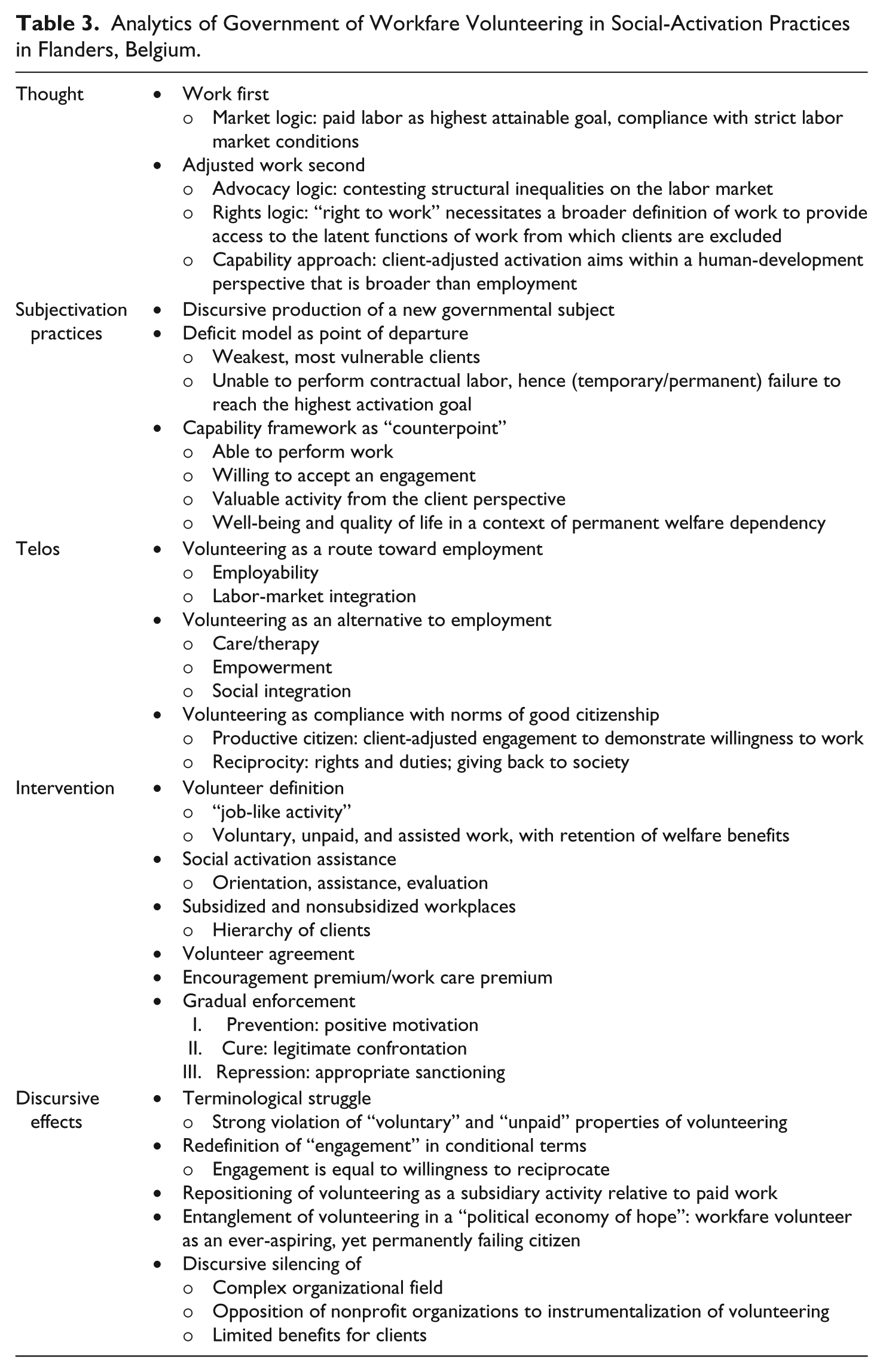
In Table 3, we summarize our findings across the various dimensions of the proposed “analytics of government” for workfare volunteering.
Analytics of Government of Workfare Volunteering in Social-Activation Practices in Flanders, Belgium.
Conclusion
This article addresses the governmental discourse underlying workfare volunteering as an increasingly significant expression of third-party volunteering, in which governments aim to foster the economic and/or social integration of social assistance recipients. It is intended to provide insight into the shifting discursive field in which volunteering is becoming re-entangled with workfare volunteering, as well as into the effects this has on the meaning and dimensions of volunteering. In Figure 2, we illustrate the discursive terrain of workfare volunteering emerging from our governmentality-inspired analysis of the internal prescriptive and descriptive documents of one PCSW in Flanders, Belgium. The “governmentalization of volunteering” through social activation clearly re-embeds volunteering within a different “order of worth” (Boltanski & Thévenot, 1991/2006), with labor market participation as the dominant norm and ultimate means for full participation in society. This relegates volunteering to an inferior status relative to paid work, and workfare volunteers suffer from a clear deficit: the inability to work under regular labor market conditions. Workfare volunteering is legitimized as a governmental solution to the problem by discursively constructing it as either a route toward employment or, if that is impossible, an alternative to employment.
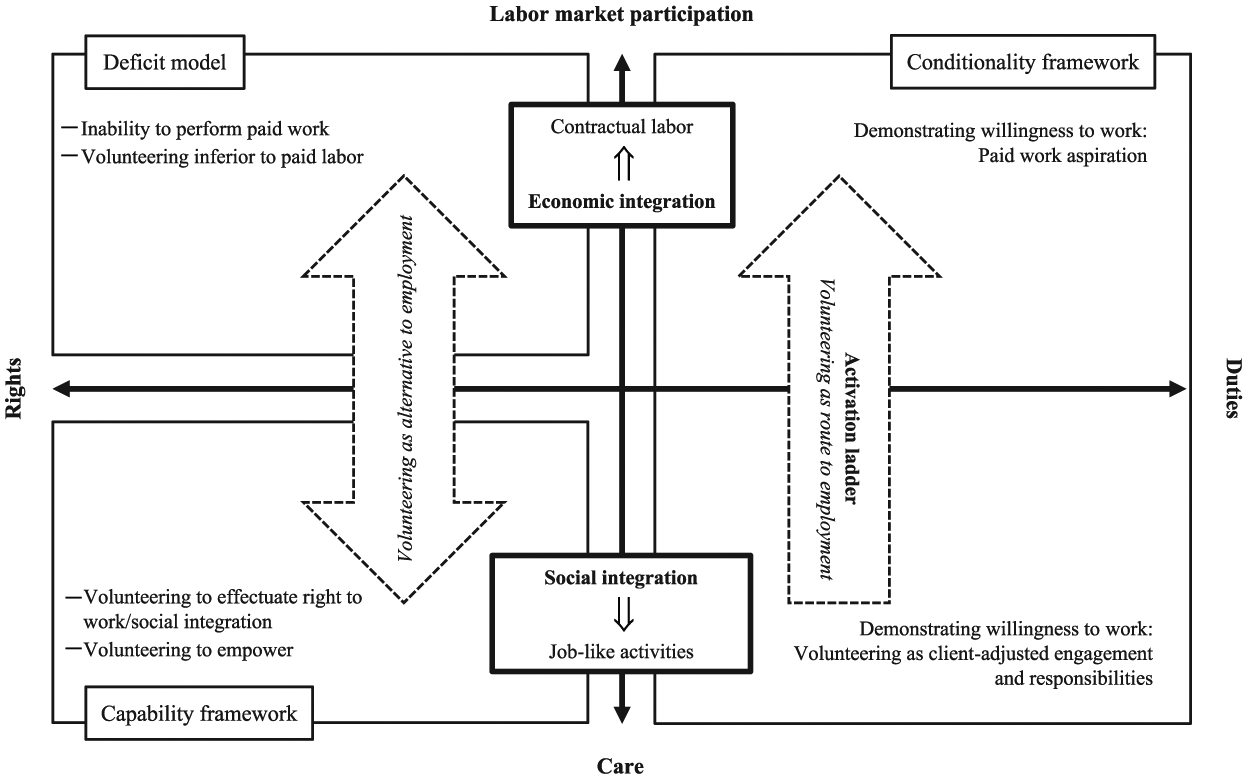
Discursive field of workfare volunteering.
Although depicting volunteering as an alternative to employment allows for a truly emancipatory and inclusive approach—staging volunteering as an alternative and even more desirable way to effectuate the right to work and social participation—the emancipatory logic is inscribed within an underlying conditional framework that makes the right to empowerment and inclusion conditional upon the willingness of welfare recipients to work in the form of an “adjusted” engagement. This quid-pro-quo logic transforms workfare volunteering into a disciplinary device, as a form of “work” and “contribution” that is feasible for even the most vulnerable citizens and that may potentially lead to full integration. As argued above, volunteering entails an inherent tendency to subject vulnerable groups to such aspirational logic.
The incorporation of volunteering into the conditional activation framework has the potential to depoliticize volunteering. In this conditional context, volunteering might lose its focus on the needs, choice, and voice of “empowered citizens” (cf. Slootjes & Kampen, 2017), possibly making it a practice of exploitation that remains discursively hidden under the multiple benefits of volunteering.
Footnotes
Declaration of Conflicting Interests
The author(s) declared no potential conflicts of interest with respect to the research, authorship, and/or publication of this article.
Funding
The author(s) disclosed receipt of the following financial support for the research, authorship, and/or publication of this article: This research was supported by research grant G.0336.10 of the Research Foundation - Flanders (FWO-Vlaanderen) to Lesley Hustinx.