



Abstract
Little research has investigated different religious dimensions, for example, public and private religiosity, in contribution to participation in different voluntary services and specific secular volunteering domains, and whether these dimensions have different effects on voluntary services and volunteering domains. Furthermore, this research has tested whether public religiosity is a mediator and/or a suppressor of the effects of private religiosity on volunteering. Of a representative sample of general adults, the current study found that public and private dimensions of religiosity significantly predicted more participation in different voluntary services and specific secular volunteering domains and public religiosity had stronger effects than did private religiosity. Irrespective of the dimension, religiosity was more strongly related to some voluntary services and volunteering domains than to others. Importantly, the effects of private religiosity on secular volunteering are significantly mediated and suppressed by public religiosity, but the reverse is not true. Implications for volunteerism for nonprofit organizations are briefly discussed.
Keywords
Introduction
Despite increasing appeals by nonprofit organizations for volunteers, a decline in volunteerism has been witnessed (Johnston, 2013). Volunteerism is indispensable to most nonprofit organizations: It is essential to the sustainability of social services (Becker & Dhingra, 2001). Therefore, it is important for researchers to identify possible motivators for engagement in voluntary services. Religion is likely a contributor. Almost all world major religions support some universal prosocial and altruistic values and tenets that promote volunteerism (Johnson, Okun, & Cohen, 2013; Krause & Hayward, 2015; Musick & Wilson, 2007; Vermeer & Scheepers, 2011). Nevertheless, religious effects on volunteering are far from conclusive. Some scholars support a strong positive association between the two (Vermeer & Scheepers, 2011; Wang & Handy, 2014), whereas others have not found such a connection (Grossman & Parrett, 2011). Thus, Prouteau and Sardinha (2015) reported, There are no consistent results with respect to the correlation between religion and volunteering. Such a situation does not allow us to conclude that there is no relationship between the former and the latter, but it makes us inclined to think that the relationship is complex. (p. 247)
Studies on volunteering indicate that researchers tend to define religiosity by one-faceted or single-item measures (Forbes & Zampelli, 2014; Vermeer & Scheepers, 2011), such as “frequency of attendance at religious services” and/or “importance of religion,” ignoring its multifaceted nature. Some recent studies have tapped into different dimensions of religiosity but have only examined religious indicators of religious dimensions in connection with volunteering individually (Paxton, Reith, & Glanville, 2014; Vermeer & Scheepers, 2011), omitting the interrelated nature of religious indicators within the same religious dimension.
In addition, many philanthropic researchers have treated volunteering as a simple dichotomous outcome by using a “yes/no” dummy variable to classify volunteers and nonvolunteers (Johnston, 2013; Manning, 2010; Son & Wilson, 2012; Vermeer & Scheepers, 2011).
This classification may overlook the diversity of participation in different services and specific volunteering domains formed by related voluntary services concurrently. Although some researchers have classified volunteering as participation in religious and nonreligious volunteering (Johnston, 2013; Wang & Handy, 2014), this broad classification may not specify the relationship between religion and different types of voluntary services and volunteering domains concomitantly, especially secular ones. Moreover, no prior research has explored whether the effects of public and private religiosity on participation in different voluntary services and specific volunteering domains are significantly different from each other. This comparison is important for nonprofit organizations for volunteer recruitment and planning. Furthermore, some studies reached their conclusions on the relationship between religion and volunteering by relying substantially on nonrandom samples, which may easily induce selection bias and difficulty of generalizability (Cnaan, Kasternakis, & Wineburg, 1993).
In light of these concerns, the current study intended to investigate the effects of religion on volunteering, by treating religiosity as multi-item and multifaceted measurement and considering volunteering as participation in multiple voluntary services and different specific volunteering domains. This study also used a representative sample of general adults from the Survey of Texas Adults 2004 to enhance generalizability and external validity of the findings.
Theoretical Framework for the Relationship Between Religiosity and Volunteering
Religion is in principle closely related to volunteerism due to its prosociality and altruism (Unruh & Sider, 2005), strength in mobilizing believers (Iannaccone, 1994), and close links with secular nonprofit social organizations (Ammerman, 2005). In the past two decades, “network explanation theory” and “value-orientation thesis” are the two dominant theoretical perspectives proposed by scholars to explicate the connection between religion and volunteering (Becker & Dhingra, 2001; Van Tienen, Scheepers, Reitsma, & Schilderman, 2011). Of the network explanation perspective, scholars reckoned that adherents’ social network and contacts can be boosted by their religious involvement, which may increase their opportunities to be asked or even “forced” to take part in volunteerism. This perspective explains the religion-volunteering connection mainly by external religious forces, for example, religious social ties. Thus, Lim and MacGregor (2012) stated that “it is religion’s community, not conviction, aspect that is most influential” (p. 747) on volunteering. From the value-orientation perspective, sometimes called belief-based theory (Okun, O’Rourke, Keller, Johnson, & Enders, 2015), scholars posit that religious prosocial values and teachings, such as the Golden Rule, inculcate in adherents a moral identity to volunteer (Son & Wilson, 2012). They claimed “religious message, e.g., compassion, sacrifice, loving one’s neighbour, instils in adherents an obligation to help those in need” (Mencken & Fitz, 2013, p. 492). Hence, these scholars proposed “(p)eople volunteer not only because they can, or because they have wider social networks . . . but also because they think it is the right thing to do” (Son & Wilson, 2012, p. 475). This latter perspective stresses intrinsic religious forces, such as prosocial religious values and altruistic tenets, in forming the relationship between religion and volunteering.
These two theoretical approaches elucidating the religion-volunteering connection are understandable as the manifestation of public and private religiosity in relation to volunteering (Cheung & Yeung, 2011; Paxton et al., 2014; Yeung, Chan, & Lee, 2009). Public religiosity is behavioral performance and practices of religion explicitly and publicly, for example, attendance at religious services and activities. Private religiosity denotes personal and intrapersonal aspects and practices of religion, for example, personal prayers and studying scripture (Cheung & Yeung, 2011; Paxton et al., 2014). These two perspectives are reciprocal in underscoring the importance of cultural, social and human capital as an impetus propelling volunteerism in the religious context (Johnston, 2013; Paxton et al., 2014).
In fact, private religiosity has been recently considered a kind of cultural capital cultivated mainly from prosocial religious values and altruistic teachings and may contribute to establishing believers’ moral identity, promoting volunteering. Johnson, Okun, and Cohen (2013) stated that “a strong sense of moral identity . . . and intrinsic motives are robust predictors of volunteerism” (p. 20), and recent research supports private religiosity as an important contributor to volunteering (Paxton et al., 2014; Vermeer & Scheepers, 2011). Religious scholars reckon that public religiosity can not only effectively instigate cultural capital (e.g., prosocial values and teachings) but also help attendees to develop social capital (e.g., religious network) and human capital (e.g., interpersonal skills; Paxton et al., 2014; Putnam & Campbell, 2010), which taken together make believers feel both more competent and ethically obliged to volunteer. Therefore, Paxton et al. (2014) stated that “more frequent attendance at religious services helps develop three types of capital, social, human, and cultural, that increase the likelihood of volunteering” (pp. 602-603). Current research has suggested, however, that there is a stronger effect of public religiosity on volunteering (Paxton et al., 2014; Prouteau & Sardinha, 2015; Vermeer & Scheepers, 2011). The concept of “moral sociability” proposed by Leffel (2011) to describe the interpersonal nature of religion may help explain why public religiosity has stronger effects on volunteering. Moreover, public religious settings can reinforce private beliefs and practices, through interpersonal processes and human relations and interactions, such as sermons, communication, and reaffirmation of coreligionists, to make the religion-volunteering connection more cohesive (Leffel, 2011).
The aforementioned is congruous with the normative theory of civic engagement, which postulates religious altruistic precepts and prosocial beliefs as a form of cultural capital derived from believers’ private religiosity can become a personal norm of prosociality and altruism to propel volunteering (Eckstein, 2001; Son & Wilson, 2012). According to this perspective, by being actively involved in religious settings, believers’ private religious commitment is strengthened by sermons, rituals, activities, and interactions of like-minded coreligionists, with which their human and social capital can be established. This hence leads to a collective norm of prosociality and altruism in promoting volunteerism (Son & Wilson, 2012). Thus, believers come to think it is their moral duty to volunteer. Thereby, although it is expected that private and public religiosity may positively predict volunteering respectively, the latter, that is, the public dimension of religiosity, would have a stronger effect on volunteering than the former, private religiosity alone.
Furthermore, although a reciprocal and mutually reinforced relationship between private and public religiosity is expected (Krause & Hayward, 2015), because it directly draws on the advantages of human, social, and cultural capital, and acquisition of volunteering information and opportunities, public religiosity is expected to be more proximal and relevant to volunteerism (Prouteau & Sardinha, 2015; Vermeer & Scheepers, 2011). In fact, volunteering is a behavioral manifestation of prosociality driven by the aggregated resources of one’s human, social, and cultural capital and personal network. Public religiosity may therefore augment a believer’s ability to volunteer by providing needed skills, network, and information obtained in a collective religious environment (Paxton et al., 2014; Prouteau & Sardinha, 2015). In line of the normative theory, public religious settings are the avenue for like-minded coreligionists to share, exchange, and mutually reinforce the collective norm of prosociality and altruism, a more direct impetus of volunteerism (Son & Wilson, 2012). In contrast, private religiosity—more intrapersonal and cognitive—is distal to volunteering (Paxton et al., 2014; Van Cappellen, Saroglou, & Toth-Gauthier, 2016). Hence, it is expected that public religiosity is more proximal to volunteering and would mediate or suppress the effect of private religiosity on volunteering when they are pooled to predict volunteering in the same statistical model.
The Present Study
In the current study, I attempted to investigate the effects of public and private religiosity on participation in 12 voluntary services and specific secular volunteering domains consisting of related and germane voluntary services. The voluntary services include helping in health, educational support, religious organizations, human services, public or societal benefit, recreational activities, environmental or animal welfare, arts or culture, political campaigns, youth development, work-related organizations, and other voluntary work. It is important to consider different types of volunteering, as religious adherents may be willing to help others as a response to their own conviction and to the moral community (Johnston, 2013; Prouteau & Sardinha, 2015). Moreover, to test the tenability of the moral sociability thesis and the normative theory of civic engagement (Leffel, 2011; Paxton et al., 2014; Son & Wilson, 2012; Vermeer & Scheepers, 2011), this study compares whether public religiosity is more strongly related to participation in various voluntary services and specific volunteering domains than is private religiosity. This study also examines whether public religiosity mediates or suppresses the relationship between private religiosity and volunteering, to test the proposition of the proximal and distal nature of the two religious dimensions based on the capital thesis derived from the normative theory of civic engagement (Cornwall, 1989; Prouteau & Sardinha, 2015; Son & Wilson, 2012). Also investigated is whether both public and private religiosity have stronger effects on participation in certain volunteering domains than on others. This is important because believers may think some voluntary services are more pertinent to their religious moral duty and collective norm of prosociality and altruism than are others (Son & Wilson, 2012; Wang & Handy, 2014).
In this study, three secular volunteering domains are formed by grouping participation in certain related and comparable voluntary services. First, most world religions stress the importance of humanitarian concerns and human significance to respond to human sufferings as their theological core (Forbes & Zampelli, 2014; Krause & Hayward, 2015; Lundberg, 2010). As the Bible teaches, “you are my disciples, if you have love one for another” (John 13:35). Therefore, it is anticipated that one class of voluntary services involve humanitarian concerns. For example, volunteering in health, youth development, and human services would be most strongly supported by religious adherents because, in this study, these services entail participation in the secular humanitarian-concerned volunteering domain. Second, social justice and societal benefits are enshrined by many religions (Ammerman, 2005; Lundberg, 2010). Thus, voluntary services involving social welfare and political righteousness, for example, volunteering in educational support, political campaigns, and public or societal benefit are expected to be strongly supported by believers and are referred to in this study as participation in the secular sociopolitical volunteering domain. However, some secular voluntary services, such as those neither explicitly supported nor rejected by religion, would be less prioritized by believers. These services are not directly relevant to their religious prosocial values and teachings (Cornwall, 1989; Forbes & Zampelli, 2014; for example, participation in voluntary services of recreational activities, arts or culture, and work-related organizations) and hence are thought to be less strongly supported by religious adherents. These voluntary services in the present study are deemed as the secular work and cultural-focused volunteering domain.
Notably, the voluntary services of religious organizations, environmental or animal welfare, and other voluntary work are excluded from the above three secular volunteering domains. First, combining volunteering in churches/religious organizations with any of above domains may not only augment the religious effect on that domain (as religiosity is expected to be most strongly related to religious volunteering) but also nullify the research purpose to see whether religiosity may have different effects on these three secular domains. Second, the incorporation of volunteering in environmental or animal welfare and other voluntary work is irrelevant, because the former is less pertinent to the above-defined domains and the latter is difficult to demarcate. Third, the nine voluntary services in the three volunteering domains are human related with a secular nature (Cnaan et al., 1993; Wuthnow, 1991), referential to the recruitment and planning of volunteerism by nonprofit organizations. Taken together, the present study has the following hypotheses:
Method and Data
Sample
The present study used a representative adult sample of 1,504 community participants at the age of 18 years or older from the Survey of Texas Adults 2004 (Musick, 2004). The survey used a modified random digit dialing design as the sampling procedure. The cooperation rate at household-level was 37% and at the respondent-level was 89%. The survey interviews were conducted in English and Spanish translations and administration were applied if necessary. Each interview maintained around 30 to 35 min. The data were weighted to correspond to the sample characteristics of the 2000 Texas population census estimates to improve the overrepresentation of highly educated respondents, non-Hispanic Whites, older adults, and women in the initial sample.
The survey provides fruitful data on respondents’ religious beliefs, practices, and participation in volunteering over the previous 12 months. The sociodemographic variables incorporated in this study include gender, age, education, citizenship, race/ethnicity, marital status, work status, family income, child number at home, and religious denomination. As family income had 34.9% of missing values, I employed expectation maximization (EM) approach to impute missing values instead of mean substitution applied in previous research of the same data set (Hale, Hill, & Burdette, 2010). The latter will distort distribution of the mean and hamper variance, and the former can offset these concerns by using maximum likelihood method and regression analysis as a two-step iterative process to incorporate all available and germane variables as predictors to impute missing values (Allison, 2002).
Measures
Dependent variables
Participation in the aforementioned 12 voluntary services was measured if the participant had taken part in any of them during the previous 12 months asked by a question: “Please tell me whether you have done any volunteer work in each the following areas over the past 12 months.” The response to the question regarding the 12 voluntary services was a dichotomous answer: 0 = no and 1 = yes.
Participation in the three secular volunteering domains was constructed and measured by combining related and comparable voluntary services the participant had participated concurrently during the past 12 months. The humanitarian-concerned volunteering domain includes volunteering in health, youth development, and human services, which imply humanitarian values and human worth for the volunteer and the service recipient. The sociopolitical volunteering domain includes voluntary services of educational support, political campaigns, and public or societal benefit, which publicly contain meaning of social welfare and political justice. The work and cultural-focused volunteering domain includes helping in arts or cultural services, recreational activities, and work-related organizations, which are less human- and socio-related but more stylistic and vocational. A count variable was constructed for each of these secular domains by adding the total number of concurrently participating in the services within the same domain, leading to a score of 0 to 3.
Independent variables
Public religiosity was measured by the following two questions: (a) “How often do you attend religious services?” and (b) “How often do you take part in the activities and organizations of a church or place of worship other than attending services?” Both questions indicate public religiosity (Son & Wilson, 2012; Yeung et al., 2009). The two questions were measured on a 5-point scale ranging from 1 = never to 5 = several times a day and were combined to create a composite of public religiosity, Cronbach’s α = .794.
Private religiosity was formed by averaging the items: (a) “How often do you pray?” (b) “How often do you read the Bible or other religious scripture?” (c) “How often do you watch religious programs on TV, listen to religious programs on the radio, or listen to religious tapes or CDs?” and (d) “How often do you read religious material other than the Bible or other religious scriptures?” All items indicate private religious practices and activities (Paxton et al., 2014; Yeung et al., 2009), which were measured on a 5-point scale ranging from 1 = never to 5 = several times a day and were combined to form a composite of private religiosity; Cronbach’s α = .792.
Control variables
The sociodemographic variables reported influential on volunteering are incorporated in the present study (Johnston, 2013; Wang & Handy, 2014): gender, age, education, race/ethnicity, marital state, child number in family, citizenship, employment situation, and family income. Gender was a binary variable (1 = female, 0 = male); age was a count of years. Education was a categorical variable from 1 = none to 7 = doctorate. For race/ethnicity, three dummy variables were constructed with non-Hispanic White serving as reference: Mexican American, African American, and other races/ethnicities. Marital state (1 = married, 0 = other), citizenship (1 = U.S. citizen, 0 = other), and employment situation (1 = employed, 0 = other) were dummy variables, and child number in family was coded 0 to 4 or more. Average family income was an ordinal variable by referring to the categorization in prior research of the same data set (Hill, Burdette, & Hale, 2009), 1 = US$0 to US$14,999, 2 = US$15,000 to US$34,999, 3 = US$35,000 to US$49,999, 4 = US$50,000 to US$64,999, 5 = US$65,000 to US$84,999, and 6 = US$85,000 or more. A dummy of missing values in family income was added in the analysis (1 = missing, 0 = otherwise) to prevent confounding effects.
Religious denominations were also controlled. The influence of denominations on volunteering was inconclusive (Cnaan et al., 1993; Lim & MacGregor, 2012; Mencken & Fitz, 2013). Some research reported denominational differences (Vermeer & Scheepers, 2011), whereas others did not find any denominational effects (Forbes & Zampelli, 2014; Mencken & Fitz, 2013). Due to its theoretical significance, for example, Catholics are more conservative about engagement in social and civic issues than are others (Jordan, 2014; Krause & Hayward, 2015), four dummy variables were created, in which the effects of Protestantism, Catholicism, other Christianity, and non-Christian religions were compared with nonaffiliates that serve as reference.
Analytical Approaches
Participation in the 12 voluntary services is a dichotomous outcome, hence logistic regression was conducted to test Hypothesis 1 (Menard, 2010). Due to our interest in how public and private religiosity may increase the likelihood of engagement in the 12 voluntary services, the odds ratio (OR) obtained from the pertinent regression coefficient is reported (Menard, 2010). Considering participation in the three secular volunteering domains as count variables and their intercorrelated nature, rs = .486 to .494, ps < .001, multivariate Poisson regression was used to test Hypothesis 2. A Poisson model exhibits as the log outcome rate generated from the linearity of pertinent predictors, loge(Y) = b0 + b1X1 + b2X2 + . . . + bkXk, in which the outcome pertains to the numeric responses as positive integers equal to or greater than zero (Cameron & Trivedi, 2013). Therefore, the normality and linearity assumptions of ordinary least squares (OLS) linear regression are inappropriate for count data. Model effects constrained tests were used to see whether public and private religiosity have stronger effects on some volunteering domains than on others. Each single Poisson equation for a specific outcome in the multivariate Poisson model was constrained equivalent to each other (Kelloway, 2015; Schoot, Hoijtink, & Dekovic, 2010). A significant difference is suggested if the null hypothesis is rejected.
To test Hypothesis 3, a Wald test of parameters equivalence constraint was conducted. The regression equations of public and private religiosity in the logistic or multivariate Poisson models were incorporated in a single modeling procedure simultaneously, and the regression coefficients of public and private religiosity were set equivalent (bpublic = bprivate; Kelloway, 2015; Schoot et al., 2010). Rejection of the equivalent constraint hypothesis suggests that public and private religiosity have significantly different effects on volunteering. Also, tests of indirect and suppressed effect were employed to investigate whether the effects of private religiosity on participation in voluntary services and volunteering domains are significantly mediated and suppressed by public religiosity, or the reverse is true for public religiosity (Paxton et al., 2014). An indirect effect test is to set the effects of private religiosity on volunteering through public religiosity (or the reverse for public religiosity). A suppressed effect test is to constrain zero the effects of public religiosity on volunteering and see whether the predictive power of private religiosity can resume (Kelloway, 2015). In modeling the above relationships, all aforementioned sociodemographic and denominational covariates were simultaneously adjusted. The statistical procedures were conducted using Mplus 7.11 (Muthén & Muthén, 1998-2013).
Results
Descriptive statistics are presented in Table 1 shows that 925 participants of the adult sample were females (61.5%) and participants’ mean age was 45.69 years. For ethnicities, 64.9% were non-Hispanic Whites (n = 1,002), 22.3% were Hispanic Americans (n = 341), 7% were Black Americans (n = 105), and 5.8% were other ethnic groups (n = 56). The educational mean was 3.4, connoting at the level in between GED (general educational development) and associate degree. were majorly American citizens (91.8%), and over half of them were married (58.4%) and in employment (56.6%). Moreover, they commonly were of one child in family and earned average family income around US$62,195. Prevalent denominations were Protestantism (42.7%, n = 688) and Catholicism (25.8%, n = 388). Adherents of other Christianity (6.4%, n = 96) and religions (12.8%, n = 193) were small but not negligible. Nonaffiliates were 9.2% (n = 139) in total.
Descriptives of the Sample of General Adults in the Survey of Texas Adults 2004.
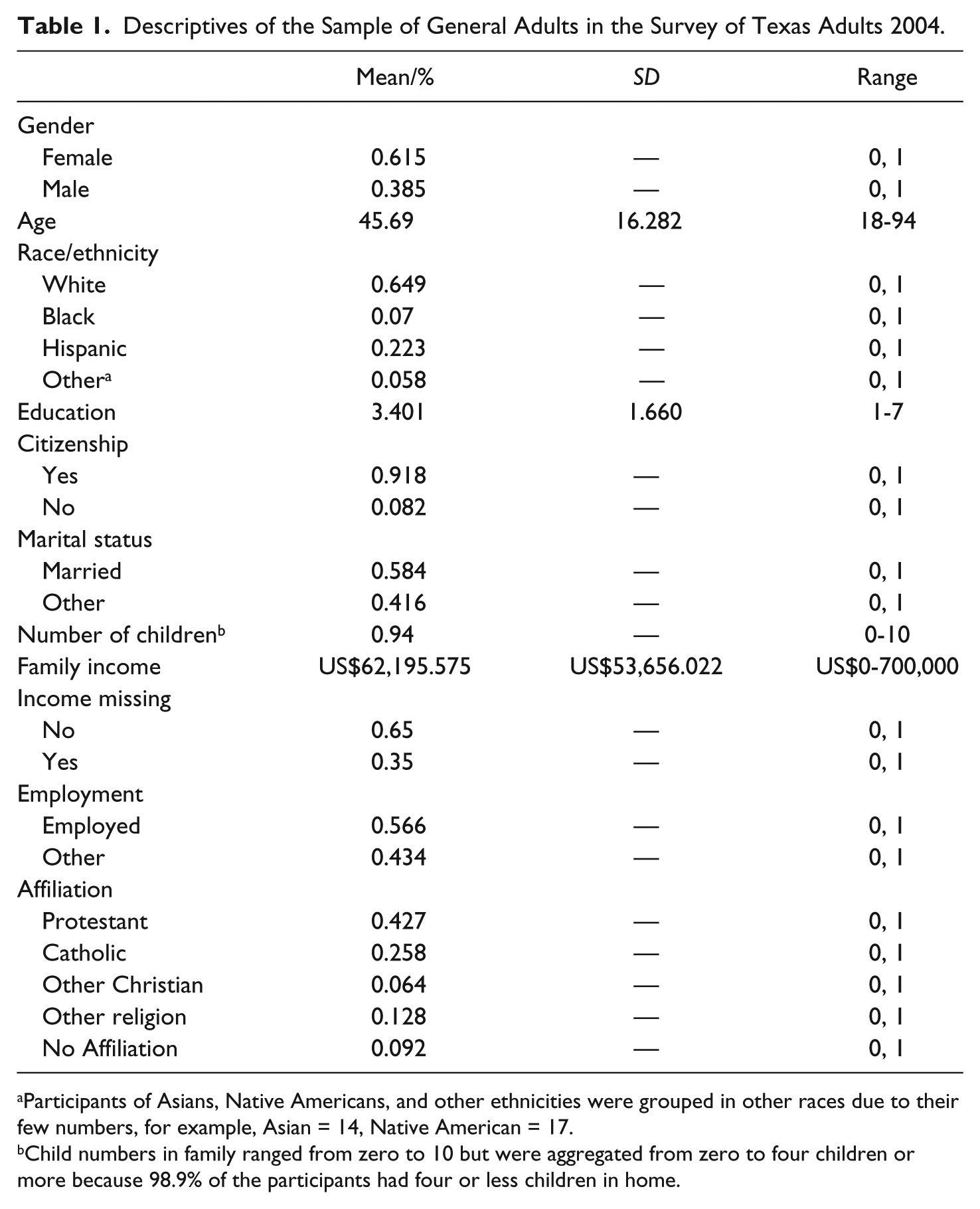
Participants of Asians, Native Americans, and other ethnicities were grouped in other races due to their few numbers, for example, Asian = 14, Native American = 17.
Child numbers in family ranged from zero to 10 but were aggregated from zero to four children or more because 98.9% of the participants had four or less children in home.
Table 2 shows the effects of public religiosity on participation in the 12 voluntary services by logistic models. Public religiosity significantly predicted higher participation in 10 of these services. Specifically, they include volunteering in health, educational support, religious organizations, public or societal benefit, human services, arts or culture, recreational activities, political campaigns, work-related service, and youth development. The most robust effect of public religiosity was, as expected, on volunteering in religious organizations; every unit increase in public religiosity contributed to 7 more times the higher odds of volunteering in religious organizations. In addition, each unit increase in public religiosity was significantly predictive of the increased odds of helping in political campaigns by 68.5%, youth development by 55.7%, and educational support by 50.7%. The odds of participating in voluntary services of recreational activities, health, and public or societal benefit were increased by 47.3%, 46.3%, and 43.4%, respectively, when one unit elevated in public religiosity. Public religiosity also significantly predicted the higher odds of participation in human services and work-related services by 36.1% respectively, and arts or culture by 22.6%.
Logistic Regressions of Public Religiosity on Participation in the 12 Voluntary Services.

Note. OR = odds ratio.
p < .1. *p < .05. **p < .01.
Table 3 presents the effects of private religiosity on participation in the same 12 voluntary services, in which nine were significantly predicted by private religiosity. Specifically, private religiosity was most strongly related to volunteering in religious organizations; each unit increase in private religiosity significantly predicted the increased odds of helping in religious settings by nearly 3.5 times. Moreover, private religiosity significantly predicted the increased odds of participation in youth development by 46.6%, political campaigns by 37.8%, recreational activities by 36.9%, educational support by 35.1%, and health by 35%. Moreover, each unit increase in private religiosity was significantly associated with the higher odds of helping in work-related services, public or societal benefit, and human services by 29.4%, 25.1%, and 22.8%, respectively.
Logistic Regressions of Private Religiosity on Participation in the 12 Voluntary Services.
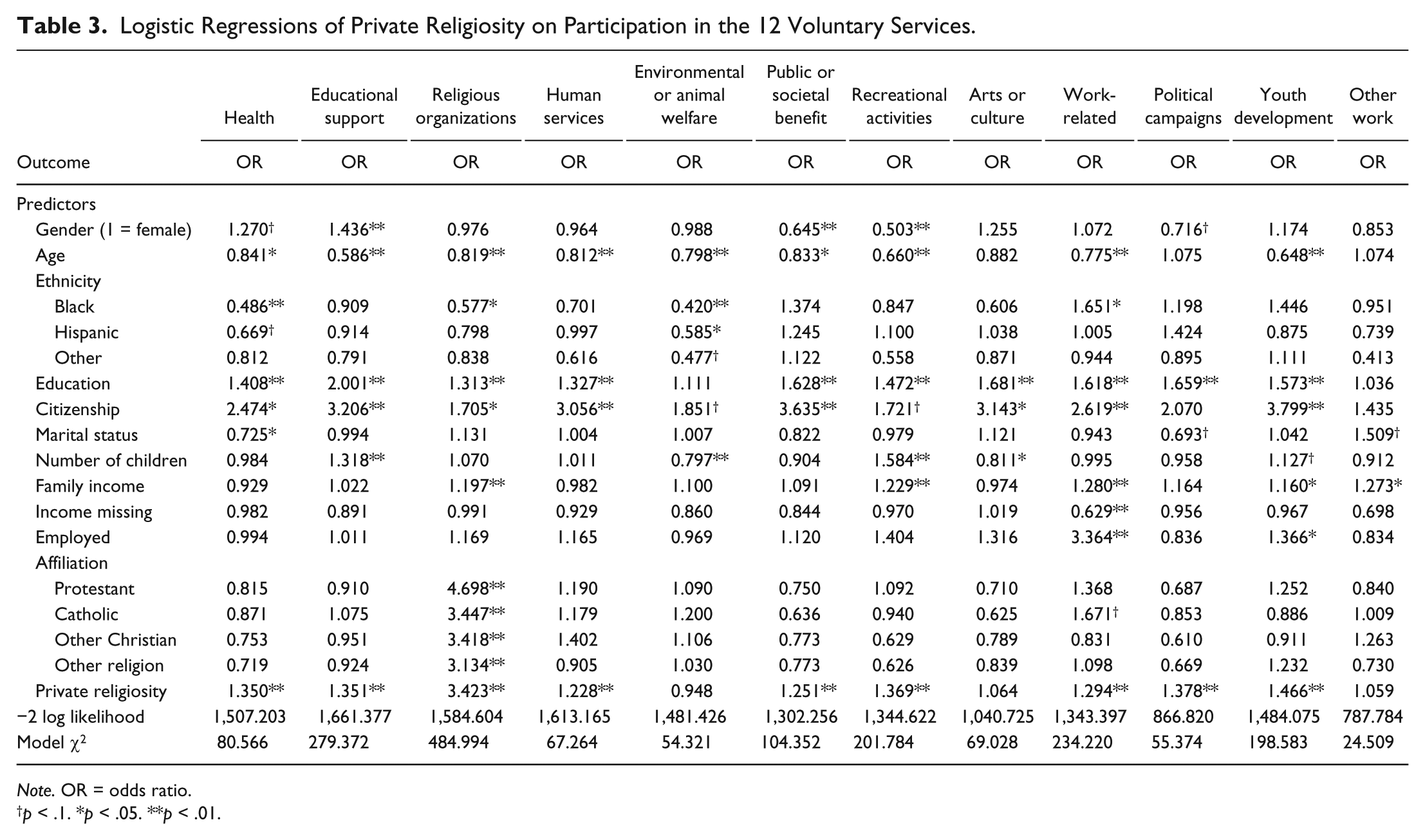
Note. OR = odds ratio.
p < .1. *p < .05. **p < .01.
Table 4 shows the effects of public and private religiosity on the three secular volunteering domains by the multivariate Poisson models. Both public and private religiosity significantly predicted higher participation in the three domains, with a descending trend in effect sizes from humanitarian-concerned domain to work and cultural-focused domain. Model effects constrained tests show that public religiosity had the strongest effect on humanitarian-concerned volunteering, β = .289, compared with that of sociopolitical volunteering, β = .273, and work and cultural-focused volunteering, β = .217, χ2 = 166.453, df = 3, p < .001. The effect of public religiosity on sociopolitical volunteering was also stronger than that on work and cultural-focused volunteering, χ2 = 116.522, df = 2, p < .001. Likewise, private religiosity had the strongest effect on humanitarian-concerned volunteering, β = .174, compared with its effect on sociopolitical volunteering, β = .158, and work and cultural-focused volunteering, β = .148, χ2 = 133.292, df = 3, p < .001. The stronger effect of private religiosity on sociopolitical volunteering than that on work and cultural-focused volunteering was also observed, χ2 = 94.932, df = 2, p < .001.
Multivariate Poisson Regression of Public and Private Religiosity on Secular Humanitarian-Concerned, Sociopolitical, and Work and Cultural-Focused Volunteering Domains.

Note. BIC = Bayesian information criterion.
p < .1. *p < .05. **p < .01.
Table 5 presents the results of parameters equivalence constraints for the effects of public and private religiosity on the 12 voluntary services and three secular volunteering domains. Effects of public religiosity were significantly stronger than those of private religiosity on participation in eight of the 12 voluntary services and two of the three volunteering domains. For voluntary services, the strongest different significant effects of public and private religiosity were on volunteering in religious organizations, political campaigns, arts and culture, and public or societal benefit (see the column labeled Difference in Betas). Although the effects of public and private religiosity on volunteering in health, recreational activities, and youth development were significantly different, the magnitude of differences is not robust as are the other types of significant voluntary services. In addition, the significant different effects of public and private religiosity on helping in educational support and human services were moderate compared with the effects of the significant types of voluntary services that public and private religiosity had. The difference between the effects of public and private religiosity on humanitarian-concerned and sociopolitical volunteering is identical. The insignificant difference between the effects of public and private religiosity includes volunteering in arts or culture, environmental or animal welfare, work-related services, and other voluntary services, as well as work and cultural-focused volunteering domain.
Results of Parameters Equivalence Constraints for Effects of Public and Private Religiosity on Participation in the 12 Voluntary Services and three Secular Volunteering Domains.

Note. All the sociodemographic and denominational variables controlled the logistic and multivariate Poisson models were also adjusted in the parameters equivalence constraints model.
Difference in betas refers to bpublic religiosity – bprivate religiosity.
p < .05. **p < .01. ***p < .001.
Table 6 presents the direct, indirect, and suppressed effects of public and private religiosity on participation in the 12 voluntary services and three secular volunteering domains concurrently. As observed, except for volunteering in religious organizations, when pooling public and private religiosity to predict volunteering, public religiosity had significant effects on different secular voluntary services and all three volunteering domains, whereas the effects of private religiosity on these voluntary services and volunteering domains became insignificant. Indirect effect tests show that the effects of private religiosity on participation in these secular services and volunteering domains were significantly mediated by public religiosity. The reverse is not true for public religiosity: Private religiosity was not a significant mediator for the relationship between public religiosity and secular volunteering. These indirect effect or mediational effects provide evidence for the proximal and distal nature of public and private religiosity in relation to secular volunteering. Suppressed effect tests add support to the mediation and suppressing role of public religiosity in the relationship between private religiosity and volunteering. When public religiosity constrained zero, the significant effects of private religiosity on volunteering resumed significance. However, although the effects of public religiosity were significant when private religiosity constrained zero, the effects are limited in change of magnitude. These results can help shed light on why more robust effects of public religious indicators in prediction of volunteering were observed in previous research (Paxton et al., 2014; Prouteau & Sardinha, 2015; Vermeer & Scheepers, 2011).
Results of Competing, Indirect, and Suppressed Effects of Public and Private Religiosity on Participation in the 12 Voluntary Services and three Secular Volunteering Domains.
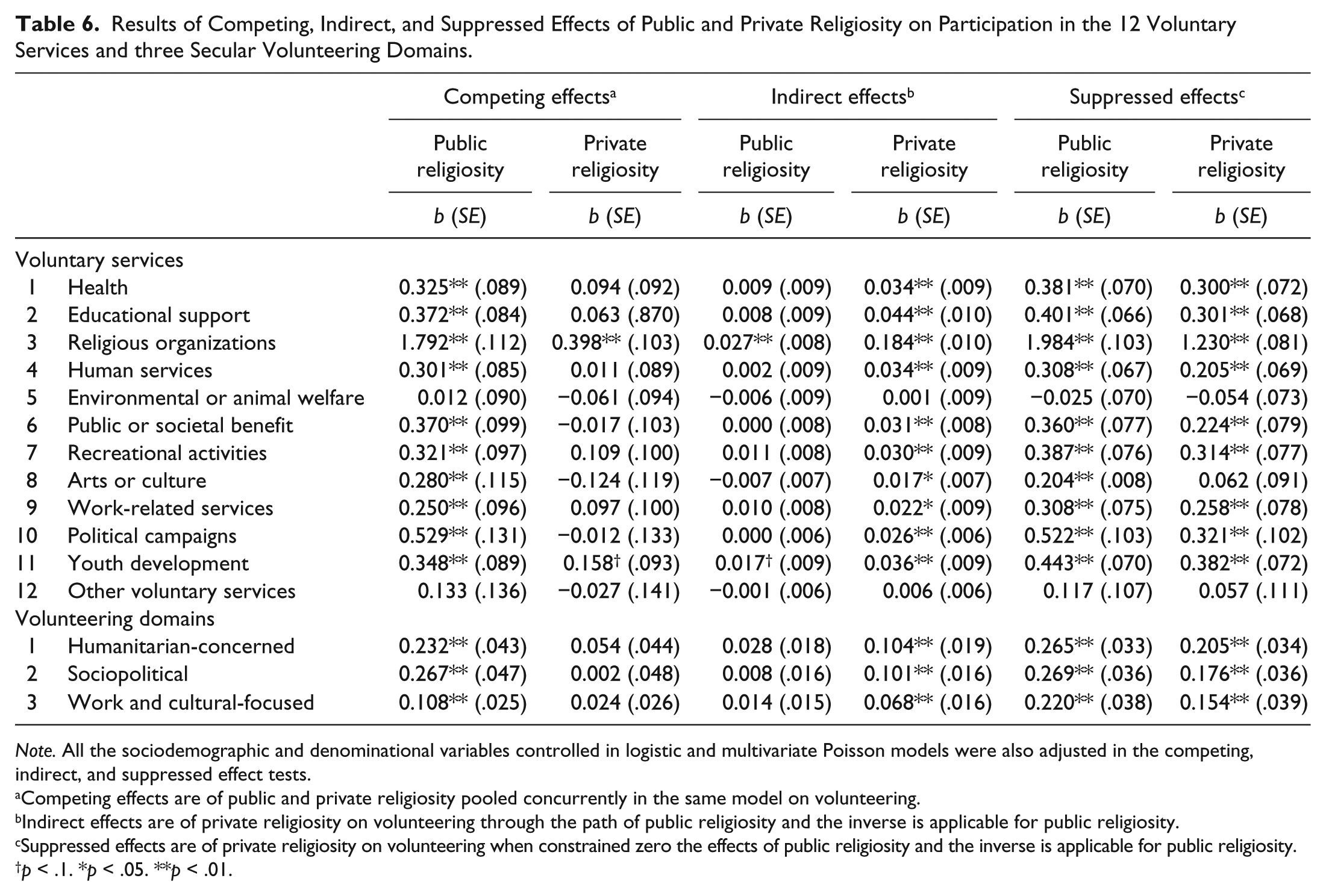
Note. All the sociodemographic and denominational variables controlled in logistic and multivariate Poisson models were also adjusted in the competing, indirect, and suppressed effect tests.
Competing effects are of public and private religiosity pooled concurrently in the same model on volunteering.
Indirect effects are of private religiosity on volunteering through the path of public religiosity and the inverse is applicable for public religiosity.
Suppressed effects are of private religiosity on volunteering when constrained zero the effects of public religiosity and the inverse is applicable for public religiosity.
p < .1. *p < .05. **p < .01.
Discussion
The present study investigated the relationship between religion and volunteering by treating religiosity as a multi-item and multifaceted construct, investigating the effects of public and private religiosity and considering various voluntary services and specific secular volunteering domains in a representative sample of general adults. Results generally confirmed that religiosity significantly augments participation in voluntary services and secular volunteering domains. Nevertheless, the effects of public and private religiosity on volunteering vary, depending on the voluntary types and volunteering domains. Furthermore, the present study corroborated the proximal and distal nature of public and private religiosity in relation to volunteering: Public religiosity significantly mediates and suppresses the effects of private religiosity on secular volunteering. It is important for future research to discern the functional roles of religious dimensions contributing to prosocial behaviors.
The results demonstrate that public and private religiosity significantly predicted higher participation in various voluntary services and secular volunteering domains, and this was net of the influences of different sociodemographic and denominational variables. The relationship between religiosity and volunteering demonstrated in this study supports the propositions of the network explanation theory and the value-orientation perspective, connoting that both one’s religious network and personal beliefs, or a combination, influence volunteering. Nevertheless, public religiosity had stronger effects on volunteering across various voluntary services and volunteering domains, correspondent to the normative theory and indicating that public religious environment is likely to contribute to volunteerism (Prouteau & Sardinha, 2015; Son & Wilson, 2012). According to the normative perspective, religious settings may enhance believers’ cultural, human, and social capital and cultivate a collective norm of prosociality, which taken together promote volunteerism. Hence, believers in their place of worship may feel it is not only their moral duty but also the collective prosocial norm to volunteer.
In addition, although the present study generally found a positive relationship between religiosity and volunteering across voluntary services and volunteering domains, religious effects on volunteering varied substantially depending on the voluntary services and volunteering domains being examined. These findings connote prioritization of believers over some voluntary services or volunteering domains than others (Krause & Hayward, 2015; Unruh & Sider, 2005). The logistic models of public and private religiosity show that volunteering in churches/other religious organizations was most strongly supported by adherents. However, the connection between religiosity and volunteering varied substantially for secular voluntary services or volunteering domains. Generally, religious people participate more in voluntary services or volunteering domains that reflect humanitarian concerns and sociopolitical benefits. One interpretation is that their volunteer preferences reflect their religious values and teachings (Mencken & Fitz, 2013). Results of multivariate Poisson models support this volunteering prioritization: The strongest relationship was for volunteering in humanitarian-concerned volunteering and the second strongest in sociopolitical volunteering. Hence, nonprofit organizations should be attentive to match religious people with appropriate voluntary work.
The present study also found that religiosity was significantly predictive of secular voluntary services that are neither of humanitarian concern nor involve sociopolitical welfare but are instead work and cultural-focused. Although voluntary services of arts or culture, recreation, and work-related services do not directly involve humanitarian concern and sociopolitical welfare, they are human related and involve interpersonal bonds. However, helping the environment and animals may not be a core religious belief or/and teaching of many religions, explaining why both public and private religiosity were not related to volunteer in these types of organizations. Generally speaking, religious people are more helpful but are restricted to helping behaviors in line with their religious convictions (see also Okun et al., 2015).
Furthermore, when pooling public and private religiosity to predict participation in voluntary services and volunteering domains, the effects of private religiosity on volunteering were significantly mediated and suppressed by public religiosity and became insignificant. The present findings are in accord with previous studies showing that, when incorporating both public and private religiosity in the same model, the public religiosity maintained significance in predicting volunteering, whereas private religiosity did not (Forbes & Zampelli, 2014; Johnston, 2013; Paxton et al., 2014). The proximal and distal concept of public and private religiosity proposed by this study in relation to volunteering is helpful in explaining these mediational and suppressed effects. A recent study by Van Cappellen et al. (2016) found that personal religiousness, similar to private religiosity, as a predictor of prosociality was significantly mediated by the social and collective aspect of religiosity. They stated that “(b)ecause religion and religiosity are to some extent linked to prosociality, this relation should be strong after attending the regular religious ritual; this has been called the ‘Sunday effect’” (p. 20). Furthermore, Van Cappellen et al. (2016) commented, “It is possible that one acts as a true mediator and another one as a suppressor, therefore the total direct effect should not be expected to be significant, even though it is present and real” (p. 25). However, the common weakness of this study and the one by Van Cappellen et al. (2016) is in the use of cross-sectional data, and more research is needed to test the mediational relationships.
Scrutinizing the effects of public and private religiosity on prosocial and volunteering behaviors has been a concern of psychologists and religious studies scholars since the introduction of the public (extrinsic) and private (intrinsic) religiosity concept by Allport and Ross (1967). Some studies have corroborated the importance of private religiosity in contributing to volunteering (Hansen, Vandenberg, & Patterson, 1995; Johnson, Okun, & Cohen, 2013). Others, including the present one, attest to a stronger relationship between public religiosity and volunteering (Forbes & Zampelli, 2014; Paxton et al., 2014; Vermeer & Scheepers, 2011). This difference may be due to the different operationalization of public and private religiosity. Scholars like Hansen et al. (1995) and Johnson, Okun, and Cohen (2013) employed a scale-based and cognitive approach, for example, measured by the Intrinsic/Extrinsic Religious Orientation Scale, to tap into the effects of public and private religiosity on helping behaviors and found a stronger effect of private religiosity on volunteering. Researchers like Paxton et al. (2014) and Vermeer and Scheepers (2011) employed attitudinal and behavioral religious indicators, for example, frequency of church attendance and prayer, to define public and private religiosity and mainly obtained a more robust influence of public religiosity on volunteering. These different defining approaches in constructing public and private religiosity are thought responsible for the contradictory results found in prior and the present research, as the former mainly views public and private religiosity in a rival and dichotomous manner, and the latter primarily treats these two religious dimensions in a mutually related but distinctive way. Thus, future research should compare how different operationalization of religious dimensions may sway the results of religiosity on prosociality and helping behaviors.
The present study included a number of sociodemographic and denominational variables as controls for the relationship between religion and volunteering. The results showed that the effects of these background characteristics on volunteering appeared more robust than we expected, when volunteering was defined as participation in various voluntary services and specific secular volunteering domains. First, volunteers of different sociodemographic backgrounds differentially participated in certain voluntary services. For example, the gender-volunteering claim is that females generally volunteer more than do their male counterparts (Forbes & Zampelli, 2014; Lim & MacGregor, 2012). However, this study found that females volunteered more only in health, educational support, and youth development and participated less in voluntary services of recreation, public and societal benefit, and political campaigns. In addition, volunteers who had children in the home generally volunteered more in education, recreation, and youth development. This is consistent with research showing that volunteering participation is not simply a unidirectional process for volunteers but rather a reciprocal one (Stukas, Worth, Clary, & Synder, 2009); volunteers may opt for certain services to benefit their social roles and situations. Adult female volunteering are generally the main caregivers in the family and hence may select voluntary services beneficial to their family, for example, health, educational support, and youth development.
It is notable that participants’ age, education, and citizenship consistently predicted participation in various voluntary services and secular domains of volunteering as shown in both the logistic and multivariate Poisson models. The negative association between age and volunteering found in this study is consonant with the findings by Lim and MacGregor (2012) and Wang and Handy (2014). Educational attainment has long been corroborated as a contributor of volunteering (Lim & MacGregor, 2012; Paxton et al., 2014). Little research has explored the relationship between citizenship and volunteering. Nevertheless, Wang and Handy (2014) found that being a citizen was a positive predictor of volunteering. The consistent relationships between age, education, citizenship, and volunteering explicate the importance of cultural, human, and social capital in facilitating volunteering. Being older indicates dwindling physical and cognitive capacity, and education connotes both human and cultural capital; educational credentials not only imply qualifications but also a cognitive and interpretative capacity of social issues. Citizenship assumes social and cultural capital, because citizens generally have greater social ties and civic awareness. Taken together, future research should investigate whether these important background variables provide additive cultural, human, or social capital, or a proxy of these three kinds of capital in relation to volunteering.
Conclusion and Limitations
Caring for and being concerned with the social welfare of others is a core belief of most religions and the common goal of nonprofit organizations. Nevertheless, administrators of nonprofit organizations must take into account the effects of public and private religiosity on participation in voluntary services and volunteering domains. Religious volunteers regard the services of humanitarian-concerned or sociopolitical implications more significant than they do others; hence, the matching of religious volunteers with appropriate volunteering opportunities is necessary to maintain their commitment and support.
Despite the potential contributions mentioned, this study includes several limitations. First, the cross-sectional data make it impossible to investigate the causal direction of the religious effects on engagement in voluntary services and volunteering domains. Second, the sample was restricted to residents of Texas, a state that is especially religious and has a higher proportion of female participants. Third, despite the diverse voluntary services and specific secular volunteering domains examined, frequency of participation has not been assessed. Future research should explore how different dimensions of religiosity contribute to the number of hours people volunteer. Fourth, other possible mediation processes linking religion and volunteering deserve attention. For example, recent research has found that religiosity influences believers’ virtues and life meaning, inducing prosocial behaviors (Krause & Hayward, 2015). In sum, panel data with a longitudinal design and the incorporation of other possible mediators to investigate the transitional trajectories of volunteering among religious people can give a more comprehensive and dynamic picture of the religion-volunteering connection.
Footnotes
Declaration of Conflicting Interests
The author(s) declared no potential conflicts of interest with respect to the research, authorship, and/or publication of this article.
Funding
The author(s) received no financial support for the research, authorship, and/or publication of this article.